By Tatiana H Moore
John Warner invited students of Cal Poly Humboldt to not only question the growing role of AI on college campuses, but to resist it.
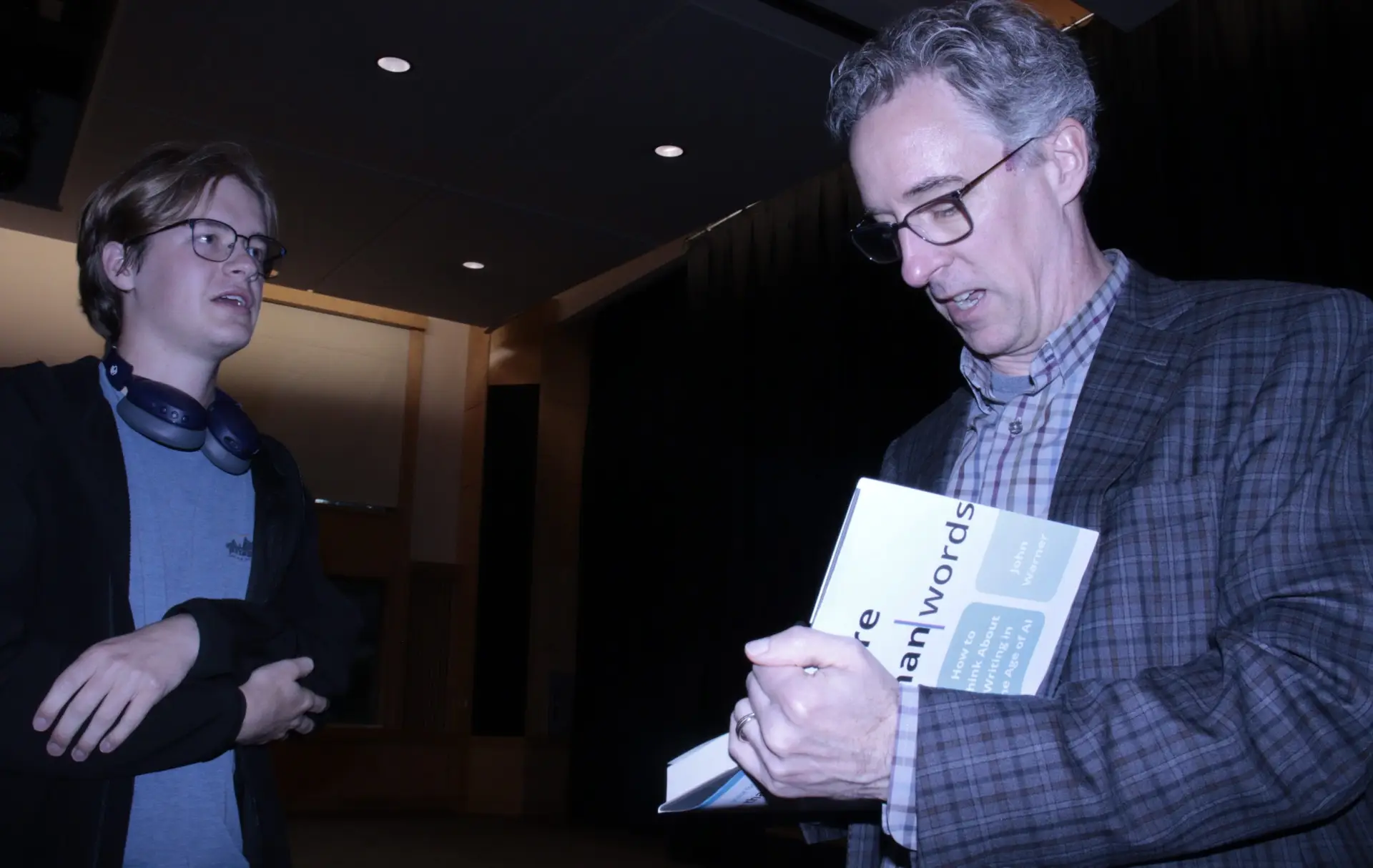
Warner, author of “More Than Words: How to Think About Writing in the Age of AI,” spoke Oct. 6 in the Kate Buchanan Room on the relationship between humanity, writing, education and AI.
Warner called on students to begin by organizing, resisting and protesting the university’s own AI involvement. CPH is one of the 23 campuses included in a rollout of ChatGPT Edu, granting premium ChatGPT licenses to students, faculty and staff. In May 2026, the California State University system renewed its agreement with OpenAI for $13 million annually for an additional three years.
ChatGPT Edu became a point of discussion where many in the audience appeared completely unfamiliar with the arrangement.
Dr. Lisa Tremain, associate professor and director of the First-year Composition Program at CPH who facilitated the lecture, responded with sarcasm about students’ awareness of the agreement with a remark about university communications.
“What? You mean you guys don’t do the surveys in your emails?” Tremain said. “No way!”
The debate over AI in education isn’t about whether or not AI can produce writing, but whether producing writing is the same as learning to think. Warner’s main argument is that AI is boring — generative AI cannot replace human writing because writing is an essential cognitive process used for thinking and discovering ideas.
“LLMs [Large Language Models], they cannot think, they cannot feel, they cannot communicate with intention,” Warner said. “They generate text untethered from meaning.”
If writing can be looked at as a process of discovery rather than simply amassing information, then evaluating students solely on the quality of the final work risks losing all the critical thinking that happens along the way.
“When we write, the act of writing alters our communication. How what we’re doing, the process of it, and how we discover things as we write,” Warner said. “The fundamental way that I learn about the world is by writing about what is happening within it. Writing is also feeling — it’s not a purely intellectual exercise. It shapes our values and worldviews. It connects us to ourselves and others.”
While Warner is a man concerned with collegiate matters, students were eager to push the conversation beyond the classroom. They raised concerns such as environmental impact, training models founded in euro-centric ideology and the growing power of the tech billionaire oligarchy.
Steven Ochoa, a graduate student and public sociology major, asked Warner if he was considering whose knowledge has historically been excluded from academic institutions.
“You’ve spoken to the ways in which resistance to AI is required by the embodied writing practice, but are you also contending with whose written words haven’t been uplifted?” Ochoa said. “Are you also speaking to what resistance looks like coming from those whose communities whose words have been erased?”
For Warner, resisting AI is within the recognition of writing as an essential part of humanity, but Ochoa’s question raised a point of contention. Resisting AI is not only about protecting the process of writing, but it’s also about considering whose knowledge is going to be the basis. While AI is trained on global datasets, mainstream models — ChatGPT, Claude, Grok — do have heavy bias skewed toward Western reinforcement learning, creating a situation that leads into the further erasure of communities.
As universities continue to embed AI in the classrooms, students have to question not only how they learn, but who gets to shape that future model of their education.
Tatiana H Moore is a reporter for LJ. Contact thm18@humboldt.edu
Leave a Reply