After three meetings, Humboldt County Planning Commission comes to Terra-Gen wind farm conclusion
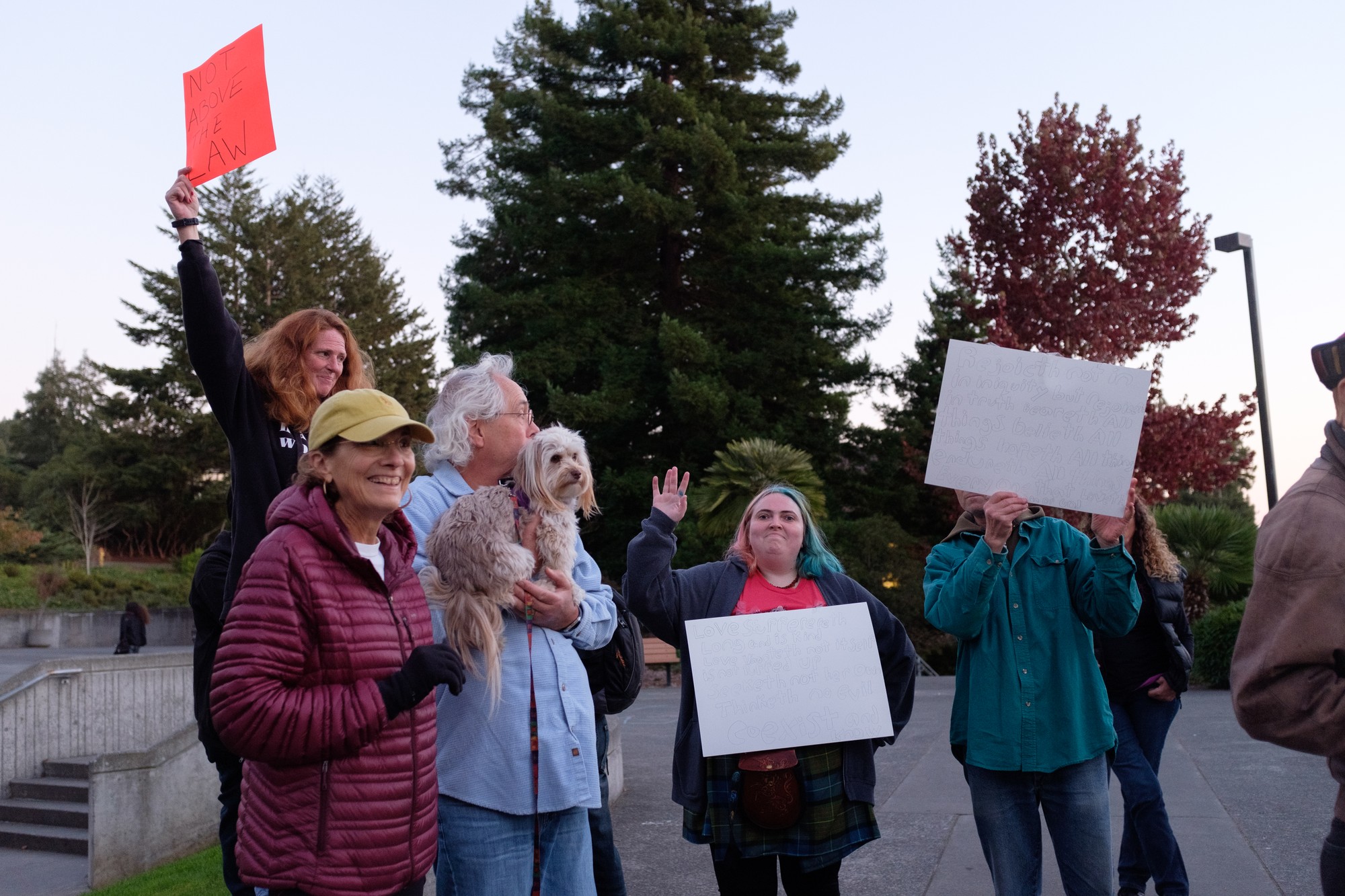
In a 4-2 vote on Thursday evening, the Humboldt County Planning Commission rejected permitting for the Humboldt Wind Energy Project, a proposed plan to bring 47 Terra-Gen wind turbines to Bear River and Monument Ridges.
The turbines would have been capable of producing half of Humboldt County’s energy needs.
The Planning Commission held two previous meetings this month before reaching a decision. Both previous meetings and Thursday’s meeting saw huge crowds.
The planned wind farm site was located in a sacred Wiyot prayer site and in a pristine wildlife environment home to several endangered species that would be impacted by the turbines.
The opposition to the project cited visual pollution, an incomplete environmental impact report and inadequate mitigations as reasons to reject the plan. Project supporters cited an urgent need to reduce fossil fuel burning and reinforce the county’s energy resiliency.
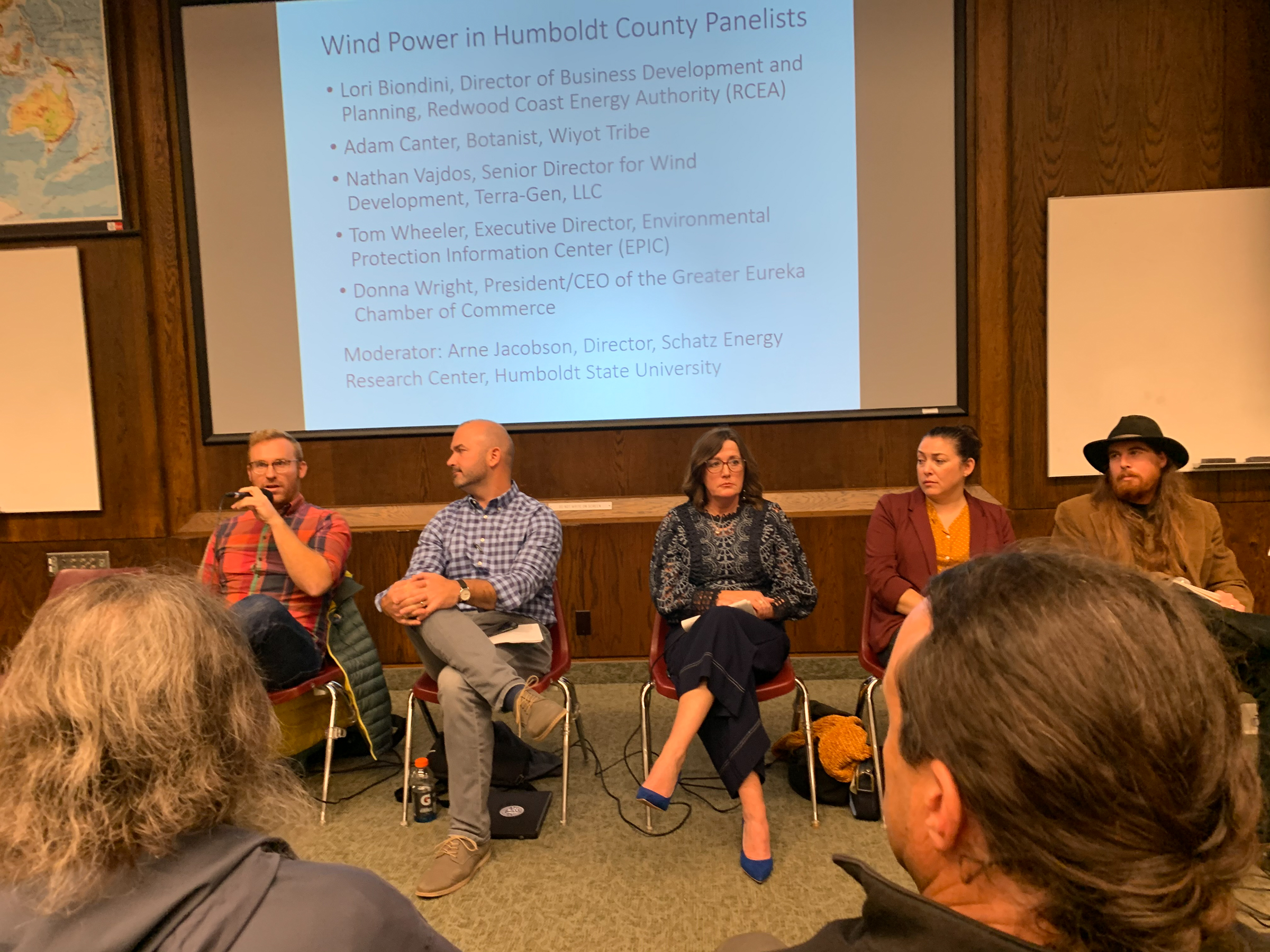
A panel at Humboldt State University’s Sustainable Speakers Series weigh the pros and cons of the Humboldt Wind Energy Project
As the global concern to act against climate change increases, Humboldt County is in a position to capitalize on an opportunity to establish a significant renewable resource.
On Thursday, the Humboldt County Planning Commission votes on the wind energy farm developed by Terra-Gen. Terra-Gen, a Manhattan-based energy company, has proposed a wind farm to be built near Bear River, on Monument Ridge, above the city of Scotia.
The Terra-Gen wind farm carries controversy for numerous reasons. The project will help achieve carbon emission-reduction goals and provide two million dollars in annual tax revenue for the county, but will impact wildlife, forest ecosystems and the Wiyot prayer site Tsakiyuwit.
Arne Jacobson, director for Shatz Energy Research Center, said the proposed turbines will produce about 100 times less CO2 than burning fossil fuels.
“From a climate change perspective, wind looks pretty good,” Jacobson said. “Whatever perspective we have on this particular project, I think one question we should be asking ourselves is what we want to do with that opportunity, because I think it’s there and I think we have the local ethic and the local talent to make that happen.”
Lori Biondini, director of Redwood Coast Energy Authority, said the Terra-Gen wind project could be part of a solution to address RCEA’s goal of 100% renewable electricity in Humboldt County by 2025.
“The Terra-Gen project is part of one scenario to reach our goals,” Biondini. “If it doesn’t get built, then we will come up with another scenario.”
RCEA administers the community choice energy program, a program which allows communities to decide where their electricity comes from. It prioritizes local energy generation and generally more clean energy.
“I think that one of the promises of community choice energy is that we get to make choices that are good to our entire community.” Biondini said. “Not further marginalize those that might not otherwise have had a seat at the table.”
A crowd waits for Sustainable Speakers panel to begin. | Photo by Michael Weber
Adam Canter, a botanist and representative of the Wiyot tribal council, defended the preservation of the land and disapproved of the Terra-Gen project. Canter cites ethnobotanical resources and culturally significant sites as reasons not to move forward with this project.
“When we first heard about this project, there was this big pit that just kind of fell into our stomachs,” Canter said. “We thought when Shell came 10 years ago that no other company would come back and try to build a project here. But we were wrong.”
Canter pointed out the cultural resource report for the site bound in a green, four-inch binder.
“The representation of cultural diversity on this ridge is pretty magnificent,” Canter said. “We’re seeing evidence of Athabaskan peoples and the Wiyot-Algonquin peoples and really it should be listed on the National Register of Historic Places.”
According to Canter, the area is also a high prayer site; a place where a large expanse of Wiyot ancestral territory is visible. Like the turbines obscuring the view, the Wiyot cultural heritage could be obscured too.
Tom Wheeler, director for the Environmental Protection Information Center, said the proposed site is a questionable area to build a wind farm.
“The representation of cultural diversity on this ridge is pretty magnificent. We’re seeing evidence of Athabaskan peoples and the Wiyot-Algonquin peoples and really it should be listed on the National Register of Historic Places.”
Adam Canter
According to guidelines set by the California Energy Commission and the California Department of Fish and Wildlife, the proposed site is “pristine.” Wheeler said the site has several rare and endangered species, including the rare Horay bat.
Wheeler is still hopeful to keep the project, and said there is technology that can reduce some of the wildlife impacts. This, however, is only one mitigation measure to the several unavoidable cultural, environmental and wildlife impacts of the project.
“I want this to be a better project and it’s not there,” Wheeler said. “At least not yet.”
On Thursday, the final vote by Humboldt County’s Planning Commission will weigh impacts to Native American culture and environmental quality to the people’s interest in local, reliable energy.
Aside from the benefit of reducing carbon emissions, allowing Terra-Gen to build the wind farm also comes with an economic and infrastructure benefit.
Senior Director in Wind Development for Terra-Gen Nathan Vajdos said the company would be the second-largest taxpayer in the county, and could fund $14 million to Humboldt’s reliability network upgrades, with $1.3 million to the Humboldt substation.
“As we charge our iPhones, we fill up our cars with gas, we’re having impacts.” Vajdos said. “Whether this project is built or not, we are having an impact in this room.”
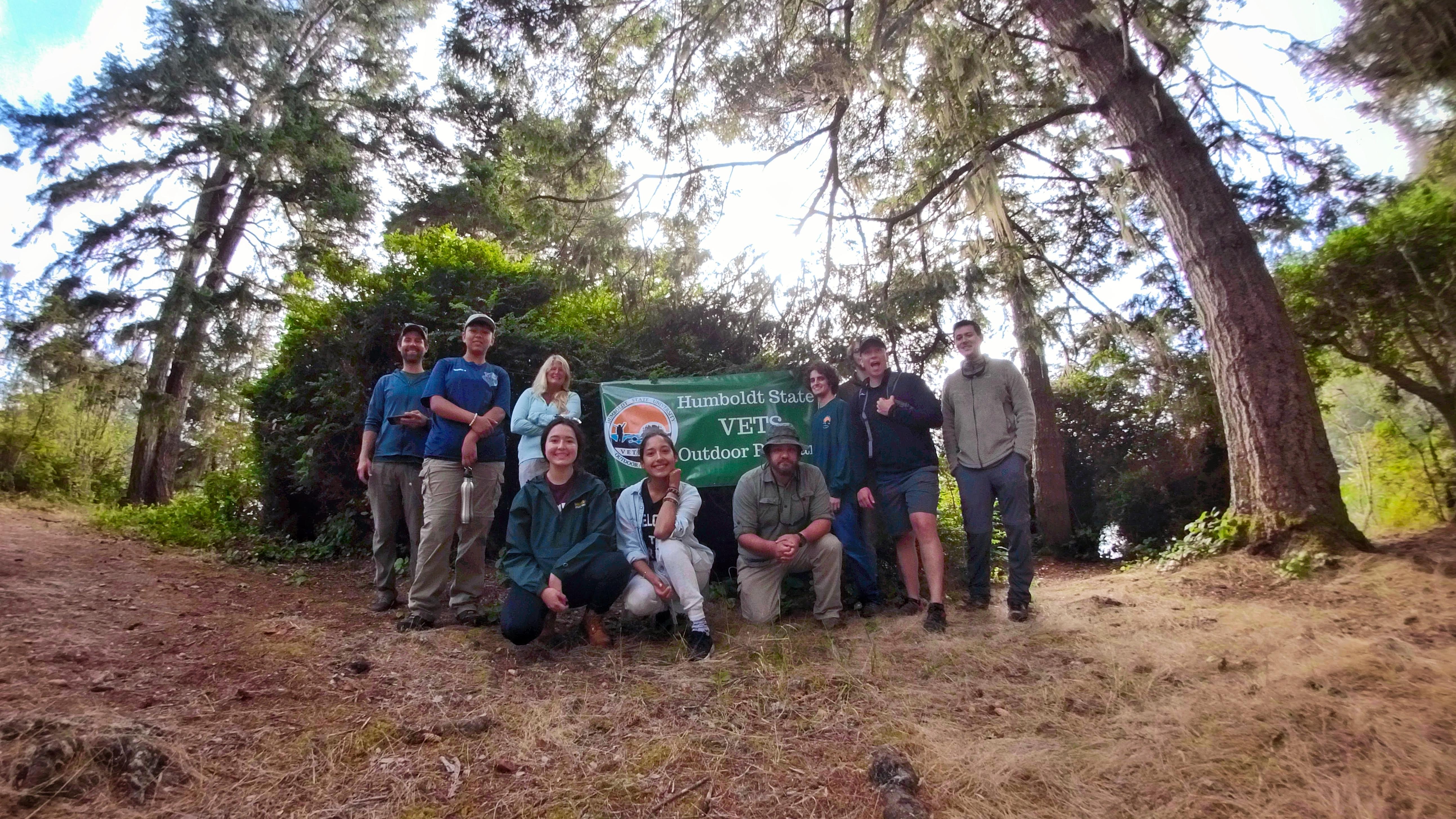
James Lamping, the outreach coordinator at the VETS office and a veteran himself, works to connect veterans by giving them a place to talk, seek therapy and find friends.
“Every vet comes from a different background, and it’s an interesting community,” Lamping said. “Even though there is a lot of diversity between us, we all share a culture tying us together.”
Nov. 11 is the anniversary of the signing of the armistice, which ended World War I. The day honors former and current military service people and is observed as a federal holiday, Veterans Day. HSU students and faculty have the day off.
One way the veterans at HSU connect is through the Outdoor Sports Program facilitated by the VETS office. Year-round, a group of veterans partake in several outdoor sports activities like hiking, kayaking and snowboarding.
James Lamping (left) and John Biggs. | Photo courtesy HSU VETS
John Biggs, a student veteran majoring in marine biology, went on one of the outdoor trips when he moved to Humboldt State in the spring of 2015. He was able to familiarize himself with other students and build relationships.
“We did a big hiking trip up in the Trinities, a rafting trip,” Biggs said. “All the people I met on that trip were my core group of friends when I started here.”
Biggs said that having friends and familiar faces in his classes helps him focus on learning. It had been six years since the last time he took an algebra class.
“I feel like I’m more successful taking classes when I know somebody and have someone to talk to and study with than just myself,” Biggs said. “I’m not someone who asks questions. That’s just my personality.”
Lamping said veterans are one of the more successful populations on campus, partly due to the structured lifestyle that is familiar to military life. Having something to do every day provides a daily purpose.
“Having the structure is nice,” Biggs said. “To have something to do rather than figuring it out on your own.”
The VETS office provides help and academic services for veterans. VETS connected Biggs with the Student Disability Resource Center to help him in the Learning Center.
“I’m not a big test taker, so that was fun,” Biggs said. “That was really helpful.”
Kim Hall, veterans program administrator for HSU, was one of the people who helped Biggs get back into the flow of school. Hall started the outdoors program and also started the North Coast Veterans Stand Down, a three-day event that provides food for homeless veterans at the county fairgrounds in Ferndale.
In celebration, HSU VETS is hosting a dinner event this Friday, Nov. 15 at 6:30 p.m in the Green and Gold Room on HSU’s campus. The Veterans Day Celebration is free for veterans and their families.
4 ways to make the most out of your pumpkin this season
They’re hard, wonky looking and often suffer from an acute case of the warts. Pumpkins are the fruit of October and epitomize the Halloween season. Here are four ways to get the most use out of your pumpkin.
Photo courtesy of Pixabay
1. Carving a Jack-O’-Lantern
Jack-o’-lanterns are the most recognizable use for pumpkins. Local stores typically have all types of pumpkins available, differing in sizes and colors. Before choosing a pumpkin, be mindful of the design you want to fit onto the pumpkin.
First, prepare a large surface with a mat or towel to minimize the mess. Then, equip yourself with a knife, a large spoon and a container for pumpkin flesh. A serrated knife with teeth will work best for cutting through thick pumpkin skin, while a paring knife works best for the smaller details of your design.
Begin by cutting out a lid from the top of your pumpkin, and set it aside for later. Dig out the pumpkin flesh and seeds with a large spoon, and if you are interested in eating the seeds, save them in a container. Now for the fun part- carve out your design: a face, an animal, a monster or anything else that catches your fancy. If cutting straight lines is challenging, printing out a design and attaching it to the pumpkin with tape can help.
Photo courtesy of Pixabay
2. Compostable Plant Pot
Instead of a jack-o’-lantern, turn a pumpkin into a compostable pumpkin planter. Save an extra step in the transplanting process by using a pumpkin planter as a naturally decomposing pot.
Just like carving a jack-o’-lantern, cut an opening at the top of the pumpkin with a serrated knife. Feel free to decorate the plant pot by carving your own patterns on the surface of the pumpkin pot. After hollowing out the pumpkin with a spoon, just like a regular transplant, take a plant from its nursery pot and replant it with soil in the pumpkin.
The plant should grow beautifully if loved and cared for. As the pumpkin ages, an eventual transplant of the whole pumpkin into the ground will take place, decomposing and fertilizing the area.
Photo courtesy of Creative Commons
3. Prepare Mashed Pumpkin Puree
It’s a fact of life that some pumpkins just aren’t made for pie. The carving of the pumpkin contains flesh that is very fibrous and may not produce the best tasting pie. You can use puree in dishes like pumpkin pie and pumpkin soup.
To prep, cut your pumpkin in half and take out stringy fibers and seeds. One and a half pounds of raw pumpkin will yield two cups of pumpkin puree. And again, if you want to eat the seeds, save them for roasting later.
Cut the cleaned pumpkin into chunks and put them into a saucepan with one inch of boiling water. Turn the heat to low and throw on a cover to simmer for half an hour. Once the pumpkin is tender, drain the water and remove the peel. Use a potato masher to smash the pumpkins into a puree. The fresh pumpkin will last three days in the refrigerator, or months frozen.
Photo courtesy of Creative Commons
4. Roasting Seeds
By virtue of carving, cooking or smashing pumpkins, you’ll eventually be left with a bunch of little pumpkin seeds. In their final, toasted form, pumpkin seeds are a delicious, high protein and high fiber snack.
With your leftover pumpkin guts, separate the seeds from the stringy flesh. Run water over the seeds in a strainer or colander to make this process easier. Pat the seeds dry to ensure a crispy crunch.
Grab two or three tablespoons of a favorite cooking oil or butter, and add any additional spices your taste buds may desire. Classic salt and pepper works well, too. Mix and spread over a baking sheet, and make sure to line the baking sheet with aluminum foil to help with cleanup.
In a single layer, spread the clean and dried pumpkin seeds on the baking sheet. Throw it in the oven at 200°F for 45 minutes, stirring every 10 or so minutes. When the timer ends, turn up the heat to 325°F for five minutes to finish the seeds with a nice crisp.
Bridging the cultural gap between the campus and community
Douglas Smith drove up to Humboldt State for the first time in 2013 as a transfer student with big eyes for a small school.
Smith was seeking same the small school feeling that he got while attending College of the Canyons, away from his home in Los Angeles. At first, Smith experienced anxiety about being one the few people of color in Arcata, but he found a way to adapt and thrive in time.
Today, he’s the director for the African American Center for Academic Excellence, and is four months into his new role. Smith holds his own college experiences as reference when approaching the job.
“My big benefit to coming to Humboldt State was that I had these opportunities for cultural exchange with different kinds of people,” Smith said.
Smith believes the center should be a place that highlights the black experience and culture, a space where students and community can freely speak and learn. Smith hopes the center will strengthen the campus community and bridge the gap between the campus and locals.
Smith emphasized intercultural exchange as an important part of learning. One way the center achieves this is through Talking Drum, a safe space that gives students the agency to converse over the issues that matter to them.
HSU sophomore Brooklyn Reed is the new facilitator for Talking Drum. She met Smith tabling in the quad and offered some of her ideas on how the center’s discussions could be run.
“I talked to him about how to facilitate it, about what I wanted it to look like, how I wanted to build community,” Reed said. “He was just very, super supportive. Just yes, like, ‘let’s do this!’”
Reed wants to run the discussions the way she learned back home in Los Angeles. She also wants the chief of police to attend some meetings so that the center can hold the police accountable if they disagree with their conduct.
Smith’s approach to working with Reed speaks to how he wants to take a step back when it comes to campus dialogue. For his first couple of months, Smith said he spent the majority of his time listening to student feedback.
“I’m trying to come in with this idea of like, ‘Okay, I have some ideas for things,’” Smith said. “But I really want to learn and listen to what students’ needs are, and identify those needs before I go in and start making decisions here and there.”
In Talking Drum, students have a safe space that gives them the agency to converse over the issues that matter to them. | Photo by Michael Weber
This approach allows the Dean of Students Office to be informed by what the center is doing, versus managing from the top down. Letting students take control of the dialogue means that they will be directly influencing the Dean of Students.
“I have been wanting every [discussion] to be student-led, student-driven, and have that peer to peer connection,” Smith said.
Smith promotes the free exchange of ideas because he believes dialogue and cultural exchange is important to becoming part of the community.
One of Smith’s most profound influences on the way he approaches intercultural exchange occurred in his senior semester spent abroad in Santiago, Chile. When he landed, Smith recognized the feeling of being alone and started to familiarize himself with the local area.
“My experience in Humboldt County and at HSU as the ‘other,’ and learning how to move from a perpetual state of survival mindset to adapting and thriving prepared me in so many ways for my time abroad,” Smith said.
Smith’s directive for the center is a culmination of his experiences learning about other people.
“Having that cultural exchange and different kinds of people allowed me to have more diverse viewpoints,” Smith said. “I’m an extrovert. Inside, I might feel anxiety about me, but I’ve always kind of pushed myself to engage with people.”
Controversial books read aloud at HSU library in protest and celebration
Humboldt State University students and faculty gathered in front of the HSU library on Tuesday, Sept. 24 for a banned book reading in celebration of Banned Books Week.
Garrett Purchio, librarian for the College of Arts, Humanities and Social Sciences, worked with Marcy Burstiner from the Humboldt Center for Constitutional Rights to host one of many readings held across the country for the campaign promoted by the American Library Association.
“It’s a chance to really listen to different people’s perspectives,” Purchio said. “I think it’s always great to hear, you know, people are reading this book because of the impact it has on them, or maybe it really opened their eyes to the world.”
Harriet Burr reads For Whom The Bell Tolls by Ernest Hemingway at the banned book reading in front of Humboldt State University’s library on Sept. 24. Burr chose the book because of its value in representing the Spanish Civil War. | Photo by Michael Weber
Readers chose from a rack of more than 50 banned or challenged books, including books of diverse content—defined by the ALA to have content by or about people of color, LGBTQ+ people or people with disabilities.
Purchio said that while many people feel we are at a point in history beyond censorship, literature still faces frequent challenges.
“Every year there’s always a list of new words that are challenged for different reasons,” Purchio said. “The ALA puts out a list of the top books challenged in 2018, 2019.”
Ocean Campbell, a graduate student in social work, read David Levithan’s Two Boys Kissing. According to the ALA, the book is ranked number 11 for the most challenged and burned book in 2018 because it included LGBTQ+ content.
“I really wish that this book had existed when I was a teenager,” Campbell said. “I think it possibly could have changed my whole life.”
Campbell said the book had a powerful message and brilliant moments that resonated with her. Campbell said any young person who wants the book should be able to have it.
Harriet Burr, a librarian with a master’s degree in community economic development, read For Whom The Bell Tolls by Ernest Hemingway, a book set during the Spanish Civil War.
“How many of you learned about the Spanish Civil War in school?” Burr said. No hands raised in the audience. “Why don’t we teach this?”
Burr said people are unaware of a lot of history, in part due to purposeful obfuscation. Burr blamed former President Franklin D. Roosevelt and the Catholic Church for ignoring the Spanish Civil War.
Purchio said people ban or challenge books because they feel threatened by a work and have a desire to respond. He said the book reading celebrates the freedom to read.
Journalism professor Marcy Burstiner reads a banned book during a banned book reading in front of HSU’s library on Sept. 24. | Photo by Michael Weber
Marcy Burstiner, who is also a HSU journalism professor, added a similar sentiment.
“You can threaten the writers, but the book will go on,” Burstiner said.
According to the ALA, it launched Banned Books Week in the 1980s after a United States Supreme Court case ruling said school officials could not ban books in libraries because of their content.
Since then, the ALA has compiled lists of challenged books each year. The ALA also posts additional information on banned books on their website.
“It’s still happening,” Purchio said. “It’s important to keep this band going, because it’s good to show that even though censorship exists in the world, there’s some people who champion freedom of speech and freedom to read.”
A previous version of this article listed the author of “Two Boys Kissing”as David Campbell, but the author is David Levithan.
Bing! Flight attendants, please prepare for take-off
We are now departing from the Humboldt State University library.
Since fall 2018, Humboldt State University’s PC Gaming Club planned, fundraised and constructed a flight simulator for anyone to use. Students, faculty, staff and community members can learn how to fly an airplane by practicing in the simulator on the third floor of the library.
“The amazing thing about simulations is that it’s designed to simulate real life,” Sarah Livingstone, president of the PC Gaming Club, said. “You are still having the same neural connections and the same wavelengths in your brain to replicate that. So then when you do step inside a real airplane, you are doing all the exact same things; you know how to do everything correctly.”
The control wheel or “yoke,” juts out from the instrument panel of the flight simulator. | Photo by Michael Weber
The simulator features all the levers, buttons, instruments, windows and pedals that one would see in a real-life cockpit. Library pilots can choose their airplane model, airport location, flight conditions and other variables within the software, Microsoft Flight Simulator X.
Step-by-step instructions are posted nearby so that anyone may start the simulation solo. Livingstone said the club wants to hire a trained student to teach the public to operate the simulator and hire a flight instructor to allow anyone to obtain a real pilot license.
“We’re looking into working with extended education to bring forward this flat ground school program that would help students get their pilot’s license at HSU.”
Sarah Livingstone
“We’re looking into working with extended education to bring forward this flat ground school program that would help students get their pilot’s license at HSU,” Livingstone said.
Just like getting a license to drive a car, the two requirements for a pilot’s license—as defined by the Federal Aviation Administration—are to pass a written test and record 40 hours of flight practice with a professional.
David Marshall, the advisor to the PC Gaming Club, said a pilot-in-training may save a significant amount of money for the 40 hours of practice by using a simulator rather than a real, gasoline-consuming airplane.
A nearby supplemental book for pleasure reading rests on the flight simulator desk at the Humboldt State University Library on Sept. 23. | Photo by Michael Weber
“The cheapest airplane is right around $100 an hour. On top of that, you get another $30 an hour for your instructor,” Marshall said. “So every hour, an airplane costs $130. In the simulator, if somebody else builds it for you, it’s just an instructor and it’s $30 an hour to put book time.”
The club is searching for more funding to provide a classroom to study the written test and a professional instructor for the simulator.
Livingstone said they are looking into purchasing the final flight instruments, headphones, a new cover for the chair and a pillow for younger pilots-in-training to access the simulator.
The project started one year ago when Marshall said he required the club to create a project with a positive, meaningful and educational experience.
“I suggested gently that gaming is really simulation,” Marshall said. “And there’s a lot of stuff we can do in simulation.”
The club then raised $10,000 for the furniture, chairs, equipment, computer and software by writing grants, fundraising and working with community members that provided some equipment and furniture.
Livingstone said the simulator caught the attention of HSU President Tom Jackson, Jr. and Provost Alex Enyedi, who are both aviators. Livingstone encountered unexpected enthusiasm when she met with Jackson.
“It was supposed to only be a 40-minute meeting, but it ended up being an hour and a half,” Livingstone said. “He was having so much fun.”
HSU to repurpose Trinity Annex building into larger Children’s Center with $8.6 million grant
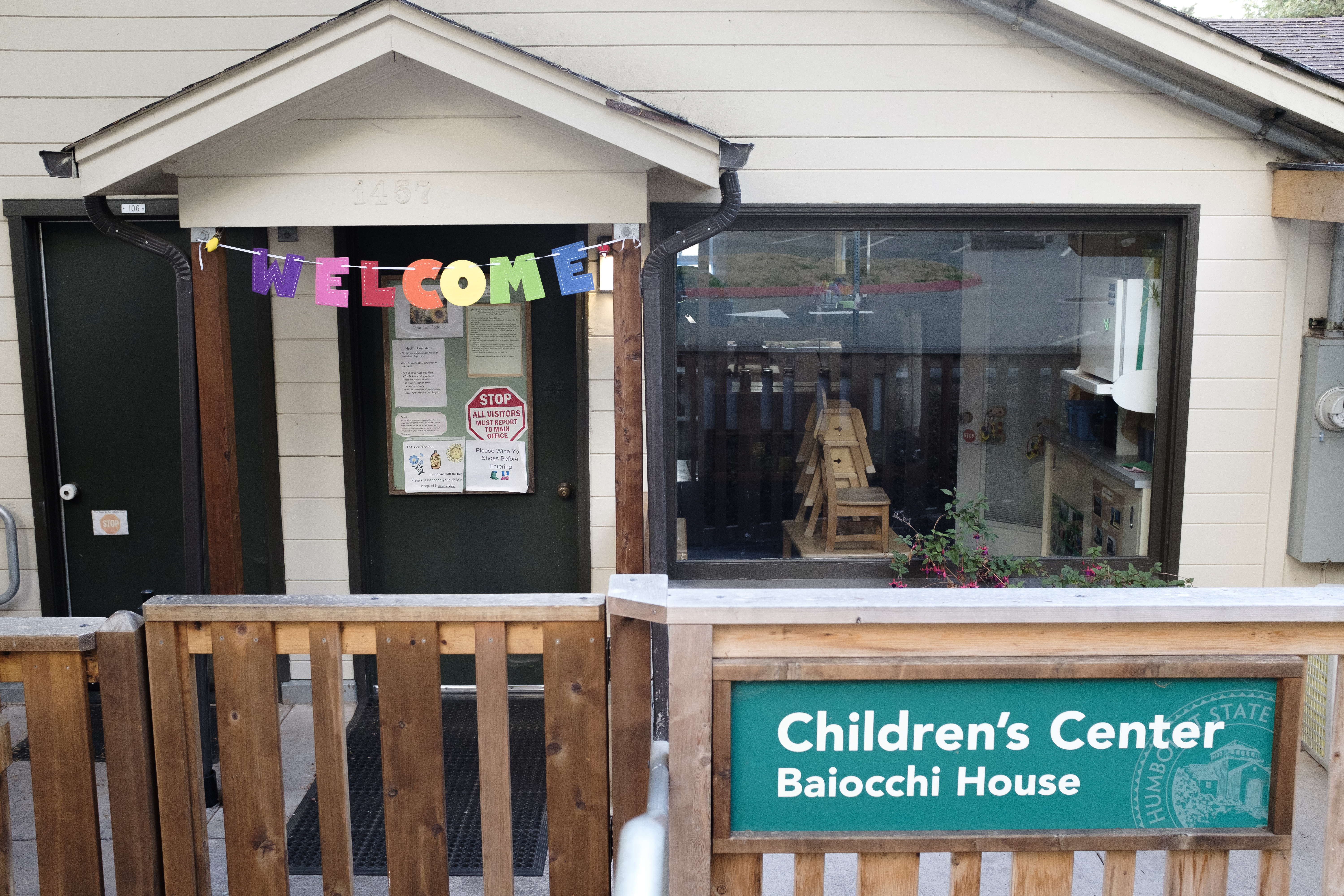
Starting this semester, Humboldt State University will begin to redesign the Trinity Annex building at the corner of 14th and B streets into an updated facility to house a new Children’s Center. The current Children’s Center facility will continue child services until it moves in 2021.
“We want folks that are going to be in the building to give feedback as to what it should look like,” HSU Associate Vice President of Student Success Steven St. Onge said.
St. Onge, who oversees the Children’s Center, said the design phase of the new building will explore increased space, updated playgrounds, manipulative toys, dynamic crawling textures and additional infant care. The education program will not change, but the physical space will be improved.
The staff responsible for the design held a recent meeting to develop ideas for the ideal facility. Staff will meet again later this semester to draft blueprints.
The Children’s Center Administration building is located above the Children’s Center. | Photo by Michael Weber
“I think we’re switching from the facility impacting the program—to the program impacting the facility,” St. Onge said. “Which I think is a good step forward.”
The redesign is funded by an $8.6 million allocation to HSU from a statewide grant for California State Universities. Betty Wilson, Children’s Center Program Director said the facility is limited by its budget.
“We are constantly searching out new funding streams to help create better experiences,” Wilson said in an email.
The Children’s Center daycare and education programs are regularly funded by Associated Students (both state and federal grants) and the university itself. This one-time grant will allow for a new facility.
“There are 86 students in the Children’s Center, about 60% are children of HSU students. The rest are a combination of faculty, staff and community members’ children.”
Steven St. Onge
The current buildings that house the Children’s Center have reached maximum capacity for the number of children.
“Right now, we’re limited by what the facility can give us,” St. Onge said. “The room size dictates how many children can be in a room, as well as the staff ratio.”
The sign-up process for the programs begins with a wait list that prioritizes current HSU students.
“There are 86 students in the Children’s Center, about 60% are children of HSU students,” St. Onge said. “The rest are a combination of faculty, staff and community members’ children.”
Infant care is the most demanding service the Children’s Center provides because they require more attention than toddlers. St. Onge said the ratio of care for infants compared to toddlers is three to one.
“It’s harder to find someone who will watch infants,” St. Onge said. That’s probably the largest wait list in that particular room.”
Bikes are parked in one of the playgrounds of The Children’s Center on Sept. 9. The playground sports multiple textures for kids to walk on. | Photo by Michael Weber
According to St. Onge, the new facility will improve operational efficiency. Currently, there are five buildings housing five different age groups. Each building has its own space, equipment and toys for its respective age group. The new facility will consolidate these spaces, improving efficiency.
St. Onge said the design phase will be tied closely to the childcare and early education programs. The Children’s Center and St. Onge did not explicitly state ways the recent grant will benefit the children and parents of the program. St. Onge said the academic aspect of the Children’s Center will remain the same.
“I think it’s exciting for the younger kids that will experience that new facility,” St. Onge said.
One main function of the Children’s Center is to provide a place for students, faculty, staff and community members to drop their kids off when they are busy at school or work.
According to Humboldt State Now, a recent survey conducted by the Campus Center for Rural Policy found that childcare improves student retention rates and work environments. Wilson said that the Early Head Start Grant allows parents to spend more time on schoolwork.
A Harbert Roofing truck parked at the Humboldt State University Annex on Sept. 9, 2019. The Annex will be refurbished into a new Children’s Center. | Photo by Michael Weber
“Family Service Coordinator Amy Pires-Moore helped to fulfill annual goals which the families create,” Wilson said. “By doing this, she is able to create a secure emotional base for the families to be able to succeed academically as some of their daily concerns can be taken care of.”
The other main function of the Children’s Center is providing care and education to the children and student workers. They are accredited by the National Association for the Education of Young Children.
The NAEYC website says, “The accreditation process provides a framework for self-study, external evaluation and improvement in the quality of teacher preparation programs.”
And yes, you can walk between Laurel Dr. and the library again
Lined with ground marks, gravel, orange fencing and machinery, the parking spots of Laurel Drive are no longer accessible to staff and students. Where a tree surrounded by brick once stood, now lies a sectioned-off zone where two workers constructed a new pathway.
Over the summer, Humboldt State staff and students received several updates about on-campus infrastructure arrangements including general maintenance, building renovations and repaved roads. Humboldt State Project Manager Michael Fisher said these updates are part of a large list of planned and required maintenance.
The pathway from the library to Laurel Drive is open as of August 20. | Photo by Michael Weber
Parts of Laurel Drive are now closed off for this construction. On the bright side, the Theatre Arts building is now open since its closure in 2018 and will hold classes this semester. The pathway from the Library to Laurel Drive is now open as well. Gist Hall is also open as of August 12 after the asbestos contamination discovered last Spring.
Starting this semester until December 2019, Laurel Drive and Library handicap parking spaces, as well as pathways, will be redone to provide a path of travel to the Theater Arts Building and Library, respectively. The new path for wheelchair access from Laurel Drive will start at new handicap spaces and lead to the elevator in the Theatre Arts Building.
Notable projects finished over the summer include Wildlife and Fisheries Building roof replacements, repaving of the Library Circle and LK Wood Boulevard left turn, six HVAC control replacements, housing maintenance, refurbished lecture halls, a new elevator in the Natural Resources Building and the near-completion of the Theatre Arts and Library seismic retrofits.
Part of Laurel Drive’s parking lot is excavated for updated handicap spots. | Photo by Michael Weber
Fisher also said portables in the Campus Events Field, which previously held the tutoring center and other facilities temporarily, are being moved out as the relocated tenants return home to the library.
One of the most visible changes to returning students is the repaved library circle and left turn lane on LK Wood Blvd. Fisher said this new turning lane, built in partnership with the City of Arcata, helps ease congestion and improve bus route times.
Less noticeable improvements are general “building system” updates in HVAC, electrical, plumbing and structural.
“Every component of our built environment has a life cycle,” Fisher said. “That includes streets, roads, sidewalks, our buildings, and our building’s infrastructure.”
(Photo by Michael Weber) Brennan Duck and Kyla Hock brought an American flag and a poster to the Common Cause protest on Nov. 8 at Humboldt State University’s quad.
Brennen Duck took an oath to defend this country from all enemies foreign and domestic.
“And right now our president is acting as a domestic enemy,” Duck said.
Duck, an Arcata community member, joined more than 20 people at Humboldt State University’s quad on Nov. 8 to protest against Donald Trump’s appointment of Matthew Whitaker as acting attorney general.
(Photo by Michael Weber) Alex Fallman (left) is addressing the protester crowd at Humboldt State University’s quad on Nov. 8. Fallman relayed a speech by local congressman Jared Huffman.
This protest was part of a nationwide protest organized by Common Cause, a watchdog group based in Washington, D.C. They are concerned that Whitaker will interfere with special counsel Robert Mueller’s more than one-year-long investigation on Russian interference in the 2016 presidential election.
Former Attorney General Jeffrey Sessions, who Trump had fired hours after the 2018 mid-term elections, recused himself from Muller’s investigation. That means that Sessions was unable to make any executive decisions on the investigation. Now that Sessions is gone, Whitaker has the power to end the investigation.
Protesters are especially worried Whitaker will interrupt the investigation because he had previously written an op-ed condemning it. The protesters with Common Cause demanded that Whitaker also recuse himself from the investigation so that Mueller can continue his investigation without any interference.
“It’s really hard to imagine that they’re getting away with being corrupt when [Whitaker] made statements opposing the investigation,” protester Joan Dixon said. “It’s quite devious.”
Political science junior Alex Fallman took the helm of the protest and relayed a speech to the group of protesters given to him by Humboldt Congressman Jared Huffman.
Fallman read Huffman’s letter on his support for the protesters and made a call to action demanding that Whitaker recuse himself from the investigation.
After being at the quad for 15 minutes the group of protesters then traveled to Arcata Plaza. Fallman said there were speakers in Eureka and Arcata Plaza at the same time.
“I’m a little disappointed in turnout,” protester Kyla Hock said. “It’s ok though, it’s a good movement to support.”
(Photo by Michael Weber) A group of protesters are gathered at HSU’s quad on Nov. 8. The protest is against newly appointed attorney general Matt Whitaker.
There are also many critically important ballots and measures which could affect everyday life for people in Humboldt county, and it’s very important to take care of yourself during such a high pressure election.
One of the most critical ballots for people’s livelihoods this year is measure K, an initiative to make Humboldt County a sanctuary county prohibiting local law enforcement with cooperating with federal immigration officers. Proponents of K claim this measure protects families of undocumented persons by granting custodial power and avoids unnecessary pain.
This measure could likely make or break the practice of separating families in our county. Family separation can cause irreversible harm to kids and their parents. It makes sense that the people whose livelihoods and security depends on this measure will feel the stress this election season.
Resources for undocumented students and/or citizens are available on both a national and local level.
Humboldt State University offers multiple resources through the Student Health and Wellbeing center for students including financial aid options, health care options and legal help.
The California State University system offers various resources for legal or con campus help for undocumented students.
Teresa Foster, Immigration Consultant 707 255-8666 – According to the St. Joseph’s Community Resource listing, Foster helps immigrants re-unite with loved ones through various visa processes, up to and including residency and citizenship; based in Napa, office serves the immigrant community throughout the state. Foster is not an attorney, she is a consultant with a bond on file at the CA Secretary of State. Because this location is farther away consider calling for information.
Catholic Charities, Immigration and Citizenship Services offers mostly legal services regarding citizenship classes, refugee resettlement, DACA, preparing documents for visa petitions, adjustments of status, affidavits of support, consular processing documents and work authorizations. This location involves a four hour drive south, but you can visit their website for general information on any of these topics or family reunification.
Those in need of help and advice can also find the closest resource to them through the National Immigration Legal Services Directory. A zip code search will bring up a list of near by resources. Click here to find resources around this a
Though there is not an explicitly a decision on immigration, this election has the potential to sway the political power in both the House of Representatives and the Senate. We recognize the results of this election can still cause great distress about the future of important topics like immigration policies and reform.
On a mental health care level, this election season, The Lumberjack has some suggestions for people who are feeling uneasy about the future. For whatever reason voters may feel stressed, depressed, angry, sad or happy, people can decompress by taking breaks from social media, watching funny animal videos, yoga and meditation, and emotion management.
Taking a break from social media is a strong preemptive measure to reduce anxiety and depression for the election. Research from Anxiety and Depression Association of America suggests that social media usage is significantly associated with mood instability, including a prevalence of depression.
If you see content that might cause you discomfort, turn your phone over for a little bit. There is no shame in logging off in the name of self care.
Crying also has mood benefits, depending on the person. The act of crying leads to tension relief, and can help with psychological recovery from distress. It is possible that people may feel distress when realizing their candidate has lost, like when President Trump was elected. A healthy cry gets the job done to move on to the future.
Try watching some online videos like funny animal videos or fail compilations. These are a great way to take the edge off a long election night. Skip the viral videos and play your favorite video game instead.
Make some time to sleep or exercise as healthy distractions if viral videos and video games won’t cut it.
Last, but most certainly not least, if you are feeling that you can not handle the pressure alone, here are some resources to connect to the person you need.
Diversity Day aims to create dialogue of race between HSU Cultural Centers and Arcata locals
Arcata’s typical Saturday morning farmer’s market looked more cultured than usual on Oct. 27 during Diversity Day, an event hosted by We Are Your Community and The Campus and Community Dialogue on Race.
Janaee Sykes, the lead student associate for the African American Center for Academic Excellence was tabling in Arcata plaza to reach out to the community.
Sykes talked to the people of Arcata and said she had some interesting conversations with the locals.
“You never know what people can take away from a three to five minute conversation,” Sykes said.
Sykes represented one of the many multicultural organizations invited by We Are Your Community, a continuing project created by Amy Mathieson last year for her master’s degree in social work.
Mathieson said she created Diversity Day to get multicultural clubs from Humboldt State to “build bridges with the community outside of campus.”
Mathieson said she wants to create dialogue with people outside of HSU so that they are more accepting of the different cultures the school brings.
Some of the multicultural organizations in attendance were the Latinx and African American Centers for Academic Excellence, the Black Student Union, the Global Connection Club and the People of Color Group from Outer Space Arcata.
The Global Connection Club performed a dance for the Arcata community.
Parents and children read from the “Book Tree,” where books dangled from a tree like floating fruits.
“All of the books are from different cultures, and there are free books for kids to take,” Mathieson said.
(Photo by Michael Weber) Father Steve Spain is reading a book to his son Oliver Spain, age 4, in Arcata Plaza on Oct. 27. The “Book Tree” was prepared by We Are Your Community for kids and parents to read culturally diverse books.
People also interacted with “The Umbrellas of Understanding,” a semi-private place to have a free conversation.
(Photo by Michael Weber) Two people have a private conversation under the “Umbrellas of Understanding” in Arcata plaza on Oct 27.
Volunteer for Sanctuary Campaign Brenda Dirks-Perez attended Diversity Day to promote Measure K. Measure K is a local ballot measure that promotes changing Humboldt County into a sanctuary county.
Dirks-Perez said the farmer’s market doesn’t normally allow political campaigns to set up at Arcata plaza, but an exception was made for them on Diversity Day. Dirks-Perez said she is grateful that Mathieson could mediate with the North Coast Grower’s Association.
(Photo by Michael Weber) From left to right: Brenda Dirks-Perez and Lisa Pelletier for the measure K sanctuary campaign are tabling in Arcata Plaza on Oct. 27. They were invited to Diversity Day as an exception to the farmer’s market rules that ban political activism.
Dirks-Perez’s husband Willie Dirks said political freedom of speech is important for “making a law protecting diversity in the community.”
I seem to find myself in the minority in today’s national Democratic Party.
I disagree with the tendency of most Democrats (including political candidates for Congress and those in the news media) to constantly bash Donald Trump over his obnoxious personality and his divisive comments.
As very-conservative “Morning Joe” Scarborough said on his MSNBC show, when Democrats talk negatively about Trump, his supporters become angrier. It makes his supporters angrier and more protective of him while corroborating their paranoid belief that the Democrats and the liberal part of the media are out to get Trump.
Rather, as Joe suggests, Democrats need to focus on communicating their humanistic, caring, and compassionate values to the American people and telling the people how the federal government can be a force for a lot of positive good in our country and can make life better for all Americans.
They don’t seem to realize that research over the past 40 years has consistently shown that most Americans agree with them that we need to protect the safety-net programs such as Social Security, Medicare, Medicaid, food stamps, college student loans, and unemployment insurance benefits.
These are winning issues and popular programs that we should constantly be talking about, not trashing Trump.
The U.S. founders warned that they had designed a good participatory democracy if “We the People” could keep it; they understood how governments dominated by a cabal of oligarchs, monarchs, military, industry (or slave-holding) and elites relies entirely upon the complicity and cooperation within every hamlet.
For example, having a corrupt developer in the White House is representative of the corrupt development industry dominating most U.S. regions, including ours, where housing prices are kept artificially inflated by locally elected and appointed officials failures to ensure balanced housing inventories that are supposed to adequately serve all economic classes of residents, while slumlords’ multiple vacancies are subsidized through generous tax write-offs.
Every rigged housing crash and bailout is worse than the last, leaving tens of millions of families facing bankruptcy and broken homes that enrich predatory speculators, bankers, brokers, realtors, insurers and their attorneys with massive windfalls of fees and penalties from the cycle of foreclosure and resale. The poverty and despair from systemic housing fraud is reflected in Humboldt County’s own (widely self-censored) “Trends Report” documenting shocking rates of every major illness, addiction, abuse, infant mortality, homelessness and suicide.
The lucrative manufacture of scarcity, debt and chaos is no longer limited to U.S. predatory prowess abroad. It is occurring nationwide in housing, healthcare, education, energy, justice and public welfare, accurately described today as the “New American Feudalism.” According to research by a Harvard PhD at evictionlab.org, nearly half of all housing in Humboldt County, and most U.S. regions are now rentals. However, rent prices continue to rise because the law of “supply and demand” is undermined by manipulated scarcity in affordable housing.
Eureka’s fledgling progressive city council majority courageously ended millions of public dollars subsidizing the Chamber of Commerce; they passed a Human Rights Resolution and apology to native people amid a resurgence of racism, misogyny, and corruption. By re-electing Eureka’s incumbent city council candidates, including Leslie Castellano for Ward 1 and Susan Seaman (to replace Eureka’s current mayor facing a year-long investigation by the Department of Justice), Eureka can maintain a new progressive direction.
Humboldt State University professors discuss media coverage of sexual assault
A discussion panel on media coverage of sexualized violence will be hosted by Journalism Professor Victoria Sama and Communications Professor Maxwell Schnurer.
The discussion will take place in Founders Hall 118 on Tuesday, Oct. 23 from 4:30 p.m. to 5:30 p.m. The discussion will also be free and open to the public.
In their panel, “Two Things The Media Get Wrong about Sexualized Violence,” Sama and Maxwell will be taking a look at language and strategy used by the media in sexual assault cases.
Sama has researched how publications report sexual assault cases since 2003 and Schnurer has focused his research on social movements, language, power, and freedom.
As Humboldt State University’s president seat becomes vacant, a confidential selection process, along with a limited advisory committee, raises concerns about students’ input in deciding a new president.
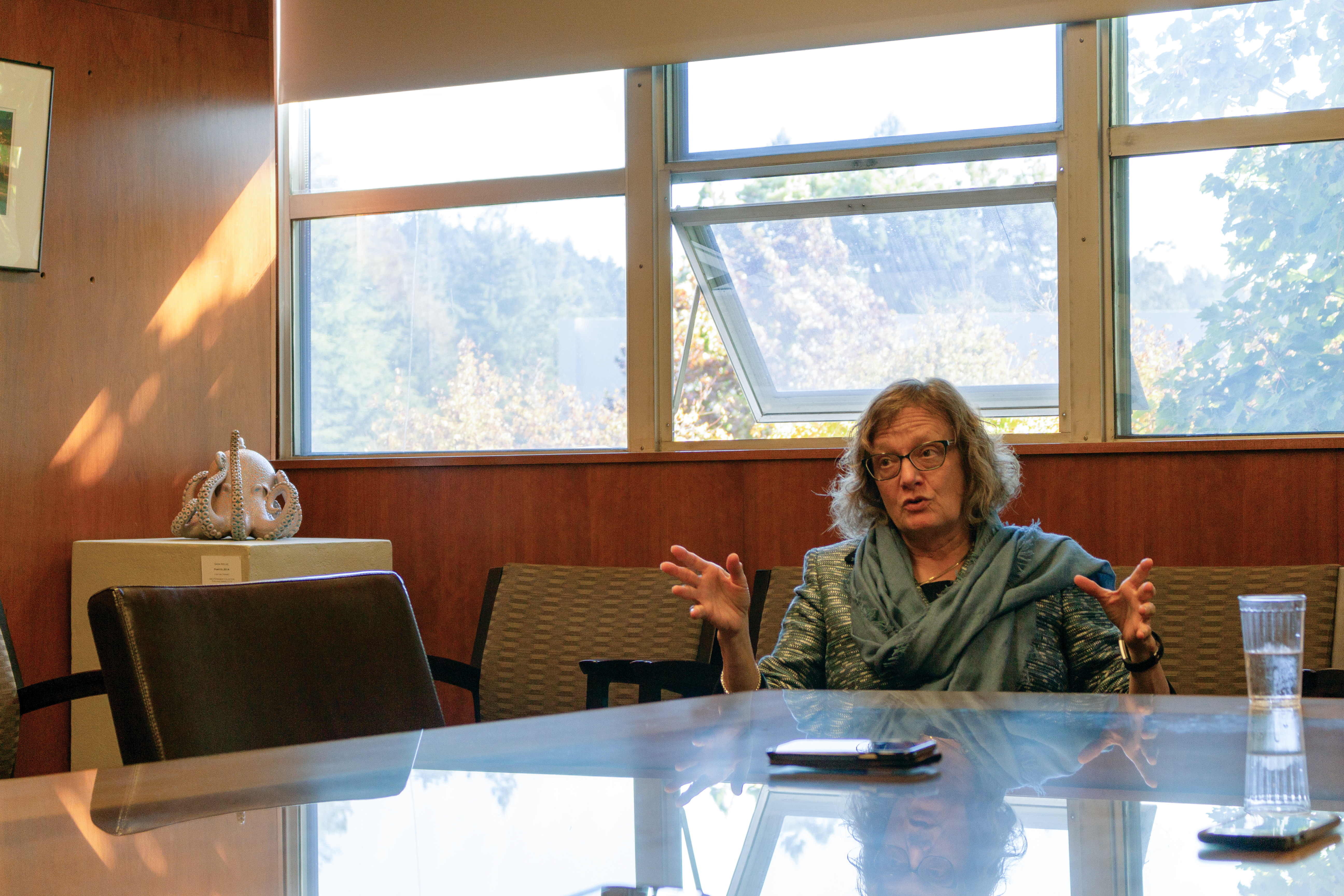
“I understand the need to be confidential,” Associated Students Board Coordinator Casey Park said. “But I don’t see how you can fit 7,500 student voices into one student rep.”
Park is one of the many Associated Students members who attended a meeting with CSU Chancellor Timothy White and Vice Chancellor Loren Blanchard about a presidential candidate search process on Oct. 8 in the AS banquet hall.
HSU’s current president, Lisa Rossbacher, announced her retirement next summer in a campus-wide letter on Oct. 1. The letter states that the search process for a new president will begin this winter.
The CSU Board of Trustees’ policy for the selection of presidents explains that a committee of CSU Trustees, along with the advice and consultation of an advisory committee, will decide in confidentiality who HSU’s next president will be.
CSU Executive Vice Chancellor for Academic and Student Affairs Loren Blanchard and Chancellor Timothy White in the UC banquet hall on Oct. 8 at HSU. Blanchard is responding to one of the AS member’s questions. | Photo by Michael Weber
Of more than 20 representatives in the advisory committee, only one will be a student. Because the process is confidential, that student will be the only student who can directly affect recommendations for the new president.
While the AS gets to choose HSU’s student representative, Park is worried that the voice of all HSU students won’t be sufficiently represented by one person.
The only opportunity for those not in the advisory committee to have a say in the search process will be during an open forum in the first week of Feb. in 2019.
White says the forum will be video taped so that candidates will be able to see and hear what the community wants. After the forum, White said, they will create a ten page public document of search criteria and will invite candidates to apply.
During Monday’s meeting, White emphasized confidentiality in the search process and that candidates will be interviewed at an airport — the same as Rossbacher.
White’s argument for confidentiality is that external candidates (not working at HSU) may lose their job if they were seen applying to HSU. Without confidentiality, the committees may not be able to form a strong group of candidates.
“It’s not secret,” White said, “It’s confidential.”
Confidentiality in the search process hasn’t always been the case for CSUs, according to John Meyer, chair of the political science department.
Meyer said that in 2002, the year Rollin Richmond became HSU president, candidates delivered a speech to an open forum. People were able to meet candidates before they were selected and were able to get a feel of who they were by asking questions and giving comments.
This conversation between candidates and community was nonexistent during president Rossbacher’s selection. White said that it won’t happen again for the new candidates.
The confidentiality gives AS Executive Director Janessa Lund little confidence in HSU’s future leadership.
“With all the turnover [in HSU], we need a solid base,” Lund said. “[We have] a lack of consistency on campus leadership, which leads to uncertainty and insecurity.”
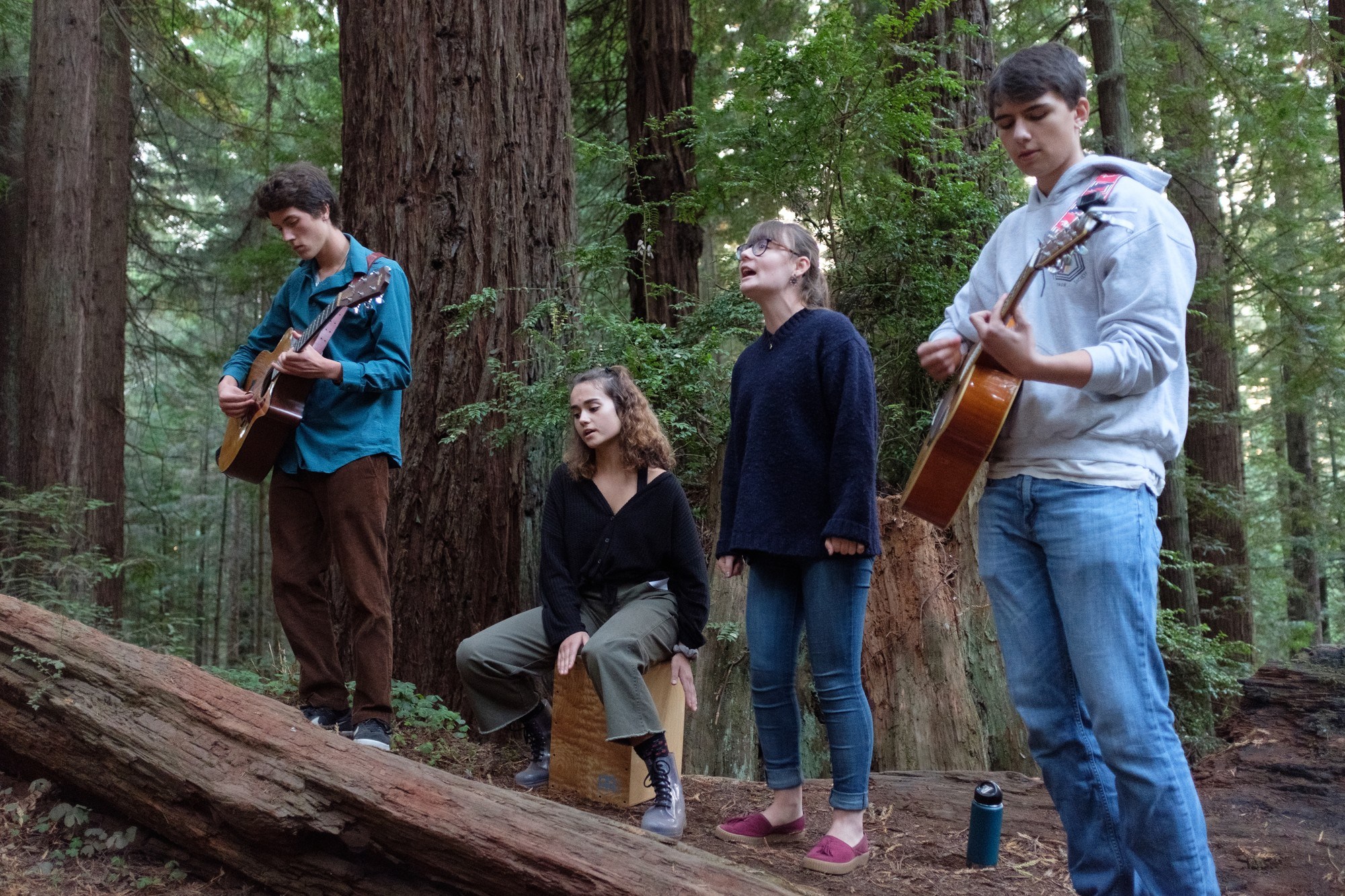
Petty Education was formed only two weeks ago, and now they’re the closing performance for a community forest show smack dab in the middle of the forest.
After the audience found their seats within the brush, the dead quiet forest became filled with sounds of the band’s guitars, drum and vocals.
The audience for the community forest show on Sept. 9 in Arcata, CA. | Photo by Michael Weber
“Bringing music to the forest lets people appreciate it more,” Zelda Geren said, a member of Petty Education. “It’s open, natural and comforting.”
Petty Education is one of the four bands that performed in Breakfast All Day Collective’s Community Forest Show in Redwood Park on Sept. 23.
They performed in the show along with the singer duo Allison Kinney and Hannah Rosecrans and the bands Cowtown Serenaders and Bandemonium.
The format of the show involves moving through four different locations in the forest where each band would play at. At the end of each performance, the audience gets up and moves to the next stop.
The audience for the community forest show on Sept. 9 in Arcata, CA make their way up to the next stop of the trail. This is one of the four stops that the audience will go through. | Photo by Michael Weber
Jackie Stuber, an organizer from the Breakfast All Day Collective, said the show is based on people enjoying music in the outdoor environment.
“It’s the forest,” Stuber said. “It brings people out.”
This is the ninth installment of the community forest show, which started three years ago and Stuber said the turnout has been increasing.
Stuber began the event by setting ground rules for respect towards the forest and other people. An audience of more than 50 people and musicians attended the show.
The first to play on the musical march were Kinney and Rosecrans. They sang three duets for the audience.
Next, the Cowtown Serenaders performed composed songs and musical poetry.
The third to play was Bandemonium, an open ensemble made from artists in the community. They played modern songs including a mashup of two Eminem songs.
Finally, Petty Education closed the show at the end of the walk. They are from the Arcata Arts Institute, Geren said, and wrote three songs to perform for the audience in the mere two weeks after their formation.
“It’s a really magical idea to have music here,” singer Hannah Rosecrans said.
Residents and students alike came together on the 4th annual Arcata “Out of the Darkness” community walk on Sept. 9 to raise awareness for mental health and suicide and to reduce stigma in the local community through connection. The event was also to fundraise for the American Foundation for Suicide Prevention (AFSP).
Heather Freitas is the lead organizer for the AFSP Out of the Darkness community walk in Arcata. Freitas said the walks are a way for the community to come together and create awareness as well as fight negative stigma against mental health.
“It is not possible without the community,” Freitas said.
The walk starts in Arcata Square where participants checked in, looked at mental illness informative booths and engaged in activities that share a connection with suicide.
Participant Sarah Zerkel writes a personal message for a posting board during the Arcata Out of the Darkeness event on Sept. 9, 2018. The board is made of memorials, pictures and tributes that other participants put up. | Photo by Michael Weber
Before the walk, community members were able to show support and learn about mental illness by wearing self identifying beads, sharing stories, and listening to speakers talk about mental health.
The walk itself was an estimated three miles long and took an hour and a half for all participants to complete the walk.
A major landmark of the walk was passing through a “bridge of support,” where motivational and inspirational posters made by former volunteers were put up for display.
One of the numerous posters filled with messages for participants of the Arcata Out of the Darkness Walk in Arcata, CA on Sept. 9, 2018. | Photo by Michael Weber Participants of the Out of the Darkness community walk in Arcata, CA cross the St. Mary’s Catholic Cemetary on Sept. 9, 2018. | Photo by Michael Weber
In the end, participants walked through the finish line and were congratulated for completing the walk.
For the closing ceremony, Friedas shared her personal experience to the crowd.
“On this day in 2011,” Friedas said her first loss to suicide was her dad. She said he hid it well, and passed away when there was no one to check up on him.
“We don’t grieve just the loss of a life, we grieve with how our relationships change as well,” Friedas said in her speech.
Sept. 9 is also the start of suicide prevention week. As national suicide rates are rising, according to the CDC, support for mental health will continue in the community of Arcata.
Part-time driver hourly limits, retirements and failed drug tests put stress on transit system schedules
The Arcata and Mad River Transit System, run by Arcata Public Works Department, is experiencing a shortage of bus drivers. A problem which has affected bus routes and scheduling.
The Red and Gold bus routes now merge into the Orange bus route from 6-10 p.m. on weekdays.
Director of Public Works Doby Class said a few drivers had to retire during the summer for age and health related issues.
Since then, replacements have been hard to come by for Arcata Public Works.
“We’re actively trying to contact agencies, temp help,” Class said. “We’re doing much more outreach than in the past.”
Finding qualified candidates has been the most difficult road block for A&MRTS.
“It’s so hard to find people who can pass a drug test, wants to work with the public, reliable and can drive a bus,” said bus driver Doug Thompson. “Lots of my friends who would love this job can’t (do it), simply because they can’t pass a drug test.”
Class said transit manager for A&MRTS LeAnn Schuetzle, whose main job is to manage the bus system, hire and train drivers, has been driving the bus herself due to the shortage.
A&MRTS also has another hiring predicament which may worsen existing conditions.
The Arcata bus system only hires part-time drivers in order to save on costs. Part-time bus drivers are limited to 1,040 hours a year, meaning that if a driver is to reach their limit, they are no longer allowed to work for the rest of the year.
According to Class, there are current employees who are nearing the 1,040 hour limit and may soon be unable to work. This means their current driver shortage may become worse.
“We’re running on borrowed time,” Class said.
Class hopes that by Jan. 2019 the driver shortage issue will be resolved.
There are proactive plans to get new drivers including a joint training program with Redwood Transit System in Eureka to provide a bus driver’s “learner permit” in order to train new drivers for a B-class driver’s license.
Students and citizens, including retired workers, are eligible for this “bus driver in training” position so long as they are willing to work and can pass a drug test.
Some residents of Arcata have been affected mildly by the driver shortage.
According to Joannah Harris, her old route had been cut off by the new routes.
“I had to get used to the new scheduling,” Harris said.
According to Frank Moldy, the change happened abruptly with no notice and left him stranded at a bus stop. “Let people know, have some ads so we know,” Moldy said.
“It didn’t really affect us,” resident Annie Bernier said. “But, we would be stuck (here) without the bus.”
Beyond the scope of the driver shortage, Class wants to expand the current bus system. He wants Arcata residents to have the same half-hour bus stops that HSU students enjoy. There are also plans with HSU to connect the University with off campus parking south of G Street, according to Class.
“We want to be the best little bus system in the west,” Class said.
Until A&MRTS can solve their driver shortage effectively, future expansion will have to wait.
Animal Place uses human cage to address industry realities for hens
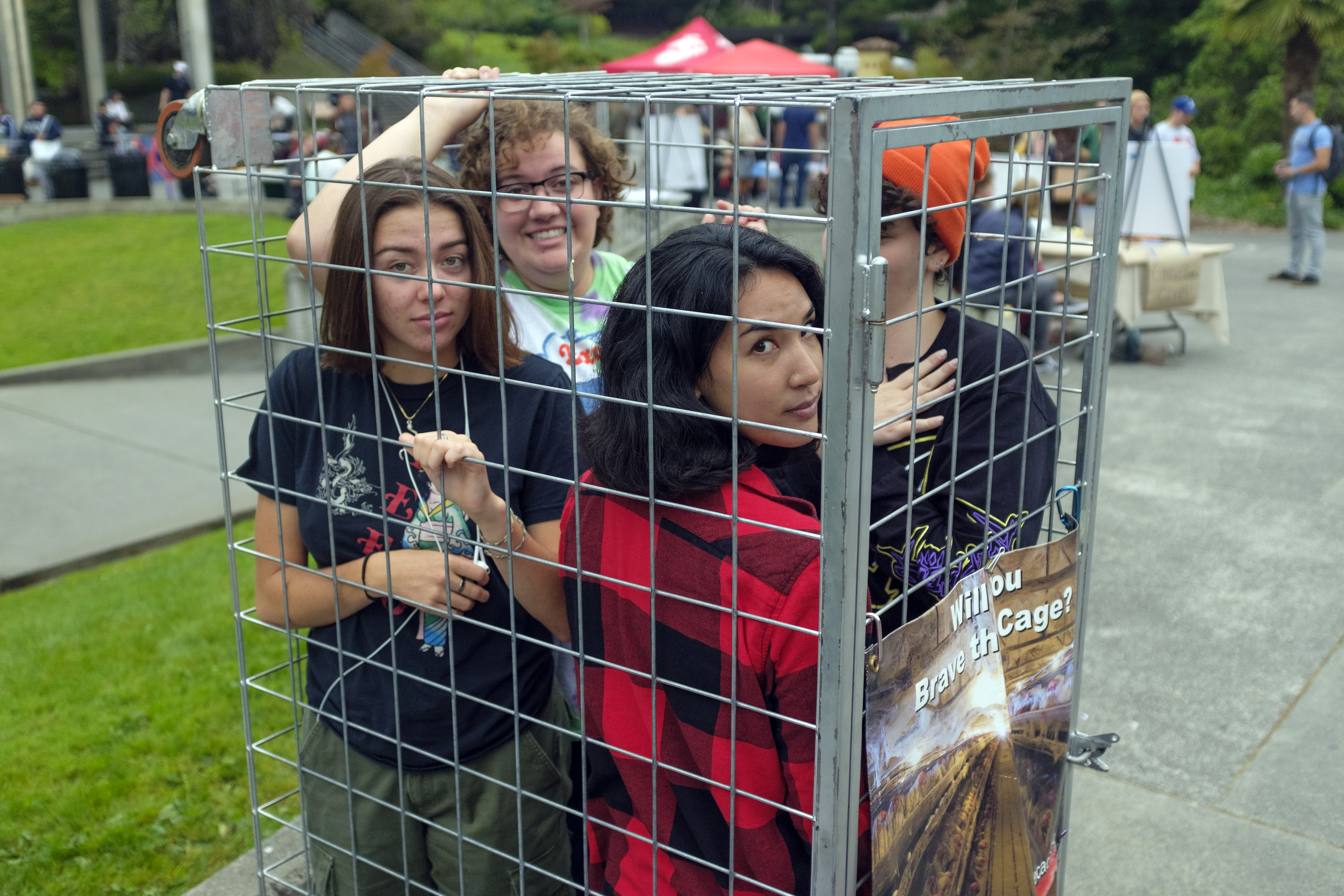
Grace Amico, volunteer for Animal Place, set up a human sized caged enclosure on Aug. 24 at the UC Quad to challenge Lumberjacks to “Brave the Cage,” a one minute challenge to simulate living conditions for hens in the egg industry.
Amico has been volunteering for Animal Place, a sanctuary for farmed animals, in running the “Brave the Cage” campaign at Northern California college campuses.
“We’re about rescuing farm animals from neglect and abuse situations while also educating the public because we believe that education is really important,” Amico said. “When we do our campaigns, a lot of the time we don’t wanna be telling people ‘don’t do this, do do that,’ We want to give them the tools to make the decision themselves.”
The tool, in this example, was the inside of a giant chicken cage.
While most students were rushing along to class, the challenge caught the eye of students Sara Galli, Alex Rumbel and Allie Battista. The trio joined Amico inside the cage for the one minute challenge.
“I was up against the cage, so I was like I don’t want to touch these people anymore,” Rumbel said. “If I had to be in there for a while, it’d be pretty annoying.”
The cage caused students to reflect on much more than simply being uncomfortable.
“It definitely has a shock factor. It’s like, ‘what… I’m in a human sized cage’,” Galli said.
Student Lily O’Connell added insightful comparison for human needs.
“It sucks. And it’s really sad that we’re able to exploit animals,” O’Connell said. “They’re not given any rights and every organism deserves to be outside and breath fresh air and sunlight. The same thing with prisons for humans too, totally inhumane.”
Though students only had to endure one minute of an awkward uncomfortable situation, the hens that Animal Place advocate for don’t have it as good.
“For this cage, people are wearing shoes that hens don’t have, so like if people were to take off their shoes and stand on the wire floor, that would be more accurate as to what the hens are going thorough,” Amico said. “Hens in the egg industry, their cages are stacked on top of each other, so you have manure raining down from the top cages to the very bottom.”
Amico said hens also have their beaks cut, or are “debeaked” to reduce injury from other hens in the case of irritation or to fight for food. The only time hens are let out of the cage is when they’re being depopulated.
“It’s basically a fancy word for being killed,” Amico said. “Farmers will do this by gassing them or starving them and throwing them into a dumpster or landfill.”
Amico said she has been volunteering for Animal Place for six months. Animal Place is a sanctuary for those hens and other animals. More information is available at http://www.animalplace.org/.
This website uses cookies to improve your experience. We'll assume you're ok with this, but you can opt-out if you wish. Cookie settingsACCEPT
Privacy & Cookies Policy
Privacy Overview
This website uses cookies to improve your experience while you navigate through the website. Out of these cookies, the cookies that are categorized as necessary are stored on your browser as they are essential for the working of basic functionalities of the website. We also use third-party cookies that help us analyze and understand how you use this website. These cookies will be stored in your browser only with your consent. You also have the option to opt-out of these cookies. But opting out of some of these cookies may have an effect on your browsing experience.
Necessary cookies are absolutely essential for the website to function properly. This category only includes cookies that ensures basic functionalities and security features of the website. These cookies do not store any personal information.
Any cookies that may not be particularly necessary for the website to function and is used specifically to collect user personal data via analytics, ads, other embedded contents are termed as non-necessary cookies. It is mandatory to procure user consent prior to running these cookies on your website.