Athletes speak out against the uncertainty surrounding rec sports and the playing season
Recreational sports at Humboldt State University is made up of 15 competitive and four non-competitive club teams that practice and play in their respective seasons throughout the school year. Each club team offers the opportunity to students of all skill levels to participate and grow their abilities while building community with fellow teammates and recreational sports athletes.
Since spring break of early 2020, HSU officials have not allowed recreational sports teams to gather or practice in order to avoid the possible spread of COVID-19. No update has been given to any rec sports athletes over the past months on when their teams would be allowed to return, practice and compete.
HSU announced that it would be allowing San Jose State University’s football program access to the Redwood Bowl and Student Recreation Center facilities to prepare for their upcoming season.
Rec sports was finally allotted the opportunity to be heard publicly at the Associated Students board meeting on Oct. 9.
Martin Gordillo, a student and member of both the men’s baseball and volleyball teams, led a discussion on who at the university was behind the decision to not allow rec sports to conduct practices.
Gordillo noted the lack of communication from the Cal State University Chancellor’s office regarding the future of rec sports. Gordillo explained the strategies that fellow rec sports clubs are willing to follow in order to uphold CDC safety guidelines. The plan includes reallocating funds from travel budgets in order to pay for increased sanitation supplies and COVID-19 testing for athletes and faculty.
Associated Students member, Collin Waichler, believes an in-depth look at Chancellor Timothy White’s decision would provide clarification to the decisions that lead to the cancellation of rec sports.
“I think it would be very helpful if we can get the text of the Chancellor’s decision to not allow rec sports,” Waichler said. “So we can see that and look at it and figure out exactly what’s going on.”
A representative of the HSU men’s crew team, Michaella Praska, voiced her experience as a rec sports athlete in her senior year not being able to practice and compete with her fellow teammates.
“It’s so disheartening and I’m very, very disappointed in how things are being run and I just wanted to say my team really became my family,” Praska said. “So to not be able to like have that one hour or half hour to be able to spend more time with them. It really hurts. And I don’t feel like I stand alone.”
The future of rec sports continues to be uncertain for the time being, Gordillo ended his presentation by quoting the HSU’s rec sport’s pledge.
“We are Humboldt plus sports and we care for our athletes, one voice in solidarity loud and proud.”
Newly Elected Associated Student Board prepares from the 2020-21 school year
Former Associated Students, Student Affairs Vice President and AS Legislative Vice President Jeremiah Finley will be returning to Humboldt State University next year as the President of AS.
“We’re here to deliver some genuine change,” Finley said. “We’re in a place where we haven’t been before. But I’m optimistic and we should all be optimistic about the direction we’re about to head in.”
Over the summer Finley will be focusing on creating guidelines for allocation processes and beginning to tackle the four-point approach he campaigned on.
“It’s gonna take more than just one person to advocate that something happens,” Finley said. “My leadership style is not centralized. I’m very much a person who’s gonna take input from everybody.”
Finley acknowledges there are students on campus that didn’t vote for him, and not without reason.
“Ultimately, I know that 258 students voted for the runner-up. With that being said, I know 258 students still believe that those points that that candidate brought up were valid, so we want to recognize that.”
Unique to this year, the new AS board will be meeting several times through out the summer, to get a much needed head start.
“This platform allows me to be a voice for all students. I don’t take that for granted.”
Jeremiah Finley
“I think that the work needs to be done,” Finley said. “That way when we move into the actual academic year, we’re able to hit the ground running.”
AS Representative for the College of Art, Humanities and Social Sciences for the 2019-2020 academic year, Montel Floyd will be returning to the AS board next year to serve as an At-Large Representative. He chose to shift roles to gain access to the entire student body.
“This platform allows me to be a voice for all students,” Floyd said. “I don’t take that for granted.”
Malluli Cuellar, Social Justice Equity Officer for AS 2019-2020, is also moving into a new role as the Legislative Vice President-Elect. Cuellar chose to run for the new position largely due to her interest in chairing the Board of Directors.
“I hope to foster an inclusive and welcoming environment at each Board of Directors meeting,” Cuellar said. “While also making sure that Associated Students is running as best as it can internally, and that our codes and bylaws are setting up Associated Students to be the best it can be.”
Floyd intends to spend his next year with the board focusing on breaking down communication barriers between students and administration and ensuring student safety.
“I love advocating for students,” Floyd said. “Listening to their concerns and finding ways to solve the concerns as a collective is what I do best.”
Cuellar believes in the power of student advocacy and students’ collective ability to promote institutional change on campus.
“I want to push for Associated Students to continue to actively uplift the student voice and encourage our students to become involved in the governance of our campus by joining committees or writing resolutions.”
Malluli Cuellar
“The student advocacy that occurs within Associated Students is what inspired me to run for elected office for the very first time,” Cuellar said. “And it is what has kept me involved with Associated Students.”
One of Cuellar’s goals for the coming year is to build and foster an environment that is inclusive and provide a safe space for collaborative thinking and change.
“I want to push for Associated Students to continue to actively uplift the student voice and encourage our students to become involved in the governance of our campus by joining committees or writing resolutions.”
With only seven students elected to the AS board for 2020-21, there are still plenty of positions open for students interested in joining. Incoming AS President Finley advocates that all students take the opportunity to share their voice.
“I would recommend everybody to do it,” Finley said. “It’s empowering. You get the chance to show who you are and put your twist and your spin on what advocacy is and what it should look like, and you end up creating some really creative solutions to old problems.”
Giovanni Guerrero makes his case for the Associated Students presidency
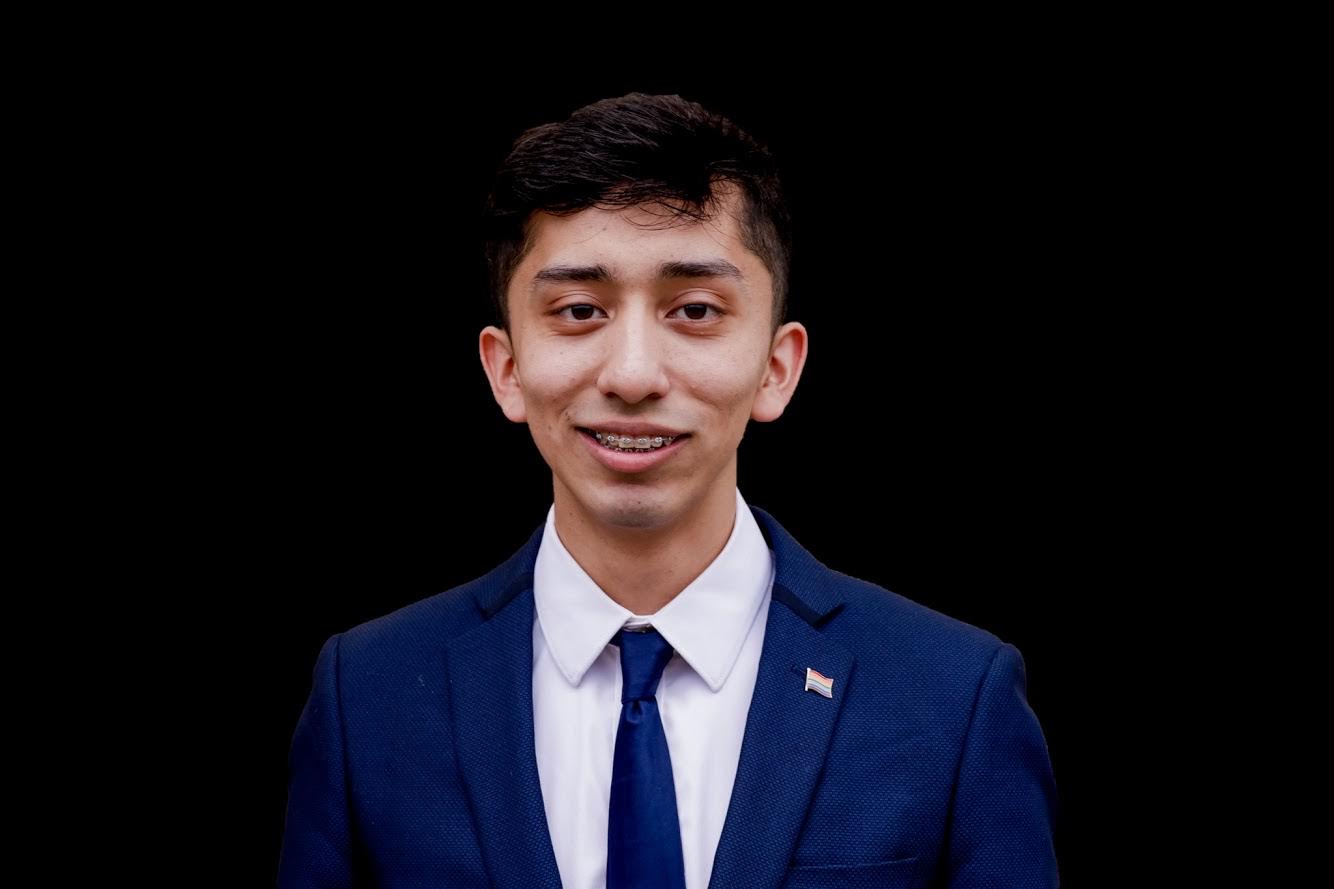
Born and raised in southern California, Giovanni Guerrero is an openly gay, first-generation Latinx student. Coming to the end of his junior year, this is Guerrero’s first time running for a position with Associated Students, and he’s aiming straight for the top—the presidency.
While Guerrero lacks a background with AS, he might make up for with a background working with the Federal Government. Last summer, he attended an internship with the Bureau of Land Management Eastern States division in Washington D.C. The division is an office of the BLM, a branch of the Department of the Interior. He spent time working with fellow interns in a geospatial segment of the Eastern States division—work that involved collaborating on several projects simultaneously.
As an environmental science major, Guerrero brings preservation into the discussion as the foundation of his platform.
“We have resources on this campus that help those students. And I think it’s very essential that we prioritize those resources and make sure that those resources aren’t seeing drastic reductions.”
Giovanni Guerrero
“We have some terrific resources on this campus, but over the next two years we’re gonna be facing $20 million in budget reductions, and that’s a big, scary number,” Guerrero said. “Those reductions will probably come in the form of student interests. So, it’s very important that we recognize the challenges that we’re gonna face, and we’re very vocal about it so that we can protect important resources.”
Humboldt State University is home to many students in need, including those facing housing and food insecurities, as well as mental health issues.
“We have resources on this campus that help those students,” Guerrero said. “And I think it’s very essential that we prioritize those resources and make sure that those resources aren’t seeing drastic reductions.”
Guerrero advocates for more energy to be spent on the promotion of these resources. One idea is to feature a ‘program of the week’ on the HSU homepage because the current navigation system does little to support them.
“I really wanna focus on promoting what Humboldt State has to offer,” Guerrero said. “Because our resources can’t serve the students that they’re meant to serve if they don’t know they exist.”
“I think he would be a great leader because he understands the complexities in debates, that sometimes we have to find productive ways to maintain arguments we can’t end, and because he is so eager to make HSU a better place for students who feel left out.”
Aaron Donaldson, debate team coach
As the only upcoming senior running for the position, Guerrero has the most respective experience on the HSU campus and the challenges faced by its students.
“I’ve been very fortunate to experience different areas around campus,” Guerrero said. “It’s really opened up my perception to how diligently students are working.”
As well as working for Recreation Sports on campus, Guerrero also worked at the J. He’s also involved in several student clubs including the running, climbing and debate clubs.
Aaron Donaldson, coach of the debate team, praised Guerrero as a genuine, sympathetic listener.
“I would describe Gio as thoughtful, careful as an advocate and a good student,” Donaldson said. “I think he would be a great leader because he understands the complexities in debates, that sometimes we have to find productive ways to maintain arguments we can’t end, and because he is so eager to make HSU a better place for students who feel left out.”
If elected president, Guerrero intends to improve HSU’s social media. That way students interested in attending the university will know what the campus has to offer. He advocated that all students take advantage of the opportunities at hand, especially clubs.
“His ability to anticipate, plan for and respond to issues in dynamic and creative ways makes him an asset to any group or team he chooses to be a part of.”
Katherine Earle, Recreation Sports
“Clubs have really helped me to connect with other people, and I think they’re really essential to building community on campus,” Guerrero said. “That leads to retention as well. If you feel connected to your campus and where you live and where you study, then you’re more likely to stay.”
One of Guerrero’s bosses at Recreation Sports, Katherine Earle, spoke highly of his performance.
“Gio has already proven himself to be an effective leader while working for Rec Sports at HSU,” Earle said. “His ability to anticipate, plan for and respond to issues in dynamic and creative ways makes him an asset to any group or team he chooses to be a part of.”
Another priority for Guerrero, as president, would be to ensure the security of student jobs.
“A lot of students depend on those jobs and I think the more opportunities we have on campus, the more attraction we will get at HSU, and more retention,” Guerrero said.
One of the biggest short-comings of AS, according to Guerrero, is active student engagement.
“You could probably go up to any student on this campus and ask them, ‘Do you know what an Associated Student does or who they are?’ And they’ll probably tell you ‘No, I have no idea.’”
Guerrero wants to create avenues to engage with the student body and inform them on what’s going on at an administrative level and within AS.
Guerrero said this will help prioritize what students want from AS. If he wins, Guerrero is aware he has his work cut out for him, and he said he’s up for the task.
“I’ve faced a lot of different barriers and a lot of different challenges, and just in general, it’s really helped me to be a resilient person,” Guerrero said. “And I think that’s the key to success. Cause you’re gonna face a lot of obstacles throughout life, and have to learn how to handle those obstacles.”
Associated Students Legislative Vice President Jeremiah Finley runs for the presidency
Former Vice President of Student Affairs and current Associated Students Legislative Vice President Jeremiah Finely has placed his hat in the race for the 2020-2021 AS presidency.
Majoring in political science, Finley’s passion for politics can be traced to the last presidential election.
“When I watched the 2016 race, I think something just awoke within me,” Finley said. “It got nasty, it got dirty, and that’s something that I don’t want to see happen ever again.”
“When he walked into our first meeting, I knew he was going to be a great leader then.”
Jourdan Lamar, Resident Hall Association president
A sophomore in high school at the time, Finley didn’t put his passion into practice until arriving at Humboldt State University. In his first semester, Finley became president of the Cypress Hill Council after attending the info session and receiving encouragement from the council to run. Current Residence Hall Association President Jourdan Lamar first met Finley when he joined the council.
“When he walked into our first meeting, I knew he was going to be a great leader then,” Lamar said. “He was advocating, asking questions, joining other organizations to learn more about HSU. Since then, I have had the opportunity to work alongside him in many organizations on campus, seeing him become a great student leader.”
From day one, despite the threat of consequences, Finley said he’s made it his number one priority to place students’ interests first.
“Due to this I have been penalized a lot, in various different ways,” Finley said. “Whether it be not getting the votes I needed to pass certain legislation, or not receiving the same type of social treatment. Ultimately, I bet on the students consistently. I think that all my students are worth it.”
Jeremiah is a super bright and motivated student leader, both in AS as the legislative VP and housing as an RA. On multiple occasions, he has combined those roles by educating his residents about current issues on campus as well as bringing his residents to campus events.”
Jenessa Lund, executive director of Associated Students
Finley began making regular visits to the AS office in his first semester on campus, familiarizing himself with the organization. He attempted to apply for the position of social justice and equity officer, but was turned down due to lack of a college GPA. He returned the following semester and was appointed to the position of student affairs VP in February of 2019.
Executive Director of AS Jenessa Lund has worked closely with Finley since he became a part of the board.
“Jeremiah is a super bright and motivated student leader, both in AS as the legislative VP and housing as an RA,” Lund said. “On multiple occasions, he has combined those roles by educating his residents about current issues on campus as well as bringing his residents to campus events.”
Finley’s favorite thing about being part of AS is watching students engage with one another and the various programs on campus.
“When I get the chance to see how my advocacy helped them along the way, those moments are my favorite moments,” Finley said. “I get to interact with folks, I get to hear about their passions, what they’re excited about, what they’re doing.”
“It’s been tough. It’s been really hard trying to navigate that, especially as a person of color in this predominantly white institution. It’s really difficult to make sure I can still be myself, but at the same time, be professional.”
Jeremiah Finley
Beyond the rewarding big-picture projects, Finley finds plenty to be proud of in his daily routine.
“My day-to-day experience is something special,” Finley said. “It’s always fast-paced, there’s always something new going on—so you have to really adapt quickly to the changing scenarios. One thing you hear in the morning could be totally different from what you hear in the afternoon. And it’s been tough. It’s been really hard trying to navigate that, especially as a person of color in this predominantly white institution. It’s really difficult to make sure I can still be myself, but at the same time, be professional.”
Despite everything HSU has to offer, including various programs and resources, a sense of community on campus and the attention paid to student voices, Finley sees endless room for improvement.
“I don’t think anything should really stay the same, and I mean that,” Finley said. “There’s just too much complacency and I think there’s a lot that needs to change.”
Finley intends to place more emphasis on incorporating student engagement within AS.
“Yeah, we have the AS board of directors, but that’s really geared towards AS and what AS wants to do,” Finley said. “But I feel like we don’t have a place where all students can come together to talk about what we all want to do and want to see happen. So, if we can make a central hub where we can talk and just listen to each other and hear what we want to do as a collective, then I think we can truly start generating some great ideas to change the way this campus runs.”
Finley said he understands the struggles college students face, whether it’s coming up with enough money to pay bills or buy groceries, providing for your family or setting aside time for schoolwork.
“But ultimately you just gotta keep going, you gotta keep fighting. And so I’ll keep fighting, I’ll keep going and I’ll keep being persistent, that way I can make sure I can advocate for students.”
Jeremiah Finley
“It’s just this balancing act and I think there’s a lot of things that can be easier for students, things that I currently have no direct control over,” Finley said. “So, if I can put myself in that position to really help, then that’s what I want to do.”
As legislative VP, Finley referred to his magnum opus, his great work, as the AS Constitution, Codes and Policies. He put together a full constitution revision packet over the course of the 2019-2020 school year, including new bylaws and revisions for out-of-date codes and policies. Presented to the board back in February, the revision wasn’t passed.
“It hurt,” Finley said. “It really did hurt when the board decided not to think carefully or listen carefully to what I was saying. I think from that moment I knew that if I wanted to bring the change that I want to see in HSU, and I think that we all deserve here, then I can’t continue in this role.”
Finley said he’s not only prepared, but is determined to take on bigger challenges and face greater consequences in the name of improving the lives of students.
“Some days are good, some days are better than others,” Finley said. “But ultimately you just gotta keep going, you gotta keep fighting. And so I’ll keep fighting, I’ll keep going and I’ll keep being persistent, that way I can make sure I can advocate for students. And come election time, I have faith that I’ll be elected for AS president for the next academic year.”
How and when to watch HSU administrators make big decisions
University Senate Meetings:
Meetings are available online via Zoom from 3-5 p.m. Email senate@humboldt.edu to receive a Zoom link.
Senate meetings will be held Tuesdays on April 21, May 5 and May 19 (if needed—undecided at the moment).
University Senate Meetings are open to the public. If members of the campus wish to speak during the senate’s open forum period from 3:15-3:30 p.m., sign-ups are available on their website.
University Senate Executive Committee Meetings:
Meetings are available online via Zoom from 3-5 p.m. Email senate@humboldt.edu to receive a Zoom link.
Executive Committee meetings will be held on alternate Tuesdays from regular University Senate meetings on April 28 and May 12 (if needed—undecided at the moment).
Associated Students Board of Finance Meetings:
Meetings are available online via Zoom from 2:30-3:30 p.m. Zoom link (unless changed).
Thursdays on April 23, April 30 and May 7.
Weekly schedule of administrative meetings:
Mondays
Tuesdays
Wednesdays
Thursdays
Fridays
4/21: University Senate Meeting 3-5 p.m.
4/23: CAHSS Council of Chairs Meeting TBD AS Board of Finance Meeting 2:30-3:30 p.m.
4/28: Executive Committee Meeting 3-5 p.m.
4/30: CAHSS Council of Chairs Meeting 9-11 a.m. AS Board of Finance Meeting 2:30-3:30 p.m.
5/5: Associated- Residential-Athletic Council 1-2:30 p.m. University Senate Meeting 3-5 p.m.
5/7: CAHSS Council of Chairs Meeting 9-11 a.m. A.S. Board of Finance Meeting 2:30-3:30 p.m.
Associated Students Board of Directors redesigns spring elections
The Associated Students Board of Directors motioned to push their voting period for their upcoming elections back two weeks and expand the period from three to five days, now April 27 through May 1.
The March 27 AS Board meeting held through Zoom included the extension of the filing period for AS candidates to April 16 and several other amendments to the upcoming elections. Elections Commissioner Cassaundra Caudillo said postponing the election could be beneficial.
“It allows for professional staff and the Elections Commission to promote elections a bit longer, so that way we raise our chances of having candidates for each position,” Caudillo said. “Because at the moment, we don’t have a candidate for every position. Not only that, but it also allows students themselves to have an additional two weeks to apply for candidacy.”
“In general, postponing elections for two weeks allows everyone to have a fair and equitable chance at running.”
Cassaundra Caudillo, AS Elections Commissioner and Public Relations Officer
AS Executive Director Jenessa Lund said students expressed interest running in this election who haven’t had the opportunity to take the necessary steps to sign up before the office closed.
“In general, postponing elections for two weeks allows everyone to have a fair and equitable chance at running—keeping in mind the situation we’re all in and how much added stress we’ve all been faced with as students and as human beings,” Caudillo said.
While minimum residency and unit load qualifications are still in place, candidates are no longer required to appear in person to obtain their nomination materials, as the AS office has closed its doors. Students can find everything they need under the “Elections!” tab on the AS website.
Students are also no longer required to supply petitions with 150 student signatures. The candidate quad talk will be replaced with one-minute videos of candidates reading their speeches that will be shared on AS social media. Requirements of wet signatures from candidates will be swapped with a Google forum, and the candidate orientations will now be held over Zoom on April 16 and 17.
The AS Board is willing to review and consider reimbursing any campaign supplies that can no longer be distributed.
AS President Lizbeth Cano-Sanchez described the value of joining AS in a separate interview with The Lumberjack.
“Education is power, and in AS you can put your education to practice, because there’s a lot of things that correlate with it,” Cano-Sanchez said. “It helps you develop yourself, and at the same time, we’re students serving students and that’s really important.”
Only four students attended the first University Resources and Planning Committee’s public budget forum, according to Associated Students President Yadira Cruz.
Around 50 faculty, staff and community members were in attendance as well, according to Art Education Assistant Professor and URPC Co-Chair James Woglom.
Woglom said the URPC’s presentation, which can be found online at budget.humboldt.edu, focused on the URPC’s work toward creating a scalable budget model, or a budget that can be altered periodically to represent changing values.
“It ends up bringing more people into the process of decision-making, and thus hopefully reflecting more people’s feeling of what we want this organism to do,” Woglom said of the URPC’s new model.
James Woglom, art education assistant professor and University Resources and Planning Committee co-chair, checking his laptop in the Humboldt State Univeristy library on Nov. 14. Woglom said the URPC has created a new scalable budget model that allows for more flexibilty and input from the HSU community. | Photo by James Wilde
URPC has been meeting over the course of the semester to form a three-year budget for Humboldt State. Woglom said the first step for deciding where to allocate funds is to clarify which values HSU should prioritize.
Besides the forum, the URPC is taking feedback online through an online submission form, a Google survey designed to scale which campus values are most important and a pie chart budget simulator that allows proposals of how HSU should divide funds. Woglom said he’d also be happy to take suggestions through direct emails.
While Cruz said she appreciated the existence of the online feedback forms, she said they can be obscure due to budgetary jargon.
“Although it’s available, it might not be accessible in that way,” Cruz said.
The Google survey, which is not yet released, lists a series of California State University values and asks the respondent to rate how much they agree with each one.
“It’s not saying that we want to devalue any of them, but it’s trying to get a quantitative sense of where the University’s priorities are in terms of allocation of resources based across a series of ideas,” Woglom said. “And then hopefully with that quantification we can make decisions based on where we can make things happen.”
The URPC’s current projections show a $5.4 million budget gap by the 2021-2022 school year, which reflects the impact of reduced tuition due to declining enrollment. According to the presentation, every 100 students generate about $560,000 in tuition.
The University Resources and Planning Committee pointed to declining tuition numbers as the cause of HSU’s current projected $5.4 million budget gap.
Joseph Reed, a political science and economics double major and a student representative on the URPC, said the key challenge has been ramping down the budget with the declining student body.
“It’s kind of been hard to keep this budget for about 8,000 students when we don’t have 8,000 students anymore,” Reed said.
Cruz said the budget should focus on the students HSU has now, and not the students it had in the past.
“Being in that cutting mindset is potentially jarring for morale. I mean, you’re coming from a space where you’re like, ‘Alright, what do we have to not do this year?’”
James Woglom
“I think every campus goes through these sorts of financial challenges, but I think how we move forward is centering students,” Cruz said.
Reed said the URPC has no plans to cut whole departments. Instead, Reed said cuts are more likely to be smaller and broader across the board.
“Every department is being affected, but each one has its own budget, so each one has its own certain amount that it’s being reduced by,” Reed said.
Over the past three years, URPC reduced the budget by $11.5 million. However, Woglom emphasized a difference between past and future cuts due to the new scalable budget model.
“[In the past] we’ve cut what we’ve determined to be at the fringe of the project of the University—so maybe not in direct agreement with the strategic plan of the University or the general values of the University,” Woglom said. “Being in that cutting mindset is potentially jarring for morale. I mean, you’re coming from a space where you’re like, ‘Alright, what do we have to not do this year?’”
The University Resources and Planning Committee showed three possible enrollment and budget scenarios in its Nov. 7 public forum presentation.
With the new model, Woglom said HSU can start with a specific budget number and then distribute it to the things HSU values most. Woglom said the budget can be continually changed, which allows HSU to scale back up or down if monetary realities change.
“We don’t want to make hurried and necessary decisions every year,” Woglom said.
The URPC uses Financial Information Reporting Management System codes, which are used in higher education to categorize expenses by their function, to compare HSU’s spending to other CSUs.
FIRMS codes break down HSU’s spending into five categories: instruction ($56.6 million in the current budget), institutional support ($21.6 million), operations and maintenance of plant ($16.3 million), academic support ($15.6 million) and student services ($12 million). Each of these categories represent a FIRMS program, and the budget determines what percent of the total amount of funding goes to each category.
Using these categories, the URPC also compares HSU’s spending to other CSUs. According to the presentation, spending at HSU in comparison to similar-sized campuses for the 2017-2018 school year was 17% higher at HSU for instruction, 24% higher for academic support, 3% higher for student services, 10% higher for institutional support and 1% higher for operations and maintenance of plant.
The presentation also showed three possible scenarios for the future of enrollment and its effects on the budget. The best case scenario, called the growth scenario, shows a leveling off of the enrollment decline and a budget gap in the $4 million range by the 2021-2022 school year.
The current scenario, upon which URPC’s projections are based, shows a continued decline that leads to the budget gap of $5.4 million. The worst-case scenario shows further decline and a budget gap of up to $7 million by the 2021-2022 school year.
The URPC’s current budget plans are based on the middle scenario of a $5.4 million gap.
Woglom said the URPC still has to figure out how to allocate its funding to keep current programs intact.
Budget projections from the University Resources and Planning Committee’s Nov. 7 public forum presentation show a $5.4 million budget gap by the 2021-2022 school year.
“It raises interesting questions about where you can move within that,” Woglom said.
Just one day after the URPC’s public forum, HSU released a campus announcement detailing the process for filling staff vacancies during the current enrollment decline and budget deficit. The announcement said that while current staff positions will not be eliminated, positions deemed “non-critical” by the vice president of the relevant division won’t be backfilled when a person leaves that position.
Woglom confirmed that announcement.
“The intention of the University at this point is to work to determine where attrition will happen and backfill positions in that manner,” Woglom said.
This backfiring process does not apply to faculty, according to the announcement.
The URPC’s next and final public forum is scheduled for Dec. 3 at 11:30 a.m. in the Goodwin Forum, during which the public can review the URPC’s draft plan before it is sent to the University president for review. Woglom urges everyone to give their input.
“Any ideas that people have that they’d like to share with us, the better our decision-making process can be,” Woglom said.
“I think [student input is] a challenge in itself,” Cruz said. “But I think that just because it’s challenging doesn’t mean it shouldn’t be pursued.”
Yadira Cruz
Reed and Cruz said they don’t think two public forums are enough to gather sufficient student input.
“I think overall we should be making a stronger effort to connect with students and get their overall opinions,” Reed said.
Reed suggested that the URPC should seek to get input not just from some students, but from the majority of students. Cruz agreed.
“I think that’s a challenge in itself,” Cruz said. “But I think that just because it’s challenging doesn’t mean it shouldn’t be pursued.”
This website uses cookies to improve your experience. We'll assume you're ok with this, but you can opt-out if you wish. Cookie settingsACCEPT
Privacy & Cookies Policy
Privacy Overview
This website uses cookies to improve your experience while you navigate through the website. Out of these cookies, the cookies that are categorized as necessary are stored on your browser as they are essential for the working of basic functionalities of the website. We also use third-party cookies that help us analyze and understand how you use this website. These cookies will be stored in your browser only with your consent. You also have the option to opt-out of these cookies. But opting out of some of these cookies may have an effect on your browsing experience.
Necessary cookies are absolutely essential for the website to function properly. This category only includes cookies that ensures basic functionalities and security features of the website. These cookies do not store any personal information.
Any cookies that may not be particularly necessary for the website to function and is used specifically to collect user personal data via analytics, ads, other embedded contents are termed as non-necessary cookies. It is mandatory to procure user consent prior to running these cookies on your website.