The Lumberjack


Students Serving The Cal Poly Humboldt Campus and Community Since 1929

Tag: Associated Students

  • Pool budget drained by Associated Students

    Pool budget drained by Associated Students

    by Valen Lambert

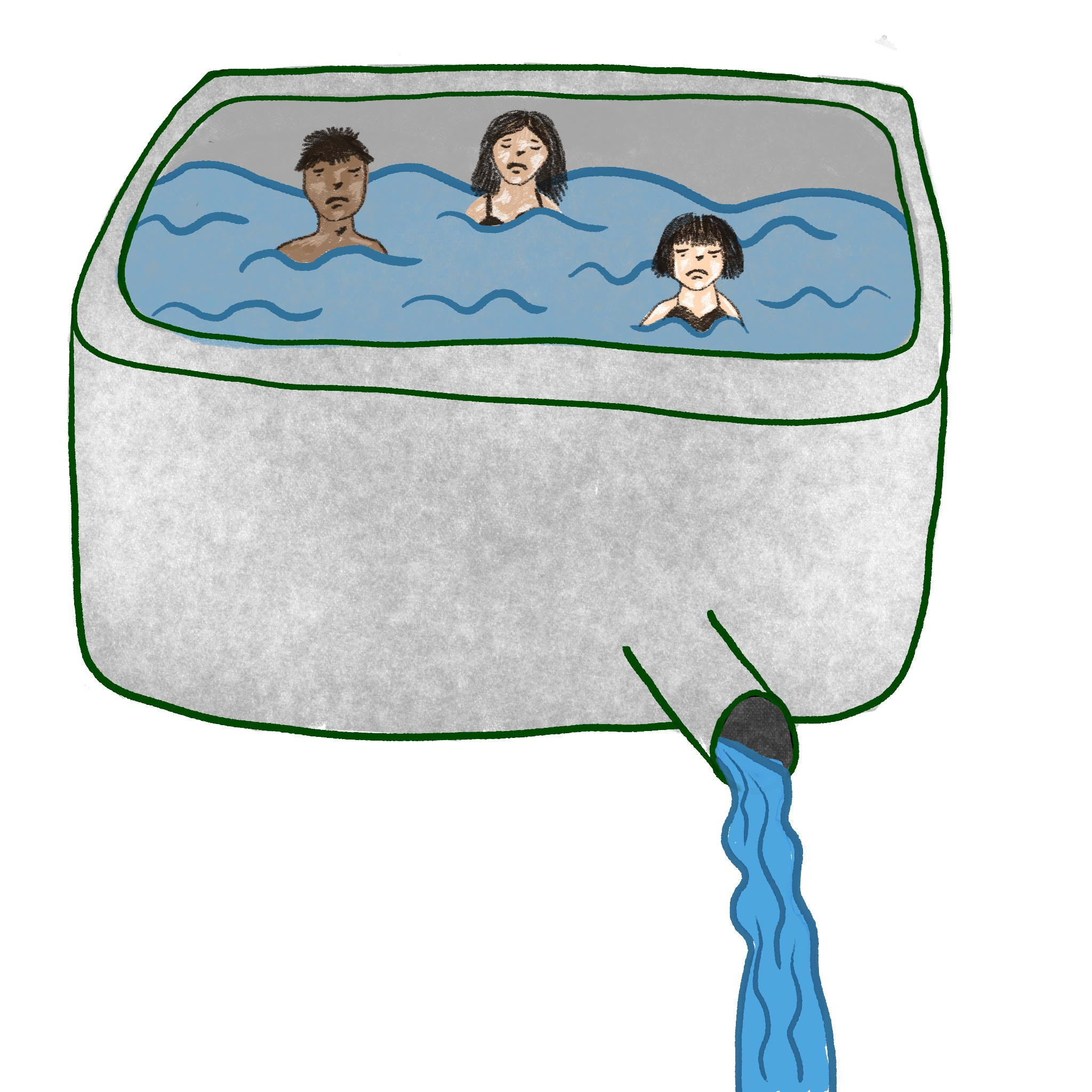
    Since the Associated Students cut nearly $500,000 from student programs in September because of the administration’s faulty admission estimate, students and faculty are enduring the collateral damage. The cut of the campus pool’s budget from $25,000 to $7,500 means a big shift for its 15 employees and the hundreds of students and faculty that recreate in it, and pool staff claim that the AS correspondence has been less than professional.

    The budget cut isn’t anything new to the pool’s programs, which are a part of the School of Applied Health. Lawre Maple, who has been the pool’s program director for nine years, notes that the pool hasn’t had full budgeting since COVID. Every year the program struggles to stay open, and every year staff have to fight to get the funding they need.

    “We’re only open right now because the [Dean of Professional Studies] came in and found us some funding and gave us $10,000,” said Maple. 

    This year, however, according to Maple and student lifeguards, A.S. confused the pool program with an entirely different department. Initially, A.S. reached out to the pool program that sent over the necessary paperwork about what the budget will be used for. When A.S. came back to clarify the budget, they reached out to Paul Wells, who is the Recreational Sports Coordinator and totally unaffiliated with the pool programs that got their budget reduced. 

    “A.S. had accidentally included drop-in pool hours with the same funding as drop-in sports when we first applied for funding,” said Wells. “I believe the similar naming convention caused the confusion when I first applied for funding earlier this year, during the spring semester.”

    “To verify the information or to gain more information about the pool, we were not told that they reached out to a faculty member [Paul Wells] in [Rec Sports],” said student lifeguard Kaden Tobin. “A.S. claimed they were a part of our staff, but they are not and in no way connected to the staff that works at the pool. A.S. claimed at the board meeting on Oct. 13 to have contacted the pool staff directly, but only through email. Only one member [Andres Olmos] of the A.S. board ever came to the pool in person to talk, which was on Oct. 12. All it takes is a simple search on Google or the school website to figure out who to talk to.”

    This miscommunication resulted in Maple not hearing about the budget cut until Oct. 4, five days after they passed the cut. At an A.S. meeting on Oct. 13, The Marching Lumberjacks also claimed A.S. failed to notify them of the Sep. 20 budget meeting where they would have had an opportunity to fight for their funding. Student lifeguard Sam McLane attended the Oct. 13 meeting where he asked the A.S. board if they even knew where the pool was.

    “I asked the Board of Associated Students ‘How many of you know where the pool is?’” said McLane. “I think two out of nine of them knew.”

    “There were some mistakes made,” said A.S. President Samuel Parker. “We had to make the budget in such a short time frame. We could have done better. We went with the allocation that the previous board had suggested.”  

    Interim executive director of AS Kendra Higgins commented on the budget discrepancy.

    “Last year, the Board of Directors collected budget applications for A.S. funding for the 23-24 school year,” said Higgins. The application had incorrect contact information for the swim program that had been copied from previous years,” Higgins said in an email statement. “Upon realizing this discrepancy, our Administrative Vice President, Andres Olmos, personally visited the pool for further clarification, apologized for any confusion, and invited representatives from the pool to participate in our board of directors meetings and the finance sub-committee, where the recommended budget for the next year is discussed.” 

    The budget cuts are not affecting the classes that take place in the pool, but the hours of its open lap time are affected. Decreasing from 25 hours to about 12 hours of open lap swim each week means that its 15 employed lifeguards have significantly reduced hours. Grace Kasberger, a student lifeguard, is seeing her hours diminish from around 15 hours a week to just four, and is scrambling to make up for the loss.

    “This is one of my only jobs, and the only job that can work because I’m also a student athlete,” said Kasberger. “Most other places on campus aren’t very lenient with an athletic schedule as well as my school schedule. This all happened in the middle of the semester. I had the security and now I don’t, and so it’s kind of a little bit of a panic.” 

    Student staff aren’t the only ones affected by the significant cut. Students of the nationally acclaimed scientific diving minor rely on the open hours of the pool to practice their diving in a safe space instead of in Humboldt’s dangerous and unpredictable ocean. Student athletes utilize the pool for cross training or training with their PT’s if they have an injury. According to Tobin, they’ve already had at least 950 people recreate during lap time in the first eight weeks, when usually they’ll get that many in a whole semester, and the amount of faculty passes sold this semester is already above average. All of these people will be affected by the diminishing open hours.

    “You have people that swim for wellbeing, mental and physical,” said Maple. “People that can’t do traditional workouts. They have different needs. They have different bodies. Swimming is one of the only sports that everybody can do.”

  • Associated Students cuts $500,000 out of student programs: resource centers struggle

    Associated Students cuts $500,000 out of student programs: resource centers struggle

    by Angel Barker

    This is an extended version of the story that was published Friday, September 29. This version was printed on Wednesday, October 4.

    It was a misty Friday morning in Arcata. Fewer than 20 people met in person to discuss the budget reform for funded student groups on campus. Tensions were high and budget cuts were higher.

    Faced with a deficit of more than $500,000, the Associated Students (A.S.) met to make huge cuts to student programs. There were over 20 funded program cuts that were approved.

    A $500,000 deficit heightened the tensions between A.S. and core funded student groups on campus. With thousands lower in enrollment numbers than originally projected by the university, it left a sour taste in the mouths of everyone whose budget was about to be cut by thousands of dollars.

    Associated Students Administrative Vice President (AVP) Andres Olmos facilitated the discussion for the necessary cuts of the budget. According to Olmos, because of lack of funds, they are essentially starting from the ground up with the bare minimum of only wages for student workers. That still leaves them over budget. The revenue is much less than predicted in the spring due to the high enrollment projections made by the university.

    The original revenue number was $786,000. Using A.S. reserve funds, the number would have been $865,000. According to Olmos, the financial office told A.S. to get to $750,000, meaning the total number of funds cut were $528,717 because the approved budget when the university thought enrollment would be much higher, a whole $1.2 million.

    A screenshot of the finalized budget of the funded student programs. The left column is the original budget approved in spring and the right column is where the budget is now.

    Olmos acknowledged that it was important to A.S. that student workers were able to keep their jobs, and that the main priority was keeping each budget at least at their current wages, only so students could continue to survive.

    Over 20 student groups like cultural centers, service organizations and more, saw cuts that ranged anywhere from $2,500 (Drop-In Rec Open Gym) to $186,498 (A.S. General Operations). 

    Some individual budgets were getting cut entirely because they have trust funds that they can survive on for the year; others were biting their nails to try and get more than just enough to pay student workers.

    “The money that is now allocated to us is strictly for wages,” Isabela Acosta, the Fiscal Coordinator for the Women’s Resource Center said in an interview after the A.S. meeting. “Not for supplies and hospitality or events.”

    A.S. President Samuel Parker said that the university told A.S. in the beginning of September that they would need to cut the budget. With less than a month to make the adjustments, it was difficult.

    “It was pretty difficult to have to deal with in such a tight time frame,” Parker said. “Also we have a very limited amount of people at the moment, so it is hard to get the adequate amount of communication out to everyone to let everyone know and have them chime in with their perspectives.”

    Marketing and Communications Director of News and Information Aileen Yoo said in an email statement that the budget office had informed A.S. about the budget shortfall on Aug. 30. 

    “One of the reasons for the budget deficit had to do with fee revenue estimates being lower than anticipated due to enrollment growth being more modest than initially anticipated during budget planning last spring,” Yoo said. “This led to needed adjustments to many of our budgeted operations across campus, including our main Operating Fund as well as our fee supported areas, such as AS.”

    The Eric Rofes Queer Multicultural Resource Center (ERC) approved budget for the 2023-2024 school year was $42,500. It was cut to $30,000 after Ascher Marks, the fiscal director for the ERC, and AVP Olmos talked. Olmos told Marks that the ERC employees might not be able to work over summer and winter breaks.

    “We cannot really consider that because our bills don’t stop during winter and summer break,” Marks responded. “We need to be working over the breaks because this is our job and how we make money.”

    Other organizations like the Women’s Resource Center are struggling to do anything except pay their employees.

    “We can’t buy menstrual products,” Acosta said. “Our sole responsibility as a resource center is to provide menstrual products for campus.”

    Acosta explained that due to a law passed in California in 2021, that the university should be stocking the bathrooms with menstrual products, but they have not been.

    “Our school should be [providing] menstrual products because of California Bill 367, which makes California public institutions required to have free and accessible menstrual products, and the school has not instilled this bill,” Acosta said. “So we have basically been taking out large portions of our yearly budget to provide menstrual products for campus when it is not even our responsibility to do so.”

    Yoo responded to this in an email statement.

    Photo by Kae Dennert. Ella Moore, Rose Co-Director, raises her hand during the A.S. meeting on Friday.

    “This [law] has been funded previously by the university, through Student Health & Wellbeing Services and other institutional resources, with staffing resupply support through the Office of Student Life and other university departments. The Women’s Resource Center provided additional supplies and locations and has done so since before the bill was passed. A group of those folks plus Facilities Management are now meeting to streamline the process and ensure funding and coordination of effort.”

    When asked about the backstock of menstrual products and when the center could possibly run out, she said that if they were to stock every bathroom regularly they would run out by next week. With the stock they have (about 20 boxes of pads, 100 menstrual cups and 18 boxes of tampons), she is hoping they will make it to the end of the semester. 

    Some organizations still have enough to sustain for the year, like the Waste Reduction Resource Awareness Program (WRAPP). The Program was cut by $9,200 leaving them below the A.S. recommendation of only wages, yet they remain optimistic.

    “We are so excited to have $44,000,” Ella Moore, Rose Co-Director said. “It means we are going to be able to pay our employees and [have] a little wiggle room for basic operations.”

    The Social Justice, Equity and Inclusion Center will still be open after their $16,500 cut. Frank Herrera, the Center’s Coordinator, is optimistic despite the small funds. Herrera said that the primary goal is to keep student staff, the secondary is to have high impact events. He understands that budgets change and the Center just needs to be more intentional with events.

    Aside from the difficulties cutting a budget by this much, Parker is proud and optimistic, particularly of AVP Olmos.

    “There were a lot of factors that made it pretty difficult for everyone. I am very proud of everyone for managing to pull it off.”

  • Associated Students cuts $500,000 out of student programs

    Associated Students cuts $500,000 out of student programs

    by Angel Barker

    Faced with a deficit of more than $500,000, the Associated Students (A.S.) met Friday to make huge cuts to student programs. The Womxn’s Resource Center saw a large cut of $25,850, Diverse Male Scholar Initiative was reduced by $29,340 and Recreational Sports Clubs were cut by 50%, now left with $15,000. Those were three of the over 20 funded program cuts that were approved.

    It was a misty Friday morning in Arcata, specifically in Gist Hall room 218, where fewer than 20 people met in person to discuss the budget reform for funded student groups on campus. The meeting was called to session at 10:03am. Tensions were high and budget cuts were higher.

    A $500,000 deficit heightened the tensions between A.S. and core funded student groups on campus. With thousands lower in enrollment numbers than originally projected by the university, it has left a sour taste in the mouths of everyone whose budget was about to be cut by thousands of dollars.

    Associated Students Administrative Vice President (AVP) Andres Olmos facilitated the discussion for the necessary cuts of the budget. He stated that because of lack of funds, they are essentially starting from the ground up with the bare minimum of only wages for student workers, which would still leave them over budget. The revenue is much less than predicted in the spring due to the high enrollment projections made by the university.

    Olmos acknowledged that it was important to A.S. that student workers were able to keep their jobs, and that the main priority was keeping each budget at least at their current wages only so students could continue to survive.

    The approved 2023-2024 funded student programs budget sat at $1,278,717, and because of the lack of funding they needed to get to $750,000. Over 20 student groups like cultural centers, service organizations, and more, saw cuts that ranged anywhere from $2,500 to $186,498. Some individual budgets were getting cut entirely because they have trust funds that they can survive on for the year; others were biting their nails to try and get more than just enough to pay student workers.

    The original revenue number was $786,000. Using A.S. reserve funds the number would have been $865,000. The financial office told A.S. to get to $750,000, meaning the total number of funds cut were $528,717.

    The Eric Rofes Queer Multicultural Resource Center (ERC) approved budget for the 2023-2024 school year was $42,500 and was reduced today to $30,000 after exchanges between Ascher Marks, the fiscal director for the ERC and AVP Olmos.

    “We still need to work over the winter and spring break,” Marks said over Zoom.

    “Like I have stated to other organizations,” Olmos said, “you guys might have to reconsider working through winter break and summer break, so I apologize for that.” 

    “We cannot really consider that because our bills don’t stop during winter and summer break,” Marks responded. “We need to be working over the breaks because this is our job and how we make money.” In the end, the ERC’s budget was reduced by $12,500.

    Some organizations still have enough to sustain for the year, like the Waste Reduction Resource Awareness Program (WRAPP). The Program was cut by $9,200 leaving them below the A.S. recommendation of only wages, yet they remain optimistic.

    “We are so excited to have $44,000,” Ella Moore, Rose Co-Director said. “It means we are going to be able to pay our employees and [have] a little wiggle room for basic operations.”

    A more in depth story will be printed this week on Wednesday, October 4.

  • Associated Students to hold referendum on increased student fees

    by Dezmond Remington

    The Associated Students is holding a referendum on raising the AS fee on April 17. The AS fee is currently $58 per semester, and is paid by every student. The fee if the referendum passes will be $67.50 a semester. 

    The Associated Students funds a lot of things on campus, such as CCAT, the Womxn’s Resource Center, and Oh Snap, as well as the hardship fund that has paid for free meal swipes for students. The AS fee is their main source of funding. The proposed fee increase will raise their budget from $600,000 to $1 million dollars. The last few years, AS spending has exceeded $1 million, with the difference made up through various reserve and rollover funds. According to AS President Juan Guerrero, that option is completely exhausted. A fee increase is the best way to pay for all the services students want, allowing AS to keep the various jobs they pay for, as well as serve future students better. The proposed fee increase will make up the $400,000 difference entirely. 

    The last fee increase was in 2015, long before the current inflation. According to Guerrero, to treat students now with the same amount of care students have received in years past, AS needs more money. 

    “We’re not campus,” Guerrero said. “We’re student ran and student driven. Our impact is more substantial than campus, and we need to keep doing that…$19 isn’t a big ask if we want to ensure maximum employment and maximum opportunities.”

  • Voting virtually for your student representatives

    by Matthew Taylor

    Associated Students’ elections are coming fast, yet empty seats and uncontested positions stay plentiful. Fifteen positions stand open for election with only nine candidates on the ballot and write-up so far. Current A.S. members Chase Marcum and Giovanni Guerrero are running for the only contested seat, the presidency. Students have until April 14 to run as a write-in candidate, however.

    Four particular candidates bring unique attention from outside the rotation of previous A.S. board members. One such candidate is Sawyer Chrisman, a communications major, seeking out the position of Administrative Vice President. Similar to most eventual members of the A.S, Chrisman was encouraged by a current member to run.

    “I’m good friends with Chase,” Chrisman said. “We were talking about A.S because beforehand when I got to Humboldt, I was president of my student government community college.”

    Other first-time A.S. members running for positions include Payton Belle, Gerardo Hernandez, and Sebastian Taylor.

    Elections will take place between April 18 to April 22 via emails sent to each Cal Poly Humboldt students’ official school email. The election will be done by choice voting, in which students choose candidates from most preferred to least preferred. The candidate who receives the most preferred votes in an amount of 50% plus one wins. Certain positions which represent the university’s specific colleges, such as the College of Natural Resources & Sciences Representative, may only be voted on by students majoring in that particular college. Before elections take place, however, candidates will be expected to participate in a public debate and campaign speech on April 14.

    “Candidates will debate against those candidates that are running under the same position,” current A.S. President Lizbeth Cano Sanchez said. “It will be a 20-minute debate [for each position]. These debates will take place via a Zoom webinar and in-person in Nelson Hall East 106.”

    Candidates who run uncontested are only expected to give a speech. Prior to and after the debates, candidates are highly encouraged to campaign all across campus after seeking approval at the Office of Student Life located within the SAC. This is especially imperative to late write-in candidates whose names will not explicitly be found on the ballot.

    “Do not pressure anyone, do not make anyone feel like they need to vote for you,” Cano Sanchez said. “We do not want to make our students uncomfortable, especially if you’re about to be one of their leaders.”

    Final results will be first published on April 25 and the transitional A.S. Board meeting on May 6.

    Only 5.6% of students eligible to vote did in last year’s A.S. election cycle. In order for a true majority of student participation, the A.S. must encourage a little under 3,000 students to vote. A lack of time and contesting candidates only serve to prove the difficulty that the association has ahead of itself. For more specific information about the elections, you can email as-staff@humboldt.edu or call (707) 826-5410.

  • Hustle and bustle at the Associated Students

    Hustle and bustle at the Associated Students

    by Matthew Taylor

    In the wake of reimagining the Associated Students, all hands are on deck. More staff and members have resigned over time as the major deadlines of AS’ yearly budget and the next election cycle fast approach. The Board of Directors has played musical chairs with itself after Finley’s impeachment in a scramble to fill the most critical positions. The AS is quickly becoming a phoenix out of its ashes. Reinvigoration among its most loyal members has been felt across the organization, and student participation and interest have been at an all-time high since the pandemic first hit.

    “[We’re] tapping into the core program,” Chase Marcum, the current Administrative Vice President, said. “Teamwork makes the dream work.”

    Since refocusing on the budget, Marcum and the Finance Committee have utilized all the help they can get from resources such as the Student Legal Lounge, CCAT, and the work of their predecessors.

    “We forget that a lot of passionate previous leadership had the foresight to give students templates and guidance,” Marcum said. “[We have] the ability to look back.”

    The yearly budget plans to increase funds for the Asian, Desi, Pacific Islander Collective (APIC) and various other cultural centers on campus. Funding is also being put into Scholars without Borders and expanding the list of study-abroad countries provided at Cal Poly Humboldt. The Student Legal Lounge may also receive higher funds to put into aid for Dreamer students.

    Discussions around previous legislation, bylaws, and organizational structures continue. Plans to review and update the AS Personnel Code along with many of Finley’s previous legislation are in the works. Reviews will ensure that all legislation and bylaws protect student representation and autonomy within the organization. The Bylaws Committee, alongside Legislative Vice President Gio Guerrero, has also begun negotiations with the Dean of Students to utilize the resources from HR to avoid future internal conflicts.

    Above all, the AS is hopeful for the new election cycle. Voting will commence between April 18-22, and students will be emailed the ballot. Guerrero said that last year only 3-4 people ran for mostly uncontested positions, but this semester almost all the positions have at least one person running for so far. The signature process to get on the ballot has also been waived, making it easier to apply. The results of the elections will be posted on May 6.

    “There’s some work ahead of us, but we’ll make it through and persist,” Guerrero said. “We’re going to be okay as an organization.”

    The next Board of Directors meeting will be held this Friday, April 8, at Nelson Hall East 106 from 3 to 6 p.m. As always, these meetings will be open to the public and are now entirely accessed via Zoom. For access to meetings or further inquiries, the AS can be contacted at (707) 826-5410 and through its email at as-staff@humboldt.edu.

  • Healing a broken student body

    Healing a broken student body

    by Matthew Taylor

    It felt like he had become a completely different person. This was a sentiment that current and previous A.S. members echoed in detailing their experiences with ex-A.S. president Jeremiah Finley over the years.

    On Sunday, Feb. 20, Finley was officially impeached and removed from his office. Due to the Legislative Vice President role being empty, the role was given to previous Social Justice and Equity Officer, Lizabeth Cano Sanchez. A unanimous vote on an impromptu Feb. 8 meeting approved this decision. Currently, six positions within A.S. remain open, with an important and daunting budget season right around the corner.

    Many inside and outside A.S. remain both worried and hopeful for the association, along with many still healing from their time serving under Finley’s terms.

    “I have witnessed many great powerhouses of [the] Associated Students’ with strong voices drop off of the A.S. Board [of Directors],” Representative Tashenea Burns Young said. “Because of the negligence, [disrespect] and [inability] to do their job to their full potential, because of President Finley.”

    For longtime members of A.S. such as Malluli Cuellar, Finley’s change in demeanor beginning in the Summer of 2021 was both shocking and confusing, akin to a light switch being flipped.

    “If we ever had any disagreements it was still very respectful,” Cuellar said, explaining his previous demeanor. “He was still actively listening, I felt like he was taking in a lot of the feedback that we would get back then and you would see your feedback implemented into the work.”

    For Cuellar, much of this seemed to change after the pre-agenda meeting of August 2021, which can be read about in our A.S. impeachment article. However, for previous Administrative Vice President (AVP) David Lopez, this had begun as early as June that year.

    As AVP, Lopez was expected to be the head of the association’s yearly budget proposal. This was a task he took very seriously and based on feedback he had assumed he successfully did that year. A phone call from Finley days after the budget books should have been closed and signed told him differently.

    Under the advice and pressure of the university, Finley had almost completely revised the budget without Lopez’s or the Board’s input. When asked what changes he had made, Finley refused to respond until the next board meeting two days later.

    “I’m not ready to share those at the moment, I’ll bring them up tomorrow at our meeting,” Lopez said, directly quoting Finley’s words at the time.

    Huge cuts were made to General Operations, and funds given to student employees under A.S. programs such as WRAPP and CCAT, along with money taken out of the reserves for reallocation. Lopez also expressed that over the pandemic, Finley repeatedly proposed legislation that directly or indirectly centered power into his presidential position.

    “He’s not like that,” Lopez said. “He doesn’t portray himself as someone who is into power [in that way], he’s the perfect politician.”

    Despite the turmoil, both past and present A.S. members have hope for the future of the organization.

    “As for Associated Students, we are working together to further engage in collaboration,” Burns-Young said. “Understanding that we are students and most importantly we are human. With the support of our advisors, core programs, and staff we are the Associated Students who will once more rise above the conflict to further empower our student body.”

    The next A.S. meeting will be March 4, at 4 p.m. in Siemens Hall 117.

  • A.S. President Finley impeached in unanimous vote

    A.S. President Finley impeached in unanimous vote

    by Matthew Taylor

    Former A.S. President Jeremiah Finley was impeached Sunday, Feb. 20, after an almost seven hour trial. All members of the Board were present, many providing their testimonies and evidence against Finley. Impeachment was under the violations of A.S Government Codes Section 9, subsections F, J, L, M, and O. He was voted guilty on four of these five charges.

    Photo by Abraham Navarro | Social Justice and Equity Officer Lizbeth Cano Sanchez crying at the Associated Students meeting in Siemens Hall on Feb. 5.

    “In order to effectively serve students, we must eliminate fear,” said Social Justice and Equity Officer Sachez, the opening speaker for the trial. “Fear that we will not be allowed to speak our minds without retaliation and fear that, despite mediation, nothing will change.”

    Under subsection F, overstepping the bounds of their office without the advice or consent of the Board of Directors, Finley was found guilty of unilateral decision-making, violation of California Law AB 361, and violation of the Gloria Romero Open Meeting Act of 2000.

    College of Natural Resources & Sciences Representative Tashenae Burns-Young gave testimony towards these violations. She stated that President Finley refused to give her Zoom access to Feb. 4’s meeting unless she divulged personal reasons to her non in-person attendance. At the time, only Parliamentarian Kate Bourne was given Zoom access by President Finley.

    “I would like to start as being a black woman on Associated Students,” Burns-Young said. “I have never felt [more] oppressed by my former BIPOC peers, than by our current president.”

    While Burns-Young was able to attend the meeting thanks to Bourne’s own decision to give the Zoom link to all other members, Finley did not count her as quorum and ignored any votes she made during that meeting.

    Under subsection L and M, President Finley was found guilty of conduct that was deemed to be causing distress to the Board as a collective whole and continuous displays of disrespect aimed at students of the association. Resigned A.S. member Malluli Cuellar gave testimony to this section.

    She gave examples of her many conflicts with President Finley as an A.S. member. In the summer prior to fall 2021, during an agenda prep meeting, Finley had requested that she include a talking point within the agenda that he wished to speak on. She expressed discomfort in allowing this agenda item to be added purely in its state as it wouldn’t allow for a debate between the Board, instead she offered similar alternatives.

    “He expressed to me that if the chair was unwilling to work with him,” Cuellar said. “He would simply amend it on to the agenda [in the state he wanted it in].”

    This incident caused her immense embarrassment and a growing panic towards speaking with President Finley. While she explained that they later spoke one-on-one and he apologized for his actions, his disrespectful words and actions continued up again not long after.

    Lastly, the violation of subsection o. negligence to thoroughly communicate with fellow board members, was testified by both Executive Director Jenessa Lund and College of Natural Resources & Sciences Representative Mark Bulgara.

    “When I would support the President in putting agendas together,” Lund said. “I always encourage, like ‘hey can we link it here it’s always best to provide things ahead of time, so people have time to review it and digest it.’ I always got denied.”

    Bulgara stated that Finley had neglected to properly educate him on important legislation and his voting rights when he appointed him to his current position. In the end, this ignorance often led him to blindly follow President Finley’s own words on any matter.

    “Seeing [this] now, I regret every second that I voted yes for him,” Bulgara said. “Because he has done nothing but betray our trust and he abused my ignorance in being a new member.”

    Photo by Abraham Navarro | Student Affairs Vice President Chase Marcum and Social Justice and Equity Officer Lizbeth Cano Sanchez speak to President Jeremiah Finley at the Associated Students meeting in Siemens Hall on Feb. 5.

    Throughout the entire trial President Finley expressed that all accusations against him were refutable and that he never did anything to break any legal laws nor did he mean to hurt any member with purposeful intent. While he did extend apologies when explicitly asked to by Bulgara, he also expressed himself as a victim to these accusations. He believed many of these accusations to actually stem from personal disagreements and opinions to his own past decisions.

    “I don’t see anything in here that results in the punishment that this board is wanting to pursue,” Finley said. “In fact, I feel as though I am being retaliated against for a lot of the ways that I’ve advocated for our students.”

    The impeachment trial ended with a unanimous vote by all Board members to impeach Jeremiah Finley from his role as A.S. president.

  • Letter to the Editors

    To our Cal Poly Humboldt Family, 

    Associated Students do not stand nor condone any kind of disrespect. We value everyone’s thoughts, opinions, and presence within AS. 

    We are aware of an unsettling situation that occurred during our Executive cabinet meeting on Feb. 4 concerning members of the Associated Students and members of AS Core Programs at Cal Poly Humboldt. 

    During the meeting, President Jeremiah Finley was uncooperative with fellow board members and had cut the meeting short. During this meeting, the WRRAP’s R.O.S.E branch team was expecting a response from the board, but would not move forward due to solely wanting in-person attendance. 

    In addition to this, President Finley neglected his team by failing to acknowledge the presence of appointed members who joined through Zoom, assuming that, “they only joined through Zoom simply because they didn’t want to be in attendance in person,” though this was not the case. 

    First and foremost, we, the Associated Students do not accept or tolerate the sort of behavior that was presented on that evening. We understand the concern, the anger, and the feelings of disrespect. You are heard and your feelings matter. 

    Next, we find it critical, to be honest with our student body and with each other. Unfortunately, there has been an unhealthy power dynamic within AS. There have been many issues regarding communication, equality, and access to opportunities. These are issues AS members have been dealing with but have managed to persevere through while keeping our student body and AS Core Programs at the top of their priority list. We are actively working towards community building and furthering our relationships with our staff and student leaders. 

    Due to the continuous amounts of disrespect and unacceptable behavior, AS will be moving forward with the impeachment process. 

    Associated Students stands for the purpose to educate, empower, and most importantly elevate all student voices. 

    Signed, 

    Associated Students of Cal Poly Humboldt

  • AS President Finley’s refusal to resign leads to more conflicts

    by Matthew Taylor

    Prior to the AS meeting last Friday at Siemens Hall, President Finley received a letter by the collective student body calling for his resignation that evening. If he failed to do so, actions would be taken towards impeachment. This letter was written in part due to his actions at the previous AS Meeting on Feb. 5th, which can be read about here.

    “I have come to understand that recently there are many that felt disrespected,” Finley said, in response to the letter during the meeting. “Reduced to only a vote to count as opposed to the valued team member they are throughout the year by my unintentional behavior.”

    The president continued in offering apologies to any members he may have unintentionally hurt over the past months. He pleaded with the student body to talk personally with him and to allow him to end his final semester, both as a student and president, without burnt bridges. He explained that the extra weight of responsibility expected of him as a Black leader in a predominantly white university may have also gotten the better of him.

    “I cannot leave till I have had a chance to put in order what is out of place for those that are hurt and be your champion once again,” Finley said, ending his speech and thus refusing to resign.

    No members present at the time had further comment. Conflict between Board members and the president continued later on in the meeting, however, as Finley attempted to appoint a new student for Legislative Vice President.

    “First, I want to apologize to you,” At-Large Representative Gio Guerrero said, to the new candidate. “Our Associated Students are in a really big hurdle at the moment, internally. I don’t feel confident that we can support an additional new member on this Board until we get through [this] storm.”

    All other Board members, excluding Finley, concurred with this sentiment. Members expressed that they did want the candidate to be appointed but only once internal conflicts had been figured out. Finley accused the Board of allowing personal opinions of him to cloud their decision. All members present disagreed and appointed Student Affairs Vice President Marcum and Guerrero to keep in contact with the candidate. Plans to properly vote in this appointee are scheduled to happen at the next AS meeting.

    The next AS meeting will be held on Friday, Feb. 18, at 4 pm in Siemens Hall 117.

  • Tears, power-grabs, and calls for resignation

    Tears, power-grabs, and calls for resignation

    by Matthew Taylor

    The first of this semester’s weekly Associated Students (A.S.) meetings ended in frustration, tears, and calls for the president’s own resignation.

    Conflicts between members arose when President Jeremiah Finley refused to hold the official meeting. His own requirements mandated that the group make in-person quorum; he stated that the student body members which attended the meeting via Zoom would not count. Most members of the present student body and the guest speakers at the meeting voiced disagreement.

    “It’s not fair to place the blame on us,” Kate Bourne, Parliamentarian, said through Zoom. “You just won’t make this hyflex, you can’t just force people to come here. The quorum is met, we’re just not in person, we are all members of this.”

    It was only due to the arrival of Social Justice and Equity Officer Lizbeth Cano Sachez moments later that the meeting was allowed by President Finley to properly take place.

    Photo by Abraham Navarro | Student Affairs Vice President Chase Marcum and Social Justice and Equity Officer Lizbeth Cano Sanchez speak to President Jeremiah Finley at the Associated Students meeting in Siemens Hall on Feb. 5.

    Multiple different issues were discussed regarding the amount of power that President Finley has been exercising during his period of presidency. Issues such as his sole power as the Chair to pick and choose what goes on the agenda of meetings, and to choose which representatives may go to the A.S. & CPH Leadership Meetings.

    An expressed lack of communication and ignored emails towards the R.O.S.E House were also present. Director Payton Wills of the organization stated they had been trying to get in contact with A.S. for over 2 months. Members anxious about the eventually demolish of their house and subsequent subpar relocation adding more stress to the tense meeting.

    Emotions ran high when Sachez had to leave to host an event for El Centro, another important student-run organization. She explained that she would continue to participate via Zoom, but under his own ruling on in-person quorum not being met, Finley attempted to end the meeting prematurely.

    Due to the collective stress of the meeting, Sachez began to break down and pleaded with the president to allow her participation through Zoom.

    “I hope I’m not failing any of the members-” Sanchez said, holding back tears.

    “You should be allowed on Zoom. There’s no reason for that to be other than preference.” Kate Bourne said.

    Photo by Abraham Navarro | Social Justice and Equity Officer Lizbeth Cano Sanchez crying at the Associated Students meeting in Siemens Hall on Feb. 5.

    Vice President of Student Affairs Chase Marcum also offered his support, pleading with Finley to make an exception for Sanchez. Still, the president refused.

    “Everyone on Zoom wants this meeting to continue and meet the quorum,” said guest speaker Payton Wills, adding their own opinion. “Lizbeth wants it to meet quorum. All of the people sitting here want it to meet quorum. You are the only person, sitting here, against continuing this meeting. It makes no sense.”

    “Seeing as I’m not leaving, we can continue our meeting…” she said, sitting back down.

    Arguments between members continued to escalate, both Bourne and Sachez accused Finley of refusing to accept not only their previous work experience at A.S. but specifically their roles as female leaders. The angry scraping of chairs could be heard across the room as almost all people present begin to leave the room.

    Unofficially the meeting was adjourned only halfway through the agenda. Only members Marcum and Finley were left, tidying up the room in complete silence.

    In the aftermath of the meeting, Vice President Marcum and President Finley had very different takes on what had occurred.

    Photo by Abraham Navarro | Associated Students President Jeremiah Finley at the Associated Students meeting in Siemens Hall on Feb. 5.

    “Being Black and in this leadership role I bear a weight that many will not understand,” President Finley said. ”Still, I know the work must get done and solutions to issues must be given. So, when my fellow board members and cabinet members won’t show up in person not because they are not able, but because they have something better to do, I still make sure students’ requests are fulfilled because that is why I do what I do and where I find joy.”

    On the other hand, Marcum accused Finley of abusing his power as President and personally apologized on behalf of the A.S. to students and staff members who have suffered hardships under the organization’s current leadership.

    “I truly believe that [Finley] should step down in a dignified fashion,” he said. “Embrace humility, be humbled. It is the most important of all characteristics to carry with you once it is obtained.”

    The Associated Students’ next meeting is planned to take place this Friday, at 3 pm in the same location of Siemens Hall 117.

  • Recreational sports athletes react to SJSU in AS meeting

    Recreational sports athletes react to SJSU in AS meeting

    Athletes speak out against the uncertainty surrounding rec sports and the playing season  

    Recreational sports at Humboldt State University is made up of 15 competitive and four non-competitive club teams that practice and play in their respective seasons throughout the school year. Each club team offers the opportunity to students of all skill levels to participate and grow their abilities while building community with fellow teammates and recreational sports athletes. 

    Since spring break of early 2020, HSU officials have not allowed recreational sports teams to gather or practice in order to avoid the possible spread of COVID-19. No update has been given to any rec sports athletes over the past months on when their teams would be allowed to return, practice and compete. 

    HSU announced that it would be allowing San Jose State University’s football program access to the Redwood Bowl and Student Recreation Center facilities to prepare for their upcoming season. 

    Rec sports was finally allotted the opportunity to be heard publicly at the Associated Students board meeting on Oct. 9. 

    Martin Gordillo, a student and member of both the men’s baseball and volleyball teams, led a discussion on who at the university was behind the decision to not allow rec sports to conduct practices. 

    Gordillo noted the lack of communication from the Cal State University Chancellor’s office regarding the future of rec sports. Gordillo explained the strategies that fellow rec sports clubs are willing to follow in order to uphold CDC safety guidelines. The plan includes reallocating funds from travel budgets in order to pay for increased sanitation supplies and COVID-19 testing for athletes and faculty.  

    Associated Students member, Collin Waichler, believes an in-depth look at Chancellor Timothy White’s decision would provide clarification to the decisions that lead to the cancellation of rec sports.

    “I think it would be very helpful if we can get the text of the Chancellor’s decision to not allow rec sports,” Waichler said. “So we can see that and look at it and figure out exactly what’s going on.” 

    A representative of the HSU men’s crew team, Michaella Praska, voiced her experience as a rec sports athlete in her senior year not being able to practice and compete with her fellow teammates. 

    “It’s so disheartening and I’m very, very disappointed in how things are being run and I just wanted to say my team really became my family,” Praska said. “So to not be able to like have  that one hour or half hour to be able to spend more time with them. It really hurts. And I don’t  feel like I stand alone.”  

    The future of rec sports continues to be uncertain for the time being, Gordillo ended his presentation by quoting the HSU’s rec sport’s pledge.

    “We are Humboldt plus sports and we care for our athletes, one voice in solidarity loud and proud.”

  • HSU Cultural Center Budget Slashed

    HSU Cultural Center Budget Slashed

    Associated Students leaves student body devastated after significant reductions in cultural center’s budget.

    Two months ago, Associated Students released its proposed budget for the 2020-21 school year at Humboldt State University. Included in this budget were major budget cuts to on-campus cultural centers such as the Multicultural Center and the Eric Rofes Multicultural Queer Center.

    For the budgeting process to begin, A.S. applications are submitted by various campus-based clubs to the A.S. Finance Committee, previously known as the Board of Finance. From there, the committee reviews all the incoming applications and after holding public appeals, creates a Recommended Budget that is sent over the A.S. Board of Directors, a mix of A.S. elected representatives and faculty advisers. The Board of Directors then holds another round of public appeals, drafts a revised Recommended Budget and sends it over the A.S. president, who promptly turns it over to the campus president for official approval.

    David Lopez, the Associative Vice President of A.S. and a sophomore at HSU, emphasized that he still greatly values the cultural centers but they will be funded differently.

    “We really appreciate them for the work they do,” Lopez said. “So to make sure that they continue to do that work still because we’re not funding them, we’re doing it through the clubs grant, and we’re forming this grant process to be as neutral as possible with funding student organization needs.”

    Lopez is personally leading the charge for these new clubs grants, which aim to support student organizations like the Asian Desi Pacific Islander Collective and the Women’s Resource Center in a reduced capacity.

    One thing that factored into the decision by Associated Students to sever the cultural centers’ funding was the Apodaca v. White lawsuit that took place between a pro-life student organization at CSU San Marcos and CSU San Marcos’s Associated Students. The pro-life student organization claimed that it was being discriminated against by CSU San Marcos because requested funding for a pro-life speaker was denied while other groups were recieiving the same funding. The final ruling by a federal court was in favor of the student organization, arguing that the funds that come from student fees need to be allocated in the most viewpoint neutral way possible. The CSU Chancellor’s office has yet to clarify what this means.

    For Lopez, this new funding procedure is radical but also necessary given the circumstances.

    “We’re supporting the greatest amount of viewpoints and opinions possible,” Lopez said. “The plan for this club grant is to further diversify the opinions on campus per Apodaca v White and to err on the side of caution while awaiting the Chancellor’s interpretation of Apodaca v White.”

    Lopez recognized that he and his staff are working with a limited financial capacity and therefore need to distribute funding in a way that will keep clubs satisfied and avoid a lawsuit of their own.

    “What’s happening is we’re being faced with the choice of either becoming a club or becoming absorbed into an administrative or academic department.”

    Amanda Huebner

    “Our total budget is less than eight hundred thousand dollars,” Lopez said. “Meaning that by not funding in a viewpoint neutral manner, we are potentially risking over a fourth of our budget, a fourth of student fees that could go to things like our Club Grants Committee or that could go to other campus resources if we were to risk not funding in a most neutral way possible.”

    Celene Gonzalez is an HSU grad student in the psychology program and an El Centro employee. She has worked closely with the cultural centers and has seen their collective downfall over the years.

    “What gives me hope in what I had seen in that time is that students were getting really connected with each other,” Gonzalez said. “They were finding their communities. It is not shocking to me that the school felt the need to kind of push that down a little bit.”

    Gonzalez is disheartened by the disconnect that has been formed between her and these students through said budget cuts.

    “I feel like our work gave us a way to connect with one another and I feel like our activism gave us a way to connect with one another,” Gonzalez said. “That it’s going to be hard to maintain and it’s going to be hard to ask of them when I know that they aren’t being compensated for that work.”

    The Eric Rofes Multicultural Queer Resource Center is getting hit hard by the extreme budget cuts. Concerned about the future of her cultural center, Amanda Huebner, a rangeland and social sciences senior and an employee at the ERC, wants to see it remain in the state that it’s in already.

    “What’s happening is we’re being faced with the choice of either becoming a club or becoming absorbed into an administrative or academic department,” Huebner said. “So I think there has been dialogue by students in the past that this would be a bad move being absorbed by a department or by an administrative department because it would make the group not be as student-run.”

    In other words, the absorption of the ERC into another department would be ill-advised because there would be more faculty interference in how it would be managed, and that wouldn’t align with the goal of this cultural center of being a student-led one.

    Student leaders like Katherine Nguyen who work in the cultural centers are frustrated with the fallout from all of this. Nguyen doesn’t feel like the administration cares about its marginalized students.

    “Are you going to be supporting your cultural centers, are you going to be supporting your students?” Nguyen said. “I’m not confident about that and I’m tired of just being told by admin, like: ‘Oh, you got it wrong, like we actually care about you. We’re going to figure out a way,’ but it’s like if you did, why didn’t you make a plan? Show that you’re invested in students.”

    When it comes to the shrinking budgets for the various cultural centers, neither the students nor the administration can be totally satisfied. After the Fall 2020 census, the A.S. cumulative budget will be reevaluated.

  • Humboldt State Elects a New Student Board

    Humboldt State Elects a New Student Board

    Newly Elected Associated Student Board prepares from the 2020-21 school year

    Former Associated Students, Student Affairs Vice President and AS Legislative Vice President Jeremiah Finley will be returning to Humboldt State University next year as the President of AS.

    “We’re here to deliver some genuine change,” Finley said. “We’re in a place where we haven’t been before. But I’m optimistic and we should all be optimistic about the direction we’re about to head in.”

    Over the summer Finley will be focusing on creating guidelines for allocation processes and beginning to tackle the four-point approach he campaigned on.

    “It’s gonna take more than just one person to advocate that something happens,” Finley said. “My leadership style is not centralized. I’m very much a person who’s gonna take input from everybody.”

    Finley acknowledges there are students on campus that didn’t vote for him, and not without reason.

    “Ultimately, I know that 258 students voted for the runner-up. With that being said, I know 258 students still believe that those points that that candidate brought up were valid, so we want to recognize that.”

    Unique to this year, the new AS board will be meeting several times through out the summer, to get a much needed head start.

    “This platform allows me to be a voice for all students. I don’t take that for granted.”

    Jeremiah Finley

    “I think that the work needs to be done,” Finley said. “That way when we move into the actual academic year, we’re able to hit the ground running.”

    AS Representative for the College of Art, Humanities and Social Sciences for the 2019-2020 academic year, Montel Floyd will be returning to the AS board next year to serve as an At-Large Representative. He chose to shift roles to gain access to the entire student body.

    “This platform allows me to be a voice for all students,” Floyd said. “I don’t take that for granted.”

    Malluli Cuellar, Social Justice Equity Officer for AS 2019-2020, is also moving into a new role as the Legislative Vice President-Elect. Cuellar chose to run for the new position largely due to her interest in chairing the Board of Directors.

    “I hope to foster an inclusive and welcoming environment at each Board of Directors meeting,” Cuellar said. “While also making sure that Associated Students is running as best as it can internally, and that our codes and bylaws are setting up Associated Students to be the best it can be.”

    Floyd intends to spend his next year with the board focusing on breaking down communication barriers between students and administration and ensuring student safety.

    “I love advocating for students,” Floyd said. “Listening to their concerns and finding ways to solve the concerns as a collective is what I do best.”

    Cuellar believes in the power of student advocacy and students’ collective ability to promote institutional change on campus.

    “I want to push for Associated Students to continue to actively uplift the student voice and encourage our students to become involved in the governance of our campus by joining committees or writing resolutions.”

    Malluli Cuellar

    “The student advocacy that occurs within Associated Students is what inspired me to run for elected office for the very first time,” Cuellar said. “And it is what has kept me involved with Associated Students.”

    One of Cuellar’s goals for the coming year is to build and foster an environment that is inclusive and provide a safe space for collaborative thinking and change.

    “I want to push for Associated Students to continue to actively uplift the student voice and encourage our students to become involved in the governance of our campus by joining committees or writing resolutions.”

    With only seven students elected to the AS board for 2020-21, there are still plenty of positions open for students interested in joining. Incoming AS President Finley advocates that all students take the opportunity to share their voice.

    “I would recommend everybody to do it,” Finley said. “It’s empowering. You get the chance to show who you are and put your twist and your spin on what advocacy is and what it should look like, and you end up creating some really creative solutions to old problems.”

  • Associated Students Lose Core Programs and Student Wages

    Associated Students Lose Core Programs and Student Wages

    Based on projected enrollment, the Associated Students budget is expected to decrease 20% each year, for the next five years

    The Associated Students Board finalized their proposed budget for the upcoming academic year, during the April 24 board meeting. The budget includes cutting the entire budgets of the Asian, Desi, Pacific Islander Center, the Eric Rofes Multicultural Queer Resource Center or ERC and the Women’s Resource Center, among other programs.

    Jeremiah Finley was elected the incoming AS President for the 2020-21 academic year. He wants to assure students they won’t be losing their programs.

    “The reality is that we want to support y’all so bad,” Finley said. “That we’re willing to go into our reserves almost $100,000 to be able to still support in some type of way.”

    Budget Administrator of the Campus Center for Appropriate Technology Justin Hawkins was baffled by the budget decisions and spoke out during the meeting.

    “How does the budget increase $14,000 and it’s going directly to the AS government in-between these recommended budgets, and yet, all of us are getting cut.”

    Justin Hawkins

    “It’s just tragic, honestly, to see these massive cuts to the ERC and the Women’s Resource Center,” Hawkins said. “I’m a male body person, I identify that way, but that doesn’t mean that I don’t empathize and really appreciate the services that are provided.”

    Hawkins questioned the justification for the AS budget increase after having several thousand dollars of his own program cut.

    “It’s really troubling what I see going on,” Hawkins said. “How does the budget increase $14,000 and it’s going directly to the AS government in-between these recommended budgets, and yet, all of us are getting cut.”

    Despite losing one of their three staff positions, the AS general operations budget has increased over $15,000 for the upcoming academic-year. This comes as a result of general operations losing miscellaneous revenue, largely made up of compensation for the oversight of Instructionally Related Activities. Without the $35,000 miscellaneous revenue provided for the 2019-20 year, the general operations budget requires additional funds to function.

    As a result of budget reductions, AS was forced to down-size their office administrator position. This sharp deadline made it impossible for AS to administer payroll for the upcoming year and as a result student-wages have been removed from AS and most of its funded-programs. Executive Director of AS, Jenessa Lund, said the current system isn’t working.

    “Even with three employees,” Lund said. “When we have eight programs spread across campus, the oversight is impossible. It’s a huge liability!”

    In order to compensate students for their time, AS has come up with several loopholes to get around the extra paperwork that comes with administering official wages. These include paid-internships and stipends for students, both of which have been allocated specific funds in the final budget.

    These allocations include a $15,000 committee compensation package that increased the AS government budget. The package is specifically set aside for non-AS board members that are involved in AS committees.

    “The optics on the final number of $111,000 looks bad,” Lund said. “But if you really look at what’s inside of it, it’s support to the students.”

    The finalized proposal includes a significant increase to the clubs’ budget, with money that can be used for student-stipends and internships. Programs that didn’t receive any funding from AS have the option to transition their organization into a club and can apply for funding through AS and the clubs’ office. Programs that weren’t given a budget for the upcoming year have also been allocated specific funds.

    “I don’t think that all of the clubs should have an equal opportunity for that funding.”

    Alexia Siebuhr

    Queer Coordinator for the MultiCultural Center, Alexia Siebuhr voiced her concerns about access to AS grants distributed through clubs, at a board meeting on May 8. Siebuhr pointed out a white supremacist club on campus, who promotes hateful behavior towards groups denied an AS budget, is competition for club funding.

    “I don’t think that all of the clubs should have an equal opportunity for that funding,” Siebuhr said. “They have the equal opportunity to apply for those grants. That just rubs me a little bit the wrong way.”

    President-Elect Finley addressed Siebuhr’s concerns, explaining the reasoning behind the allocation.

    “Every fee-paying student has to be able to have access to these funds,” Finley said. “If we do not allow them to have access to these funds, then we are doing a dis-service to our students.”

    Programs with a department and a state employee overseeing paperwork are the only ones able to maintain regular wages because their payroll doesn’t go through AS. For programs that didn’t receive a budget from AS, finding a department to adopt them and re-applying for funding is currently their only option.

    AS is already in discussion with the Student Access Gallery, the Waste-Reduction and Resource Awareness Program, the Campus Center for Appropriate Technology and several departments about the possibility of adoption. Executive Director Lund believes this will be the most beneficial direction for the programs, moving into next year.

    “We didn’t have enough time to do that for every program,” Lund said. “That would’ve been ideal.”

    AS is prepared for the possibility of refunding fee-paying students for potentially cancelled events and other unspent student-fee funds. Ultimately, if they aren’t providing the services outlined by student-fees, they shouldn’t be charging them.

  • Athletics Deals with a Budget Curveball

    Athletics Deals with a Budget Curveball

    With Humboldt State University anticipating lower enrollment for the upcoming academic year, the athletics department has been preparing to make budget adjustments in alignment with the rest of the university. While the department is still waiting on official numbers from the administration to what the budget will look like next semester, Athletics Director Jane Teixeira has been actively working towards making changes with athletics.

    “We are going to start going through program by program, looking at ways that we can reduce costs or maximize our benefits and resources,” Teixeira said. “We look at everything from corporate partnerships and how we can maximize those, to donations, to can we live without a second pair of tennis shoes if that’s something we were buying.”

    Student enrollment is directly linked to the budget through the Instructionally Related Activities fee that every student pays each semester. The fee currently costs students $337 and covers coach salaries as well as operational expenses for athletics. The funds generated by the IRA fee are also split among the IRA Committee Fund, Jack Pass Fund and Humboldt Energy Independence. A large majority of the money goes to athletics. However, with the department receiving $3.3 million for the 2019-2020 academic year. There is no talk at this time of the fee being raised even if enrollment drops in the future.

    The IRA Fee may not be changing, but faculty salary which applies to coaches and is determined with unions and includes automatic increases is at risk. Associated Students Executive Director Jenessa Lund points out that at a certain stage this model will simply stop working as salaries fall out of balance with the fee.

    “Salary increases for positions paid by the state are included in the state allocation, as the state builds in a cost of living increase when funding for CSU’s,” Lund said. “When salaries are paid by a flat fee, eventually the salary increases will exceed the amount of fees.”

    Newly elected Associated Students President Jeremiah Finley believes that students should not be having to pay for athletics faculty and instead should be paid with state-side funds.

    “Ultimately I believe that the wages should be off the back of students. So I’ll advocate that it moves back to state-side.”

    Jeremiah Finley

    Moving faculty wages back to state-side funding is something the budget office has been looking into since Spring 2018 according to Lund. If this move is made then the money allocated by the CSU system would take rising salaries into consideration. While the current flat fee does not.

    Athletics will certainly take a financial hit if enrollment drops as the university predicts. Teixeira was adamant that even though the department has been asked to make changes, the existing programs will not be going anywhere.

    “There’s no talk of contracting on our sports,” Teixeira said. “I know there has been some thought from some individuals that were nervous about that because you’re starting to see that happen across the country.”

    With enrollment down significantly in the Fall semester, athletics will be leaning more heavily on other sources of revenue; state-side, private donations and corporate sponsorships. Teixeira was unable to provide exact numbers on how much money comes from these sources, but did say that support from the community is especially important for athletics. However with the long term effects following COVID-19, donors contributions will potentially be affected.

    “I appreciate the individuals who have given to us and hope we can continue to gather their support for that,” Teixeira said. “We’re going to need it as we move forward in this budgetary time. But we also are aware that this pandemic has affected people. It’s affected our neighbors and we have to be really smart about that.”

    “Rec sports is a huge part of what HSU does for students. So it’s not just an athletic issue, this is a student issue.”

    Athletics Director Jane Teixeira

    If student enrollment takes the anticipated dip for the 2020-2021 school year, recreational sports would see a dip in funding, since they’re part of the athletics department. Teixeira said that recreational sports had already taken a reduction and needs support since it applies to so many students.

    “Rec sports is a huge part of what HSU does for students,” Teixeira said. “So it’s not just an athletic issue, this is a student issue.”

    The potential to use unspent money from this semester to bolster athletics is being explored as an option. While the final numbers haven’t been released, track and field, softball and rowing all had their seasons cancelled before completion. Meaning funds that are normally spent on travel and lodging are still available. This money could be used for other operations in the future.

    Finley thinks that any athletic money not spent due to COVID-19 should be dispersed back into the program.

    “Ultimately if that money is allocated, which it currently is, for our student athletes,” Finley said. “Then our student athletes should still benefit from that. I don’t know what that looks like, but that’s why we have different bodies in different pockets of excellence around campus to get that input.”

    Without certainty from HSU’s administration, the athletic department continues to create scenarios for possible budget outcomes they will face going into the 2020-21 school year.

  • Giovanni Guerrero Aims to Promote and Protect Campus Resources

    Giovanni Guerrero Aims to Promote and Protect Campus Resources

    Giovanni Guerrero makes his case for the Associated Students presidency

    Born and raised in southern California, Giovanni Guerrero is an openly gay, first-generation Latinx student. Coming to the end of his junior year, this is Guerrero’s first time running for a position with Associated Students, and he’s aiming straight for the top—the presidency.

    While Guerrero lacks a background with AS, he might make up for with a background working with the Federal Government. Last summer, he attended an internship with the Bureau of Land Management Eastern States division in Washington D.C. The division is an office of the BLM, a branch of the Department of the Interior. He spent time working with fellow interns in a geospatial segment of the Eastern States division—work that involved collaborating on several projects simultaneously.

    As an environmental science major, Guerrero brings preservation into the discussion as the foundation of his platform.

    “We have resources on this campus that help those students. And I think it’s very essential that we prioritize those resources and make sure that those resources aren’t seeing drastic reductions.”

    Giovanni Guerrero

    “We have some terrific resources on this campus, but over the next two years we’re gonna be facing $20 million in budget reductions, and that’s a big, scary number,” Guerrero said. “Those reductions will probably come in the form of student interests. So, it’s very important that we recognize the challenges that we’re gonna face, and we’re very vocal about it so that we can protect important resources.”

    Humboldt State University is home to many students in need, including those facing housing and food insecurities, as well as mental health issues.

    “We have resources on this campus that help those students,” Guerrero said. “And I think it’s very essential that we prioritize those resources and make sure that those resources aren’t seeing drastic reductions.”

    Guerrero advocates for more energy to be spent on the promotion of these resources. One idea is to feature a ‘program of the week’ on the HSU homepage because the current navigation system does little to support them.

    “I really wanna focus on promoting what Humboldt State has to offer,” Guerrero said. “Because our resources can’t serve the students that they’re meant to serve if they don’t know they exist.”

    “I think he would be a great leader because he understands the complexities in debates, that sometimes we have to find productive ways to maintain arguments we can’t end, and because he is so eager to make HSU a better place for students who feel left out.”

    Aaron Donaldson, debate team coach

    As the only upcoming senior running for the position, Guerrero has the most respective experience on the HSU campus and the challenges faced by its students.

    “I’ve been very fortunate to experience different areas around campus,” Guerrero said. “It’s really opened up my perception to how diligently students are working.”

    As well as working for Recreation Sports on campus, Guerrero also worked at the J. He’s also involved in several student clubs including the running, climbing and debate clubs.

    Aaron Donaldson, coach of the debate team, praised Guerrero as a genuine, sympathetic listener.

    “I would describe Gio as thoughtful, careful as an advocate and a good student,” Donaldson said. “I think he would be a great leader because he understands the complexities in debates, that sometimes we have to find productive ways to maintain arguments we can’t end, and because he is so eager to make HSU a better place for students who feel left out.”

    If elected president, Guerrero intends to improve HSU’s social media. That way students interested in attending the university will know what the campus has to offer. He advocated that all students take advantage of the opportunities at hand, especially clubs.

    “His ability to anticipate, plan for and respond to issues in dynamic and creative ways makes him an asset to any group or team he chooses to be a part of.”

    Katherine Earle, Recreation Sports

    “Clubs have really helped me to connect with other people, and I think they’re really essential to building community on campus,” Guerrero said. “That leads to retention as well. If you feel connected to your campus and where you live and where you study, then you’re more likely to stay.”

    One of Guerrero’s bosses at Recreation Sports, Katherine Earle, spoke highly of his performance.

    “Gio has already proven himself to be an effective leader while working for Rec Sports at HSU,” Earle said. “His ability to anticipate, plan for and respond to issues in dynamic and creative ways makes him an asset to any group or team he chooses to be a part of.”

    Another priority for Guerrero, as president, would be to ensure the security of student jobs.

    “A lot of students depend on those jobs and I think the more opportunities we have on campus, the more attraction we will get at HSU, and more retention,” Guerrero said.

    One of the biggest short-comings of AS, according to Guerrero, is active student engagement.

    “You could probably go up to any student on this campus and ask them, ‘Do you know what an Associated Student does or who they are?’ And they’ll probably tell you ‘No, I have no idea.’”

    Guerrero wants to create avenues to engage with the student body and inform them on what’s going on at an administrative level and within AS.

    Guerrero said this will help prioritize what students want from AS. If he wins, Guerrero is aware he has his work cut out for him, and he said he’s up for the task.

    “I’ve faced a lot of different barriers and a lot of different challenges, and just in general, it’s really helped me to be a resilient person,” Guerrero said. “And I think that’s the key to success. Cause you’re gonna face a lot of obstacles throughout life, and have to learn how to handle those obstacles.”

  • Jeremiah Finley is Willing to Face Consequences to Create Change

    Jeremiah Finley is Willing to Face Consequences to Create Change

    Associated Students Legislative Vice President Jeremiah Finley runs for the presidency

    Former Vice President of Student Affairs and current Associated Students Legislative Vice President Jeremiah Finely has placed his hat in the race for the 2020-2021 AS presidency.

    Majoring in political science, Finley’s passion for politics can be traced to the last presidential election.

    “When I watched the 2016 race, I think something just awoke within me,” Finley said. “It got nasty, it got dirty, and that’s something that I don’t want to see happen ever again.”

    “When he walked into our first meeting, I knew he was going to be a great leader then.”

    Jourdan Lamar, Resident Hall Association president

    A sophomore in high school at the time, Finley didn’t put his passion into practice until arriving at Humboldt State University. In his first semester, Finley became president of the Cypress Hill Council after attending the info session and receiving encouragement from the council to run. Current Residence Hall Association President Jourdan Lamar first met Finley when he joined the council.

    “When he walked into our first meeting, I knew he was going to be a great leader then,” Lamar said. “He was advocating, asking questions, joining other organizations to learn more about HSU. Since then, I have had the opportunity to work alongside him in many organizations on campus, seeing him become a great student leader.”

    From day one, despite the threat of consequences, Finley said he’s made it his number one priority to place students’ interests first.

    “Due to this I have been penalized a lot, in various different ways,” Finley said. “Whether it be not getting the votes I needed to pass certain legislation, or not receiving the same type of social treatment. Ultimately, I bet on the students consistently. I think that all my students are worth it.”

    Jeremiah is a super bright and motivated student leader, both in AS as the legislative VP and housing as an RA. On multiple occasions, he has combined those roles by educating his residents about current issues on campus as well as bringing his residents to campus events.”

    Jenessa Lund, executive director of Associated Students

    Finley began making regular visits to the AS office in his first semester on campus, familiarizing himself with the organization. He attempted to apply for the position of social justice and equity officer, but was turned down due to lack of a college GPA. He returned the following semester and was appointed to the position of student affairs VP in February of 2019.

    Executive Director of AS Jenessa Lund has worked closely with Finley since he became a part of the board.

    “Jeremiah is a super bright and motivated student leader, both in AS as the legislative VP and housing as an RA,” Lund said. “On multiple occasions, he has combined those roles by educating his residents about current issues on campus as well as bringing his residents to campus events.”

    Finley’s favorite thing about being part of AS is watching students engage with one another and the various programs on campus.

    “When I get the chance to see how my advocacy helped them along the way, those moments are my favorite moments,” Finley said. “I get to interact with folks, I get to hear about their passions, what they’re excited about, what they’re doing.”

    “It’s been tough. It’s been really hard trying to navigate that, especially as a person of color in this predominantly white institution. It’s really difficult to make sure I can still be myself, but at the same time, be professional.”

    Jeremiah Finley

    Beyond the rewarding big-picture projects, Finley finds plenty to be proud of in his daily routine.

    “My day-to-day experience is something special,” Finley said. “It’s always fast-paced, there’s always something new going on—so you have to really adapt quickly to the changing scenarios. One thing you hear in the morning could be totally different from what you hear in the afternoon. And it’s been tough. It’s been really hard trying to navigate that, especially as a person of color in this predominantly white institution. It’s really difficult to make sure I can still be myself, but at the same time, be professional.”

    Despite everything HSU has to offer, including various programs and resources, a sense of community on campus and the attention paid to student voices, Finley sees endless room for improvement.

    “I don’t think anything should really stay the same, and I mean that,” Finley said. “There’s just too much complacency and I think there’s a lot that needs to change.”

    Finley intends to place more emphasis on incorporating student engagement within AS.

    “Yeah, we have the AS board of directors, but that’s really geared towards AS and what AS wants to do,” Finley said. “But I feel like we don’t have a place where all students can come together to talk about what we all want to do and want to see happen. So, if we can make a central hub where we can talk and just listen to each other and hear what we want to do as a collective, then I think we can truly start generating some great ideas to change the way this campus runs.”

    Finley said he understands the struggles college students face, whether it’s coming up with enough money to pay bills or buy groceries, providing for your family or setting aside time for schoolwork.

    “But ultimately you just gotta keep going, you gotta keep fighting. And so I’ll keep fighting, I’ll keep going and I’ll keep being persistent, that way I can make sure I can advocate for students.”

    Jeremiah Finley

    “It’s just this balancing act and I think there’s a lot of things that can be easier for students, things that I currently have no direct control over,” Finley said. “So, if I can put myself in that position to really help, then that’s what I want to do.”

    As legislative VP, Finley referred to his magnum opus, his great work, as the AS Constitution, Codes and Policies. He put together a full constitution revision packet over the course of the 2019-2020 school year, including new bylaws and revisions for out-of-date codes and policies. Presented to the board back in February, the revision wasn’t passed.

    “It hurt,” Finley said. “It really did hurt when the board decided not to think carefully or listen carefully to what I was saying. I think from that moment I knew that if I wanted to bring the change that I want to see in HSU, and I think that we all deserve here, then I can’t continue in this role.”

    Finley said he’s not only prepared, but is determined to take on bigger challenges and face greater consequences in the name of improving the lives of students.

    “Some days are good, some days are better than others,” Finley said. “But ultimately you just gotta keep going, you gotta keep fighting. And so I’ll keep fighting, I’ll keep going and I’ll keep being persistent, that way I can make sure I can advocate for students. And come election time, I have faith that I’ll be elected for AS president for the next academic year.”

  • HSU is Holding Administrative Meetings Online and You Can Attend Them

    HSU is Holding Administrative Meetings Online and You Can Attend Them

    How and when to watch HSU administrators make big decisions

    University Senate Meetings: 

    Meetings are available online via Zoom from 3-5 p.m. Email senate@humboldt.edu to receive a Zoom link.

    Senate meetings will be held Tuesdays on April 21, May 5 and May 19 (if needed—undecided at the moment).

    University Senate Meetings are open to the public. If members of the campus wish to speak during the senate’s open forum period from 3:15-3:30 p.m., sign-ups are available on their website. 

    University Senate Executive Committee Meetings:

    Meetings are available online via Zoom from 3-5 p.m. Email senate@humboldt.edu to receive a Zoom link.

    Executive Committee meetings will be held on alternate Tuesdays from regular University Senate meetings on April 28 and May 12 (if needed—undecided at the moment).

    Associated Students Board of Finance Meetings:

    Meetings are available online via Zoom from 2:30-3:30 p.m. Zoom link (unless changed).

    Thursdays on April 23, April 30 and May 7.

    Weekly schedule of administrative meetings:

    MondaysTuesdaysWednesdaysThursdaysFridays
    4/21: University Senate Meeting
    3-5 p.m.
    4/23: CAHSS Council of Chairs Meeting
    TBD
    AS Board of Finance Meeting
    2:30-3:30 p.m.
    4/28: Executive Committee Meeting
    3-5 p.m.
    4/30: CAHSS Council of Chairs Meeting
    9-11 a.m. 
    AS Board of Finance Meeting
    2:30-3:30 p.m.
    5/5: Associated- Residential-Athletic Council
    1-2:30 p.m.
    University Senate Meeting
    3-5 p.m.
    5/7: CAHSS Council of Chairs Meeting
    9-11 a.m.
    A.S. Board of Finance Meeting
    2:30-3:30 p.m.
    5/12: Executive Committee Meeting (“if needed” – undecided at moment)
    3-5 p.m.
    5/14: CAHSS Council of Chairs Meeting
    9-11 a.m.
    5/19: University Senate Meeting (“if needed” – undecided at moment)
    3-5 p.m.
  • IRA Budget Expected to Take Substantial Hit

    IRA Budget Expected to Take Substantial Hit

    Associated Students prepare for massive budget cuts

    Associated Students is anticipating a nearly 20% cut to the Instructionally Related Activities Committee budget.

    As of April 7, the IRA Committee budget for the 2020-2021 academic year is predicted to be about $375,000, compared with around $520,000 approved for the 2019-2020 budget. This accounts for an anticipated loss of around $27,000 due to COVID-19.

    As a condition of enrollment at Humboldt State University, each full-time student pays about $3,900 in student fees, around $2,900 of which is tuition. The remaining amount of about $1,000 is split between six student fees, including a $337 contribution the IRA.

    From that $337 paid by each student, the IRA budget is divided into about $260 for athletics, $8 for the Humboldt Energy Independence Fund, about $17 for the Jack Pass and about $19 for the IRA Committee. Made up entirely of Associated Students board members, the IRA Committee votes on the allocation of their budget among instructionally related activities.

    Executive Director of AS Jenessa Lund is heavily involved in the committee.

    “It’s interesting that there is not a lot of money compared to the big budget, but what I’ve realized over the past couple of years is because they are so visible, people react to them very strongly,” Lund said. “IRA is less than $500,000, and compared to the campus budget that’s just drops in the bucket. But because it means whether or not a group of students can go compete, or do something, they feel it directly.”

    “We had conflicting pieces of arguments that said, ‘You do this, but you don’t do that in these cases,’ which makes it very hard to evaluate who’s gonna be in and who’s gonna be out.”

    Sandy Wieckowski

    IRAs are limited to those that are disciplined, department-based and sponsored, and are integral to formal instructional offerings. They are intensive, structured activities that reflect active rather than passive student involvement. They are considered essential to the quality of an educational program and an important instructional experience, and they demonstrate skills derived from intensive coursework. They include everything from The Lumberjack newspaper to club sports, and almost everything in between.

    Made up of majority student voters, the IRA Committee has been meeting to re-evaluate their funding guidelines, based on the Education Code, their current IRA funding guidelines and memos between the AS president and HSU president from the 2019-2020 academic year that outline the direction they were headed. Sandy Wieckowski is currently the longest-acting board member.

    “This is the same thing we hit last year,” Wieckowski said. “We had conflicting pieces of arguments that said, ‘You do this, but you don’t do that in these cases,’ which makes it very hard to evaluate who’s gonna be in and who’s gonna be out.”

    Lund blamed the rotating chairs for inconsistent goals.

    “This current model has annual turnover,” Lund said. “It’s new faculty on this committee every year, and it’s often new student leaders every year.”

    On top of HSU having new administration for the past three years, AS has had four presidents in three years. With administrations in a constant state of change, it’s much more difficult to accomplish progress.

    “I’ve been on the committee four years and we’ve done it different every year,” Wieckowski said.

    Board members were assigned budget applications from IRA groups to review in advance of their April 7 meeting. During the meeting, the board looked at each application and adjusted the proposed budgets where they saw fit. As Lund scrolled down the list of submissions, board members weighed in with their recommendations.

    One significant impact looks to be the denial of a budget for the campus sexual assault prevention program, CHECK IT, as the “swag” the budget was requested to pay for wasn’t considered a priority.

    Other impacts include The Lumberjack newspaper, which faces over $8,000 in cuts from a budget of around $28,000. Osprey magazine faces about $4,000 in cuts from a $10,000 budget, and the KRFH student radio station also faces a $5,000 cut from their budget of $10,000. AS Public Relations Officer Cassaundra Caudillo suggested the cuts.

    “All of the publications on campus tend to over-print,” said Caudillo. “I think all of the publications could probably take a little bit of a cut because of that.”

    Despite the budget crunch, the IRA committee managed to make room for programs that did not receive IRA funding in the 2019-2020 academic year, including $2,500 for the Youth Educational Services program, $5,000 for reserve library textbooks and $3,000 for the Society of American Foresters Quiz Bowl. The IRA budget recommendations have been finalized, but they currently have an open appeals period before the budget will be sent to HSU President Tom Jackson by April 30.

    A potentially significant factor in next year’s budget is possible carry-over from money that didn’t get spent in the 2019-2020 academic year. That amount, for now, is yet to be known. However, the IRA Committee felt comfortable over-allocating about $25,000 they expect to gain in roll-over.

    “We have all these potential expenses out there that we need to get covered and tidy up before we try and allocate that money to next year,” Lund said.

    In the past, AS has put in place a contingency plan to allocate money based on a projected headcount in case there is money left over from the previous school year’s budget.

    “If money were to roll forward and be available in addition to what we’re looking at today, then they gave three priorities, and that was already voted,” Lund said. “So, it made it a pretty clean process for us if there was funding there.”

  • AS President Sports Decorated Track Record

    AS President Sports Decorated Track Record

    Lizbeth Cano-Sanchez steps up to the Associated Students presidency

    Lizbeth Cano-Sanchez is the first sophomore to serve as president of Associated Students at Humboldt State University since at least 1975.

    Cano-Sanchez took over as president of AS following the previous president’s resignation in December 2019. Formerly the administrative vice president, Cano-Sanchez decided to run for HSU student government after serving as president of the Hill dorms and a member of the Resident Hall Association board in her freshman year.

    “Sometimes in my life, and I thank God for it, things align and things happen, but I push for them, and I work for them,” Cano-Sanchez said.

    AS Legislative Vice President Jeremiah Finley began working with Cano-Sanchez as a fellow dorm president on the RHA.

    “During any transition period in any organization, things can get a little hectic and challenging as the new person comes to fill the role left behind,” Finley said. “That being said, after she became AS president, working with her has been the most valuable experience that I have had in my young professional life.”

    “I don’t think I was intimidated. I was very excited. But I could feel a little bit of sadness within me, because I knew I had to make a choice between sacrificing more leisure time or self care time or I was going to be sacrificing running.”

    LIzbeth Cano-Sanchez

    Originally from Mexico, Cano-Sanchez was raised in Monterey Park, California. She currently has temporary residency in the U.S. and is making her way toward citizenship.

    Cano-Sanchez initially came to Humboldt to be a part of the track and field team and the cross-country program. She’s taken part in both varsity sports since her freshman year at Schurr High School. She was the MVP for cross-country her freshman and senior years, and MVP of track and field her sophomore and junior years. She became captain of the cross-country team her sophomore year, and the track and field team her junior year. She also currently holds the 5K record at Schurr High.

    Cano-Sanchez decided to step away from sports this spring to make much-needed room for her new role as AS president.

    “I don’t think I was intimidated,” Cano-Sanchez said. “I was very excited. But I could feel a little bit of sadness within me, because I knew I had to make a choice between sacrificing more leisure time or self care time or I was going to be sacrificing running.”

    Cano-Sanchez said her relationship with running also changed.

    “I wasn’t setting goals for myself in that area anymore, and it was because I was trying to grow in other areas,” Cano-Sanchez said. “Now that I’m away from it I can see all of my errors, but I still have some growing to do before I go back.”

    As a business major, Cano-Sanchez chose to run for the administrative vice president’s position during the 2019 spring elections because of its practical application to her major. She ran with a platform advocating for a stronger student union, having visited other universities with more efficient systems.

    “We have a very lenient and flexible system at the moment,” Cano-Sanchez said. “It calls for innovation and creativity, and that’s a huge thing that I value. So, I’m not talking about making things more strict, not at all. I’m talking about having a more efficient system, within ourselves, in order to successfully serve our students.”

    As the AS administrative vice president, Cano-Sanchez made efforts to centralize HSU’s funded programs. She also resurrected the AS Funded Programs Committee that’s been chaired by the AVP position in the past.

    “Being AS president is very time consuming and Lizbeth has done a phenomenal job at doing what she can, but also delegating tasks and roles to other AS board members.”

    Jenessa Lund, Executive Director of AS

    “At first, only a few showed up,” Cano-Sanchez said. “Then the second meeting, more showed up and I felt very happy to see them getting involved and wanting to have their voice be represented. That was a hard one to let go of [the AS Funded Programs Committee] because I liked seeing how the money worked and how our students were being served through their student fees.”

    As the fill-in president of AS, Cano-Sanchez has taken on the position as if she ran for it. She has weekly advising meetings with the AS professional staff, monthly meetings with HSU President Tom Jackson, and has created strong communication between the AS board.

    Executive Director of AS Jenessa Lund has worked closely with Cano-Sanchez for the academic year.

    “She has consistently demonstrated that she is willing and capable to prioritize her AS roles,” Lund said. “Being AS president is very time consuming and Lizbeth has done a phenomenal job at doing what she can, but also delegating tasks and roles to other AS board members.”

    Cano-Sanchez admitted the position takes time.

    “But it’s worth it,” Cano-Sanchez said. “Students need to know and my board needs to know in order to communicate it down.”

    Cano-Sanchez’s main focuses with AS are improving the internal structure and raising awareness of AS resources that can help to meet student needs. Cano-Sanchez has also decided to run for AS president for the 2020-2021 academic year.

    Juggling classes with a presidency is enough to stress out anyone, but Cano-Sanchez feels she was made for it.

    “I think that I’m very much a natural born leader, ” Cano-Sanchez said. “I know that I am. I know that I can tell when things need to be fixed, and I have been fixing them.”

  • Associated Students Elections Delayed Due to COVID-19

    Associated Students Elections Delayed Due to COVID-19

    Associated Students Board of Directors redesigns spring elections

    The Associated Students Board of Directors motioned to push their voting period for their upcoming elections back two weeks and expand the period from three to five days, now April 27 through May 1.

    The March 27 AS Board meeting held through Zoom included the extension of the filing period for AS candidates to April 16 and several other amendments to the upcoming elections. Elections Commissioner Cassaundra Caudillo said postponing the election could be beneficial.

    “It allows for professional staff and the Elections Commission to promote elections a bit longer, so that way we raise our chances of having candidates for each position,” Caudillo said. “Because at the moment, we don’t have a candidate for every position. Not only that, but it also allows students themselves to have an additional two weeks to apply for candidacy.”

    “In general, postponing elections for two weeks allows everyone to have a fair and equitable chance at running.”

    Cassaundra Caudillo, AS Elections Commissioner and Public Relations Officer

    AS Executive Director Jenessa Lund said students expressed interest running in this election who haven’t had the opportunity to take the necessary steps to sign up before the office closed.

    “In general, postponing elections for two weeks allows everyone to have a fair and equitable chance at running—keeping in mind the situation we’re all in and how much added stress we’ve all been faced with as students and as human beings,” Caudillo said.

    While minimum residency and unit load qualifications are still in place, candidates are no longer required to appear in person to obtain their nomination materials, as the AS office has closed its doors. Students can find everything they need under the “Elections!” tab on the AS website.

    Students are also no longer required to supply petitions with 150 student signatures. The candidate quad talk will be replaced with one-minute videos of candidates reading their speeches that will be shared on AS social media. Requirements of wet signatures from candidates will be swapped with a Google forum, and the candidate orientations will now be held over Zoom on April 16 and 17.

    The AS Board is willing to review and consider reimbursing any campaign supplies that can no longer be distributed.

    AS President Lizbeth Cano-Sanchez described the value of joining AS in a separate interview with The Lumberjack.

    “Education is power, and in AS you can put your education to practice, because there’s a lot of things that correlate with it,” Cano-Sanchez said. “It helps you develop yourself, and at the same time, we’re students serving students and that’s really important.”

  • Retention Rate on the Rise at HSU

    Retention Rate on the Rise at HSU

    More Humboldt State students are electing to stick around, but there’s still work to be done

    Corrections: a previous version of this story incorrectly quoted Casey Park as saying “We’re absent as an institution.” The quote should have said “We were absent as an institution.” The story also wrongly included “interim” in Jason Meriwether’s title.

    Humboldt State revealed more students were staying on its campus rather than taking off for other schools or ventures in a Jan. 31 press release.

    Tracy Smith, the director of the HSU Retention through Academic Mentoring Program, said she was proud of the work she and her peer mentors have accomplished over the years.

    “I think Humboldt sincerely believes that whether students decide to stay at Humboldt or not is really a product of our entire campus community and off-campus community,” Smith said. “RAMP really is designed to support incoming students and them finding a place where they feel a connection.”

    “85 percent of new first-year students said if they were given the option to choose a college again, they ‘probably’ or ‘definitely’ would attend HSU again.”

    National Survey of Student Engagement, spring 2019

    A study done in conjunction with HSU by the National Survey of Student Engagement in spring 2019 provided some data on student perceptions of HSU.

    “85 percent of new first-year students said if they were given the option to choose a college again, they ‘probably’ or ‘definitely’ would attend HSU again,” the study said. “And 89 percent of first-year students said their overall experience was ‘good’ or ‘excellent’, compared to an overall CSU system rate of 84 percent.”

    Jason Meriwether, Ph.D., vice president for Enrollment Management, said a few things have contributed to the increased retention rates, including Enrollment Management staff and related faculty streamlining the registration process and connecting students with support services—all in an attempt to create a sense of belonging for students.

    “It’s the experience but it’s also the listening and packaging it into one,” Meriwether said. “So, all of that is about looking at the students and giving them what they’re asking for first, and using the resources that we have to create an experience for the student.”

    Meriwether said his staff’s hard work has paid off by meeting student needs.

    “We have to be aligned with what students are expressing that they need and putting ourselves in a position to support students,” Meriwether said.

    “There wasn’t attention given to the most affected and traumatized students. And those are the students who went back to where we recruit from and said ‘Humboldt is not a place for me,’ and ‘Humboldt is not a place for you.’”

    Casey Park, HSU alumna

    He noted a growing trend at HSU of transfer students outnumbering first-time freshmen. HSU has needed to move around campus resources to accommodate the influx of transfer students.

    “It’s about being nimble and seeing where the student population is going and meeting those needs,” Meriwether said.

    Meriwether added that in recent months, the Student Disability Resource Center and cultural centers have received major face-lifts, which, in turn, have opened up more doors for students.

    Casey Park, an HSU alumna, was glad for the rising number of retained students, but said the campus administration’s past actions around retention shouldn’t be ignored as a new wave of measures are enacted. Park is an Associated Students coordinator, but gave her perspective only as an alumna.

    “We are still going to need to reconcile the years where we were neglectful of students,” Park said. “It’s going to take a lot of really good decisions to hold ourselves accountable for that and kind of be like, ‘We were absent as an institution.’”

    Park said the HSU administration’s inaction regarding the Josiah Lawson case and other events affected previous student perceptions of HSU.

    “There wasn’t attention given to the most affected and traumatized students,” Park said. “And those are the students who went back to where we recruit from and said ‘Humboldt is not a place for me,’ and ‘Humboldt is not a place for you.’”