The Lumberjack


Students Serving The Cal Poly Humboldt Campus and Community Since 1929

Tag: campus safety

  • University promises on-campus housing for returning students following backlash

    University promises on-campus housing for returning students following backlash

    by Angel Barker, August Linton, and Dezmond Remington

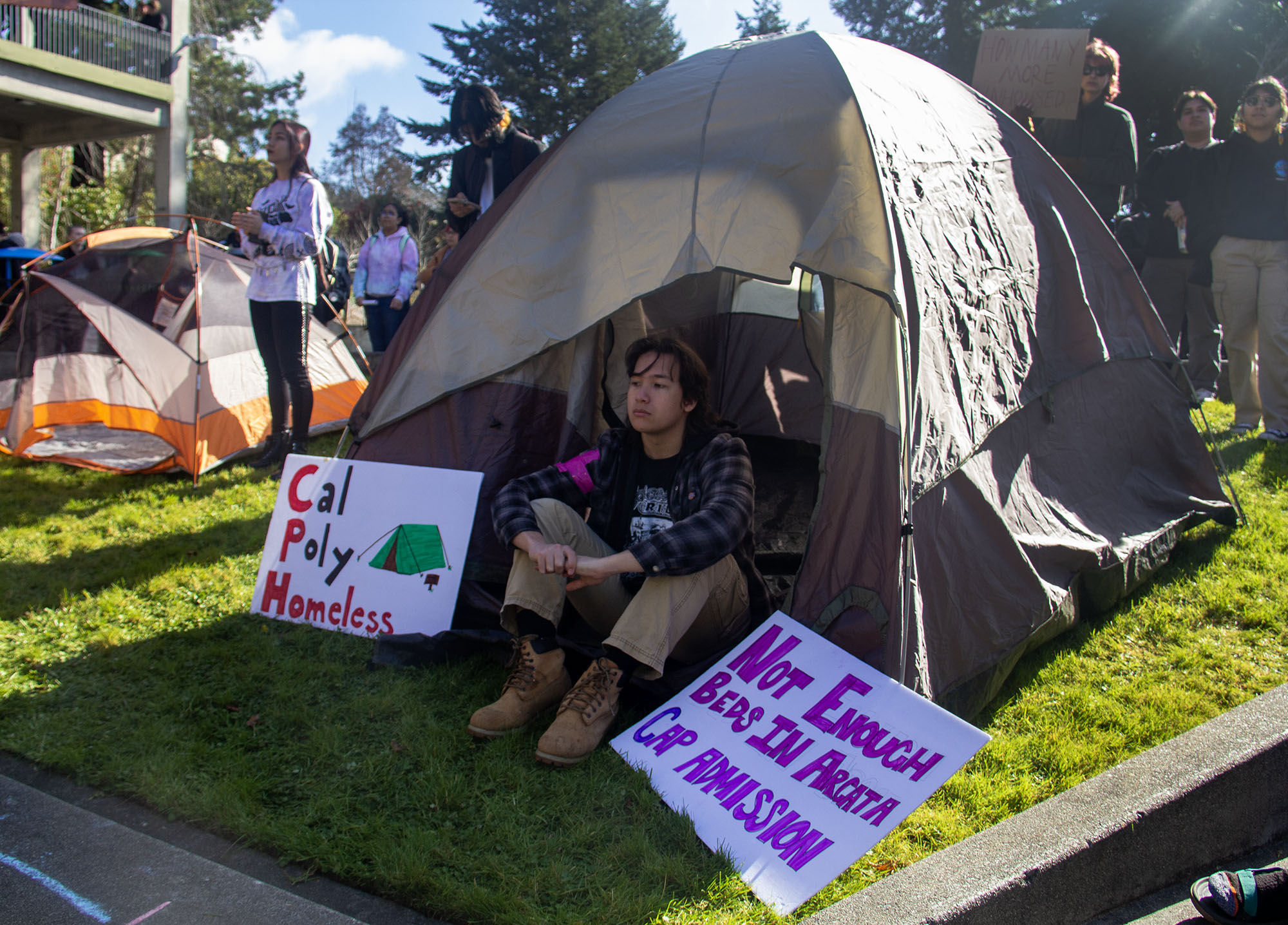
    A housing protest on Feb. 8 in the U.C. quad drew hundreds of frustrated students, many of whom stayed for several hours. Dozens of students used the open mic to share their thoughts with the crowd about the housing crisis, and the impact of the university’s recent announcement that returning students would not be offered the option to live on campus in the fall.

    In the end, the University relented, announcing on Feb. 10 that 600 on-campus beds in Creekview and the College Creek apartments would be reserved for returning and transfer students. In a meeting of the Associated Students Board of Directors, CPH Executive Director of Auxiliary Services Stephen St. Onge provided other updates on the University’s ongoing plans for student housing in Fall 2023.

    Students will not be penalized for leaving on-campus leases early, and will receive partial refunds if they choose to live elsewhere.

    St. Onge said that the University is working on an amenity package for those students who will be living in the ‘bridge housing’ off campus. There are no details yet on what this package will include, or when this information will be available. The housing website explains that students are collaborating with admin on this.

    Students were frustrated by the lack of concrete answers provided by St. Onge on some pressing subjects, as he avoided speaking definitively on any topic outside of specific updates on housing. 

    At the Feb. 8 protest, Ashe Kolden talked about their experience with being homeless. They moved up to Humboldt right as classes were starting in 2020 with their partner. They weren’t able to find a place to live, so for a period of a whole month they lived in a tent with their partner in a campsite in Samoa. The housing coordinator on campus wasn’t able to help them, but they were eventually able to independently find a spot they could afford. 

    “I’m really lucky to have a tent, I’m really lucky to have a camping stove, and I’m really lucky to have [been homeless] while school wasn’t in,” Kolden said. “I’m imagining students living in those situations while school is in….I’m just scared for every student here who’s going to have a similar experience that I did, because 99 beds at the inn is not enough for all the students who are about to be kicked off campus.”

    Plenty of people simply let their feelings loose about the decision, condemning the university administration. University president Tom Jackson in particular was a target, even though he was not present. One student yelled, “Tom Jackson, if you’re listening, fuck you, you’re a little bitch.” 

    Some of the comments were more hopeful. Associated Students At-Large Representative Gerardo Hernandez spoke to the crowd, saying that the Associated Students were there to help. 

    “What I say to [a fifth of CPH students being homeless] is, that’s bullshit…we’re here to advocate for you,” Hernandez said. “We’re all screwed…we need to stand together.”

    Chrissy Holliday, Vice President for Enrollment Management and Student Success, says the University’s goal is to provide roughly 1000 off-campus beds for returning students, adding an additional 650 beds. Where those beds will be located is unknown.

    The themed housing communities on campus, including Rainbow/Gender Inclusive, Sankofa House, Native American Living, and La Comunidad will maintain their number of students, including returning students, according to St. Onge.

    “There are groups from, I would say, some of the more vulnerable populations, members of the BIPOC community, LGBTQ community, foster youth,” St. Onge said. “We will save spots on campus for them to continue on campus should they desire.”

    Lower-level administrative positions have been on the front lines of the university’s response to controversy in the wake of last week’s housing announcement. 

    “I know I, myself, the folks who work in housing, our campus administration, we hear the concern, and we feel it,” Holliday said. “None of this is anything that we do lightly. We are doing everything we can to put the pieces together for our students in a way that alleviates as much of the concern and the negative impact as we can.”

    “There’s not going to be as many beds as will probably fill the need, but we are going to open some up,” St. Onge said.
  • Hunt for new police chief continues despite adversity

    by Carlos Pedraza

    Cal Poly Humboldt is struggling to find a new police chief in the wake of yet another resignation

    For the last two years, Cal Poly Humboldt’s University Police Department has been plagued with resignations at the very top of their hierarchy. Anthony Morgan, the most recent chief, resigned early in Jan. 2022 after a year in the position.

    UPD is still in the early stages of searching for a new chief.

    “Cal Poly Humboldt has not yet made the public announcement for accepting applications,” said Grant Scott-Goforth, a communication specialist in the CPH’s News and Info department.

    The search for UPD’s next leader will be nationwide. Representatives from different university sources will be involved in the decision, including students, faculty, and university police department staff.

    “The University aims for a July 1, or sooner, start of the new permanent chief,” said Scott.

    Morgan was only the latest chief of the campus police to resign. Cal Poly Humboldt’s current acting chief of police is Peter Cress, a 25-year police veteran. He started his career at what was then Humboldt State before moving to Sacramento, and eventually returning to UPD in 2021. Cress stated he will likely apply to become the permanent chief of police.

    Even if the position is filled, the UPD has barely enough officers to be fully staffed. With a more critical eye on police nationwide, the UPD is struggling to maintain leadership and swear in new officers.

    “A lot of people have just said no, they are not interested in living under that kind of criticism,” said Cress.

    For students interested in giving their input for the hiring process or for UPD, the police conduct bi-weekly phone calls with students. The university directory also provides all officers’ contact information, and the general UPD contact number is 825-55-55.

  • Let the bodies hit the floor at RWC

    Let the bodies hit the floor at RWC

    by Matthew Taylor

    On Monday, Feb. 7, the deep and thunderous sounds of student bodies hitting the floor echoed down the halls of Cal Poly Humboldt’s Recreation and Wellness Center. Instructor Mairead Sardina, the department’s Adventure Program Supervisor, pushed student after student onto large cushioned mats. She instructed them to copy her previously demonstrated method of proper falling. This was the second class within Sardina’s “Intro to Self Defense” workshop.

    The course focused on utilizing multiple different martial arts techniques for the purpose of self defense and self empowerment. Lessons within the course included energy cultivation and energy negating practices. Students first began with a simple guided meditation by the instructor.

    “We’re trying to push away the outside world,” Sardina said. “But the reality of meditation is it makes us more connected to the outside world, by being more connected to ourselves.”

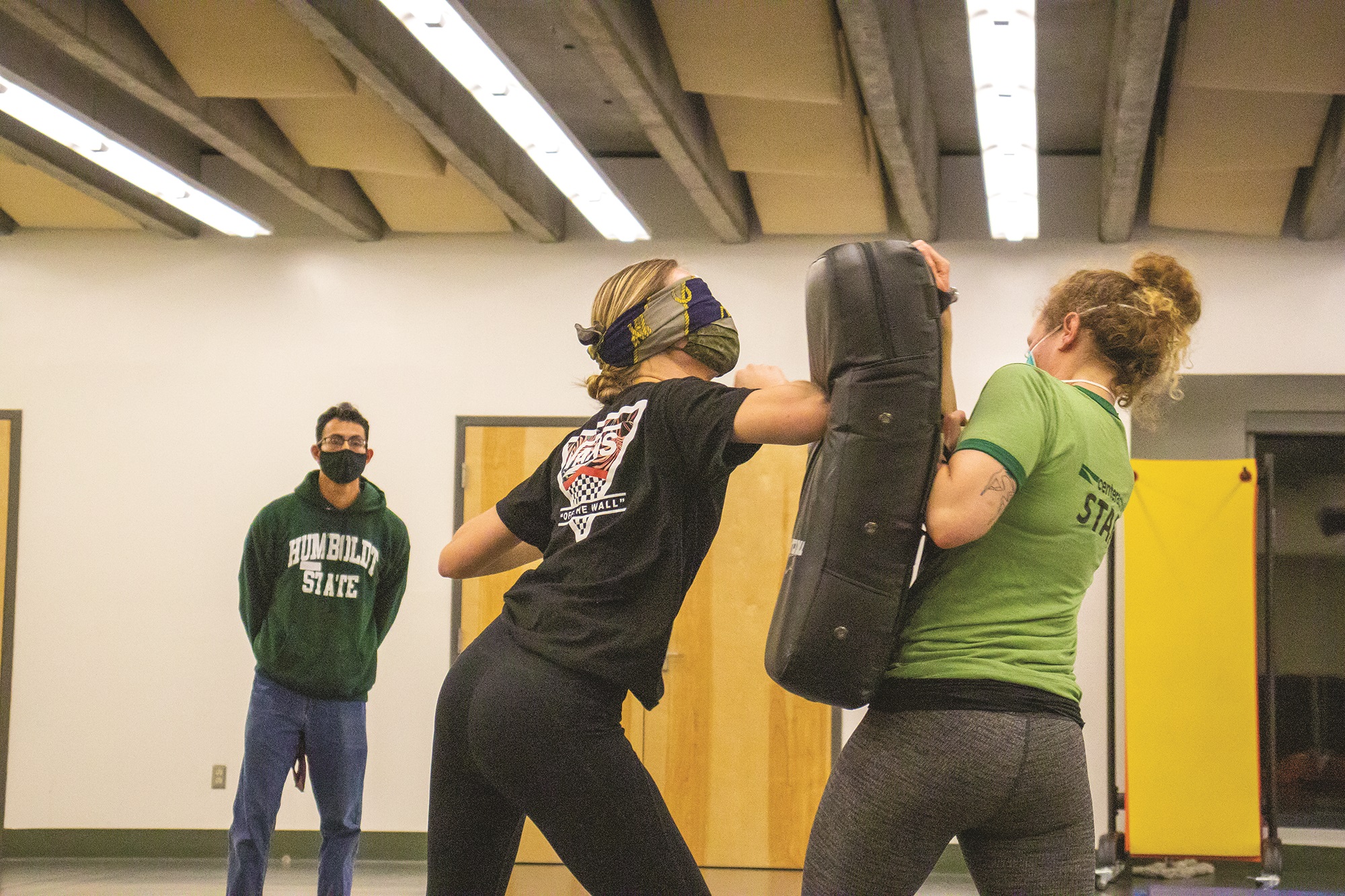
    As the evening progressed the lessons became more physical and hands-on. Lessons would involve activities such as swinging each other around with a red rope and fighting against the instructor whilst blindfolded.

    “The human brain is amazing, it can do insane things,” Sardinia said. “If a parent can flip a car off of a child, we can protect ourselves.”

    Many of the students laughed at each other as they attempted many of the strange yet effective techniques. An audible shock heard amongst them whenever they found themselves accomplishing a seemingly impossible task.

    Photo by Matthew Taylor | Instructor Mairead Sardina (right) teaches blindfolded Theodore Lee (left) to use his other senses when in combat at the Reaction and Wellness Center on Feb. 7.

    “[The classes have] been fantastic,” Theodore Lee, a major in wildlife conservation, said. “I’ve always wanted to learn martial arts and this made me understand the concepts.”

    Another student and participant, Ada Erlewine, a biology major, explained that she had been searching for a self defense course to go to for awhile. She stated that her friend had found the course while checking the RWC website and told her.

    “[I] wanted to be more confident in my body and my power,” Elrewine said, explaining why she joined. “[It’s my] first extracurricular outside of schooling since transferring during COVID.”

    These were the last scheduled workshops, however, future courses may be offered if enough students express interest by reaching out to cntract@humboldt.edu.

  • The moving pieces under Humboldt

    by Carlos Pedraza

    Cal Poly Humboldt sits on top of a very seismically active part of the world known as a the Cascadia subduction zone. This area is composed of three tectonic plates under the ocean off of the Pacific coast.

    The Juan de Fuca, Explorer, and Gorda plates are subducting beneath the continental North American Plate, where the Cal Poly Humboldt campus is located.

    As the oceanic plates push against the continental plate, the friction created leads to deformation and faulting.

    “We live on that boundary where this is taking place, which leads to frequent earthquake activity,” said Cal Poly Humboldt geology professor Amanda Admire.

    In addition to the deformation from the Cascadia subduction zone, the Humboldt region is also influenced by the movement along the San Andreas Fault to the south. Humboldt stands on top of an intersection of three different plates pushing against each other.

    The plates themselves move very slowly, only a few centimeters every year. However, they still generate friction as they move against each other. This is the energy released during an earthquake and tsunami.

    Graphic by Carlos Pedraza and August Linton

    In the Pacific Northwest, both earthquakes and tsunamis are important to prepare for. The Redwood Coast Tsunami Work Group, an organization made up of local government officials, tribes, and relief groups, gives information and warnings in their “Living on Shaking Ground”magazine.

    The magazine states that “more than two-thirds of our large historic earthquakes have been located offshore within the Gorda plate.”

    A tsunami is created when an earthquake along a fault ruptures the seafloor, moving the entire water column and releasing that built-up energy, which moves out in all directions.

    The primary local tsunami hazard, the Cascadia subduction zone, is very close to Humboldt’s coastline compared to other regions in the Pacific Northwest.

    According to Admire, a tsunami produced along the fault between the Gorda and North American plates would only take approximately ten minutes to reach the Humboldt shoreline. In Oregon and Washington the fault is further from shore, allowing for more warning time should there be a tsunami.

    This much seismic activity can be exciting to study for geologists and scientists, but for people living in Humboldt it may be nerve racking. Admire said there is no need for panic, but that residents should prepare.

    The last mega earthquake along the Cascadia subduction zone was in 1700. However, there are still smaller instances of seismic activity as the plates move and push against each other.

    So when an earthquake happens: drop, cover and hold on. If you’re near the coastline, head for higher ground in case of a tsunami.

    To find more preparedness tools and tsunami evacuation maps for the region, check out the Redwood Coast Tsunami Work Group.

  • Campus vandalism causes student outrage over school policy

    Campus vandalism causes student outrage over school policy

    A security camera was vandalized somewhere on campus, so the school responded to this by sending out an email to everyone who lives on campus. This email was simple— someone was messing with the security cameras, and if that person wasn’t caught, everyone who lives in the building would be fined for the damages.

    This announcement caught many students off guard. The email didn’t give out the information of which building was impacted, or what students would be getting charged.

    “Unless a specific individual’s responsibility can be determined, ALL members of a living area will be charged for damages,” said HSU Housing & Residence Life. “The cost to repair, relocate, adjust and/or clean damaged cameras is $150 per incident and identified individuals will be adjudicated through the conduct process.”

    Questions about how much individual students are going to be charged were left unanswered. Donyet King, the Senior Director of Housing & Residence Life says that the fine is regrettable but routine when it comes to vandalism cases.

    According to Section V of the license agreement, “Damage or loss of common area furnishings, equipment and physical plant unless specifically assigned to individuals shall be equally divided among all members of the living group that have reasonable access to the common area.”

    King stressed that faculty would prefer to charge students who were directly involved and are open to information from the public.

    “It’s helpful if students report any suspicious behavior or share any information they have with us that so we can address the issue with the responsible person,” said King.

    Several Cal Poly Humboldt students vented their frustrations with this arrangement on an Instagram page “HSU Confessions”. This page allows students to send in anonymous “confessions” which are then posted by the page’s creator for students to interact with. One post was a screenshot of the security camera email with the caption “Thanks guys…”

    The comments were brimming with furious students.

    “If these mf’s think they can force me to pay for repairs for something I had no hand in breaking, they better rethink, bc I am not afraid to contest this s***,” said one particularly upset student. A majority of the comments were thinking along similar lines. Students called into question why the school would come after student money instead of trying to solve the issues with the security that’s supposed to protect students.

    “Shouldn’t you literally have them on camera messing with them? So either the cameras are s*** or they just want us to snitch. Either way they f****** suck,” said one irritated student.

  • A Look Into HSU’s Annual Crime Report

    A Look Into HSU’s Annual Crime Report

    Clery Act reveals numerous sexual assault cases within the last 3 years at HSU

    Humboldt State University’s 2019 Clery Act Annual Security Report reveals more than three sexual assault cases at HSU in each of the past three years.

    Amelia Wagoner, a victim rights advocate and kinesiology major at HSU, said the problem goes deeper than the statistics suggest.

    “The amount of reported cases here and throughout the nation do not reflect campus safety,” Wagoner said. “The reporting process is traumatic and most survivors don’t want to deal with it.”

    The Clery Act federally requires all higher education institutions to disclose campus crime statistics. The newest report for HSU, released in September, covers crimes from January 2016 to December 2018. All Clery Act reports for California State Universities are available on the California State University webpage.

    HSU’s report notes five rapes in 2016, five in 2017 and four in 2018. HSU doesn’t have the most rape or sexual assault instances within the CSU system, but it did have one of the largest percentages compared to its relatively low student population. Sexual assault victims made up .05% of HSU students.

    HSU requires students to go through a consent course before attending, and all members of clubs or sports teams attend a Title IX seminar once per year. Title IX is a federal law prohibiting discrimination on the basis of sex in federally-funded education institutions, and the seminar focuses on teaching consent culture and anti-hazing.

    Geography major Allie Jones expressed concerns about the faculty behind HSU’s Title IX seminar.

    “At HSU, nobody on the Title IX team is a woman,” said Jones. “I’m sure the coordinator is qualified for his job, but as a woman I’d feel more comfortable having another woman to talk to.”

    For now, Wagoner urged students to play their part in improving campus safety.

    “Make sure everything is okay,” Wagoner said. “If you see or hear something that doesn’t seem right, do your part to make a difference.”

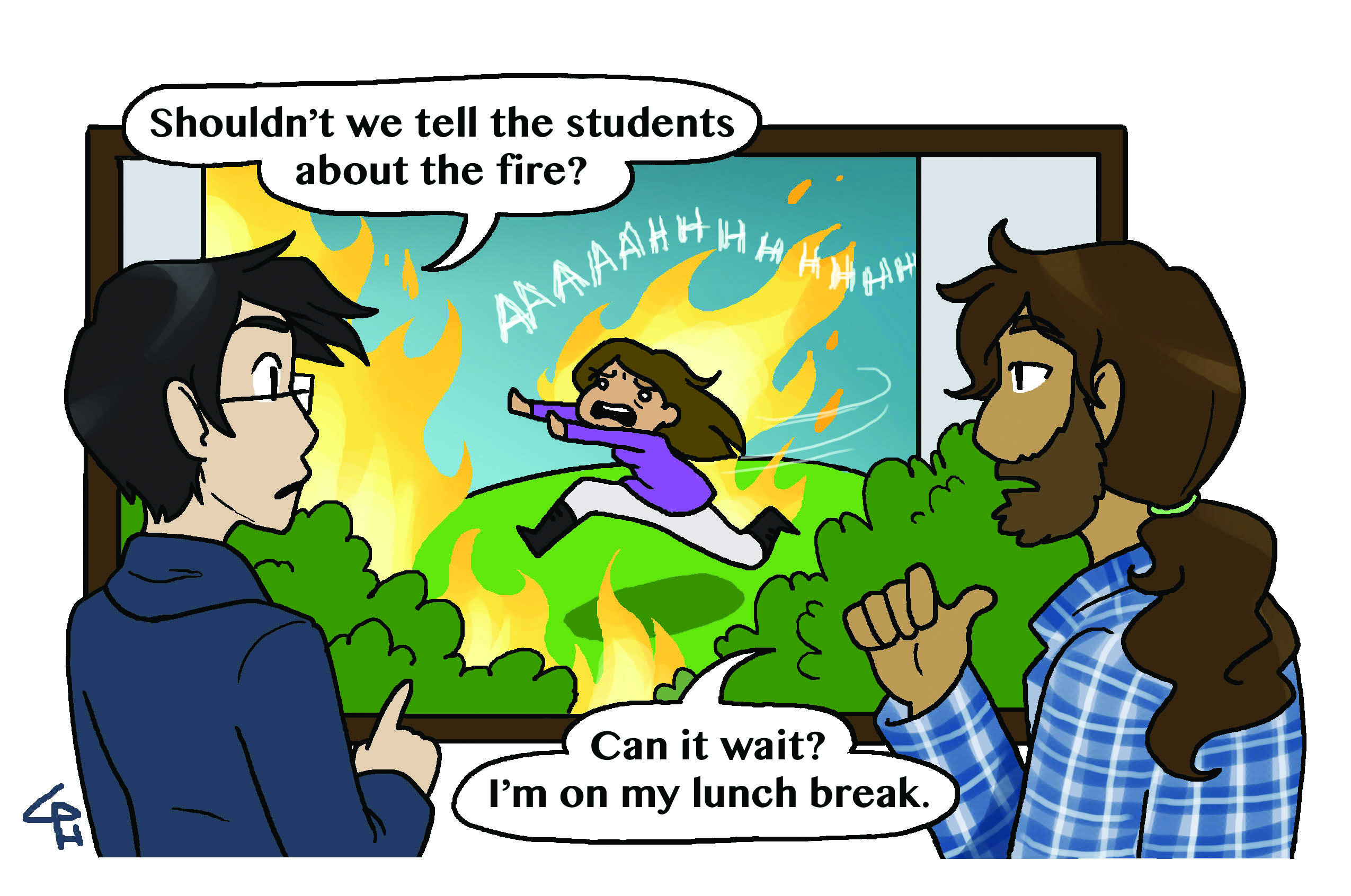
  • EDITORIAL: Warn us faster HSU

    EDITORIAL: Warn us faster HSU

    Our safety lies in the university’s hands, we want to know what’s going on

    As college students who pay thousands and put our safety in the university’s hands, we live on campus expecting to be safe. But that’s not what’s been happening.

    Last weekend a student assaulted another student on campus. This assault went unnoticed until nearly 24 hours later when the school sent out a mass text and email stating what had taken place.

    In our staff we have editors who have attended various colleges before HSU and recounted stories of students who weren’t alerted of crimes on time. Notices were given out days later if at all.

    There were some instances where students would hear about assaults and harmful events on campus from fellow students rather than the school themselves.

    When you’re a senior in high school looking for schools to attend, one thing that you’re not told to look out for are schools that fail to alert you if there is a dangerous person on campus. You’re not told to look out for schools that fail to alert their students about assaults, rapes, etc.

    In the past academic year at HSU we have received a lot of big news via mass emails and texts within hours of it occurring. We think that no matter how small or big the event, we should be alerted as soon as possible.

    We want to be told of everything that goes on on our campus. We do not pay for the school to decide what is worthy of being sent out in mass messages. We are tired of these messages being inconsistent with their timing.

    The amount of time between when an assault happens on campus or a student goes missing and when the school sends a message should be the same amount of time. One shouldn’t be told to students faster than the other. They are both serious events and they both should be treated as such.

    We want to feel safe on our school campus.