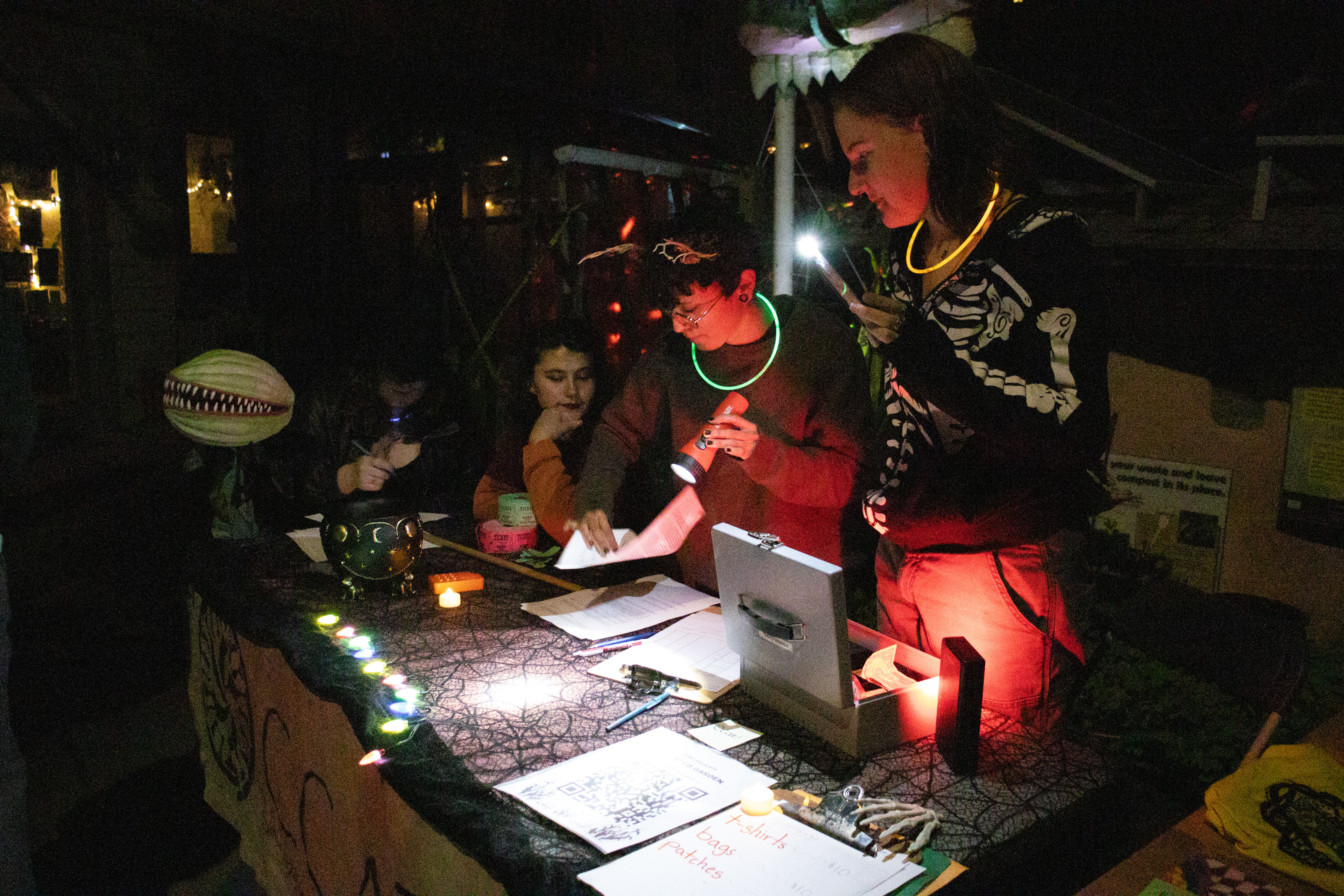
On the edge of campus, the sound of Michael Myers’ theme floated up from the entrance to the Campus Center for Appropriate Technology’s Buch House. The garden, normally home to a variety of edible crops and other plants, was transformed into a maze with shadowy figures lurking in every corner. Guests in a variety of costumes from Little Red Riding Hood to Sonic the Hedgehog paid the one dollar entry fee and vanished into the maw of a green monster with curled horns.
CCAT’s Haunted Garden event on Oct. 28 garnered lots of attention from students and community members this year, and I had to see for myself if the scares were worth the one dollar entry fee.
After I passed the toothy threshold of the maze, four small pumpkins with “CCAT” carved into them were the last remaining comfort before I was enveloped in darkness. A string of colorful fairy lights outlined the pathway and added to the whimsical atmosphere, but did little to illuminate the surrounding decor. Going in, I was aware that there were volunteer scare actors, but I greatly underestimated their dedication to their roles.
Photo by Griffin Mancuso. The entrance to the CCAT Haunted Garden.
I started my journey through the haunted garden behind a group of guests, so I got a ten-second notice before any upcoming scares. Unfortunately, it was so dark that I couldn’t tell where they were coming from or what they looked like.
A mysterious figure wearing a ragged newspaper mask, who I initially assumed was a part of the group in front of me, suddenly turned around and gave me the most uncomfortable eye contact for a solid 20 seconds. The eye holes in the mask were small, black pits that I couldn’t bear to look away from. I expected them to eventually scream or lunge towards me, but they eventually stepped to the side, watching me closely as I rushed forward.
I became highly aware of my surroundings after that. I passed another actor who had finished scaring a group ahead of me and decided to watch me silently, crawling around in a way that I don’t think humans are supposed to move. I turned around to make sure no one was following me, only to notice a decapitated torso near the trail’s fairy lights (a fake one, thankfully).
Following the steady incline to the upper level of the garden, a disembodied voice whispered, “Boo!” I whipped my head around to see an actor dressed in all black smiling at me, crouched behind a bush. I decided to try being funny, raised my hands in the air, and loudly went “Ah!” The sound of their ominous giggling followed me as I continued.
As I walked along the upper ledge, a rare source of light from a workbench area appeared ahead of me. As I got closer, the roar of a weed wacker met my ears as an actor revved it in the direction of a group ahead of me. I was not initially startled, but my face twisted into an uncomfortable frown as I saw who was holding the weed wacker. The actor wore a dull, flesh-colored mask with no features besides a large mouth with sharp, bloodstained teeth.
I was caught off-guard twice after that. As I walked along the upper ledge, I was startled by an actor in a clown mask whose blood-curdling scream made me jump out of my skin. I rushed forward through a section of the garden that was lined with tarps. As I turned around a corner, I screamed again as a witch with a shrill cackle lunged towards me. I cursed my tendency to easily startle and pressed forward.
Hiding in a corner just before a short descent was a person in a full body black suit with large googly eyes pointing in opposite directions and a toothy grin. While this actor’s costume was almost comedic, it was a little less funny once they started shuffling towards me while making intense googly eye contact. They reminded me of a spider, but one of those terrifying, giant Australian kinds.
Just past the last source of light in the maze where a three-foot tall skeleton lounged in an Ace Hardware wheelbarrow, I heard a stream of chilling laughter behind a corner. I approached nervously and found that the laughter was coming from a ghostly nun with black lipstick. I was more impressed than anything and felt compelled to tell them. They seemed flattered.
I stepped out of the maze back onto the blacktop leading up to the Buch House, slightly frazzled but satisfied with my experience. For a haunted maze set up in a small garden with a limited budget, it was definitely worth more than a dollar.
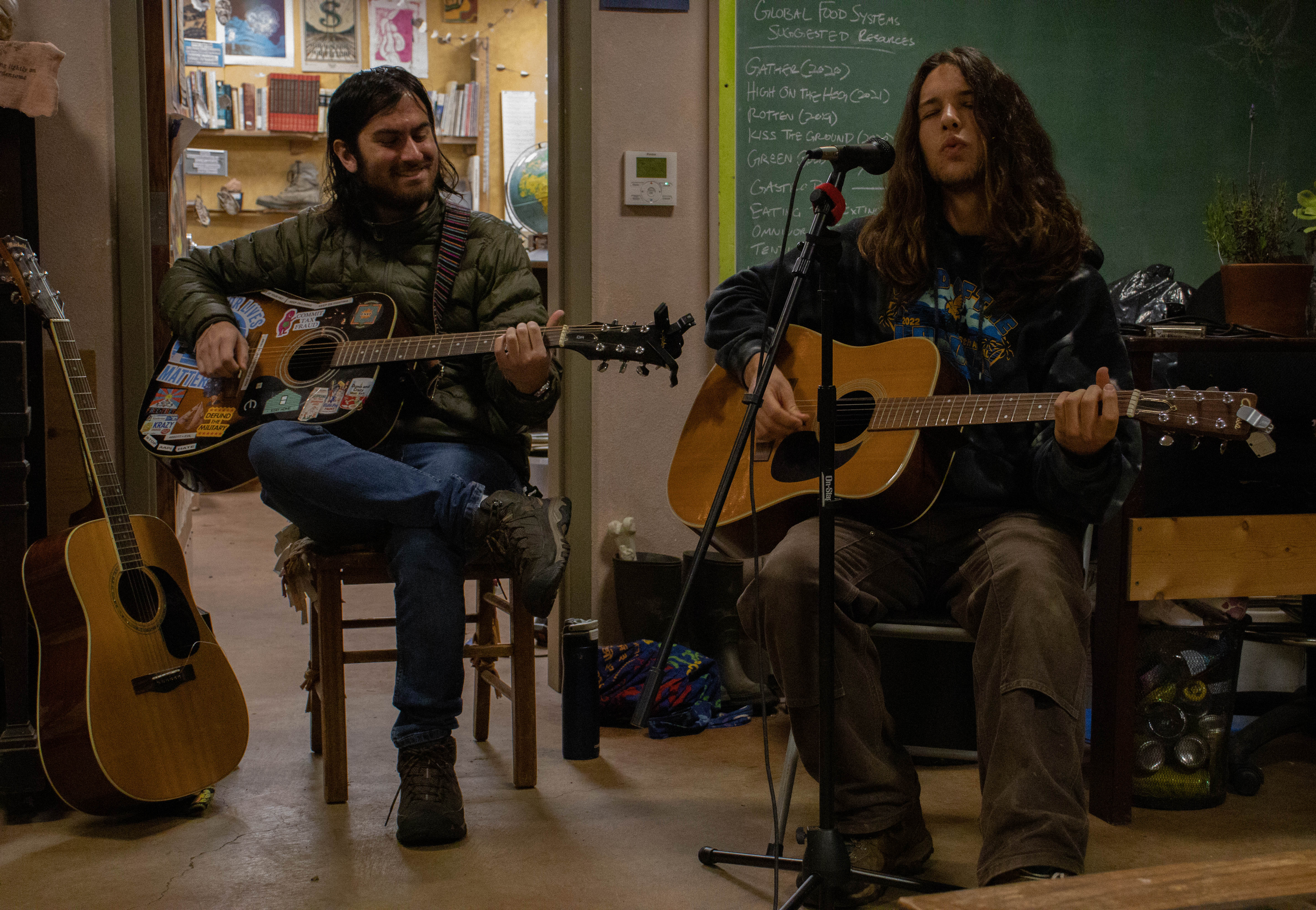
The Campus Center for Appropriate Technology (CCAT)’s first open mic of the semester took place at the Buck House on a snowy February 22nd. The night began without a microphone, which would likely have been an issue at any other performing arts event. However, it seemed the crowd of nearly fifteen students were all aware of the same truth: The only necessary ingredient for an open mic night is willing participants. By all meaningful measures, the night was off to a perfect start.
Jack McCann, who goes by the stage name Mushroom Jack, announced to the growing audience that he had an amplifier cord in his room across campus. Then, as if he was a majestic snow bunny, Mushroom Jack sprinted out of the cozy Buck House to retrieve the cord.
Indigo Thomspon was first to take the stage. She opened the night with an original poem which she couldn’t remember when she originally wrote. She confidently set the tone for the night and closed with “Fate won’t let you live your life in vain,” to unanimous applause from the crowd.
In the meantime, our hero Mushroom Jack returned with the amp cord. Unfortunately, lady luck was not doing us any favors and the amplifier chord Mushroom Jack brought required a converter to plug into the amp. Undeterred, Mushroom Jack again braved the elements, to retrieve the right converter from his lair.
Without missing a beat, Julia Simmons took to the stage and began dropping joke after joke, as if she were a seasoned road comic. The crowd erupted in laughter and even began firing jokes back at Simmons.
“What do you call a cow with no legs?” an audience member shouted from the back of the room. “GROUND BEEF!”
This was a real hoot and absolute holler, obviously. There is never a bad time for dad jokes, depending on who you ask.
The atmosphere was so welcoming that I could not stand by like a journalistic fly on the wall. I have one joke ready at all times for critical moments like this. “What is the difference between a cottonball and a lizard? … A lot of things!”
After some minutes of jokes, there was a general consensus in the room that if we continued with the comedy, Jay Leno would be out of work.
Next, James Lara harnessed the now-rowdy room with a heartfelt poem simplifying the complexities of life and attachment, ending his set with “Desire and longing pulls you farther away.”
Jack Hellesoe, known as Bird Jack, was not to be confused with Mushroom Jack, I was warned. Bird Jack opened with a unique cover of “New Slang” by the Shins to the beat of various audience members on tambourines. Bird Jack then played an original song, written “during a time of social uncertainty.”
Having endured the chilly night air twice to get both an amplifier chord and converter, Mushroom Jack finally joined Bird Jack onstage. A solid cover of Neil Young’s “Down By The River,” led to an unforgettable original performance of a song detailing the tribulations of a mushroom. It was Flight of the Conchords meets Pink Floyd meets Paul Stamets with a sprinkle of Mid 80’s Ozzy Osbourne.
Leaning into the finally functional microphone, Mushroom Jack belly-sang, “What would YOU do if I was a mushhhhhrooooom?”
He then paused for a perfectly timed guitar solo as Bird Jack held rhythm on his wonderfully stickered guitar. Reading the crowd’s energy, Mushroom Jack brought us back down like a seasoned symphony conductor, abruptly yelling into the mic with authority, “It’s antibacteriaaaaaaal!”
It was a night of firsts, too. With the support of the crowd, Isabella Jug got on stage to sing in front of people for her first time ever. Bird Jack improvised chords even though he’d never played through the song before. The level of talent in the room was only outdone by the complete support from everyone there.
Danika Zikas and Julia Simmons finished out the night with a song written in the throes of a mushroom trip their freshman year. The fungi-inspired song was being unveiled for the very first time for the audience huddled inside the Buck House. Jug provided gentle harmonies from the couch while Mushroom Jack laid out a soft guitar section to complete the soundscape. It was a beautiful team effort. The final act of the night was the roaring applause from the throng.
CCAT will be hosting monthly open mics throughout the semester. Find them on instagram @ccat.humboldt.
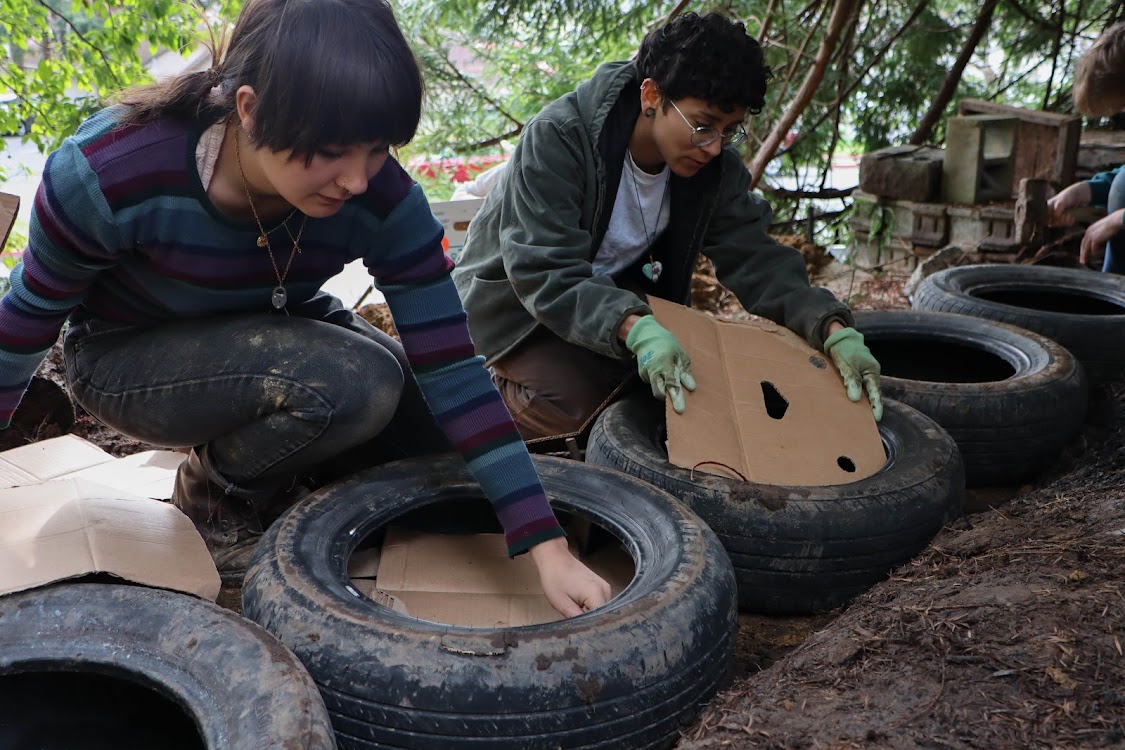
The Campus Center for Appropriate Technology began construction of a tire retaining wall in their on-campus garden at Buck House. Constructed by CCAT directors, instructors and volunteers, the retaining wall is part of CCAT’s project to rebuild the existing Reclamation Station structure located in their garden. The structure has served as storage for students to donate and access reclaimed building materials.
Made from used tires, the retaining wall is needed to support the sloped landscape where the structure is located. Following the wall’s completion, project managers and volunteers are working towards utilizing natural building materials to complete the project.
The goals of the rebuild are to increase usage of reclaimed materials through safer and easier access. With a budget of $1,000, the project is proposed to be completed by May 5th of this year.
Spearheaded by project organizer Maddy Hunt, the project is aimed at promoting sustainable practices and techniques as well as serving as an example of utilizing appropriate technology in construction projects.
“The shed uses natural building methods which are focused on using reclaimed materials, minimizing ecological impact, and inviting community participation,” Hunt said.
Plans for the rebuild include construction of a wall made of hempcrete, a natural alternative to concrete. CCAT intends to collect data on usage of the material within Humboldt County in an effort to understand and demonstrate the feasibility of hempcrete to address housing needs within the community.
External Co-director James Lara added that CCAT’s overall goal is to encourage sustainable resource and energy use.
“We are in a live-in demonstration home for sustainability and to live lightly on the Earth,” Lara said. “It’s about engaging students to have more experience with sustainable living.”
Construction of the retaining wall is nearly complete, and project organizers expect to continue the groundwork for the structure in the next coming weeks with the help of students and volunteers. Hunt aims for the project to be a practical example of the organization’s goals.
“It can be a demonstration for Cal Poly Humboldt,” Hunt said. “Especially for us to demonstrate [sustainability building] here at CCAT. It’s going to be a really cool way for us to connect with that and to be a part of that process.”
Hunt added that the project has potential for showing the university and surrounding community the viability of natural building, noting the relatively quick project timeline.
A soon-to-be graduate from the Environmental Studies program, Hunt mentioned that the reclamation project is the culmination of what she has learned in her degree.
“It’s equally stressful as it is gratifying to be putting theories into action, and seeing it come together as not only a completed project in the end, but also as a network of people working towards a sustainable future,” Hunt said.More information on the project and techniques being used can be found at www.appropedia.org/CCAT_reclamation_station_2023. Those interested in aiding in the project’s completion are encouraged to participate in CCAT’s Volunteer Friday events, which occur weekly from 10am-12pm and 1-4pm. More information can be found on the organization’s website at ccat.humboldt.edu/ and Instagram @ccat.humboldt.
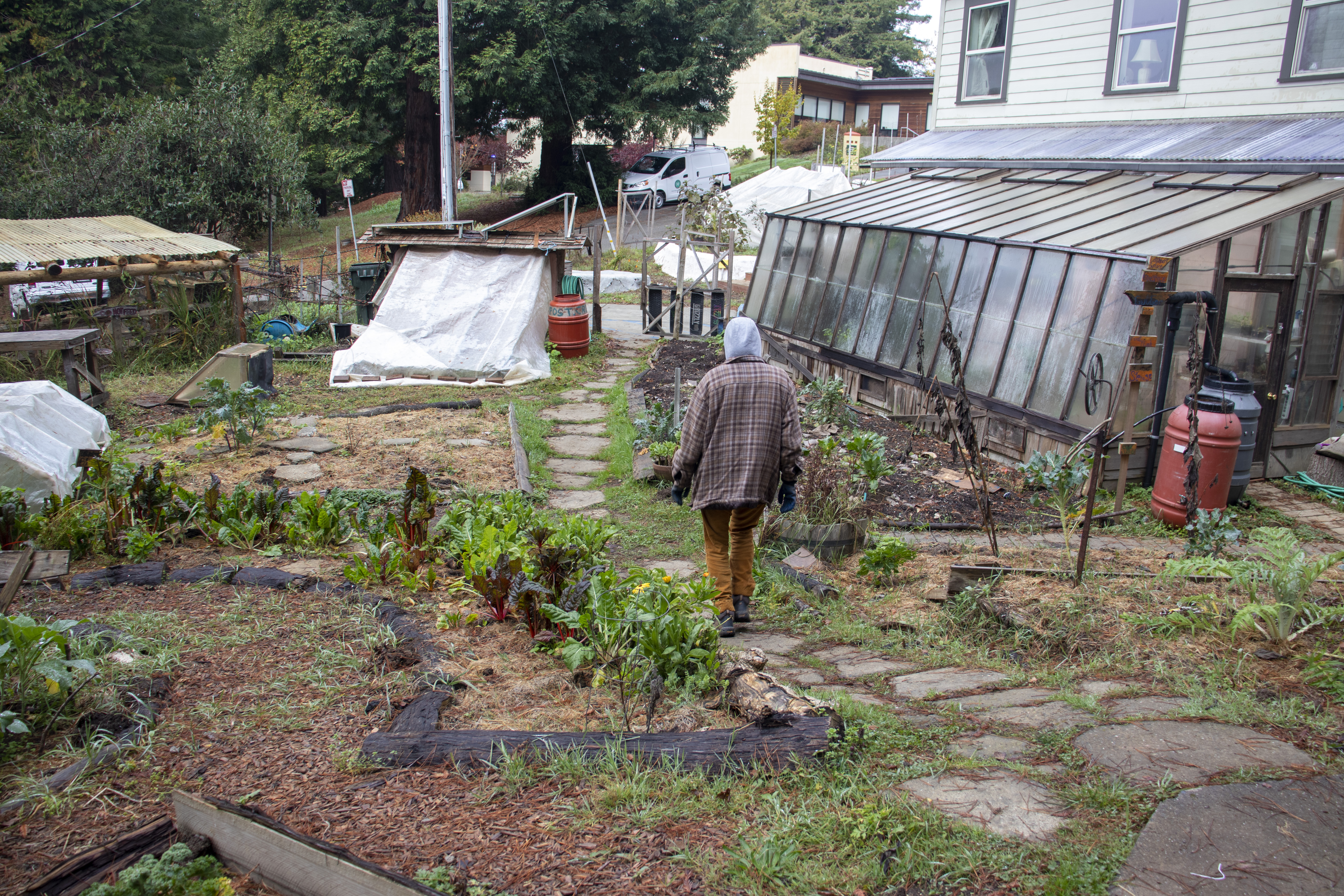
CCAT courses are back this spring. One of the classes on the roster this semester is Organic Gardening. In this one-unit course, students will learn the basics of gardening. Students grow their plots in the campus community garden using sustainable techniques.
Since the pandemic disrupted CCAT operations, the course has not been offered. Now, the course has returned, and students have a lot of work ahead of them. Ben Cross is a political science major who’s more than excited to be back in the Buckhouse.
“I’ve got lots of passion for this, and it’s an amazing area to learn it,” Cross said. “If there is a place I’d want to take this class, it’s at Humboldt. I want to have my garden and tend to it with confidence.”
Julia Simmons is the student instructor of ENST 123.
“We’re teaching the basics of what goes into gardening,” Simmons said. “I want to focus on how plants affect each other. Some plants have nitrogen-fixing properties and support other plants in the soil. I want to teach students to cultivate ecology and grow food forests.”
Food forests are a farming technique that mimics the natural patterns found in ecosystems. Growing plants interact with each other in a network of reciprocal relationships. The result is healthy biodiversity, nutrient-rich soils, and a sustainable food source.
Agroecologic farming methods have the potential to localize food systems and make them more efficient. A 2018 study titled “Permaculture—Scientific Evidence of Principles for the Agroecological Design of Farming Systems” by the EU Institute for Environmental Science establishes environmental damages caused by industrial agriculture. Monoculture causes biodiversity loss, soil degradation, and alteration of biogeochemical cycles and greenhouse gas emissions. The study cited food forests to remedy the damage done by monoculture.
Monoculture is the standard agricultural practice in the United States. Crops are planted in rows, where they can be most efficiently harvested by machine. Though it is convenient for machinery, this practice does not benefit plants or local ecologies. Without ecological support and context, isolated crops require fertilizers and pesticides to grow.
Plants can fend off pests and fertilize each other in food forests. One example Simmons describes is the three sisters. This pairing of beans, squash and corn, comes from traditional ecologic knowledge.
“They grow really well together, and they use each other to grow well,” Simmons said. “The beans provide nitrogen for the other plants to grow. Ground cover [from the squash leaves] keeps weeds from growing.” The tallest sister, corn, acts as a trellis for the beans to climb up. Growing together, they protect each other and help one another flourish.
“We’re going to be working in the community garden. We’ll design food forests with their own ecologic networks,” Simmons said. “I want anybody to be able to garden, and everyone should garden.”
Edible and medicinal plants grow in every corner of campus. Students can learn to forage for them in Campus Center for Appropriate Technology’s new Foraging class. Josefina Barrantes and Sandra Zepeda are the student instructors of ENST 123. The course expands on their research of ethnobotany on the Cal Poly Humboldt campus.
Ethnobotany is the study of plants and how people use them. Zepeda and Barrantes spent the last year mapping and researching edible plants on campus. Their map shares a location, name, and photos of plants with ethnobotanical purposes. Students will use the map along with information taught in the class to forage on campus sustainably. The map includes native plants that grow in the area and non-native plants used in landscaping.
“It’s comparable to urban foraging because we’re not actually nature, we’re on a university campus,” Zepeda said. “A lot of the edible plants on campus are not native, they’re just for decorative purposes.”
The course will highlight how plants like mountain pepper (Tasmannia lanceolata) can serve as a seasoning alternative and also have medicinal uses.
“This plant was significant to aboriginal people, they used it to make medicines and tinctures,” Zepeda said, between nibbles of a leaf. Indigenous groups used the mountain pepper to treat stomach aches, colic skin disorders, and toothaches.
As its name suggests, the mountain pepper is spicy, but it is not quite a pepper. Instead, it is a shrub that uses a tricky chemical reaction to taste spicy, rather than capsaicin like many spicy plants. The pepper taste comes from the compound polygodial, a C15 sesquiterpene.
According to a study published by The Australian Institute of Food Science and Technology titled “Native Australian fruits — a novel source of antioxidants for food,” the mountain pepper had more than three times the antioxidant levels of blueberries.
The instructors shared some of their favorite foragable plants on campus. The Dog Rose (Rosa canina) provides bright red hips packed with vitamins and has many common health benefits.
Some campus plants have simple uses, like in-between-class snacks. Bolivian fuchsia (Fuchsia boliviana) offers bright flowers and juicy berries. The strawberry tree (Arbutus unedo) also has round edible fruits.
The ENST 123 course is the result of several attempts to bring sustainable foraging on campus. Barrantes and Zepeda are enabling students to rethink food sustainability.
“We started this project so that we could add more edible landscape,” Barrantes said. “To show this is what we have and we could do more, and also supports the desire for more sustainable food projects, like the food sovereignty lab or starting an off-campus farm.”
HSU students continue to pursue a zero waste lifestyle despite the additional obstacles presented by COVID-19
Humboldt State University is synonymous with an eco-friendly, green lifestyle. This year, student sustainability values have been put to the test with a nationwide shutdown and a closed campus.
Sage Palacils, freshman at HSU, was raised in a household that emphasized the importance of sustainability and has been living eco-consciously their entire life.
“I’ve been practicing [sustainability] since I was young and the practice, more than the reasons are ingrained in me,” Palacils said. “I grew up really poor and we really didn’t have money to keep replacing things or not be sustainable.”
Since the pandemic began, Palacils’ carbon footprint has been significantly reduced, after they moved to Humboldt and stopped driving. Palacils also found they don’t miss shopping in the massive malls back home in Los Angeles, because they don’t see a need to be flashy this year.
“Since I don’t go out much, I don’t really buy clothes,” Palacils said. “I don’t really shop online. I kind of reuse the same clothes I have because of the pandemic.”
This semester, Co-Director for HSU’s Campus Center for Appropriate Technology Klara Hernandez is attempting to provide students with a virtual substitute for the resources and sustainable living information they would have access to in a normal semester.
“I feel like if I lead by example, people will become aware,” Hernandez said. “[I] just want to show that it’s possible that we can change individually. But at the same time, we have to attack this at the source, the corporations and big businesses, the people in power making the environmental impacts.”
Hernandez originally got involved through their volunteer Friday events, which are not currently offered. The hardest part about being a member and leader of CCAT for Hernandez this semester has been having to turn away eager students because of the HSU’s pandemic policies.
“We have to tell them no and it’s sad,” Hernandez said. “People really want to get involved and get their hands-on experiences, which is what we’re all about – providing that and serving the students, but we’re not able to.”
HSU Waste Reduction and Resource Awareness Program Outreach Director Skylar Fisher believes the pandemic has proved the human race is ill equipped to tackle the much larger issue of climate change.
“[If] we are not capable of responding to something as serious and as widespread as COVID, then we’re not gonna be able to be prepared for climate change,” Fisher said. “I’m very fortunate because I’m not extremely impacted by [climate change] yet, but you see all these communities that are and I think living sustainably is the least I can do.”
Unfortunately, Fisher believes a majority of the sustainability advice floating around the internet comes from insincere influencers who are seeking an easy paycheck.
“I think the current environmental movement is incredibly whitewashed. A lot of people having these conversations have taken it on more so as a fad than as something that they think can actually benefit our greater systems,” Fisher said. “It’s not so much about making a positive impact on the environment, it’s more so buying these products to make more products.”
Practices like upcycling, thrifting, composting and growing your own foods can significantly contribute to a reduced carbon footprint. Fisher emphasized not putting yourself down for things your unable to accomplish, instead being proud of what you did.
“It is impossible to expect everyone to be completely zero waste, but the important thing is to stay as aware as you can and reduce what you can.” Fisher said. “Just being aware, I think that’s the most important thing.”
Given the precautions taken to prevent further spread of COVID-19, living a sustainable lifestyle has become significantly more challenging as stores safeguard their produce in plastic and purchasing in bulk items is no longer an option.
“It’s super hard to get a hold of cheap, quality, low waste products and that has only gotten more difficult as the pandemic has progressed,” Fisher said. “[In the past] zero waste was the way that you lived if you couldn’t afford to waste, but it’s kind of been swapped now because plastic is subsidized, so it’s really easy for everything to be wrapped in plastic products. Which is hard on the consumer who now is blamed for wasting plastic.”
For Fisher, the bottom line when it comes to waste reduction and sustainable living is that we all need to get involved and do our part in order to succeed and for species to survive.
“[Reducing carbon emissions] is something that is very abstract to a lot of people but is very real and we need to understand that this isn’t just a competition to see how little trash we can throw out every week,” Fisher said. “There’s really real ramifications behind our waste output.”
Here’s how HSU received the trees and where you can find them
Humboldt State University has a handful of redwood trees grown from seeds that went to the moon.
In 1971, astronaut Stuart Roosa brought around 500 tree seeds with his personal items on the Apollo 14 NASA mission to the moon. Roosa intended to test the seeds to see if space radiation would affect their germination. While he never set foot on the moon, he orbited the moon 34 times while his colleagues walked the lunar surface.
When Roosa returned, he sprouted most of the seeds. NASA then sent the seedlings around the world. Around 1976, HSU received a handful of redwood seedlings and planted them around campus. Some of those trees remain near the theatre arts and natural resources buildings and near the Campus Center for Appropriate Technology and Facilities Management.
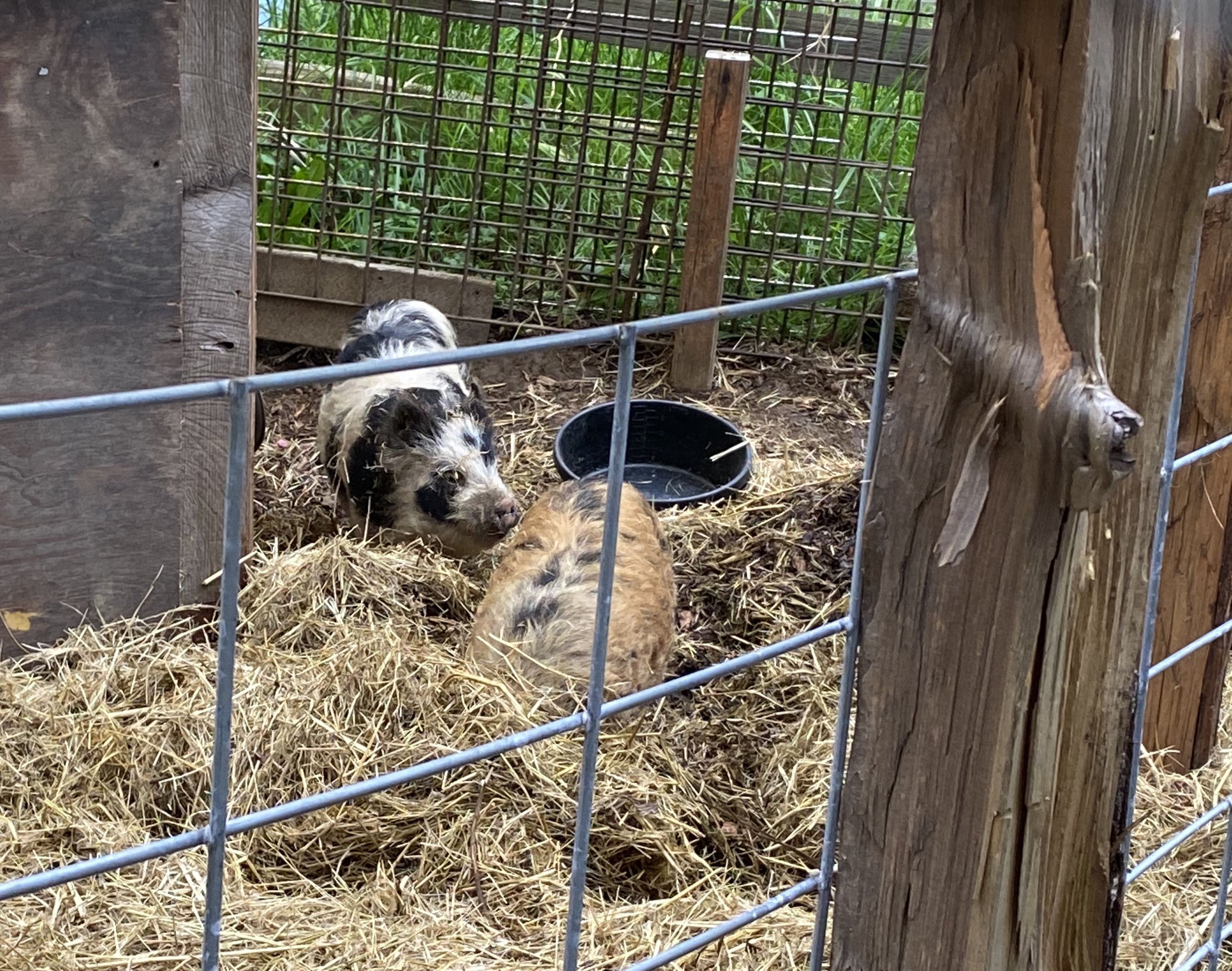
A few weeks ago, two little piggies went wee-wee-wee all the way home to the Campus Center for Appropriate Technology. On-campus dining services like The J are working with CCAT by delivering their compost to feed the pig project. Instead of the food waste going to the bin, it can fill the bellies of the pigs.
CCAT acquired the two baby kunekune pigs from Tule Fog Farm in an attempt to reduce Humboldt State’s organic carbon footprint.
Ben Nguyen, the primary animal caretaker, farmer, project manager and a co-director of CCAT, explained that, depending on their nutrient demand, the pigs will eat as much or as little as they need in order to maintain healthy growth.
“Usually what we pick up from The J is around 10 pounds of food a day,” Nguyen said.
The kunekune pig is a small grazing pig that can survive on a low-calorie diet and can weigh anywhere from 150 to 400 pounds. Although different breeders may breed for a smaller size, the pigs from Tule Fog Farm average around 200 to 300 pounds, making them the ideal size for an on-campus composter.
The pigs will probably be on campus at CCAT eating food waste for the next semester unless someone wishes to keep the project going through the summer and so-on, since Nguyen will be graduating in May.
Some students are against keeping the pigs and are seeking to purchase the pigs and send them to a sanctuary. But for now, after the completion of the project, the pigs are arranged to be returned back to Tule Fog Farm.
Before they were adopted by CCAT, Shail Pec-Crouse, Tule Fog Farm owner and farmer, introduced the pigs to a diverse diet. Tule Fog Farm pigs ate compost as a nutritious supplement to their natural grazing diet of fresh grass.
“We take kitchen waste from a couple of local restaurants like Slice of Humboldt Pie and Los Bagels,” Pec-Crouse said.
Pigs are omnivores and need a diverse diet consisting of grains, fats, protein and greens. This diverse diet makes them an excellent option for getting rid of food waste or any organic waste in general.
According to Oxymem, a DuPont brand, when food waste is thrown in the trash and decays unnaturally among plastic and other non-biodegradable things in landfills, a toxic liquid called leachate is produced, which has a high ammonia concentration that isn’t easily biodegraded. Compost solves this problem by keeping biodegradable materials out of landfills so that it can continue its life cycle and be returned to the ground naturally.
Robert Just, a local livestock veterinarian, described the relationship between human trash and pig diets as an evolutionary interaction. He explained that since humans and pigs have lived symbiotically for so long, their gut biomes may have adjusted to eating our over-ripe food waste.
Pigs have digestive tracts that are unique to livestock animals, but are similar to the human gut. They have one simple stomach, just like people. Pigs are omnivores and need a diverse diet consisting of grains, fats, protein and greens. This diverse diet makes them an excellent option for getting rid of food waste or any organic waste in general.
“Pigs aren’t indestructible though,” Just said. “And they are still susceptible to illness from molds and some fungus, but this can be easily avoided by cooking the food into a slop.”
This project is one more step towards increasing sustainability on campus and problem-solving to reduce food waste.
Composting can be one of the most beneficial ways to handle waste
Learn the steps to compost.
Every Wednesday, the trash bin, filled with whatever waste was tossed during the week, goes to the curb to be picked up by Recology and shipped off to a landfill.
Forty percent of the waste that ends up in landfills is food waste, according to Recology. This can include raw scraps from food preparation, old sandwiches left to rot and unwanted leftovers. When food scraps end up in a landfill, the material is not just waste, it’s being wasted.
“The average American generates 4.4 pounds of garbage a day,” the Recology site says. “Don’t let your food scraps go to waste.”
Illustration by Collin Slavey
It’s a big deal if food waste gets tossed into landfills. Besides taking up space in our already overwhelmed landfills, food waste doesn’t decompose properly in such settings. For example, an apple that falls above ground breaks down into useful nutrients like nitrogen, which enriches the soil. Underground the apple isn’t able to break down.
Buried in a landfill, the apple is in an anaerobic environment, meaning that it is starved of oxygen. Anaerobic decomposition creates some nasty byproducts. The most malicious of these byproducts are methane and liquid leachate. Both of these are pollutants with consequences.
“Fortunately, avoiding these pollutants is simple. Just compost it,” international waste management firm ToWaSo said. “Food and yard waste can be reused and turned into nutrient rich compost. Composting exposes the green waste to oxygen, allowing it to decompose as it would in nature.”
Humboldt State does compost food waste. According to an email from TallChief Comet, the director of sustainability, energy and grounds keeping with Facilities Management, HSU compost is managed in two ways. The Waste Reduction and Resource Awareness Program manages the composting bins on campus, while food waste is diverted from dining services.
“The on-campus composting process is handled by WRRAP and is using the material from the public compost bins scattered around campus,” Comet said in an email. “This material goes into an Earthtub composting vessel, located at Facilities Management and processes about 10,000 lbs (5 tons) of material per year.”
“The average American generates 4.4 pounds of garbage a day. Don’t let your food scraps go to waste.”
Recology
“The food-waste diverted from all the dining locations on campus is collected by FM waste and recycling staff into a large pre-composting container,” Comet said. “About every three weeks it is transported by Recology (a local waste hauler) to a vermicomposting facility in Dows Prairie run by The Local Worm Guy.”
“The best effort students can make is to not generate waste in any form to begin with,” Comet said. “For compostable waste they can achieve this by not purchasing more than they will use/consume during the anticipated period.”
But composting may very well be appropriate. Composting may seem like an intimidating, tedious and smelly thing to do, but with a bit of practice it becomes second nature. Working with local resources like the Campus Center for Appropriate Technologies can help prepare a student for their own compost bin.
Jacob Gellatly, an active member of CCAT, recommended that students learn about composting.
“Before a student starts composting they should learn a few things,” Gellatly said. “It is critical to get educated on the process of composting. Learn the recipe.”
Students at HSU participated in the iNaturalist-sponsored Mycoblitz to contribute to the North American Mycoflora project
Humboldt State University’s Mycology Club is collecting samples of mushrooms and sending them to Purdue University for DNA testing.
In association with iNaturalist, the Humboldt Bay Mycological Society and the North American Mycoflora Project, the Mycology Club is helping a national team of scientists record the location and species of as many fungi as possible.
The North American Mycoflora Project will allow the scientific community to compile and use a huge amount of knowledge and data about the identity and location of macrofungi in the United States.
“The sheer quantity of data getting piled in will give [scientists] a better idea of where species grow in the world. Sometimes people find species in a place where they were thought to be gone thousands of years ago.”
Lucas Burton
Mycology Club members Lucas Burton and Caleb Von Rossum spent a cold Monday afternoon documenting their mushroom samples in the bottom of the Campus Center for Appropriate Technologies. Burton and Von Rossum recorded their amateur identifications of the mushroom and the date and location where it was found on a little slip of paper that would travel with their specimen.
“We are using iNaturalist,” Burton said. “We upload a photo and GPS location, and people from all over the world can come together and help us positively ID it.”
iNaturalist is a popular tool for biologists and botanists who want to take advantage of citizen science for data collection. Von Rossum mentioned a lot of people in the club record their mushroom finds on iNaturalist, but Burton and Von Rossum were taking it to the next level by mailing in their samples.
“The sheer quantity of data getting piled in will give [scientists] a better idea of where species grow in the world,” Burton said. “Sometimes people find species in a place where they were thought to be gone thousands of years ago.”
Mycology Club President Austen Thibault worked with the Humboldt Bay Mycological Society to get the Mycology Club participating in the Mycoblitz, the official iNaturalist mushroom-recording event.
“Contributing to the Mycoblitz, you could easily be one of really just a few thousands of DNA specimens ever taken in the history of the globe. And for the rare specimens, your name will be saved with the specimen forevermore.”
Austen Thibault
The Mycoblitz was a national week long mushroom foraging event which challenged citizen scientists to record the location of as many mushrooms as they could. Participants rummaged through undergrowth for mushrooms and submitted pictures of their finds on iNaturalist. Locally, the Mycology Club was encouraged by the Humboldt Bay Mycological Society to participate.
The Mycological Society offered a thorough training on iNaturalist and mushroom identification to prepare participants for the Mycoblitz challenge. The data and specimens that were gathered will be sent to Purdue University for DNA testing so they can be incorporated into the North American Mycoflora Project.
“Contributing to the Mycoblitz, you could easily be one of really just a few thousands of DNA specimens ever taken in the history of the globe,” Thibault said. “And for the rare specimens, your name will be saved with the specimen forevermore.”
The Mycology Club meets every other Wednesday in the Campus Center for Appropriate Technologies at 5:00 p.m.
Waste Reduction & Resource Awareness Program hosts environmental event and educates community
The Humboldt State Zero Waste Conference, hosted by the campus’ Waste Reduction Resource Awareness Program, taught students and community members how to reduce the amount of waste they produce in their daily lives. The week ended in a city proclamation that Nov. 15 would forever be Zero Waste Day.
“WRAPP is all about serving students and providing students resources to make lifestyle changes,” Program Manager Amanda McDonald said. “It’s a slow and gradual process where it’s not like you can get rid of every plastic thing in your house at once, but you have to be committed to doing this over time.”
A week of influential guest speakers, engaging activities and exciting happenings kept students active and engaged in reducing waste. These included a moving speech by Tedd Ward, the authority on Del Norte solid waste, Tinkertime on the quad and the extravagant Green Campus Trashion Show.
The clothing industry is so detrimental. Fast fashion, in my opinion, is one of the worst industries for the environment. It not only deteriorates sense of commitment, but it also withholds your own sense of style. It’s good to upcycle clothes for a new purpose instead of sending them straight to the landfill.
The Zero Waste Conference began with a banquet which set the tone for the rest of the week. A keynote speech by Alec Cooley shared the story about the origins of the Humboldt Campus Recycling Program, following closely by the Trashion Show.
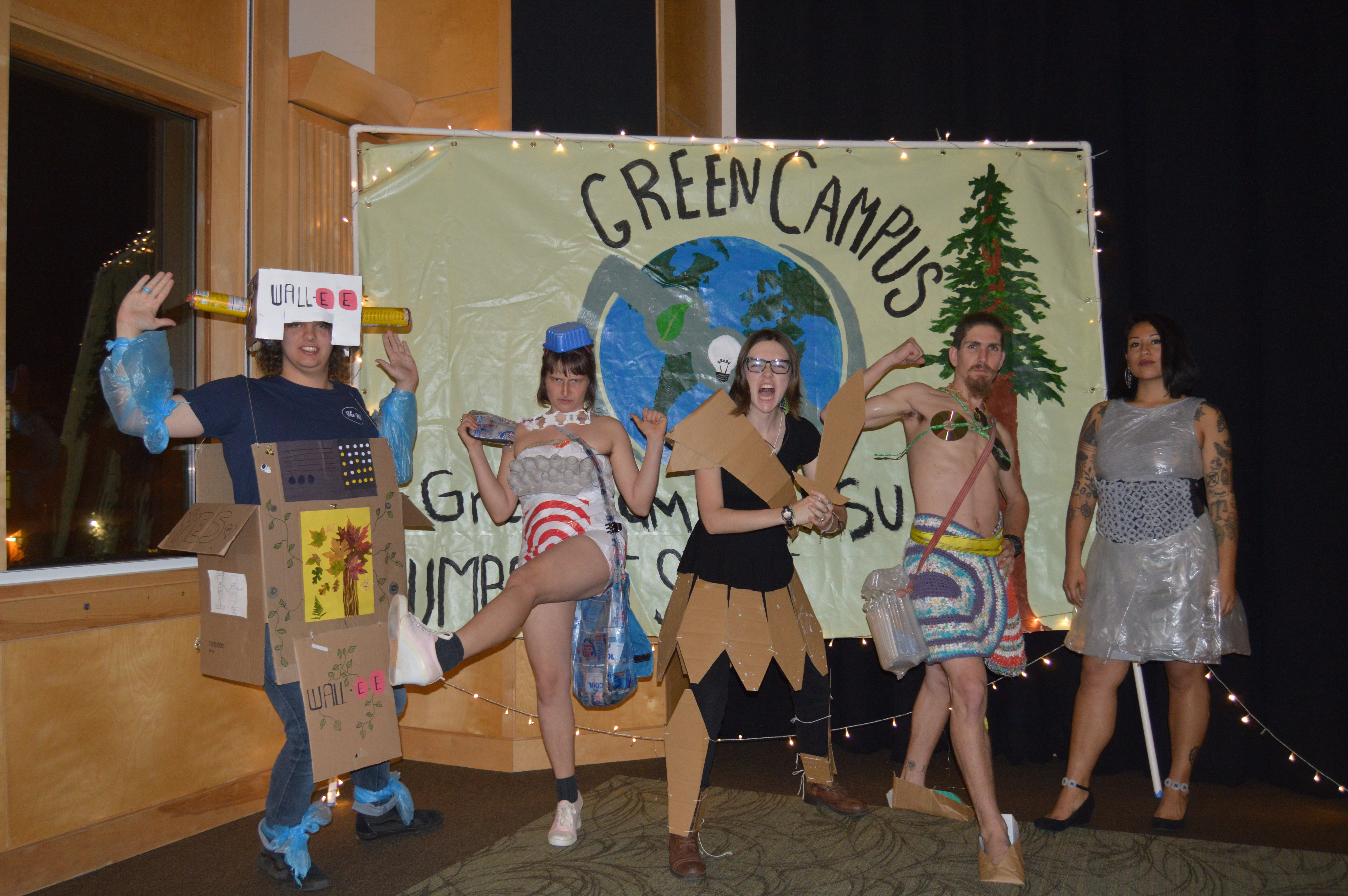
Eight students built magnificent costumes out of household waste. There was a Rob-box, sword wielding cardboard centurion, and the CD bikini-rocking Julian Palmisano. They each strut their stuff across the stage to show off what they made.
“I think my grandma would be proud,” Palmisano said. “I did it for fun. It’s kind of a joke, really, and it’s a way to bring attention to the unprecedented degree of waste that is in this world.”
In pursuit of constructive solutions, the following day was Tinker Time. WRRAP, CCAT and Green Campus showed students how to reduce their waste by upcycling recyclable items. Upcycling is the “reuse” part of the reduce, reuse, recycle phrase.
During Tinker Time, WRRAP showed students how to upcycle their clothes into mason jar coozies and grocery bags. The Campus Center for Appropriate Technologies upcycled wood waste and oyster shells into wind chimes. At the coozie table, WRAPP Compost Site Intern Krissi Fiebig taught students how to cut up old clothes and sew them together for a more beneficial use.
“The clothing industry is so detrimental,” Fiebig said. “Fast fashion, in my opinion, is one of the worst industries for the environment. It not only deteriorates sense of commitment, but it also withholds your own sense of style. It’s good to upcycle clothes for a new purpose instead of sending them straight to the landfill.”
In 1964 the first plastic bag was made, and it was the beginning of this. One half of all of all plastic produced has been produced in the last thirteen years. Recycling is ineffective… It was not our decision which led to this. It was fractional distillation and oil refining.
Finally, Ted Ward’s speech was a somber reminder of the modern state of the world. He said he felt as though he had failed as a waste manager. He reminisced about the day the first plastic bag was created and commented on how we ought to rename our modern era the “Plastocene,” cynically addressing the volume of plastic waste we produce.
“We should coin this era the Plastocene instead of the Holocene because that is our legacy,” Ward said. “In 1964 the first plastic bag was made, and it was the beginning of this. One half of all of all plastic produced has been produced in the last thirteen years. Recycling is ineffective… It was not our decision which led to this. It was fractional distillation and oil refining.”
The Zero Waste Conference finished up with Humboldt officially declaring Nov. 15 Zero Waste Day. The official proclamation reflects Humboldt County, the City of Arcata and our local community’s progress towards zero waste.
“Now be it resolved that the Humboldt County Board of Supervisors joins Humboldt cities and business groups to recognize November 15, 2019 as Zero Waste Day,” the proclamation said. “A day each year we acknowledge the County’s waste reduction progress and urge residents to recommit efforts toward Zero Waste.”
CCAT plans to keep pigs on campus to reduce food waste
Humboldt State University’s Campus Center for Appropriate Technology plans to house two pigs on campus as soon as next week.
CCAT will loan the pigs from the Tule Fog Farm in Arcata for the duration of the fall semester. CCAT plans to feed the pigs food waste from HSU’s J dining hall.
Jacob Gellatly, environmental resources engineering major and former CCAT Co-Director, helped lead the project from concept to reality.
“We want to show how animals can be raised in a residential environment, and how you can use urban byproducts such as food waste to raise animals in an urban setting,” Gellatly said.
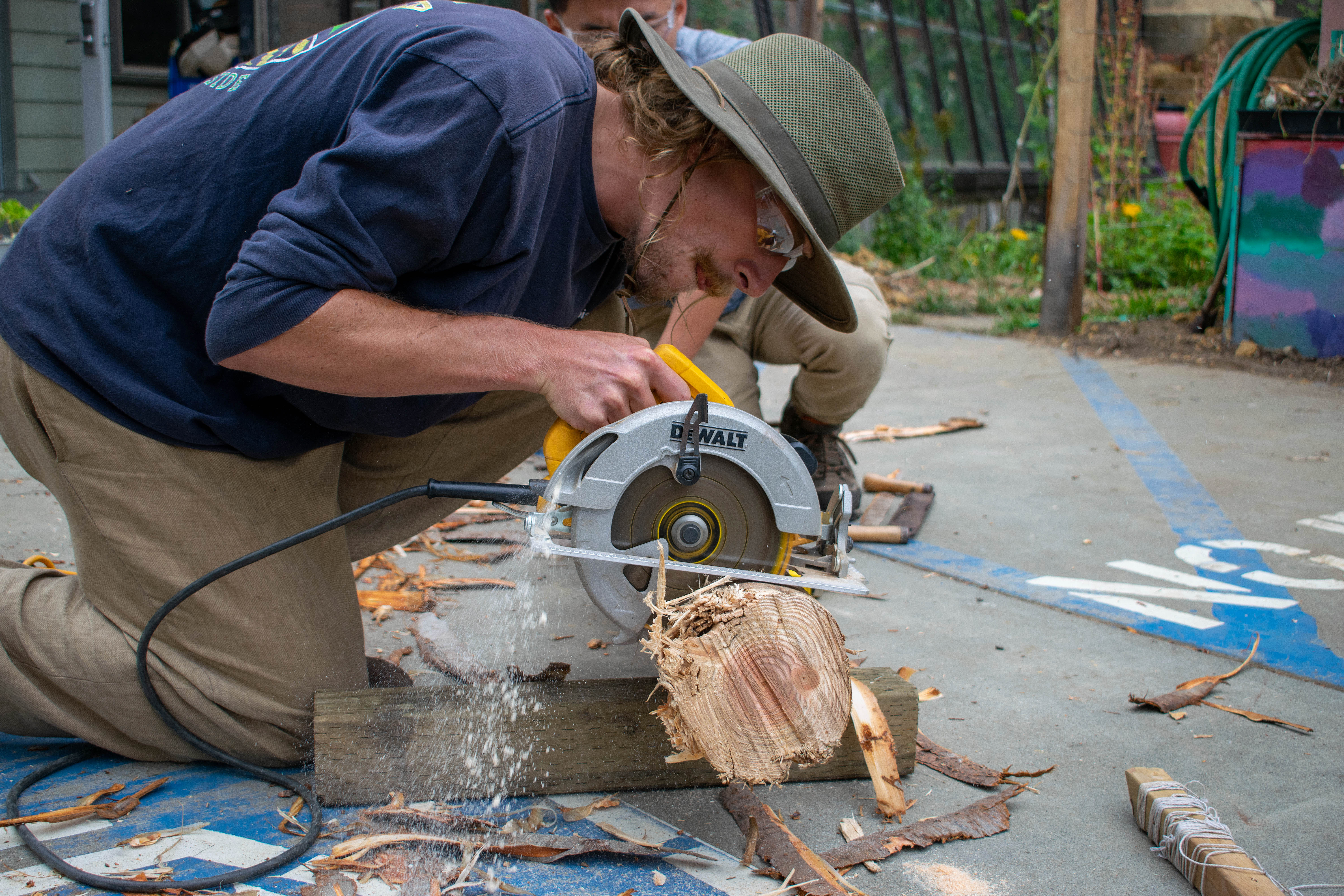
EnvironmentalRresource Engineering majors Jacob Gellatly (right) and Kong Vang (left) prepare a log on Sept. 6 to be used for the roof of a pig pen. | Photo by James Wilde
The plan to house the pigs began last fall when students in the CCAT Student Club vocalized interest in keeping animals on campus. CCAT contacted Shail Pec-Crouse from the Tule Fog Farm in Arcata. Pec-Crouse recommended pigs as the most viable animal.
“The easiest animal for us to raise would be pigs,” Gellatly said. “The reasoning for that is—a big thing is predators. So it’s a lot harder for something to come and get a hold of a pig as opposed to a chicken.”
As part of their plan, CCAT realized they could feed the pigs food waste from the J. While CCAT couldn’t feed the pigs food thrown away by customers of the J, CCAT could feed the pigs pre-consumer waste, such as food trimmings or spoiled foods not suitable for people.
“Another goal with the project was how can we divert food waste on campus,” Gellatly said. “And with that we can feed almost, and in some cases, their entire diet from food waste that’s at the school here.”
Once CCAT decided to loan the pigs from the Tule Fog Farm it needed approval from HSU’s Associated Students, Institutional Animal Care and Use Committee, Facilities Management, Risk Management and an environmental health and safety specialist.
The pig pen-in-progress on Sept. 6. CCAT plans to house two pigs in the pen for the duration of the fall semester. | Photo by James Wilde
Humboldt State’s IACUC reviews the use of animals on campus to ensure the animals are treated humanely under the requirements of federal and state law. College of Natural Resources Associate Dean Rick Zechman, who chairs IACUC, said the IACUC proactively reviews and inspects over 100 animal-involved projects on campus each year.
“There’s varying kinds of emotional feelings about the use of animals, and that’s respected and honored in the system of review,” Zechman said. “And that’s why the Animal Welfare Act was developed, to prevent mistreatment of animals. And I think, you know, in our committee, that’s sort of our first principle.”
While Zechman could not comment on the details of CCAT’s proposal, which is still pending, CCAT has worked over the last year to assuage concerns raised by various HSU faculty.
CCAT started by building a pig pen out of reclaimed wood from a local logging operation in Fieldbrook. CCAT has since integrated plans for a roof to prevent flooding of the pen and security to prevent people from getting harmed by the pigs.
In the long run, Gellatly hopes the project might convince the University to keep animals around for good.
“Big picture, I would like the school to see this and see, with what we’re having to deal with—getting rid of all this food—we could be raising meat for the school and have locally-produced meat with a byproduct of our current dining system,” Gellatly said.
Environmental Rresource Engineering majors Jacob Gellatly (right) and Kong Vang (left) working with a log for the pen. | Photo by James Wilde
CCAT’s plan to house pigs has only recently become known to the wider HSU campus. Saraí Escalante, psychology graduate student and president of HSU’s Vegan Club, sees the value of reducing food waste but wonders about the sustainability of the project.
“I think the underlying problem is that we see them as a convenience, as objects, so we see them as a tool to help us fix a problem or make our problems or our lives easier,” Escalante said. “And from a sustainability point of view, you still waste a lot of water in all of the slaughter process and the cleaning up of the meat. In that way, it wouldn’t be sustainable.”
Escalante said she’s considering starting a fundraiser to purchase the pigs and send them to a sanctuary instead of a slaughterhouse. However, Escalante said she plans to talk with CCAT to exchange thoughts, as she does like the idea of reducing food waste on campus.
Gellatly, for his part, noted that the current plan as registered with Tule Fog Farm and IACUC is for CCAT to house the pigs only for the rest of the semester.
“I think it’s, in theory, possible for them to buy the animals from the farmer if that’s something they’re inclined to do,” Gellatly said. “But, as far as our scope goes with the IACUC, once the project’s done, we’re taking the animals back to the farm and that’s where it ends for us.”
The project’s beginnings are dependent on approval from IACUC, but the pigs could arrive at CCAT as early as the week of Sept. 8 through 14.
Upbeat music filled the air on campus. May Day, the springtime celebration of fertility and joy, was in full swing at CCAT. Smiling faces crowned in flower wreaths welcomed visitors to the house. Anticipation was building.
The front lawn of the Campus Center for Appropriate Technologies was covered in yellow hay. The sun shone over people gathered there, warming hearts and heads. Funky music rolled across the yard, digging deep into people’s souls. There was a pep in everybody’s step as they danced around the yard. May Day is a celebration of rebirth and revitalization. Students and families crowded around tables to weave themselves flower crowns, dressing themselves in natural beauty.
Sean Armstrong introduced May Day with passion. He stood above the crowd with his corn blond hair blowing in the wind as he wove an image of May Day. Armstrong said humans have been celebrating May Day for five thousand years. May Day is a celebration of fertility and rebirth, of sexuality and community. May Day marks the beginning of spring and traditionally pays homage to Eostre, the pagan goddess of spring. May Day is ultimately a celebration of one and all.
“Spring is a non-optional time of renewal,” Armstrong said. “Today is a moment of optimism. This place is about regeneration and optimism. We have a ‘world gets better perspective’ and we trust in a future of growth.”
CCAT offered a whole bouquet of May Day themed activities. Piles of flower clippings were set out on tables so people could make themselves a wreath of flowers to wear. The wreaths were crowns accentuating natural beauty. Bright blues, fiery reds and striking yellows were set in rings of ivy and grass. Abigail Lowell shared why flowers were celebrated on May Day.
“A flower is beauty,” Lowell said. “Flowers are one of humans definitions of beauty. Humans have always considered flowers to be the foundation of beauty.”
Lowell wore a light blue dress to match her light blue eyes at the May Day festival. The weather was kind enough to copy Lowell and grace the celebration with a bright blue sky to boot. Girls danced and twirled in flowery dresses to the funky music. After a while a hush fell over the crowd, the music slowed down when Armstrong took the stage to introduce the May Pole.
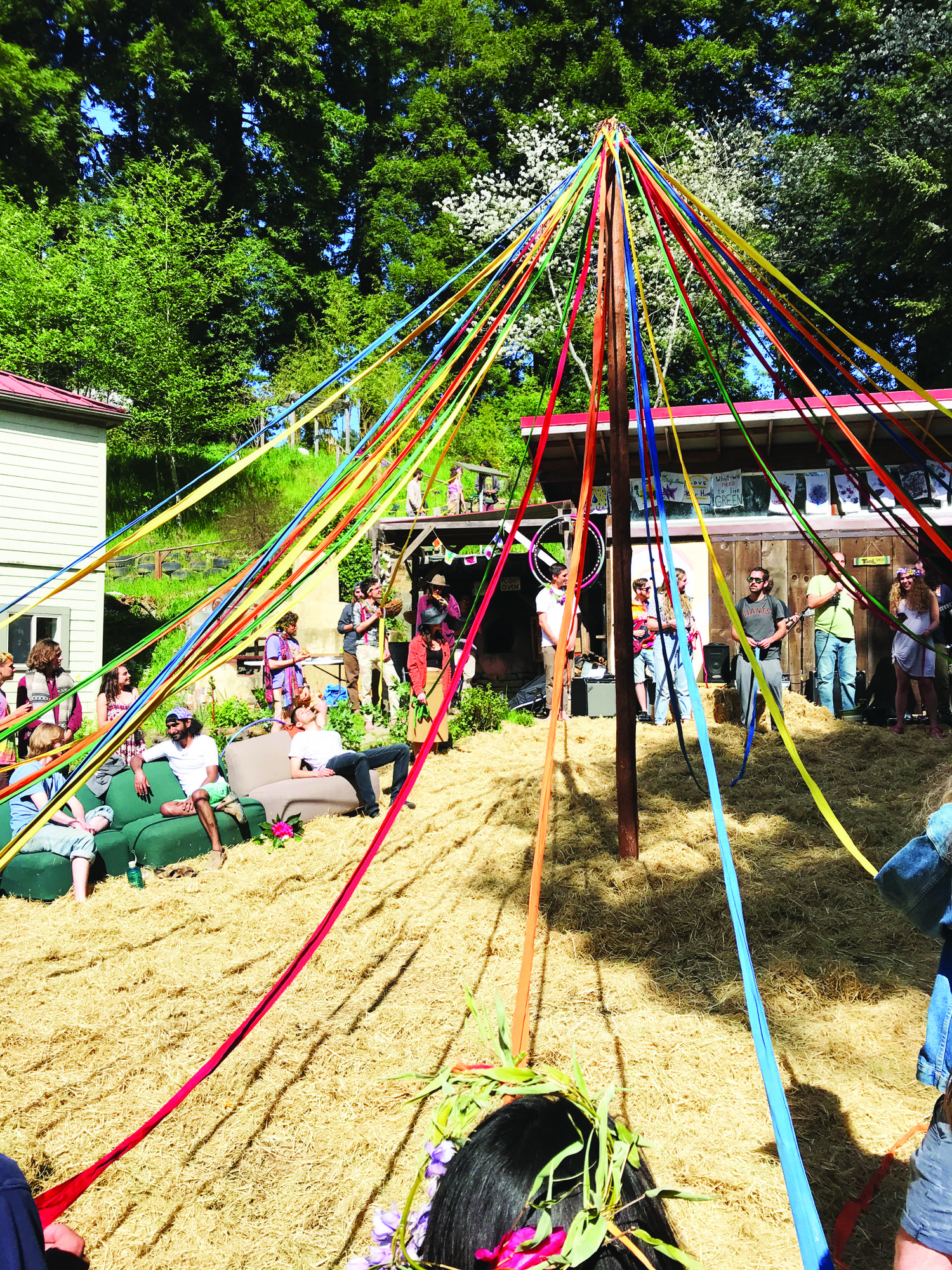
The May Pole is a symbol of the potency of the god. For lack of a better term it is a phallic birch pole set straight into the ground. Attached to the top of the pole green, red, yellow, blue and orange ribbons streamed down into the hands of excited people around the base.
“I met my wife at a May Day celebration right here on CCAT’s lawn,” Armstrong said. “The whole day build up to this great release. You know, there’s flirting, there’s drinking, there’s feasting. We can pay attention to the spring season and celebrate it.”
The music kicked up again. Half of the dancers began to skip around the pole. Every other person walked towards the center of the pole and danced in the other direction. The inner circle and the outer circle wove in and out between one another. At the climax of the dance the May Pole was wrapped in an intricate lattice of color. As the weave tightened around the pole, flowers were tucked into the ribbons. What resulted was a rainbow braid adorned with bright flowers and surrounded by smiling faces.
If only the sensation of May Day could be pressed and preserved forever. Alas, just as the celebration recognizes change the day’s sky began to change as the sun set. Sebastian Forward, CCAT’s organic gardener and future botanist, did his best to save the day. He was teaching CCAT’s visitors how to press plants and flowers.
“Pressing plants gives you something tangible when photos and drawings just won’t cut it,” Forward said. “We can preserve plants for over 100 years. Pressed plants show us what the plant was like the day it was pressed. We can still see what the little hairs look like under the microscope.”
May Day celebrated the transition of winter to spring. As plants bloom they herald fruits to come. Chirping birds and buzzing bees sat on branches while they watched humans dance around a field of hay celebrating life and joy. Celebrate this time of year with happiness and love. Show compassion to those around you. Stop and smell the roses, spring has come.
“It was heartfelt,” Lowell said. “Everybody was talking to one another. There were no inhibitions. The bright colors livened everybody up. We felt community. I liked it.”
The sun was shining brightly, flower crowns were seen everywhere, and music blasted all day for the Campus Center for Appropriate Technology’s 41st May Day celebration.
CCAT is a nonprofit student run organization that provides numerous amounts of workshops and tours open for the public. It also offers a great deal of hands-on work for anybody who is up to volunteer.
Locals making their way up to the CCAT house to join in the festivities on April 27. | Photo by Skylar Gaven.
Anh Bui, the co-director from last year, greeted everyone who walked up to the CCAT house. Bui was full of energy and was excited to see all the new and familiar faces who wanted to join in on the festivities.
“I like being here because it’s fun, the people are fun,” Bui said. “It’s for people who seem like minded and also bringing in people who are not like minded and expose them to new things.”
Ahn Bui greeting everybody who walked up to CCAT with a friendly smile on April 27. | Photo by Skylar Gaven.
Students and volunteers who invest so much time to create such a friendly environment is just one of the many components that CCAT transfers to both HSU students and the general public.
“There’s a lot of components making what CCAT is and what CCAT is now,” Bui said. “Student enthusiasm and volunteers is what keeps us alive and our connection with people and the community bring people here.”
Everyone who joined the celebration were free to dance to the live performers on the CCAT lawn. | Photo by Skylar Gaven.
Engineering student Riley Henderson, like many others, walked to the CCAT bunk house to enjoy laughs and a variety of colorful exciting activities. Henderson has been eager to check out CCAT and was delighted that she came. Henderson along with her daughter had a wonderful time spending the day with the loving community.
“I’m an engineering student and I’ve definitely wanted to come here for a while, just the sustainability of CCAT in general has always been a draw for me,” Henderson said, “It’s very welcoming and inviting and even my daughter loves it.”
CCAT has always opened its doors to new volunteers ready to get down and dirty. For David Kandoo, who just so happened to stop by in Arcata for a little while, stumbled to CCAT with a friend of his and immediately fell for the community.
“I’m actually just a random guy passing through town, I was with my boy Patrick who is also a passerby and he was like ‘I gotta run to CCAT and volunteer’ and I was like ‘I’ll go,” Kandoo said, “I love this kind of stuff, this is what we live for.”
Students gathering around to make vibrant flower crowns. | Photo by Skylar Gaven.
CCAT was more than happy to have Kandoo stay, help out, and just enjoy this extraordinary group that projected nothing but love Saturday afternoon. Kandoo was especially happy to talk to new people and expressed plenty of loving energy throughout the day.
“They invited me back today and I wouldn’t miss it,” Kandoo said.
The backyard of CCAT was filled with a buoyant crowd who really spread the love to all who showed their support.
“This is a community space, a place to be, you could do anything here, it’s family,” Kandoo said.
Getting your hands dirty never felt so gratifying, but for volunteers at Humboldt State University’s Campus Center for Appropriate Technology, otherwise known as CCAT, the satisfaction of hand-to-earth action persists each Friday, Chelsea Wood reports.
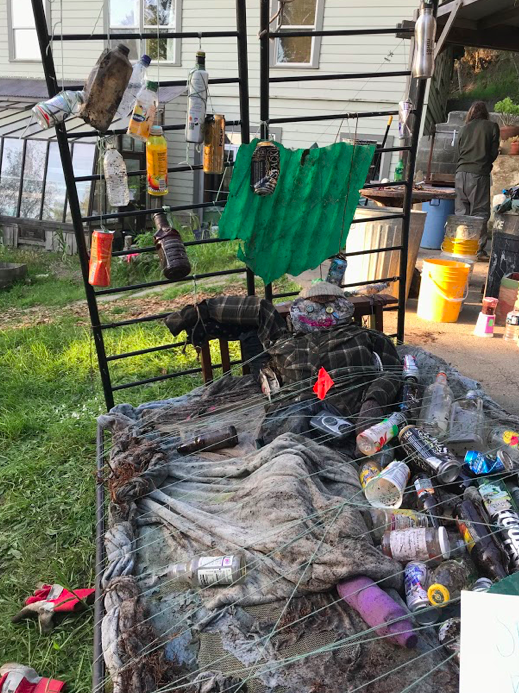
Hands gripped ankles, one leg pointed for balance, creating a human bridge. An arm reaches out over a river in the community forest to grab a long forgotten sour cream container. It would have never decomposed, so instead, it was upcycled into art. A collaborative art installation to visualize human influence on our natural world, showing what we leave behind and what will stay behind. The tagline: “you made your bed, now sleep in it.”
Jonelle Alvarez, a Humboldt State student majoring in environmental science and management, helped collect the trash and turn it into a sleeping student. She was inspired to be participating in the transition from trash to art.
“There was a lot more trash than I imagined and it would’ve stayed out there forever,” Alvarez said. “We had to get really creative with it. Prove we have no limits.”
This past Sunday, a group of students from Earth Guardians suited up in their rain gear and headed to the forest, armed with empty sandbags to fill up with trash. It was the first of many community forest clean up days hosted by the club.
Earth Guardians is a global movement founded and sustained by young people to spread resiliency through direct action activism. They are demanding greener policy from governments and leaders around the world, co-creating our future by empowering youth leaders. They are currently suing the federal government for endangering our generation through excessive fossil fuel consumption.
Earth Guardians picking up trash in the community forest. Photo by Madeline Bauman.
The Humboldt State Earth Guardians chapter meets every Monday in the CCAT house at 5 p.m., fostering an all-inclusive, accessible space for local activists to turn their ideas into reality.
Simone McGowan, an environmental studies student who brought Earth Guardians to Humboldt, struggled to find an accessible outlet for her activism, a space for people to feel good about themselves and what they’re doing.
“We’re uniting a large group of activists for political and social action on the macro and micro scale,” McGowan said. “Activism should be accessible and everyone should be included in the conversation.”
Earth Guardians promotes activism for anyone trying to catalyze change. They are bridging the disconnect between social and environmental justice, starting an open dialogue where all voices can be heard.
Jacob Gellatly, an environmental resource engineering major, believes Earth Guardians’ inclusive, collaborative activism is the answer to the social and environmental problems that plague our planet.
“Don’t focus on what can’t be done,” Gellatly said. “Instead, figure out what we can do together to make it happen.”
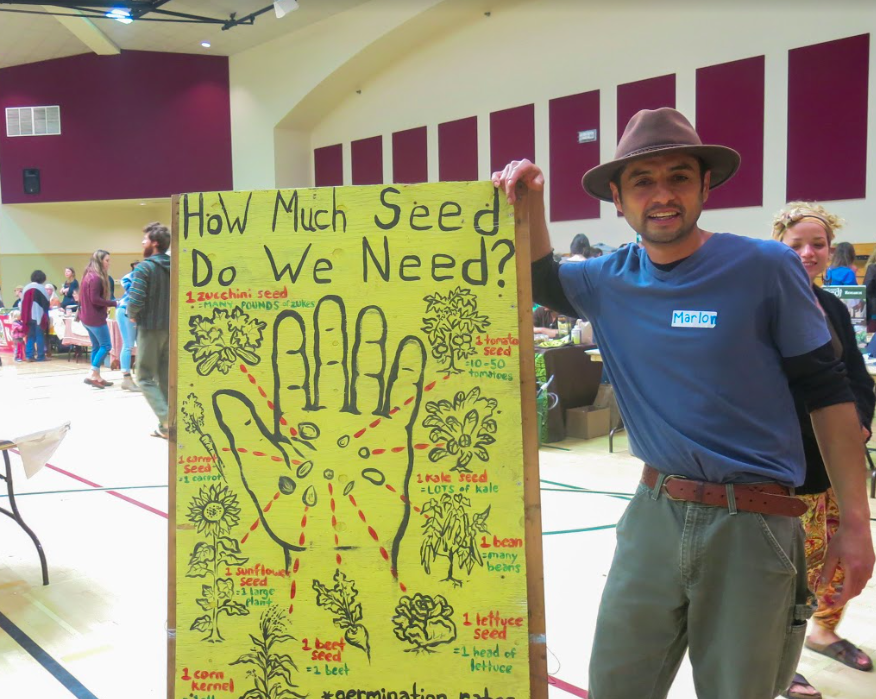
Everyone eats. You’re either buying food or you’re growing it. This past weekend, the Humboldt Permaculture Guild hosted their annual Seed and Plant Exchange, a collaborative event that brings together students and members of the community over a share gardening knowledge, materials and resources.
Organizations on and off campus are working to make growing food more accessible for students and community members.
Student volunteers at the Humboldt Permaculture Guild’s booth during the Seed and Plant Exchange on March 31. Photo by Emily Owen.
WRRAP and CCAT tabled at the event, providing information on composting and Humboldt State University’s other zero waste initiatives.
Isabel Sanchez, a Humboldt State senior and a co-director at CCAT, the Campus Center for Appropriate Technology, recognizes the need for coalition building in gardening and food justice. She thinks this event offers a chance to cultivate an open space for everyone to learn.
“CCAT is a place to pass down ancestral knowledge,” Sanchez said. “[The seed exchange] creates a space to engage with that information and the community.”
Karina Coronado, a HSU environmental studies major and librarian at CCAT, wants to provide access to seeds and make gardening available to all people.
“CCAT is an always active, continuous space to learn, follow up and further knowledge,” Coronado said. “It is the forever seed exchange.”
Isabelle Sanchez and Karina Coronado explaining CCAT’s mission to community members at the Humboldt Permaculture Guild’s annual Seed Exchange. Photo by Emily Owen.
Permaculture comes from the concept of permanent agriculture and is based on the belief that we can align ourselves with nature’s own rules.
It is the idea that we can build sustainable, regenerative human settlements that benefit people and the natural world. Permaculture works to minimize our impact on earth and maximize the efficiency of how we consume natural resources.
Marlon Gil is a HSU wildlife graduate, gardener, natural builder and self-proclaimed “permie.” He believes permaculture concepts can be applied to all situations.
“We have a moral obligation to share the excess we have,” Gil said. “Permaculture is a way to do that. It’s about balance. Take the time now to learn it and then live it.”
Every April, HSU’s Oh Snap! offers a series of gardening workshops hosted in association with WRRAP and CCAT. Irán Ortiz is the sustainability coordinator for Oh Snap! and she has organized the programs to prepare even the most inexperienced gardener to take back their power.
“It is empowering to grow your own food,” Ortiz said. “There is a big problem with our current food system, mainly in distribution, and this really affects students. So this is a way to take advantage of the resources provided.”
The gardening workshops will culminate on April 19 from 5-9:30 p.m., with a seed bank on campus.
The event will feature a banquet and showing of Seed: The Untold Story. It will provide students with almost all of the resources they need to start their own personal gardens.
Waste Reduction and Resource Awareness Program’s Zero-Waste Conference is a reflection of the effort the community and students put toward goals of engaging, expanding, sharing and moving forward.
Shanti Belaustegui Pockell, an environmental studies major at Humboldt State University, is the education director for WRRAP on campus.
Belaustegui Pockell said WRRAP hopes to grow in the future by working more with students on campus, as well as other programs to form coalitions and strengthen relationships.
WRRAP is hosting the Zero-Waste Conference throughout the day on Friday, Feb. 9 and Saturday, Feb. 10.
Belaustegui Pokell said the event will focus on intersectionality, social justice issues and institutionalizing sustainability practices of evolving and shaping policy.
Multiple speakers will be attending the event to discuss community challenges.
Sofia Pereira, the mayor of Arcata, will speak on making Arcata a zero-waste city on Friday and Andre Villasenor, a United States Environmental Protection Agency Sustainable Management of Food program representative, will speak on institutionalizing sustainable materials.
Ceria Wilbur, an environmental science and management major at HSU, has been the zero-waste director at WRRAP for the past year.
The conference and banquet at 5:30 p.m. on Friday is new this year and works to extend the message of a sustainable future.
“It’s just a way for us to connect with our campus community, bring our peers together with a number of different inputs and experiences,” Wilbur said. “This year our theme is Beyond Barriers, Imagining a Zero-Waste Future.”
Community members are encouraged to attend the event. Vegetarian and vegan options will be available.
There are activities on Friday from 11:00 a.m. to 4:00 p.m. at the UC Quad that include crafting with Tinker Time and a clothing swap, along with demonstrations from the Campus Center for Appropriate Technology, or CCAT.
Tinker Time are local and on-campus programs that have workshops for gardening and crafting body care products.
Campus sustainability groups that are also participating in the zero-waste event are Green Campus, Humboldt Energy Independence Fund, with speakers from local officials, academic departments and the Office of Sustainability.
WRAAP will host the second half of the Zero-Waste Conference in the Kate Buchanan Room on Saturday, covering topics such as the role of compost in carbon sequestration, biomass and the Yurok tribe.
Jason Martinez, outreach coordinator for CCAT, will attend the Zero-Waste Conference.
“Help is always welcome at CCAT, and for folks that come through, there is a lot they can learn, a lot they can experience,” Martinez said.
Martinez is excited to introduce CCAT to students who don’t know about the house on campus.
“I love seeing how the projects get started, how they are going to see how CCAT continuously is growing,” Martinez said. “Whether it’s the physical space itself or just the people, I think that is the piece I love seeing.”
WRRAP’s Zero-Waste Conference is meant to bring together students, faculty and community members to discuss real issues the environment is facing due to human impact.
Armed with their usual commitment to sustainability and an updated mission statement, the Waste Reduction and Resource Awareness Program (WRRAP) is starting to integrate intersectionality into their brand of environmentalism.
WRRAP started as an on-campus recycling program in 1989. Their goal has always been to reduce waste coming from HSU through environmental education. Since its inception, the organization has expanded into compost diversion, water quality assurance and a reusable office supply exchange.
This semester, the organization is attempting to bring together two important fields of activism by designing this semester’s projects with inclusive sustainability in mind.
“Environmentalist” is a label that comes with a dark history of eugenics, exclusivity and barriers that WRRAP is attempting to dismantle on a local level. The campus-based organization WRRAP recently hired an environmental justice intern with the intention of making sustainability more accessible for all HSU students.
Lauren Wardle, the newly hired environmental justice intern, has experience running an intersectional feminist club and wants to bring those concepts to her position.
“Social issues go hand in hand with environmental problems,” Wardle said. “Environmental justice and intersectionality will bring in the voices of the communities that are most affected.”
The program’s main goal is to ensure that HSU students are using their available resources to the fullest extent. WRRAP’s first environmental justice project will be a campus-wide survey to assess students’ access and understanding of sustainability.
Shanti Belaustegui Pockell, an environmental studies major, WRRAP’s education director and intern coordinator, hopes the internship will help shift environmentalism into something more accommodating for everyone.
“Instead of trying to get more people into this little space we have created, we want to expand the circle,” Pockell said. “We are reimagining what sustainability can look like, because a lot of people are living sustainably, just without the label.”
Irán Ortiz, environmental studies major and director of the student-led campaign Take Back the Tap, credits WRRAP’s leadership and innovations for social justice.
“We need to bring together the communities that are affected, but ignored,” Ortiz said. “I hope this new position helps address the problems we see in our institution by creating a new perspective and understanding of intersectionality.”
When environmentalism is executed with an intersectional lens, social and environmental issues are looked at as one. To put it another way, it is the understanding that all oppressions exist under the same hegemonic systems.
Ryan Sendejas, environmental studies major and community garden coordinator at Campus Center for Appropriate Technology, realizes the importance of incorporating environmental justice into an institution.
“In society and bureaucracies specifically, we tend to compartmentalize everything in an attempt to understand it,” Sendejas said. “Nothing is truly singular. So, we need to start thinking in terms of interconnectedness.”
WRRAP will be hosting a Zero Waste Conference on Feb. 9 and 10. Look out for flyers around campus for more details!
For more information about WRRAP, visit their website HERE.
Sitting in silence with our eyes closed, we listened to Loba guiding us through the mediation, instructing us to allow the seed to tell us what it needed to communicate.
La Loba Loca, a queer herbalist visited CCAT (the Campus Center for Appropriate Technology,) this past Wednesday guiding students on an herbalist knowledge share centered around herbal Medicina Feminista.
Some students and community members that attended La Loba Loca’s Herbalism knowledge share at CCAT on Oct. 18, 2017. Loba requested to take a photo with everyone who attended the workshop. Photo credit: Mariza Ocampo
Erick Garcia, a Sociology major, was right at home in the herbalist knowledge share.
“I’m queer and I enjoy herbalism, so it was the perfect thing for me,” said Garcia.
Loba is from Arequipa, Peru, but currently resides in LA teaching herbal medicine, conscious mooning (classes on menstruation,) the oral history surrounding the healing practices as well as many other topics and practical tools. Loba identifies as “a queer, Chocolla, Andina, South American migrant, artist, researcher, writer, handpoke tattooist, full spectrum companion/doula, aspiring midwife student, seed-saver, gardener and yerbetera,” on La Loba Loca’s website.
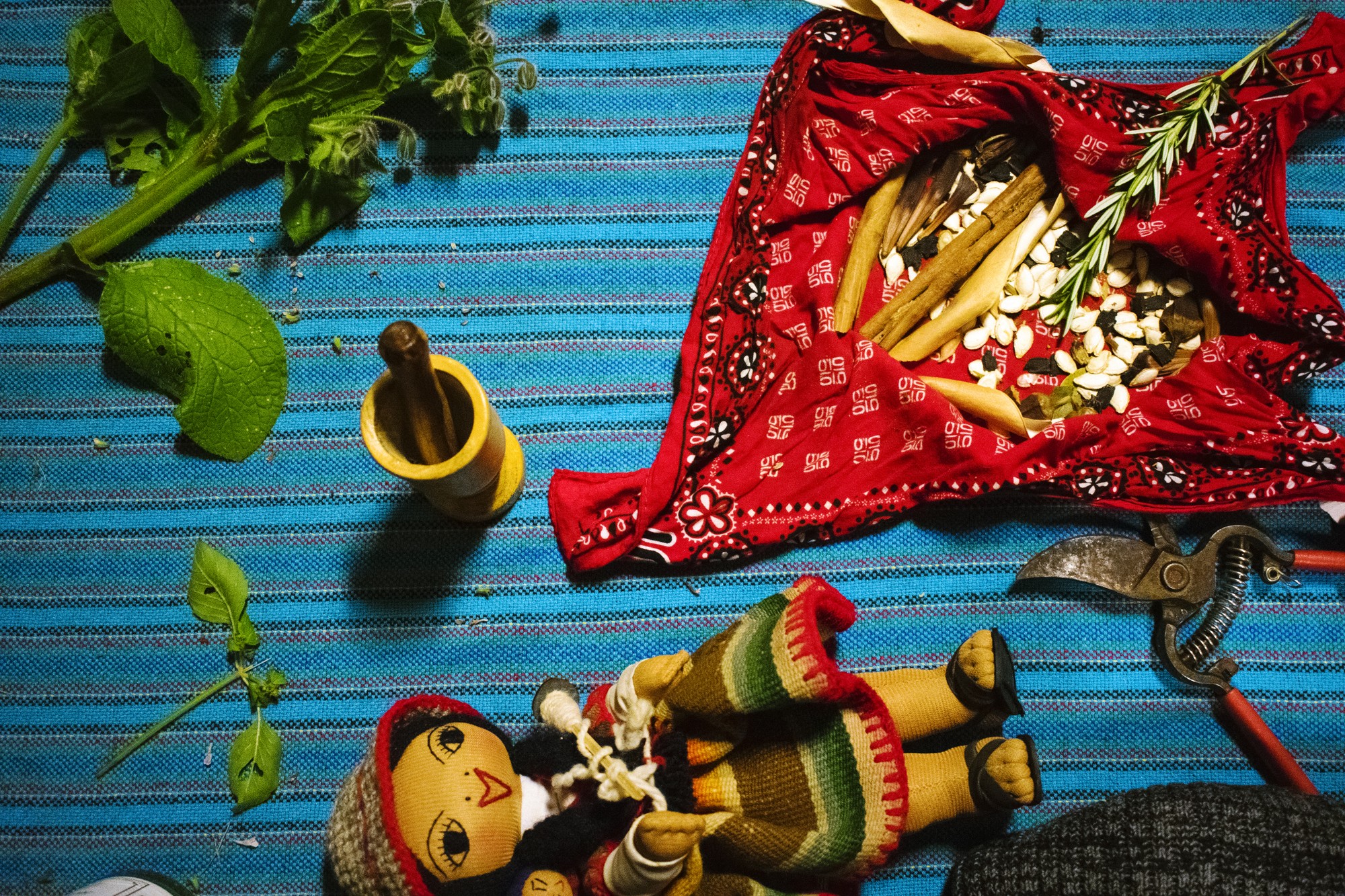
The knowledge Loba shares with audiences is Abuelita Knowledge, the wisdom and practices passed down through generations of women and femmes. Leading the knowledge share with a seed meditation, Loba gave each individual a seed to hold. Loba then introduced the idea of seeds as technology.
“Literally to me, seeds are the most reliable technology that we have,” said La Loba Loca.
From there everyone was led through a meditation in which we held the seed in our hands and were guided to open ourselves to anything the seedling wanted to tell us. In a room packed so that only standing room remained, everyone there simply closed their eyes and focused on the knowledge that the seeds had to share.
One attendee said that their seed was old, “not necessarily the seed itself, but the information it holds.”
Other individuals attending the workshop simply reflected on the importance and process of a singular seed, noting that we often don’t stop to appreciate the work and undertaking of one simple seed.
Loba then encouraged everyone attending to research seeds and plants important and cherished within our own heritage and cultures. Different plants used for healing and nurturing native to one’s own history that we could incorporate into our diet and/or daily life. The coca plant, specifically the coca leaf holds special significance to Loba as a grounding and energizing plant native to Peru.
From there, Loba went into the oral history and roots of some of the healing practices of herbalism today. Discussing the power of Medicina Feminista, its origins, certain tools and practices, as well as the history of the witch trials and how that has affected women/femme interactions and healing.
“To me, feminism is the magic that happens when women and femmes have resisted the patriarchy,” said Loba.
Loba delved into the topic of women/femmes as the traditional caregivers and healers in comparison to the male and masculine dominated health fields of western medicine. In a field composed of primarily white males, Loba works to take back and teach the traditions and knowledge to healing through herbalism. Loba honored the acts of women and femmes who for centuries have healed and cared for individuals, sharing their knowledge and healing as an act of free labor.
Aliah Bueno’Strong, a Rangeland major at HSU felt a strong connection to the dialogue surrounding feminism and Loba’s
“Hearing her talk about feminism, that’s what I really resonated with the most,” said Bueno’Strong. “I’m one of those people that doesn’t believe that you have to have equality of the genders, but simply the equality for everyone. It was good to hear it come from someone else.”
Loba discussed the current inequality between the genders, allowing for discussion on historical events that influence us now, such as the witch trials.
Viewing the witch trials as an intentional act of the church and state, the patriarchy, as a way to take away women’s power. The healers, midwives, doulas, herbalists, and any woman or femme who practiced traditional non-westernized healing were persecuted. Even women who were not as versed in Medicina Feminista and Abuelita Knowledge were under suspicion.
Loba showing and explaining some of the items that were brought for the knowledge share. Photo credit: Mariza Ocampo
“The witch hunts were toxic masculinity at its best,” said Loba.
The witch hunts eliminated much of the trust and communication between women, turning one another against each other to prevent their own persecution. This robbed women and femmes of spaces to share information and stories, places to come together in healing and discussion.
“They took away the bond and unity between women and femmes,” said Loba.
Loba discussed the effects of the trials in the way women and femmes bond and communicate with one another today. These historical events are still very much with us in that they affect the perception and acceptance of woman interaction and healing today.
The systematic goal of mainstream society is to prosper as individuals, to rise up alone. Herbalism and Medicina Feminista work to bring up everyone and benefit everyone collectively.
To learn more on Abuelita Knowledge you can read Loba’s article, “Reclaiming Abuelita Knowledge as a Brown Ecofeminista.” The article discusses the roots of Loba’s knowledge and works to take back the knowledge and practices that have been westernized and claimed by many white hippies as new eco-friendly practices.
Diving into the history and the roots of herbalism, La Loba Loca explains some of the benefits and properties of certain plants during the herbalism knowledge share at CCAT. Photo credit: Mariza Ocampo
“Specially all these white supremacist ideas that make people believe that conscious mooning is a white hippie thing, that giving birth to a baby under a tree is white, that gardening organically is white, that meditating is white,” Loba writes in the article.
Deconstructing common misconceptions on this passed down cherished knowledge and working to reclaim these ancestral practices is one of Loba’s main goals. Knowledge shares like the one held at CCAT is another incentive for Loba to continue educating and sharing knowledge.
One of Loba’s goals laid out on the La Loba Loca website is to create safe spaces and resources for “Spanish-speaking communities of color as well as queer and trans communities of color.”
Vanessa Cota, a Political Science major at HSU, left the knowledge share at CCAT house feeling nourished and refueled.
“It’s a space that was very needed,” said Cota.
After going over some of the oral history and recalling the origins of some of the practices, Loba moved on to share knowledge as an herbalist discussing certain plants and their beneficial properties.
Passing around borage, fennel, rosemary, lemon balm, calendula, tulsi, and a Mexican Marigold, Loba shared knowledge on each plant, explaining their healing properties and some of the ways incorporating them into our lives could beneficial.
Each plant was discussed in-depth with an open dialogue between Loba and the audience as everyone shared their experience and knowledge with the different plants.
“It takes what I’m learning about in Botany out of the confines of academia and back to the down to earth roots on how people actually interact with plants,” said Kevin Riley.
Riley, an Environmental Science and Management major, loved attending the knowledge share, both for the knowledge he gained and because of the space CCAT and those in attendance created.
“It was very positive and uplifting, we were talking about life and health together,” said Riley.
After the workshop, Riley said, “I have the biggest smile on my face I’ve had all week.”
The knowledge share concluded with a tea meditation, in which all of the attendees were given a cup of tea that had been brewing throughout the event.
A simple mixture of lemon balm and rose prompted the ending discussion on what the tea could do for our bodies and minds. With each individual in the audience feeling and focusing on the tea, we concluded the knowledge share explaining what the tea brought up for us, both physically and emotionally.
Erick Garcia was glad to have attended the event.
“A whole bunch of people ready to learn came together, if you wanted to be here you were,” said Garcia. “We came in here with love and joy and we are leaving with love and joy. Some of us don’t have that on a day to day basis, so it was nice to know that there is a community filled with that.”
Aliah Bueno’Strong is in the herbalism class on campus at CCAT, and knew a good deal of what Loba went over. Bueno’Strong had a strong appreciation for the dialogues on feminism, gender, race, and equality as well as the herbal discussions.
“I’m heterosexual, but to be in a room with a lot of people who are not necessarily like me was amazing,” said Bueno’Strong.
Loba succeeded in creating a safe space to discuss the power of plants, the history of healing and herbalist practices, the effects of the patriarchy and white supremacy, as well as many other topics that come up when a large group tells stories and shares ideas.
“I was very happy by the turnout, I left to go get food and when I came back the room was full,” said Bueno’Strong. “It shows how diverse and inclusive the school is as a whole, and our students.”
Everyone in attendance stayed until the very end, soaking up all of the knowledge Loba had to share. While each individual gained something different from the workshop, everyone left feeling different from when they entered CCAT.
“Rooted.”
“Rooted is the best word to explain it,” said Cota.
The CCAT garden’s are moving and bending in shape, forever changing with the seasons, through the helping hands that come and go. The folks at CCAT are welcoming these changes of seasons with open arms. Rows upon rows of seeds have been planted and now they wait patiently for their chance to peek through the top layer of soil to greet the moist air. Yet, it’s still just too early to see what lies within these carefully raked piles of soil. It’s fall in Humboldt, the height of the rainy season will soon be upon us, and outside the rain gently flutters across the terraced gardens, over the open grass, and trickles down the windowed walls of the CCAT greenhouse.
CCAT herb garden. | Michelle Meyers
Inside the greenhouse, Austin Anderson, Co-Director at CCAT is hard at work, re-treating its wooden floors in order to limit wear and tear and slow weathering, so that the floors stand strong, hopefully for many seasons to come.
In regards to the greenhouse, CCAT volunteer coordinator Natalie Rynne says, “The thing that everybody is most excited about, is the hydroponic system.”
The new system is intended to reduce water usage by controlling the amount of water that goes into the plants and recycling their runoff. In addition, Rynne says crops that can’t commonly be grown in this climate can now be grown year round inside of the greenhouse.
Outside of the greenhouse, around the CCAT grounds and gardens, coordinators and volunteers are currently working on revamping these surrounding areas to prep for new, exciting projects.
“We’re trying to reclaim everything again,” said Rynne. “Clear all the weeds, mulch everything, and build up the soil.”
Cob woodfire oven and Compost Demonstration Site. | Michelle Meyers
One of the many projects underway in the CCAT gardens is the Food Forest. Rynne says the project works to “create a forest of edible plants,“ by creating different gardening areas that all even have different names.
The folks at CCAT cook with the food grown on the grounds and would like the Food Forest to be a place where visitors can enjoy the ‘fruits’ of the Food Forest as well. Rynne also hopes that the Food Forest can be a place where people come to simply hang out and relax.
“It smells amazing up there because of the jasmine” says Rynne as she pauses to gaze at the billowing bushes of jasmine blooms.
Near the jasmine bushes, the folks at CCAT have also recently constructed by hand what are called Cob structures. Everything that went into these structures was derived from all organic or reused materials, such as clay, straw, sand, newspaper and a natural plaster, used to coat the structures. This form of building has proven to be incredibly versatile, hearty and efficient.
Anh Bui, NRG and ETaP grad student. | Michelle Meyers
So far they have constructed Cob benches so people have another place to sit and enjoy the scenery, Cob terraces, in order to provide homes to a variety of plants, and even a wood fire Cob oven, which allows them an opportunity to prepare meals outdoors. Due to Cob’s heat retention properties, it makes to be an incredible oven explains Rynne.
Over the years, CCAT has come a long way. They began their journey in 1978, and since then coordinators and volunteers have been hard at work, addressing issues in the local and global environmental community, hosting sustainability centered workshops and also working the property itself, installing sustainable technology such as a composting bin, solar hot panels, and wind turbines.
The Buck House itself has undergone immense change over the years. It’s seen repairs, improvements, and new sustainable innovation come and go, such as the addition of a new roof, an entire ground floor and the installation of a Graywater catchment system used to recycle used dish, shower, laundry and hand-washing water.
A new season has just begun and there’s still lots of gardening and more to be done at CCAT.
TO GET INVOLVED:
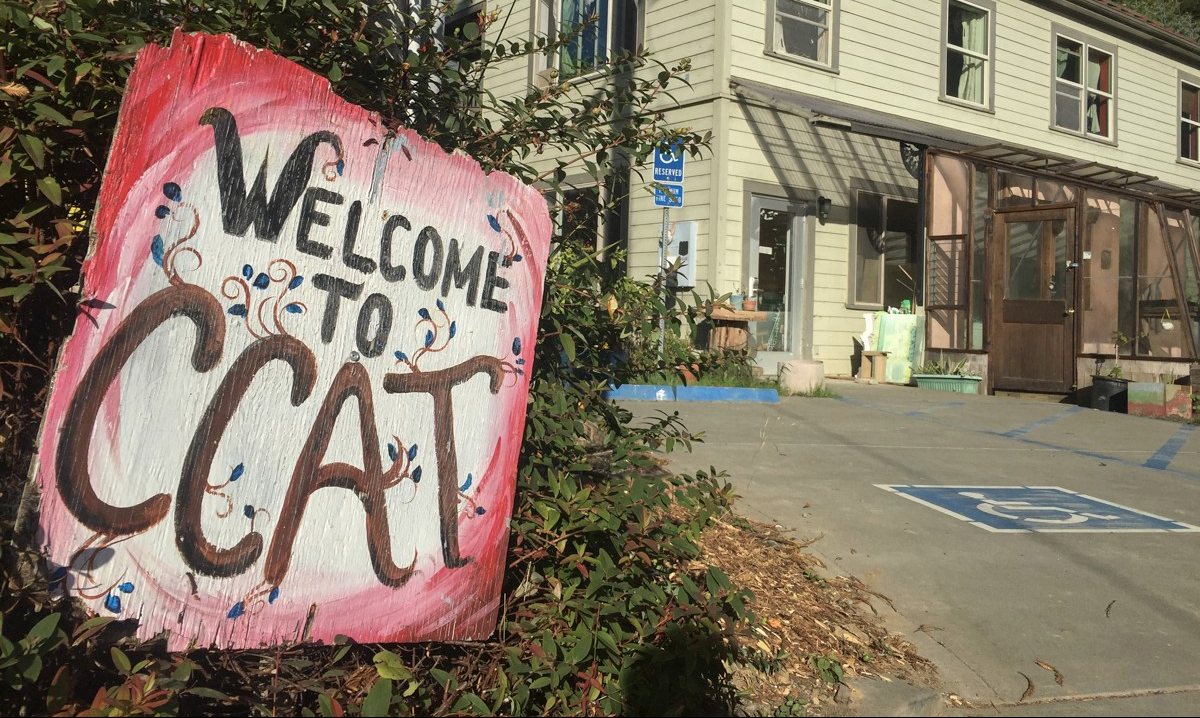
The Campus Center For Appropriate Technology is located on the Humboldt State University campus near the Redwood Community Forest.
To learn more about CCAT and to keep up to date on all of the happenings at CCAT, click here.
Head over to their Facebook page under Campus Center For Appropriate Technology
To contact CCAT
(707) 826-3551
Email: ccathsu@gmail.com
CCAT Upcoming events:
Open Mic Night
Oct. 13 at 7:00pm
Herbalism Workshop with Loba Loca
Oct. 18 at 5:00pm
This website uses cookies to improve your experience. We'll assume you're ok with this, but you can opt-out if you wish. Cookie settingsACCEPT
Privacy & Cookies Policy
Privacy Overview
This website uses cookies to improve your experience while you navigate through the website. Out of these cookies, the cookies that are categorized as necessary are stored on your browser as they are essential for the working of basic functionalities of the website. We also use third-party cookies that help us analyze and understand how you use this website. These cookies will be stored in your browser only with your consent. You also have the option to opt-out of these cookies. But opting out of some of these cookies may have an effect on your browsing experience.
Necessary cookies are absolutely essential for the website to function properly. This category only includes cookies that ensures basic functionalities and security features of the website. These cookies do not store any personal information.
Any cookies that may not be particularly necessary for the website to function and is used specifically to collect user personal data via analytics, ads, other embedded contents are termed as non-necessary cookies. It is mandatory to procure user consent prior to running these cookies on your website.