The Lumberjack


Students Serving The Cal Poly Humboldt Campus and Community Since 1929

Tag: Ceramics

  • Emotional baggage finds a resting place in The Mess Nest

    Emotional baggage finds a resting place in The Mess Nest

    by Alana Hackman

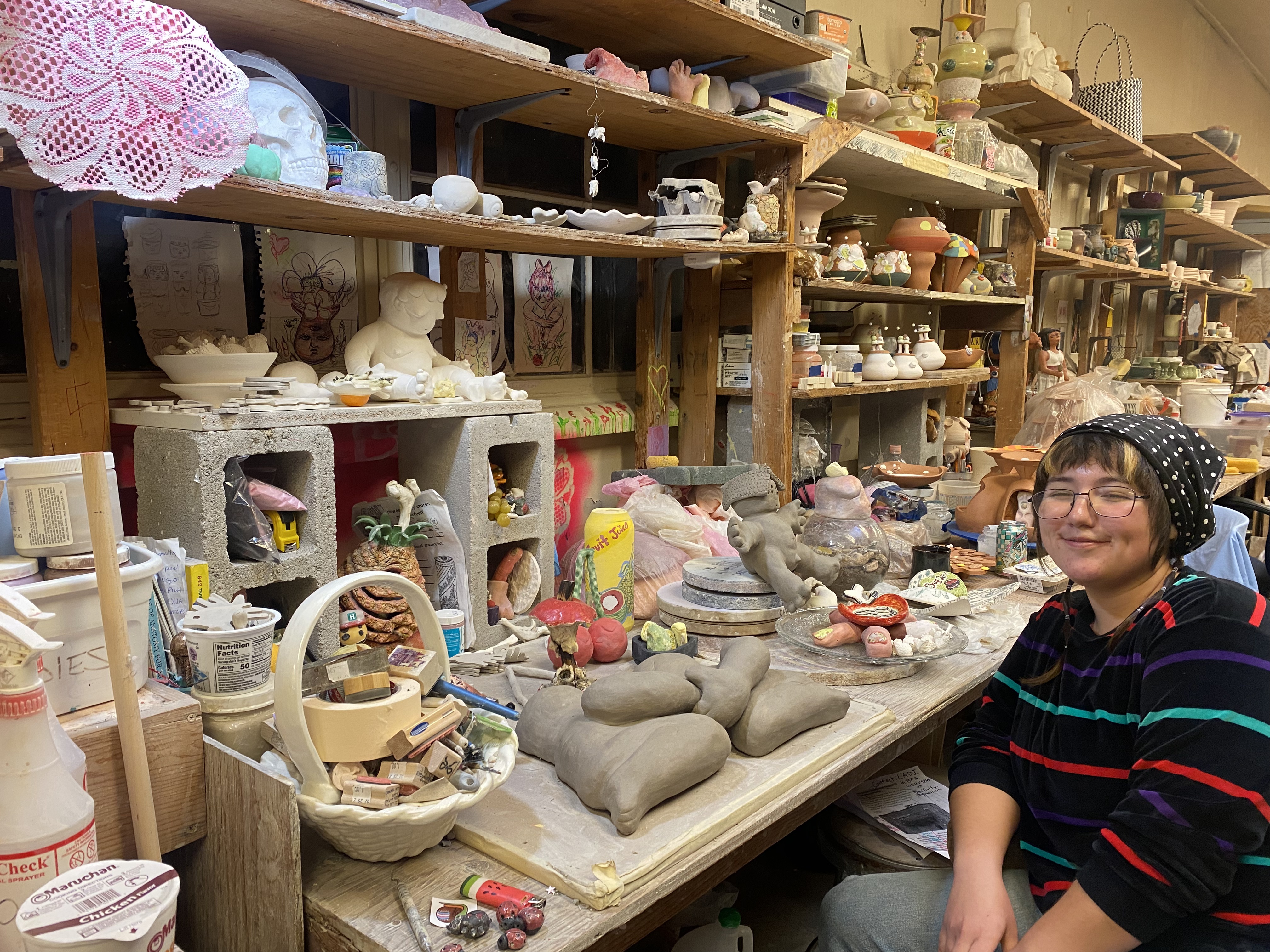
    Tucked away in the narrow hallway-like room of the BFA studio located in Cal Poly Humboldt’s ceramic lab, or better known as The Laundry, you’ll find a crowded corner of a workspace. 

    Littered with anatomical clay body parts, a cinder block shrine of fake grapes, a clay pineapple with a bone sticking out of the top and many more tinkering tools like tape measures and lighters. Behind this workspace, you’ll find Ladi Ladines working away on their latest creation. 

    The Lake Elsinore native graduated from Cal Poly Humboldt with a stack of accolades last year. Starting with their Bachelor’s in Fine Art, minor in Art History and finishing off the list with a certification in museum and gallery practices. They’re prolonging their stay in the redwoods to finish out a ceramics extended education program.

    They came up to Humboldt in 2019, but art had always been a foundational building block in their life since they can remember. 

    “I’ve always been an artist since before I could talk, walk or whatever,” Ladines said. “Everyone told me, ‘You’re an artist!’ so I just kept going with it — I see the world in a very visual way and it’s how I process everything, so it just felt like the right thing to do.”

    Their most recent work on display was an interactive sculpture labeled “The Mess Nest” that was shown through October and November at the The Morris Graves Museum of Art in Eureka, California. The piece was a part of the 27th annual “Junque Art” exhibition that included art made from all recycled material, but the origin of the nest came way before the exhibit. 

    Ladines had been thinking about the concept of a “nest” for over two semesters before the idea finally came to them on a reflective day at the beach. 

    “I was feeling pretty down in a rut and lost in my art process,” Ladines said. “I saw this tree that was tipped over – it was a huge tree, and the roots were just flourishing and it took my breath away. It was at that moment I just wanted to make something, even just an ounce of that feeling – of having my breath taken away, feeling at peace with myself.” 

    They came home that following evening and began their creative process for the nest. The piece itself is a place to let those physical items that hold so much emotional baggage and weight in our daily lives go. 

    Photo courtesy of Ladi Ladines | The Mess Nest

    “I had a box of emotional baggage trash under my bed. You know, old love letters and things that are just sort of triggering, and I went home that day, I got that box out and just dumped it out on the floor, and I lived with it on the floor for a good week,” Ladines said.“ I lived with it until the triggers weren’t triggering me anymore, and I felt like these are the pieces that I want to tie to the branches of my nest.” 

    Soon after, the nest spiraled into what it is today, after Ladines’ neighbor asked to add pictures they were hoping to get rid of to the nest. Ladines soon found themselves posting fliers on craigslist, LEX and even on campus urging the community to share their items of emotional baggage to the piece. 

    “I found myself asking everyone around me and making posts online and reaching out towards people that I would have never really got to connect with in that way,” Ladines said. “I found out a lot of people have boxes under their beds that they aren’t confronting and that they would like a space to do that, so that’s how the nest was born.

    The nest is an ongoing interactive piece that now lives in the Redwood Art Association in Eureka. Ladines encourages the community to continue donating to the nest. Ladines has had quite an impact on the art community and has had many installations displayed across Humboldt County since residing here. 

    “I never have an end goal in mind, I let the thing flourish by itself. And it really snowballed this time into something that I would do again, like I would love to continue this project and find new spaces for it and reinforce the branches,” Ladines said.                                                                                                                                                                      

    Ladines previous art installations have included contributions to the 2022 Eureka Street Art Festival, The Morris Graves Cal Poly Humboldt Senior exhibit, as well as the Senior Art exhibit at the Reese Bullen Gallery.  

    Ladines served as a gallery intern under the Reese Bullen Gallery’s director, Brittany Britton, during their undergrad, later serving as a gallery assistant. Britton mentions how the galleries on campus serve as a learning lesson to students involved to really explore how their works will be viewed outside of a personal studio space.

    “It seems like Ladi for their part has really taken that to heart, and has been really developing a deeper interest in exhibition art,” Britton said. 

    Ladines art plays with bright playful colors and lots of child-like wonder. Ceramic bones and fruit, their specialty, inspired their instagram handle, @bonefruity. They work with a wide variety of mediums and really try to hone in on creating community and home behind their artwork.

    A few materials used to make the nest included a friend’s childhood blanket, a pair of bedsheets that triggered Ladines’ trypophobia and overall things they find attractive throughout their daily life. Whether that’s trash, an abandoned school desk on the side of a road they used in a previous installation or abandoned cardboard boxes.

    “I do play with all kinds of materials, and by this I feel like I’m grounding myself in my reality, just by seeing how all of these different things interact with each other. Whether that’s wood and plaster, or jello,” Ladines said. “I’m working on some big jello projects.”

    Ladines’ is constantly pushing their comfort zone when it comes to the process of their art. Their art process explores the relationship with our nervous systems and how things make us feel. 

    They’ve used three live cockroaches (named Sarah, Jessica and Parker) in a ceramic piece shown at the 2023 California Conference for the Advancement of Ceramic Art. Ladines explains this was a way to really explore their limits as an artist as cockroaches are something that always was a fear for them. Ladines said the cockroaches helped them work through trauma and are now a symbol of resiliency. 

    “It was me trying to desensitize myself to the heebie-jeebies you get when you see a roach or a bug. I ended up keeping them as pets for like over a year, and they became my studio buddies. I learned to love them and get over that initial sensation of being scared of them – that was a really wild experience. I love those roaches and am now thinking about getting a spider, cause I’m really scared of spiders.”

    Through this process of testing their limits within their art work Landines has made beautiful community connections with their art , the nest especially. In their time spent at the The Morris Graves Museum and Redwood Art Association they’ve seen individuals come back to contribute to the nest, and even embraced with strangers that were grateful for the ability to add to the nest. 

    “The last day that it was on display at Morris Graves, there was a woman who came in hot with this ceramic pot, and just slammed it into the center, and I was like ‘yeah!,’” Landines said. “I had no idea who she was or anything, and she just looked at me, embraced me and was just telling me her lore. I cried a little bit, she cried a little bit. My tension about my piece was made and it just felt so fulfilling.” 

    Britton especially adores Ladines’ efforts to really incorporate the local community into their artwork and creative visions, even after their graduation. 

    “They’ve really done the hard work to embed themselves here in the community and become part of it, versus maybe just leaving as a student, like you get your degree and you take off,” Britton said. “But, they seem invested in helping embolden and strengthen the art community here in Humboldt.”

    The nest will be on display at the Redwood Art Association through Dec. 15. Ladines still encourages materials and emotional baggage to be added to the piece during its stay. Ladines emphasized whatever is added to the nest is about what the giver wants to let go of, not what they want personally as the artist. 

    “My ultimate intention is just wanting to embrace people and myself, and that’s hard. Comfort is a big one – and acceptance. I’m not a perfectionist, I like things that are a little funky,” Ladines said. “I like to be playful with my colors. I hope that that comes through as love, and for people to also accept those qualities within their own work.”
  • Veterans find healing through the arts

    Veterans find healing through the arts

    by Andrés Felix Romero

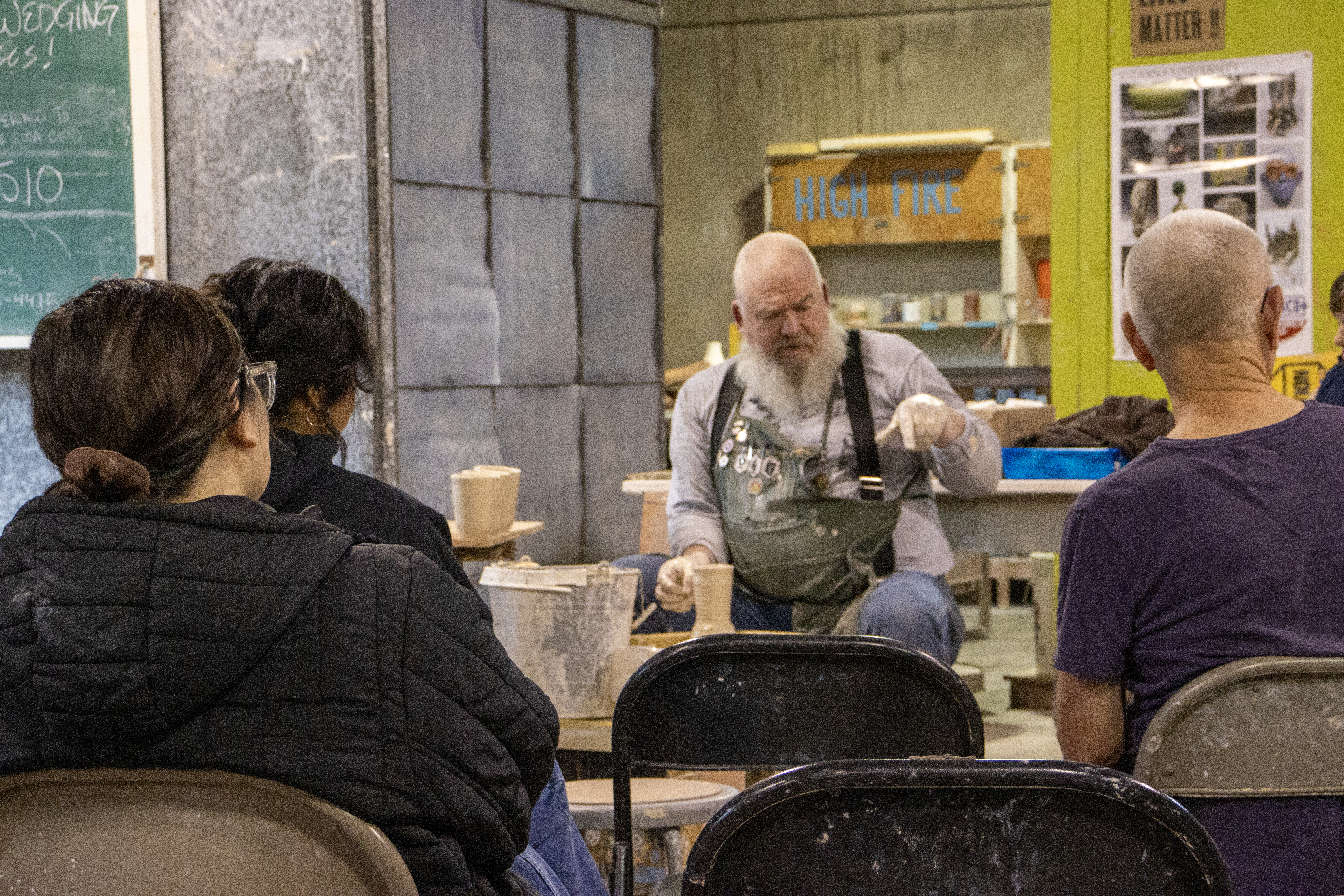
    On a gloomy Thursday afternoon, a Gulf War Marine Corps Veteran brought a warm energy to the ceramics studio, nicknamed, “The Laundry.” The veteran, Ehren Tool, is the senior laboratory technician for the ceramics studio at UC Berkeley, and has created and given away over 26,000 ceramic cups. Tool’s art documents the pains that military veterans struggle with after their service. Tool smiled behind his bushy beard and told stories about his healing journey, from his time as a Marine to his time as an artist. Tool expressed how his ceramic cups convey aspects of military culture that are difficult to openly discuss.

    “The cups are an opportunity to talk about unspeakable things,” Tool said. “War is murder, and military sexual trauma is rape, that happens in the civilian world too. Where can you talk about that? Where in polite society do we talk about these things that happen with too many people and the effects they have on their lives?”

    Ceramic students in attendance to Tool’s demonstration, such as Jack McCann, were inspired by how veterans have found ways to express the grief they feel. 

    “I really felt like in the art there’s a lot of pain, every piece is almost like mourning,” McCann said. “It’s helpful to see people grow even after experiencing something like war.”

    The class that Tool was a guest instructor for was part of a weekend-long veteran’s day celebration, organized by Humboldt College Corps, Cal Poly Humboldt’s College of Arts, Humanities and Social Sciences and College of the Redwoods. The events aimed to focus on how veterans can heal from their traumas in the military. Part of the weekend events was a dinner and panel by veterans at the Arcata Veterans Hall on Nov. 9. Tool was part of the panel alongside Air Force veteran Mark Walker. Walker is the East Bay Deputy Director for the veteran’s support non-profit, Swords to Plowshares. Walker and his wife Lynn were in attendance at Tool’s demonstration in The Laundry. Lynn Walker hopes that the arts can help veterans similar to how ceramics have helped Tool. 

    “For me, [art] allows you to open up [feelings] that are suppressing you, to things that you don’t want to say,” Lynn Walker said. “[Art] opens up your being to where there’s a healing process as you identify [your emotions] through art.” 

    Alongside Tool and Walker for the Nov. 9 panel were Air Force Veteran Joe Fox, Marine Corps Veteran Ryan Jensen, Veterans Affairs Health Nurse Ella Price, and U.S. Army veteran and Dean of Arts, Humanities, and Social Sciences Jeff Crane. Crane shared his experiences on how education in his college has supported veterans.

    “I’ve thought about this in my own work,” Crane said. “Arts and Humanities have a critical role to play in veteran’s transition, in supporting veterans, and in educating people about the role of the military in American life and in the world.”

    Panelist Joe Fox is an interdisciplinary studies major at Cal Poly Humboldt and also facilitates a veteran’s ceramics class at College of the Redwoods

    “I found healing in significant ways through playing with clay,” Fox said. “My only plan in all of this [art] is that somehow I’ll be able to connect some resources in our community, and there will be space for other people to find [healing].”

    The main event was the 3rd annual Veteran’s Day at McKay Community Forest in Eureka, CA on Nov. 11. There was a five and ten kilometer walk/run, as well as free barbeque, music, and painting. There was an opportunity for attendees to decorate their own ceramic mugs to be completed later. On Nov. 13 and 14, there was another ceramic demonstration at College of the Redwoods by Jessica Putnam-Phillps.

    No matter how veterans try to overcome their traumas and suffering, Mark Walker holds onto hope that his fellow vets will find whatever sustainable means available to find their healing, art or otherwise.

    “Different veterans find different things of purpose, inspiration, and therapy,” Walker said. “Whether it’s formal or informal therapy. It’s just about what veterans find to be healthy, get healthy, and stay healthy.”

  • Spooky masterpieces come to life in hauntingly creative ceramics department block party

    Spooky masterpieces come to life in hauntingly creative ceramics department block party

    by Christina Mehr

    The Cal Poly Humboldt ceramics department put on their 2nd annual spooky block party at the ceramics lab on the day of Halloween. The festivities were held in The Laundry from 4p.m – 7p.m.

    It was open to all Humboldt students and their friends and family too. Hosted not only by the jewelry and small metals club as well as ceramics, but with the help of the art education department as well. 

    Photos by Christina Mehr. Students walk around and observe artwork in the ceramics building.

    There were free hotdogs and snacks provided for attendees, pumpkin carving, button making, the art show, raffle prizes, costume prizes and all sorts of spooky good times. Oh, and smoke machines!!!

    The event offered a chance for art students to showcase their work this semester so far. Students were able to submit their work to be shown at the event. They accepted all art mediums in this show and the ceramic masterpieces were spooktacular. 

    “We’ve been working together to try and create a fun little art show and sale to support the art department. We divided ourselves into committees like decorating, food, art and we all just worked together to make this happen,” said Jade Hisamoto.

    The ceramic spooky block party was a hauntingly good time for everyone who dared to attend. Ghostly creations and eerie vibes filled the air of the studio as attendees unleashed their creativity alongside the art community.  

    Bachelor of fine arts (BFA) student Max Parrish helped run the clay club sale table.

    “I am one of the treasures for the clay club and we’re just trying to host a fun event. We did this last year as well as this year. We want to make it an annual event where we can have a little block party and do cute Halloween stuff and bring more and more clubs in,” said Parrish.

    “It’s also a great opportunity for students to showcase their work and put things in their resume or for grad school.”

    You can follow along on the Clay Club’s instagram for updates @HumboldtClayClub if you want to join the Clay Club and get involved in their future events. 

  • Reese Bullen Gallery features faculty artwork

    Reese Bullen Gallery features faculty artwork

    by Nina Hufman

    The Staff and Faculty Exhibition is now open at the Cal Poly Humboldt Reese Bullen Gallery, featuring artwork created by members of the art department.

    The exhibition will run until Oct. 15. It features a variety of mediums from all of the divisions of the art and film departments. Isabela Acosta, a gallery attendant and art history major, was excited about the variety of work presented. 

    “It’s literally every faculty member from every art sector, and they’re presenting their work here which is super cool,” Acosta said. “You have jewelry, ceramics, sculptures, paintings, some videos, there’s some digital art that’s really cool. It’s just like a whole nebula of stuff.” 

    Photo by Angel Barker | Sarah Whorf’s “Palm to Pine”, 2005 at the Reese Bullen Gallery on Friday. The piece is a photo screen print construction.

    Students were excited to see their teachers’ work in a gallery setting. Jack Miklik, an English major, talked about the importance of featuring faculty work.

    “They’re practicing artists and teachers,” Miklik said. “It’s good to like, look and see if you enjoy the work that your instructor is making. I think it’s like one of the more important shows as students for us to see in the art department.” 

    Many of the artists featured in the exhibition were heavily impacted by COVID-19. Their works feature themes of isolation and a desire for connectedness. 

    “A lot of this work I think was done during like COVID so when you read their little manuscripts they just talk about like what they were doing during COVID and what came out of it,” Acosta said. 

    Dave Woody, a photography and film lecturer, has two pieces in the gallery. “Gabe” and “Madeline” are both silver gelatin prints created in 2022. In the card next to his work, Woody discusses how the pandemic has impacted his art.

    Photo by Angel Barker | Sarah Whorf’s “Palm to Pine”, 2005 at the Reese Bullen Gallery on Friday. The piece is a photo screen print construction.

    “The lessons learned during that period of isolation really helped me to value the time that I do have with friends and strangers,” Woody wrote. “These photographs included in this show feel reflective of my current state of thinking about images of people- a desire to connect and to embrace the beauty and mystery of life.”

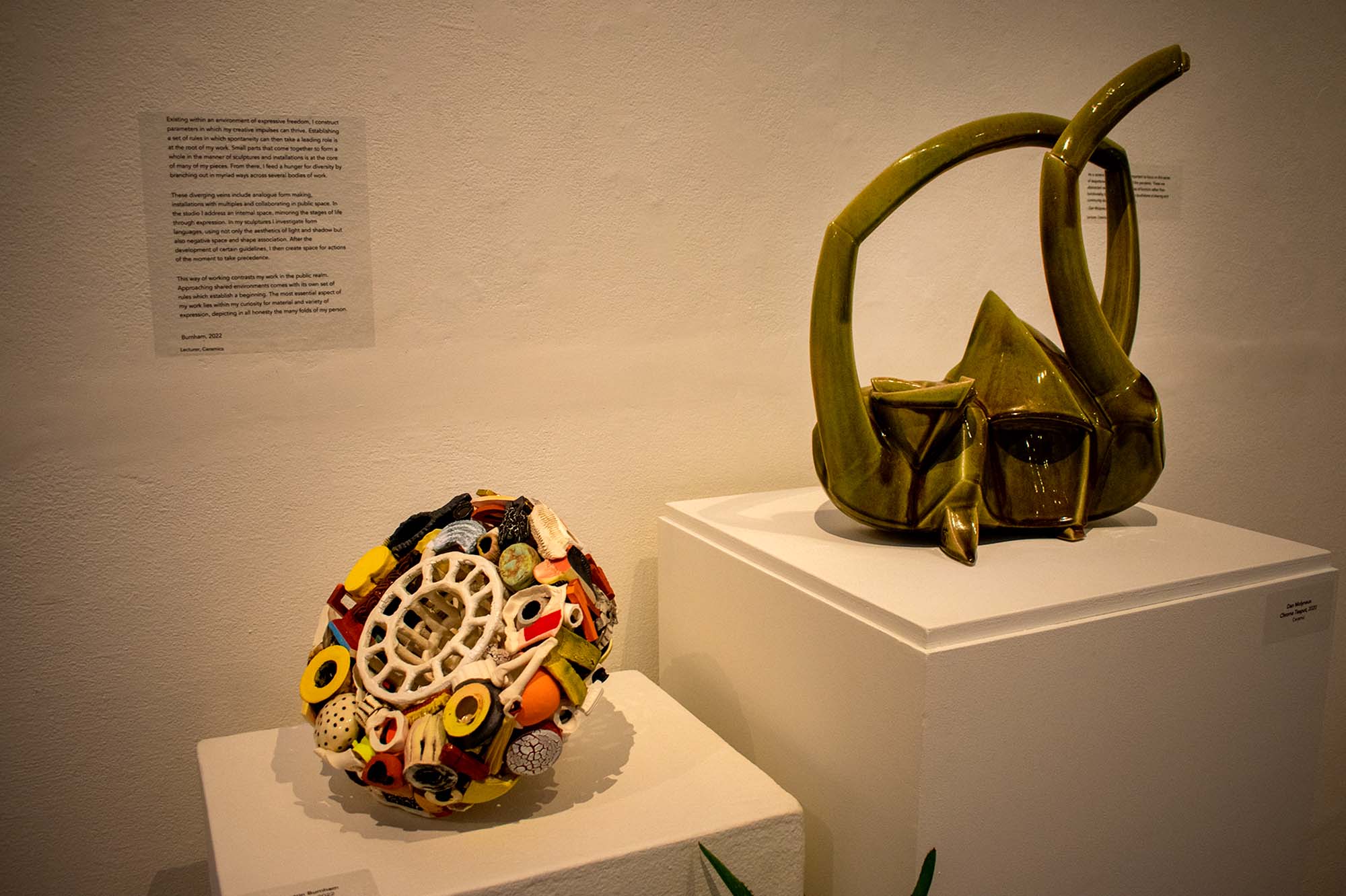
    Dan Molyneux, a lecturer specializing in ceramics, also wrote about his experience of the pandemic. His featured work “Chroma Teapot” is part of a series of ceramic teapots that were created during the pandemic. 

    “As a ceramic sculptor, it became important to focus on this series of teapots/ewers over the course of the pandemic,” Molyneux wrote. “These are abstract vessels that project an idea of function rather than functionality itself but served me as a touchstone of sharing and community during a very isolated time.”

    COVID-19 was not the only subject of the faculty artworks. Sondra Schwetman, an associate professor who specializes in sculpture. Her piece “Witness” was created in 2019 from fabric, pigment, and steel. In her description of the piece, Schwetman writes about how her work embodies the themes of the female experience. 

    “My current body of work addresses the ambiguous space between reality and fiction where the female form and therefore females often dwell,” Schwetman wrote. “The works in this series concentrate on psychological, religious, cultural, and social issues that impact women everyday such as: reproduction and reproductive rights, illness and COVID-19, class systems, colonization, compliance, silence, and war.” 

    Marilyn Koch, a visiting faculty member who specializes in jewelry and small metals, discussed the concept of “self” in her two featured works, “We are a colony,” and “Year 30: Age Badges.” The pieces utilize unique mediums like hair and synthetic teeth.

    Photo by Angel Barker | Sarah Whorf’s “Palm to Pine”, 2005 at the Reese Bullen Gallery on Friday. The piece is a photo screen print construction.

    “It is egocentric in nature and at first glance, coyly uses replicas of the human body to simultaneously repel and entice us,” Koch wrote. “Beyond the skin, teeth, or hair, are themes of ephemeral youth, community, social norms, and a prominent objective: A desperate attempt to define the Self.”

    A wide variety of mediums and subject matter means that there is something that everyone can connect with. 

    “My favorite piece is this painting over here and it’s called ‘From palms to pines.’ It’s just about moving from SoCal to up here,” Acosta said. “There’s like the map of Los Angeles and Orange County that goes into the map of Humboldt County.”“Gina [Tuzzi]’s paintings are really nice,” said Martin Lopez, an economics and studio art major. “And the cars, the ceramic cars, are pretty sweet. Yeah, that shit’s tight.”

  • An ode to “The Laundry”

    An ode to “The Laundry”

    by Jack Hallinan

    Anyone who has paid a visit to the ceramics lab here at Cal Poly Humboldt knows that it’s not your typical classroom. The run-down warehouse looks more like an abandoned industrial space invaded by artsy 20-somethings, which, after a look at the history of the building, isn’t far from reality. However rough around the edges the lab may be, it is well loved by ceramics students and staff alike, which is why the recently proposed demolition of the building and its replacement with new housing and parking structures is a controversial topic. 

    While the new construction will provide much-needed parking and housing for Cal Poly Humboldt’s growing student body, the demolition of the art spaces is a cause for some sadness and reflection for the university’s ceramics veterans. Keith Schneider, who retired from his twenty year career as a ceramics professor at Humboldt last spring, reflected on the history of the building as well as his own personal connection to the space. 

    “Over the past 50 years, tens of thousands of students have developed their work and

    honed their skills here, made lifelong friends, and some even met their future spouses

    here in the lab,” said Schneider. 

    The lab’s long history begins with the Arcata Laundry, a commercial laundromat once located in the current ceramics lab location. Reese Bullen, who developed the ceramics program at Humboldt, was successful in purchasing the space under the condition that as a temporary lab, no major structural improvements were to be made to the building. In 1969, the ceramics department staff and students moved all of the laundry equipment out of the space themselves, and replaced it with the ceramics equipment that had previously been stuffed into an undersized room in Jenkins Hall. The ceramics lab continued to be endearingly referred to as “The Laundry,” and in the first few months of its existence as a classroom, former Arcata Laundry customers would wander into the studio with bags of dirty clothes wondering if they could still get them washed. 

    The proposed demolition of this unconventional yet beloved space is one of many small changes occurring throughout campus. The ROSE house and Bret Harte house are also set to be demolished, a decision that has received pushback from students and staff who feel that the charming, if outdated, buildings enrich the character and history of Humboldt’s campus. 

    “Someone said, the best art is made in spaces that look the least like classrooms,” Schneider said. “If you get a chance to walk through the lab, you will get a sense of what our students love about it. It’s not a classroom, it’s a funky old run-down industrial space, with remnants of the past everywhere you look.” 

    Since transitioning to a polytechnic university, Humboldt has received state financial support for the construction of several multi-million dollar projects. At least ten new buildings are listed on the school’s “Infrastructure Projects” web page, mostly including science labs and housing. Included in the prospective are plans to construct a new Campus Apartments building and parking structure where the current residence and ceramics and sculpture labs are now located. 

    According to the web page, the building complex will consist of “600-700 beds in total that will be built in relation to a new 650-stall parking structure.” While Cal Poly Humboldt students are undoubtedly in need of both housing and parking, a vital part of campus culture and art will be replaced by the facilities. Brandy Ayon, who is currently enrolled in their second class in the ceramics lab, expressed this sentiment. 

    “I will miss it. It’s bittersweet,” said Ayon. “The old-timey-ness and roughness of the building is very Humboldt. I’ll miss it, but I’m excited for the new opportunities a new space will bring.” 

    Ayon hopes that the new space will be like a blank canvas for students. It is unclear where the new studio will be located, or when it will be ready to use. The demolition of the ceramics and sculpture studios is proposed to be completed by 2026 and is expected to cost $2.5 million.  

    “A new building may come with all the latest technology, but the character and quality that students have come to love about the Laundry would be very difficult to recreate. A huge part of history will be lost when/if this building goes,” said Schneider.

  • The HSU ceramics department fires back up

    The HSU ceramics department fires back up

    Experienced ceramics students are back in the lab this semester

    Following a graceless transition to online learning in the spring, ceramics students are receiving a drastically improved experience this semester.

    When the COVID-19 pandemic first went into effect, forcing students to finish the spring semester from home, ceramics students were among those who drew the shortest stick.

    According to Ryan Hurst, who has been teaching ceramics at HSU for nine years, when classes were moved online, the hands-on experience that students signed up for was no longer possible. They were instead tasked with drawing up sketches, studying research and development and critiquing other artists’ works.

    “It wasn’t ideal,” Hurst said.

    This semester has been a continuous adjustment according to Hurst. Gaining access to the building as well as the proper equipment to record demonstrations over the summer was an uphill battle.

    “I didn’t get either of those things until two weeks before it started up, so the plan kind of went out the window,” Hurst said. “I’d reformulated plans leading up to the end of the summer and some are working and some aren’t, but it’s a crazy adjustment.”

    At the start of the fall semester, each student was given a kit to take home, including basic ceramics tools and the clay they would receive in a normal semester. Beginning ceramics students will be creating almost entirely from home this semester, because of the new lab capacity put in place by COVID-19 protocols. Meanwhile, intermediate and advanced level students are granted some access to the building, with portfolio development students receiving first priority.

    “They have paid their dues and deserve the last moments of their academic career to do as much as time allotted them,” Hurst said.

    Jenna Santangelo is a former student and now lab technician for the ceramics department. After six years of classes, this is Santangelo’s first year as a staff-member. According to her, the beginning students are able to accomplish almost all that’s required of them in a normal semester from the comfort of their homes, assuming they possess the space.

    “Working at home is possible,” Santangelo said. “But it’s pretty messy and a lot of people don’t really have the space necessary for it.”

    Melissa Martin is a graduate psychology major with an emphasis in academic research. She takes ceramics as a therapeutic ritual each time she’s nearing the end of a chapter in her education. This semester, she’s preparing to close the final chapter as she puts the polishing touches on her thesis. Taking the beginning ceramics course this semester and not having access to a lab has changed the way Martin approaches her projects.

    “I think that you’re a little bit more restricted of how much work you can actually do,” Martin said. “I also was a very avid wheel thrower, so that’s also been a real big challenge. Now I’m doing a lot of hand building stuff so I really have to hone in on different skills.”

    One thing not included in the kits the university handed out to ceramics students this semester was a proper kick wheel for throwing pottery.

    “The kick wheels are, I think, like 400 pounds,” Santangelo said. “Which isn’t really feasible for most students to move.”

    Despite the disappointments and also experiencing challenges with creating a comfortable workspace at home, Martin is remaining optimistic.

    “We’re just learning how to be resilient in this world. We’re still trying to accommodate the best that we can,” Martin said. “But it is still a challenge and we’re still learning little bit by little bit, each time.”

    Maximus Landon is brand new to the ceramics program this semester. Landon took the class in hopes it would help them enjoy school again. Unfortunately, the barriers introduced by the online format have taken away from some of the enjoyment.

    “Because I’m really new to all of this, I’m not entirely sure what exactly I’m doing,” Landon said. “I’m not sure if I’m scoring things wrong and I’m not sure if I make this dent too large if it’s just going to have the entire side fall off, so it’s a lot of trial and error by myself and it’s not very fun for my anxiety.”

    Likewise, Hurst has been very anxious this semester about the safety of his students and the quality of their education.

    “It’s definitely not an ideal thing,” Hurst said. “But a lot of students have just been really happy to still be able to work with clay, even if it is at home.”