The Lumberjack


Students Serving The Cal Poly Humboldt Campus and Community Since 1929

Tag: Collin Slavey

  • #HowTo: Exploring with Center Activites

    #HowTo: Exploring with Center Activites

    HSU’s Center Activities helps students get out and around Humboldt County


    Trying to explore Humboldt but don’t have a paddle to go with your board? Center Activities is an on-campus resource available to students looking to get geared up and participate in local adventures.

    The staff at Center Activities are friendly and attentive and they’re more than happy to help students find what they need to enjoy their day out in Humboldt County. Adventure Program Director Deserie Donae says Center Activities makes an effort to ensure students feel welcome on campus and in the community.

    “We can outfit a student with anything but shoes,” Donae said. “We get people prepped and prepared to go out by providing food and transportation so people don’t have to think too hard about it. We want the outdoors to be easy and accessible.”

    The Lumberjack has compiled a convenient how-to playlist of videos to guide readers toward fun activities. This list is a great way to introduce students to an outdoor lifestyle in a healthy way.

  • Flynn Creek Circus Goes Down the Rabbit Hole

    Flynn Creek Circus Goes Down the Rabbit Hole

    A hot and bothered rabbit and a troop of acrobats highlight the 21+ circus show

    The Rabbit is out of the hat and she wants some action. Animal control is on the scene, face to face with a gang of nihilist bunnies who are ready to pounce. The Flynn Creek Circus was set up in a big, red and white circus tent in the Creamery District of Arcata.

    The inside of the tent was warm. The audience’s voices were loud under the tent’s striped skin. The stage lights glowed a harsh, dull silver. A three person band charged with a buzz of anticipation playing a staccato drum, a perpetual accordion and a melodic guitar. A five-foot tall, eight-foot wide, magnificent red hat sat on the corner of the stage, otherwise known as the the magician’s hat.

    The stage lights flashed and a hush fell over the crowd. After all eyes turned to the stage, the drum roll crescendoed into a crash as the curtains parted. Out came a sharp dressed man in a red suit who held a deck of cards in his hand.

    The Flynn Creek Circus was set up in a red and white striped tent. The ticket booth was the eclectic trailer the left. | Photo by Collin Slavey

    “You know what I am going to say next?” he said to the audience with a smile on his face. “Pick a card.”

    The mix of sleight of hand, bravado and stage magic was just the start of the show. Popcorn and booze were also on the menu. After the magician’s magic act, Grenda the Science Chick made her appearance on stage with a platter ringed in butter shots.

    “The story comes first,” Grenda said. “It’s what makes us different. The art director comes up with a story and makes acts serving the story. It adds a lot to think about. You wonder what’s next and become more invested in the characters.”

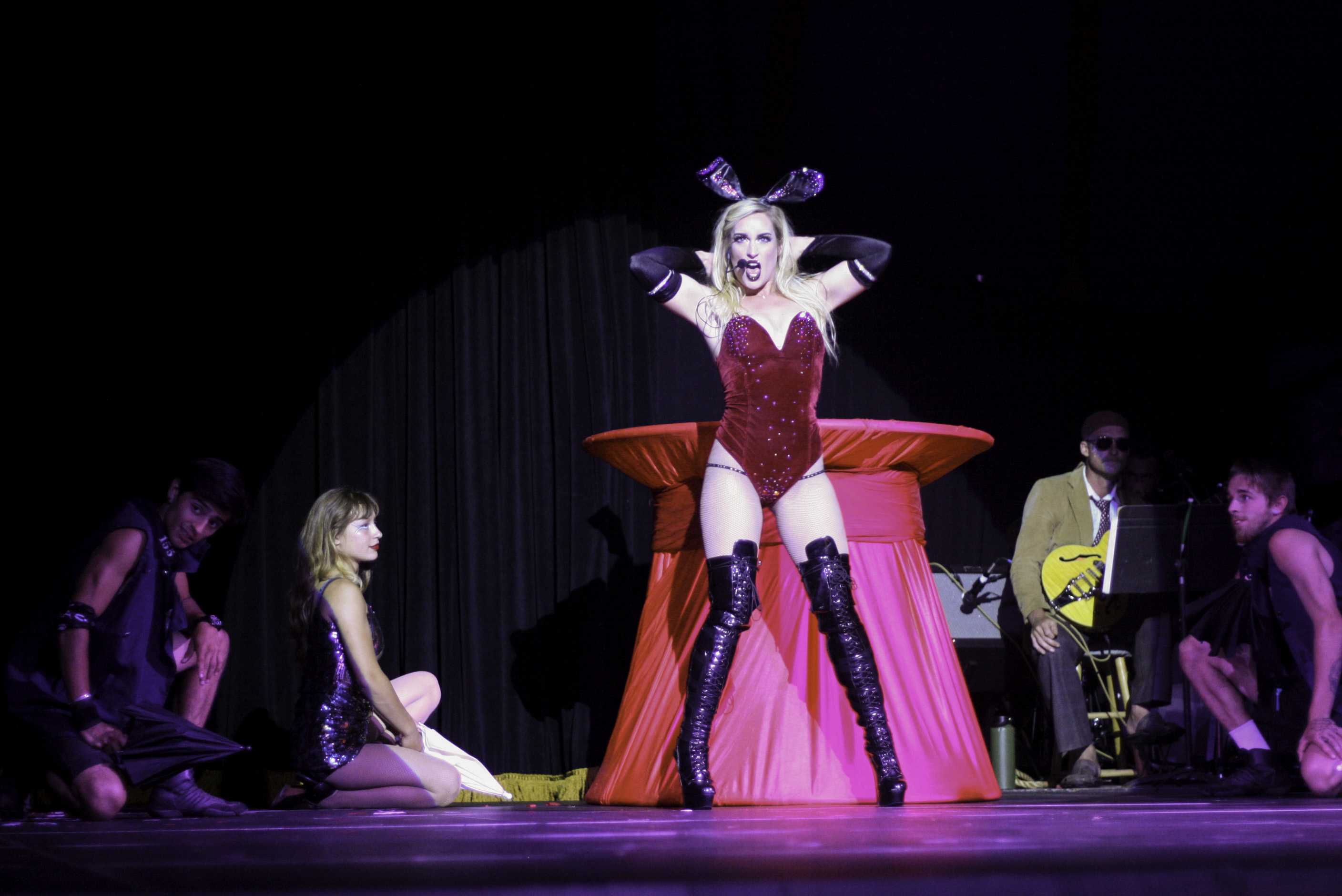
    That evening was the 21-and-over show. The story was about the magician’s rabbit who had figured out how to get herself out of his hat. Life in a hat is awfully lonely, and she was desperately tense after a solitary life. She was on a mission to do what rabbits do best: reproduce.

    “I’ve been in that hat for so long,” the Rabbit said. “Do you know how tough it is to be in a hat your whole life? Oh, my god it’s dreadful! I am so pent up. I have got to find me a carrot to chew on.”

    Cue the nihilist bunnies. Animal control was on their tail with malicious intent. The magician’s rabbit was roped into the conflict on stage and the gang decided to make a stand as they whipped out K-bar carrots. Their performance devolved into a harrowing knife act and they were not messing around. The nihilists didn’t have a hare in the world. They made an acrobatic escape, bringing the magician’s bunny with them.

    Nick Harden doubled as animal control and ticket salesman. Here he is grimacing after the credit card reader stopped working. | Photo by Collin Slavey

    Nick and Wendy Harden played classic opponents: animal control and a stray cat. The duo did a unicycle act with acrobatics and headstands. It was a regular game of cat and mouse around the stage, their faces tight in concentration as Nick wheeled around the stage while Wendy maneuvered over his body in an impressive display of poise and balance. Clearly the duo has put years into their act.

    “We were sold out the first night. I hope we can get you a ticket tonight,” Harden said. “Wendy stands on my head during our unicycle act.”

    As the show came to a close, the magician performed his final act. It was an arcane rope act where he hoisted himself up and down, suspended 30 feet off the ground. He tied up the loose ends with his rabbit partner and encouraged her to find herself. The magician’s rabbit concluded the show with a descent into general apathy as the nihilist bunnies welcomed her into their ranks.

    “Nothing really matters,” she said with a wink. “So I’m going to go get what I can get while I can get it. Know what I’m saying?”

    The Flynn Creek Circus is based in Mendocino. The circus tours the North Coast and Oregon during summer, while the weather permits it. The 2019 season is halfway through and August 18 was the final show performed in Arcata this time around. Not to worry though, the next local shows will be in Fortuna on September 5, 6, 7 and 8. Tickets can be bought online or at the door.

  • Pollinator Predicaments

    Pollinator Predicaments

    Climate change affects the lives of birds, butterflies and bees

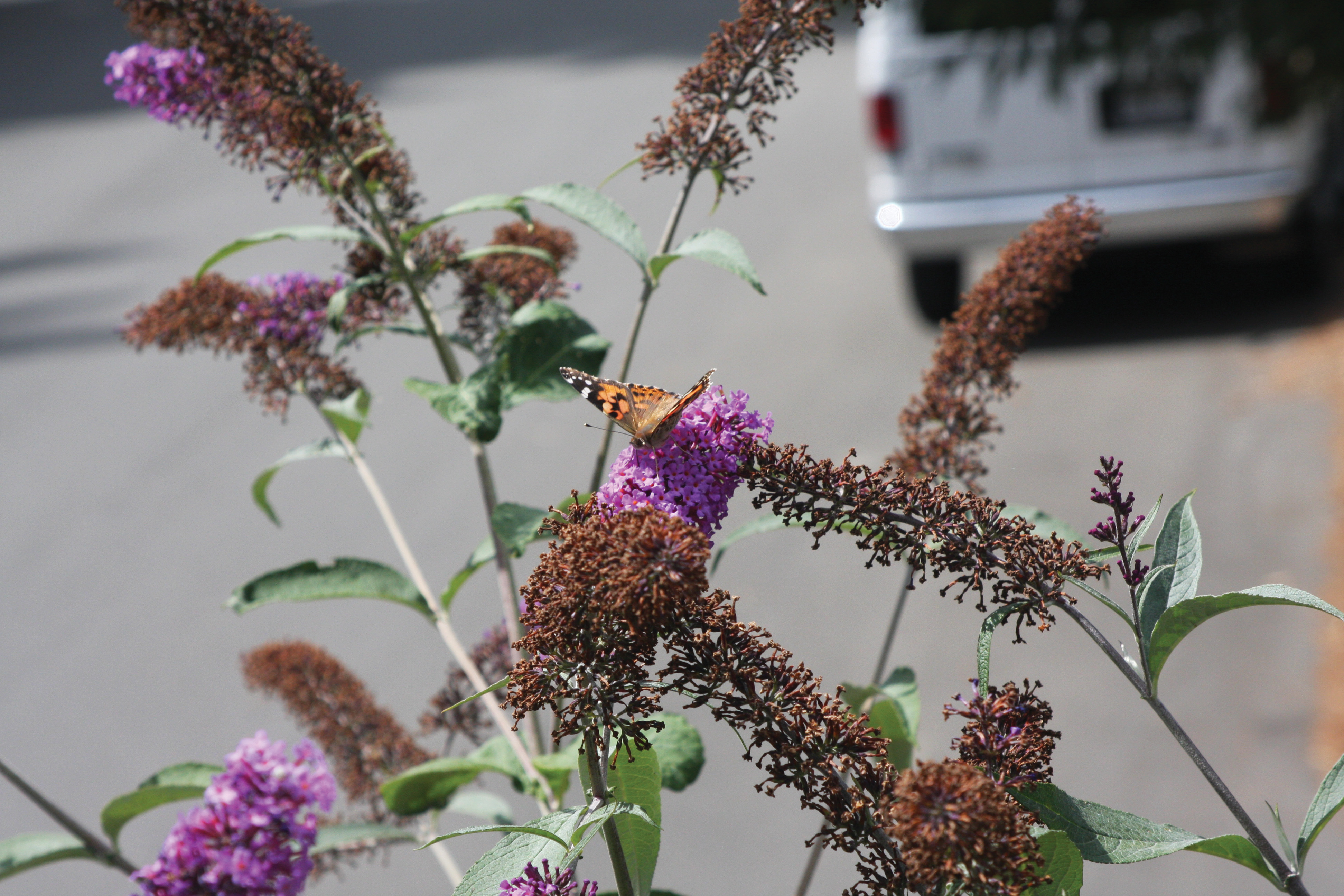
    Pollinators matter! Right under our noses a huge community of ants, butterflies and bees are hard at work to make sure the world gets fed. The climate crisis is turning up the heat on these poor guys, and our many-legged friends are at risk. Here’s some information on how pollinators are still doing their best to help us out.

    A solitary silver bee perches on a yellow flower to drink nectar. Notice the yellow pollen on its legs which it will bring to the next flower it drinks from. | Photo by Rand Rudland

    Flowering plants and pollinators have a unique relationship with one another. Ecologists and biologists pay attention to special events in these organisms’ lives which mark growth and development. The science of studying life events is called phenology.

    Ideally a pollinator will hatch from its egg or develop from its pupa and leave the hive around the same time its flower of choice blooms. The timing of these life events is important because if a bug emerges too early or late, it may miss a plant’s flowering completely. No flower equals no food, and that’s no good.

    After emerging, the pollinator goes searching for nectar. The sweet liquid is energy-packed food for bugs. When a pollinator lands on a flower, it picks up pollen. As it continues to look for nectar, the pollen is shaken off and sticks to other flower’s pistils, the female organ of the plant. Pollen travels down a shaft to fertilize the ovary, which begins to go through mitosis and eventually produces fruit.

    Tayloranne Finch and Melanie Honda are two farmers working on the Bayside Park Farm in Sunny Brae who get to interact with pollinators every day. Without pollinators, their farm would be a bunch of fruitless bushes.

    Finch said the farm was working with the City of Arcata to build a permanent solution, a perennial native pollinator garden. The garden would have year-round plants that local pollinators prefer, supporting the local habitat organically.

    Tayloranne Finch, left, and Melanie Honda, right, are farmers at Bayside Park Farm. They spent a sunny afternoon pollinating corn by walking through the rows, swaying their arms back and forth. Every week is a volunteer friday at Bayside Park Farm on Old Arcata Road in Arcata, CA 95521. | Photo by Collin Slavey

    “We’re installing plants that will be there forever. It makes it easier for pollinators to establish themselves on the farm and it is mutually beneficial for us,” Finch said.

    Small changes in abiotic, or physical non-living factors, can alter life events. There are many changes in an ecosystem that can affect how a plant or pollinator does its job. Dr. Rachael L. Olliff-Yang and Dr. Michael R. Mesler published a paper in 2018 titled The potential for phenological mismatch between a perennial herb and its ground-nesting bee pollinator.

    In the paper they investigate how temperature affects the phenology of the silky beach pea (Lathyrus littoralis) and its main pollinator, the ground-nesting solitary silver bee (Habropoda miserabilis).

    “Temperature best predicted both flowering and bee activity, although soil moisture influenced the timing as well,” the paper said.

    Their findings imply that in the face of the climate crisis, an average increase in temperature may cause the silky beach pea and the solitary silver bee to fall out of sync.

    “Comparison of linear regression slopes of phenology against temperature suggests that bee nesting time is more sensitive to differences in seasonal maximum temperatures, and may advance more rapidly than flowering with temperature increases,” the paper said.

    A bumblebee looking for lunch landed on this flower to get a drink of nectar. The bee will help pollinate nearby flowers as it continues on its flight. | Photo by Collin Slavey

    Olliff-Yang and Mesler said that it’s important to understand what factors influence flowering and pollinator activity. Their investigation into the bee and the pea is just an example of a broader issue in the world.

    Building habitat is invaluable to local animal communities, as shelter, food and water are critical needs for every living organism. The most simple thing to do is to plant native plants in the front yard, as this will attract local pollinators.

    Local nurseries like Mad River Gardens will be more than happy to teach you about native plants and how you can attract and support our flying friends. As active members of the ecosystem, we all need to do our part.

  • April showers bring May flowers

    April showers bring May flowers

    Upbeat music filled the air on campus. May Day, the springtime celebration of fertility and joy, was in full swing at CCAT. Smiling faces crowned in flower wreaths welcomed visitors to the house. Anticipation was building.

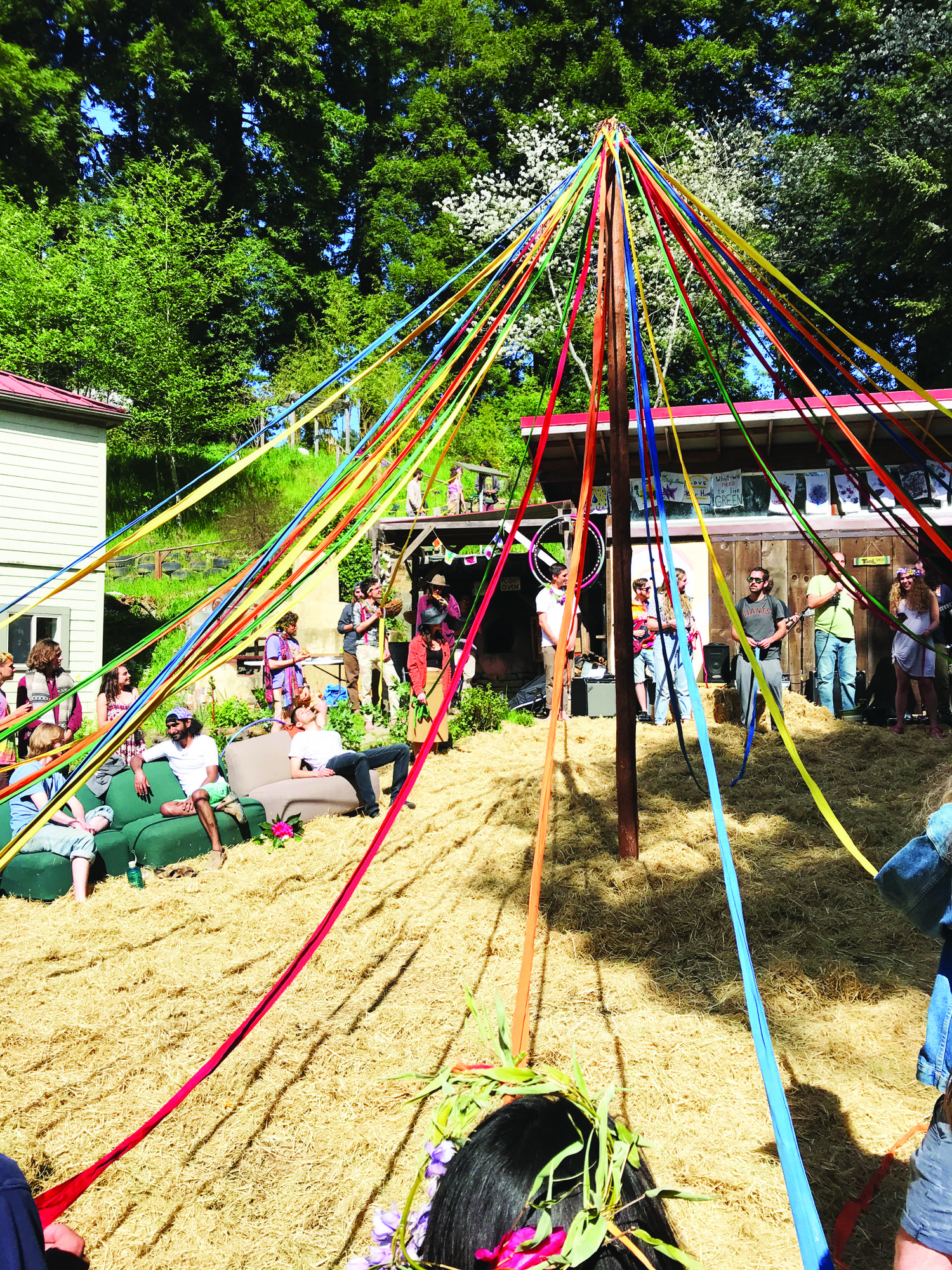
    The front lawn of the Campus Center for Appropriate Technologies was covered in yellow hay. The sun shone over people gathered there, warming hearts and heads. Funky music rolled across the yard, digging deep into people’s souls. There was a pep in everybody’s step as they danced around the yard. May Day is a celebration of rebirth and revitalization. Students and families crowded around tables to weave themselves flower crowns, dressing themselves in natural beauty.

    Sean Armstrong introduced May Day with passion. He stood above the crowd with his corn blond hair blowing in the wind as he wove an image of May Day. Armstrong said humans have been celebrating May Day for five thousand years. May Day is a celebration of fertility and rebirth, of sexuality and community. May Day marks the beginning of spring and traditionally pays homage to Eostre, the pagan goddess of spring. May Day is ultimately a celebration of one and all.

    “Spring is a non-optional time of renewal,” Armstrong said. “Today is a moment of optimism. This place is about regeneration and optimism. We have a ‘world gets better perspective’ and we trust in a future of growth.”

    CCAT offered a whole bouquet of May Day themed activities. Piles of flower clippings were set out on tables so people could make themselves a wreath of flowers to wear. The wreaths were crowns accentuating natural beauty. Bright blues, fiery reds and striking yellows were set in rings of ivy and grass. Abigail Lowell shared why flowers were celebrated on May Day.

    “A flower is beauty,” Lowell said. “Flowers are one of humans definitions of beauty. Humans have always considered flowers to be the foundation of beauty.”

    Lowell wore a light blue dress to match her light blue eyes at the May Day festival. The weather was kind enough to copy Lowell and grace the celebration with a bright blue sky to boot. Girls danced and twirled in flowery dresses to the funky music. After a while a hush fell over the crowd, the music slowed down when Armstrong took the stage to introduce the May Pole.

    The May Pole is a symbol of the potency of the god. For lack of a better term it is a phallic birch pole set straight into the ground. Attached to the top of the pole green, red, yellow, blue and orange ribbons streamed down into the hands of excited people around the base.

    “I met my wife at a May Day celebration right here on CCAT’s lawn,” Armstrong said. “The whole day build up to this great release. You know, there’s flirting, there’s drinking, there’s feasting. We can pay attention to the spring season and celebrate it.”

    The music kicked up again. Half of the dancers began to skip around the pole. Every other person walked towards the center of the pole and danced in the other direction. The inner circle and the outer circle wove in and out between one another. At the climax of the dance the May Pole was wrapped in an intricate lattice of color. As the weave tightened around the pole, flowers were tucked into the ribbons. What resulted was a rainbow braid adorned with bright flowers and surrounded by smiling faces.

    If only the sensation of May Day could be pressed and preserved forever. Alas, just as the celebration recognizes change the day’s sky began to change as the sun set. Sebastian Forward, CCAT’s organic gardener and future botanist, did his best to save the day. He was teaching CCAT’s visitors how to press plants and flowers.

    “Pressing plants gives you something tangible when photos and drawings just won’t cut it,” Forward said. “We can preserve plants for over 100 years. Pressed plants show us what the plant was like the day it was pressed. We can still see what the little hairs look like under the microscope.”

    May Day celebrated the transition of winter to spring. As plants bloom they herald fruits to come. Chirping birds and buzzing bees sat on branches while they watched humans dance around a field of hay celebrating life and joy. Celebrate this time of year with happiness and love. Show compassion to those around you. Stop and smell the roses, spring has come.

    “It was heartfelt,” Lowell said. “Everybody was talking to one another. There were no inhibitions. The bright colors livened everybody up. We felt community. I liked it.”

  • April showers bring May flowers

    April showers bring May flowers

    This past week flowers on Humboldt State’s campus have come into full bloom

    Rhododendron, azalea, coltsfoot and more plants have begun flowering. Don’t forget to stop and smell the rosemary. Flowers’ sweet smelling perfume waft across campus, attracting a host of pollinators and people to their petals. Our biologists are on a buzz researching flowers on campus.

    IMG_5190.HEIC.jpg
    Stefani Brandt pointing to the date of the first flowering plant. | Photo by Collin Slavey

    Stefani Brandt is one such biologist. Brandt teaches plant taxonomy on campus, the branch of science concerned with classification of organisms. She said flowers serve one function: sex.

    “Flowers have evolved to be the perfect fix for their pollinators,” Brandt said. “If no pollinator showed up, there would be no flowers. The flower uses scent, color and shape to attract pollinators that spread sperm and pollen from one flower to the egg of another. Once fertilized, every flower produces a fruit.”

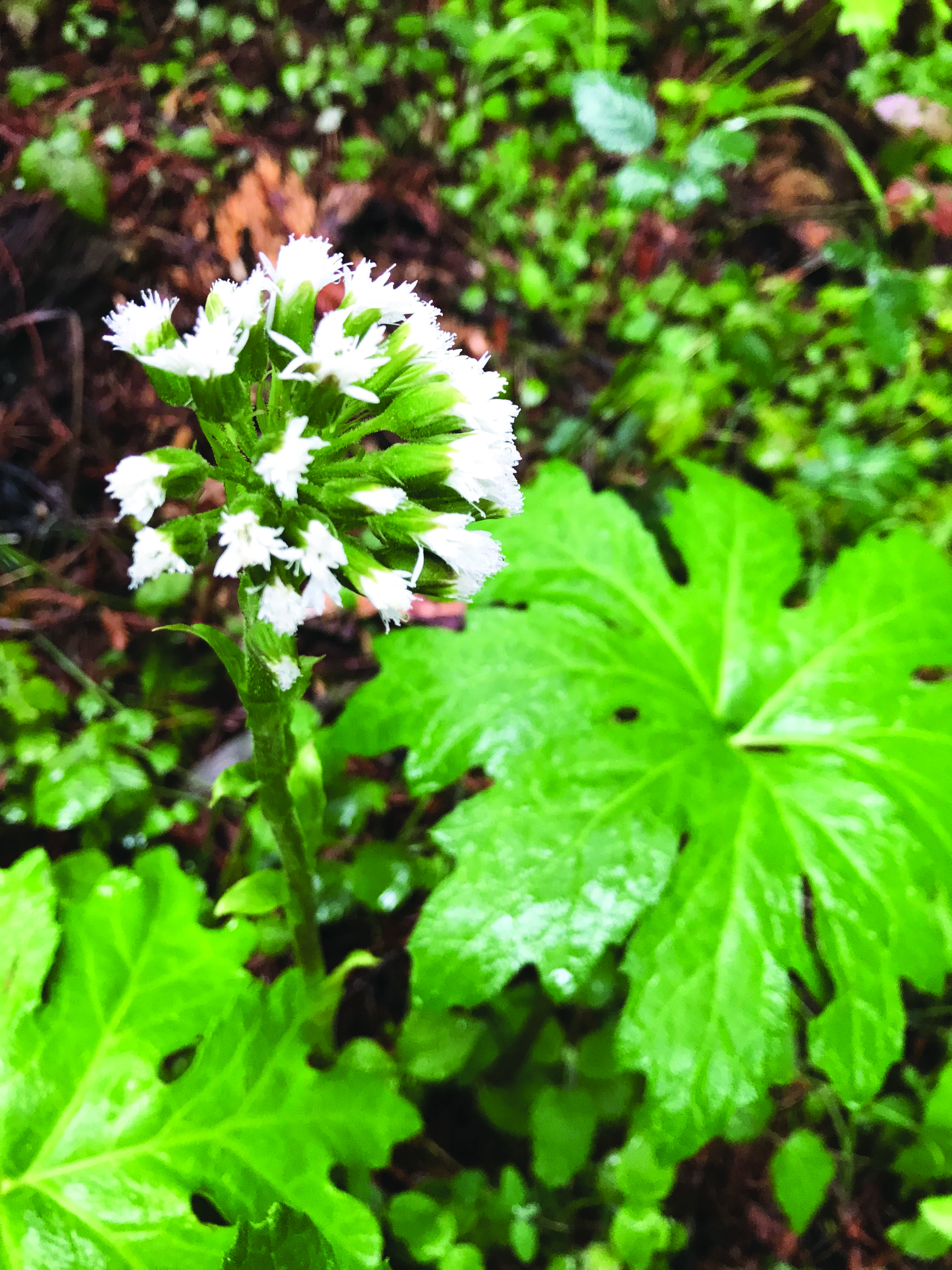
    Casey Albarran is a co-director for CCAT and a biology student who is investigating Petasites frigidus var. palmatus, otherwise known as Arctic sweet coltsfoot. Albarann is working with Michael Messlet to learn about what pollinates the mysterious plant. Together they are hoping to discover what pollinates the plants.

    “Petasites is a complicated plant,” Albarran said. “It is dioecious, meaning there are male plants and female plants. It is native to this region and there is not much we know about it. We’ll check on it for ten minutes at a time and try to learn what pollinates it.”

    IMG_5125.HEIC.jpg
    Casey Albarran posing with the Arctic colts foot he is studying. | Photo by Collin Slavey

    Albarran said the research group has already began collecting pollinators. Some flies and bumblebees have been captured to be studied. Keep an eye out on campus for pollinators like the bumblebee and treat them nicely. Those bumblebees are responsible for making sure the beautiful flowers come back year after year.

    Biologists keep track of when flowers bloom each year. Phenology is the study of periodic life cycle events such as a plant’s first flower. These life cycle events are often sensitive to climate and temperature and are used as indicators for climate changes.

    Our grounds crew takes care of plants on campus as they grow and change. Skye Freitas prunes the campus trees to prepare them for flowering. Freitas cuts away dead branches and shapes trees to help the tree thrive.

    IMG_5129.HEIC.jpg
    Sky Freitas hanging out with some plants. | Photo by Collin Slavey

    She said she enjoys working with plants every day. Since the bloom has happened on campus, Freitas is more than happy to take care of the plant life.

    “It never feels like I’m actually working,” Freitas said. “It’s very therapeutic to work with the trees. I get to help make sure all the nutrients get to the right place.”

    Petasites, however, is not waiting for Freitas to visit. It displays its white flowers, beckoning pollinators to its petals. Albarran and his team monitor the plant as pollinators begin to fly towards it, landing on the flower in search of Petasites sweet nectar.

    In due time the plant shall be fertilized to create fruit, restarting its life cycle so it may live on to flower another day.

    IMG_5119.HEIC.jpg
    A blooming trillium flower. | Photo by Collin Slavey

    “There are over 300,000 species of angiosperms, flowering plants, in the world,” Brandt said. “There are probably over a hundred on campus. There is a reason they smell good and look pretty.”