The Lumberjack


Students Serving The Cal Poly Humboldt Campus and Community Since 1929

Tag: CSU

  • Editorial: Thank u, next

    Editorial: Thank u, next

    Who will be the next HSU president?

    When President Lisa Rossbacher announced in October that this spring will be her last year serving as president of HSU many wondered who will be the one to take her place.

    We’re already reaching our end of the school semester and there is still no word as to who will serve as HSU’s president. The last we’ve heard of the search publicly was back in February when there was an open forum for the search for the next HSU president, but there was still no announcement on who’s next.

    However, what’s more convenient is that the announcement of HSU’s next president will be after spring graduation. You know, when most students will not be in campus until their summer or fall semester starts. It’s convenient since there won’t be many students at that point voicing their opinions of the new president.

    President Rossbacher has been a controversial president, with the cutting of the football program, the administration’s lack of acknowledgment when it comes to racism around the community and the closing of the third street art gallery and KHSU’s shut down just to name a few things that don’t paint a positive picture for Rossbacher’s image. Many students, community members and faculty have spoken out against President Rossbacher’s actions and lack of taking action.

    While we’re happy to finally see an end to Rossbacher’s leadership there needs to be more transparency as to who will take on her role next. We don’t know if the next president will improve upon HSU’s issues and demands, resume the same leadership tactics as Rossbacher or be an even worse president than Rossbacher.

    With that in mind we should know who HSU’s next president is going to be at this point in our semester. We should know if our next president will stand with their students, faculty and community.

    We don’t want a president who will just stay quiet from the students’ and the community’s demands while cutting programs that meant a lot to the community and former alumni. Thank you Rossbacher for not completely burning HSU down to a crisp but, who’s next?

  • Community still demands ‘Justice for Josiah’

    Community still demands ‘Justice for Josiah’

    Police are past their estimated time for solving the more than one-year-old crime

    He was smart. He had goals. He came to Humboldt to avoid the challenges of South L.A.

    These words were spoken outside of Arcata City Hall by Karim Muhammed, a friend of David Josiah Lawson. Lawson was murdered on April 15 2017 and his case still remains unsolved.

    Discussion on race and safety in the community were the main subjects amongst community members on Oct. 15. Tears streamed down faces as homemade posters of Lawson were hung on the walls in front of Arcata City Hall.

    Muhammed met Lawson their freshman year in the dorms at HSU. He said he misses Lawson and was at his dorm everyday.

    “He was one of the first people I met when I moved to Humboldt,” Muhammed said.

    Muhammed said he thought Arcata was safe compared to south L.A but that isn’t his experience. How to keep moving forward he said is to bring awareness and continue to inform incoming students about Lawson’s murder.

    “We need to get it solved, get new people in power, get people informed and vote,” Muhammed said.

    Muhammed said the goal is to make the community safer but many people in the community are still oblivious to the death of Lawson or they just don’t care. When he learned of the roster release of the HSU’s predominantly African American student clubs to the Arcata Police Department, Muhammed said that was a big red flag. He said this shows where they stand with the situation and further proves their indifference.

    “People choose what they want to believe or they just don’t want to believe,” Muhammed said.

    Meg Stofvsky, a retired school psychologist, said the vigil’s are held to continue remembering Lawson as well as inform people who are new in the area. Stofvsky was representing Charmaine, Lawson’s mother, and said Charmaine has caught the interest of the California State University system about her son’s murder. She said Charmaine has been travelling to other CSU’s to talk about safety on campus and will be in Sacramento later this week.

    “We need a firm insistence we are not going to continue to let this happen,” Stofvsky said.

    It has been 18 months since Lawson’s murder and Stofvsky said the county seems to be sliding backwards. She said we need to continue having resilience and hope and to keep the Arcata Police Department accountable. Stofvsky said the APD recently gave a six to eight week time limit to solve the case and that limit is up.

    “We hear a lot of talk about progress from the APD but we haven’t seen any,” Stofvsky said.

    When Charmaine Lawson comes into town for court hearings or monthly vigils she stays at Sharon and Michael Fennell’s house. Both are HSU alumni and have been proponents seeking justice for Lawson. Sharon Fennell, was a KHSU DJ under the name Sista Soul and said she met Charmaine at the second vigil held for Lawson.

    “We show up once a month. This is a beautiful thing and Charmaine knows,” Fennell said.

    Fennell offered ideas to start selling “Justice for Josiah” shirts at the HSU bookstore to continue to bring awareness of his murder. She said that way Lawson would be seen more on campus and students would be reminded of what happened. A conflict Fennell has is that students come to HSU but then leave after they graduate, which keeps Humboldt from changing.

    “People need to come, stay, build businesses and change the community,” Fennell said. “If not we stay 80 percent white. Boring.”

    A member of the “Justice for Josiah” movement, Jill Larrabee, said actions by CSU and California Faculty Association are starting to take hold regarding safety on campuses but society needs to change. Larrabee said we need to learn, educate, heal and grow and get more people in office.

    “Humboldt County has the good ol’ boys club in power,” Larrabee said.

    To move forward Larrabee said white people need to converse with other white people about racism. Larrabee said racism is still a big problem here in Arcata but more and more people are coming out and acknowledging their privilege.

    “When we hear white people say we can’t guarantee safety, then we are going to demand it,” Larrabee said.

  • 17 going on 18

    17 going on 18

    But still no justice for David Josiah Lawson and his family

    On the 15th of every month for the past 17 months the advocacy organization Justice for Josiah, which is led by his mother Charmaine Lawson, holds a vigil in memory of David Josiah Lawson in the wake of his murder.

    This month the vigil was held at the Manila Community Center, adjacent to Josiah Lawson and his friends most cherished beach.

    “I chose this spot today because my son loved the beach,” Charmaine Lawson said. “I wanted to be in a place were my sons presences was often.”

    There were around 30 to 40 in attendance. Community members, Humboldt State University faculty members and family and friends of David Josiah Lawson gathered around to eat barbecue and listen to music.

    This did not detract from the seriousness of why people were gathered that day. Many wanted to talk about both the lack of transparency within the HSU administration and Arcata Police Department and overall trust in them.

    Sylvia DeeRoy, a local community member and HSU alumni, said she has had enough of HSU President Lisa Rossbacher and the HSU administration’s avoidance to answer questions they deem vital for family and friends of David Josiah Lawson, and other HSU alumni.

    “Ages have gone by,” Derooy said. “As an alumni (Rossbacher) doesn’t even care about me.”

    The vigil happened 25 days after the Aug. 20 roster release of the HSU’s predominantly African American student clubs to the Arcata Police Department. Many community members are unaware of this but those who are seem to take a deep frustration with the events that have transpired.

    Meg Stofsky a community advocate and member of the Justice for Josiah Movement, had words that seemed to resonate with many at the Vigil.

    “I thinks it’s racist as hell,” Stofsky said.

    Although there has been a deep mistrust of the HSU Administration and Arcata Police Department, many family and friends of Josiah say they appreciate the community support of those who know or didn’t know him.

    Berenice Roman, a student at College of the Redwoods and friend of Josiah, said that although she is frustrated and this situation is difficult, she is glad some in the community are concerned and willing to support them and Josiah.

    “It’s really cool that people in the community are mad about it, and are still coming to support Ms. Lawson and his friends,” Roman said. “It just makes us feel like we are not alone.”

    As the day drew on, the vigil turned its sights on the remembrance of the memory of David Josiah Lawson. Charmaine Lawson, aunt of Josiah Stacey, and friends Alex Foster and Karim Muhammad led the walk to Josiah and his friends’ favorite beach.

    Charmaine lead community members following the vigil and attendees chimed in harmony the ethos of these vigils and protest:

    “Justice for Josiah, long live D.J. and say his name, Josiah!”

    The procession winded down to the beach as their calls for justice echoed out into the humboldt-sphere. After, the vigil attendees gathered in a circle with their hands clasped together, which was formed around hearts with texts inside them that read, “Josiah” and “D.J.”

    Attendees were asked to go around and say something about Josiah that they remembered, or the reasons for why they were there that day.

    No one seemed to be able to get a word out without a semblance of confusion or sorrow.

    The vigil ended with the symbolic throwing of roses and petals into the ocean. Although this was supposed to be the most powerful image of the vigil Charmaine Lawson’s words seemed to transcend the moment.

    “I know he is not here in the physical but he’s here in spirit,” Lawson said. “I know he is shining and saying ‘Mom thank you, for not forgetting me and thank you strangers who are now family for being here and standing with my mom and our family.’”


  • HSU hosts CSU Native American Initiative council

    HSU hosts CSU Native American Initiative council

    The California State University Native American Initiative began in March 2006 as the result of a CSU summit with the representing leaders of 40 California Tribes discussing strategies to instill a pathway to higher education for Native American families. Humboldt State President Lisa Rossbacher will lead the Native American Initiative council.

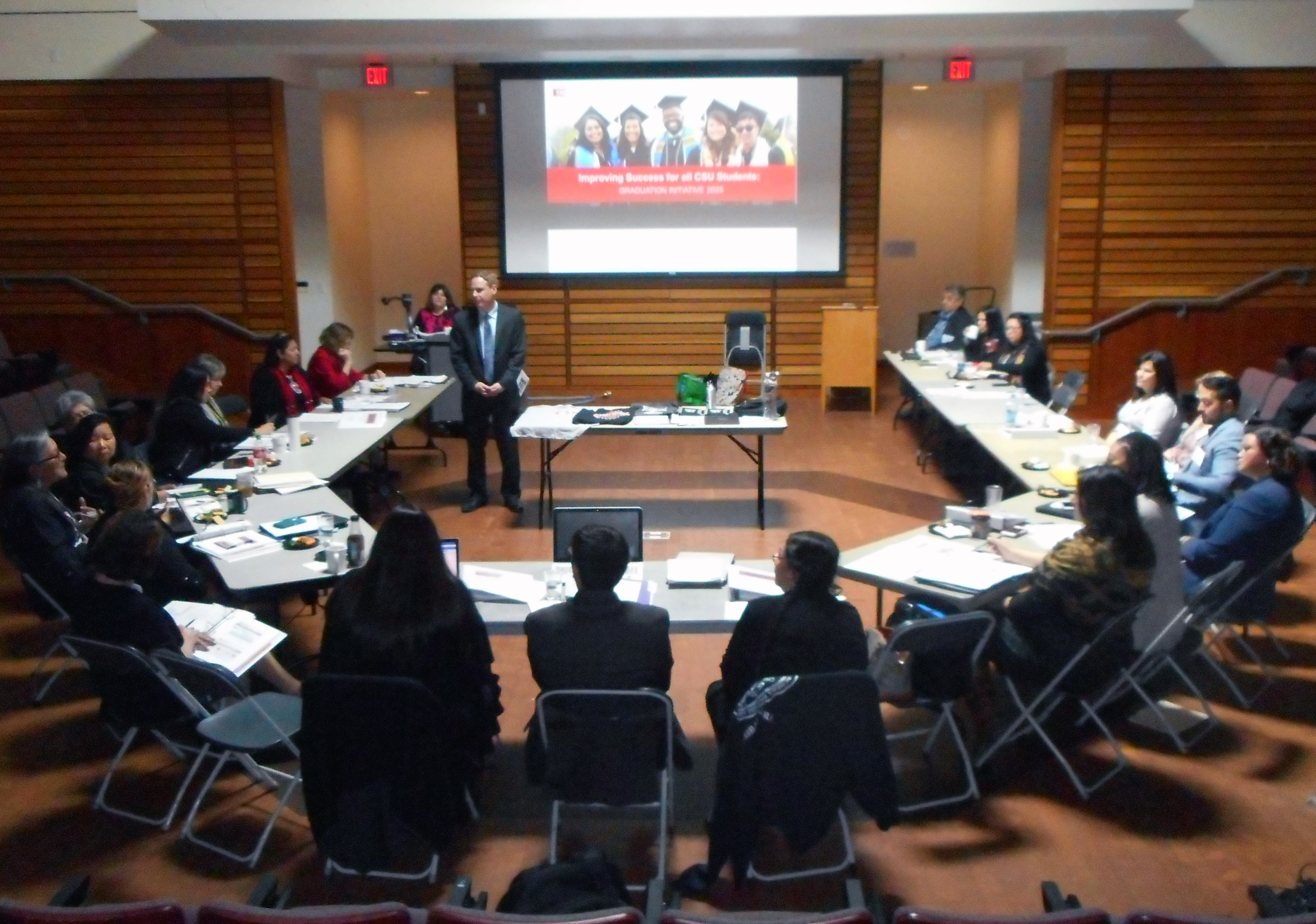
    Last week, HSU hosted the California State University Native American Initiative statewide meeting in the Native American Forum on campus. Representatives from the California State University Chancellor’s Office, along with representatives from 19 of the 23 California State Universities, met with Rossbacher.

    Former HSU president Rollin Richmond was chair of the initiative, too. During that time, there were two summit meetings.

    Rossbacher was appointed by CSU Chancellor Timothy White to lead this initiative in February.

    “I am truly honored to be asked to serve as the presidential liaison with this council,” Rossbacher said.

    During the summit, Rossbacher laid out the overall goals of the Native American Initiative council.

    “One of our overall goals is to identify, share and support strategies that will help the graduation initiative [of 2025] and [Native American] student success. Strategies that will help us recruit students, retain students and graduate Native American students, and help them be successful beyond their time in the CSU,” Rossbacher said.

    Item two on the agenda was to support Native American studies research.

    “One of our goals is to engage and support faculty, staff and student research into the wide variety of fields related to Native Americans in the state and national Native American studies,” Rossbacher said.

    Another subject Rossbacher wanted to focus on was sharing information.

    “How can we share information that we are discussing and coming up with to support [Native American] student success? How do we share that with the tribal leaders throughout the state and the tribal communities? How do we share that critical information with the chancellor, his staff and the presidents throughout the CSU system?” Rossbacher said.

    The goals of the April 4 meeting were different than the overall goals of the Native American Initiative.

    The first goal of the April 4 meeting was to learn about updates and current CSU data on Native American student success, including recruitment, retention and graduation.

    “Look at the achievement gap or the opportunity gap that may be affecting Native American students on our campuses,” Rossbacher said.

    The third goal on the agenda was learning about some of the trends, practices and successes of the K-12 level and how that assists Native American students moving on to the California State system.

    The fourth goal of the meeting is developing strength.

    “Because I am the campus president, I want to be sure that you all know that there is something we are doing here at Humboldt State to accomplish those goals,” Rossbacher said.

    There are funds available from the Chancellor’s Office to support academic programming.

    “We do have funds that were established through the president’s council for underserved communities. It is a grant to the campus for academic preparation to strengthen the graduation initiative,” Maryann Jackmon of the CSU Chancellor’s Office said.

    “Funds can help students travel and see what is out in the world waiting for them after graduation,” Theresa Gregor, CSU Long Beach faculty said.

    The Tribal Liaison from the California State University of San Marcos, Tishmall Turner, is also the vice-chair of the Rincon Tribe.

    “President Rossbacher seems really genuine and sincere and she will do a good job of leading the Initiative,” Turner said.

    “President Rossbacher has been very supportive of Native American studies since she came to HSU,” Dale Ann Sherman, retired HSU Native American studies faculty said.

    The initiative will provide support to Native American faculty and students.

    “It gives you that lift to do the work. You don’t have to fight just to get to the point where someone will say go ahead,” Leece Lee-Oliver, CSU Fresno director of American Indian studies program and department of women’s studies said.


  • Humboldt State alum Lynette Zelezny becomes first female president of CSU Bakersfield

    Humboldt State alum Lynette Zelezny becomes first female president of CSU Bakersfield

    Humboldt State University alumna Lynette Zelezny was recently appointed as the first female president of California State University, Bakersfield.

    Zelezny will be the 12th woman added to the current list of 23 CSU presidents, officially making female presidents the majority.

    “It’s an amazing honor,” Zelezny said. “This is a really big deal for such a large system. I am modeling to women that there is no ceiling. We just smashed it.”

    Zelezny earned both her bachelor’s degree in psychology in 1979 and her master’s in 1981 from HSU. Zelezny remembers her time at HSU fondly. Not only is it where she met her husband, but also she was mentored and nurtured academically.

    Zelezny said it was her time studying with psychology professor Mary Gruber, Ph. D. that changed her life. Zelezny took statistics with Gruber, and eventually became her teacher’s assistant.

    “She was kind and encouraging in helping the students develop their skills,” Gruber said. “The students expressed great appreciation for her guidance and inspiration.”

    Gruber worked at HSU from 1974 to 2008, and recalls how much she enjoyed working with Zelezny as a student, as an advisee and as her teacher’s assistant. Gruber said that Zelezny helped tutor a group of international students, and worked very closely with a blind student, coming up with creative ways to graph and manipulate data.

    “Lynnette’s positive energy, dedication, expertise, insight, caring and collegiality are clearly beneficial for those she works with, and serves,” Gruber said. “The students and faculty at California State University at Bakersfield will be very fortunate to have her guiding and inspiring them as their president.”

    Kauyumari Sanchez is an assistant professor of psychology at HSU who attended California State University, Fresno to finish her undergraduate degree, and has known Zelezny since 2003.

    Sanchez said that Zelezny served as a mentor, helping guide her through applying to grad schools and providing tips for success. Sanchez said Zelezny’s ability to work with others, and her adaptability, set her apart in her field.

    “I would say I owe a lot to her,” Sanchez said. “She was really quite honest about some realities of being a woman in this field. She prepared me mentally for that expectation.”

    Chris Aberson is a professor of psychology who said that he thinks Zelezny helped him get his job at HSU.

    “When I was scheduled to interview at HSU in 2000, I reached out to Lynnette, as I knew she was an alum. She immediately emails one of the professors on the search committee to provide an informal reference,” Aberson said. “I have a feeling that her kind words have something to do with me being here.”

    Zelezny’s position as president will commence on June 30.

    Zelezny currently serves as the provost and vice president for academic affairs at Fresno State. This means she is in charge of faculty hires and development of new academic programs, among other things.

    Zelezny said that she feels it is her consistent involvement with her students that makes her a unique leader.

    “It’s a privilege to serve students in a bigger way,” Zelezny said.

    Zelezny said an important part of her role is to understand diversified funds. These are multiple ways a university can make revenue, through grants, self-support, such as extended education, and gifts from alumni and friends.

    When asked about Humboldt State’s budget crisis, Zelezny said that while the entire CSU system is facing budget cuts, understanding the different ways to obtain funding is more important than ever.

    Zelezny said that she supports students’ rights to protest, and encourages them not to lose optimism, or hope.

    “We hold each other up in times like these,” Zelezny said. “Your voice should be heard, and that should be encouraged.”


  • Humboldt State University ranked 39th out of 632 Master’s degree-granting universities.

    Humboldt State University ranked 39th out of 632 Master’s degree-granting universities.

    By | Robert Brown

    Humboldt State broke into the top 50 of Washington Monthly’s most recent annual National College Guide for master’s universities. The guide rates universities across the nation and evaluates them based on graduation rate, price of tuition, and other factors.

    BestWest_Web-5.jpg
    The view of Union Street by the Redwood Bowl. Photo credit: Lauren Shea

    The publication is changing the way universities are valued; instead of rewarding colleges for the number of applications they reject, they get credit for enrolling large numbers of low-income and first-generation students. Instead of promoting the most expensive schools, universities that produce research, train next generation scientists and PhDs and instill the importance of public service are acknowledged.

    “We rate schools based on their contribution to the public good in three broad categories,” Washington Monthly magazine said.

    “Social mobility (recruiting and graduating low-income students), research (producing cutting-edge scholarship and PhDs), and service (encouraging students to give something back to their country).”

    Dr. Meredith Williams, Assistant Professor of Sociology, said the faculty and coordinators in the master’s programs are always looking for new and better ways of making programs affordable for all students.

    “That is who we are as a university and as the CSU system,” Williams said.

    BestWest_Web-3.jpg
    The view of Humboldt State University from 14th Street. Photo credit: Lauren Shea

    Dr. Yvonne Everett, Professor of Environmental Science and Management, said that despite the CSU system’s pledge to help low-income students, getting funding for graduate school is challenging.

    “There is financial aid available for students who qualify and there are a few scholarships students can apply for,” Everett said.

    “Students in the natural sciences may also be funded through their faculty members’ research grants.”

    “HSU’s graduate programs are different because HSU is different,” Williams said.

    “We have great relationships with local businesses, nonprofits and community organizations to connect with in classes, as a volunteer, and with required internships and projects.”

    According to Williams, the learning here is hands-on. Many of our graduate programs are focused on applied, real life skills, using the skills and knowledge of our disciplines to create lasting, systemic social change.

    “Many students do their M.A./M.S. research or projects on topics in the public interest or that benefit a community organization,” Everett said.

    “Graduate students in social work do all kinds of projects with local agencies to help them monitor and improve their services. For graduate students in Wildlife and Natural Resources, HSU is located very close to field research sites with many state and federal agency professionals to collaborate with.”

  • Smoking Ban at HSU

    Smoking Ban at HSU

    By Danny Dunn

    This fall Humboldt State University will officially become a tobacco and smoke free campus. This ban includes all tobacco products such as, but not limited to cigarettes, tobacco pipes, and cigars along with electronic smoking devices like vape pens and box mods.

    Several California State Universities have already enforced this rule, and all 23 CSUs will eventually become smoke free.

    There are some exceptions to this ban, though not very many. According to the Executive Order 1108 exceptions include: smoking in a university sponsored theater, as well as ceremonial campus events may be authorized by the President or designee only when a required part of a specific performance. This includes smoking and tobacco use for traditional ceremonial activities of recognized cultural and religious groups.

    The use of nicotine cessation products such as Nicorette products are permitted under the order.

    This order will help to create a safer and more healthy environment on campus, but not everyone is onboard with this new smoke free campus.

    HSU student Jason Henkle believes that this new order treads on his rights as a smoker on campus and that it will give smokers a bad look among their fellow classmates.

    “There will be a stigma now for smokers at CSUs,” Henkle said. “This ban is going to isolate smokers from the non smokers.”

    Henkle went on to say that if he had not already planned on living off campus next fall, that this order would have made that decision for him.

    HSU student Joseph Keith also believes that smokers and even some non smokers social lives will take a hit from this new ban, because of the connections that people make throughout the gazebos on campus, most notably the gazebo at the bottom of campus apartments.

    “What are people going to do, we are not going to hang out our tiny ass living rooms all day,” Keith said. “I have friends now that I would have never had, not just through smoking, but me having a friend that I smoked with that introduced me to their friends.”

    HSU student Oscar Arzate admits that he is relieved that HSU is becoming a smoke free campus.

    “Honestly I am glad people will not be smoking or vaping on campus,” Arzate said. “The smell is very irritating to me.”

  • Editorial:  Freezing tuition fee increase

    Editorial: Freezing tuition fee increase

    By | The Lumberjack Editorial Board

    At the end of January, the University of California Board of Regents approved a 2.5 percent tuition fee increase to take place in the 2017-2018 academic year. Though the University of California system said that financial aid will cover two-thirds of California undergraduates, protests against the tuition fee increase persist.

    Too many rights of college students have been under attack. There are worries about undocumented students’ access to education, the continuance of the anti-discrimination regulation safeguarding our LGBTQ community and the general welfare of our public school system under the direction of Secretary of Education Betsy DeVos.
    The increase may seem inconsequential to some, but many students struggle with affording both higher education and the daily cost of living. Decreasing the Pell Grant to cushion the cost of inflation means reducing supplemental income that helps students pay for vital services from transportation to housing.
    California State Assemblywoman Sharon Quirk-Silva and the California Faculty Association fought against the tuition hike with AB 393, the Student Protection Act. The Act states that the increase in college tuition has surpassed the cost of living while student debt continues to rise. 
    AB 393 cites a Consumer Financial Protection Bureau’s statistic that said, “one in four student loan borrowers are either in delinquency or default on their loans.”
    The Institute for College Access and Success reports that from 2010-2014, the average student debt rose by 56 percent. 74 percent HSU of graduates had debt in 2014.  
    The rising student debt numbers indicate that students are struggling to maintain a balance between the high cost of college and necessary expenses like housing, food and healthcare. The resulting cycle of loan defaulting continues to cause an unnecessary drain on the lives of students.  
    AB 393 suspends the tuition hike and limits the increase of system-wide fees to an amount that was agreed upon on Dec. 2016.  This suspension will be in place until the 2019-20 academic year. 
    The public education system is facing a myriad of problems; now isn’t the time to force a tuition increase. AB 393 also takes into account factors beyond the primary fiscal burdens of the cost of higher education. The Act will help students breathe easier during these contentious times and alleviates at least one worry. 

  • A master plan for free tuition

    A master plan for free tuition

    By Charlotte Rutigliano

    Can California follow in the footsteps of many European countries and offer free tuition for students?

    While CSU students across the state are currently protesting a 5 percent tuition hike, in Sacramento  Governor Brown reaffirms his commitment to protect access to higher education, and of a plan for free tuition across the state of California. As of now, it’s just talk.

    Most current students and prospective students have not heard about this plan, and some have mixed feelings about it.

    Jake Morrison a 21-year-old senior communications major said he thought it would be both a good and bad thing.

    “It would be good in the sense that it would make knowledge and education more accessible,” Morrison said. “But bad in the sense that it would probably cause a rise in Americans immigrating to California, and we already have a population and housing issue in the state.”

    Alyssa Buie a 21-year-old junior business marketing major said it greatly benefits many people in the state though she doesn’t think the state could afford something like free tuition.

    “It would be beyond beneficial for students of all ages in all walks of life,” Buie said. “But it’s a little economically unfeasible.”

    Even people that have thought about going back to school like 22-year-old McDonald’s general manager, Lindsey Blood, said it seems great and she would be more inclined to go back if tuition were free.

    “It would encourage people to invest in themselves,” Blood said. “And it would give a lot of people opportunities they would otherwise not have.”

    The idea of free tuition it brings up many questions such as, would students take it just as seriously and go to classes as when they had some type of financial investment? Would they be more likely to choose passion over job security? Would they be more likely to further their education and go on to graduate school or get a doctorate?

  • Increasing fees and increasing fears

    Increasing fees and increasing fears

    By: Domanique Crawford

    As Humboldt State students struggle with affording available housing and hot meals, we can now add the extra burdens of the proposed tuition fee increase to our list of troubles for the 2017-18 academic school year. Students are surprised the decision is up for discussion and are outraged.

    “I think it’s high enough already,” psychology major and single mother Tanya Repair said. “I get financial aid and that’s the only reason I can come.” 

    University of California will formally propose to the UC Board of Regents at the end of January. The new plan will increase the tuition fee by five percent, and students like Repair who struggle financially are worried about what the increase will mean for them. Funding education is expensive, and that expense is a major deterrence to wanting to reach for anything higher than a high school diploma.

    When Governor Jerry Brown enacted the college tuition freeze almost five years ago, it was a temporary halt to the ever-increasing hikes that have already been witnessed in the UC and CSU school systems. These hikes would follow the rate of inflation. 

    One of the top concerns is that a tuition fee raise, even one that is only five percent, will affect financial aid disbursement amounts because it is the only protection they have against the already high costs of college. Though students want to oppose any increase in educational expenses, the incremental annual increases to tuition is meant to help students manage the additional cost at a more reasonable time frame. 

    Alice Abler, HSU child development major and scholarship recipient said even though she has money to pay for college, she is worried about other students.

    “You want a more diverse population for everyone,” Abler said, “not just people who can afford it.”

    According to HSU President, Lisa A. Rossbacher, if the tuition fee is raised then HSU financial aid would be increased to cover low-income students, including qualified California Dream Act students. Financial aid funding will increase to cushion the costs.

    “The tuition increase being discussed at the system level would not exceed $270 for full-time undergraduates for an academic year and a similarly proportional increase would apply to graduate students,” Rossbacher said in an e-mail. “The increase would apply to all students in the California State University, including at HSU.” 

    Although students are angry about the proposed rising tuition, the new fees are designed to provide a cushion for costs for future crises. The administration wants to avoid the steep and dramatic costs we have witnessed in previous years. Eventually, the cost of tuition will rise. Hopefully, the measures the administration have taken will prove viable enough to aid those who already struggle with the high cost of education.