After months of organizing, students working for CSU campuses are getting ready to vote on whether they would like to unionize as part of California State University Employees Union (CSUEU). If they vote to join, the CSUEU would negotiate contracts on the student’s behalf.
Student workers, such as Leah Baker at Cal State Monterey Bay, stress the importance of a union for this campus population.
“CSU has student workers doing the labor that usually union employees would be doing,” Baker said. “But they’re paying us much, much less, and they’re not giving us any of [union] kinds of benefits.”
With a unionized contract for student workers, Baker hopes that it will allow for improved conditions and benefits for student workers such as a discounted parking pass. Student Assistant Tori Umeda at Cal Poly Pomona shared why they are voting to unionize.
“I am voting [in favor of] a union because I am sick and tired of struggling every day to make ends meet,” Umeda said. “Many of us work multiple jobs besides being students just to cover the basics like food, rent and utilities. Often, we have to work [when we’re] sick because we don’t have sick time.”
Communications Officer for CSUEU Khanh explains how student workers can vote.
“Voting starts on Jan. 25 [and ends Feb 22]. Student Assistants will receive an email the day before [Jan. 24] with instructions to access their electronic ballot,” Khanh said. “[Students] will be issued a PIN unique to them in order to vote. This is a historic election, the largest of its kind ever, and we know thousands of student workers are ready and eager to vote, ‘union yes,’ and join CSUEU/SEIU 2579 as the next wave of union leaders building a more equitable CSU for all.”
After over a year of negotiations with the California State University (CSU) Chancellor’s Office, the California Faculty Association (CFA), which represents lecturers, professors, counselors, coaches and librarians, and Teamsters Local 2010, which represents skilled laborers such as locksmiths, plumbers, painters, etc., have decided to strike during the second week of classes Jan. 22-26.
This will be the second strike for the Teamsters following their day-long strike across the CSU system on November 14, 2023. As for the CFA, this is their second strike as well, following their series of strikes across select CSU campuses in December 2023.
Goals for Strike
Teamsters such as Housing Locksmith Phillip Bradley and the CFA hope that the combined strike will bring the CSU back to the bargaining table.
“If you don’t have classes, you’re not going to have students-and if you don’t have students, you don’t have much of a university,” Bradley said. “So honestly, we’re hoping that the threat of [a week without classes] will get us back to the negotiating table, but the ultimate goal of this is to get some fair labor contracts.”
The CFA in particular is fighting for better aspects in their contracts, such as paid leave for parents, lactation rooms, safer bathroom options and as CFA President Marisol Ruiz highlights as the most important, a wage increase that can compete with the recent 8% increase in inflation.
“The end goal for us is to get our 12% [wage increase] that we deserve,” Ruiz said. “[The 5% wage increase that the Chancellor’s office is offering] is behind inflation and would mean that we’re getting a pay cut. Are you seeing the gas prices? Have you seen the PG&E bill? Have you seen the food prices? [The Chancellor’s Office] is cutting our salary because it doesn’t keep up with inflation, so we’re doing the same work for less pay.”
The CSU has previously stated that they lack the funds to accommodate the 12% pay increase. However, Ruiz questions that the CSU lacks the funds, as evidenced by the salaries of the CSU presidents and chancellors, as well as pay increases they receive.
“If [the CSU system] didn’t have the money, why did the Board of Trustees allow [new CSU Chancellor] Mildred Garcia to [receive] almost a million dollars for her salary?” Ruiz said. “For me, [the Board of Trustees are] not making good decisions. They’re using our taxpayer dollars, our student’s money, to give the rich more, and it’s not trickling down to us, the workers – the ones on the front lines with the students.”
Potential Impact of the CFA-Teamster Strike on Campus
Besides classes being canceled, there are more potential and expected impacts on the campus community at large. CFA Faculty Rights Chair and member of the state-wide bargaining team for the CFA, Loren Cannon, explains the extent of the strike for faculty besides lecturers temporarily trading their markers for picket signs.
“We cannot do any other work,” Cannon said. “There’s no halfway to strike. If somebody said, ‘Hey, I’m not going to teach my classes, but I’m going to answer my students’ emails,’ – we can’t do that. We can be reprimanded. We can be disciplined. We can lose our jobs. So, the laws about striking, it’s gotta be an all-or-nothing.”
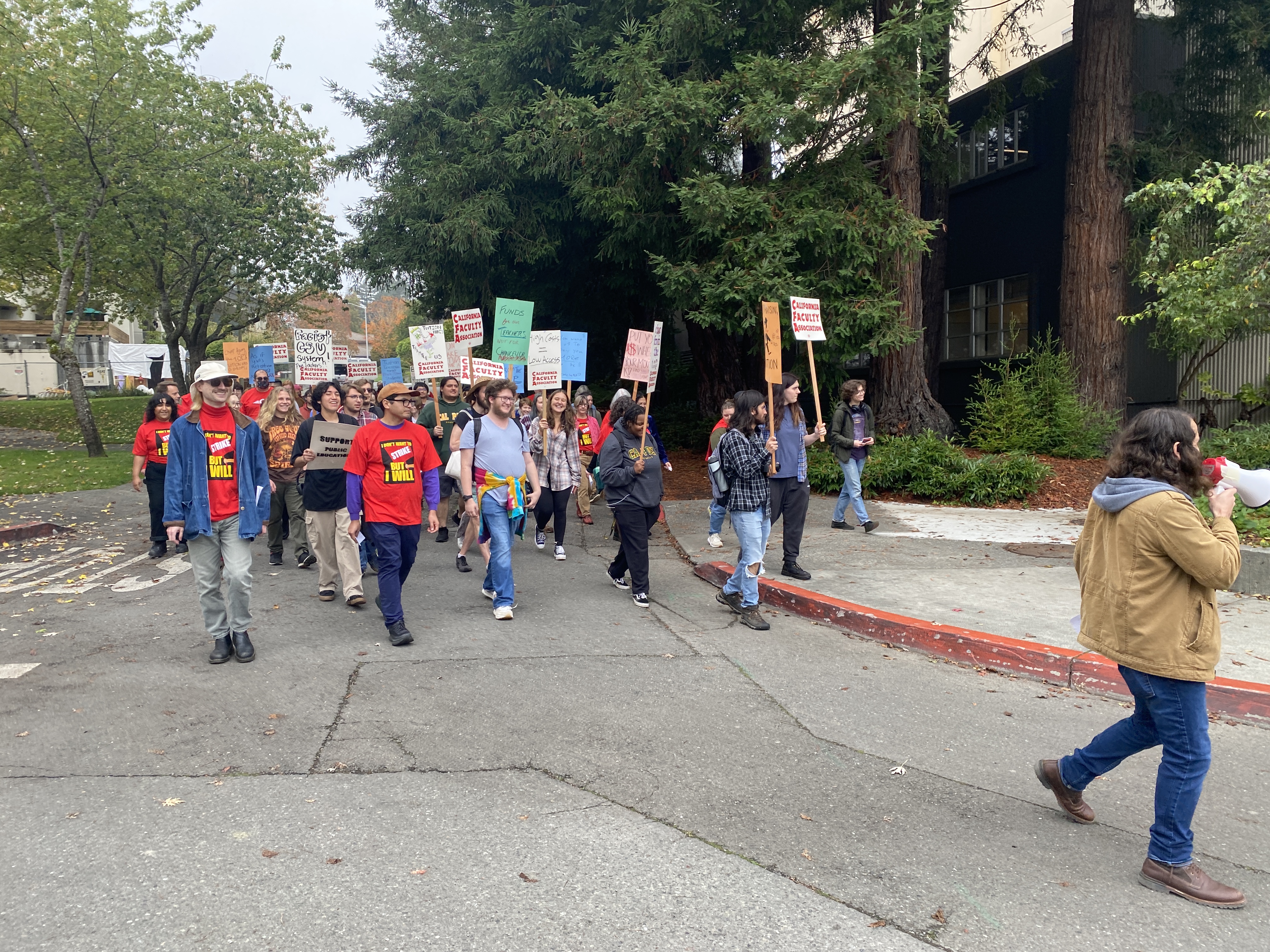
During the week of the strike, the Teamsters and the CFA will be picketing across campus, notably on LK Wood and 14th Street. Ruiz encourages students to support by joining the line throughout the week and hopes that the actions can be a teaching moment.
“[The CFA and Teamsters are] modeling,” Ruiz said. “We don’t know what industry [the students are] going to be in, but in any industry, they’re going to have to join a union to protect their wages.”
Bradley wants to make it clear that the Teamsters’ strike isn’t to attack Humboldt but to send a message to the CSU at large.
“This strike is not about protesting Humboldt,” Bradley said. “All this is about our collective bargaining with the Chancellor’s Office and the CSU system as a whole. We’ve got good managers and supervisors at Humboldt who have been very respectful and very supportive, and have been going above and beyond.”
With the Teamsters on strike, there will likely be much deeper impacts on the campus. Bradley explains that the university will likely need to hire outside contractors to keep the basic functions of the campus moving.
“We have to assume [the university is] arranging to bring in contractors or [other skilled laborers] that cover for leaks or [other repairs],” Bradley said. “But, we all have to go through extensive background checks before we’re hired because, you know, we work around students. And contractors cost more, outsourcing rarely results in long-term savings.”
On top of the CSU Teamsters being on strike, other Teamsters belonging to other companies and groups will not be crossing the picket line out of solidarity.
“It’s a good strike because it’s a [Teamster] sanctioned strike,” Bradley said. “That means all of the other Teamsters won’t cross that line. Food deliveries won’t happen [such as Sysco Foods, which delivers much of the campus dining food]. UPS also won’t deliver. Any other Teamster-related service won’t cross that line. It will probably halt or delay construction on the new buildings [as those Teamsters are also affiliated with those projects.]”
Despite Sysco Foods not delivering for the campus next week, Assistant Retail Director Carlos Castillo assures that Dining services has prepared for the strike and there will be no expected food shortages.
“All units are ordering heavy this week in order to get through all of next week,” Castillo said. “So that way, there are no food shortages for the week.” What About Those That Can’t Afford to Strike?
As much as some faculty members would like to strike alongside their colleagues, some simply aren’t able to, as the financial hit of losing pay while on strike would be too much for them. Child Development Professor Larisa Callaway-Cole is trying to find a balance between supporting the action and meeting the needs of her family.
“I have spent significant time thinking about my position with the strike and have come to the following decision for myself,” Callaway-Cole wrote in an email to her students. “I cannot afford to strike. I am a new single mom, which has come with a significant increase in costs that I am learning to balance. If I were to strike for a whole week, I would not be able to pay all of my bills. That being said, I would like to show solidarity with my union, and will be striking on Friday, January 26.”
Why Strike Now?
Cannon clarifies that he feels the strike could have been avoided if the Chancellor’s Office were negotiating fairly.
“We weren’t getting anywhere at the negotiation table,” Cannon said. “From my perspective, it just seemed like they weren’t ready to negotiate with us at all. The strike could have been called off if they had brought us something that made sense that we could work with, but I think they just want to act like there’s no union here at all. We said, ‘All right, then the strike is going on.’ This may be the largest strike in the history of higher education.”
Cannon highlights the importance of the unions standing in solidarity together and taking action towards the CSU system.
“The CSU does not work without faculty. The CSU does not work without the Teamsters,” Cannon said. “If we don’t make a stand, it’s just going to get worse. It’s going to get worse for faculty members, and it’s going to get worse for students.”
On an otherwise unremarkable foggy Thursday morning, students and faculty alike met on the main Quad at Cal Poly Humboldt in order to protest the vote to raise tuition by the CSU Board of Trustees. Signs adorned with, “don’t make students your ATM” and “stop targeting education,” were taped to walls and held by protesters.
As the weather began to heat up, so too did the rally. Cries of, “chop from the top” and “education is a right,” rang out across the campus.
The event was organized by the Students for Quality Education (SQE) and the California Faculty Association (CFA), as well as by the Students for a Democratic Society (SDS). Other groups showed up to speak, including the Critical Race, Gender, and Sexuality (CRGS) Club and the CSU Employees Union (CSUEU).
The rally was held in response to the Sept. 13 vote by the Board of Trustees to raise tuition 6% every year for the next five years. CSU defended the vote by pointing to inflation increases and a relative lack of tuition rate increases; the Board of Trustees deemed it a necessity.
“We know [administration] can pull from their own salaries and they have reserves they can pull from,” Zoe Reed, a third-year CRGS student and intern for SQE said. “But instead, they’re putting that on us, the people who work here and are learning here, who can’t afford that.”
Many speakers at the protest, including Mary Mangubat, a third-year environmental studies student and SQE intern, called for the CSU to rely on the reserve money they have to account for inflation and rising costs rather than taking it out of the students’ pockets.
“The CSU has $8.8 billion in reserves that they do not want to touch because they said that they only pull out that money when there’s financial uncertainty in time,” Mangubat said. “What the hell are we in right now?”
Mangubat cited the pandemic and the student organizations struggling under the recent Associated Students budget cuts due to low enrollment numbers as criteria befitting a time of uncertainty.
Another common complaint was the amount of money CSU administrators were paid relative to the income and costs suffered by students and faculty. President of the CFA Humboldt Chapter Marisol Ruiz weighed in and called for the current Board of Trustees to be fired.
“I think it’s just terrible that we have faculty here that make as much as someone’s housing and car allowances,” Ruiz said. “We need equity, and we need people that are responsible to the people to be part of the Board of Trustees.”
Rick Toledo, an environmental science major and one of the main organizers of the event as a representative of SDS, led many of the chants at the rally before providing a speech of his own.
“Think about the weight of a billion dollars,” Toledo said. “They have over 12 of those in their budget. Yet they can’t pay faculty and staff? Yet they have to use students as their ATM? I call BS.”
Toledo explained how the administration has sewn a narrative of discord between faculty and students, pitting them against each other to cover for themselves. He went on to say that the CSU is lying in their reasoning for not using the reserves available to them.
“In reality, the reserves have been built up to boost their credit so they can borrow more money for more capital investments on projects,” Toledo said. “They’re basically turning the entire thing into a hedge fund with education as the front.”
Some students expressed skepticism over the success of holding a rally. Gavin Martin, a theater arts student, questioned how successful a protest against administration sanctioned by administration can be. He likened it to the housing protests during the Spring 2023 semester.
“After the protest, we all went to look for homes individually,” Martin said. “We were supposed to be in this together.”
Mangubat announced the rally’s list of demands for the CSU through a megaphone. The first was to end the tuition hike and take money from the reserves. The second was for the administration to stop relying on students to fund student programs. The third demand called for higher wages for faculty, staff and student workers. The fourth demand called for funding for programs that provide resources for basic needs such as housing, food and mental health resources. Sufficient funding for cultural centers for marginalized communities was the final demand.
‘If we are not heard, we will continue making noise,” Toledo said. “We will continue to be loud until we are heard.”
On September 13th, the CSU board of trustees approved a tuition increase of 6%, every year, for the next five years. In effect, this will raise tuition costs by $1,940 in the 2028-2029 school semester as compared to tuition in the 2023-2024 semester. CSU cites inflation, the rising cost of living, and a lack of rising tuition rates as reasons for the compounded 6% increase over the next five years. For their part, students cite inflation, the rising cost of living, and six figure salaries for upper level administrators as reasons for their frustration with the tuition increase.
In defending the hike in tuition, CSU states that inflation has grown by 39% over the last twelve years while tuition has only increased by 5%. CSU expects a whopping 860 million in revenue in the five years post tuition hike, with 280 million being put towards financial aid.
Among the top priorities for the millions being brought in from the tuition include: expanding the work of the CSU’s Graduation Initiative, providing non-loan financial aid to assist students, increase in salaries for faculty and staff, and infrastructure projects.
Crucially, the tuition increase will cease at the end of the 2028-2029 school year. Tuition will remain at those rates unless the board of trustees votes again to increase.
CSU states that their current budget revenues are not sufficient to sustain current operations. The six-figure salaries of many CSU employees stoke the flame of frustration for students struggling to afford their education at the current tuition cost.
Prior to the increase being approved, it was heavily opposed by students, staff and faculty across the CSU system. In Long Beach alone, the CSU unions CSUEU, Teamsters 2010, and the CFA protested the tuition increase alongside the student-led rights group, the Students for Quality Education (SQE) outside of the Chancellor’s office where the tuition would be eventually decided. SQE member, Jackie Barrett, laments how the higher-ups in the education system generate thousands of dollars in income, yet the CSU persists they need more funds to sustain itself and pay its workers.
“They say that they need the tuition increases so they can pay faculty and all this stuff,” said Barrett, “But the new chancellor with all of her benefits such as housing, car allowance, after all of that she makes almost a million dollars a year. And campus presidents make anywhere from $250,000 to $500,000. [CSU] say they don’t have the money, but they definitely have the money. It’s just not in the right places.”
Even here on Humboldt’s campus, President Jackson’s salary was raised 14% from last year making his salary $396,150 with a $50,000 housing stipend.
Marisol Ruiz, President of the CFA Humboldt Chapter and Professor, noted the possible ramifications the tuition increase could have on the upward mobility of CSU students in the future.
“We know what [the tuition increase] means,” said Ruiz. “The students are going to have [higher] loans and what is that going to do? That’s going to make [students] indebted, that’s going to take away freedom to be wherever [students] want to be, and to do whatever [students] want to do. [Loans] affects your freedom to move,and it affects your freedom to have better opportunities.”
Hundreds of miles from Humboldt county in Long Beach, dozens of people are rallying against the decisions of the Chancellor’s and the Board of Trustees that hold the fate of our communities’ future outside of the headquarters of the California State University (CSU).
What the CFA is fighting for
The California Faculty Association (CFA) is one of six CSU Unions present across the 23 campuses. The CFA focuses their support on staff that work directly with students such as lecturers, coaches, and counselors.
The other unions are the CSU Employees Union (CSUEU) who support staff that provide essential services to students such as those in admin, the Union of American Physicians and Dentists, Teamsters Local 2010 that supports skilled trade workers such as painters and carpenters, the student union UAW 4123 and finally, the Academic Professionals of California (APC) which provides support to campus staff that work with students outside of the classroom such as financial aid and residence life.
Currently, the unions are collectively bargaining, and they are fighting for many of the same things. The CFA is campaigning on two main fronts, better wages and financial compensation, as well as better workloads and support to faculty
Wages
The CFA is asking for a 12% general salary increase. Cal Poly Pomona CFA member and associate professor of Political Science Marc Scarcelli reasons that although a 12% increase may seem like a lot, it’s essential to keep wages fair as the inflation rates increased 8% since the last bargaining session between the CFA and the CSU.
“If your wage increases don’t keep up with inflation, your wages are actually going down,” said Scarcelli, “and so if you think about it, we have to threaten the strike just to break even if we’re not actually fighting for more. We’re fighting just to break even. We [got a 3% pay raise] at a time when inflation was over 8%. What we got is effectively a pay cut.”
The CFA is also hoping to raise the salary floor for lecturers. Chief Steward of the Humboldt APC Chapter Tania Marin-Zeldin feels that this proposal is needed to help faculty with their standard of living.
“To hear that some of our members have two jobs because they can’t afford to have a decent living and provide for their families, that’s the sad part,” Said Marin-Zeldin. “We shouldn’t have to have two jobs. We shouldn’t have to be barely living, paycheck to paycheck.”
Freshman Evaluator and Union Representative of the APC Sierra Farmer hopes that having more competitive wages could help with retention of workers within the CSU system. She explains that because of what feels like unfair wages, many CSU workers, including alumni, leave because they can’t live comfortably with the wages provided.
“We lose good employees in the Cal State system,” Said Farmer. “We have lower wages than the UC’s and the community colleges. So we lose really good people to the other systems all the time because they don’t make a living wage.”
Another financial goal to increase fair wages and combat inflation resulting in pay cuts, is the unions fighting for yearly step-raises within the CSU system.
Better support for staff and faculty
To also help with retention rates for faculty and staff, especially counselors, Professor and CFA President of the Humboldt Chapter Marisol Ruiz notes that better policies surrounding tenure and more long-term contracts can help with the feeling of stability for employees.
“We want [counselors] to get three year contracts,” said Ruiz. “When you’re in a [year-long contract], you’re in a precarious situation. You don’t know if you’re getting your job back or not, so people sometimes don’t want to stay. We’ve had a hard time getting good counselors to stay. We need to offer them better [contracts], where they will be more likely to stay due to better conditions.”
On top of contracts, the unions want there to be more fair workloads for faculty, as well as better ratios between students and faculty. Ruiz remarks on the importance of a healthy ratio between students and faculty.
“We want to give [students] more attention,” said Ruiz. “We want to lower class sizes, and focus on [student’s work]. But the [CSU] just wants to cram everybody in. The more care that we have for our students, the better they will do in their classes and the more effective they will be as [learners] and we want that. ”
Beyond workloads and wages, the unions are also wanting to ensure more gender equity on campuses by providing bathrooms and changing facilities that people can feel safe with no matter their gender. They also want better paid parental leave and more lactation stations for parents across campuses.
Process of Union Bargaining and Current State of Negotiations
Every few years, each of the unions on the CSU campuses reopen their contracts with the CSU to bargain. This year’s cycle is unique as it was delayed due to COVID, and instead of bargaining in a staggered way, every union is negotiating their contracts at once. As of the writing of this article, every union aside from the CFA is still at the bargaining table. The CFA has declared an impasse with the CSU since they did not come anywhere close to an agreement, and has moved onto the fact-finding stage. Faculty Rights Chair for the CFA Humboldt Chapter and Lecturer in the Philosophy Department Loren Cannon explains the process
“Fact finding is where [the CFA] and [the CSU] produce information and argumentation as to why our proposals are good. [The CSU] will probably try to produce information that says, ‘Oh, we just can’t afford it.’ [The CFA] will produce information that says, ‘well, actually, you can.’ We could go back to bargaining somewhere in the middle here, but if we don’t have any agreement at that point, there might be collective action.”
If the mediation following the fact finding stage again fails, the union can then vote on to take action, such as a strike. If the CFA does decide to strike, it will likely be in early November as of the time of writing this article. Scarcelli notes that a few within the CFA are looking forward to a chance to strike.
“In terms of willingness to strike, I talked to a lot of my colleagues and honestly, they’re not just willing, they’re eager,” said Scarcelli. “Colleagues all over the place are chomping at the bit like, ‘when do we get to strike,’ because they’re pissed. They’re just furious. You know, when our incomes are effectively going down. And then we keep seeing that they give appalling raises to university presidents and the Chancellor.”
CSU Response
In a video message and written statement from interim Chancellor Jolene Koester, she affirmed that the CSU is committed to fair pay and compensation for faculty and staff. The CSU has proposed a salary step structure for faculty and staff in the CSU’s to reach 12% over three years, however the increase will be 5% in the first year. The CFA has rejected this and declared impasse following the offer. The CSU leadership say they will be challenged to meet the proposals of the CFA and other unions throughout the CSU.
CFA flyer
Why Faculty are Fighting
With the CSU rejecting some of the union’s requests, many within the union are becoming more frustrated, especially with the wages that the CSU higher-ups and presidents are making. Ruiz notes that on average, after the average CSU president’s salary and allowances for their car and housing, they generate more income than the governor of California.
“I do not think it is acceptable for us to have a housing allowance for anybody who’s making $300,000. it’s not right, when our students are homeless and are living in cars, and we don’t even pay a living wage to lecturers,” said Ruiz. “ How [is the CSU] getting all this money for car allowances? How are you getting a housing allowance? How are [CSU presidents] being provided for? And our students are not? Your job is not as important as the governor of California, let’s put back the money where it needs to go.”
Farmer also notes that her yearly wage barely compares to Humboldt President Jacskon’s yearly housing allowance
Overall, the unions and their members such as Scarcelli are working towards better compensation and working environments to continue supporting students in their journey of creating a better future for themselves.
“We do what we do because we love education,” said Scarcelli. “We love our students. It would pain me to skip classes, but I will, and I find most students are very receptive to our cause.”
Club baseball organizations from the CSU system discuss COVID-19 obstacles
Humboldt State University club teams are not the only ones having issues with recruiting and getting on the field. Baseball clubs across the Cal State system came together to discuss the cancellations of their seasons due to COVID-19.
Most teams present have been unable to do anything in-person due to quarantine. Players from University of San Francisco came up with a unique idea to combat restricted field access.
Alex Bradshaw, a member of the USF baseball club, is able to practice with his teammates because of a homemade batting cage.
“Saul Diaz [a member of USF baseball] was able to build a homemade batting cage that some of us are able to meet up at and hit some balls,” Bradshaw said. “There are only about five of us on the team right now so no rules are broken and we are doing our part in social distancing.”
HSU athletic clubs aren’t the only ones getting the short end of the stick when it comes to not being able to get on the field.
Aiden Patterson, president of the USF baseball club, has been facing the same problems when it comes to creating a game plan to get back on the field.
“They are slowly bringing sports back into our area. Our university is not working with us now and they never did,” Patterson said. “Our club is not allowed to use equipment or fields on campus. Our club sports representative has been trying to work with the Athletic Director but they have not even budged a little on the issue.”
Robert Rocha, president of Long Beach State University’s baseball club, has been working hard with his university to get the team back to practicing.
“Up until two weeks ago there was no chance of us getting back on the field,” Rocha said. “ Then I received and email last week with guidelines for practice from a representative of the NCAA that I sent to club sports and they are reviewing the situation right now.”
During the meeting, Martin Gordillo, president of HSU’s baseball club, questioned if club teams would compete in the spring season, some were hesitant to say yes. The debate surrounds wanting to compete and not wanting to expose players to COVID-19.
“Going back to practice is hard to decide,” Rocha said. “It is frustrating because we want to practice, but I do not want to have guys risk their own health for us to play baseball.”
Daniel Pena, Cal State Fullerton University’s baseball club president, spoke on the risk of COVID-19 extending beyond players on the field and into their households.
“I know some of my players live with their parents and grandparents,” Pena said. “I just don’t want any house to be jeopardized. It is a hard decision because we don’t want to force the issue of people being hurt and sick.”
The biggest problem at hand surrounds lack of players for the competitive season. COVID-19 has created boundaries surrounding club outreach and recruitment.
“We are only three to five people,” Patterson said. “It isn’t a matter of will, but if we will be able to compete. We can’t even recruit during these times. We just don’t have the numbers.”
Recruitment and outreach has limited player enrollment. Pena found it difficult to motivate returning players, adding that the team’s competitive attitude is down due to the cancellation of their season.
“A lot of guys graduated,” Pena said. “Recruiting is going horrible and I have difficulty contacting my teammates. They don’t respond to me probably because there is no effort put into this season. It’s hard to be competitive when there is no season to look forward to.”
The meeting between CSU baseball clubs has solidified the fact that the spring season remains undecided. Even if teams were permitted to compete in the spring, they may be unable to play due to the lack of players on the field.
Club sports member expresses disappointment in administration inviting SJSU to campus
You know there is a huge lack of communication between the Humboldt State University’s administration and its students when an email is sent only a day before the arrival of an entire football team from San Jose State University.
It’s very frustrating there is such a disconnect between our administration and it’s student body and community. As a member of club sports it is disappointing to see another team from another school practice on a field that I can not touch with my teammates.
From spending 14 hours a week all of last year, at the Redwood Bowl or College Creek field with my teammates building my skills to now, possibly suspended for even gathering with a small group of teammates is frustrating to say the least. All clubs such as Men’s Baseball and the Mountain biking club can not join together because of the guidelines given from HSU.
Last time I checked, you have to already be six feet away in order to shoot a baseball. Also I don’t know if anyone in the Humboldt administration has ever mountain biked, but normally bikers keep distance like cars in order to avoid an accident or sudden stop.
I will say that my sport, rugby, brings more challenges to social distancing. I still can not go to the field with non-house members of my team to kick or pass a ball and even train.
So this is where I find it ridiculous that a football team, a contact sport to say the least, consisting of 141 players and personnel are able to play on the same field we at club sports cannot.
I will not blame or send hate towards the players or coaches of SJSU because I respect them leaving their homes in order to possibly have a chance at playing at the next level. If I was in the same situation, I would do the same thing.
But I will turn all my blame and anger towards the administration of both universities and the Chancellor of the CSU system.
I do not understand how my rugby team cannot practice because of rules given by the Chancellor and the HSU administration but a large football team can travel across multiple county lines, probably making a stop or two, in order to practice for just a week.
To put a whole community at risk is baffling to me. The decision to allow another university to send their football team approximately 360 miles to us is terrible.
HSU student shares their experience of sexual assault from a non-student member within their club.
Title IX is a federal law protecting students from facing discrimination within any federally funded academic institution. Title IX prioritizes the significance of equal treatment of students, however, flaws in the investigation process leave some students feeling abandoned.
David Hickcox is the Title IX coordinator at HSU. When the Title IX office conducts an investigation into a sexual assault, they’re required to remain impartial through the process.
“I think it’s human nature to want to assume that every person bringing a report is telling the truth,” Hickcox said. “In some cases, it’s pretty clear cut that the person accused is responsible for that behavior, but I can’t rush to judgment. I can’t start treating that person unfairly and not giving them access to advice.”
In a Title IX investigation, an investigator will be assigned to conduct interviews with the parties involved and witnesses willing to cooperate. They will also gather any relevant documentary evidence they can, including text messages, social media posts are collected. The investigator will then present the evidence to both parties, allowing for any questions, before writing up a report with their findings.
Prior to 2019, Title IX investigations were entirely done on paper by a single investigator. A CSU-wide policy change requires that all students be given access to a live-hearing, with the opportunity to question and respond to evidence used in the investigation before a finding is made.
In the case of non-students who participate in campus activities like rec-sports and clubs, the Title IX office has almost no jurisdiction as they’re only able to investigate students or staff members.
“I can’t compel a member of the community to come on the campus and talk to me and give me an interview statement,” Hickcox said. “I can with a student, because guess what, I can put a hold on your student account and you won’t be able to progress in your degree.”
An HSU student-member came forward, wishing to remain anonymous. They shared their experience of being sexually assaulted by a non-student club member and demanded accountability and reform within club policy to exclude non-student members from joining.
“I read through a couple of cases where it was pretty clear that the students had lost faith in the process, because it was taking so long.”
David Hickcox
Hickcox hasn’t found there to be a disproportionate number of sexual-misconduct cases coming from the clubs department, and doesn’t believe non-student members should be excluded.C
“I think that might be a bit like the sledgehammer on the fly,” Hickcox said. “But I think we could definitely target that behavior.”
Through auditing cases, Hickcox discovered the office wasn’t properly following through with several victims. He took his concerns to the HSU Chief of Staff.
“I read through a couple of cases where it was pretty clear that the students had lost faith in the process, because it was taking so long,” Hickcox said.
California State University executive order 1068 allows for non-students to become non-voting members of clubs on campus, provided they constitute less than 20 percent of each club.
Molly Kresl is the office of student life coordinator and oversees the clubs department. Kresel says this is a prevalent issue that’s been happening at the CSU level for a while now, claiming non-student members pose a higher risk.
“It is because of push back from student groups who rely on their alumni and community members to support their events and outreach that we permit the 20 percent max non-student membership,” Kresl said.
It’s ultimately up to each club to allow or not allow non-students to become members. Kresl works with clubs to put together plans of action to address problematic non-student members. Students can obtain a no-contact-order against another student or non-student.
Under CSU executive order 1095, all campuses are required to have a survivors advocate – a person to whom students can confidentially report sexual-assault, without any obligation to report to the University.
Rather than hire a single advocate to work from within HSU, the University has been contracting the local North Coast Rape Crisis Team. The NCRCT provides victims with a 24-hour hotline, one-on-one counseling and general advocacy.
Paula Arrowsmith-Jones is the community outreach coordinator of the NCRCT. Her job is to hear, believe and support victims of sexualized-violence.
“Our services are available to any person of any age or gender,” Arrowsmith-Jones said. “Who has ever in their lifetime been impacted by some form of sexualized-violence.”
HSU’s Title IX office has recently been granted two new full-time positions, tripling the size of their department and expanding their opportunities to stop, remedy and prevent sexual misconduct on campus.
“No one should ever have to go through the betrayal and violation that an assault invokes,” Anonymous said. “It’s not just physical – it’s also an overt psychological trespass that forces you to question the entire relationship you thought you had with the person who assaulted you. It’s a form of injustice on the interpersonal level, a trickle-down of our society’s attitude and response toward sexual assault, and it needs to be addressed.”
Humboldt Domestic Violence Services
24-hour crisis line: (707) 443-6042
North Coast Rape Crisis Team
24-hour crisis line – (707) 445-2881
Humboldt County Mental Health
720 Wood Street, Eureka, CA 24-hour crisis line – (707) 445-7715
On May 21, Humboldt State University sent out an email announcing that it would be submitting a proposal to the CSU system requesting for a hybrid learning environment where there would be a mixture of face-to-face and online instruction. June 6, another email was sent out confirming that HSU would be able to operate virtually and in-person as needed.
According to the official HSU email, “the University’s academic program has perhaps the highest proportion of courses with a hands-on component in the CSU.”
About a quarter of all HSU courses involve labs and other activities and experiences that can’t really translate online and half of those course sections are able to be taught in-person this upcoming fall.
Regarding all other courses that involve less tangible experiences, like lectures and seminars, they will continue to operate online.
Following the acceptance by the CSU system, HSU can now ramp up its thorough planning process beginning this summer. HSU is also considering a return to a fully online learning environment if things worsen. For now, it will be a hybrid of face-to-face and online instruction.
As for the details of HSU’s plan for the fall semester:
Health and Safety
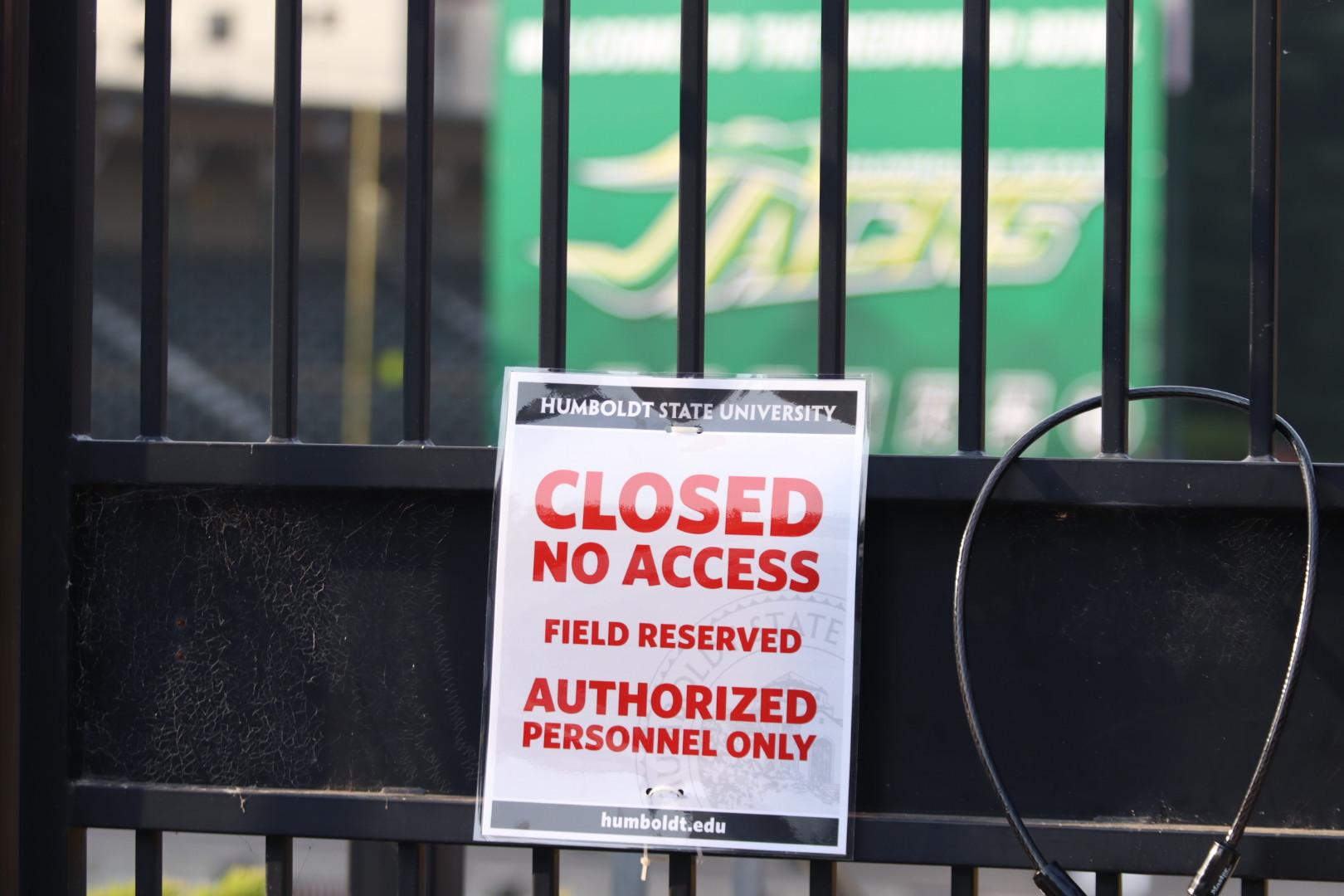
Steps will be taken to ensure the health and safety of people on campus like limiting capacity and mandating face coverings for all who step foot on HSU turf.
Social Responsibility
Students and faculty will be expected to be socially responsible when returning to campus and remain vigilant in keeping themselves safe.
Schedule
Courses taught in a face-to-face manner will start and finish with virtual interactions to go over safety measures, and all face-to-face parts of courses will start after the initial virtual interaction and end on Nov 6. just in time for the second virtual interaction.
Housing
The combined capacity in HSU’s residence halls will not exceed 1000 students and students will be placed in single-occupancy rooms. Dates and times for moving in will be spread out.
Dining
Dining services will not be as frequent on campus. Takeout and food-delivery will be available to students but buffet-style and self-serve food will not be.
Faculty and Staff
A majority of employees will continue to telecommute. Workers deemed essential will come back to campus to work more regular hours. Employees over the age of 65 will continue to telecommute as well.
Athletics and Recreational Activities
HSU will enact a four-stage plan intended to gradually allow student-athletes and related staff to come back to campus. The availability of recreational activities will increase in conjunction with the availability of recreational activities in the county.
Face-to-face instruction for Humboldt State’s fall 2020 semester has been canceled due to COVID-19. California State University Chancellor Timothy White announced Tues. May 12 that instruction will primarily be offered online. A virtual plan is expected to be implemented into the entire CSU system as the possibility of a second COVID-19 wave of cases is predicted.
“Our planning approach will result in CSU courses primarily being delivered virtually for the fall 2020 term,” Chancellor White writes in a CSU press release. “With limited exceptions for in-person teaching, learning and research activities that cannot be delivered virtually, are indispensable to the university’s core mission and can be conducted within rigorous standards of safety and welfare.”
Academics that can not make the direct translation to an online format, such as artistry and laboratory classes, will be conducted through a hybrid approach which limits in-person contact as much as possible and continues to emphasize online instruction.
HSU, along with other CSU systems, are subjected to differing class standards based on the level of necessity placed behind face-to-face instruction. The fall semester is projected to primarily remain online, however, updates and further information will be announced later in the week.
The CSU Travel Suspension has just been extended until July 31
The California State University travel suspension for all international and non-essential domestic travel has officially been extended until July 31, according to an update email from the CSU Chancellor’s office on April 29.
The update also says that the determinations are made with guidance from the CDC and the US State Department. At the time of the update, the State Department had issued a level 4 Travel Advisory to worldwide travel. Level 4 advisory is a warning level caused by a higher likelihood of life-threatening risks.
“We regularly monitor data from local, state, national and international agencies and organizations,” wrote the Chancellor’s office. “And may modify the temporal or geographical restrictions in this directive if warranted by future developments.”
A plan to reevaluate the restriction has been projected to be in discussion again by mid-June.
The campus presidents are allowed to make exceptions to this rule but only for “extenuating and compelling circumstances.” The authority of these decisions cannot be delegated. Factors for contributing to these exceptions are:
Necessity of the proposed travel, including consequences of postponing travel.
Needs and preferences of the individual.
Availability of safe and secure shelter at the destination.
Availability of appropriate medical care at the destination.
Availability of transportation, services, and other necessities at the destination.
Assessment of risks associated with traveling versus risks of remaining in place.
As well as “other relevant factors as determined by the president.”
The update also clarified what will happen for an essential traveler is allowed.
“Individuals granted exceptions to travel must observe local health guidelines upon their return. Presidents who grant an exception to the travel suspension must create a written memorialization of how the circumstances were extenuating and compelling, using the factors above.” said The Office of the Chancellor’s COVID-19 update.
The update ends saying that circumstances and conditions may change at any time and the Chancellor’s office will provide updated information as it becomes available.
With Humboldt State University anticipating lower enrollment for the upcoming academic year, the athletics department has been preparing to make budget adjustments in alignment with the rest of the university. While the department is still waiting on official numbers from the administration to what the budget will look like next semester, Athletics Director Jane Teixeira has been actively working towards making changes with athletics.
“We are going to start going through program by program, looking at ways that we can reduce costs or maximize our benefits and resources,” Teixeira said. “We look at everything from corporate partnerships and how we can maximize those, to donations, to can we live without a second pair of tennis shoes if that’s something we were buying.”
Student enrollment is directly linked to the budget through the Instructionally Related Activities fee that every student pays each semester. The fee currently costs students $337 and covers coach salaries as well as operational expenses for athletics. The funds generated by the IRA fee are also split among the IRA Committee Fund, Jack Pass Fund and Humboldt Energy Independence. A large majority of the money goes to athletics. However, with the department receiving $3.3 million for the 2019-2020 academic year. There is no talk at this time of the fee being raised even if enrollment drops in the future.
The IRA Fee may not be changing, but faculty salary which applies to coaches and is determined with unions and includes automatic increases is at risk. Associated Students Executive Director Jenessa Lund points out that at a certain stage this model will simply stop working as salaries fall out of balance with the fee.
“Salary increases for positions paid by the state are included in the state allocation, as the state builds in a cost of living increase when funding for CSU’s,” Lund said. “When salaries are paid by a flat fee, eventually the salary increases will exceed the amount of fees.”
Newly elected Associated Students President Jeremiah Finley believes that students should not be having to pay for athletics faculty and instead should be paid with state-side funds.
“Ultimately I believe that the wages should be off the back of students. So I’ll advocate that it moves back to state-side.”
Jeremiah Finley
Moving faculty wages back to state-side funding is something the budget office has been looking into since Spring 2018 according to Lund. If this move is made then the money allocated by the CSU system would take rising salaries into consideration. While the current flat fee does not.
Athletics will certainly take a financial hit if enrollment drops as the university predicts. Teixeira was adamant that even though the department has been asked to make changes, the existing programs will not be going anywhere.
“There’s no talk of contracting on our sports,” Teixeira said. “I know there has been some thought from some individuals that were nervous about that because you’re starting to see that happen across the country.”
With enrollment down significantly in the Fall semester, athletics will be leaning more heavily on other sources of revenue; state-side, private donations and corporate sponsorships. Teixeira was unable to provide exact numbers on how much money comes from these sources, but did say that support from the community is especially important for athletics. However with the long term effects following COVID-19, donors contributions will potentially be affected.
“I appreciate the individuals who have given to us and hope we can continue to gather their support for that,” Teixeira said. “We’re going to need it as we move forward in this budgetary time. But we also are aware that this pandemic has affected people. It’s affected our neighbors and we have to be really smart about that.”
“Rec sports is a huge part of what HSU does for students. So it’s not just an athletic issue, this is a student issue.”
Athletics Director Jane Teixeira
If student enrollment takes the anticipated dip for the 2020-2021 school year, recreational sports would see a dip in funding, since they’re part of the athletics department. Teixeira said that recreational sports had already taken a reduction and needs support since it applies to so many students.
“Rec sports is a huge part of what HSU does for students,” Teixeira said. “So it’s not just an athletic issue, this is a student issue.”
The potential to use unspent money from this semester to bolster athletics is being explored as an option. While the final numbers haven’t been released, track and field, softball and rowing all had their seasons cancelled before completion. Meaning funds that are normally spent on travel and lodging are still available. This money could be used for other operations in the future.
Finley thinks that any athletic money not spent due to COVID-19 should be dispersed back into the program.
“Ultimately if that money is allocated, which it currently is, for our student athletes,” Finley said. “Then our student athletes should still benefit from that. I don’t know what that looks like, but that’s why we have different bodies in different pockets of excellence around campus to get that input.”
Without certainty from HSU’s administration, the athletic department continues to create scenarios for possible budget outcomes they will face going into the 2020-21 school year.
Where we were, what went wrong & how we build a brighter future
This is a letter to the editor from Humboldt State University Education Department Chair Eric Van Duzer, Ph.D. It has been edited only for minor punctuation and grammar style preferences.
As I reflect back on nearly 30 years at Humboldt State University, first as a student and then for the past 20 years as a faculty member, I wanted to share some of the thoughts that I have about HSU’s current situation and where the campus might go from here.
As a student I experienced a remarkable education where faculty were fully invested in my intellectual and personal development. There were so many opportunities to explore areas of interest and develop new ones. I have spent many hours trying to encapsulate the nature of the schooling I experienced in a way that would really represent the experience.
The best analogy I have been able to come up with was that HSU offered a graduate education to undergraduates. The small classes typical of graduate school encouraged faculty to fully invest in their student’s growth. The university, set so far from the oversight of CSU headquarters in Long Beach, offered a great deal of flexibility to shape our experiences.
This would be impossible today. In those days HSU had the third smallest class sizes in the 23 campuses of CSU. But more than that, it had a unique faculty ethos that reflected nearly 100 years as a student-focused institution that exalted excellence in teaching above all else.
I was the first student CEO of the Institute of Industrial Technology, a self-supporting club that allowed us to use the skills and knowledge we were developing to grow in business acumen, engage in manufacturing and light construction on campus as well as conduct experiments for local agencies. In its second year, Bill Wilkinson used the institute to earn enough profit making desks for campus offices that it paid for several pieces of expensive equipment for the department.
This would be impossible today. In those days HSU had the third smallest class sizes in the 23 campuses of CSU. But more than that, it had a unique faculty ethos that reflected nearly 100 years as a student-focused institution that exalted excellence in teaching above all else.
Faculty came to campus because this is where they wanted to spend their career. Unlike most universities where faculty play academic hopscotch building their resume through research reputations and earning ever-higher salaries as they bounce from college to college, HSU faculty built their reputations on teaching. These were inherently local reputations, not very valuable if one wanted to move on, but rather a reflection of the values and attitudes associated with a culture of excellence in the service of students’ intellectual growth.
As anyone who has worked with university budgets will tell you, graduate education is expensive. That is why through the first 100 years, the administration and other services were done on a shoestring. It was common for a variety of upper administrative positions to be filled by faculty who served temporarily. Staff was thin and overworked and processes were slow and inconsistent.
What happened? In the early 2000s the CSU was facing the onslaught of a Generation X student bulge. Chancellor Charles Reed decided the best strategy to deal with this situation was to homogenize campuses so that if a student could not get into Sacramento State because it was impacted, they could simply go to another campus and get a similar experience.
Yet, the campus, with significant leadership from the faculty, focused its significant resources on classroom instruction, and through that dedication, produced exceptional graduates who were deeply committed to HSU when they graduated.
I remember an administrator in the early years telling me that he had been in a restaurant on the East Coast and overheard a group of students talking at a nearby table. He was so impressed with their sophistication and the values they held he found out where they came from and immediately applied for a job at HSU.
He was the first person hired under then-president Rollin Richmond to manage our enrollments in the early 2000s. The diversity on our campus is a credit to him and Richmond, who reached out across the state to bring in students from urban areas. Sadly he became disillusioned and left. So did most of the faculty leaders.
What happened? In the early 2000s the CSU was facing the onslaught of a Generation X student bulge. Chancellor Charles Reed decided the best strategy to deal with this situation was to homogenize campuses so that if a student could not get into Sacramento State because it was impacted, they could simply go to another campus and get a similar experience.
Shortly thereafter the upper administration received inflated titles and significant raises in an apparent effort to reduce resistance. Then the attack on the faculty began.
Naturally, faculty on campuses such as HSU who were proud of their traditions and niche identities resisted. Fiercely. At one point, three campus presidents, including Rollin Richmond, suffered through votes of no confidence by their faculty as they implemented this strategy.
To achieve the required changes in the face of faculty resistance, campuses, including Humboldt, began shifting to a corporate structure of top down management. Faculty who had held a privileged position in campus life were systematically reduced to workers with only a symbolic voice in campus decisions. The administration turned its focus inward towards improving the functioning of the bureaucracy. They eliminated administrators such as Rick Vrem, an ethical provost, who refused to implement changes that hurt the traditional focus on instruction.
Vrem was replaced with a provost who had no such compunction. Shortly thereafter the upper administration received inflated titles and significant raises in an apparent effort to reduce resistance. Then the attack on the faculty began. Nearly 80 faculty positions were eliminated over several years and during the same time period, a similar number of new staff positions were created and filled to support administrative functions.
Over the majority of the intervening 15 years, budget reductions for academic programs have been the norm: reductions in staff, program availability and courses. This year it was a 6% cut, last year another and many like it before. The funds have been shifted to an ever-expanding variety of administrative initiatives.
Now we sound more like a parks and recreation office than a university. Come for the redwoods, the beaches, the bike riding—that is wonderful and I love it, but it is not why people pick a university.
We spend nearly 68% of our budget on administration and campus facilities. Despite the results of a study commissioned by Rollin Richmond’s administration that showed the two most important factors that cause a student to come to HSU are quality of education and availability of the program they are interested in, both have been repeatedly attacked, sliced and diminished.
It is surprising that no one seems to notice that every time we cut academic programs, fewer students want to come here. And when fewer students come here, the budget suffers and HSU responds by cutting academic programs even more severely—a cycle the faculty in 2004 described as a “death spiral.”
As we address our current crisis and try to figure out what we need to become in order to grow back to a sustainable enrollment, we might want to engage in some soulful reflection. What would cause a 20-year-old to come to a place five hours from major centers of civilization and spend four years with us? What do we have to offer them that is so valuable, so different from what they can get at any of the other CSU campuses which are closer, cheaper and offer a great deal more college life in the community?
We stopped selling the small classes and close academic relationships with faculty when the hypocrisy became too much to bear as campus priorities shifted. Now we sound more like a parks and recreation office than a university. Come for the redwoods, the beaches, the bike riding—that is wonderful and I love it, but it is not why people pick a university.
When I arrived here as a faculty member in 2000 we had one staff member, John Filce, doing institutional research. He was wonderful and badly overworked. I am sure he still is. Now we have nine staff members listed in the directory in the Office of Institutional Effectiveness, including a vice president. I am sure their work is valuable, but to pay for it we had to cut 64 class sections.
Today, we are an organization of inflexible rules and their keepers.
We have proliferated the bureaucracy, which is unfortunately necessary to achieve top-down control of a professional organization. Had our leadership studied industrial technology with me, they would know what companies in the 1970s learned: that this form of management is ineffective and inefficient in a professional organization.
To achieve control requires monitoring, which in turn requires more staff. For a top-down organization, where the vast majority of employees serve at the will of their manager, fear prevents innovation and compliance is key. Before the shift to this model, administrators were problem solvers. In fact, the standing joke in those days was that everything was an exception. Faculty, staff and administrators had the flexibility to serve the needs of students even when it required bending the rules.
Today, we are an organization of inflexible rules and their keepers. It has greatly diminished the effectiveness of the organization and its ability to make decisions that best serve our students. The resulting bureaucratic culture has seen a proliferation of forms, rule books and rigid adherence to often dysfunctional orders.
This is no way to run a university. Perhaps a grocery store, but not an organization of 500 highly educated experts with thousands of years of collective experience. Top-down decision-making, particularly when the president and upper administrators are drawn from institutions that do not share the culture and values of the campus, is inherently poor compared to what would be possible if faculty once again had a meaningful voice in campus affairs.
No student has ever come to HSU because we have a wonderful registrar’s office or because the president’s office is fully staffed. These only matter when they impact the quality of the education a student receives.
The proof of this is apparent everywhere at HSU. When Rollin Richmond came, he had no interest in what made HSU special. Like a white suburban principal coming to a school in Watts, he thought he knew what needed to be done to remake the university into his vision of a modern institution. That ignorance has cost us immeasurably. Today we face the consequences. The failure to fundamentally change direction of subsequent presidents has simply deepened the mess. We now have a new president, perhaps we can find a new vision.
In my view there are two key concerns that need to be addressed from a rational and values-driven perspective. First, an effective budget model that allows funding to follow enrollment is essential to support growing programs while shifting resources to where they will best serve student needs and interests. This can refocus the campus on providing the service/product students come here for—classroom instruction—and it is essential.
There are so many amazing faculty and academic staff here. They are people with a heart for their students, struggling in a system that constrains and conflicts with their efforts. Let their voices guide the future and we may yet have one worth celebrating.
No student has ever come to HSU because we have a wonderful registrar’s office or because the president’s office is fully staffed. These only matter when they impact the quality of the education a student receives.
Second, we have to decide how we are going to rebuild the excellence we once were known for in our student’s academic programs. The day Rollin Richmond refused to give the Outstanding Faculty Award to a physics professor (selected by the faculty based on his ability to delight and inspire students) because that professor had not published, is the day we snuffed out the soul of the old HSU campus.
Now we need to find out what animates us in ways that provide an experience worth the isolation, cost and struggles required to live in this remote community. Redwoods are not enough; we need a reinvestment in education.
I am retiring from HSU at the end of this May. I am sad to see what has happened to my university. There are so many amazing faculty and academic staff here. They are people with a heart for their students, struggling in a system that constrains and conflicts with their efforts. Let their voices guide the future and we may yet have one worth celebrating.
All classes to go online for the rest of the semester and other plans, plus a translation
Humboldt State University informed its students March 12 through email that classes would be going online following spring break. Concerns of spreading COVID-19 led the California State University system to suspend face-to-face instruction. HSU initially said it would be shifting to online classes March 26 until at least April 17. But in a March 17 message from President Tom Jackson, HSU announced classes would be taught online for the rest of the semester.
Jackson’s message said all exams, labs, field trips and in-person meetings are canceled. HSU encouraged students living on-campus to return home if possible. However, HSU promised it would not displace students living on campus.
Other notes from Jackson’s message included: non-essential student employees will work from home. Campus will close to the general public. Most of campus will close, with the exception of the Student Health Center, the University Center and the library, all of which will remain open with reduced staff. Finally, HSU said it will review alternatives to celebrate commencement.
HSU has also launched a web page with resources for working from home. HSU plans to provide laptops for students without computers and internet hotspots for students with no internet at home. Programs like the Adobe Creative Cloud Suite and SPSS are expected to be available on HSU’s remotely accessible virtual lab and for downloads to personal computers. Multiple phone and internet companies have also agreed to waive late fees, not cutoff service and open up internet hotspots.
HSU began updating students and staff through emails starting Feb. 24, when it informed them of the single case of COVID-19 confirmed in Humboldt County. They continued to provide updates weekly on how HSU would be handling a potential pandemic. The week before students were meant to head home or hunker down in Humboldt, HSU ramped up its online communications.
HSU suspended all international and non-essential domestic travel March 10 for the remainder of the spring semester. In a March 11 email, they defined essential domestic travel as travel for academic credits that are necessary for graduation and cannot be postponed or substituted.
Through several emails on March 11 and March 12, HSU canceled all instruction from March 23-25 to allow faculty to prepare for online classes. HSU then canceled all intercollegiate and club sports.
HSU canceled non-essential events on and off campus March 13. Essential events—following HSU’s previous definition of essential—are any events done for academic credit necessary to meet a graduation requirement that cannot be postponed or substituted.
On March 15, HSU noted the closure of local K-12 schools, and how that may affect staff and faculty. HSU later advised faculty aged 65 and older, or those with underlying health issues that make them more vulnerable to COVID-19, do not come to campus. HSU will arrange telecommuting for adaptable positions, but anyone not able to work remotely will be placed on administrative leave at their current rate of pay and for their normally scheduled work hours.
Humboldt State University President Tom Jackson’s March 17 Message to Campus:
Message from President Tom Jackson on Plans for the Semester
Dear Campus Community: Over the last week, I have had the privilege of observing the amazing work of so many people in their efforts to assist others. The work by all of you to not only protect yourself, but to care for your family and our students is beyond remarkable. We are a very caring Lumberjack Family and I thank you.
Things are changing rapidly and these updates are subject to change based on the fluidity of this situation. Every day, nearly every hour it seems, we are asked to pivot and address a new challenge in our efforts to reduce the spread of COVID-19. Our guiding light remains the health and safety of our Lumberjack Family while also helping our students to progress in their education. At times these efforts may appear in conflict, but they are not. At the root of all we do is our humanity and our underlying willingness to do what must be done.
The time has come for HSU to implement a number of additional contingency plans and bolster our COVID-19 precautions. While there are no known active COVID-19 cases in our County at this time, and there have been none on campus, these additional precautions are consistent with recent federal and state health directives. In short, we must now do more to protect the health and safety of our campus and local communities.
HSU will operate virtually through the end of the semester.
Beginning today, we will shift as quickly as possible to virtual operations. Non-essential employees, including student staff, are to work remotely (telecommute) once they have received direction from their supervisor. Please continue to work with your supervisor on your work assignments and technology support needs.
It is important we reduce the number of people on campus. We encourage students who can return to a home off-campus to do so. We will not displace students who are facing housing insecurities or homelessness. More information will follow.
From Monday to Wednesday, March 23-25, the faculty will prepare for a complete shift to virtual instruction by Thursday, March 26. All professional development and preparation activities will now occur remotely. For the remainder of Spring 2020, all instruction is to be virtual and the primary operational state of campus is to be virtual. There will be no face to face meetings, events, instruction, exams, instructional labs, field trips, live performances, or small group seminars.
We have closed all access to campus facilities to the general public.
Most campus facilities will be closed to the campus community, including all sports and recreation facilities. We have also suspended all intramural and recreational activities for students. Any services remaining open for students – such as the library, student health center, and university center – will be operating with reduced staffing and must implement social distancing.
As a campus we must continue to carefully practice social distancing techniques for those essential individuals who remain on campus, including students in our residence halls who truly have no other place to reside, and the food services and other staff who are supporting those students.
Lastly, and sadly, we must review other ways to celebrate degree recipients instead of the traditional Commencement. We are a very creative campus and we will find alternative ways to celebrate our students’ success.
There are many questions to be answered, and we will do our best to answer them in a timely way. We will share more information soon as we prepare campus to shift to virtual operations.
We are resilient. From the Marching Lumberjacks doing what they do, to alumni making a difference in the world, to hiking in the Redwoods, to kayaking in the great Pacific ocean, we are Humboldt. This pandemic is challenging us but it will not break us. We are Humboldt, and while we may be socially distant for now we remain close at heart.
Thank you for all that you are doing. I ask you to be flexible and understanding as we work together to protect the health and safety of the campus community. You are appreciated.
Respectfully,
Tom Jackson, Jr. President
El Mensaje en Español:
Mensaje del Rector Tom Jackson sobre los planes para el semestre
Estimada comunidad universitaria, durante la última semana he tenido el privilegio de observar el increíble trabajo y esfuerzo de tantas personas que quieren ayudar a otros. El trabajo de todos ustedes, no sólo para protegerse, sino que también para cuidar a su familia y a nuestros estudiantes es notable. Somos una familia muy cariñosa de leñadores y se los agradezco.
Las cosas están cambiando rápidamente debido a la fluidez de la situación. Todos los días, parece que casi cada hora, se nos pide que viremos y abordemos un nuevo desafío en nuestros esfuerzos para reducir la propagación del COVID-19. Nuestra luz guía sigue siendo la salud y seguridad de nuestra familia de leñadores y, al mismo tiempo, el apoyo necesario para que nuestros estudiantes progresen en su educación. A veces, estos esfuerzos pueden aparecer en conflicto, pero no lo están. La raíz de todo lo que hacemos está nuestra humanidad y en nuestra voluntad fundamental de hacer lo que sea necesario.
Ha llegado el momento de implementar en HSU una serie de planes de contingencia adicionales para reforzar nuestras precauciones acerca del COVID-19. Si bien no hay casos activos conocidos del COVID-19 en nuestro Condado en este momento, y no ha habido ninguno en el campus, estas precauciones adicionales son consistentes con las recientes políticas de salud de nivel federal y estatal. En resumen, ahora debemos profundizar nuestros esfuerzos para proteger la salud y seguridad de nuestro campus y comunidades locales.
HSU va a funcionar virtualmente hasta el fin del semestre.
A partir de hoy, pasaremos lo más rápido posible a operar virtualmente. Los empleados no esenciales, incluyendo el personal estudiantil, deben trabajar de forma remota (teletrabajo) una vez que hayan recibido instrucciones de sus supervisores. Por favor continuar trabajando con su supervisor en sus tareas de trabajo y apoyo técnico.
Es importante que reduzcamos la cantidad de personas en el campus. Alentamos a los estudiantes que puedan regresar a sus hogares fuera del campus que lo hagan. No desplazaremos a los estudiantes con inseguridad de vivienda o falta de vivienda. Proveeremos más información sobre este tema.
Del lunes 23 al miércoles 25 de marzo, los profesores se prepararán para un cambio completo a la instrucción virtual, a comenzar el jueves 26 de marzo. Ahora todas las actividades de capacitación profesional y preparación se realizarán de forma remota. Durante el resto de la primavera del 2020, toda la instrucción será virtual y todo el campus funcionará de forma virtual. No habrá reuniones presenciales, eventos, instrucción, exámenes, laboratorios, excursiones, presentaciones en vivo, o seminarios de grupos pequeños.
Hemos suspendido todo acceso público a las instalaciones del campus.
La mayoría de las instalaciones del campus estarán cerradas a la comunidad del campus, incluyendo todas las instalaciones deportivas y recreativas. También hemos suspendido todas las actividades extracurriculares y recreativas de los estudiantes. Cualquier servicio que permanezca abierto para los estudiantes, como la biblioteca, el Centro de Salud Estudiantil y el Centro Universitario, funcionará con un personal reducido y se deben implementar distanciamiento social.
Como campus, debemos continuar practicando cuidadosamente técnicas de distanciamiento social. Esto se aplica a aquellas personas en roles esenciales que permanecen en el campus, incluyendo a los estudiantes en las residencias universitarias que realmente no tienen otro lugar donde ir, y proveedores de servicios de comida y otro personal que apoya a estos estudiantes.
Por último, y lamentablemente, debemos explorar otras formas de celebrar a los nuevos licenciados ya que no podrán tener una ceremonia de graduación tradicional. Somos un campus muy creativo y encontraremos formas alternativas de celebrar el éxito de nuestros estudiantes.
Hay muchas preguntas por responder y haremos todo lo posible para responderlas de manera oportuna. Compartiremos más información pronto, a medida que preparemos el campus para cambiar a operaciones virtuales.
Somos resistentes. Desde la banda de los “Marching Lumberjacks” que hacen lo que saben hacer, y los egresados que hacen una diferencia en el mundo, y las caminatas en los bosques de los gigantes rojos, hasta el paseo en kayak en el gran océano Pacífico, somos Humboldt. Esta pandemia nos desafía, pero no nos romperá. Somos Humboldt y aunque es posible que estemos socialmente distantes por ahora, seguimos estando cerca en el corazón.
Gracias por todo lo que están haciendo. Les pido que sean flexible y comprensivas/os mientras trabajamos juntos para proteger la salud y seguridad de nuestra comunidad universitaria. Todos son apreciados.
Humboldt State has no direct input on chancellor search committees
No one from Humboldt State University sits on the search or advisory committees for the next CSU chancellor, and the closest forum to give feedback to the committee is in Sacramento.
“It’s roughly a dozen people on these committees combined, and unfortunately,” CSU Senior Director of Public Affairs Mike Uhlenkamp said. “Unfortunately we’re not able to get that far north because of the travel considerations.”
The CSU Board of Trustees has appointed a search committee and an advisory committee to select the next chancellor. The search committee includes the Board of Trustees Chairman Adam Day, the vice-chair, current CSU Chancellor Timothy White and eight other trustees.
The stakeholder committee includes two CSU faculty representatives, a staff representative, a student representative, an alumni representative and two campus president representatives. These representatives hail from Sonoma State, San Francisco State, CSU Sacramento, San Diego State, CSU San Marcos, California Polytechnic San Luis Obispo and Cal Poly Pomona.
“There isn’t currently anyone from HSU on those committees,” HSU Communications Specialist Grant Scott-Goforth wrote in an email.
According to CSU data, graduation rates are currently at all-time highs. Four-year graduation rates for first-time college students have risen from 19% in 2015 to 27% in 2019, and six-year graduation rates have risen from 57% in 2015 to 62% in 2019.
The two committees are currently undergoing what they are calling a “listening tour” to gather feedback for the search process.
“It’s a fairly tight group and so they went with, for all intents and purposes, the leaders from those groups,” Uhlenkamp said.
Four public forums at Sacramento State, CSU East Bay, the Chancellor’s Office and Cal Poly Pomona were held on Nov. 12, 13, 20 and 22, respectively. Two more public forums were held on Dec. 3 and 5 at CSU San Marcos and Fresno State.
All of the forums can be streamed or viewed online, where you can also submit feedback.
“We are 23 campuses, one university,” Uhlenkamp said. “So we’re looking for everyone to provide some sort of feedback. And everyone’s going to have different forms of feedback, and one of the great things about the University is that we’re so diverse and so different.”
White announced his plan to retire on Oct. 22. He has served as chancellor since 2012 and will remain chancellor until the end of the 2019-2020 academic year.
White, a first-generation Argentinian-American, most notably launched in 2015 the Graduation Initiative 2025, a CSU-wide push to increase graduation rates.
According to CSU data, graduation rates are currently at all-time highs. Four-year graduation rates for first-time college students have risen from 19% in 2015 to 27% in 2019, and six-year graduation rates have risen from 57% in 2015 to 62% in 2019.
“The Board of Trustees is very pleased with the current direction of the University,” Uhlenkamp said. “And by direction, I refer to the fact that enrollment is close to an all-time high, graduation rates are at all-time highs, the funding from the state of California is at an all-time high. The dollars that we receive from donors is also at an all-time high—so it’s effectively a golden age of being a CSU student. So they want to maintain that trajectory.”
Uhlenkamp said the committees will take the feedback they receive over the next two months to make a position description and then use that to gather a pool of candidates. Following multiple rounds of interviews, the committees will choose a group of finalists to be interviewed by the full 25-person Board of Trustees.
“More than using students as photo opportunities, we need a Chancellor who will do whatever it takes to secure what students need to succeed.”
Uhlenkamp said the committees want someone who can maintain the current CSU trajectory while also bringing their own vision. As for the longevity of the next chancellor, Uhlenkamp said current higher education leaders tend to serve for shorter lengths than in the past.
“While, yes, we do want to have consistency, I don’t think that there is a specific number put on how long they want this individual to serve for,” Uhlenkamp said.
On Nov. 20, the California Faculty Association wrote an open letter to the CSU Board of Trustees detailing its desires for the next chancellor.
The letter began by asking for a chancellor dedicated to student success.
“More than using students as photo opportunities, we need a Chancellor who will do whatever it takes to secure what students need to succeed,” the letter said. “Knowing that success means more than four-year graduation rates, our new Chancellor should be committed to helping students follow their own paths unfettered.”
The letter went on to call out the lack of labor representation in the stakeholder committee, calling it “a serious oversight.”
“We need a leader who will change the toxic culture of disrespect for labor at the CSU, and value the work of all employees who serve the system,” the letter said.
The letter ended with a request for an open search process allowing participation.
“We look forward to working with a new Chancellor who will partner with us in these efforts,” the letter concluded.
The committees expect to select the next chancellor by summer 2020.
HSU’s Dining Services employees don’t receive a free meal while on shift
While many food service employees receive heavily discounted meals or one free meal per shift, dining services student employees at Humboldt State University get the same meal discounts as anyone who pays with J-points: 25% off.
Abigail Rosales, junior communications major and a floor manager at The Depot, said employees frequently complain about the minimal discount.
“It would be nice to know that our job and our work is valued,” Rosales said. “Because if we’re just getting the same discount as people who already live on campus, then there’s not really an incentive food-wise. Obviously we’re getting paid, but it’s always a nice bonus if you get any benefits while working here.”
Rosales previously worked at the fast-casual restaurant chain, The Habit Burger Grill. Employees received a free burger and fries every shift, and got 50% off everything else.
Rosales said a free or more discounted meal per shift would likely make for a better workplace.
“I think if we did get that, a lot of us would be a little less grumpy,” Rosales said. “Because sometimes we’re tired or hungry, and sometimes we just don’t have money on us, so we get irritated.”
Abigail Rosales, a junior communications major, standing in The Depot at Humboldt State University on Nov. 8. Rosales, a floor manager at The Depot, said student dining employees often feel irritated with the lack of an extra discount, but never feel like they can do anything about it.
William Weinberg, a forestry senior and College of Natural Resources representative and vice chair, said over the phone that he’d be interested in seeing HSU try a pilot program giving free meals to student employees.
“I think it would be cool if it did happen, or if they ran a pilot to see if it would work,” Weinberg said. “Would the costs of that free meal maybe make up for more work ethic, more happier workers?”
Rosales said many student employees bring their own food or have to clock out from work early to go home and eat before their next class to avoid paying for a meal. But according to Rosales, even a cheap meal would be helpful.
“Even just like the fries and a corn dog,” Rosales said. “I think those are the two cheapest things. If we just get that, that’ll probably be enough for a lot of people.”
Director of Dining Services Ron Rudebock pointed to money as the primary issue behind the lack of an extra discount for student employees.
Rudebock, who has been the director of dining services for 15 years, said declining enrollment has reduced dining services income, while increases in minimum wage and insurance prices, alongside efforts to provide more organic and local food options, have increased costs.
“It’s unfortunate, because we’re trying to keep our food costs lower while our costs are going up,” Rudebock said. “So how do you balance those two?”
Dining services at HSU are not run by the university, but instead by the University Center. The UC is a nonprofit auxiliary corporation that works with HSU, but is not owned or operated by the school. The UC operates on-campus entities like dining services, the library, Center Arts and Center Activities.
While student fees provide money for some of the services, Rudebock said dining services runs entirely on the income from student food purchases.
In fact, Rudebock said dining services has to pay HSU rent for their facilities along with utilities, garbage, internet and so on.
“It’s a separate business,” Rudebock said. “And we actually pay the university money.”
All California State University Dining Services are run by auxiliary corporations, according to CSU Public Affairs Manager Hazel Kelly. We have reached out to all CSUs to determine which CSU dining services provide free meals to student employees.
Thus far, only five CSU’s have responded.
Student employees at CSU Bakersfield and CSU Monterey receive free meals during shifts, and according to a representative for Sonoma State, SSU student employees get free meals for shifts longer than four hours and free snacks for shifts shorter than that. San Francisco State gives its student employees a free meal if they work a shift longer than five hours, and CSU Chico gives students meals for $2.50 for shifts longer than four hours. In addition, Chico gives student employees 10% off all food items purchased on campus.
Director of Dining Services Ron Rudebock in his office on Nov. 8. Rudebock said dining services has hit tough times lately due to declining enrollment and increased expenses. | Photo by James Wilde
Any profit that dining services makes goes back into its operations, according to Rudebock. Rudebock pointed to The J’s more than 25-year-old dishwasher as one example of an upcoming expense. Rudebock said the dishwasher will cost around $250,000 to get replaced.
“We need the reserves to be able to pay for everything so we can stay in business,” Rudebock said. “But we don’t have a set of stockholders. We don’t have—you know, like a corporation has a set of stockholders that have got to make money. We don’t have a magic investor.”
Rudebock said the UC lost around $100,000 in each of the last two power outages, during which The J offered free meals to students, faculty and staff. Rudebock said HSU may only partially reimburse dining services for those costs.
In regard to free meals, Rudebock said that dining services doesn’t have any plans to provide a larger discount for student employees. However, Rudebock said the issue is not off the table. HSU could suggest larger discounts for student employees to the UC, and while the UC does not have to follow HSU’s suggestions, Rudebock said it wants to work with the university.
“We need the reserves to be able to pay for everything so we can stay in business. But we don’t have a set of stockholders. We don’t have—you know, like a corporation has a set of stockholders that have got to make money. We don’t have a magic investor.”
Ron Rudebock
HSU Director of News and Information Aileen Yoo said via email that HSU hasn’t suggested the UC adopt free meals due to the impacts it could have on prices.
“We understand that offering free or more heavily discounted meals for student employees would be a financial burden for the UC and likely mean a price increase for all HSU students who may not necessarily have the means to cover those additional expenses,” Yoo said.
At the moment, HSU dining services employs about 350 students and 26 full-time employees, which, according to Rudebock, is the highest proportion of students to full-time employees in the CSU system.
Aileen Dominguez, a senior political science major who works as a student assistant at The Depot, said she sometimes wishes there were more full-time employees because when she started the position she felt she was never properly trained.
“I was just kind of put in with my coworkers who actually just said, ‘Oh, this is what we do, or this is how we do it—or this is how the girl before taught me how to do it,’” Dominguez said.
Dominguez said this has led to confusion and she’s not always sure how to train new employees.
Aileen Dominguez, a political science senior, studying in the library on Nov. 10. Dominguez works as a student assistant at The Depot. Dominguez suggested that a bigger discount for dining service employees might increase sales. | Photo by James Wilde
“I’ll say, ‘This is what you do, I think. At least, this is how I’ve seen the other girls do it,’” Dominguez said.
As for meal discounts, Dominguez echoed Rosales.
“I think we all talk about it,” Dominguez said. “But they probably don’t have enough money to feed us all.”
Dominguez said she only eats at The Depot when she has to—typically on Thursdays, when she is on campus all day. She said that employees frequently go to Oh Snap or elsewhere instead of buying food on campus.
Dominguez suggested that a larger discount might actually help bring in more business, but she doubts that one will be offered.
“I just feel it’s unfair that we kind of have to choose,” Dominguez said. “Like, ‘I don’t want to eat this right now, because I have to buy other things,’ or say, ‘I’m just gonna go eat a cup of noodles at home because this burrito isn’t worth it.’”
Rosales made a similar statement.
“On our end, we kind of pick and choose if we want to pay for something,” Rosales said. “If we’re really that hungry to pay for it or if we’ll just deal with it and not.”
This story will be updated if and when other responses for comments are received.
Getting to the bottom of a rumor of an HSU club embezzling money
Student clubs aren’t guilty of embezzling money, but they have misused funds.
A rumor from a recent Humboldt State University clubs meeting said that a student club embezzled money. According to Tay Triggs, the director of the Office of Student Life, that rumor was false.
Triggs said the embezzlement mentioned in the meeting was an illustrative example from another college of how clubs might mishandle money. However, Triggs did acknowledge that some HSU clubs fail to follow proper financial procedures.
Triggs said she has seen students use club funds to pay for necessities, including textbooks, but that she wouldn’t label that as embezzlement. For Triggs, embezzlement is applicable only to long-term, premeditated theft.
“Some clubs can accidentally misuse funds if they didn’t get permission to do something,” Triggs said. “There’s all kind of cash handling rules. If they don’t follow them, that can technically be a misuse of funds.”
Triggs said she tends to take a forgiving stance when a student club is found to have mishandled money.
“When it comes to clubs, I’m more educational than punitive,” Triggs said. “I would rather meet with them and make sure they knew what the policy was—if they didn’t, then I’m going to give them a warning.”
Our students are learning all of this. Managing budgets as if they’re tiny nonprofits—which all of them are—is not easy and so we definitely recognize that, especially understanding that the state is a very bureaucratic system.
Molly Kresl, HSU Clubs and Activities Coordinator
HSU student clubs have seen changes in their financial management in recent years in an effort to comply with the Integrated CSU Administrative Manual for student clubs defined by CSU Executive Order 1068, passed late 2011.
HSU Clubs and Activities Coordinator Molly Kresl said all student club advisors, presidents and treasurers undergo financial management training before handling money. Nevertheless, Kresl said policy violations do happen.
“Mismanagement does occur,” Kresl said. “And sometimes it’s unintentional and sometimes there is mal-intent there. And more often than not that mal-intent is coming from a place of need from an individual, but whatever it is, we have these policies and procedures in place to protect that money, to protect our organizations and to protect our students.”
Kresl said Clubs and Activities promotes proper financial management procedures like the taking of inventory, the use of receipt books and the use of dual-custody, which Kresl elaborated on.
“Dual-custody is important because it ensures accountability that one person’s watching another,” Kresl said. “You’re less likely to mishandle money if there’s someone else there. Also to ensure the safety of the students, so an individual student who’s maybe handling like $100 or $200 dollars, doesn’t get targeted and then potentially attacked—not that I would expect that to happen in our community.”
Kresl said club funds are stored in HSU accounts, so transactions are monitored. A club’s advisor and president, or treasurer, must sign for any withdrawals from the accounts. Clubs and Activities tries to aid student clubs as much as possible to avoid financial mismanagement.
“Our students are learning all of this,” Kresl said. “Managing budgets as if they’re tiny nonprofits—which all of them are—is not easy and so we definitely recognize that, especially understanding that the state is a very bureaucratic system.”
Ryen Cosgro, recreation administration senior and president of the recreation club, said he underwent almost nine hours of training to become a club president. Cosgro agreed that learning to manage a club was difficult.
“There’s kind of a steep learning curve, and that’s something that I could tell the clubs office was trying to provide us resources to avoid,” Cosgro said.
Despite the time and effort Cosgro had to put in, he said he was grateful for the training he received.
“A lot of the educating, I was like, ‘Man, I have to go to a lot of meetings and orientations,’ but coming out of it, okay, I learned a lot,” Cosgro said. “That was very helpful.”
Cosgro had doubts about how anyone at HSU could pull off embezzlement, as he said any large expenses require prior approval.
Ryen Cosgro, recreation administration senior and president of the Humboldt State University recreation club, standing outside the HSU recreation and wellness building on Nov. 1. Cosgro said his only gripe so far as a club president has been a small travel budget. | Photo by James Wilde
“From my point of view, it seems really hard to do that,” Cosgro said. “I don’t really see how you can do that unless you’re making false receipts or something.”
In the event that mishandling does occur, Triggs will typically meet with students, gather information and divide up the responsibility of the mishandling based on what she finds.
If an entire club has benefited from mismanagement, Triggs would likely implement conduct policies upon the whole club.
Otherwise, Associated Dean of Students Roger Wang would oversee conduct procedures for individual students.
Depending on the severity of the mishandling, Triggs said she could put the club on probation or revoke its status as a club. Triggs also said she tries to keep an eye on any mishandling to prevent it from impacting all of Clubs and Activities.
“I’d rather confront and deal with one club to eliminate it happening again than to take the chance of it happening more and more and more and then we get into some kind of trouble,” Triggs said. “I’ve never had an audit finding and I don’t plan on it happening any time soon, because I know they’re not fun to rectify.”
Even for clubs caught mishandling money, both Triggs and Kresl emphasized that they ultimately aim to support and educate students.
“Our goal is ultimately to keep students here whenever we can and to support our students as best as we can,” Kresl said. “The whole reason we exist is as a learning institution and our goal is to help our students learn.”
Playing collegiate sports and taking a full-time schedule is the equivalent of having two full-time jobs
During an online-only episode of “The Shop,” California Governor Gavin Newsom signed Senate Bill 206, or the Fair Pay to Play Act on Sept. 30.
Along with several other former college athletes, Newsom believes college athletes, especially Division I athletes, deserve compensation for their hard work and dedication to the game that makes their “bosses” rich.
“Colleges reap billions from student athletes but block them from earning a single dollar,” Newsom tweeted. “That’s a bankrupt model.”
Despite Humboldt State being a NCAA Division II program, we still agree that our athletes deserve some type of compensation based on the amount of revenue our athletic program brings in.
“The Shop” is a HBO talk show owned under the digital sports media company Uninterpreted. During the episode, Newsom was accompanied by NBA star LeBron James and they both shared the news on Twitter by posting a video snippet.
In a world that is so divided, sports can bring people together. Whether an athlete plays for a professional team or a college team, the support and compassion they receive from fans remains loyal.
In professional sports, athletes sign contracts with a team or an organization. When they sign, they are agreeing to the specific payment details they were offered or that they negotiated with their organization. For collegiate sports, college athletes are offered a scholarship breakdown and have the decision of accepting it or not.
However, anyone who is up to date with our budget crisis around campus knows that our athletic program probably receives close to no money to provide to our athletes. Especially considering that we still have athletes attending HSU out of pocket to participate in an intercollegiate sports.
HSU may not seem like a great example when pushing the idea that college athletes deserve compensation, but the Fair Pay to Play Act doesn’t allow athletes to be paid by their university, it just gives them the leeway to find sponsorship and make money off their hard work.
When we consider professional athletes, endorsement deals are contracted regularly. These deals allow companies to use athletes’ names, numbers and any other marketing facet that’s agreed upon, in exchange for money paid to the athlete. College athletes do not receive endorsement offers, but they still partake in similar marketing techniques that bring in revenue for their college and coaches.
The counterargument to this case states that college athletes are provided a scholarship that pays their tuition and resources that help them get through the academic portion of school.
Although this is true, many fail to realize the dedication and time commitment it takes to be a successful student-athlete. Being a student-athlete is essentially equivalent to holding two full-time jobs: studying and playing. This doesn’t leave time for a job off-campus to provide a steady source of income.
The fact that colleges and head coaches make money off their players’ successes is ludicrous, especially when the players themselves aren’t receiving any portion of that revenue. It is this exact argument that Newsom brought to light.
The proposed bill allows college athletes to receive a portion of the revenue that their college receives and sign endorsement deals like the pro athletes they aspire to be. Although the NCAA fought against the signing of this bill, Newsom stuck to his belief. He proposed providing the NCAA with a grace period to narrow down rules and regulations in hopes of making the transition smooth and effective. Therefore, the bill does not play any effect on college sports in California until Jan. 1, 2023.
In spite of the successful campaign to phase out single-use water bottles, Humboldt State has yet to remove plastic bottled beverages from campus
Almost 10 years have come and gone since Humboldt State University took back the tap and did away with single-use water bottles on campus.
Overall HSU is known to lead the way in sustainability across the California State University system. In spite of being further ahead in the sustainability game than most campuses, HSU still offers a variety of beverages for sale packaged in single-use plastic.
HSU Dining Services Director Ron Rudebock said they have gotten a fair number of comments over the last couple of years regarding plastic products and on phasing out plastics completely.
“We have been working with vendors to obtain their products in a reusable or compostable or recyclable package and vendors are changing their package materials,” Rudebock said.
Four of the five campus responsibilities listed under the policy have set deadlines.
The first is the elimination of single-use plastic water bottles by Jan. 1, 2023. HSU met this requirement in 2011. The second is the elimination of plastic straws no later than Jan. 1, 2019. HSU eliminated plastic straws during the fall 2017 semester.
The third responsibility listed, also set for January of this year, was the elimination of single-use plastic carryout bags. HSU stopped using plastic bags back in March 2014. The fourth deadline, and last with a time requirement, was the elimination of single-use polystyrene (e.g. STYROFOAM™) food service items no later than Jan. 1, 2021. HSU eliminated Styrofoam to-go containers over 10 years ago and the campus is working to eliminate it in any pre-packaged items.
The final goal of replacing single-use plastic items with materials that are reusable, locally compostable and/or recyclable doesn’t list a specific deadline.
A variety of some of the single-use plastic bottled beverages offered. According to Rudebock, much of the decision to continue to sell single-use plastic drinks is because of consumer choice. | Photo by Megan Bender
Rudebock said this specific change is a challenge. The Depot, the College Creek Marketplace, the Cupboard and vending machines still offer plastic bottled beverages on campus.
“We would like to see a faster adaption but with this guideline having no deadline and with the current collapse in the recycling market I do not see this becoming feasible in the next year,” Rudebock said.
Dining services has made some efforts in providing more glass or aluminum options. The J, for example, has a beverage cooler that is all aluminum and glass, has eliminated single use plastic containers and has single-use packaging that is compostable or recyclable.
However, other locations haven’t been able to make the same change as effectively because of the demand for products that happen to also be in plastic bottles.
“We’ve been working with a lot of our vendors and pushing, trying to get more either glass or aluminum containers.” he said.
Rudebock said Dining Services also goes out of their way to order aluminum and glass alternatives whenever possible from specific companies and brands like Coke or Pepsi.
“It kind of comes down to consumer’s choice,” he said. “Consumers can help by purchasing products that are in reusable, compostable or recyclable packaging and not requesting products that are not in reusable, compostable or recyclable packaging.”
Students have pushed back against the university in the past, questioning its dedication to environmental responsibility over their business ties with PepsiCo.
As reported in the Lumberjack and the North Coast Journal, in 2017 HSU made efforts to meet student’s demands to closer align with its dedication to social, economic and environmental issues by re-evaluating a 40-year-long partnership with PepsiCo.
Under the contract PepsiCo funded HSU with around $58,000 worth of athletic scholarships in exchange for pouring rights. Pouring rights allowed PepsiCo to reserve 80% of HSU shelf space for their products.
Students also made the argument the set up was not fair to local businesses.
In spite of being in a budget deficit and the loss of scholarship funding, HSU did not renew the pouring rights contract and let it expire at the end of June 2017.
HSU was the first California public university and third national public university to phase out water bottles.
The University Center and Dining Services stepped into to help with some of the lost resources.
Rudebock said they managed to fund a majority of the lost scholarship money but leaves the decision of how the scholarships are dispersed up to the school. This way the UC and Dining Services are not directly funding athletics or any specific department.
The university still does business with PepsiCo but under different rebate-based agreements. Dining services also stopped carrying Aquafina water bottles, a brand owned by PepsiCo as a result of the nationally recognized Take Back the Tap campaign.
Under the Waste Reduction & Resource Awareness Program, students began efforts to Take Back the Tap at HSU starting in 2009. The student lead group and Dining Services worked to phase out the sale of single-use water bottles in 2011 as is the primary focus of the campaign.
As a result, HSU became the first California public university and third national public university to phase out water bottles. Dining Services initially explored an alternative by offering boxed water.
“At first we thought they were upset with the plastic water bottles, but they said ‘No no, just the water,’” Rudebock said. “It was more about the idea of selling packaged water.”
Before HSU removed water bottles on campus, TBTT calculated that HSU’s annual bottled water demand “required approximately 43 barrels of oil per academic year” and in turn was “releasing 35,000 pounds of carbon dioxide into the atmosphere.”
HSU now owns two Hydration Stations and has 16 water fill stations on campus.
Environmental Science & Management Professor James Graham and his geospatial students created an interactive map of HSU that includes where to find water fill stations on-campus as well as other resources.
The locations of all water stations on HSU’s campus according to the Sustainability project. These locations include the two Hydration Stations.
Sustainability Director Morgan King said Facilities Management worked with students help create the map.
“We worked with [Graham’s] students to develop layers for sustainability attributes,” King said. “Including water filling station locations, bike parking locations, recycling and compost bin locations.”
Anyone can access the map by visiting HSU’s sustainability website. The map key is listed in a drop down menu that offers different types of resources on campus. Under the sustainability option, users can check the box of the information they’re looking for.
Rudebock said Dining Services remains attentive to the needs of the students and the possibility of selling less plastic-bottled products.
“Every journey begins with a step,” Rudebock said. “The less plastic containers that students buy helps change the need for that product.”
The California State University system’s single-use plastic policy passed in December 2018 includes four policy changes that have deadlines, but the fifth and final goal of the policy doesn’t list a deadline.
Eliminate single-use plastic water bottles by January 1, 2023. HSU has already met this requirement as of 2011.
Eliminate plastic straws no later than January 1, 2019. HSU eliminated plastic straws during the fall 2017 semester.
Eliminate single-use plastic carryout bags no later than January 1, 2019. HSU eliminated plastic bags in March 2014.
Eliminate single-use polystyrene (e.g. STYROFOAM™) food service items no later than January 1, 2021. HSU eliminated Styrofoam to-go containers over 10 years ago and are working to eliminate it in any pre-packaged item
Replace single-use plastic items with materials that are reusable, locally compostable and/or recyclable.
To find out more about HSU’s Zero-Waste Initiatives, WRRAP and TBTT visit the WRRAP homepage.
Volleyball bounced back, women’s soccer took a loss and cross country preps for an upcoming meet in Oregon
As Humboldt State sports fans wait for Jacks games to return to College Creek Field and Lumberjack Arena, the volleyball and soccer teams competed along the West Coast and beyond. Volleyball suffered an initial setback at the West Region Showcase in San Francisco, but bounced back with two wins. Women’s soccer managed a loss and a draw in Portland and men’s soccer traveled to Billings, Montana and won both of their games. Cross Country did not compete last week, but they are training for their upcoming meet in Monmouth, OR.
The weekly HSU Athletics press conference at Lumberjack Arena featured comments from the coaches and chosen players from each sport.
Volleyball
The Jacks traveled home from San Francisco with a 2-2 record. Thursday brought a doubleheader loss to both San Francisco State and Cal State Dominguez Hills, both by a score of 3 sets to 1. Friday and Saturday proved to be much better, as the Jacks swept Fresno Pacific and Dominican 3 sets to 0.
Outside Hitter Lenox Loving scored 60 kills in the four matches, earning her HSU student-athlete of the week honors. She talked about how the team chemistry and energy have improved over last season, with the benefit of the team returning ten players from last year’s squad.
“Even when we lost everyone was working hard,” Loving said. “I think it’s just that the team chemistry is so much better this year, and everyone has the same attitude of working hard and getting the job done.”
Cross Country
The Jacks weren’t in competition this week; however, they were still hard at work as they prepare for their upcoming competition at the Sundowner Invitational in Monmouth this weekend. Head Coach Jamey Harris talked about the team’s preparation and what to expect with the course in Monmouth.
“We’ve been training hard out in the marsh and in the forest trying to make ourselves better,” Harris said.
He also talked about the course that the Jacks are going to race this Friday, saying it is milder than the home course in Arcata and he expects times to be faster.
“It’s almost all grass, so it’s similar to our home meet,” Harris said. “It’s not nearly as hilly, but most of it is not entirely flat.”
Men’s Soccer
The long days of air travel paid off for the Jacks in Montana, as they swept their road trip and won both games convincingly. On Friday they beat MSU-Billings 2-0, and things only progressed as they put the University of Mary away with ease in a 5-1 win on Sunday. The Jacks made history in the second game as Isaiah Dairo scored just 10 seconds into the match, which broke a team record for the fastest goal in a game. Dairo took us through the process of the goal that started at the opening whistle and how he noticed the defenders playing farther away from their own goal.
“From the start, we had seen that they were playing a high line,” Dairo said. “My teammate Dalton Rice plays a fantastic ball, and it took maybe two touches at most.”
Women’s Soccer
The Jacks are still searching for their first win. Their trip Portland included a 3-1 loss to Concordia and a 0-0 tie in double overtime to Saint Martin’s. Head Coach Paul Karver talked about the need to finish their chances, as the team only had two goals on 63 shot attempts over the two games. He also discussed the pressure on the team as they search for their first win.
“It’s a big old gorilla on the back and the girls feel the weight,” Karver said. “It’s just that in that final moment we’re not making the right decision.”
El Centro event welcomes and connects Latinx students and community members
Music and cheerful chatter filled Arcata’s Redwood Park on Sunday as Humboldt State University’s El Centro Académico Cultural held its Convivio de Bienvenida, a convivial welcoming event.
Ritz Garcia, a junior and critical race, gender and sexuality studies major and liaison for El Centro, said he has loved being a part of El Centro.
“It’s made me feel like family,” Garcia said. “Like there’s somewhere I belong.”
Ritz Garcia, junior critical race, gender and sexuality studies major, at the Convivio de Bienvenida on Sept. 15. Garcia is a liasion for El Centro. | Photo by James Wilde
The gathering served as an opportunity for Latinx students, families and community members to convene and connect with one another.
Resource centers from HSU and the local community offered information on a wide range of topics that included parenting lessons, food pantries, housing insecurity, drug addiction recovery, communication with law enforcement and the expansion of diversity in the community.
Meanwhile, children played in the grass and members of Latino Outdoors led hikes into the surrounding redwoods every 30 minutes.
Daniel Gallardo, vice president of LatinoNet and coordinator for the Assisting Families to Access Change Through Resources Americorps program, hoped to connect attendees with community offerings.
“There’s a perception of Humboldt not having a lot of resources,” Gallardo said. “We’re trying to debunk that.”
Gallardo emphasized that resources for the Latinx community are available in Humboldt but can be difficult to access. Gallardo urged students to join the AFACTR program, which has a goal of preventing child abuse in Humboldt County. AFACTR awards up to $10,000 per year in services.
Jorge Matias, health educator for St. Joseph Health, pushed table visitors to check out health classes offered in Eureka and Fortuna. Matias promoted a Zumba class for physical health but also emphasized the importance of mental health.
Vice President of Latinonet and Program Leader at Americorps Daniel Gallardo at the Convivio de Bienvenida, a Convivial Welcome from HSU’s El Centro Académico Cultural on Sept. 15 at Arcata’s Redwood Park. Gallardo hopes to make resources more available for the surrounding community. | Photo by James Wilde
“We want to get rid of the stigma with mental health,” Matias said.
Before rain clouds crept in, attendees enjoyed a free lunch alongside a brief mariachi performance. A table for Adventure’s Edge offered raffle tickets for two new backpacks while another table for Equity Arcata offered information on housing, employment and education.
El Centro intentionally designed the event with inclusivity in mind. El Centro, which was previously known as the Latinx Center for Academic Excellence, changed its name to better represent those it serves.
Lunch at the Convivio de Bienvenida, a Convivial Welcome from HSU’s El Centro Académico Cultural on Sept. 15. The event, held at Arcata’s Redwood Park, had free food for all attendees. | Photo by James Wilde
“Not everybody identifies as Latinx,” Garcia said. “El Centro sounds more inviting.”
HSU’s Hispanic Serving Institutions STEM grant, a $3.9 million U.S. Department of Education gift spread over five years, from 2016 to 2021, funded the event.
Each table offered its own brand of services focused on improving the local community. Bertha de la Cruz, a representative for Food for People, sought to connect attendees with free food resources.
“There’s tons and tons of food,” de la Cruz said. “I wish I would’ve known all of this as a student.”
Devon Hernandez, academic and career adviser, helmed a table for HSU’s Academic and Career Advising Center.
Academic and Career Advisor Devon Hernandez at the Convivio de Bienvenida, a Convivial Welcome from HSU’s El Centro Académico Cultural on Sept. 15 at Arcata’s Redwood Park. | Photo by James Wilde
“We’re here to make sure students have the resources they need,” Hernandez said.
For attendees of the Convivio de Bienvenida, resources appeared abundant. More information on El Centro and their upcoming events can be found in room 205 of Nelson Hall East or on their website which is still branded as the Latinx Center for Academic Excellence.
CSU Chancellor Timothy White sends update regarding ongoing HSU president search
A message containing an update for the Humboldt State University President search was sent campus wide today. According to CSU Chancellor Timothy White the eighth HSU president will be announced May 22, 2019. This will be in between the end of the spring semester and beginning of summer session classes when no students will be on campus.
The last update from the administration was when they held an open forum for the first meeting of the Trustee’s Committee for the selection of the president on February 4, 2019. The Lumberjack has been unable to speak with Lisa Rossbacher on her departure as of yet.
Rossbacher will retire at the end of June after a controversial five-year run as HSU president. Under her presidency HSU lost their football team, the Third Street Art Gallery, the community radio station KHSU and not to mention what many observed as a lack of responsiveness for the April 15, 2017 fatal stabbing of HSU criminal justice major, David Josiah Lawson.
According to the press release the search is “on track” and there has been interest to fill the position of HSU president across the country. Finalists will be chosen and ultimately interviewed by the full Board of Trustees.
The press release is as follows:
Sent on behalf of the CSU Office of the Chancellor:
The search for the next Humboldt State University president is on track. From a sizeable group of candidates that included interest from across the country, the search committee has culled the pool to a handful of semifinalists.
From that group, finalists will be interviewed by the full Board of Trustees. We are on schedule to announce the eighth HSU president on May 22, 2019.
A growing and thriving HSU is key to the prosperity of the North Coast community. It provides transformational educational opportunities and generates a substantial economic impact for the region.
Thank you to everyone who attended the forum on campus or who has shared input about the knowledge, skills or experience requisite of the next campus president. Your feedback has been invaluable as we work diligently to identify the next HSU president.
Under the Bridge Awareness Benefit event raises money for SHAA, new book to be published on student homelessness
The benefits of attending a four year university attract more than 484,000 students to enroll in the CSU system, yet more than 50,000 of them have experienced homelessness in the last year.
Eleven percent of CSU students have gone to school without having a roof over their head. This finding was part of a research study for “Addressing Homelessness and Housing Insecurity in Higher Education,” a book set to publish in June.
The book is authored by Assistant Professor of social work at CSU Long Beach, Rashida Crutchfield and Associate Professor of social work at Humboldt State University Jen McGuire.
They also found that roughly 400,000 students enrolled in the California community college system have experienced homelessness in 2019, and nearly 20% of students at HSU reported being housing insecure at least once in the last year.
Community members bid on art donated by HSU students and local artists during the silent art auction at the Under the Bridge Awareness Benefit. All proceeds went to SHAA. | Photo by T.William Wallin
One group helping to reduce these numbers and offer resources for students at HSU is Student Housing Advocate Alliance (SHAA), who has worked closely with McGuire since the group was founded three years ago.
The purpose of SHAA is to advocate for the rights of homeless students, locate resources to assist students, engage in activism to help push this issue to the forefront and engage the larger community in the struggle to end homelessness.
Because of the work they do, recreation administration senior Ines Aguilar co-coordinated the Under the Bridge Awareness Benefit event at the Humboldt Bay Social Club to raise money and spread information about SHAA. The event was her senior project and she said her and her event partner felt SHAA’s cause was the best to address.
“I was homeless with some friends for a while,” Aguilar said. “We found housing eventually but it was scary. You think, ‘I’m a student paying tuition, how can I be homeless?’ I didn’t know what I was going to do or how I was going to go to school.”
Aguilar said she didn’t know there were resources like SHAA on campus, and more students need to know what they offer. Aguilar would like to get involved with a similar non-profit organization once she graduates and said the goal is to be able to give back to community.
“We have a large percentage of homeless students dealing with housing insecurity,” Aguilar said. “(SHAA) helps with housing, food and just basic needs getting met.”
Art was donated by local artists and HSU students. | Photo by T.William Wallin
SHAA staff member Daniela Prada also experienced homelessness while working on her senior project at HSU and said it encouraged her to get involved with SHAA. Prada’s project was about policy processes of homelessness and while conducting research she met other students who were navigating school without a home.
“I wanted to make it a personal project,” Prada said. “We started talking with community members who were experiencing similar experiences. There were a lot of students going through the same thing but not voicing it.”
Prada has been with SHAA since its beginning. She first worked as a secretary and then started working towards policy changes. She is currently an apprentice for a local law firm that she said is involved with family and juvenile criminal law, which intertwines with housing issues.
“There is a plan for us to look into complaints with tenants and landlords so we can know the platforms people go through in Humboldt county,” Prada said. “We are in a fucked up system when people are living on the streets and we are one of the wealthiest nations.”
SHAA Co-founder Michael Barnes agrees with Prada. Even with money in their savings and good credit, Barnes and his partner had trouble securing a spot to live when he transferred to HSU. It took them three months to find a rental.
Barnes said HSU was falling short of helping students secure housing and one of the goals for SHAA was to get HSU to partially take responsibility for the state of the current housing issue.
“They eventually took some responsibility, they should take more but it was a start,” Barnes said. “We felt validated, like all this effort was for something.”
Barnes said that other CSU campuses are looking to SHAA so they can improve their own campuses and help their students. A point-in-contact position was created last year for the first time, not only at HSU but for the entire CSU System. Co-founder of SHAA, Chante Catt, filled that position as off-campus housing liaison.
Barnes said they collaborate with other CSU campuses who don’t have a point-in-contact position and advocate for them. Barnes said in other states like Washington this position is carried out by professors who have rapport with students.
“It’s someone students can rely on and have an ear to the ground about what’s happening with housing opportunity in the community,” Barnes said. “The person of contact has the info but also the empathy of being able to relate with the experience of the student.”
This website uses cookies to improve your experience. We'll assume you're ok with this, but you can opt-out if you wish. Cookie settingsACCEPT
Privacy & Cookies Policy
Privacy Overview
This website uses cookies to improve your experience while you navigate through the website. Out of these cookies, the cookies that are categorized as necessary are stored on your browser as they are essential for the working of basic functionalities of the website. We also use third-party cookies that help us analyze and understand how you use this website. These cookies will be stored in your browser only with your consent. You also have the option to opt-out of these cookies. But opting out of some of these cookies may have an effect on your browsing experience.
Necessary cookies are absolutely essential for the website to function properly. This category only includes cookies that ensures basic functionalities and security features of the website. These cookies do not store any personal information.
Any cookies that may not be particularly necessary for the website to function and is used specifically to collect user personal data via analytics, ads, other embedded contents are termed as non-necessary cookies. It is mandatory to procure user consent prior to running these cookies on your website.