The Lumberjack


Students Serving The Cal Poly Humboldt Campus and Community Since 1929

Tag: DACA

  • Dreams in Between

    Dreams in Between

    Cast and crew of “Dreamers: Aquí y Allá” shed light on complexities of immigration

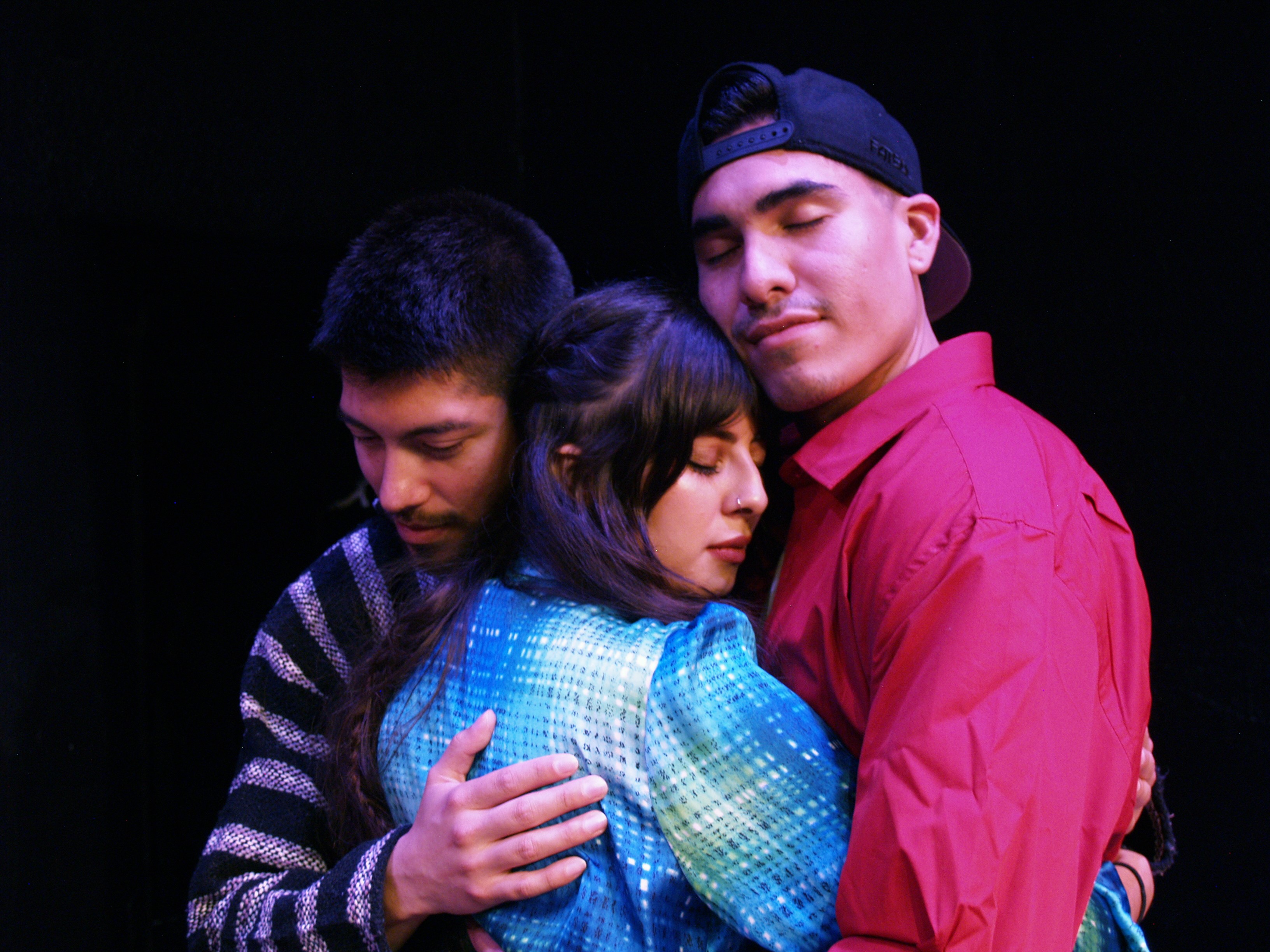
    The story starts in the blue and red lights that bathe a replica-sized model of a wall. Not just any wall, but The Wall, the most southern one that separates country from country, family from family and the hopes of migrants for better opportunities and life.

    In that obscurity, bodies shift and take steps until they’re center stage and in full view. They face you, you face them and under the spotlight, the stories of immigrants and Deferred Action for Childhood Arrival recipients begins.

    “Some of these scenes will break your heart because they show so much humanity,” Co-Director Andrea Carrillo said. “Humanity is such a great big theme within this story. You can’t help but connect and feel compassion for these individuals.”

    The Humboldt State University Theater Arts, Film and Dance Department presents “Dreamers: Aquí y Allá.” The script was written by Andrea Caban, her students, and a collaboration from source material provided by Armando Vazquez-Ramos and the California-Mexican Studies Center.

    Students in the California-Mexico Dreamers Study Abroad Program, DACA recipients and immigrant community members gave testimonials and interviews for the script.

    Troy Lescher, co-director and HSU associate professor, came upon the script in spring 2018 when Caban emailed the script to all 18 California State Universities in hopes they would produce the show.

    “I was blown away by the humanity of the story,” Lescher said. “As soon as I read it I said to myself, ‘We have to do this show at HSU.’ I mean, because of our social justice mission, commitment to minority voices on stage, how timely this issue is and this play had HSU written all over it.”

    The play follows the memories and lived experiences of immigrants and DACA recipients who then obtained advance parole, which gave them opportunity to travel to Mexico and reconnect with their culture and families.

    Carrillo said that they go through time jumps and include the audience as they break the fourth wall in various scenes from start to finish.

    However, circumstances prevented the play from happening until fall 2019. Lescher reached out to theater arts graduate students Carrillo and Amy Beltrán via email. They said that they were overjoyed about directing the play.

    “For me the biggest thing was to evoke empathy within the community because a lot of the community, as well as in Humboldt County, can be either on the middle ground or can be very conservative,” Carillo said. “These are human beings with their own experiences, their own love, their own families, and that was a big thing for me to show that to them.”

    But just as the directors were compelled to tell this story, so too were the actors.

    Business marketing major and theater arts minor Victor Parra, who plays Mateo, said he knew it was important for him to get involved when he heard about the script.

    “As an actor and artist this is the kind of stuff that catches my attention,” Parra said. “This is the kind of work that I want to do personally.”

    Parra said it’s important to remember that the play is a cumulation of many stories, real stories, and that these are real people who struggle everyday. These were stories close to him because he experienced similar struggles back home.

    “We have to keep working to give spaces for minority voices to be heard, especially voices that aren’t heard very often.”

    Troy Lescher
    Co-director

    “I brought a lot of personal past into this and it was my own decision,” Parra said. “Nobody asked it of me, but because I relate to this.”

    Parra plays Mateo, who in the play fears being deported and leaving his child and mother behind. He said that is what happened to him when one of his parents was deported not too long ago, and he brought those feelings into the production.

    “I envision my own family,” Parra said. “That’s what I just had to bring to the table because it’s so important. We need to say this. We need for our voices to be heard and something needs to happen.”

    Lescher knew that he wanted to encourage and open the production to more students, so he reached out to El Centro Académico Cultural Coordinator Fernando Paz, Interim Executive Director of the Office of Diversity, Equity and Inclusion Edelmira Reynoso and Multicultural Center Coordinator Frank Herrera.

    The result was that out of 11 cast members, six of them were non-theater majors and four of them performed for the first time.

    “This story hits differently,” Carrillo said. “It resonates differently with people. It’s such an immediate connection with a lot of Latinx people and people of color. It made sense that we had so many new faces in the theater.”

    Lescher said that the challenges DACA recipients struggle with is a big part of the conversation, because their voices are often unheard or aren’t highlighted in the news.

    “We have to keep working to give spaces for minority voices to be heard, especially voices that aren’t heard very often,” Lescher said.
  • ‘Dreamers: Aquí y Allá’ Preview

    ‘Dreamers: Aquí y Allá’ Preview

    Theater Arts Department presents a production that transcends borders

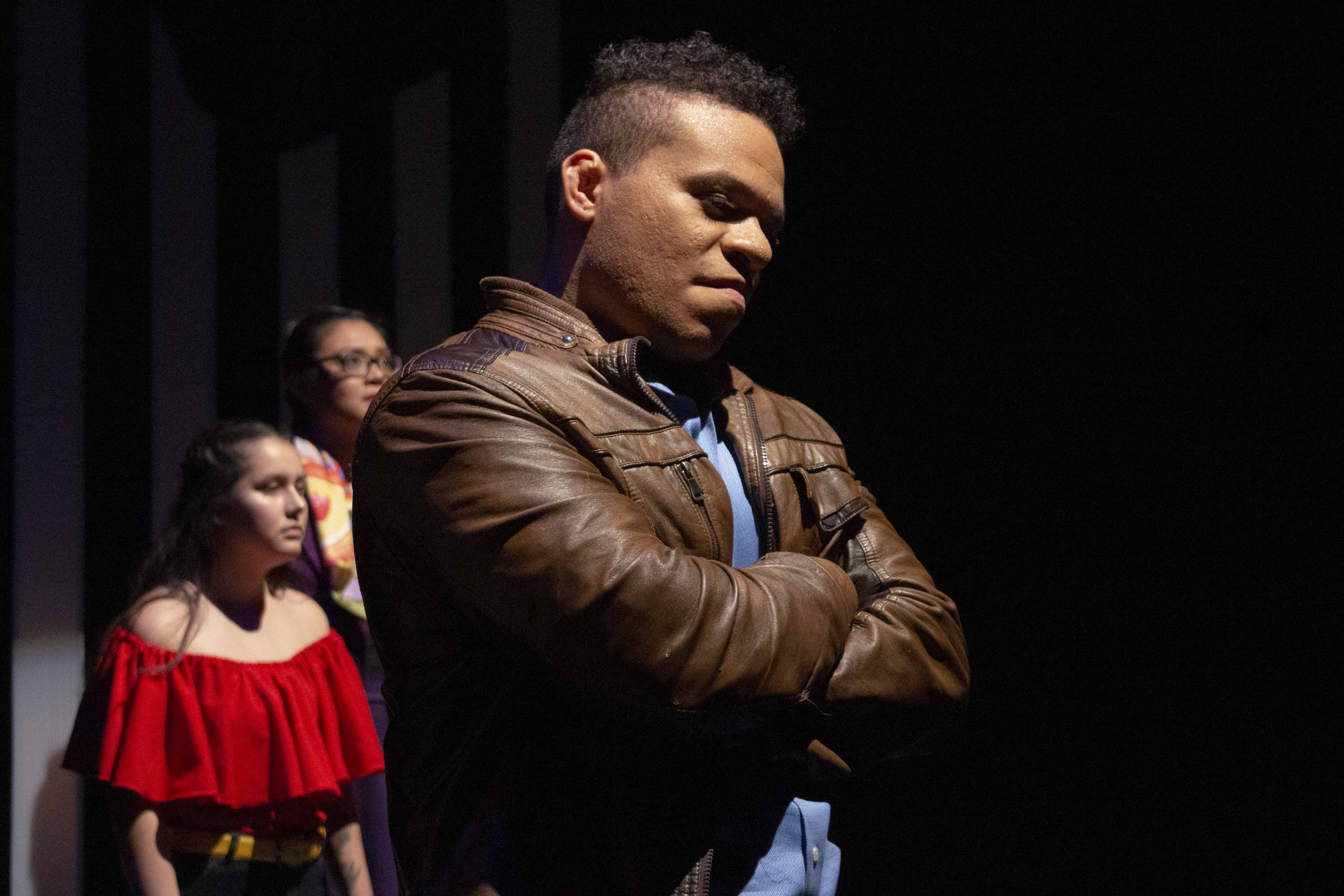
    The room is dark, the audience silent. On stage, right before your eyes, a story begins to unfold. Actors stride onto the set, and within seconds, they transport their audience into a world that deals with fears of family separation, job loss and deportation.

    But that world is reality, as the actors break the fourth wall and address issues for immigrants and Deferred Action for Childhood Arrivals recipients.

    “I read the script and I thought, ‘Wow, this needs to be told,’” Co-Director Andrea Carrillo said. “I know that there’s a good portion of undocumented people living in Humboldt County as well. It’s a great way to show the community that we see you, we hear you and we want to do what we can to share your experiences and your voices on stage.”

    Humboldt State University’s Theater Arts Department will premiere a production of “Dreamers: Aquí y Allá” this weekend and next. The show features testimonials and interviews from students in the California-Mexico Dreamers Study Abroad Program, DACA recipients and community members.

    “I’d say for people who have heard the story and don’t necessarily connect with the politics, I’d say, stay open minded about it. You never know what you might experience or learn. You might surprise yourself as an individual.”

    Andrea Carrillo

    The production is co-directed by theater art graduate students Amy Beltrán and Carrillo along with Assistant Professor Troy Lescher. “Aquí y Allá,” first produced at California State University, Long Beach, was written by Andrea Caban and presented as a collaboration between Caban, her students, material provided by Professor Armando Vazquez-Ramos and the California-Mexico Studies Center.

    “This is a story that needs to be heard. You need to be here and sit with it and listen intently and openly as well,” Carrillo said. “I’d say for people who have heard the story and don’t necessarily connect with the politics, I’d say, stay open minded about it. You never know what you might experience or learn. You might surprise yourself as an individual.”

    “Aquí y Allá” opens Dec. 6 in Gist Hall Theatre and continues Dec. 7, 12, 13 and 14 at 7:30 p.m. There will be a matinee at 2 p.m. on Dec. 15. Tickets are $10 for general admission and $8 for student and seniors. For tickets, visit the Center Arts website or call 707-826-3928.

    After the show on Dec. 6, representatives from HSU’s Scholars Without Borders and Centro Del Pueblo will present on DACA initiatives. Following the shows from Dec. 12 through 14, Professor Vazques-Ramos will present a 30-minute lecture called “Dreamers 2020: What’s Next?” followed by a Q&A.

  • Decision Time for DACA

    Decision Time for DACA

    Supreme Court set to determine future of over 700,000 people

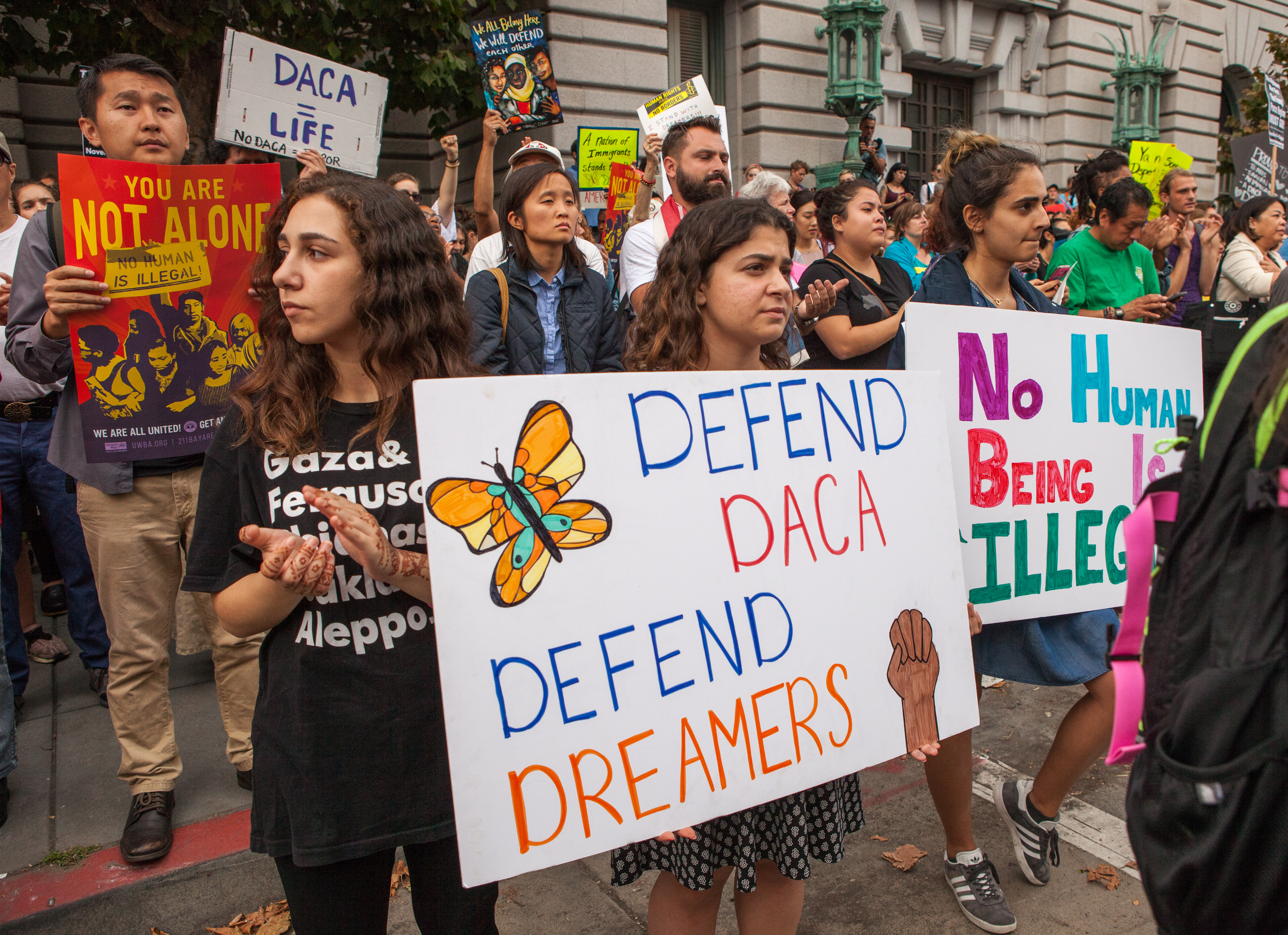
    The Supreme Court of the United States heard oral arguments on Nov. 12 that will determine the future of more than 700,000 immigrants brought to the United States by their parents as children.

    The Court’s decision isn’t expected until sometime next year, possibly as early January or as late as the summer. The majority decision will likely depend on Chief Justice John Roberts’ decision, as the remaining four liberal justices and four conservative justices are expected to vote in support of and in opposition to DACA, respectively.

    Eighty minutes of oral arguments sustained a packed courtroom on the legality of the rescission of the Deferred Action for Childhood Arrivals policy. Three to four million immigrants that live in the United States arrived illegally as children. DACA protects about 700,000 of those immigrants from deportation and makes them eligible for work permits.

    The DACA program, which requires that recipients renew their status every two years, is currently only accepting renewals, not new applications.

    Seiri Aragon, a 27-year-old DACA recipient, advises first generation, low-income students for Academic Talent Search at Sonoma State University. Aragon, who was born in Oaxaca de Juárez, México and came to the United States in 1997 at age five, said in a phone interview that she has no choice but to pay close attention to the news surrounding DACA.

    “It’s kind of hard not to pay attention,” Aragon said. “Because it’s a real, big part of my life, and so anything that could jeopardize my life here definitely should be of some importance to me.”

    Aragon went to high school in Petaluma before completing undergraduate programs at Santa Rosa Junior College and SSU. She then went to the University of Texas to complete a master’s program.

    Aragon signed up for DACA when it first came to be in 2012. While Aragon has doubts about the logistics of how a mass deportation could take place in the event of DACA’s rescission, she acknowledges that individual DACA recipients could easily be targeted and deported.

    “For a really long time I thought that because we were kids, we would be given a chance,” Aragon said. “But I feel like both Republicans and Democrats in government pretty much just use students like me, kids like me or folks like me as pawns in their political game. As soon as you realize that, you just get so discouraged that at some point you’re just like, ‘Well, if they want to throw me out, they’ll throw me out.’”

    Solicitor General Noel Francisco argued in support of DACA’s rescission in the courtroom. Francisco said DACA “maintained in perpetuity a program that actively facilitated violations of the law by hundreds of thousands of individuals.”

    “For a really long time I thought that because we were kids, we would be given a chance.”

    Seiri Aragon

    Francisco suggested that an executive action ordering the government not to enforce the law had questionable legality. Francisco also reminded the Court that DACA was never intended to be permanent.

    “DACA was always meant to be a temporary stopgap measure that could be rescinded at any time, which is why it was only granted in two-year increments,” Francisco said. “So I don’t think anybody could have reasonably assumed that DACA was going to remain in effect in perpetuity.”

    Francisco argued that a ruling on DACA’s actual legality would be unnecessary. Instead, Francisco believed that President Donald Trump’s attempted rescission of DACA in 2017 was legal and should be allowed to go forward—thus eliminating any need to rule on DACA itself.

    Attorney Theodore Olson argued against the rescission of DACA. Olson said such an impactful rescission necessitated a review by the Court.

    “The decision overturned a five-year enforcement policy of deferred action that had enabled DACA recipients under other unchallenged laws and regulations to apply for employment authorization, seek driver’s licenses and other benefits,” Olson said.

    While Justice Neil Gorusch acknowledged what he called “sympathetic facts,” Gorsuch and Justice Brett Kavanaugh questioned Olson’s stance.

    “What’s the legal limiting principle you’d have this Court adopt?” Gorsuch asked.

    Olson returned to his initial point on the significance of DACA.

    “All we’re saying is that it should be subject to review in the context of the big picture,” Olson said.

    When asked if Olson believed that the executive had the power to rescind DACA, Olson said “yes.” Thus, Olson’s argument rested on doubts of the explanation behind the rescission.

    President Barack Obama put DACA in place in 2012 as an executive action after Congress failed to pass the Development, Relief and Education for Alien Minors Act. The DREAM Act offered a path to citizenship for some immigrants brought to the United States as children.

    With DACA, Obama intended to give Congress time to come up with permanent immigration legislation. No such legislation has come to fruition, and in 2017, President Donald Trump attempted to rescind DACA.

    The Trump administration has called DACA illegal and unconstitutional, but lower courts have disagreed. In June, the Supreme Court agreed to hear the case to determine if the rescission of DACA was legal.

    About 11 million total undocumented immigrants lived in the United States in 2017, according to the Pew Research Center, and about 100 undocumented students currently attend Humboldt State University, according to an August press release.

    HSU released a statement Nov. 21 detailing its commitment to DACA and undocumented students. The release noted HSU’s resources available for undocumented students, including a clinic scheduled for Dec. 6 and 7 in which the Coalition for Humane Immigrant Rights will cover the DACA renewal fee for the first 20 renewals.

    “We would like to firmly reassert our commitment to being an inclusive campus which provides access and support for all students, staff, and faculty members within our HSU community,” the release said.

    The future for DACA recipients if the policy is rescinded is uncertain. The Department of Homeland Security website has a list of frequently asked questions regarding DACA’s rescission.

    “Current law does not grant any legal status for the class of individuals who are current recipients of DACA,” the site says. “Recipients of DACA are currently unlawfully present in the U.S. with their removal deferred. When their period of deferred action expires or is terminated, their removal will no longer be deferred and they will no longer be eligible for lawful employment.”

    The site says that once a DACA recipient’s status expires, their case will not be “proactively” provided to Immigrations and Customs Enforcement unless they receive a notice to appear in immigrations court. According to the site, this policy may change at any time without notice.

    In an analysis conducted following Trump’s move to rescind DACA in 2017, the bipartisan political organization FWD.us estimated that removing DACA recipients from the workforce would cost $460 billion in gross domestic product over a decade.

    When asked what she will do if DACA gets rescinded, Aragon paused.

    “I don’t know,” Aragon said. “I really don’t know. I’m just looking out for allies at this point.”

    Aragon said that while having DACA is a privilege compared to other undocumented immigrants, she, like Olson, pointed out that a large part of the program is providing basic citizen privileges like being able to file taxes or apply for driver’s licenses.

    “The privilege is to bring equity to essentially what we are, which is American,” Aragon said.

    For the next few months, DACA recipients across the United States, including Aragon, will await the word of the nine justices. Aragon said she hopes for DACA’s reinstatement, at the very least.

    “I feel like I’m asking for crumbs,” Aragon said. “Because at this point, I’m so disappointed that I’m like, ‘Can you just, one, not take away the program, and two, maybe reopen it to people who qualify?’ That’s it, that’s all I want.”

  • Keep the dream alive

    Keep the dream alive

    Immigrants are the backbone of the United States, but anti-DACA protesters think they could do without them entirely.

    The Deferred Action for Childhood Arrivals, a polarizing immigration policy that allows certain individuals to enter or remain in the United States, was established by the Obama administration on June 15, 2012.

    Those who meet the guidelines for DACA receive a renewable deferred action, or immunity from deportation, for a period of two years and a work permit.

    According to a Sept. 4, 2017 report by the U.S. Citizenship and Immigration Services, there are approximately 690,000 active DACA recipients, or Dreamers, of which about 548,000 are from Mexico. Trump repealed the DACA policy on Sept. 5, 2017, announcing the termination of the policy on March 5.

    However, the Supreme Court announced on Monday that they refuse to take up the case, leaving the fate of Dreamers in limbo once again.

    Center of American Progress said our country is estimated to lose $434 billion annually in gross domestic product if Congress decides to put a fork in DACA. What this means is the cost of goods and services would eventually rise with the success of mass deportation of immigrants. Inflation would further burden lower and middle class Americans who make up the better part of the U.S., while wealthy elites remain virtually immune to financial setbacks. In other words, economic inequality would worsen as a result of deporting Dreamers.

    Deporting Dreamers would diminish diversity, which would favor white nationalists who wish to establish cultural dominance. Further, the lack of culture in the United States would ruin the overall character of our country, replacing our melting pot for something less palatable.

    Despite the widespread fallacy that immigrants take away jobs from American citizens, or overindulge in government benefits, the truth is immigrants contribute to economic growth.

    “Immigrants contribute mightily to the economy, by paying billions in annual taxes, by filling low-wage jobs that keep domestic industry competitive and by spurring investment and job-creation, revitalizing once-decaying communities,” Douglas P. Shuit and Patrick McDonnel of the L.A. Times said. “Many social scientists conclude that the newcomers, rather than drain government treasuries, contribute overall far more than they utilize in services.”

    But intolerance carries on as the Trump administration and anti-DACA hardliners push to bring an end to the DACA policy, which would result in the wrongful deportation of people who enhance the wellbeing of Americans. Undocumented immigrants who commit heinous crimes do exist, but that is far from the majority of law-abiding immigrants who are trying to make better lives for themselves in the land of the free.

    While the fate of Dreamers remains uncertain, pro-DACA supporters are urged to get involved. Reliable resources to protect Dreamers are available online, including American Civil Liberties Union and National Immigration Law Center. United We Dream is the largest immigrant youth-led network in the country. They offer tools and strategies to take action, such as launching grassroots campaigns or signing a petition to Congress that endorses DACA.

    Power in numbers can make a difference, as we recently witnessed on a local level with the removal of the McKinley statue. Educate yourselves with immigration policies, pertaining specifically to DACA, so you can stand up for what is right if you run into anti-DACA supporters.

    The U.S. Immigration and Customs Enforcement, or ICE, has been raiding immigrants under the dominance of federal law, including Dreamers in sanctuary cities. Another way of supporting Dreamers is assisting them in the event of a raid, such as translation or explaining their rights. Understanding immigration policies during such a confrontation could make a world of a difference.

  • Government shutdowns: uncertainty as a price for democracy?

    Government shutdowns: uncertainty as a price for democracy?

    The showcase of the United States’ unique democratic system happened on Jan. 20. It marked the one-year anniversary of a reality TV star’s presidential inauguration. It also highlighted the country’s freedom of speech in the form of a nationwide women’s rights demonstration, as well as the beginning of a short-lived government shutdown.

    Professor Stephanie Burkhalter, a political science professor at HSU who studies communication strategies between Congress and the president, provides more insights on the phenomena of government shutdowns.

    What is a government shutdown?

    A government shutdown occurs when the House of Representatives and the Senate cannot pass an appropriations bill — the technical name for a bill that funds the government agencies — that the president will sign.

    Shutdowns are a uniquely U.S. government thing, because of our constitution, the filibuster rule and our two-party system. The two parties have become increasingly polarized on policy issues and more willing to have a shutdown if they cannot get the policy changes that they think are important.

    What caused this previous government shutdown and why was it so short?

    This answer depends on whom you ask. The consensus from mainstream media sources is that the Senate Democrats caused the shutdown by filibustering and demanding that the Senate markup — the official term for editing a bill — and debate an immigration bill that would create a pathway to citizenship for DACA recipients, known as “Dreamers.”

    Senate Democrats agreed to fund the government through Feb. 8 in exchange for Senate Majority Leader Mitch McConnell’s promise that the Senate will take up an immigration bill in the next two weeks.

    In this shutdown, Democrats were also able to negotiate six years of funding for the Children’s Health Insurance Program. House Republicans had not funded this program in their version of the permanent appropriations bill.

    What does a shutdown say about the administration of President Trump?

    From my understanding, President Trump was ready to make a deal on Jan. 19 to avoid a shutdown, but his advisers scuttled the deal, because they believed that this deal was not tough enough on immigration policy.

    So, this shutdown says less about Trump and more about the partisan politics plaguing our nation’s capital.

    What could happen around Feb. 8?

    [On Feb. 8], the Senate will reconsider a permanent spending bill. If Democrats again decide to filibuster, another shutdown could occur if a deal cannot be reached between Republicans and Democrats on immigration policy.

    Government employees, such as those who work in the National Park Service and the Bureau of Land Management, will not be paid.

    ——–

    Eric Nelson, the manager of Humboldt Wildlife Refuge, an organization managed by U.S. Fish and Wildlife Service, detailed the obstacles a shutdown would impose on the refuge’s operations.

    “In 2013, there was a shutdown that lasted 13 days, I believe,” Nelson said. “Probably the most challenging part of a shutdown is dealing with the uncertainty, and what it can do to schedules and scheduled work.”

    Because shutdowns are often prevented at the last minute, preparing for them is difficult. Fortunately, most shutdowns occurred outside of the spring/summer restoration work season and did not pose big problems for the refuge’s projects.

    If a shutdown occurs on Feb. 8, the refuge will be closed to most of the public. However, independent researchers working on the refuge will be allowed to continue their work, as long as they can access their research site without the help of a federal employee.

    Nelson added that if the shutdown goes on for three to four weeks, the financial challenge of not getting paid will become an issue.

    “Ironically, Congressional members do get paid during a shutdown,” Nelson said.

    Burkhalter also recognizes that a shutdown’s impact is affected by its length.

    “The effects of a shutdown are felt the longer it continues,” Burkhalter said. “Let’s hope that the Senate can make a deal on immigration policy, a permanent spending measure can be passed and we can feel secure that our government is funded through this fiscal year.”

    On the potential of shutdowns that may occur beyond Feb. 8, Burkhalter said that they could happen again when Congress tries to pass appropriate measures.

    “I would not be surprised if a few more shutdowns are headed our way in the next few years,” Burkhalter said.

  • Open house with open arms

    Open house with open arms

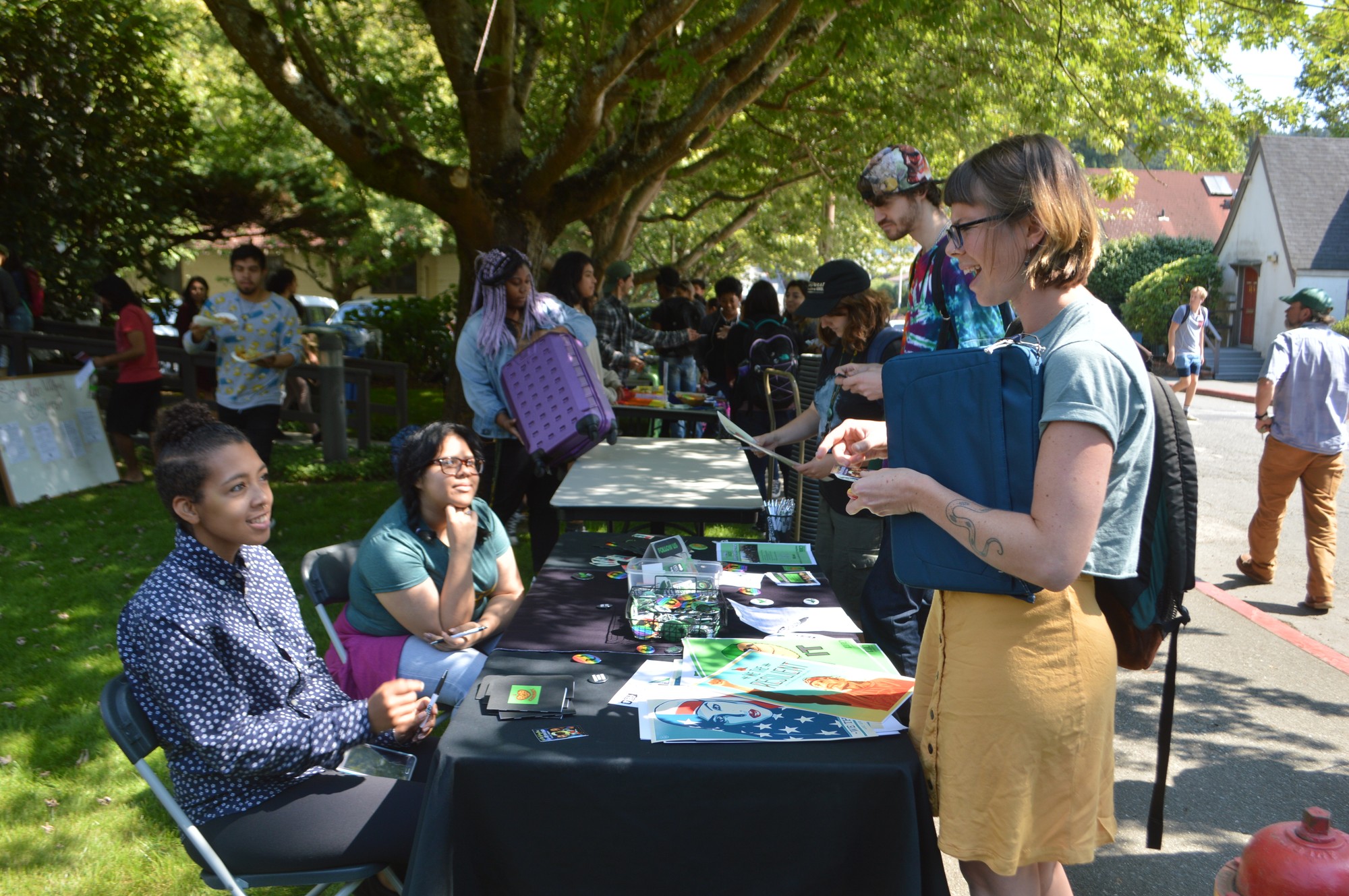
    On a seemingly quiet Friday afternoon on the Humboldt State University campus, the MultiCultural Center was booming with energy, as international music and the savory smell of lumpia filled the air. Dozens of HSU students gathered in front of the center on Sept. 12 for the MCC open house to represent and celebrate the various cultures our campus consists of.

    LN_OpenHouse(3).JPG
    The MCC featured a cultural exchange through cultural cuisine. Photo credit: Lora Neshovska

    The center open house aimed to familiarize students with the numerous cultural centers available on campus and create a comfortable environment for socializing and learning.

    Among the representatives were Scholars without Borders (SWB), Women’s Resource Center (WRC), the Latinx Center, and the Eric Rofes Multicultural Queer Resource Center (ERC). These centers, as well as much more serve as resources to anyone on campus, especially students who may feel marginalized.

    Although these centers and clubs seem to differ, they all share a passion for solidarity and intersectionality. Jonathon Salinas, 20, is majoring in Spanish and currently working as the event coordinator at ERC. Salinas says instead of viewing activism as separate social movements, it’s important to support each other, heal and move forward together.

    LN_OpenHouse(1).JPG
    Criminology and CRGS student Deema Hindwai (right) converses with EOP staff, Rama Rawal (left). Photo credit: Lora Neshovska

    According to a 2013 Humboldt retention report, an average of 25 percent of the first year, full-time undergraduate students were not retained.

    Cesar Abarca, faculty coordinator of SWB and an assistant professor in the Social Work department said this emphasizes the importance of student support centers, such as the MultiCultural Center and SWB.

    “In a small, rural area,” Abarca said. “It’s really important to make students feel welcome and accepted.”

    Abarca also said there needs to be support and advocacy specifically for underrepresented students

    As of late, SWB has shifted their focus towards assisting undocumented students, specifically with the application process for D.A.C.A. renewal. This includes providing information about the U.S. Immigration and Customs Enforcement (ICE) and basic guidelines and civil rights when dealing with law enforcement.

    Angie Muñoz, current editor of the Cultural Times said the MCC caters to what students need and can benefit from the most. This includes representing student voices and opinions in the Cultural Times, as well as opening up staff meetings to students with suggestions for the center.

    The MultiCultural Center on campus is located in the Balabanis House and is open Monday-Thursday from 10 a.m. to 8 p.m. and Fridays from 10 a.m. to 5 p.m.


  • Letter to the editor: Welcome from the Mayor of Arcata

    Letter to the editor: Welcome from the Mayor of Arcata

    By: Mayor Michael Winkler

    Welcome back to Arcata! And welcome to winter weather. I know many of you are from the south, and less comfortable with frost and rain — but I hope you embrace the nature of the North Coast. Enjoy it! Don’t let it get you down, it is not really that cold. You just need layered clothing, a raincoat, umbrella, socks and boots. Now you are ready to go, at least for a saunter through town.

    Grab your friends and walk into town! It is only a few blocks southwest and there are adventures to be had. Interesting stores, great food, a walk to the marsh, visit the Farmers Market on a Saturday morning. Get to know the local opportunities. There are businesses that need employees, non-profits with internship opportunities and maybe some second-hand or new clothing you want to shop. Enjoy the music shows, movie theaters and community celebrations. We may not have an In-N-Out Burger here, but try Stars on G Street or enjoy the late open hours at the Arcata Pizza Deli on H Street.

    I want you to know the city of Arcata council, staff and police work hard to respect the dignity of ALL people. We want our town to be safe and welcoming to all students, no matter their immigration status. No person will be held legally solely for their immigration status. We support DACA students and wish all HSU students success in their dreams.

    Make these years the best in your life — which means try things that scare you a bit, explore your interests and make lifelong personal connections. Success is often about who you know in life — so let yourself be known! Arcata City Council meetings are held every first and third Wednesdays of the month, at 6 p.m. in City Hall. Please come say hello!

    Be sure to speak up if you are having problems academically, socially or legally. HSU has advisors to help you, and the Arcata City Council wants to know how we can help you be more successful. We believe this country is best served with educated people and are so happy you chose Humboldt State University!

    Welcome to Arcata! As Sara Bareilles sings it, “I want to see you be brave!”