The Lumberjack


Students Serving The Cal Poly Humboldt Campus and Community Since 1929

Tag: Humboldt County

  • Students’ first time voting among many historic firsts

    By Marielle Winuk

    Students and community members lined up on the first floor of the Jolly Giant Commons, ready to have their voices heard. Democrats did very well in Humboldt, a trend that continued throughout the nation. Democratic Congressmen Damon Connoly and Jared Huffman took substantial leads in the reports from the Humboldt County Office of Elections.

    For many students at Cal Poly Humboldt this election was their first time voting. Les Arreola, a history major with an education concentration shared how her vote amplified more than just her voice.

    “My parents don’t have the privilege of voting and honestly I’m giving myself a voice but I feel like I’m also giving them a voice as well,” Arreola said.

    Jaquy Shanteau, a music major, grew up in a politically active family and was excited when it was their turn to cast a ballot.

    “I’ve been really excited to finally be able to vote because my parents have been very politically inclined and they’ve shown me a lot about the voting process so I was like, yay finally my turn,” Shanteau said.

    The polls closed at 8 p.m. and around 8:30 p.m., the Humboldt County Office of Elections released the first election-night report.

    In the Arcata City Council race, incumbent Kimberley White showed an early lead with 825 of the 2,545 early votes cast by mail. The last seat is an incredibly close race between Abigail Stickland and Genevieve Serna with only nine votes currently separating them.

    Democratic candidate Xavier Becerra won the governorship by a landslide, becoming the first Latino California governor. In Humboldt County, 9,858 of the 14,402 votes counted so far went to Becerra. Burak Yildiz, an environmental science & management and climate and energy major, felt that the primary earlier this year had already decided who he would vote for in the midterms.

    “I didn’t know if I was the most excited for Becerra,” Yildiz said. “But by the time it gets to like, Hilton or Becerra, then it was like the choice has already been made for me. Whereas with the primary it felt more like that than when you had a pretty large selection.”

    According to the Associated Press, Democrats gained control of the Senate with a 53-42 majority due to key states like North Carolina, South Carolina, Ohio and Maine flipping from Republican to Democrat representatives. In the House races the Democrats also led with 220 seats and the Republicans holding onto 128 seats.

    At the time of publication these races are not finalized. California gives the election offices 30 days to certify the election.

    In a world where an affordability crisis is at the forefront of students’ lives, Daniel Fernandez, a mechanical engineering major, echoed the importance of voting.

    “It’s definitely a good feeling being able to feel like you can impact the government somehow, especially in the current day and age religion right now, where everything’s so crazy,” Fernandez said.

    Marielle is the layout editor with an interest in sports and elections. Contact her at mmw146@humboldt.edu.

  • Eloisa Profile

    Eloisa Profile

    By Sadie Shields

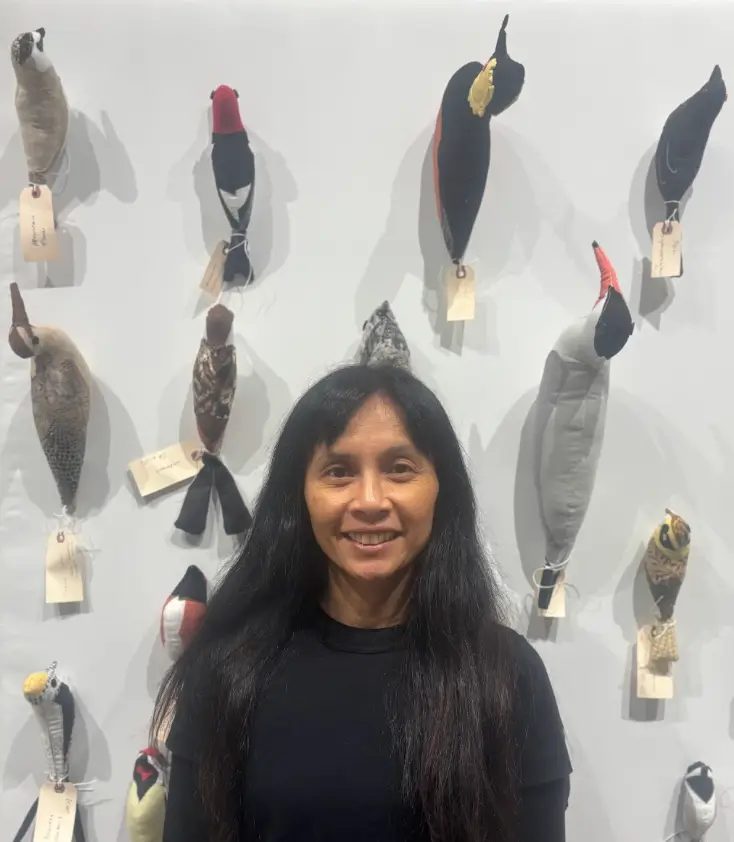
    Plush birds line the walls like specimens in a taxidermist’s collection, accompanied by photographs and inky paintings of telephone pole trees. The Darwin’s Finches exhibit focuses on the natural history between birds and human counterparts. The exhibit opens in the Reese Bullen Gallery located in the Art building on Nov. 4 at 7 p.m. After, it will be free for public viewing from Nov. 12 through Dec. 19.

    For artist and art professor at Cal State San Marcos, Eloisa Guanlao, inspiration comes from anywhere – even the smallest feather. What began as an interest in observing birds developed into an artistic interpretation of evolution and environmental change. Guanlao’s interest in birds began while living in Alabama with her partner and two daughters. During hikes and camping trips, Guanlao and her family would search for fossils, observe wildlife and collect feathers that fell from the sky. One of these discoveries – a feather from an endangered bird known as the Cerulean Warbler – began her deeper interest in birds and the changing environment as the world further industrialized.

    Guanlao began making stuffed bird puppets in 2016 by repurposing old fabric from outgrown clothing as a sustainability practice and for sentimental value. She wanted her daughters to be part of her creative process, allowing them to learn hands-on instead of keeping them away from her studio.

    “I started using their outgrown clothes and made stuffed birds,” Guanlao said. “So that when they come in, they can play with it. They were so young, and I wanted to be with them, and so that was a great way for them to come into my studio.”

    Guanlao’s interest in evolution played a major role in the development of the exhibit. The Beak of the Finch by Jonathan Weiner, a book about scientists studying the evolution of finches on the Galapagos Islands inspired the project and its name.

    “It’s a really great book, and it’s just about the people who looked at Darwin’s finches, you know the Galapagos,” Guanlano said. “It was a bunch of scientists that actually saw in real time that the finches evolved over a number of years and so I thought that was really cool and interesting.”

    Alongside her interest in evolution, Guanlao uses artwork to draw attention to the environmental challenges birds face – from urbanization to noise pollution, artificial lighting and tall buildings. In Darwin’s Finches, she displays historical photography techniques used to document and classify wildlife.

    “It’s just so many things that disrupt their natural rhythm, and how they go about,” Guanlao said. “Just feeding them from your backyard affects their movements.”

    Through Darwin’s Finches and future installations, Guanlao hopes to create opportunities for people to engage with science and the natural world by creating an environment where visitors can ask questions and talk to one another about the subject presented.

    “I really like students. I really like the faculty, and also the people in the community coming in,” Guanlano said. “So they’re ready to talk, they are ready to engage and I really like that.”

    Sadie is a reporter with an interest in covering and taking photos for sports and science. Reach her at sls331@humboldt.edu.

  • Sustainability and Habitat Building in the Garden

    Sustainability and Habitat Building in the Garden

    By Tara Linderborg-Cordry

    Wild animals thrive on a Fieldbrook property, living on plants such as manzanitas, native grasses, and wildflowers. Humboldt local Peter Haggard developed a unique, native-plant-focused garden on his one-acre property. This ecosystem gives Stellar’s jays a place to collect acorns from the oak trees, and a pond that is home to frogs and tadpoles. Haggard is a co-author with Jane Monroe on a 2025 Cal Poly Humboldt Press-published book, Rewilding: Native Gardening for the Pacific Northwest and North Coast.

    They encourage readers to replace ornamental lawns and gardens with native plants. Rewilding also involves creating a habitat through water sources, food and shelter for wildlife. The goal is to support ecosystems, not just have a decorative garden. Monroe defines rewilding as “planting native plants that will help support and provide habitat for wildlife.”

    Native plants provide seeds, food and habitat for local wildlife. Some insects depend on specific native plants to support their life cycles. Native manzanita trees can flower during the winter, providing nectar for pollinators when other plants aren’t available. Haggard noted that bumblebee queens sometimes emerge on warmer winter days in search of nectar. Native oaks produce acorns that feed birds and other wildlife. Native plant diversity helps to support a complex and balanced food web.

    “If you can bring the right plants in,” Haggard said. “It multiplies how many more insects and wildlife you can actually get in an area.”

    Cal Poly Humboldt’s Campus Center for Appropriate Technology (CCAT) practices sustainable gardening focused on composting and recycling.

    “Most of the stuff that we get from our garden goes into our compost,” said CCAT Co-Director and CPH Senior Bono Hercila. “[It] turns into super beautiful compost and then goes right back into our garden.” The facility also collects rainwater and saves seeds from its garden to reuse in future seasons.

    CCAT uses a three-bin composting system which helps to return nutrients to the soil. Hercila also spoke about CCAT’s pocket prairie that features a variety of native grasses, including California fescue and needlegrass.

    Humboldt County has a large amount of natural spaces compared to other regions in the state, Monroe believes that this makes it an ideal place to implement rewilding. She hopes students at CPH will learn about the benefits of native plants and carry that knowledge to other places. One benefit is that these practices bring animals back, which Haggard is concerned about with so much urbanization.

    “What about all the displaced animals, can we bring them back?” Haggard said. “I don’t want to see them disappear.”

    Sharing space with wildlife is a natural part of ecological gardening. Monroe emphasizes that as community members, we have a responsibility to share resources and space with every member of our community — big and small.

    “One of the main things I want people to take away is a sense of building community,” Haggard said. “Not just with people, but with the animals and plants.”

    Bio: Tara Linderborg-Cordry is a student journalist and reporter with the Lumberjack. She enjoys writing about community issues and events, and hopes to pursue a career in Public Relations. She can be reached at trl39@humboldt.edu

  • Finding myself at Phoebe Bridgers’ “Lost” Tour

    Finding myself at Phoebe Bridgers’ “Lost” Tour

    by Taea Seigler

    I recently had the privilege of attending indie rockstar Phoebe Bridgers’ “Lost” tour at the Chase Center in San Francisco on Oct. 28. It was beyond magical and the most uniquely unforgettable concert I’d ever seen for a multitude of reasons, largely because it was the first concert I’d ever attended with a strict no-device policy, and I loved it.

    Before entering the venue, attendees had to secure their phones in Yondr pouches, a lockable fabric pouch that can only be opened with a specialized magnet. Phone use was limited to certain places outside the stage area, where staff would open and relock them for guests throughout the night. During the show, Bridgers thanked fans for unplugging for the night and explained that it was a decision born out of both a rejection of technology in the ever-growing expanse of AI and a desire to have no record of the tour — due to its deeply personal nature as a tribute to her recently deceased father.

    Personally, I had no issue giving up my phone for the three and a half hour concert. It was a relief to not worry about taking pictures and just focus on the enchanting performance, which exceeded my expectations. The setlist was a perfect combination of her old and new work, I got to hear all my favorites. Most notably, she performed a cover of Bo Burnham’s “That Funny Feeling,” her first time doing so since 2021.

    Each song was accompanied by a dreamlike light show that I struggle to find the words to describe. Bridgers has a lyric in her song “As Above” that goes, “You don’t have to believe in magic, leave it to me to make it happen,” and all I could think was, she certainly made it happen. There was a fog machine going on all night, catching the light rays in such a way that it looked like something metaphysical. There were times the fog appeared waterlike, light danced like shooting stars across the venue, illuminating fans from the floor to the nosebleeds. During particularly slow songs, some fans held up lighters in place of phone lights, lighting the stadium like a night sky.

    It was breathtakingly beautiful, I cried so hard my tears started draining into my sinuses. Despite the venue’s 19,000 seat capacity, the show felt intimate, likely because of the lack of phone screens obscuring my view. I hope to see more artists adopting this policy going forward, as it truly made the night something special.

  • Middle Class Scholarships

    By Alba Galvan

    The Middle Class Scholarship (MCS) helps undergraduate California students pursuing a bachelor’s degree with financial aid, lowering the cost of attending a university for up to eight semesters or four years. Cal Poly Humboldt, like many universities, posts estimated MCS awards in student financial aid packages, which were distributed on Oct. 19.

    The California Student Aid Commission (CSAC) administers and finalizes the MCS for students and distributes once CSAC has confirmed enrollment of a student after the add/drop date and has calculated other financial aid awards, eligibility varies from student to student.

    “Eligibility depends on several factors, including a student’s financial circumstances, enrollment and academic progress,” Morgan McBroom, Senior Associate Director of Student Services, Financial Aid, said. “Meeting these requirements does not guarantee a particular award amount. The final amount also depends on the student’s other financial aid and the funding available for the program.”

    Alejandro Paz, a junior environmental studies major, believes the MCS 4-year eligibility rule has been a stressor for students.

    “I think [it] is stressful for students because some students may have to [or] may not graduate in four years; they may graduate in five or six years, or you just even add an extra semester. So when they don’t get that additional support from the middle-class scholarship, it’s a lot,” Paz said. “It makes a big difference basically in terms of financial help, especially when you’re adding an extra year, and so because it was only limited to four years, it very much forces people to stay on the four-year track when they know they can’t.”

    Students need a minimum of six units to qualify for the MCS and 12 units to receive 100% calculated aid. Taking fewer units will result in a reduced MCS award. Students can apply for the MCS by submitting a FAFSA or California Dream Act application by the March 2 priority deadline. McBroom shared how transfer students’ eligibility differs from that of students who go straight into a four-year college.

    “CSAC uses information reported by colleges to determine a student’s eligibility, including community college coursework, university units and Advanced Placement (AP) credits,” McBroom said. “As a result, a student who transfers as a junior may have less than two years of MCS eligibility remaining, depending on how CSAC evaluates their educational history. Students with questions about their remaining eligibility should contact the Financial Aid office.”

    Violeta Rivas, a junior social work and political science major, found the timing for the MCS distribution to be ideal, but has an issue with how the Department of Financial Aid informs students.

    “I feel like we should get, like, a call or something, not just an email, because emails are easy to miss, whatever and this is people’s money,” Rivas said. “I remember my freshman year. I was really confused because I was like, ‘Wait, I’m getting this money, but I don’t even know when I’m getting it,’ and nobody really explained it to me, so it was definitely just very confusing.”

    CSAC is able to recalculate the MCS award throughout the academic semester if student aid information changes. Students are encouraged to check their student accounts for updates regarding awards and balance.

    “If CSAC reduces a student’s MCS award after the funds have already been disbursed, the student may owe money back to the University. We understand that this can be stressful, especially if a student has already used the refund to pay for rent, food or other essential expenses,” McBroom said. “If this happens, students should contact both the financial aid office and Student Financial Services as soon as possible. The financial aid office can help explain why the award changed, while Student Financial Services can discuss the outstanding balance and available repayment options.”

    Alba is a reporter and opinion editor for the Lumberjack. She enjoys listening to people’s opinions with an open mind. You can reach her at agg83@humboldt.edu.

  • Coach Grant Landy’s final kick off ends in victory

    Coach Grant Landy’s final kick off ends in victory

    By Sadie Shields

    As the cold brisk air of Thursday morning hit the soccer field, the Lumberjacks prepared for their final game of the season, a quietness filled the air. Head Women’s Soccer Coach Grant Landy sat in his chair and seemed to soak it all in.

    With 30 years of experience, Coach Landy began his career as head coach in 1997  at Concordia University in Portland, OR he came down to Humboldt to take over as head coach in 2020, where he began to rebuild the program following the COVID-19 pandemic.

    “First of all, ending on this note today means a lot,” Landy said. “I think the players were playing for a lot of things today, mostly themselves, but I know they were playing a little bit for me, so that feels good.”

    Rebuilding the Women’s soccer program at Cal Poly Humboldt was one of the most meaningful parts of Landy’s career. Some of his highlights after six years were the 2023 team reaching the final four of the championship and the 2025 team winning the conference championship and advancing to the national stage.

    “When I got here, we had to really just build this program up,” Landy said. “Now we’ve turned into a program that expects to win, and that’s something that I’m really proud of.”

    Although the season did not end with a conference tournament appearance, Landy believes the team had a lot to learn from the experience, especially with the young roster coming into this season.

    “Small margins in our conference separate a team that’s going to go to a conference tournament and a team that’s not,” Landy said. “We’re going to learn a lot from this season. Our players worked extremely hard and I’m really proud of them. We’re young, so we have a lot of growth coming our way, and that’s exciting.”

    For junior communications major Heidie Munoz, Thursday’s game meant more than just ending the season with a victory. The team wanted to come together and give Landy a strong final game.

    “Honestly we were playing for each other, and it’s our coach’s last season so we really wanted to win the game to go out with a bang, and we didn’t give up,” Munoz said. “When we got scored on we worked really hard and came together as a team.”

    While the season had highs and lows throughout the season, one of Munoz’s favorite memories was the final game on Thursday, Oct 29.

    As the clock ticked down in the second half, it seemed the game was going to end as a tie, but Freshman kinesiology student Hayden Anderson was able to get the final goal, winning with her first goal of the season.

    “I’ve been working towards a goal for a long time this entire season, and I really just wanted it,” Anderson said. “I wanted to be there for my team and be able to put us a goal up.”

    Anderson was initially in shock after scoring, standing still for a brief moment on the field, before she realized what she accomplished. After scoring and celebrating on the field, Anderson ran to the side line and high-fived each teammate, connecting and high-fiving Coach Landy at the very end of the celebratory line.

    “I just want to say thank you to Grant for giving me this amazing opportunity and giving me a family with this team,” Anderson said. “He will be missed a lot.”

    As Landy prepares to step away from the program he said the next head coach will be decided by the athletics department. While that may be the case, he did express his support to the assistant coaches, Colin and Taylor, hoping they can help maintain the continuity within the program.

    “When I took this job, I really didn’t know what I was getting into, and it’s just been so fun developing this program, coaching a bunch of amazing young women,” Landy said. “I’m really proud of what we’ve built.”

    Landy ends his head coaching career with 429 wins and 118 losses.

    Bio: Sadie is a reporter with an interest in covering and taking photos for sports and science. Reach her at sls331@humboldt.edu.

  • Evil Laughs Conquer the Plaza

    Evil Laughs Conquer the Plaza

    By Keziah Rutschow

    Arcata Plaza echoed with sinister laughter and roared with cheers, filling the night air with Halloween spirit on the eve of the spookiest day of the year.

    Prospective competitors spread out around the plaza, practicing their laughs with friends before gathering in a giant circle in the center. Dressed as Shaggy ‘big naturals’ from the Scooby-Doo live action film, the event’s host and organizer, CPH art alumni Cash Fry called the scattered crowd together through a mini megaphone and introduced the competition. They stepped into the center one at a time, gave their evil laugh through the megaphone, then passed it to the next person. There was a panel of costumed judges: from a scary Joker to a cute angel, each one shined with excitement. Each laugher competed for the special prize of a polo t-shirt with a laughing green monster printed on the front, along with “Evil” and “2026.”

    Dressed in a witch costume, ‘Cunty Evil Lesbian’ introduced themself and stepped forward as the first laugher, starting the night off with a high-pitched and witchy laugh. Following it up was a deep, gruff, evil laugh from someone dressed in an array of different mismatched garments.

    Charlotte Leonard, a first-year grad student at Cal Poly Humboldt, learned about the event from a teammate on both the cross-country and track & field teams. Leonard said all her friends were super hyped leading up to it, excited to hear the evilest laughs and see the most creative costumes.

    “It’s pretty good, and I’m having a great time,” Leonard said. “And I wish I dressed up because the costumes are fire.”

    Spectators pushed through the overflowing plaza for a good view, while others stood on benches overlooking the buzzing crowd. Then, suddenly, the Green Goblin emerged from the crowd into the center for a second time – not to laugh again, but to call upon Spider-Man and challenge them in a 1v1 battle. Spider-Man was pushed through the crowd and into the center, quickly jumping into the fake brawl. Just when everyone thought it was over, a second Spider-Man came forward from the audience to team up against the Green Goblin.

    Alexis Sarmiento, a senior journalism and philosophy major, judged the competition. Her roommate Fry launched the first evil laugh competition last Halloween. This year, he advertised more and again recruited his roommates to help host.

    “For a while, we kept it a secret about who was hosting and that I was helping judging,” Sarmiento said. “I kind of knew it was going to be a little bigger than last year just because he’s been putting so much work into making it big. Every design that he made for this was like made by himself.”

    Despite all the action and boastful laughs, the competition was far from over. After nearly 30 people laughed it up, the judges picked 10 of the best laughers to come forward.

    “You are going to laugh off for the grand prize.” Fry said.

    After the 10 finalists unleashed their most evil, loudest laughs, the judges picked the final two. The pair stood face to face and dueled with their voices. Jigsaw cackled, flexing both voice and suit for the audience. A low roar answered from their opponent in intriguing, caveman-like attire. The crowd then chose the winner, cheering as the hosts called each name one by one.

    Peyton, a Humboldt community organizer, won the 2026 Evil Laugh Competition dressed as Jigsaw. They came excited to watch, and maybe compete, but their friends pushed them through the horde to rival.

    “I was content with just participating at all,” Peyton said. “End result, I’m walking away with a T-shirt.”

    Fame and glory isn’t what Peyton was looking for. They appreciated the experience shared with their community and will forever reminisce about it together. During a season that can bring spooky gloom, it’s important for all ghouls and goblins to share communal fun and experiences.

    “That’s what Halloween is,” Sarmiento said. “Everyone’s getting like crazy, and we just want an event where everyone can come together.”

    Keziah is the science editor with an interest in crime & justice and politics. Contact her at kfr19@humboldt.edu

  • Rhinoceros preview

    By Nico Patakidis

    As you might’ve seen from the guerilla theatre advertising, there’s something stampeding across campus, and it isn’t gorillas. Rhinoceros by Eugène Ionesco is playing at the Van Duzer Theatre from Nov. 6 to Nov. 15 and just might be about as perplexing as seeing a rhinoceros while having your morning coffee.

    The play is an impressive feat, as several dialogues and actions took place simultaneously on different parts of the stage. Multiple viewpoints bring new understandings to the story and ensure you’re never bored as it’s hard to find something on stage that’s not moving. The witty and sometimes nonsensically goofy dialogue especially in the first act guarantees an entertaining night at the theatre.

    Visiting director and acting professor James Peck spoke to the difficulty of running such a complex play.

    “The most challenging thing actually is how many bits there are in it,” Peck said. “There’s just so many moving parts.”

    But the amount of actors talking, fighting and performing various actions on stage wasn’t the only thing impressive about this production. Projections, puppets and set pieces were all well utilized, pulling you into accepting the absurdist concept of rhinos taking over a small French town. Every actor clearly put a lot of effort into each character, especially the main character, Bérenger, who faced near constant slapstick action and emotional confusion.

    The play was originally written in 1959 and is an absurdist piece about how individuals of any position, as well as society as a whole, can quickly shift in ideals and values.

    “In particular, his [Ionesco’s] point of view came out of post-World War II,” Peck said. “So the play was a result of that, and there is something about authoritarianism and cult behaviors that are written into it that seem really relevant at the moment.”

    Immediately after its debut on Nov. 6 at 7:30 p.m. in Van Duzer, there will be a panel by the crew to discuss themes of the play and its relevancy today.

    Nico is a reporter with an interest in covering local government and political affairs. Reach him at np211@humboldt.edu.

  • AI am done with irl slop

    AI am done with irl slop

    By Bodhi Haugen

    With AI everywhere on our phones, I feel the only safe haven is away from a screen. When people say AI slop is taking over the world, I can’t help but think if they spent time off social media they’d realize the world’s not as rotted as it seems.

    On the other hand, these past few months I have been seeing AI slop more often in person. I usually find it funny or ugly, but most of the time I’m met with genuine confusion. Too many people have become accustomed to using AI for advertising or outreach, but it’s not a good practice. The old saying goes ‘something’s better than nothing,’ but I’ve started to believe that in some cases, nothing is actually better.

    There is a particular food truck around Humboldt that I wouldn’t have gone to if my friend didn’t recommend it. The truck’s theme is questionable, AI faces and a variety of little details that just don’t make sense. Yes, the truck looks atrocious, but the food is delicious. While I understand some people are not the most creative with designs and whatnot I would argue that a white truck with a Sharpied menu slapped on it could make just as many — if not more — sales than AI slop advertisements.

    Another example in a similar realm is obvious AI-generated food on menus. I don’t know if they are trying to fool me, but it can’t be good for business. No way their burger has sesame seeds on the patty and lettuce in three different places. I’m not buying it, literally. Businesses should be proud of what they serve. I’d rather see the food for the first time when it comes out than look at a comedically large and unobtainable basket of fries.

    My point is, lazy marketing using AI is worse than no marketing. I know this all sounds mean toward businesses, especially when a majority of them are local. I say this constructively rather than to tear any person or business down. Expressing your own creativity, even if not artistically inclined, is light-years better than any computer recreating a prompt.

    Bodhi is a reporter and news editor for the Lumberjack. You can reach him at bgh27@humboldt.edu.

  • Spooky times come early at HHM East

    Spooky times come early at HHM East

    By Sadie Shields

    Laughter and excitement filled the air as classic Halloween music kicked off the first ever Hinarr Hu Moulik East housing Trick or Treat event Oct. 25 from 6-8 p.m. The first stop? A trip down the tunnel to other mother’s abode as the Coraline themed candy banquet began!

    Residents of the Hinarr Hu Moulik (HHM) building and students from all around campus traveled to HHM on Sunday to get an early start on celebrating Halloween. This spooky event was organized by the Resident Advisors (RAs) who had the idea to bring Halloween early to HHM East. Each study room was decorated with their own themes of the RA’s choosing and students gathered around the mocktail table on the second floor while learning to be aware of alcohol and spiking.

    Because the event was held inside a residence hall building, the housing department shared the information for this event a week in advance so that the students in HHM East were able to prepare for the possible foot traffic this event could cause.

    Kai Frimodig, a junior and the HHM East lead RA, was excited to bring the event together and share how each residential building will be doing one major event per semester this year.

    “We just wanted to be festive,” Frimodig said. “We decided that for our big event for HHM East, we would do something during Halloween and this seemed very fitting.”

    RAs were stationed in separate study rooms throughout the floors of the residential area, some dressed in costume while other RAs dressed in fall sweaters and t-shirts. Residents participated in the trick-or-treating experience while exploring the different themed study rooms.
    Floor seven’s decorations involved red balloons heading towards the direction of the origami boat stream, with a clown decorated door and a projector playing It, with templates for people to create their own boats to add to the stream. Floor five brought Charlie Brown and The Great Pumpkin’s pumpkin patch to life as visitors learned all about the Do’s and Don’ts of having a pumpkin.

    Aside from floor five’s candy, the educational information about pumpkins and their environmental impact helped students to understand the importance of safely disposing of the festive decorations that come with the fall season. Abraham Orozco, a junior marine biology major, shared how learning about invasive pumpkin species and reading the recipes was his favorite part of the event.

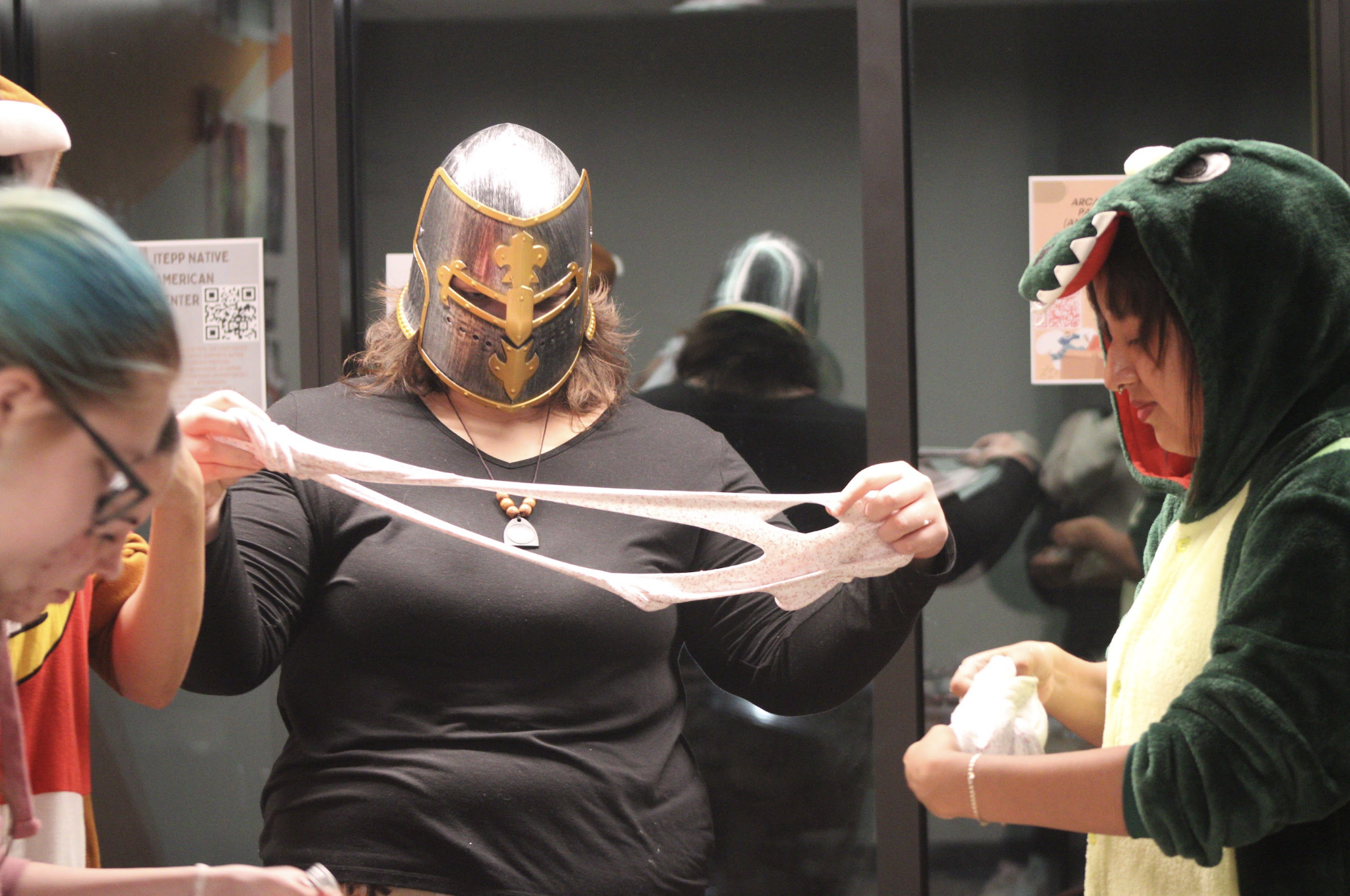
    From origami boats, to slime, to ofrenda decoration making, the hands-on activities drew a crowd of students and filled up the halls which spurred long lines for the elevators. The treats and the mocktails ran out before the event was over.

    Lincoln Hester, a junior forest soils major, enjoyed how the event truly allowed you to fall into the interactive chaos of the evening, with many decoration stations and music to dance to.

    “I really enjoyed the engagement, just interacting with the people hosting,” Hester said. “They had a lot of helpful info, and I found that to be pretty valuable.”

    By the end of the event, the bowls were empty, the floors were quiet and the feeling that Halloween is nearly here could be felt throughout the resident halls.

    Sadie is a reporter with an interest in covering and taking photos for sports and science. Reach her at sls331@humboldt.edu.

  • The haunting of Founders Hall

    The haunting of Founders Hall

    by Taea Seigler

    With over 100 years of history behind its walls, Founder’s Hall is bound to carry the stories, secrets and perhaps even the spirits of students, staff and faculty that have roamed its halls throughout the decades. Rumors of supernatural activity have spread amongst students and alumni, both through the grapevine and online.

    One user of the Cal Poly Humboldt Reddit thread by the username Vivid_Ranger_2915, shared their paranormal encounter in the basement of Founder’s Hall one night in the late 2010s.

    “We could hear the seismograph ticks from the hallway. We heard a sound from the hallway but due to the tall lab desks couldn’t hear [where] the scurrying noises came from,” user Vivid_Ranger_2915 said. “We got up, looked around and it was a black cat! There was no collar, and the cat proceeded to hop up on one of the tall lab chairs and hang out with us well into the evening and take a nap. For the day, that cat was our mascot. We made sure to bring it back outside and it was never seen again.”

    Humboldt State University alumni Robyn Friedman O’Leary, who graduated with an English degree in 1989, also shared her experience with Founders Hall during her time here. She recalled hearing about strange noises within those halls heard by her fellow classmates who studied late into the evening, usually on stormy nights.

    “There were always rumours of things that went bump in the dark there,” O’Leary said. “It is such an old building with such a storied history that I don’t think anyone would be surprised by stories of hauntings or paranormal experiences there.” During her time as a student, O’Leary had the opportunity to spend time in the now closed-off section of the building, Kerr Tower. The topmost part of Founder’s Hall, rounded with windows, was refurbished for student use in 1971 thanks to an $8,000 donation from Maple Creek residents, the Kerr family. According to a 1972 HSU press release, Kerr Tower was created “…to provide a place on campus where students could contemplate, meditate, think and pray in an atmosphere of peace and seclusion.”

    Like many students who had once visited Kerr Tower, O’Leary described the room as warm, cozy, quiet and more than anything, peaceful.

    The tower has since been quietly closed for no publicly available reason, leaving students to speculate why that might’ve been.

    To this day, Kerr Tower remains empty and unused, but if you go into the courtyard of Founder’s Hall at night and catch it at the right angle, you’d find there is a light up there that remains on to this day, and a curtain that sways slowly back and forth, concealing whatever secrets may hide behind those windows.

  • Wildwood, an Artistic and Technological Marvel

    by Winter Music

    In a world full of AI-generated slop created by machines, original stories crafted by hand with immense attention to detail truly feel like a breath of fresh air. Wildwood, directed by Travis Knight, is the latest film released by Laika Studios and the longest stop-motion film to ever grace the silver screen. Wildwood took 16 years to complete with a budget estimated to be near $400 million.

    Anyone who’s seen the film can easily tell that that time was well spent since this film has some of the smoothest, busiest and most action-packed animation that stop motion can offer. It’s easy to forget the film is stop motion at all with how crisp it feels in comparison to Laika’s previous films, but if you watch it, you’ll probably have a similar question to the one I had — how the hell did they do that? Laika is known as one of the best stop-motion animation studios in the world, however, the complexity and technological prowess shown in this film, combined with raw, human artistry, can be felt through every second, marking this as a true masterpiece.

    This isn’t just a movie for animation nerds like myself, it’s an adaptation of the novel Wildwood, written by Colin Meloy, lead singer of The Decemberists. The story follows Prue McKeel, who finds herself in the middle of a major conflict between several factions of intelligent talking animals while trying to find her brother in the magical woods she was told to stay away from. Each faction is fleshed out and well executed, with an impressive roster of characters who each feel real in their motivations and character traits.

    In spite of the fantasy concept, this movie is PG-13 with violent, emotional and sometimes bloody scenes. The film grabs your attention from the beginning and isn’t afraid of death or intense imagery, which may be surprising since many stop-motion fantasy films are seen as being made for kids. This isn’t a child’s story, but instead a fairytale for adults who need to reconnect with their inner child and remember that magic is real, and that it’s in all of us.

    Winter Music is a junior English major and copy editor for the Lumberjack. You can reach her at wlm38@humboldt.edu.

  • Indigenous Fashion with local flare

    Indigenous Fashion with local flare

    Sadie Shields

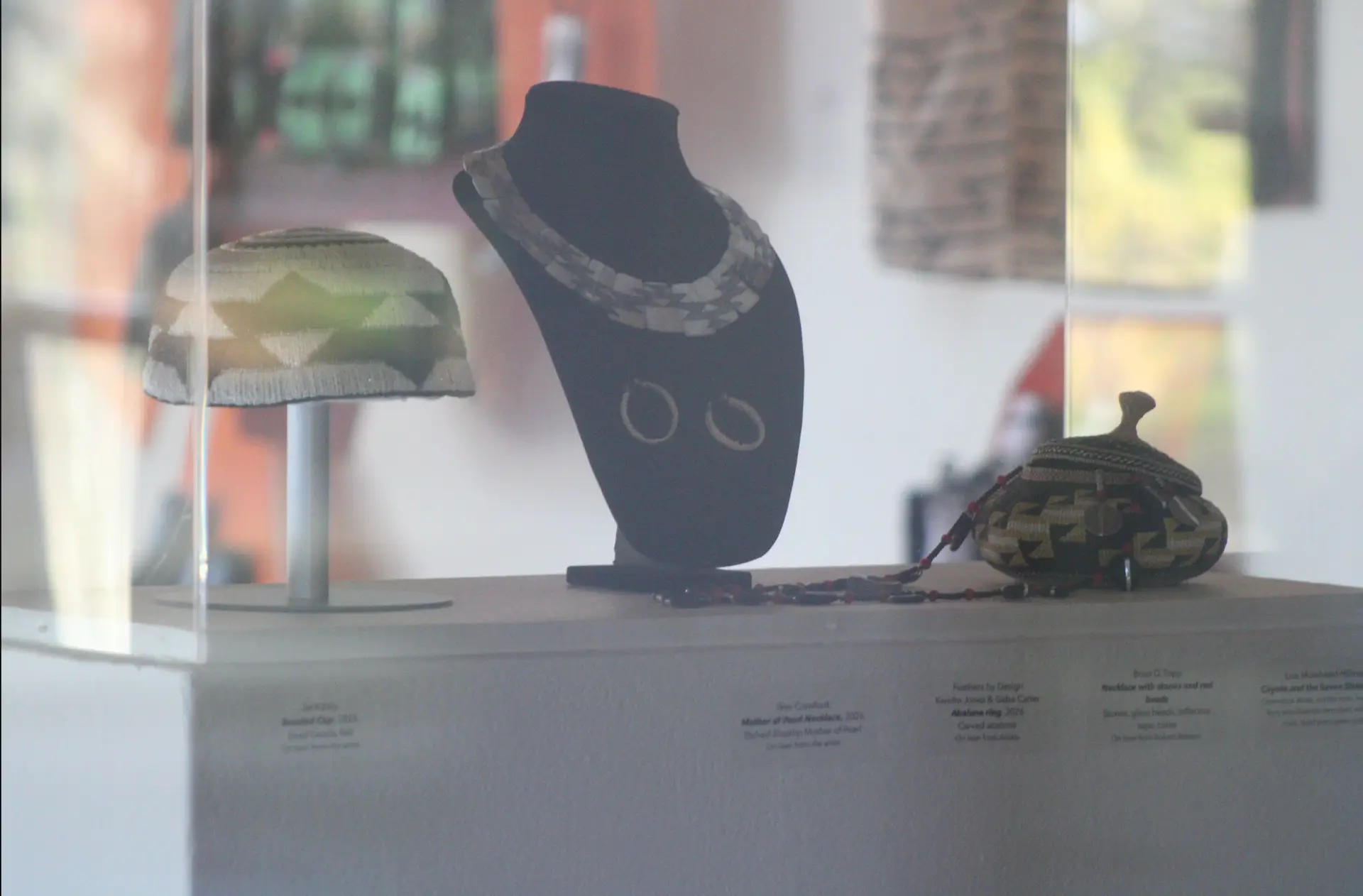
    Color fills the Goudi’ni Native American Arts Gallery as a story of culture is told through the threads of clothing and adornments inside. Root, Thread, Stitch | Fashion and Adornment, is the current exhibit at the gallery located inside the Behavior and Social Science Building (BSS) and running from Oct. 13 to Nov. 21. From past materials to present, the exhibit brings visitors through years of cultural fashion within indigenous tribes.

    Brittany Britton is the director of the gallery, and said the exhibition represents Indigenous fashion through designers bringing traditional materials and cultural designs into contemporary fashion.

    “We’re seeing what other designers from different tribes are doing,” Britton said. “And then how we can look at our local area and see what’s here.”

    The exhibition features approximately 110 pieces, including jewelry, clothing and other forms of adornment. One of Britton’s favorite pieces can be seen on the flyers around campus advertising the event. A beaded cap created by Jaimoe Kibby, a Yurok Tribe member, which proved far more detailed in person.

    “It looks good in photos,” Britton said. “But it’s even better up close.”

    The cap reinterprets the Yurok tribes local woven caps through intricate beadwork. Kibby recently won second place for the beaded work he did on the cap at the Santa Fe Indian Market.
    Putting the exhibition together required careful planning and creative display methods. Students in the Museum Gallery Practices Certificate program helped install the show while also learning how to properly handle and care for the artwork, Native American jewelry and regalia. The team worked to create displays that felt dynamic and not just like a jewelry story or museum, as many of the pieces are earrings or necklaces. Students even worked on making the mannequins and custom wall mounts for certain pieces.

    Since the gallery is on campus, students have the opportunity to learn about the Indigenous culture and community as well as see how it has changed over the years.

    For students who create their own work, the exhibit provides an opportunity to discover other artists with whom they can exchange ideas, and for visitors to gain inspiration from local creators.

    The opening reception drew approximately 120 people over three hours. Some of the artists attending even wore their own creations for visitors to see the fashion outside of their gallery displays.

    “It’s an opportunity for Native students and non-native students to see representation of particular styles and materials from other tribes,” Britton said.

    The pieces donated not only tell the story of local indigenous wear, but also the future of where it’s going to be.

    The gallery is free and open to the public Wednesday and Thursday 12 p.m. to 6 p.m. and Friday and Saturday 11 a.m. to 2 p.m.

    Sadie is a reporter with an interest in covering and taking photos for sports and science. Reach her at sls331@humboldt.edu.

  • If you’re afraid to be alone, I ask you, why?

    If you’re afraid to be alone, I ask you, why?

    By Alba Galvan

    As I go through life, it feels like I’m being shoved into a reality where time moves too fast to be spent waiting on others. I’ve learned to love the little things in life, the comfort of being alone and enjoying the process of learning new things about myself.

    Lately, it feels like there is an unwritten rule that happiness matters most when it’s shared with other people, but that is far from the truth. Having friends and falling in love are beautiful parts of life that we as humans crave to experience, but an equally important part that is not talked about much is being able to enjoy life alone. It’s okay to try new things alone, why hold yourself back waiting for someone?

    I chose to value my time alone in my early 20s, not in a lonely way, rather I choose to find joy in taking myself to Sequoia Park Zoo, walking on the sand at Clam Beach or looking at the stars on a cool, clear night. You should be able to do things alone and find joy in them. I like to remember an old saying,“At the end of the day, you only have yourself.”

    In prioritizing making plans with others, have you ever missed out on an experience because you were waiting on someone else?

    Our early 20s should be used as a time to find out what kind of people we want to be. What we want to learn, do and experience, not to feel the fear of time running out before you even had the chance to do what you wanted to do.

    “I decided instead of running away from the idea of a life alone,” Carrie Bradshaw from Sex and the City said. “I’d better sit down and take that fear to lunch.”

    Alba is a reporter and opinion editor for the Lumberjack. She enjoys listening to people’s opinions with an open mind. You can reach her at agg83@humboldt.edu.

  • Tensions rise at title IX Town Hall

    Tatiana Moore

    Roughly 40 students gathered in Siemens Hall on Oct. 14 to question Cal Poly Humboldt officials about sexual violence, campus safety and the university’s response to students’ concerns.

    The hour-and-a-half event began at 6 p.m. and consisted of a panel made up of university representatives.

    Students shared stories of feeling unsafe on campus, struggling to get help and having to repeatedly contact university staff to get answers. Many questioned whether the university was doing enough to protect students and prevent sexual violence.

    One major point of tension in the night was the university’s use of confidentiality to explain away why they could not answer campus safety concerns.

    “I acknowledge you,” Title IX Coordinator David Hickcox said. “But perps have the right to due process, sorry.” Then shrugged his shoulders.

    This remark was interpreted by students not only as dismissive, but patronizing to a student who had just detailed the sexual violence they had experienced while at this school.

    Students pushed back, saying they weren’t asking for private case details. They wanted to know what the university was doing to prevent future hardship and protect students who already felt unsafe.

    Several students described how the process of seeking help is exhausting. One student said they had to keep emailing and following up to get help. Another student said the experiences shared at the meeting reflected a bigger problem that was affecting general student mental health and academics.

    Tensions grew as students and panelists spoke over one another. One student called on the audience to raise their hand if they didn’t feel protected by school administration and about every hand shot up while a student pleaded, “Look at us!” Another student called the panelists chuds before leaving the room.

    Students continued to press for direct answers about campus safety, housing and Title IX. They questioned what happened when a report was made, what consequences followed confirmed violations and why students were often responsible for pushing the process forward themselves.

    Panelists discussed possible housing changes, no-contact orders and campus support services. They also described prevention efforts that included training for resident advisers. Students asked how those measures helped people who were already feeling unsafe.

    Late-night transportation was another concern. Students said cuts to bus services make it harder to get around campus safely. Panelists said the university was working to maintain the services. Notes from the meeting did not establish a final decision or timeline.

    As the meeting neared its end and the panel wanted to wind down the conversation, a student yelled, “You should be here all night.” Not everyone had the chance to speak. Chelsey Castiglione with the Recreation and Wellness Center said they would compile student feedback and prepare a report for the University Senate. Students asked to see the notes and wanted information about when the University Senate would discuss their concerns.

    For the upcoming Ssenate meeting Castiglione will be proposing a Violence Prevention Community Advisory Board made up of eight to twelve paid students. The board would give students a role in shaping prevention efforts and holding the university accountable.

    The meeting gave students a chance to share their concerns but did not establish what specific changes the university would make in response.
    Students left having raised questions about safety, communication and accountability. Whether those concerns lead to changes remains to be seen.

  • Lithium-ion sparks new vape ban

    Lithium-ion sparks new vape ban

    Bodhi Haugen

    As California prepares to eliminate disposable nicotine vapes, the topic goes beyond just people’s health. The state’s new law surrounding vapes raises questions centering on addiction, sustainability and safety.

    According to Assembly Bill No. 762 (AB 762) posted on California Legislative Information, “This bill would prohibit, beginning January 1, 2027, a person from importing or manufacturing for sale in this state a new or refurbished disposable, battery-embedded vapor inhalation device, and, beginning January 1, 2028, prohibits a person from selling, distributing, or offering for sale a new or refurbished disposable, battery-embedded vapor inhalation device in this state.”

    The ban does not apply to marijuana vapes, while both devices use the same lithium-ion battery to function.

    A California Assembly committee analysis of AB 762 states that lithium-ion batteries in vapes are “highly flammable, cannot be removed and post costly safety issues at every point of the waste stream. These devices are thrown in the trash, and sent to material recovery facilities where they can ignite, posing safety risks to workers.”

    According to the Department of Cannabis Control’s Monthly Sales Report, vape sales in California have exceeded flower sales in 2025 and are projected to surpass them again in 2026. Although nicotine vape sales in California do not provide similar statistics, the California Tobacco Facts and Figures from the California Department of Public Health state that vaping has increased since 2020, with 1.5 million Californians reporting current vape use.

    Cassidy Faye, a wildlife conservation and management senior, didn’t know about the ban but thinks it’s ethical for California to ban nicotine vapes without weed vapes for addictive reasons.

    “I think that it’s fair if they only ban nicotine vapes because it’s more addictive chemically,” Faye said. “With weed you don’t really; like some people sit around and hit the dab pen all day but it’s not as common I feel like and that would get you high as f[uck].”

    Faye also considers previous concerns with nicotine vapes, and recalls their original purpose when initially released to help smokers quit.

    “I feel like the main issue with it was that they had these really, like what’s this, Juicy Peach Ice, like that’s a child. That’s like—that’s—it’s like a lollipop, it tastes like a lollipop. And so a big issue is that kids were getting into it because it tasted good and it was cool or whatever,” Faye said. “And I think that vapes do have a purpose, because some people who are super addicted to cigarettes, they switch to vapes and that actually does help them cut down. So, I feel like it should still be an option.”

    As California moves toward phasing out disposable nicotine vapes, the challenge goes beyond passing a new law. The ban’s long-term impact remains uncertain, but the changes in safety risks of disposable vaping devices will become clear in the following years.

    Bodhi is a reporter and news editor for the Lumberjack. You can reach him at bgh27@humboldt.edu

  • Standing in solidarity with the National Day of Act Against Sexual Violence

    Standing in solidarity with the National Day of Act Against Sexual Violence

    By Tatiana H Moore

    As the Lumberjack Weekend kickoff event began in the SAC Quad at Cal Poly Humboldt on Oct. 8, a group of concerned students simultaneously gathered to stand in solidarity with the National Day of Action Against Sexual Violence.

    CPH’s response to a recently reported sexual assault on Aug. 29 at Hinarr Hu Moulik (HHM) East dorms brought outrage after numerous news outlets across the state reported on the arrest of Delos Moore.

    This all comes amidst growing national scrutiny surrounding universities’ responses to sexual violence. With universities’ current handling of allegations, people are calling for institutional accountability. The Cornell Seven case is but one of many high-profile instances where men alleged to have committed sexual violence were allowed to continue their education with the privilege of privacy.

    Katerina Gaines, wildlife ecology student and organizer of the gathering, called on university administration to do more in addressing the recent public campus safety concern.

    “We’re concerned because the perpetrator of sexual assault at the HHM dorms is now back on campus, there’s been no communication from the school regarding this, no clear outline on how they’re keeping students safe,” Gaines said. “We’re here because we deserve a safe campus. And we want perpetrators to be expelled from the school.”

    Chelsey Castiglione with Student Health and Wellbeing Services was in attendance to offer support and resources.

    “We want to support our students who are protesting,” Castiglione said. “And we want them to know this is the avenue where they can have a voice.”

    Castiglione was providing information about related existing programs at CPH, including the Act to End Sexualized Violence course and Check It.

    “Act to End Sexualized Violence is a class that myself and Dr. Schnurer do every semester,” Castiglione said. “It is all about advocacy and action surrounding sexual assault prevention.”

    Castiglione emphasized the power that student advocacy and activism has had on the campus in the past.

    “That class came out of a student protest back in the day, it came out of students saying, why don’t we have a class on this?” Castiglione said. “Our Check It program also came out of student advocacy saying, what is going on with this? We need to have a program on campus, and their advocacy is what pushed it stateside.”

    While these resources provide students with support and community, they aren’t answering the questions that students are asking. Confidentiality requirements limit what university officials can disclose about individual cases, but students feel this is a matter of safety.

    “We just have to trust what they say,” Sid Spahn, a biochemistry student said.

    “That makes me feel uncomfortable because the only information I have about Delos Moore is that he sexually assaulted somebody and falsely imprisoned them,” Spahn said. “The fact that the administration, all they have to say, is trust us, we dealt with it. I don’t trust them and I think that they aren’t doing anything to actually protect people on campus.”

    Title IX has no public registry, unlike criminal sex offenders who are mandated to report to a central public database. Students who have been disciplined under a school’s Title IX process are protected by the Family Educational Rights and Privacy Act (FERPA).

    Nicki Viso, deputy Title IX coordinator, was also in attendance Oct. 8th. Stuck between respecting students’ privacy and students’ desire for information, Visoi was unable to provide students with any new information.

    “I don’t have a satisfactory answer. We can point you towards publicly available information,” Visoi said. “Outside of those sources, as far as what is contained in an arrest report, what’s contained in the Title IX report, that’s information that we’re not really able to share as our office or as a campus.”

    This is not a Humboldt issue alone; this is just yet another case of people feeling that their university is systematically protecting perpetrators of sexual violence. To address students’ concerns, a town hall meeting will be held in Siemens Hall on Oct. 14.

    Tatiana is a reporter. Contact at thm18@humboldt.edu

  • AI Literacy and Resistance

    AI Literacy and Resistance

    By Tatiana H Moore

    John Warner invited students of Cal Poly Humboldt to not only question the growing role of AI on college campuses, but to resist it.

    Warner, author of “More Than Words: How to Think About Writing in the Age of AI,” spoke Oct. 6 in the Kate Buchanan Room on the relationship between humanity, writing, education and AI.

    Warner called on students to begin by organizing, resisting and protesting the university’s own AI involvement. CPH is one of the 23 campuses included in a rollout of ChatGPT Edu, granting premium ChatGPT licenses to students, faculty and staff. In May 2026, the California State University system renewed its agreement with OpenAI for $13 million annually for an additional three years.

    ChatGPT Edu became a point of discussion where many in the audience appeared completely unfamiliar with the arrangement.

    Dr. Lisa Tremain, associate professor and director of the First-year Composition Program at CPH who facilitated the lecture, responded with sarcasm about students’ awareness of the agreement with a remark about university communications.

    “What? You mean you guys don’t do the surveys in your emails?” Tremain said. “No way!”

    The debate over AI in education isn’t about whether or not AI can produce writing, but whether producing writing is the same as learning to think. Warner’s main argument is that AI is boring — generative AI cannot replace human writing because writing is an essential cognitive process used for thinking and discovering ideas.

    “LLMs [Large Language Models], they cannot think, they cannot feel, they cannot communicate with intention,” Warner said. “They generate text untethered from meaning.”

    If writing can be looked at as a process of discovery rather than simply amassing information, then evaluating students solely on the quality of the final work risks losing all the critical thinking that happens along the way.

    “When we write, the act of writing alters our communication. How what we’re doing, the process of it, and how we discover things as we write,” Warner said. “The fundamental way that I learn about the world is by writing about what is happening within it. Writing is also feeling — it’s not a purely intellectual exercise. It shapes our values and worldviews. It connects us to ourselves and others.”

    While Warner is a man concerned with collegiate matters, students were eager to push the conversation beyond the classroom. They raised concerns such as environmental impact, training models founded in euro-centric ideology and the growing power of the tech billionaire oligarchy.

    Steven Ochoa, a graduate student and public sociology major, asked Warner if he was considering whose knowledge has historically been excluded from academic institutions.

    “You’ve spoken to the ways in which resistance to AI is required by the embodied writing practice, but are you also contending with whose written words haven’t been uplifted?” Ochoa said. “Are you also speaking to what resistance looks like coming from those whose communities whose words have been erased?”

    For Warner, resisting AI is within the recognition of writing as an essential part of humanity, but Ochoa’s question raised a point of contention. Resisting AI is not only about protecting the process of writing, but it’s also about considering whose knowledge is going to be the basis. While AI is trained on global datasets, mainstream models — ChatGPT, Claude, Grok — do have heavy bias skewed toward Western reinforcement learning, creating a situation that leads into the further erasure of communities.

    As universities continue to embed AI in the classrooms, students have to question not only how they learn, but who gets to shape that future model of their education.

    Tatiana H Moore is a reporter for LJ. Contact thm18@humboldt.edu

  • Fund current students first, alumni second

    Fund current students first, alumni second

    By Barley Lewis-McCabe

    Dead-eyed administrators hovered over the open bar, just beer and wine — a big distinction. Drinking until their monologues about student success were as slurred as they were callous. Indentured student workers wandered the Kate Buchanan Room, waiting on their every desire, filling wine glasses nearly to the brim, bringing steaks, salads, cider-brined chicken breasts and of course a dessert. In the wake of the dinner, one thing was clear, it’s just unreasonable to assume the university could continue to fund bus lines or any program we’d offer, we’re in a budget crisis after all. Some sacrifices will have to be made.

    I recently had the honor of being one of a handful of students invited to the distinguished alumni awards dinner on Thursday, Oct. 8. The most impactful administrators in our school and guests of the celebrated alumni gathered together to honor graduates who made an impact on their communities and to preach the accomplishments of our university. The room was decorated with flower pots, each table had a gilded H, golden plates and cardstock brochures depicting the honorees were placed atop long white tablecloths that went down to the floor. It was awfully tone deaf.

    Alumni Relations footed the bill using funds allocated by the Cal Poly Humboldt Foundation. The Foundation receives charitable donations and invests in a series of mutual funds in order to fund a variety of student and campus services. It wasn’t money that was earmarked to go towards a certain program, It was up to Forever Humboldt to decide the most impactful way to spend it. Celebrations for alumni are hollow if current students are unable to have saturating meals or even get to school reliably.

    At a school with obvious financial problems, I have to ask if this is the best use of our endowment. Should this money have been given to Forever Humboldt in the first place, or would it have been better spent keeping struggling departments afloat and uplifting current students? I wonder if people who donated to the foundation under the assumption that their donation would help fund scholarships knew what their money was spent on.

    I’m not against celebrating distinguished alumni — the four honorees more than deserved to be there and be celebrated by their peers. In my mind, the problem is the dissonance between the ornate celebration and the average student experience at CPH.

    I understand the limitations of our university’s budget and I know that there are plenty of good-hearted administrators who want nothing more than for each and every student to be successful, but what good did this dinner do for the students waiting in line for OhSNAP! to open? What good does it do for a student who feels powerless to stop the mold growing in their dorm? What’s the point in these patriotic celebrations of school spirit if so many of our students aren’t having their basic needs met?

    The dinner was a far sight from tacos on the Quad or the stale tofu and tomato sandwiches we’ve become accustomed to from university catering. I dined on a sage butter steak over delicious garlic mashed potatoes, with a pan sauce and brown rice on a bed of eggplant. It was incredible — the best meal I’ve ever had at CPH — but it was poisoned with the knowledge that the average student would never be fed like this on campus until they graduated, if then.

    Barley is the good-timing Editor In Chief of The Lumberjack, as well as a jack of all trades news writer. Contact him for any reason at bl258@humboldt.edu

  • Travel days from hell

    Travel days from hell

    By Jacqueline Zuniga

    I recently went on a trip to North Carolina, and it made me realize how unpleasant it is to fly now. If you’ve ever flown out of the Arcata-Eureka Airport, you know there are limited options. This time I was stuck with United Airlines. Tickets and baggage were expensive, so if I wanted anything other than a middle seat, I had to pay an additional 60 bucks. No, thank you.

    I flew from Arcata to San Francisco, and that’s where it started to go downhill, I spent $50 on four snacks. I sat near my gate laughing out loud at Reels, not knowing it would be the last time I laughed for a while.

    When it was time to board, the lady I was sitting next to decided it was Piss Off Jacky Day. It took her forever to empty her backpack and finally sit down. Over the next four hours, she woke me and the guy next to me five times so she could get up to use the restroom. I was so bothered ‘cause how many times does someone need to use the restroom on a four-hour flight? There we were, standing in the middle of the aisle waiting for our seat buddy to get back from the restroom. Oh, and she had her brightness all the way up on her iPad, and kept coughing in our shared space.

    After that magnificent experience, I made it to my second connection in Chicago at 5 a.m. I thought I would treat myself to a coffee after that flight. Worst coffee ever. I was so upset because I spent a whole lotta money I shouldn’t have. The next flight was super chill, no one sat next to me and I finally got to rest. Once I touched down in North Carolina, I still had an hour and a half commute to my aunt’s house.

    After hearing all the family gossip, my commute back to Arcata started. Woke up at 4 a.m. and headed to the airport, where the nightmare started again. When boarding, the flight attendant had sat someone in my seat and told me I was in the wrong seat. Where was I supposed to sit — the cockpit? It was shortly resolved. The man who sat next to me used his huge leather jacket as a blanket, which spilled into my seat and took over my armrest. I felt like a sardine in a can.

    On my last flight, the United app said I had 54 minutes to get to my gate. Chill. Unfortunately, that was actually how long it was going to take me to arrive at my gate — I had 14 minutes until boarding. I needed to get from A23 to B58; the Denver Airport is so big for no reason. I had to phone a friend, my sister, for help navigating this maze. After hopping on a train and walking for what felt like forever, I finally got there.

    The whole flight was noisy — no shade to them — but the people in front of me were yelling and laughing. Why are we being so loud on a flight? Have we forgotten airplane etiquette? Two hours of chatter and laughter at an absurd noise level was not fun. Their joy of making absurd plans at such a loud level made me miserable.

    May we not forget, not everyone wants to hear your loud conversations. If you need to get up 15 times during a flight, buy an aisle seat. What was supposed to be a relaxing journey through the clouds became a flight straight from hell.

    Jacqueline is the super duper cool sports editor,social media manger for LJ and news manager for KRFH.

  • Raccoon Run Club

    Raccoon Run Club

    By Keziah Rutschow

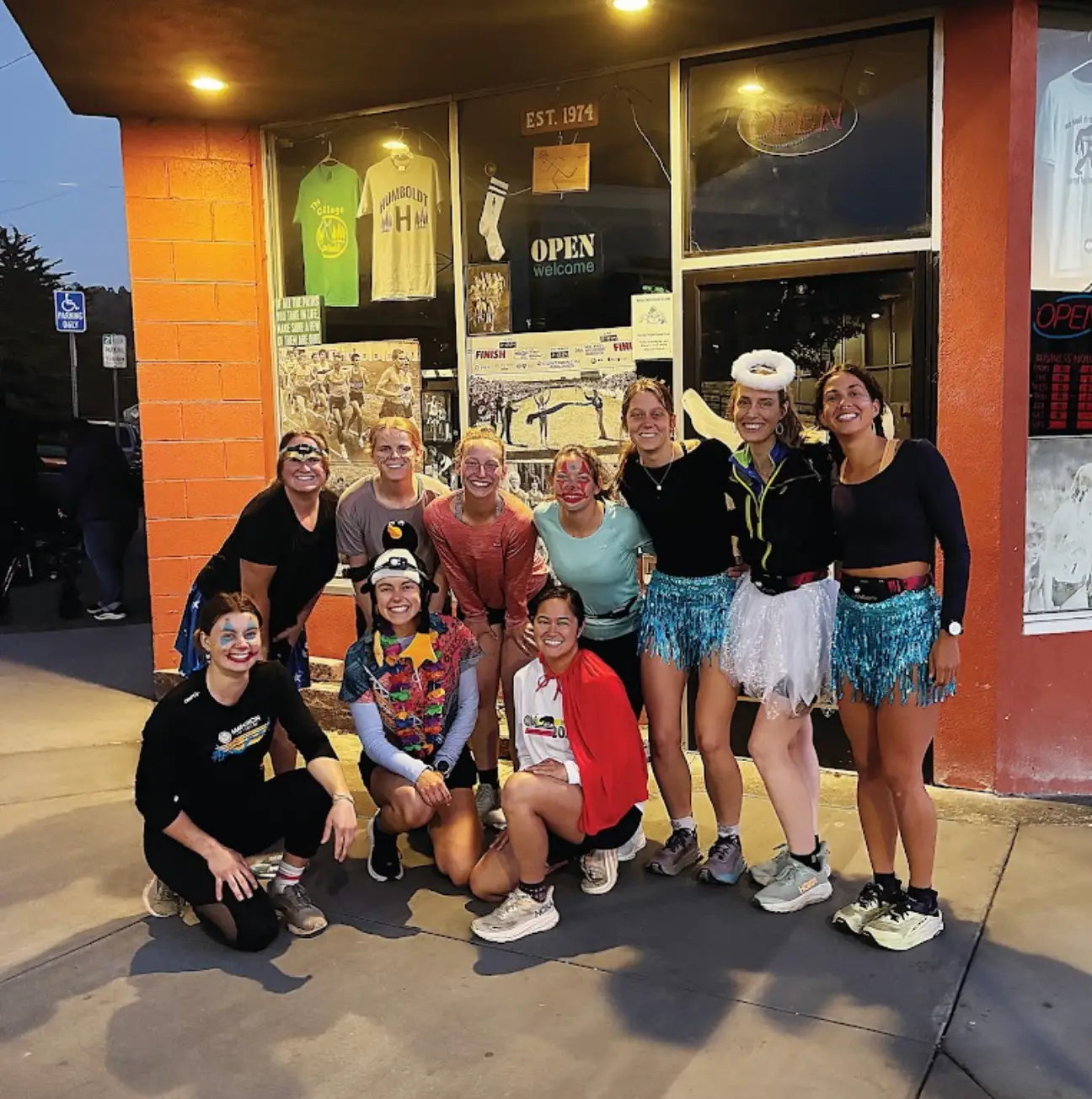
    At 6:30 p.m. every Wednesday, participants gather at Jogg’n Shop for the weekly Raccoon Run Club Ladies’ Night. Gradually, runners arrive, greeting each other and catching up before the run. Olivia Black, one of the founders of Ladies’ Night, welcomes everyone and begins leading the group towards the Arcata Community Forest to complete a five-mile loop.

    The Raccoon Run Club was started in Arcata by two locals, Thomas and Wes, who wanted a space for younger runners to get together in a fun yet casual environment. After a few months of the 6:30 p.m. Monday runs, Black and her friend Lily decided to come together and start a second session with a ladies’ night on Wednesdays.

    “It’s super chill, there’s never pressure to run a certain pace, look a certain way — anything like that,” Black said. “Most of the time people show up in Hawaiian shirts and it’s just silly and it’s just fun.”

    Moving from West Virginia to Humboldt for work, she continued to build and find her own community through running.

    Beyond being friendly to all running levels, many runners at the club come from different backgrounds, experiences and abilities.

    “We all come from a different sports background or lack sports background,” Black said.  “But we’re all out here doing the same thing every night, having fun together.”

    Runners often introduce each other to different sports, such as surfing or biking. Not only have they shared interests with each other, but they have also created a space of support and strength for one another.

    Dana Merrill grew up in Humboldt and began attending Ladies’ Night six months postpartum with her second child, eventually running an ultramarathon a year after joining the group.

    “Running is super social. And I think people think of it as, ‘Oh, I, like, have to grind on the treadmill,’ or ‘you’re always miserable.’ And, starting, running is not easy.” Merril said. “I wouldn’t sugarcoat that, but once you’re in it, so many runners just want people to run with. They don’t care about your pace.”

    This run club not only inspires those who join, but provides a social scene. For some, running is a solo personal journey.

    Sol Fernandez kept running after spending just a year on the Cal Poly Humboldt cross country team during COVID before leaving, but she found herself missing that social side

    “It allowed me to fall in love with running. For a personal love for it, versus I have to be at practice after school every day. Like the way it was before,” Fernandez said. “It just allowed me to actually find peace in running rather than punishment.”

    Whether someone is new to running or a seasoned athlete, the Raccoon Run Club Ladies’ Night offers an inclusive and supportive space for community, personal growth and fun. The group demonstrates that running can be about connection, encouragement and enjoyment — making it more than just a workout.

    Keziah is the science editor with an interest in crime & justice and politics

  • Lumbersnack – Barbecue Mushroom Sandwich

    Lumbersnack – Barbecue Mushroom Sandwich

    By Winter Music

    Autumn brings the start of mushroom season. Whether you’re buying them from the store or foraging in the woods — it’s a great time to learn how to cook these weird, meaty, not-a-vegetable, not-a-fruit gifts from the ground.

    This is a simple method you can use to cook almost any edible mushroom that’s fast, delicious, affordable and filling.

    I created this recipe when I needed a filling vegetarian meal to eat while my friends ate meat at barbecues. Since then — through trial and error — with little more equipment than a knife and a frying pan, this has become a staple of college survival for me. I can throw it together in 20 minutes, it’s cheap and mushrooms are high in protein, which I’m usually trying to get more of as a vegetarian.

    Ingredients:

    • 4-6 small mushrooms — I use baby portobellos
    • 2 Tbsp butter
    • 1/4 of an onion
    • 2-3 Tbsp barbecue sauce
    • 2 slices of bread
    • 4 tsp mayonnaise
    • 1-2 slices cheese of your choice — optional

    Step 1:

    Start by cutting your mushrooms and onions into 1/4 inch-thick slices, then put the mushrooms directly into your cold pan and spread evenly.

    Step 2:

    Heat on medium-low, beginning to stir when the mushrooms start to sizzle. Cook for a total of 7 minutes or until the mushrooms become flexible, aromatic and have expelled most of their juice — this method is called a dry fry, and will improve the texture of your mushrooms.

    Step 3:

    Add your butter and onions, then cook until the onions become translucent.

    Step 4:

    Add barbecue sauce and cut the heat, mix well and let rest on the stove while putting mayo on each slice of bread — toasting bread is optional.

    Step 5:

    Transfer the contents of the pan onto one slice, then layer on cheese and the second piece of bread.

    Step 6:

    Enjoy!

    Winter Music is a junior English major and copy editor for the Lumberjack. You can reach her at wlm38@humboldt.edu.

  • Don’t touch the bats, they bite

    Don’t touch the bats, they bite

    By Sadie Shields

    On Sept. 23 around 7 p.m., Avi Kaplan, a junior botany student, stumbled upon quite a strange sight. Four freshmen gathered around a bat that was crawling its way across the library circle roads.

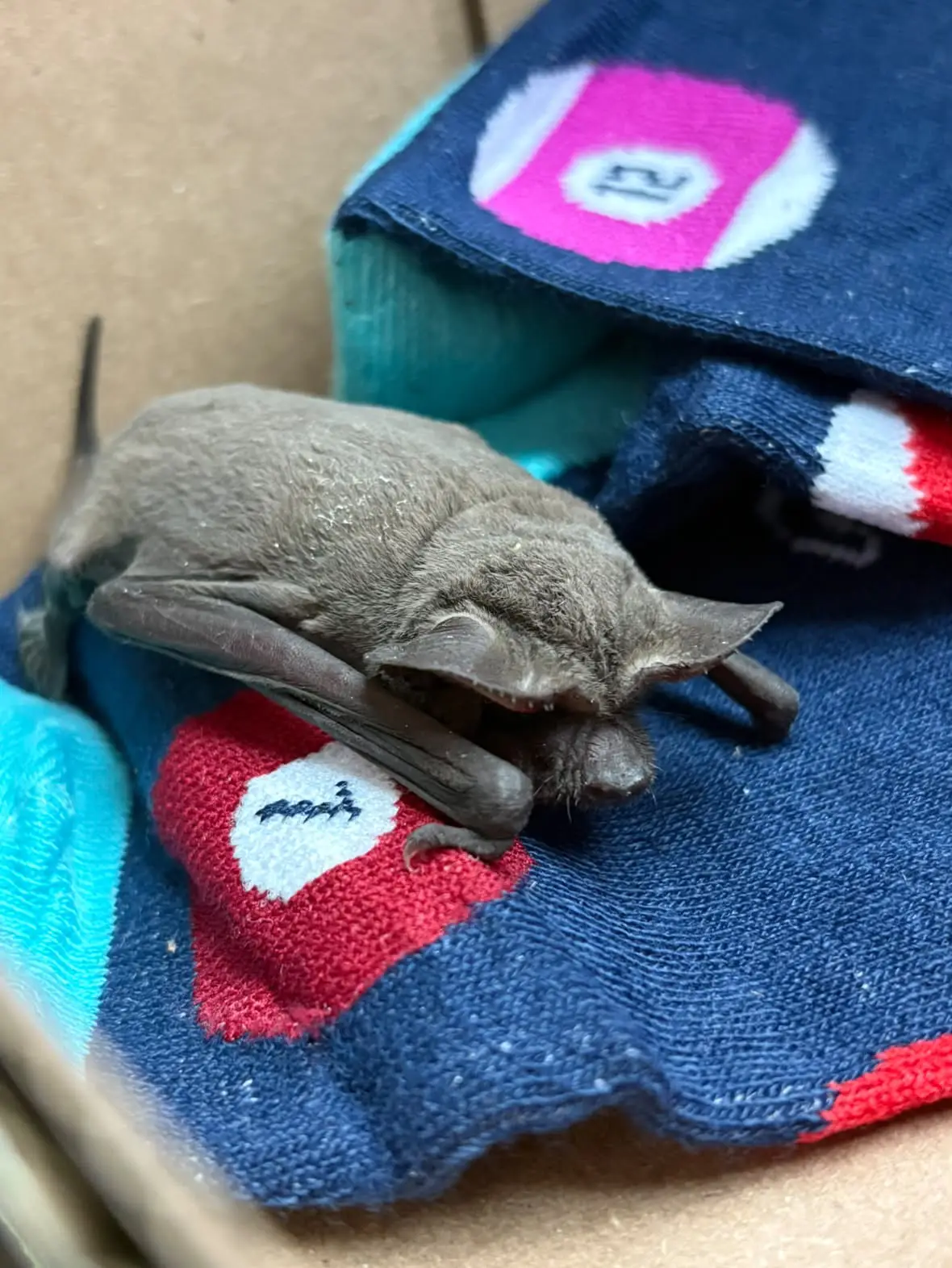
    “I scooped it up with a sock and used it like a hammock so it couldn’t bite me,” Kaplan said. “I moved it off the road near the tree, but figured someone might come and pick it up so it would be better to bring it to the wildlife sanctuary.”

    This bat — which turned out to be a Mexican free-tailed bat, a medium-sized bat that tends to travel in large colonies — was solo, crawling on the floor. It was quite an uncommon sighting. It turned out that the bat Kaplan was carefully taking care of was carrying rabies, an almost always fatal disease to humans carried by wildlife.

    “Finding out the bat had rabies really freaked me out for a bit,” Kaplan said. “But because California doesn’t want a rabies epidemic, they completely cover all costs related to treating the disease, so I wasn’t too worried,”

    According to Monica Sheffer, an assistant professor of Entomology, bat bites are easy to miss.

    “If you come into contact with bats, it’s better to get treated for rabies than not,” Sheffer said. “Even though the likelihood of that particular bat biting you and having rabies is very low.”

    One of the main culprits behind their danger is their teeth, with their body being only 3.5 to 4.5 inches long, Mexican free-tailed bats’ teeth are in the millimeters.

    “Their teeth are very small,” Sheffer said. “So you might not know that you were bitten.

    In terms of safety, what Kaplan did is not recommended.

    If a bat infected with rabies were to bite you, once the bite reaches the central nervous system, it has a 100% fatality rate according to the World Health Organization.

    According to Dr. Joseph Szewczak, a professor at Cal Poly Humboldt,  mammals present one of two forms of end-stage infection of rabies, which is either furious or dumb. Usually bats present with dumb rabies in which they become weak and lethargic. They will become too weak to fly and if away from their roost they end up on the ground. Only about 10% of bats found on the ground test positive for rabies. If people find a grounded bat it will most often appear docile and in need of help and this has led to human exposure when they attempt to pick up the bat to help it. A bat in such a situation will bite in defense of what they likely interpret as a predator.

    Silvia Pava, an assistant professor in the Biological Sciences Department, noticed many red flags just in terms of the location of the bat.

    “I would not handle a bat, you’re not supposed to handle bats. If you see one, especially on the sidewalk, that is per se already a red flag that the bat is probably not fine,” Pava said. “I would not handle bats at all. If you see a bat that is just hanging out in some really accessible area, I would think that the bat may be sick.”

    “That’s the first advice, keep the distance,” Pava said. “If you keep the distance, you’re going to be fine.”

    If you are to find a bat, or any other animal walking around campus exhibiting highly unusual behavior, it’s best to leave it alone and stay as far away as possible.

    Feel free to call 911 or call the Humboldt County Sheriff’s Department Environmental Health Division at (707)-445-6215.

    Sadie is a reporter with an interest in covering and taking photos for sports and science. Reach her at sls331@humboldt.edu.