Humboldt State student newspaper wins four first place California College Media Association awards
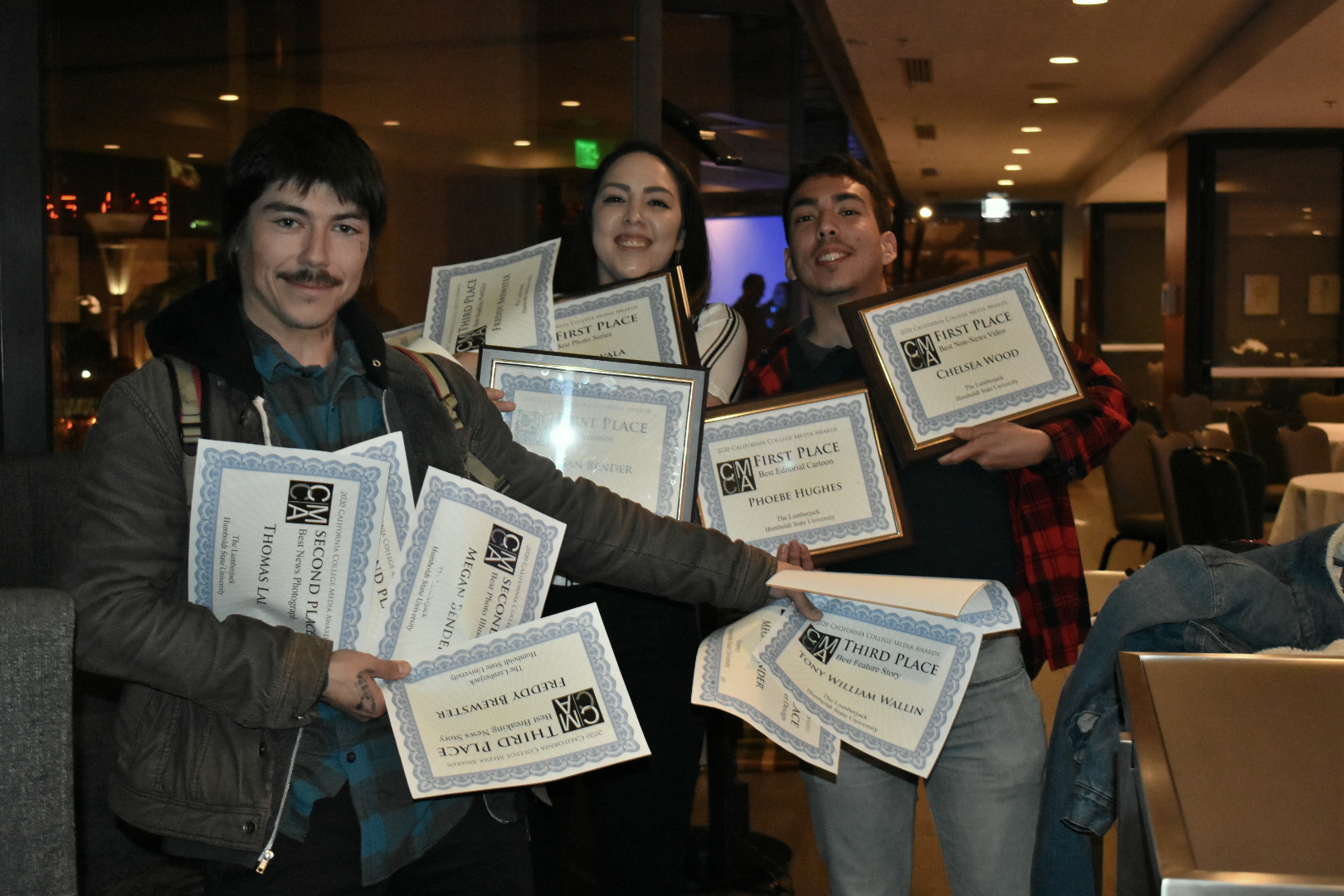
The Lumberjack won 14 California College Media Association Excellence in Student Media awards for a variety of work in 2019. The Lumberjack took home four first place awards, seven second place awards and three third place awards at the CCMA awards banquet Feb. 29 in San Francisco.
Vanessa Flores (top left), Tony Wallin (bottom left) and Jose Herrera look through awards won by HSU journalism students at the California College Media Association Excellence in Student Media awards banquet Feb. 29 in San Francisco. | Photo by Megan Bender
Hold PG&E accountable for its reckless and unprofessional behavior
During the most recent Public Safety Power Shutoffs, the Pacific Gas & Electric Company’s communication with its customers was awful.
The first time the utility shutoff power in Humboldt County was on Oct. 9. The county had less than 12 hours of notice for residents to prepare for a possible four-day outage. Humboldt was the only county in California to lose all power and initially wasn’t even on the list of affected counties.
After the outage, Michael Lewis, PG&E’s senior vice president of electric operations, said that Humboldt County shouldn’t have lost power in the first place. Although extreme weather and fire risk were at play in other counties’ outages, Humboldt went dark because of scheduled maintenance on one of the transmission lines coming into the county.
On Saturday, Oct. 26, reports from PG&E said only about 2,000 customers in Humboldt would be affected. Several hours later, PG&E corrected itself and acknowledged that all Humboldt residents would be hit with the outage.
During the most recent PSPS, the utility released news that another outage would likely hit Humboldt early Tuesday morning. Additional updates said that while many residents would regain power, it was possible that residents still without it may continue to be in the dark through to Tuesday’s outage.
When Tuesday morning came and went, locals wondered when the outage would hit. Those who regained power the day previous still had it, and conflicting reports from PG&E, the Redwood Coast Energy Authority and the Humboldt County Office of Emergency Services led to mass uncertainty about when –and if– the power would go out again.
For those PG&E customers who tuned in to one of the company’s many streamed press conferences, they were forced to wade through jargon including “operational event,” “incident commander,” and the terribly-named “Public Safety Power Shutoffs.”
Late Monday night, the Redwood Coast Energy Authority posted on Facebook that PG&E said that power in Northern Humboldt wouldn’t go out until 9 p.m. That same night, OES made its own Facebook post stating that PG&E said power was still planned to go out early in the morning.
On Tuesday morning, OES continued to stand by what it had learned from PG&E.
PG&E’s own updates from Tuesday morning listed the outage time for Northern Humboldt as 9 p.m., and as the day went on, that seemed to be likely.
Humboldt State University had no better idea of when the power would go out, as it noted in its update on Tuesday morning.
“HSU is seeking clarity from PG&E regarding the timing of a possible power shutdown,” HSU’s update said. “There has been conflicting information from the company, and in local news reports, over the last 24 hours.”
PG&E later updated its estimated timing to 7 p.m., and then, around 5 p.m., it called off any PSPS for Humboldt at all. On Facebook, OES said PG&E had given it inaccurate information.
“PG&E has provided the Humboldt County Office of Emergency Services (OES) inaccurate information regarding times of de-energization in our County,” OES said.
Communication is everything. PG&E changing times of planned outages makes sense, especially since the outages are primarily based around weather patterns. But failing to provide accurate information to emergency services and county officials is ludicrous. The company’s communication strategies are unacceptable.
As a community and state we need to hold PG&E accountable and remove ourselves from its firm corporate grip. These blackouts should be the push California needs to turn toward alternative energy and municipal utility boards, ridding the state of monopolized power once and for all.
For the second outage to affect Humboldt in less than a month, students and staff were better prepared for the darkness and the subsequent time off
After Humboldt County’s first Public Safety Power Shutoff, students and staff at Humboldt State University were better prepared when the latest outage hit the county the night of Saturday, Oct. 26.
Marine biology sophomore Tyler Nagle spent his Sunday at a beach in Trinidad with friends.
“I went to the beach, got a campfire going, roasted some s’mores and looked at the stars,” Nagle said.
While Nagle said he’s learned how to prepare for these outages, he did have concerns about the outages’ impact on classes.
“I definitely think this has taken a hit on my learning,” Nagle said. “But I hope these will be more few and far in between.”
Vice President for Administration and Finance and HSU Emergency Operations Center Director Douglas Dawes said it’s too early to make any calls about how the outages will affect the semester’s class schedule, but he said HSU will be in touch with its academic accreditor.
Otherwise, Dawes said he’s proud of the way the campus has handled the outages.
“There have been some hiccups, but we’re getting through it,” Dawes said.
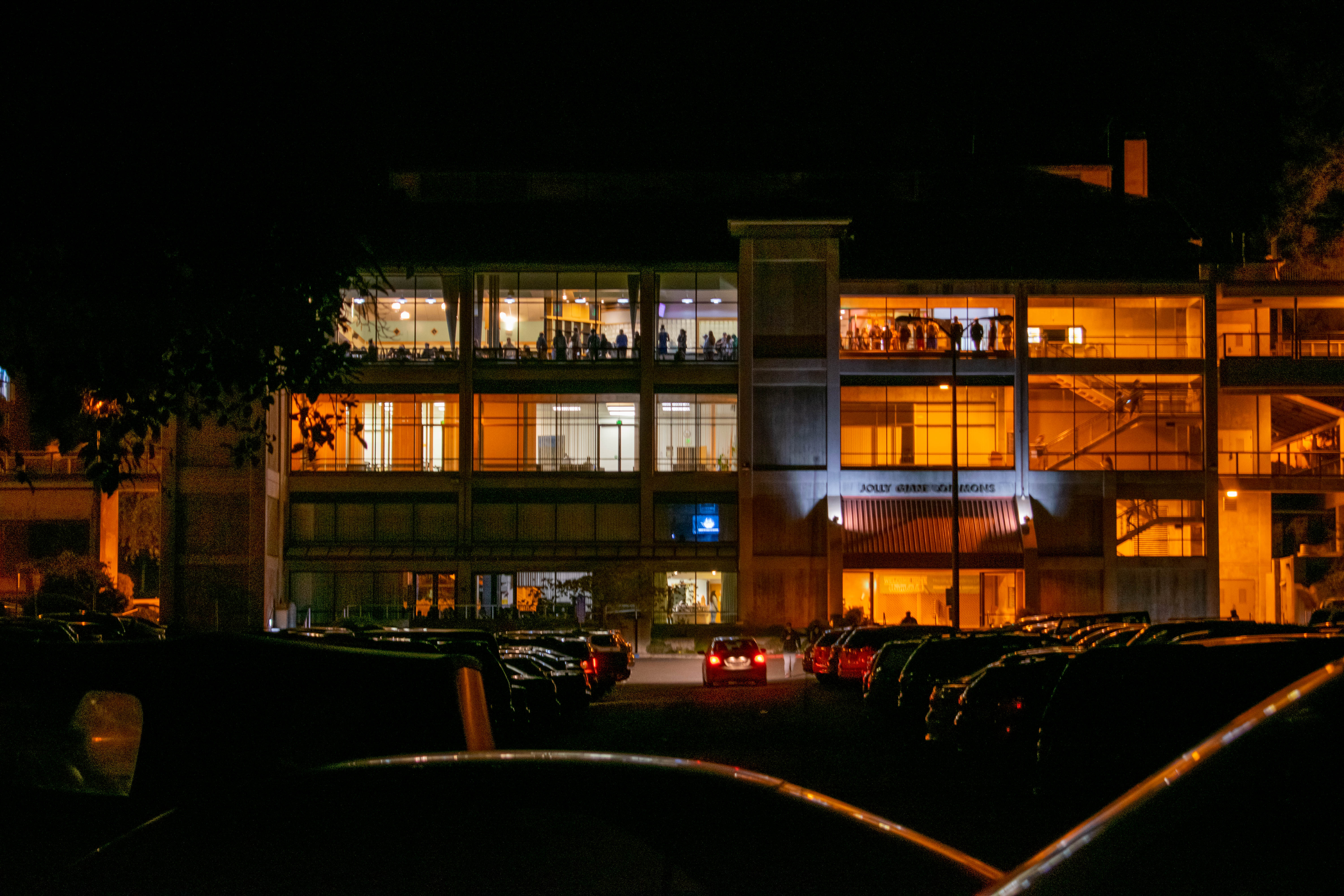
Dawes said one generator failed over the weekend, but Facilities Management quickly moved around generators to keep providing power to the most essential buildings on campus including the Jolly Giant Commons, Student Recreations Center and residence halls.
“They’ve been champions,” Dawes said. “Our facilities team has been keeping everything together.”
Daniel Valencia, a sophomore kinesiology major, normally works at The Depot. During the outage, Valencia helped out at The J. When not working, Valencia said he enjoyed his hobbies.
“I picked up skating more,” Valencia said. “And I’ve been looking into hobbies like reading and painting.”
Zane Eddy, a master’s student in the environmental science and management program, came from an undergraduate program at the University of Oregon. Eddy said he was surprised by the outages.
“It’s really odd having these power outages,” Eddy said.
Eddy spent his free time going to Clam Beach and picking chanterelle mushrooms. Eddy said he believes the outages will make people understand their dependence on others for power.
“We’re part of a larger system and we’re part of a larger environment,” Eddy said.
While preparing for the outages on Friday, Interim Vice President of Enrollment Management Jason Meriwether echoed Dawes and said he was proud of how HSU handled the first outage.
“That was a positive thing that we responded to the power outage in that way,” Meriwether said. “Now, in my opinion, that’s how it should always be and that’s how it will be. But I think students were happy to know we took that approach.”
Dawes said HSU served 4,400 meals on Sunday. While he admitted that HSU incurred some significant costs in diesel and food, he said a percentage of those costs can be covered by disaster funds.
On Tuesday, HSU uploaded a response page for students wondering why classes are cancelled during the outage. The page noted concerns over safety, non-functioning technology and a focus on personal wellbeing. The page also explained why it takes time to reopen campus even once power is restored.
“It takes a great deal of time to safely re-open the campus, including powering down and disconnecting generators, resetting locks, and ensuring fire suppression systems are working,” HSU’s post said.
As of Tuesday afternoon, HSU classes are set to resume on Thursday, Oct. 31.
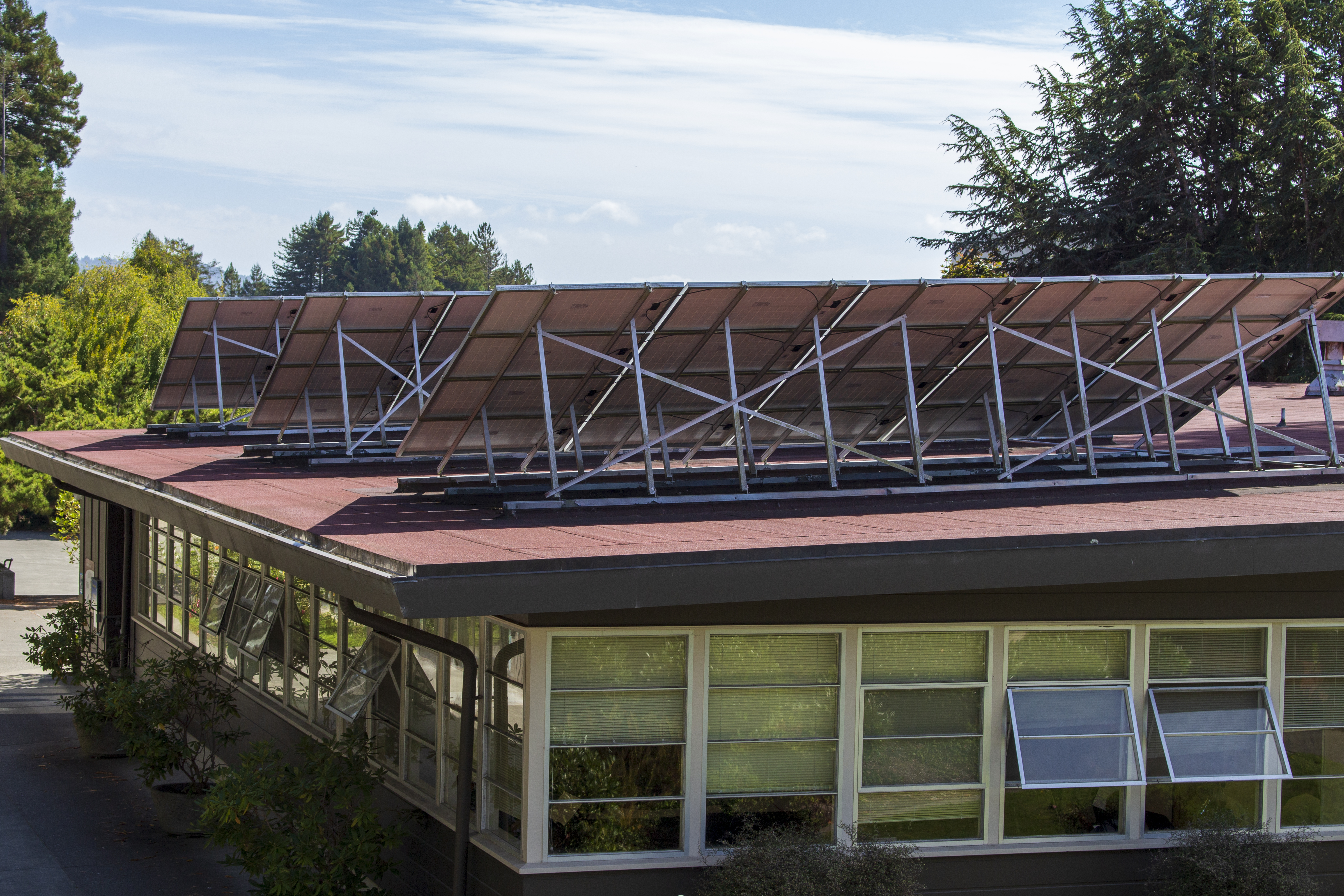
In the future, Dawes said HSU will likely look toward generating more of its own power.
“Having more generation for the campus would be a huge help,” Dawes said. “So we’ll be looking into doing that.”
For now, Dawes wanted to thank staff, faculty and students for restoring his faith and hope in humanity.
“We’ve got really good students that want to provide for others,” Dawes said. “And staff that really care about providing for students as well.”
With the recent Public Safety Power Shutoffs, blackouts may be a big push toward renewable energy
Public Safety Power Shutoff, blackouts could aid the push toward renewable energy. Solar micro-grids, local offshore wind farms or more well maintained power lines could be the answer to back-to-back outages.
Pacific Gas and Electric Company’s PSPS events are triggered by environmental conditions that threaten parts of their power grid. For example, a third consecutive power shutoff was originally scheduled for Tuesday morning, but changing weather patterns pushed back the timing. On Tuesday at 5:22 p.m. the county was removed from the PSPS affected counties list.
PG&E’s PSPS events are triggered by environmental conditions that threaten parts of their power grid.
“Due to diminished weather conditions, Humboldt County is no longer in the scope for a Public Safety Power Shutoff tonight and power will remain on,” said Humboldt OES in an email alert. “There are still communities without power but PG&E advises they hope to have those areas re-energized tonight.”
The nature of the power grid in Northern California renders Arcata and Eureka subject to power outages if other areas of the grid are at risk. The energy used in Northern Humboldt is imported through transmission lines to the Eureka Humboldt Bay Generating Plant, where it’s amplified for local use. If energy stops flowing through the lines to Humboldt, there is no source of energy and therefore, no electricity.
Terra-Gen, a Manhattan-based wind power company, has proposed a wind generation project for the Monument and Bear River Ridges that could provide nearly half of Humboldt’s energy. A panel discussion on the project will be held Nov. 6 at 5:30 p.m. in Founders Hall 118.
“Anticipated project features include a significant contribution to North Coast renewable energy generation and to California’s clean energy mandate,” the panel flyer says.
According to Terra-Gen, benefits of the project could include the creation of local green jobs and Humboldt Bay development. However, some local community members see the project as more consequential than not.
As California’s dry and windy seasons become the new normal, power shutoffs will likely become common occurrence.
The proposed area of development, Monument and Bear River Ridges, sit on Wiyot territory. According to the Wiyot Tribe and the California Department of Fish and Wildlife, the Monument and Bear River Ridges aren’t appropriate for wind development. The turbines could harm or destroy some of the rare and protected species that call the area home.
“Concerns raised include impacts on bat and bird deaths; tree removal; effects on sites with cultural and ecological significance to Native American Tribes; erosion and sedimentation from sub-river drilling and road expansion; visual impacts; light and noise pollution; and traffic congestion,” the flyer says.
The upcoming panel lists some of these concerns as additional talking points, but it is unclear if the company or the county have come to a conclusion on how to proceed with this particular option of alternative energy.
Alternatively, PG&E maintains that shutoffs are necessary to prevent dangerous wildfires like the Camp Fire of 2018. Any at-risk transmission line can be shut off. As California’s dry and windy seasons become the new normal, power shutoffs will likely become common occurrence. However, some individuals are taking advantage of the winds, rather than suffering from them.
Blue Lake Rancheria has tested local energy generation since 2011. The Rancheria has yet to be seriously impacted by the power shutoffs because they have solar electricity and battery storage, forming a microgrid.
Their microgrid works as a system of solar panels which power the Casino and other buildings during the day while also charging up a bank of Tesla batteries for the night. The grid can be connected or disconnected from PG&E’s grid as needed, making them sustainable without any power from the utility.
The primary barrier to building offshore wind turbines and micro grids or improving PG&E’s transmission lines is cost. Alternative energy projects cost significantly more upfront that traditional fossil fuels. The economic costs of the recent power shutoffs, however, may be enough to kickstart real conversations about alternatives.
Some areas of Humboldt County still don’t have power, however power will potentially be restored by tonight
UPDATE 10/29/19 5:25 p.m. : According to the Humboldt County Office of Emergency Services alerts, “PG&E has advised that Humboldt County is no longer in teh scope for a Public Safety Power Shutoff tonight and power will remain on.”
They also said at this time the National Weather Service does not see more weather patterns that would cause another PSPS event in the near future.
UPDATE 10/29/19 4:24 p.m. : PG&E has now stated Humboldt County will be affected by a third power outage on Oct. 29 at 7 p.m. rather than the previously reported 9 p.m.
UPDATE 10/2/19 10:00 p.m. : According to a PG&E press release Humboldt county is expected to lose power on Oct. 29 at 9 p.m. This is the most current information as of Oct. 28 at 10 p.m.
Pacific Gas and Electric Company announced in a press release they will shut power off for a third PSPS event scheduled for Oct. 29.
The utility said the next weather event responsible for the third PSPS may begin Tuesday at 6 a.m. According to the Humboldt Office of Emergency Services, power will likely be turned off before that time, although the exact time of the shutoff remains unclear.
The third PSPS event is expected to last until the afternoon of Wednesday, Oct. 30.
Power was restored at Humboldt State University mid-morning Monday, but the campus remains closed through the duration of Tuesday. There is no update for Wednesday classes as of 5:20 p.m.
PG&E has reported it could take up to 48 hours to assess the damage from the Oct. 26 PSPS, but said it is attempting to restore power to customers before the next shutoff. According to the utility company, it is possible not all customers will have their power restored before it goes off again.
Amidst the shutoff, the Student Recreation Center is open temporarily till midnight. HSU is inviting students, staff, faculty and their families to eat for free at the J until campus reopens. Parking permits are not required during the shutdown.
This story is ongoing and timing is subject to change due to changing weather patterns.
In spite of the successful campaign to phase out single-use water bottles, Humboldt State has yet to remove plastic bottled beverages from campus
Almost 10 years have come and gone since Humboldt State University took back the tap and did away with single-use water bottles on campus.
Overall HSU is known to lead the way in sustainability across the California State University system. In spite of being further ahead in the sustainability game than most campuses, HSU still offers a variety of beverages for sale packaged in single-use plastic.
HSU Dining Services Director Ron Rudebock said they have gotten a fair number of comments over the last couple of years regarding plastic products and on phasing out plastics completely.
“We have been working with vendors to obtain their products in a reusable or compostable or recyclable package and vendors are changing their package materials,” Rudebock said.
Four of the five campus responsibilities listed under the policy have set deadlines.
The first is the elimination of single-use plastic water bottles by Jan. 1, 2023. HSU met this requirement in 2011. The second is the elimination of plastic straws no later than Jan. 1, 2019. HSU eliminated plastic straws during the fall 2017 semester.
The third responsibility listed, also set for January of this year, was the elimination of single-use plastic carryout bags. HSU stopped using plastic bags back in March 2014. The fourth deadline, and last with a time requirement, was the elimination of single-use polystyrene (e.g. STYROFOAM™) food service items no later than Jan. 1, 2021. HSU eliminated Styrofoam to-go containers over 10 years ago and the campus is working to eliminate it in any pre-packaged items.
The final goal of replacing single-use plastic items with materials that are reusable, locally compostable and/or recyclable doesn’t list a specific deadline.
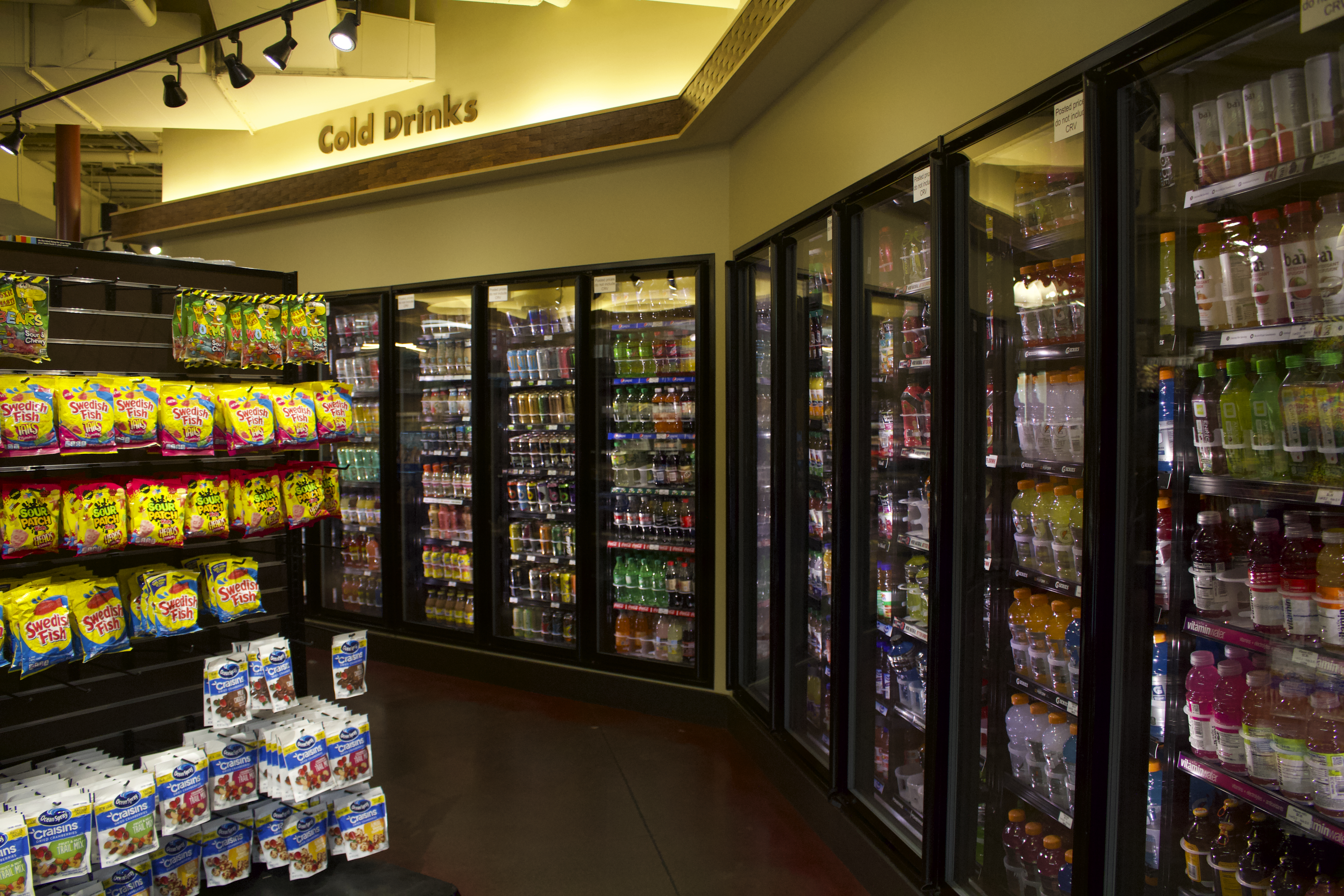
A variety of some of the single-use plastic bottled beverages offered. According to Rudebock, much of the decision to continue to sell single-use plastic drinks is because of consumer choice. | Photo by Megan Bender
Rudebock said this specific change is a challenge. The Depot, the College Creek Marketplace, the Cupboard and vending machines still offer plastic bottled beverages on campus.
“We would like to see a faster adaption but with this guideline having no deadline and with the current collapse in the recycling market I do not see this becoming feasible in the next year,” Rudebock said.
Dining services has made some efforts in providing more glass or aluminum options. The J, for example, has a beverage cooler that is all aluminum and glass, has eliminated single use plastic containers and has single-use packaging that is compostable or recyclable.
However, other locations haven’t been able to make the same change as effectively because of the demand for products that happen to also be in plastic bottles.
“We’ve been working with a lot of our vendors and pushing, trying to get more either glass or aluminum containers.” he said.
Rudebock said Dining Services also goes out of their way to order aluminum and glass alternatives whenever possible from specific companies and brands like Coke or Pepsi.
“It kind of comes down to consumer’s choice,” he said. “Consumers can help by purchasing products that are in reusable, compostable or recyclable packaging and not requesting products that are not in reusable, compostable or recyclable packaging.”
Students have pushed back against the university in the past, questioning its dedication to environmental responsibility over their business ties with PepsiCo.
As reported in the Lumberjack and the North Coast Journal, in 2017 HSU made efforts to meet student’s demands to closer align with its dedication to social, economic and environmental issues by re-evaluating a 40-year-long partnership with PepsiCo.
Under the contract PepsiCo funded HSU with around $58,000 worth of athletic scholarships in exchange for pouring rights. Pouring rights allowed PepsiCo to reserve 80% of HSU shelf space for their products.
Students also made the argument the set up was not fair to local businesses.
In spite of being in a budget deficit and the loss of scholarship funding, HSU did not renew the pouring rights contract and let it expire at the end of June 2017.
HSU was the first California public university and third national public university to phase out water bottles.
The University Center and Dining Services stepped into to help with some of the lost resources.
Rudebock said they managed to fund a majority of the lost scholarship money but leaves the decision of how the scholarships are dispersed up to the school. This way the UC and Dining Services are not directly funding athletics or any specific department.
The university still does business with PepsiCo but under different rebate-based agreements. Dining services also stopped carrying Aquafina water bottles, a brand owned by PepsiCo as a result of the nationally recognized Take Back the Tap campaign.
Under the Waste Reduction & Resource Awareness Program, students began efforts to Take Back the Tap at HSU starting in 2009. The student lead group and Dining Services worked to phase out the sale of single-use water bottles in 2011 as is the primary focus of the campaign.
As a result, HSU became the first California public university and third national public university to phase out water bottles. Dining Services initially explored an alternative by offering boxed water.
“At first we thought they were upset with the plastic water bottles, but they said ‘No no, just the water,’” Rudebock said. “It was more about the idea of selling packaged water.”
Before HSU removed water bottles on campus, TBTT calculated that HSU’s annual bottled water demand “required approximately 43 barrels of oil per academic year” and in turn was “releasing 35,000 pounds of carbon dioxide into the atmosphere.”
HSU now owns two Hydration Stations and has 16 water fill stations on campus.
Environmental Science & Management Professor James Graham and his geospatial students created an interactive map of HSU that includes where to find water fill stations on-campus as well as other resources.
The locations of all water stations on HSU’s campus according to the Sustainability project. These locations include the two Hydration Stations.
Sustainability Director Morgan King said Facilities Management worked with students help create the map.
“We worked with [Graham’s] students to develop layers for sustainability attributes,” King said. “Including water filling station locations, bike parking locations, recycling and compost bin locations.”
Anyone can access the map by visiting HSU’s sustainability website. The map key is listed in a drop down menu that offers different types of resources on campus. Under the sustainability option, users can check the box of the information they’re looking for.
Rudebock said Dining Services remains attentive to the needs of the students and the possibility of selling less plastic-bottled products.
“Every journey begins with a step,” Rudebock said. “The less plastic containers that students buy helps change the need for that product.”
The California State University system’s single-use plastic policy passed in December 2018 includes four policy changes that have deadlines, but the fifth and final goal of the policy doesn’t list a deadline.
Eliminate single-use plastic water bottles by January 1, 2023. HSU has already met this requirement as of 2011.
Eliminate plastic straws no later than January 1, 2019. HSU eliminated plastic straws during the fall 2017 semester.
Eliminate single-use plastic carryout bags no later than January 1, 2019. HSU eliminated plastic bags in March 2014.
Eliminate single-use polystyrene (e.g. STYROFOAM™) food service items no later than January 1, 2021. HSU eliminated Styrofoam to-go containers over 10 years ago and are working to eliminate it in any pre-packaged item
Replace single-use plastic items with materials that are reusable, locally compostable and/or recyclable.
To find out more about HSU’s Zero-Waste Initiatives, WRRAP and TBTT visit the WRRAP homepage.
Administration rehires union protected station broadcast engineer
Humboldt State University has rescinded the lay off of one KHSU employee out of the seven laid off in April.
Kevin Sanders, a full-time employee who primarily works in Information Technology Services was rehired after his union, the California State University Employees Union, pushed back against the university. Sanders was and is the National Public Radio affiliate’s only broadcast engineer.
“Kevin is employed, working mostly in the Information Technology Services area, but is available to assist with broadcast engineering for KHSU if the need arises,” HSU Communication Officer Grant Scott-Goforth said in an email.
[perfectpullquote align=”right” bordertop=”false” cite=”Steve Tillinghast” link=”” color=”” class=”” size=”18″]”Humboldt realized over the last several months that the chief engineer of KHSU is a critical employee and that the station could not operate, even in its reduced form, without him.”[/perfectpullquote]
Humboldt chapter president of CSUEU Steve Tillinghast said in a press release that HSU management did not expect the Union to care.
“Or perhaps they did not even realize that one of the employees in the group they terminated was part of a Union and that they would be held accountable,” he said. “Humboldt realized over the last several months that the chief engineer of KHSU is a critical employee and that the station could not operate, even in its reduced form, without him.”
KHSU runs with the help of Chico’s North State Public Radio station to air its programming off and on since April.
At the beginning of August HSU signed a short-term interim agreement with Capital Public Radio in Sacramento for programming assistance with KHSU Public Radio. The agreement will keep KHSU running till the end of October.
According to a press release, “the agreement allows KHSU to continue airing national and state programming as the University considers various approaches for KHSU’s future.”
HSU will be assessing ways to ensure KHSU aligns with the university’s teaching missions after an advisory audit report. The audit report, ordered by the previous HSU president Lisa Rossbacher, found the station lacking in the opportunities it was supposed to provide for students.
The report suggested that over time the station had evolved from an exclusive student training ground to primarily a community servicing station. The report said the university should assess student involvement at KHSU and determine whether or not to develop more opportunities for students through “employment, internships, academic programs and coursework.”
The advisory team did not, however, suggest laying off employees as an answer to any suggested shortcomings.
For now, the university is considering joining the discussion of a three-way regional partnership with the Chico and Sacramento stations.
This partnership could bring about certain opportunities such as a Public Service Operation Agreement, which would formalize cost-sharing for programming and management.
Structural organization was also an area of improvement listed on the KHSU audit.
HSU President Tom Jackson wants to gather input from faculty and students to learn more about their interest in KHSU before committing to anything further.
This website uses cookies to improve your experience. We'll assume you're ok with this, but you can opt-out if you wish. Cookie settingsACCEPT
Privacy & Cookies Policy
Privacy Overview
This website uses cookies to improve your experience while you navigate through the website. Out of these cookies, the cookies that are categorized as necessary are stored on your browser as they are essential for the working of basic functionalities of the website. We also use third-party cookies that help us analyze and understand how you use this website. These cookies will be stored in your browser only with your consent. You also have the option to opt-out of these cookies. But opting out of some of these cookies may have an effect on your browsing experience.
Necessary cookies are absolutely essential for the website to function properly. This category only includes cookies that ensures basic functionalities and security features of the website. These cookies do not store any personal information.
Any cookies that may not be particularly necessary for the website to function and is used specifically to collect user personal data via analytics, ads, other embedded contents are termed as non-necessary cookies. It is mandatory to procure user consent prior to running these cookies on your website.