The Lumberjack


Students Serving The Cal Poly Humboldt Campus and Community Since 1929

Tag: Mental Health

  • Depressing Dishes: recipes for when you’re feeling down

    By Alexandra Berrocal

    I normally don’t like spinach because people typically serve it raw. Many people don’t like “creamed” spinach either. Try this recipe. It isn’t raw, or creamed. It is simple to make. It is also very nutritious because it includes soybean paste, which adds nutrients. According to a research paper called Effects of Doenjang, traditional Korean Soybean paste has anti-obesity, anti-diabetic, anti-cancer, and anti-inflammatory properties. Garlic is also known as a natural antibiotic. The blanching in the cooking process also leaves most of the nutrients intact, unlike the boiling process in other recipes. 

    Depressed people often don’t feel up to doing anything fun. It was my goal in publishing “I am the darkness”, my recent cookbook, to let people know they aren’t alone in their depression. And, if they want to cook a recipe along the way, well, that’s great too!  The tofu recipe is also easy to multiply in case you want to serve it to others. The tofu recipe, on the other hand, is a simple, tasty way to prepare tofu. Usually tofu is a bit bland, but the sauce counters this. It is a good way to add more protein to your diet. You can combine the spinach and the tofu into a simple meal, if you like.

    SOY SPINACH

    1 bunch spinach (or other greens)

    Salt

    1 tablespoon soybean paste

    1 minced clove garlic

    1 tablespoon sesame oil

    Toasted sesame seeds

    Wash spinach and remove dead leaves and roots. Blanch spinach for about 20 seconds in boiling water. Cool with cold running water. Gently squeeze to get out as much excess water as possible. Add soybean paste, garlic, and sesame oil. Mix it all by hand. Sprinkle some sesame seeds on top as garnish.

    PAN FRIED TOFU

    1 package medium firm tofu

    1 tablespoon avocado oil

    1 green onion

    4 teaspoons soy sauce

    2 teaspoons rice vinegar

    1 teaspoon sesame seeds

    1 teaspoon sugar

    Blot the tofu with paper towels. Cut the tofu block in half, then into slices.  Grease the pan with the oil. Place the tofu in the pan without overlapping or touching. Put the lid on the pan and cook for three minutes on high heat, or until crispy and golden brown on one side. Repeat on the other side.

    Thinly slice green onion, and combine all other ingredients in a bowl for the sauce. Enjoy!

  • From the psych ward to the newsroom

    From the psych ward to the newsroom

    By Savana Robinson

    March 8, 2023, I was released from a psychiatric facility with two diagnoses: schizophrenia and bipolar I. A year later, I’m doing better than ever. I’ve got a nice job as a multimedia journalist, I’m close to graduating, and I have a great group of people who care about me. Getting here wasn’t easy – I had to reconstruct myself as a person. It took a lot of support, therapy, and medication, but I did it.

    I went back to the fundamentals of me. I left Humboldt and moved back into my childhood bedroom in Redwood Valley. The pink walls with pastel butterflies and flowers, my rock collection, and my numerous stuffed animals helped gently bring me back to where I needed to be.

    The first few weeks of being back in the world were scary. I wasn’t in psychosis anymore, but the paranoia and hallucinations of onset schizophrenia were still present. I had been started on medication for it a few days before I was released, but it still took some time and help to be manageable. I’ve been in therapy since the day I got out of the facility, which has helped tremendously. Of course, I chopped off my hair. Some people believe that hair holds on to memories, so I got a bob. I loved it for a while, but I eventually mourned my long hair. 

    Per my routine-abiding father’s suggestions, I started by waking up early, making my bed, walking the dogs, and making breakfast. I took it one day at a time and eventually, I was thriving. I had to drop advanced photojournalism, and I couldn’t use the school’s camera anymore, but I love taking photos, so I bought my own. 

    Photography is another form of therapy for me. It’s relaxing and lets me express my creativity. I got a job doing photography and blog writing at a mini golf course in Ukiah. I continued with a few of my classes from home, doing online work when I wasn’t taking pictures. I finished out the semester and by the summer, I felt that my medications had leveled out enough to feel “normal.” I didn’t feel like I was moving through jello anymore.

    Halfway through the summer, I decided that I wanted to go back to Humboldt, despite my parents’ protest. I found out my friend had a vacant room, so I moved back to Arcata and went back to school in person. I was a bit nervous, but I was confident that I would be fine. I worked on The Lumberjack and continued to take photos. I started doing sports photography and made some money doing it. I even did my first wedding photography gig. In January, I got my job at Redwood News. I’m just getting started in my career, but I’m optimistic for the future.

    After being released from the psychiatric facility, I had no idea where I’d be in a year. I was hopeful that I’d be somewhat successful, but I didn’t expect to be working as a professional journalist. If I had to do my year of healing all over again, I’d do it the same, because I’m very happy with how I turned out.

  • How to interact with a service dog – don’t.

    How to interact with a service dog – don’t.

    By Griffin Mancuso

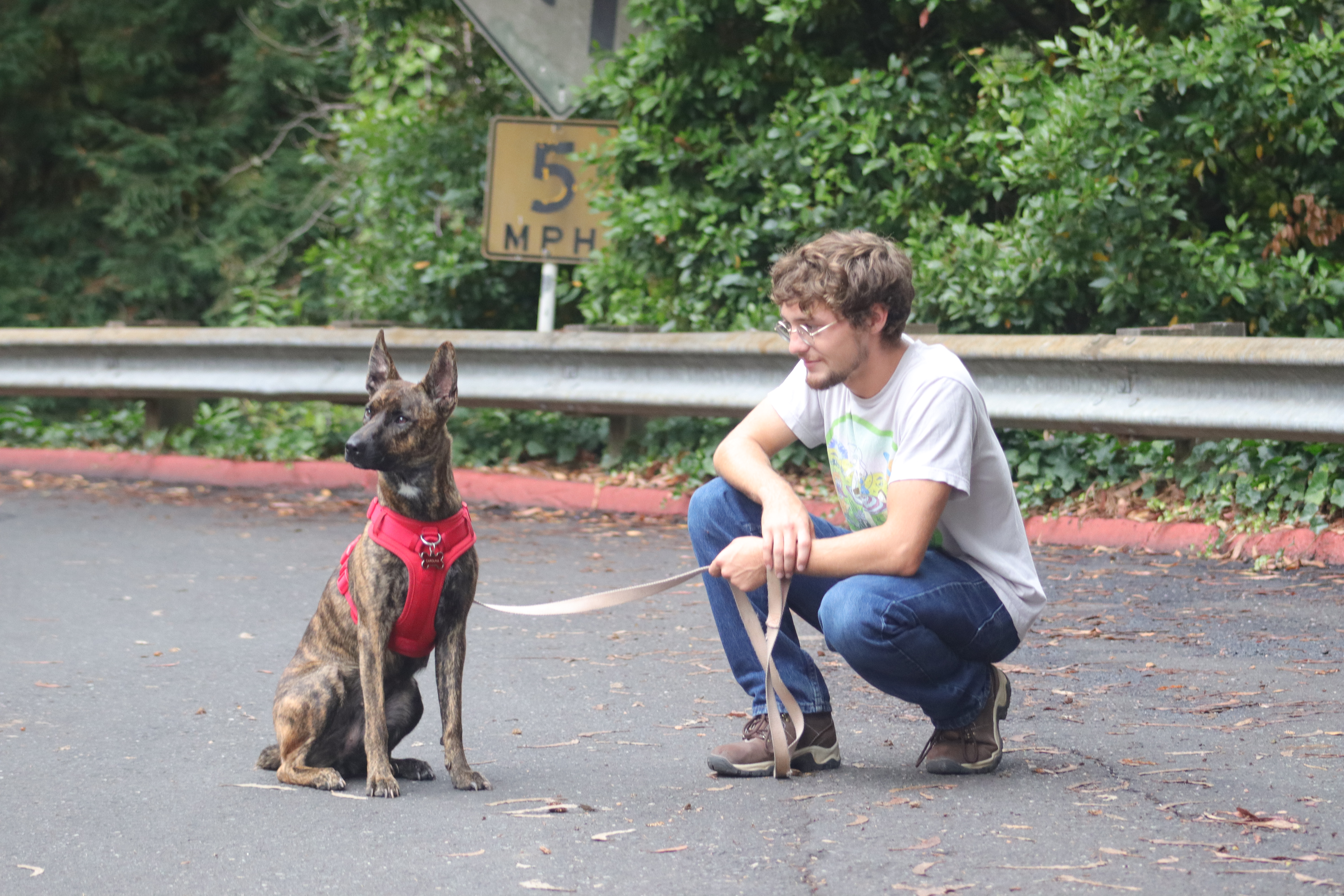
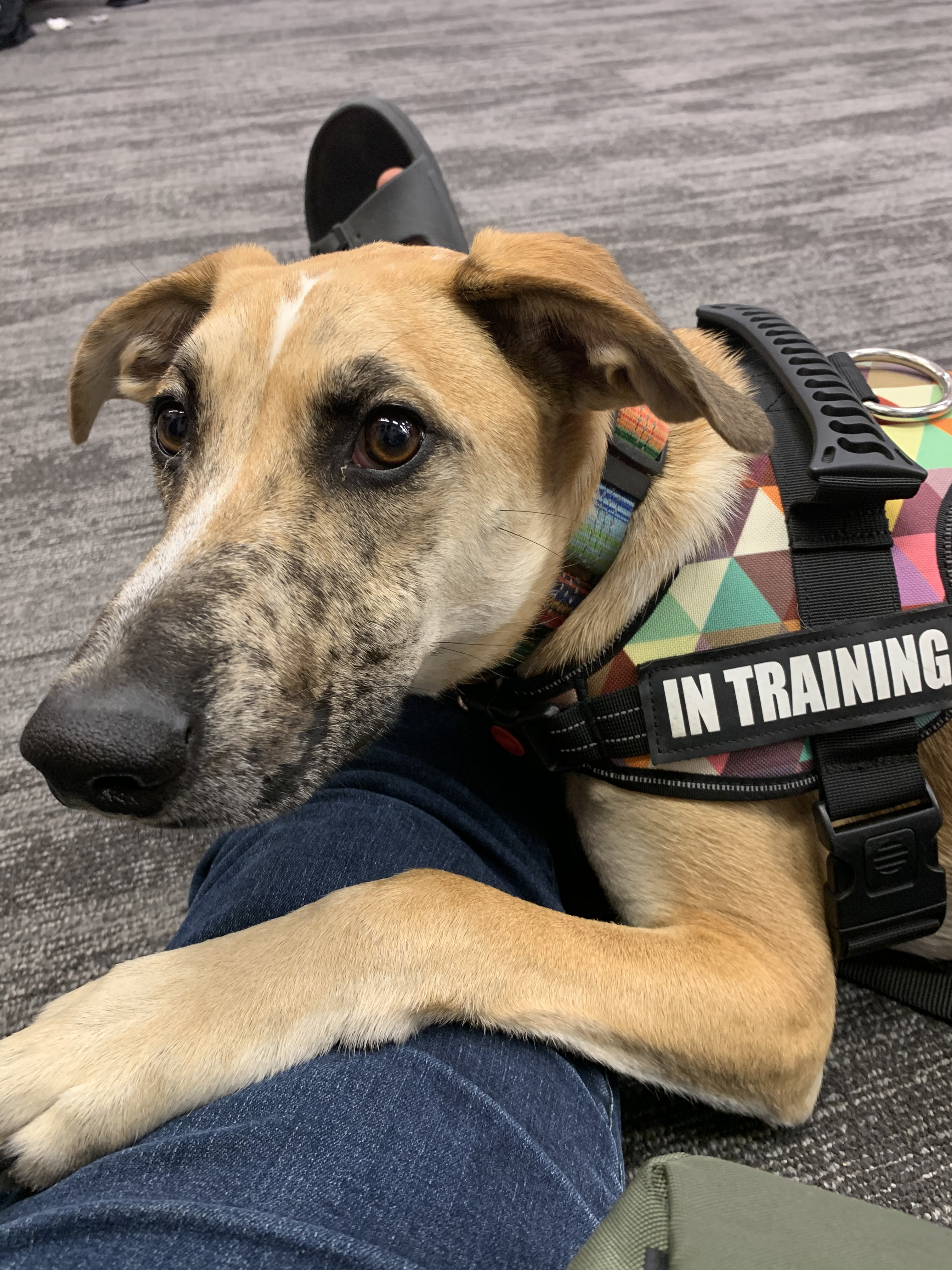
    On my second day of public access with my service dog in training, I braved the crowded hallways of The Depot in search of brunch. After paying for my food, I found a booth and used the opportunity to practice deep pressure therapy with my service dog, which is his favorite task because it involves him laying on my legs and getting a bunch of treats. The pressure helps decrease my heartrate, and thus, lowers the constant buzz of anxiety any time I go into a public place. 

    A group of men in the booth next to me took notice of my service dog. I didn’t pay them much attention until I heard one of them say, “Hey, there’s a way you can point out a fake service dog, watch this.”

    My blood ran cold as one of the men tried to call my dog over in an excited, high-pitched voice. Even though it was his second day on the job and he was seven months old at the time, my angel of a dog stayed put and watched them with the same amount of bewilderment I had. Apparently, that glance was enough for the men to start gasping and pointing. Feeling embarrassed and defeated, I rushed out of The Depot and hid in my apartment for several hours.
    Thankfully, that was the worst situation I have faced with my service dog. Since then, I gained more confidence in me and my service dog’s abilities and know how to advocate for his space. I also did a little bit of reading on the law.

    According to California Penal Code 365.6, section A, anyone who intentionally interferes with a service dog’s ability to perform their tasks could be charged with misdemeanor. They can face time in jail for up to six months, a fine between $1500 and $2500, or both.

    Two years later, I have realized that many people do not know how to interact with a service dog in public. Generally speaking, the key is to not interact with them at all. In fact, pretend like they aren’t even there.

    The Americans with Disabilities Act defines a service dog as a dog that is trained to perform a task that alleviates the symptoms of a person’s disability. A service dog can be any breed and are not required to be certified or go through a professional training program. They are also not required to wear a vest or identification showing that they are a service dog, but most handlers will identify their dogs in some way to prevent access issues.

    The types of tasks service dogs can perform include retrieving items, deep pressure therapy, acting as a brace if their handler falls down, alerting to rises in cortisol or blood pressure, reminding their handler to take medication, protecting their handler’s head during a seizure, and many more. In a legal sense, service dogs are medical equipment and can be life-saving. They empower their handlers to live independently and improve their quality of life.

    Therefore, it can be detrimental, or deadly, if someone distracts a service dog, no matter what their intentions are. The Depot incident was the only time a person’s intentions were clearly malicious, but most of the time people just really, really want to say hello to my dog. 

    I’ve noticed that many passersby develop what I call doggy tunnel vision. They see the dog and feel intensely compelled to talk to them or approach them, without much thinking in between. I get it, I really do. I love dogs with my whole being. If you are an adult, I promise that you have enough self-control to leave service dogs alone. If you must say something, talk to the handler directly.

    When talking to a handler, some may be more comfortable answering questions about their dog than others. I will put up with a lot of questions and comments. You’d be surprised how many stories I get about people’s dead dogs. Not everyone is as tolerant as I am, so please be respectful of the handler’s comfort level and save your stories for later. Most importantly, do not ask about their disability.

    Some handlers are okay with their dog being pet, and some aren’t. Petting them may interfere with their ability to task or the dog is simply not interested in greeting strangers. Some handlers will have a badge saying something like, “Ask to pet,” but you should always ask before you reach your hand out.

    Most of the time, if a dog is tasking, it is best to let them do their job. You wouldn’t go up to a cashier at a store and ask them if they need help. 

    If you pass by someone having a medical episode and their service dog is tasking, assess the situation before immediately dialing 911. Ambulance rides are expensive and not always necessary.

    I am personally more patient with children when it comes to my service dog. They often don’t know any better and are following their parent’s example. Half of the time, parents will redirect their children away from my dog or take a few minutes to explain that my dog is working. Those are my favorite parents. My least favorite parents are the ones who are either blissfully unaware of their child approaching my dog or actively encourage them talking to or petting my dog.

    Living in Humboldt County, I understand that I live in a pretty dog-centric area. Some people bring their pet dogs everywhere they go, including non-pet friendly stores. Most of the time, these dogs are behaved enough and not bothering anyone, but I have no way to tell if those dogs are a danger to my service dog. Service dogs come with the expectation that they will not lunge, bark, or attack other dogs while working. Pet dogs do not.

    Some dog owners try to bypass this restriction by putting a vest on their pet dog and bringing them anyway. Legally, store employees are only allowed to ask service dog handlers if their dog is, in fact, a service dog, and what tasks they perform. This is meant to prevent employees from asking handlers invasive questions about their disability, but some pet dog owners abuse this system. 

    There is no definitive way to tell a fake service dog from a real one, so you’re doing a disservice to service dog handlers by trying to pass your dog as an essential piece of medical equipment. The best case scenario is that they are an inconvenience we have to avoid while shopping. The worst-case scenario is that your dog injures our service dog and puts them out of work permanently, or kills them.

    Having a disability can be hard. We navigate a world that was not built with us in mind, and if the dog allows me to go to the grocery store and find the minced garlic without panicking, so be it. Please don’t make our outings harder than they need to be. We appreciate those who respect us and our service dog’s space, and we’d love more people to join that crowd.

    Griffin Mancuso is the photo editor and a prolific graphic designer for The Lumberjack. He is also a service dog handler and overall dog enthusiast/nerd. You can contact him at gm249@humboldt.edu.

  • Proposition 1 – will it hurt or help California?

    By Alexandra Berrocal

    I am a person with mental illness. I have bipolar disorder and take my five medications every night. As a person with mental illness, I have mixed feelings about Prop. 1. I think it’s great that our state is finally doing something about homelessness. According to research done by UC San Francisco, over eight in ten homeless people in California struggle with serious mental illness and nearly two-thirds struggle with addiction. This proposition would increase treatment beds and increase care for people with addictions. I am unhappy that they are expanding involuntary treatment. Involuntary treatment is necessary under certain circumstances. I have been so delusional that I thought I was the Messiah, despite taking my medication. I didn’t think I needed as much care as I ended up getting. I credit involuntary treatment with saving me in certain situations. However, I am concerned that involuntary treatment will be overused.  

    It comes down to a very tricky dilemma. To what degree can a person, whose mind is impaired, make good choices for themselves? It’s a tricky line to walk. Often, we can’t make good choices for ourselves if we are severely ill, so we need to rely on others to do what is best for us. However, this inherently violates the rights of the mentally ill to a degree. Sometimes the current laws assume we can make choices for ourselves when the part of us that makes choices is impaired. Our current system doesn’t really know how to deal with this. Either they give us the freedom to make bad choices, or we have no choices at all.

    It could be argued, though, that the situation really has become dire. I actually walked through Skid Row once, with company, and was shocked by the poverty. This makes me consider that maybe the situation with mental health has become so dire in our state that involuntary measures have become necessary.

  • What is Proposition 1?

    What is Proposition 1?

    Voting on the future of mental health treatment

    By Savana Robinson

    At face value, Proposition 1 amends the Mental Health Services Act to offer more behavioral health services. This requires authorizing $6.38 billion in bonds. Meaning that the state sells this amount in bonds, which is how the government borrows money and repays it, plus interest over time. According to the Legislative Analyst’s Office, it would increase state costs to repay bonds, amounting to $310 million annually for 30 years. This also means that an annual $140 million of existing tax revenue for mental health, alcohol, and drug rehabilitation shifts from counties to the state government.

    So what will Prop. 1 do?  If voted in, it will make counties’ mental health care and substance use treatment services more focused on housing and personalized support. The money could go to building more facilities and housing for people with mental health, drug, or alcohol issues. If it’s not voted in, nothing will change.

    Arguments for Prop. 1 emphasize the importance of finding solutions to the homelessness, mental health, and addiction crises, and Prop. 1 may be a step in the right direction. Arguments against Prop. 1 point out that the proposition is expensive and this is not the time for more government debt. It may also take away funding from current community-based mental health services funded by the Mental Health Services Act, taking almost a third of the annual funding dedicated by the act.

    According to the California Voter guide, those in favor of Proposition 1 include California Professional Firefighters, CA Assoc. of Veteran Service Agencies, and National Alliance on Mental Illness–Ca. Those opposing Prop. 1 include Mental Health America of California, Howard Jarvis Taxpayers Association, and CalVoices.

    Voting day is March 5. To register to vote, visit registertovote.ca.gov/

  • Home for the weekend: a conversation with myself

    Home for the weekend: a conversation with myself

    By Mia Costales

    The flicker of the TV from down the hall lit up my room just enough that I could still see the outline of my bookshelf in the corner. The flashes of light just barely illuminated the spines of books, dried flowers, a nesting doll my mom gifted me for a birthday so many years ago. It’s quiet, aside from the distant murmur of late night TV. Nights like these, I typically stay up pretty late. There isn’t much to do here other than hang out with my dogs or pester my mom while she’s working. And I can’t do either of those things because they’re all asleep. So instead, I conducted an interview with myself. 

    Mia: Hi, it’s been a while since I’ve seen you here.

    Mia: Yeah, I usually don’t come around here too often. It seems I only end up here in moments of crisis. 

    Mia: Do you consider this a moment of crisis? Don’t you think that’s a bit of a reach? I mean, yeah it’s been a rough couple of weeks, but you’re still doing okay. 

    Mia: I guess you’re right. It feels wrong to call this a moment of crisis. I just can’t seem to get out of my own head. That is why I’m talking to you; I’m exhausted. It’s been hard to get out of bed. I’ve been forcing myself to shower, brush my teeth, and eat. I’ve been skipping classes because I can’t leave my house, only to obsessively watch the clock in fits of guilt. I made the drive up to Mom’s in part so that I could get away from Humboldt. But I don’t know if coming up here is helping or hurting. 

    Mia: I get that. It just feels a little self-indulgent to be so complicit in your pain. I know you are in pain, but lingering on it is only going to make it worse.

    Mia: I don’t want to say that I’m complicit in my own pain or sadness, but I think a part of me is. This reminds me of when I first went on antidepressants. I didn’t necessarily feel sad or depressed or suicidal anymore; I didn’t really feel anything. The numbness was a completely new feeling and I wasn’t used to it. I was so used to being in pain that I almost kind of missed it; like, I had felt this for so long that it was a part of me, and without it I wasn’t the same. I hate when people say that their mental illness is what gives them their “sparkle.” I think that it can be really invalidating. There is nothing glamorous about not being able to get out of bed in the morning. When I’ve been wearing the same pajamas going on day six and I haven’t brushed my teeth, washed my hair or eaten a proper meal in days, I am the furthest thing from glamorous. 

    Mia: What will happen when you’re no longer in pain?

    Mia: I’m not really sure. What will happen if the pain never goes away?

    Mia: You’ll continue living. Just as you are doing now. I know it’s not always easy to do that and I don’t know if it’ll ever get easier. But regardless of ease, you’ll go on. It might seem impossible to go on at one point or another, but then you’ll hang out with your friends, or call your mom, or see a cute dog in a car across the street, and for a moment, the pain will subside. 

    Mia: Thanks for that. Same time tomorrow?

    Mia: Always.   

  • Unpacking Black Joy with Kirby Moss

    Unpacking Black Joy with Kirby Moss

    By Carlina Grillo

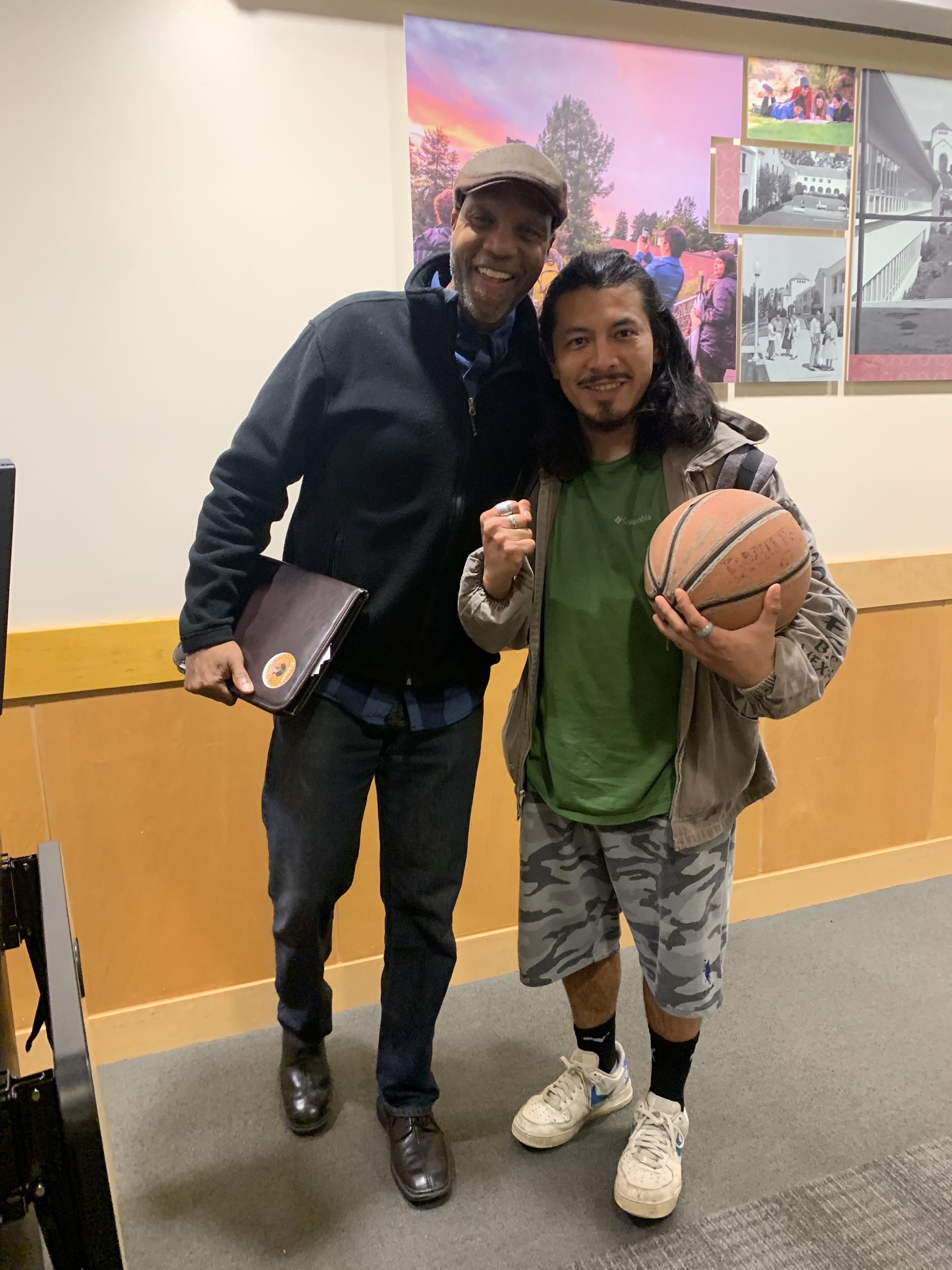
    If money is the root of all evil, when do people feel joyful about it? Kirby Moss, a professor and head of the journalism department at Cal Poly Humboldt, asked nearly 20 students and community members last Tuesday, Feb. 13. It left people stumped. 

    Topics discussed were Black representation in the media, feelings around finances and money, how to navigate being a first generation student while saving money for college, and hypotheticals about splurging on a life experience or saving and investing said money. 

    Rather than lecturing, Moss guided a conversation by asking plenty of thought-provoking questions. 

    “We’re in college, this is an academic setting, this is a setting of intellectual exploration. Do you think we should be learning more about money or not?” Moss said. “This conversation today is about money, but it’s not about material stuff. It’s about autonomy, it’s about options.”

    Aundrea All’love is a community member and business owner who was invited to share their experiences. One experience they have as a Black business owner is balancing mental health and community value, while still recognizing their worth and being paid a sustainable amount. 

    “From going from homeless, to some stability, to slowly growing my business now, the biggest shift I did was to focus on what brings me joy. Having faith in my ability and understanding my value,” All’love said. “I have been choosing more opportunities to make money and less scrumping down on my savings.”

    Jeremiah Keys is a sophomore at Cal Poly Humboldt who shared experiences about college being the foundation for the rest of his life. 

    “It’s not just going to be college then careers. It’s like college, then another college, then career and then struggles in between those things, but I’m still going to get through it,” Keys said. “Providing for my family and friends suits me, because I love doing it. That’s the expression that we love. Do something that suits you, but don’t push yourself to where you end up judging yourself more and more and more, and not looking at all the good that you’ve already done and all the good you can possibly do in the future.”

    This event was a part of a month-long series of events for Black Liberation Month, held by The Umoja Center for Pan African Student Excellence. For more information on upcoming events the Umoja Center can be found on Instagram at @umojahumboldt.

    “Money is not power. It’s all about us,” Moss said.

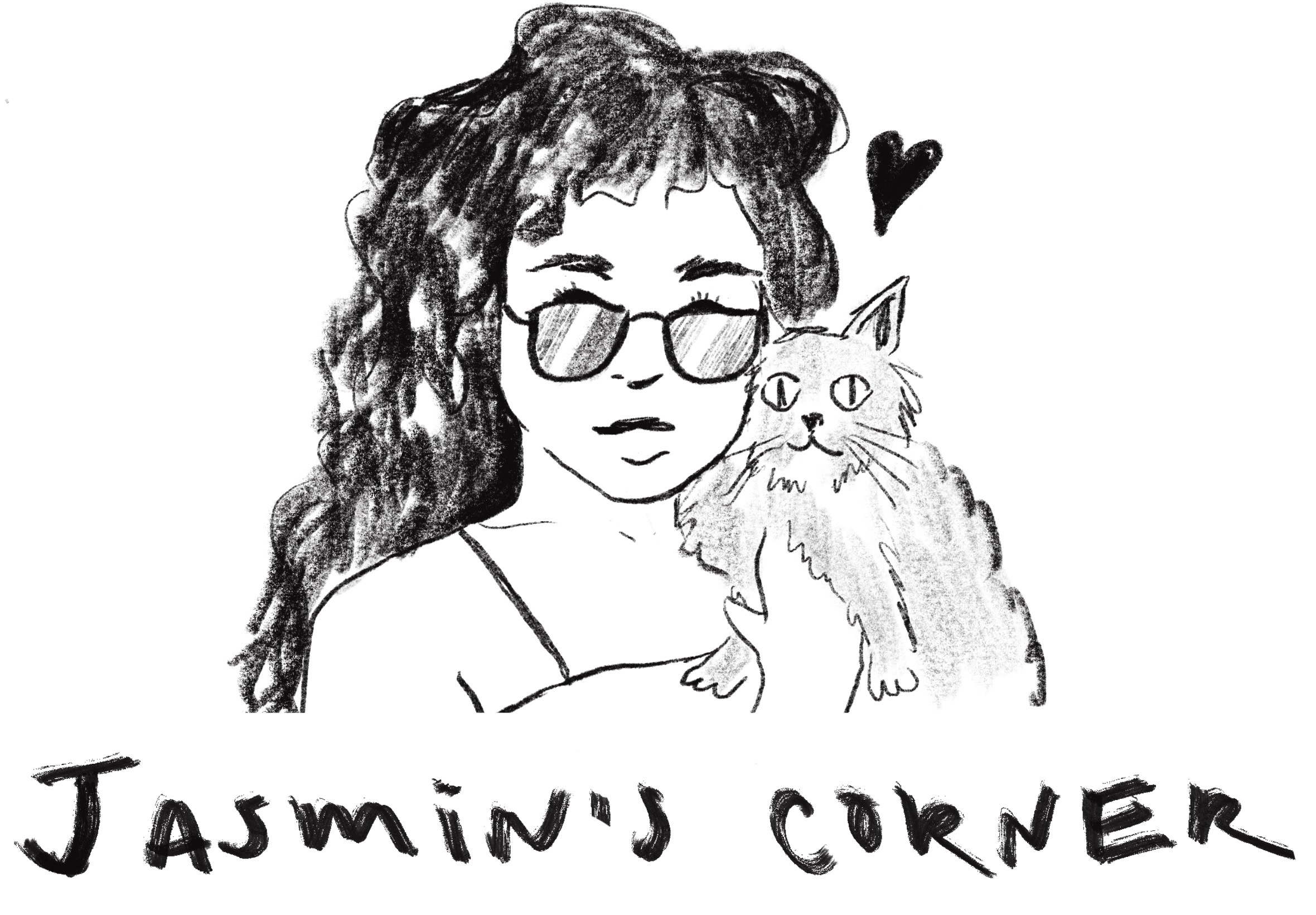
  • Jasmin’s Corner; you need therapy

    Jasmin’s Corner; you need therapy

    by Jasmin Shirazian

    Hey Jasmin, 

    I think I need therapy, but I’m afraid. I’m not the type of person who likes to share my sad feelings with anybody, so I shove them down and pretend like they aren’t there. Recently, I’ve been noticing that my sad emotions are starting to catch up to me and are taking over my thoughts. I can’t really sleep because of them and it’s making all of my days seem mushed together. So back to the therapy thing, I’m afraid to tell someone about how I feel because I don’t want to get judged. In my mind, I feel like it’s silly for someone like me to be sad because I don’t really have anything happen to me recently to have sad emotions. 

    If you think you need therapy, you need therapy. If you don’t think you need therapy, you’re wrong and you need it more than anyone else. To me, therapy is just as important as a regular doctor or dentist appointment. Your mental health is just as relevant as the physical stuff. 

    Shame, pride and embarrassment are what stop many people from seeking help, but you can’t let your fear prevent your growth. Therapists are awesome because they get paid to care, so you don’t have to feel like you’re burdening anyone in your life with your problems. Their job isn’t to judge you, but to help you, though it may take a few tries to find a therapist that you feel comfortable with. Life is about trial and error. 

    Journaling your feelings throughout the day can be a good starting point in expressing your feelings. Getting them down on paper can help organize your thoughts and maybe recognize some patterns, like certain triggers. At the end of the day though, a proper diagnosis can seriously help you navigate your emotions and make sense of your brain. 

    You have to take chances and put yourself in uncomfortable positions to create change in your life. Being vulnerable is one of the strongest things you can be, which is why it can be so hard to get to a point of comfortability within it. 

    There’s no reason to feel silly for having emotions just because you’re not actively going through a tragedy or a trauma. If you can’t find the means to validate yourself, let me put it clearly: you are allowed to have feelings. More than anything, you are allowed to feel your feelings. 

    Shoving your feelings down into an endless pit will only fill it with emotional-vipers that’ll come back to bite you in the ass later in life. Make your life easier and deal with them now. 

    xoxo,

    Jasmin

  • Damn worth a conversation

    Damn worth a conversation

    by Alex Anderson

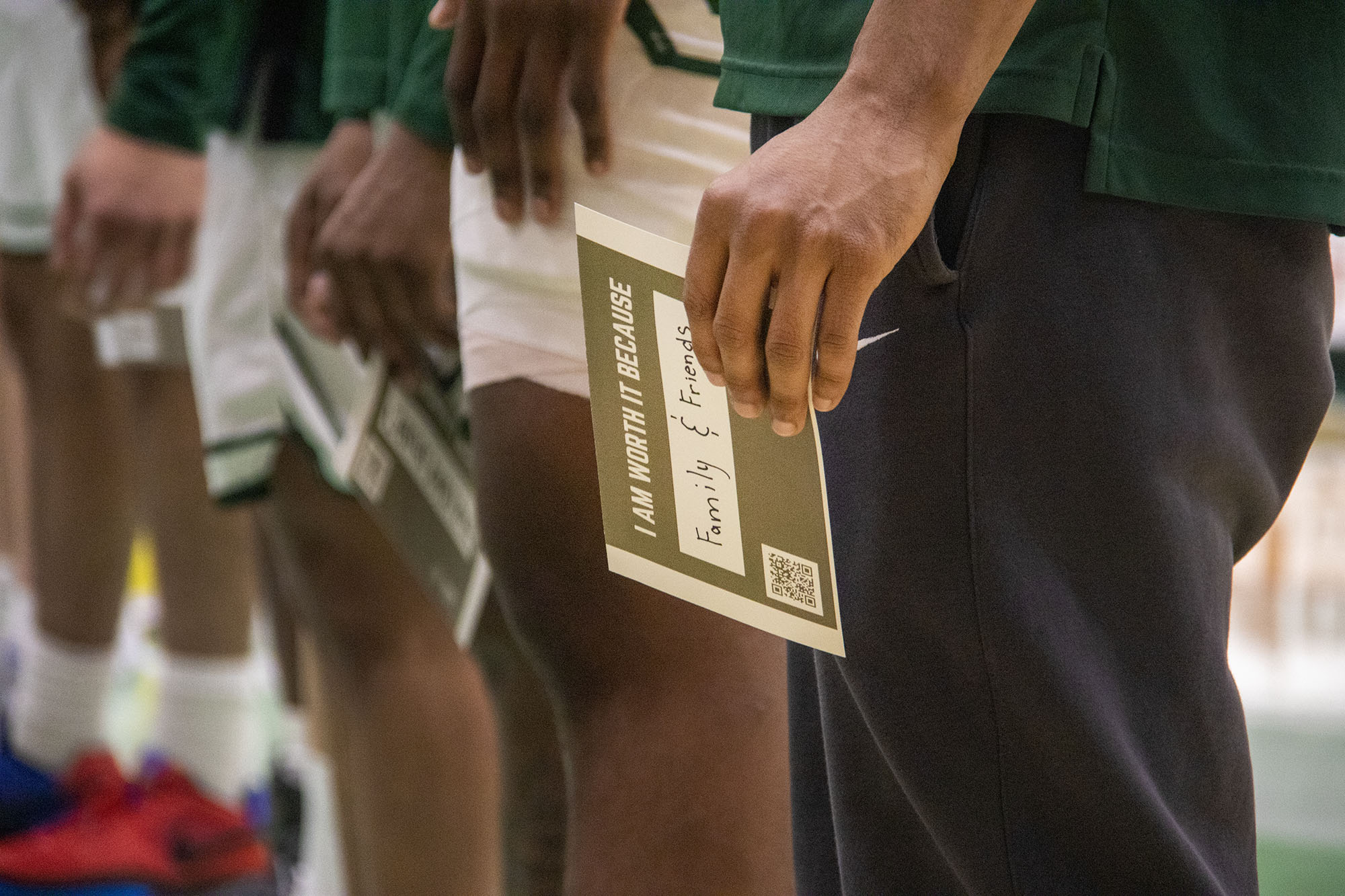
    Walking into the arena, music blaring, teammates running onto the court mentally preparing to go to battle. Coming together and huddling as one, teammates are there for each other. Lining up with signs in hand, showing the world why they are damn worth it. 

    The Humboldt branch of Dam Worth It (DWI) celebrated Cal Poly Humboldt men’s and women’s basketball in the Lumberjack Arena on Saturday, Jan. 27. Despite the Lumberjacks losing both games against Cal State San Marcos, athletes from both teams came together as a community to recognize the significance of mental health awareness. 

    DWI started in 2017 as a campaign to end the stigma surrounding mental health, and has been raising awareness and fueling conversations around mental health in college sports ever since. Coaches, players, cheerleaders and fans celebrated DWI, shedding light on mental health through storytelling and community. 

    Vice President for DWI’s Humboldt branch and former Cal Poly Humboldt athlete Gianna Giacomotto described what DWI’s mission is among college athletes. According to Giacomotto, a senior studying psychology, opening the dialogue about her struggles has helped her find comfort through hard times, and has facilitated the ability to help others going through the same struggles. 

    “I have struggled with mental health for a lot of my life and it’s really affected both my ability to perform on and off the court,” Giacomotto said. “I have found that by talking about it and being open about my mental health that I find personal ease through that and I also am able to find that I help others by making it less controversial to talk about and helping people get the help they need.” 

    Fans in attendance at the game were encouraged to fill out their own Dam Worth It signs to signify why they matter.

    Opening the dialogue about the mental health struggles athletes face is a key component of DWI. Introducing the tough conversations that help facilitate healing and combating the stigma against mental health struggles in sports is the ultimate goal of the organization. As part of that goal, DWI organizes college sports events, such as the basketball games in the Lumberjack Arena, to show athletes that they matter. 

    “Having these games for our athletes lets them know that they’re not alone, we provide resources to all of our student-athletes and try [to] remind them that they are damn worth it,” Giacomotto said. “You are more than just your sport and your identity that comes with your sport.” 

    Juggling college athletics while trying to pursue an education is no easy feat. College athletes bear a heavy load navigating the world of performing on a team as well as in the classroom. Maneuvering through practices, competing in games, managing homework on the road, communicating with professors and combating injuries – all while trying to excel athletically and academically is the reality for college athletes. 


    Cal Poly Humboldt Women’s Basketball team in the group huddle during the Dam Worth It game against Cal State San Marcos on Jan. 27.

    Delilah Kimble-Gray is a junior studying kinesiology and plays guard for Cal Poly Humboldt’s women’s Basketball team. Kimble-Gray knows firsthand how much time and effort is needed to succeed on the court and inside the classroom. On the Dean’s list from 2019 to 2022, as well as the Presidential List, Kimble-Gray puts in the time but knows the significance of communication and the ability to ask for help. 

    “Being able to continue, to keep going, keep your head on, being able to communicate with others I feel like is a challenge because as an athlete you don’t want to be seen as, ‘Oh, I’m not strong enough, or I feel weak’ but really you need that help,” Kimble-Gray said. 

    Currently sidelined due to a recent ACL injury, Kimble-Gray appreciates the need for community and communication. 

    “It’s hard. It’s my first major injury to my ACL. It’s the team, coaches and trainers that keep you going like a family, because it’s hard,” Kimble-Gray said. “You’re doing it by yourself, but you’re not – you know, everyone here is here to help you. It goes back to just asking for that help. That’s the challenge, being accepting of it and embracing the journey. Being within the injury is the hardest part, but everything else is super easy, as long as you just keep going and ask for help.” 

    Cal Poly Humboldt volleyball player Kaitlyn Patterson views Dam Worth It as a crucial safe space where athletes can share their stories. To Patterson, building a community and helping other athletes feel comfortable about having difficult conversations is indispensable. College athletes such as Patterson endure the difficulties that come with playing sports because they truly love the game.

    Cal Poly Humboldt Men’s Basketball team watching the introductory Dam Worth It video before the start of the game.

    “I would say just like the pressure of performing, trying to be perfect, of what the world wants,” Patterson said. “Ultimately, [I] have to dial down and really take it back, and realize that I am playing this sport for me – because I love it and not for anything else, not for the outside attention.”

    Athletes such as Giacomotto, Kimble-Gray and Patterson embrace Dam Worth It’s mission of fostering community and dialogue. Ending the stigma related to mental health only strengthens that community. 

    “No matter what anyone says to us or what anyone dislikes about you, whatever you’re going through, you’re worth it,” Kimble-Gray said. “You can overcome any and everything as long as you know that you’re worth it.” 

  • Everything comes at a price. My newfound sanity came with an extra 65 pounds.

    Everything comes at a price. My newfound sanity came with an extra 65 pounds.

    by Savana Robinson

    Last year, after a bout of psychosis and mania, I was diagnosed with schizophrenia and bipolar I. I was given a little blue pill called Abilify. Abilify (aripiprazole) is an antipsychotic/mood stabilizer that kept me on my rocker for a few months until my body started changing. I was prescribed Abilify in March 2023 when I weighed about 130 pounds. By May, I was 160. I went to my psychiatrist and he put me on Vraylar (cariprazine) which is a weight-neutral drug, meaning it should have stopped the weight gain. It didn’t. My general mental health was starting to decline, but at least I wasn’t convinced that everyone was out to kill me. I was probably overeating to some extent, but not enough to gain another 30 pounds. Yet around Nov., I hit 195. The drugs had wreaked havoc on my body and I didn’t recognize myself anymore. I had started an antidepressant, Wellbutrin (bupropion) back in the summer and it slowly started to help me accept my body and not mope about it all the time.

    I decided to start Weight Watchers (WW) on Christmas Day. It was the best decision I’ve made in a while. It’s been almost a month and I’ve lost six pounds! I’d been tracking calories for seven months with no results, but doing WW, which factors in grams of fat, protein, carbs and more, I’m taking a more holistic approach to weight loss. It’s also like a game; I get daily and weekly points to spend on food and I have to budget my points like they’re money. I went from constantly planning what I was going to eat to only thinking about it right before eating.

    Even though my body is different than it was before my life-changing diagnosis, I’m still the happy person I was before. I wouldn’t say I’m the same; I’m stronger. I’m more resilient. I am grateful for my body and my opportunity to live this life in this world.

    No matter what you look like, if you’re happy, then you’re perfect. It took me a while to love myself even when I thought I didn’t deserve to. Now, as Billie Eilish said, ‘I’m happier than ever. I’m no longer trying to be someone else.’ I’m just being Savana Motherfucking Robinson.

  • Breaking the stigma

    by Savana Robinson

    On Feb. 25, 2023, I was transported to Mad River Hospital after Sergeant Andy Martin of Cal Poly Humboldt University Police expressed concern for me. I had lost my phone at the Student Activity Center, and after I got it back I told him and other officers that someone had bugged my phone, people were following me and there were recording devices in my dorm room. Because of Martin’s commitment to helping, I was later given a diagnosis that answered so many questions: schizophrenia and bipolar I. If it weren’t for Sergeant Martin, I don’t know what would have happened, or where I would be.

    Martin knew me before the incident because he had picked up my knocked-over motorcycle for me. I brought him and the dispatcher, Jennifer Gomes, Harley-Davidson keychains and candy as a thank-you gift. Martin and Gomes knew that something was wrong with me because they knew me as a confident, Harley-riding girl – not a scared, paranoid kid.

    “Law enforcement’s role in mental health is complicated, to say the least,” said Martin. “Mental [illness] is not a crime.”

    Because my paranoia was high, the emergency room and the hospital in general was a scary place to be.

    “Some of the [hospital] staff and I have had conversations. They know that it’s not the ideal,” said Martin.

     Following the Lanterman-Petris-Short Act, those under 5150 hold must be taken to a facility designated by the county, which is either the emergency room or county mental health, which has only been taking voluntary patients since COVID. To me, this is a shame. I strongly believe that they should be transported to an inpatient facility for those in immediate mental crisis.

    “It’s designed for medical care, not psychiatric care,” said Martin, referring to the hospital. He recognized that there could be some overlap in the type of care needed for patients. In my case, my second hospital stay warranted medical care because I ran three miles barefoot thinking my hometown was littered with explosives, which tore my feet up. This happened the night after I was released from Mad River to my dad, who took me home to Redwood Valley.

    College is a time in life in which mental illness often manifests. The American Psychiatric Association states that 75% of mental illnesses start by the age of 24. 

    “We see more than our fair share of it,” said Martin. I was given my diagnosis at the age of 22, which is right in that sweet spot for when such illnesses surface.

    5150, also known as the Welfare and Institutions Code, is what allows police to detain a person if they are deemed a danger to themself or others.

    “Those are actually very strict criteria, the idea being that law enforcement shouldn’t be able to detain somebody without good cause,” said Martin.

    The way it works is that if an officer is concerned about someone, they’ll express their concern and give two options, voluntary admission to the hospital or 5150 if the case is severe enough. I was technically voluntarily admitted and I just learned after the fact that I could have left if I wanted to, but hospital staff repeatedly told me that I couldn’t leave.

    If someone refuses admission to the hospital, UPD can put them in contact with an on-campus counselor or county crisis. UPD also works with the Office of Students Rights and Responsibilities (OSRR), who work with Counseling and Psychological Services (CAPS)  and Campus Assistance, Response and Engagement (CARE).

    I have a great support system, and I’ve been told that by several people, including Sergeant Martin. I consider him and all of UPD to be part of my support system. I’m very blessed to have so many compassionate and caring people in my life.

    If you are concerned about yourself or another student, please fill out “Reporting Students of Concern” at deanofstudents.humboldt.edu/CARE or call UPD at 707-826-5555. If it’s an emergency, call 911.

  • Pets keep students healthy and happy

    Pets keep students healthy and happy

    by Savana Robinson

    Finals week: a stressful, anxious time for all. During this time, Raymond Haeckel, a forestry major at Cal Poly Humboldt, had a public panic attack.

    “It was really embarrassing and not the best on my mental health,” Haeckel said. “I’m thinking about how all those people saw me freak out. It sucks.”

    After the panic attack, Haeckel decided to adopt a companion that would ease his troubles and calm his mind; he is now the owner of a beautiful cattle dog mix, Carolina. He is certain that having an animal companion has helped support healthier habits.

    “It’s a really good, big motivator to keep on a healthy schedule in my life,” Haeckel said. “When I’m feeling depressed, I have trouble keeping up with my daily habits. Having a dog to calm me down when I’m feeling anxious is really important for my mental health. It’s thanks to her that I was able to overcome my inability to sleep through the night.”

    Vanessa Hidden, a leadership studies major at Cal Poly Humboldt through the College of Extended Education and Global Engagement, believes having a pet or emotional support animal can be one of human’s deepest connections.

    “Our pets can stimulate the healing process within ourselves,” Hidden said. “They can help us look forward to tomorrow and get out of bed.”

    Hidden is the administrator for the Co-Sheltering Collaborative, a peer-to-peer support network by My Dog is My Home. The organization is a national nonprofit focused on supporting people experiencing homelessness and their pets.

    Having had pets most of her life, Hidden feels a certain sense of comfort and safety from having animals around. She has struggled with depression and anxiety disorder, and her pets were a core part of her healing process.

    “To this day, [they] provide the connection and consistency I need to get through new challenges,” Hidden said. “Being fully remote for school and work… is a challenge that I don’t know I would be able to sustain without the company and emotional stability that my pets provide for me.”

    Maia Ryan, a Counseling and Psychological Services therapist and campus outreach coordinator at Cal Poly Humboldt, provided some insight on how emotional support animals can improve their owner’s mental health. Social connection is crucial to overall wellbeing and there is ongoing research to prove that the positive interactions with animals offer psychophysiological and psychosocial benefits like lowering anxiety, alleviating loneliness and normalizing heart rate and blood pressure.

    “People who may have difficulties with medical or emotional conditions exacerbated by stress could potentially benefit from having an emotional support animal,” Ryan said.

    Mental health is heavily influenced by social connection and animals can provide that necessary companionship. The unique bond between humans and animals is a powerful source of comfort and healing, underscoring the vital role animals play in bolstering our emotional resilience and overall mental health.

  • Manic? Don’t panic!

    Manic? Don’t panic!

    by Savana Robinson

    This year, I had a manic episode that lasted from January to March. During that episode, I got very little sleep. I was burying myself in any work that I could find, and my mom said I sounded different. 

    Manic episodes can be caused by a number of things. High stress levels, trauma, changes in sleep patterns or lack of sleep, using recreational drugs or alcohol, or the time of year; some people are more prone to mania in the spring. Mania is classically associated with bipolar disorder, and is also known as the “high” compared to the “low” of a depressive episode.

    According to the Cleveland Clinic, symptoms of mania include, “feelings of invincibility, lack of sleep, racing thoughts and ideas, rapid talking and having false beliefs or perceptions.” For example, during my manic episode, I would go without sleeping for a couple of days at a time and I was talking everybody’s ears off about how I planned to be a motorcycle journalist, or how that semester’s Osprey was going to be the best magazine to come out of this school (it was a banger, though). It wasn’t until one of my roommates sat me down and told me that I was manic that I realized I had not been my normal self for months. I accepted what she had to say, but the only thing I could think to do to help myself was try to get some sleep and just get back to normal; that’s not how it works. I should have gotten help then, but it wasn’t until a month later that I got help the hard way through multiple 5150 holds and a nine-day stay in a psychiatric facility. Listening to those around me was the most beneficial thing that I did during my episode. If I hadn’t let the university police help me by transporting me to Mad River Hospital, where I was put on 5150 for the first time, I might not be writing this.

    If I could go back and do it again, or if I had to get help for someone else, this is what I would do: call 988. That number is not only a suicide hotline, but it’s a mental health crisis hotline. It’s easy to remember in case you can’t find the local number (707-445-7715) and they will give you tips on how to get help for yourself or others. Next, I would make an appointment with a psychiatrist. This can be done through your general practitioner. Students can make an appointment with Counseling and Psychological Services (CAPS). CAPS can be contacted at 707-826-3236.

    Well, I hope this helps. If you have any questions or just want to talk about mental health, email me at sr424@humboldt.edu.

    24hr National Suicide & Crisis Hotline: 988

    24hr Humboldt County Crisis Hotline: 707-445-7715

    Cal Poly Humboldt Counseling and Psychological Services: 707-826-3236

  • Schizophrenia, bipolar and anxiety, oh my!

    Schizophrenia, bipolar and anxiety, oh my!

    by Savana Robinson

    What is schizophrenia? According to the American Psychiatric Association, schizophrenia affects less than 1% of the population. It is a chronic brain disorder with symptoms such as delusions, hallucinations and disorganized speech.

    I got lucky. I got my diagnosis at the young age of 22, and the mental health system worked in my favor. This is not the case for most, and I want to raise awareness of that. Oftentimes, people suffer from symptoms for years without a diagnosis. Often they are gaslit or belittled. Being called crazy isn’t fun. That’s what I heard the lady next to me in the psych ward at Mad River Hospital say. She was right. It’s not fun, but getting help when you’re not in the right headspace is important. The stigma around mental health, schizophrenia specifically, needs to change. We should be treating those in distress with compassion because mental health can be a difficult topic to approach, especially if it’s regarding a loved one.

    The first time I was put on a 5150 hold was because Sergeant Martin of the university police noticed that I wasn’t acting like myself. I misplaced my phone at the Student Activity Center, convinced someone had stolen it. I was telling him things like the person who took my phone put recording devices in my room, and that someone was out to get me. He transported me to Mad River Hospital, where I was put on a 5150 hold; involuntarily held there for my own safety. They ran some tests to make sure I wasn’t on drugs; my paranoia was high and I thought that the oxygen tank in my hospital room was going to explode. I could hear a ticking coming from a camera on the wall that was in sync with my heartbeat. They released me to my dad after one night. 

    The peak of my psychosis was the night after I was released from Mad River. I took a sleeping pill – never again. I walked and ran three miles from my house barefoot, thinking that someone had planted bombs all over Redwood Valley and that everything I loved would be blown to smithereens. Thank goodness a kind samaritan saw me hopping the fence to the freeway and called the authorities. My dad is a first responder and he told me that was the most fucked-up call he’d ever been on. I tore up my feet and traumatized my father that night. 

    The next day my parents took me to Ukiah Adventist and they put me on my second 5150 hold. I believe I should have gone straight to a psychiatric facility, but my feet were hurt pretty bad. I guess it made sense to keep me in the hospital for a couple of days, but the hallucinations I experienced there were unsettling. It felt like I lived through a horror movie. I could hear the happenings of what I believed to be a torture chamber in the room next to me. When I was finally transported – without my consent – I believed my whole family had been cut up and sewn into a big wad of flesh, and that I was being “saved” and sent away to start a new life. It took me about five days, and a lot of sedation, to realize that I had been in psychosis for over a week, having been in a manic episode for months. After months of therapy, I fully realized that what I experienced in the hospital was one big hallucination. When the psychiatrist told me I was schizophrenic and bipolar, everything finally made sense.

    In total, I was put on a 5150 hold twice and 5250 once. A 5150 hold lets the facility keep you for 72 hours and 5250 lets them keep you for 14 days. I will say this until I die: 5150 patients should not be kept in hospitals unless they have severe injuries. In my experience, hospitals can be very triggering. It’s an unfamiliar environment; the sounds of the machines and people talking can make someone suffering from psychosis spiral into a worse condition.

    Now that I have my diagnosis, have been on medication for six months, been in therapy, I look back on all of my delusions and hallucinations, and I don’t recognize that girl. She needed help, lots of help, but she got it. I’m very thankful for everyone who helped me when I wasn’t myself. I’m also appreciative of myself for being vulnerable enough to admit that I need help and accepting the help that was offered to me.

    If you take away anything from my experience, please let it be this: listen to the people around you when they’re trying to help you. Say something if you notice a loved one is behaving strangely. No one has all the answers, especially not a manic college student, but that’s okay. The world is a scary place and sometimes our brains make it scarier, but we have each other and that is what’s most important.

    Love always,

    Sav

  • Masking mental illness is a privilege

    Masking mental illness is a privilege

    by Lex Valtenbergs

    I could tell that the woman lingering at the bus stop was mentally ill within the first few moments of speaking to her, although it wasn’t my place to surmise what mental illness she suffered from.

    She asked me a question about the bus schedule and muttered something aloud as if in reply, but not to me. When her eyes met mine again, she blurted, “Oh!” as if she forgot I was there.

    My initial reaction was to fear her; I didn’t understand the inner workings of her mind nor their outward manifestations. I perceived her as volatile and therefore threatening.

    At that time, I was also going through a protracted depressive episode marked by the distinctive mistrust and self-sabotaging tendencies that are all too common in borderline personality disorder. As a result, I had little to no verve to engage with her.

    In our own respective ways we were unmasked.

    The difference between her and myself is that I have the privilege to mask, or hide the symptoms of my mental illness to the best of my ability. She’s always visible; not by choice but by circumstance.

    Ironically, my masking urge to ‘help’ in some way and assuage her symptoms that brought me discomfort was snuffed out by my own unmasked symptoms. I was defying the neurotypical script and the internalized ableism – discrimination against people with disabilities, mentally ill and neurodivergent people – that came with it.

    I got on the bus and sat down, trying to push away the dread and discomfort that were triggered by the brief interaction that I had with the mentally ill stranger at the bus stop.

    As if being summoned by telepathy, the woman appeared at the open back door of the bus and asked me another question that I didn’t have an answer to. Just before the back door slid shut, she snuck inside the bus without paying at the front and sat down across from me.

    For the next half hour or so, she had an ongoing dialogue with no one in particular, constantly shifted in her seat, and ripped up a handful of white paper straw covers from a fast food restaurant.

    At one point her eyes wandered to mine and she asked me, point-blank, “Are you okay?”

    I was baffled by her lucidity. I curtly replied, “I’m good,” even though I wasn’t. She didn’t push me like I feared she would.

    At the last northbound bus stop in Eureka, she abruptly stood up from her seat. She left a pair of brown moccasin boots under her seat. As she passed by me, she gently touched my shoulder and said, “I love you.”

    The physical contact was unexpected but not entirely unwelcome. When she told me that she loved me – a misplaced but sincere disclosure – I felt the burning touch of shame press firmly inward. What were the people around us were thinking? Would they associate me with her?

    It didn’t matter, I consoled myself. I always try to deconstruct any ableist narratives that crop up in my mind. Then I learn from it and strive not to repeat it again.

    If we dare to overcome our fear of judgement, we are more prepared to dig through the other discriminatory narratives that are ingrained in us.

    She turned around. “Could you be a dear and grab my boots for me?”

    I cynically inferred that she left her boots on purpose just so I could get them for her, but I realized that I couldn’t be certain. Even if I was, her intention wasn’t malicious. I stooped down to grab them, and brought them out to her.

    It felt like we understood each other as I handed her the boots. She took her boots from my hands, and then she was gone.

    I almost cried as I sat in silence, my heart twinging painfully with every second the bus pulled away.

    I am mentally ill. I am broken. I am whole, but not seamless. The woman on the bus couldn’t seal her cracks as well as I can, and that’s a privilege that weighs heavily on me.

  • César Chavez Day with YES

    César Chavez Day with YES

    by Eddie Carpenter

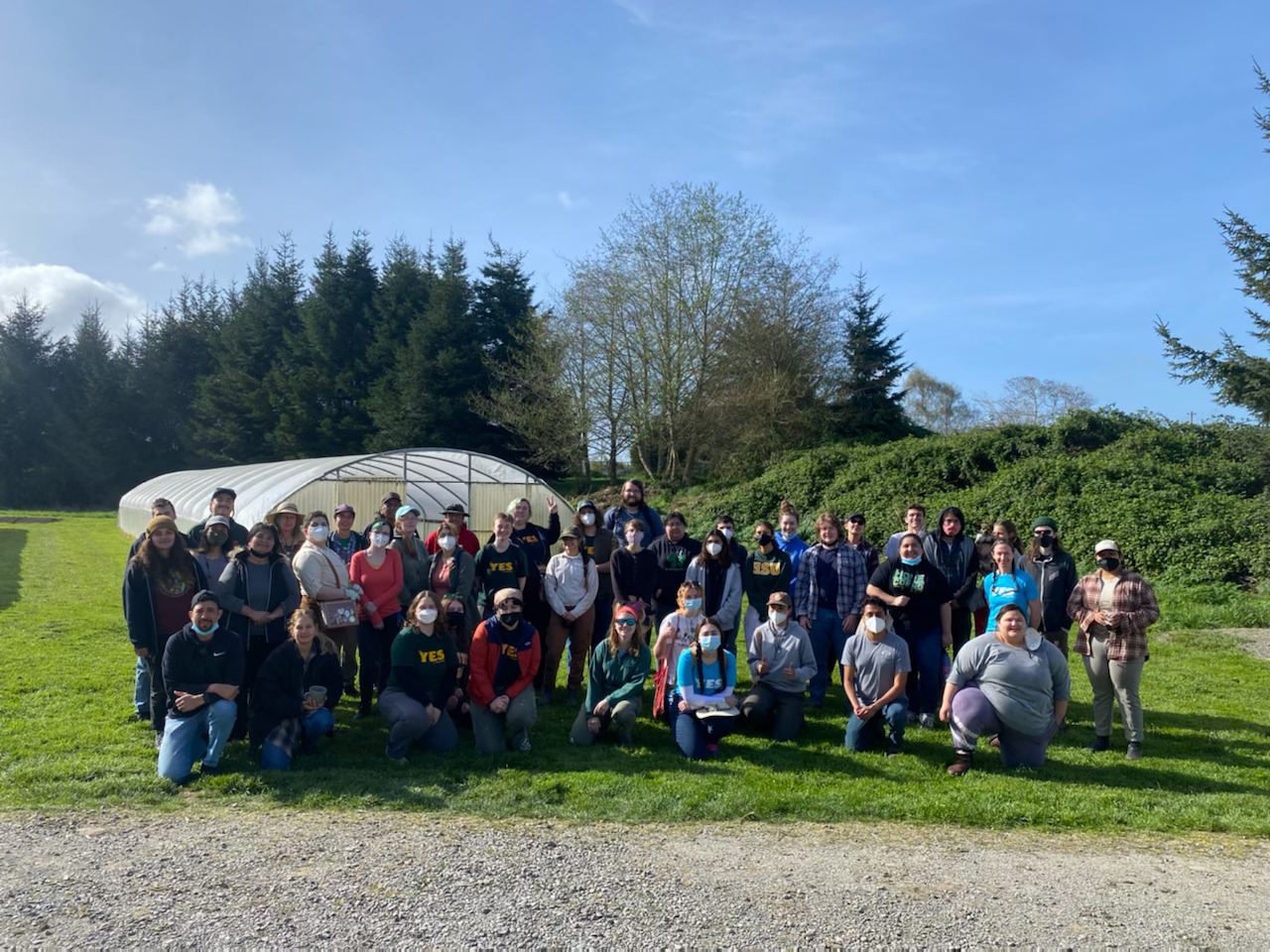
    In honor of César Chavez Day, the YES program hosted a volunteer event at the Potawot Community Food Garden in Arcata. It had an amazing turnout with a whopping 40 volunteers in attendance, caressed by the sunny blue skies and the refreshing Humboldt breeze.

    We were assigned tasks by being divided into five groups. I was grateful to be a part of a group that planted beds of squash. We did everything from scratch, laying out layers of black cover material across the four rows to keep the weeds from robbing the plants of their nutrients. We also covered the tops of the rows with white cloth.

    Gardening skills have practical value in my daily life. Prior to this experience, I had been a volunteer at Potawot through a program called the Intertribal Agriculture Council. Potawat’s head gardener Ed Mata gave me a handbook about gardening and I was mentored by a professional development specialist named Elaini Vargas.

    Maybe I was a little rusty on the terminology, but basic knowledge about soil health has since been ingrained into the recesses of my brain. I learned in a soils class that if you live in a mild climate, it’s estimated that it took 200 to 400 years for 1 centimeter of the soil to form. Vargas’ and Mata’s teachings directly impacted the mindset I had going into the YES serve-a-thon on César Chavez Day.

    Youth Educational Services (YES) is a collective on campus that provides students with opportunities to volunteer at local school and community sites. One of their goals is to connect hands-on service and in-class learning with awareness of the injustices and oppressions experienced by those they serve. Actions sometimes speak louder than words. Making donations and saying nice things about a cause is totally different from donating your time and bodily energy to a cause.

    According to mentalhealth.org, helping others can possibly help make you happier as a person. Through volunteering, I was able to make temporary connections through teamwork and group communication. This gave me a sense of community and made me feel like I belonged to a noble cause.

    If you want to see change in your self-esteem, you might want to consider doing good deeds, so we can manifest the world into a better place. Indeed, an outward reflection of finding happiness can in turn make you a happy person.

  • Humboldt Athletes are ‘DAM WORTH IT’

    Humboldt Athletes are ‘DAM WORTH IT’

    by Morgan Hancock

    Photo by Morgan Hancock | Gracie Kasberger finishing the 400M Log Relay on Feb. 12 at the Cal Poly Humboldt Redwood Bowl.

    Athletes live in a culture of perfection and pressure that can lead to high stress, these Cal Poly Humboldt students want to address that. Gracie Kasberger founded this campus’ branch of Dam Worth It. Dam Worth It is a nonprofit that supports athletes struggling with mental health. Athletes’ mental health has become a bigger conversation since the recent double feature Olympics. High-profile athletes are setting precedents by putting their mental health first. Students like Kasberger are laying the groundwork for a new culture in athletics. 

    Kasberger is a kinesiology major and track athlete, she saw a need to support her peers. The athletics department doesn’t have any counseling services for athletes, so students are on their own. They balance classes, practice, work, and self-care. Kasberger expressed that students will often put their mental health on the back burner. 

    “I’ve noticed more pro athletes coming out about their mental health and saying that they are struggling,” Kasberger said. “It’s something that is being normalized. Athletes go in and get help when they’re injured, but they’re not doing the same for their mental health. We’re bringing attention to it, we want athletes to have access to help and feel like they can speak out.”

    Photo by Morgan Hancock | Travis Allen in the 60M hurdles on Feb. 12

    Travis Allen is a track athlete who opened his season at the Green and Gold event last weekend. Allen expressed how sports can offer a mental haven for athletes, but with it also comes added stress.

    “Mental Health is often overlooked, especially with athletes,” Allen said. “Teammates are like a family, there is a lot of support from each other.” 

    Each athlete filled out a card with the reason why they are ‘dam worth it’.

    “I’m ‘dam worth it’ because I am me,” Allen said.

    Sue Grigsby, Lumberjack class of ‘79  track hall of famer and record shatterer, attended the legacy event. Grigsby has seen the pressures change for students over the years. Students have increased pressures from athletics and an unstable world. 

    “If you have a vision problem or dental problem or a knee injury you seek help,” said Grigsby. “Athletes should do the same for their brains. It’s okay to seek help, there are ways to get help.”

    Student-Athletes often define themselves by their sport. They use athletic success as a measure of their worth. Clara Lenihan struggled to define herself outside of her sport once she ended her soccer career.

     “When I introduce myself I start with ‘oh I play soccer,” Lenihan said. “Now that I don’t play anymore I don’t know what to say. Sports is such a big part of our lives.” 

  • My mental illness makes me a better leader

    My mental illness makes me a better leader

    by Lex Valtenbergs

    You sleep too much or too little and neglect your personal hygiene. You’re a ticking time bomb that can’t be defused. You oscillate between extremes like a pendulum. Your own thoughts wage war against you and, in some circumstances, the people around you.

    Being mentally ill is a constant struggle, and that is only the surface of it.

    In my case, I have undiagnosed traits of borderline personality disorder (BPD), specifically a subset of the disorder called quiet BPD, as well as comorbid anxiety and depression.

    To be clear, I am not diagnosed due to being assigned female at birth (AFAB) in a rural county, one with a disproportionately high rate of Adverse Childhood Experiences (ACEs) and inaccessible or understaffed mental healthcare facilities.

    Seeking and getting a diagnosis from a psychiatrist is also protracted and difficult, especially during the ongoing COVID-19 pandemic.

    It must also be said that being branded borderline in our society is not ideal, especially as someone who was is perceived as female. There is a lot of stigma around the four Cluster B personality disorders: narcissistic, borderline, histrionic and antisocial personality disorder.

    I stigmatized narcissism in particular, before I became self-aware and realized that narcissism is merely the inverse of codependency. Both stem from traumatic formative experiences with maladaptive object constancy and abandonment, but they manifest differently. For me, narcissism was a mirror into my own dark traits that I wasn’t able or willing to peer into.

    Most borderlines are stuck in an incredibly alienating and painful catch-22. The people who understand us aren’t necessarily healthy for us, and the people who don’t understand us are usually stabilizing for us. Couple that with the chronic emptiness that borderlines endure daily and you quickly rack up a series of short, toxic relationships that end in violent staccato.

    The Western culture of individualism makes things worse for mentally ill people. In our society, we have a tendency to overlook our ability to affect other peoples’ lives. We also have the tendency to sell ourselves short. We would rather shrink than dare to take up space. The latter is contingent upon us being vulnerable, which includes the risk of failure.

    Because my judgment is skewed by my mental illness, I make a lot of mistakes. I assume the worst of people who don’t deserve it. I misread peoples’ intentions before giving them the benefit of the doubt, or idealize people who haven’t yet earned my trust or respect. These behaviors open me up to exploitation and abuse. I can also be abrasive, intense and even callous, but that doesn’t mean that I don’t have compassion or remorse.

    If anything, I feel too much, more strongly and longer than the average person does. I constantly emotionally regulate myself, to grapple with my volatile moods and intense emotions. Most of these emotions go inward towards myself rather than radiate outward.

    Believe it or not, my mental illness makes me a better leader. Because I am mentally ill, I have put myself in situations where I needed to be held accountable for the sake of myself and people around me.

    I couldn’t play the victim. I had to own up to my behavior, even though it stemmed from something out of my control. At the end of the day, I am fully responsible for my choices and the consequences.

    Owning up to your dark side every time it creeps up and wreaks havoc enables you to build healthy, strong relationships. Relationships are hard work.

    Good leaders have good relationships. Good relationships are contingent on accountability, boundaries, trust and clear communication.

    The first step of realizing your ability to lead others and trying it is hard no matter what, but mentally ill people just have more barriers to overcome.

    I have had to learn how to use the dark side of my mental illness to harness my light and use it to influence others around me. The skills that I’ve developed to cope with my borderline traits, anxiety and depression allow me a self-insight which is extremely useful.

    Every day, we have the choice to be a positive or negative influence in the lives of people we know. Try to go against the grain of your darkest tendencies of your humanity and use your light as a guide.

  • COVID-19 defines society’s future mental health

    COVID-19 defines society’s future mental health

    Though it’s still far from over, the effects of the COVID-19 pandemic could last a lifetime.

    All CSU campuses offer mental health services with a range of options available, included in the cost of student fees. Operations Coordinator and Staff Psychologist for HSU’s Counseling And Psychological Services program Dr. Elizabeth A. McCallion said their services are especially valuable now that students are facing additional stressors brought upon by the pandemic. Though in-person services are currently unavailable, CAPS is operating at full capacity, offering all of the regular services, virtually.

    “Students come to counseling at CAPS for a range of reasons and I think it’s really important to recognize that,” McCallion said. “We are not just a support for students who are in a crisis situation, though we do provide that support as well.”

    For students curious about the practice or grappling with issues of any size, CAPS provides an opportunity to uncover the answers to some of your questions. For those who decide it’s not for them, McCallion especially recommends placing emphasis on the prioritization of our emotional health.

    “Getting good sleep, nutrition and physical exercise have been shown to have really positive benefits on our mental health,” McCallion said. “So, I think looking at our health behavior and our lifestyle choices can be really key to making sure that we’re taking care of our emotional health.”

    Professor of Psychology Gregg Gold believes the effects of isolation will remain, to some capacity, with those who live through the pandemic.

    “There will probably be some permanent mental health issues for those of us who spent a year and a half alone,” Gold said. “I don’t think you could say that’s not going to have some kind of effect on people.”

    Gold said the pandemic lifestyle has generated more loneliness and frustration in his life as he battles with motivation and concentration droughts. The monotony of quarantine is largely to blame, Gold said, giving us nothing to look forward to with each day being the same as the last. The most significant factor influencing this is the deprivation of genuine, in-person human interaction.

    “It’s a basic human need to be around other people, face to face,” Gold said. “We’ve evolved to crave the company of other humans because the more friends we have, the bigger our network, the more we can ask others to do things we can’t do for ourselves, the more likely we were in the very recent past to be able to survive and even today, [we’re] much more likely to be successful.”

    Our time in isolation is not only damaging to our present well-being, according to Gold. Each day we spend contained inside the walls of our homes, interacting only with a familiar few and the algorithms of our social media accounts, we are being deprived of opportunities to explore new ideas.

    “When you’re out in the real world, you actually run into people that might think differently than you do,” Gold said. “That tends to broaden your view.”

    Though some are willing to place their own lives and those of others in immediate danger in order to go about life as usual, the majority of people are less inclined to make the sacrifice.

    “If you can’t [socialize] safely it means there’s underlying tension and fear and that takes the fun out of it,” Gold said. “It’s like trying to go out and party the night before you have a major midterm, how much fun are you really gonna have?”

    While millions of people lost their homes, their loved ones, and their lives to COVID-19, it can put those who’ve been more fortunate in a position where they don’t feel comfortable feeling sorry for the lesser losses they’ve suffered in their own lives, Gold said. The reality, however, is that the individual struggles we face now will be significant in our entire lives.

    “It’s easier for people to become depressed,” Gold said. “If you think about it, [depression] is the reaction you would expect, given the circumstances.”

    The increase in depression among American citizens is evident by the increased rates of substance abuse and suicide since the pandemic began, Gold pointed out. These reactions also come from severe anxiety surrounding financial and health insecurity. According to Gold, the two are one in the same in this country, where our physical and mental well-being are treated as commodities.

    Masters Student and Associate Professor of Sociology Travis Cunha began work on his thesis around the same time COVID-19 reached the United States and explored how different countries initially navigated the pandemic, specifically in regards to business practices. Given the high volume of jobs that have moved online and are planned to remain there, Cunha is concerned for smaller communities that rely upon only a few providers for a high volume of jobs, as he expects more outsourcing of labor than ever when the pandemic has finally passed.

    Cunha is curious to see what will come of all the vacant buildings left over from businesses that were forced to leave. He fears outside sources will capitalize on the opportunities and feed off the people who are in need of relief. This is especially a problem in low-income communities of color.

    “It was already like that even before the pandemic. These communities aren’t getting the resources other communities are,” Cunha said. “Since the pandemic, those things have just been made a lot worse.”

    According to Cunha, the most shameless offenders are the loan companies by allowing opportunities for business owners to remain open, for families to keep their homes and for students to pursue their educations. With a contract guaranteeing significant profits, loan companies have nothing to lose and everything to gain.

    “It’s not a coincidence that they’re opening places where communities have been hit the hardest,” Cunha said. “These communities need loans and grants and stuff to recover from this pandemic because they got no help during the pandemic, so I think it could be a recipe for disaster in that sense.”

    Unlike the psychological trauma that will follow us out of the pandemic, the financial burden that will plague the post-pandemic society is entirely avoidable if we were to come together in solidarity, recognize the problem and create a solution.

    “I would hope that after this is over, people wouldn’t dismiss the views of scientists as politically motivated when they tell them something they don’t want to hear,” Gold said. “But the incredible ability of people to completely deny reality even when it’s right in front of them is profound.”
  • It’s time to stop the taboo talk around therapy

    It’s time to stop the taboo talk around therapy

    I remember the first time I went to therapy. I had just dropped out of a public high school my sophomore year and joined a charter school with only two days a week of face to face classes. I was 15, overwhelmed, depressed and confused – all things that come along with growing up. I told my parents I didn’t know how to handle these feelings, how empty and lost I felt. So my dad connected me with a local therapist.

    For a long time, I didn’t tell people I was going to therapy because it felt shameful. Now as a 10-year therapy veteran, I can honestly say it was the best decision I have ever made.

    You are not any less valid for wanting to better yourself, and therapy can help you do that. It isn’t something that will happen overnight, but therapy can help you learn and exercise healthy coping mechanisms.

    Being able to talk to someone I knew I could trust helped me process the feelings at hand. Being stuck in my own head was detrimental to my well-being because I couldn’t always see both sides of the coin. When you talk to your therapist, they will offer you alternative perspectives that you may not have ever considered.

    The most valuable thing I’ve learned is that I am allowed to feel sad, angry and happy. I can give myself permission to experience all of the emotions that come with life. With negative emotions, it’s important to recognize them, accept them, but not let them consume you, challenge them. I have learned, and am still putting into practice, that concept.

    The coping mechanisms that I find most useful when I’m not able to see my therapist are reaching out to people I trust, letting myself enjoy moments of happiness, to be vulnerable and receive emotional support. Self-care is another important coping mechanism. Mine is drinking coffee and watching Gilmore Girls. It doesn’t have to be extravagant. It can be as simple as letting yourself sleep in one day a week, taking a walk on the beach or writing down how you feel, whatever brings you joy.

    The Mental Health America Association has a long list of healthy coping mechanisms to adapt which I learned in therapy as well, including but not limited to, connecting with yourself, doing things you enjoy, and setting realistic goals for yourself.

    Life is not one size fits all. Everyone struggles in life, everyone has a story and trauma unique to themselves. You are valid in your feelings, you deserve to be helped, you deserve to flourish. When I understood that reaching out for help can only benefit me, it changed my life.

    I’m not cured, but I’ve learned to function with my mental illness, how to adapt in times of distress, and you deserve that too.

  • Improving One’s Health Within The Trees

    Improving One’s Health Within The Trees

    Rosa Granados is a member of Women’s Cross Country at Humboldt State University and found when problems arise, doing something with her time was helpful.

    “I started running when there was something crucial going on in my life, running helped me find my home,” Granados said.

    According to pilot studies published in the “Journal of Adolescence,” outdoor activities can improve one’s overall health.

    Granados was raised in foster care, a difficult experience for her, but was able to find a family with the members of her running team and a passion for running which positively impacted her health. Running was a place for her to disengage from stressful situations and focus on the peaceful environment of nature.

    “It’s very important for everyone to practice self-care and expand one’s own definition of wellness,” Granados said.

    Granados enjoys hiking through the forests of Humboldt and the calmness of nature. It was a great place to disconnect from society as there was often a lack of cell reception. This caused her to feel present in the moment.

    Enjoying nature helped Granados cope with depressing situations and accept life experiences that she couldn’t control.

    According to an article published in the journal “Perspectives in Public Health”, “Using a combination of arts- and nature-based activities, present distinct synergistic benefits that have the potential to make a significant impact on the psychosocial wellbeing of adult mental health service users.”

    Granados’ job at Harm Reduction at HSU was about helping others with their mental health and trauma.

    In order to maintain Granados’ job with care, it was important for her to take care of her own mental health and wellbeing.

    Sheila Camerarena had a similar life experience to Granados.

    “Being a social worker can be very draining and I always have to remember that I need to take care of my needs first before I can help others,” Camerona said.

    Camerona also had a hard time at home. She found herself having to grow up very fast, taking a massive toll on her.

    “Knowing these difficulties I had at home is what led me to nature, it was like an escape,” Camerona said.

    Growing up, she found peace with bike riding throughout her neighborhood and grew up to become a lover of hiking.

    Nature helped Camerena get in touch with her spirituality and culture, it gave her a sense of connection with the world around her that she always wanted to find.

    Several studies have suggested that having a deep connection to spirituality can lead to a more positive well-being. According to the article “Enhancing Spirituality and Positive Well-Being Through Nature,” a study by Stringer and McAvoy wrote exposure to nature can lead an individual to connect to something greater, increasing their cognitive abilities and creative abilities.

    Similar to Camerarena and Granados, Annika Slattery was also searching for a home. Fresh from Hawaii and stepping foot in Arcata for the first time in her life, Slattery wasn’t sure if this was the place for her.

    Slattery was planning on getting her degree and moving back to Hawaii, however, things changed when she fell in love with the environment at Humboldt State University.

    “I started learning about my awesome major and it was everything I wanted,” Slattery said.

    Slattery is a recreational studies major and fell in love with forest bathing, being outdoors, and enjoying nature with her fellow classmates.

    She focused on recreational tourism and backpacking trips with classmates, from rafting trips to beautiful hikes in the forest.

    Being outside, enjoying nature, and being disconnected from the world for ten to fifteen minutes, Slattery not only found her home but developed a family bond within her major.

    “With this pandemic, I felt very contained and that my life had shifted into this box, I never realized how being outdoors could greatly improve your mental state,” Slattery said.

  • Time for yourself is more than okay

    Time for yourself is more than okay

    If you needed a sign to tell you to take a break, this is that sign

    Burnout is among us, for some it hit pretty early on. Whether you’e a student, a worker or both, taking a step back just feels impossible. Why do we justify our exhaustion with more exhaustion?

    While it is important to take responsibility for our lives, we need to be kind to ourselves. Living in this pandemic, we have come across what is called “pandemic fatigue.” According to University of Californi a Los Angeles health, it comes in various forms like the inability to focus, not knowing what day it is, feeling anxious, hopeless and worrisome.

    How do we fight pandemic fatigue? How do we fight burn-out? How can we avoid a downward spiral of intrusive thoughts, fear, irritability and insomnia?

    In an article in General Surgery News, Rachel Goldman, Ph.D., FTOS, a licensed psychologist, talks about healthy selfishness. The phrase explains itself, “knowing what you need to do and allowing yourself to do it.”

    It’s time to be more selfish with our health and recognize that we need to take me-time. It’s a reminder and also heavily recommended that we do take time for ourselves.

    I personally struggle with taking that break and I wouldn’t consider myself selfish. We are living in a very unpredictable time. I’m a planner, not being able to plan for the holidays or the next semester drives me up the wall. However, maybe it’s time that I stop worrying about the future and worry about what I am doing right now.

    “People need to focus on what is in their control, which is behaviors, reactions and how they cope, and not on what is out of their control,” Goldman said.

    Worrying about things you can’t control is unproductive and a playing factor in my pandemic fatigue. The feeling of being lost and confused about what to do next runs through my mind every day. Dwelling on the unknown is out of my control and I need to let it be.

    I know we are all going through it differently, but we are all still going through it.

    So when you are too exhausted to go on, take that nap.

    When your head is spinning, go for that walk.

    When you find yourself reading that one page four times over because you’re just not getting it, take a step back and make some pasta.

    Hit a pillow. Call a loved one. Cry. Watch that cringey holiday rom-com. Draw something, ugly or pretty.

    Talk to yourself using only nice words.

    Learn some breathing techniques on YouTube, meditate with Spotify, watch the news or don’t, and don’t forget to drink water.

  • Dealing with Sh*t During COVID-19

    Dealing with Sh*t During COVID-19

    The reality of ‘going through it’ during a time of a pandemic

    Being trapped in your house with your mind feels like the worst thing possible, but right now is the time to allow yourself to heal. It is more than okay to not be okay, all the time and even more so now. Although we wish this was just a vacation for us to sit around and do nothing, sometimes sitting around and doing nothing makes us feel out of control. It feels like we have lost whatever stability we had before.

    We have been in quarantine for over a month now and things were not going too bad. Well, that’s what I thought until I was left alone with my mind and as a result, my anxiety started acting up. Since quarantine started I have gone back to Humboldt to pack up my stuff and move back to my hometown. I made a long-distance relationship plan with my partner only for us to break up less than a week later. I came back to a house where I do not have my own space since I share a room with my teenage sister. Everyone is always in everyone’s business. There’s just no privacy and rules to follow. Plus, dealing with family stuff has really taken a toll on half of the household.

    I will always be grateful for the love I had and for the good times.

    Everything was happening all at once, I felt as if I wasn’t getting a chance to catch my breath. With the quarantine, it’s not like I could get out of the house or go out with my friends to talk things out or distract my mind. Not to mention, in Southern California you can only go outside for so long before the heat is suffocating you and you’re dripping in sweat. With all that being said, I would rather be dealing and healing with all of this right now, where I’m forced to sit in my home and deal with my thoughts.

    I cried for three days straight after my breakup and still find myself tearing up from time-to-time, even as I write this. However after eating all the ice cream I wanted and receiving some tough love from my loved ones, I decided that my world was not going to end just because a relationship did. I will always be grateful for the love I had and for the good times.

    As far as dealing with the family drama, all I can really do is take myself out of it. I make some tea and go outside for as long as I can. My sister and I lock ourselves in our room. I FaceTime my friends at least once a day just to have contact with people that live outside the house. For a while, I let my family pull me into each of their own drama, when it really didn’t have anything to do with me since I just got here. I was taking on their issues as if they were my own and they weren’t. Of course, I will always be there for my family, but I have my own things going on and my own healing to do. My responsibilities right now are my school work and taking care of myself. I mean we’re still in school even though it doesn’t feel like it. That degree is the only thing I have my eyes on right now.

    If I was still going to work and face-to-face classes, I would have so many distractions that I would forget what was going on or I was feeling some type of way. This might be ideal for some people but in my experience if I do not deal with or acknowledge my feelings, it builds up. The end result is much worse than what would have happened if I just took the time to heal right then and there. Now, of course, I would love to go get drunk with friends and forget about real life for a second, but we can’t because of quarantine. However, when you’re not drunk or hungover anymore your problems will most likely still be there so you will have to deal with them eventually. This quarantine has allowed me to deal with everything at once which has been hard, but it is reassuring knowing that once we are allowed to roam freely, I’ll have my mental and emotional shit together.

    Take the time to focus on your well-being. We will be let out again someday. Also, rest assured that you are not the only one. We would all rather not deal with our feelings alongside a pandemic, but it happens and that’s okay.