Students on campus can still reach out to medical services
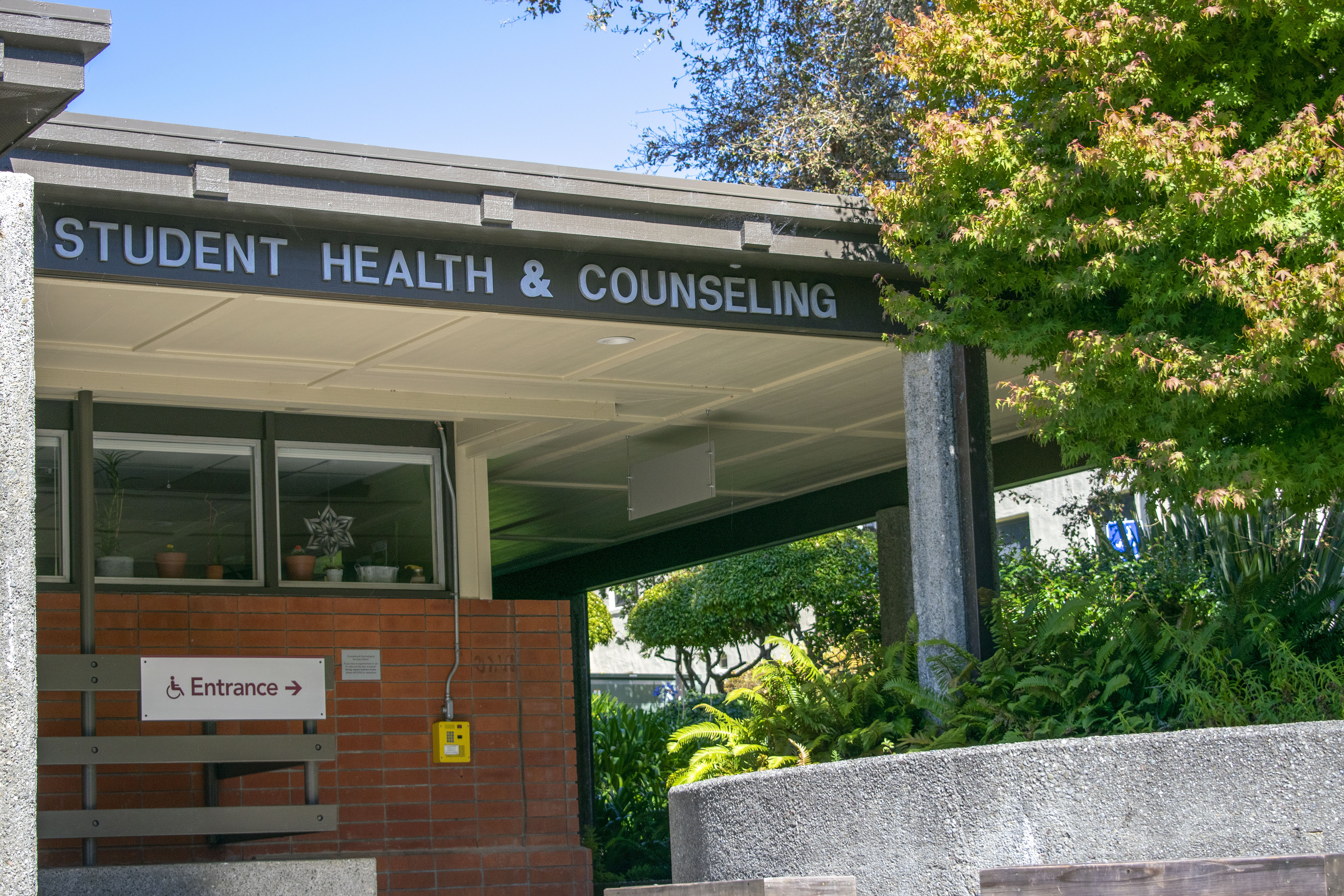
The Humboldt State University campus is closed to the public, but the Student Health Center expects to remain open for the remainder of the semester to help any students remaining on campus. The health center is limiting face-to-face contact as much as possible, but is still helping students without physical appointments when possible.
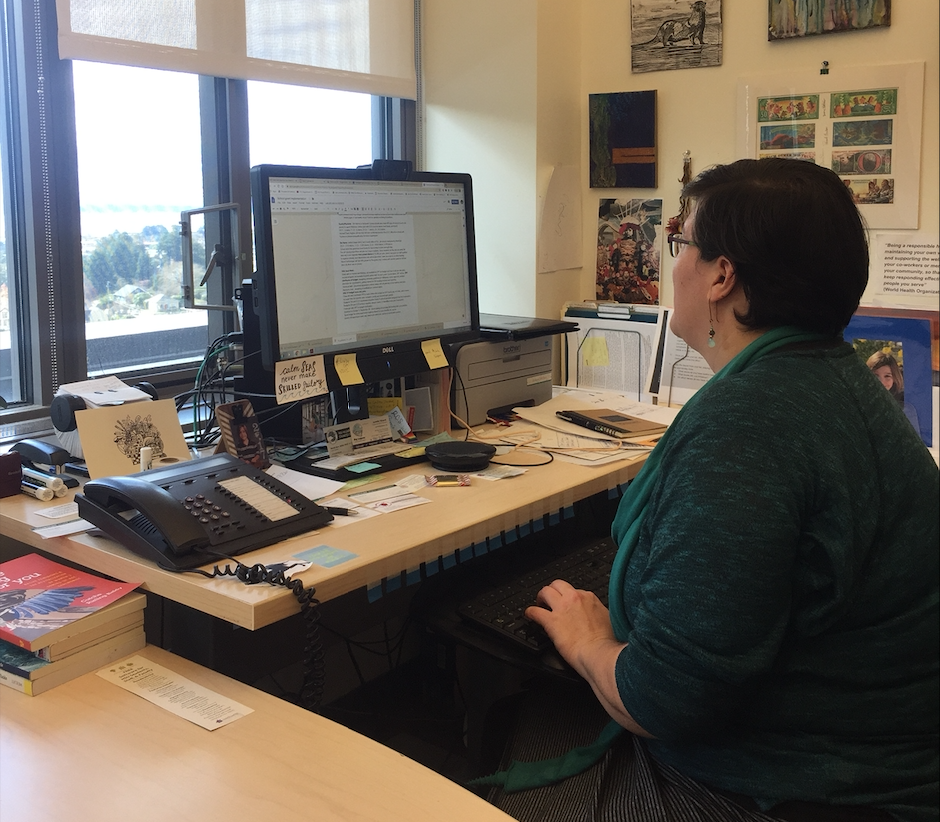
“We’re doing everything we can to help minimize the risk of exposure for students and Student Health and Counseling staff by limiting as much face-to-face contact as possible,” HSU Director of News and Information Aileen Yoo said. “For emotional support, for instance, students can talk to a CAPS counselor over the phone and, in most cases, if preferred, Zoom.”
The Health Center is still offering other essential services like prescription refills and COVID-19 testing.
“For those who are sick or suspect they have COVID-19, we have urged them to call before visiting the health center,” Yoo said. “When it comes to COVID-19, our main focus is assessing the student and collecting swab samples if we think that’s necessary.”
“It is normal to have ebbs and flows with your mood and productivity levels but if you get “stuck” in a dark space for an uncomfortably long time, consider reaching out to get help such as from a counselor at CAPS.”
Jennifer Sanford, director of Counseling and Psychological Services and associate director of student health and wellbeing
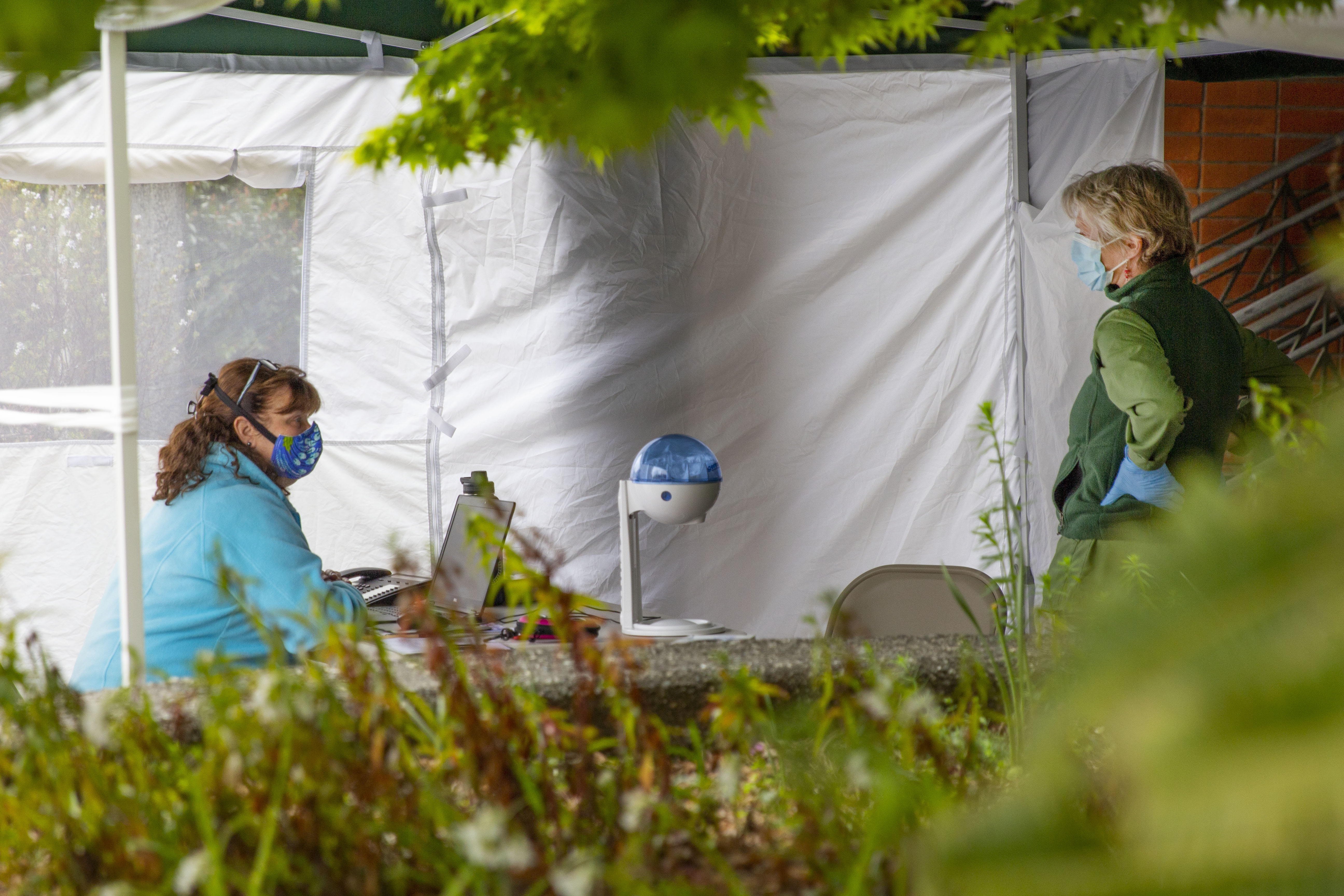
The Health Center set up white triage tents in front of the building to help students check in and get assessed. If a student tests positive for COVID-19, the Health Center will work with county health services to make sure the student gets the treatment they need.
During a pandemic, the disease itself isn’t the only medical problem facing students. The Center for Disease Control warns the stress of a pandemic can cause or worsen mental health problems, and recommends calling a health care provider if symptoms persist.
The Director of Counseling and Psychological Services and Associate Director of Student Health and Wellbeing Jennifer Sanford asked students to consider reaching out to Counseling and Psychological Services if they feel their mental health is deteriorating.
“Pay attention to how your thoughts and attitudes in any given moment are impacting your mood and overall wellbeing,” Sanford said. “Talk with others, connect. It is normal to have ebbs and flows with your mood and productivity levels but if you get “stuck” in a dark space for an uncomfortably long time, consider reaching out to get help such as from a counselor at CAPS.”
Sanford said that this can be an uncertain time, but it’s important to see social distancing as community care.
“The reality is that in our physical distancing, we are displaying compassion and care for our elderly and medically compromised,” Sanford said. “We are allowing our healthcare system to better manage the flow and care of patients, and we are caring for ourselves by lessening our own risk.”
There’s never been a better time to start reading books
You’re stuck inside. You’ve already watched all the best shows on Netflix. You’ve already done your homework. Instead of wasting away the hours on social media, do something good for yourself and your mental state. Read a book.
Maybe you’ve never read a book for fun, but don’t let that discourage you. Reading is for everyone. You don’t have to be an intellectual to enjoy books.
Listed below are a few my favorite books—hopefully you can find something to check out.
If: you want to read a dystopian satire set in a world eerily similar to our current pandemic-stricken one,
Where should you buy a book if you want to pick one up?
I always recommend supporting your local, independent bookstores, especially right now. Each book above is linked to Powell’s bookstore—probably the most famous independent bookstore, located in Portland, Oregon.
If you’re in Arcata, you can order books online from Northtown Books and pick it up on the curb as of March 25. You can also order a book from Tin Can Mailman, which is shipping orders of $10 or more for free to anywhere in Humboldt, and orders of $40 or more for free outside Humboldt.
Mental health grant seeks to address adverse childhood experiences in Humboldt
A new $5 million grant from the U.S. Department of Education will be placing Masters of Social Work students at Humboldt State University in Eureka City Schools and Del Norte County schools as stipend workers.
“The grants themselves are funding positions at Eureka City Schools and also the Del Norte Unified School District,” Director of Field Education at HSU’s Department of Social Work Yvonne Doble said. “It’s actually a full time benefited position that’s being brought on at the school side to support our students.”
Announced Nov. 20, the funds will come from the U.S. Department of Education Mental Health Service Professional Development Program.
Nearly $1 million of the grant will be going to Humboldt State to help support the students and get them prepared for applying for the Pupil Personnel Services Credential, which is necessary for social work students to be hired by schools.
“A large portion of that is coming specifically for the stipends for the students,” Doble said. “We plan to offer a class for stipend recipients, where they will receive faculty guidance and support regarding school social work practice.”
The grant will be placing Masters of Social Work students at HSU in varying levels of schools throughout Del Norte and Humboldt Counties.
“It looks like we are going to have eight students this next fall, maybe more, and that will move up to 13 to 15 students by year four of the grant,” Doble said.
“Our region, for a number of reasons, has California’s highest ACEs rates in Humboldt and Del Norte County,” Jack Bareilles, the Northern Humboldt Union High School District grants administrator and an author of the grant, said. “You’re looking at approximately a third of all kids are being raised in families with four or more of the ten ACEs. So there is just a real need for that here, and I believe that’s one of the reasons we got funded.”
A graph taken from the HSU California Center for Rural Policy Sept. 2017 report on adverse childhood experiences.
ACEs can include things like alcohol and drug use or violence in the home, housing insecurity and food insecurity.
“Locally, there is a real need for support for students and support for families,” Bareilles said. “Social workers are uniquely qualified to provide, and that being said, we actually have a real shortage of social workers in the schools. It’s just something that we haven’t had before.”
Bareilles said the shortage comes from the lack of PPS credentials for students, and also because social workers, which are different from counselors and school psychiatrists, are mainly used in larger cities. Now, the PPS credential will be offered at HSU.
“Kids and schools and families will be helped, and when push comes to shove, that is the most important thing.”
Jack Bareilles
“The role of school social workers is to really help address social and emotional needs of our students,” Doble said. “It’s not just about academic counseling. It’s about providing resources to children and families. It’s about providing opportunities to developers, opportunities to repair harm that’s occurred.”
Bareilles said doing social work in school systems differs greatly from social work in other categories because the public schools operate under different processes than normal organizations.
“Having these interns work two days a week for a whole year working in a high school or middle school or elementary school, they will emerge from their MSW program with a real sense of, ‘Oh this is how schools work,’” Bareilles said. “So whether or not they are employed as a school social worker or some other child-serving social worker, they will really have a better ability of connecting the dots and getting kids what they need.”
Bareilles said the grant is a huge win for mental health support in Humboldt County and will help provide many troubled youths with the resources and personnel that they need.
“Kids and schools and families will be helped, and when push comes to shove, that is the most important thing,” Bareilles said.
HSU’s CAPS is working to combat mental health concerns among HSU students
Rates of attempted suicide in Humboldt County stand far above national and state averages, according to Humboldt State University Health Center Director Brian Mistler, Ph.D.
“Suicide attempt rates in Humboldt County are nearly twice the national and California averages,” Mistler said in an email response facilitated by HSU Communication Specialist Grant Scott-Goforth. “And HSU students face greater systemic barriers to access health care than in other more affluent and less isolated parts of the country.”
An estimated 40% of HSU students felt elevated levels of depression according to a 2016-2017 Healthy Minds Study led by Daniel Eisenberg, Ph.D of the Healthy Minds Network, which performs web-based mental health surveys on college students.
Eisenberg has been leading an analysis of student mental health at all 23 California State Universities. In the 2016-2017 analysis of HSU, an estimated 42% of students had elevated levels of anxiety, while an estimated 4% of students attempted suicide in the last year.
Mistler tied Humboldt County’s lack of expert services to mental health.
“…HSU students face greater systemic barriers to access health care than in other more affluent and less isolated parts of the country.”
Brian Mistler, Humboldt State University Health Center Director
“Mental health is a critical basic need and it’s tied to others like having enough food, shelter and physical health care and safety,” Mistler said in the email. “Psychological needs become more important as chronic resource insecurity increases.”
Mistler clarified that HSU’s relatively high rates of mental health conditions do not appear to be caused by Humboldt itself.
“From what we know today, the increased needs among students appear to be present on the first day,” Mistler said in the email. “That is, it’s not caused by being here.”
Mistler added that many HSU students may arrive with a history of limited health care access.
“It’s also true that many students arrive at HSU having not had access to their fair share of health and counseling services in the past,” Mistler said in the email. “It’s clear from all the data that HSU’s team of health experts do a phenomenal job of helping those students who choose to seek help.”
Counseling and Psychological Services Staff Psychologist and Outreach Coordinator Dr. Elizabeth McCallion in a CAPS office on Oct. 1. McCallion said most students who visit CAPS report positive experiences. | Photo by James Wilde
HSU Counseling and Psychological Services Staff Psychologist and Outreach Coordinator Dr. Elizabeth McCallion is one of the experts working to help students.
McCallion hopes to mitigate the stigma around mental health.
“Mental health support doesn’t just have to be for when you’re having severe symptoms,” McCallion said. “It can be a way of just generally taking care of yourself. Kind of like preventative health care.”
McCallion said CAPS is working to meet students where they are, including through library SkillShops and outreach by Multicultural Specialist Cedric Aaron.
McCallion praised HSU’s mental health services but did acknowledge a lack of services in the surrounding community.
“I think in terms of the counseling center, the counseling center does a wonderful job with that support,” McCallion said. “In terms of our community, there is a need for additional mental health care. But that’s not just mental health, that’s health care in general because of where we live.”
Both McCallion and Mistler emphasized that those students who do use HSU’s services see verifiable benefits.
“Dozens of studies confirm that medical and counseling services reduce the risk for students of catastrophic outcomes, help with anxiety and depression, and increase the chances of students graduating,” Mistler said in the email. “If there’s a message here, it’s to encourage people to use the available resources.”
Mistler noted that HSU’s outreach efforts have produced an increase in student visits to counseling services of about 5% each year.
Mistler also pointed out that students that receive counseling show improved retention rates and a higher likelihood of graduating.
Mistler and Eisenberg plan to prepare a CSU-wide analysis of mental health in spring 2020, which they hope will provide more information on the state of student mental health.
Per the CAPS website: You can reach a CAPS therapist by phone at all hours at (707) 826-3236. In emergency situations, you should call Humboldt County Mental Health at (707) 445-7715 or dial 911.
You may also reach the National Suicide Prevention Lifeline at 1-800-273-8255.
2014 bus crash survivor now turned activist, Santiago Calderon shares his story
In 2014, a Spring Preview bus trip filled with many prospective students travling to HSU from southern California was cut short when a Fedex truck collided into it. Five years later, bus crash survivor and activist, Santiago Calderon continues to fight and share his story to save more lives.
Santiago Calderon holds his cat Henny as they swing on his porch swing. | Photo by Dajonea Robinson
[perfectpullquote align=”right” bordertop=”false” cite=”Santiago Calderon” link=”” color=”” class=”” size=”16″]“I escaped to survive. I was pulled out by God, by some entity and landed head first on my shoulder from the charter bus window.”[/perfectpullquote]
Calderon went to Oxnard high school located in North Oxnard and graduated in 2014. He is now 22 years young and has a cat named Henny. Calderon played football for 10 years and had plans of continuing his football career in college but, the bus crash changed it all. Calderon said the crash took his life away from him.
“Football was my life, it was everything,” Calderon said. “I escaped to survive. I was pulled out by God, by some entity and landed head first on my shoulder from the charter bus window.”
[perfectpullquote align=”left” bordertop=”false” cite=”Santiago Calderon” link=”” color=”” class=”” size=”18″]“I saw death, I saw war, I saw trauma, torment… I saw hell on Earth.”[/perfectpullquote]
Calderon said he has vivid flashbacks of the collision. He said the visual of the red Fedex truck crossing the median right before impact, is screwed into his brain. Calderon described that day as the worst day of his life.
“I saw death, I saw war, I saw trauma, torment, I saw hell on Earth,” Calderon said. “That day I accepted death because I didn’t think I was going to make it. I told myself I’m not going to live in fear, to have happy thoughts before I die. I started thinking about my family. The life that I’m losing.”
Calderon said that during the collision he felt everything, and nothing at once. That he felt numb, completely numb. Calderon said that at some points he was so distraught couldn’t believe it and told himself that he was hallucinating.
“I remember asking the paramedics ‘Is this real?’and then I began to cry,” Calderon said. “Part of me died on that bus, I don’t know who I am anymore. I don’t know who I was before. I was broken, shattered in pieces and so much more after the crash.”
Satiago Calderon’s mother, Corinne Pinon looks off into the distance. | Photo by Dajonea Robinson
Corinne Pinon is Calderon’s mother. She and her family has been Calderon’s backbone since the crash and continues to deal with the after effects that stemmed from the incident. Pinon described Calderon before the accident as a great athlete, a honors student, and a happy carefree kid.
“The therapist said back then he lost his childhood that day, he was only 17,” Pinon said.
[perfectpullquote align=”right” bordertop=”false” cite=”Corinne Pinon” link=”” color=”” class=”” size=”17″]“Our family is barely holding on by a string to continue to help him. He is not a happy person. He has survivor’s guilt.”[/perfectpullquote]
Pinon said that her family is still healing and learning how to cope from the crash. She said that she’s not sure what’s the right or wrong thing is to do but her family keeps on trying.
“Our family is barely holding on by a string to continue to help him,” Pinon said. “He is not a happy person. He has survivor’s guilt. Like [Calderon] said, it’s easier if he didn’t make because living with this, even for me, his dad and his brother, is pretty unbearable.”
Pinon said Calderon is definitely a different person than he would have been if the crash didn’t happen.
Calderon suffers from mental health issues that stemmed from the crash. He was diagnosed with PTSD and bipolar disorder. He has tried therapy but is now trying PTSD groups and other programs.
Calderon went to HSU for four years and studied psychology to learn how the mind and how people function. Calderon had a psychotic break in May and had to move back home down south from Humboldt County. He described the episode as a very dark moment in his life.
Calderon said he’s not done recovering. He said the crash lead to PTSD related actions he never thought he’d make. That the crash caused chaos in his head, and the over analyzing of everything.
“I’ll go into a room and I’ll figure out how to get out alive,” Calderon said. “I’ll do everything I can to stay alive. I feel like everywhere I go I’m going to die. That’s a scary feeling, it’s something I learned to live with. Something that has given me such strength and courage.”
Calderon said that he’s in a continuous fight. When he’s low he sometimes has suicidal thoughts, and feels that it’d be easier just to stop but that is not what his God wants.
“I will not be afraid, I have no fear in my heart, I have no fear,” Calderon said. “ I went through hell on earth. I will never stop recovering. How could you be normal after something like that? You can’t. I’ll never be the same person. I lost Santi that day but a new Santi arose a stronger Santi.”
Angelica Espinoza is a close friend of Santiago Calderon. She is pictured outside of Calderon’s home on a tie swing. | Photo by Dajonea Robinson
Angelica Espinoza is a close friend of Calderon. They have a relationship that heals each other when they’re both down. Espinoza said that they reunited at a good time because they were both in a dark place struggling with depression.
“We just talked about healing, we didn’t talk about the crash,” Espinoza said. “It’s really a brotherly/sisterly bond with a lot of caring and deep conversations. We talk a lot of scripture. We’ve been finding answers through scriptures.”
Calderon received various emails from news agencies after the incident. Calderon said that he came across a message from a man named Harry who is the executive of the Truck Safety Coalition.
Calderon said that Harry’s message was different. The coalition was fighting against unjust policies that would make roads even more dangerous and, that was something Calderon wanted to be apart of.
“A truck is like a moving missile on the highway,” Calderon said. “That was a missile, the bus exploded-the charter bus exploded. What if the ruck was 22 feet longer and went 22 feet more into our bus? More people would have died.”
Corinne Pinon, Santiago Calderon, and Angelica Espinoza sit on Calderon’s family porch. | Photo by Dajonea Robinson
Every two years the coalition has a conference in Washington D.C. to fight against unjust trucking policies. The coalition educates themselves of the laws and policies that are in the works to better create ideas to stop them.
[perfectpullquote align=”left” bordertop=”false” cite=”Santiago Calderon” link=”” color=”” class=”” size=”16″]”We have to prepare for war, because we’re fighting for change. We’re fighting for policies that should never happen. We’re fighting for safety procedures that should happen.”[/perfectpullquote]
Calderon said the coalition plans on fighting a good fight. This year Calderon and his truck coalition members will be in Washington D.C. July 13 through 17 for a week of action.
“We have to prepare for war, because we’re fighting for change,” Calderon said. “We’re fighting for policies that should never happen. We’re fighting for safety procedures that should happen.”
Calderon has been apart of the coalition since 2015 and has been striving to save lives ever since.
“I don’t know where I would be if I didn’t have my truck coalition family behind me,” Calderon said. “They are my family. I would be more lost than I am. The coalition makes me feel like I never went through it. To gain such hope, such courage, we’re like any army fighting against injustices.”
Calderon does not plan on giving up and succumbing to the obstacles life throws at him. He feels as though he’s doing godly work.
Santiago Calderon sits on his porch in southern California. | Photo by Dajonea Robinson
[perfectpullquote align=”right” bordertop=”false” cite=”Santiago Calderon” link=”” color=”” class=”” size=”16″]“If I could, I would die for everyone if that meant for everyone to be good. Saving lives is everything I do.”[/perfectpullquote]
Calderon wants to be a vessel of God. He wants to let the light shine brighter than it has been before. He feels that he is the light in this world of darkness.
“If I could, I would die for everyone if that meant for everyone to be good,” Calderon said. “Saving lives is everything I do. I want to hear laughter, I want to see joy and people’s pearly whites. I want the injustices to stop. I want people to hear us and see us. I want truck services to care about truck safety and to actually listen. All we’re trying to do is save lives. That’s all we want.”
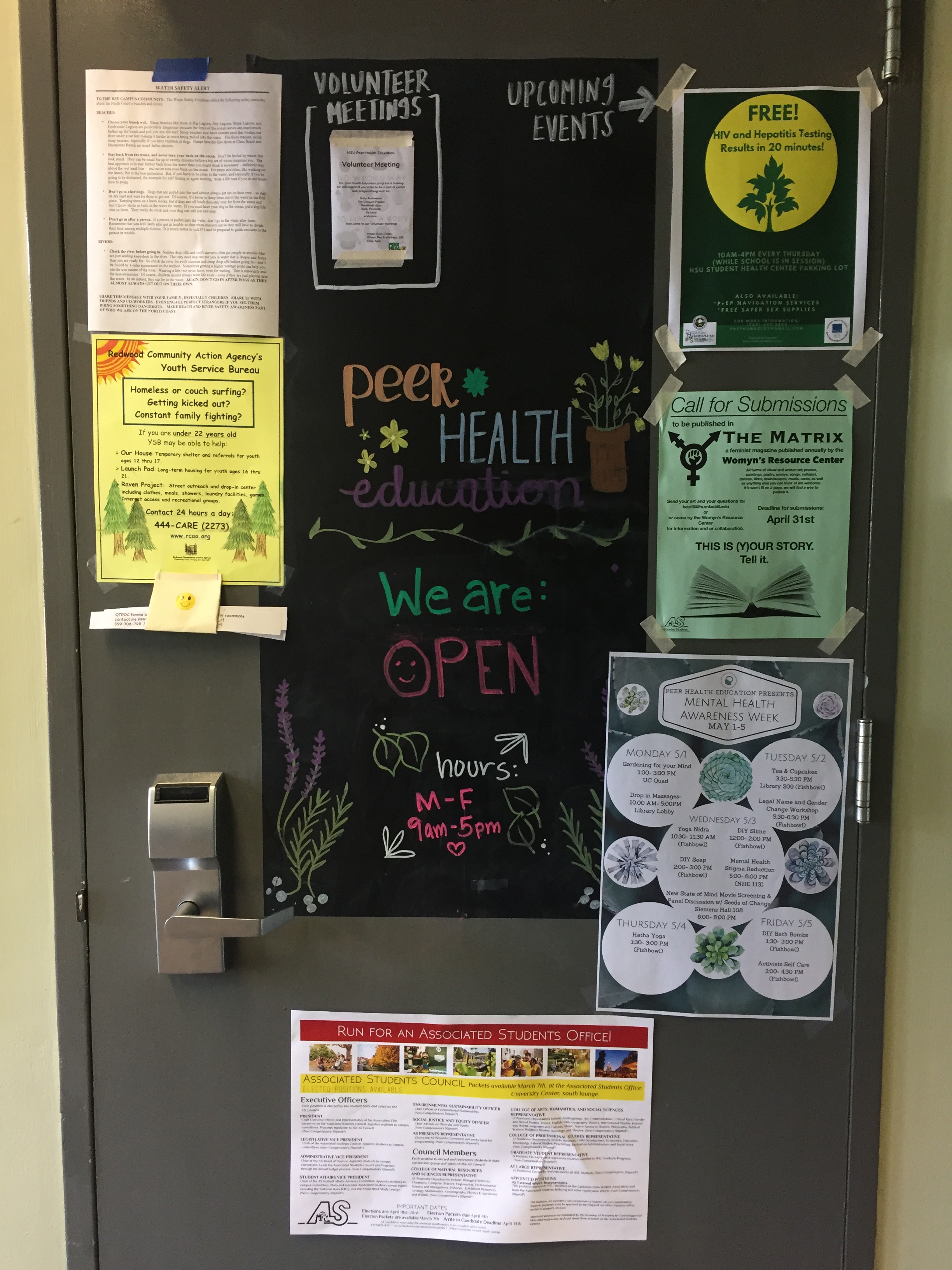
The Peer Health Educators are hosting various workshops around HSU campus during Mental Health Week from May 1-5. They’ve finalized all the workshops for the students to enjoy, including yoga lessons, massages and how to make bath bombs. Lizzie Alvarez, the coordinator of Mental Health Week, believes people forget to care for themselves because they’re so focused on homework and papers.
“Self care is increasingly important,” Alvarez said.
Christina Cole adds that it’s not only finals that students stress about. With the news of David Josiah Lawson’s death and other personal factors, the semester can be draining to students.
“It makes times like this more important to check in,” Cole said.
Alvarez and Ani Glenn suggest studying in parts, not cramming everything in at once to ease the strain of finals. Late night study sessions are not mentally or physically healthy because lack of sleep can affect your grade. Planning what to study and organizing time can be overall helpful and beneficial.
Peer Health Educators are a social justice focused program consisting of students who educate fellow students on mental, physical and sexual health. For more information on Peer Health Educators, visit their office in RWC 127, open 9 a.m.-5 p.m. Monday-Friday. For disability accommodations, email ravin@humboldt.edu.
This website uses cookies to improve your experience. We'll assume you're ok with this, but you can opt-out if you wish. Cookie settingsACCEPT
Privacy & Cookies Policy
Privacy Overview
This website uses cookies to improve your experience while you navigate through the website. Out of these cookies, the cookies that are categorized as necessary are stored on your browser as they are essential for the working of basic functionalities of the website. We also use third-party cookies that help us analyze and understand how you use this website. These cookies will be stored in your browser only with your consent. You also have the option to opt-out of these cookies. But opting out of some of these cookies may have an effect on your browsing experience.
Necessary cookies are absolutely essential for the website to function properly. This category only includes cookies that ensures basic functionalities and security features of the website. These cookies do not store any personal information.
Any cookies that may not be particularly necessary for the website to function and is used specifically to collect user personal data via analytics, ads, other embedded contents are termed as non-necessary cookies. It is mandatory to procure user consent prior to running these cookies on your website.