The Lumberjack


Students Serving The Cal Poly Humboldt Campus and Community Since 1929

Tag: NASA

  • NASA Engineer Jessica Bowles-Martinez speaks to students on Humboldt campus

    NASA Engineer Jessica Bowles-Martinez speaks to students on Humboldt campus

    by August Linton

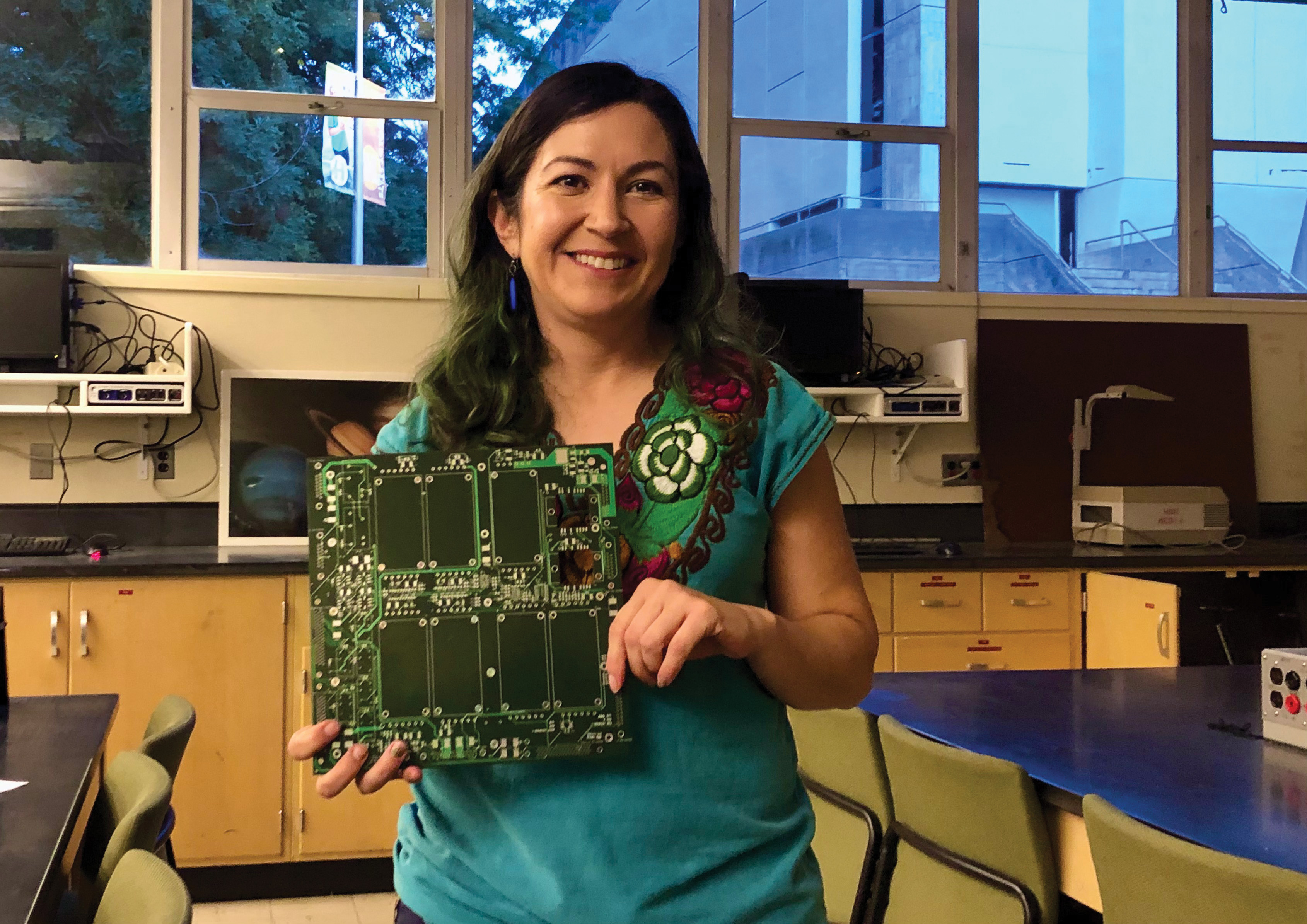
    Jessica Bowles-Martinez, an ex-NASA engineer and “systems engineer, aka science wrangler,” spoke to Cal Poly Humboldt students on Monday. About 20 attendees gathered in Science A 475, sipping coffee and hot chocolate as late-afternoon gray rainy light filtered through the windows.

    The seminar, “Wrangling Scientists and Engineers to Make Something Awesome – Systems Engineering” was put on by the CPH Physics Department. It focused on Bowles-Martinez’s role in various NASA projects, defining what a systems engineer’s role is in these exacting and large-scale endeavors. 

    After graduating high school in Fresno, California, Bowles-Martinez attended MIT where she majored in electrical engineering, computer science, and media studies.

    In her 13 years working at NASA’s Pasadena-based Jet Propulsion Laboratory (JPL) Bowles-Martinez was on the team for many high-profile projects. She worked on New Horizons, which was the first probe sent to explore Pluto up close, as well as the OPALS (Optical Payload for Lasercomm Science) laser data transfer project on the ISS. Her other projects include the Perseverance Mars rover and the Europa Clipper, which will fly by Jupiter’s fourth-largest satellite and assess it for markers of life. 

    As a systems engineer, Bowles-Martinez’s role on projects is to facilitate communication and collaboration between the science team, engineering team, and the team that actually builds the finished design. 

    “It’s not just checking the boxes, it’s about ‘does it all work together?’” she said. 

    There were many problems which the OPALS team had to contend with to ensure a successful outcome, according to Bowles-Martinez. The entire project, which was attached to the outside of the ISS, was a test of an experimental method of data transfer, which would add the capability to send high-res video from the station. The laser used on the module was potentially dangerous to the astronauts on board the ISS, so there needed to be extensive safety measures around its deployment. 

    “Because this laser is class 4, if an astronaut looked at it they would go blind. So we had to figure out how you make a system that will be safe enough to have it be on the space station and shoot this laser down to Earth; all the safety controls are there,” Bowles-Martinez said. “My job is to be in the middle of everyone on that type of stuff.”

    As a systems engineer on the Perseverance rover, Bowles-Martinez worked on the systems which brought the rover safely down from orbit onto the planet’s surface, as well as the systems which launched the Ingenuity Mars helicopter from the main body of the rover. 

    To physics and engineering students hoping for a career in NASA, Bowles-Martinez stressed the importance of internships and especially programming experience. 

    Systems engineering is a little-known field, but absolutely essential to every NASA endeavor. 

    “It’s a really intricate science dance, almost,” Bowles-Martinez said.
  • How the Redwoods are Battling Climate Change

    How the Redwoods are Battling Climate Change

    While the rest of the planet suffers, what will become of the Redwood Forests?

    While climate change continues to cause destruction around the globe, scientists are finding hope in a local tree: The Giant Redwood, or Sequoiadendron giganteum.

    The trees are currently in the midst of a growth spurt, producing more wood in the past century than any other time in their lives, according to Save The Redwoods League, a nonprofit organization who protect and restore the California redwood forests. Researchers from Humboldt State University, UC Berkeley, Natureserve, United States Geological Survey and Colorado State University are working alongside Save The Redwoods League to understand the growing trees and how they will continue to respond to climate change.

    The Save The Redwoods League and HSU published findings concerning the impact of climate change in the recent research paper Aboveground biomass dynamics and growth efficiency of Sequoia sempervirens forests. They found that within the redwood forests, there are massive amounts of carbon sequestration. “Sequoia forests may be the most effective to [sequester carbon], because they accumulate more above ground biomass than any other vegetation, sustain higher rates of productivity than any other forest, and protect biomass produced via superlative fire- and decay-resistance.”

    Carbon sequestration is “the capture and secure storage of carbon that would otherwise be emitted to, or remain, in the atmosphere,” according to Encyclopedia of Energy, 2004. This means carbon is trapped in forests, soil, or oceans for long periods of time instead of entering the atmosphere. It can be done naturally or artificially, and is becoming a researched effort to delay global warming which is caused by increase of greenhouse gases, such as carbon dioxide.

    This is why scientists are so interested in the natural carbon sequestration of the redwood forests. While this seems to be good news, there is still much research to be done.

    NASA scientists have started to create a global map of where carbon is being stored, and how much carbon is being released through deforestation. The redwood forest is only a tiny part of that map.

    Humboldt State University Professor Steve Sillett has worked on the research with Save the Redwoods League.

    “Redwoods can do little to fight climate change as they occupy a TINY proportion of the landscape,” Sillett said in an email. “Even though they are impressive in many respects, too little of the landscape is covered by them to make much difference at the global scale.”

    While the redwoods alone cannot create a global change, scientists are continuing to research the storage of carbon in forests and what this means for the future of the planet.

  • Humboldt State Has Trees Grown from Seeds That Went to the Moon

    Humboldt State Has Trees Grown from Seeds That Went to the Moon

    Here’s how HSU received the trees and where you can find them

    Humboldt State University has a handful of redwood trees grown from seeds that went to the moon.

    In 1971, astronaut Stuart Roosa brought around 500 tree seeds with his personal items on the Apollo 14 NASA mission to the moon. Roosa intended to test the seeds to see if space radiation would affect their germination. While he never set foot on the moon, he orbited the moon 34 times while his colleagues walked the lunar surface.

    When Roosa returned, he sprouted most of the seeds. NASA then sent the seedlings around the world. Around 1976, HSU received a handful of redwood seedlings and planted them around campus. Some of those trees remain near the theatre arts and natural resources buildings and near the Campus Center for Appropriate Technology and Facilities Management.

  • Trump watch (April 19 to April 25)

    Trump watch (April 19 to April 25)

    President Donald Trump would like to reduce corporate tax from 35 percent to 15 percent. The president ordered White House aides to draft a tax plan that slashes the corporate tax rate on Monday.

    President Trump and the first lady visited the Walter Reed Medical Center to award the first Purple Heart under his administration to Army Sergeant Alvaro Barrientos.
    During a video conference with NASA astronaut Peggy Whitson, who set a new record for most time spent in outer space, President Trump said to her that he wanted a Mars landing by his second term and that he wanted to speed up that process.

  • Discovery of new solar system

    Discovery of new solar system

    By Domanique Crawford

    With NASA’s recent discovery of seven earth-sized planets orbiting a small star, who’s to say extraterrestrials don’t exist? The cosmic possibilities may be endless.

    “It’s definitely possible,” said  HSU history major Cameron McDermid. “It’s not going to be like the way we think of extraterrestrial life though. If anything they will probably be like little tiny microbes growing around.”

    The discovery of the new solar system has astronomers hoping to discover the existence of extraterrestrials. According to a study published in the Journal Nature, “one aim of modern astronomy is to detect temperate, Earth-like exoplanets that are well suited for atmospheric characterization.” Much of modern-day space travel involves a search for planets capable of sustaining life.

    A Belgium research team led by Michaël Gillon, astronomer from the University of Liège in Belgium, found the first three planets of the  solar system using the transit method. To perform this method, the research team used the Transiting Planets and Planetesimals Small Telescope, also called Trappist, to observe the star light around a dwarf star called Trappist-1. Researchers find planets by watching the starlight for periodic blocks of shadow, indicating a planet is orbiting the star. After the discovery of the first three planets, the last four were discovered using NASA’s Spitzer Space Telescope.
    The study reports that  Trappist-1 is about 40 light-years away. Trappist-1 is classified as an ultra-cool star. Not only is the star small, but it is low energy and low temperature. Some astronomers question whether or not the star is big enough to sustain the orbiting planets. Trappist-1 is only 8 percent of the mass of the sun. According to HSU astronomy professor Paola Rodriguez Hidalgo, if the planets are close to the star, the star should still generate enough energy to support the surrounding planets.  

    “They are so close in some cases that when a year for us is 365 days that it takes the earth to go around the sun, in their case it is 20 days,” Hidalgo said.

    The proximities to the dwarf star, the rocky terrains and warm temperatures of three of the earth-like planets, classified as Trappist-le, f, and g-, make them the most likely to sustain life. These three planets also fall into the habitable zone, meaning the area of a planet’s orbit that is close enough to its star to sustain liquid water.