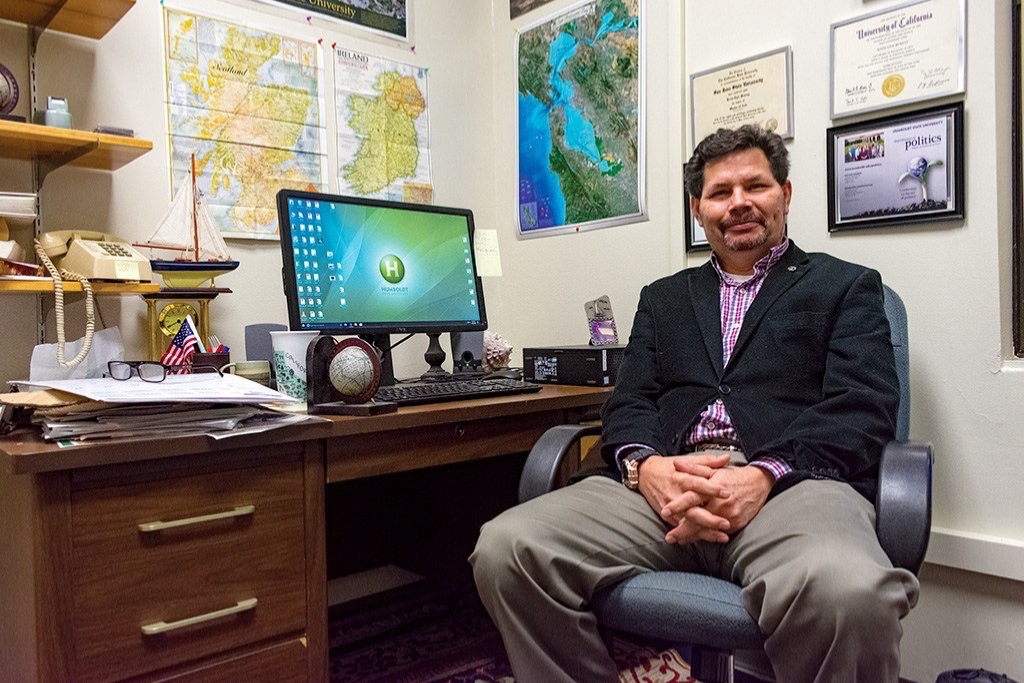
Humboldt State issued a press release today notifying the campus community that it had finished its investigation into a faculty member soliciting students for sex. According to the release, HSU no longer employs the faculty member, but since no formal criminal charges have been filed, the University Police Department is not able to bring charges.
Read the full release below:
HSU Concludes Faculty Misconduct Investigation
Humboldt State University has concluded an administrative investigation into anonymous allegations of faculty misconduct, in which a faculty member was accused of soliciting students for paid sex.
Upon discovery of the allegation, the University took immediate steps to protect students from harm, and the employee subject to the investigation is no longer employed at Humboldt State. Because this is a personnel matter, the University is not able to provide details of the investigation or the outcome. However, the University is confident that it responded strongly and appropriately, and that it reached a resolution that ensures the safety and well-being of our students, faculty, and staff.
The University Police Department has also been investigating the incident for any potential criminal violations and charges. Because no formal criminal complaints have been filed, University Police is not able to bring criminal charges at this time. However, the University Police Department’s investigation remains open.
The University encourages anyone who may have been harmed to seek assistance through the following campus support services.
Counseling & Psychological Services (CAPS) provides a variety of support services. You may make an appointment by calling (707) 826-3236. If you are having a crisis, you may reach a CAPS therapist 24 hours a day at the same number (707) 826-3236.
The Campus Advocate Team (CAT) is an on-campus resource for students, staff, and faculty at HSU. CAT is a program of the North Coast Rape Crisis Team, a private nonprofit organization that has been contracted by HSU to provide specialized services to the HSU community. CAT provides 24-hour, confidential support to any HSU student, staff, or faculty who wants to talk about harm they’ve survived (sexual harassment, sexual assault, dating/domestic violence, stalking), or explore their options for support and/or holding accountable the person who harmed them. CAT can be reached at (707) 445-2881, 24 hours a day. On-campus appointments are available.
The Dean of Students Office can help students navigate the steps of any reporting process and provide support and advocacy while navigating a formal complaint, as well as helping students find resources on- and off-campus to best meet their needs. You can reach the office at (707) 826-3504.
Human Resources handles staff employment as well as Title IX matters and can be reached at (707) 826-3626. Academic Personnel Services handles employment and related responsibilities for faculty, and can be reached at (707) 826-5086.
The University also requests that anyone with information report it to one of the offices listed below. The Title IX Office helps students navigate accountability and accommodation for incidents of harm. The University Police Department, which operates from a trauma-informed perspective, assists with accountability and responds to reports of criminal activity.
Title IX Office, David Hickcox at office (707) 826-5177, cell (707) 296-4032, or david.hickcox@humboldt.edu.
With life disrupted, lecturer Kerri Malloy perseveres with flexibility and humor
A professor noticed students often left Kerri Malloy’s class laughing. One day the professor asked what he was teaching.
“Oh, that’s my genocide class,” Malloy said.
Malloy teaches courses in the Humboldt State Native American studies department on colonialism and genocide. With such somber subjects, Malloy relies on humor and honesty to engage students. Now that classes have gone online during the pandemic, Malloy has employed those traits, alongside plenty of flexibility, to keep students connected.
“The hurdle is going to be maintaining that connection with the students,” he said.
He created class blogs for students to post what they want—questions, memes, dog or cat or reptile pictures. Glance through Malloy’s Instagram, Twitter or Snapchat accounts, and you’ll find lots of memes, like one he posted April 3 on Instagram:
“The year 2020. Brought to you by the letters W, T & F.”
“I think you have to walk into it—at least my plan is to walk into it—with an incredible amount of flexibility.”
Kerri Malloy
“I love a good meme,” he said in one of two Zoom interviews. He sat in his home office. Behind him, family photos and a Star Wars Yoda action figure topped a bookshelf. He wore glasses and a button-up shirt.
Memes dominate Malloy’s social media accounts, but there’s more to the accounts than humor. They make him accessible to students. He receives messages on those accounts about class, and he replies happily.
“There are times where I’m like, ‘Why am I doing this?’” he said. “And then I realize, I’m getting to see a different side of students, and my colleagues, too.”
Malloy also emphasized the importance of flexibility.
“I think you have to walk into it—at least my plan is to walk into it—with an incredible amount of flexibility,” he said. “And let them—let the students—help guide where we’re going to go.”
Yurok and Karuk by heritage, Malloy was born on the Oglala Lakota Reservation in South Dakota, but he grew up on the Quinault Indian Nation Reservation in Washington.
Marlon Sherman, chair of the HSU NAS department, knew Malloy from working together for the Yurok tribe. Sherman and Malloy have a family connection, as Sherman grew up on the Oglala Lakota Reservation where Malloy was born.
“If it wasn’t for Kerri, there might not be a NAS department right now.”
Marlon Sherman, chair of the Native American studies department at Humboldt State
After working together for the Yurok tribe, Sherman and Malloy parted. About six years ago, Sherman asked Malloy to come to HSU to teach two courses for a semester.
Shortly after Malloy came on board, Sherman had to take time off. He had cancer. Sherman returned in about a year, but Malloy became program leader and helped steer the department. Sherman said Malloy basically did all the work and helped the department hire two professors.
“If it wasn’t for Kerri, there might not be a NAS department right now,” Sherman said over the phone.
Malloy said Sherman was too generous, but there’s no doubt that Malloy works, a lot—so much so that Sherman joked it might be illegal.
Malloy wakes up around 4:30 a.m. every day. He gets up so early partly because he finds those early hours productive, and partly because his back is built on metal rods and pins that make lying flat for too long unbearable. He’s not exactly sure how he damaged his back—maybe a car accident—but he had to have surgery that put him out of commission for three years.
He estimated he’s on eight to 10 HSU committees, from the University Resources Planning Committee to the Diversity, Equity and Inclusion Committee. Malloy does this while teaching multiple classes as a lecturer—a position with an uncertain future amid HSU’s projected enrollment decline and budget cuts. He joked when asked how he has the time.
“People usually don’t like my answer,” he said. “How do I have the time? A calendar.”
Kumi Watanabe-Schock, a 23-year HSU employee, works in public programming and as the library media coordinator. She first met Malloy when he was an HSU student getting degrees in economics and Native American studies.
Since then, Watanabe-Schock has worked with Malloy on committees and for classes. Every time she talks to Malloy, he seems to be attending workshops or giving talks around the world. She praised his willingness to help out.
“He’s not good at saying, ‘No,’” she said over the phone. “I don’t know if he’s that way with everybody, but when you ask him to do a favor he always follows through and he always says, ‘Yes.’ So I really am appreciative, yeah. He’s a good person.”
When not working, Malloy is more private. He has a husband and three dogs. He has two sisters and 14 nieces and nephews he tries to see every year. Around 8 p.m. every night, he tries to unwind. Maybe he’ll watch some TV, or maybe he’ll read a book about genocide. Fun.
While COVID-19 has pushed teaching online, Malloy has found his courses as relevant as ever.
A key concept in Native American studies is survivance, a portmanteau of survival and resistance. Survivance is about the living of Native American lives in the present tense. By surviving, Natives resist, and by resisting, Natives survive.
Malloy said people must fight right now to have their voices heard, like many Natives must do at all times. He said individual voices humanize current events and prevent people from kicking the ball of reality down the road.
On that note, Malloy told a story. Last summer, he taught Native history in a program that spent two days in Auschwitz I, the main site of the Nazi concentration camp. One day he stopped and looked out a window. The bizarreness of the situation dawned on him. Here they were, decades later, standing in a place of horror and trying to learn from it.
A window at Auschwitz I, the main site of the Nazi concentration camp on August 20, 2019. | Photo courtesy Kerri Malloy
Later that night he received an email from then-HSU President Lisa Rossbacher. She was checking in, so he wrote back.
“If we can educate in such a place of incredible horror and death, we have the ability to change the world,” he remembered writing. “We really do. If we can actually go into these places and find this incredible darkness and turn it into something that allows us to reach out to other human beings and get us to talk to each other and push the things that really don’t matter aside, I think we can do this.”
To get people to talk, Malloy uses humor, which he said can get us past anything—and Malloy does seem capable of getting past anything. It seems strange to call research on genocide a passion, but Malloy approved the descriptor.
“Passion’s a good word for it, actually,” he said. “You’ll find that for those of that this is what we do, it is a passion.”
Every student interviewed for this story agreed on a few descriptions of Malloy. He’s open and funny, they said, and he can be brutally honest. They warned against getting into an argument with him.
“If you’re gonna have an argument with him, you better have good stats and have all your ducks in a row, because you’re not gonna win Kerri in an argument—I’ve tried,” HSU biology major Michelle Navarette said over the phone.
“And he told me, like, ‘You can’t let the system fuck you up and throw you down.’”
Michelle Navarette, Humboldt State biology major
Navarette, a senior, first had Malloy for a 9 a.m. general education course. Once she got to know him, she tried not to miss his class. Since that first course, she’s tried to have a course with him every semester.
Navarette’s appreciation of Malloy goes beyond the classroom. She said she was losing her job last semester due to discrimination from her boss. She didn’t know what to do, so she went to Malloy.
“He sat me down and was like, ‘You know what, this is just a portion of how life is,’” she said. “’You’re gonna have these obstacles all the time.’ And he told me, like, ‘You can’t let the system fuck you up and throw you down.’”
When she thinks of Malloy, she remembers his honesty.
“I think he was like the first person to tell me, ‘This shit is going to be hard.’”
As a lecturer of general education courses, he usually has to work for the attention of students. He goes into his courses hoping for students to leave with more questions than answers. Students have told him he gives too many assignments, but no interviewed students said Malloy graded harshly.
“My philosophy,” he said, “is if I can get one brain cell to function per student on an assignment, we’ve succeeded.”
Malloy once had a student he didn’t think he had triggered any brain cells in. Malloy said the student believed everyone should be committed to a single belief. Malloy respected the devotion, but he worried about the implications.
About a year after the student left his class, Malloy received a message on one of his social media accounts. The student wanted to know if a site he shopped on looked like a hate group.
“I went and checked the site out and went, ‘Yeah, this is definitely an organization that supports anti-Islam—very Islamophobic,’” he said.
The student thanked him and decided to shop elsewhere. Malloy remembered that as a success.
“It’s when you see those little things, you’re like OK,” he said. “Even at some small level, we were able to plant some idea, some seed that is getting people to think differently, or at least question.”
Like many of Malloy’s students, Joshua Overington, an HSU environmental science senior, only took Malloy’s introductory Native American studies course for a general education requirement.
The class was so good Overington signed up for more. He eventually worked with Malloy on the Northwest Genocide Project, an online archive Malloy manages.
Overington also worked with Malloy on a research project on Tuluwat Island for HSU’s IdeaFest, which led into a research paper Overington is now finishing.
“He is incredibly passionate in what he does and he is uncompromising in his views,” Overington said over the phone. ”If Kerri feels something or has an opinion, he always speaks his mind and really, he’s always the one who’s honest and puts himself out there. And that’s not something I see at all in other teachers.”
“If we can make those connections on that level, this is much more understandable. And then we get to be more willing to go, ‘Alright, maybe I need to look in the mirror.’”
Kerri Malloy
Malloy likes to tell people teaching about genocide is fun. People usually give him a blank stare and change the subject. But if asked, Malloy will elaborate.
“And what it means is not fun as in, ‘Yay, happy stuff.’ It means that it’s fundamental,” he said. “Atrocity is a fundamental part of the human existence. Peace is a fundamental part of the human experience. It’s understandable—we can understand why it happened, how it happened, what needs to be done to prevent it. And it’s necessary.”
Malloy knows most people don’t want to talk about atrocities all day. To get past that, Malloy said we have to be willing to look at ourselves.
Malloy tries to relate concepts directly to his students. He sometimes asks if students curate their social media profiles—do they post every photo they take? They admit they do some curating, and he suggested history books do the same.
“If we can make those connections on that level, this is much more understandable,” he said. “And then we get to be more willing to go, ‘Alright, maybe I need to look in the mirror.’”
Malloy teaches because he believes we’re all here to learn. He admits his own ignorance and encourages others to do the same. That openness to learning is perhaps what makes Malloy love his job. His willingness to let students guide his classes is perhaps what makes students love him.
“I tell my students this directly: ‘This is not my class,’” he said. “’This is yours. You guys are the ones who are paying for it. I am just the tour guide on this expedition.’”
Malloy always ends each of his classes—each chapter of the expedition—with the same message.
“Go out and learn something,” he tells his students. “Go out and breathe.”
Alison Holmes, Ph.D. spent her sabbatical researching whether California acts as its own nation
California has the means to be its own nation. It’s big, it’s wealthy and it’s been disrupting the status quo by acting internationally.
“California has been acting outside the box,” Humboldt State University Associate Professor and International Studies program leader Alison Holmes said. “They’ve been going and doing stuff with China, Mexico and Canada. It’s like, ‘Wait, you’re not supposed to do that. That’s not what international relations theory says, it’s not what the U.S. Constitution says, it’s not what all kinds of other rules suggest.’ So how are they doing that?”
Holmes spent her sabbatical last school year researching California and talking with state officials and those the state has dealt with.
In August, Holmes presented her research to the Center for California Studies at Sacramento State University in a presentation called, “California as a Nation-State: Innovative or Inevitable?”
In her research, Holmes found that cities and industries within California may act internationally, but the state itself doesn’t typically act as its own nation.
“We do things internationally but we don’t do them in a coordinated fashion,” Holmes said.
Holmes grew up in Oklahoma, but she moved to the United Kingdom after volunteering in Belfast during college. Holmes lived in the United Kingdom for 25 years, where, among other things, she worked for and advised the Liberal Democrats and worked as the Deputy Head of Corporate Communication Strategy for the BBC.
In 2005, Holmes completed her doctorate in London and then became a speechwriter for Ambassador Robert Tuttle.
“When I worked for the ambassador, I became very interested in international relations and diplomacy,” Holmes said.
California likes to think that it’s an innovator. We’re really big and proud about how we do stuff. And actually we’re not at the front of that innovation edge; a lot of other places in the world have been doing this for a long time.”
Alison Holmes, Ph.D.
When Holmes moved to California, she saw a perfect opportunity for research.
“California makes an excellent case-study, because it is the fifth largest economy in the world,” Holmes said. “But it is a sub-national unit of a huge, hegemonic, vast, largest-nation power.
Holmes said California’s international actions are part of a larger globalization trend.
“What a lot of international relations theory will tell you is that globalization has meant a bunch of people who aren’t nation-states have started to do things on the international stage,” Holmes said.
With this in mind, Holmes said that while California might be innovative for the United States, it isn’t elsewhere.
“California likes to think that it’s an innovator,” Holmes said. “We’re really big and proud about how we do stuff. And actually we’re not at the front of that innovation edge; a lot of other places in the world have been doing this for a long time.”
Holmes also said non-state entities acting internationally brings up questions about the very nature of sovereignty.
“When does a sovereign not have sovereignty?” Holmes said. “At what point do state relations at the international level become a foreign policy? My point here is that our traditional ideas of sovereignty are ill-equipped to describe what we see in the real world.”
Holmes says there are three future goals for California: the establishment of an agency focused on international policy, the honoring of tribal relations and the inclusion of tribes in international policy, and the coordination of city and county international efforts with state efforts.
Holmes ended her research presentation with an urge to take advantage of California’s diversity across all of its communities.
“That is the only way to create a robust local-global citizenship and to turn California’s state-nation vision of unity from diversity into a reality,” Holmes said.
Locally, Holmes said Humboldt is more global than it might think. Holmes urged Humboldt residents to connect local actions with outside, global forces.
“I worry that Humboldt is a little too proud of being the Lost Coast or being behind the Redwood Curtain,” Holmes said. “Privileging what they perceive to be the local over the global, to the point of seeking to disconnect from rather than engage with the world outside.”
Holmes said ignoring global events has consequences.
“If you don’t understand these things, you’re not really paying attention to what’s happening, how you can take advantage of that, how you can be a part of that and how it doesn’t have to roll over you like a steamroller,” Holmes said. “Because otherwise it will.”
However, Holmes cautioned that connecting local issues with the rest of the globe doesn’t mean people should start blaming external forces for all local problems.
“Trying to understand it is not the same as trying to find somebody else to blame,” Holmes said.
Holmes suggested that freshmen coming to HSU would likely benefit from learning intercultural communication strategies that international studies students use.
“There is culture shock,” Holmes said of new HSU students. “There is intercultural communication issues between the different groups of people who turn up here.”
While HSU politics professor and international relations teacher Noah Zerbe said Holmes’ work goes beyond the scope of his expertise, he did agree with the importance of paying attention to the rest of the globe.
“Stuff that happens globally affects us everywhere,” Zerbe said. “It affects us here as well.”
California’s prowess has led some to believe that California should secede from the United States.
Marcus Ruiz Evans, president of Yes California, the largest organization dedicated to California’s secession, said he believes California would be better off on its own.
“The basic idea is that California is held back financially because it’s part of America,” Ruiz Evans said over the phone.
“The basic idea is that California is held back financially because it’s part of America.”
Marcus Ruiz Evans
Ruiz Evans said Yes California and the #CalExit movement started back in 2011. Since then, it has seen significant growth, especially following the election of Donald Trump.
However, Ruiz Evans said that the movement’s growth led to a divide in its supporters that left the movement momentarily stagnant.
“With success came civil divorce,” Ruiz Evans said.
Nevertheless, Ruiz Evans said he firmly believes California should secede. Ruiz Evans said that California, on its own, wouldn’t have to fight with the president or the rest of the country, wouldn’t have to fight with federal immigration laws and would save billions of dollars.
Ruiz Evans also said California is held back politically and financially, and that he believes a split is only logical.
“We think it’s inevitable,” Ruiz Evans said.
Yet, when asked, Holmes put a damper on such enthusiasm.
“I am not sure ‘doing it alone’ is ever a great idea,” Holmes said. “I think while California is rich by many standards, if they had to pay for all the things that the federal government currently does, our situation would change rapidly. California could go that route, but revolutions rarely end well or the way the instigators intended. Be careful what you wish for.”
This story has been changed from its original version on Jan. 25 at 4:24 p.m.
Humboldt State University’s political science professor, Kevin Murray, will be running as a candidate to represent California Assembly 2nd District in the upcoming elections.
Murray has taught college-level political science classes since 1989. He started teaching at HSU in 2015, and plans to take his political experience to the next level.
“I’ve taught political science for around 30 years and I figured it was time to convert that knowledge into action,” Murray said.
Murray is running as a Democrat and bases his political platform on four main issues:
Universal health care for California. Murray believes that every Californian should have full health care coverage in order to vastly improve our quality of life. The universal health care plan Murray wants includes mental health care and drug rehabilitation, helping those who are often ignored.
A green economy. By switching from our over-reliance of non-renewable energies, such as oil, to greener and more sustainable energies, we can help lead the way to show that there is a profitable way to have a green society.
Debt-free college. Murray states that an undergraduate college degree now has about the same equivalent to a high school diploma in the 1940s. Because a college experience is becoming essential to get better jobs, there shouldn’t be as large of a barrier for those with low-income backgrounds. By reducing or completely erasing college tuition, Murray hopes to have college graduates leave without debt hanging over their heads.
Affordable housing. With debt and homelessness on the rise in California, Murray wants to bring peace of mind to Californians by pushing for affordable housing. By introducing rent stabilization, tiny homes and Measure J Housing to the 2nd District of California, Murray plans to fix our states housing problem.
If elected as representative for the California Assembly 2nd District, he will represent several counties such as Humboldt, Trinity, Del Norte and Mendocino. Jim Wood is currently the incumbent representing California Assembly 2nd District.
“It’s a daunting task, but one I’m well prepared for,” Murray said.
Murray says that running for office won’t interfere with his current teaching, as his activism will take place only during weekends and, if anything, will enhance how he teaches.
“I don’t really have anything to lose,” Murray said. “I can take my 30 years of experience into the position or I’ll be able to walk away with the knowledge gained from running and incorporate it into my classes.”
The primary election is coming up on June 5, and the general election is occurring on November 6. If you’re interested in getting into contact with or volunteering for Kevin Murray, head to his website at http://murray4ca.homesteadcloud.com/
This website uses cookies to improve your experience. We'll assume you're ok with this, but you can opt-out if you wish. Cookie settingsACCEPT
Privacy & Cookies Policy
Privacy Overview
This website uses cookies to improve your experience while you navigate through the website. Out of these cookies, the cookies that are categorized as necessary are stored on your browser as they are essential for the working of basic functionalities of the website. We also use third-party cookies that help us analyze and understand how you use this website. These cookies will be stored in your browser only with your consent. You also have the option to opt-out of these cookies. But opting out of some of these cookies may have an effect on your browsing experience.
Necessary cookies are absolutely essential for the website to function properly. This category only includes cookies that ensures basic functionalities and security features of the website. These cookies do not store any personal information.
Any cookies that may not be particularly necessary for the website to function and is used specifically to collect user personal data via analytics, ads, other embedded contents are termed as non-necessary cookies. It is mandatory to procure user consent prior to running these cookies on your website.