The Lumberjack


Students Serving The Cal Poly Humboldt Campus and Community Since 1929

Tag: professors

  • CFA and Teamsters commit to joint strike second week of classes

    CFA and Teamsters commit to joint strike second week of classes

    by Andres Felix Romero

    Originally printed 1/17/24

    After over a year of negotiations with the California State University (CSU) Chancellor’s Office, the California Faculty Association (CFA), which represents lecturers, professors, counselors, coaches and librarians, and Teamsters Local 2010, which represents skilled laborers such as locksmiths, plumbers, painters, etc., have decided to strike during the second week of classes Jan. 22-26.

    This will be the second strike for the Teamsters following their day-long strike across the CSU system on November 14, 2023. As for the CFA, this is their second strike as well, following their series of strikes across select CSU campuses in December 2023. 

    Goals for Strike

    Teamsters such as Housing Locksmith Phillip Bradley and the CFA hope that the combined strike will bring the CSU back to the bargaining table.

    “If you don’t have classes, you’re not going to have students-and if you don’t have students, you don’t have much of a university,” Bradley said. “So honestly, we’re hoping that the threat of [a week without classes] will get us back to the negotiating table, but the ultimate goal of this is to get some fair labor contracts.”

    The CFA in particular is fighting for better aspects in their contracts, such as paid leave for parents, lactation rooms, safer bathroom options and as CFA President Marisol Ruiz highlights as the most important, a wage increase that can compete with the recent 8% increase in inflation.

    “The end goal for us is to get our 12% [wage increase] that we deserve,” Ruiz said. “[The 5% wage increase that the Chancellor’s office is offering] is behind inflation and would mean that we’re getting a pay cut. Are you seeing the gas prices? Have you seen the PG&E bill? Have you seen the food prices? [The Chancellor’s Office] is cutting our salary because it doesn’t keep up with inflation, so we’re doing the same work for less pay.”

    The CSU has previously stated that they lack the funds to accommodate the 12% pay increase. However, Ruiz questions that the CSU lacks the funds, as evidenced by the salaries of the CSU presidents and chancellors, as well as pay increases they receive.

     “If [the CSU system] didn’t have the money, why did the Board of Trustees allow [new CSU Chancellor] Mildred Garcia to [receive] almost a million dollars for her salary?” Ruiz said. “For me, [the Board of Trustees are] not making good decisions. They’re using our taxpayer dollars, our student’s money, to give the rich more, and it’s not trickling down to us, the workers – the ones on the front lines with the students.”

    Potential Impact of the CFA-Teamster Strike on Campus

    Besides classes being canceled, there are more potential and expected impacts on the campus community at large. CFA Faculty Rights Chair and member of the state-wide bargaining team for the CFA, Loren Cannon, explains the extent of the strike for faculty besides lecturers temporarily trading their markers for picket signs.

    “We cannot do any other work,” Cannon said. “There’s no halfway to strike. If somebody said, ‘Hey, I’m not going to teach my classes, but I’m going to answer my students’ emails,’ – we can’t do that. We can be reprimanded. We can be disciplined. We can lose our jobs. So, the laws about striking, it’s gotta be an all-or-nothing.”

    During the week of the strike, the Teamsters and the CFA will be picketing across campus, notably on LK Wood and 14th Street. Ruiz encourages students to support by joining the line throughout the week and hopes that the actions can be a teaching moment. 

    “[The CFA and Teamsters are] modeling,” Ruiz said. “We don’t know what industry [the students are] going to be in, but in any industry, they’re going to have to join a union to protect their wages.”

    Bradley wants to make it clear that the Teamsters’ strike isn’t to attack Humboldt but to send a message to the CSU at large.

    “This strike is not about protesting Humboldt,” Bradley said. “All this is about our collective bargaining with the Chancellor’s Office and the CSU system as a whole. We’ve got good managers and supervisors at Humboldt who have been very respectful and very supportive, and have been going above and beyond.”

    With the Teamsters on strike, there will likely be much deeper impacts on the campus. Bradley explains that the university will likely need to hire outside contractors to keep the basic functions of the campus moving.

    “We have to assume [the university is] arranging to bring in contractors or [other skilled laborers] that cover for leaks or [other repairs],” Bradley said. “But, we all have to go through extensive background checks before we’re hired because, you know, we work around students. And contractors cost more, outsourcing rarely results in long-term savings.”

    On top of the CSU Teamsters being on strike, other Teamsters belonging to other companies and groups will not be crossing the picket line out of solidarity. 

    “It’s a good strike because it’s a [Teamster] sanctioned strike,” Bradley said. “That means all of the other Teamsters won’t cross that line. Food deliveries won’t happen [such as Sysco Foods, which delivers much of the campus dining food]. UPS also won’t deliver. Any other Teamster-related service won’t cross that line. It will probably halt or delay construction on the new buildings [as those Teamsters are also affiliated with those projects.]”

    Despite Sysco Foods not delivering for the campus next week, Assistant Retail Director Carlos Castillo assures that Dining services has prepared for the strike and there will be no expected food shortages.

    “All units are ordering heavy this week in order to get through all of next week,” Castillo said. “So that way, there are no food shortages for the week.”
    What About Those That Can’t Afford to Strike?

    As much as some faculty members would like to strike alongside their colleagues, some simply aren’t able to, as the financial hit of losing pay while on strike would be too much for them. Child Development Professor Larisa Callaway-Cole is trying to find a balance between supporting the action and meeting the needs of her family.

    “I have spent significant time thinking about my position with the strike and have come to the following decision for myself,” Callaway-Cole wrote in an email to her students. “I cannot afford to strike. I am a new single mom, which has come with a significant increase in costs that I am learning to balance. If I were to strike for a whole week, I would not be able to pay all of my bills. That being said, I would like to show solidarity with my union, and will be striking on Friday, January 26.” 

    Why Strike Now?

    Cannon clarifies that he feels the strike could have been avoided if the Chancellor’s Office were negotiating fairly.

    “We weren’t getting anywhere at the negotiation table,” Cannon said. “From my perspective, it just seemed like they weren’t ready to negotiate with us at all. The strike could have been called off if they had brought us something that made sense that we could work with, but I think they just want to act like there’s no union here at all. We said, ‘All right, then the strike is going on.’ This may be the largest strike in the history of higher education.”

    Cannon highlights the importance of the unions standing in solidarity together and taking action towards the CSU system.

    “The CSU does not work without faculty. The CSU does not work without the Teamsters,” Cannon said. “If we don’t make a stand, it’s just going to get worse. It’s going to get worse for faculty members, and it’s going to get worse for students.”
  • The attendance trap: time to set grades free

    The attendance trap: time to set grades free

    by Jake Hyslop

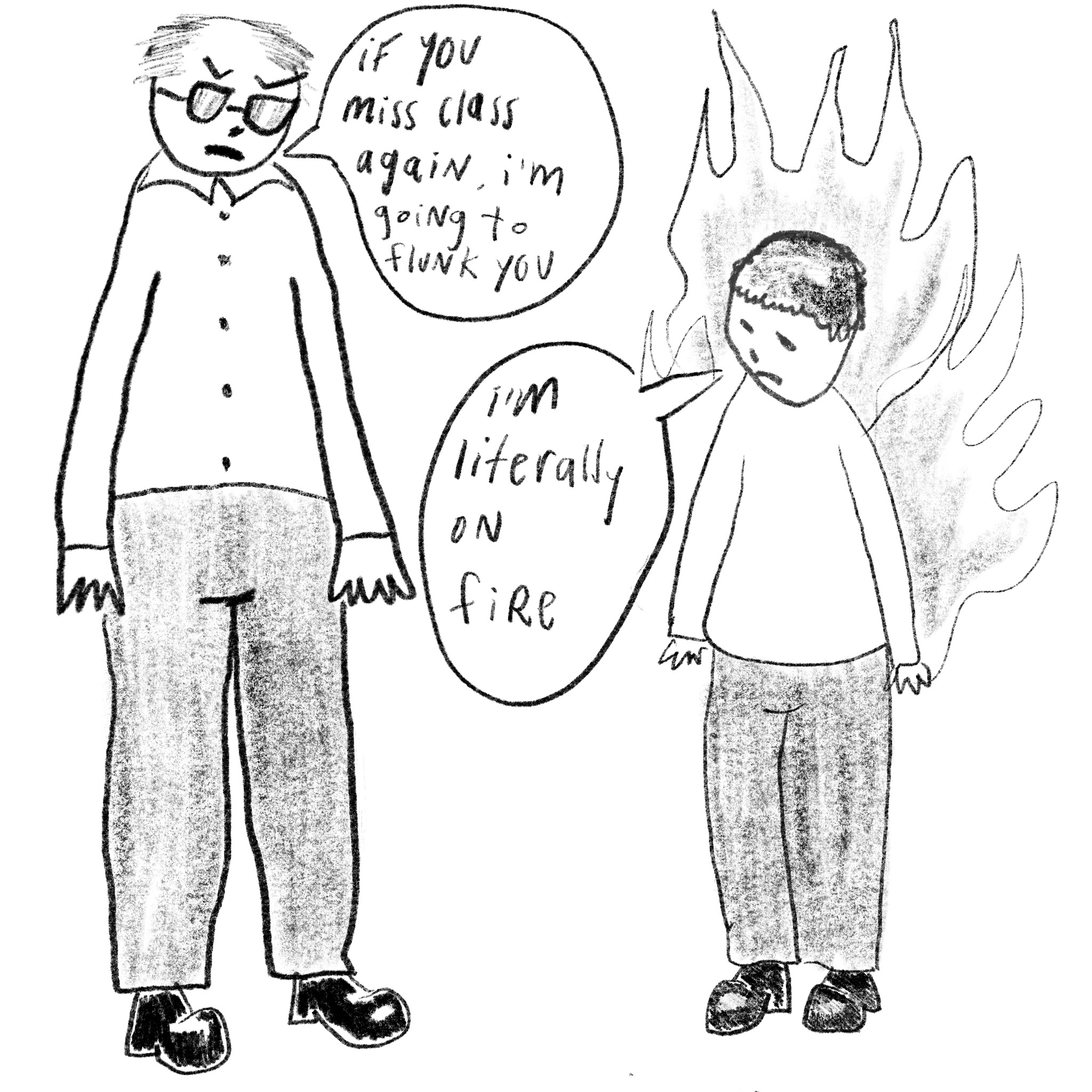
    Over a month into the semester, most of you are probably familiar with your professors and their grading policies by this point. Some require you to show up to every class to get a decent grade, while there are others who simply don’t care if you show up to class (spoiler alert: these are the cool professors).

    I stand very firmly in the belief that attendance should not factor into a student’s grades. They should be graded on their performance instead. 

    Maybe this is crazy, but if I miss two or three classes, yet demonstrate knowledge of the course materials by performing well on exams/essays/projects/you-name-it, I shouldn’t be punished. That A grade should stay an A. 

    Too often a class I’ve had has spent a week or two teaching something I already know fairly well (especially those classes that teach a broad range of practical skills in a major), but I am forced to sit through lectures bored to tears. I often think about the tens of things I could be doing instead, which are more often than not, assignments for other classes I could be using this valuable time for. 

    Allow me to introduce the concept of life. Life has this crazy habit of happening. It happens to you, to me, even to the professors here. When a professor has a wedding they plan to attend, or are feeling a little sick, they call off class. 

    Tell me then, why when I missed a class due to a personal loss, I was emailed a “sorry for your loss,” followed by a Canvas notification of my attendance grade being lowered by 7%? When I’m paying for my college credits, what valid reason is there for attendance affecting my grade? Professors don’t get paid based on class attendance, so the only person negatively affected when a student misses class is the student. 

    Let’s dig into how the supposed function of classroom attendance is to motivate students. I’m willing to bet money that mandatory attendance doesn’t motivate any student to do better in class. It sure doesn’t motivate me to do better in class. 

    A student should want to attend class. If a student is paying to take a class, they should be engaged by and with the course material, and that interest will intrinsically motivate the student to keep attending and learning. Requiring the student’s presence, and actively lowering the grade if not graced with their presence will extrinsically motivate the student to attend class. It will not motivate the student to learn. 

    Extrinsic motivation, like keeping a seat warm to satisfy an arbitrary requirement, doesn’t hold a candle to the intrinsic motivation of actually being interested in what’s being taught. Otherwise, self-motivation is taken away from the student and butchered in the slaughterhouse of butts-in-seats and vacant stares. 

    According to a 2010 report by the American Educational Research Association, while attending class can assist in getting better grades, mandatory attendance has a very small impact on how the students perform. 

    For all of you professors out there balking at the idea, slow down and take a deep breath. I promise you that most of us would attend the majority of our classes, just like usual. After all, it’s our money on the line. If you think that nobody will attend your class without graded attendance, chances are your class sucks and you should step it up. Make us want to come to class. If I’m able to accomplish the majority of your coursework well without paying a lick of attention to your lectures, they’re probably not all that engaging. 

    Oh, and participation grading is fine. After all, the professor has to keep track of students contributing. In the case of discussion-based classes, maybe offer students who miss class a discussion board on Canvas to post things on. 
    Stopping mandatory attendance puts the power and capacity to learn into the hands of the student. It restores that joie-de-vivre that graded attendance robs us of and allows us to feel like students, eager to learn instead of prisoners chained to our degrees.

  • Humboldt professors speak in ‘Ukraine in Crisis’ forum

    Humboldt professors speak in ‘Ukraine in Crisis’ forum

    by Liam Gwynn

    Professors addressed the complex and multifaceted nature of the Ukraine invasion during an event hosted by the political science department on Friday. They addressed the situation from three different angles with professors breaking down the topic relevant to their expertise.

    Dr. Robert Cliver is a history professor at Cal Poly Humboldt. Cliver gave historical context for the war in Ukraine and explained how the situation is not black and white in his mind. Between the corrupt Ukrainian white nationalist oligarchs and Ukraine’s tentative alliance with the west, Cliver doesn’t think Ukraine is as innocent as they are being painted by the media at large.

    Cliver drew criticism after claiming there were no heroes or villains in war. In his eyes, all of the world leaders are villains fighting over power and resources.

    “I’m against war, period. I think if you’re resorting to violence to achieve your ends you’re not a hero,” said Cliver.

    Cliver warned students against glamorizing and glorifying political figures like Ukrainian president Volodymyr Zelenskyy. Cliver supports the Ukrainian people, but thinks people need to look into the historical context of situations and understand that their perspective may have been altered by nationalistic rhetoric they have been exposed to.

    “It’s very difficult to find heroes and villains historically and when people do, it’s usually for nationalistic reasons and I’m very skeptical of that,” said Cliver.

    After Cliver’s talk, Noah Zerbe from the political science department gave a thorough breakdown of the international relations situation currently unfolding between Russia and the rest of the world. In particular, he explained how the sanctions put in place by NATO would affect both Russia and the global economy.

    “Russia and Ukraine account for about 20% of the world’s corn exports and about 30% of the world’s wheat exports,” said Zerbe, continuing. “So cutting that off from global markets is going to have a huge impact on food prices.”

    Zerbe went on to explain how Russia also accounts for about 20% of the world’s fertilizer so not having that on the global market will impact many types of agriculture on top of the ones previously mentioned.

    Allison Holmes from the international studies department took over after Zerbe. Holmes gave an urgent speech about the importance of fact-checking what you read online and the unreliability of news in the era of social media.

    Holmes explained how social media has changed the way people digest information which has, in turn, made times of crisis like this even more disorientating.

    “Everyone became their own spokesperson, nobody needed to wait for the official statement, nobody waited for a press officer to tell you what was happening out there, the feeds from Twitter, Facebook, TikTok, went straight to the news headlines,” said Holmes.

    She explained how this massive change has resulted in a repetitive news cycle where the most TV-ready looking civilians are asked the same questions over and over and other important developments are pushed to the side.

    “This has produced hours and hours of interviews with young women, most of whom happen to be lovely blondes who all speak perhaps halted but excellent English with at least one if not preferably two children sitting on a train platform going they know not where,” said Holmes.

    Holmes did not want to downplay the situation in Russia, but she does think it is being overplayed by the media, especially in comparison to how other conflicts outside of Europe are covered.

    “I’ve lost the number of times I’ve heard ‘we haven’t seen this since world war II’ which is simply not true,” Holmes said, continuing. “What about Yugoslavia, what about Syria’s impact on Europe and the estimated 13 million refugees or displaced people who are still not home?”637 words

  • Letter to the Editor: Reflections on 30 Years at HSU

    Letter to the Editor: Reflections on 30 Years at HSU

    Where we were, what went wrong & how we build a brighter future

    This is a letter to the editor from Humboldt State University Education Department Chair Eric Van Duzer, Ph.D. It has been edited only for minor punctuation and grammar style preferences.

    As I reflect back on nearly 30 years at Humboldt State University, first as a student and then for the past 20 years as a faculty member, I wanted to share some of the thoughts that I have about HSU’s current situation and where the campus might go from here.  

    As a student I experienced a remarkable education where faculty were fully invested in my intellectual and personal development. There were so many opportunities to explore areas of interest and develop new ones. I have spent many hours trying to encapsulate the nature of the schooling I experienced in a way that would really represent the experience. 

    The best analogy I have been able to come up with was that HSU offered a graduate education to undergraduates. The small classes typical of graduate school encouraged faculty to fully invest in their student’s growth. The university, set so far from the oversight of CSU headquarters in Long Beach, offered a great deal of flexibility to shape our experiences. 

    This would be impossible today. In those days HSU had the third smallest class sizes in the 23 campuses of CSU. But more than that, it had a unique faculty ethos that reflected nearly 100 years as a student-focused institution that exalted excellence in teaching above all else.  

    I was the first student CEO of the Institute of Industrial Technology, a self-supporting club that allowed us to use the skills and knowledge we were developing to grow in business acumen, engage in manufacturing and light construction on campus as well as conduct experiments for local agencies. In its second year, Bill Wilkinson used the institute to earn enough profit making desks for campus offices that it paid for several pieces of expensive equipment for the department.

    This would be impossible today. In those days HSU had the third smallest class sizes in the 23 campuses of CSU. But more than that, it had a unique faculty ethos that reflected nearly 100 years as a student-focused institution that exalted excellence in teaching above all else.  

    Faculty came to campus because this is where they wanted to spend their career. Unlike most universities where faculty play academic hopscotch building their resume through research reputations and earning ever-higher salaries as they bounce from college to college, HSU faculty built their reputations on teaching.  These were inherently local reputations, not very valuable if one wanted to move on, but rather a reflection of the values and attitudes associated with a culture of excellence in the service of students’ intellectual growth.

    As anyone who has worked with university budgets will tell you, graduate education is expensive.  That is why through the first 100 years, the administration and other services were done on a shoestring. It was common for a variety of upper administrative positions to be filled by faculty who served temporarily. Staff was thin and overworked and processes were slow and inconsistent. 

    What happened? In the early 2000s the CSU was facing the onslaught of a Generation X student bulge. Chancellor Charles Reed decided the best strategy to deal with this situation was to homogenize campuses so that if a student could not get into Sacramento State because it was impacted, they could simply go to another campus and get a similar experience. 

    Yet, the campus, with significant leadership from the faculty, focused its significant resources on classroom instruction, and through that dedication, produced exceptional graduates who were deeply committed to HSU when they graduated. 

    I remember an administrator in the early years telling me that he had been in a restaurant on the East Coast and overheard a group of students talking at a nearby table. He was so impressed with their sophistication and the values they held he found out where they came from and immediately applied for a job at HSU. 

    He was the first person hired under then-president Rollin Richmond to manage our enrollments in the early 2000s. The diversity on our campus is a credit to him and Richmond, who reached out across the state to bring in students from urban areas. Sadly he became disillusioned and left. So did most of the faculty leaders. 

    What happened? In the early 2000s the CSU was facing the onslaught of a Generation X student bulge. Chancellor Charles Reed decided the best strategy to deal with this situation was to homogenize campuses so that if a student could not get into Sacramento State because it was impacted, they could simply go to another campus and get a similar experience. 

    Shortly thereafter the upper administration received inflated titles and significant raises in an apparent effort to reduce resistance. Then the attack on the faculty began.

    Naturally, faculty on campuses such as HSU who were proud of their traditions and niche identities resisted. Fiercely. At one point, three campus presidents, including Rollin Richmond, suffered through votes of no confidence by their faculty as they implemented this strategy. 

    To achieve the required changes in the face of faculty resistance, campuses, including Humboldt, began shifting to a corporate structure of top down management. Faculty who had held a privileged position in campus life were systematically reduced to workers with only a symbolic voice in campus decisions. The administration turned its focus inward towards improving the functioning of the bureaucracy. They eliminated administrators such as Rick Vrem, an ethical provost, who refused to implement changes that hurt the traditional focus on instruction.  

    Vrem was replaced with a provost who had no such compunction. Shortly thereafter the upper administration received inflated titles and significant raises in an apparent effort to reduce resistance. Then the attack on the faculty began. Nearly 80 faculty positions were eliminated over several years and during the same time period, a similar number of new staff positions were created and filled to support administrative functions. 

    Over the majority of the intervening 15 years, budget reductions for academic programs have been the norm: reductions in staff, program availability and courses. This year it was a 6% cut, last year another and many like it before. The funds have been shifted to an ever-expanding variety of administrative initiatives. 

    Now we sound more like a parks and recreation office than a university. Come for the redwoods, the beaches, the bike riding—that is wonderful and I love it, but it is not why people pick a university.  

    We spend nearly 68% of our budget on administration and campus facilities. Despite the results of a study commissioned by Rollin Richmond’s administration that showed the two most important factors that cause a student to come to HSU are quality of education and availability of the program they are interested in, both have been repeatedly attacked, sliced and diminished.

    It is surprising that no one seems to notice that every time we cut academic programs, fewer students want to come here. And when fewer students come here, the budget suffers and HSU responds by cutting academic programs even more severely—a cycle the faculty in 2004 described as a “death spiral.” 

    As we address our current crisis and try to figure out what we need to become in order to grow back to a sustainable enrollment, we might want to engage in some soulful reflection. What would cause a 20-year-old to come to a place five hours from major centers of civilization and spend four years with us? What do we have to offer them that is so valuable, so different from what they can get at any of the other CSU campuses which are closer, cheaper and offer a great deal more college life in the community? 

    We stopped selling the small classes and close academic relationships with faculty when the hypocrisy became too much to bear as campus priorities shifted. Now we sound more like a parks and recreation office than a university. Come for the redwoods, the beaches, the bike riding—that is wonderful and I love it, but it is not why people pick a university.  

    When I arrived here as a faculty member in 2000 we had one staff member, John Filce, doing institutional research. He was wonderful and badly overworked. I am sure he still is. Now we have nine staff members listed in the directory in the Office of Institutional Effectiveness, including a vice president. I am sure their work is valuable, but to pay for it we had to cut 64 class sections. 

    Today, we are an organization of inflexible rules and their keepers.

    We have proliferated the bureaucracy, which is unfortunately necessary to achieve top-down control of a professional organization. Had our leadership studied industrial technology with me, they would know what companies in the 1970s learned: that this form of management is ineffective and inefficient in a professional organization. 

    To achieve control requires monitoring, which in turn requires more staff. For a top-down organization, where the vast majority of employees serve at the will of their manager, fear prevents innovation and compliance is key. Before the shift to this model, administrators were problem solvers. In fact, the standing joke in those days was that everything was an exception. Faculty, staff and administrators had the flexibility to serve the needs of students even when it required bending the rules. 

    Today, we are an organization of inflexible rules and their keepers. It has greatly diminished the effectiveness of the organization and its ability to make decisions that best serve our students. The resulting bureaucratic culture has seen a proliferation of forms, rule books and rigid adherence to often dysfunctional orders.

    This is no way to run a university. Perhaps a grocery store, but not an organization of 500 highly educated experts with thousands of years of collective experience. Top-down decision-making, particularly when the president and upper administrators are drawn from institutions that do not share the culture and values of the campus, is inherently poor compared to what would be possible if faculty once again had a meaningful voice in campus affairs.  

    No student has ever come to HSU because we have a wonderful registrar’s office or because the president’s office is fully staffed.  These only matter when they impact the quality of the education a student receives. 

    The proof of this is apparent everywhere at HSU. When Rollin Richmond came, he had no interest in what made HSU special. Like a white suburban principal coming to a school in Watts, he thought he knew what needed to be done to remake the university into his vision of a modern institution. That ignorance has cost us immeasurably. Today we face the consequences. The failure to fundamentally change direction of subsequent presidents has simply deepened the mess. We now have a new president, perhaps we can find a new vision. 

    In my view there are two key concerns that need to be addressed from a rational and values-driven perspective. First, an effective budget model that allows funding to follow enrollment is essential to support growing programs while shifting resources to where they will best serve student needs and interests. This can refocus the campus on providing the service/product students come here for—classroom instruction—and it is essential.  

    There are so many amazing faculty and academic staff here. They are people with a heart for their students, struggling in a system that constrains and conflicts with their efforts. Let their voices guide the future and we may yet have one worth celebrating.

    No student has ever come to HSU because we have a wonderful registrar’s office or because the president’s office is fully staffed.  These only matter when they impact the quality of the education a student receives. 

    Second, we have to decide how we are going to rebuild the excellence we once were known for in our student’s academic programs.  The day Rollin Richmond refused to give the Outstanding Faculty Award to a physics professor (selected by the faculty based on his ability to delight and inspire students) because that professor had not published, is the day we snuffed out the soul of the old HSU campus. 

    Now we need to find out what animates us in ways that provide an experience worth the isolation, cost and struggles required to live in this remote community. Redwoods are not enough; we need a reinvestment in education. 

    I am retiring from HSU at the end of this May. I am sad to see what has happened to my university. There are so many amazing faculty and academic staff here. They are people with a heart for their students, struggling in a system that constrains and conflicts with their efforts. Let their voices guide the future and we may yet have one worth celebrating.

  • Teach But Make It Fashion

    Teach But Make It Fashion

    Humboldt State professors and lecturers stunt their favorite fits

    We’ve talked to students on campus about their fashion statements. But what about teachers?

    Opinions Editor Delaney Duarte asked some professors and lecturers on campus to show us their favorite looks, tell us their hobbies and give some insight into their dream jobs.


    Jessica Rismiller

    Psychology Lecturer

    Originally from: Cincinnati, Ohio

    Clothes: Sweater is from Tj Maxx, skirt is from Hot Knots in Arcata, Scarf is from North Coast Co-op and boots are from Nordstrom Rack.

    If Rismiller wasn’t teaching, she would work in the field of applied behavioral analysis providing behavioral intervention services for individuals with developmental disabilities and their families/supporters.

    Hobbies: Running, hanging out with her dog, meditation, ceramics, hiking/camping and traveling.

    Jessica Rismiller. | Photo by Delaney Duarte

    Marlon Sherman

    Native American Studies Professor and Department Chair

    Originally from: Pine Ridge Reservation in South Dakota

    Clothes: Shoes were purchased at a shoe store in Eureka, shirt from a store in Santa Cruz, pants from San Francisco and undershirt from a store in Boulder, Colorado.

    If Sherman wasn’t teaching he would pick up the guitar again or find a boy band to sing in.

    Hobbies: Sleeping on the couch, writing a chapter in a book he is working on.

    Marlon Sherman. | Photo by Delaney Duarte

    Nikola Hobbel

    English Education and Poststructural Analyses

    Originally from: Westberlin, Germany

    Clothes: Purchased dress in London on a summer vacation, shoes bought online from Ninewest, ring is from Sol to Sol in Arcata, earrings are by Gilbert Castro from Arcata Artisans.

    If Hobbel wasn’t teaching she would be a librarian or work in a kitchen because she likes to cook.

    Hobbies: Hiking, going to the beach and hunting for agates.

    Nikola Hobbel. | Photo by Delaney Duarte

    William Gannett

    Physics Lecturer

    Originally from: Portland, Oregon

    Clothes: Flannel is from Lands End, jeans are Levi’s, shoes were purchased at Nordstrom Rack and he bought his watch online.

    If Gannet wasn’t teaching he would be doing physics research or try and be a National Geographic photographer.

    Hobbies: Wildlife photography, and hiking with his wife and son.

    William Gannet. | Photo by Delaney Duarte

    Michelle Cartier

    Film Professor

    Originally from: Burbank, California

    Clothes: Pants and shoes are from Zappos, shirt from men’s section of H&M, belt was a gift and hat is from AMPT Skate Shop.

    If Cartier wasn’t teaching she would be a poet or filmmaker.

    Hobbies: Traveling, eating, writing and being on the local roller derby team.

    Michelle Cartier. | Photo by Delaney Duarte

    Ryder Dschdia

    History Lecturer

    Originally from: Santa Cruz, California

    Clothes: Shoes are from Plaza Shoe Shop in Arcata, shirt is from JackThreads, pants are from Kohl’s, tie was a gift from his sister and coat was a gift from his brother.

    If Dschdia wasn’t teaching he would be working in the food industry or become a professional photographer or reporter.

    Hobbies: Rock climbing, disc golfing, cycling and hiking. Dschdia also likes playing Dungeons and Dragons on his switch, PC and console.

    Ryder Dschdia. | Photo by Delaney Duarte

    Ross MacKinney

    Communications Lecturer

    Originally from: Washington D.C.

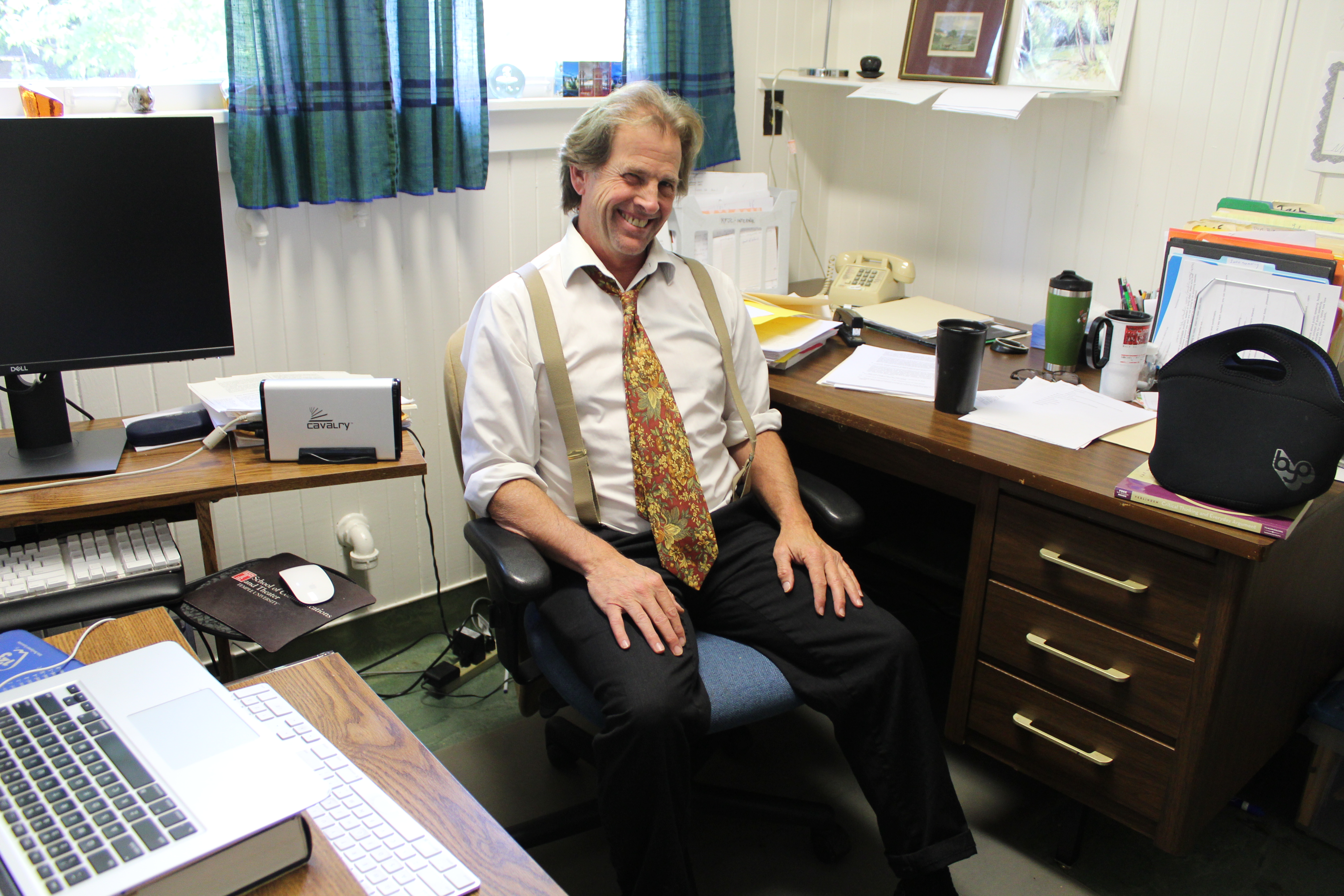
    Clothes: Tie and suspenders found while thrift shopping, pants are from Costco, shoes are from Abraxas Shoes and Leather in Eureka and his shirt was a gift from his son.

    If MacKinney wasn’t teaching he would be a professional storyteller.

    Hobbies: Juggling and walking in the woods.

    Ross MacKinney. | Photo by Delaney Duarte
  • Raising the bar

    Raising the bar

    In the National Survey of Student Engagement, zero percent of faculty think seniors devote “Very Much” or “Quite a bit” of their time doing community service or volunteer work. Six percent of seniors said they devote “Very Much” or “Quite a bit” of their time for community service or volunteer work.

    The National Survey of Student Engagement was sent out to seniors last spring at the same time the Faculty Survey of Student Engagement was sent out.

    In these surveys, 298 seniors and 226 faculties participated. Percentage-wise, that’s around 31 percent of seniors and 40 percent of the faculty. A part of the results from both surveys for the 2016-17 academic year shows how upper division faculty thinks seniors spend their time versus how senior say they spend their time.

    Upper division faculty were asked how much time do they think seniors devote to participating in co-curricular activities. Faculty answered only one percent of students devote “Very Much” or “Quite a bit” of their time participating in co-curricular activities. On the other hand, seniors answered seven percent.

    According to the same surveys, upper division faculty thinks 41 percent of seniors devote “Very Much” or “Quite a bit” of their time relaxing and socializing, while seniors answered only 23 percent.

    Almost half of all seniors in the survey said they devote “Very Much” or “Quite a bit” of their time to prepare for class, on the other hand, Upper division faculty think only 13 percent of seniors do so.

    It’s not the first time HSU students participate in the National Survey of Student Engagement. The first time was back in 2002, according to NSSE website, though last spring was the first time HSU conducted the Faculty Survey of Student Engagement on HSU faculty.

    According to the Office of Institutional Effectiveness, the Faculty Survey of Student Engagement costs $2,008 and the National Survey of Student Engagement cost $5,550.

    Such surveys are important as they help the university administration understand students and how do they spend their time and how both student and faculty are seeing and perceiving things.

  • Compassionate Bonds — New HSU Chem Prof Goes Above and Beyond

    Compassionate Bonds — New HSU Chem Prof Goes Above and Beyond

    By Bryan Donoghue

    For many students at Humboldt State University, any chemistry class is on a list of the hardest courses a student can take. Humboldt State has taken on a new temporary chemistry professor whom students are dubbing “passionate,” “exuberant,” “enthusiastic,” and “caring.” Walking into his office, some may mistake him for a student. He’s listening to Selena Gomez, One Direction and country music. But it’s his demeanor, not his music preference, that makes Puminan Punthasee so approachable.

    punthasee
    Puminan Punthasee | Photo Credit: Humboldt State University Chemistry Department

    “I’m not afraid to approach Pete, which I sometimes am with other professors,” said Kathryn Buzanski, 29-year-old student and Marine Corps veteran. “With Pete, I can email him, I can approach him, talk to him face-to-face, and have no worries.”

    Punthasee’s approachability follows into his relationships with colleagues in the chemistry department. Joshua R. Smith, chair of the Department of Chemistry, recalls that the first time he met Punthasee. He found him to be funny and deeply empathetic. But it was his passion for teaching that struck Smith the most in the hiring process.

    “He clearly had a passion for teaching, based on what he wrote in his application, and he clearly got that across during the interview as well,” Smith said.

    This enthusiasm and commitment Punthasee brings to teaching chemistry blossomed long before Humboldt State. Dating back to his high school years in Thailand, Punthasee had to take science courses every semester in high school. Thailand’s education system requires six science courses in order to graduate.

    “I wasn’t really a smart kid, I was slow, and couldn’t grab anything that the teacher taught us,” Punthasee said. “My grades were okay but weren’t as high as I wanted them to be.”

    Before graduating high school, Punthasee discovered his passion for learning, as he found a role model at his tutoring school.

    “This chemistry teacher at my tutoring school made chemistry understandable,” Punthasee said. “And that was the starting point that made me realize that if I could understand chemistry, maybe there’s some other stuff that I can understand as well.”

    Following high school, Punthasee graduated from the University of Thailand, and continued to expand his horizons by enrolling in University of Missouri’s Ph.D. program for chemistry.

    “I was in a Ph.D. program at the University of Missouri, and I hated the program,” Punthasee said. “It’s the nature of the Ph.D. program that makes you do a bunch of research, but I don’t like doing the research, so I found myself looking at the clock every five minutes.”

    Although he isn’t passionate about research, Punthasee found his calling as a teacher. He’s won three awards for being a teaching assistant through his graduate program. He’s been awarded with the Number One T.A. Choice award twice, and has also accepted the Green Chalk award for being an excellent teaching assistant.

    “I bet you that no science teacher does things like I do, not in this state,” Punthasee said. “Only two people follow my “Pete” style. Me, and my role model in Thailand.”

    His efforts to reach out to students outside of the classroom further solidifies their appreciation for Punthasee as well. As a professor, he will send three emails each day on average, all for varying, but positive reasons.

    “Pete really likes to send out encouraging emails,” said chemistry student Kate Panebianco.

    Brooke Holdren, a 20-year-old science and art major at Humboldt State, also expressed how much the emails help her.

    “I’ve gotten both general and personal encouragement emails. He’s really taking the time out to say specifically, ‘You’ve done this really well today’,” Holdren said.

    “He sends the most emails out of any teacher I’ve ever had. It’s really great and encouraging, sometimes a bit over the top, but that just shows how involved he is in comparison to the other teachers I’ve had.”

    What makes Punthasee such a well-liked professor boils down to how relatable he is. He’s just like any regular college student, and he likes to keep things simple because simplicity is easier to understand.

    “It’s just human nature,” he said. “We don’t like complicated stuff, we like fun stuff.”

    Attributing his best quality to being a “tremendously freaking hard worker,” Punthasee said his talent lies in his ability to simplify and socialize.


    Buzanski explained this in a way that many of Punthasee’s students can empathize with. “He does want to be our friend, but more importantly, he wants to be our friend while we know he’s our teacher,” she said.

  • Breaking Boundaries

    Breaking Boundaries

    By Bryan Donoghue

    A professor develops expertise in their area of study after years of building their intelligence. A martial arts instructor culminates themselves into a master of their craft. There are three professors on campus who instruct in the classroom and the studio.

    Each professor said they see Bruce Lee as an inspirational pop-culture icon, but their own origin stories begin with a simple fascination of martial arts rather than following a role model.

    Hal Genger, an oceanography professor at Humboldt State University, is a 5th dan black belt in aikido and has been practicing the art since attending graduate school. His career at North Coast Aikido began in 1978, and has since become an instructor.

    “I just love to train with people,” Genger said. “When it flows good, I just feel so much better. Almost every time I get out of class I feel better than when I went to class. Every class does not go as well as I think it ought to, but I’m just working on myself figuring out how to do this.”

    Even now, Genger retains interest in martial arts. Not only does he enjoy passing on what he’s learned to his students, but Genger also finds benefit in martial art’s stress relief, as well as how it helps people battle their ego.

    “You know, kind of my whole life I’ve been interested in martial arts, and it really helped with some anxiety issues,” Genger said. “It helped me survive graduate school,

    and then I just got interested in the physical, mental, spiritual part of it. It was important to my whole life.”

    “Any martial art is dealing with your ego, you become a little bit more humble and you learn to listen more, feel the experience that’s going on instead of going directly to a conflict situation,” Genger said. “That’s really important in dealing with your significant others. It’s better to listen instead of argue.”

    Aside from dealing with ego and helping with anxiety, Genger finds the connection between martial arts and the classroom to be related to how he interacts with his students.

    “In the lecture you’re verbally interacting with your students, but it’s not a physical interaction, but with aikido it’s a little bit verbal but it’s just physical,” Genger said.

    A fellow instructor at North Coast Aikido, Peggy Ilene, teaches aikido at the university. Ilene is a kinesiology professor, and although she only instructs aikido at the school currently, she has taught other classes in her time at Humboldt State. Her perspective of how students relate to the dojo and to the classroom is the difference in setting.

    “It’s simply that in the dojo every single person who’s come into the dojo is really dedicated to that art in a more specific way,” Ilene said. “Often people who are coming to the university have a more general either curiosity or they’re coming in to find out about it.”

    The benefit in either the classroom or the dojo is based on the interaction we have with other people. According to Ilene, people learn from each other by working together.

    “There’s something new to learn because, partly because, we’re working with people. People are so intricate,” Ilene said. “We’re working with principles that can simulate that intricateness and find a way to difficult places.”


    Aikido isn’t the only martial art present in Arcata that houses an instructor who is simultaneously a professor. Corey Lewis is an author, master of Arcata’s Sun Yi Tae Kwon Do academy and emeritus English professor at Humboldt State University. He finds that the relationship between martial arts and academics is based on balance.

    “For me, there’s always been that balance of that scholar warrior,” Lewis said. “It’s not just about the jock, the warrior and the athlete. You got to feed the mind and the spirit. You got to have scholar, too. You got to read, you got to write. It’s about the pen and the sword.”

    Fights and bullies were problems Lewis dealt with growing up until he made a decision to learn self-defense at 10 years old. From that point on, Lewis trained with Grandmaster Sun Yi who became like family to him, and then went on to teach his own classes when he turned 21. Lewis taught english classes at Humboldt State until 2014, and helped produce many graduates, and since owning his own practice in Arcata, Lewis has trained around 40 black belts. There’s a method to his instruction.

    “What I would tend to do in classes like that is what I learned in martial arts.” Lewis said. “First, need to break it down into its constituent components and model it several times. Then, have the students practice it a bunch. Then, you critique the students practice to help them improve.”

    A college degree or a black belt can boost a person’s confidence, but the underlying benefit is the way a balance as a martial artist and academic helps an individual grow.

    “I’ve always been really interested about how education empowers us and builds skills, and how martial arts empowers us and builds skills.” Lewis said. “There’s a lot of similarities between both of those.”


  • The Spring Deal-Breaker: Midterms on the day after break

    The Spring Deal-Breaker: Midterms on the day after break

    By | Erin Chessin

    Earlier this month, HSU students enjoyed a much needed week long spring break, but not everyone was relaxing.

    While classes may have adjourned for a week, school work continued in motion. Students said they spent the free week studying for midterms because they were scheduled on the day they came back from the break.

    Nicole Heighes is a senior psychology major at HSU. Heighes had a midterm on the Monday after spring break and a speech in her senior seminar the day after

    “It defeats the purpose of spring break when professors place midterms on the Monday or Tuesday after the break,” Heighes said.

    She spent hours studying over the break, going over study guides and preparing for her speech.

    “You need a few days after Spring Break to get back into school-mode,” Heighes said.

    Daniel Burrell, a biology professor at HSU, said he always considers the break when planning his midterms.

    “I like to grade midterms over the break and thus plan my midterms before the break,” Burrell said.

    He believes stepping away from schoolwork allows students to maximize their relaxation time.

    “I feel that students prefer to finish their exams before break so they have the break to relax,” Burrell said.

    Stephanie Toste, a senior business marketing major, typically has lots of homework throughout the week. Like Heighes, she had a midterm on the Monday after spring break and found herself using the break to study.

    “Luckily I didn’t have any homework to do after the break, but I had a midterm the day we got back,” Toste said. “I prefer to have midterms before the break because that week is dedicated to getting a break from school.”

    Some benefits come out of having midterms scheduled after spring break. Toste said that without class interrupting study time, students might be able to focus more on their midterms. “On the other side of things it allows students to not stress about going to class while trying to study for midterms,” Toste said.

    There are seven weeks of the spring semester left. With no more breaks aside from Cesar Chavez Day coming up this Friday, studying and school work is in full swing till the end of the semester.