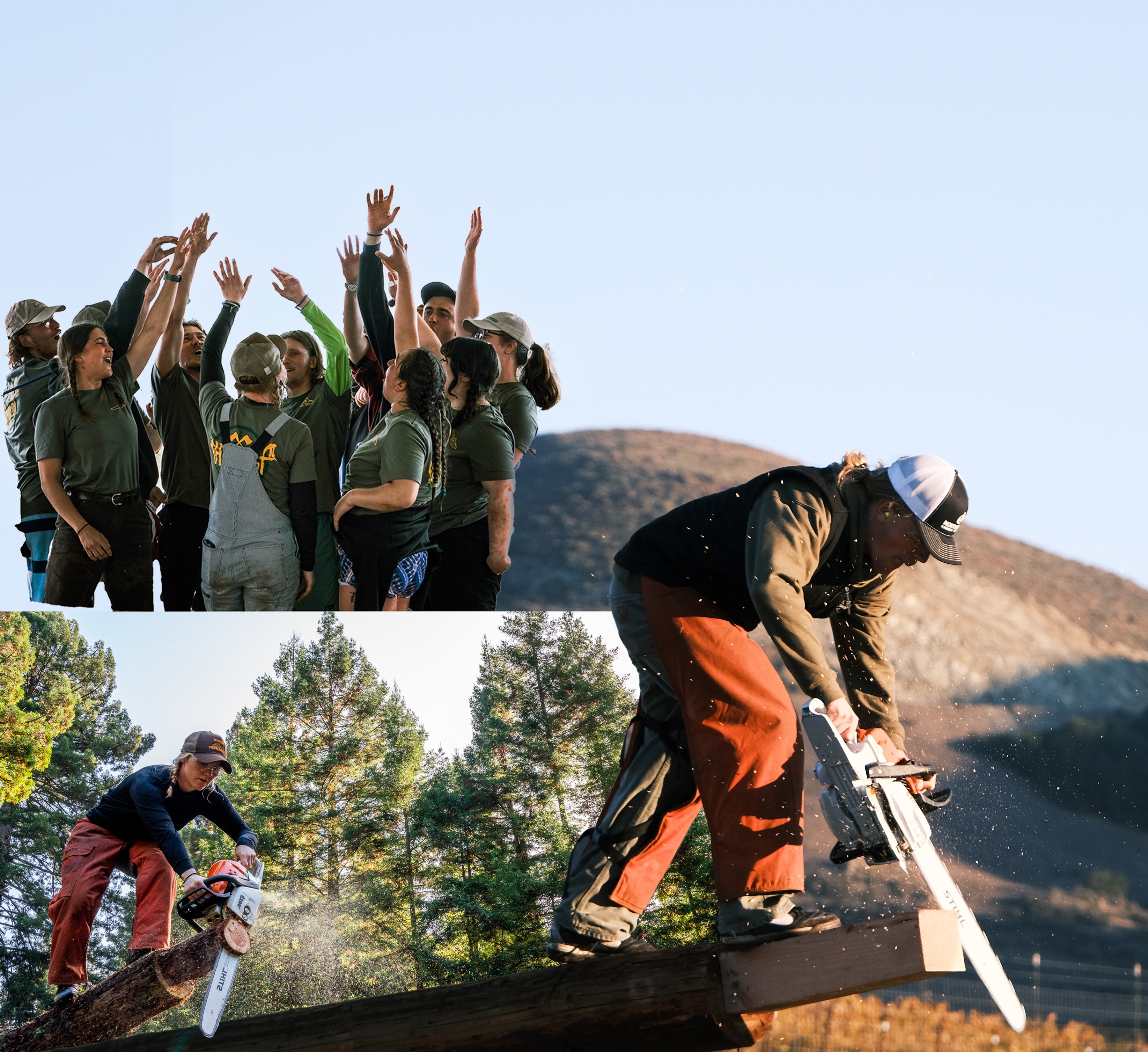
Over 150 logging competitors will soon descend upon Humboldt swinging axes, climbing trees and firing up their saws. They’re coming to compete at the 84th Annual Association of Western Forestry Clubs (AWFC) competition, a special opportunity to showcase what makes Humboldt logging sports unique.
After about a year of planning, Cal Poly Humboldt’s logging sports team is excited to host the AWFC competition for the first time in 10 years, in conjunction with the Redwoods Region Logging Conference (RRLC). The competition is free and open to the public, taking place at Redwood Acres Fairgrounds on March 13 through March 16. Zoey Cardoza, president and captain of Cal Poly Humboldt’s logging sports team, is excited for the team to host the event this year.
“We’re expecting over 180 competitors coming from 10 western schools,” Cardoza said. “We’re bringing 31 students to compete, which is wild, and it’s gonna be really fun. I just want them to have the same opportunities that I’ve had and be able to compete in a competition that everybody else has strong passions for, learn something new about themselves and hopefully about the sport too.”
Logging sports is far from any typical sports club seen on university campuses. Deeply intertwined into the history of Cal Poly Humboldt and surrounding community, logging sports keeps the tradition alive. The team strives to open their doors to everyone with interest, not limiting themselves to forestry majors. Cardoza aims to create a safe space for people to try something new with logging sports.
“I think a lot of people assume that, you know, we’re logging sports, we’re all foresters,” Cardoza said. “We’re not. We have economics majors, psychology majors, and English majors. We welcome any and all walks of life. I think that’s what makes us unique too, is that you don’t have to be a certain shape, size or have a certain passion. If you want to try it, come out and try it.”
While the club is open to all educational backgrounds, the team does serve a vital role in preparing students who are interested in forestry careers following school. Ed Laskey, a forestry student and second year logging sports competitor, explained how being on the team also provides an essential space for learning safe practices with modern and traditional logging skills.
“I would say just practicing valuable working skills using the axes, the cross cuts and chainsaws because I’ve worked with chainsaws before and it’s good to have a big group of people that you can learn from to do safe operation,” Laskey said. “And help others to learn how to use these tools in a safe way.”
Cameron Wallace, a forestry student at Cal Poly Humboldt and logging sports competitor, explained what sets logging sports apart from other sports on campus.
“It’s more niche,” Wallace said. “There’s a little more inherent risk. It really lets me get involved with my friends in forestry and in a way that I wouldn’t normally be able to… at the end of the week you’re tired, you’re done with sitting in the library all week and you’re just [ready to] go out into the woods with your friends to use chainsaws and axes. Do what we’re learning about in a natural environment with your friends, and it’s a good way to get outdoors, that’s part of the fun.”
Humboldt’s logging team is another place where students find a supportive community. Team members look forward to showcasing their skills and comradery at upcoming competitions.
“I would say it’s special because you meet a lot of cool people,” Laskey said. “The friendships that you make are really cool. Whenever you’re at a competition and you’re competing in an event, you have the whole team, because usually it’s only one thing going on at a time. So the whole team is able to go there and watch you and cheer for you. That’s super special.”
While the rest of the planet suffers, what will become of the Redwood Forests?
While climate change continues to cause destruction around the globe, scientists are finding hope in a local tree: The Giant Redwood, or Sequoiadendron giganteum.
The trees are currently in the midst of a growth spurt, producing more wood in the past century than any other time in their lives, according to Save The Redwoods League, a nonprofit organization who protect and restore the California redwood forests. Researchers from Humboldt State University, UC Berkeley, Natureserve, United States Geological Survey and Colorado State University are working alongside Save The Redwoods League to understand the growing trees and how they will continue to respond to climate change.
The Save The Redwoods League and HSU published findings concerning the impact of climate change in the recent research paper Aboveground biomass dynamics and growth efficiency of Sequoia sempervirens forests. They found that within the redwood forests, there are massive amounts of carbon sequestration. “Sequoia forests may be the most effective to [sequester carbon], because they accumulate more above ground biomass than any other vegetation, sustain higher rates of productivity than any other forest, and protect biomass produced via superlative fire- and decay-resistance.”
Carbon sequestration is “the capture and secure storage of carbon that would otherwise be emitted to, or remain, in the atmosphere,” according to Encyclopedia of Energy, 2004. This means carbon is trapped in forests, soil, or oceans for long periods of time instead of entering the atmosphere. It can be done naturally or artificially, and is becoming a researched effort to delay global warming which is caused by increase of greenhouse gases, such as carbon dioxide.
This is why scientists are so interested in the natural carbon sequestration of the redwood forests. While this seems to be good news, there is still much research to be done.
NASA scientists have started to create a global map of where carbon is being stored, and how much carbon is being released through deforestation. The redwood forest is only a tiny part of that map.
Humboldt State University Professor Steve Sillett has worked on the research with Save the Redwoods League.
“Redwoods can do little to fight climate change as they occupy a TINY proportion of the landscape,” Sillett said in an email. “Even though they are impressive in many respects, too little of the landscape is covered by them to make much difference at the global scale.”
While the redwoods alone cannot create a global change, scientists are continuing to research the storage of carbon in forests and what this means for the future of the planet.
How fire suppression is a mixed bag in Humboldt County
Every fire season, blankets of smoke roll over Humboldt County. Here on the coast, that’s as close to wildfires as some of us get. But our practice of fire suppression is a relatively new state for our woodlands and the lack of fire is taking its toll on the county.
“Humboldt county’s interesting. Most of the county really hasn’t experienced much fire over the last few decades,” said Jeffery Kane, associate professor of fire ecology and fuels management at Humboldt State University.
High levels of rainfall and a more temperate climate contribute to a lower risk of fire, but that doesn’t mean fire isn’t a natural part of Humboldt’s environment.
“When there are ignitions, and there are ignitions here from lightning and humans from time to time, they are usually fairly easy to put out,” Kane said. “That nice fog layer, that’s going to moderate fire behavior.”
Inland Humboldt county is not as protected by our temperate, coastal environment. But Kane said that quick fire suppression may not be the safest or most environmentally friendly way to manage wildfire in the long term.
“The thing that we know is most effective is to treat areas with a combination of thinning and burning,” Kane said.
The suppression of small wildfires can make future fires more difficult to control. Dense canopies and the buildup of dry fuel makes fire more dangerous. By thinning the forest, the trees become less tightly packed. When the canopy has more gaps, fires spread slower. Then after the canopy is thinned, a prescribed burn can take care of the natural dry fuels and remaining debris created from thinning. Thinning and burning can make an area less vulnerable to uncontrolled wildfires.
Although Humboldt is relatively protected, this area still would see wildfire activity every few years if not for the relatively recent introduction of American colonizers. Due to the danger of wildfire to settlers and property, wildfire is almost completely suppressed.
Disturbance Ecology Professor Rosemary Sherriff studies the impact fire suppression has on local woodlands. She thinks there can be a balance between protecting settled areas and letting wildfires run their course.
Lightning strikes and Indigenous burning would have introduced fire to local oak woodlands. These woodland areas suffer without the fire that shaped the ecosystem.
“In the past few years we’ve had fires that have gone into more urban areas, a lot of it stemming from more wildland areas,” Sherriff said. “There’s been a substantial amount of urban-woodland interface and these are really extremely hazardous places to live.”
In addition to providing more fuel to fires, the removal of wildfire has come at the cost of native biodiversity. Removing a natural phenomenon that was encouraged by local Indigenous tribes has consequently impacted our landscape. Local ecosystems are adapted to wildfire and removing fire allows fire sensitive species to grow without natural inhibitors.
“Inland we have oak woodlands, for example, that historically would have had a lot of fire,” said Sherriff.
Lightning strikes and Indigenous burning would have introduced fire to local oak woodlands. These woodland areas suffer without the fire that shaped the ecosystem.
“What we’ve seen is a lot of encroachment of native douglas fir into these oak woodlands,” Sherriff said. “So there’s been a loss of the oak woodland open areas.”
This loss of oak woodlands can be seen throughout Humboldt County. This destroys native biodiversity. But fire suppression is not the only consideration.
“Fire suppression has certainly shaped the landscape,” Sherriff said. “We can’t disregard the fact that settlements and communities and ranches and homeownership and the cannabis that’s happening also shapes and reshapes the landscape and can contribute significantly to shifts in fire behavior.”
The balance between human settlement and fire suppression is a difficult medium to reach.
“It becomes extremely tricky when it’s someone’s livelihood,” Sherriff said. “It’s very easy to sit at the university and say ‘yeah, more fire on the landscape’ but it’s extremely hard to make it happen with all the structures and policies in place.”
Lenya Quinn-Davidson is an advisor for the University of California Cooperative Extension. One of her projects is the Humboldt County Prescribed Burn Association. It’s a loose cooperative of land owners and community members that implement prescribed burns. While structures and policy is slow to change, they’ve proactively decided to put fire back into their land themselves.
“A lot of people want to use prescribed fire,” Quinn-Davidson said. “By the time we’re actually there lighting the fire, there’s already been a ton of work making sure that it’s safe, effective and that it won’t get out of control. It’s not like we’re just going out and lighting things off.”
Prescribed burning is a tool that landowners can use for fuels management, invasive species control and habitat restoration. The encroaching firs that Sherriff studies are a main target of controlled burn.
“We’re losing our oaks at a pretty astonishing rate,” Quinn-Davidson said. “So a lot of the landowners that have oak woodlands really want to use prescribed fire to get in there while those firs are small and kill the firs. The oaks survive just fine because they’re very fire adapted.”
Though douglas firs are native, there are some invasive species that landowners can keep back with prescribed burns. There are invasive species of grass like the medusa head that smother local grasslands. Ranchers want to make sure their cattle grazing lands are free of medusa head.
“It creates this thick thatch that prevents other plants from growing, so it turns into this homogeneous field of grass that nothing can eat.” Quinn-Davidson said.
Fire is necessary for keeping our natural landscape healthy and biodiverse. Where forest and human settlements meet, controlled burning can help maintain a healthy habitat with less danger to human life. With those buffer zones established, wildfire can be allowed to burn in a controlled manner, establishing a careful balance between fire and safety.
Quinn-Davidson thinks getting to a meaningful scale of fire management will take a combination of state intervention and owners taking control of their land.
“It’s a real community thing.” Quinn-Davidson said. “People just love it.”
Where we were, what went wrong & how we build a brighter future
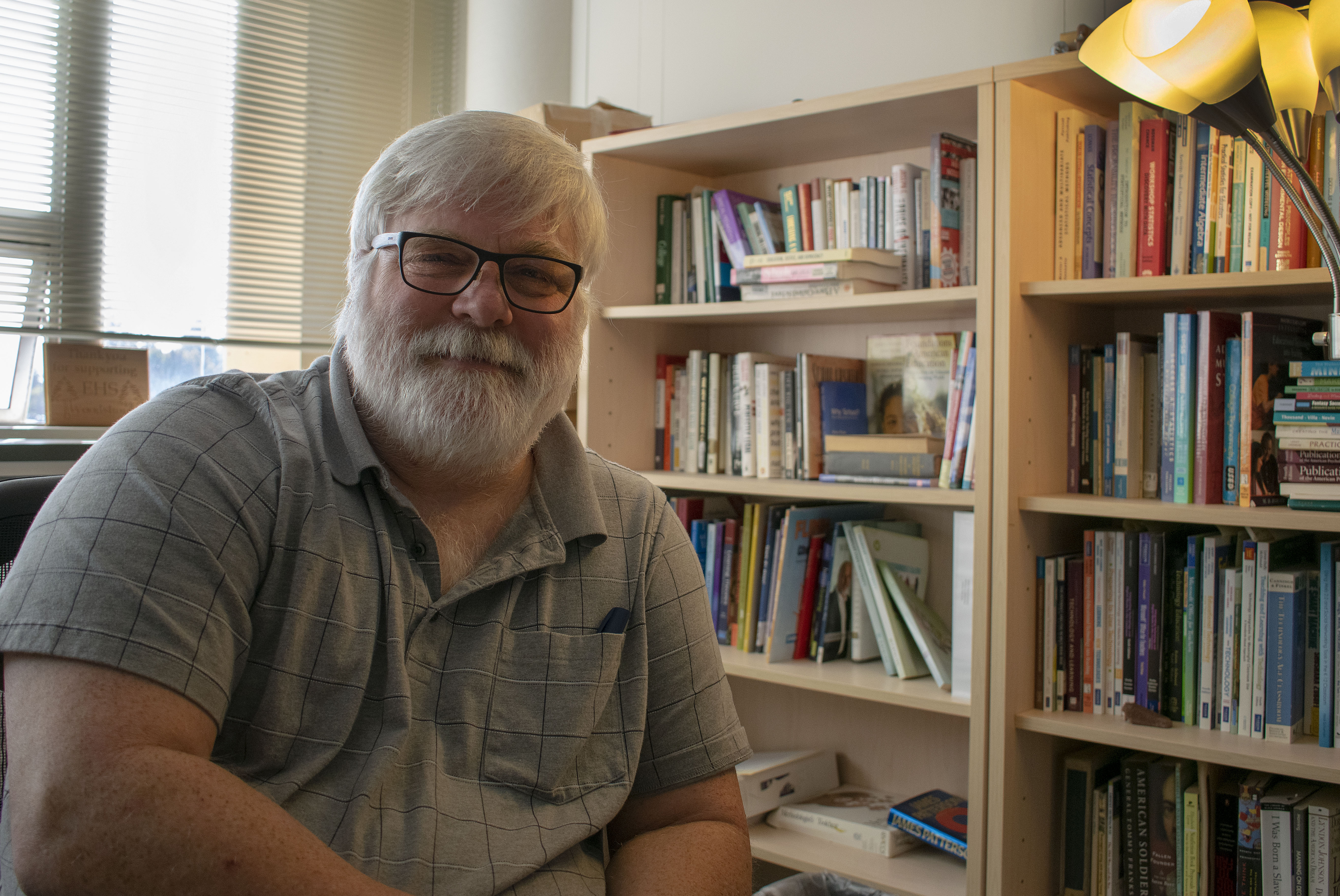
This is a letter to the editor from Humboldt State University Education Department Chair Eric Van Duzer, Ph.D. It has been edited only for minor punctuation and grammar style preferences.
As I reflect back on nearly 30 years at Humboldt State University, first as a student and then for the past 20 years as a faculty member, I wanted to share some of the thoughts that I have about HSU’s current situation and where the campus might go from here.
As a student I experienced a remarkable education where faculty were fully invested in my intellectual and personal development. There were so many opportunities to explore areas of interest and develop new ones. I have spent many hours trying to encapsulate the nature of the schooling I experienced in a way that would really represent the experience.
The best analogy I have been able to come up with was that HSU offered a graduate education to undergraduates. The small classes typical of graduate school encouraged faculty to fully invest in their student’s growth. The university, set so far from the oversight of CSU headquarters in Long Beach, offered a great deal of flexibility to shape our experiences.
This would be impossible today. In those days HSU had the third smallest class sizes in the 23 campuses of CSU. But more than that, it had a unique faculty ethos that reflected nearly 100 years as a student-focused institution that exalted excellence in teaching above all else.
I was the first student CEO of the Institute of Industrial Technology, a self-supporting club that allowed us to use the skills and knowledge we were developing to grow in business acumen, engage in manufacturing and light construction on campus as well as conduct experiments for local agencies. In its second year, Bill Wilkinson used the institute to earn enough profit making desks for campus offices that it paid for several pieces of expensive equipment for the department.
This would be impossible today. In those days HSU had the third smallest class sizes in the 23 campuses of CSU. But more than that, it had a unique faculty ethos that reflected nearly 100 years as a student-focused institution that exalted excellence in teaching above all else.
Faculty came to campus because this is where they wanted to spend their career. Unlike most universities where faculty play academic hopscotch building their resume through research reputations and earning ever-higher salaries as they bounce from college to college, HSU faculty built their reputations on teaching. These were inherently local reputations, not very valuable if one wanted to move on, but rather a reflection of the values and attitudes associated with a culture of excellence in the service of students’ intellectual growth.
As anyone who has worked with university budgets will tell you, graduate education is expensive. That is why through the first 100 years, the administration and other services were done on a shoestring. It was common for a variety of upper administrative positions to be filled by faculty who served temporarily. Staff was thin and overworked and processes were slow and inconsistent.
What happened? In the early 2000s the CSU was facing the onslaught of a Generation X student bulge. Chancellor Charles Reed decided the best strategy to deal with this situation was to homogenize campuses so that if a student could not get into Sacramento State because it was impacted, they could simply go to another campus and get a similar experience.
Yet, the campus, with significant leadership from the faculty, focused its significant resources on classroom instruction, and through that dedication, produced exceptional graduates who were deeply committed to HSU when they graduated.
I remember an administrator in the early years telling me that he had been in a restaurant on the East Coast and overheard a group of students talking at a nearby table. He was so impressed with their sophistication and the values they held he found out where they came from and immediately applied for a job at HSU.
He was the first person hired under then-president Rollin Richmond to manage our enrollments in the early 2000s. The diversity on our campus is a credit to him and Richmond, who reached out across the state to bring in students from urban areas. Sadly he became disillusioned and left. So did most of the faculty leaders.
What happened? In the early 2000s the CSU was facing the onslaught of a Generation X student bulge. Chancellor Charles Reed decided the best strategy to deal with this situation was to homogenize campuses so that if a student could not get into Sacramento State because it was impacted, they could simply go to another campus and get a similar experience.
Shortly thereafter the upper administration received inflated titles and significant raises in an apparent effort to reduce resistance. Then the attack on the faculty began.
Naturally, faculty on campuses such as HSU who were proud of their traditions and niche identities resisted. Fiercely. At one point, three campus presidents, including Rollin Richmond, suffered through votes of no confidence by their faculty as they implemented this strategy.
To achieve the required changes in the face of faculty resistance, campuses, including Humboldt, began shifting to a corporate structure of top down management. Faculty who had held a privileged position in campus life were systematically reduced to workers with only a symbolic voice in campus decisions. The administration turned its focus inward towards improving the functioning of the bureaucracy. They eliminated administrators such as Rick Vrem, an ethical provost, who refused to implement changes that hurt the traditional focus on instruction.
Vrem was replaced with a provost who had no such compunction. Shortly thereafter the upper administration received inflated titles and significant raises in an apparent effort to reduce resistance. Then the attack on the faculty began. Nearly 80 faculty positions were eliminated over several years and during the same time period, a similar number of new staff positions were created and filled to support administrative functions.
Over the majority of the intervening 15 years, budget reductions for academic programs have been the norm: reductions in staff, program availability and courses. This year it was a 6% cut, last year another and many like it before. The funds have been shifted to an ever-expanding variety of administrative initiatives.
Now we sound more like a parks and recreation office than a university. Come for the redwoods, the beaches, the bike riding—that is wonderful and I love it, but it is not why people pick a university.
We spend nearly 68% of our budget on administration and campus facilities. Despite the results of a study commissioned by Rollin Richmond’s administration that showed the two most important factors that cause a student to come to HSU are quality of education and availability of the program they are interested in, both have been repeatedly attacked, sliced and diminished.
It is surprising that no one seems to notice that every time we cut academic programs, fewer students want to come here. And when fewer students come here, the budget suffers and HSU responds by cutting academic programs even more severely—a cycle the faculty in 2004 described as a “death spiral.”
As we address our current crisis and try to figure out what we need to become in order to grow back to a sustainable enrollment, we might want to engage in some soulful reflection. What would cause a 20-year-old to come to a place five hours from major centers of civilization and spend four years with us? What do we have to offer them that is so valuable, so different from what they can get at any of the other CSU campuses which are closer, cheaper and offer a great deal more college life in the community?
We stopped selling the small classes and close academic relationships with faculty when the hypocrisy became too much to bear as campus priorities shifted. Now we sound more like a parks and recreation office than a university. Come for the redwoods, the beaches, the bike riding—that is wonderful and I love it, but it is not why people pick a university.
When I arrived here as a faculty member in 2000 we had one staff member, John Filce, doing institutional research. He was wonderful and badly overworked. I am sure he still is. Now we have nine staff members listed in the directory in the Office of Institutional Effectiveness, including a vice president. I am sure their work is valuable, but to pay for it we had to cut 64 class sections.
Today, we are an organization of inflexible rules and their keepers.
We have proliferated the bureaucracy, which is unfortunately necessary to achieve top-down control of a professional organization. Had our leadership studied industrial technology with me, they would know what companies in the 1970s learned: that this form of management is ineffective and inefficient in a professional organization.
To achieve control requires monitoring, which in turn requires more staff. For a top-down organization, where the vast majority of employees serve at the will of their manager, fear prevents innovation and compliance is key. Before the shift to this model, administrators were problem solvers. In fact, the standing joke in those days was that everything was an exception. Faculty, staff and administrators had the flexibility to serve the needs of students even when it required bending the rules.
Today, we are an organization of inflexible rules and their keepers. It has greatly diminished the effectiveness of the organization and its ability to make decisions that best serve our students. The resulting bureaucratic culture has seen a proliferation of forms, rule books and rigid adherence to often dysfunctional orders.
This is no way to run a university. Perhaps a grocery store, but not an organization of 500 highly educated experts with thousands of years of collective experience. Top-down decision-making, particularly when the president and upper administrators are drawn from institutions that do not share the culture and values of the campus, is inherently poor compared to what would be possible if faculty once again had a meaningful voice in campus affairs.
No student has ever come to HSU because we have a wonderful registrar’s office or because the president’s office is fully staffed. These only matter when they impact the quality of the education a student receives.
The proof of this is apparent everywhere at HSU. When Rollin Richmond came, he had no interest in what made HSU special. Like a white suburban principal coming to a school in Watts, he thought he knew what needed to be done to remake the university into his vision of a modern institution. That ignorance has cost us immeasurably. Today we face the consequences. The failure to fundamentally change direction of subsequent presidents has simply deepened the mess. We now have a new president, perhaps we can find a new vision.
In my view there are two key concerns that need to be addressed from a rational and values-driven perspective. First, an effective budget model that allows funding to follow enrollment is essential to support growing programs while shifting resources to where they will best serve student needs and interests. This can refocus the campus on providing the service/product students come here for—classroom instruction—and it is essential.
There are so many amazing faculty and academic staff here. They are people with a heart for their students, struggling in a system that constrains and conflicts with their efforts. Let their voices guide the future and we may yet have one worth celebrating.
No student has ever come to HSU because we have a wonderful registrar’s office or because the president’s office is fully staffed. These only matter when they impact the quality of the education a student receives.
Second, we have to decide how we are going to rebuild the excellence we once were known for in our student’s academic programs. The day Rollin Richmond refused to give the Outstanding Faculty Award to a physics professor (selected by the faculty based on his ability to delight and inspire students) because that professor had not published, is the day we snuffed out the soul of the old HSU campus.
Now we need to find out what animates us in ways that provide an experience worth the isolation, cost and struggles required to live in this remote community. Redwoods are not enough; we need a reinvestment in education.
I am retiring from HSU at the end of this May. I am sad to see what has happened to my university. There are so many amazing faculty and academic staff here. They are people with a heart for their students, struggling in a system that constrains and conflicts with their efforts. Let their voices guide the future and we may yet have one worth celebrating.
On-campus food pantry provides for students in need
With the J dining hall closed and grocery stores inducing anxiety, some students are relying on Humboldt State’s OhSNAP! pantry for food.
OhSNAP! will remain open for the rest of the semester, serving students Wednesdays from 10 a.m. to noon and Thursdays from 1 to 3 p.m. on the bottom floor of the Jolly Giant Commons. OhSNAP! can also deliver food directly to you if you can’t make it to campus (email mira@humboldt.edu for more information).
Here’s how HSU received the trees and where you can find them
Humboldt State University has a handful of redwood trees grown from seeds that went to the moon.
In 1971, astronaut Stuart Roosa brought around 500 tree seeds with his personal items on the Apollo 14 NASA mission to the moon. Roosa intended to test the seeds to see if space radiation would affect their germination. While he never set foot on the moon, he orbited the moon 34 times while his colleagues walked the lunar surface.
When Roosa returned, he sprouted most of the seeds. NASA then sent the seedlings around the world. Around 1976, HSU received a handful of redwood seedlings and planted them around campus. Some of those trees remain near the theatre arts and natural resources buildings and near the Campus Center for Appropriate Technology and Facilities Management.
Some coastal redwoods are growing faster than expected and scientists aren’t certain why
Many redwoods in Northern California are growing at unexpected—even record-breaking—rates. While redwoods only remain in a tiny portion of the world, they appear to be in good health.
“People talk about saving the redwoods,” Humboldt State University Professor of Forest Ecology Steve Sillett said. “The redwoods, as long as we don’t cut them down, are doing just fine. The question is, can they help save us?”
The answer is complicated.
“The Redwoods and Climate Change Initiative found that one Del Norte County redwood put on 2,811 pounds in 2014, a record-breaking annual growth.”
The RCCI, a research partnership studying redwood health since 2013, found surprising growth in redwoods located away from dry forest fringes or recent fires.
By estimating tree weight based on the tree’s measured width, height and volume, the RCCI found one Del Norte County redwood put on 2,811 pounds in 2014, a record-breaking annual growth.
The cause of the increased growth is uncertain. Sillett, who sat in his lab beside tree rings which he used to measure age and growth, said climate change may or may not play a role in the increased growth. Sillett said the Clean Air Act of 1970 may have cleaned the air enough to allow more sunlight on the trees.
“What happened is, the air cleared,” Sillett said. “And with clear air, you get more light, and so it could very well be that this increase in growth rate that we see very strikingly in some of these trees, starting in the late 60s and early 70s to present, is just because of increasing air quality.”
Beyond climate and air quality, Sillett said multiple factors likely contribute to increased growth. Sillett also said the growth won’t necessarily last.
“I think that there’s very much a limit to what redwoods or any vegetation can achieve,” Sillett said.
A redwood tree ring in HSU Professor Stephen Sillett’s lab Aug. 28. | Photo by James Wilde
A sudden spread of redwood forest also seems unlikely, Lucy Kerhoulas, an assistant professor of forest physiology, said. Kerhoulas said redwoods already have to work hard to reproduce via seed. Climate change might make reproduction even more difficult.
“Successful seedling germination and establishment might be really challenging under a warming and drying climate,” Kerhoulas said.
In other words, redwoods are doing well, but they’re not about to reclaim their lost forests.
Sillett emphasized that many living redwoods are maintaining their normal growth despite less successful reproduction.
“It’s not the case that they’re responding uniformly,” Sillett said. “But what we do see is that in the prime parts of their range, which is, say, north of San Francisco and relatively close to the coast, the rates of wood production are higher than they were in the not-too-distant past.”
Redwoods store large amounts of carbon, especially in their prime ranges, but Sillett said that won’t offset the carbon dioxide produced by humans.
“There’s not enough land in the world to plant with redwood forest,” Sillett said, “that would allow them to save us from what we’re doing to the atmosphere’s chemistry.”
This website uses cookies to improve your experience. We'll assume you're ok with this, but you can opt-out if you wish. Cookie settingsACCEPT
Privacy & Cookies Policy
Privacy Overview
This website uses cookies to improve your experience while you navigate through the website. Out of these cookies, the cookies that are categorized as necessary are stored on your browser as they are essential for the working of basic functionalities of the website. We also use third-party cookies that help us analyze and understand how you use this website. These cookies will be stored in your browser only with your consent. You also have the option to opt-out of these cookies. But opting out of some of these cookies may have an effect on your browsing experience.
Necessary cookies are absolutely essential for the website to function properly. This category only includes cookies that ensures basic functionalities and security features of the website. These cookies do not store any personal information.
Any cookies that may not be particularly necessary for the website to function and is used specifically to collect user personal data via analytics, ads, other embedded contents are termed as non-necessary cookies. It is mandatory to procure user consent prior to running these cookies on your website.