The Lumberjack


Students Serving The Cal Poly Humboldt Campus and Community Since 1929

Tag: sexual assault

  • USA TODAY investigation brings Humboldt Professor’s sexual assault allegations to light, one department chair who spoke out has experienced retaliation

    by Liam Gwynn

    Correction: The department chair who has spoken out against John Lee was not fired but was put on temporary suspension.

    USA TODAY released an investigative expose on a professor and former Dean of Professional Studies accused of sexual assault and how the school has continued to employ him for years. One dean who spoke out against the school in the article has already been fired for unstated reasons.

    Last week the USA TODAY published an extensive expose, unearthing sexual assault allegations against a former dean and current professor who is currently teaching in the College of Professional Studies at Cal Poly Humboldt. Since the release of the story, another dean has been fired and Lee continues to work, even if people aren’t showing up to class.

    In 2015, John Lee was a dean at Cal Poly Humboldt but after an investigation organized by the school found evidence of four counts of sexual harassment, Lee was given three months of paid leave and transitioned into a tenured professor position. The two women who accused Lee were forced to work in the same department as the man who allegedly assaulted them.

    One unnamed professor told the USA TODAY that Lee had groped and tried to forcibly kiss her on three occasions. Her husband corroborated the story saying that on one occasion he had to physically pull Lee off his wife. Before the sexual harassment claims were submitted, the school had already received numerous complaints about Lee, citing bullying and abusive behavior.

    Lee was able to maintain a position at the school because he evoked “retreat rights” that can be found in a majority of CSU dean contracts. “Retreat rights” give deans the right to a full-time professor position if they are ever fired from their position as a dean. These contracts did not have any stipulations regarding Title IX violations. This is how Lee was able to get a teaching job paying $154,000 a year working in the same department as the two women who accused him of sexual misconduct.

    School representative Grant Scott-Goforth told USA TODAY that Cal Poly Humboldt changed the contracts after John Lee’s case so that retreat rights wouldn’t apply to faculty that violate campus policies. However, USA TODAY reporter Kenny Jacoby found two contracts from administrator’s currently working at Cal Poly Humboldt, neither of which had any changes that the school claimed they made.

    In a conversation with the Lumberjack, Jacoby says that he contacted the school asking about the two aforementioned contracts. The representative simply asked who gave the contracts to him and when he told them, they never responded. The Lumberjack also reached out for a response regarding the John Lee situation, but after asking about the changes in the contracts, they stopped responding.

    The school’s official response to the situation has been very limited so far. They sent out an email three days before the USA TODAY story was released, attempting to reassure students and faculty that the school has resources for sexual assault survivors followed by instructions on what to do if contacted by the media.

    “For media inquiries about campus policy, decisions, and similar, spokespeople are designated by News & Information. You should not speak to the media on behalf of the campus unless you have been designated to,” states the email. “This is important to maintain consistency and to ensure that questions are answered as completely as possible.”

    That email is important because three days after the USA TODAY article was published, a dean who was quoted in the article speaking out against the school, was quietly relieved of his position as dean. The now-former dean, who wishes to remain anonymous, told the Lumberjack that he had already spoken to the reporter weeks prior to them sending out the notification not to talk to the media. That didn’t stop him from being demoted to a professor position, although officially, he was given no reasoning for the termination of his position.

    The school has yet to address whether or not they plan on reconsidering Lee’s position. Lee still vehemently maintains his innocence and although he originally would not speak to the press, he recently issued a statement to the Lumberjack which is linked below. In this statement, Lee denies all accusations and claims the investigation conducted by the school was biased against him and didn’t provide the proper due process. Lee also claims he had evidence that was dismissed and believes the school treated him unfairly. He goes on to detail all the work he’s done for women and minorities on campus and how the pushback he received was really just because people disagree with his decisions supporting BIPOC and women.

    Although the statement gets a little off-topic, he makes his stance clear, he is owning up to nothing. With the school making it so difficult for people to speak out, it’s unclear if we will ever see any change with the contracts here. However, the Lumberjack will continue to investigate this story as the situation unfolds and if anyone has any information regarding John Lee you can reach out to us at contactthelumberjack@gmail.com as well as the Campus Advocate Team’s 24/7 confidential line (707) 445-2881.


    Official Statement give to The Lumberjack by John Lee

    The allegations brought against me in 2015 are false. Like you, I condemn sexual harassment in any form. As I said back then and continue to maintain today, I did not sexually harass anyone. The allegation is simply untrue. The investigation conducted by the campus at the time was biased and flawed from the very beginning and in no way provided me due process. Evidence provided by me as well as testimony provided by others was ignored and dismissed. A few months after my appeal was denied, I was notified that my contract as dean was non-renewed. There was no cause mentioned for the non-renewal. My position was at will, so there were no legal avenues for me at the time. I had done nothing wrong, yet was told I was not to discuss the case, making it impossible for me to defend myself against the rumors I knew were spreading like wildfire.


    My life’s work has been about fighting for justice and creating a better and safer world for all, but especially women and children and those who face adverse experiences or discrimination of any kind. I was hired in 2010, because my mission aligned with the changes the university under then President Rollin Richmond and Provost Bob Snyder wanted to make. One of the goals was to provide better support for our increasingly diverse student body, which included creating paid internships and increasing our recruitment of faculty of color. During my tenure, we increased student enrollment, continued to diversify our student body, and significantly increased our hiring of BIPOC and female faculty.

    Most of my conflicts as dean stemmed from the push back I received from some who did not embrace these changes. I was also an outspoken critic of the well-publicized dismissal of an administrator who held to account the new administration for recruiting but not providing the supports Native American students needed to feel welcomed and thrive at Humboldt. The period before and after the non-renewal of my contract saw the dismissal and non-renewal of numerous administrators. Although there were few administrators of color at the time, most of them were either non-renewed, pushed out,
    or encouraged to move on. We have seen similar trends on the faculty side and student body since.


    So I have had conflicts for sure and I would be the first to admit that I have also made my share of mistakes. People who know me know I am not the person described in the USA Today article. Had other people been interviewed who were present during the time of the alleged events, a story closer to the truth could have emerged. But that was clearly not the author’s purpose. I strive to learn from my mistakes and experiences, but none have involved sexual harassment or other repugnant violations. While I do not seek conflict, I will continue to be vocal, combat injustices and work to improve the lives of those who have not been given fair access to education and life opportunities.


    DISCLAIMER: We at The Lumberjack post John Lee’s statement for the benefit of the public and the community’s right to all information regarding this subject, not in agreement or support.

    Extra Note: While in Lee’s statement he says “Had other people been interviewed who were present during the time of the alleged events, a story closer to the truth could have emerged. But that was clearly not the author’s purpose,” we were told by the original author Kenneth Jacoby that he had reach out to John Lee for an interview but was ultimately turned down.
  • Cal Poly Humboldt admin can’t be fired, even after investigations conclude he sexually harassed colleagues

    by Angel Barker

    USA Today published an article on Monday, April 18 describing how a current Cal Poly Humboldt professor is still employed with the university, even after investigations concluded that he “groped two colleagues.” 

    John Lee, current professor in the School of Education and former dean in the College of Professional Studies, is still working at the university because of a loophole in his contract, called “retreat rights.” Retreat rights mean that even though he was fired as an administrator, through his contract he has the right to remain employed as faculty.

    The full story published by USA Today can be found at https://archive.ph/iifTo and a followup story will be published in The Lumberjack on April 27.

  • Take Back the Night coordinators raise concerns about event speaker

    Take Back the Night coordinators raise concerns about event speaker

    by Matthew Taylor

    Corrections: The event was not hosted by CAT or the North Coast Rape Crisis Team but instead the Women’s Center at CPH, they were important guests and coordinators there.

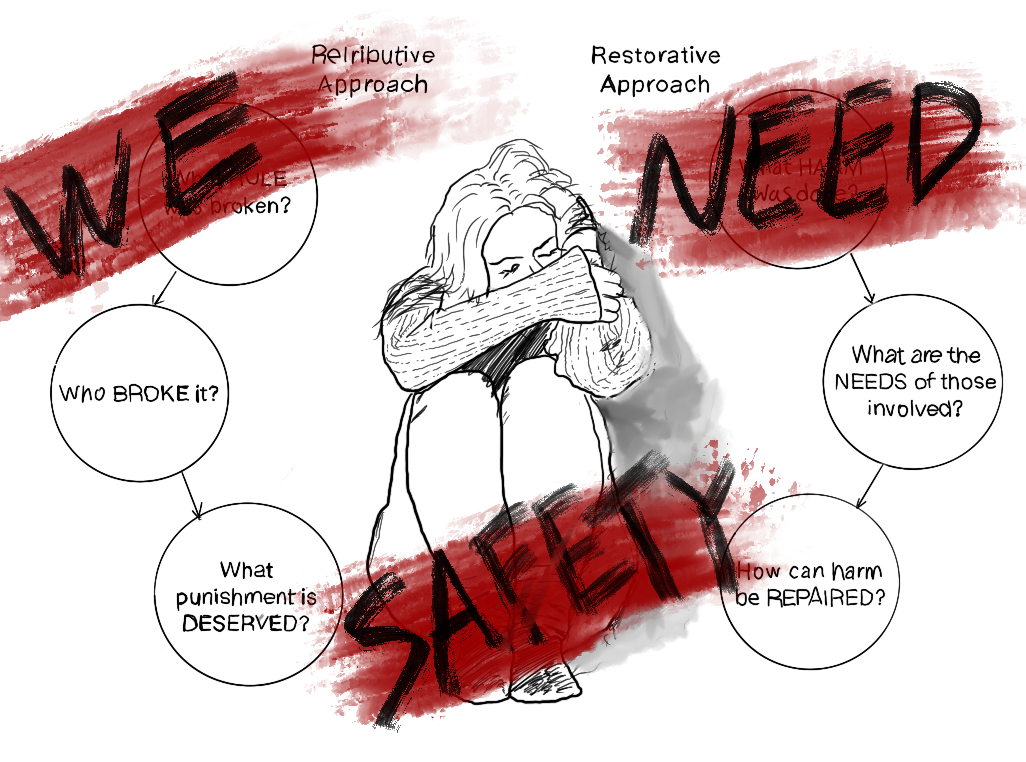
    Cal Poly Humboldt’s Campus Advocacy Team (CAT), along with the help of the North Coast Rape Crisis Center, hosted the annual international event known as Take Back the Night last Friday. This college campus-focused event looks to empower women and other vulnerable minorities. This year’s event began with a presentation by Dr. Rachel King, a specialist in issues of sexual misconduct within higher education. Her presentation explored the usage of restorative justice in situations of sexual assault on college campuses.

    Restorative justice focuses on the rehabilitation of offenders through reconciliation with their victim(s) and the community at-large. The framework often assumes that the offender committed their crime due to a perceived need in their life that wasn’t being met or a lack of knowledge towards the harm they inflicted. Proponents say that restorative justice has the capability to be incredibly effective and healing to all parties involved in a crime. However, should we assume sexual assault falls into this category of effectiveness?

    An hour into the presentation, many participants were disheartened, disgusted, and frustrated. At multiple points in the Zoom-based presentation, King implied that many perpetrators of sexual assault did so based on a simple ignorance or misunderstanding of the situation. While this could be true for a minority of cases, statistically, the vast majority of sexual assaults are done with the explicit understanding that these actions were unwanted.

    “It’s not about ignorance, it’s about power and control,” an event coordinator said after the presentation.

    Many of the event coordinators present refused to speak on the record regarding their feelings on the hour-long speech. Their reasons ranged from the sensitivity of the topic to a perceived backlash from the administration.

    “I personally have a very hard time with restorative justice as a survivor myself, working as an advocate, and hearing survivors on a daily basis,” another event coordinator said. “I’m not saying that the normal system is [made] to protect the survivors in any way. It’s not. The traditional justice system is very re-victimizing and very re-traumatizing for survivors, but the model that was shown today could also be set up for survivors to be re-victimized and re-traumatized.”

    Whether intentional or not, restorative justice processes can put the offender and the victim on equal levels of legitimacy. In the case of sexual assault, this makes little to no sense. As advocates in this area, the members of CAT and the North Coast Rape Crisis Center know that these actions predominantly come from an abuse of power or a complete apathy towards the victim, not due to innocent miscommunication.

    “I feel like this presentation weighed a bit too heavily on the perpetrator and their choices,” a coordinator said. “It just wasn’t all that comfortable for me to hear, it’s like ‘if they get this little bit of accountability, then they’ll never do it again’ when we know that that’s not true.”

    The event ended four hours earlier than its intended conclusion, in part due to the extremely low turnout. It is unknown if CAT and the North Coast Rape Crisis Center will continue to use Rachel King as a resource for sexual assault trainings, especially in light of the negative reaction towards her presentation.

    Both teams stand firm in their mission to empower survivors on campus, whether they wish to take a restorative justice approach or a traditionally retributive one. Their concern lies solely with the victims and their personal well being.

    The Campus Advocate Team runs a 24 hour anonymous support line for any and all student victims of sexual assault that can be reached at (707) 445-5881.

  • Painting it teal for sexual assault awareness

    Painting it teal for sexual assault awareness

    by Matthew Taylor

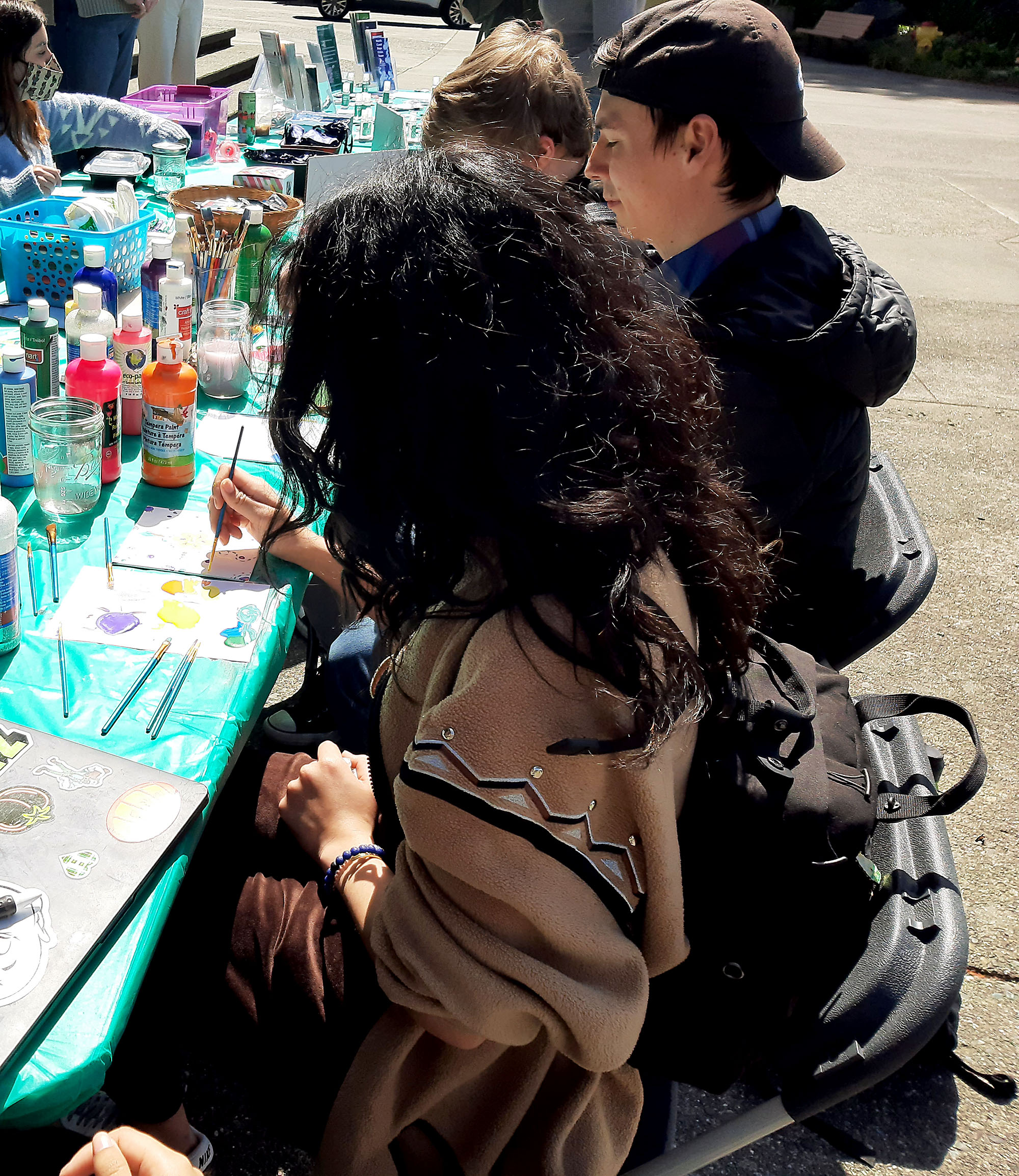
    Pamphlets and papers flew around the UC Quad. Three teal blue tables stood to the right of The Depot entrance, pushed up close to the SAC’s concrete stairs. Dozens of paint bottles cluttered the leftmost table while various pins cluttered the right. April is international recognized as Sexual Assault Awareness month and The North Coast Rape Crisis Team alongside its on campus program Campus Advocate Team (CAT) have worked together to host its annual Take Back the Night week. The week-long event lasts from April 4 to April 7 and includes activities such as Denim Day, Clothesline Project Workshop, and Take Back the Night.

    Photo by Matthew Taylor | Liliana Cortez (center) speaking with students on the UC Quad about Teal Day on April 4.

    Tuesday marked Teal Day, a day dedicated to the awareness of sexual assault survivors and their stories. Students at the tabling event were encouraged to paint their expressions of positive growth and healing. By the end, all the small canvases would be placed together to form a larger mural. Liliana Cortez, the Violence Prevention Advocate at the Women’s Resource Center, expressed that the mural was an optional part of the activity.

    “It’s up to them,” Cortez said. “If they want to create their piece and keep it, or if they want to go ahead and give it to us so we can make it part of [the mural].”

    Together with Cortez, CAT Education Coordinator Kira Morse was also present at the table.

    “We provide services here on campus for survivors of sexual assault,” Morse said. “We have counseling, we have an office here, and we also respond out if there’s any incidents or things like that and help with [things] like Title IX and accommodations.”

    Rachel Mack, a Rangeland Resource Management major, was one of the handful of students painting at the table.

    Photo by Matthew Taylor | Painting by Rachel Mack created during the Teal Day event at the UC Quad on April 5.

    “It’s nice to have something positive as well as it being important for what it stands for,” Mack said, whilst painting her sunflower piece. “I think [it’s] really important for survivors to be able to have control over their own situation.”

    Alexa Farias, a Critical Race, Gender & Sexuality Studies major, expressed this event is very important to her work and role within Students for Violence Prevention.

    “We actually want to be part of the whole Speak Out, because it’s a really good way to show people what it feels like to really look through the situations,” Farias said.

    Speak Out is one of the many sub-events planned within Friday’s Take Back the Night program. This event will provide a safe space with counselors on hand for survivors to ‘speak out’ about their experiences and tell their stories.

    “The main movement and push with Take Back the Night is that people can feel safe here on campus and have their voices heard,” Morse said. “I feel a lot of times that survivors feel like they’re hush hushed. There’s not that open space where people can name their experiences. Take Back the Night, there is a lot of this amazing support where people feel comfortable.”

    Friday’s event will begin with a speech by Dr. Rachel King that will culminate into a rally and the aforementioned Speak Out event. Lasting between 6 to 10 pm, the event will end in a vigil dedicated to the victims of sexual violence.

    “I feel like [this] is really good,” said psychology major John Clark. “If this could happen at most events, then people would start to see that this is a [common] thing that we should talk about.”

  • A Look Into HSU’s Annual Crime Report

    A Look Into HSU’s Annual Crime Report

    Clery Act reveals numerous sexual assault cases within the last 3 years at HSU

    Humboldt State University’s 2019 Clery Act Annual Security Report reveals more than three sexual assault cases at HSU in each of the past three years.

    Amelia Wagoner, a victim rights advocate and kinesiology major at HSU, said the problem goes deeper than the statistics suggest.

    “The amount of reported cases here and throughout the nation do not reflect campus safety,” Wagoner said. “The reporting process is traumatic and most survivors don’t want to deal with it.”

    The Clery Act federally requires all higher education institutions to disclose campus crime statistics. The newest report for HSU, released in September, covers crimes from January 2016 to December 2018. All Clery Act reports for California State Universities are available on the California State University webpage.

    HSU’s report notes five rapes in 2016, five in 2017 and four in 2018. HSU doesn’t have the most rape or sexual assault instances within the CSU system, but it did have one of the largest percentages compared to its relatively low student population. Sexual assault victims made up .05% of HSU students.

    HSU requires students to go through a consent course before attending, and all members of clubs or sports teams attend a Title IX seminar once per year. Title IX is a federal law prohibiting discrimination on the basis of sex in federally-funded education institutions, and the seminar focuses on teaching consent culture and anti-hazing.

    Geography major Allie Jones expressed concerns about the faculty behind HSU’s Title IX seminar.

    “At HSU, nobody on the Title IX team is a woman,” said Jones. “I’m sure the coordinator is qualified for his job, but as a woman I’d feel more comfortable having another woman to talk to.”

    For now, Wagoner urged students to play their part in improving campus safety.

    “Make sure everything is okay,” Wagoner said. “If you see or hear something that doesn’t seem right, do your part to make a difference.”

  • Out of the darkness comes light

    Out of the darkness comes light

    Survivors of sexual violence share their experiences through the events of Take Back the Night

    Take Back the Night delivers the message that domestic partner violence, intimate partner violence and other types of violence will not be tolerated.

    Xochitl Cabrera runs the Humboldt State’s Women’s Resource Center, which hosts Take Back the Night every year.

    “Sometimes people don’t need you to help them, you may need to take a step back. Some people just need to heal themselves,” Cabrera said.

    The Women’s Resource Center is a campus resource for people who need a safe place to study or find the help you need for survivors of sexual violence experiences.

    “The Women’s Resource Center knows that sexual violence and domestic violence happen all of the time, but it is up to the survivor to reach out to the Women’s Resource Center,” Cabrera said. “Take Back the Night is not for everyone. People tend to avoid the trauma it brings up.”

    Hanging on the walls of the Kate Buchanan Room are T-shirts from survivors of sexualized violence and friends of people who died from sexualized or domestic violence. The T-shirts had messages written telling of horrible acts of sexualized violence from family members, friends and others.

    “The T-shirts are difficult to look at, but their story needs to be heard. They are not nice. It is painful but necessary,” Jodie Huerta, HSU sociology major, said.

    Messages written on T-shirts decorating the walls of the KBR. Photo by Ahmed Al-Sakkaf.

    Assistant professor of Native American studies Cutcha Risling-Baldy was the guest speaker for Take Back the Night. Risling-Baldy’s talk was based on systemic violence toward people of color. Before her talk on missing and murdered indigenous women, Risling-Baldy acknowledged the death of HSU student David Josiah Lawson.

    “If David Josiah Lawson were not a person of color, his death would be on the news every day,” Risling-Baldy said.

    The Native Americans view domestic violence differently.

    “In an interview with a Wiyot woman, the anthropologist asks what happens if a man rapes a woman,” Risling-Baldy said. “The Wiyot woman replies, ‘That never happens.’ Asked why it never happens, the Wiyot woman said, ‘Because that person would be killed.’”

    Speaking out can trigger traumatic experiences for people.

    “People choose to come if they feel comfortable speaking on their testimony, and they choose not to come because they don’t feel comfortable speaking on their testimony,” Cabrera said.

    Some of the speak-out testimonies were about sexual violence that occurred during childhood and adolescence, while some of the testimonies were about sexual violence that happened at HSU. Sexual violence happens to HSU students, for which most of us are unaware.

    “Everybody knows that sexual violence is happening, but nobody is doing anything about it. It is just getting swept under the rug,” Grace Lamanna, HSU recreation major, said.

    People tend to restrain themselves from being in these spaces, because of the trauma it brings to them.

    “Some folks don’t feel safe in this space, because they don’t identify with domestic violence and sexual assault. People feel like they are taking up space and say, maybe this isn’t the space for me, I’ll take a step back,” Cabrera said. “That’s totally fine, because we want to prioritize those individuals that have experienced sexual assault and sexual violence at some point in their lives. That is what this space is mainly for.”

    Students hold hands in a circle behind the McKinley statue on the Plaza. Photo by Ahmed Al-Sakkaf.

    HSU sociology major Omar Miranda helped as a monitor for the Take Back the Night march as part of his class.

    “I feel like I made a difference. Big or small. Something small to me could make the biggest difference to the survivors,” Miranda said.

    The survivors gathered after the speak-out for the Take Back the Night march. Marchers wore orange safety vests, gathered in groups of five and were assigned a monitor. Monitors had received tactical training for this march and could protect the group if some danger presented itself.

    The marchers left school chanting, “Hey! Ho! The patriarchy has got to go!”

    The marchers went from school to the plaza downtown and were heckled by a few passersby in cars, as well as people along the route.

    On the plaza, the Take Back the Night members and public in attendance gathered in a memorial for the people who have died from sexualized and domestic violence. In silence, the less fortunate victims of this violence were honored.

    As the Take Back the Night march left the plaza, the declarative chanting could be heard echoing off buildings and down alleyways.

    “Take back the moon, take back the stars, take back the night because the night is ours!”

  • Check-It celebrates fourth anniversary

    Check-It celebrates fourth anniversary

    Students and staff get to share why they check it.

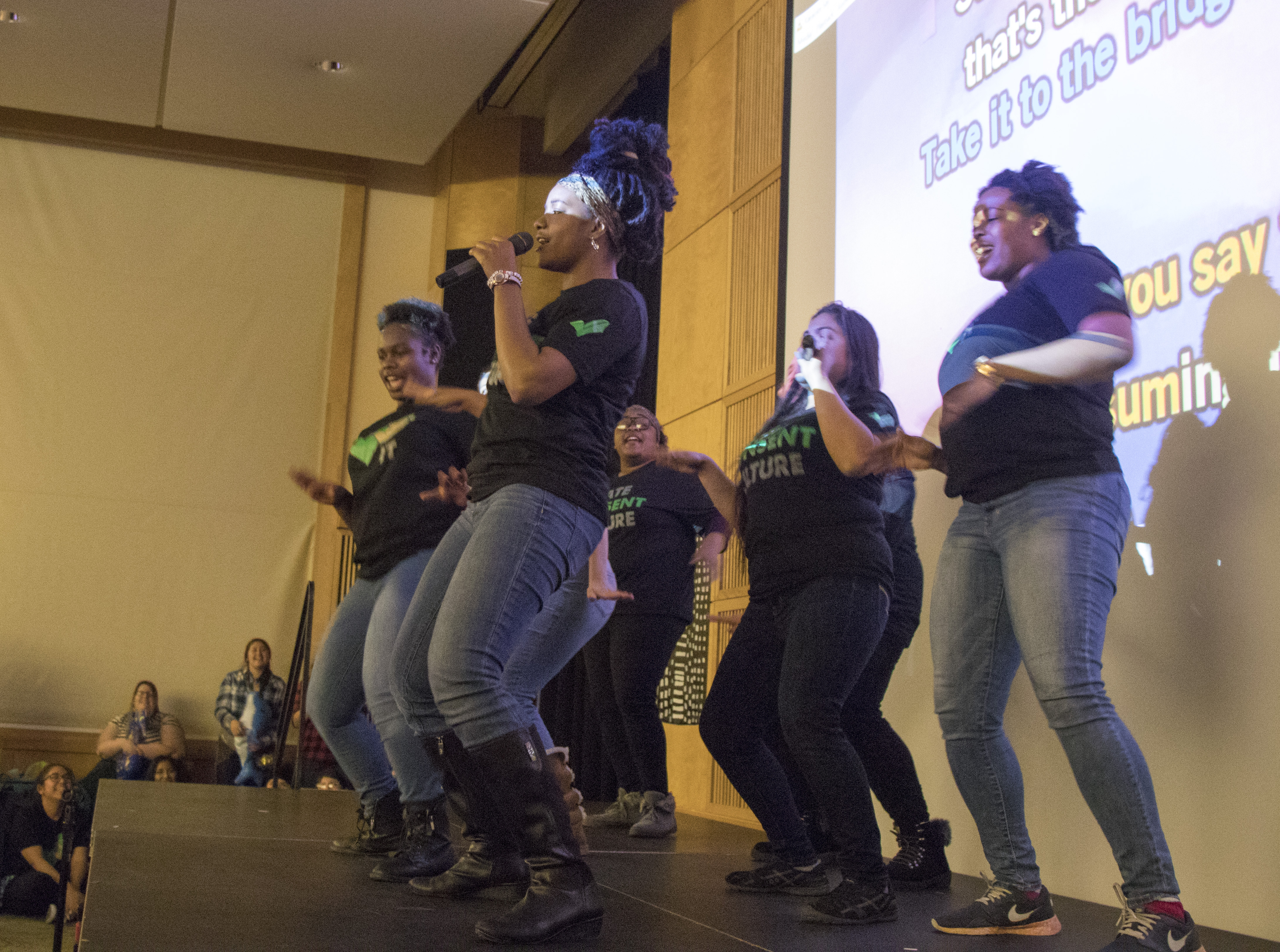
    Check-It had their fourth anniversary party in the Kate Buchanan room on Feb. 23. There was free food, karaoke and a variety of clubs that performed from 7-8 p.m. The lights-out dance party was from 8:30-10 p.m.

    Mary Sue Savage is the prevention coordinator at Humboldt State. Savage has been here all four years and says this anniversary party has become a tradition.

    “To ‘check it’ means to intervene, to take action when we witness a potential moment of harm, specifically addressing sexual assault, dating violence and stalking,” Savage said.

    Savage checks it for many reasons. She checks it for her family, her community and for her future children.

    “I check it, because I want to live in a world where harm is not the norm. I want to live in a world where we have a consent-centered culture,” Savage said. “It’s really exciting knowing we can use Check-It as a tool to create the culture and the world we all wanna live in.”

    Esmeralda Hurtado is the student coordinator for consent culture. Hurtado checks it, because she wants to continue to spread the knowledge of respecting consent and people’s boundaries.

    A time where Hurtado personally checked it was when she first moved into the HSU dorms.

    “I had just came home from class and I heard a lot of commotion outside. I stopped and I heard screaming and things being thrown,” Hurtado said. “I ran out of the dorm and I knocked and that stopped it. I still felt that something was not okay so I ran and grabbed a [community advocate], and they were able to asses the situation and handle it properly.”

    Bridget Ocampo is a peer health educator with Oh SNAP!

    “I feel like back in high school, we didn’t have much education within that. When I came up here, I became aware that it’s really important,” Ocampo said. “When I personally checked it, [it] was at work. One of [my] coworkers tapped my friend on their rear end, so I confronted them. At the time, my friend was too afraid to tell them anything.”

    Lemia Wells was an attendee at the Check-It anniversary party. Wells came to the event to support the program and those who have been sexually harassed.

    “I check it, because consent is important. If it’s not a for sure consent, then it is an assault,” Wells said. “Last week, I checked a guy who was yelling at a girl. The girl was telling the guy to leave her alone, but he wouldn’t so I told him that it wasn’t necessary. He got frightened and stopped yelling at her.”

    HSU acapella club member Christian Placet was one of the karaoke performers. The acapella club checks it, because it’s important that everyone should feel respected in any situation.

    “There were moments where i’ve been a bystander, where I wished I checked it.” Placet said. “Back in high school, there were a lot of nerds that were picked on and I really should’ve done something.”

  • #metoo

    #metoo

    By | Iridian Casarez

    Victims of sexual assault and sexual harassment need to continue to tell their story. It cannot stop here. It wasn’t until the #metoo movement that people began to acknowledge how sexual assault and sexual harassment was prevalent and happening everywhere. Everyone felt supported enough to tell their stories, including men. Men who, according to society, can’t get raped. Men who are victims of sexual assault don’t report it. The National Sexual Violence Resource center says that about nine percent of men are victims of sexual assault.

    53 thousand people and counting participated in the “#MeToo” movement. The hashtag “me too” was used by victims of sexual assault or harassment. All people did was post the hashtag and that was it. It was known to everyone that they had become a victim. It shed light to the fact that anyone could be a victim of sexual assault.

    We have seen sex scandals happening way before the Harvey Weinstein allegations. This past February, Uber was under scrutiny after a former engineering employer, Susan Fowler, claimed that she was sexually harassed, as previously reported by Bloomberg Technologies.Kesha, the singer/songwriter, sued her music producer, Dr. Luke because of how he sexually, verbally, and physically abused her. We saw a big rape case a year ago at Stanford University in which an unconscious woman was raped behind a dumpster by Brock Turner. She read a letter outloud to her rapist in open court that was reported by Buzzfeed. But it wasn’t until after more than 2 million posts that we started to listen.

    We cannot let this movement die. Rape, Abuse, and Incest Network Statistics (R.A.I.N.N.) says that every 98 seconds, an American is sexually assaulted. R.A.I.N.N says that women who are college-aged are at higher risk for sexual assault.

    I have someone close to me that is a victim of sexual assault. I have listened to their stories and I can see the effects of sexual assault. It’s devastating.

    #metoo is making it clear that sexual assault, abuse, harassment is always happening. #metoo lets us see the reality of sexual abuse and it must come to an end. We need to continue to tell our stories and we need to seek justice for those who have been sexually abused. We must teach everyone that you need to have consent. Yes, means yes.

    If you have been sexually assaulted there is the Campus Advocate Team provided by North Coast Rape CrisisTeam.Support is available for all survivors, no matter when the assault occurred, no matter what age or gender. They can be reached at (707) 445-2881.

  • Don’t be a creep

    Don’t be a creep

    Grabbing or groping a person without their consent are desperate acts of perversion. The same goes for ogling at someone’s body for too long or texting unsolicited photos. While they may not seem like a big deal, you’re ruining someone’s day to say the least. There is no excuse for sexual harassment.

    Contrary to the sexual harassment case that was reported to the University Police Department this month, many survivors choose not to speak up, especially survivors of rape.

    Allie Jones, 20, is majoring in geography and journalism at HSU. She was harassed and assaulted twice last semester by two different men, both on and off campus. The worst incident involved stalking and attempted rape.

    It took Jones almost a month before calling UPD, yet she disguised her report with hypothetical questions about how to deal with sexual assault. Jones did not get help that day. In fact, she didn’t want help.

    “I realized that I didn’t want to talk about it,” said Jones. “I didn’t want to rehash it… you just want some normalcy, because you just want to move on.”

    Before long, Jones opened up to her friends and accepted their emotional support. She also signed up for Counseling & Psychological Services (CAPS) and credits them for partial recovery.

    Sergeant Janelle Jackson of UPD handles cases of sexual misconduct. She says that sexual harassment is “a burden to hold in.”

    Survivors who don’t speak up are suppressing trauma that may lead to long-term consequences of phobias and chronic stress. If many stories go untold, sexual harassment wins. Speak up in numbers and let your voices be heard.

    If you feel inclined to speak up, there are resources available to you, including North Coast Rape Crisis Team (NCRCT), Sexual Assault Prevention Committee (SAPC) and Campus Assistance Response and Education (CARE).

    Print
    Graphic by Michelle Meyers