One of the distinctive qualities of a journalist is that they never truly stop working. They may finish working on a story or taking photos, but they are always thinking of their next story, their next assignment, their next grand idea to pitch to their editor. A great journalist can make a story out of almost anything.
One of my greatest qualities (and downfalls) is my ability to turn what was supposed to be my vacation into another article.
Every March, just before spring break, a handful of journalism students at Cal Poly Humboldt get the chance to attend the Associated Collegiate Press Conference (ACP), where we get to attend panels on journalistic practices, connect with companies and other students, and submit our work for the chance to win awards. It takes place in a different city in California every year, which gives us the opportunity to travel to new places and see all the local sights.
This year, the ACP conference was held in La Jolla, a sunny beachside town populated by rich people and entitled seagulls. Journalists travel from all over the country to attend this conference and, hopefully, win some awards for their student media. Apparently, this year had the most attending journalism students out of any ACP conference, according to a fellow journalist who interviewed me for an article. Even with the large number of attendees, there was an unspoken sense of comradery and understanding among us, even if we had never met each other.
One of the appeals of the conference, besides the opportunity to network and learn new skills at the dozens of panels, is getting to explore the city as a group. I didn’t have the opportunity to stick around and enjoy the city at last year’s conference, so I’m happy I had the chance to spend time with the rest of the Lumberjack team. We had a group breakfast of homemade eggs and potatoes made by our editors. We visited the Birch Aquarium where I stared at the leopard shark tank for a good ten minutes. We browsed downtown La Jolla and I made everyone visit my mother’s yoga teacher’s deli shop. I got to swim at the beach for the first time since high school.
I make an effort to attend panels with differing topics to broaden my knowledge and gain an appreciation for the other jobs in the newsroom. I learned about the particular but important art of typography, I got a refresher on inclusive design for newspapers and websites, I learned about covering LGBTQ+ communities in San Diego County, and I attended the panel on satire news hosted by our amazing adviser and one of our editors-in-chief. Everyone was laughing for a good half of the presentation, so I consider that a success. I smiled as journalists from other schools ecstatically told me how they planned to pitch a satire issue to their publications. Holding figures of authority accountable is much more fun when you get to be funny about it.
The biggest part of the conference for our newspaper is the awards. The ACP hosts its own award show, and a separate group called the California College Media Association (CCMA) has its own awards on the last night of the conference. ACP is a national organization, and out of all the schools with less than 15,000 students, we still won 5th place in Best in Show for one of our papers. Not too shabby for a staff of less than 30.
The CCMAs focuses more on awards for individual journalists and is where we get most of our recognition. We all watch with anticipation as the announcer reads off each category, waiting for our school’s name to appear on the projector.
Being unable to take a break ever, I took it upon myself to film all of our announced awards for social media. As the announcer read off the top three winners for Best Headline Portfolio, I narrowed my eyes as three familiar headlines rolled across the screen. I soon realized they were my headlines and I had won second place out of all California schools with under 15,000 students. I can now proudly put on my resume that I have the second best headlines in the state, and I have the piece of paper to prove it.
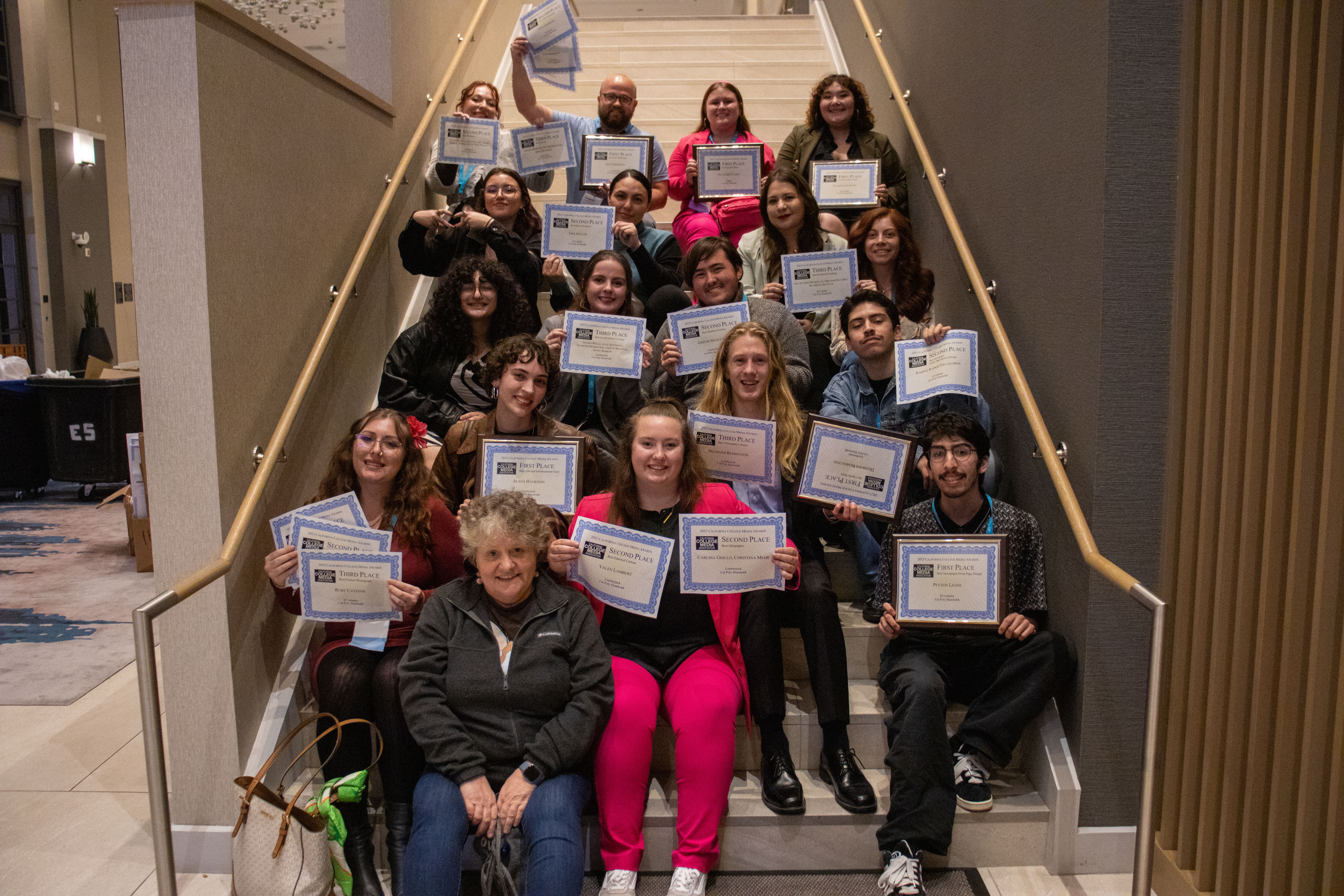
We embraced one another and cheered as we collected a total of 14 awards for the Lumberjack. We placed in categories like Best Social Justice Coverage, Best Feature Photo, Best Arts and Entertainment Story, and Best in Show. We were struggling to get a photo with all of our awards together on the table, even when I stood on a chair and raised my camera in the air. Our advisor soon approached each of us to get a snippet of our reactions for social media. At the time, I was so overwhelmed with excitement and pride in my team that I couldn’t give the groundbreaking, heartfelt speech I wanted. I can at least give that speech in writing.
I didn’t originally come to Cal Poly Humboldt as a journalist. I was an English major and I wanted to write novels. I joined the student magazine, Osprey, during my first semester and fell in love with it. I loved learning from people and giving that knowledge to the public. I knew I wanted to write. When I took the Lumberjack workshop, I didn’t expect to be writing for an award-winning paper. I’m grateful to be a part of the process and I am honored that our hard work gets to be recognized on a state and national level. The pressure of working on The Lumberjack is intense, but you take on that pressure as a team. No matter what else is going on in our lives, we get together every Tuesday, hunker down in the newsroom, and make a newspaper for our campus.
Despite the fact I had only had two drinks throughout the entire night, I very quickly felt unwell and more drunk than I have ever been in my entire life. The fact is, if you are roofied, you often have very little time between drinking and realizing that you are not well. It comes on quickly and you may find someone promising to “help you.” I realized then I had been roofied. The scariest part about that night is I don’t remember half of it.
What exactly is a roofie though? Roofies, or being roofied, is the slang term for the date rape drug called Rohypnol, officially known as flunitrazepam. Easily popped into and dissolved in drinks, the sedative causes memory loss, drowsiness, and sometimes even the loss of consciousness. Only one tablet can impair you for up to 8-12 hours. Combined with alcohol, it makes for an intensified effect.
As cliche as it sounds, don’t ever leave your drink unattended. Sometimes, you need to be even more careful of those around you that are your so-called friends. It’s not that I didn’t not trust who I was with – I had my friends and dormmates with me, but we had been party hopping on Halloween night, drinking and accepting drinks from wherever they came from. Truth is, I still have no idea how I got roofied. This wasn’t a blackout just from too much alcohol, this was a new experience clearly resembling the effects of being roofied.
Staying safe while out on the town starts with prevention. Consider bringing cup covers next time you go out partying. Cup covers prevent someone from getting the opportunity to slip pills, powders, or other substances into your drink without you knowing. I understand you may feel silly pulling out something that resembles a condom for your cup but remember, self defense begins with prevention. The Check Your Drink CYD test strips are another way to prevent being roofied. This is an easy-to-use rapid drink spiking test that detects ketamine, rohypnol, and GHB from only a few drops of your drink.
It’s not like this experience has deterred me away from drinking or the occasional partying, especially now that the drinking I’m doing is legal. However, it has made me think to just be a little more careful and aware of my surroundings because of what can happen.
If I can bring awareness and prevention methods to just one person, I’d be happy with that. Nobody deserves to have their drink tampered with and potentially taken advantage of.
Can I be in love with someone I’m not dating? This situationship has got me fucked up.
How do I answer this without coming off like a complete bitch? Your situationship is not real. That’s not to say your feelings aren’t real, or that the love doesn’t exist – but a situationship is not a real thing. The creation of the label “situationship” has opened the doors for this generation to participate in an unwinnable battle: The IDGAF wars. I like you, so let’s find out which one of us can care the least to keep the other person interested without fully committing?
What is a situationship? To me, it’s one person caring more than the other. One person giving more than the other. One person receiving more than the other — you get it. A situationship will never fulfill you in the ways you’re looking for. Rather, this infatuation will leave you feeling more hollow. One person will always have more power than the other.
That’s not to say I don’t understand where you’re coming from; you caught feelings for the wrong person. It happens to the best of us. At the core of it, we are all just creatures looking for love, security, comfort, happiness; we want to feel desired and safe. There is no safety in a situationship. In fact, more often than not, they all have a three month shelf life. Seriously, name one situationship where things stayed good after that three month mark — if that existed, it would evolve into a relationship.
“We accept the love we think we deserve.”
Everyone, their mother and their mother’s single best friend knows this phrase. It’s true though! We often don’t love ourselves enough to believe we deserve better, and so we stay in the situation(ships) we know because it’s the space we’ve decided to fill. You deserve to take up space with someone who will appreciate how you light up the room.
Where we were, what went wrong & how we build a brighter future
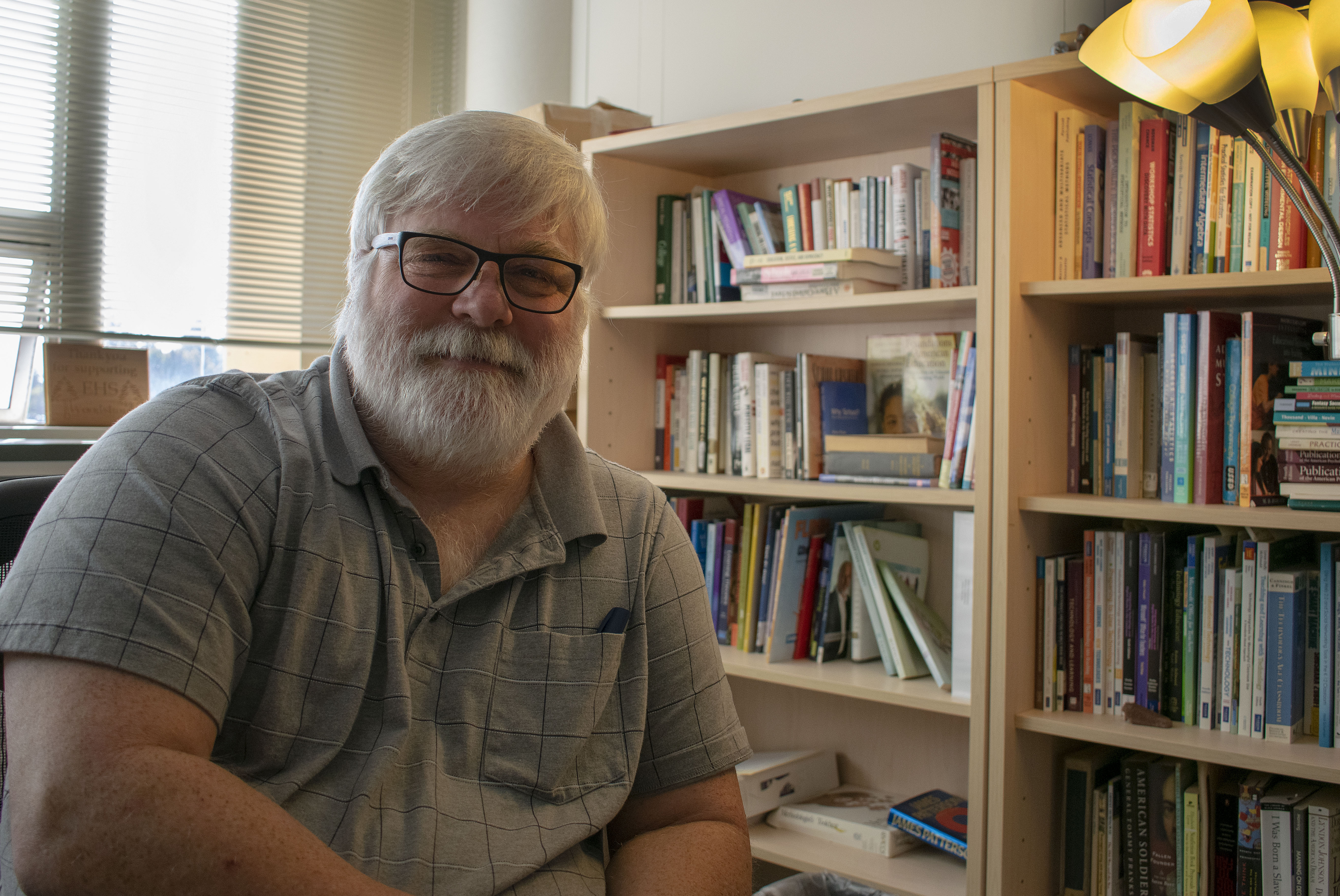
This is a letter to the editor from Humboldt State University Education Department Chair Eric Van Duzer, Ph.D. It has been edited only for minor punctuation and grammar style preferences.
As I reflect back on nearly 30 years at Humboldt State University, first as a student and then for the past 20 years as a faculty member, I wanted to share some of the thoughts that I have about HSU’s current situation and where the campus might go from here.
As a student I experienced a remarkable education where faculty were fully invested in my intellectual and personal development. There were so many opportunities to explore areas of interest and develop new ones. I have spent many hours trying to encapsulate the nature of the schooling I experienced in a way that would really represent the experience.
The best analogy I have been able to come up with was that HSU offered a graduate education to undergraduates. The small classes typical of graduate school encouraged faculty to fully invest in their student’s growth. The university, set so far from the oversight of CSU headquarters in Long Beach, offered a great deal of flexibility to shape our experiences.
This would be impossible today. In those days HSU had the third smallest class sizes in the 23 campuses of CSU. But more than that, it had a unique faculty ethos that reflected nearly 100 years as a student-focused institution that exalted excellence in teaching above all else.
I was the first student CEO of the Institute of Industrial Technology, a self-supporting club that allowed us to use the skills and knowledge we were developing to grow in business acumen, engage in manufacturing and light construction on campus as well as conduct experiments for local agencies. In its second year, Bill Wilkinson used the institute to earn enough profit making desks for campus offices that it paid for several pieces of expensive equipment for the department.
This would be impossible today. In those days HSU had the third smallest class sizes in the 23 campuses of CSU. But more than that, it had a unique faculty ethos that reflected nearly 100 years as a student-focused institution that exalted excellence in teaching above all else.
Faculty came to campus because this is where they wanted to spend their career. Unlike most universities where faculty play academic hopscotch building their resume through research reputations and earning ever-higher salaries as they bounce from college to college, HSU faculty built their reputations on teaching. These were inherently local reputations, not very valuable if one wanted to move on, but rather a reflection of the values and attitudes associated with a culture of excellence in the service of students’ intellectual growth.
As anyone who has worked with university budgets will tell you, graduate education is expensive. That is why through the first 100 years, the administration and other services were done on a shoestring. It was common for a variety of upper administrative positions to be filled by faculty who served temporarily. Staff was thin and overworked and processes were slow and inconsistent.
What happened? In the early 2000s the CSU was facing the onslaught of a Generation X student bulge. Chancellor Charles Reed decided the best strategy to deal with this situation was to homogenize campuses so that if a student could not get into Sacramento State because it was impacted, they could simply go to another campus and get a similar experience.
Yet, the campus, with significant leadership from the faculty, focused its significant resources on classroom instruction, and through that dedication, produced exceptional graduates who were deeply committed to HSU when they graduated.
I remember an administrator in the early years telling me that he had been in a restaurant on the East Coast and overheard a group of students talking at a nearby table. He was so impressed with their sophistication and the values they held he found out where they came from and immediately applied for a job at HSU.
He was the first person hired under then-president Rollin Richmond to manage our enrollments in the early 2000s. The diversity on our campus is a credit to him and Richmond, who reached out across the state to bring in students from urban areas. Sadly he became disillusioned and left. So did most of the faculty leaders.
What happened? In the early 2000s the CSU was facing the onslaught of a Generation X student bulge. Chancellor Charles Reed decided the best strategy to deal with this situation was to homogenize campuses so that if a student could not get into Sacramento State because it was impacted, they could simply go to another campus and get a similar experience.
Shortly thereafter the upper administration received inflated titles and significant raises in an apparent effort to reduce resistance. Then the attack on the faculty began.
Naturally, faculty on campuses such as HSU who were proud of their traditions and niche identities resisted. Fiercely. At one point, three campus presidents, including Rollin Richmond, suffered through votes of no confidence by their faculty as they implemented this strategy.
To achieve the required changes in the face of faculty resistance, campuses, including Humboldt, began shifting to a corporate structure of top down management. Faculty who had held a privileged position in campus life were systematically reduced to workers with only a symbolic voice in campus decisions. The administration turned its focus inward towards improving the functioning of the bureaucracy. They eliminated administrators such as Rick Vrem, an ethical provost, who refused to implement changes that hurt the traditional focus on instruction.
Vrem was replaced with a provost who had no such compunction. Shortly thereafter the upper administration received inflated titles and significant raises in an apparent effort to reduce resistance. Then the attack on the faculty began. Nearly 80 faculty positions were eliminated over several years and during the same time period, a similar number of new staff positions were created and filled to support administrative functions.
Over the majority of the intervening 15 years, budget reductions for academic programs have been the norm: reductions in staff, program availability and courses. This year it was a 6% cut, last year another and many like it before. The funds have been shifted to an ever-expanding variety of administrative initiatives.
Now we sound more like a parks and recreation office than a university. Come for the redwoods, the beaches, the bike riding—that is wonderful and I love it, but it is not why people pick a university.
We spend nearly 68% of our budget on administration and campus facilities. Despite the results of a study commissioned by Rollin Richmond’s administration that showed the two most important factors that cause a student to come to HSU are quality of education and availability of the program they are interested in, both have been repeatedly attacked, sliced and diminished.
It is surprising that no one seems to notice that every time we cut academic programs, fewer students want to come here. And when fewer students come here, the budget suffers and HSU responds by cutting academic programs even more severely—a cycle the faculty in 2004 described as a “death spiral.”
As we address our current crisis and try to figure out what we need to become in order to grow back to a sustainable enrollment, we might want to engage in some soulful reflection. What would cause a 20-year-old to come to a place five hours from major centers of civilization and spend four years with us? What do we have to offer them that is so valuable, so different from what they can get at any of the other CSU campuses which are closer, cheaper and offer a great deal more college life in the community?
We stopped selling the small classes and close academic relationships with faculty when the hypocrisy became too much to bear as campus priorities shifted. Now we sound more like a parks and recreation office than a university. Come for the redwoods, the beaches, the bike riding—that is wonderful and I love it, but it is not why people pick a university.
When I arrived here as a faculty member in 2000 we had one staff member, John Filce, doing institutional research. He was wonderful and badly overworked. I am sure he still is. Now we have nine staff members listed in the directory in the Office of Institutional Effectiveness, including a vice president. I am sure their work is valuable, but to pay for it we had to cut 64 class sections.
Today, we are an organization of inflexible rules and their keepers.
We have proliferated the bureaucracy, which is unfortunately necessary to achieve top-down control of a professional organization. Had our leadership studied industrial technology with me, they would know what companies in the 1970s learned: that this form of management is ineffective and inefficient in a professional organization.
To achieve control requires monitoring, which in turn requires more staff. For a top-down organization, where the vast majority of employees serve at the will of their manager, fear prevents innovation and compliance is key. Before the shift to this model, administrators were problem solvers. In fact, the standing joke in those days was that everything was an exception. Faculty, staff and administrators had the flexibility to serve the needs of students even when it required bending the rules.
Today, we are an organization of inflexible rules and their keepers. It has greatly diminished the effectiveness of the organization and its ability to make decisions that best serve our students. The resulting bureaucratic culture has seen a proliferation of forms, rule books and rigid adherence to often dysfunctional orders.
This is no way to run a university. Perhaps a grocery store, but not an organization of 500 highly educated experts with thousands of years of collective experience. Top-down decision-making, particularly when the president and upper administrators are drawn from institutions that do not share the culture and values of the campus, is inherently poor compared to what would be possible if faculty once again had a meaningful voice in campus affairs.
No student has ever come to HSU because we have a wonderful registrar’s office or because the president’s office is fully staffed. These only matter when they impact the quality of the education a student receives.
The proof of this is apparent everywhere at HSU. When Rollin Richmond came, he had no interest in what made HSU special. Like a white suburban principal coming to a school in Watts, he thought he knew what needed to be done to remake the university into his vision of a modern institution. That ignorance has cost us immeasurably. Today we face the consequences. The failure to fundamentally change direction of subsequent presidents has simply deepened the mess. We now have a new president, perhaps we can find a new vision.
In my view there are two key concerns that need to be addressed from a rational and values-driven perspective. First, an effective budget model that allows funding to follow enrollment is essential to support growing programs while shifting resources to where they will best serve student needs and interests. This can refocus the campus on providing the service/product students come here for—classroom instruction—and it is essential.
There are so many amazing faculty and academic staff here. They are people with a heart for their students, struggling in a system that constrains and conflicts with their efforts. Let their voices guide the future and we may yet have one worth celebrating.
No student has ever come to HSU because we have a wonderful registrar’s office or because the president’s office is fully staffed. These only matter when they impact the quality of the education a student receives.
Second, we have to decide how we are going to rebuild the excellence we once were known for in our student’s academic programs. The day Rollin Richmond refused to give the Outstanding Faculty Award to a physics professor (selected by the faculty based on his ability to delight and inspire students) because that professor had not published, is the day we snuffed out the soul of the old HSU campus.
Now we need to find out what animates us in ways that provide an experience worth the isolation, cost and struggles required to live in this remote community. Redwoods are not enough; we need a reinvestment in education.
I am retiring from HSU at the end of this May. I am sad to see what has happened to my university. There are so many amazing faculty and academic staff here. They are people with a heart for their students, struggling in a system that constrains and conflicts with their efforts. Let their voices guide the future and we may yet have one worth celebrating.
APD asks witnesses to come forward on third anniversary of David Josiah Lawson’s death
FOR IMMEDIATE RELEASE
JOSIAH LAWSON HOMICIDE OCCURRED THREE YEARS AGO
On this day three years ago HSU Student David Josiah Lawson was murdered in Arcata. This case remains under investigation and the Arcata Police Department is seeking the public’s assistance during the on-going investigation. On April 15, 2017, while attending a house party on Spear Avenue, Josiah was stabbed during an altercation. Josiah was pronounced deceased shortly thereafter at Mad River Community Hospital.
Witnesses described upwards of 100 people in attendance at the house party. Many of those who were present have not been identified nor have they been interviewed by Detectives from the Arcata Police Department. The completion of this investigation is dependent on a number of factors including interviewing all people who were present at some point during the party or who have information that can corroborate what occurred that night.
The Arcata Police Department established a 24 hour confidential tip line for community members to provide information relative to this investigation. The phone number is (707) 825-2590. Community members can also call the APD’s Dispatch Center at (707) 822-2424.
Keeping Josiah’s memory alive is paramount to this case. The Arcata Police Department will continue to investigate this case and will continue to work all investigative leads until justice prevails.
Attached in a separate email is a Public Service Announcement developed in partnership with DJ’s Mother, Charmaine Lawson, the Arcata Police Department, the Eureka Broadcasting Company and the City of Arcata’s IT Department. The PSA link is Facebook compatible. All are encouraged to share this link with anyone in order to never forget DJ and to encourage community members who have any information at all regarding who else was in attendance at the party and/or the events that led to DJ’s death, to come forward.
Public service announcement video reposted by the North Coast Journal:
I woke up on St. Patrick’s day—my birthday—to sobbing. My roommate was curled up on her bed, across the room, crying her eyes out. She cried for half an hour, if not more, because she’d just received the Humboldt State email canceling our graduation and asking students to leave campus if they were able. An achievement she has been working toward for seven years and one I have been busting my ass off for four years was all taken away in seconds.
Instead of celebrating and going to the bars—in true St. Paddy’s day fashion—I spent the day in quarantine having to tell my family to cancel their plane tickets and Airbnb reservations because I wasn’t going to be able to walk.
As one of the students left on campus, it’s strange, to say the least. When my roommate and I go for walks or head to get food from OhSNAP!, the university looks like a nightmarish scene from some dystopian novel. Usually, the only people you’ll find walking around campus are construction workers, nurses or other essential HSU staff. Every once in a while there’s the odd student or two, using what little resources are left available on campus.
In front of the health center, a tent is set up to greet all students where they sanitize their hands and grab a face mask before being allowed to enter the building—even students who just need to pick up medication from the pharmacy.
The only students allowed to be seen at the health center are those who show severe symptoms like a fever, sore throat or difficulty breathing. But for those of us who need regular prescriptions through their pharmacy, be it for anxiety medication, emergency inhalers, birth control pills or other medications they offer, we can still access the pharmacy during their posted hours.
In my opinion, this is one of the most concerning aspects of COVID-19. Students and community members cannot be tested through campus for the illness unless they are extremely sick, which leaves carriers with less severe symptoms to go untested.
Before campus was closed, my roommate and I came down with a cough and fatigue that wouldn’t seem to go away so we decided to visit the health center to see what was wrong, maybe a bit paranoid that we might have contracted the coronavirus somehow. But who isn’t a little paranoid during this pandemic?
We were seated outside and only admitted into the entrance of the health center one-by-one. A blood pressure monitor, thermometer and other equipment were set up in the hallway, with two nurses wearing masks and gloves. We were given masks, examined and told that, unfortunately, if we did not show severe symptoms, they were unable to test us.
In my opinion, this is one of the most concerning aspects of COVID-19. Students and community members cannot be tested through campus for the illness unless they are extremely sick, which leaves carriers with less severe symptoms to go untested.
My roommate and I were told we had post-viral infections and given medicine to treat that, but the truth is, we could very well have had the illness and not known because of arbitrary rules only allowing people very ill to access tests.
I’m still sad that graduation was canceled and I know that it’s a momentous accomplishment that I will never get back. But it’s more important to me that we keep people safe than having the chance to walk across the football field to accept a degree.
There are “asymptomatic” carriers of COVID-19, meaning there might be tons of people in the area infected with the coronavirus without any knowledge they are sick. There might be people who have mild symptoms who are unable to be tested and are unintentionally spreading illness because they think they aren’t that sick. We aren’t only putting the health of students at risk by not testing those concerned they might have the illness, we are endangering the nurses and doctors who are still working through the health center, members of the community that students might come into contact with while grocery shopping or performing essential tasks during quarantine.
But this isn’t only a concern in Arcata. The reason behind such arbitrary testing rules is because, as reported by The New Yorker, there is a critical shortage in medical equipment necessary to perform tests. This is why those who are extremely ill are being prioritized over people who don’t show as many symptoms. We simply do not have the resources to test everyone, so people infected with the illness are falling through the cracks, living their normal lives and potentially spreading the illness because they are unaware they even have it.
While those who are sick, but not sick enough, cannot get tests, celebrities who show no symptoms of COVID-19 are allowed to be tested, leaving medical professionals, sick patients and community members to wonder if their lives are less important than the rich.
I’m sitting in my dorm right now going a bit stir-crazy, still trying to find things to do to occupy my time while I practice social distancing in quarantine. Last week, my roommate and I painted canvases to pass the time. I started learning embroidery because I was that bored and today I went to my Zoom English class, then spent the day writing and watching movies with my roommate. We’ve downloaded TikTok just to pass the time.
I’m still sad that graduation was canceled and I know that it’s a momentous accomplishment that I will never get back. But it’s more important to me that we keep people safe than having the chance to walk across the football field to accept a degree.
A moderate rainstorm will make its way through Humboldt County
A storm is hitting Humboldt this weekend will bring a considerable amount of rain.
Jonathan Garner, a meteorologist for the National Weather Service in Eureka, gave us a preview of what to expect.
“All in all, maybe up to two inches of rain over the weekend,” Garner said. “I’m also expecting accumulated snow across the mountains for elevations mainly above 3500 feet. We could get a little bit of small hail and stronger showers and perhaps a thunderstorm as well.”
The rain is mainly forecasted to fall on Saturday but will linger in showers on Sunday. Expect high temperatures to be in the low to mid 50s with lows in the lower 40s.
“It will put a very small dent into our deficit. We’re about 10 or 11 inches below normal right now.”
Jonathan Garner, meteorologist for National Weather Service in Eureka
Garner said the storm won’t resolve our rain deficit for the year.
“It will put a very small dent into our deficit,” he said. “We’re about 10 or 11 inches below normal right now.”
Emily Read, a junior environmental studies major, is still around in Humboldt amidst the coronavirus outbreak. With the rain looming, she planned on not doing much this weekend beyond trying to learn a new program for an engineering class.
“I typically am fine with rain,” Read said. “I like it most of the time—but right now, since we’re stuck at home anyway, I kind of just am tired of it and I just want it to stop raining so it can be nice and warm.”
Jared English, a junior film major, also planned to remain indoors this weekend even though he was initially looking forward to getting outside and doing the one thing he can do in Manila—frisbee golf.
“It does kind of make me a little sad,” English said. “Because that means even more time inside and even more time isolated in this quarantine, and the rainstorm kind of takes that one thing away.”
The Weeknd’s fourth album, “After Hours,” has arrived
The R&B villain, better known as The Weeknd, has returned with his fourth studio album, “After Hours.” In this album, The Weeknd revisits the same themes of drugs, lust and heartbreak found in previous releases, but this time, with a different approach. In the past, his music has come off generally unapologetic, but “After Hours” brings a mix of emotions on his lifestyle.
After nearly a decade of partying and coming onto the scene in 2011, The Weeknd reveals on track eight, “Faith,” that he’s spent the last year sober. Still battling the urge to return to the fast life, The Weeknd comes to terms with the choices he’s made in “After Hours” and the mental war he’s fighting to avoid making those same mistakes.
Coming into this project, The Weeknd set the tone by dropping two pop singles at the end of November, claiming the top position on the Billboard Hot 100 chart with his lead single, “Heartless.” His follow up, “Blinding Lights,” is currently peaking at number two on the Hot 100 chart in the wake of the album release. He followed up in the second half of February with the title track, “After Hours,” as an unofficial single. The song is slow to build, but is equal parts patience and pop, making it clear that the pop-star style is here to stay.
“I will always prefer his earlier stuff. It’s just a sound you couldn’t have found anywhere else at the time.”
Alexa Noperi, HSU film major
Alexa Noperi is a film major at Humboldt State University, and she hasn’t been happy with The Weeknd’s direction since he dropped “Starboy.”
“I will always prefer his earlier stuff,” Noperi said. “It’s just a sound you couldn’t have found anywhere else at the time.”
The Weeknd’s gradual transition to pop music has left some of his day-one fans behind in the darkness of his mixtapes. Made official by his 2016 album “Starboy,” the style shift can be attributed to the success of his biggest single, “Can’t Feel My Face,” along with other pop efforts on “Beauty Behind the Madness,” including “Earned It” and “Angel.”
When he released his first EP, “My Dear Melancholy,” in 2018, the day-one fans that were left behind were delighted by the return of a dark Weeknd. With his latest release, The Weeknd is likely to disappoint hardcore fans again, as he mostly leaves behind the dark, moody atmosphere of his earlier music to make room for the pop sound that generated so much success with “Starboy.”
“After Hours” is a rollercoaster of indecisiveness. The Weeknd’s desires constantly clash with one another on his quest for true happiness.
The album begins with chilly instrumentals that build into their own pop section. The Weeknd flaunts his typical unremorseful attitude, claiming, “It’s too late to save our souls,” on the song “Too Late.”
“After Hours” is the most consistently solid project The Weeknd has dropped so far.
Track four, “Scared To Live,” marks the first shift in his approach. He begins to express remorse for his actions, as well as an authentic desire to leave the fast life behind on the stand-out track “Snowchild,” reinforced on the next song, “Escape From LA.”
Unfortunately, The Weeknd relapses, back to the fast life on his song, “Heartless.” This marks the beginning of the pop-star section that dominated the sound of “Starboy,” this time, with a heavy ’80s electro-dance influence.
“After Hours” then enters its final section, returning to the slower, chilly instrumentals that opened the album on the “Repeat After Me” interlude. The Weeknd concludes his fourth album, echoing a desire to leave the fast life behind and asking for one last chance at a normal life.
Though it may be missing the unique, dark sound of The Weeknd’s early music, found on songs like “D.D.” and “The Hills,” as well as the beauty and optimism found on “True Colors” and “I Feel It Coming” from “Starboy,” “After Hours” is the most consistently solid project The Weeknd has dropped so far.
“It’s not bad background music to try on jeans to. But I don’t think I will be playing it again.”
Isabelle Eddisford, HSU political science and dance major
This album marks a growth in his discipline, but also in experimentation. Following the massive success of “Starboy” and the widely-positive reception of “My Dear Melancholy,” the less-than-spectacular “After Hours” might just leave all of his fans a little disappointed.
Isabelle Eddisford, an HSU student studying political science and dance, felt disappointed that the new songs sounded the same. She described the album as something that would be playing in an Abercrombie and Fitch store.
“It’s not bad background music to try on jeans to,” Eddisford said. “But I don’t think I will be playing it again.”
With predicted first-week sales of 400,000 units for “After Hours,” The Weeknd’s continued success in the pop genre may mean the death of his dark times.
On a warm Friday afternoon, student volunteers help trim eight different varieties of basil leaves for a study headed by undergraduate Fisheries Biology major Bryan Lester.
Lester is studying which strain of basil grows the fastest using this aquaponics facility, he completed his second trial on Friday. The stains grown in the study are dark opal, holy, Italian large leaf, lemon, lime, spicy globe, sweet Genovese, and Thai.
Fisheries Biology student volunteers trimming basil leave to be weighed Photo credit: Charlotte Rutigliano
A study he might not have been able to do without the help of Coast Seafoods, Hog Island Oyster Co., and Taylor Shellfish. According to assistant professor of Fisheries Biology Rafael Cuevas Uribe, past donations from Ameritas faculty ran out this past summer.
“The donation we received from these local businesses will help run the facility for about a year,” Cuevas Uribe said.
Since HSU starting leasing this facility, which belongs to the Humboldt Bay Harbor District, around two years ago Cuevas Uribe and the student volunteers have grown pak choi, lettuce, cilantro, chard, spinach, arugula, kale, and cabbage.
Cuevas Uribe started this program to help teach students about what aquaculture is and how to maintain and grow in a system like this.
“Aquaponics is an educational tool,” Cuevas Uribe said, “students often run their own research projects, like what Bryan is doing.”
According to Cuevas Uribe, aside from evaluating growth rates of plants, one of the other student-run research projects was evaluating the growth rates of the fish by changing their diets. A diet that normally consists of pellets made from fish meal, fish oils and other types of oils.
“This study evaluated the growth and feeding habits of the white sturgeon,” Cuevas Uribe said, “the students gave them a fish-free organic diet, and the results from that study were presented at a national conference.”
According to Cuevas Uribe, they get the white sturgeon from a fish farm in Galt, Ca.
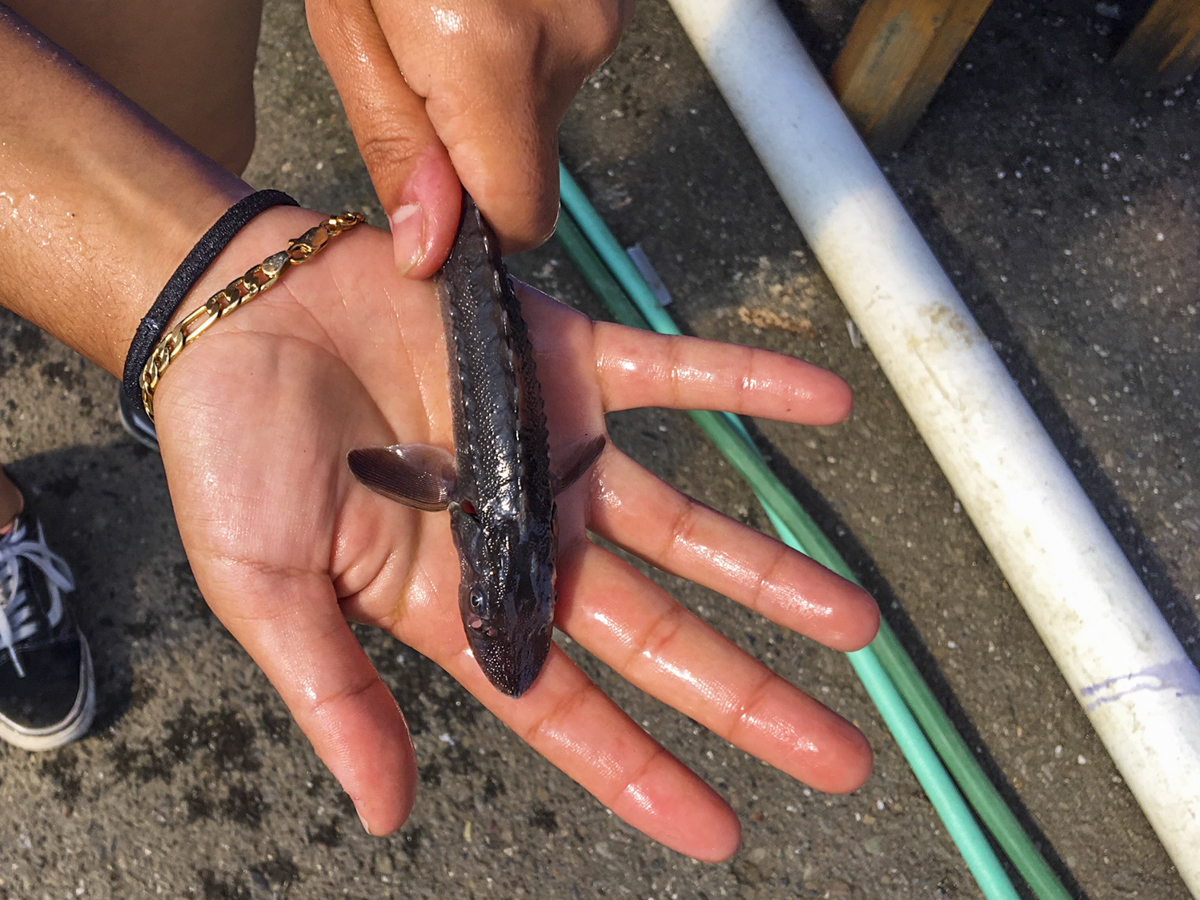
“We have about 80 sturgeons that are 2-years old,” Cuevas Uribe said, “and another 400 sturgeons that are a few months old.”
Cuevas Uribe said that the fish are separated by their biometrics or their size, and student volunteers like senior Fisheries Biology major Alexis Harrison come down to the facility once a day to check on the water quality of the fish.
“We come down to check the oxygen levels, the temperature, the pH levels, ammonia levels, nitrite levels and nitrate levels,” Harrison said.
According to Cuevas Uribe, the fish help circulate the water for the plants. The water from the tanks the fish are held in is filtered by a polygeyser bead filter that holds bacterias that have nutrients the plants prefer.
“It’s a very symbiotic relationship,” Cuevas Uribe said, “even the waste drained from the filter, is strained and reused as soil for the plants.”
Cuevas Uribe said that everything that is grown at the facility is either taken home by the student volunteers or donated to the open community garden or the Food for People food bank in Eureka.
Lacy Ogan communications manager with Pacific Seafood, a company who has hired several HSU students as interns to work with the company because of this facility. Ogan said that companies are dedicated to the success of this program.
“They are in the process of helping to find a long-term funding source,” Ogan said, “so their resources can be focused on increasing internship programs.”
Sarah Arias, a senior art studio major and business administration minor is in a process of creating a piece for her advanced painting class.
Arias has created a series piece of gay lovers eyes. Eyes who belong to the Queer Trans People of Color (QTPOC) community. Arias is adding a twist to a late 1700s to early 1800s jewelry fad of necklaces, rings, and broaches which held small photos of their secret lovers’ eyes. Arias was inspired by a similar theme within her life and the lives of her POC friends who still struggle to come out to their families. For her friends, telling their parents about their lovers could jeopardize more than just their relationships, it could jeopardize their schooling if their parents pay for it. This lack of acceptance from Latinx parents results in lovers being kept secret.
To learn more about Arias and her work, watch the video below.
Humboldt County has a reputation for accepting the widespread use of cannabis. While Humboldt State gives a stern warning to students that weed is not allowed in the dorms upon orientation, it is still present. One freshman smokes almost everyday and believes that one of the hardest parts of getting high discreetly is that weed can be very potent.
“Depending on your CA it can be pretty hard sometimes, the smell can give you away,” they said. “It depends on what you’re smoking. If its wax, it doesn’t necessarily smell as bad as if you are smoking actual bud.”
For this particular student, the fear of being caught has subsided since the beginning of the year.
“At first there was a nervousness, but then you realize that everyone smokes and everyone is used it so you’re not worried about being caught,” they said.
Being caught comes with severe punishment. The Humboldt State housing handbook outlines the potential outcomes of being caught while in possession or under the influence of any drug or controlled substance.
According to the housing handbook, “Outcomes may include educational administrative sanctions, a student’s removal from Housing, and referral to Student Affairs, and possible legal charges (including arrest and fines).”
These harsh penalties cause some people living in campus housing to not risk smoking in their rooms. One resident in campus apartments admits to smoking, but never in their room.
“I have never been caught,” they said. “I honestly never smoke in the dorms, always outside.”
These types of measures are necessary to not get caught with a very strict and observant CA.
They believe that the school does not care about students smoking.
“No [they don’t care] but, they are still a school, and have to function as such,” they said. “Smoking weed openly in dorms would discredit the school I believe.”
In Creekview, there is only one CA per building. One resident has only ever met their CA three times. To stop from being caught smoking in their dorm, the Creekview resident has their smoke detector covered and window open.
“It is very very easy to smoke in Creekview,” they said, “It is also very easy to hide, we don’t really have to do it, but we do it as a precaution.”
Marijuana is a known occurrence in Humboldt County and while the school preaches that it does not allow marijuana on campus, it is readily available and people smoke it openly in the dorms.
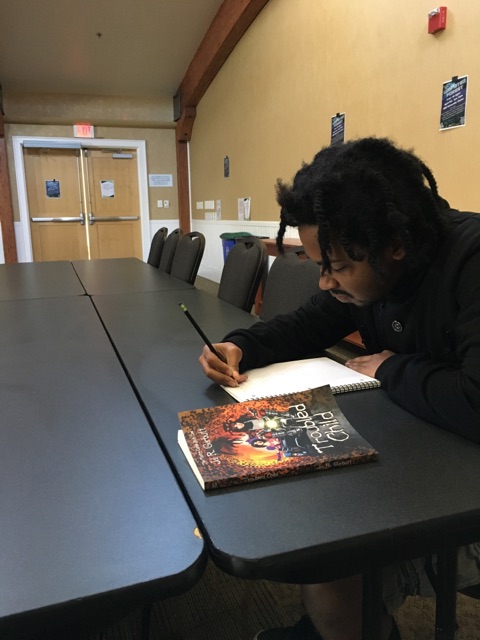
HSU student Jai R. Garbutt is a business major from Palmdale, California who uses part of his free time to explore his imagination in the form of writing. A fan of fantasy with a passion for writing, Jai is currently working on “The Floating Castle”, a fantasy series that latterly began with his first publishing. Garbutt’s novel “Troubled Child” is a story about 12-year-old Lokkiyama who travels around the country with her mother in the year 8077. Along the way they eventually settle, but due to Lokkiyama’s reputation as a troubled child, the pair always finds trouble. Garbutt’s 155 page book was published on January 23 and is available now on Amazon.
Jai Garbutt reads his work | Photo by Bryan Donoghue
Q: When did you first start writing your novel?
A: I don’t know the exact month. I know the year I started writing. It was 2013. That was because I graduated high school in 2013. Also, I had to go to college but there were some complications, so I ended up staying home for a year. So during that year my mom was like, ‘You and your brothers, I want you guys to write at least a 40 page book.’ So I started with the 40 pages. That wasn’t really enough for the idea I was going for, so I just went on from there.
Q: I was also wondering, who are your role models in terms of writing? Who do you look for who? Are your favorite authors?
A:I don’t have any that I know directly inspired me, but I like, I think his name is Christopher Paolini. He’s the author of Eragon Cycle, Eragon the dragons. I read all four of those in one sitting. I think he’s from, somewhere from Europe. I don’t know if I ever had like took anything from him, but I definitely like him and enjoy his books. His books are some of my favorite books. If I did have inspiration, it’s probably from those.
Q: Along those lines, what inspired you to start writing fantasy?
A: I don’t know actually, that one is actually a tough question. I’m not really sure. Especially because the characters for this book is based off the whole universe that’s in my head. It’s been in my head for awhile. I used to draw and just randomly draw in high school, and then I thought to put it in stories, just cause.
So basically with my mom telling oh you gotta write a book. I’m like oh I have a perfect opportunity to bring these characters to life. So that’s I guess why that started too, I guess I’m just … fantasy is just one of those things that’s just like life, and not just with books but like games and movies and stuff.
Q: Have you ever wanted to live inside the books that you write?
A: I would not necessarily live inside them, but I have thought about what the characters might say to me if they were real. And I’ve had mixed feeling about whether or not I’d want them to be real.
Q: I mean, where did you gather your inspiration? Because your main character sounds pretty fascinating.
A: It was inspired partially by a song.
Q: What song?
A: Set Apart This Dream by Flyleaf.
Q: How is it inspired by that song?
A: Well, let me say this without going overly complicated. So basically this is that there’s this entire universe behind this book. I wasn’t entirely sure, I’m not sure if you’ll ask me this later, but when I wrote this book I wasn’t entirely sure where to start with the universe. I had the idea of the character already, but I didn’t really know what I wanted her motivation to be as far as her aspirations. That was part of it.
I knew that I wanted it to be something not necessarily out of reach, but something she really has to work towards, that I didn’t know. I really like that song. That’s one of the inspirations.
Q: Do you ever have writer’s block?
A: Oh yeah, definitely. That happens a lot. Sometimes I’ll be like I’m fire for a while or something, or sometimes I’ll just give it a thought, and when that happens I’m just okay lets give it a break. If I do get writer’s block, I’m like okay it’s better to just not do anything right now, because if I try to work while I’m not really refreshed it makes the quality suffer. Yeah, definitely get a lot of writers block.
Q: And just kind of waiting it out, is that kind of how you deal with the writer’s block? Just until you got that fire again kind of.
A: Yeah, I’ll just put it down or whatever, I’ll just stop and just be like okay I’ll think of something eventually, or I’ll get inspired by something later.
Q: Well that just kind of adds as a continuation to your novel, is it a series?
A: Planning on it, I think I wrote half way through the second one right now.
Q: Why did you decide to start a series rather than an individual novel?
A: Because I don’t think one novel would be enough to say what I have to say.
Q: Yeah, do you think you’re gonna do another series after this?
A: I’m not entirely sure, depends on what happens with this, with this current one.
Q: And my last question for you actually is what can fans and future readers of your series expect from you in the future?
A: Oh well, it might be different depending on how high of a volume I get, but right now pretty much I have a Facebook page and a Twitter for the book. So if people ask me questions I’ll try to respond as fast as possible, and actually that’s one of the things with the tech input right now. I want to wait for feedback from the first one first to see what people are saying about it, because like this one I’m proud of it and stuff, it’s the first one. But I haven’t really gotten any … the last time I checked I didn’t have any reviews yet or anything on Amazon. So I don’t really want to just keep going without any feedback from people.
Q: So, maybe give or take a few more months here, fan bases are gonna grow?
A: Possibly. I think it will more once I start doing more advertising. Right now I haven’t really done much advertising, just because I’ve been busy with school and paying for stuff with school that I haven’t really had a chance to do that, but probably this summer I’ll do a lot advertising.
Sharrod Richard won Best Music Show Award for the fall semester of 2016 from RadioFlag’s Radio Star Awards. In the spring of 2015 he was also awarded Golden Voice and Best Safe Harbor Show from KRFH. His journey at HSU involved being the communication liaison for the Brother’s United Club, a member of the school’s debate team and last but not least a Defensive Back for the HSU football team. With all his extra curricular activities he still manages to do what he likes best, to deejay his show. With his various selections of hip hop and rap music, he gets the listeners going and keeps them tuned in. Going by the DJ name DJ Tana Glo, he gives us music from artists like Nipsey Hussle, Young Dolph, Young Thug, and so many more who are dominating in the rap industry right now. However, he likes to let upcoming artists get a chance to shine so you can even catch local rappers he knows from California being played on his shows. Hoping for a career in radio hosting and deejaying, Sharrod goes day by day living by his motto “Glow Up or Blow Up”.
When did you first start Deejaying?
I actually first started deejaying in 2015 in the spring semester. I had never used a DJ board or anything, I had took a course here at HSU.
What was your first time going live like?
It was kind of nerve racking. It actually felt like the start of a football game, I had a lot of butterflies. I didn’t know if the community would accept my style of music being that it is hip hop.
Richard deejaying on his DJ board for his listeners. Photo by Liam Olson
Where did you come up with your radio name DJ Tana Glo?
I actually was named DJTeezySosa before I was named DJ Tana Glo. One of my friends had called me DJ Tana Glo and I liked it. On one of my shows, I had asked my listeners to vote on which named they thought had the best ring to it. The phone was ringing off the hook, and the vote was DJ Tana Glo by a landslide!
Who or what has been your inspiration in what you do?
I have a lot of DJ friends so it was pretty natural to have a good ear for music. One of my high school friends, London on The Track, is now a producer for Young Thug and Cash Money. So I have inspirations from all over the place.
Richard speaking to a caller on the phone. Photo by Liam Olson
How did you know you were nominated for best show, how did it feel when you won?
I didn’t know I was nominated for this award at all! I don’t remember getting a notification saying I was nominated. I remember getting an email a couple days before this Spring.
What do you think it was in your shows that got you the award? Your music selection? Your hosting?
I think it was mostly my charisma. I have a great sense of energy and that’s what I try to bring to each and every show. Also I would like to think my song selection would have played a great deal in me winning best Music Show. I brought a lot of new artist into my show to interview and play their music. Two of them being King Tre and Paris Francis, two HSU students, who have some great songs. So with a combo of those traits, it made me the best. All Smiles!
Richard interacting with his listeners on Periscope. Photo by Liam Olson
Are you looking for a career in Radio Hosting? If so are there any big Radio stations you are interested in working for besides KRFH?
Yes I do plan on graduating from Humboldt State and KRFH, and going to a major radio station. I am from Los Angeles so I would love to be on Real 92.3 with DJ Charizma and Young California. I love their style and ambition to cover all of California, North and South.
Where do you hope to see yourself in the next 5 years?
In the next 5 years I see myself on tour with an artist or with the radio station. I have big concert plans that I don’t want to comment on due to privacy, but I see myself being successful in 5 years. My motto is “Glow Up or Blow up”, meaning to enlighten yourself, better yourself, or Die!
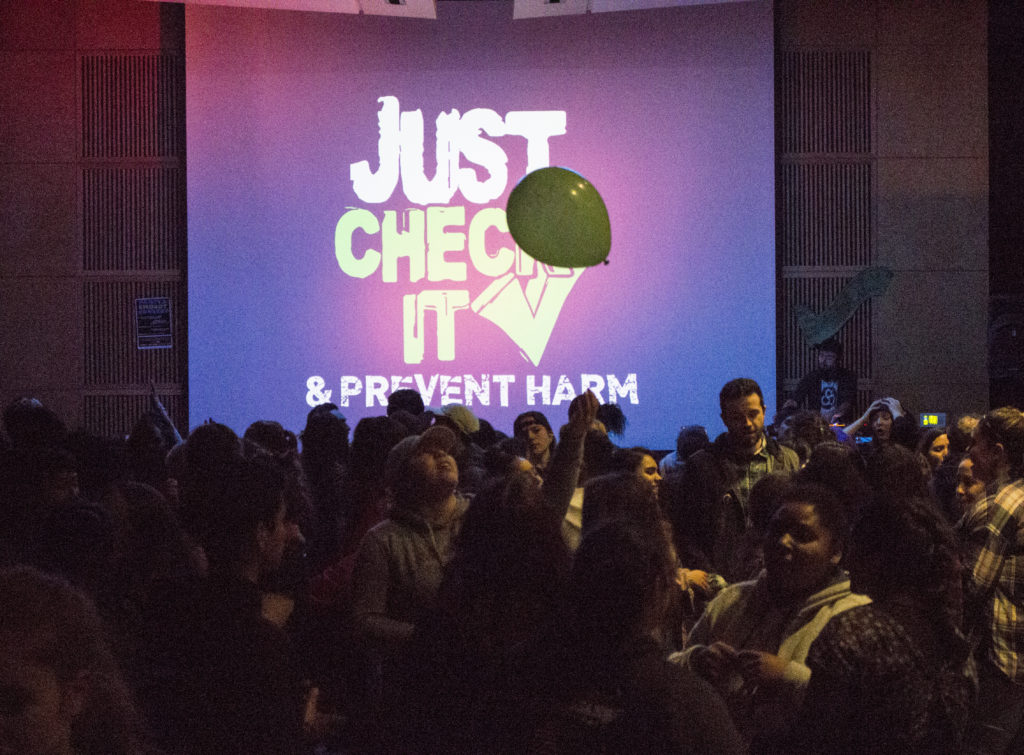
Check It celebrated its three year anniversary on Friday night. A group of students with the African American Center for Academic Excellence (AACAE) belt out TLC’s “No Scrubs” while the crowd sang along . The stage was open to any brave soul willing to belt it to their favorite song, and when the karaoke ended? The floor transformed into a sea of dancing students.
Check It is a Humboldt State student run program working to prevent sexual assault on campus. On their third birthday, the program hosted a “lounge night”. Attendance was free, and they provided guests with food, stickers, a photobooth, and a rockin’ dance party.
Photo by Ali Osgood
Check It Peer Educators stand outside the Kate Buchanan room on Friday, Feb. 24 during a successful celebration of their three year anniversary. (From left) Mike Tjoelker, Celene Lopez, Mary Sue Savage, Carmen Peña-Gutierrez, Yvette Cerna, Jayda Kosar, and Marco Gonzalez.
Photo by Ali Osgood
Check It volunteers slice a chocolate cake while guests line up to get a piece. The Check It crew also offered free pizza and snacks for the anniversary party guests.
Photo by Ali Osgood
HSU alumnus Jacob Stadtfeld DJ’s during the three year anniversary Check It celebration. Nearly 300 students attended the party and enjoyed karaoke, a photo booth, button making, and an epic dance party.
Photo by Ali Osgood
Check It promotes consent and reaches out to students on campus through multiple social media accounts. According to their Facebook mission statement, they are a “student led project that’s about preventing and responding to sexual assault, dating violence, and stalking here on campus.”
Since the 1970s, a Canadian-based energy company called Veresen Incorporated has been working on a plan to build a pipeline to carry natural gas through Southern Oregon, just 200 miles north of Arcata. After being repeatedly turned down, documents are currently being prepared to be re-submitted with the expectation of eventual approval.
According to Veresen Incorporated’s website, the Pacific Connector Gas Pipeline is proposed to be 232 miles long, cross under five major rivers and result in the clear-cutting of up to 30 miles of forest. At $7.5 billion, the project is worth twice as much as the Dakota Access Pipeline and is being praised for its potential in economic benefit.
When Leonard Perry heard about the Pacific Connector Gas Pipeline and that sections were going to pass through the Klamath River, he readied himself for the fight he knew was coming. Perry, an 18-year-old student attending College of the Redwoods, is a founding member of a group known as Humboldt Water Protectors. The group, now called Sacred Seeds, has made it their main goal to protect the abundance of natural resources in and around Humboldt County.
“We see what’s happening to the world, what’s happening in our own backyard, and people are waking up,” Perry said. “We all drink water. This isn’t a party issue, we need to start looking out for our brothers and sisters. The minute we start coming together there’s change.”
Mouth of the Klamath River in the fall. Photo by Emily Owen.
The HSU Environment and Community Club is organizing an on-campus event titled Water is Life: The Standing Rock-Klamath Connection to publicize and spread awareness of the potential Pacific Connector Gas Pipeline. The event will happen on March 4 in the Kate Buchanan Room from 12 to 6p.m. and will shed light on interconnectivity behind the movement for clean and safe water.
Francesca Gallardo and Yojana Miraya, both graduate students in the environment and community program, are coordinating outreach for the event. Gallardo sees the potential to unite these communities and cross boundaries through building coalitions.
“These movements are for everyone,” Gallardo said. “We are fighting the biggest fight of our lives. It is time for everybody and anybody to step up.”
Miraya is from an indigenous tribe in Peru and recognizes the parallels in the global struggle to protect natural resources.
“Leaders aren’t working for the communities” Miraya said. “Educating people will bring consciousness and the parts of society that are marginalized can come together.”
Cutcha Risling-Baldy professor of Native American studies at HSU, is Karuk, Yurok and an enrolled member of the Hoopa Valley Tribe, thinks of pipelines as last resort efforts from the nonrenewable energy industry to stay relevant in a world relying on a failing system.
“There’s a Gold Rush mentality of wanting to make as much money as possible no matter what the consequences are,” Risling-Baldy said. “That’s why we need to always include an indigenous perspective. Native people consult with the land and we see those connections. You can’t account for the way nature plays with your best plans.”
Risling-Baldy stressed the importance of divesting from companies and organizations that fund nonrenewable infrastructure.
“We’re finding out that people think with their money,” Risling-Baldy said. “The government is actively working against the people so you need to speak with your money. Take it out.”
Michael Hinrichs, Director of Communication for the Pacific Connector Gas Pipeline, acknowledges the opposition that is growing and wants to assure people that the project is meeting all environmental standards set by the federal government.
“We’re trying to avoid the impacts that people are worried about,” Hinrichs said. “I would encourage people with concerns to make them known.”
Albert Bernales in the studio to record a Bread Talk.
Sandwiched between school and life, Albert Bernales makes time to record podcast’s on his talk show called “Bread Talk”. Topics range anywhere from food to money, encompassing the word “bread”. Before the interview, Bernales, the host of Bread Talk, sat me down and made me a grilled cheese sandwich with my favorite type of bread, sweet Hawaiian rolls. Bernales made “Bread Talk” because he wanted to create a show of his own. Using it as a creative outlet, his voice now goes out to the Humboldt community.
Q: To start us off, what’s your name and major?
A: My name is Albert Bernales, my alias for Bread Talks is “Sandwich Kid”. I’m a business major with an economics minor.
Q: What’s your favorite type of bread and why?
A: It would probably be sourdough, because as you dip it in soups, it tastes really good. Not all things are going to be sweet, there will be some sour things that will happen. I think sourdough represents life.
Q: So you could be the “Sourdough Sandwich Kid”. Why did you decide to make a podcast and call it “Bread Talk”?
A: I decided to make a podcast just for fun. I was listening to people like Jimmy Fallon and all those late night talk shows. They kind of inspired me, because they’re just talking to somebody, but it’s still really fun and interesting. That’s one reason why, and as soon as I started listening to podcasts, I realized “this is pretty easy, I can do this”. I called it Bread Talks because it grabs your attention. I’m pretty interested in business, but it lets me talk about other things. I can just pull up some articles I’m interested in and talk about them.
Q: What is Bread Talk? Do you talk about bread, money, or everything in between?
A: Definitely about all things bread, like the physical bread we have here, this sweet Hawaiian bread. It also goes into money, that’s where the business aspect of this podcast comes in. A lot of rappers inspired me, like E-40. He said, “I choose to get money, I’m stuck to this bread,” in his song “Choices”. Definitely talk about the rap culture and community, since they tend to rap about money, and stuff, like bread. But there’s definitely another meaning, such as bread as in food, because I love food and cooking as well.
Q: Food and money seem to be two universally appreciated topics. Everyone wants to talk about, and listen into both of these subjects. In your fifth podcast, one topic you were talking about was the change in iPhone headphones from the iPhone 6 to the iPhone 7, and how that’s affecting people today. Which subject does that fall under?
A: That’s pretty business related. They took a risk in their products, and I think people need to take more bold risks. It’s really appreciated for when they take those risks. It takes a lot of guts to do that.
Q: Where do you record?
A: First time we recorded in an actual studio in Gist Hall, but for the second and third time we got a headphone microphone that comes with the iPhone and put it on top of an empty water bottle, and spoke into the bottle. We literally had no options for episode 2-4. You can hear the difference on Soundcloud, it’s either really loud and clear, or not.
Q: Is Soundcloud the main media outlet you use to put out your podcasts?
A: Yeah, definitely, it’s the first thing that popped up to me, and it’s a great way to get your voice out there.
Q: And Bread Talk is a continuing series. You have your own following of listeners.
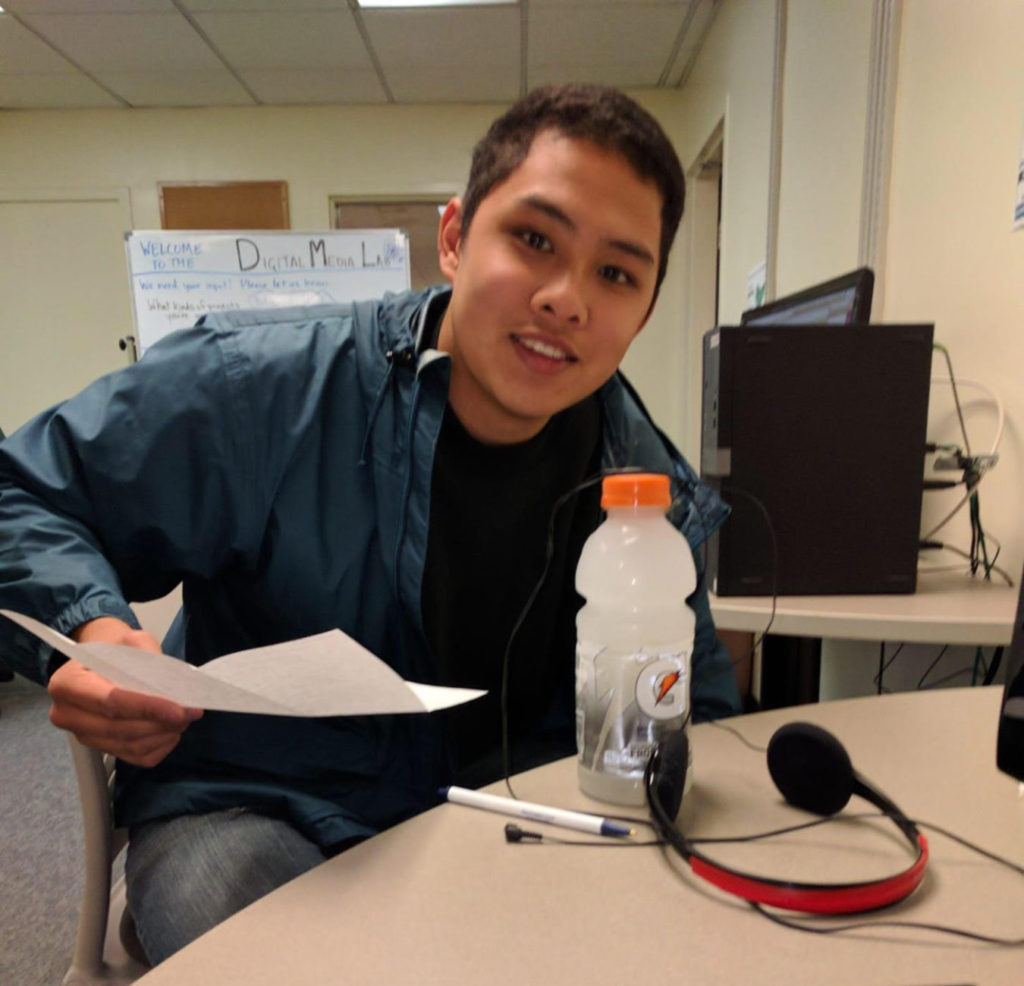
A: Definitely always shout out to the listeners, we love them. We at Bread Talk definitely have come a long way, from a recording standpoint, from iPhone microphones, to studio microphones, and I now record on the library microphone. So, shout out to the digital media lab too. They have all the snowball microphones I use. I can just plug it into the computer and record a podcast whenever I need to.
Q: When does the new Bread Talk come out?
A: It was originally supposed to come out every single week, but we were really busy, so it eventually became every month. Then every month became every couple of months. But I have extra podcasts stored on my laptop, I just have to add the intro music and I’ll be able to upload it. For the show, I made the intro music Entertainment Tonight, but on a keyboard.
Q: You still have a few episodes in a storage vault, but they’re ready to come out?
A: We have number 2, but that’s a lost episode, since we don’t know where to find it. It was on my friends flash drive but I didn’t get the file. But since it’s a lost episode, let the idea of it marinate in your mind for how good it’s going to be. This is a comedy type of show, you know. It is super spontaneous, you don’t know what’s going to happen. I don’t even know what’s going to happen in the next Bread Talk.
Q: It’s really interesting that you decided to take that approach.
A: I have an article here to highlight the next Bread Talk actually. Here’s the teaser, it’s about a “master pickle tester.” Basically, there’s a person who eats pickles for a living to determine the quality. That’s the article that I chose to talk about in the next podcast.
Q: You have plenty of guests on your show, but in terms of subject matter, is it just being spontaneous? How do you prepare before for what questions you’d want to ask?
A: Definitely, in my head, I find an interesting topic. So I go on the internet, and find a couple of articles that are interesting. We’ll talk about it, and do an analysis on that article. For the questions that I ask, they’re typically solid but typically the same through every episode. And at the end, I have quick fire questions, where it’s like fill in the blank. I switch those up every single episode.
Q: I noticed you have your Bread Talks listed by number, but some are also categorized by words, how do you come up with these?
A: They are the focus, and central theme of each episode. Like the one that’s under “ninja—no income, no job”, that originated from a friend of mine who works on these with me. He had a finance class, and ninja was a term they discussed. So I asked if he just wanted to leave it as Bread Talk Number 5, and he said to add ninja.
Q: Ninjas and economics together, that’s an unusual combination. Do you know what ninja means?
A: Ninja pretty much means no job, or no assets. So pretty much if you don’t have any money, you won’t have a job or anything valuable. And vise versa.
Q: You have a sandwich, or just any meal that involves bread with your guests before or during an interview. For my last question, a spontaneous one on my part, why do you eat with your guests along with the bread talk?
A: Well I try to always have bread. This is Bread Talk after all. You’re going to want some bread, and eat it with your guests. That’s a true Bread Talk.
This website uses cookies to improve your experience. We'll assume you're ok with this, but you can opt-out if you wish. Cookie settingsACCEPT
Privacy & Cookies Policy
Privacy Overview
This website uses cookies to improve your experience while you navigate through the website. Out of these cookies, the cookies that are categorized as necessary are stored on your browser as they are essential for the working of basic functionalities of the website. We also use third-party cookies that help us analyze and understand how you use this website. These cookies will be stored in your browser only with your consent. You also have the option to opt-out of these cookies. But opting out of some of these cookies may have an effect on your browsing experience.
Necessary cookies are absolutely essential for the website to function properly. This category only includes cookies that ensures basic functionalities and security features of the website. These cookies do not store any personal information.
Any cookies that may not be particularly necessary for the website to function and is used specifically to collect user personal data via analytics, ads, other embedded contents are termed as non-necessary cookies. It is mandatory to procure user consent prior to running these cookies on your website.