By Alexandra Berrocal
Watercolor can be very hard to control. For that reason, it is considered a challenging medium by most artists. It is also considered by some to be illegitimate. While there has been a lot of impressionist art done in oil and acrylic, there hasn’t been a lot of impressionist art done in watercolor. I am not sure why this is, but then again, I am not a formal artist and have never been one.
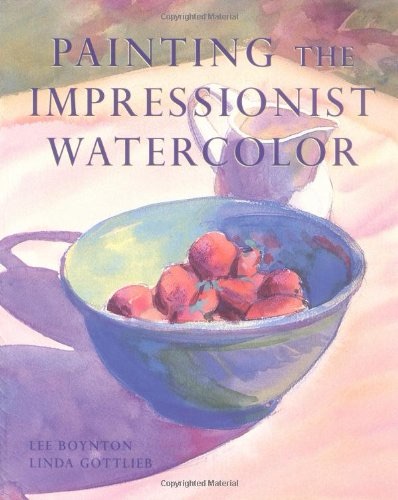
I read the book Painting the Impressionist Watercolor by Lee Boynton and Linda Gottlieb. It was published in 2004. Lee Boynton is known for his impressive body of work regarding Impressionism in watercolor. This book is co-authored with one of his students, Linda Gottlieb. This book aims to teach you how to paint authentic Impressionist paintings in watercolor. This is done by guiding you through buying the right tools — that is, paints, brushes, palettes, and paper — that will enable you to get the job done. Boynton starts by having you paint blocks, and then you gradually work your way up to still lifes. I find it interesting that Boynton never has you do a portrait, because portraits are very demanding and difficult. I also find it interesting that he has you paint in a very specific manner. But, then again, the goal is to paint like him, so this shouldn’t be a surprise.
I initially picked up this book because I was charmed by the author’s artistic style. I was hoping that reading it and maybe doing some of his exercises would make me a better artist. However, I was disappointed.
I think that this is a very good book, but it’s definitely not for beginners. This book is also not for people who prefer to work with pans, which are shallow dishes of paint you find in most craft stores. Lee Boynton clearly prefers to work with tubes and this book advises you to work with such, which are more like acrylic and oil paints and require more preparation.
Tubes are not bad. If you prefer to work that way, more power to you. However, during the times I have dabbled with watercolors, I have always preferred to work with pans. Therefore, I can’t really use this book. This book also requires specific colors from specific brands in tubes. As someone who doesn’t like to work with tubes, this leaves me high and dry.
That said, if you are willing to buy and work with tubes, as well as everything that this artist wishes you to buy in order to follow his regimen, you will become somewhat of a real Impressionist painter. I came away with a much better understanding of Impressionism than when I began. Impressionism is a school of art that is about portraying light. I never really understood that before reading his book, but now I do.
Last semester, when there were therapy animals in the school library, I brought my small pan of watercolor paints to the scene so that I could paint a picture of one of the dogs, Garbo. It wasn’t meant to be a study of light, like most impressionism is. It was my interpretation of something I thought was cool and interesting, or rather someone I thought was cool and interesting.
I have taken my pan to the library quite a few times, because last year I didn’t always feel like painting in my dorm. I don’t paint as much these days. Nowadays, I prefer to draw more, especially with pen and ink. You can’t do that as much with tubes. With tubes, you still need a palette and an easel and all that. That doesn’t appeal to me nearly as much. I enjoy the minimalism involved in putting a pan, a sketchpad, a bottle of water, and a pencil and pen in my pack and going to the library to paint there.
If you are a beginner to art in general, there are three books I recommend for you. I recommend What Adults Don’t Know About Art: Inspiring young minds to love and enjoy art by The School of Life, Urban Watercolor Sketching: A Guide to Drawing, Painting, and Storytelling in Color by Felix Scheinberger, and Draw Your World: How to Sketch and Paint Your Remarkable Life by Samantha Dion Baker. With those three books, you can’t go wrong. I don’t recommend Painting the Impressionist Watercolor, unless you are already good at drawing, are dedicated to Impressionism, and/or are willing to work with tubes.
What Adults Don’t Know About Art was written for children with special needs. However, it is the best book about art appreciation that I have ever read and I wholeheartedly recommend it. I recommend Urban Watercolor Sketching for anyone who wants to get into watercolor. It is appropriate for all skill levels. I have reread this book countless times, and every time I read it I feel like I have more to learn. Scheinberger presents tough concepts, in an accessible way. Even if you don’t initially understand everything, you still go away feeling like you can paint.
I also prefer Scheinberger’s approach to art over the emphasis on light in Painting the Impressionist Watercolor. Scheinberger’s approach resonates more with me. I don’t care about portraying light when I do art. I care about portraying people and places that I love, that are dear to me, or that I just find interesting. This is Scheinberger’s approach as well, although he does emphasize “the light” somewhat. As for Draw Your World, that isn’t necessarily a book I would read multiple times. However, I enjoy her approach to art as well. I also feel anyone can benefit from her exercises. So, paint on!
Leave a Reply