By Nick Escalada
Picture this — you are suspended 100 feet in the air, overlooking a beautiful inlet of the Pacific Ocean teeming with wildlife. Shorebirds chirp down below, chorus frogs serenade you from all directions and crisp North Coast rainfall washes over your senses. Suddenly, a massive shadow enshrouds you, and your eyes dart up to meet the 7-foot wingspan of a brown and white raptor as it touches down within arm’s reach. While this might sound like every wildlife major’s perfect fantasy, you won’t have to limit this scene to your imagination for much longer.
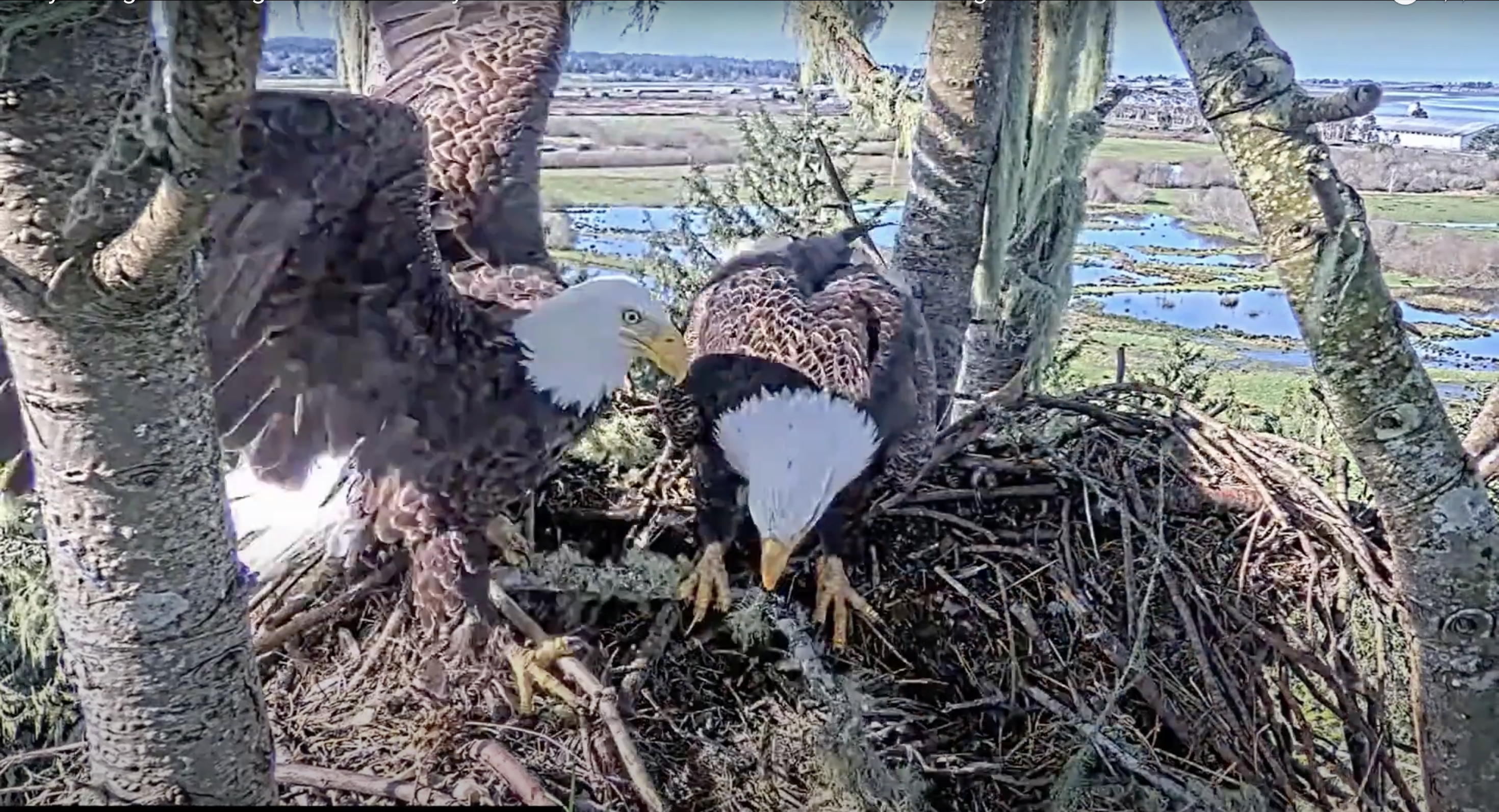
Climbing Biologist and Sequoia Park Zoo Director Jim Campbell-Spickler partnered with Dr. Peter Sharpe of the Institute for Wildlife Studies to re-establish Humboldt’s locally renowned bald eagle nest cam livestream. Formerly known as Humboldt Bay Eagle Cam, the Faye Slough Eagle Cam is now situated at a promising new nest site by the wildlife area of the same name.
The starring couple, known only as Mr. and Mrs. Humboldt Bald Eagle (HBE) were first observed in 2006 and were eventually the subjects of an initial livestream backed by the Humboldt Wildlife Care Center and Sequoia Park Zoo. The pair gained swaths of admirers on Facebook once they began rearing chicks, but they eventually abandoned their nest in 2016 and were not seen again. That was until two years ago, when a resembling couple was spotted building a home atop a 110-foot grand fir near Fay Slough.
“It’s a great territory for them to hold,” Campbell-Spickler said. “And Fay Slough is amazing, so you can see they’re just hunting that area. It’s a great view.”
Like most birds, bald eagles are highly selective with the areas in which they choose to breed and raise their young. These doting parents often abandon fully built nests for reasons ranging from structural integrity to exposure to predators, but recent observations have the biologists hopeful that this pair is here to stay.
“This is about the time of year when we’d expect them to show up and start exhibiting courtship behavior,” Campbell-Spickler said. “[They’re] starting to really solidify that bond that they have for the breeding season, and we’re starting to see that behavior. It’s really early, so we’re watching very closely to see what happens. It’s like a soap opera.”
Even as apex predators, building a homefront in the treetops is no easy feat. A portion of the nest broke off during last week’s storm series, which has impeded the HBE’s construction progress a fair bit. On top of that, turf wars with other large birds of prey make early nest life a constant uphill battle.
“We watched the male who was roosting at the nest site one night get tagged pretty hard by a horned owl,” Campbell-Spickler said. “We are hearing red-shouldered hawks and red-tail hawks aggressively calling in the area, meaning that this is not just a territory held by bald eagles.”
Despite sitting over 100-feet off the ground, both nests from the current and original livestream have occasionally housed numerous creatures beyond their original avian architects. So far, the phenomenon has brought up Pseudacris regilla, the Pacific chorus frog, and Aneides vagrans, the wandering salamander.
“A neat feature of our area is that these big nests just sponge up water and can support what are mostly considered terrestrial amphibians,” Campbell-Spickler said. “We did have our first frog observation the other night, with these warm, rainy conditions coming in. As far as I know, it’s not something that’s been discussed in literature yet. They seem to cohabitate, just unaware of each other.”
It’s apparent that bald eagle nests like these invoke as much joy and wonder in seasoned biologists as they do the casual birdwatcher or passerby. After all, the birds were a much rarer sight in Humboldt only a couple decades ago due to the uncontrolled logging and hazardous waste disposal of the county’s past.
“What we know is that in the lower 48 [states], Eagle numbers just crashed,” Campbell Spickler said. “Populations remain somewhat healthy in Alaska, but it’s some over the last several decades that we’ve seen this recovery in all of North America, so our region shows the same. There’s recovery. There’s a lot more young that are being produced, and it’s great to see. You wouldn’t see eagles flying around 20 years ago. But if you drive up to 101 North, you will see them at the lagoons, and they’re not uncommon anymore.”
The Fay Slough Eagle Cam is now live on Sequoia Park Zoo’s YouTube channel, Redwood Zoo. Highlight clips and pictures of the eagles are posted regularly to the Facebook page Fay Slough Bald Eagles, which boasts a lovely community of fans. You can even watch the drama unfold on a 65-inch screen on your next visit to the zoo in Eureka!
Nick Escalada is a sophomore minoring in journalism who reports on happenings of all sorts. As a wildlife major, he enjoys nature-related pieces. On his off days, you can find him taking a hike behind campus or collecting shiny stuff on the beach.
Leave a Reply