By Jess Carey
Legend has it that long ago, a poor young man fell truly, tragically in love with the most beautiful princess in all the land. He scoured his savings and sold what little he owned to buy her gifts of slippers, jewelry and rabbits. He traveled many miles to her palace, where he confessed his love at her feet. She denied him reciprocity and took the gifts greedily. He was left alone and destitute. Heartbroken, he stabbed himself in the chest with his knife, and the first bleeding heart flower grew from the dirt where his corpse lay. The story traces back to a Japanese legend, as different species of Dicentra are native to California’s western neighbor.
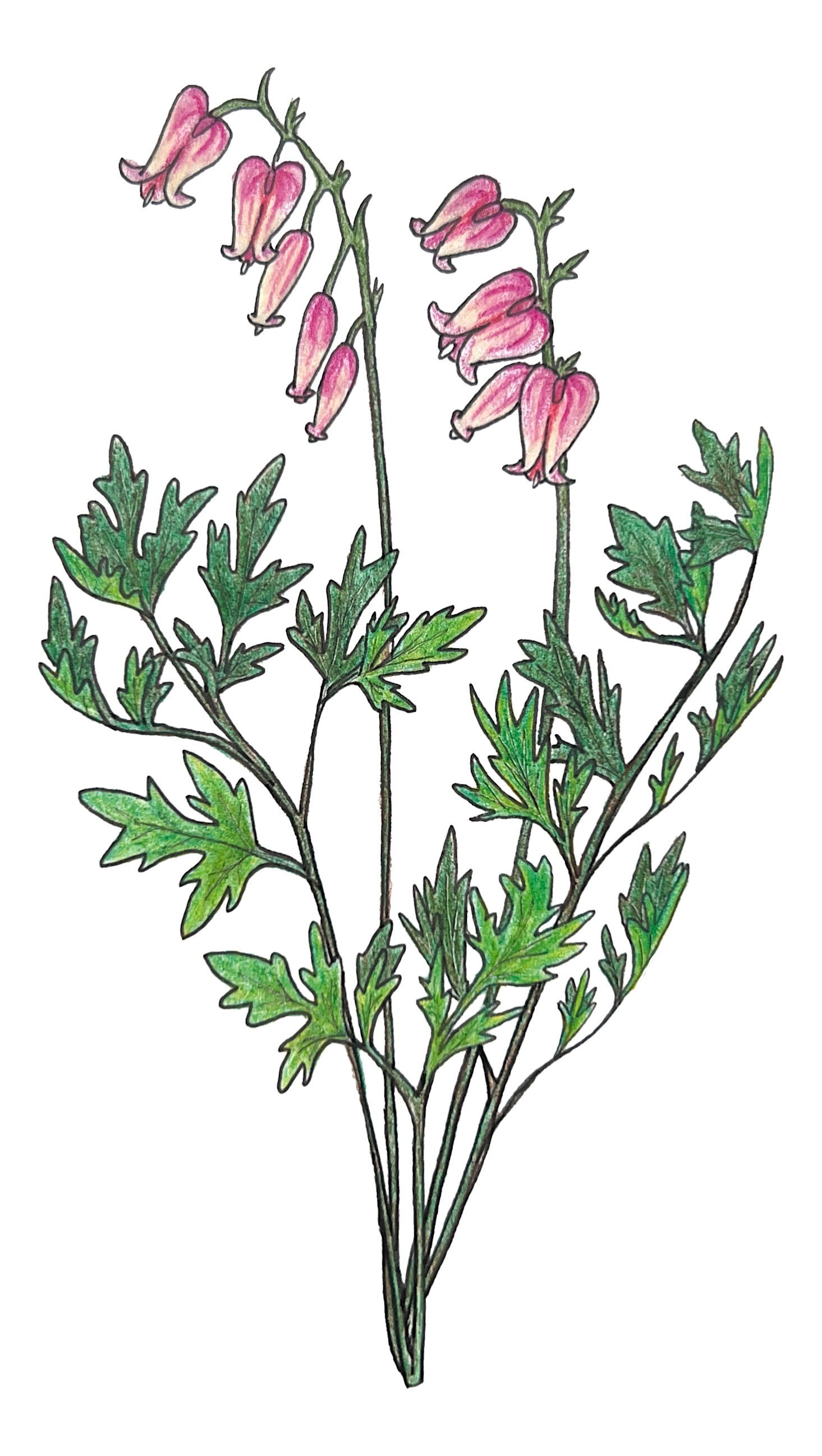
Dicentra formosa, or Pacific Bleeding Heart, will be blooming soon. The plant, of the poppy family, flowers from March to early summer and dots the redwood forest with its delicate pink blooms. Its uniquely shaped inflorescences are a striking pink to lavender hue and balance in clusters atop long drooping stalks, like tiny hearts on a stick. A darker streak cuts each flower in half and looks suspiciously similar to dripping blood. The plant’s delicate and feathery leaves are cilantro-like in color and texture, but less tasty and unfortunately toxic. As summer approaches, the petals will wither away as a legume-like capsule fruit takes their place. The fruit will eventually dry up and split open, revealing seeds that have a special oil-rich coating that attract ants to aid in their dispersal. You can find Dicentra tracing up hillsides in the redwood forest, following trails of moisture in the troughs of streams. The plant also grows around campus, particularly abundant throughout the grounds of the residence halls that are nestled in the redwoods.
Jess Carey is a senior at Cal Poly Humboldt, majoring in biology and double minoring in botany and journalism, and the science editor for The Lumberjack. They are passionate about telling stories that are relevant to the community, branching their interests in science, music, and the arts.
Leave a Reply