The Lumberjack


Students Serving The Cal Poly Humboldt Campus and Community Since 1929

Month: April 2025

  • Rapper Shordie Shordie set to show out at Arcata Theatre Lounge

    Rapper Shordie Shordie set to show out at Arcata Theatre Lounge

    By Alexis Blue 

    Shordie Shordie, a Baltimore-born rapper turned West coast sensation, is set to perform in Arcata on May 8. An accomplished music artist, Shordie Shordie has shown range in his music style from rapping to singing and more recently, riding the line of R&B and pop. 

    Shordie Shordie’s first hit in the music industry broke through in 2018 with Bitchuary, from his debut solo album Captain Hook — a now two-times platinum record, curating more than 260 million streams. According to his Warner Records Inc. biography, Shordie Shordie is the first rapper out of Baltimore to earn a platinum plaque and has accumulated over 1.5 billion catalog streams with his discography. 

    A celebrated artist, Shordie Shordie is known for his top tracks: Bitchuary, Save a Little, Bonnie & Clyde, Long Time, and Both Sides (featuring Shoreline Mafia). Now on his Breath of Fresh Air Tour, Shordie Shordie is scheduled to perform in Arcata. He will take the stage at the Arcata Theatre Lounge on Thursday, May 8, at 7 p.m. General admission is only for those 18 and older, with tickets set at $34 and Meet & Greet tickets at $140. See you at the show!

    Alexis Blue is a junior at Cal Poly Humboldt, majoring in journalism and minoring in writing. She enjoys drinking coffee, sunsets on the beach, and playing soccer.

  • The aviation club takes off at airport day

    The aviation club takes off at airport day

    By Eli Farrington and Noah Pond

    Antonio Jordan’s passion for aviation started early in life, fueled by a lofty childhood dream — a dream shared by countless children across the world, but only pursued by a select few once they reach adulthood: flying.

    “Honestly, the main thing is that I always wanted to fly. I would see people flying whether they’re superheroes or whatnot on TV and I was like, ‘Damn, I can’t do that,’ but flying planes is kind of the closest we can get to that,” Jordan said at Airport Day, an event hosted by the Aviation Club at Samoa Field Airport on Saturday, April 26. The event showcased multiple aircrafts and companies in the field of aviation and aeronautical technologies, and highlighted the resources and opportunities offered by the Aviation Club.

    Jordan is a freshman environmental science and management major and the Aviation Club’s treasurer. He dealt with all of the expenses of the Airport Day event, which was overseen by David Marshall, a computer science lecturer and the club’s advisor.

    Before Marshall advised the Aviation Club, he was the advisor to the PC Gaming Club. He wanted the PC Gaming Club to do something for the entire community — something beyond video games. 

    “I told the students in that club that [they] need to do something that impacts the whole campus, and they decided to build a flight simulator,” Marshall said. “And so, there was a flight simulator at the library for three years and it was based on gaming [equipment] — it was plastic pedals, plastic everything.”

    It wasn’t until years later that Marshall was contacted by a former Humboldt State University journalism student, Meg Godlewski class of ‘87, about getting a new simulator that was Federal Aviation Administration (FAA) certified. As an editor for FLYING Magazine, Godlewski presented an opportunity to take the aviation club to new heights. 

    “[Godlewski] was doing a story for a flight magazine and was in the offices of a company called Precision Flight Controls, and they’re in Sacramento,” Marshall said. “It just so happened that the president’s phone rang, and the very wealthy gentleman who flies his own planes said, ‘I’m getting a new airplane, build me a new simulator. I want to give away the one I have.’” 

    Godlewski got in contact with Marshall and asked him if the aviation club wanted the simulator, to which Marshall replied with a resounding yes. The simulator that Godlewski donated is an advanced aviation training device (AATD), which retails for about $140,000. Renting an AATD would usually cost around $50-$100 an hour, but Cal Poly Humboldt students get to use it for free. 

    Marshall co-owns two planes with C.D. Hoyle, a fellow Cal Poly Humboldt professor in the physics department. The pair were originally introduced to each other by a certified flight instructor. They purchased their first plane back in 2008 and their second in 2013. 

    “We started out as co-workers on campus and became buddies through plane ownership,” Hoyle said.  

    Hoyle got his pilot’s license at 18, and has been flying for over 30 years. He loves flying for both the convenience and the understanding of weather patterns that he has learned over the years. 

    “I like how it makes you kind of in tune with the weather,” Hoyle said. “There’s this aspect of flying where if you’re preparing for a flight, you have to be constantly in tune with what’s happening with the environment around you.” 

    Unfortunately, the weather was not in the aviation club’s favor on Airport day, as a combination of rain and low-hanging fog prevented anyone from taking off or landing. Hoyle explained that a lack of visibility, coupled with the fact that Samoa Field Airport doesn’t have air traffic control, caused the event to have a smaller turnout than expected. Had the event taken place on a clear day, the airport would have seen dozens of model and full size planes taking off and landing. Despite the bad weather, the event was still a hit. 

    Aviation club president Lee Donohue was disappointed with the harsh conditions, but didn’t let the rain dampen his good mood. As club president, it is Donohue’s job to preside over meetings and help organize events like Airport Day. This year, he was able to assemble a group of volunteers and tech companies to table at the event. 

    “We’ve asked a lot of organizations to come in and volunteer their time and efforts to showcase how they’re involved with the community,” Donohue said. “Some of it is involved directly with aviation, some isn’t. A lot of it is showcasing emerging technologies and people’s connections to aviation, whether that be with fixed wing aircraft or with paragliders and drones. I think it’s just really cool that we were able to pull this off and show off the technology.”

    Airport Day played host to a number of guests and volunteers, including a handful of aeronautics companies, Humboldt County Sheriff Bomb Disposal Squad and Cal Poly Humboldt’s very own Marching Lumberjacks.  

    “I think it’s a unique event where you have this mosaic of people who came and are passionate about the technology they use to help serve the community and, you know, explore their own hobbies and passions,” Donohue said. 

    Donohue is not a pilot yet, but his goal is to use the tools provided by the aviation club to eventually get a license. For him, campus resources like the on campus flight simulator bring him one step closer to a seat in the cockpit. He plans to take advantage of all the resources he can, and learn to fly before he graduates. 

    One aviation club member who goes above and beyond when it comes to flying is Kendra Char. Char is a junior marine biology major and student pilot, and just two weeks ago, she soloed an airplane for her first time — a huge milestone in her flight training. 

    “[Soloing] is going up in the aircraft by yourself … I flew a Piper Cherokee 140,” Char said. “It’s a lot of work to get to that point, and it built my self confidence. It’s scary at first — it’s weird — but it’s incredibly rewarding.”

    The FAA requires 40 hours of flight time for a private pilot’s license, and 10 of them have to be solo. Char has completed about 35 training hours, and is now in the process of completing 10 solo hours before getting her license. She eventually wants to turn her passion for flying into a career and work for an airline, but for now she’s enjoying the fruits of her labor, about to pay off.

    “I love the freedom of it,” Char said. “I’ve flown over campus a couple times, and it seems so small when I’m up there. At its core, flying is freedom from the ground. You get so much of a new perspective on everything from flying… I joined the aviation club because flying is something I love, and I want to share my love and experiences with other people who also love aviation.” 

    Eli Farrington is a junior journalism major working as the opinion editor for the Lumberjack. Noah Pond is a junior journalism major working as the managing editor. Together, they work around the clock, uncovering secrecies, solving mysteries, and leaving no stone unturned.

  • Gaultheria shallon or salal berry and the magic of foraging

    Gaultheria shallon or salal berry and the magic of foraging

    By Jess Carey

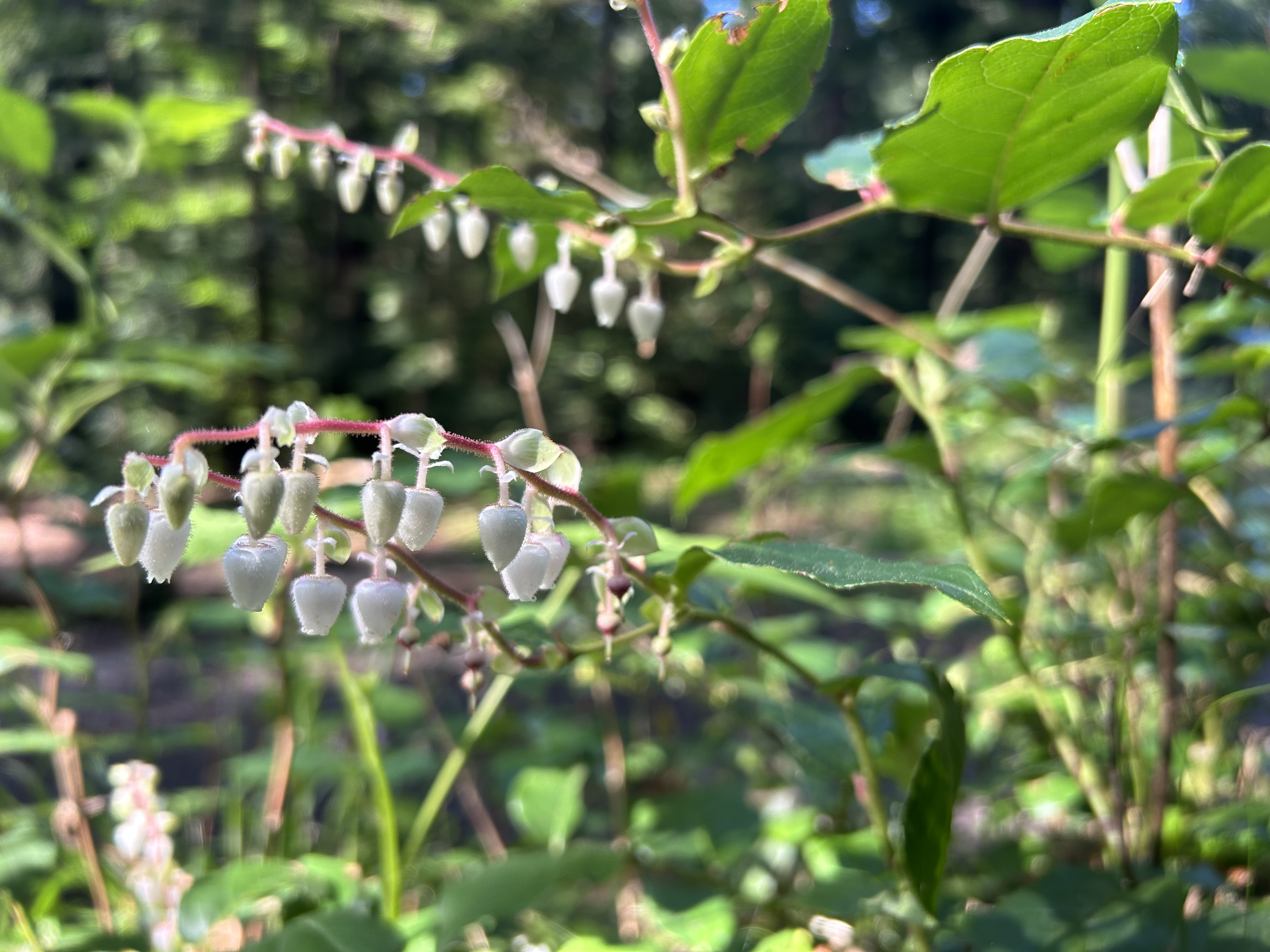
    Salal berries are one of the most common and underappreciated woodland snacks in the North Coast. Blueberry-like in texture and flavor, with a much more sweet and floral taste; you can forget your bland mushy berries in little plastic tubs from the grocery store — these are the real deal. The joy of snacking on berries while on a walk in the woods is monumentally different compared to the soulless beeps of the self-checkout at Safeway. Ingesting a little bit of dirt or the occasional bug won’t hurt you — but a sterile relationship with food and nature might. Armed with a little bit of plant identification practice, you have nothing to fear. Foraging, to me, is a beautiful and accessible way to connect with nature while honoring indigenous knowledge.

    Salal, or Gaultheria shallon, is a common shrub that can be found throughout the Arcata Community Forest and scattered around campus landscaping. The plant’s Wiyot name is viqhul. While its berries won’t be ready for picking until July or Aug., the plant is in full bloom now. Salal is in the Ericaceae family — a group characterized by adorable pink bell-shaped flowers in long clusters. They look like tiny lanterns that a fairy might carry, or perhaps wear as a hat. 

    Its dull green oval leaves are slightly pointed, simple and usually two to four inches long. The plant grows in mats around the base of trees and in thickets throughout the woods. It is a humble shrubby plant, usually not more than two or three feet tall and is fairly inconspicuous until its flowers emerge in spring. 

    Summer is approaching, and with it, the promise of berry season. The huckleberries, or Vaccinium, also have edible berries and look similar to salal, although with smaller leaves and denser bushier growth. Other common edible berries that will be ripe soon include blackberry, salmonberry and thimbleberry, all of the genus Rubus. If you are inspired to try them out for yourself, always keep in mind the principles of the honorable harvest — to only take what you need, respect the plants and embrace reciprocity with the land. 

     Jess Carey is a senior at Cal Poly Humboldt, majoring in ecology and minoring in journalism, and the science editor for The Lumberjack. They are passionate about telling stories that are relevant to the community, branching their interests in science, music, and the arts.

  • 58th Humboldt International Film Fest

    58th Humboldt International Film Fest

    HIFF steals the spotlight in another show-stopping debut

    By Julia Kelm and Ariana Wilson

    The Humboldt International Film Festival (HIFF) has entertained audiences since 1967, showcasing a wide range of independent and alternative short films, hosted by Arcata’s Minor Theatre.

    Cal Poly Humboldt has been inviting filmmakers from all over the world to enter their short films into the festival since its beginning, making it the longest-running student-run film festival in the world.

    Films were previewed and judged by Cal Poly Humboldt student volunteers and HIFF club members from Sept. to March. Once film submissions are closed, finalists are narrowed down until finally being deliberated upon by the co-directors, Adrian Anderson, Zoe Reed and Jett Supler, as well as faculty advisor Nicola Waugh. 

    Thanks to them, we get to see these marvelous independent films on the silver screen, where we otherwise may have never gotten to see them.

    The festival lasted four days, starting on Thursday, April 24, and ending on Sunday, April 27. 

    Each day of the festival featured a different film style, excluding Sunday, which consisted of the award-winning films of various categories. First was narrative, then documentary, animation and ending with the best of fest films.

    A standout film featured on Friday was Sunchong, directed by Yoontaek Hong. A 14-minute film from the U.S. that follows an 89-year-old Korean immigrant who volunteers at a senior center and reflects on his life’s journey with his beloved late wife. 

    Sunchong stood out for its message of never taking the people we love for granted. Even though it’s painful to mourn our loved ones who have passed away, it’s still worth it to love and to be loved. In the end, our memories and love are all we will ever truly have to ourselves.

    Sunday’s Best of Fest was a sold out event as people from all over the world gathered to pay homage to the effort and art of independent film. If you didn’t get a chance to see it for yourself, the best animated film award went to Father’s Letters, directed by Alexey Evstigneev. The use of paper elements, and traditional mediums like pastels and pencil elevate the captivating collage style. 

    Father’s Letters is set in 1934 and follows a young girl and her imprisoned father, Professor Vangengheim through the letters they shared over the remainder of his life at the Gulag Archipelago. Elya’s father sends flowers and spins the tale of his imprisonment as an expedition to preserve the innocence of her childhood, shielding her from the reality of the Stalin regime.

    Reg flags blow in the wind as hundreds of people flood the streets. Elya runs alongside the crowd, her small stature weaving swiftly through the legs of the much larger adults. 

    Elya sends a care package with winter boots, a dictionary and other books. Behind barbed wire, her father gets caught outside of his cell writing a letter to Elya — his last letter to his daughter. His effort to escape is no use and he is executed in the yard, feet covered in old boots.

    The community of independent film is unlike anything you can experience at a box office opener. Film festivals recognize films like polished souls, and audiences walk into the theater acknowledging the respect and care essential to coexist in the space.

    Film is a beautiful art form that can be made in so many alternative ways. It’s rare we see experimental film styles on the big screen. 

    Getting to see an independent film — something that never quite gets the recognition it deserves — was an amazing experience. If you missed this year’s festival, don’t fret, as there will be another year to experience this always unique theater-going experience.

    Julia is a journalism major at Cal Poly Humboldt. She loves film and is a regular on Letterboxd. To quote Robin Williams in her all-time favorite movie, Dead Poets Society, “The powerful play goes on and you may contribute a verse. What will your verse be?”

    Ariana Wilson is a junior majoring in journalism and minoring in scientific diving. She intends to merge her passion for the environment and conservation with her love of journalism as a science writer in the future. This semester’s goal: write one story per section.

  • Cal Poly Humboldt Model UN dominates on the east and west coast

    Cal Poly Humboldt Model UN dominates on the east and west coast

    By Kimberly Alexsandra Madrigal

    This past month, students from Cal Poly Humboldt’s political science department attended two international Model United Nations conferences. The National Model United Nations (NMUN) conference in New York, the largest and most iconic of the Model UN, is open to over 5,000 students from around the globe. Students and faculty then rushed back to the west coast as the Model United Nations of the Far West (MUNFW) conference took place in San Francisco the following weekend, inviting over 400 students from the western U.S. and The Philippines. 

    Our school’s team, representing the country of South Sudan, brought back an honorable mention award from NMUN-NY. 

    Our school’s team representing Egypt won an award for outstanding delegation in San Francisco. Additionally, student Amanda Cawthron was chosen as a lead author in the best resolution and Kiera Sladen was named best delegate within her committee.

    Political science sophomores and Model UN members Ruth Worthington and Kiera Sladen shared their takeaways from their first time attending the iconic, back-to-back, bi-coastal conferences. 

    “There was a lot of office siren action,”  Sladen said, referring to the “Office Siren” fashion aesthetic adored by Gen-Z that combines 90s and 2000s formal business wear with a sexy and confident feminine energy. 

    Photo courtesy of Cal Poly Humboldt political science department | Cal Poly Humboldt Model UN smiles with awards a Model United Nations of the far West in San Francisco, CA, April 2024.

     “It’s a lot of fun, I think it’s rewarding, it’s worth it. It’s open to not just political science majors, so that’s a plus. It’s definitely beneficial for anyone looking to build skills in public speaking, teamwork, leadership and cooperation, and it’s overall just a fun experience.”

    From showing Dr. Zerbe Never have I ever — Gen Z’s favorite on-screen portrayal of Model UN — to appreciating baddies in business casual and sitting in the iconic United Nations General Assembly inside the global headquarters of the United Nations, this trip was one for the books. 

    “It was super cool because we went to the actual UN for the closing ceremony, so that was pretty epic,” Worthington said. 

    Cal Poly Humboldt has also been selected as the host institution for MUNFW-SF 2027, with Kiera Sladen as Secretary General and Ruth Worthington as Under Secretary General of the conference. 

    Over the next year they will decide and plan the theme and select committees for MUNFW-S 2027, where they will then present it to the president and board of the conference, next spring in 2026.

    Students interested in joining Model UN must enroll in PSCI 376, a two unit seminar course and one unit PSCI 377 conference lab open to students of any and all majors, political standings and knowledge. Contact polisci@humboldt.edu for more information. 

    Kimberly Alexsandra Madrigal is a multimedia journalist who lives for cruising in her ‘05 convertible beetle, lowballing on facebook marketplace, yacht rock and oversharing on the internet. 🙂

  • Ryan Coogler’s new horror film Sinners bites at bigger themes… and people

    Ryan Coogler’s new horror film Sinners bites at bigger themes… and people

    By Alexis Blue

    The southern summer had cooled to a tolerable temperature, but the heat at Club Juke was hotter than ever — with drinks flowing and feet moving on the dance floor. Sammie stood in the center of the juke, strumming his guitar as spirits from the past and future danced in circles from his Blues. 

    “There are legends of people with the gift of making music so true, it can conjure spirits from the past and the future,” said the film’s narrator. 

    Ryan Coogler’s film Sinners premiered on April 3 and was released April 18, ticket sales generating $48 million its first weekend in theaters and $45 million this past weekend according to the Variety. Coogler’s film is set in 1932, following the storyline of two twin brothers named Smoke and Stack — both played by Michael B. Jordan — as they return to the Mississippi Delta and find themselves face-to-face with the devil, so to speak. 

    Director and screenwriter for Fruitvale Station, Creed and Black Panther, Coogler dabbled in a new genre of horror with Sinners, while also tackling deeper truths. The film touches on Jim Crow racism rampant in the South during this time period, religion, and the larger role that music plays within society and culture — particularly Blues music, which gave voice to the stories of Black Americans at the hand of segregation. 

    When first watching the preview for the film, I don’t think I entirely grasped what kind of evil these “sinners” were facing, until further investigation showed that this evil was in fact… vampires. I let out an audible groan because, typically, I find vampires in film and television rather corny and overdone. Unpopular opinion — I could never understand the hype around Twilight because it is corny and the acting is too. Sue me! But Coogler’s jab at vampires on screen was tasteful and acknowledged the deeper role they played in religion as a tangible representation of the devil. 

    The theme of religion throughout the entire film begins in the opening scene. The movie opens to a strikingly white church into which Sammie “Preacher Boy” — played by Miles Caton — stumbles, the remnants of a guitar in hand. For one, I must applaud Caton for his role and vocals in this film because I was shook in my seat at the Mill Creek Cinema listening to him sing. I was even more shocked to find out that this was his debut Hollywood film at the ripe age of 20. I am incredibly impressed and hope to see more of Caton on the big screen. 

    In addition to Preacher Boy, I was enthralled by the casting and the acting in the film — chef’s kiss. Michael B. Jordan, Hailee Steinfeld, Wunmi Mosaku, Jayme Lawson, Omar Miller, Li Jun Li, Delroy Lindo and Jack O’Connell all made it nearly impossible to take my eyes off the screen. 

    Two characters I must acknowledge are Annie, played by Mosaku, and Delta Slim, played by Lindo. That feeling when you watch horror movies and think, “Gosh, why are these people so stupid?” and “Why are they running toward that really creepy noise?” was not really jumping out at me in this film — and we have Annie to thank for that. She is the voice of reason we all need in horror movies. As for Slim, he is the comedic break we needed amongst all the bloodsuckers, because two hours of straight panic would be exhausting.

    Jordan’s role as both twins, Smoke and Stack, is also worth noting. The cinematography was seamless as both twins appeared on screen at the same time, making me forget that they were even being played solely by Jordan. 

    One of my overall favorite parts of this film was the care that Coolger took to build the audience’s relationships with the characters, with the plot revealing the antagonist over an hour into the film. This first hour of the film was spent well, developing the complexities of each character and foreshadowing their future sins. 

    The foreshadowing, the symbolism and the complex themes of this movie that transcend the oftentimes trite nature of vampires leave me still trying to uncover all the hidden messages tucked into the unexpectedness of this film. I challenge you to figure them out for yourselves, you bloodsuckers!

    Alexis Blue is a junior at Cal Poly Humboldt, majoring in journalism and minoring in writing. She enjoys drinking coffee, sunsets on the beach and playing soccer.

  • Good times and a whole lotta love for Zeparella

    Good times and a whole lotta love for Zeparella

    Zeparella’s tour stop in Arcata was an emotionally evocative experience

    by Emma Wilson

    Zepparella made their way on stage — dressed to impress in white corsets, bell bottom pants and white heeled boots. They started the night with the main singer facing the drummer and wasting no time in launching into the first song of the night, We’re Gonna Groove. This got the crowd swaying, rocking to the magical beats and feeling the love all around. TV screens displayed trippy hallucinogenic art underneath a live video of the band playing on stage. 

    Zepparella, a female cover band of the famous Led Zeppelin, performed at Humbrews in Arcata on Friday, April 25. After their opening song, lead singer Anna Kristina thanked the audience of at least 200 people for coming out and welcomed them to the venue. 

    “Hello to all, hello to all the love, hello to all you beautiful people from Humboldt, and from those of you who have come far and wide to be here — because I know some people traveled some distances to be with us today — we really appreciate it!” Kristina said. “Oh my goodness, Humbrews, we can not wait to come back to you. You know there’s a special mojo here, and we feel it every visit!” 

    My heart was filled by how each of the band members had something memorable and nice to say about each other. Kristina started off by showing her love for bass player Holly West and Gretchen Menn on guitar. At the end of the night, Kristina continued the positive affirmations towards Clementine Moss, the drummer. This was the female empowerment I didn’t know I needed to hear. 

    Zepparella regularly stops on tour a couple of times a year in Humboldt County, typically in Blue Lake. They formed as a band in 2005 in San Francisco and have toured all over the United States. As they played, it made me feel like I was finally fulfilling my need of living in the 60s or 70s. I imagined I was watching Led Zeppelin live for the first time, which I have never been able to do. Instead I was watching Zepparella, a very inspiring female band that was just as talented and beautiful. 

    Zepparella performing on stage.
    Photo by Emma Wilson | Zepparella performing Whole Lotta Love. (Left) Clementine Moss on Drums, Anna Kristina the Lead Singer, Holly West on Bass, and Gretchen Men on Guitar (Right).

    As a die-hard Led Zeppelin fan, this experience filled me with so much glee and dopamine. Their performance of Good Times Bad Times, which is my favorite Led Zeppelin song, hits all the marks in life, and expresses the importance of one’s good and bad times in life. 

    Each band member also did their own breathtaking solo. I got lost in the passion and determination each player embodied. Kristina started off the solos with just a harmonica and microphone, where she went on for about six to eight minutes. The solo went into a rendition of Bring it On Home —  she did, indeed, bring it home! 

    Moss soloed the famous Moby Dick, rocking out for about five minutes. She drummed with strength and dedication — I never wanted it to end. I felt the beat in my soul, and the long bangs in her face made her look like a true rockstar. 

    Now let’s talk about the beautiful bass player Holly West soloing Immigrant Song. It was so impressive, especially since her eyes were closed for the majority of the solo. I was mesmerized as she made it look so effortless! 

    The last song they played before their encore was Whole Lotta Love. As they all took a bow holding hands and closed out their set, West gave me the set list that had been laying on the floor for the whole show. 

    I highly recommend that the next time Zepparella comes to Humboldt County, you see them, especially if you’re a 23-year-old that has never been able to see Led Zeppelin and never will. The experience is uncanny, and they really put a Whole Lotta Love into their performance. Especially as a women-led band covering a genre that is very male-dominated, having women represent this band that I have loved forever and seeing it taken over by women brings me empowerment and love within my heart. 

    Emma Wilson is a journalism public relations concentration major with an environmental ethics minor. Wilson enjoys learning about every inch of the world and making collages in her free time. She is also Editor In Chief of The Lumberjack.

  • German cruise ship looms over Humboldt Bay harbor

    German cruise ship looms over Humboldt Bay harbor

    By Nick Escalada

    Dream vacation spots are a good indicator of personality, but certain locales tend to become common favorites due to their sheer romantic appeal. Fiji might come to mind, or maybe Morocco, the Bahamas, Italy, Humboldt County… wait.

    A mild traffic jam occurred in Eureka on Sunday, April 27 as drivers halted in fascination at the colossal cruise liner parked at the humble Schneider Dock. The MS Europa 2, brought forth by German shipping company Hapag Lloyd, made a stop in Humboldt on its 18-day round voyage along the West Coast to Canada from Los Angeles. According to a press release from the Humboldt Bay Harbor, Recreation and Conservation District, 370 crewmates and 460 passengers disembarked from the vessel and got a taste of life behind the redwood curtain.

    For the short day they spent here, the tourists were offered most of northern Humboldt’s landmark excursions, including walks through Old Town Eureka and Prairie Redwoods State Park, tours of local manufacturers, and kayaking in Trinidad Harbor. In the evening, onlookers from Eureka to the North Jetty caught stellar views of the ship’s departure up the narrow passage to the open ocean.

    The Europa 2 will return to Los Angeles on May 1 after stops in Santa Barbara and San Diego. Mass tourism is a rare sight in Humboldt and this luxury liner was met with little apart from excitement and intrigue from locals.

    Nick is a sophomore minoring in journalism who reports on happenings of all sorts. As a wildlife major, he enjoys nature-related pieces. On his off days, you can find him taking a hike behind campus or collecting shiny stuff on the beach.

  • Why solo travel is so goated

    Why solo travel is so goated

    By Kimberly Alexsandra Madrigal

    This past spring break I embarked on my first trip across the pond. I planned, funded and went — alone. Probably my proudest achievement thus far. 

    I got to live my childhood self’s dream of visiting London, because of the iconic Parent Trap and Paris and Monte Carlo — mainly because of Monte Carlo. I felt I owed it to my younger self to go see the places she would’ve literally sold her siblings for in exchange to visit, as my first big gift to myself. 

    I became extremely sick and quite literally almost died just minutes after seeing Sabrina Carpenter live in Paris. I was accused of shoplifting and couldn’t plead my case because my French sucks. I was practically attacked by a rodent while seeing The Phantom of the Opera. To top it off, I unfortunately didn’t stumble across a handsome and wealthy F1 driver to romance me and invite me to sip Dom Perignon and eat caviar on his yacht. However, I could definitely still say I had a great time.

    Whether you’re a type A or type B friend, I believe solo travel can be for you. Not to sound like those pretentious digital nomads who go to another country to find themselves, but they kinda have a point. It’s really cool. 

    Everything’s on your terms… you get to do whatever you want. 

    You don’t have to wait for anyone to be down, get their funds up or worry about them flaking right before booking. My favorite part is getting to the airport two hours before boarding, versus 7 hours before boarding like my anxiety-filled parents would. 

    If you like to wake up at 6 a.m. and follow a strategically planned itinerary, you don’t have to worry about fighting with friends like me, who much prefer to wake up at noon and see where the day takes them.

    The oddly specific, original experiences and lore you will gain will be so iconic. Solo traveling  gives you endless opportunities to step out of your comfort zone, build trust and confidence in yourself and the opportunities to meet some awesome people and cultures. 

    My tips for making the most of your funds are booking flights ahead of time, staying at hostels or shared apartments, walking and taking public transportation versus taxis and/or tour groups, and grocery shopping and cooking versus eating out for every meal. 

    It’s not as scary as it seems. The only time I truly realized I was alone was when I’d be seated for one at restaurants, but it honestly made me feel even more mysterious and fed heavily into my main character/god complex. 

    I’m just a Mexican girl from Fresno having Indian food at a boujie restaurant in front of the Tower Bridge in London on a random rainy Wednesday afternoon in the middle of the semester — No big deal. 

    If you’re someone who is shy, not the most mature, first-gen and/or low income like me — and you could successfully navigate the crazy, unfamiliar new world that is college, especially in a unique place like Arcata —- I have no doubt that you can confidently and safely explore unfamiliar places like me and thousands of others who do it alone! 

    It doesn’t have to be extravagant, extreme or luxurious, start small, but get yourself out there and have fun!

    Kimberly Alexsandra Madrigal is a multimedia journalist who lives for cruising in her ‘05 convertible beetle, lowballing on facebook marketplace, yacht rock and oversharing on the internet. 🙂 

  • Five Programs Cut or Suspended from Cal Poly Humboldt

    Five Programs Cut or Suspended from Cal Poly Humboldt

    by Ursula Newman

    At the start of the spring semester, Cal Poly Humboldt notified the California Faculty Association (CFA) and university community that one department, one major, one minor and one credential program will be discontinued, while one other major will be suspended until further notice. 

    Provost and Vice President for Academic Affairs Jenn Capps said these changes are attributed to low enrollment and budget constraints. Students within these programs will have a clear path to completion, and there will be no layoffs as a result of these cuts. A total of 56 students are enrolled in these five programs. 

    “It’s common for academic institutions to streamline programs by adding, modifying and discontinuing academic offerings,” Capps said. “In our case, discussions of discontinuing or suspending certain programs have been ongoing in the Integrated Curriculum Committee (ICC), a faculty-lead committee of the University Senate, for quite some time and well before our current budget challenges.”

    The religious studies department, economics major, German minor and educational leadership credential will be discontinued. The international studies major will be suspended until further notice. As a result of the discontinuation of the religious studies department and major, the history department has updated its offerings to retain the entire religious studies curriculum, and offer a related concentration. With the discontinuation of the economics major, a concentration in economics through the business department will remain along with the economics minor.

    Religious studies 

    The religious studies department and major will be discontinued and, moving forward, a history of religions concentration will be offered within the history department. Religious Studies Department Chair Sarah Jaye Hart said that although the department is being discontinued, the entire religious studies curriculum will be retained through the history department’s updated courses. According to the university’s enrollment numbers, there were 10 students in the 2024-25 academic year enrolled as religious studies majors.

    “Faculty from both the history and the religious studies departments have worked steadily for well over a year now to reshape the history curriculum in ways that meet the cutting edge of both fields and that serve our students,” Hart said.

    In the 2025-26 catalog, the history major will have three concentrations — history, history education and history of religions. 

    “Through general education courses across the major, students from all majors have the opportunity to take these classes,” Hart said. “The faculty remain committed to teaching them, knowing as we do that an understanding of history and of belief-based traditions, and a commitment to education, are critical to democracy.”

    Economics

    With the discontinuation of the economics major, Professor Erick Eschker, chair of the department of economics, wanted students to know that they can still study economics. The economics concentration in the business administration bachelor of science degree will remain. A minor in economics will continue to be offered, as well as all of the economics classes required for several other majors. Eschker said that they are still signing up new economics majors. 

    “That’s because the process of major discontinuation is uncertain, long and probably won’t be implemented until the 2027-28 catalog,” Eschker said. “Any new economics majors will be able to graduate on time.”

    There are 22 students enrolled as economics majors during the 2024-25 academic year. Cal Poly Humboldt is also discussing merging the economics and business departments. However, the process is on pause right now as discussions with the CFA begin.

    “The hope is that faculty will become energized, and that new projects and initiatives will develop,” Eschker said.

    German minor

    With the discontinuation of the German minor, German language courses will no longer be offered at the university. Kate Foley-Beining, a lecturer in the department of world languages and cultures, said she hasn’t taught any German language courses for two years due to enrolled students having already completed those courses. 

    The 2024-25 school year only had four students in the German minor, according to the university’s enrollment numbers. Foley-Beining said that the low enrollment could be combated with more recruitment, and has felt that there is not much spirit for increasing the humanities. 

    Foley-Beining said that in the midst of the school transitioning to a Cal Poly, there should be more of a focus on STEAM instead of STEM, an acronym which would better serve and include the arts.

    “It slowly dawned on me that there would be no more German languages taught at Humboldt University, that’s named for Alexander von Humboldt,” Foley-Beining said.

    Educational leadership credential

    The educational leadership credential will no longer be offered through the school of education. For the 2024-25 school year, there were nine students enrolled in the credential. 

    As stated on the educational credential fact sheet on the university website, after earning a bachelor’s degree and passing exams, students must get a teaching credential grounded in field experiences, which allows them to teach. 

    The school of education will offer three remaining credential programs, the elementary education, secondary education and special education credentials.

    International studies department

    The 2024-25 year only had 11 students enrolled in the international studies department, according to the university’s enrollment numbers. Again, low enrollment is credited for the discontinuation and suspension of these programs. The major is set to be suspended, not discontinued.

    Capps stated that there are still several options available for students to explore international study and global engagement.

    “Some examples include: the International Studies Minor, the Global Studies Concentration in Politics, the International Service Learning Program, study abroad options available in summer and winter breaks, and Anthropology field schools which provide valuable learning and study abroad opportunities,” Capps said.

    Conclusion

    The university has been intentional in preserving some of the coursework from these discontinued programs, and recognizes the value of these disciplines, according to Capps. She said that it is common for academic institutions to add, modify and discontinue academic offerings to streamline programs and meet student demand. 

    “Since 2023 and the university’s transition to a polytechnic, we have launched 12 new degree programs in a broad range of disciplines including Mechanical Engineering, Applied Anthropology and Marine Biology,” Capps said. “We will be launching a number of new programs in 2026 including Applied Humanities, Media Arts, and Health Sciences.” 

    Ursula Newman is a journalism major and Humboldt local. You can find her all over town doing all kinds of things, and talking to all sorts of people.


  • Plants, waterfalls, carnivores and more!

    Plants, waterfalls, carnivores and more!

    A trip through the Dennis K. Walker Greenhouse’s extensive collection

    By Jess Carey and Nick Escalada

    Take a break from class and step into the lush island of life that is the Dennis K. Walker Greenhouse. The giant translucent dome sitting between Wildlife and Fisheries and the science buildings is a familiar landmark of Humboldt’s campus to most students, even if some have no idea what it contains. The greenhouse includes over 1,000 specimens from 187 families.

    Specimens on display range from backyard garden favorites to potential once-in-a-lifetime viewing opportunities. Each time you peruse the greenhouse collections, something new may be in bloom. 

    Temperate Room

    The largest room in the greenhouse other than the dome is the first stop on the right from the entrance, and it stores a myriad of fruiting plants from temperate regions. Several members of the Solanaceae family on display include Capsicum, the habanero, and devil’s trumpet, Datura. Affectionate types will fawn over the sweetheart plant, whose modified leaves indent at the tip to form an adorable heart shape. There are many specimens of cycads, unique plants that at first glance appear very similar to palms, but are actually conifers. This means that they are more closely related to trees with cones, like pines. 

    Desert Room

    Warm, parched air swells forth from the desert room whenever its door is opened. The section features dozens of impressive species of cacti, from the branching white Mammillaria magnifica to the beach ball-sized Grusonii. On both sides of a stylish cow skull are the delightfully hairy Indian comb cactus and the imposing Madagascar Palm. There are several specimens of Welwitschia, which is considered a living fossil as the only extant member of its lineage. Its unique trailing tendril-like leaves continue growing for its whole life, dying off near the ends. 

    Aquatic Room

    The aquatic room features several large concrete ponds teeming with life, not limited to plants. Look closely into the water and you can see many aquatic creatures, including worms and shrimps, sharing their habitat with the likes of Taro and water lilies. Dainty Azolla coats the surface of some ponds, floating on the water’s surface and following its rippling movement. 

    Several carnivorous plants call this room home. Drosera and Pinguicula exude sticky droplets of a compound that attracts small bugs. Similar to the more well-known venus flytrap, the plants trap bugs. These plants send their flowers up on tall thin stalks, in order to prevent their pollinators from becoming prey. 

    Tropical Room

    The tropical room includes many Araceae like laceleaf and peace lily. These plants have unique stalk-like flowers called a spathe. Other fun, tropical characters are the carnivorous pitcher plant, and many common houseplant species like Philodendron and string-of-pearls. Many houseplant species are of tropical origin, because the warm and dimly lit conditions of most homes mimic tropical environments. 

    Fern Room

    Ferns are lush, leafy plants that lack the ability to produce seeds. Instead, they produce spores. Look under the leaves in this room and you’ll see small yellow-brown spots called sori that are the site of spore production. Species in this room range from native Polypody and Bracken fern to tropical giant fern. 

    Dome

    Stepping into the tropical dome on a cold rainy Humboldt day provides a lush respite from the gloom. The warm and humid room mimics a tropical climate, and the beautifully designed room is as aesthetically pleasing as it is scientifically informative. Tree ferns tower over a small waterfall, its banks lush with Pothos and other tropical understory plants. There are several pitcher plants, milkweeds and even a coffee tree. Air plants and orchids decorate the walls. There is even a rare corpse flower, although it only blooms every two to ten years. 

    The greenhouse has open visiting hours from 10 a.m.-2 p.m., Monday through Thursday. Mouse Sloan is a senior in the Botany program at Cal Poly Humboldt, and works as a student assistant in the greenhouse. They say that the collection is an awesome resource for students. 

    “It also serves the community as a place of solace amidst academic and life stress,” Sloan said. 

    Click here to see the greenhouse map with room names.

    Nick is a sophomore minoring in journalism who reports on happenings of all sorts. As a wildlife major, he enjoys nature-related pieces. On his off days, you can find him taking a hike behind campus or collecting shiny stuff on the beach.

    Jess Carey is a senior at Cal Poly Humboldt, majoring in biology and double minoring in botany and journalism, and the science editor for The Lumberjack. They are passionate about telling stories that are relevant to the community, branching their interests in science, music, and the arts.

  • Plant of the week

    Plant of the week

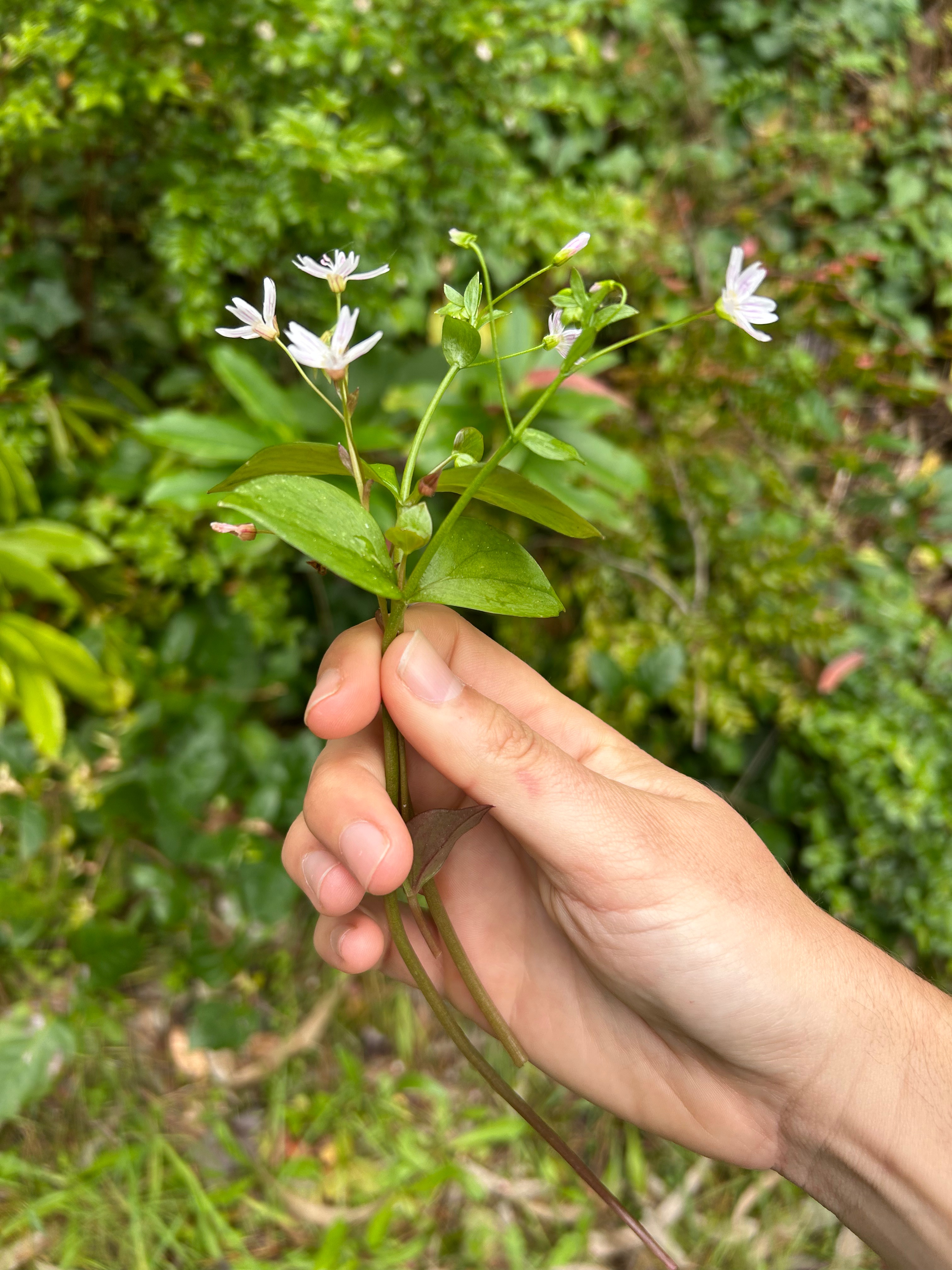
    Claytonia sibirica – miner’s lettuce or candyflower

    By Jess Carey

    Spring is in full swing in the Arcata Community Forest. Look out for small pink blooms of Claytonia sibirica poking out from underneath shrubs and trees. The plant is in the family Montiaceae. The plant’s common name, miner’s lettuce, comes from its lettuce-like taste and texture. It was an important source of vitamin C for gold rush miners and helped to prevent scurvy. I like to call it trail salad, as it makes a great trailside snack. 

    The young leaves have a bright spinach-like flavor that gets more bitter as the plant flowers and ages. Although it is very common, it is easily overlooked due to its small size. Most plants are less than a foot tall. Its flowers are usually less than a half inch across, and white, with bright pink stripes.

    Jess Carey is a senior at Cal Poly Humboldt, majoring in biology and double minoring in botany and journalism, and the science editor for The Lumberjack. They are passionate about telling stories that are relevant to the community, branching their interests in science and the arts.

  • The mutual, my personal niche micro celebrity

    The mutual, my personal niche micro celebrity

    By Kimberly Alexsandra Madrigal

    This is my personal, parasocial phenomenon of “the mutual.”

    I thought this was something only my brain rot-ass experienced, but after asking some friends — and even some mutuals about it — I realized I’m not alone, and a lot of other students here are Instagram mutuals with other students they also don’t really know in real life. They agree it’s like a celebrity sighting walking past them on campus — yet they all wonder the same question, “is it weird if I say hi in real life?”

    Then I wondered; Is this just a Humboldt experience? Has hiding from the world amongst the redwoods made us too shy and nervous to actually converse with others in real life? Especially ones we see and actively engage with on social media daily? 

    Or is it just our generation’s version of having acquaintances in this digital age?

    Whatever it is, it’s entertaining and I love it. 

    My mutuals are my favorite influencers – you’re like my own personal celebrity. I don’t know you or your past, I just skipped right into seeing you in your hottie college girl era and I love it, pookie. 

    Whether we met on the Humboldt ‘26 Insta, the Arcata Theater Lounge bathroom line, or we haven’t even met at all; if we follow each other and heart each other’s stories constantly, we’re locked in.

    I get to see the best parts of your life — you learning how to DJ, your art, your new nails, your matcha of the day and maybe even a hard launch of your current man. 

    In exchange, you get to see my fit checks, magnificent music recs and, of course, my wonderfully curated reposts of deep-fried Facebook memes. 

    The coolest part is, we don’t speak, we just love — each other’s stories. God, I love girlhood.

    Sometimes, if you’re a great moot  — cute nickname for mutual, duh — like me, you get promoted to Close Friends status. That is where you get an all-access backstage pass into the psyche of a girl. 

    This is where we see more than macarons and ramos buchones. This is where we see the non-aesthetic chaotic content that I live for. The moot reconnects with the earth after blacking out on a jazz Thursday at The Basement. She frequently misses flights, manically cuts baby bangs after a breakdown and buys a new pair of shoes every week. A rich old man invited her on his yacht in Greece and she vlogged it all for us?! Oh, don’t forget the time she burned soup and ruined her evil roommate’s great grandma’s cherished pot. 

    She’s an icon — and I’m lowkey starstruck when I see her. I forget she’s not just my niche personal celebrity, but a real person and we go to the same school. Do I smile and wave hi when I see her at the gym, the farmers market or a Manila function? Or is that too weird? Am I giving fan? Ugh, idk. 

    It’s like I have a behind-the scenes look into your life, but I don’t really know you — but that’s also kind of like the best part. The mysteriousness just adds to the coolness. 

    Your life is a movie, darling, and I have a free screening of it all from the cracked screen of my iPhone 14 and the comfort of my twin XL mattress. 

    I will be very offended and heartbroken the day you unfollow me and I still follow you. What about all we had? Was that nothing to you? But then my inner #hater will rise over and unlike every single post, take back all the loving vibes I ever sent you telepathically and send you ojo, aka the evil eye. You’re not Nicki Minaj — I am!

    Kimberly Alexsandra Madrigal is a 3rd year journalism student from Fresno, CA. She enjoys classic cars, fashion, shoes, Amy Winehouse and romanticizing life. 

  • Celebrate your heritage by keeping your family’s recipes alive

    Celebrate your heritage by keeping your family’s recipes alive

    By Mia Costales

    As a fifth-generation Mexican-American, I’ll be the first to say that I’m pretty far removed from my ancestors’ culture. I don’t speak Spanish — very well, at least. My family never celebrated any traditional Mexican holidays and I don’t share the same struggles and triumphs that many first-gen Mexican-Americans experience. Despite this, my family has managed to salvage one crucial aspect of our culture — food. Because of this, I grew up regularly eating my mom’s pozole, my grandma’s enchiladas, my aunt’s tamales, my uncle’s molé — the list goes on. If there’s one thing I hope to pass down to my future children, it’s all of the recipes that were passed down to me. 

    Food is an excellent medium for showcasing cultural pride and education. One dish has the power to tell the story of thousands of people, oftentimes a story based in indigenous roots, colonization and reclamation. Many of the dishes that we know and love today are the product of multiple cultures. Tacos are the product of Mesoamerican cuisine, like masa harina and chiles combined with European introduction of livestock and cooking techniques. The bánh mì is a direct result of French colonization in Vietnam, combining traditionally Vietnamese ingredients like pickled vegetables, chiles and cilantro with French ingredients like mayonnaise, pâté and the quintessential baguette. 

    If these dishes were to get lost over generations, the history associated with them also gets lost. Centuries of celebration, oppression, invention, adaptation and survival can become forever extinct as traditional cultural dishes die out. Honoring ancestry and preserving cultural traditions is more important than ever and cooking with traditional ingredients is one of the easiest ways to do this. 

    Nosheen Maung, an environmental science management major, explained that she honors her Burmese heritage by cooking cultural recipes her mom passed down to her. 

    “Growing up first-gen Burmese, I find it even more important to learn my mom’s food because it’s scary to feel it decreasing in importance from generation to generation, especially because Burma is so far,” Maung said. “I just talked to my mom recently and moving so far away from her for college, I miss her cooking more than I can express.” 

    The next time you go to The Depot and eat a katsu burger, take a moment to think about where the recipe came from. There’s a good chance that the recipe originated in someone’s kitchen hundreds of years ago and has evolved over the years into the chicken sandwich that holds you over in between classes. 

    Food has always been political and keeping family recipes alive is imperative to fighting white supremacy and colonial ideals. Shop at your local cultural grocery store. Host dinner parties highlighting the food of your friends’ cultural backgrounds. Write down your recipes. Expand your palate. I urge you to stay in touch with your ancestry and explore your culture’s cuisine because revolution can start in your kitchen. 

    Mia Costales is a senior journalism major and the Life & Arts Editor for The Lumberjack. With a background in music performance, she hopes to bring thoughtful and informative stories to the public.

  • Shopping sustainable: Cannabis certifications to look for in Humboldt County

    Shopping sustainable: Cannabis certifications to look for in Humboldt County

    By Ursula Newman

    Flower, hash oil, gummies, oh my! Having trouble choosing? Start with local and environmentally conscious. Supporting third party certified cannabis farmers is the thing to do when in Humboldt County.

    The process to get a license and begin cultivating cannabis legally in California can be long and costly. Regardless of the size of a license, there are a number of requirements that are true to all farms. Applying with the California Department of Fish and Wildlife, the local water board, completing pesticide registry and county inspections are typical requirements. Farms have to get a wildlife survey, archaeological survey, and biological survey to check for rare plants. By ensuring that cultivation sites meet these requirements, California is working to protect the environment throughout the legalization process. 

    There are third party certifications that cultivators can get after they are legalized by completing additional regulatory inspections. These certifications show their commitment to environmental and ethically sound practices. The main certifications are Sun+Earth certified, O-Cal — organic equivalent through the California cannabis system — and Dragonfly Earth Medicine (DEM) Pure. When products are on the shelf in a dispensary, these certifications help the cultivator and their brand stand out. 

    Herb & Market Humboldt located at 427 H street in Arcata is a dispensary that aims to uplift farms that are going the extra mile. If interested in shopping for cannabis with those values weaved into their practices, Herb & Market Humboldt is a great place to start.

    What are third party certifications?

    The owner and founder of Herb & Market Humboldt, Chrystal Ortiz, is a board member at the Sun+Earth organization. Her cannabis farm, High Water Farm, was a part of the pilot program that helped to create the standard for the Sun+Earth certification. Sun+Earth certifies that cannabis is grown under natural sunlight without toxic pesticides, herbicides and synthetic fertilizers, and that the farms support healthy soil ecosystems for their crop.  

    “Sun+Earth was founded by a collective of experienced cannabis growers, industry leaders, and environmental advocates. We saw an opportunity to raise the bar for cannabis cultivation and create a trusted symbol that consumers could rely on,” the Sun+Earth website reads.  

    “The Sun+Earth certification is the top-tier, it basically uses the National Organic Program as its baseline,” Ortiz said. “There’s emphasis on human empowerment, so a farm worker and labor pillar, and then there’s a community engagement pillar, where people have to be engaging in their community and volunteer in whichever way. A lot of people are growing food for the food banks, or people are volunteer firefighters and coaches, things like that.”

    O-Cal is another certification that was launched more recently, and it means organic, through the California Cannabis System. Because cannabis is not federally legal, you can’t use the term organic. This certification shows that the product is comparable to organic. Ortiz explained that this certification is designed to retire as soon as farmers can have a standard organic certification that is federally recognized. 

    Dragonfly Earth Medicine Pure, or DEM Pure, is a more peer-to-peer-based certification that is widely recognized. Ortiz explained that people like it because its farmers certifying each other’s practices. The certification covers regenerative and biologically intelligent practices, and shows that farms are being mindful cultivators on the land as well as in their community.

    Other certifications are still up and coming. Matthew Johnson, a professor in the department of wildlife at Cal Poly Humboldt, along with Jackee Riccio of Cannabis for Conservation, developed a Wildlife Conscious certification process. Johnson said that farms that already have a certification such as Sun+Earth will then be able to get the Wildlife Conscious certification if they implement certain wildlife specific enhancements on their farms. Those enhancements include things like lowering noise pollution, establishing native hedgerows, nest boxes, and making sure there aren’t things on the farm that will kill or inhibit movement of wildlife. 

    Johnson pointed out that the two main ways people view the relationship between wildlife and agriculture is that agriculture is destroying wildlife habitats, or wildlife is threatening farmers. 

    “I’m really interested in a third pathway there, and that is the idea that farms and wildlife can not only just coexist,” Johnson said. “They can actually mutually benefit each other.”

    Only one farm, Mattole Valley Sungrown, is currently certified, and several others are in the process. 

    What value do these certifications bring? 

    Daniel Mar is a lecturer in the cannabis studies department at Cal Poly Humboldt, and the environmental stewardship lead for the program. Mar explained that the value of these certifications depends on two things — the practices being implemented at the cultivation site, and the consumer engaging with the product. Shopping for certifications such as these is a part of responsible consumption, in more ways than one. 

    “If we don’t protect the small farms, which are the ones being inherently more environmentally sound in their practices, then we’re kind of running those good practitioners out of the market,” Mar said. “Then at the consumer end, you have less of a choice because those products aren’t available, the industry itself ran them out of business.”

    Industries are guided by where consumers spend their money. Mar says that they need consumers asking for those products, which would shift the market and incentivise even more farmers to adopt those practices and get those certifications. 

    When it comes to the retail space, Ortiz said that these certifications are a big talking point that helps products sell. The amount fluctuates, but they try to keep around 75-80% of the store’s offerings locally based. When she designed Herb & Market Humboldt, it was an extension of advocacy for small farmers. The store houses a farmers market-esque booth space, and Ortiz has hosted several events for farmers to come and sell their products directly to customers.

    “We need more Herb & Markets in the world that have a core principle in their business model, which is connecting the consumer to where the product came from,” Mar said.

    Find out more on instagram @iloveherbandmarket for details on their upcoming 4/20 events and to get clues for the 21+ glass egg hunt on Easter.

    Ursula Newman is a journalism major and Humboldt local. You can find her all over town doing all kinds of things, and talking to all sorts of people.
  • Students and locals step up to protect oceans and beaches with Surfrider Humboldt

    Students and locals step up to protect oceans and beaches with Surfrider Humboldt

    By Ursula Newman

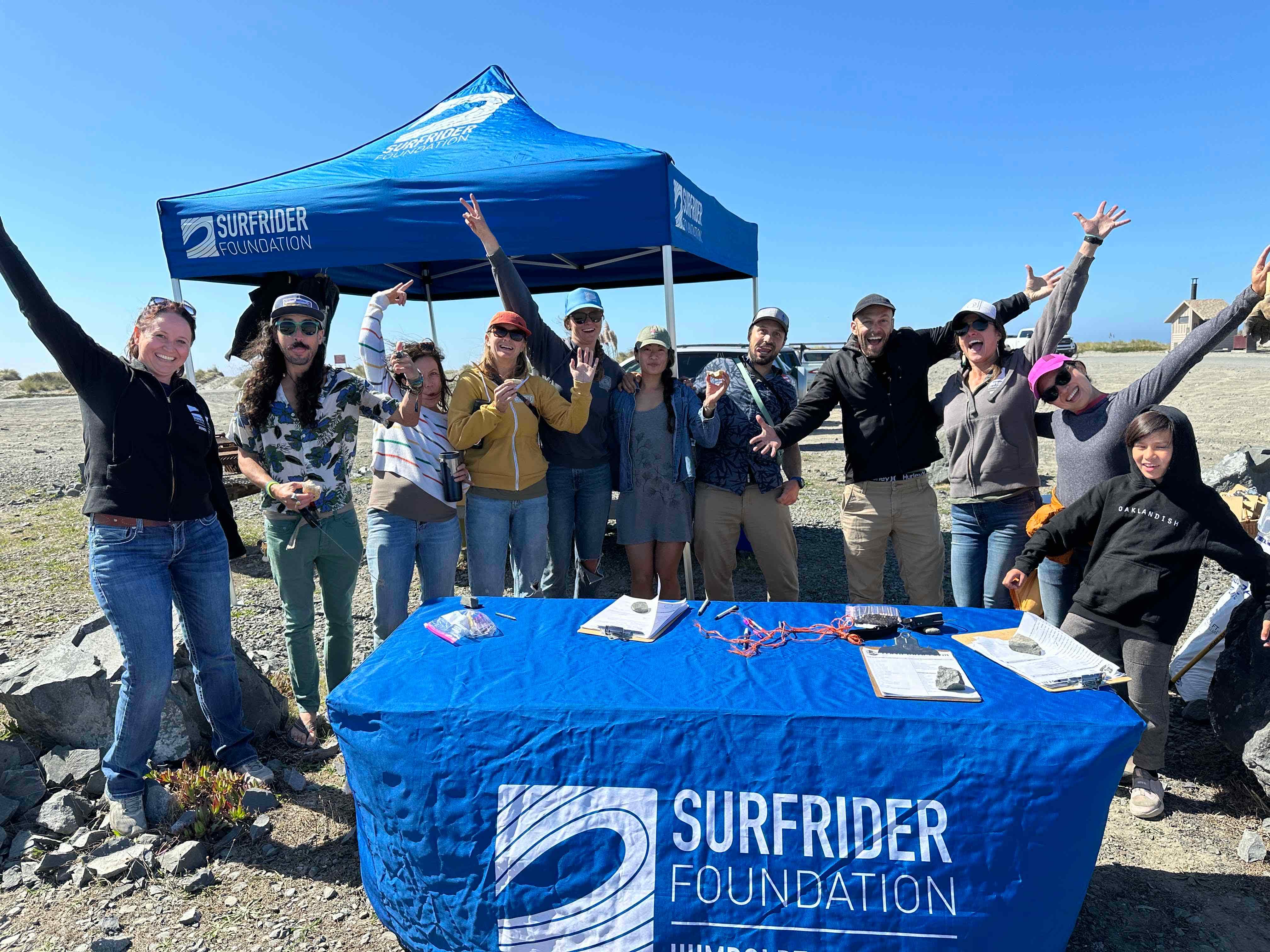
    Even in Humboldt where coastlines may look pristine, the fight for ocean health is alive and well. The Surfrider Foundation’s Humboldt chapter is a major force in that fight. They’re inviting students and community members to get involved through education and action.  

    Founded in 1984, the Surfrider Foundation began as a group of surfers concerned about Surfrider Beach in Malibu, Calif. Their favorite surf break was facing environmental issues caused by increasing coastal development. 

    “The Surfrider Foundation believes that getting outside and engaging with the natural world, especially the ocean, waves and beaches, is inspiring, supports healthier lifestyles, improves productivity and ultimately creates a better culture.” their website reads.

    One of the co-founders of Surfrider Foundation, Tom Pratte, majored in coastal environmental studies here at Humboldt State University. One of the first major victories for Surfrider as an environmental nonprofit was the work they did in the second largest Clean Water Act-related case in U.S. history. This lawsuit filed in 1989 against two oceanfront pulp mills in Humboldt resulted in significant reduction of toxic discharges. Both mills closed down several years later. 

    What does surfrider do?

    Jessie Cretser-Hartenstein is the current chair for Surfrider Humboldt and an associate professor in the journalism department specializing in public relations. The chapter is volunteer-based and a 501(c)(3) nonprofit organization. She explained that because of our smaller population, industry pollution has been a bigger problem than individuals. 

    “We do a lot of policy work for environmental policy and programs in addition to beach clean-ups, and some more local boots-on-the-ground efforts,” Cretser-Hartenstein said. “When there are specific agenda items in local government, we also do things like writing public comment letters and showing up at city council meetings to have our voice heard on environmental issues that affect our oceans and waterways here in Humboldt County and beyond.”

    Recently, the Surfrider Humboldt chapter has been active as a watchdog on local projects, such as the Redwood Coast Offshore Wind Project, which has Vineyard Offshore and RWE Offshore Wind as its main developers. Nordic Aquafarms, a fish farm in development here in Humboldt is another project Surfrider is monitoring to ensure they have as little negative environmental impact as possible.

    Nationally, Surfrider engages in litigation and advocates for strong environmental standards. They contributed to the banning of single-use plastic bags throughout California. The Humboldt chapter certifies ocean-friendly restaurants and gardens in the county, performs water testing as part of the Blue Water Task Force and hosts educational outreach at local grade schools. Regular events such as beach clean-ups and movie nights are a great entry point for engaging with environmental work. 

    They encourage everyone to make more sustainable choices, like avoiding single-use plastics and supporting green businesses. 

    Student involvement through the Surfrider Club

    Surfrider Humboldt relies on people who are passionate about the environment getting involved. Ryan Diaz, a junior studying public relations and communications at Cal Poly Humboldt, is the media and communications intern for Surfrider Humboldt. Recently, Diaz revived the Surfrider club on campus, which faded in 2019.

    “All up and down California, and [nationally], there are countless universities and high schools who have taken initiative to create a Surfrider club and expand its mission,” Diaz said. “It’s a vital part of our activist network, and it’s what keeps our oceanic conservation messaging, concepts and ideas alive.”

    Diaz said that the first meeting had a really good turnout, with students looking forward to beach clean-ups, Earth Day celebrations and partnerships with other clubs in the near future. Cretser-Hartenstein, who is also faculty advisor for the club, explained that they’re getting active on and off-campus.

    “We’re doing education and outreach to inform other students on campus and throughout the community about ocean conservation, and also just doing fun stuff as well, like getting out to the beach and actually enjoying the beautiful coastline that we have here,” Cretser-Hartenstein said.

    Getting involved/upcoming events  

    The chapter’s popular event Ocean Night is hosted every month at Arcata Theatre Lounge. Coming up on April 24 at 6:30 p.m., they will be showing the documentary Corners of the Earth, and an episode of Maps to Nowhere.

    “Sometimes, it will be a pretty hard-hitting environmental documentary, and sometimes it’s just fun and uplifting films about how different people recreate and utilize our beaches and our oceans,” Cretser-Hartenstein said. “It’s a really good community event that’s education and outreach-centered, but also just a fun time for like-minded folks to get together.” 

    Secretary of the Humboldt chapter Kate Russell is also involved with event planning for things like public meetings and movie nights. 

    “One of the easiest things [students] could do is come to one of our chapter meetings,” Russell said. “The club members come to our meetings, and you can meet everybody and get a sense of what we have planned out for the year.”

    Individual action adds up, especially when it’s a local effort. The Surfrider Foundation provides a way to make change with environmental issues that the community cares about.

    “We implore all of our population in Humboldt County to get involved,” Diaz said. “Students are the grounds of our society and the next generation that is going to be making those hard-hitting decisions and choices that impact our future.

    The club welcomes all students, no experience necessary. They will be hosting a beach clean-up on April 27 at 9 a.m. at the North Jetty.

    More information can be found @cphsurfrider, the official Instagram for the club. You can find out more about Surfrider Humboldt on their website and Facebook, @surfriderhumboldt.

    Ursula Newman is a journalism major and Humboldt local. You can find her all over town doing all kinds of things, and talking to all sorts of people.

  • The politics of pot: A brief history of cannabis as a political weapon

    The politics of pot: A brief history of cannabis as a political weapon

    By Eli Farrington

    Nothing says peace and love like the hyper-politicization and weaponization of one of America’s most highly disputed and controversial substances. Throughout history, cannabis has played a major role in politics. The political history of cannabis in the U.S. is anything but brief, but I’ll try to summarize it as best I can for those of you who may be a little too high for a long-form story. 

    Prior to the 1920s, cannabis was historically viewed as a versatile all-purpose plant, used in textiles as well as medicine. Although recreational use did exist, it wasn’t what cannabis was known for at the time. 

    It wasn’t until the 1920s that recreational use of cannabis gained the attention of mainstream society. Because recreational use of the plant was introduced after the Mexican Revolution, American lawmakers viewed it as a dangerous foreign substance that threatened American Pharmaceutical companies, and completely ignored any of its medicinal benefits. Classic America, rejecting natural remedies in favor of pharmaceuticals concocted in a lab. This shift in perception created a domino effect that would eventually lead to generations of weaponization of what was once a simple medicinal plant.

    The “Marijuana Tax Act” was introduced in 1937, marking the first major piece of cannabis legislation in the United States. The act essentially outlawed the plant and solidified its status as an illegal drug. Supporters of the act argued that cannabis posed a threat to larger pharmaceutical and textile companies, while racism — shocker — was another key factor leading to the plant being outlawed. At the time, lawmakers associated the plant with Mexican immigrants and African-American musicians. One lawmaker in particular was responsible for creating this stereotype. His name was Harry Anslinger, and he was the first commissioner of the Federal Bureau of Narcotics (FBN). Anslinger was a strong believer in the prohibition of all drugs and narcotics except for alcohol, but the one substance that he hated above all others was cannabis. He would go on to use the media as his platform to spew racist and xenophobic misinformation about the plant on a national level. 

    Anslinger basically dedicated his entire career with the FBN to convincing the country that cannabis was an evil substance sent by Satan to destroy everything that the white man had worked so hard to build. Here are a few of the batshit crazy things that this guy actually said about cannabis:

    1. “Marijuana is the most violence-causing drug in the history of mankind.​”
    2. “You smoke a joint and you’re likely to kill your brother.​”
    3. “The primary reason to outlaw marijuana is its effect on the degenerate races.​”
    4. “Marijuana leads to pacifism and communist brainwashing.​”
    5. “If the hideous monster Frankenstein came face to face with marijuana, he would drop dead of fright.”

    The next significant pieces of legislation regarding cannabis came in the 1950s when Congress passed the Boggs Act of 1952 and the Narcotics Control Act of 1956. These acts created mandatory sentencing for first-time cannabis possession, with a minimum sentence of 2-10 years and a $20,000 fine. 

    In 1970, Congress passed the Controlled Substances Act (CSA), essentially wiping the slate clean of any previous cannabis legislation and starting from scratch. The CSA categorized cannabis as a schedule one substance alongside drugs like heroin, LSD and peyote, and determined that it had no medicinal use and a high potential for abuse. 

    On June 17, 1971, President Nixon declared drug abuse “public enemy number one” and waged a nationwide offensive on drug abuse, known as the war on drugs. Although Nixon claimed drugs to be the enemy, his campaign disproportionately targeted African-Americans and anti-Vietnam War protesters. 

    In fact, one of Nixon’s own advisors, John Ehrlichman was quoted saying that the Nixon campaign had two enemies: the anti-war left and Black people, and the war on drugs was just a cover up to target these groups. 

    “We knew we couldn’t make it illegal to be either against the war or Black… but by getting the public to associate the hippies with marijuana and blacks with heroin, and then criminalizing both heavily, we could disrupt those communities… We could arrest their leaders, raid their homes, break up their meetings, and vilify them night after night on the evening news. Did we know we were lying about the drugs? Of course we did,” Ehrlichman said.

    The result was a drastic increase in the percentage of cannabis arrests in the following decades. Today, nearly one quarter of all drug arrests are for cannabis possession and people of color are far more likely to be impacted due to racial profiling in policing. 

    Nixon, and many presidents that followed him, used and manipulated drug policy laws to bring their political careers to new heights and gain leverage. Nowadays, cannabis law making is done at the state level, with 24 states voting to legalize it despite it being illegal on the federal level.

    Cannabis is just as politicized today as it was in the 1930s. For people who enjoy cannabis, a politician’s political stance can be a huge deciding factor in the way they vote. In today’s world, cannabis legalization or decriminalization is a familiar proposal on many ballots. It’s not uncommon to see politicians running for office make promises of cannabis reform, when just a few decades ago they were the ones responsible for putting people behind bars for possession. 

    Cannabis has an incredibly complex and contentious history in the U.S. spanning over a century. Wars have been fought, lives have been lost, and laws have been drafted all in the name of this plant. As the generation of legalization, it is our responsibility to acknowledge that history and do what we can to avoid repeating it. So, next time you roll one up, remember that you are smoking a piece of the past in the name of a brighter future. 

    Eli Farrington is a highly intelligent human life form working as the opinion editor for The Lumberjack. In his free time, he enjoys analyzing the complexities of the human condition. His passion for journalism knows no boundaries and exceeds time and space itself.

  • Come fall, time to move to Craftsman Mall

    Come fall, time to move to Craftsman Mall

    Cal Poly Humboldt continues construction of new dorm buildings

    By Andres Felix Romero

    Among the gravel, milling construction workers and a small fleet of construction vehicles lies potential for the largest housing project in Cal Poly Humboldt’s history. Currently, the Craftsman Mall dorm buildings and complex lack the color it will have upon completion. One half of the dorms, called Hinarr Hu Moulik — pronounced hee-NOD huh MOO-leek, meaning “Our Home” in the Wiyot language — will be completed and ready for students to move in by the fall semester. As for the other building, major construction, painting and furnishing will be completed in the fall. The building will be ready for students to move in by Spring 2026. 

    The dual dorms are among the largest buildings at the university. Each one sits at about the height of the Behavioral Sciences building, which itself stands at five stories tall. The buildings are also being constructed with A-1 materials, which are composed of non-combustible substances. Upon completion of construction, there will be plenty of outdoor space and features including an acre of green space and small hills rolling between the dual dorms, with plenty of outdoor seating. Along with the outdoor space there will be activities, such as basketball hoops, a pickleball court, a ping pong table and a cornhole setup.

    A dimly lit hallway with hanging lightbulbs strung along the sides of a metal pipe. The hallway extends into eventual darkness, with occassional pieces of construction equipment tucked against the walls.
    Photo by Barley Lewis-McCabe | A hallway under construction in the Craftsman Mall construction project.

    As for the inside of the dorms, there will also be recreational options with a multipurpose room for lounging and other events, including a foosball table. The multipurpose room will also have wall-height glass doors that open to the grassy hills for more space. In terms of dining, Craftsman Mall will have a large professional kitchen staffed with cooks to prepare hot and ready meals, as well as meals to order for the campus community. In the same area will be a market similar to The Marketplace for snacks and essentials.

    The living dorms themselves will be able to host 1,050 students in apartment-style dorms. Each suite will have four to six residents. The apartments have a modern feel with wood-laminate finish furniture, black leather and green cloth seats, and a dishwasher. These dorms will be reserved for upperclassmen.

    There will be a few options for travel between the main campus and the dual dorms. The City of Arcata and Cal Poly Humboldt have partnered to develop the Annie Marie trail, a pathway that leads to Sunset Avenue. The university and the city of Arcata have also been allotted funds to reconstruct the Sunset Ave. overpass to make it safer for cyclists and pedestrians.

    Those with bicycles will have access to a lot area with 200 spaces that is essentially a giant cage to protect their wheels from theft. The campus’ Green and Gold bus route will also have a stop here, alongside a dedicated shuttle between Craftsman Mall and the main campus that runs every 30 minutes.

    One of the leads on this project from Cal Poly Humboldt is Vice President of Finance and Humboldt State alumnus Mike Fisher. Fisher understands the dorm life of a Lumberjack as he lived in the Sunset dorms. He also understands the hesitation the new Craftsman Mall residents may have living a bit of distance from campus, but Fisher hopes that these new dorms can begin a new chapter of Lumberjack residents.

    “I know this place will be a community unto itself,” said Fisher. “It will feel like you’re on campus, but also independent.”

    An external view of a Craftsman Mall building, which is a simplistic, beige, rectangular structure with windows of varying widths. Three white tubs run out of the building for ventilation and construction equipment is scattered about.
    Photo by Barley Lewis-McCabe | A view of the Craftsman Mall project under construction.

    Andres Felix Romero is a senior and reporter for The Lumberjack. He is passionate about writing to improve the world around him and can often be found hiking in the woods with his dog, Uichu.

  • Decoys play pivotal role in on-campus arrest

    By Andres Felix Romero

    DISCLAIMER TO THE READER: Please use caution when reading this article, it contains language related to sexual abuse, and may be harmful to readers.

    University police and Ryan Hill of the District Attorney’s office (DA) arrested  Cal Poly Humboldt Student Health Center Medical Assistant Ryan Graves on April 8 on felony charges of contact with a minor for sexual offense (PC288.2) and showing pornography to a minor (PC288.3). The arrest was the result of a sting operation in which an adult decoy from the 501(c)(3) nonprofit Child Safety Soldiers (CSS) posed as a 14-year-old on social media.

    The Lumberjack obtained court documents and a copy of Graves’ warrant detailing the key dates of the case. Graves made contact with the decoy on Feb. 16, where the decoy made clear they were underage. According to court documents, after Graves made contact, he engaged in conversation with the decoy that consisted of lewd language and nude images sent to the decoy. These chat logs resulted in Hill beginning an investigation into Graves.

    “On or about 4-3-25, [Hill] was contacted by a member of [the CSS],” said the court documents. “[The CSS] advised that a 41-year-old-male, Ryan Edward Graves of Humboldt County, was engaged in a text conversation with [the CSS] posing as a 14-year-old-girl.”

    On April 5, Judge Steven Steward of the Humboldt County Superior Court authorized a warrant for the arrest of Graves, as well as a search warrant of Graves’ residence and electronics. On April 10, Graves was arraigned in front of a judge. He entered a plea of not guilty and hired a private defender who requested a two-week continuance for confirmation of counsel. Graves posted bail late in the evening and is set to appear in court next on April 22 for the confirmation of counsel. A preliminary hearing for the case is set for May 29.

    At this time, the university cannot comment on Graves’s employment status with the campus as it is an ongoing investigation. At the time of publication, Graves’ employee profile is still on the university’s website. The family of Ryan Graves are distraught after the arrest, and ask the public to respect their privacy as they deal with the weight of the charges.

    “We will continue to know, love, and support him as a family,” said the Graves family in a statement. “We beg that you please respect our privacy during this extremely difficult time. Any further negativity will not help, even if it feels like it will.”

    Who are the Child Safety Soldiers?

    The Child Safety Soldiers is a nonprofit that operates nationwide, founded in 2017 and is led by Shane Coyle. The CSS conducts sting operations and works with local law enforcement and Attorney Alexandria Crouthamel to ensure their practices are legal, sound, and that all evidence they gather is admissible in a court of law.

    Seek resources if needed

    If you are a survivor of any form of assault, there are many resources available as well. Counseling and Psychological Services on campus can be reached by health@humboldt.edu or (707) 826-3236. If you’re someone who struggles with urges that would lead to sexual offenses, there are resources and support available. The John Hopkins School of Public Health has a division called MOORE that focuses on preventing child sexual abuse. Please refer to their website for more information on their anonymous services for those with sexual interest in children.

    Kyla Baxley is the current Chief Investigator for the DA’s office and shared a reminder to stay vigilant against all kinds of predators on the internet.

    “Internet safety is crucial in today’s digital world to protect individuals from identity theft, cyberbullying, exploitation, and scams,” said Baxley. “It helps protect personal information, promotes responsible online behavior, and ensures people can use technology safely and confidently. Sexual predators exploit the anonymity and accessibility of the internet to target vulnerable individuals, especially children. Families, schools, and law enforcement staying aware and responsive to internet safety is a vital defense against these threats.”

    Andres Felix Romero is a senior and reporter for The Lumberjack. He is passionate about writing to improve the world around him and can often be found hiking in the woods with his dog, Uichu.

  • Arcata locals hold 8th annual vigil honoring David Josiah Lawson

    Arcata locals hold 8th annual vigil honoring David Josiah Lawson

    By Nick Escalada

    A collection of Arcata residents, HSU alumni and members of Black Humboldt gathered at the community garden El Jardin Sanctuario on Tuesday, April 15, for a candlelight vigil in memory of David Josiah Lawson. The day marked the 8 year anniversary of the Humboldt student’s fatal stabbing at a house party, which the Arcata Police Department recognized to have been mishandled in court by the Humboldt County DA’s office. The city community has remained steadfast in its support of Josiah’s family and their efforts to ensure the still-open case reaches a just conclusion. 

    Rosemary Grady, a member of Black Humboldt, Changing Tides and the activist group Justice for Josiah, voiced her motivations behind her work as a community organizer. 

    “Of course we want justice. We keep saying that Josiah was lost, but he wasn’t lost. He was stolen, and that deserves justice, and his mother deserves justice,” Grady said. “But the thing that I continue to move forward with is just the fact that we are in community, there are people to share this heaviness with. There are people who are ready to support and continue to show up, so that’s why I continue to show up.”

    Lawson’s routine vigils have grown into a powerful point of convention in Arcata such that people who did not know him personally or did not live in Humboldt during his death continue to appear to pay him homage. Kris Coy, who has been involved with Justice for Josiah for most of its existence, expressed appreciation for the growing public support while acknowledging the continued activism needed to see proper change.

    “[Josiah’s killing] occurred when I was a student, and it really emboldened me to join the student-led movement at the time and to continue to follow it after I graduated,” Coy said. “I think that giving the spotlight to the people who are actually doing the work is the responsibility of all those people who are here. There’s been hundreds, probably thousands of hours I’ve gone into stuff like this, and props to those who just show up, but the work gets to be done.”

    Participants mobilized through town to conclude the vigil by Josiah’s mural across the street from the Cal Poly Humboldt campus. While these events are a strong vessel for further community awareness and healing, their organizers make it clear that efforts for justice are not limited to Lawson’s death anniversary. Justice for Josiah persists in working with city authorities and judiciaries to ensure this case closes with equity and respect.

    Nick is a sophomore minoring in journalism who reports on happenings of all sorts. As a wildlife major, he enjoys nature-related pieces. On his off days, you can find him taking a hike behind campus or collecting shiny stuff on the beach.

  • Breaking records and earning diplomas

    Breaking records and earning diplomas

    Track and field athletes celebrate their bittersweet end at Humboldt

    By Ariana Wilson

    Applause and excitement echo throughout the Redwood Bowl as racers take their mark. The packed stands anxiously wait for the gun to sound. Long, drawn out seconds stretch over the oval and… they’re off. Teammates and friends let out frenzied cheers as they watch their seniors race on their home track for the last time. These athletes have put their heart and soles into every meet and each practice, showing up on the top of the California Collegiate Athletics Association (CCAA) leaderboard and breaking long-established school records year after year.

    Ryan Castro is a team captain and four year member of the Humboldt track and field team, but he didn’t need four years to make an impression on Humboldt. In 2024, he broke the 42-year standing school record in the 100 meter sprint with a time of 10.54 seconds. 

    Starting as a walk-on during COVID-19, his track career hasn’t always been a straight shot to the finish line. 

    “I had to earn everything from the ground up, and there were a lot of moments where it would’ve been easier to give up,” Castro said. “But I had coaches and friends that believed in me and helped me push through the injuries, the setbacks and the mental battles. That record represented a standard that stood for over four decades, and being the one to raise the bar to our new standard as a team meant a lot to me.”

    Castro’s character speaks to the influence of this program, the athletes, trainers and coaches that influence student athletes every season. 

    A close up shot of a Cal Poly Humboldt male track and field athlete wearing yellow sunglasses, a green tank top, and black shorts. He is mid-run as he takes off from the start line.
    Courtesy of Humboldt Athletics | Senior Ryan Castro perfoming in a track and field event.

    “Humboldt has given me so many opportunities, not just to grow as an athlete, but as a person. Being part of this program has shaped me in ways I’ll carry forever,” Castro said. “To know I’ve played a small part in the program’s history and culture is something I’ll always be proud of. I’m thankful I got to wear this jersey and be part of something bigger than myself.”

    Senior transfer Cristian Megas has left his mark on the Humboldt top ten list in both the 100 and 200 meter sprints. 

    “One of the most valuable lessons is patience. In track, you train so long to be good for such a short period of time,” Megas said. “To enjoy what you do, it makes everything better from training to mental health.”

    In 2024, Castro and Megas were joined by Joey Bowser and Harry Singh, where the four secured a spot as the second fastest in Humboldt history in the 400-meter relay with a time of 41.11 seconds.

    Senior Gracie Kasberger of Prineville, Oregon, was a part of the post-COVID rebuild in 2020. 

    “There are some amazing athletes and coaches on this team, and I hope I am remembered as one of them. I am honored to have contributed to Humboldt Athletics,” Kasberger said. “This place has been home to me for 6 years, and many of the people in the athletics department contributed to making it a home for me.”

    Kasberger was the conference champion in the heptathlon in 2022, a discipline which features 7 different sports, and hit the national provisional mark for the heptathlon in 2024. 

    “I have overcome numerous injuries and setbacks in my career as a heptathlete, and I have never given up,” Kasberger said. “I have been a conference champion and runner-up for my event every year I have competed at the CCAA conference championships. Hard work does pay off.”

    Senior Joy Hano hails from Southern California and brought the heat with impressive accolades in her five years at Cal Poly Humboldt. Hano claimed her victory as the CCAA Champion in the 100 hurdles and broke a 33-year-old school record in 2023 with a personal best of 13.96 seconds in the 100 meter hurdles breaking the former school record of 14.06 seconds. In 2024, Hano beat her own school record with a time of 13.93 seconds.

    “My motivation has always been rooted in the question of possibility,” Hano said. “Every time I accomplished something I once thought was out of reach, it pushed me to ask, ‘if I can do that, what else might be possible?’”

    Hano’s performances cemented her name in history, along with several of her teammates. They encouraged each other and used one another as motivation to keep striving higher and running faster. 

    “I want to be remembered as someone who didn’t let adversity steal their joy. More than anything, I hope people remember that I gave it my all. I hope my time here showed others that it’s possible to take the sport seriously without losing yourself in it,” Hano said. “That you can chase big goals and still find happiness along the way. Trying your best, finding joy in the process, and showing that personal growth can be its own victory — that’s the legacy I hope I leave behind.”

    A line of Cal Poly Humboldt male athletes competing in a track and field event. They are all wearing green tank tops and black shorts. They are all running at full speed around the curve of a race track.
    Courtesy of Humboldt Athletics | Senior athlete Cristian Megas (middle) competes on the track.

    A common sentiment from these seniors is ‘comparison is the thief of joy.’ Their legacies as change makers will continue to live on after their departure and they will hold a special place in Humboldt history as record breakers, character builders and the example for future generations of Lumberjacks.

    “This past year, things shifted. That emotional growth, being able to race without fear, to enjoy the process, and to end my final season on a note of genuine happiness, that’s what I consider my greatest achievement,” Hano said. “Because medals fade, records get broken, but the feeling of reclaiming something you thought you lost? That stays with you.”

    Ariana Wilson is a junior majoring in journalism and minoring in scientific diving. She intends to merge her passion for the environment and conservation with her love of journalism as a science writer in the future. This semester’s goal: write one story per section.

  • Redwood national and state parks boast underappreciated beauty

    Redwood national and state parks boast underappreciated beauty

    By Nick Escalada

    What is your favorite part of being a Cal Poly Humboldt student? Is it the quirky and intimate local community, inspiring faculty body or exciting new fields of study? If your answer resembles any of these, you may be a boring bastard who needs some enlightening. We live in one of the most uniquely beautiful regions on the planet, and that can be hard to remember when your weekend excursions consist of Dutch runs, thrifting and laps around the farmer’s market.

    For starters, our campus is home to an expansive community forest with a scenic marsh and wildlife sanctuary within walking distance, but if you want some fresh air that’s not laced with THC, a quick drive up north is your best shot. Between Orick and Crescent City are dozens of miles of pristine forest, grasslands and beaches all protected by the National and State Park Service. Below is a list of essential day and overnight trips in the area you would be remiss to pass up before you graduate.

    Trillium Falls Trail Loop (40 min drive)

    About 40 miles up the 101 lies a left turn onto Davidson Road, where you can pull over to watch the occasional elk herd graze in the surrounding meadows. Beyond that is a questionably narrow route to Gold Bluffs Beach, which offers car camping reservations, but you’re better off making another left at the junction which will lead you to the Trillium Falls Trail. The two-or-so-mile loop makes for a laid-back tour of Humboldt’s temperate rainforest ecosystem, featuring vibrant plant life like the crack willow and American skunk cabbage. The titular falls rest near the end, and I’ll prescribe a minimum of one splash to the face for a good time. Just be careful not to slip on the mossy rocks.

    Sue Meg State Park (20 min drive)

    Sue Meg, pronounced Soo-May, is a shorter trip not far past Trinidad, and it is popular among travelers for good reason. Apart from its maintained campgrounds, it contains some excellent views of the rocky coastlines which occur more up in southern Oregon. Chief among these vistas are Patrick’s Point, which becomes a great spot for humpback whale watching in the early summer, and Wedding Rock, which juts out into the sea with a medieval castle aesthetic, and can in fact be just as magical for proposals! In the shadow of these monoliths is a trail to the water line, and at low tide you can explore some immaculate pools of north coast sea life.

    Newton B. Drury Scenic Parkway (45 min drive)

    A few minutes past Davidson Road will get you to Newton B. Drury Scenic Parkway. If you drive up to Humboldt from SoCal, this is like a souped-up version of the Avenue of the Giants, complete with bigger trees, a bike-friendly road and several diversions worth your time. The first and most interesting one is Prairie Creek Redwoods State Park, which welcomes you with a massive grassy clearing open to sightseeing, hiking and camping. This place holds your best chance of spotting Roosevelt elk, the largest subspecies of elk on the continent and native only to our area. If you’re headed up to Crescent City or Oregon, I highly recommend taking the full length of the parkway as a scenic alternate.

    Redwood Creek Trail (30 min drive)

    If you love nature enough, you will eventually go backpacking. It is an unfortunate pipeline, and hardcore outdoors enthusiasts need not look further than the Redwood Creek Trail just beyond Orick. The path runs along the bank of a sizable river, and certain parts may get flooded during the rainy season. But a few puddles never hurt a young adventurer like yourself, and once you push through, you will be rewarded with stellar photo ops and one or two guaranteed wildlife encounters. Two designated campsites lay partway down the trail, but the real gem of this locale is its permittance of dispersed camping anywhere on the river’s gravel bars. If civilization in Humboldt still somehow overwhelms you like it does me, you will delight in the total isolation of this forested retreat where no one will hear you scream.

    Nick is a sophomore minoring in journalism who reports on happenings of all sorts. As a wildlife major, he enjoys nature-related pieces. On his off days, you can find him taking a hike behind campus or collecting shiny stuff on the beach.

  • U.S. Department of Education investigates Cal Poly Humboldt in nationwide crackdown on DEI programs

    By Kaylon Coleman

    Cal Poly Humboldt is among 52 other universities nationwide who have had Title VI investigations launched by the United States Department of Education for allegedly allowing race-based discrimination on campus. Filed on March 14, this investigation into Cal Poly Humboldt derived from a complaint filed by a Cal Poly Humboldt student, along with Louis D. Brandeis Center for Human Rights Under Law and the nonprofit Jewish on Campus claiming that Cal Poly Humboldt failed in their responsibility to protect Jewish students on campus post Oct. 7, 2023, leading them to be assaulted, harassed and subjected to antisemitism. The complaint cited different instances, including a person throwing a red liquid on Jewish students as well as verbal harassment during a club tabling event.

    On March 18, another investigation was launched against Cal Poly Humboldt, along with 44 other universities, for alleged violations of Title VI once again. This time, the Department of Education accused Cal Poly Humboldt of discrimination by partnering with The Ph.D. Project, a non-profit program established to better help Black and Latino doctoral students of color pursue different opportunities and degrees.

    While Cal Poly Humboldt is a predominantly white institution, it is also a Hispanic Serving Institution, with an almost 30% population as of Fall 2024. The funding cuts administered by the Trump administration to abolish diversity, equity and inclusion on college campuses put programs and cultural centers at risk. These investigations are amongst the first steps taken by the administration to dismantle DEI initiatives throughout not only California, but the country. 

    The day before these investigations were put into place, Associate Vice President and Campus Diversity Officer Rosamel S. Benavides-Garb gave his take on Trump’s policies against DEI and why the office of Diversity, Equity, and Inclusion exists in the first place.

    “We serve all members of our community regardless of color or race or religion or national origin. We also serve in making sure that there is access and opportunity,” Benavides-Garb said. “The role of our office is to make sure that this is happening, to make sure that we support, to make sure that we create capacity to deliver that mission — support all members of your community so they can move forward, so they can be successful.”

    In a press release statement given by Secretary of Education Linda McMahon on behalf of the U.S. Department of Education, McMahon expressed that these Title VI investigations were made with the intention to bring back equal opportunity to students.

      “Students must be assessed according to merit and accomplishment, not prejudged by the color of their skin,” McMahon said. “We will not yield on this commitment.”

    In February, Acting Assistant Secretary for Civil Rights in the U.S. Department of Education Craig Trainor issued a “Dear Colleague” letter — a form to disseminate information, solicit support, or offer guidance on specific issues — stating that schools K-12, along with universities nationwide, will potentially have federal funding pulled if they consider race in any way when it comes to applications, opportunities and more.

    DEI has been a big contention point in politics as of late, with Trump signing executive orders within his first week of office attacking DEI programs and initiatives. With many on the right, including Trump and those in his office, claiming that the premise of DEI is unfair, racist, and unnecessary.

    DEI was initially established due to marginalized communities not having the same access to resources and opportunities as others who are white, male, straight, or in other privileged groups. This could mean something as simple as making sure a building is accessible to those who may not be able-bodied, to non-discriminatory workplace practices when someone comes in with a hairstyle that better resembles their culture and identity.

    Republicans have argued that DEI is discriminatory in that it uses race as a factor in determining scholarship applicants, access to select opportunities and more. Benavides-Garb expressed that Cal Poly Humboldt’s DEI initiatives promote inclusivity and operate within the confines of Proposition 209 which prohibits the University of California system and other state entities from using race, ethnicity or sex as criteria in public employment, public contracting and public education.

    “For the last 30 years, no institution in California has been discriminating. So, to have these executive orders say that DEI is discriminating because we’re doing nondiscrimination work is paradoxical,” Benavides-Garb said. “The administration has been attempting to criminalize DEI work by saying that it’s ‘illegal’ DEI work. There’s nothing illegal in the work you do because we support, we open the door, the gates, create opportunities, close the gap. We create equity.”

    On March 25, Interim President Michael Spagna issued an email response to the Title VI investigations.

    “We take these allegations seriously, and we want to assure you that we are working closely with the California State University (CSU) system to address them,” the email read. “We will also fully cooperate with the Department of Education’s Office for Civil Rights during their investigation. Consistent with California law and federal civil rights laws, the CSU [system] provides equal opportunity in education and employment without unlawful discrimination or preferential treatment based on race, sex, color, ethnicity, or national origin. All university programs and activities are open to all.”

    When asked about the importance of educating people about DEI now more than ever, Benavides-Garb stated how it has always been important to educate folks on the importance of DEI and how they’re using this difficult time as an opportunity to educate.

    “It’s more important than ever that our community understands the role that DEI offices play and the humble and silent role that we have been playing for many years,” Benavides-Garb said. “We’re taking this opportunity to have conversations with all members of our community about what DEI is and the work we do. So, in many ways, we’re leveraging this moment of harm.”

    Kaylon Coleman is a junior journalism major with a concentration in news and a minor in Communications. He is the Social Media Assistant Manager for LJ. He is also the president of the Black Student Union at Cal Poly Humboldt, social media coordinator for the Umoja Center, and a part-time radio DJ.