Sarah Arias, a senior art studio major and business administration minor is in a process of creating a piece for her advanced painting class.
Arias has created a series piece of gay lovers eyes. Eyes who belong to the Queer Trans People of Color (QTPOC) community. Arias is adding a twist to a late 1700s to early 1800s jewelry fad of necklaces, rings, and broaches which held small photos of their secret lovers’ eyes. Arias was inspired by a similar theme within her life and the lives of her POC friends who still struggle to come out to their families. For her friends, telling their parents about their lovers could jeopardize more than just their relationships, it could jeopardize their schooling if their parents pay for it. This lack of acceptance from Latinx parents results in lovers being kept secret.
To learn more about Arias and her work, watch the video below.
Opening a video store in 2017 may seem like a joke, but a new video store, Shadow Gallery, opened in Old Town Eureka on April 1. After the recent closing of the Eureka Figueiredo’s and the Arcata Spotlight, it is hard to believe that a new video store would open. With all the streaming websites, it seems there is no need for a physical store. For a weird and rural place like Humboldt County, owner Harley Demarest doesn’t believe so.
“We have crappy Internet,” Demarest said. “Streaming isn’t for everybody and a lot of growers don’t have wireless Internet, so they buy movies to bring up in the hills.”
The Shadow Gallery is more than just a video store. Entering inside is like going in a organized garage of memorabilia. There is a diverse collection of books, comic book issues, graphic novel anthologies, vinyl records, band shirts, and video games for Sega Dreamcast to Xbox 360. There is a small section of the store dedicated for gaming. A shelf of various vintage gaming consoles sits next to a TV in front of a couch. Customers can’t check out consoles, but they are welcome to ask to play a game on the consoles in store. There is a large amount of collectable figures, vintage movie posters, collectible Lego sets and other memorabilia throughout the store. The majority of the items are from Demarest’s personal collection.
“It’s been an ongoing collection for about 10 years,” Demarest said. “About three to four years ago, I reached a tipping point in my collection. I had to decide to either sell it or just go further with it.”
The idea of owning a video store, or possibly a comic book store, has been bumping around Demarest’s head for the last 10 years. He created a GoFundMe page to see people’s reactions to the idea of opening a video store and received a lot of support. With help from his friends, they slowly moved Demarest’s collection into the new store. Since the grand opening, the store had steady traffic. On the sunny Friday afternoon, several people came in. Two older women entered and looked at the band shirts. A group of adults went straight to the video game section and one woman bought a figurine from the popular video game, Starcraft. Many more walked in and browsed the diverse movie selection, that varied from B-rated horror, popular anime shows, essential Criterion film, TV shows and much more in VHS, DVD and Blu-Ray. When talking about movies, Demarest suggested several movies.
“Have you seen ‘Attack the Block’?” he said. “It’s John Boyega, before ‘The Force Awakens’, and it pretty much started his career,”
He also suggested “Gentleman Bronco,” a comedy that featured one of his favorite actors Sam Rockwell.
“If I had an employee’s pick section, those two have to be it,” he said.
To check out anything from the store, there are two options for customer membership. The first is the video club, much like other video stores. It costs $3 for a two-day new release or $1 to check out previously released movies for seven days. The second option is a library membership. Varying from $10 a month or $150 a year, a customer would be allotted a specific number of points as currency to check out a limited amount of media. For example, a $10 membership would allow the customer 10 points. Each media is worth a number of points, from one-point comic issues to five-point DVDs and Blu-Rays. The $10 membership will allot the customer to rent two movies at one time and those 10 points are used. Once the movies are returned, those points are returned to the customer and can be used on other media, like the games or books. This can be used until the month membership is over. This format of membership limits the amount of media that can be checked out and limit potential loss.
There are many plans for the future of The Shadow Gallery. Demarest, who is a comic book artist, wants to get art supplies to rent out from pencils to easels. This would hopefully open the store as an art collective, where people can work and share their artwork. He also hopes to host future game nights, both Tetris tournaments and Magic games.
The Shadow Gallery is at 214 E St. in Eureka and open 7 days a week 12-9 p.m. For further questions, call (707) 273-5250.
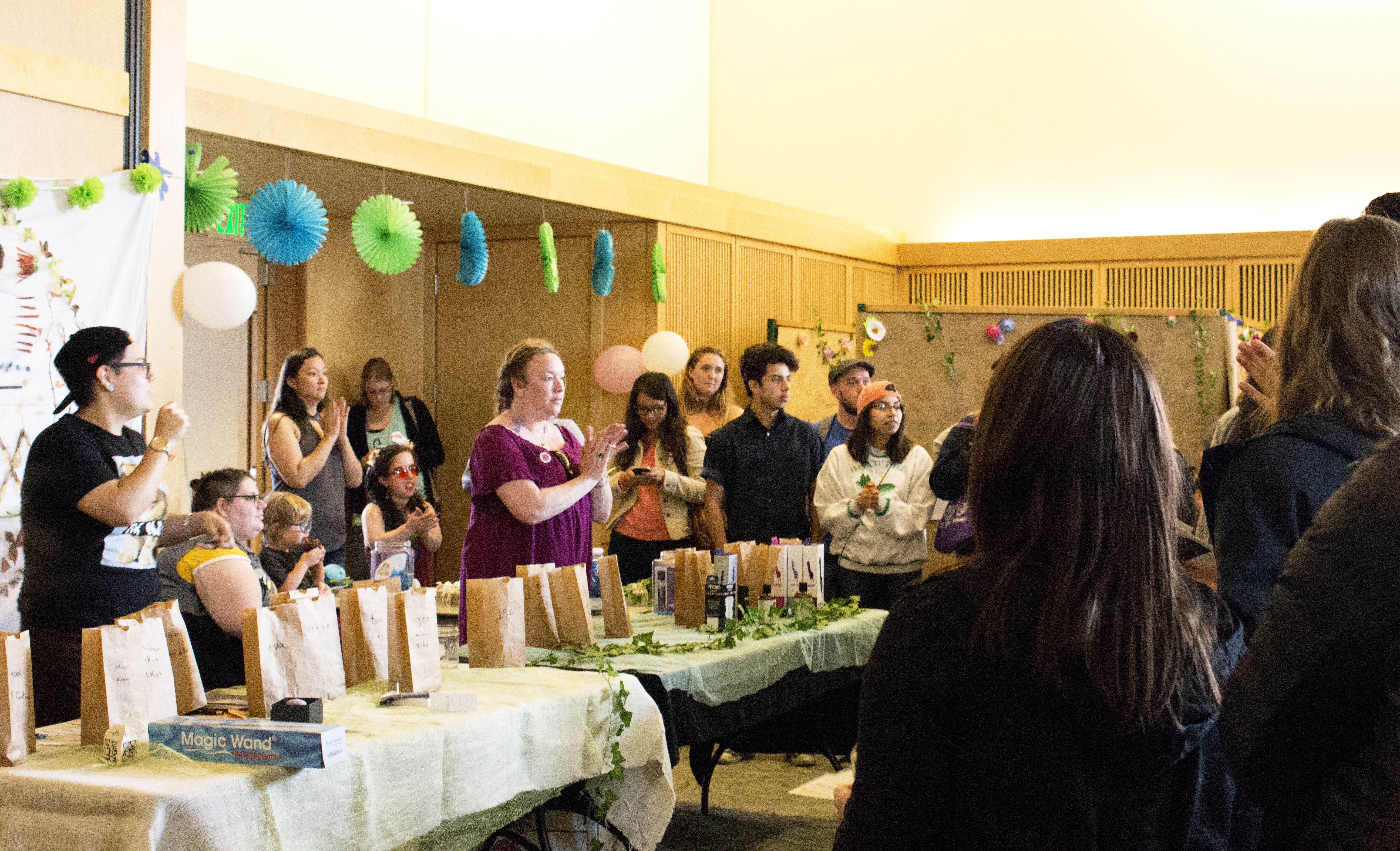
Sexland is a yearly event at HSU hosted by the Peer Health Education Program. On April 22 at the Kate Buchanan Room, the HSU community gathered at the sexual health event. This years theme was Garden of Hedon which centered around self definition and identity. Tables of HSU clubs and community resources filled the edges of the KBR such as HSU’s Check It, the North Coast Rape Crisis Team, Planned Parenthood representatives, and even HSU’s Botany Club.
Peer Health Educators planned a sex toy raffle giveaway, games and free food.
Peer Health Educators explaining the differences in sex toys for the raffle | Photo by Sarahi Apaez
HSU students taking pictures inside of the ball pit. | Photo by Sarahi Apaez
Jason Valez, Travis Ioncaric and Mason Trevino, workers and volunteers of Planned Parenthood. | Photo by Sarahi Apaez
Bridget Ocampo, Peer Health Educator and Melissa Salazar a volunteer explain the zines created by Peer Health Educators. | Photo by Sarahi Apaez
Raymond Yu getting his picture taken with the sex toy he won in the giveaway. | Photo by Sarahi Apaez
Condoms laid out on every table along with floral designs | Photo by Sarahi Apaez
Peer Health Educator giving information about massages and giving away free coconut oil. | Photo by Sarahi Apaez
Bridget Ocampo, Peer Health Educator showing a sex toy for the raffle. | Photo by Sarahi Apaez
Students writing consent based questions they would ask their partner(s) and safe words | Photo by Sarahi Apaez
Todd Larsen, associate director of Housing and Residence admits there is not enough housing on campus for every student who wants to live on campus.
“This year we have a record number of returners and transfers,” Larsen said. “We had 800 returners apply for the 600 spots we have.”
The housing office is trying to take some of the stress off of students looking for off campus housing. The housing office has held four events now to help students find housing.
Their final event held on April 24, gave students an opportunity to meet with real estate management groups. Kimberly Morris was at the event with Kramer Investment Corporation talking with students about renting apartments for them next semester.
“We try to make it as easy as possible for first time renter,” Morris said. “We try to get the parents involved to help students through the process.”
Sol Dinay, a freshman physics major, attended the event held by housing. He has already seen about a dozen houses and is hoping to secure his housing for next semester soon.
“It’s just a matter of getting an app that gets approved,” Dinay said. “I’m not that worried cause I know we’ll eventually get a place.”
Dinay tried to get an early start looking for houses and has some advice for people just barely starting out.
“Try getting started on Craigslist because the application process is just an email,” Dinay said. “Apply to as many places as you can cause most will get denied.”
Levi Mazza a freshman business major already lives off campus. Mazza found a house last May when he came up with his friend and current roommate. For him the hardest part of finding housing was getting his calls returned.
“Everyone is extremely flaky up here,” Mazza said. “If you find a property, annoy the property manager by phone and in person.”
He believes that by constantly contacting the manager you have a better chance to get a face to face meeting. It is in this first meeting that impressions are made that can determine whether or not you get the house.
“When you do meet them in person be well dressed, make eye contact,” Mazza said, “and shake there hand multiple times.”
To me, there’s nothing compared to a greeting full of warmth. Whether it be the humid sun of the Mediterranean or the staff of Kebab Cafe, genuine warmth is the type of feeling that makes someone feel right at home. Kebab Cafe’s warmth is akin to nostalgia, and you can feel right at home at 5000 Valley West Blvd in Arcata.
The cooking station in Kebab Cafe | Photo by Bryan Donoghue
Their lighting in the front of the restaurant is fluorescent leading into a dim casual setting in the back of cafe, and the staff welcomes me with a similar brightness as I tell them it’s my first time at the Kebab Cafe. Every team member is open and amiable as they show me the menu, their cabinet display full of fresh food, and even the open grill where the kebabs are made. In their presentation about what’s on the menu, the highlight I chose was the gyro sandwich, and before starting me off with that, I ordered a few dolmas.
I need to attest to the flavor of the dolmas Kebab Cafe makes in house. Dolmas are a unique appetizer among any cuisine. They are seasoned rice and herbs that are tossed together before being formed, and ultimately, wrapped with a grape leaf. It reminds me of a vegan burrito, but with a harmony of Mediterranean tastes, and much smaller in scale. Dolmas tend to be finger food, but Kebab Cafe’s freshly wrapped dolmas feel relatively too small in comparison to dolmas I’ve had previously.
Four dolmas neatly arranged in a plate | Bryan Donoghue
That being said, size isn’t a testament to how they taste. The ratio of flavors is the key impact this dish had. At first bite, my taste buds note a splash of lemon as I bite into the leaf, until the herbs combine with the citrus flavor. The chewy texture of the rice along with the prominent flavors of herb and citrus make these little wrapped bundles delicious. Kebab Cafe’s dolmas are 90 cents each, and I recommend getting more than one.
After I devour the dolmas, I move into the gyro sandwich. Kebab Cafe’s gyro meat is a blend of ground beef and ground lamb that’s first seasoned seasoned until being grilled on a vertical boiler. The meat is thinly sliced and served inside a warm pita with a combination of raw onions, tomatoes, cucumbers, and lettuce. You choose your sauce, with the choices being either tzatziki or red sauce. I chose tzatziki, a sauce made from yogurt and cucumbers that have a tangy kick. In accompaniment to the dolmas, this was the absolute best follow up I could have chosen as my main plate. As I chew, I notice it’s soft, chewy, and plays a trick on my perception of temperature because of how it’s layered. The pita is warm, as well as the meat in the middle. The contrast is in the vegetables, as they’re cold and smothered with tzatziki sauce. This contrast makes each bite different from the last, as the temperature of the sandwich is trying to find an equilibrium. This is one of the few meals I’ve had in recent times where not only did I finish my plate at the restaurant, but I couldn’t think of a single piece of criticism. It’s a remarkable dish at $8.35.
From Santorini to Turkey, Kebab Cafe captures the essence of the Mediterranean, but condenses it into a small cafe where customers can feel at home. Open Monday through Friday from 11 a.m. to 8 p.m., or Saturday from noon to 7 p.m., Kebab Cafe is cooking up food six days a week.
Grow marijuana from the comfort of your home with the Green Box
By Andre Hascall
There is a way to grow marijuana easily while keeping costs relatively low. Greenbox Grow is a company that sells the necessary tools for marijuana cultivation for the average consumer. Dylan Osborn, a graduate in business administration at the University of Southern California, is the founder of GreenBox Grow. He currently lives and grows in Monterey, CA. “Our mission is to teach people how to easily grow medical cannabis at home,” Osborn said. “It’s easy enough for beginners and takes less than ten minutes per day.”
Dylan Osborn with the Green Box Grow | Green Box Grow
Initially, Osborn grew marijuana for his own personal use. Osborn as well as his father have both suffered from sports related injuries, and Osborn turned to medical marijuana to ease the pain.
“I found an opportunity to help people who use marijuana for its medical benefits.” Osborn said, “Once I got into it, I saw all these things about it [growing] being difficult, but my first grow was close to dispensary quality.”
You can find tutorials on their website, www.greenboxgrown.com, to help with the growing process along with the products you’ll need to get started. Osborn also works with clients at their homes helping set up their grow, as well as walking them through the different steps of growing quality cannabis. Once the greenhouse is set up, more steps follow such as getting the proper air circulation, how to properly pH your water, the correct amount of water to use, wiring your greenhouse, as well as how to grow while gone on vacation or during winter.
GreenBox Grow is currently sold through Amazon. Though Osborn would like to have a store for GreenBox Grow in the future.
Dylan Osborn and his greenhouse | Green Box Grow
Using GreenBox is as simple as setting up your greenhouse, watching weekly tutorials and growing your marijuana. There are two different types of growing tents and various sizes for both. Greenhouses are for outdoor grow and for indoor you’d need a hydroponic grow tent. Of course the indoor option will cost more money for both equipment and your monthly electricity bill.
Osborn favors outdoor growing as it is more environmentally friendly, and provides the grow with fresh air and natural sunlight. “Depending on the size of a greenhouse the costs could be as low a $30 a month, but indoor would be $100 a month at least,” Osborn said. “The bigger size of grow can bring the cost to hundreds even thousands more than outdoor because of electricity.”
Marijuana plants growing in the greenhouse | Green Box Grow
An average greenhouse grow of two plants will put you at a start-up cost of $450, adding around $30 extra on the electric bill for the month. The average time from start to harvest is nine weeks to four months. By harvest you would have a pound of marijuana from the two plants.
With marijuana being legalized in California, it’s looking like it is easier now than ever to grow marijuana at home.
Humboldt County has a reputation for accepting the widespread use of cannabis. While Humboldt State gives a stern warning to students that weed is not allowed in the dorms upon orientation, it is still present. One freshman smokes almost everyday and believes that one of the hardest parts of getting high discreetly is that weed can be very potent.
“Depending on your CA it can be pretty hard sometimes, the smell can give you away,” they said. “It depends on what you’re smoking. If its wax, it doesn’t necessarily smell as bad as if you are smoking actual bud.”
For this particular student, the fear of being caught has subsided since the beginning of the year.
“At first there was a nervousness, but then you realize that everyone smokes and everyone is used it so you’re not worried about being caught,” they said.
Being caught comes with severe punishment. The Humboldt State housing handbook outlines the potential outcomes of being caught while in possession or under the influence of any drug or controlled substance.
According to the housing handbook, “Outcomes may include educational administrative sanctions, a student’s removal from Housing, and referral to Student Affairs, and possible legal charges (including arrest and fines).”
These harsh penalties cause some people living in campus housing to not risk smoking in their rooms. One resident in campus apartments admits to smoking, but never in their room.
“I have never been caught,” they said. “I honestly never smoke in the dorms, always outside.”
These types of measures are necessary to not get caught with a very strict and observant CA.
They believe that the school does not care about students smoking.
“No [they don’t care] but, they are still a school, and have to function as such,” they said. “Smoking weed openly in dorms would discredit the school I believe.”
In Creekview, there is only one CA per building. One resident has only ever met their CA three times. To stop from being caught smoking in their dorm, the Creekview resident has their smoke detector covered and window open.
“It is very very easy to smoke in Creekview,” they said, “It is also very easy to hide, we don’t really have to do it, but we do it as a precaution.”
Marijuana is a known occurrence in Humboldt County and while the school preaches that it does not allow marijuana on campus, it is readily available and people smoke it openly in the dorms.
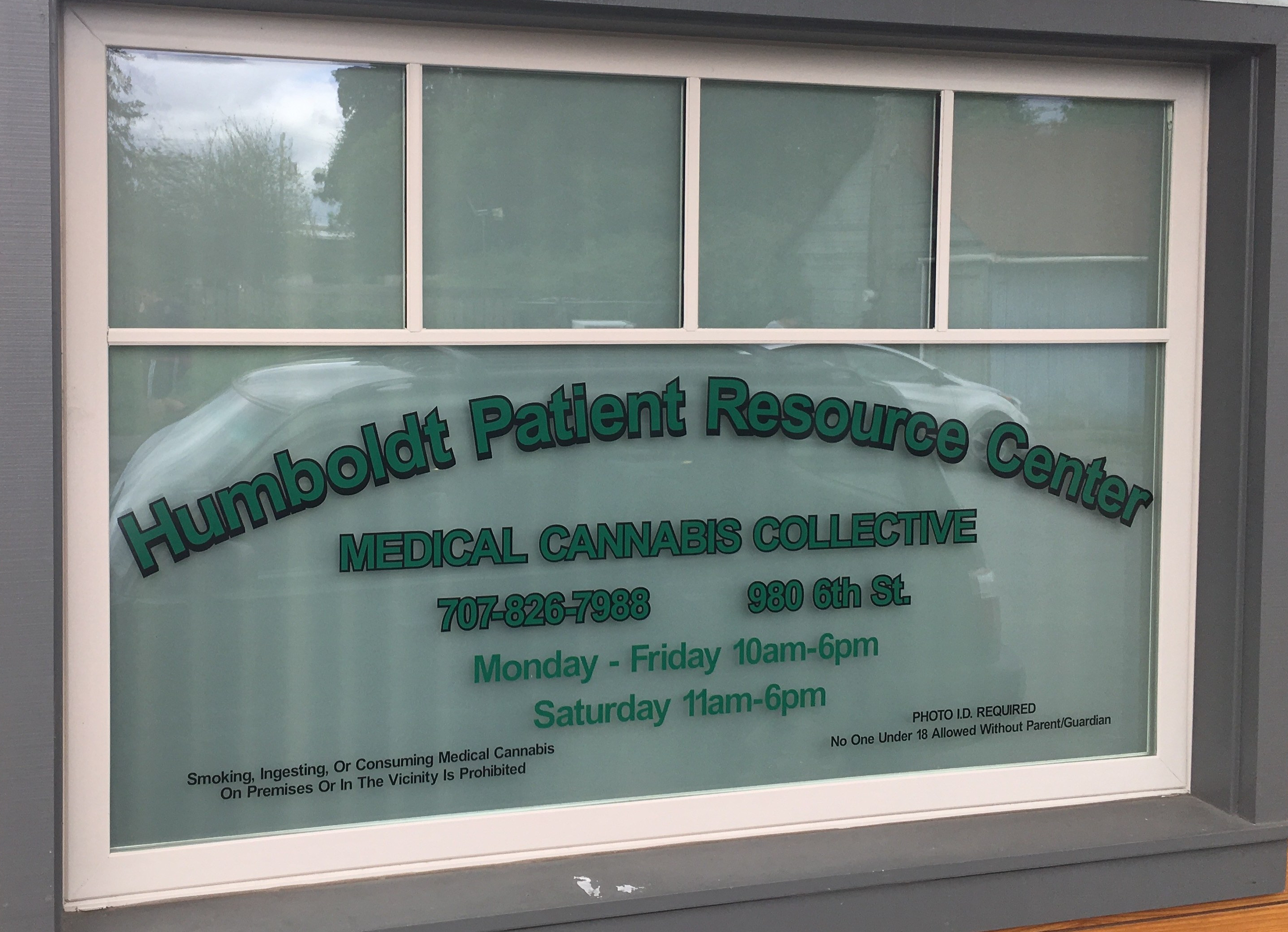
Right when you enter, the strong aroma of medicinal marijuana hits your nostrils so hard you can almost taste it. Over twelve different strains clog your nose of smelly cannabis and yummy edibles. Humboldt Patient Resource Center, also know as HPRC, has been serving Humboldt county for over 15 years.
Michelle Sealy, a bud-tender at HPRC, discusses the patients most preferred cannabis offered.
“Gorilla Glue #4, Girl Scout Cookie, and Titan OG are the winners of the people,” Sealy said.
Girl Scout Cookie at HPRC. | Juan Herrera
Sealy also talks about concentrates and edibles that all their patients love.
“When it comes to concentrates our customers love the live resin by Mr. Nice Guys, or any of the Sour Extract $30 grams,” Sealy said. “As far as edibles, the KIVA bars are a huge hit as well as the smaller size called KIVA bites.”
Sealy explained how each KIVA bar has 100 milligrams of THC, the mind-altering substance in marijuana, compared to 5 milligrams for the bites. According to Ricardo Baca, an author for the marijuana publication The Cannabist, the average dose for a person is 10 milligrams.
Another budtender from HPRC, Mark Moore, talked about the exciting plans their clinic has for the special day of April 20.
“To start off this exciting holiday we will be giving out 420 goodie bags full of different cannabis strains and edibles from the different vendors we use,” Moore said. “There will also be many special deals the clinic is offering as well as live music playing.”
HPRC lighter and matches. | Juan Herrera
Moore goes on to mention how HPRC will also be hosting a delicious barbecue for their patients and also to the community at their location on the corner of 6th and J street in Arcata.
Caeden Williams, a new worker at HPRC, discussed the changes they have seen in patients since the medicinal marijuana laws have passed.
“There has been a lot of anxiety in the air with the new change of what the outcome or end will be,” Williams said. “A lot of patients are scared that the prices are going to skyrocket, while others are anxious to see how far this industry will go.”
Williams explains how as a new employee he is excited to adapt with the new change, but also nervous to see how it will play out.
Moore had one last thing to say the patients of HPRC.
“We are here to fulfill the needs of everyone, from new patients to old ones, we have what you need,” Moore said.
After the passing of Proposition 64 last November, there has been a lot of talk about what it will mean for the legalization of marijuana. We asked some students on campus their thoughts on what it might mean.
Jelo Ramirez – Visiting Student from Norco Community College
“I think the more it becomes legal the more we have to respect other people’s boundaries.”
Clay Smeback – Junior Communications Major
“I personally am not that affected by it because I don’t smoke, but I think it might help in local environment, since illegal grows have no regulations.”
Anna Kowalczyk – Senior Wildlife Major
“I don’t think it means a lot as long as people are people respectful about it.”
Ariel Nelson – Junior Environmental Science Major
“For me it’s an opportunity for more regulation of the weed industry, so the cultivation practices will be better for the land. Also it makes it more accessible.”
Humboldt County’s Cannifest brought local cannabis culture to Redwood Acres Fairground on April 15 & 16
Reporting by Ali Osgood
Photos by Marcos Villarreal and Devyn Session
Visitors check out local vendors in Area 215 at Cannifest. Area 215 required a medical card for admission and featured local cannabis growers products available for sampling, purchasing, and inspection. | Photo by Marcos VillarrealA visitor inspects a bud. Visitors with medical marijuana cards were able to enter Area 215 where a wide variety of harvested cannabis was on display. Cannifest also hosted medical consultants so that visitors without cards could apply for one and be admitted to Area 215 to check out the local goods. | Photo by Devyn SessionsStephen Gieder, Cannifest organizer and “ideas man” spent the two day festival hosting the Humboldt Grow Games. “This is my favorite part. I love being apart of it!” Gieder said. | Photo by Marcos VillarrealA team carries bags of soil through the obstacle course during the Humboldt Grow Games. The six teams competed in a variety of activities from repotting plants to setting up an irrigation system. | Photo by Marcos VillarrealTeam The Sungrowers pull a 150 gallon pot of soil 65 feet during the Humboldt Grow Games. Six different teams competed for the fastest overall time. The Sungrowers walked away with first place on Sunday, April 16. | Photo by Marcos VillarrealA variety of strains of marijuana are lined up for visitors to inspect. Cannifest attendees holding medical marijuana cards were able to vote on their favorite strains featured throughout the weekend. | Photo by Marcos VillarrealCannifest hosted over 23 musical acts with four different stages and a silent disco. Headliners included Prezident Brown, The Polish Ambassador, Sassafras Belly Dancers and local bands including the Dubbadubs and Kingfoot. | Photo by Marcos VillarrealThe Sungrowers receive their trophy on Sunday afternoon after winning the Humboldt Grow Games. Cannifest held the Cannifest Bowl, a competition for the best buds at the event, as well as awards for best live art and best glass. | Photo by Marcos Villarreal
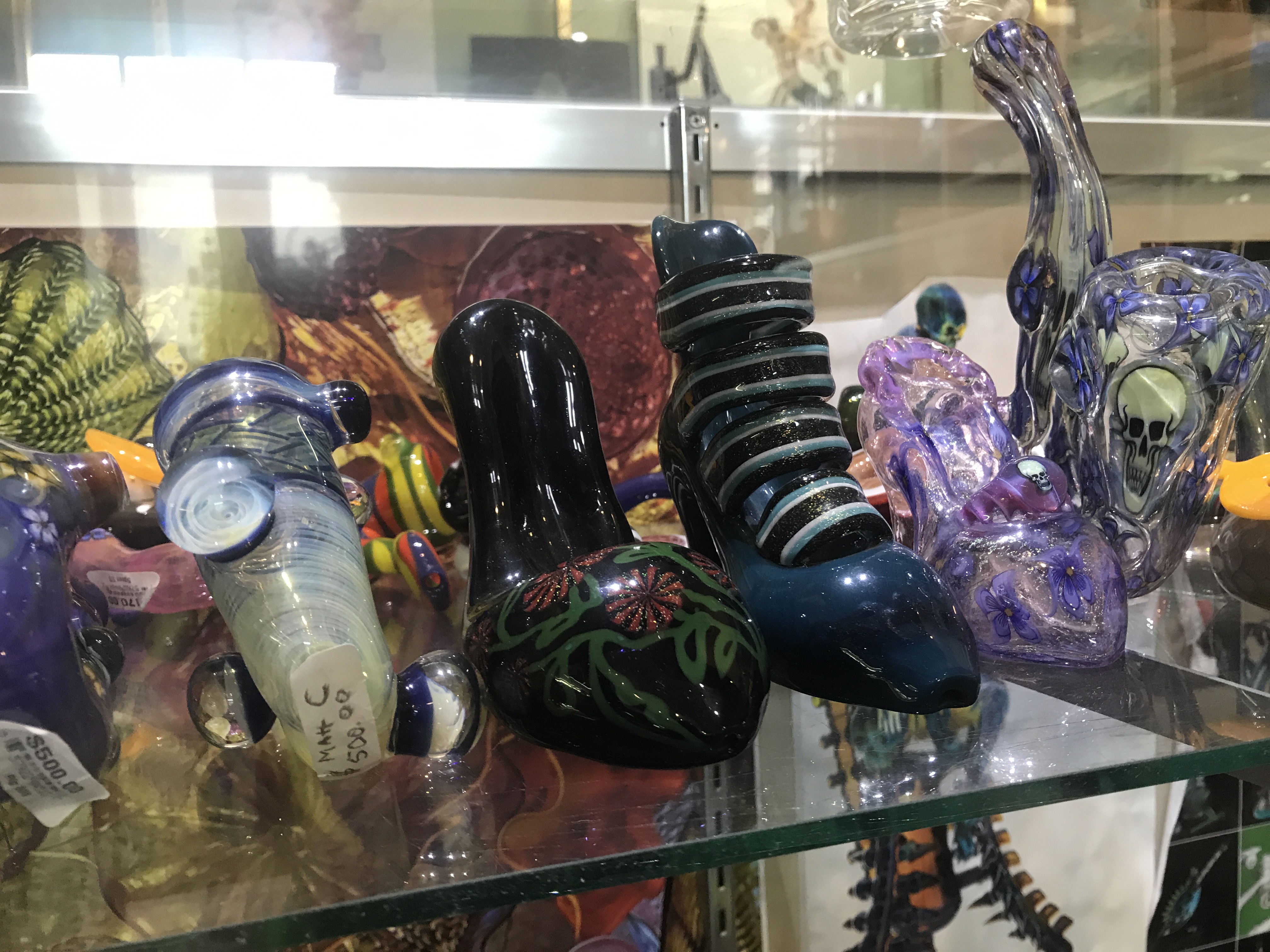
On display and for sale at Humboldt Glassblowers, is a $75,000 bong. You can find psychedelic and intricate glassworks of nearly a hundred local artists at the bong and pipe store located in downtown Arcata.
Two of the most expensive bongs. On the right is Banjo Glass $75,000 bong. | Photo by Andre Hascall
Arthur Ecker works at Humboldt Glassblowers. He said the asking price for the bong, made by local glassblower Banjo Glass, is appropriate due to the intricacy and precision of the bong.
“The amount of time and energy that was put into that piece shows just how hungry that artist was,” Ecker said.
Ecker said the amount of hours these Humboldt County artists put into their artistry is unfathomable. An artist can spend anywhere from 300-400 hours creating just a single piece, which equates to four to six months of hard work and craftsmanship.
“These people have families, and children they need to put food on the table for,” Ecker said. “These artists are incredibly hardworking people.”
This new breed of contemporary artistry sprouted new beginnings for Banjo Glass. Ecker said Bango Glass is a devoted father who was driven in his earlier years to make his best quality work in efforts of supporting his children.
Utilizing his past experience in art school, the aspiring artist was committed to creating iridescent, three-dimensional, and functional glass pieces.
Humboldt Glassblowers was in awe when they obtained one of his most extravagant pieces which is on sale for $75,000.
Customers are also impressed by the quality of the work when they walk into Humboldt Glassblowers.
Isaiah Harris was visiting a friend in Arcata for the week and made a point to visit Humboldt Glassblowers on his trip.
Animal Rigs | Photo by Andre Hascall
“I was impressed by the intricate artwork,” Harris said.“The quality of the glass is what sets them apart from other glass shops in different areas.”
Located at 815 Ninth St. the Arcata Plaza, Humboldt Glassblowers has the works of numerous local artists for sale and on display. Artists from all over Humboldt County bring their artwork to Humboldt Glassblowers. The shop holds pieces from 80 to 100 different artists, many of them local.
For efficiency, the shop is divided in half. On the left side of the store, customers will find small, multicolored glass pipes where prices ranges based on the complexity of the glass patterns.
Then there is the right side of the store, where Humboldt Glassblowers puts its finest glass pieces on display. Prices can run through the thousands depending on the intricacy and size of the bong.
Glass bongs and pipes have become not just a functional aspect of weed culture, but also an artistic element.
Papa Smurf Pipe | Photo by Andre Hascall
What use to be an online-only market for glassblowers has now become a state-of-the-art level of craftsmanship. Nowadays, the public is able to walk into a store and visually experience the glasswork.
As customers walk in and experience these inspiring pieces of art, they gain appreciation for the artistry.
“People are now respecting the art by being exposed to it,” said Dan Belo, who works with Ecker at the shop.
Belo and Ecker agreed that with legalization, glassblowers should gain more recognition for their craft with time because there is no longer a reason to be secretive about their artistry.
“With legalization you will start to see artists become more public about their work,” said Ecker.
Proposition 64 legalized the recreational use of Marijuana by people 21 years of age or older. The passing of Prop 64 also created new taxes to help generate state tax increases. These taxes are meant to make Marijuana profitable for the state.
Humboldt County is home to illegal marijuana grow operations. With the legalization of Marijuana it is expected that some illegal growers will begin to make the transition to legal operations.
Joshua Zender, assistant professor in the School of Business at Humboldt State, is an active certified public accountant in California. Professor Zender warns illegal growers who attempt to go legal with their operation of the problems they will face when filing taxes.
“Regardless of whether your business is licensed, you still need to disclose all sources of income to the IRS,” Zender said. “Including illegal sources of revenue from CSA – Class I banned substances like marijuana.”
Failure to comply with tax regulations can put grow operations in serious danger of incurring tax penalties.
“I highly doubt that the State of California will attempt to recapture previously under-reported monies,” Zender said. “They want to encourage the industry to come clean, by offering incentives to accurately report in current and future periods.”
While the state may not be looking to recoup some of the past money, that does not stop the IRS from looking for what it believes it is owed. A grower that previously under reported could be subject to an audit in which case the IRS could assess the additional tax, plus penalties and interest.
Growers hoping to start going legal will be faced with declaring their income accurately, something they may not have been doing while operating outside the law. To avoid these types of issues it is important that marijuana dispensaries and growers need to become familiar with Internal Revenue Code Section 280E which states, “No deduction or credit shall be allowed for any amount paid or incurred during the taxable year in carrying on any trade or business if such trade or business consists of trafficking in controlled substances which is prohibited by federal law or the law of any state in which such trade or business is conducted.”
The rules and regulations can be very complex and confusing once you begin to delve into them. Finding a qualified tax attorney or Certified Public Accountant would be highly beneficial in trying to navigate the uncertain tax ground that exists surrounding marijuana businesses.
“Individuals who make a good faith effort to comply are unlikely to be severely penalized,” Professor Zender said. “However, people who elect to disregard these requirements are likely to pay a price.”
Travis Poe is racing against countless others in Humboldt County to build a cannabis business under the recently passed Proposition 64, a bill that legalized marijuana in California. And much like his competitors, there is a lot of uncertainty as the policies change the landscape for cannabis farming throughout the state.
“Right now it’s super exciting,” Poe said. “I’m glad we’re doing it and I’m glad it happened but it’s also fucking terrifying.”
Poe spends his day building his business. As CEO of his startup company, most of his day involves market research, website development, company branding, and problem solving. If you looked at his to-do list, you might think he is your average young businessman, but he is not in the average business. He operates a legal cannabis nursery.
Poe has been involved in the cannabis industry for several years and actually voted against Prop. 64. But since it’s passing he has fully embraced the changes and teamed up with four others to create a cloning and genetics company where they provide plant starts for full-term cannabis growers.
Currently, the five are operating business under an affidavit which allows them to continue cultivation as they wait for their permit to be approved. The county is still working out the details on local legislature regarding the cannabis industry, which has caused a hold-up on Poe’s permit.
“The process has been interesting, slow, and somewhat unclear,” Poe said. “What’s happening right now is that the county is feeling that too, realizing it’s not the right formulation and going back to the drawing board.”
For Poe and many other longtime growers, the passing of Prop. 64 has been a confusing time. While they are excited to come out of the shadows the confusion and lack of clarity regarding county policies have given reason for caution.
“It’s just a lot. A lot of moving parts and a lot of changes moving really really fast,” said Chris Anderson, the cofounder and president of Redwood Roots. “I think there are going to be a lot of people that don’t make it through the process and that breaks my heart. It’s a really hard pill to swallow.”
Redwood Roots is a collective that oversees 25 different outdoor greenhouse marijuana farms in Southern Humboldt. Anderson created the collective in hopes of helping the smaller farm operations in his community have a chance at breaking through the expensive and competitive process of becoming a profitable farm under the new regulations.
Currently, all cannabis businesses are required to obtain a permit. There are 17 different licenses available, according to Cal Growers Association, ranging from large-scale outdoor cultivation to transporting licenses.
For those looking to cultivate marijuana outdoors they not only need to apply for a permit but they must go through extraneous lengths to come into compliance with Humboldt County regulations. These growers are hiring environmental, legal, and structural consultants so that they are within the specific codes the county requires for permitted cultivation. This includes soil testing, erosion surveying, environmental impact reports and, for many, regrading and rebuilding infrastructure. It gets expensive quickly which is separating the small farmers from the corporate farmers who are new to the scene.
Anderson is currently waiting for approval on three different permits: dispensary, nursery, and transportation. Although he is eager to get his permits finalized, he has been patient with the county in recognizing the complicated scenario.
“[It’s been] a huge challenge. The county has been helpful on our part, it’s just a really complicated process,” Anderson said. “We just wanted to step out and be ourselves and represent where we are from and make sure that our culture survives through the change.”
Until the county confirms their policies and clearly defines the components of the local market, growers will hang in limbo. Many are hoping to keep a boutique approach to Humboldt grown marijuana in order to isolate themselves from the corporate structure forming in county’s like Monterey and Los Angeles.
The biggest concerns expressed by Humboldt growers surrounding the new law are that the small grow operations won’t be able to compete with the larger corporate farms throughout California. Poe and his partners remain positive that the existence of big business will leave room for smaller well branded business.
“We’re investing in the brand. You have to be building value in other areas of your business to compete with the big guys,” Poe said. “There’s always an evil empire, but that leaves a place for the rebel alliance.” The county is sensitive to these concerns as they reform their policies to help small farmers break through the startup costs and into the market.
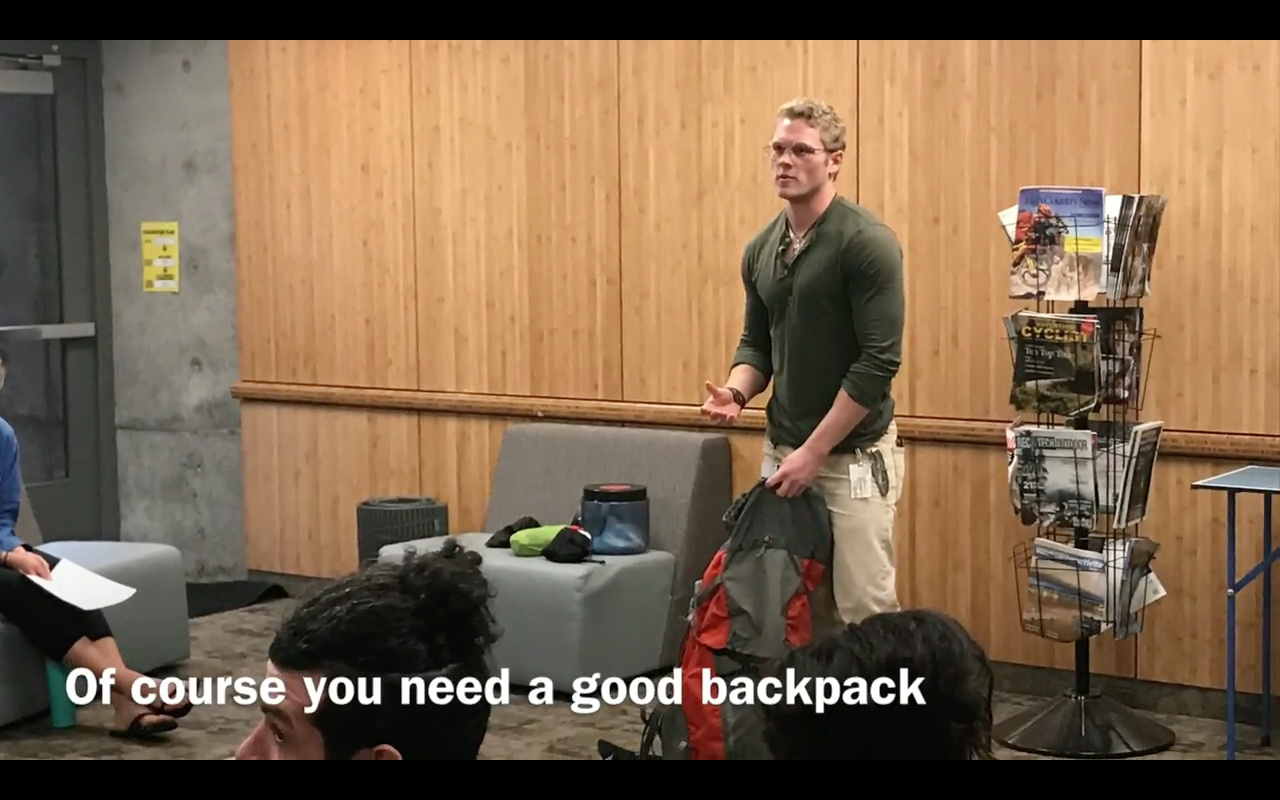
Senior Outdoor Adventure Recreation Administration major, Dillon Travis knows a thing or two about backpacking. He works with Center Activities at HSU, and on April 4th he ran a backpacking seminar in the Rec and Wellness center on Campus.
The big reason for this seminar are the upcoming backpacking trips for HSU students. These students will be backpacking the lost coast from the 7th through the 9th.
There is a plethora of areas to go backpacking at nearby, Travis pointed out locations such as Lost Coast, Redwood National park and the Shasta Trinity Forest to name a few. “I would suggest calling the rangers at each park to get up to date info,” Travis said. “ It’s always a good idea to bring a partner if you haven’t gone before, or go with a guide.”
The first two episodes of “13 Reasons Why”, “Tape 1, Sides A and B” are a strong and well done start to the story of high schooler Hannah Baker. What makes this show so great is the diverse cast of characters, well thought-out plot, and emotional and convincing acting. “Tape 1, Sides A and B” is so heart wrenching and intriguing, it will keep audiences pressing play to find out each reason why.
The Netflix show “13 Reasons Why” was released on March 31. The show is adapted from the young adult book, “13 Reasons Why” which was written by Jay Asher. The show was created by Brian Yorkey and the first two episodes were directed by Tom McCarthy. Another well-known public figure who had a hand in the making of the show is Selena Gomez as an executive producer.
The show’s engaging and thorough plot is one of the many reasons this show is so great. The show follows along each of Hannah’s reasons for committing suicide, but shows some of them out of order causing some differentiation from the book. Furthermore, while the book only goes into the tapes and each reason why Hannah ended her life, the show expands beyond that. It explains how the characters are reacting to Hannah’s suicide, such as her parents searching for the reasons Hannah ended her life and her friend’s interactions with people who are on the tapes Hannah left behind.
“13 Reasons Why” begins with Hannah’s friend, Clay Jensen, finding a package at his door full of cassette tapes and a map. Clay puts the first cassette tape into his parents’ cassette player and begins to listen. He is shocked to hear the voice of his friend Hannah Baker who ended her own life not long ago. The recording of Hannah tells Clay that the set of tapes contains the 13 people who influenced her decision to take her own life, one side for each person, and that everyone who is on these tapes must listen to all 13 tapes. Not only does each person have to listen to the tapes but they must pass it on to the person after them on the tapes. Also, if one person refuses to pass on the tapes or refuses to listen to them, then a person Hannah entrusted with a second set of the tapes will release them publicly. After hearing the instructions, Clay begins to follow the tapes and find out the answers to why his friend ended her life.
One of the reasons that “13 Reasons Why” is such a powerful show is the fact that it brings awareness to issues such as bullying, suicide, and other issues that are prevalent in the dark side of high school social culture. In the first two episodes alone, the viewer learns that one of Hannah’s classmates cyber bullied her and that one of her close friends betrayed her and isolated Hannah from her peers. This is just the beginning to the bullying that Hannah Baker experienced.
Another reason why the show is so amazing is the wide variety of characters throughout the show. Even though there are many characters within the show, it does an amazing job at introducing each character and gives the audience enough background and time to understand each character. Some of these characters include Hannah Baker’s grieving parents, played by Kate Walsh and Bryan d’Arcy James, Clay’s calm and collected friend Tony, played by Christian Navarro, and popular girl and Hannah’s former friend Jessica played by Alisha Boe.
With so many actors and actresses in the show, all of them gave outstanding performances but it is best to focus on the performances of the actors who play two main characters, Clay and Hannah.
Dylan Minnette does a phenomenal job of bringing Clay Jensen to life. He perfectly captures the lost and confused feelings that Clay has after finding out that he is one of the 13 reasons why Hannah chose to end her life. In one scene, Minnette was able to show the mixed emotions Clay was feeling while he was riding his bike listening to one of Hannah’s tapes.
The one person who by far has an outstanding performance in the show is Katherine Langford as Hannah Baker. Langford marvelously narrates the tapes explaining the tragedy contained in each one. Not only that but she perfectly captures the emotions Hannah feels after being betrayed by her close friend.
“13 Reasons Why”, “Tape 1, Sides A and B” are an amazing start to the tragic and heart wrenching story of Hannah Baker. With outstanding acting, interesting plot, and a wide variety of characters, “13 Reasons Why” will keep audiences wanting to press play to find out each reason.
President Obama was giving a speech at the White House in honor of LGBTQ Pride Month last year when suddenly a loud voice spoke out from the crowd.
Jennicet Gutiérrez | Photo by La Familia: TQLM
“President Obama, release all LGBTQ detention centers! Stop the torture of transgender women!”
That voice rose from the sea of politicians, organizers and advocates of LGBTQ rights. It was the voice of 30-year-old Jennicet Gutiérrez.
Activist and civil rights leader Gutiérrez spoke at HSU on April 3 to share her story and her organization’s mission. She is a founding member and leader of La Familia, a transgender and queer liberation movement.
One of the missions of her movement is to end LGBTQ detention centers that criminalize and imprison the transgender community, putting thousands at risk of facing deportation.
The speaker began by presenting video footage of her causing an interruption at the White House in 2015.
“It wasn’t easy to interrupt the president,” Gutiérrez said. “But we tried sending letters to him, and we tried reaching out to him. Our voice needed to be heard.”
As a Latina transgender woman and undocumented immigrant, Gutiérrez has faced undeniable prejudice and societal oppression since childhood.
Her transgender liberation began at a young age. She started showing femininity around five years old, realizing around seven years old how much “pride and happiness” she felt when her aunt let her try on women’s clothes.
When her mother found out about this, she scolded Gutiérrez. This was her first realization that there are societal restrictions to being a transgender woman.
Gutiérrez wanted to be recognized as female despite the male identity she was born with, but her family and the society around her showed no approval.
“I thought to myself ‘what’s wrong with me, why am I being told not to be myself or not to exist’,” Gutiérrez said.
Gutiérrez is passionate about denouncing injustices of the transgender community. She has devoted her life to her organization, La Familia, which aims to stand up for transgender rights and put an end to violence towards transgender women of color.
At HSU, Gutiérrez told her story in hopes of inspiring students to help denounce social injustices of the transgender community. Students listened attentively to her motivating speech and cheered often after powerful statements Gutiérrez made.
Freshman Grace Hall, an environmental science major, was amongst the crowd of HSU students at her speech.
“It’s incredibly courageous of her to interrupt the president and stand up for something she believes in,” Hall said.
While the bulk of the presentation was about her fight for transgender rights, Gutiérrez also talked about the struggles of being an illegal immigrant and the risks of being deported.
Gutiérrez was denied a visa at age 15 and could not obtain a social security number. This meant she could not advance her education past high school.
Not having the resources to further her education was her first realization that she was an undocumented immigrant.
Gutiérrez continued to use her sister’s social security number in order to get small jobs to support herself.
According to Gutiérrez, transgender immigrants are 12 times more likely to face discrimination than cisgender immigrants.
Philosophy professor Loren Cannon also attended Gutiérrez’ speech. “There are students who can relate to her status as an undocumented immigrant and as a transgender woman,” Cannon said. “There are students who don’t feel accepted, and it’s important to listen to those students.”
Gutiérrez hopes she left students with a powerful message.
“Our issues and struggles can no longer be ignored,” Gutiérrez said. “I am a human being and no human being is illegal.”
Broke college student are three words that comfortably go together. However, students still spend money they do not have on things they do not need. Sometimes these items are expensive, making students have to work hard in order to afford them.
Illustration | Joe DeVoogd
One of these expensive items that students are willing to spend large amounts of money on, are shoes. Each student has a reason for why they shell out extra cash for shoes they may be able to buy for a cheaper price.
Some students like to buy shoes for the style and brand names. They want to look good walking around in their expensive shoes. Business administration major Paul Chavarria bought a pair of Jordan shoes for $300 as a reward for all of his hard work.
Chavarria worked hard to earn the money for his shoes having worked two jobs prior to getting his busser job that allowed him to be able to afford his shoes.
“I bought my first pair of expensive shoes back in 2011 through my job as a full-time busser,” Chavarria said. “I got my second check and wanted black and red Jordan 11’s from Footlocker.”
However, for some students, shoes are a necessity for the sports they participate in. Some sports such as baseball and soccer require special expensive shoes in order to play. Kinesiology major Jimmy Bautista had to buy expensive wrestling shoes in order to wrestle in high school. In order to buy the necessary shoes, Bautista had to spend money he earned from his part-time job.
“Most expensive shoes I bought were $120 for wrestling in high school,” Bautista said. “I no longer wrestle but can still fit a size 10 shoe.”
Sometimes students spend extra money on shoes in order to get better quality shoes that will last longer. By spending extra money, students would not have to constantly buy shoes since shoes of better quality last longer. Environmental engineering major Aaron Page bought an expensive pair of leather shoes for fire fighting. Page worked as a bartender for an entire year before saving enough money to be able to purchase his shoes.
“I bought $300 leather boots for fire fighting during the summer,” Page said.
More than a year after his initial purchase of his leather shoes, Page still wears them even while not working for the fire department. The quality of the shoes and the investment of the shoes make the purchase worth the while.
Research is necessary for almost any academic thing you do. Whether it is a research paper, project, or sometimes even a forum post, they all require some sort of background information.
For junior psychology major Liz Espinoza, research is important for academic work. She uses some of the library databases on the library’s website that are specific to her major to help her get the right information for her work. Not only that but she said that Google Scholar is helpful for sifting through research as well.
“It’s [research] the only way to test a hypothesis,” Espinoza said.
Senior zoology major Nicole Gutierrez has a few tips as well for navigating the large amount of research out there. She said that while looking at normal articles on the web, it is important to look at the website source and make sure it is a credible publication. It is also important to look at the author of the source to make sure that they have background on the subject area they are talking about.
Gutierrez uses the large selection of library databases to more easily find credible research. One tip she has for students who need help figuring out if an article is peer reviewed is to click on the peer reviewed option in the search criteria of the research databases.
“Stick to research databases so you know you’re getting credible information,” Gutierrez said.
However, the library website is the not the only place to find resources for research. The library also offers in person research help with a librarian at the Library Research Help desk. Special Collections Librarian Carly Marino, is one of the librarians that helps students at the help desk. She said that the Research Help desk offers students help with developing research topics, learning how to search the library databases, and making citations.
“It’s a one stop shop for research needs,” said Marino.
One of the tips Marino gives students is to keep searches down to keywords to get the most relevant search results. She also recommends to look at subject specific research guides put together by the Humboldt State librarians. These guides help students get a starting point for beginning research in the subject they are writing about.
Special Collections Librarian Carly Marino is one of the librarians that helps students at the research help desk | Photo by Liam Olson
According to Marino, the library also has various SkillShops available for free to students. Some of these upcoming SkillShops teach students how to make citations and bibliographies which are an essential skills to learn for research papers and projects. The upcoming SkillShops can be found on the HSU library website.
With these tips and tricks as well as the large amount of resources available, you’ll easily be able to get an A on that final paper.
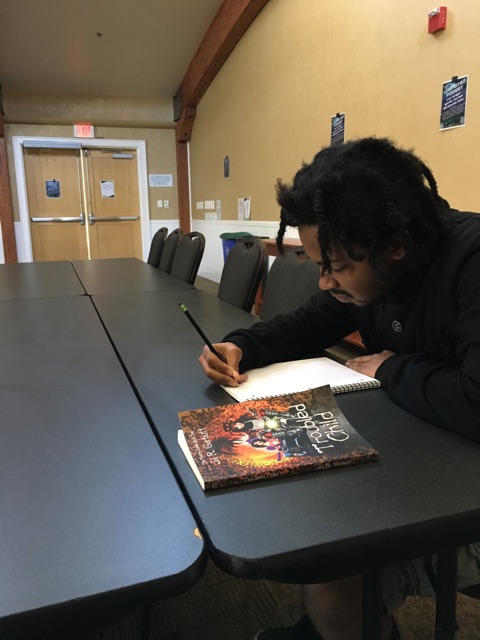
HSU student Jai R. Garbutt is a business major from Palmdale, California who uses part of his free time to explore his imagination in the form of writing. A fan of fantasy with a passion for writing, Jai is currently working on “The Floating Castle”, a fantasy series that latterly began with his first publishing. Garbutt’s novel “Troubled Child” is a story about 12-year-old Lokkiyama who travels around the country with her mother in the year 8077. Along the way they eventually settle, but due to Lokkiyama’s reputation as a troubled child, the pair always finds trouble. Garbutt’s 155 page book was published on January 23 and is available now on Amazon.
Jai Garbutt reads his work | Photo by Bryan Donoghue
Q: When did you first start writing your novel?
A: I don’t know the exact month. I know the year I started writing. It was 2013. That was because I graduated high school in 2013. Also, I had to go to college but there were some complications, so I ended up staying home for a year. So during that year my mom was like, ‘You and your brothers, I want you guys to write at least a 40 page book.’ So I started with the 40 pages. That wasn’t really enough for the idea I was going for, so I just went on from there.
Q: I was also wondering, who are your role models in terms of writing? Who do you look for who? Are your favorite authors?
A:I don’t have any that I know directly inspired me, but I like, I think his name is Christopher Paolini. He’s the author of Eragon Cycle, Eragon the dragons. I read all four of those in one sitting. I think he’s from, somewhere from Europe. I don’t know if I ever had like took anything from him, but I definitely like him and enjoy his books. His books are some of my favorite books. If I did have inspiration, it’s probably from those.
Q: Along those lines, what inspired you to start writing fantasy?
A: I don’t know actually, that one is actually a tough question. I’m not really sure. Especially because the characters for this book is based off the whole universe that’s in my head. It’s been in my head for awhile. I used to draw and just randomly draw in high school, and then I thought to put it in stories, just cause.
So basically with my mom telling oh you gotta write a book. I’m like oh I have a perfect opportunity to bring these characters to life. So that’s I guess why that started too, I guess I’m just … fantasy is just one of those things that’s just like life, and not just with books but like games and movies and stuff.
Q: Have you ever wanted to live inside the books that you write?
A: I would not necessarily live inside them, but I have thought about what the characters might say to me if they were real. And I’ve had mixed feeling about whether or not I’d want them to be real.
Q: I mean, where did you gather your inspiration? Because your main character sounds pretty fascinating.
A: It was inspired partially by a song.
Q: What song?
A: Set Apart This Dream by Flyleaf.
Q: How is it inspired by that song?
A: Well, let me say this without going overly complicated. So basically this is that there’s this entire universe behind this book. I wasn’t entirely sure, I’m not sure if you’ll ask me this later, but when I wrote this book I wasn’t entirely sure where to start with the universe. I had the idea of the character already, but I didn’t really know what I wanted her motivation to be as far as her aspirations. That was part of it.
I knew that I wanted it to be something not necessarily out of reach, but something she really has to work towards, that I didn’t know. I really like that song. That’s one of the inspirations.
Q: Do you ever have writer’s block?
A: Oh yeah, definitely. That happens a lot. Sometimes I’ll be like I’m fire for a while or something, or sometimes I’ll just give it a thought, and when that happens I’m just okay lets give it a break. If I do get writer’s block, I’m like okay it’s better to just not do anything right now, because if I try to work while I’m not really refreshed it makes the quality suffer. Yeah, definitely get a lot of writers block.
Q: And just kind of waiting it out, is that kind of how you deal with the writer’s block? Just until you got that fire again kind of.
A: Yeah, I’ll just put it down or whatever, I’ll just stop and just be like okay I’ll think of something eventually, or I’ll get inspired by something later.
Q: Well that just kind of adds as a continuation to your novel, is it a series?
A: Planning on it, I think I wrote half way through the second one right now.
Q: Why did you decide to start a series rather than an individual novel?
A: Because I don’t think one novel would be enough to say what I have to say.
Q: Yeah, do you think you’re gonna do another series after this?
A: I’m not entirely sure, depends on what happens with this, with this current one.
Q: And my last question for you actually is what can fans and future readers of your series expect from you in the future?
A: Oh well, it might be different depending on how high of a volume I get, but right now pretty much I have a Facebook page and a Twitter for the book. So if people ask me questions I’ll try to respond as fast as possible, and actually that’s one of the things with the tech input right now. I want to wait for feedback from the first one first to see what people are saying about it, because like this one I’m proud of it and stuff, it’s the first one. But I haven’t really gotten any … the last time I checked I didn’t have any reviews yet or anything on Amazon. So I don’t really want to just keep going without any feedback from people.
Q: So, maybe give or take a few more months here, fan bases are gonna grow?
A: Possibly. I think it will more once I start doing more advertising. Right now I haven’t really done much advertising, just because I’ve been busy with school and paying for stuff with school that I haven’t really had a chance to do that, but probably this summer I’ll do a lot advertising.
HSU’s JackPass offers students unlimited city bus access
By Alexandria Hasenstab
Humboldt State student Miami Liscano was having an enjoyable spring break until their car broke down. They knew they would need to find a new means of transportation. Luckily, Liscano already knew about the JackPass, a program that allows students access to the city buses with just a swipe of their student I.D. card.
“I used to use the bus a lot my freshman year,” Liscano said. “If I didn’t have the bus, I would have never left campus.”
An Arcata-Mad River Transit bus driving down H Street. | Photo by Robert Perez
Liscano is now a sophomore and, like many other students, takes the bus due to a lack of a personal vehicle. But JackPass is not only for students without cars. It’s an effort to reduce the number of students who drive to school as well as reducing HSU’s carbon footprint.
According to the 2016-2017 catalog, the JackPass offers students unlimited free rides on the Arcata & Mad River Transit System, the Redwood Transit System, and the Eureka Transit System. This means students can take the bus all the way from Scotia to Trinidad and even to Willow Creek for a day at the river.
However, the JackPass is not free. Every student pays for it whether they use the bus or not. A portion of HSU registration fees, amounting to $29.02 a semester, is used to fund the JackPass according to Humboldt State’s financial services webpage.
For students who live out of town like senior Noah Dunkley, the JackPass is a necessity.
“I totally agree it’s worth paying for the bus pass in our tuition,” Dunkley said.
Dunkley lives in Eureka. In order to get to school and back home he has to take the Redwood Transit System. A monthly pass for the RTS is $60 according to their website. This means that a student would pay twice as much for a one-month RTS pass as they do for a 5-month JackPass.
Charles Burdick is the public transit manager for the Arcata-Mad River Transit. According to Burdick, over 70 percent of bus riders for the Arcata-Mad River Transit are HSU students. He believes that the JackPass is beneficial because it lessens the number of students parking on campus and increases the use of the city bus.
“There’s a lack of parking there [at HSU],” Burdick said. “They would rather students not take their cars to campus.”
Humboldt State has been notorious for inadequate parking spaces. According to HSU’s parking and commuter services website, a parking pass for the fall and spring semesters is $315. The parking pass does not ensure students will find a spot.
JackPass is a great deal for HSU students, but students who use the local transit do experience some flaws.
“The bus will come either really late or really early,” Liscano said.
To avoid missing the bus Liscano uses an app called Transit that offers accurate, real-time predictions for public transit arrival times.
Dunkley has also experience some flaws on the RTS including sagging bus seats and fights breaking out on the bus, but he feels like these flaws are ignorable.
“Overall it’s a pleasant experience,” Dunkley said.
The man behind Burger Records, Sean Bohrman, co-founded a record label and built a scene from the ground up.
Bohrman graduated from HSU in 2004 with a minor in graphic design and a degree in journalism.
Burger Records is a record label, a record shop, and a social media entity. Currently located in Fullerton, California , the record shop was an idea created by Bohrman and his bandmate and business partner Lee Rickard.
Bohrman is from Anaheim and started the Burger Records label as a way to promote his band, Thee Makeout Party!, with his bandmate and business partner Lee Rickard.
Once graduated from HSU, Bohrman landed a job as Art Director of a Fishing and Boating Company where he worked in a small cubicle where his coworkers had worked for 30 plus years.
After four and a half years of working with this company, Bohrman decided to leave to pursue something bigger. By leaving his job six months early he lost out on about $12,000 since the company did not have to match his 401k.
“But it was worth it,” Bohrman said. “It was the best decision I ever made for sure.”
Bohrman has sacrificed his entire life for the label and the shop. For seven years he lived in the back of the Burger Records shop since it’s opening in 2009.
There are currently 1,000 bands on the label and only five people on Burger staff working the shop, the label, publishing, and running social media.
“We started a record label and a record store and had no idea how to run either,” Bohrman said. “I designed the website and I don’t know how to design websites.”
Bohrman has very meticulous to do lists. His passion lies in discovering all of the music associated with Burger Records himself.
“I’m a control freak, that’s why I do everything,” Bohrman said.
“We never stop talking or working on Burger Records,” Bohrman said. “We put 100 percent of ourselves into this company.”
Burger Records, for many people, will go down in history as a movement that happened. From 2009 to present day, Burger Records is a subculture for many youthful people to hold on to.
Sean Bohrman speaking to journalism students at the Bret Harte House. | Photo by Sarahi Apaez
What separates Burger Records from any other major record label is how they manage their social media. Every social media account is filled with content written by the character called Burger Records created by Bohrman who writes everything in all caps and three exclamation points.
Burger Records ventured into an untapped business in it’s time which is creating cassette tapes. The label creates cassette tapes for bands who are signed on to another label.
”It only takes two weeks to make a cassette tape which is convenient for when bands go on tour and need something to sell for their merch table,” Bohrman said. “It is also very inexpensive, it costs a $1.25 to make a tape and we make 250 for each band.”
When the company started, they were first losing money because for the first two years they were supporting it with their job.
“When we started I put 100 dollars in and Lee put 100 dollars in,” Bohrman said.
His taste in music has also been a big help along the way.
“I have a knack for discovering new music,” Bohrman said. “I’m going to take all of the good records here in Arcata, so don’t even try finding anything good later.”
“Even if the store has failed I would still feel better about it than had I not ever done it and had I grown up and said ‘what if I started a record label.”
Bohrman never saw himself as a trendsetter but that’s what he has done.
“It’s really hard to sit and take in everything we’ve done and everything we’ve accomplished,” Bohrman
Bohrman feels that whenever something amazing happens and it’s gone, then there’s always something on the horizon
“Maybe later on in life I’ll get to appreciate all the really cool things that have happened,” Bohrman said.
Bohrman and everyone who works at the shop tries to have the most fun while working long days and nights on Burger Records.
“Everything we do is a joke,” Bohrman said. “We’re good at saying that’s so funny, let’s do that.”
ADVICE: HOW TO START A BUSINESS by Sean Bohrman.
“It’s all about sacrifice, you’re going to have to skip meals, you’re going to have to work when other people are having fun.And if you’re out having fun there is someone else at home working to be better than you are,”
“You have to be working all of the time to stay ahead of everybody”
“It’s just total 100 percent dedicate to a cause, an idea, and following through with it, even with the stupidest ideas.”
Ryanne Bailey in the hospital with her father, Mark Rivero | Denise Bailey
Senior recreation major Ryanne Bailey was 17 years old when she woke up and could not recognize anyone, even her own parents.
“That’s when they told me I had a seizure,” Bailey said.
One minute Bailey was taking a shower, the next thing she knew she was riding in an ambulance on the way to the hospital.
“I woke up and started pulling the IVs from my arms,” Bailey said. “I didn’t know what was happening.”
Earlier in the day before the incident, Bailey had a busy schedule. She skipped breakfast, went to class and made an effort to catch up on school work. She had an extensive amount of homework to catch up on after being gone for a week and a half on a school-related field trip to Washington D.C. She didn’t get back to her hometown in Las Vegas until late Sunday evening.
Without having much to eat that day, Bailey went to a two-hour long track practice, followed by another two-hour long Powder-Puff football practice. Strained and drained from the day’s activities, she took a nap at her grandma’s house while waiting for her parents to pick her up and take her home.
At home, the demand of school work and the physical exhaustion from sports was taking a toll on her. She decided she needed a hot shower after dinner. It was around 10 p.m.
That’s when things took a turn for the worst.
“We heard something loudly banging against the wall, so I ran to the bathroom to see if she was okay,” Bailey’s mother, Denise Bailey, said.
The water was still running when she saw her daughter shaking uncontrollably in the bathtub. Her mother picked her up out of the shower and set her on the floor.
Mark Rivero, Bailey’s father, is a retired firefighter. He had seen numerous people have seizures before in the 20 years he worked at the City of Las Vegas Fire Department. Still, his heart could not handle it when he witnessed his own daughter have a seizure. “This was by far the hardest seizure to watch,” Rivero said.
Bailey’s mother called 911. She waited outside for the ambulance to arrive, shaken by the culmination of events.
“When Mark said she had stopped breathing, I stepped outside. I couldn’t watch my daughter die,” Denise Bailey said.
Emergency personnel arrived to the family’s home in a matter of minutes. Firefighters were handling her when Bailey woke up and tried to reach to turn off the water in the shower.
There are three possible outcomes that can happen to a person after they have had a seizure.
Firefighters told Bailey’s parents she would either wake up and continue what she was doing, her brain would reset itself and she won’t remember anything that happened, or she will gain abnormal strength and act violently.
Everyone was shocked to witness the 17-year-old display all three behaviors.
Bailey tried to push the firefighters off of her. When she fell asleep again, they were successful in getting her into the ambulance.
Then she woke up again during the ride. She tried to pull the IVs out of her arms. Ambulance personnel quickly stopped her and informed her she had a seizure and needed to keep them in.
“I was so confused. I didn’t know what was happening,” said Bailey.
Bailey was rushed into emergency care. Doctors ran an entire panel of drug tests on her, and conducted various tests throughout the next couple of days to figure out the cause of the seizure. All results of the tests, the CAT scan, X-Ray, MRI, and blood sugar analysis, came back negative. Even the MRI showed her brain was in perfect condition.
A nurse relayed to Bailey’s parents that they were going to have to do a spinal tap on her in order to test for meningitis.
Meningitis can have fatal results if not treated promptly, however Bailey’s parents were skeptical of the spinal tap. If done incorrectly, a spinal tap can cause permanent paralysis of the spine.
Bailey’s parents allowed the doctors to administer the spinal tap. The procedure was the most painful experience Bailey has ever endured till this day.
“It’s excruciating pain, and a slow process too,” said Bailey.
The cerebrospinal fluid was tested for meningitis and came back negative. The family was relieved, but frustrated at the same time to still have no idea what caused the seizure.
For the next two weeks, Bailey suffered adverse side effects from the spinal tap. She could not bend her knees, which made walking an agonizing pain.
Bailey continued to go to school, her teachers showed understanding.
Denise Bailey had not recovered from the emotional distress of her daughter’s seizure. For the next couple of weeks after the incident she slept in the same bed as her daughter every night. Whenever something drops on the floor, Denise is quick to rush into the room.
“I’m a very protective parent. But when you have seen your daughter nearly die, you tend to be overprotective,” Denise Bailey said.
Bailey has not had any more seizures since the one that occurred when she was 17 years old. Even at 22 years old, the possibilities of having another seizure in any moment at any time is daunting, but taking medication helps assure her that she is safe.
The tap tilts forward. Fresh alcoholic refreshment begins to flow out. Twelve ounces later, you have yourself a glass of Humboldt Regeneration’s Red Jay craft beer.
Pressey is the owner and brewmaster of Humboldt Regeneration Brewery and Farm, a sustainable farmhouse brewery.
Humboldt Regeneration Brewery off Central Avenue in McKinleyville, California. Follow the “Beer to Go” sign | Carlos Olloqui
“The concept built overtime,” Pressey said. “We are one of the first breweries in the country, and the first in California, to grow and malt our own grains since prohibition.”
The wheat and barley they grow is floor-malted on site at their brew house located at the north end of McKinleyville, California. Humboldt Regeneration Brewery and Farm also grows their own grains and hops. They produce everything from seed to sip.
“This was something that was pretty normal in the old days,” Pressey said. “But nowadays, the reason it’s not as normal is because a lot of the agriculture industries got scaled up after the Green Revolution. Everything became really mechanized.”
Pressey grew up in Napa one of the biggest wine counties in California.
“I worked in the wine industry during high school,” Pressey said. “During the summer time I’d bottle. My friends family owned the winery so, after I graduated, they ask me to stay on for crush. That’s when you actually make the wine.”
He then moved to Humboldt County to attend College of the Redwoods before he transferred to Humboldt State University.
“I was always interested in plants and sustainable agriculture,” Pressey said. “When I got to college I knew I needed a job to pay rent, so I basically just started applying at all the breweries here.”
Humboldt Regeneration’s Red Jay craft beer | Carlos Olloqui
In 2001, Pressey was hired on at Eel River Brewery as an assistant brewer.
“I pretty much just got lucky with the timing, they needed someone,” Pressey said. “I started off just doing cellar work and night brewing, but I got trained up pretty fast.”
Pressey graduated HSU in 2010 with a degree in environmental science, focusing on soils and alternative agriculture.
He worked at Eel River Brewery for over seven years before trying to brew his own.
“I just wondered why aren’t there truly local breweries anymore,” Pressey said. “Why aren’t people using local ingredients?”
That was when he realized that it was because of the malting process. In comparison to some of these other beverages such as wine or cider, beer requires an intermediate step.
“For wines and ciders you are just growing the raw ingredient, such as the grapes or the pear and apples,” Pressey said. “With beer, your growing barley and other grapes – but you can’t just make beer out of that.”
Pressey began to put his degree to work and Humboldt Regeneration Brewery and Farm was born.
Upon arrival at his brew house, after you take a left at the “Beer to Go” sign off Central Avenue, you’ll notice the some of the “sustainable” aspect of the operation. A barbecue grill turned into a roaster, solar panels on the side of the building, and a malting table which he built himself.
Jacob Pressey speaking to a customer about his newest brew | Carlos Olloqui
“We dry farm all our grains,” Pressey said. “This means you plant in the Spring and use the Spring rains. There’s no irrigation.”
Humboldt Regeneration Brewery has been up and running since 2012. The operation is currently a two man team that consists of Pressey and his partner Matt Kruskamp.
“I was a customer here, I used to come around here regularly when he first opened,” Kruskamp said. “I asked him if he needed an intern, I told him he wouldn’t have to pay anything since it was through HSU.”
Kruskamp was hired on full time after he graduated in 2014.
“It’s great to be such a big part of this and to be able to say I contributed so much of the ideas and effort towards it,” Kruskamp said.
You can find over 100 different house recipes being filtered through the brewery Wednesday through Sunday from 11 a.m. to 7 p.m.. A new flavor comes out every week.
Pressey transforms his labor into alcoholic beverages and serves it to a growing clientele. Sean von Devlin is one of the many fans of Humboldt Regeneration Brewery. He is amazed by Pressey’s passion for the product.
“The beer is great, I used to live just across the street. It truly epitomizes the local handmade blue collar mindset,” von Devlin said. “I have spoken with Jacob only a few times and he always is excited to share his story. It amazes me to see how everything operates.”
Humboldt Regeneration’s weekly beers on tap | Carlos Olloqui
Humboldt Regeneration is not only Humboldt’s first locally grown beer, they also offer a community supported brewery program. This program gives community members the opportunity to purchase shares that will allow them to a free weekly growler fill-up.
“I have a new beer come out every week, you can miss weeks and not lose your credit,” Pressey said. “We fill our growlers on a bottling machine. They are fully carbonated, just like a store-bought beer.”
The principle is simple, sustainability.
“Right now we are just on tap at a handful of spots in Northern Humboldt,” Pressey said. “But no distribution and no bottling, the whole concept is to reduce waste.”
With a brewery, your main waste products are water and spent grains.
“After you’ve extracted all your sugars and proteins from the grain you got all the wet solid grains left over,” Pressey said. “Most breweries will give that to a rancher as feed in exchange for them taking it off site.”
Unlike other breweries, Pressey grows a mixture of bacteria and mixes his spent grain in with it. This ferments into a soil amendment.
“There’s a similar process called Bokashi, I call it Beerkashi,” Pressey said. “We spray that [soil amendment] pretty heavy twice a year in the fields, this basically makes the soil extra healthy.”
From seed in the field, to the malt floor, to the brewing process, and then back out to the fields, an entire lifecycle of a foamy pint of beer is what you can expect at Humboldt Regeneration Brewery and Farm.
“In the future I hope to establish a larger brewery and have the farm all in the same location,” Pressey said. “We could give tours and have a full beer garden.”
This website uses cookies to improve your experience. We'll assume you're ok with this, but you can opt-out if you wish. Cookie settingsACCEPT
Privacy & Cookies Policy
Privacy Overview
This website uses cookies to improve your experience while you navigate through the website. Out of these cookies, the cookies that are categorized as necessary are stored on your browser as they are essential for the working of basic functionalities of the website. We also use third-party cookies that help us analyze and understand how you use this website. These cookies will be stored in your browser only with your consent. You also have the option to opt-out of these cookies. But opting out of some of these cookies may have an effect on your browsing experience.
Necessary cookies are absolutely essential for the website to function properly. This category only includes cookies that ensures basic functionalities and security features of the website. These cookies do not store any personal information.
Any cookies that may not be particularly necessary for the website to function and is used specifically to collect user personal data via analytics, ads, other embedded contents are termed as non-necessary cookies. It is mandatory to procure user consent prior to running these cookies on your website.

















 Currently, the five are operating business under an affidavit which allows them to continue cultivation as they wait for their permit to be approved. The county is still working out the details on local legislature regarding the cannabis industry, which has caused a hold-up on Poe’s permit.