The Lumberjack


Students Serving The Cal Poly Humboldt Campus and Community Since 1929

Category: Life & Arts

  • Magic arises unto Arcata’s nightlife

    Magic arises unto Arcata’s nightlife

    By Tatiana Moore

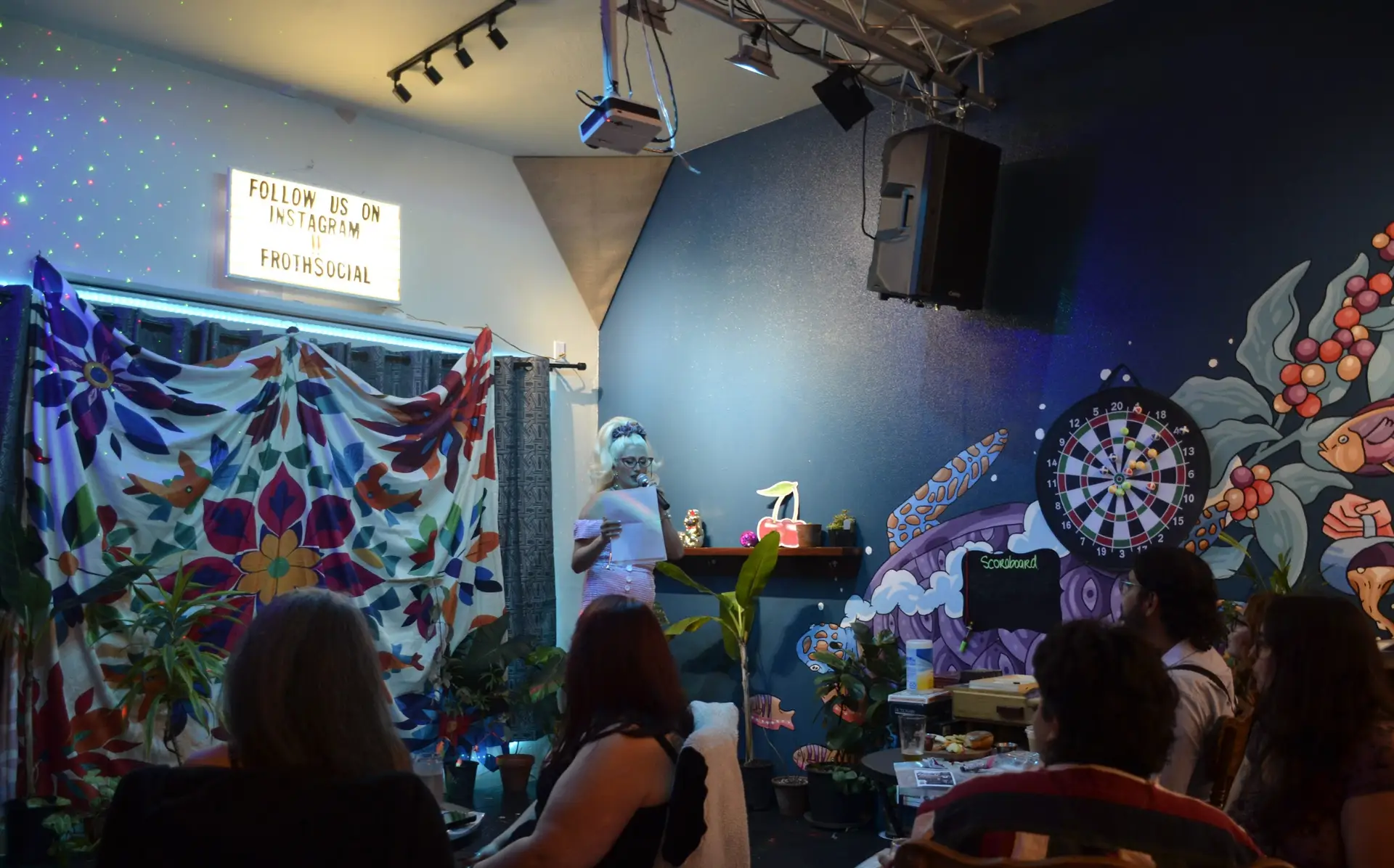
    The further north you go along the coast, the quieter California gets. The pace of life is slow beneath the redwoods, and yet Humboldt has a habit of producing people who refuse to sit still. Enter Arcane Artists, home to a whole spectrum of performers. Pole, go-go and fire dancing, aerial silks, DJing and live painting are just some of the acts that bring Humboldt nightlife to life. 

    Founded in 2021, in the aftermath of pandemic lockdowns, Arcane Artists Director Joey Constini set out to create a home for creatives across Humboldt County.

    “What I saw in the community, more than anything, was depression and isolation,” Costini said. “I was watching so many young creatives having to leave this area.”

    Unlike larger cities in California such as Los Angeles or San Francisco, Arcata is not an entertainment hub. There are no streets lined with clubs, no huge concert venues and no major touring circuits. 

    Lana Gallinat, stage name Lacy Mar, graduated from Cal Poly Humboldt (CPH) with a degree in psychology and a minor in dance last May. Gallinat discovered Arcane through people she met on campus.

    “They were like, ‘We’re dancing with this group and you’d be perfect. Let’s go audition.’” Gallinat said.

    Gallinat is a dance lead with Arcane Artists as a go-go dancer, but Humboldt wasn’t the first place she tried to build a life as a dancer. Before coming north, Gallinat lived in Los Angeles. where she studied dance and pursued performing professionally.

    Gallinat said her time in Los Angeles eventually changed her relationship with dance.

    “It became something that was really stressful and it was no longer a passion or outlet for me,” Gallinat said. “In Humboldt and with Arcane, I’m just surrounded by a bunch of people who just love what they do, who want to pursue their passions, who are also working and doing other things to get their bag. But then, like, this is what they choose to fill their free time with.” 

    Performers in Humboldt can be students, environmentalists, welders, therapists or teachers. In a place where entertainment opportunities are hard to come by, CPH students Luke Schulke and Wysdem Singleton are making a scene. 

    Schulke, also known as Dewdrop, is a graduate student pursuing a master’s degree in environmental and community programming, and an aerialist specializing in aerial silks. For her, performing is less about entertainment and more about pushing back against the limitations placed on her body.

    “Performing to me means kind of everything,” Schulke said. “I have a few different disabilities and that can prevent me from using my body in the way that I want to, but when I can perform in this way, in this death-defying act, I kind of just defy what somebody might perceive my abilities to be, or what I might perceive my own abilities to be. And it just brings me out of that and puts me into a different mindset —a different world.”

    Singleton, an accounting major at CPH, has had a lifelong entanglement with dance. With Arcane Artists giving her a space to experiment without having to fit neatly into one category she’s been able to branch out.

    “I did praise dancing, I did ballet, I’ve done hip-hop, and then I took a couple dancing classes at Cal Poly, but I’ve always loved the art of dance,” Singleton said. “And so here I just do a lot of improv, a lot of go-go dancing, and I just get to love on dance.” 

    In a larger entertainment market, that kind of variety can mean constantly trying to prove where you belong. In Humboldt, that seems to be a part of the appeal. There is ample room to try something new, get on stage and figure it out as you go. 

    Humboldt may never have the neon lights of Vegas, and that’s exactly what makes the scene so different. The performers of Arcane Artists aren’t waiting for Humboldt to become the next entertainment capital; they’re not bound by the common industry expectations; they’re building something of their own. 

    Tatiana is a reporter. Contact her at thm18@humboldt.edu

  • Fiber arts fair interweaves community  

    Fiber arts fair interweaves community  

    By Sadie Shields

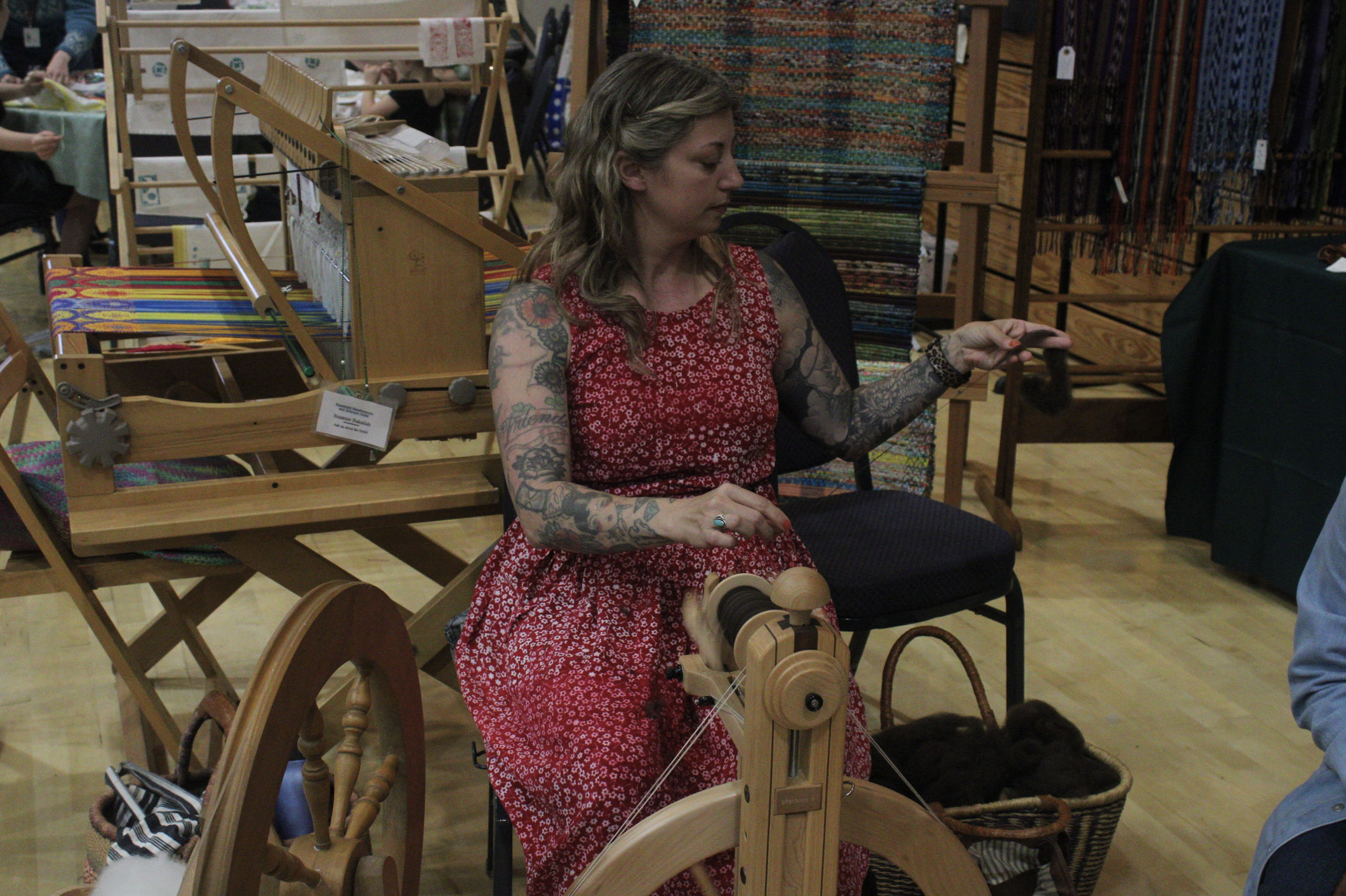
      Vibrant colors, natural fibers and the chatter of people catching up like old friends brought the Arcata Community Center to life at the 36th Natural Fiber Fair from Sept. 12-13.

    After walking through the packed parking lot toward the venue, visitors were greeted at the door by three of Blackberry Fields Alpaca Farms alpacas. The space was filled with booths featuring crafts of all kinds and fiber artists putting their hands to the spindle. If you choose to venture close enough to watch the process, you can smell lavender from custom pouches and alpaca wool.

    For some of the crafty crafters, beginning a new fiber art piece comes with mixed emotions of excitement and frustration, ending in sweet satisfaction of seeing their finished project come together. 

    “Starting a project is usually equal parts exciting and intimidating,” Clair Voigtlander, the Redwood Empire Quilters Guild Opportunity Quilt Chairperson said. “Then towards the end I’m like, well , that did not turn out the way I wanted, but next time it will be better and I learned a lot along the way.” 

    Walking through the corridors to such a creative space, learning about new crafts and speaking to vendors and artists gives a sense of creativity and yearn to learn yourself.While fiber arts does take some time to master, the basics can be learned quickly. Knitting and crocheting were recommended by Voigtlander as beginner friendly options, especially for college students who may have limited space or equipment. 

    Jo Kuzelka ran the used equipment booth during the fair and does fiber art herself in her free time.  According to Kuzelka, repetitive movements can help some people with focus, like a sort of fidget, while also fabricating a handmade project they can wear with pride. The biggest challenge for beginners is often time and coordination. 

    “Knitting or crocheting [is] kind of your starter … it’s a gateway craft, ” Kuzelka said.

    Sustainability is one of the main reasons why attendees and artists choose natural fibers. Cotton, hemp, linen and wool were among some of the materials that people used for their spinning, felting, needling and knitting crafts at the fair. With so much natural fiber that can be found around you, crafting with natural fibers allows you to avoid some of the environmental concerns associated with synthetic fibers. 

    “If I can do it myself, I would like to do it myself,” Voigtlander said. 

    Molly Quinones, one of the owners of the Blackberry Fields Alpaca Farm based in Eureka said natural materials are part of the artistic experience. Aside from that, Quinones said that using natural fibers is beneficial in other ways. 

    “With the alpacas we have no carbon footprint. It’s all usable,” Quinones said. “All of the fiber is for something. It’s better for the earth, it’s better for the skin and the animals get a good life.”

    Also present at the fair was the Humboldt Handweavers and Spinners Guild, the main sponsor of the fair. The guild provides prospective fiber artists a space to begin their spooling journey into the craft. Beginners can attend meetings, learn from experienced artists and borrow equipment before purchasing their own.

    The fair presented fiber arts as accessible to anyone willing to try something new, and fostered an environment for experienced fiber artists to connect with each other through a shared love for handmade fibers. Quinones believes creativity doesn’t have to come naturally for someone to become involved in crafting.

    “Everybody’s crafty,” Quinones said. “All you have to do is like something that you see, and you can do it.”

    Sadie is a reporter with an interest in covering and taking photos for sports and science. Reach her at sls331@humboldt.edu.

  • Rumba Madre, Fuck yeah

    Rumba Madre, Fuck yeah

    By Winter Music

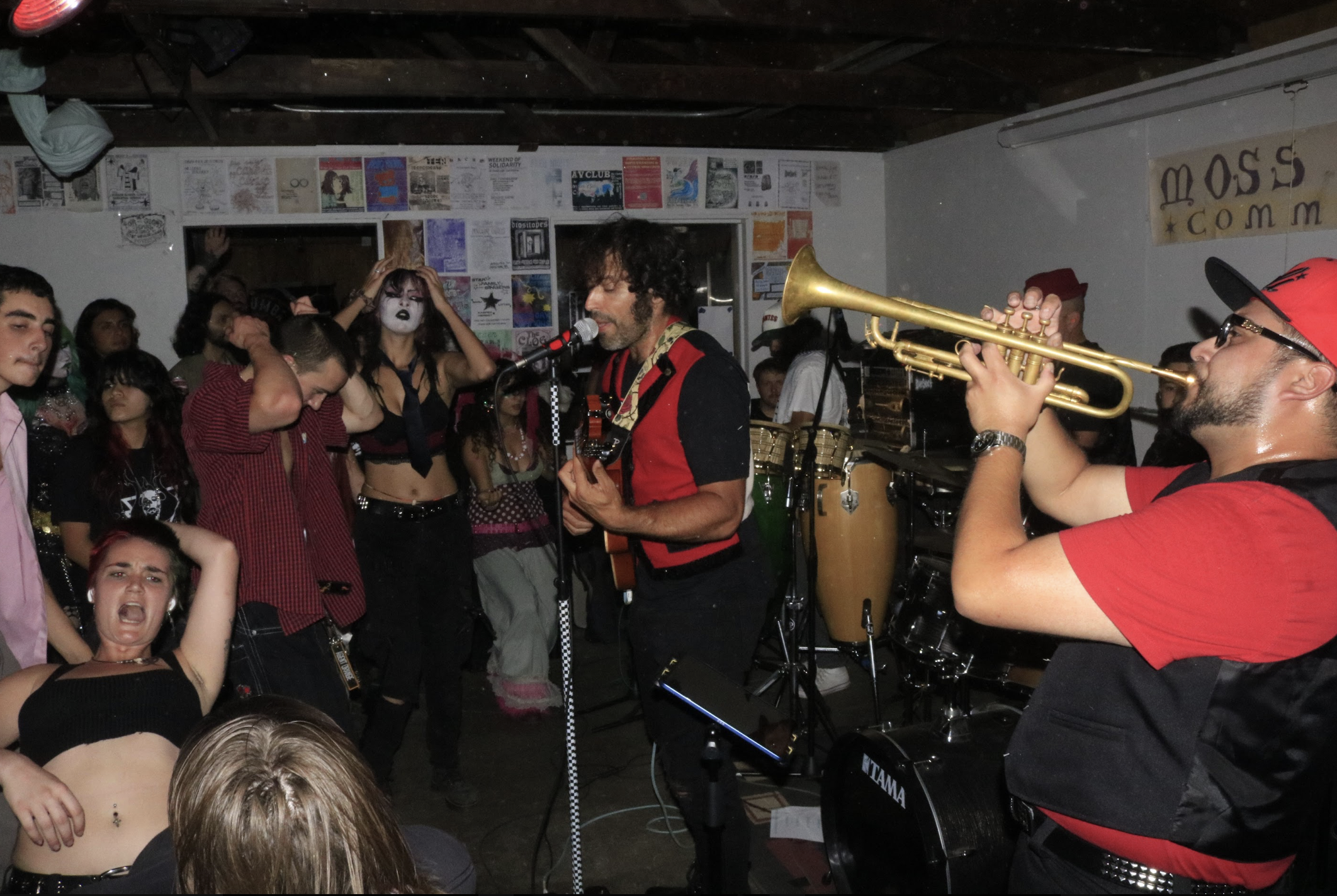
    While punks, goths, band members and regular people crowded around Moss Oak Commons, everyone knew this show wouldn’t be just like any other punk show. Being one of the first events of the school year, old friends and new students alike agreed that mariachi punk was something we had to see. 

    The Rumba Madre is a multicultural mariachi/punk band consisting of members from California, Spain, Puerto Rico and Nashville. Despite popping a tire on their way from San Francisco, they were able to play their set on Aug. 27 at Moss Oak Commons. 

    That setback filled the crowd and band with determination, leading to an explosive show with crowdsurfing, moshing and a fantastic community atmosphere. In classic punk fashion, The Rumba Madre can’t truly decide on a genre, so they take influences from flamenco, latinx, urban, celtic and punk.

    “That’s probably the best genre of music, when you get two different genres and put them together,” Something Wicked bassist, Peter Ramos said. “The Rumba Madre? They do that really well.”

    Among t-shirts, mugs and lighters, there was one item rarely seen sold at punk shows. SPANISH PUNK, SCREAMING FOR DEMOCRACY IN A POSTDICTORIAL STATE, a book written by lead singer and guitarist for The Rumba Madre, David Vila Diéguez, was for sale at the merch table.


    “In that book, I studied the influence of Spanish punk on the way people thought politically and how they saw themselves politically in Spain right after the end of the dictatorship in 1975,” Diéguez said. “So basically: How did punk influence the way people act and live politically?”

     A World Languages and Cultures Professor at Cal State Monterey Bay selling books might not fit classic punk aesthetic, but the music, history, radical politics and hard moshing serves as a reminder that academia and punk rock can and should coexist.

    “I believe that we have to think about education, not just in terms of being in university, we have to go beyond the classroom,” Diéguez said “It’s very important that what happens in the classroom of the university, we take outside and bring to places like this.” 

    Diéguez said that because many people can’t afford college, it’s important to take these conversations out of the classroom and into the community. Everyone deserves to be a part of conversations surrounding racism, sexism, colonisation; Everyone deserves a chance to learn, grow and expand their knowledge. 

    “Everyone that goes to university, you take that with pride and you share it,” said Diéguez.

    Winter is an English major and copy editor with an interest in covering local community events mostly focusing on music and art

  • Same Ol’ Bonfire, Different Kinda Buzz: A Sobering Night at Moonstone Beach

    Same Ol’ Bonfire, Different Kinda Buzz: A Sobering Night at Moonstone Beach

    By Tatiana Moore

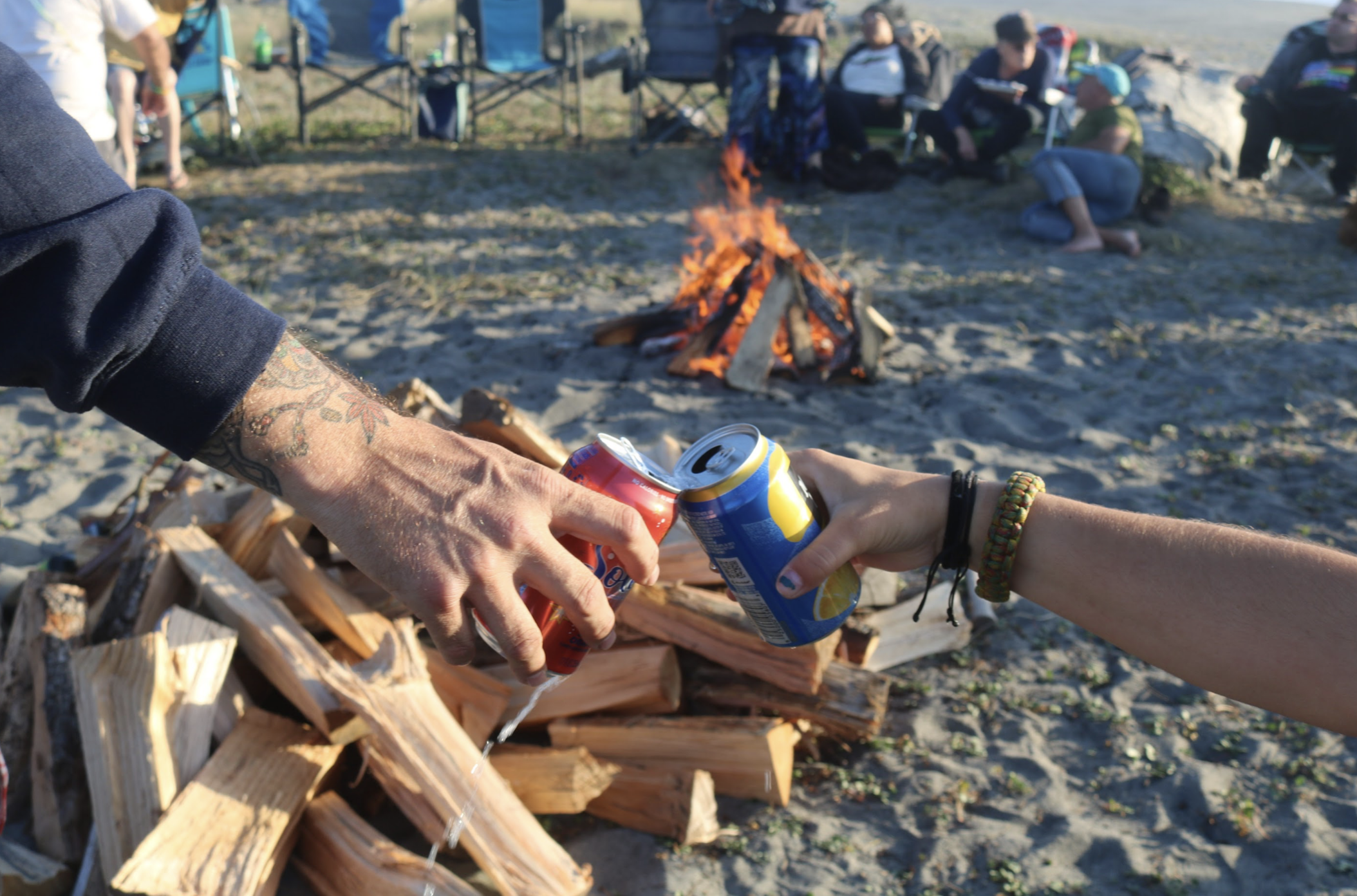
    Bonfires at Moonstone Beach are a cornerstone of freshman year. Blackouts, questionable decisions and, on occasion, police shutdowns. But at this particular fire pit, a different kind of night is unfolding, where the strongest thing being poured here is some ice cold, cold brews.

    Fran, Cal Poly Humboldt (CPH) student and event coordinator for The Queer Dimension group proudly tote around her “no AI used” poster outlining just what this is all about. The Queer Dimension group serves to provide a space for LGBTQIA+ people and allies alike, to gather, socialize and build community together away from alcohol or other mind-altering substances.

     “Humboldt may not be known as the party school,” Fran said. “But drinking and smoking weed are definitely a big part of the culture here and that can be unhealthy and dangerous for people.” 

    For students surrounded by a culture where drinking can feel like an expected part of college life, events like this offer an alternative to that narrative. There’s no pressure to explain why someone isn’t drinking. There are no awkward questions about what’s in their cup and no expectation that having fun requires being under the influence. 

    Whether someone is in recovery, struggling with addiction or are just pursuing a sober straight edge lifestyle, community groups like this can be instrumental in making sobriety feel less isolating. For Tony, a sober senior at CPH, that choice is something to be proud of. 

    “I don’t feel embarrassed or hide the fact that I’m sober,” Tony said. “It’s a choice I’m happy with and I’ve found a special community in that space.” 

    As the sun disappears into the sea, and the fire starts raging, the scene is familiar. Young people gathered around a bonfire, laughing, getting marshmallows ready and passing drinks. The only difference is what’s in those cups. 

    Names have been changed to protect anonymity. If you or someone you know struggles with substance use call 988 for support. 

    Tatiana H Moore is a reporter/writer thm18@humboldt.edu

  • Dolly’s Legacy

    Dolly’s Legacy

    By Jacqueline Zuniga

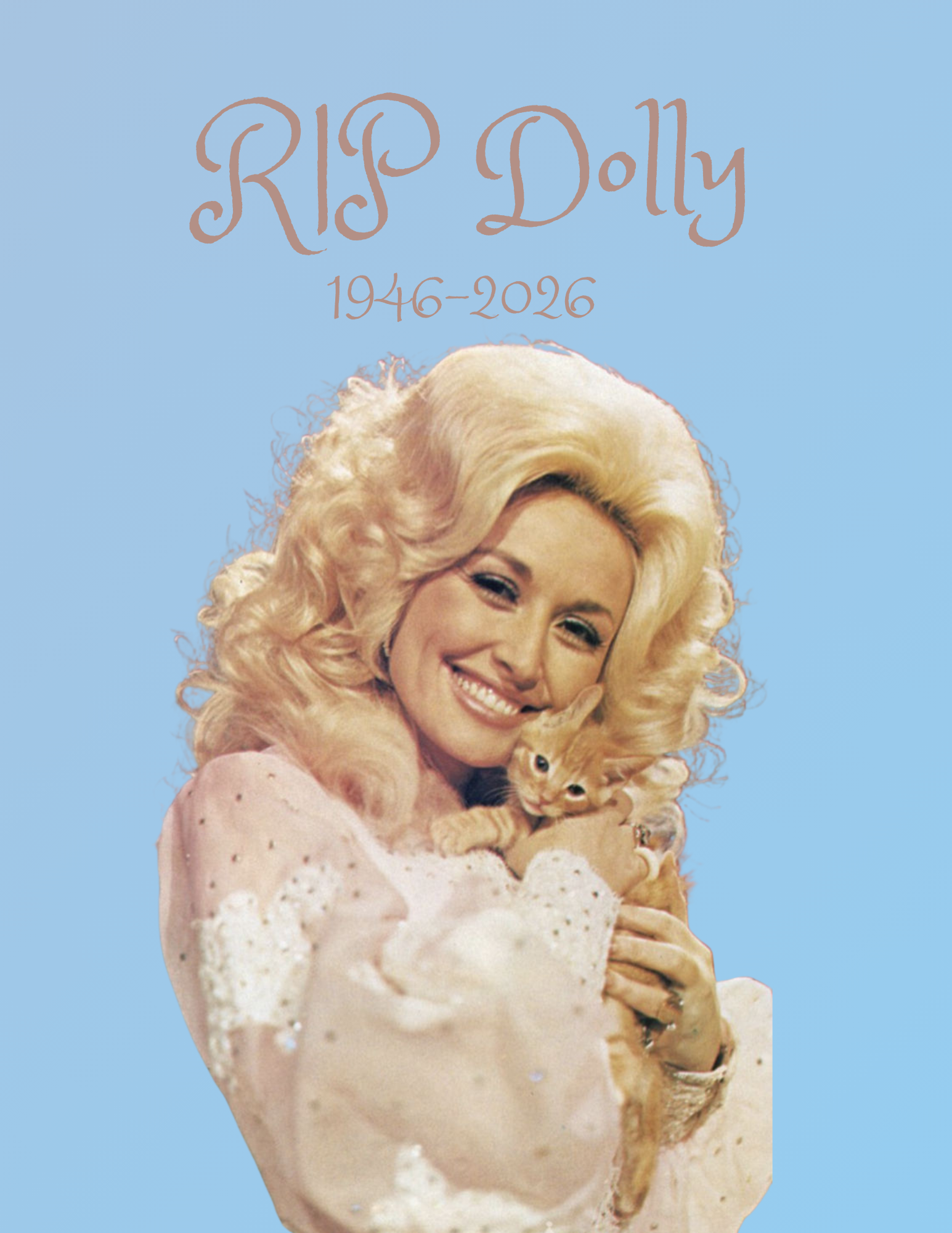
    Singer, songwriter, actress and philanthropist Dolly Parton passed away at 80 on Aug. 25, after a brief battle with cancer. She was a ten time Grammy winner known for her songs Jolene, 9 to 5 and I Will Always Love You. Students around Cal Poly Humboldt have been shocked and hurt by the news of her passing.

    “One of the biggest heartbreaks of this year for me,” junior environmental studies major Alejandro Paz said. “A lot of her philanthropy work…her book program and teachings, definitely resonated with me.”

    Parton founded the Dollywood Foundation in 1988, inspiring children in Sevier County, Tennessee, where she grew up, to achieve educational success with the help of Dolly Parton Scholarships.Dolly Parton Imagination Library mailed high quality books to children from birth to the age of five in communities across the United States, as well as the United Kingdom, Ireland, Canada and Australia. Parton also funded COVID vaccine research at Vanderbilt University Medical Center, later the developers of the Moderna vaccine. 

    “I thought of Miley Cyrus, Sabrina Carpenter and the Nashvillers who have gone to the Dolly Parton bar,” senior English education major Naidely Gonzales said. 

    Parton was Disney Channel star Miley Cyrus’s godmother after becoming close to her father, Billy Ray Cyrus, while touring with him. Carpenter and Parton worked closely together on the remix of Carpenter’s song Please Please Please and was an inspiration for Carpenter. 

    With so much work done around the world, people can’t believe she’s gone.

    “I had to genuinely take a second because I’m from Austin, Texas, and Dolly is such a huge part of Austin culture,” Ava Hernandez, a general biology junior, said. 

    Parton’s impact in Austin started in the 80s and continued throughout her career. Parton’s 1982 film The Best Little Whorehouse in Texas premiered in Austin and was filmed across Texas.

    “She represents such love and kindness; everything she stands for is just so positive and bright,” Hernandez said. 

    As per an executive order from president Donald Trump all flags, such as the one in front of the library, should be flown at half staff for Dolly Parton.

     Jacqueline is a journalism major, a news manager for KRFH, sports editor for the Lumberjack and she aspires to be a sports journalist one day


  • Friday Night Market

    Friday Night Market

    By Barley Lewis-McCabe

    “There’s nothing to do in Arcata!” 

    To the relief of bored community members and students alike, the Arcata nightlife is receiving a weekly boom for the next three weeks in the Friday Night Market. The plaza will be lined with artist stalls and food trucks alike for an event that brings out the best in our community! The Friday Night Markets will be held from 5:30-8:30 p.m., the event is free to enter and all ages.

    The first Friday Night Market welcomed back students and celebrated the uniqueness of our community. We even had an appearance from local celebrity and frequent burning man guest, El Pulpo Magnifico, a 28 foot tall kinetic octopus sculpture equipped with fire breathing tentacles! At the first Market on Friday Aug. 21 the plaza was packed with folks living in the moment, celebrating life itself, dancing with a giant octopus and eating delicious food.

    Barley is the good-timing Editor In Chief of The Lumberjack, as well as a jack of all trades news writer. Contact him for any reason at bl258@humboldt.edu

  • Do You Believe in My New Band Believe?

    Do You Believe in My New Band Believe?

    By Will Bishop

    The foundations of My New Band Believe and their titular debut album came to Cameron Picton in a fever dream while under the throes of food poisoning, far away from home in a Chinese hotel room while on tour with his previous band, black midi. The name, and a handful of other phrases, became stuck in his mind, eventually coalescing into the project some years later. The music and songwriting very much reflect this, rife with surrealist imagery and lavish sonic cacophony, filled with euphoric highs and long dark tunnels.

    Love Story, the first track released off the album, initially reads as a gentle musing on domestic life refracted through little moments. “You sing along to your favourite songs. But you don’t know the words. So you make up your own.” Then a harsh aura builds in the string section, giving way to frightful and nightmarish imagery. “A mеtal spike from the sky. Precisе and poisoned. Somehow avoided me.”


    Hopeful and optimistic phrases are spoken like a mantra, beguiling you into peering deeper beyond the shimmering surface. The ostinato — a musical pattern that is consistently  repeated at the same pitch throughout a composition — of Target Practice telling you over and over again “Don’t cry, you deserve this,” has a soothing, almost therapeutic quality — until you start to wonder what exactly it’s telling you that you deserve. The verses reveal a world of pain. The narrator tells you that you deserve what you have given, promising you desecration beyond death.

    The towering Heart of Darkness pushes the album’s shapeshifting approach to its furthest extreme. Playful flamenco guitars fill your ears with bright color as the unease of its lyricism mounts. “Open up, I have come too far to run. My, my, my, what have you done?” Picton breathes, pulling back dark clouds with a moment of musical bliss only to reveal night has fallen beyond the veil as you circle a black drain in the sky that spits you back out, eventually lowering you down on the feather of an angel’s wilting wing.

    For all its musical virtuosity, My New Band Believe is often reserved, as if hiding in the thorny bramble of its instrumentation. If you follow the vine of a blackberry bush down its ever winding path, counting every overlap, every splintering, every leaf, then it is a complex thing indeed. But, it is internally inaccessible, only offering its outward appearance and the fruits held on its distant edges. It does not offer its innermost complexities, rather, it leverages them into an impenetrable fortress. A yaegaki, fences within fences. But, the album is at its best when it’s letting you in. At times, it can look so impossible. Thorn bushes made of nylon string. Like a non-euclidean horse with legs melting long and tangling together. Then, suddenly, its aestivating worm appendages unswirl, its sinewy muscles tighten back to life, exploding into a triumphant gallop. In those moments, you will believe Cameron Picton can fly. “Speak of the dragon and the dragon shall appear at last.”

    Will Bishop is a Cal Poly Humboldt journalism major. He is prone to writing essays about things that bother him, and fictional works about things that also bother him but in different ways. A highly bothered individual, and a lover of cinema, music, and large trees/rocks. He can often be found in the woods, dancing to bring down the sky.

  • Humboldt Calls Curtains for 59th Film Festival

    Humboldt Calls Curtains for 59th Film Festival

    By Julia Kelm and Ariana Wilson

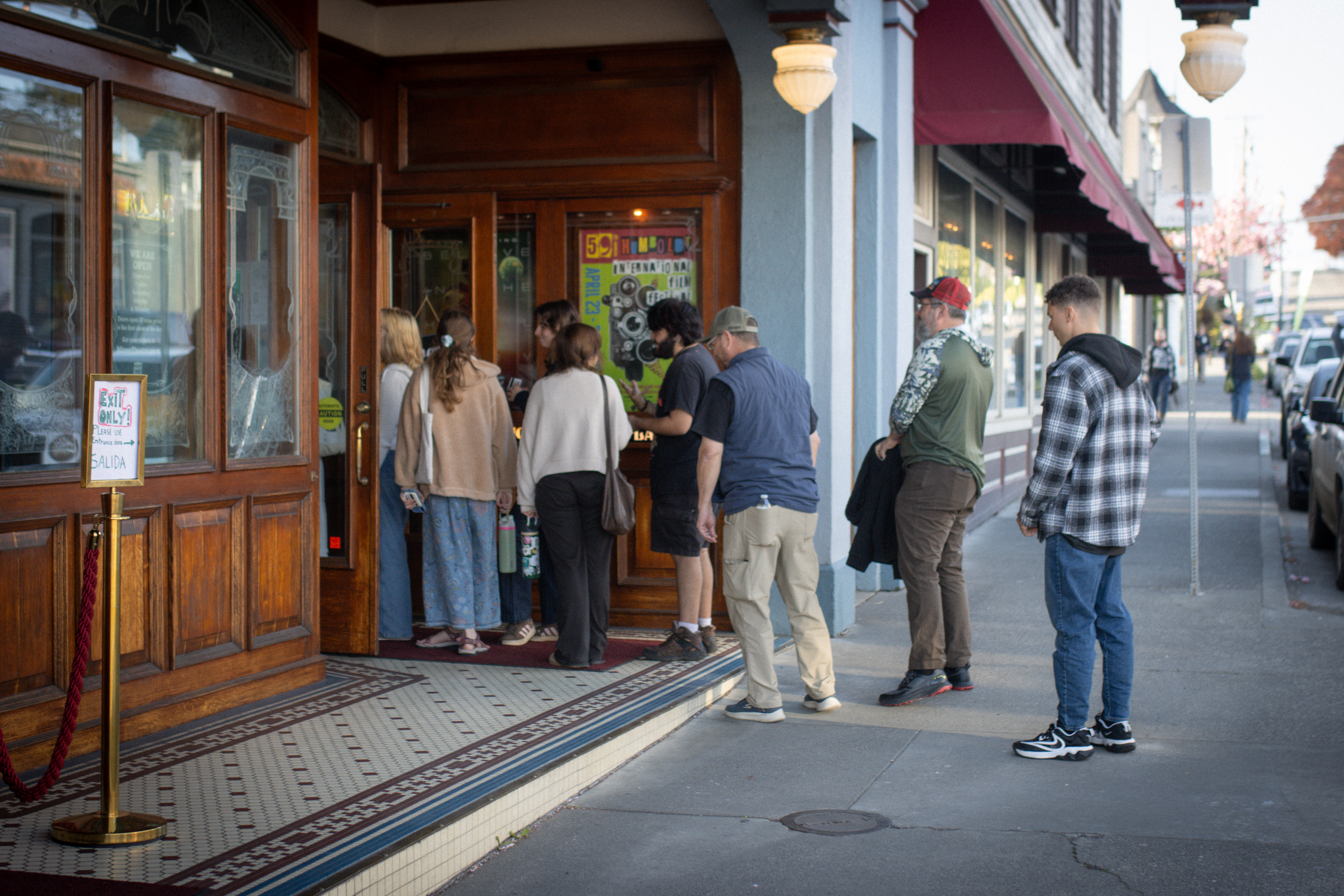
    Laughter and chatter reverberated through the air as Cal Poly Humboldt film majors and cinema enthusiasts piled into the Minor Theatre. From April 23 to 26, the venue served as the heartbeat of the 59th annual Humboldt International Film Festival.

    The festival hosted 39 short films that featured a variety of visual and narrative genres. However, on the last day of the festival, the content featured their ‘best of fest.’ Seven films were voted the pinnacle in their respective categories by a panel of three guest judges.

    Cal Poly Humboldt’s College of Art, Humanities and Social Sciences Dean, Jeff Crane, spoke about how the festival was a long-standing tradition that helped create a space for students and the community to view and create art. 

    “[We’re] reminding the community that universities are much more than just STEM programs,” Crane said. “The arts provide an important service and broaden the way we think about and understand the world; develop empathy.” 

    Film provides a medium for tough subject matter to be discussed in a more approachable format. Many of the films at the festival spotlight heavy topics, such as domestic violence, death, aging and care, intergenerational trauma, climate change and artificial intelligence. 

    Danica Frey, senior film major and co-director of the award-winning local film, The Void, dealt with intense topics. The film approached topics like parental trauma and learning to heal one’s inner child — a powerful message that was fortunately able to be platformed.

    “It’s very surreal to be a student filmmaker and see your film on the big screen with all of these other established filmmakers,” Frey said. “It just feels very validating… you’re actually making steps into the industry.”

    Humboldt’s isolated location as one of the most northern universities in California creates surprising opportunities for students that could be harder to come by in areas with more saturation in their chosen career fields. 

    “It’s been very rewarding to come here as opposed to a bigger school. You get a lot more personal connections and feedback,” Frey said. “It’s a much more unique look at filmmaking.”

    Frey’s co-director and producer, Sara Ortega, a senior film major doubling in communication, has been a part of the film program and festival since 2024. However, it wasn’t until last year that she applied to be co-director of the festival. 

    “The reason why I had gotten in was because I really wanted to have a relationship with the advisor, because she’s a producer, and that’s what I’m aiming for,” JUMP Ortega said. “I want to be a film producer, so I knew that working with [the film advisor], I would learn a lot more — which did happen, thankfully.”

    Both Frey and Ortega expressed how beneficial the festival was for them, and hope the event will continue for many years to come.

    “This festival is growing more and more every year,” Ortega said. “The more people attend, the bigger it can get, and the more opportunity it brings to not just the [local] community, but also to the film community.”

    Julia is a journalism major and the co-EIC of the paper. She loves film and is a regular on Letterboxd. She also enjoys going on walks in the forest and taking pictures to relax. If you have a movie you’d like her to review, please email her at jk328@humboldt.edu.

    Ari is a senior journalism major and co-EIC this semester, with a deep passion for the environment and conservation. As a scientific diver, she plans to combine journalism with research and conservation work. For inquiries, contact ajw167@humboldt.edu.

  • Toyon 72 Launch

    Toyon 72 Launch

    By Jacqueline Zuniga

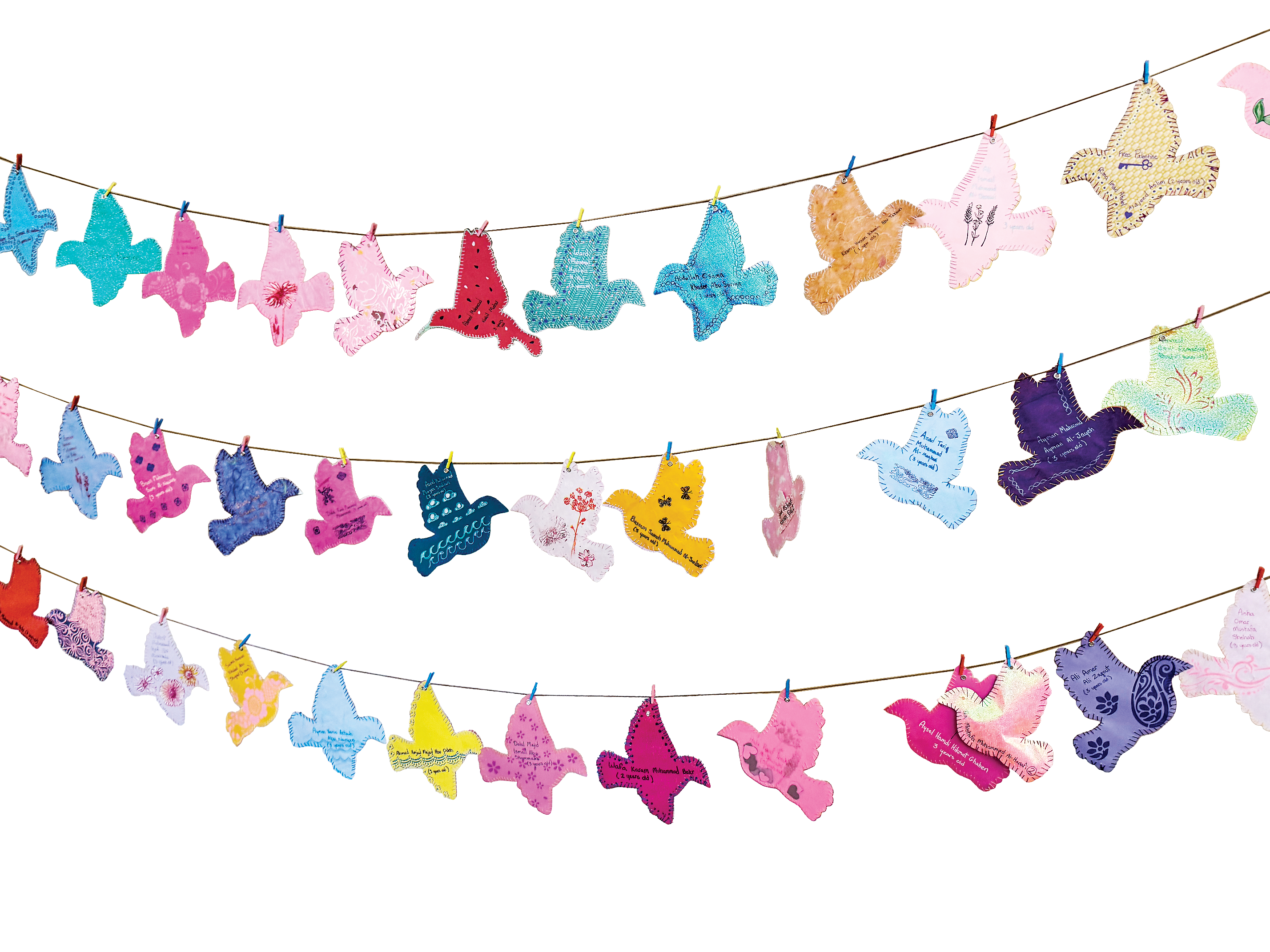
    The Toyon Multilingual Literary Magazine held a launch party April 22 in the Great Hall to highlight one of the university’s longest running student publications and brought students, faculty and contributors together for an afternoon of readings and celebration of the 72nd issue. The event featured published work, student run presentations, free copies of the new issue and Palestinian desserts. Toyon advisor Marcos Hernandez said the publication carries a long legacy on campus, dating back to 1954. 

    “Toyon has been printing [literature] since 1954,” Hernandez said. “As a legacy publication in Humboldt, Toyon’s pages reflect a rich history of art and social activism on-campus.”

     He pointed to the magazines’ connection to documenting movements such as the counterculture in the 60s, the student-led anti-war movement in the 70s and local multicultural organizing efforts through the years. More recently, the magazine has featured the global movement in solidarity with Palestine. He emphasized that Toyon not only serves as a literary outlet, but also is a space for students from all majors to publish their creative work.

    This year’s issue centered on “sumud,” a Palestinian noun meaning steadfastness, perseverance or persistence in the face of adversity. Guest editor Jamilia Hashem said she helped shape this year’s theme by working with the editorial team to help encompass and embody what sumud means.

    Hashem was involved in last year’s issue, which led her to be invited back with a bigger role as guest editor. Hashem said that this issue is meant to reflect the ongoing commitment to raising awareness about Palestine and other issues rather than a singular movement.

    She worked with the other guest editor, Dr. Abdulaziz Akila, to shape the theme of this issue from the perspective of two Palestinians. They focused on both personal and collective experiences to reflect ongoing struggles. She also said Toyon connects different social issues and shows how storytelling is part of activism through journalism.

    “This isn’t just a performative piece of standing with Palestine,” Hashem said. “We really want to keep carrying this message forward.”

    Attendees shared their reactions to the event. Neveah Salinas, a sophomore majoring in elementary education, described the experience as impactful and educational. 

    “It was very nice to hear all the different pieces,” Salinas said. “It was for sure eye-opening.” 

    Salinas added that the readings helped her better understand the issues happening in Palestine. She encouraged others to attend future events because of the sense of community present during the event. 

    The launch of Toyon 72 showed how student writing and art can bring multiple communities together. Through readings and presentations, attendees celebrated the magazine’s commitment to social issues and creativity. 

    Jacqueline is a journalism major, a news manager for KRFH and she aspires to be a sports journalist one day.

  • Editorial Goodbyes

    Editorial Goodbyes

    Julia Kelm: We did it, Joe (Ari) — we were the EIC’s of The Lumberjack! I can say with certainty that The Lumberjack has been the best part of my college experience, and the best part of my life for the past 2-years. I often have trouble living in the moment; fear of missing out or not appreciating the present enough is constantly rattling in my brain. Because of this, I end up feeling like I’m floating through life, but I’ve never felt more passionate, creative, and alive since I joined this fuck-ass — affectionate — paper. As I transition into real-life, I hope I never lose this feeling. I love everyone on this editorial team more than words on paper can describe. Signing out, love Julie Kelp.

    Ariana Wilson: This semester has been the swiftest kick out of the nest. It seems like just yesterday, I was driving the short nine hour drive South from Washington State to build a life in Humboldt, a place I didn’t even know existed. The Lost Coast is where I found my voice and developed a deeper love for diving, the ocean and conservation. I have always thought of this place as an extension of the Pacific Northwest, and even though I am graduating and moving on, there will always be a piece of me here. I am proud to be a part of The Lumberjack’s legacy and to have met some of the most formative people in my life. To my fellow journalists and friends, I have yet to recognize the fullness of my gratitude for you. 

    Jasmin Shirazian: I can’t believe my time at The Lumberjack is actually wrapping up. I have accomplished so much through this paper, from forever friendships to serious career steps. I am forever grateful for the experiences I’ve had on this paper and all I have learned both as a journalist and as an ever-evolving woman. There is no other department at Cal Poly Humboldt that shines a light to the journalism department, and I am honored to be a part of that small but mighty community. I am a Lumberjack. We are The Lumberjack. I’ll miss The Lumberjack. Goodbye from your favorite award-winning, curly-headed, column-writing copy editor. Xoxo, Jasmin. 

    Kaylon Coleman: Words can’t serve to show how truly monumental The Lumberjack has been for me. Aside from some much needed career development before embarking into real life, this paper has offered me so much more than I could’ve hoped. To the lifelong friends I’ve made, working from noon to night every week in the newsroom — thank you. To any person who may’ve picked up one of my articles, whether it be Severance, to passion, to washing your hands — thank you. For providing me an outlet to dish out all my experiences, reflections and reviews — thank you LJ. The Lumberjack will forever remain within my heart and mind and I owe all my future journalistic endeavours to this paper. We are The Lumberjack.  

    Nick Escalada: For the past three semesters, I’ve had the honor of reporting and editing for one of California’s most acclaimed print publications, as well as the pleasure of sharing a newsroom with some of California’s kindest and funniest 20-something-year-olds. Much has transpired on our little campus in that time, and we were there to cover it all. As I depart from the paper to finish my wildlife degree, I reflect on all journalism has done for me and all I’ve tried to do with it. I only hope to grow in my skills and impact on whatever outlet I write for next.

    Noah Pond: For the past five semesters, The Lumberjack has been my pride and joy. I have nothing but love for this publication and I am going to miss it every day. I will miss all of my fellow editors and reporters, and I am so damn grateful I had the pleasure to be a part of LJ. 

    Nico Patakidis: What a pleasure it’s been to be the photo editor. Sometimes when I’m falling asleep on Tuesday night, and even Wednesday morning, I see the Photoshop user interface when I close my eyes. “Dodge, burn. Image, image adjustments, curves. Convert to profile, CMYK. Filter, sharpen, unsharp mask. Channels, black plate, image, image adjustments, brightness/contrast…” I whisper to myself, as if counting sheep. I’ve found the perfect candidate to pass the burden honor of photo editor to; someone that I’m confident will do excellent work. Now, I’ll be the Life & Arts section editor, and I couldn’t be more excited to see how our new photo editor ensures that each wonderful story is accompanied by a beautiful photo. 

    Luke Shanafelt: It’s been two years at Humboldt; full of trials, tribulation, Jedi mind tricks and fun. I couldn’t ask for a better team to write these silly little newspapers. Goodbye everybody, if you need me I’ll be at the beach, probably chilling or low-key relaxing. 

    Ursula Newman: Farewell for now, faithful readers! I’ll be returning next spring for the last time, after a brief baby-birthing hiatus. My love for journalism is rooted in my love for this area and my appreciation for well-researched writing. As a reporter, you can chase new interests, speak to the experts and share the interesting parts. I strongly encourage anyone who’s even a little curious about journalism to give the paper a try, especially students in STEM fields. It’s a great way to explore your studies while getting your work published. Serving as science editor this semester reminded me how valuable and fun it is to have a diverse team with diverse interests. Good luck to my buddies keeping it going! Much love, Ursula.

    Eli Farrington: The Lumberjack has been the candle that guided my way through college for the past five semesters, and now the flame has reached the end of the wick. This glorious outlet for everything that our beautiful community showcases has been more than my home away from home. It has given me something to look forward to every Tuesday — even when times were tough, even when I felt like giving up, even when the future looked bleaker than the sands of a vast desert plane. It has given me a group of friends that feels more like a family than anything else has during my long and winding tenure here at Cal Poly Humboldt. Growing up, I was always one of those kids with a lot of passions and interests. I bounced from one hobby to another, and I never really stuck with anything long enough to truly fall in love with it. I sure am glad I stuck with this. Thanks LJ. Love, Eli. 

    Barley Lewis-McCabe: I’ve enjoyed my time as the opinion editor very much, but saying I’m excited to take the reins as editor in chief next semester would be a gross understatement. I’ve had the pleasure of working with some of the most talented, creative and passionate journalists in the world, and I promise that I’ll keep the tradition going strong, and work with our incoming team of hot blooded news-hounds to bring our paper to a new level! The Lumberjack is a living, breathing, record of our campus and its history — because of that, we aren’t afraid to adapt to the world we inherit. It’s a new day for The Lumberjack. We’re going to do what seems impossible, and become even better!

  • Destigmatizing Sexual Health at Sexland 

    Destigmatizing Sexual Health at Sexland 

    By Alba Galvan 

    As they walked into the Kate Buchanan Room, students were greeted by two volunteers handing out raffle tickets for the annual Sexland event hosted by Peer Health Education on April 16, with prizes ranging from dildos, to vibrators, to nipple pasties and more. 

    Sexland featured booths where students could ask health educators questions and learn how to use barrier methods like condoms to prevent sexually transmitted infections or pregnancy. Students were also provided with free resources like plan B and condoms, and were educated about topics like STIs, sex and vaginas. 

    “It’s a space for students to come in and get resources and support they need, also just destigmatize it, it’s also just fun,” said sophomore kinesiology major and Peer Health Educator  Delano Savage. “People like to come by, and we have lots of people bid on our raffles. I think we had like 500 students last year — it’s definitely Peer Health Education’s big event of the year.” 

    The event aimed to destigmatize topics that might be considered sensitive or taboo to some students, and created a safe space for those who had any questions or concerns.  

    “I think learning about sex is really important, especially in college. A lot of things happen, and I think that sex is something that is so shameful amongst teenagers, especially in this generation, when we’re trying to find ourselves and find who we are as people,” said sophomore psychology major Violet Kiki. “I think that the fact that we can all come together and learn this together and not be ashamed and not be embarrassed, that’s really great.” 

    Peer Health educator Malloy Fitzsimmons, a junior wildlife major, wants students to learn about sexual health in a judgment-free space. 

    “I don’t believe in things that are taboo,” Fitzsimmons said. “I truly believe that knowledge is power, and the more that we give people information, the more sound decisions they can make for themselves. Sexuality and how you choose to engage in that is such a diverse field. I just want to be able to equip everyone to engage in it the way that’s safest for them.”

    Sophomore English major Ileana Novoa notes how important it is to have an open discussion about sexual education. 

    “I’m someone who really believes in sexual education and sexual liberation as well, and I don’t think these are topics that should be kept hush and hidden. I think these are topics we should be talking about so that people can have safe and educated sex,” Novoa said.

    Alba is a journalism major and reporter for The LumberJack and El Lenador. She’s very passionate about sharing and listening to different opinions and loves self-expression. Contact her at: agg83@humboldt.edu 

  • Photographing for Impact 

    Photographing for Impact 

    By Sadie Shields 

    In the world of wildlife photography, Krisztina Scheef approaches the art with the mindset of patience, ethics and education over the pursuit of aiming for the perfect shot.

    Appearing as the Keynote Speaker for Godwit Days on Saturday April 18, Scheef discussed how she built her career in wildlife photography across the globe while also mentoring and encouraging young photographers to advocate for conservation. 

    Her interest in photography began with a broader love of nature. Over time, her passion evolved into a career centered around sharing these photography experiences with others.

    “I want to share with people who might or might not be able to see it themselves,” Scheef said.

    Scheef believes that wildlife photography has the power to shape the way people view the environment and encourage them to protect it. 

    “The more you see and fall in love with nature, the more protective you’re gonna get,” Scheef said.

    In addition to having her photos featured in many magazines, Scheef mentors young women through Girls Who Click, a nonprofit focused on increasing representation in nature photography. 

    Through workshops and the mentorship program, Scheef works with students to develop both the technical skills and understanding of ethical practices required to be a wildlife photographer.

    Ethics play a critical role in the work Scheef creates. She serves on the ethics committee for the North American Nature Photography Association, where she promotes responsible wildlife photography.

    “We are playing in their home, in their world, “Scheef said. “We need to be ethical and nice to them.”

    One of the most common mistakes beginners make is expecting immediate results. New photographers often assume they will capture multiple high quality images without understanding animal behavior or the time required to hone their skills. Scheef points out how important it is to learn how animals behave, and how to approach without disturbing the wildlife they are photographing. Scheef discourages chasing animals, disturbing nests or using repeated playback calls to attract birds.

    “These are things that can stress the animal,” Scheef said, noting that such behavior can disrupt feeding patterns and leave young birds vulnerable.

    While capturing a strong image can take days or hours, the process itself is part of the reward.

    For Scheef, some of the most meaningful moments come not from her work, but from teaching others. Watching young photographers become successful and develop an appreciation for wildlife is one of the most rewarding parts of her career.

    “Seeing in their eyes… ‘I got a good photo,’” Scheef said. “Those are rewarding moments.”

    Sadie is a junior communications major, journalism minor at Cal Poly Humboldt who has an interest in covering and taking photos for sports and wildlife journalism, and a slight interest in breaking news. She can be reached at sls331@humboldt.edu.

  • Printing a new Perspective: A Nicole Kita Feature Story

    Printing a new Perspective: A Nicole Kita Feature Story

    By Bodhi Haugen

    Engulfed by layers of ink and the symbolic storytelling of audiobooks, Nicole Kita creates her prints one press at a time. Kita is a lecturer at both Cal Poly Humboldt and College of the Redwoods.

    She expresses herself across a wide range of media, including ceramics, drawing, painting, installation and, her favorite: Printmaking. For her, art is both a process of learning and a way of connecting with others and herself.

    Kita was born in Ontario, Canada, but later moved to Florida around the age of eight where she spent the remainder of her youth. As a child, she wanted to be an artist, but faced resistance at home.

    “My parents really don’t appreciate the arts and didn’t want me to go into any kind of art field. They’re just very worried, of course, about financial stability for their children, and I wasn’t allowed to take any art classes until I was a senior in high school,” Kita said. “I feel like I got a late start in a lot of ways, but I think it helped change their mind a little bit after doing a portfolio review with a local college that essentially offered me a full scholarship.”

    Kita completed her Bachelor of Fine Arts degree in Florida in 2004. She worked as an elementary school art teacher before moving to Boston, landing a job as a printmaking technician at the School of the Museum of Fine Arts.

    “I’ve been really fortunate with a lot of opportunities,” Kita said. “But, things got pretty rocky after grad school.”

    Making a career-defining decision, Kita chose to leave her teaching job and move to Chicago during the Great Recession in 2009, a time when it was more difficult than ever to find work.

    “I was in a really good job at the time, but I had left because I wanted to move to Chicago,” Kita said. “It was just in the transition where I was not aware of what was fully happening in just the financial world.” 

    She eventually found work in a commercial screen-printing studio called Crosshair Chicago, where she developed skills that would later shape her artistic practice. But, after a snowy April in Chicago, Kita was ready for a change and moved to Humboldt County in 2013.

    In Humboldt, Kita spent nine years working at The Studio, a nonprofit organization in Eureka that supports artists with disabilities. Her experience at The Studio played a crucial role in how she approaches art.

    “I think artwork is very hard work, but working with all the artists at The Studio helped re-establish and reinvigorate that people are finding joy and therapy in making art, and it doesn’t have to be so mentally taxing at every juncture,” Kita said. 

    Kita later transitioned toward a community-based arts and cultural organization, the Ink People in Eureka.

    Kita’s style has been ever-changing. She previously worked more figuratively and with geometric shapes, but has recently focused on animal portraits. While working on a pig portrait, she listened to audiobooks such as Lord of the Flies and Animal Farm, drawing literary connections to her work. Audiobooks play a vital role in her process, allowing her to focus and learn while she creates.

    A recurring design in Kita’s portfolio is a bear paw shape, inspired by an artist residency she attended in Ohio. She enjoys creating work with a visual language that holds meaning.

    Kylie Anderson, an environmental studies major and art minor at Cal Poly Humboldt, has taken Kita’s classes before.

    “Kita has been an incredible instructor and guide for me throughout my years in the printmaking studio,” Anderson said. “She is such a wealth of knowledge, and I’m very grateful to have had her as a teacher for as long as I have.”

    Sadi Finch, a studio art major at Humboldt, has had the opportunity to work as a teacher’s assistant for Kita.

    “I’ve gotten to work with and get to know Kita over the past few semesters. Her passion and keen attention to this fine art practice is contagious,” Finch said. “It’s inspiring to have an instructor who encourages compositional thought, is energetic about learning new processes, and is unabashed to share and show what they are excited about.”

    Kita encourages students to take advantage of art classes at Humboldt, regardless of their major.

    “I think it’s such an important part of your educational development to start thinking with these creative practices,” Kita said.

    For Kita, art is not just a career; it’s been a journey shaped by risks, valuable lessons and community. Through her work and teaching, she invites others to discover that same sense of possibility.

    Bodhi Haugen is a journalism major and writer for the Lumberjack at CalPoly Humboldt. Bodhis on KRFH and enjoys reading, writing, photography, and art. You can reach him at bgh27@humboldt.edu.

  • Instagram Submissions

    Instagram Submissions

    Compiled by Jasmin Shirazian

    Jacob Christopher 

    Political Science Junior

    I’ve been going a bit crazy during the second half of this semester, so I found a particular kind of relief in making these images. RETROSPECT ON INTELLECT is a mixed-media series using digital photography that engages with seemingly obsolete technologies and methods to resurrect an early 2000s nostalgia into a post-postmodern expression of emotional accumulation online. I shot with a camera from 2002, worked with a small crew of friends, went to a party, layered in recycled colored plastics and moved files through different software and two phones. The workflow was deliberately impractical, an act of resistance against frictionless and disposable image-making. I think of the project as a kind of proclamation on the state of elysium, about memory, and how it entangles with whoever is in front of the subject. Drawing on the texture and layering inspired by the aesthetics of frutiger aero, I hope to have turned what could have been a photo of a stranger into a figure of imagination and projection. In that sense, the collection is as much about how we remember images as it is about the subject in them.

    Sage Fowler

    Psychology 

    Junior

    @imgonnadigahole on instagram 

    I often find myself enjoying the process: entering a dissociative state that allows me to entirely devote my attention to each element of the piece. I’ve been focusing on developing my technical skills and becoming more familiar with various mediums before I try and explore a more consistent theme in my work.

    That being said, I’ve noticed that I’m particularly drawn to portraying everyday moments and using color to take the tone in a different direction. I love painting those who aren’t what first come to mind as the conventional subject. I’ve been delighted to find out that I can create something that people emotionally resonate with!

    Roland Asch

    21

    Psychology with a minor in fine arts and Indigenous Studies

    I make art that, in a way, reflects my life. I think I can’t really make art without being sorta autobiographical. It’s really kind of like a visual diary in a way and therapy; if I don’t do it, I get kind-of ornery. It just feels like something I need to do. I love making art, and if you wanna see more, follow me on Instagram @Found_a_job.

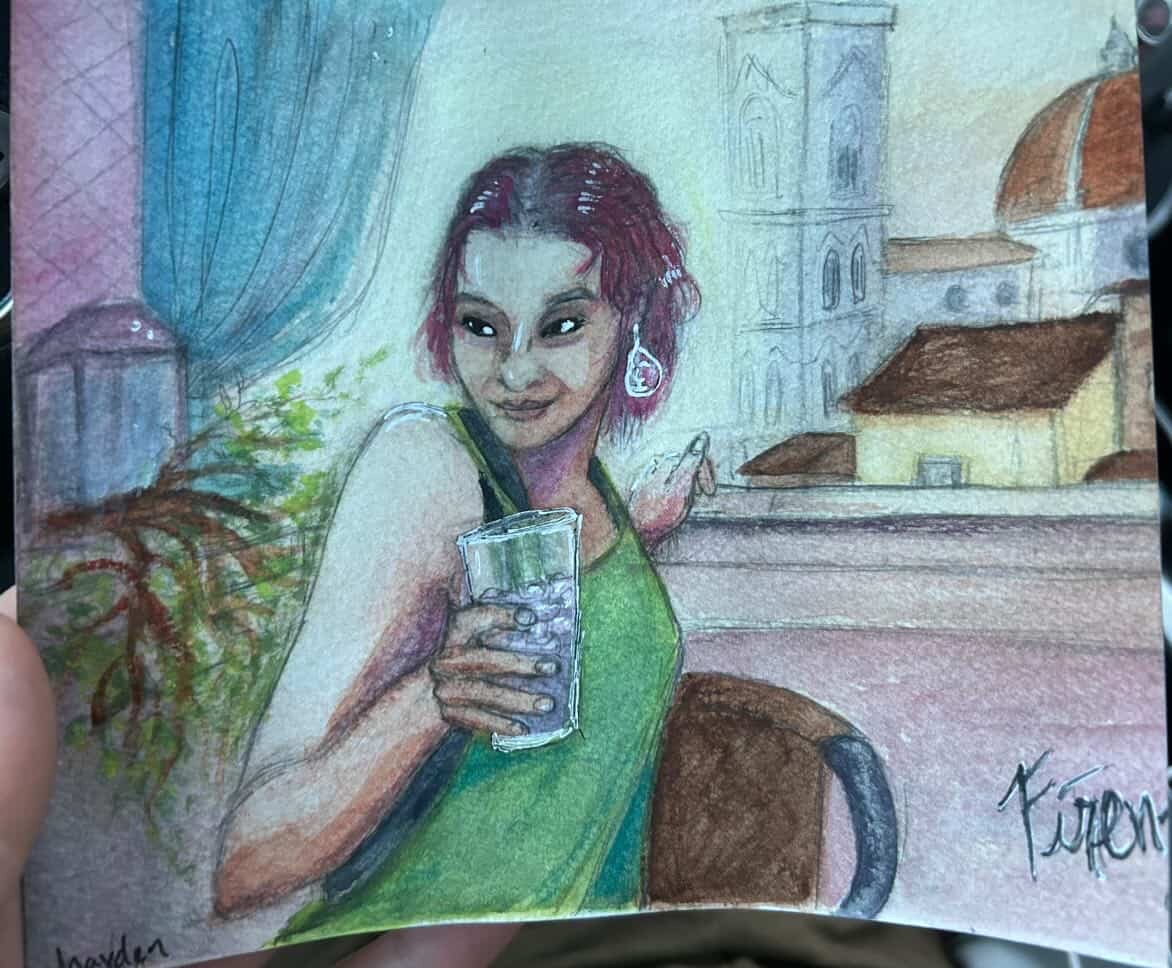
    Hayden Hilscher

    Theatre Arts

    Senior

    I’ve been drawing and doodling since I was a kid, and it’s just stuck with me after all these years. I create because I just have to sometimes, even if it just leaves me with a bunch of unfinished projects. It has to get out somehow, and I’m glad when I’m able to use that to create something for my loved ones.

    Mia Kelm

    She/hers

    Art History 

    Senior

    The Blue Heron was for a class assignment for my Drawing 2 class with a focus on drawing animals and the natural world. 

    The Blue Herons sometimes represent the concept of being “resilient,” thus the bird represents me and the internal turmoil I’ve faced with personal issues concerning my mental health. I am becoming not just better despite my issues, but also finding resilience within them. The ribbon is still there, it just doesn’t define me…

    Crowe Connolly

    Wildlife major

    Freshman

    I don’t really have much to say about this piece other than I really hate losing my lighters, and I thought this would be a cool way to stop that from happening.

    Jasmin Shirazian is the award-winning, curly-headed copy editor of The Lumberjack. Her beats range from breaking news to covering local performances. In her free time, she enjoys leaving the country and spending time with her cat. Inquiries can be sent to js760@humboldt.edu.

  • Alumna soars cultivating career in journalism and aviation

    Alumna soars cultivating career in journalism and aviation

    By Ariana Wilson

    Sitting in the cockpit of the flight simulator, staring down the tarmac of Arcata Airport, the engine roars to life. We lift off, soaring thousands of feet above the Humboldt skyline, all from the confines of the library’s second floor. Meg Godlewski, Humboldt class of 1987 and journalism major, carved out a career and found the elusive balance between passion and profession as a writer and editor for Flying magazine.

    Writing and aviation may not intersect on paper, but when “Death by Timebuilder” was published in Oct. 2023, her words circulated across the country and inspired change that is evident in today’s flying safety standards. “Death by Timebuilder” was a controversial article published in Flying magazine by Godlewski following the unprofessional conduct of an instructor, shaming a student and knowingly flying into severe weather cataloged on Snapchat resulting in two preventable fatalities.

    “That story is now up in frames around the country, in different flight schools. It’s required reading because I said things that other people were afraid to say,” Godlewski said. “I threw it out there and said, ‘We have a broken system. We have these time builders who don’t want to be there, they pass the test, but they don’t have teaching skills that just come with time.”

    Beneath the canopy of the Redwood Bowl, Godlewski recalls her days with the Marching Lumberjacks and the sense of found family that shaped her years at Humboldt. 

    “Close your eyes for a minute,” she said. “Think of your best birthday, the thrill of your team’s big win, the pride of your graduation — that’s what solo flight feels like. It’s incredible. You feel 15-feet-tall, walking on a cloud.”

    Godlewski remembers a time before information was just a click away. 

    “[Artificial Intelligence]  slows me down. It just gets in the way,” Godlewski said. “It’s a tool, but like anything else, it can be misused. I compare it to a Swiss army knife. My father, before giving me one, made me learn what each tool was for — because you shouldn’t use a fish scaler to cut wood. AI is the same way: you have to know how to use it properly.”

    Godlewski has always believed that humans are creators.

    Surrendering the process and mental frameworks of creation to machines threatens humanity’s imagination and wonder.

    Continuous learning has always defined her approach, even before her aviation career took off. 

    “I study pretty much every night,” Godlewski said. “Once a year, I read the manuals for each airplane I fly to refresh my knowledge.”

    Mentors from her early career shaped the leadership style she now brings to teaching. She walks her students through every inch of a flight pattern as they prepare for their first solo flights. 

    “I give all my students call signs, even though not everyone finishes. I want them to remember the experience,” Godlewski said. “I am helping someone do something they’ve wanted to do their whole life, because someone will come to me, and [say] I’ve always wanted to be a pilot and I ask, ‘Why not?’ [And they say] ‘well, I’m 40.’ It’s doable. If you can find your butt in the dark, with both hands, a map and a flashlight, I can probably teach you how to fly. And if I’m not the right instructor for you, I’ll find you one.”

    Reciprocity has defined her career, serving as a catalyst for a life of meaning. “Honestly, I don’t see myself at the end of my career, because I turned two hobbies into careers,” Godlewski said. “If I can help someone, I want to. Sometimes I’m not the right instructor or mentor, and that’s okay — there are others who are a joy to work with, and I hear from them later.”

    Godlewski believes there’s a beautiful emptiness as we walk through life as wayfinders, charting our own course of self-discovery. “Recognize that you are leaving a bubble,” Godlewski said. “[Humboldt] is insular, but when you move on, nobody’s going to care where you came from. It’s about what you can do.” 

    Ari is a senior journalism major and the science editor this semester with an adoration for the environment and conservation. She is currently pursing her scientific diving certification and plans to meld her journalistic passions with scientific research in the future. For any inquiries please contact ajw167@humboldt.edu.

  • Work in progress

    Work in progress

    By Kaylon Coleman

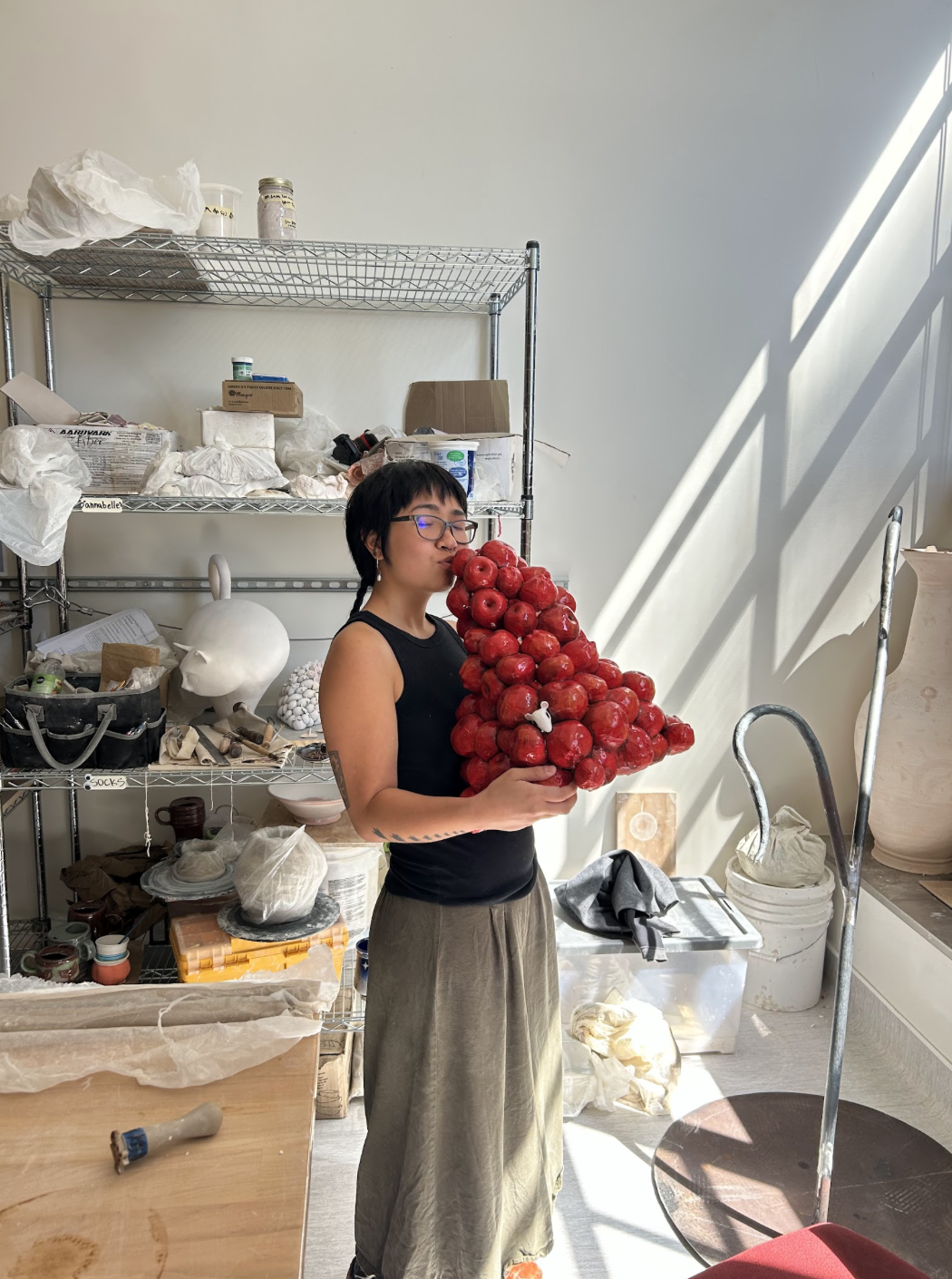
    Within the confines of Cal Poly Humboldt, many a-student choose to express themselves in a multitude of ways. For senior ceramics major, philosophy minor and clay club president Socks Lucas, ceramics is their expressive outlet of choice. 

    Lucas got into ceramics around the time of the pandemic at age 16.

    “I was taking classes at a community college instead of going to a traditional high school. I just wanted to do something at home that used my hands, and that wasn’t staring at a screen,” Lucas said. “So, I signed up for a hand building ceramics class.”

    At first, Lucas hated the class — but after another attempt in-person the following semester, they grew to love the medium and have stuck with ceramics ever since.

    “I’ve done [ceramics] every semester since I was 16,” Lucas said. “I think I had one semester off, but I snuck into the ceramics studio here-and-there to touch clay.”

    Lucas is heading to the California Conference for the Advancement of Ceramic Arts (CCACA) this weekend, April 24 and 25 in Davis, Calif.. Lucas plans on bringing three pieces to showcase as a triptych — a term that refers to a three piece work of art showcasing a specific theme or concept.

    “One of them is a cat with two apples on its head. It’s kind of reminiscent of my childhood cat who passed away last semester,” Lucas said. “And then a giant pile of apples with a little mouse in it. And then a pile of mice with an apple core.”

    Lucas delved into the significance of the pieces. Naming the cat piece, “keeper,” the apples, “hold them close, pile them high” and the mice, “surrender.” 

    “My work explores themes of childhood memories, comfort, grief and nostalgia. Personal experience, the emotions of my past, and my ongoing consideration of who I am drive the ideas I materialize into clay,” Lucas said. “These sculptures are a monument to all memories I have held onto: the good, the bad and the rotting.”

    Lucas explained their creative process and how they get inspiration for their pieces. 

    “Probably laying in bed, having an idea pop in my head and not being able to sleep for a few hours,” Lucas said. “And then, scribbling down a few circles on a page, coming in the next day and just having this extreme urge to just make something… the 3D nature of clay for me really allows me to just fully manifest it physically into reality.”

    This process isn’t without its caveats though. Lucas explained the tribulations of ceramics and what inspires them to keep with it.

    “It’s a tough-ass medium to stay in. There’s constant failings and disappointment,” Lucas said. “I crashed out about my pile of apples last week because they were too dark of a color than I wanted them to be… what keeps me going every day in the studio, though, is my friends in it. It’s a community.”

    Lucas has no concrete plans for after graduation and remains a bit weary of having no studio space next semester, but wishes to go to grad school in either Alfred, New York or Boulder, Colorado with long term goals of teaching.

    “I want to go to grad school, do some residencies and eventually teach at a four-year, just so I can sustain my art practice,” Lucas said.

    Lucas also shared where their drive of teaching originates from. 

    “I love sharing what I know about ceramics with other people,” Lucas said. “I think that process of sharing information is so beautiful, and I would love to share that with the broader world and also get paid for it. I think that’d be really sweet.” 

    Lucas’ main passion around ceramics, however, is how it allows them to express emotion.

    “I make my work to share the joys of my life with others and provide a space to hold their sorrows,” Lucas said. “Much of what I create is not intended to affect others directly, but to help me understand myself and how I move through life’s peaks and valleys. Through my work, I show you my old bruises that refuse to disappear, alongside the sweet reality I have built.”

    Kaylon Coleman is a senior journalism major with a concentration in news and a minor in communications. He is the Life & Arts editor for LJ, Marketing and Communications lead for the Umoja Center and a part-time radio DJ and merch manager for KRFH. If you have a topic you want him to discuss, email him at kc403@humboldt.edu.

  • Cultural Connections Without Community

    Cultural Connections Without Community

    By Jasmin Shirazian

    A dish served to distinguished lecturer Maral Attallah of the department of critical race, gender and sexuality studies at a Palestinian restaurant in the Bay Area, and a conversation with the owner in Arabic, brought her to tears. When community is limited, sudden access to cultural connections, like a meal and communication, can be incredibly emotional. The constant feeling of isolation that is so abundant in Humboldt County is amplified for minority communities. 

    “My father passed away in June of 2024, so I don’t speak Arabic to people — I don’t hear Arabic, people don’t speak Arabic up here. It’s not a part of my daily life anymore, and that makes me really sad,” Attallah said. “[The owner] basically told me in Arabic, to enjoy your meal — and I lost it, because the last time I heard someone say that to me was my dad. My dad used to say it every time he’d bring me my meal.” 

    Students of color who choose Cal Poly Humboldt often leave behind communities more diverse and supportive than what can be found in Humboldt County. According to 2025 U.S. Census Data, out of 131,647 residents in Humboldt County, 82% were white, with the second largest demographic being Hispanic or Latino at 14.6%. As of now, there is no categorization available for those of North African or Middle Eastern descent to differentiate from or collect data on, which can make it even more difficult to connect and form communities. Though some minority groups are able to find a semblance of similarity to what may feel like home through established groups and organizations, for students with Middle Eastern, North African and West Asian ancestry, cultural connections can be much harder to find. 

    Attallah is of Armenian and Assyrian descent on her father’s side. She has made it her life’s work to tell the facts and stories of the victims of the Armenian Genocide, which includes her grandfather. Through her work, she connects with her heritage; she keeps her father and grandfather’s experiences alive, refusing to let their stories be told for them.

    Food in many cultures serves as a pillar of community; it can provide an opportunity to sit, relax and take time to connect with loved ones. For Attallah, language and food are key components of her connection to her roots. However, enjoying a West Asian, Middle Eastern or North African dish, like the Kafta bil Saniyeh that brought Attallah to tears, often means venturing outside of Humboldt County. Though there are a handful of establishments that serve Mediterranean foods and inspired dishes, the selection is limited. Attallah, when able, will leave Humboldt County specifically to get back in touch with diversity. 

    “Any opportunity I get to leave Humboldt, I do,” Attallah said. “I have to leave — I need the food, I need the language, I need to see people who look like me. Not even like me, but just different.” 

    The simple act of shared words over a dish can have unexpected impacts on minority communities that have limited access to their culture. When going out is not an option, learning to cook at home is something many diaspora, like fisheries biology major Neshwa Rabie, must  do to reconnect with their roots. Rabie, of Jordanian descent on her father’s side, lived in Jordan until she was six years old. Like Attallah, she finds that speaking Arabic, especially with her family, is what helps her feel most at home. 

    “I have my old pictures from Jordan that I have in my room,” Rabie said. “But, mostly, it’s just speaking to my family, because that gives me a chance to speak Arabic and that makes me feel really connected to my roots.”


    Rabie also stays connected with her roots through her pride of being Arab. The comfort and joy she has in her identity are undeniable aspects of her person. 

    “I like to think that every room I go into, I want people to know I’m Arab, I’m Jordanian,” Rabie said. “This is who I am. This is a very big part of my identity. This affects how I do everything, and everybody should know that that is who I am.”

    While food and language can serve as the connection for many, other students like Leyla Craven use art and art history to reconnect with their heritage. 

    Craven, a double major in art history and art education, is Iranian on her father’s side and has based her thesis on Iranian artist Shirin Neshat. Craven also incorporates traditional Iranian motifs into her art as a way to reclaim and reconnect with her heritage. One of her main reasons behind her art is her insistence that Iranian voices must be heard. She believes that through art, Iranian voices can be amplified to show the nuances that are often pushed aside due to distance, misinformation or propaganda. 

    “Obviously, especially here in Humboldt, but just in the whole Western world in general, there’s not a lot of Iranian representation,” Craven said. “So, we should make as much stuff and get our voices out there as much as possible, especially to avoid [being] turned into a monolith.” 

    For Craven, creating Iranian-inspired art also further connects her to other Iranian diaspora. The act of creation can feel like the connection that has been fractured from both civil wars and foreign intervention. For diaspora, it can be one of the few ways to form community. The disconnect felt being removed from a home that housed generations of a person’s family can be slightly remedied through the connection found within the diaspora. Through these connections, Middle Eastern, West Asian and North African diaspora are able to rebuild their community.

    “I think a lot of Iranian artists are about being a part of the diaspora, about being disconnected from their cultures and from their families,” Craven said. “We’re all connected internationally through the act of making art and communicating with each other as a way for us to sort of reclaim a sense of heritage or belonging. Because for so many of us, our families are so fractured and traumatized, it’s a way to find connection.”

    Jasmin Shirazian is the award-winning, curly-headed copy editor of The Lumberjack. Her beats range from breaking news to complaining about minor inconveniences. In her free time, she enjoys leaving the country and spending time with her cat. Inquiries can be sent to js760@humboldt.edu.

  • Bat Boy: The Musical

    Bat Boy: The Musical

    By Kaylon Coleman

    Over the weekend, I attended the last show for Bat Boy: The Musical hosted by the Cal Poly Humboldt Department of Dance, Music and Theatre. To fully immerse myself in the experience, I decided to channel my inner bat and walk in blind. I know it’s in the name, but it wasn’t until I was smack-dab in front of the Van Duzer that I realized I was attending a musical. 

    Now, it’s been a minute since I’ve basked in the theater arts, ironically six or seven years probably — but I believe this is the first time I’ve ever witnessed a musical live. The play itself lasted about two-and-a-half hours, with an intermission included. For those unaware, Bat Boy is about… well, a bat-boy. Bat Boy, later dubbed Edgar, is stumbled upon by some cave explorers while spelunking. After getting captured and brought to the surface, Edgar is caged as the townspeople decide whether to string him up as entertainment or to put him down via the town doctor, Dr. Parker.

    The first act of the musical consisted of Edgar getting accustomed to human life, learning how to walk the walk, talk the talk, so on and so forth. This presented itself through 13 different songs sprinkled throughout the first act. I know musicals get a bad wrap a lot of the time, but I think the fact that I was watching this live immersed me more than a traditional movie-musical. I need to give props to Rylan McClain, a.k.a Dr. Parker. Everybody who sang did a great job, but McClain’s vocals stuck with me. He was belting up there like his rent was due. 

    The play, while more serious leaning, did indulge in some bouts of comedy. One moment that made me laugh was when Edgar was showing off his progression as a civilized individual, and replied to someone with the term, “indubitably.”

      It took me some getting used to, but by the end of act one, I was fairly brought on board the Bat Boy train. All this changed during act two however. After a brief intermission, the play resumed with Edgar attending the revival service they chose to hard launch his progression at. After some snafu’s, Edgar flees into the wilderness, with the townsfolk hot on his tail. This is where the play started to lose me, to no fault of the performers. It just seemed as though the story completely flipped from where I thought it was going. There was a plot twist that I assumed would be the case, but did not end how I thought it would. 

    Bat Boy: The Musical is one of few productions I’ve seen that have left me speechless for the most part, which might just be a symptom of live theater, who knows. I applaud the performances of each cast member, and extend my applause to the band as well, which did an amazing job of immersing the audience. Keep live theater alive!

    Kaylon Coleman is a senior journalism major with a concentration in news and a minor in communications. He is the Life & Arts editor for LJ, Marketing and Communications lead for the Umoja Center and  and a part-time radio DJ and merch manager for KRFH. If you have a topic you want him to discuss, email him at kc403@humboldt.edu.

  • Dorm dwellers stake in the SAC for Casino Night

    Dorm dwellers stake in the SAC for Casino Night

    by Nick Escalada

    Cal Poly Humboldt’s highest rollers, many of whom were under 21, arrived at the Student Activities Center (SAC) lounge dressed to the nines for an evening of non-monetary gambling. Student employees at the center appeared as the house’s dealers, hosting games of poker, roulette and blackjack across a U-shaped arrangement of tables in the familiar hall bathed in red light.

    The event drew swaths of students living in the on-campus dorms to what many saw as a flicker of night life at a university with a usual nine-o-clock bedtime. Amanda Kachevas, programming coordinator of the SAC, was excited to provide residents with the opportunity for after-hours recreation for the fourth year in a row.

    “There’s so many people who live on campus and don’t necessarily have things to do in town. Not everyone’s 21 or has a party to go to on the weekend,” Kachevas said. “This event kind of fulfills that party atmosphere. And we used to always get requests to stay open late for events, and we found that this event specifically has like the big draw all the way into the night, almost more so than concerts sometimes.”

    As fun as it would be, the SAC does not have a gambling license under the State of California, so its tables were open to all ages and dealt in imaginary cash. Guests were each given a Santi book, named after Operations Coordinator Santiago Menjivar, which granted them a starting total of $10,000 to play with throughout the night.

    “It’s really low stakes, and we just teach people how to play so that they can have poker nights at their house and stuff like that,” Kachevas said. “At the end of the night, whoever has the most chips at the end can win a poker set.”

    The idea for Casino Night came about when staff looked at events held in the student centers of other universities, and some version of a dapper gambling function seemed to always pop up.

    Professional dealers were hired for its first outing, but after slashes to funding and requests from SAC student workers, attendees now receive their hands from decks shuffled by their peers.

    “There’s a lot of tiny, nitty gritty things, like getting our student staff together and asking them, ‘Okay, do we want student dealers this time? Do we want to bring in a professional dealing company?’” said Events and Media Lead Riley Hemenober. “But, the students always want to just deal themselves, because it makes it more fun. You can go sit at a table and your friend is the dealer, and I think it makes it fun.”

    Guests were encouraged to dress their best to match the lounge’s glitzy atmosphere, and a ‘best couple’ fashion contest was held at the end of the night and decided by the cheers of the surrounding crowd. Clad in black and red blazers and dresses, the congregation of high rollers seemed worlds apart from their casual daytime appearances.

    “Students love the opportunity to dress up and dress fancy, because there’s not really events [like this] that happen on campus,” Hemenober said. “Students also love some free giveaways, and so we always try to do that too. We hand out little gifts and [hold] different competitions. So, that way, students have that opportunity to get something on their way out.”

    Student workers are eager to bring more opportunities for late night fun to the SAC in the future. The Kate Buchanan Room in the lounge was formerly a venue for frequent musical performances, which included student bands. The room has since become a reservable space for on-campus organizations, but the push for the return of live concerts continues.

    Nick is the news editor at The Lumberjack, and studies wildlife and journalism with the goal of spreading his love of nature through media. Chat with him at ne53@humboldt.edu!

  • AI vs student creativity

    AI vs student creativity

    By Jacqueline Zuniga

    As artificial intelligence (AI) becomes more present across different majors, students in art, journalism and English share similar thoughts about how it will affect creativity. While some may see AI as a helpful tool for brainstorming or drafting, some think it could weaken the originality of people’s creativity. On April 10, Journalism Professor Yumi Wilson at San Francisco State University led a discussion at Humboldt’s 2026 Media Day where local high school students could learn from fellow journalists about the field. Wilson explained how she sees AI used in her daily life and work, and that it should be utilized rather than ignored. “AI is being used, whether we talk about it or not,” Wilson said. “We need to talk about it… and maybe even set guardrails in place.” 

    Rather than replacing core reporting skills journalists have, AI is being used as a tool in the newsroom. Wilson explained that journalists can use AI to help generate story ideas, proofread drafts and analyze information they have gathered. But, she does emphasize that it shouldn’t be replacing core skills journalists have. She emphasizes that journalists still have to use AI responsibly and not allow it to do all the work. 

    “I think we need to be open about the usage, and maybe even set guardrails in place,” Wilson said.

    Wilson thinks that the process of using AI tools is like being in a newsroom. You’re not working alone, you’re getting help from editors, photographers and others to help improve your story. They provide feedback and fix errors they might see. She made the argument that AI could help support some of those processes. 

    “If we could think about AI tools doing some of that work, but not replacing what we do, might it be a good application?” Wilson said.


    The conversation and concern surrounding AI impacts many fields. Another area where AI usage is heavily debated is within the arts. Adrian Conner, a studio arts major, feels that because AI isn’t part of their coursework at Humboldt, it hasn’t had an impact on their education or artistic practice. He feels that art students’ work is more physical and requires hands-on activities, whereas AI is all digital. Within that, Conner worries about people using AI for creative work.

    “Art, for me, is the human mind and the human experience, and if you’re using a chatbot to come up with ideas for you, maybe your ideas aren’t good enough to be shared,” Conner said.

    Some art students see AI as a tool that must be used carefully.

    Studio arts major Jennifer Flores said that AI can be helpful in certain situations, but it can’t replace human work. Flores added that while AI may continue to grow and have its useful moments, it cannot replace the value of human expression. The AI conversation continues to impact a wide range of students and fields, with varying stances. Junior English major Riley Torres feels that AI can actually hurt people’s writing creativity and voice. 

    “It may reduce a person’s creativity and make them rely on technology instead of developing their own ideas and voice over time,” Torres said. 

    Fellow English major Nathan Casey shared his  perspective on AI. He acknowledges that there are risks when it comes to using AI for writing, but he also sees the potential in using tools to help generate ideas. He still thinks students should be responsible for what they write and not let AI do all the work. 

    “AI can help students explore ideas more easily, but it’s often used inappropriately,” Casey said. “If you give all your writing to AI, you’re not improving — and you won’t get better.”

    Jacqueline is a journalism major, a news manager for KRFH and she aspires to be a sports journalist one day.

  • Taxidermy is a dying art kept alive inside the walls of Cal Poly Humboldt

    Taxidermy is a dying art kept alive inside the walls of Cal Poly Humboldt

    By Julia Kelm

    While the sight of an animal carcass might make some people queasy, for Wildlife Museum Curator Anna E. Goldman, it is an area of fascination. 

    “I’ve always been interested in dead things,” Goldman said as she ripped the skin from the body of a recently thawed squirrel for a taxidermy demonstration. “In 3rd grade, for show and tell, I brought in a severed deer leg that still had fur on it. I was really excited, and then the principal called my mom… they thought I was a serial killer.” 

    This love of death led Goldman to an unconventional career as a taxidermist and museum curator for the Cal Poly Humboldt wildlife department.

    Goldman explained that since she’s the only one who maintains it, the museum is hers to manage as well as take care of.

    “All of the collections, duties, the databasing, the cataloging, setting up and taking down for classes… everything that happens here is on me,” Goldman said.

    Goldman’s day-to-day work weeks can vary greatly. From simply cataloging specimens for the museum to racing off to the shoreline when a whale washes up, things are constantly in flux for Goldman.

    When it comes to directly working as a taxidermist, Goldman described a process called museum prep. A procedure in which the skin of an animal is dried out and preserved emphasizing its anatomical structure. It then is placed inside drawers and cabinets at the museum, accessible for students and researchers to take measurements.

    “I’m most classically trained in how to prepare specimens for the museum collection, which takes up the least amount of space possible, but also allows you to see all of the notable features of this animal,” Goldman said.

    The museum is in the fisheries and wildlife building, only accessible with supervision. Those with access will find drawers and cabinets filled with furs, skins and stuffed critters like chipmunks, mice and beavers lying peacefully as if tucked into bed.

    Goldman admitted that taxidermy and museology work is a difficult career field to break into. If it weren’t for her stubborn determination to make taxidermy a career, she would not be where she is today. 

    Goldman’s journey began in 2006 after finishing her undergraduate degree in biology, with a focus in entomology, at the College of the Atlantic in Bar Harbor, Maine. She moved back to her birthplace of Chicago, Ill., to work at the Field Museum of Natural History. 

    There, she spent her early career working primarily with insects. However, when museum positions temporarily dried up due to the lack of immediate long-term work position, Goldman had to take up various retail jobs to make ends meet.

    “[I was] still volunteering for the insect division, and then the mammals preparator job at the Field Museum opened up,” Goldman said. “I got so lucky to get [that] job, and it kind of just snowballed.” 

    Although working with mammals began as a pivot of Goldman’s original love of insects, she has enjoyed this new direction. 

    In 2015, Goldman desired to go after her PhD in biological science. Unfortunately, she was first met with a massive roadblock. To apply for grad school, she would need to take a standardized test. Goldman said she was never a good tester.

    “I was told by the dean of one of these universities that I applied to that, ‘there are museum people, and there’s academics. You’re just a museum person,’” Goldman said. “Give up, basically.” 

    Every U.S. school that Goldman applied to denied her based solely on her test scores, despite the experience she gained during her time at the Field Museum. 

    Fortunately, there was a loophole that allowed Goldman to pursue her dreams. 

    “I figured out that international programs don’t do standardized tests to get in, and a lot of your experience actually is very beneficial,” Goldman said. “So, I was able to get into the University of Hong Kong.” 

    After Goldman graduated from the University of Hong Kong in 2021, she looked for work back in the States and ended up in Humboldt County.

    Now retired, the previous museum curator, Tamar Danufsky, said Humboldt’s collection, though small, boasts many regional specimens. 

    “Nobody from [University of California], Berkeley is driving up here to pick [roadkill] up and take them back to their collection,” Danufsky said. “It’s an impressive collection for this little university… it’s not what you would expect.”

    Goldman explained that the 16,000 specimens housed in the wildlife building provide an excellent resource for study to students and researchers alike for years and years to come. 

    Junior wildlife major Josh Gellens said the museum is an incredible resource for wildlife majors.

    “The specimens curated from the wildlife museum — as well as the zoology department’s vertebrate museum — play such a huge role throughout your courses and interests when it comes to studying anatomy, adaptations and diversity of all the different taxa,” Gellens said. “It’s truly an integral part of being able to get that unique hands-on learning.”

    In addition to the museum being a resource for students, it acts as an archive to record history. 

    “We kind of view natural history museum collections as these libraries of empty books that have yet to be written. There are numerous questions that can be asked and can be discovered just by looking at specimens.” Goldman said.

    Goldman said that her position here at Humboldt was a rare blessing; both taxidermy and museum jobs like hers are hard to come by and hardly ever make a lot of money. Despite these factors, Goldman never gave up on her love of dead things and turned her passion into a career.

    “I always find it really beautiful that we’re able to give life and preserve this dead animal for so long,” Goldman said. “And that there’s actually scientific value to this otherwise decomposing mess.”

    Julia is a journalism major and the co-Editor in Chief of the paper. She loves film and is a regular on Letterboxd. She also enjoys going on walks in the forest and taking pictures to relax. If you have a movie you’d like her to review, please email her at jk328@humboldt.edu.

  • Campus Q center emerges after decades in the making

    Campus Q center emerges after decades in the making

    By Sadie Shields

    An idea formed by clubs and organizations 25 years ago has finally come into fruition as the LGBTQ+ center opens its doors. The Q Center aims to provide coordinated support, resources and advocacy which was originally unable to be provided.

    It all began with one man, Eric Rofes, an openly gay professor at Humboldt who tragically passed in 2006 of a heart attack. Before he passed, Rofes served as director of the Los Angeles LGBT center and as executive director of the Shanti Project, a non profit AIDS service organization.

    For many queer representing students, faculty and staff at this institution, his loss was heavy.

    “He passed away unexpectedly… and he was a pretty strong presence here,” said Loren Cannon, a professor and author at Cal Poly Humboldt.

    In remembrance of Rofes’ work and contribution to the university in 2006, one of the first queer spaces created on campus was named the Eric Rofes Center (ERC) in his honor. After its creation, the ERC became a foundation for queer community-building on campus — but while meaningful, the space was confined.

    Efforts to establish a fully funded Queer Center have been ongoing, but repeatedly stalled over the years.

    “There have been more than a few attempts to have an actual queer center,” Cannon said. “Most schools have had queer centers for 20 to 30 years.”

    Constant administrative turnover was believed to be the main obstacle preventing the center from opening. 

    “Typically, they stay around for three to six years…and then you’re kind of back to the starting place,” Cannon said.

    Another roadblock was the lack of clear data on LGBTQIA students, due to long standing stigma around identity disclosure.

    “When I was here in ‘06, I was the only out trans faculty member,” Cannon said. “Now, we have many more students identifying.”

    Elias Pence, coordinator at the Q center, also noticed the shift and how more students are openly identifying as LGBTQIA members today.

    “People are identifying openly, which helps us get an idea of our population,” Pence said.

    Since then, Cal Poly Humboldt has taken steps towards inclusion, including gender-inclusive housing, restrooms and tracking of LGBTQIA student data.

    “I think we certainly have a more accepting place,” Cannon said. “But, it’s kind of mixed. Sometimes it feels like the tide’s coming in, sometimes it feels like the tide’s going out.”

    Despite this progress, it is very evident that the rising political tensions, especially around transgender rights, have created a major concern within the community. One of these ways is scapegoating, which is a process of blaming a person or group for problems they did not cause.

    “What we’ve seen now looks like classic scapegoating,” Cannon said. “You have a relatively small group, and then, you conjure the monster of trans people.”

    This type of scapegoating has not decreased the queer population that is now coming out, but has created signs of anxiety. 

    “I have not seen any decrease; what I have seen is a lot of fear and a lot of distress,” Pence said.

    Still, no matter the environment, students will continue to be who they desire to be.

    “We’re still gonna transition, we’re still gonna change our names,” Pence said. “We’re gonna do all of it.” 

    The Queer Center marks the first step on a long journey, and the work is still ongoing.

    “We have to realize this is a marathon, it’s not a sprint,” Cannon said. “We might have to be involved in this work for a long time.” 

    After 25 years of advocacy, setbacks and most importantly persistence, the Queer Center does not just stand as one of the newest resources available for Queer students on this campus, but also as a symbol of a community that, now more than ever, refuses to be invisible. 

    “Let’s fight back, let’s resist dehumanization, let’s protect each other,” Pence said. “Let’s build beautiful things.”

    Sadie is a junior communications major, journalism minor at Cal Poly Humboldt who has an interest in covering and taking photos for sports and wildlife journalism, and a slight interest in breaking news. She can be reached at sls331@humboldt.edu.

  • West Gym Showcases the rich tapestry of Indigenous traditions

    West Gym Showcases the rich tapestry of Indigenous traditions

    By  Sadie Shields

    As the sun rose high in the sky and the wind carried a gentle breeze, students, staff, family and Humboldt locals gathered in the West Gym to celebrate Indigenous culture. 

    California Big Time, organized by the Indian Tribal and Educational Personnel Program (ITEPP), gave students, alumni and family members a space to perform traditional dances and songs to form community connections.

    Lead singer Tim Snow of the Xa Batin Feather Dancers from Lake County, Calif., and member of the Habematolel Pomo of Upper Lake California, shared the cultural importance of the dances.

    “We call them feather dances – shakehead dances – and they date back 100 years,” Snow said. “They all have different meanings, for the plants, for the wind, rain, earth; it’s an important thing for us to be able to carry this on.” 

    The event itself was designed to support Indigenous students and act as an Indigenous campus preview, as well as an opportunity for students to relax and recuperate for the rest of the semester.

    This sense of renewal reflects a change that occurred with the creation of the American Indian Religious Freedom Act in 1978 that allows indigenous tribes the right to believe, express and exercise their traditional religions. The act aimed to end government suppression of ceremonies, protect access to sacred sites and allow the use of sacred objects.  

    Coordinator of ITEPP, Sasheen Raymond, explains how indigenous communities were unable to practice their beliefs before this act was instated. 

    “For a long time, there was a loss in culture due to laws and policies from the U.S. Government… The American Indian Religious Freedom Act changed a lot of the policies where previously people weren’t able to participate in their ceremonies… it’s really phenomenal that we are able to revive this next group and continue for many generations to come,” Raymond said. 

    The gathering has also changed and evolved over time; what was once a more powwow style gathering changed to become Big Time through student ideas.

    Former ITEPP Coordinator and current special assistant to the President for Tribal Relations and Community Engagement Adrienne Colgrove-Raymond recalls how the idea came about.

    “It doesn’t have to be a powwow, it could be something different… a Big Time, which focuses on California Indian culture and dances.” Colgrove-Raymond said.

    California Big Time stands as a source not only for community, but also to provide a sense of balance for Indigenous students in their life and culture. 

    “Your cultural balance is the most important thing in your life; understanding where you come from and the places that you’re from,” Colgrove-Raymond said. “And so, I think that’s what those dances are about.” 

    Sadie is a junior communications major, journalism minor at Cal Poly Humboldt who has an interest in covering and taking photos for sports and wildlife journalism, and a slight interest in breaking news. She can be reached at sls331@humboldt.edu.