The Lumberjack


Students Serving The Cal Poly Humboldt Campus and Community Since 1929

Category: News

  • Improvement or Inaccesible?

    by Barley Lewis-Mccabe

    Telonicher House, the building the Department of Communications has resided for over 40 years, is to be demolished or removed in the near future. Facilities management confirmed via email that open green space will take its place, and that the controversy around its inaccessibility did not contribute to the decision to remove it.

    Due to its lack of ramps or elevators, the stair-reliant Telonicher House has been ground zero for a push for more adequate accessibility on campus. Communications Lecturer Aaron Donaldson spoke about his experience of having to work in the inaccessible Telonicher House and the culture of inaccessibility at the university. 

    “I study ableist rhetoric, and when I came here I hit a headwind,” Donaldson said.  “I’ve worked at Telonicher House, and there was no elevator and no ramp. I had to climb 14 stairs every time I wanted to print.” 

    There’s currently no timeline on the destruction of Telonicher House, but faculty of the department of communications are expecting to be relocated to Harry Griffith Hall, once the engineering department is moved to the new engineering and technology building next year.

    The development of the aforementioned engineering building, as well as general campus construction, has also brought an unexpected headwind of inaccessibility. Geospatial Science Professor Jim Graham spoke on the importance of continuing campus development while not sweeping accessibility under the bus. 

    “We want to encourage construction, particularly when it’s removing barriers,” Graham said. “But it needs to be done in a way that there’s other accessible paths — and those are identified and that’s not happening.”

    Graham soon after identified a series of obstructions of accessible areas created by the construction projects: the large mound of dirt in front of the library, the trailers blocking two accessible parking spaces next to the wildlife building, the parking lot behind forestry and natural resources now being official use only. This cuts off access to the handicapped parking, and the accessible parking spaces in front of Harry Griffith Hall end up behind a cyclone fence amongst other obstacles.

    He then discussed the issue of islands of accessibility, which is where new buildings are built with accessibility in mind without a pathway to access them. 

    Jenkins hall is an example of this: the interior is relatively accessible, equipped with elevators and ramps. But, the only way to get inside is to go up a small flight of stairs, or take a shuttle around campus to enter from the north side. 

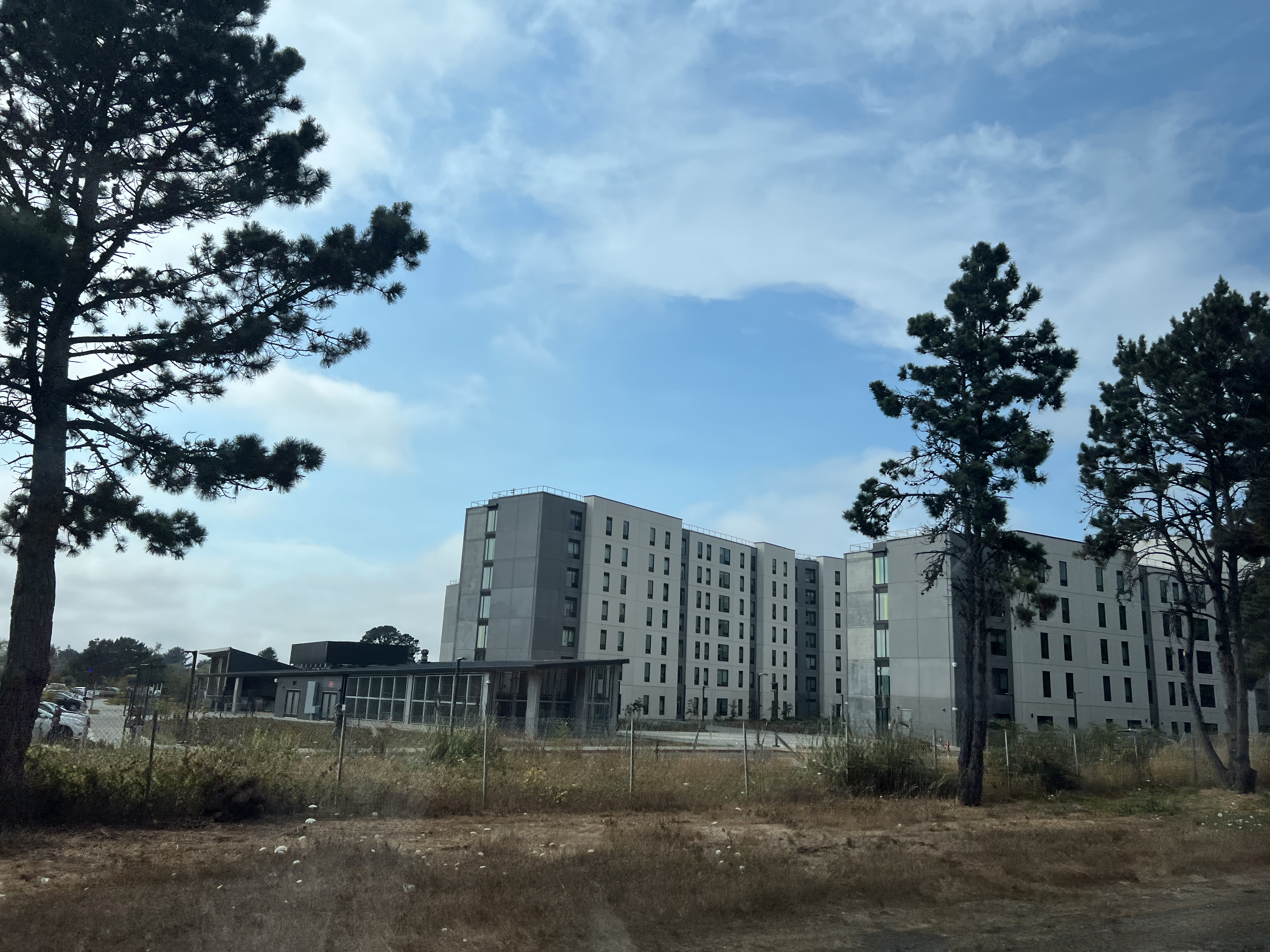
    Graham also described how the new Hinarr Hu Moulik dorms also function as an island of accessibility. 

    “It looks like it’s got some accessibility things and not some, but the buses were only running until 7 p.m. when it opened, and so people who had classes till 8 p.m. couldn’t get to it,” Graham said. “The shuttles are absolutely critical for our campus until we get those pathways accessible.”

    Mike Fischer, acting Vice President of Administration and Finance, responded to these issues. 

    “While construction projects are sometimes disruptive by nature, we fully understand how critical accessibility is for every member of our campus community,” Fischer said.We are aware of the issue of the dirt piles caused at the library and have informed our teams about the importance of maintaining accessible paths. We only close accessible parking spaces as a last resort, and only when there are no other options available.”

    Aaron Donaldson talked about his issue with administration finding band-aid solutions instead of addressing the root cause of the issue,

    “They have a thing where, if you bring them a fire, they put out that fire,” Donaldson said. “They don’t see that the campus is soaked in gasoline. They need to go get rid of all the gasoline. They need to find all the things that could burst into flames.”

    Barley is the photo editor and an untraditional reporter who focuses on social change and stories with a real human impact. If you’d like to reach him for whatever reason email bl258@humboldt.edu
  • Humboldt mourns loss of senior environmental studies major

    A university email alerted campus of the passing of student Nicholas Reed, a senior environmental studies major and member of the environmental studies club. The message notifying students was sent out Sept. 16 and included resources for those impacted by the loss. Reed was a deeply involved member of the community and was admired by students and faculty alike. 

    “Dear Campus Community,

    We are saddened to share news of the loss of student Nicholas Reed. Nicholas’ death is a loss for the Cal Poly Humboldt community, and our thoughts are with all of those who are close to him. 

    Nicholas was a senior Environmental Studies major and an active member of the campus Environmental Studies Club. Nicholas was known for his huge heart, his kindness, and his ability to connect with anyone through genuine conversation. He cared deeply about people, the Earth, and the importance of community. Passionate about marine ecosystems, he came to California with the hope of helping to save kelp.

    Nicholas recently shared his enthusiasm for just and communal food systems, participating in land stewardship at the Rou Dalagurr Food Sovereignty Lab, where he expressed joy in the work, pride in his contributions, and excitement to engage further with the community.

    Nicholas was a joyful presence in and out of the classroom. He regularly attended campus gatherings, eager to connect with others, and is remembered by his professors as a thoughtful, compassionate student, and by all who knew him for his warmth, generosity, and spirit of connection,” the email read. 

    Students seeking support can reach out to Counseling and Psychological Services (CAPS) at caps@humboldt.edu or (707) 826-3236. They can also access Telehealth support at any time through TimelyCare’s “TalkNow” feature. Faculty and staff can receive confidential support through the Employee Assistance Program, available 24 hours a day, seven days a week through Empathia.

  • Test Your Transit: Can you last a Week Without Driving?

    Test Your Transit: Can you last a Week Without Driving?

    by Miranda Ricks

    From Sept. 29 until Oct. 5, Cal Poly Humboldt students are invited to join the Week Without Driving challenge, a national event that encourages participants to spend an entire week without getting behind the wheel. The challenge was started in 2021 by Anna Zivarts, Director of the Disability Mobility Initiative. It aims to spotlight the barriers faced by non-drivers in a largely car-centric society.

    Arcata is generally appreciated by students for its free and often dependable public transportation. Many Humboldt residents already live car-free and use bikes, skateboards or the University Jack Pass program, which grants free, unlimited access to local bus lines. 

    “When I was living on campus, I walked literally everywhere,” Elsa Williams, a sophomore at Cal Poly Humboldt, said. “I used the overpass, I would walk into town, but everything was on campus, so I didn’t have to leave a lot.” 

    Williams has lived in Arcata without a car for over a year. After moving off-campus, her walking lifestyle transitioned to bus routes and carpooling. 

    “I come from Sacramento, and I also didn’t have a car there, and it was basically the same thing,” Williams said. “I had to figure out how the [public transit] worked, and then it took me everywhere.”

    Alternative transportation methods are especially favored for students amidst frustrations with limited parking options on campus. But even in a small town, the Week Without Driving challenge may reveal more serious questions about accessibility. Steep hills, narrow sidewalks and unpredictable weather can create obstacles for anyone, especially for students and faculty with mobility disabilities.

    “I really like having my car, because I basically never left campus last year,” Freddie Dasigner, a sophomore journalism major who brought his car up to Humboldt for the new semester, said.

    Dasigner recounted how navigating town on foot with an injury was near-impossible.

    “When I hurt my ankle, I was trying to walk everywhere on crutches,” Dasigner said. 

    Participants with cars are encouraged to explore non-driving methods to accomplish their typical daily routines. Whether it’s utilizing bus routes, walking, biking or carpooling, participants should try not to drive or ask someone else to drive them, unless it’s essential to their usual routine.Whether you already live car-free or are just curious about the setbacks of Arcata’s accessibility, the Week Without Driving is a chance to rethink mobility and see how our campus and community can improve for everyone.

    Miranda is a reader, writer, movie-goer, radio DJ and lover of all things pop culture. She is a senior journalism major with a concentration in public relations and the station manager of KRFH. She hopes to represent the local music scene through her writing for the Lumberjack.

  • Spagna prepares to step down for new president

    Spagna prepares to step down for new president

    by Nick Escalada 
    After a half-year delay, a successor to Cal Poly Humboldt’s Interim President Michael Spagna has been selected. Dr. Richard A. Carvajal from Valdosta State University in Georgia will be transferring to Arcata for the spring 2026 semester.

    Hailing from California State University, Dominguez Hills as provost and vice president of Academic Affairs, Spagna assumed Humboldt’s presidential office in 2024 upon Tom Jackson’s controversy-backed resignation. Since then, he has overseen the university’s continuing transformation into a polytechnic, welcoming in new campus infrastructure and academic programs.

    “[Carvajal] starts on January 20, so the beginning of the spring semester,” Spagna said. “I’m looking forward to that, because it allows me to have some closure with the campus of what my work has been about.”

    Administration postponed their selection from March to this semester after no favorable candidates were found. According to Spagna, Dr. Carvajal caught their attention for the nine years he served at a university that went through seven presidents in the previous eight years.

    “That’s not a way to build a university,” Spagna said. “I am completely confident he will bring a level of stability and longevity to this university that will really guide it through the next several years.”

    With much of the state’s $458 million grant yet to manifest on campus, Carvajal has a lot of growth to facilitate in the near future. Several construction projects remain incomplete, and officials maintain their ambitious goal to double the current student population to 12,000 by 2035. Despite this, Spagna holds faith that his successor will realize the full potential of this historic investment.

    “He is not, from my discussion with him, coming in with an agenda of, ‘I want to start this, this and this,’” Spagna said. “Instead, he wants to make sure that there really is self-actualization of this university, getting to understand student needs, the faculty and staff needs. And I will tell you, he’s very committed to shared governance and co-creation of things that the community really needs going forward.”

    Valdosta State has produced several leading teams in NCAA division II athletics. As a member of the Cal State system that is currently gutting programs across its schools, Cal Poly Humboldt’s attraction to Carvajal was partially owed to the success propagated under his leadership.

    “Athletics is the front porch to the university,” Spagna said. “I couldn’t be prouder of our student athletes, because they have the best retention graduation numbers, and they’re also what I call ‘glue students.’ They know teamwork and they work with peers who are non-athletes.”

    In the wake of President Jackson’s stepping down following his response to the pro-Palestine occupation of campus, concerns linger about a new president’s capacity to regulate student activism in an appropriate manner.

    “I think that he embraces that activism should be a part of the education process, and I think that it’s been under attack nationwide,” Spagna said. “But I’ve been really impressed with what this university has done over the last year or two to maintain its activism roots, but at the same time, be force for good where we can respect one another.”

    At such a high administrative role, the president’s duties are fairly divorced from the on-the-ground student activities they influence so heavily. Spagna has advised Carvajal to take caution toward opportunities that will pull him away from campus, and instead focus on connecting with his constituents.

    “You need to physically walk on campus,” Spagna said. “You need to be in student clubs, you need to be at activities. I went to a student honors recital in the fall, and students were so overjoyed that the president was in their presence. This is something that should be normalized. This should be something that always happens.”

    With three academic months left in office, Spagna’s presidency seems to be leaving as quickly as it came. As Carvajal bids his own farewells in the deep South, Humboldt’s latest leader promises the institution remains in good hands.

    “I’ll say this for the hundredth time: you’re going to love this person,” Spagna said. “He’s really committed. I could tell within a minute he’s a kindred spirit. He really cares about the things that matter, and he’s going to be phenomenal here.”

    Nick is the news editor at The Lumberjack, and studies wildlife and journalism with the goal of spreading his love of nature through media. A famous recluse, he is rarely seen at social functions, but you might dig him up in a SAC lounge beanbag chair. Chat with him at ne53@humboldt.edu!

  • Red and blue do not make green, California 2026 governor candidate visiting campus this week

    Red and blue do not make green, California 2026 governor candidate visiting campus this week

    by Lily Zwirzina

    This Friday, Rudolph “Butch” Ware, a candidate for the 2026 gubernatorial election, will be coming to speak at Cal Poly Humboldt. 

     Amidst a polarized political climate, Ware represents one of many U.S. parties beyond the two primary options. A number of Americans are familiar with the Green party, one of the more established independent groups. They arose in the late eighties out of increasing public demand for environmental and social protections. 

    Ware currently teaches African and Islamic history at University of California, Santa Barbara. During the people’s assembly, he will detail why — as an academic — he felt compelled to run for office.

     The People’s Assembly will be happening on the second floor of the Marketplace from 5:30 p.m. until 7 p.m. on Friday, Sept. 19. The event will also be livestreamed. If you would like to learn more contact @greenparty_humco on Instagram, or email the local chapter at greenpartyhumco@gmail.com

    Lily Zwirzina is a senior majoring in Environmental Science with a focus in Ecology and a Spanish minor. She leads the Environmental Studies (ENST) club as the vice president; off-campus she works with the North Coast Progressive Alliance (NCPA) and

  • Revisiting Voices of Van Life

    Revisiting Voices of Van Life

    by Bodhi Haugen
    During the height of midterms, an eviction notice was sent to multiple people sleeping in their vehicles on campus due to what administrators called, “unsanitary and unsafe conditions.” On Oct. 31, 2023, a decision enforced by university officials altered the lives of students overnight parking and disrupted a small community.

    Previously, students living out of their vehicles were allowed to sleep overnight in various campus parking lots. Some current and new van lifers still attend Cal Poly Humboldt, though their routines have since changed.

    “It used to be kind of like, it didn’t really feel like I’m a nomad, because I just had a home base. It’s like my house was on campus,” said Derek Beatty, a mechanical engineering senior. “Now, I don’t really feel like I have that anymore.”

    Despite the restrictions, incoming Humboldt students remain curious about trying a home on wheels. The lifestyle still has its upsides: financial freedom from rent and utilities, mobility and continuous access to personal belongings on-the-go.

    Ryan Crabtree, a wildlife major and junior transfer student moved to Humboldt having had issues getting accepted into a room for rent. 

    “I was too concerned about not having housing at all,” Crabtree said. “So, I bought a cab-over camper, put it on my truck that I already had, and said, ‘I’m going to figure this out in this direction.’” 

    Beatty has been taking advantage of some of van life’s luxuries around Humboldt County. Having a consistent sense of home wherever you go has its own set of advantages regarding schedules and comfort. 

    “I can go to cool places and still be just as comfortable as I am all the time,” Beatty said. “If I go to someone’s house and they’re not ready or something, I don’t really mind waiting because I’m still home, which is nice. And saving money on rent is, you know, huge.”

    The university currently has no plans to lift the overnight parking ban on campus. However, van lifers are advocating for a policy shift that includes designated parking spaces, a communal kitchen and on-site restroom access.

    “It would be so huge, if they just had a designated parking area with five to 10 spots, you know, that’s not hard for them to do,” Betty said. “It would be huge for all the people dealing with this. It’s not that many people.”

    Current van lifers hope to rebuild a tight-knit on-campus community like the one that existed before the eviction. The van life culture at Humboldt continues on, with students supporting one another and finding joy in the freedom the lifestyle offers.

  • Fish of the Week: The Garibaldi

    Fish of the Week: The Garibaldi

     Hypsypops rubicundus

    The Garibaldi, the Golden State’s official marine fish, was declared in 1995 and named after General Giuseppe Garibaldi for his recognizable red shirts. Also known as the Catalina goldfish, if you ever have the pleasure of diving or snorkeling in Southern California reefs, you will see these protective fish in abundance. 

    They are truly a star in their own right, and California’s coastal mascot, so visible that they can be seen without setting foot in the water. Their distinctive orange color also makes Garibaldi an indicator species whose population health and stability provide divers and scientists with insights into the overall condition of reef ecosystems. Garibaldi’s grazing maintains the biodiversity that keeps these habitats balanced, so kelp and other species don’t get overrun by invasive species like urchins.

    Male Garibaldi spend a lot of time decorating their nests in hopes of female visitors, cleaning and collecting to create an attractive and safe home for potential mates to lay their eggs. These fish are not currently under any threat and are listed as a species of ‘least concern’ by the International Union for Conservation of Nature. Under the California Department of Fish and Wildlife, the collection or catching of Garibaldi is prohibited.

    Don’t miss next week’s issue for one of our neighboring states’ fish! For any science section stories, please contact ajw167@humboldt.edu.

  • What’s with all this talk about chalk?

    What’s with all this talk about chalk?

    By Barley Lewis-McCabe

    he newest alteration to the Time, Place, Manner policies requires an additional form to be filled out through conference and event services in order to chalk, stake, or put up posters, banners or tables. As per the email sent out, same-day options are available for posters and tabling, but it’s advised to allow a two-day waiting period for any request.

    Contrary to popular belief, the chalking and promotional materials policy itself have not changed; rather, the new form was implemented with the goal of making the process to advertise easier. Still, some students felt puzzled about why the change is being pushed. Junior Tatiana Bond of the Marching Lumberjacks spoke on the issue.

    “As of right now, I haven’t seen any major differences, except having to fill out the application  that’s a bit longer,” Bond said. “I think people who I talk with just view this as a bit of an annoyance of having to fill out more, but not an issue fully.” 

     Heather Honig, Dean of Students Office Administrator, discussed their ambitions for the new form. 

    “The result should be fewer barriers for students and organizations who want to share their messages, while ensuring the University can respond promptly and consistently,” Hoing said.

    Junior Aubrey Coyne, vice president of recruitment for the Delta Phi Epsilon sorority, talked about some of her confusions with the policy.

     “I just think the whole overall thing is just strange, but I don’t think I’m part of the group most largely affected,” Coyne said. “[Those are] maybe people that don’t align with the image that the [California State University] system is trying to present.”

    Coyne speculated on the cause for the increased protocol as a response to the pro-Palestine protests from spring 2024.

    “I saw the quad, and there was chalk everywhere,” Coyne said. “And you could tell, nobody within administration had a handle on it while it was going on. I think that lack of control kind of scared them a little bit.” 

    Honig opposed this position, stating how the alterations further foster an environment of free speech. 

    “It further protects free speech by ensuring that only University officials or the sponsoring organization may remove it,” Honig said. “It helps create a fair, safe, and respectful environment for expression.” 

    Barley is the photo editor and an untraditional reporter who focuses on social change and stories with a real human impact. If you’d like to reach him for whatever reason email bl258@humboldt.edu

  • Moldy past, greener future: reimagining campus apartments’ former site

    Moldy past, greener future: reimagining campus apartments’ former site

    By Ryan Diaz
    The former Campus Apartments were plagued with mold last semester, leading to their demolition in July. This left many Cal Poly Humboldt students questioning what will take its place. 

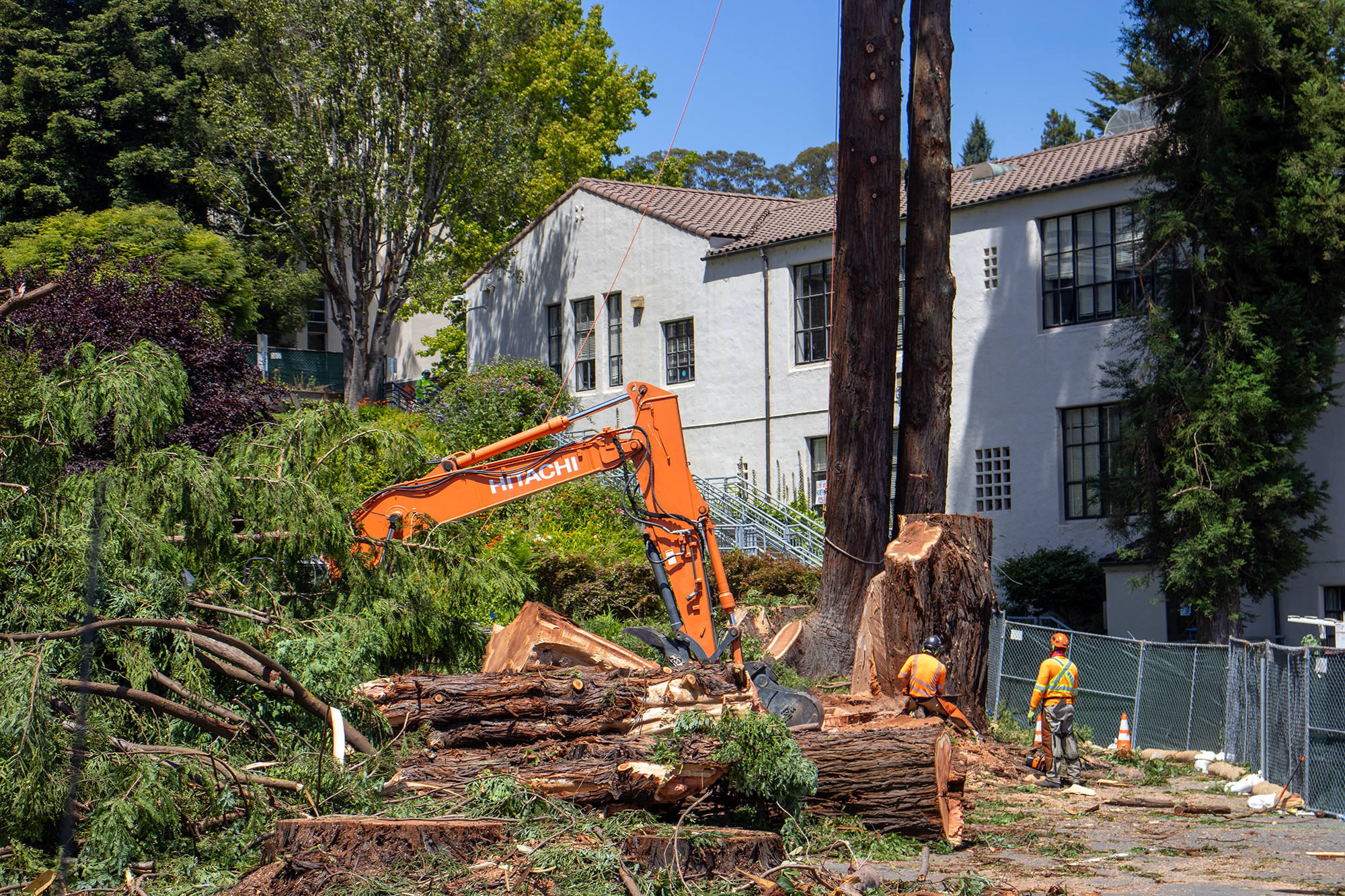
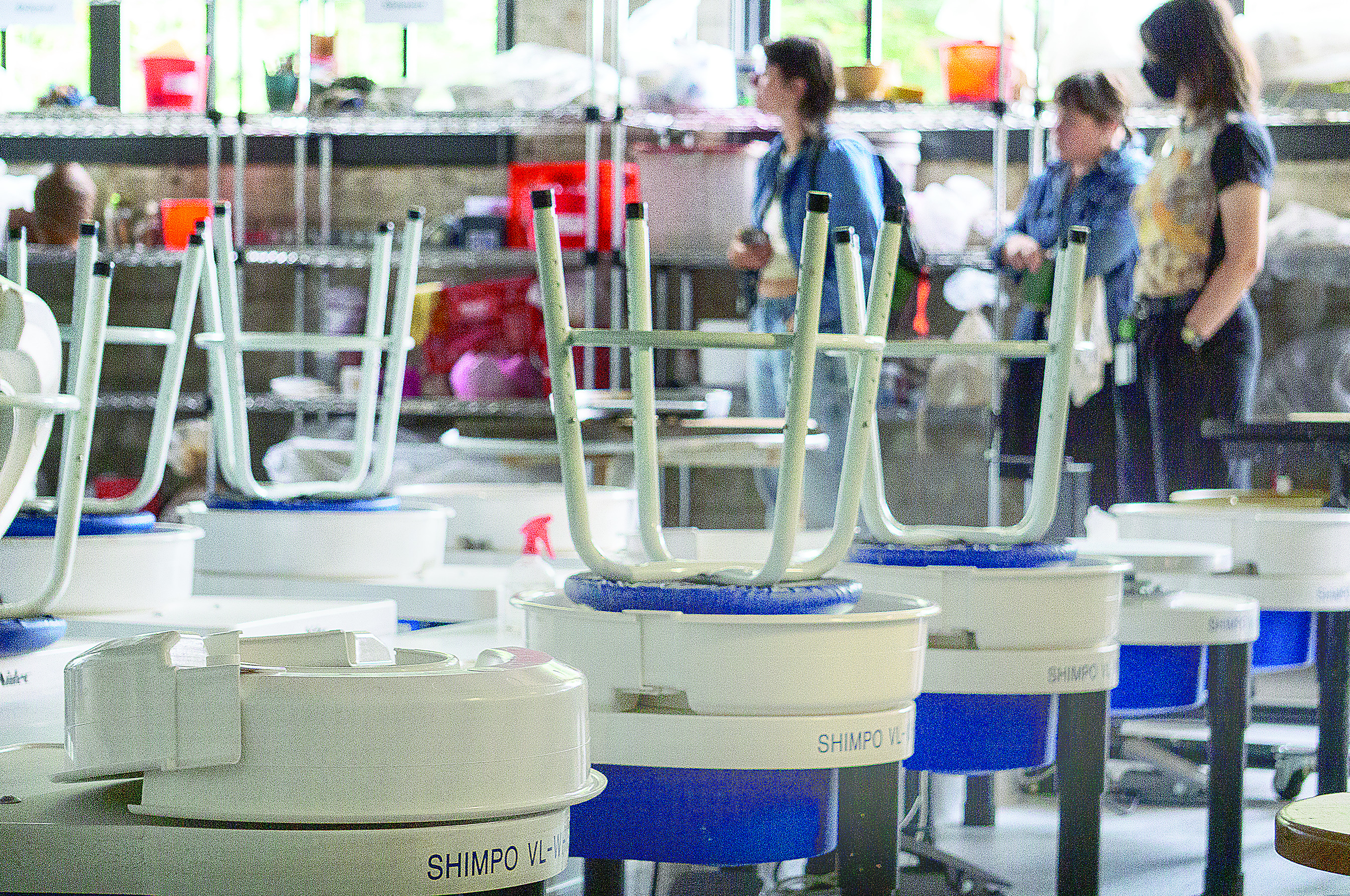
    Last summer, demolition began on campus apartments after repeated reports of mold from residents. This vibrant space was once filled with 37 varieties of trees, the former ceramics and sculpture labs and campus apartments. What remains now is an empty landscape that was formerly full of life.

    Interim Vice President of Administration and Finance Michael Fisher oversees the responsible use of physical and human resources to support students and their educational experience, including this project. 

    “The rehabilitation effort will include native and wild landscapes, with plans to add green space and seating for the community at the top of the hill,” Fisher said. “Some of the redwoods that were removed will be reused on the hillside as part of a regenerative native landscape, while others will be milled locally for use in small campus projects such as benches and site elements.” 

    Fisher also said that the hillside rehabilitation will be completed before the end of the fall 2025 semester. 

    “Longer term, the areas that were previously home to the ceramics and sculpture labs will be the site of the new Housing, Dining and Health building, which is scheduled to begin construction in 2027 and be completed in 2029,” Fisher said. 

    Students and staff can expect to see these changes in our near future with the expansion of the campus over the next several years. 
    Ryan Diaz is a senior at Cal Poly Humboldt and is a second-semester reporter who has an ambition to work in the public relations field after graduation. He is also a DJ on 105.1 FM KRFH, hosting a weekly show on Thursday from 7-8 P.M.

  • Fire contained in community forest

    Fire contained in community forest

    By Ursula Newman
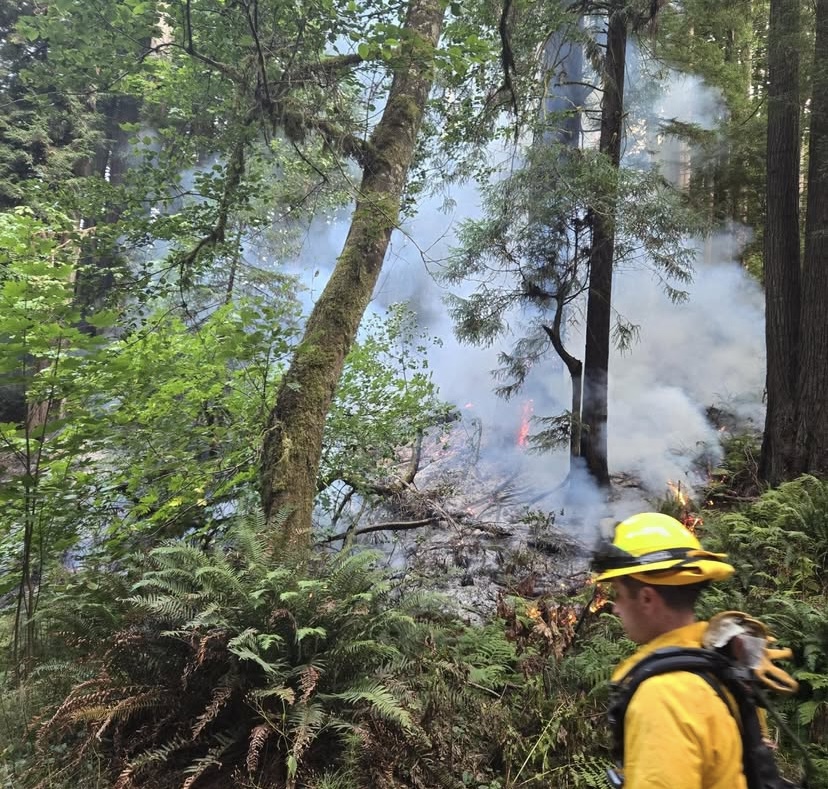
    Fire personnel responded to a report of smoke near Granite Avenue in the Arcata Community Forest on Thursday, Sept. 4. The initial response was a single engine for a smoke check, but as more smoke was observed, additional resources were requested. The response took around five hours from notification to completion, with the fire covering just over a quarter of an acre. 

    Arcata and University Police assisted in locating the smoke, which led to a full response involving all on-duty engines and mutual aid partners in the area. CAL FIRE sent an engine crew from Trinidad and a hand crew from Fortuna to assist. Humboldt Bay Fire and Blue Lake Fire also provided aid to cover the district while the fire was being managed.

    The fire was in brush and timber, spreading slowly over a couple of hours. The exact cause remains unknown.

    Arcata Fire Chief Chris Emmons said an encampment site was found along the edge of the fire.

    “If I had to speculate, it looked like it very well could have been like an encampment fire left unattended that spread over a few hours,” Emmons said. “I couldn’t say 100%, but that’s the only source of ignition I could find in the area.”

    Andrew Ramirez arrived on the scene from Fortuna as part of CAL FIRE’s hand crew. 

    “We established a fire line all around the perimeter of the fire,” Ramirez said. “We made sure that there was nothing sticking over the line that could potentially catch fire and spread over. There were one or two larger redwood trees that were caught in the fray that got burnt up about halfway up their trunks.”

    In the following days, Arcata Fire continued to monitor the area.

    “Our crews went back for the next couple of days to check and see if there’s anything within the containment lines that was popping up, like we call it, ‘checking for smokes,’” Emmons said.

    Emmons views the incident as a reminder of the importance of early reporting and community vigilance.

    “With the right conditions, fires can spread and cause significant damage. So if [you] see something, certainly call us,” Emmons said. “You’re not going to get in trouble for it. We would much rather come and find something small, than not get notified and have to use more of our resources on something that’s larger.”

     Ursula Newman is a journalism major, Lumberjack social media manager and Humboldt local. You can find her all over the county doing all kinds of things, and talking to all sorts of people.

  •  2 parking passes, what’s the cost?

     2 parking passes, what’s the cost?

    By  Sadie Shields

    In addition to the Hinarr Hu Moulik (HHM) dorms’ required meal plans and relatively pricey housing, residents commuting by car will be required to purchase a single pass, choosing between parking closer to the dorms, or parking at school. 

    According to Humboldt’s Official Parking Permit and Fees Information, “HHM permits are not valid for parking on the main campus during weekdays. However, HHM residents can park on the main campus from 5:00 p.m. to 12:00 a.m. on weekdays and all day on weekends.”  

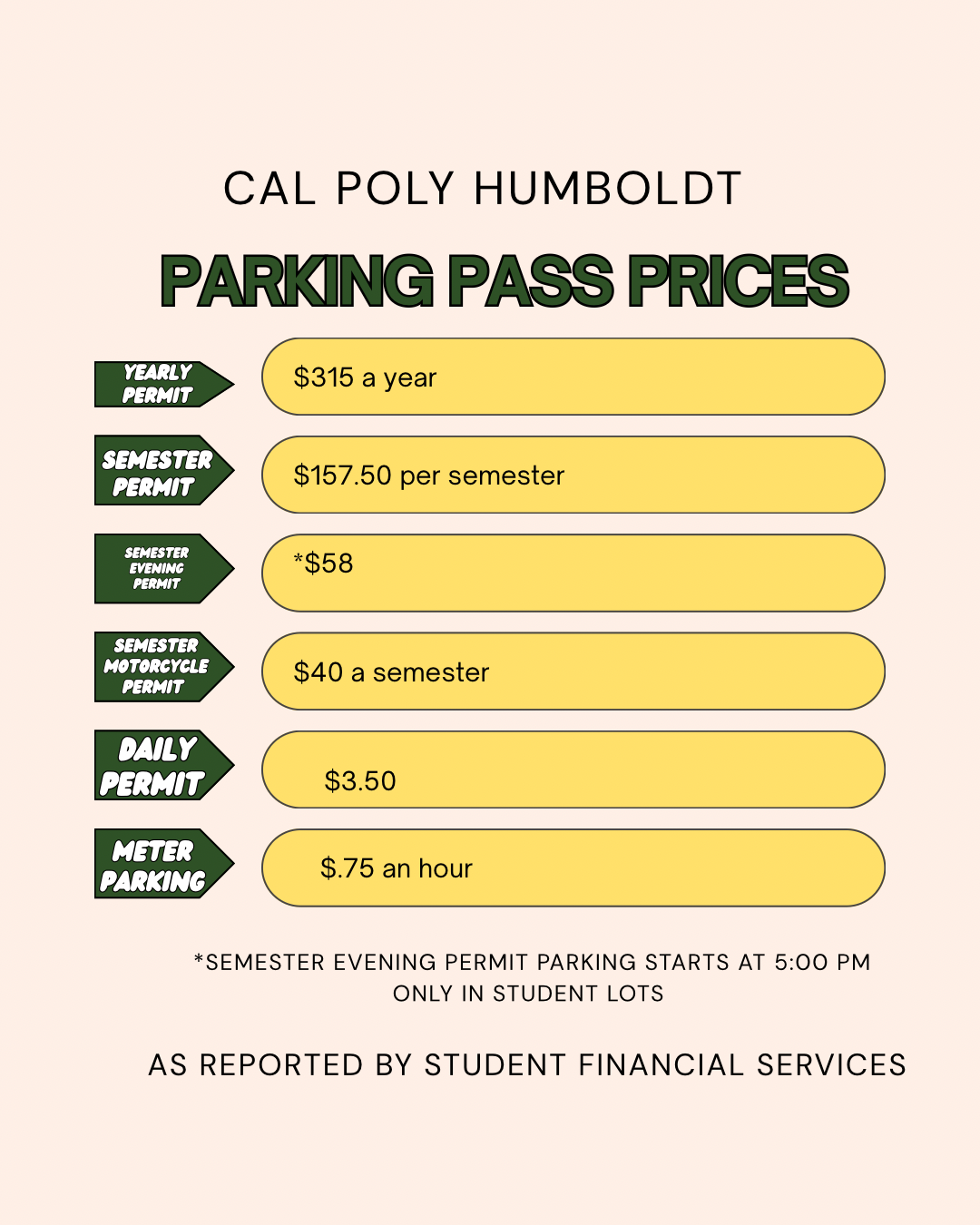
    Students who bought a parking permit for HHM cannot buy the parking permit for campus and can only park at school after hours. Those who desire to go to school and park on school grounds will need to pay for the daily parking pass. 

    “Students will need to choose one type of permit,” Humboldt Communications Specialist Melissa L. Hutsell said. “A Hinarr Hu Moulik permit allows you to park in the Hinarr Hu Moulik residence hall lot, while a main campus resident permit allows you to park in resident lots on campus. You cannot hold both permits, and a single permit does not allow parking in both locations.” 

    Hutsell also mentioned that students who did not purchase an HHM parking permit in time were put on a waitlist. Waitlisted students are not allowed to park in the HHM lot unless a space becomes available and they are offered a permit. Waitlisted students are still able to purchase a main campus resident permit and use the shuttle service to commute to and from the campus.

    Shiloh Litke, a junior communications major, talked about the difficulties of parking on campus and the cost she pays for daily parking.

    “Any time I pay for campus parking, it is around two to four dollars,” Litke said. “I wish it was free for students. People who paid for the passes are still unable to find parking, so they have to pay for the daily parking at the meters.”

    According to Humboldt’s official website, general parking for fall and spring can cost up to 315 dollars. This amounts to a daily expense of three dollars and 50 cents, almost 20 dollars a week for a full-time student.  

    Those who desire to go to school and park on school grounds will need to pay for the daily parking pass. For students who have purchased a parking pass at HHM, there are residential streets and metered parking available. Alternative methods of travel include public transportation or by foot.

    Sadie is a junior Communications Major, Journalism minor at Cal Poly Humboldt who has an interest in covering and taking photos for sports or wildlife journalist, and a slight interest in breaking news. She can be reached at sls331@humboldt.edu

  • More students, new grant opportunities

    By Nico Patakidis

    During an Associated Students (A.S.) meeting on Sept. 5, information about increase in enrollment and discussion of proposed A.S. grants for the 2025-26 academic year were introduced. 

    Dr. Chrissy Holiday, Vice President of Enrollment Management & Student Success, shared at the meeting that student enrollment at Cal Poly Humboldt has increased by 4% this fall semester. Enrollment has been increasing each fall semester since 2022, the same year the university became a Cal Poly, with this fall being the largest growth so far. Holiday said that the growth of the student population will also increase the A.S. budget for funding programs and services. 

    Nate Heron, the Administration and Finance Vice President, proposed three new A.S.  grants at the Sept. 5 meeting. With $45,000 available to fund grants, $20,000 was dedicated to on-campus grants and $25,000 dedicated to off-campus grants. 

    The on-campus grant, Starting Initiatives, is designed to support individual students or groups that aim to take action around campus to support students’ basic needs. However, the movement was not passed as board members discussed that the grant description of ‘basic needs’ was too broad. The movement was postponed until it could be refined further and looked over by the finance committee. 

    The proposed off-campus grants are for students that are looking to travel in order to benefit their associated registered student organization (RSO). The proposed travel grant would cover costs such as lodging and flights. The second proposed off-campus grant is the Professional Development Grant. This grant covers the costs required to attend conferences or competition entrance fees, though it would not cover any fees related to travel. Both off-campus grants are required to benefit an RSO the applicant is a part of. 

    An increase in student enrollment allows for a larger A.S. budget that can be used to fund these grants. As grants continue to be proposed, revised and approved, students will have more opportunities to further their education, benefit their RSO and bring change to Cal Poly Humboldt’s campus. While the off-campus and on-campus grants were not passed during this A.S. meeting, a motion was passed that the grants will be revised and revisited in the next A.S. meeting on Sept. 19.

    Nico is a sophomore journalism major with an interest in covering local government and political affairs. In his free time he enjoys hanging out and can be reached at np211@humboldt.edu.

  • Campus pissed on, students pissed off

    Campus pissed on, students pissed off

    By Jasmin Shirazian

    An account on TikTok by the username @cphpisser has spent the past several days uploading videos to the platform that suggest a person urinating in different parts of campus. In one video, the user secretly films from the bushes and captures a group of unknowing students on the Redwood Bowl field in the background of the act. 

    The anonymous user has remained faceless and the videos only show a stream of liquid in various common areas, such as the steps of Founders Hall. Public comments on the videos vary from disgust to disbelief. One commenter said the videos breach the line of consent. 

    “Disregarding people who are bringing up that they feel uncomfortable with the video being up as overly sensitive is perpetuating a culture of ignoring consent,” user @momoneymoproblems003 said. “If you want to pee around campus and take videos, that’s gross, but please don’t include people who did not consent to being in a video of this nature in them.” 

    A specific post has caused discomfort and unease for viewers. The unknown subject started the video by zooming in on a women’s campus sports team, and carried on to show a stream of liquid aimed at the bushes directly in front of them. This was in an area where they could see the team, but could not be seen directly by players. 

    Commenters vocalized their distaste for the actions of the poster, with a few stating that the videos border the line of sexual assault. A user by the name @barelylucidlibra, said, “Okay, now it’s getting sexual assualt-y [sic]… purposefully watching people and peeing while they don’t know you’re watching is giving non-consensual voyeurism.” 

    While the videos and the username imply that the user is urinating throughout campus, a few commenters speculate that they are instead spraying a bottle filled with liquid. The most recent video from the user shows them in the quad, an area of campus that is surrounded by security cameras, leading some commenters to believe that the poster would be unable to get away with public urination and indecency. 

    This appears to be a trend throughout the country, with similar accounts emerging at other universities. San Diego State University has @SDSUpisser, University of Missouri has @mizzou.pisser0, Pittsburgh State University, Ohio University — an ever-growing list of participation in a trend seemingly centered around public urination. 

    The Lumberjack reached out to the account, who replied, “Don’t believe everything you see on the internet.”  

    University spokesperson Director of News and Information Aileen Yoo said they were unaware of the actions of the individual. The Lumberjack reached out for further comment, but did not receive a response at time of publication.

    Jasmin Shirazian is the award-winning, curly-headed managing and copy editor of The Lumberjack. Her beats range from breaking news to covering local performances. In her free time, she enjoys leaving the country and spending time with her cat. Inquiries can be sent to js760@humboldt.edu.

  • Jenkins Hall is back in business—but is it built for students’ growth?

    Jenkins Hall is back in business—but is it built for students’ growth?

    By Jess Carey and Julia Kelm

    As one steps through the large glass double doors of freshly remodeled Jenkins Hall, they are greeted by a branded H. rug and the potent chemical smell of the future. The building is now home to Cal Poly Humboldt’s ceramics and sculpture programs. With the help of 12 million dollars, it was transformed from an abandoned warehouse into a state-of-the-art sculptor’s paradise.

    Jenkins Hall has replaced the previous studio, affectionately referred to as The Laundry, which was demolished alongside the Campus Apartments over the summer. 

    The Laundry was an eclectic space infused with a D.I.Y spirit, having housed the ceramics and sculpture programs since 1969. Handmade tiles covered walls and floors, paintings hung from the rafters and bookshelves overflowed with sculpture magazines and reference books. Drips of glaze, paint and slip coated the sinking concrete floors. 

    Leah Dunn, a studio art and art education major, attended classes at the Laundry when it was still operational.

     “It felt well-loved, and I could tell that it had been a creative home for a lot of artists that were creating art long before I got there,” Dunn said.

    Despite being beautiful and well-loved, it was always intended to be a temporary home, and as such there were limits on what the space could accommodate. Sculpture professor Sondra Schwetman taught classes in the old building for 20 years. She said that the building had been charming — but also cramped and dirty, and students had issues keeping projects clean. 

    “There was a lot of elbow bumping in the Laundry,” Schwetman said. 

    She explained that the lab has new and improved tools and an expanded floorplan including a separate woodshop and metal shop as well as a forge. 

    “We are so much improved from being in the Laundry. We are just really excited for the potential,” Schwetman said. “I do think that for our students that experienced the other place, that this seems really clean.”

    Schwetman also plans to install photos and memorabilia from the Laundry as a display inside the new building. 

    Despite the many upgrades, students who are taking classes in Jenkins Hall say that it feels like things were not laid out as well as they could have been. 

    “There are two sinks, which get crowded pretty fast,” Dunn said. “And then [there’s] a giant sink-like thing in the corner that would be so helpful, but we aren’t allowed to use it.”

    Senior fine arts major Trinity Altemueller said that some students have experienced frustration with the new building. 

    “It’s like an art studio that was designed by scientists,” Altemueller said. “It feels like a lab. It’s so sterile.”

    The harsh industrial vibe of the new studio is certainly a contrast to the Laundry’s wonky charm. Piles of cardboard boxes and empty offices are noticeable. Bare concrete walls have exposed metal bits sticking out and wood shards, evident of a freshly-completed and perhaps somewhat rushed construction job. Creating here may be awkward for some until the Humboldtian creative spirit has enough time to warm up the atmosphere. 

    “A couple classmates were talking about wanting to add murals and stuff to make it feel less like a prison and more like our creative home,” Dunn said. 

    The Laundry was a misfit studio for a misfit art department, and a reminder of a particular period of creative explosion in Humboldt that has now come and gone. As for this generation of artists, sculptors and potters, there is a new canvas to paint or piece to throw. Jenkins Hall has more resources and amenities for current and future students to continue to create exceptional work — although it came with the loss of a treasured part of campus history. 

    Art Department Chair Nicole Hill said that the university’s efforts to provide a new space for artists is symbolic of art’s place in the university’s future. 

    “It’s a sign of big commitment from the university and the California State System as a whole in the arts in our region,” Hill said. 

    She added that any problems associated with the transition have easy fixes. 

    “There are growing pains, things that happen anytime you move,” Hill said. 

    Art students continue to adjust to the space as a new chapter of local art history begins. While the Laundry will be missed, Jenkins Hall has the potential to become a vibrant hub for creativity on campus. 

    Jess Carey is a senior studying botany with a journalism minor. Their writing branches interdisciplinary interests in science, music, and arts.

    Julia is a journalism major, and is the life and arts editor for the paper. She loves film and is a regular on Letterboxd. She also enjoys going on walks in the forest, and taking pictures to relax. If you have a movie you want her to review, email her at jk328@humboldt.edu 

  • Reel Talk with Julia

    Reel Talk with Julia

    Kpop Demon Hunters hit some good notes, but didn’t really stick the landing.

    By Julia Kelm
    KPop Demon Hunters (2025) is Netflix’s newest money-maker, which hit streaming platforms on June 20. The plot centers around Kpop group “Huntr/x,” and its members Rumi, Mira and Zoey who actually come from a long line of singing demon hunters. 

    However, the three girls are faced with their biggest challenge yet, as a group of demons disguised as a boy band try to steal their fans and take over the world.

    The animated film is produced by Sony, which is noticeable with the quality of the animation. Sony is known for its sorta choppy, comic book-esque animation style that was noteworthy in their recent animated works like Spider-Man Into the Spider-Verse and The Mitchells vs. the Machines. It’s a shame that this film didn’t have a proper theatrical release, as a film of this quality would have been much more enjoyable in a theater.

    Overall, I would say this movie was a good time, but not noteworthy in the long-run. The story is fine, but it was just missing a lot that would’ve taken it to another level. 

    For instance, early on it’s revealed that Rumi is also part demon. Her father was supposedly a demon, but as an orphan, Rumi’s demonic origins aren’t expanded upon much.

    In addition, the main demon boy Jinu, is revealed to have an interesting backstory as well and has a semi-romantic thing with Rumi. Both of which go nowhere.

    Rumi’s friendship with the other two girls, Mira and Zoey, is also severely underdeveloped. This was disappointing, since one of the major themes the film seemed to be pushing was female friendship. 

    The lack of development in aspects of this film may be due to unconfirmed suspicions that the film was originally supposed to be a TV series. Another disappointment, because I think I may have enjoyed this more if it had more time to tell its story. 

    Lastly the music, although decent, left little to be desired. I asked someone with more knowledge about music for their opinion on KPop Demon Hunters. 

    “[When] Rumi and Jinu meet up and Rumi starts singing ‘Free,’ I just think it needs a little more build up,” said Hayden Hilscher, a theater and music minor at Cal Poly Humboldt. “Both because the emotional beats feel a little rushed, and to make the song feel earned or justified to start at the moment it does.” 

    I agree. The music was good, it just felt a little out of place at times. I think this could’ve been improved if the film decided to take a more traditional musical approach.

    Overall, if you didn’t stream KPop Demon Hunters over the break, I would give it a shot if it interests you. Feel free to email me a complaint if you disagree.

    Julia is a journalism major, and is the life and arts editor for the paper. She loves film and is a regular on Letterboxd. She also enjoys going on walks in the forest, and taking pictures to relax. If you have a movie you want her to review, email her at jk328@humboldt.edu.

  • Cal Poly Humboldt in transition: New programs and housing for students

    Cal Poly Humboldt in transition: New programs and housing for students

    By Serah Blackstone-Fredericks

    Since Humboldt State University’s transition to Cal Poly Humboldt in 2022, the school has offered additional majors, with plans for a total of ten new programs by 2029. The newly added leadership studies, geared towards upper division transfer students, will be held fully online and supports an increase of the student population and adult learners returning to school. 

    The new B.A. in critical agriculture studies & agroecology highlights creative career paths — such as a fiber and plant dye artist — while reflecting Humboldt’s choose-your-own-adventure spirit. After all, it’s the breathtaking landscape and peaceful coastline that invokes a certain magic, drawing many students to our campus. 

    Lilly Snibley, a wildlife major, shared that after multiple transfers, she was finally able to find her people in a nature-oriented community after attending a few colleges and not having positive experiences. 

    “Humboldt’s very welcoming, very low-key –– it’s a lot quieter,” Snibley said. “It feels very down-to-earth.”

    Amid these exciting new programs, campus facilities are also undergoing major transformations. The ceramics building has been demolished to make more space for housing, and per Mike Fisher via Redwood News, this will be the last major project in a new era of change towards the Cal Poly Humboldt designation.

    The uninhabitable campus apartments were demolished over the summer, with construction of a student health building commencing. Hinarr Hu Moulik — the new campus dorms off St. Louis Road — are officially open, adding housing for up to 964 additional students and are almost 90% occupied. 

    The current 6,182 student population is rapidly growing, with hopes that additional programs and funding will expand the school’s capacity to 8,500. This fall saw a 9% increase in the transfer student population and the transfer student welcome dinner was noticeably larger than in spring.

    As the CSU target is 6,347, the goal is that 165 more students will enroll. With Humboldt’s draws — smaller class sizes, a more personable approach to academia, excellent faculty and strong student services — many hope that word will spread. Jordyn Jones, a psychology M.A. student shared her reasons for attending.

    “What drew me here was the ocean and the trees,” Jones said. “The campus is beautiful. I really wanted to do my masters in person and this was the closest one.”

    Thankfully, housing is now being addressed after poor planning left many students struggling to complete their degrees. Jones shared some of her inconveniences, which include parking challenges due to being a commuter student.

    As many who live here are aware, housing can be a major challenge at Cal Poly Humboldt and hopefully, the new dorms will add a bit of relief to the housing insecurity and homelessness that is a part of a larger problem within California universities. With almost 70% of students reporting that they reside off-campus, housing has been a point of contention, affecting both students and the local community.  For incoming transfer students, these changes signal a campus in transition — growing programs, improving housing, and offering an intimate learning environment in one of California’s most unique regions.

    Serah Blackstone-Fredericks is a cross-disciplinary anthropology major, minoring in arts in health and narrative medicine. A writer, musician, and mother, she weaves together her studies with creative practices like gardening, cooking, fermenting, and natural dye experiments. Her work explores the ways culture, storytelling, and connection shape how we live and heal. Feel free to connect with her at sb625@humboldt.edu

  • How will the big beautiful bill affect student loans, healthcare and snap?

    How will the big beautiful bill affect student loans, healthcare and snap?

    By Barley Lewis-McCabe and Nico Patakidis

    The Big Beautiful Bill serves as one of the largest and most impactful acts of the Trump administrations and includes hundreds of changes to policy from radical tax cuts to clean energy reduction. 

    Healthcare:

    The One Big Beautiful Bill Act (OBBBA) includes a $28.4 billion cut for federal medicaid funding in California, which could leave 3.4 million Californians without healthcare. Medicaid provides a significant source of income for rural hospitals by covering patients that wouldn’t otherwise have access to healthcare. As of July 2025, over 300 rural hospitals across America are at immediate risk of closure, one of those being Mad River Community Hospital in Humboldt County. The increase in uninsured patients due to Medicaid cuts could increase the ongoing problem of rural hospital closure. 

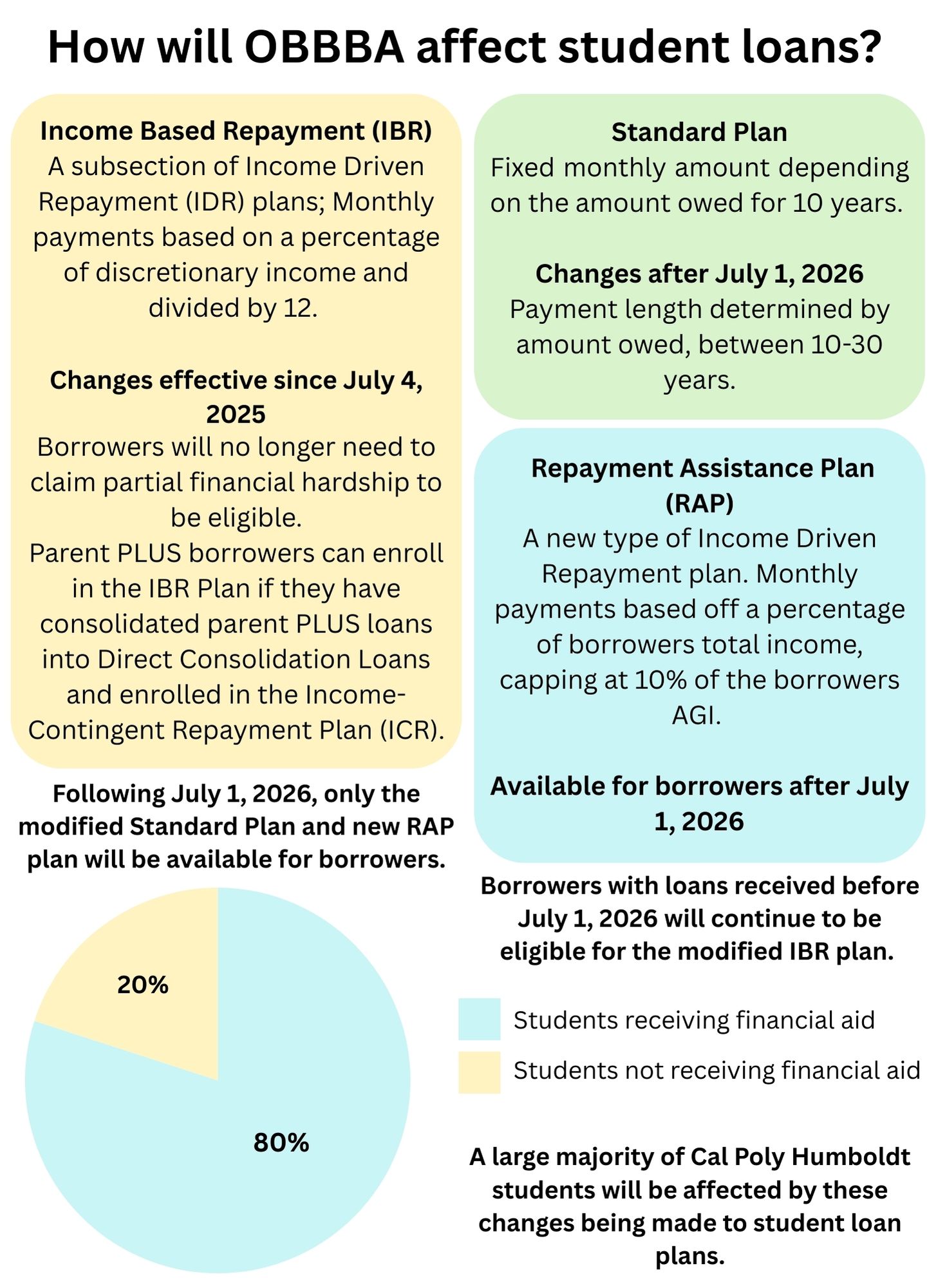
    Infographic describing how Trump's Big Beautiful Bill will effect college students.
    Infographic by Nico Patakidis

    Snap:

    The OBBBA will cut federal funding to Snap programs by $186 billion over 10 years. Previously, administrative costs for Snap programs were funded 50/50 by state and federal governments. Moving forward state governments will have to provide 75% of administrative funding. OBBBA also enacts work requirements to receive Snap benefits. The bill states that able-bodied adults are mandated to work for 20-80 hours a month. This includes community service, training and unpaid labor as well as jobs. Previous waivers for veterans, unhoused people, and former foster children have been eliminated. 

    When approached for comment on how the Big Beautiful Bill could affect Oh Snap on campus, Cal Poly Humboldt Communications Specialist Melissa L. Hutsell said, “At Cal Poly Humboldt, we know that access to healthy food is essential for student success. While the full impact of federal cuts is still uncertain, we remain committed to advocating for resources that help students meet their basic needs so they can focus on their education.”

    Student Loans:

    Along with the changes made to the different student loan repayment plans, the OBBBA has also introduced modified borrowing limits for new loans starting July 1, 2026. Graduate students are currently being allowed to borrow up to the amount that is needed for their graduate programs, capped at $138,500. Once the new limits go into effect, graduate students will only be able to borrow a lifetime amount of $100,000. The OBBA sets a new lifetime limit for the combined loans of undergrad and graduate loans at $257,500. New loan limits are also being set for those enrolled in the Parent PLUS program, at $20,000 a year and $65,000 a year. 

    Barley is the photo editor and an untraditional reporter who focuses on social change and stories with a real human impact. If you’d like to reach him for whatever reason email bl258@humboldt.edu.

    Nico is a sophomore journalism major with an interest in covering local government and political affairs. In his free time he enjoys hanging out and can be reached at np211@humboldt.edu.

  • Increased ICE presence during summer brings concerns to Humboldt

    Increased ICE presence during summer brings concerns to Humboldt

    By Nick Escalada

    EDIT: Parts of this story were edited for clarity.

    Immigration and Customs Enforcement (ICE) is a bureaucracy that has gone largely undiscussed in the public sphere until the start of Donald Trump’s second presidential term. Over the past year, the agency has been hard at work delivering on the president’s promise of deporting undocumented immigrants in the United States en masse.

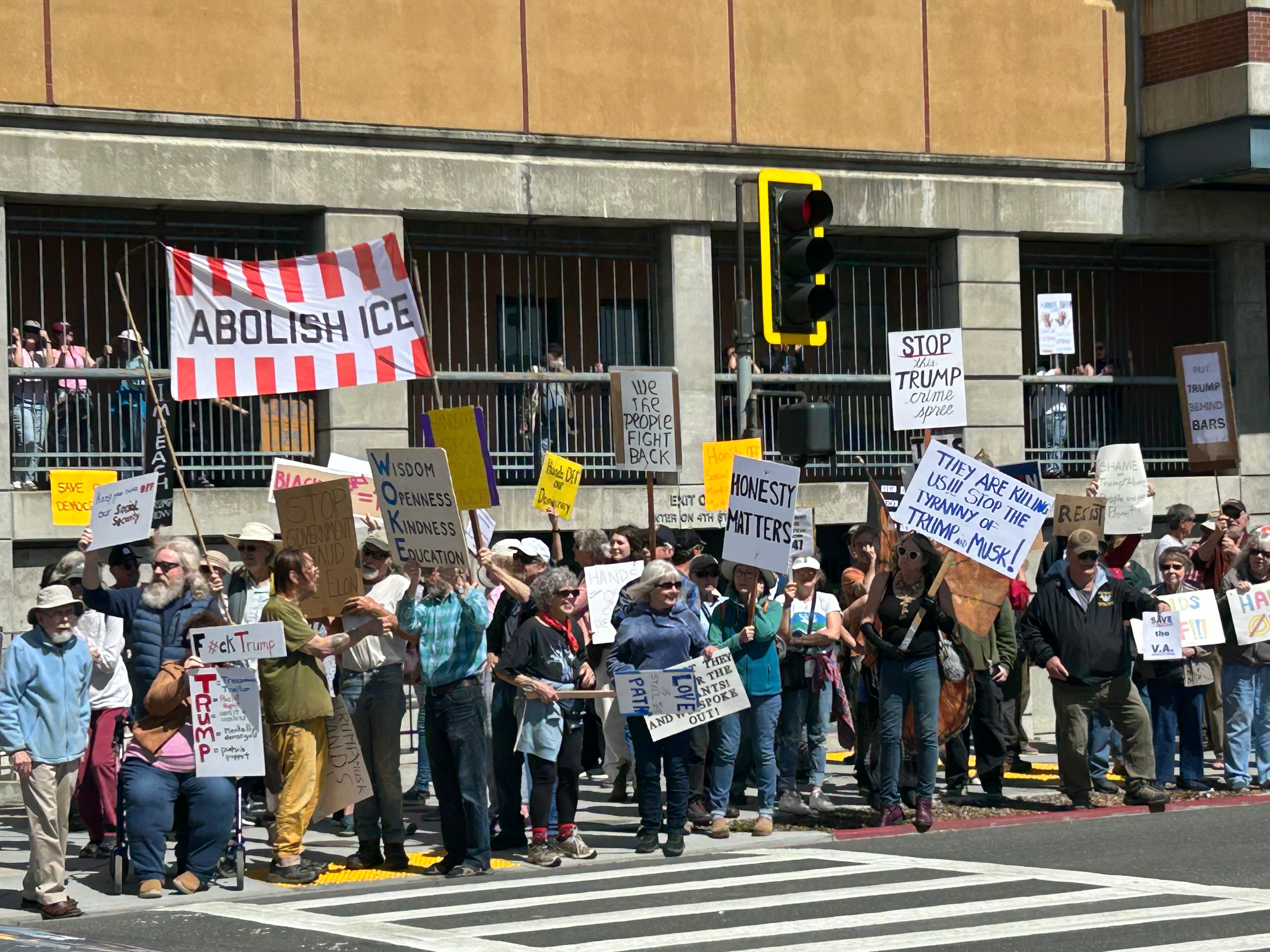
    This initiative has sparked an unprecedented level of controversy and outrage across the nation, with individuals seen unwillingly collected by masked agents in unmarked vehicles. Many have likened this to kidnapping, and major cities like Los Angeles have seen large-scale protests with violent police retaliation.

    Rather than strict documentation status, ICE often selects their targets based on whether or not they are Latin American, which appeases Republican voter concerns on southern border security. With a largely LA-native student body and a rapidly growing Latino population of nearly 30% (according to IPEDS in fall 2024), Cal Poly Humboldt finds itself in a vulnerable position.

    Peyton Leone, the communications and research manager at Centro del Pueblo — an organization dedicated to supporting Latiné and Indigenous migrants in Humboldt County — shared how the resource center keeps track of ICE raids for those concerned in the area.

    “We have responders that are ready to take a call and then others that are willing to investigate anything that’s happening,” Leone said. “Anytime that ICE is up here, we want to know about it, we want to have it documented and we want to make sure that everyone’s aware.” 

    According to Centro del Pueblo, two incidents in Humboldt have been confirmed as visits from ICE this year, with another recent report under review. Unidentified agents appeared at a local business asking for an employee, who they were unable to find. Agents were also seen at the Humboldt County Correctional Facility requesting to pick up a detained person.

    “The Latino community in Humboldt has been here for a long time. There’s folks that have been here for 40 years and have generations up in Humboldt,” Leone said. “Right now, we’re just constantly making sure that folks are having their needs met.”

    Although ICE has not yet been reported on campus, potential targets at the university include F-1 student visa holders and students with Deferred Action for Childhood Arrivals (DACA) status. Leone shared federal and local legislation that protects non-citizen students and their families from deportation.

    “There is a sanctuary law in Humboldt,” Leone said. “It’s called Measure K or Humboldt Sanctuary Law, and that pretty much prevents local law enforcement and ICE from communicating outside of circumstances where there’s things like murder, human trafficking or serious felonies.”

    A component of Measure K allows parents detained by ICE to sign an affidavit that dictates where their children are sent. Beyond their preventative resources, Centro del Pueblo offers contingency plans in cases where deportation is unavoidable.

    “What we do at Centro del Pueblo is connect families with a notary that can, at a very low price, make sure that families do have that plan in place,” Leone said. “Otherwise, children could be sent to different parts of the state, like Child Protective Services or different organizations that take people’s kids. We don’t want any family separated in Humboldt.”

    Even if you’re unable to receive aid from external groups, the best way to prepare for an encounter with ICE is to know your rights. Federal statutes have granted protections to all human beings on U.S. soil since the country’s inception and agents rely on their targets’ legal blind spots to carry out deportations.

    “The Constitution applies to everybody living in the United States, regardless of immigration status,” Leone said. “You have the right to remain silent; that’s your First Amendment. Fourth Amendment […] you don’t have to let the police search you or your house without a warrant. Those are the things that we try to encourage people to remember.”

    For a comprehensive list of immigration-related protections, request a “red card” from Centro del Pueblo or directly from the Immigration Legal Resource Center’s website. If you spot suspicious activity that may involve ICE or are being pursued by agents, call Centro del Pueblo’s Rapid Response hotline at 707-200-8091.

    Nick is the News Editor at The Lumberjack, and studies wildlife and journalism with the goal of spreading his love of nature through media. A famous recluse, he is rarely seen at social functions, but you might dig him up in an SAC lounge beanbag chair. Chat with him at ne53@humboldt.edu!

  • UPD Bytes

    UPD Bytes

    Compiled by Ariana Wilson

    This information is from the Cal Poly Humboldt Police Department daily media logs. These reports are edited for clarity.

    Sunday, April 20

    4:49 p.m. – Medical Aid

    The Reporting Party states his friend ingested something, unknown if it was marijuana. The subject is a 20-year-old male with a dry throat. An officer and medical responded and the subject was not transported.

    Monday, April 21

    3:09 p.m. – Suspicious Person

    Report of a male subject who appears to be under the influence and laying down on the ground outside of Van Duzer Theater. Subject is a 70-year-old white man with gray hair, last seen wearing a purple t-shirt and jeans. An officer responded and interviewed the subject.

    Wednesday, April 23

    2:38 p.m. – Vandalism

    Report of graffiti on the north elevator at Jolly Giant Commons, “FUCK BMER7” etched on the right side.

    Thursday, April 24

    5:50 p.m. – Suspicious Circumstances

    RA reports they found two concerning notes on the room door of a Redwood Residence Hall, threatening the residents. Residential Learning Communities spoke to the residents of the room.

    Monday, April 28

    6:08 p.m. – Suspicious Circumstances

    Report of three subjects next to the ravine on the Jolly Giant Trail with airsoft guns, wearing all black clothing and vests. The Reporting Party states that they were on her property and APD was notified.

    Tuesday, April 29

    3:55 p.m. – Non-Injury Traffic Accident

    Vehicle vs golf cart, no injuries.

    Wednesday, April 30

    12:28 p.m. – Animal Call

    The Reporting Party was walking past the College Creek Marketplace and was bitten by a dog. The owner was on scene when the incident occurred.

    Thursday, May 1

    11:46 a.m. – Miscellaneous

    The Reporting Party overheard their roommate in Cypress calling them names and talking bad about them. RP would like to speak to an officer regarding the roommate issue.

  • CSUEU protests chancellor’s office initiated budget cuts

    By Barley Lewis-McCabe

    Everywhere we go (everywhere we go)

    People wanna know (people wanna know)

    Who we are (who we are)

    So we tell em

    We are the union (we are the union)

    The mighty mighty union”

    No matter where you were, you could hear the organizer’s calls. Union members  held signs and chanted as they marched along the Cal Poly Humboldt campus boundary, backed by a chorus of car horns from passersby sympathetic to their cause. 

    On May 1, International Workers Day, members from the California State University Employees Union (CSUEU) held a series of demonstrations at California State University (CSU) campuses across the state in order to protest proposed budget cuts to the CSU system, and to hold the Chancellor’s Office accountable for past agreements made to workers.

    The promises in question included adequate funding to the CSU system and reinstating the Salary Steps Program, which would involve employees receiving pay raises based on how much time they spend working in the system. 

    An anonymous union member at the march explained why they were protesting.

    “At the moment, a person who’s been in the system for 27 years is getting paid the same amount as a person who just started,” they said. “And [the union] doesn’t think that’s fair.”

    The CSUEU contract states that the program will be reinstated in October, unless the CSU general budget fund falls below $227 million. In the 2025-26 fiscal plan governor Gavin Newsom outlined a 7.95% cut to the CSU system. Moving forward, universities will receive a $252.3 budget.

    Does this mean the program is in the clear? Not quite. 

    The budget proposal still has many uncertainties; it’s only in its first draft, so as it goes through legislators and lobbyists the amount of money allocated could change. Also, federal funding cuts could impact the budget heavily, especially considering the ongoing DEI investigation at Cal Poly Humboldt. 

    Phil Bradley, member of the Teamsters Union, spoke on these budget cuts and solidarity for the unions. 

    “We’re here showing solidarity for our fellow union members,” Bradley said, “We’re sending a message to the chancellor’s office and the governor that we need our contracts to be honored and creative accounting does not negate the agreements we’ve come to. We’d also like the csu to be fully funded and we’re opposing the 7.9% cuts that have been proposed.” 

    The CSUEU covers over 16,000 CSU support staff, including administrative and academic support, custodial services and student assistants. They provide collective bargaining services in which union leaders meet with CSU administrators to agree on contracts that they feel adequately represent their members and provide the services they’re owed. 

    “It’s crucial to have unions protecting workers,” said sophomore student employee Kiera Sladen. “Without that, you’d have pure unfettered capitalism and exploitation of the workers.” 

    Barley isn’t just the grooviest guy around, he’s also an untraditional reporter, photographer, and-of course the photo editor!

  • March for Missing and Murdered Indigenous Women and People

    March for Missing and Murdered Indigenous Women and People

    By Barley Lewis-McCabe

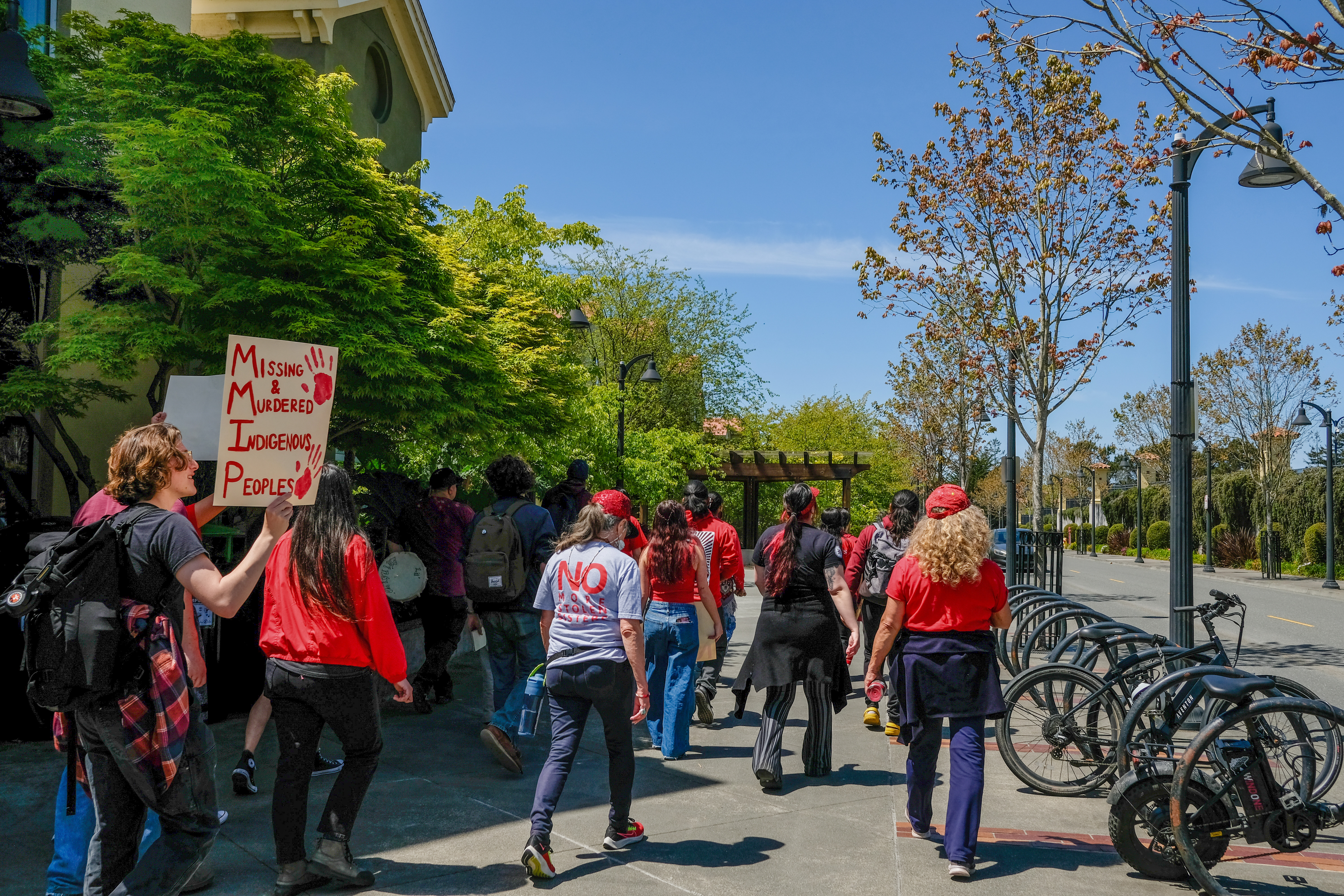
    About two dozen people dressed in red marched through campus and sang traditional Indigenous songs. Some held signs and others were drumming with the spirits  — all demanded change. The march was held on May 5, the national Missing and Murdered Indigenous Women and People (MMIWP) day of awareness. It began and ended at the Brero House, went through the SAC quad and down LK Wood Boulevard. 

    “We have a crisis in our Indigenous communities of women, children, men, elders, [and] Two-Spirit people going missing,” Student organizer Covin Sigala said. “That’s causing harm. It’s not a recent event — it’s been going on since colonization began.” 

    According to the U.S. Department of Justice, one in three Native women will be assaulted in their lifetimes. On some reservations women are murdered at a rate 10 times above the national average.

    “We’re walking for awareness,” Maudesty Merino, one of the organizers for the event, said. “[We] walk to carry their spirits and walk with them. We’re also raising awareness for the Violence Against Women Act.” 

    Photo by Evauna Grant | Protestor holds a sign during the march at the corner of Harpst and Roscow near the Marketplace on campus.

    The Violence Against Women Act (VAWA) is a law that addresses sexual assault, domestic violence, stalking and dating violence directed towards women. The VAWA has several special provisions for Indigenous women due to disproportionate rates of abuse on reservations, as well as hesitation from the federal government to prosecute these cases due to jurisdiction disputes.  

    The VAWA has had five amendments addressing violence against Indigenous women since it was enacted in 1994. One amendment from 2013 affirmed Tribal courts’ right to prosecute non-Indigenous peoples who commit these crimes on reservations. 

    The Violence Against Women Reauthorization Act of 2021 reauthorizes VAWA grants-which go towards strengthening the courts’ capabilities to prosecute offenders, and survivor support networks. It also calls for the end of impunity against people who come onto reservations and commit sexual crimes. It also addresses the need to support Native Alaskan Tribes who were previously excluded.

    “Even with these acts and laws over the years we continue to see more and more missing and murdered Indigenous peoples,” said tribal forestry student Evauna Grant. “The injustice of our people goes unnoticed and is a main reason why we do the awareness march.”

    A marcher described the march as a day to honor lost community members with song, to carry the spirits with them and bring those energies out; they discussed how everyone has a song to sing. Some of the songs were passed down from generation to generation, and some were just simply from the person’s heart.

    The marchers chanted and sang under the shade of a tree along LK Wood Boulevard. At one point when they stopped, the wind rattled the trees and released a flock of chirping birds. The songs shook the Earth with resounding passion. After finding a caterpillar on one of the singers’ hats, someone shouted something very apt.

    “We’re waking up a lot of spirits today.” 

    Barley isn’t just the grooviest guy around, he’s also an untraditional reporter, photographer, and — of course the photo editor!

    Yurok MMIP Tip Line: 1-833-YRK-MMIP 

    Hoopa Tribe MMIW (530) 625-4261

  • A love song to Lixxapalooza

    A love song to Lixxapalooza

    By Barley Lewis-McCabe

    You could hear it all — every chord, footstep and 2-step. The room was a living, breathing organism. Music and conversation surrounded the crowd while kids danced around without a care in the world. It was raucous, it was loud, it was unique. 

    On May 3, KRFH, Cal Poly Humboldt’s student-run radio station, held Lixxapalooza, a celebration for local bands and musicians at Rampart Skatepark in Arcata. The event was fully planned by students and highlighted student musicians. Lixxapalooza is a live music festival held every semester by Local LIXX, the weekly live broadcast arm of KRFH. The festival aims to raise funds for the station and encourage the DIY music community.

    June Morris, a.k.a DJ Princess Tornado, spoke on the care and time that goes into Lixxapalooza.

    “I mean, every lixxapalooza is an event that’s like three months in the planning, you know?” Princess Tornado said. “I feel like that’s honestly hard to come by when it comes to shows up here, a lot of it’s very like, ‘let’s throw a show at what time?’ ‘What time next week?’ ‘Well, yeah, let’s do it.’ ‘Oh, this man can’t make it.’ ‘Oh, yeah, I guess you have to revise the flyer.’ But we get to put a lot more time and effort into it, which I think is great.”

    The night began with a bang with DJ NOLO, soon followed by local band Public Diary — each song providing a melancholic tribute to human existence. The stage was a small ramp and plateau in front of murals of Ren and Stimpy, Skelator and a large tag reading HVOC. Two quarter pipes nearly reached the ceiling on either side of the room. Stairs led to a balcony where several local artists were selling their work, including Blake Knapp and Your Local Worm Dealer.

    Rampart is covered in memories, the floors were speckled but smooth, and any open wall space was adorned with graffiti murals or stickers. The bathrooms were a similar case, an open canvas to the folks who carry paint pens.

    Local band Pickpocket, consisting of Cal Poly students Luke Shanafelt, Colby Palmer, Andy Garvin and Jesse Sammel, performed with such ferocity that they ruptured their amp.

    Some bands performed single-word songs, some played psychedelic guitar. Each band and artist flowed perfectly into the next. After sets from a myriad of local bands, the miraculous DJ Princess Tornado took the stage, followed by DJ L30. Local artists were given the stage they deserved, there’s nothing else like it. 

    “It’s something that’s unique to here,” DJ Milkman, a KRFH DJ, said. “There are only seven student-run radio stations in the country — we’re one of those, which is awesome.”  

    At times it can all seem so overwhelming to step out and allow yourself to enjoy life — to break the drudge of assignments, errands and obligations. Taking a moment to relax can feel daunting. It’s easier to fall into a soulless routine rather than take a moment to breathe, to run in a circle and support your community. 

    Never take community music for granted. There is an undeniable sense of freedom when there’s a good crowd, a real community and something worth supporting. What a time to be alive.

     Barley isn’t just the grooviest guy around, he’s also an untraditional reporter, photographer, and-of course the photo editor!

  • Cal Poly Humboldt’s pro-Palestine occupation and protest, a year later

    Cal Poly Humboldt’s pro-Palestine occupation and protest, a year later

    Compiled by Griffin Mancuso

    Last year on April 22, dozens of Cal Poly Humboldt students and community members occupied Siemens Hall in support of Palestine for eight days. These eight days resulted in a notable shift in opinion about administration and perspectives on campus activism. The following took place during this occupation.

    April 22, 2024

    A group of students organized a sit-in in Siemens Hall at 4 p.m. — they brought games, books and art supplies and planned to host a Seder.

    At 4:15 p.m., UPD entered the building and asked the students to leave. The students continued to protest and UPD evacuated non-participants out of the building. The students began to lock doors and entrances to the building, except for the door leading to the quad. They constructed barricades in front of doors with chairs, desks and other items in Siemens Hall. 

    At 5:00 p.m., officers arrived in riot gear and attempted to remove the protestors from the building. The scene drew hundreds of spectators and people started joining in the protest. An alert was initially sent out at 5:57 p.m. of the university closing Siemens Hall for the night, but that status changed to the entire campus being closed until April 24, 2024 by 8:53 p.m. By 10:50 p.m., law enforcement left the area and the protesters inside the building opened the doors. Dozens of outside protestors flooded into the building.

    April 23, 2024

    Students and community members continued to occupy Siemens Hall and the surrounding area, including the Gutswurrak Student Activity Center (GSAC) quad. Signs and chalk decorations covered the area, and several local bands performed in front of the GSAC. The protestors released a set of demands to the university calling for them to:

    -Disclose all ties to Israel

    -Cut all ties to Israeli universities

    -Divert from companies with ties to Israel

    -Drop all charges against protestors and cease the use of law enforcement against them

    -Publicly call for a ceasefire and end to the occupation of Palestine

    Students, faculty and community members delivered supplies to the protestors in Siemens Hall and a Mutual Aid Kitchen was set up in front of the Siemens Hall main entrance.

    April 24, 2024

    From 12 to 4 p.m., the California Faculty Association (CFA) hosted a teach-in in the GSAC quad where multiple faculty members spoke and led workshops for an audience of students, faculty and community members.

    At 2:12 p.m., a Humboldt Alert was sent out over email announcing the campus to be closed through April 28, 2024.

    April 25, 2024

    An open forum was hosted between protestors and Provost Jenn Capps and Dean of Students Mitch Mitchell at 4 p.m. in the Goodwin Forum of Nelson Hall. Other admin, such as Dean Jeff Crane, also made appearances. 

    The University Senate released a Sense of the Faculty Resolution on a Vote of No Confidence in President Tom Jackson, citing Jackson and former Chief of Staff Mark Johnson’s mishandling of the protest and inappropriate use of law enforcement resulting in the injury of students and faculty.

    April 26, 2024

    At 10:28 a.m., the university released an email response to the protestors’ demands and distributed physical copies of the response on campus. In the email, the university reported that they have no direct ties to Israeli universities and they would continue to uphold the Time, Place and Manner Policy and enforce consequences for violations of university policy and laws. The university also stated that they don’t have any direct investments in defense companies or securities issued by Israeli companies, organizations or defense firms.

    “Our estimates put the potential indirect investment in the areas that are asked about at less than 1% of the investment portfolio of more than $51 million,” the email read.

    At 12:28 p.m., the university sent out a Humboldt Alert announcing the closure of campus for the rest of the semester and the continuation of remote work and instruction.

    At 1:49 p.m., the university sent an email to the campus body opening a check-out option for protestors from 2 to 4 p.m., presenting an option to vacate campus without immediate arrest.

    “Voluntary participation in this check-out process WILL be considered as a mitigating factor in University conduct processes and may reduce the severity of sanctions imposed,” the email read.

    At 5:20 p.m., protestors opened one of the entrances to Siemens Hall to allow the public to walk inside and document the state of the building.

    The same day, the University Senate published a Sense of the Senate Resolution On A Call for a Permanent Ceasefire in Gaza.

    At 6:20 p.m., a local rabbi along with students and community members welcomed Shabbat in the GSAC quad in solidarity with the protestors.

    April 27, 2024

    The university sent out a Humboldt Alert announcing the hard closure of campus at 12:35 p.m., specifying that individuals are prohibited from entering or being on campus without authorization from the UPD. At 1:45 p.m., construction workers placed cement blockades at three main entry points to campus, including the Library Circle.

    At 6:30 p.m., protestors and community members hosted a group march and protest, starting at the Arcata Plaza and ending at the Library Circle cement blockades. 

    April 29, 2024

    At 2:15 p.m., the CFA organized a march from the Arcata Plaza to the Library Circle, then ended at the lawn in front of the main Cal Poly Humboldt sign off of 14th St. 

    Another march from the plaza to the Library Circle happened at 7 p.m., with a Seder being hosted for a group of around 200 people. The group slowly dwindled over time, but protestors remained in the area until around 4 a.m.

    At 10 p.m., two UPD officers started driving a police vehicle up to the main barricades set up by protestors near the campus library and the GSAC quad. The vehicle played a recorded message from Chief of University Police Peter Cress announcing the protest as an unlawful assembly. The message warned protestors that they had 15 minutes to disperse or risk being faced with rubber bullets and chemical agents. The message continued to play at each of the barricades for around 5 hours.

    April 30, 2024

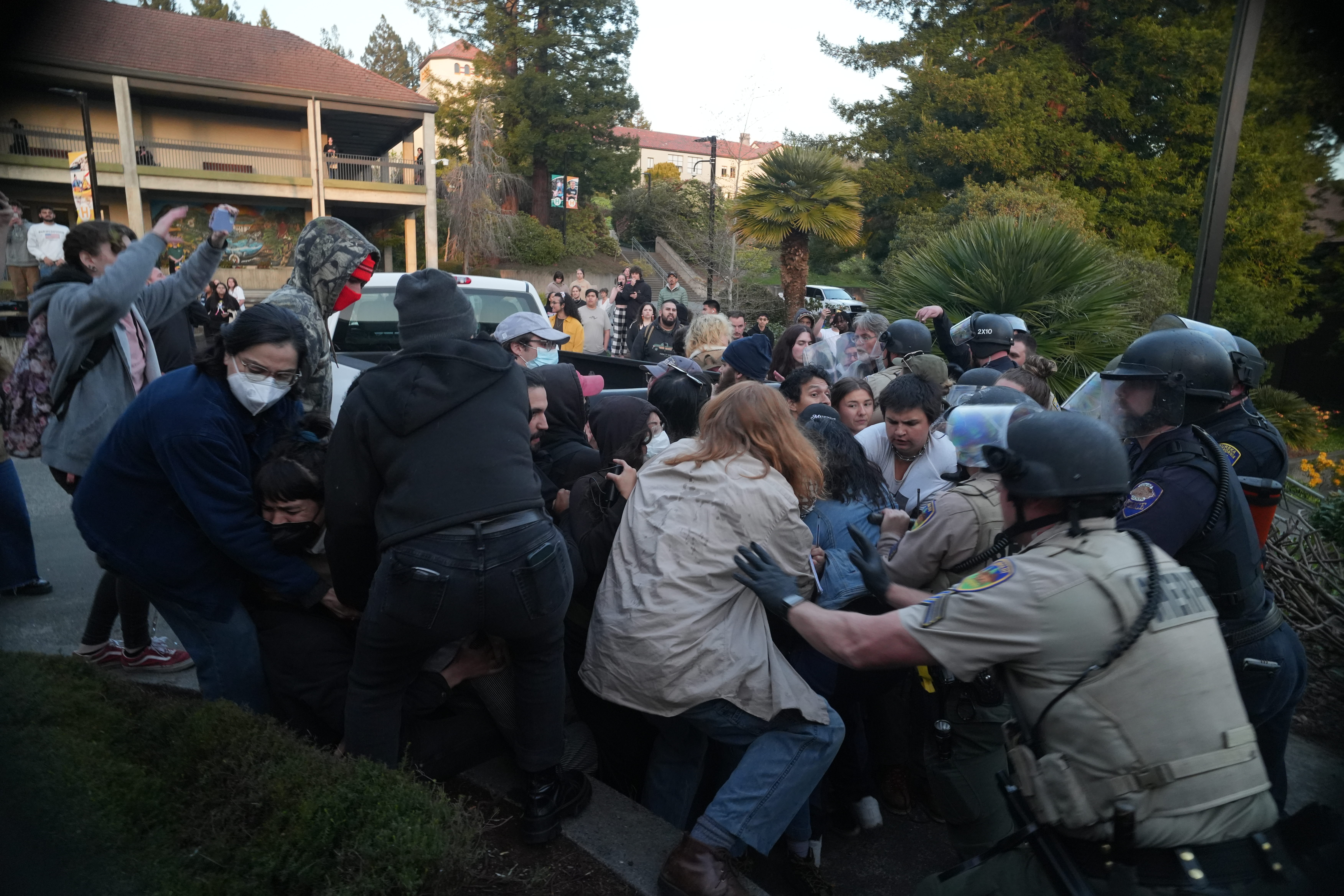
    At 2:50 a.m., hundreds of officers in riot gear from agencies in Humboldt County to San Francisco and Redding began breaking down barricades and entering the occupied area. A group of protestors sat in a circle in the quad with their arms linked together. Officers gradually closed in on the area and some began arresting protestors in the circle. 32 protesters were arrested, including a faculty member and a journalist.

    A Humboldt Alert was sent out at 3:00 a.m. ordering students living on campus to shelter-in-place.

    Those detained were processed for arrest in front of Gist Hall and sent on buses and vans to the county jail in Eureka.

    A Humboldt Alert was sent out by 6:56 a.m. declaring that law enforcement secured the campus and order had been restored to Cal Poly Humboldt. A few protestors were charged, and many were released around 12 p.m.

    For further information about the pro-Palestine protest and occupation in April 2024, visit our full comprehensive timeline on our website: