The Lumberjack


Students Serving The Cal Poly Humboldt Campus and Community Since 1929

Category: News

  • The aviation club takes off at airport day

    The aviation club takes off at airport day

    By Eli Farrington and Noah Pond

    Antonio Jordan’s passion for aviation started early in life, fueled by a lofty childhood dream — a dream shared by countless children across the world, but only pursued by a select few once they reach adulthood: flying.

    “Honestly, the main thing is that I always wanted to fly. I would see people flying whether they’re superheroes or whatnot on TV and I was like, ‘Damn, I can’t do that,’ but flying planes is kind of the closest we can get to that,” Jordan said at Airport Day, an event hosted by the Aviation Club at Samoa Field Airport on Saturday, April 26. The event showcased multiple aircrafts and companies in the field of aviation and aeronautical technologies, and highlighted the resources and opportunities offered by the Aviation Club.

    Jordan is a freshman environmental science and management major and the Aviation Club’s treasurer. He dealt with all of the expenses of the Airport Day event, which was overseen by David Marshall, a computer science lecturer and the club’s advisor.

    Before Marshall advised the Aviation Club, he was the advisor to the PC Gaming Club. He wanted the PC Gaming Club to do something for the entire community — something beyond video games. 

    “I told the students in that club that [they] need to do something that impacts the whole campus, and they decided to build a flight simulator,” Marshall said. “And so, there was a flight simulator at the library for three years and it was based on gaming [equipment] — it was plastic pedals, plastic everything.”

    It wasn’t until years later that Marshall was contacted by a former Humboldt State University journalism student, Meg Godlewski class of ‘87, about getting a new simulator that was Federal Aviation Administration (FAA) certified. As an editor for FLYING Magazine, Godlewski presented an opportunity to take the aviation club to new heights. 

    “[Godlewski] was doing a story for a flight magazine and was in the offices of a company called Precision Flight Controls, and they’re in Sacramento,” Marshall said. “It just so happened that the president’s phone rang, and the very wealthy gentleman who flies his own planes said, ‘I’m getting a new airplane, build me a new simulator. I want to give away the one I have.’” 

    Godlewski got in contact with Marshall and asked him if the aviation club wanted the simulator, to which Marshall replied with a resounding yes. The simulator that Godlewski donated is an advanced aviation training device (AATD), which retails for about $140,000. Renting an AATD would usually cost around $50-$100 an hour, but Cal Poly Humboldt students get to use it for free. 

    Marshall co-owns two planes with C.D. Hoyle, a fellow Cal Poly Humboldt professor in the physics department. The pair were originally introduced to each other by a certified flight instructor. They purchased their first plane back in 2008 and their second in 2013. 

    “We started out as co-workers on campus and became buddies through plane ownership,” Hoyle said.  

    Hoyle got his pilot’s license at 18, and has been flying for over 30 years. He loves flying for both the convenience and the understanding of weather patterns that he has learned over the years. 

    “I like how it makes you kind of in tune with the weather,” Hoyle said. “There’s this aspect of flying where if you’re preparing for a flight, you have to be constantly in tune with what’s happening with the environment around you.” 

    Unfortunately, the weather was not in the aviation club’s favor on Airport day, as a combination of rain and low-hanging fog prevented anyone from taking off or landing. Hoyle explained that a lack of visibility, coupled with the fact that Samoa Field Airport doesn’t have air traffic control, caused the event to have a smaller turnout than expected. Had the event taken place on a clear day, the airport would have seen dozens of model and full size planes taking off and landing. Despite the bad weather, the event was still a hit. 

    Aviation club president Lee Donohue was disappointed with the harsh conditions, but didn’t let the rain dampen his good mood. As club president, it is Donohue’s job to preside over meetings and help organize events like Airport Day. This year, he was able to assemble a group of volunteers and tech companies to table at the event. 

    “We’ve asked a lot of organizations to come in and volunteer their time and efforts to showcase how they’re involved with the community,” Donohue said. “Some of it is involved directly with aviation, some isn’t. A lot of it is showcasing emerging technologies and people’s connections to aviation, whether that be with fixed wing aircraft or with paragliders and drones. I think it’s just really cool that we were able to pull this off and show off the technology.”

    Airport Day played host to a number of guests and volunteers, including a handful of aeronautics companies, Humboldt County Sheriff Bomb Disposal Squad and Cal Poly Humboldt’s very own Marching Lumberjacks.  

    “I think it’s a unique event where you have this mosaic of people who came and are passionate about the technology they use to help serve the community and, you know, explore their own hobbies and passions,” Donohue said. 

    Donohue is not a pilot yet, but his goal is to use the tools provided by the aviation club to eventually get a license. For him, campus resources like the on campus flight simulator bring him one step closer to a seat in the cockpit. He plans to take advantage of all the resources he can, and learn to fly before he graduates. 

    One aviation club member who goes above and beyond when it comes to flying is Kendra Char. Char is a junior marine biology major and student pilot, and just two weeks ago, she soloed an airplane for her first time — a huge milestone in her flight training. 

    “[Soloing] is going up in the aircraft by yourself … I flew a Piper Cherokee 140,” Char said. “It’s a lot of work to get to that point, and it built my self confidence. It’s scary at first — it’s weird — but it’s incredibly rewarding.”

    The FAA requires 40 hours of flight time for a private pilot’s license, and 10 of them have to be solo. Char has completed about 35 training hours, and is now in the process of completing 10 solo hours before getting her license. She eventually wants to turn her passion for flying into a career and work for an airline, but for now she’s enjoying the fruits of her labor, about to pay off.

    “I love the freedom of it,” Char said. “I’ve flown over campus a couple times, and it seems so small when I’m up there. At its core, flying is freedom from the ground. You get so much of a new perspective on everything from flying… I joined the aviation club because flying is something I love, and I want to share my love and experiences with other people who also love aviation.” 

    Eli Farrington is a junior journalism major working as the opinion editor for the Lumberjack. Noah Pond is a junior journalism major working as the managing editor. Together, they work around the clock, uncovering secrecies, solving mysteries, and leaving no stone unturned.

  • Cal Poly Humboldt Model UN dominates on the east and west coast

    Cal Poly Humboldt Model UN dominates on the east and west coast

    By Kimberly Alexsandra Madrigal

    This past month, students from Cal Poly Humboldt’s political science department attended two international Model United Nations conferences. The National Model United Nations (NMUN) conference in New York, the largest and most iconic of the Model UN, is open to over 5,000 students from around the globe. Students and faculty then rushed back to the west coast as the Model United Nations of the Far West (MUNFW) conference took place in San Francisco the following weekend, inviting over 400 students from the western U.S. and The Philippines. 

    Our school’s team, representing the country of South Sudan, brought back an honorable mention award from NMUN-NY. 

    Our school’s team representing Egypt won an award for outstanding delegation in San Francisco. Additionally, student Amanda Cawthron was chosen as a lead author in the best resolution and Kiera Sladen was named best delegate within her committee.

    Political science sophomores and Model UN members Ruth Worthington and Kiera Sladen shared their takeaways from their first time attending the iconic, back-to-back, bi-coastal conferences. 

    “There was a lot of office siren action,”  Sladen said, referring to the “Office Siren” fashion aesthetic adored by Gen-Z that combines 90s and 2000s formal business wear with a sexy and confident feminine energy. 

    Photo courtesy of Cal Poly Humboldt political science department | Cal Poly Humboldt Model UN smiles with awards a Model United Nations of the far West in San Francisco, CA, April 2024.

     “It’s a lot of fun, I think it’s rewarding, it’s worth it. It’s open to not just political science majors, so that’s a plus. It’s definitely beneficial for anyone looking to build skills in public speaking, teamwork, leadership and cooperation, and it’s overall just a fun experience.”

    From showing Dr. Zerbe Never have I ever — Gen Z’s favorite on-screen portrayal of Model UN — to appreciating baddies in business casual and sitting in the iconic United Nations General Assembly inside the global headquarters of the United Nations, this trip was one for the books. 

    “It was super cool because we went to the actual UN for the closing ceremony, so that was pretty epic,” Worthington said. 

    Cal Poly Humboldt has also been selected as the host institution for MUNFW-SF 2027, with Kiera Sladen as Secretary General and Ruth Worthington as Under Secretary General of the conference. 

    Over the next year they will decide and plan the theme and select committees for MUNFW-S 2027, where they will then present it to the president and board of the conference, next spring in 2026.

    Students interested in joining Model UN must enroll in PSCI 376, a two unit seminar course and one unit PSCI 377 conference lab open to students of any and all majors, political standings and knowledge. Contact polisci@humboldt.edu for more information. 

    Kimberly Alexsandra Madrigal is a multimedia journalist who lives for cruising in her ‘05 convertible beetle, lowballing on facebook marketplace, yacht rock and oversharing on the internet. 🙂

  • German cruise ship looms over Humboldt Bay harbor

    German cruise ship looms over Humboldt Bay harbor

    By Nick Escalada

    Dream vacation spots are a good indicator of personality, but certain locales tend to become common favorites due to their sheer romantic appeal. Fiji might come to mind, or maybe Morocco, the Bahamas, Italy, Humboldt County… wait.

    A mild traffic jam occurred in Eureka on Sunday, April 27 as drivers halted in fascination at the colossal cruise liner parked at the humble Schneider Dock. The MS Europa 2, brought forth by German shipping company Hapag Lloyd, made a stop in Humboldt on its 18-day round voyage along the West Coast to Canada from Los Angeles. According to a press release from the Humboldt Bay Harbor, Recreation and Conservation District, 370 crewmates and 460 passengers disembarked from the vessel and got a taste of life behind the redwood curtain.

    For the short day they spent here, the tourists were offered most of northern Humboldt’s landmark excursions, including walks through Old Town Eureka and Prairie Redwoods State Park, tours of local manufacturers, and kayaking in Trinidad Harbor. In the evening, onlookers from Eureka to the North Jetty caught stellar views of the ship’s departure up the narrow passage to the open ocean.

    The Europa 2 will return to Los Angeles on May 1 after stops in Santa Barbara and San Diego. Mass tourism is a rare sight in Humboldt and this luxury liner was met with little apart from excitement and intrigue from locals.

    Nick is a sophomore minoring in journalism who reports on happenings of all sorts. As a wildlife major, he enjoys nature-related pieces. On his off days, you can find him taking a hike behind campus or collecting shiny stuff on the beach.

  • Five Programs Cut or Suspended from Cal Poly Humboldt

    Five Programs Cut or Suspended from Cal Poly Humboldt

    by Ursula Newman

    At the start of the spring semester, Cal Poly Humboldt notified the California Faculty Association (CFA) and university community that one department, one major, one minor and one credential program will be discontinued, while one other major will be suspended until further notice. 

    Provost and Vice President for Academic Affairs Jenn Capps said these changes are attributed to low enrollment and budget constraints. Students within these programs will have a clear path to completion, and there will be no layoffs as a result of these cuts. A total of 56 students are enrolled in these five programs. 

    “It’s common for academic institutions to streamline programs by adding, modifying and discontinuing academic offerings,” Capps said. “In our case, discussions of discontinuing or suspending certain programs have been ongoing in the Integrated Curriculum Committee (ICC), a faculty-lead committee of the University Senate, for quite some time and well before our current budget challenges.”

    The religious studies department, economics major, German minor and educational leadership credential will be discontinued. The international studies major will be suspended until further notice. As a result of the discontinuation of the religious studies department and major, the history department has updated its offerings to retain the entire religious studies curriculum, and offer a related concentration. With the discontinuation of the economics major, a concentration in economics through the business department will remain along with the economics minor.

    Religious studies 

    The religious studies department and major will be discontinued and, moving forward, a history of religions concentration will be offered within the history department. Religious Studies Department Chair Sarah Jaye Hart said that although the department is being discontinued, the entire religious studies curriculum will be retained through the history department’s updated courses. According to the university’s enrollment numbers, there were 10 students in the 2024-25 academic year enrolled as religious studies majors.

    “Faculty from both the history and the religious studies departments have worked steadily for well over a year now to reshape the history curriculum in ways that meet the cutting edge of both fields and that serve our students,” Hart said.

    In the 2025-26 catalog, the history major will have three concentrations — history, history education and history of religions. 

    “Through general education courses across the major, students from all majors have the opportunity to take these classes,” Hart said. “The faculty remain committed to teaching them, knowing as we do that an understanding of history and of belief-based traditions, and a commitment to education, are critical to democracy.”

    Economics

    With the discontinuation of the economics major, Professor Erick Eschker, chair of the department of economics, wanted students to know that they can still study economics. The economics concentration in the business administration bachelor of science degree will remain. A minor in economics will continue to be offered, as well as all of the economics classes required for several other majors. Eschker said that they are still signing up new economics majors. 

    “That’s because the process of major discontinuation is uncertain, long and probably won’t be implemented until the 2027-28 catalog,” Eschker said. “Any new economics majors will be able to graduate on time.”

    There are 22 students enrolled as economics majors during the 2024-25 academic year. Cal Poly Humboldt is also discussing merging the economics and business departments. However, the process is on pause right now as discussions with the CFA begin.

    “The hope is that faculty will become energized, and that new projects and initiatives will develop,” Eschker said.

    German minor

    With the discontinuation of the German minor, German language courses will no longer be offered at the university. Kate Foley-Beining, a lecturer in the department of world languages and cultures, said she hasn’t taught any German language courses for two years due to enrolled students having already completed those courses. 

    The 2024-25 school year only had four students in the German minor, according to the university’s enrollment numbers. Foley-Beining said that the low enrollment could be combated with more recruitment, and has felt that there is not much spirit for increasing the humanities. 

    Foley-Beining said that in the midst of the school transitioning to a Cal Poly, there should be more of a focus on STEAM instead of STEM, an acronym which would better serve and include the arts.

    “It slowly dawned on me that there would be no more German languages taught at Humboldt University, that’s named for Alexander von Humboldt,” Foley-Beining said.

    Educational leadership credential

    The educational leadership credential will no longer be offered through the school of education. For the 2024-25 school year, there were nine students enrolled in the credential. 

    As stated on the educational credential fact sheet on the university website, after earning a bachelor’s degree and passing exams, students must get a teaching credential grounded in field experiences, which allows them to teach. 

    The school of education will offer three remaining credential programs, the elementary education, secondary education and special education credentials.

    International studies department

    The 2024-25 year only had 11 students enrolled in the international studies department, according to the university’s enrollment numbers. Again, low enrollment is credited for the discontinuation and suspension of these programs. The major is set to be suspended, not discontinued.

    Capps stated that there are still several options available for students to explore international study and global engagement.

    “Some examples include: the International Studies Minor, the Global Studies Concentration in Politics, the International Service Learning Program, study abroad options available in summer and winter breaks, and Anthropology field schools which provide valuable learning and study abroad opportunities,” Capps said.

    Conclusion

    The university has been intentional in preserving some of the coursework from these discontinued programs, and recognizes the value of these disciplines, according to Capps. She said that it is common for academic institutions to add, modify and discontinue academic offerings to streamline programs and meet student demand. 

    “Since 2023 and the university’s transition to a polytechnic, we have launched 12 new degree programs in a broad range of disciplines including Mechanical Engineering, Applied Anthropology and Marine Biology,” Capps said. “We will be launching a number of new programs in 2026 including Applied Humanities, Media Arts, and Health Sciences.” 

    Ursula Newman is a journalism major and Humboldt local. You can find her all over town doing all kinds of things, and talking to all sorts of people.

  • Come fall, time to move to Craftsman Mall

    Come fall, time to move to Craftsman Mall

    Cal Poly Humboldt continues construction of new dorm buildings

    By Andres Felix Romero

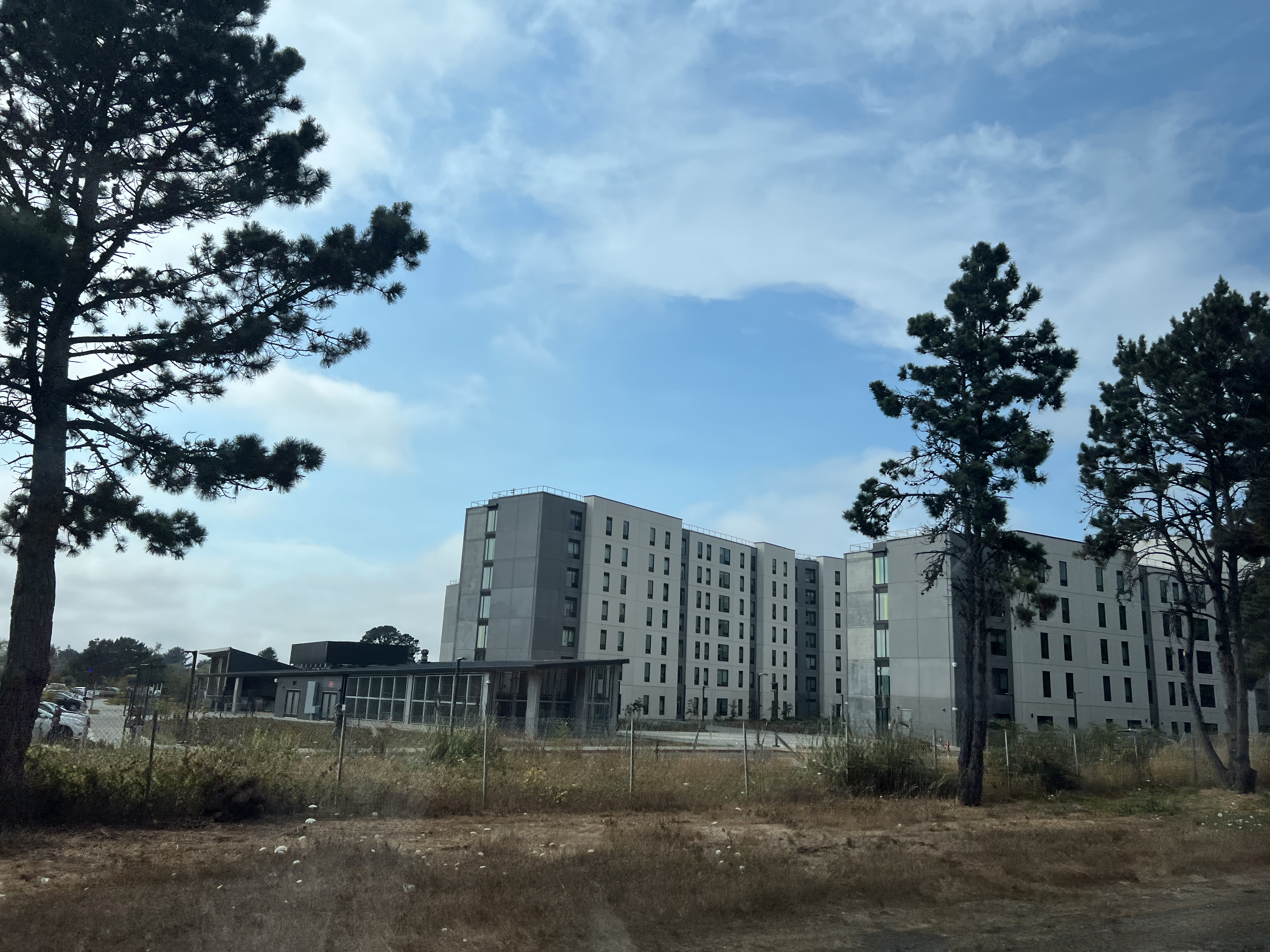
    Among the gravel, milling construction workers and a small fleet of construction vehicles lies potential for the largest housing project in Cal Poly Humboldt’s history. Currently, the Craftsman Mall dorm buildings and complex lack the color it will have upon completion. One half of the dorms, called Hinarr Hu Moulik — pronounced hee-NOD huh MOO-leek, meaning “Our Home” in the Wiyot language — will be completed and ready for students to move in by the fall semester. As for the other building, major construction, painting and furnishing will be completed in the fall. The building will be ready for students to move in by Spring 2026. 

    The dual dorms are among the largest buildings at the university. Each one sits at about the height of the Behavioral Sciences building, which itself stands at five stories tall. The buildings are also being constructed with A-1 materials, which are composed of non-combustible substances. Upon completion of construction, there will be plenty of outdoor space and features including an acre of green space and small hills rolling between the dual dorms, with plenty of outdoor seating. Along with the outdoor space there will be activities, such as basketball hoops, a pickleball court, a ping pong table and a cornhole setup.

    A dimly lit hallway with hanging lightbulbs strung along the sides of a metal pipe. The hallway extends into eventual darkness, with occassional pieces of construction equipment tucked against the walls.
    Photo by Barley Lewis-McCabe | A hallway under construction in the Craftsman Mall construction project.

    As for the inside of the dorms, there will also be recreational options with a multipurpose room for lounging and other events, including a foosball table. The multipurpose room will also have wall-height glass doors that open to the grassy hills for more space. In terms of dining, Craftsman Mall will have a large professional kitchen staffed with cooks to prepare hot and ready meals, as well as meals to order for the campus community. In the same area will be a market similar to The Marketplace for snacks and essentials.

    The living dorms themselves will be able to host 1,050 students in apartment-style dorms. Each suite will have four to six residents. The apartments have a modern feel with wood-laminate finish furniture, black leather and green cloth seats, and a dishwasher. These dorms will be reserved for upperclassmen.

    There will be a few options for travel between the main campus and the dual dorms. The City of Arcata and Cal Poly Humboldt have partnered to develop the Annie Marie trail, a pathway that leads to Sunset Avenue. The university and the city of Arcata have also been allotted funds to reconstruct the Sunset Ave. overpass to make it safer for cyclists and pedestrians.

    Those with bicycles will have access to a lot area with 200 spaces that is essentially a giant cage to protect their wheels from theft. The campus’ Green and Gold bus route will also have a stop here, alongside a dedicated shuttle between Craftsman Mall and the main campus that runs every 30 minutes.

    One of the leads on this project from Cal Poly Humboldt is Vice President of Finance and Humboldt State alumnus Mike Fisher. Fisher understands the dorm life of a Lumberjack as he lived in the Sunset dorms. He also understands the hesitation the new Craftsman Mall residents may have living a bit of distance from campus, but Fisher hopes that these new dorms can begin a new chapter of Lumberjack residents.

    “I know this place will be a community unto itself,” said Fisher. “It will feel like you’re on campus, but also independent.”

    An external view of a Craftsman Mall building, which is a simplistic, beige, rectangular structure with windows of varying widths. Three white tubs run out of the building for ventilation and construction equipment is scattered about.
    Photo by Barley Lewis-McCabe | A view of the Craftsman Mall project under construction.

    Andres Felix Romero is a senior and reporter for The Lumberjack. He is passionate about writing to improve the world around him and can often be found hiking in the woods with his dog, Uichu.

  • Decoys play pivotal role in on-campus arrest

    By Andres Felix Romero

    DISCLAIMER TO THE READER: Please use caution when reading this article, it contains language related to sexual abuse, and may be harmful to readers.

    University police and Ryan Hill of the District Attorney’s office (DA) arrested  Cal Poly Humboldt Student Health Center Medical Assistant Ryan Graves on April 8 on felony charges of contact with a minor for sexual offense (PC288.2) and showing pornography to a minor (PC288.3). The arrest was the result of a sting operation in which an adult decoy from the 501(c)(3) nonprofit Child Safety Soldiers (CSS) posed as a 14-year-old on social media.

    The Lumberjack obtained court documents and a copy of Graves’ warrant detailing the key dates of the case. Graves made contact with the decoy on Feb. 16, where the decoy made clear they were underage. According to court documents, after Graves made contact, he engaged in conversation with the decoy that consisted of lewd language and nude images sent to the decoy. These chat logs resulted in Hill beginning an investigation into Graves.

    “On or about 4-3-25, [Hill] was contacted by a member of [the CSS],” said the court documents. “[The CSS] advised that a 41-year-old-male, Ryan Edward Graves of Humboldt County, was engaged in a text conversation with [the CSS] posing as a 14-year-old-girl.”

    On April 5, Judge Steven Steward of the Humboldt County Superior Court authorized a warrant for the arrest of Graves, as well as a search warrant of Graves’ residence and electronics. On April 10, Graves was arraigned in front of a judge. He entered a plea of not guilty and hired a private defender who requested a two-week continuance for confirmation of counsel. Graves posted bail late in the evening and is set to appear in court next on April 22 for the confirmation of counsel. A preliminary hearing for the case is set for May 29.

    At this time, the university cannot comment on Graves’s employment status with the campus as it is an ongoing investigation. At the time of publication, Graves’ employee profile is still on the university’s website. The family of Ryan Graves are distraught after the arrest, and ask the public to respect their privacy as they deal with the weight of the charges.

    “We will continue to know, love, and support him as a family,” said the Graves family in a statement. “We beg that you please respect our privacy during this extremely difficult time. Any further negativity will not help, even if it feels like it will.”

    Who are the Child Safety Soldiers?

    The Child Safety Soldiers is a nonprofit that operates nationwide, founded in 2017 and is led by Shane Coyle. The CSS conducts sting operations and works with local law enforcement and Attorney Alexandria Crouthamel to ensure their practices are legal, sound, and that all evidence they gather is admissible in a court of law.

    Seek resources if needed

    If you are a survivor of any form of assault, there are many resources available as well. Counseling and Psychological Services on campus can be reached by health@humboldt.edu or (707) 826-3236. If you’re someone who struggles with urges that would lead to sexual offenses, there are resources and support available. The John Hopkins School of Public Health has a division called MOORE that focuses on preventing child sexual abuse. Please refer to their website for more information on their anonymous services for those with sexual interest in children.

    Kyla Baxley is the current Chief Investigator for the DA’s office and shared a reminder to stay vigilant against all kinds of predators on the internet.

    “Internet safety is crucial in today’s digital world to protect individuals from identity theft, cyberbullying, exploitation, and scams,” said Baxley. “It helps protect personal information, promotes responsible online behavior, and ensures people can use technology safely and confidently. Sexual predators exploit the anonymity and accessibility of the internet to target vulnerable individuals, especially children. Families, schools, and law enforcement staying aware and responsive to internet safety is a vital defense against these threats.”

    Andres Felix Romero is a senior and reporter for The Lumberjack. He is passionate about writing to improve the world around him and can often be found hiking in the woods with his dog, Uichu.

  • Arcata locals hold 8th annual vigil honoring David Josiah Lawson

    Arcata locals hold 8th annual vigil honoring David Josiah Lawson

    By Nick Escalada

    A collection of Arcata residents, HSU alumni and members of Black Humboldt gathered at the community garden El Jardin Sanctuario on Tuesday, April 15, for a candlelight vigil in memory of David Josiah Lawson. The day marked the 8 year anniversary of the Humboldt student’s fatal stabbing at a house party, which the Arcata Police Department recognized to have been mishandled in court by the Humboldt County DA’s office. The city community has remained steadfast in its support of Josiah’s family and their efforts to ensure the still-open case reaches a just conclusion. 

    Rosemary Grady, a member of Black Humboldt, Changing Tides and the activist group Justice for Josiah, voiced her motivations behind her work as a community organizer. 

    “Of course we want justice. We keep saying that Josiah was lost, but he wasn’t lost. He was stolen, and that deserves justice, and his mother deserves justice,” Grady said. “But the thing that I continue to move forward with is just the fact that we are in community, there are people to share this heaviness with. There are people who are ready to support and continue to show up, so that’s why I continue to show up.”

    Lawson’s routine vigils have grown into a powerful point of convention in Arcata such that people who did not know him personally or did not live in Humboldt during his death continue to appear to pay him homage. Kris Coy, who has been involved with Justice for Josiah for most of its existence, expressed appreciation for the growing public support while acknowledging the continued activism needed to see proper change.

    “[Josiah’s killing] occurred when I was a student, and it really emboldened me to join the student-led movement at the time and to continue to follow it after I graduated,” Coy said. “I think that giving the spotlight to the people who are actually doing the work is the responsibility of all those people who are here. There’s been hundreds, probably thousands of hours I’ve gone into stuff like this, and props to those who just show up, but the work gets to be done.”

    Participants mobilized through town to conclude the vigil by Josiah’s mural across the street from the Cal Poly Humboldt campus. While these events are a strong vessel for further community awareness and healing, their organizers make it clear that efforts for justice are not limited to Lawson’s death anniversary. Justice for Josiah persists in working with city authorities and judiciaries to ensure this case closes with equity and respect.

    Nick is a sophomore minoring in journalism who reports on happenings of all sorts. As a wildlife major, he enjoys nature-related pieces. On his off days, you can find him taking a hike behind campus or collecting shiny stuff on the beach.

  • U.S. Department of Education investigates Cal Poly Humboldt in nationwide crackdown on DEI programs

    By Kaylon Coleman

    Cal Poly Humboldt is among 52 other universities nationwide who have had Title VI investigations launched by the United States Department of Education for allegedly allowing race-based discrimination on campus. Filed on March 14, this investigation into Cal Poly Humboldt derived from a complaint filed by a Cal Poly Humboldt student, along with Louis D. Brandeis Center for Human Rights Under Law and the nonprofit Jewish on Campus claiming that Cal Poly Humboldt failed in their responsibility to protect Jewish students on campus post Oct. 7, 2023, leading them to be assaulted, harassed and subjected to antisemitism. The complaint cited different instances, including a person throwing a red liquid on Jewish students as well as verbal harassment during a club tabling event.

    On March 18, another investigation was launched against Cal Poly Humboldt, along with 44 other universities, for alleged violations of Title VI once again. This time, the Department of Education accused Cal Poly Humboldt of discrimination by partnering with The Ph.D. Project, a non-profit program established to better help Black and Latino doctoral students of color pursue different opportunities and degrees.

    While Cal Poly Humboldt is a predominantly white institution, it is also a Hispanic Serving Institution, with an almost 30% population as of Fall 2024. The funding cuts administered by the Trump administration to abolish diversity, equity and inclusion on college campuses put programs and cultural centers at risk. These investigations are amongst the first steps taken by the administration to dismantle DEI initiatives throughout not only California, but the country. 

    The day before these investigations were put into place, Associate Vice President and Campus Diversity Officer Rosamel S. Benavides-Garb gave his take on Trump’s policies against DEI and why the office of Diversity, Equity, and Inclusion exists in the first place.

    “We serve all members of our community regardless of color or race or religion or national origin. We also serve in making sure that there is access and opportunity,” Benavides-Garb said. “The role of our office is to make sure that this is happening, to make sure that we support, to make sure that we create capacity to deliver that mission — support all members of your community so they can move forward, so they can be successful.”

    In a press release statement given by Secretary of Education Linda McMahon on behalf of the U.S. Department of Education, McMahon expressed that these Title VI investigations were made with the intention to bring back equal opportunity to students.

      “Students must be assessed according to merit and accomplishment, not prejudged by the color of their skin,” McMahon said. “We will not yield on this commitment.”

    In February, Acting Assistant Secretary for Civil Rights in the U.S. Department of Education Craig Trainor issued a “Dear Colleague” letter — a form to disseminate information, solicit support, or offer guidance on specific issues — stating that schools K-12, along with universities nationwide, will potentially have federal funding pulled if they consider race in any way when it comes to applications, opportunities and more.

    DEI has been a big contention point in politics as of late, with Trump signing executive orders within his first week of office attacking DEI programs and initiatives. With many on the right, including Trump and those in his office, claiming that the premise of DEI is unfair, racist, and unnecessary.

    DEI was initially established due to marginalized communities not having the same access to resources and opportunities as others who are white, male, straight, or in other privileged groups. This could mean something as simple as making sure a building is accessible to those who may not be able-bodied, to non-discriminatory workplace practices when someone comes in with a hairstyle that better resembles their culture and identity.

    Republicans have argued that DEI is discriminatory in that it uses race as a factor in determining scholarship applicants, access to select opportunities and more. Benavides-Garb expressed that Cal Poly Humboldt’s DEI initiatives promote inclusivity and operate within the confines of Proposition 209 which prohibits the University of California system and other state entities from using race, ethnicity or sex as criteria in public employment, public contracting and public education.

    “For the last 30 years, no institution in California has been discriminating. So, to have these executive orders say that DEI is discriminating because we’re doing nondiscrimination work is paradoxical,” Benavides-Garb said. “The administration has been attempting to criminalize DEI work by saying that it’s ‘illegal’ DEI work. There’s nothing illegal in the work you do because we support, we open the door, the gates, create opportunities, close the gap. We create equity.”

    On March 25, Interim President Michael Spagna issued an email response to the Title VI investigations.

    “We take these allegations seriously, and we want to assure you that we are working closely with the California State University (CSU) system to address them,” the email read. “We will also fully cooperate with the Department of Education’s Office for Civil Rights during their investigation. Consistent with California law and federal civil rights laws, the CSU [system] provides equal opportunity in education and employment without unlawful discrimination or preferential treatment based on race, sex, color, ethnicity, or national origin. All university programs and activities are open to all.”

    When asked about the importance of educating people about DEI now more than ever, Benavides-Garb stated how it has always been important to educate folks on the importance of DEI and how they’re using this difficult time as an opportunity to educate.

    “It’s more important than ever that our community understands the role that DEI offices play and the humble and silent role that we have been playing for many years,” Benavides-Garb said. “We’re taking this opportunity to have conversations with all members of our community about what DEI is and the work we do. So, in many ways, we’re leveraging this moment of harm.”

    Kaylon Coleman is a junior journalism major with a concentration in news and a minor in Communications. He is the Social Media Assistant Manager for LJ. He is also the president of the Black Student Union at Cal Poly Humboldt, social media coordinator for the Umoja Center, and a part-time radio DJ.

  • Grim concerns about construction

    Grim concerns about construction

    Union contractors speak out about alleged Sundt Construction wage theft and safety violations

    By Barley Lewis-McCabe and Jess Carey

    Bright yellow hazard jackets served as a neon beacon in the mist as the rain started to pour early Monday morning. Large red and black banners read, “Don’t let this project become a CRIME SCENE!” A giant caricature of the grim reaper, fashioned out of PVC, towered over the quad, complete with an accusatory pointed finger and imposing black robes. 

    Starting on April 7, four contractors from the NorCal Carpenters Union stood in the Student Activities Center quad in what they described as a public service, or free speech action. They stayed there late into the afternoon, handing out fliers that read, “TELL SUNDT CONSTRUCTION THAT WAGE THEFT IS A CRIME, AND A BAD BUSINESS MODEL.” The protestors explained that they’d be there spreading information all week. 

    Steve Harris, one of the demonstrating workers, said they want to bring awareness to the issues with Sundt Construction. 

    “We just want to let everyone know that there’s a labor dispute,” Harris said. “On some of their jobs back in the past, they [didn’t pay] prevailing wage, [there was] misclassification of workers, stuff like that.”

    Sundt has subcontracted with three organizations that, along with Sundt, have been issued civil wage and penalty violations by the Department of Interior in the past over failure to pay prevailing wage. Monetz Glass in CSU East Bay was ordered to pay $232,964.05 in prevailing wage in April 2017. Green Growth industries at San Jose State was ordered to pay $2,182 in withheld training funds in March 2017, and Citadel Premium Design in UC Merced had to pay $5,612.71 in withheld prevailing wage, but there is no evidence of failure to pay prevailing wage on any Cal Poly Humboldt campus construction projects.

    Sundt’s Role on Campus

    Sundt Construction is an Arizona-based construction company with projects nationwide. They have worked with several other California State Universities on large projects, including a commons building for Sacramento State and dorms at Cal State, Fullerton. They are the general contractor managing the Hinarr Hu Moulik housing project in Arcata, as well as the Jenkins Hall Renovation project, the location of the new Ceramics and Sculpture labs. Sundt also won the contract for the new Housing Dining and Health Building, which is set to begin construction in 2027 in the footprint of the old Ceramics Building.

    Sundt’s Local Legal Issues

    On Feb. 18, a document was shared with University Contracts and Procurement Manager Addie Dunaway from the United Brotherhood of Carpenters and Joiners of America Local 751. It detailed why they feel Sundt isn’t capable of safely carrying out the contract. This document stated that Sundt has been cited by OSHA in 14 recorded violations of safety and health regulations nationwide, resulting in $48,777 in fines. A portion of these cases are from projects outside of California. 

    The local 751 document says that during a worksite inspection on the Cal Poly Humboldt campus, union representatives claim to have found unsafe working conditions. 

    “We found workers leaning A frame ladders up against the wall and working on them without them properly opening up like they are intended to work from. We found rebar exposed, nails sticking out of 2×4 where someone could step on it.”

    Two construction workers wearing bright yellow and black jackets with reflective stripes on them sand on the sides of a large banner reading, "Don't let this project become a crime scene!" The worker closest to the camera on the right is holding up a yellow flyer, and the worker to the left is sheltering under an umbrella.
    Photo by Barley Lewis-McCabe | Local 751 construction worker Steve Harris (right) protests Sundt Constructions’ alleged labor law and safety violations.

     An excerpt of the same letter, sent to Cal Poly Humboldt administration from local 751, further discussed this incident. 

    “When I tried talking to workers, they would walk away with the superintendent coming up yelling, telling us we can’t be on site,” the letter read.  “As we were leaving the site, we found that the police were called and we stayed to talk to the officer. After sharing our interaction with the officer, she couldn’t find anything we had done wrong and let us go.”

    In Aug. 2024, a charge was filed against Sundt with the National Labor Relations Bureau by Local Carpenters Union 751, alleging that Sundt engaged in coercive actions and denial of access to Jenkins Hall Renovation, which they argue violated the National Labor Relations Act section 7.

    “Within the past six months, the [Sundt] has violated the [National Labor Relations] Act by discriminatorily and in retaliation for protected concerted activity, interfering with the exercise of protected rights by preventing and restricting Union representatives from accessing a jobsite at Cal Poly Humboldt in Arcata California,” the charge read. “Clark Pacific was present, surveilling Union representatives, eavesdropping on conversations between Union representatives and their members, preventing union representatives from speaking to members and calling the police on Carpenter representatives seeking access to the jobsite. By these and other acts, the above-named employer interfered with, restrained and coerced employees in the exercise of their rights guaranteed by Section 7 of the Act.”

    In regard to the charges, Mike Fisher wrote in an email, “The Union was denied access because they had no related business and didn’t arrange for permission to be there. When they refused to leave, UPD was called. The union’s second claim of ‘surveillance’ was due to UPD being dispatched.”

    Section 7 of the National Labor Relations Act outlines workers’ right to self-organize, communicate with union representatives and protects said workers from managerial interference, such as wrongful surveillance or unfair removal from job sites.

    Lumberjack reporters reached out to the Sundt company for comments on the charge, but did not receive a response prior to publication. 

    Thoughts from the admin

    The contract for #PLY102, Science A Renovations, will be awarded on May 6. The project consists of renovations to Science A’s laboratories and chemistry equipment, and the winner of the bid will have a role in designing and building the project. The CSU has a pre-qualification process for prospective bidders that Cal Poly Humboldt VP of Facilities Mike Fisher said is in place to ensure high standards. 

    “Contractors must adhere to a set of laws and policies before they can be considered for bid awards,” Fisher said. 

    These policies result in a shortlist of qualified companies being the only parties whose bids are considered for a project. For the Science A renovations, Sundt and Swinerton were companies included on the shortlist.

    Fisher commented on the Sundt company and their role in campus projects. 

    “To date, there have been no claims or complaints from subcontractors, and both projects [Hinarr Hu Moulik and Jenkins Hall] have maintained an exceptional safety record. The references used by Local Union 751 against Sundt are for other projects outside of our area and across different states,” Fisher said. “Sundt has provided exceptional service and demonstrated outstanding safety practices on our projects at Cal Poly Humboldt.” 

    Thoughts from the union

    Chris Palomo, a NorCal Carpenters Union organizer, commented on other companies up for bidding on the Science Renovations Project that the union would be more comfortable with ethically. 

    “In contrast to Sundt, Swinerton has agreements with local hiring halls, which provide work opportunities to local journeymen and apprentices, pays area standard wages and benefits and, to our knowledge, has no known history of labor violations,” Palomo said. 

    Barley Lewis-McCabe is a freshman reporter and Jess Carey is a senior reporter and science editor for The Lumberjack. They both like to cover unique stories that impact the local community.

  • Thousands protest Trump administration at Eureka courthouse as a part of national Hands Off! protests

    Thousands protest Trump administration at Eureka courthouse as a part of national Hands Off! protests

    By Jess Carey

    An older woman with short grey hair, glasses, and a blue scarf walks through a crowd outside of the Humboldt County Superior Court holding a handmade sign that reads, "IKEA makes better cabinets," with cutouts of members of the Trump administration.
    Photo by Jess Carey | A protestor holds up a sign at the Hands Off! protest in Eureka. The sign reads, “IKEA makes better cabinets.”

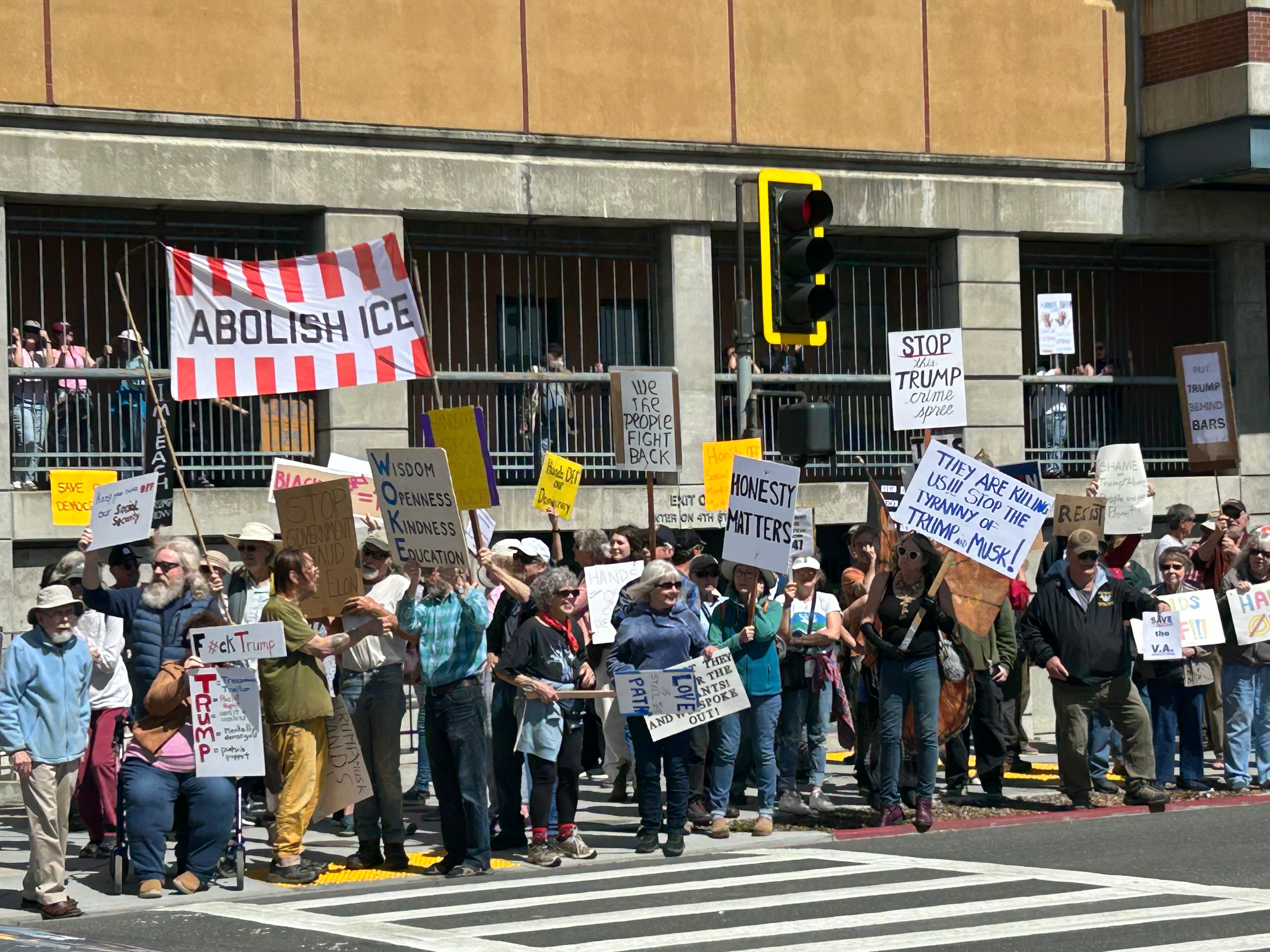
    Thousands of people took to the streets of Eureka to participate in a nationwide demonstration of dissent for the policies of the Trump administration last Saturday, March 5. More than 1,300 “Hands Off!” rallies occurred in all 50 states over the weekend, with a nationwide turnout estimated in the millions. 

    The Humboldt crowd spread more than four blocks on the Redwood Highway near the Humboldt County Superior Court, sporting handmade signs, noisemakers, flags and even costumes. A person with a megaphone led the crowd in chants such as “No Trump! No KKK! No racist, fascist USA!” and “Love, not hate, makes America great!” 

    A group of people at the Humboldt County Superior Court standing in a walkway with vertical metal bars,  resembling a jail cell. One person holds a cardboard sign that reads, "Dump Trump."
    Photo by Jess Carey | A group of protestors stand in a walkway on the outside of the Humboldt County Superior Court.

    Hundreds of voices echoed throughout town, mingled with enthusiastic honks of support from passing motorists. Some banged pots and pans together, some blew horns and some cheered. A brass band hosted a jam session and dance party around the flagpole. Bikers piloted a kinetic sculpture in laps around the procession. 

    It was a colorful cacophony of resistance — a Humboldt twist on a national movement. The scene was vibrant and determined, in line with the county’s long history of passionate political and social activism.

    Jess Carey is a senior at Cal Poly Humboldt, majoring in biology and double minoring in botany and journalism, and the science editor for The Lumberjack. They are passionate about telling stories that are relevant to the community, branching their interests in science, music, and the arts.

    A view of the Humboldt County Superior Court - a large, plain white building - surrounded by protestors holding signs. A few people are standing on the base of a large flag pole above the rest of the crowd.
    Photo by Jess Carey | A crowd of protestors stand around the U.S. flag podium holding handmade signs in front of the Humboldt County Superior Court in Eureka.
  • Cannabis Studies Program hosts cannabis symposium

    Compiled by Savana Robinson

    The information in this article is taken from a press release courtesy of the Cal Poly Humboldt Cannabis Studies Program.

    The second annual Cannabis and Environmental Stewardship Symposium will be held on Friday, March 28, from 8:30 a.m. to 5 p.m. in the Native American Forum at Cal Poly Humboldt. The symposium will feature 23 speakers, three panels, two presentations, a town hall, and free food for breakfast and lunch. 

    Among the speakers is Cal Poly Humboldt Associate Professor of Native American studies, Kaitlin Reed, the university’s Traditional Ecological Knowledge faculty fellow and the co-director of the Rou Dalagurr Food Sovereignty Lab & Traditional Ecological Knowledges Institute. Michael Polson, the director of UC Berkeley’s Cannabis Research Center and a member of the State of California’s Cannabis Advisory Committee, is also scheduled to speak.

    The symposium will explore current and possible policy options for encouraging sustainable cannabis agriculture and ideal practices for legal cannabis production that challenge the existing set of rules and regulations.

    The symposium is produced by the Cal Poly Humboldt cannabis studies program cannabis studies lab and funded through the Land-Sea Connection Program of Resources Legacy Fund, made possible by the Keith Campbell Foundation for the Environment.

    A poster advertising the Cannabis and Environmental Stewardship Symposium. It reads, "Held by the Cannabis Studies Program, this symposium aims to: develop a community definition of environmental stewardship through the lens of regenerative agricultural practices."
  • From rubble to renewable — Former Children’s Center is grounds for new energy and sustainability center

    From rubble to renewable — Former Children’s Center is grounds for new energy and sustainability center

    By Jess Carey

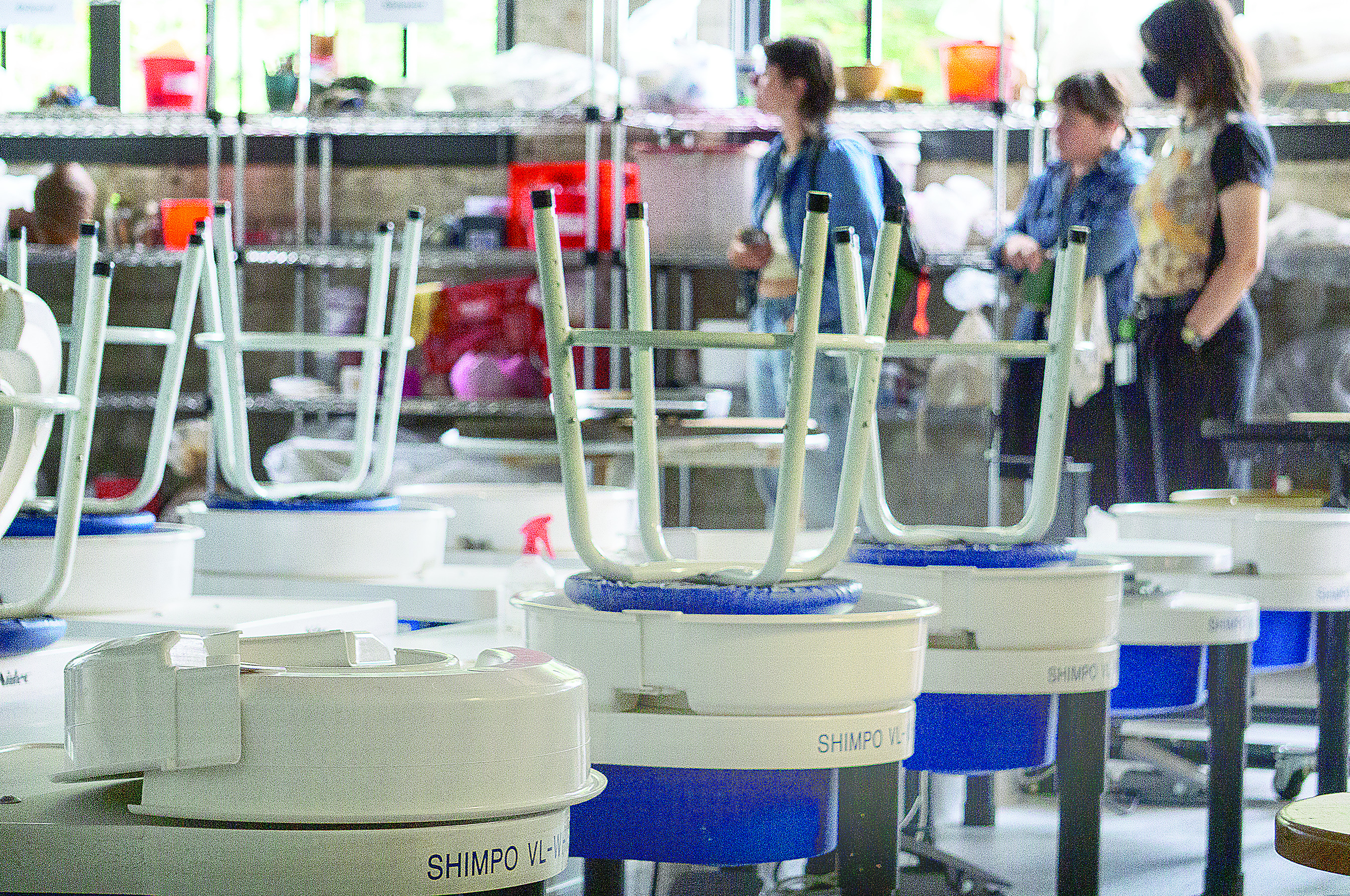
    These days, the whirrs and booms of machinery have become a familiar presence on campus. Walking up B St. comes with the added challenge of dodging beeping trucks and equipment; bangs and clangs echo clear up to the Redwood Bowl. Construction noise is a constant reminder of changing times as the state’s $433 million investment in campus infrastructure is being converted into concrete and steel. While a giant crane looms over the new science building, visible from most of Arcata, another project has been breaking ground around the corner on 14th and B St. Four buildings of the former Children’s Center have been demolished — the Mary Warren House, Walter Warren House, Baiocchi House and the Toddler Center.

    As the administration demolishes a historic structure on campus, questions are raised about what the big H chose to build instead. The site is grounds for a new building, dubbed the Energy Research and Sustainability Center (ERSC). The planned 20,000 square-foot two-story building has a budget of $28 million, and is slated to be the epicenter of sustainability and energy programs on campus. The project is funded by one-time Cal Poly funds that were designated for facilities improvements in 2022.

    The site has been abandoned since the Children’s Center moved to the renovated Trinity Annex in 2023. The buildings were former residential homes that the university reused, examples of what Mike Fischer, Associate Vice President of Facilities Management, calls the campus’s legacy homes. These older buildings on campus were acquired from donations or purchased from the surrounding community as the campus grew over time. While originally built as residences, they are now used primarily as offices and community spaces.

    “While [legacy homes] are quaint and a vision of the past, they are old, expensive and inefficient,” Fischer said. “When it comes to better land utilization and increasing density to serve our population, these are some of the buildings we’d like to remove.”

    Fischer cited constant maintenance needs, including “leaky pipes and windows,” as a recurring problem. He says that the new ERSC will consolidate existing sustainability programs that are currently scattered around the campus, like the energy systems engineering program and the Office of Sustainability. 

    “This project will give sustainability programs visibility, and a place to manifest a real place to live,” Fischer said. 

    The Schatz Energy Research Center, which already has a building of its own on campus, is expected to have a footprint in the ERSC. The non-profit agency is partnering with Cal Poly Humboldt on this project. The building will contain labs and equipment for energy research including the development of a campus microgrid solar energy system.

    Fischer also noted that the entry to campus is a little lost on the south side, as the buildings looked like part of the resident community. Walkability is awkward, as the lack of pedestrian connection between Union and B Streets causes foot traffic to frequently cut across the G14 and G15 parking lots. The ERSC will establish a “southern place” on the campus border and improve walkability by building new sidewalks and pedestrian routes. 

    With the Campus Center for Appropriate Technology and the community gardens being just up the hill, the ERSC will complete the sustainability theme of the south campus. 

    “That quadrant of campus is really gearing up to be our sustainability and land stewardship center, becoming something really unique,” Fischer said. 

    While the sustainability of leaving buildings empty for years only to demolish them raises some ethical questions, the university has recently renovated several historic buildings. The Trinity Annex project, completed in 2023, preserved the aesthetic of a unique old-growth redwood building and converted it from decrepit campus storage into a fully functional childcare and educational center. The ongoing restoration of the former technology building will preserve its architectural style while transforming it into a new state-of-the-art sculpture lab.

    It is important to remember where we come from, and nods to the past can still be seen in the remaining legacy homes scattered throughout campus. However, it is clear that as the university settles into its Cal Poly future, not every treasured, quirky building is going to stick around.

    Jess Carey is a senior at Cal Poly Humboldt, majoring in biology and double minoring in botany and journalism, and the science editor for The Lumberjack. They are passionate about telling stories that are relevant to the community, branching their interests in science, music, and storytelling.

  • CSU system announces new landmark AI initiative

    CSU system announces new landmark AI initiative

    By Ursula Newman

    The California State University (CSU) system announced its new Artificial Intelligence (AI) initiative to enhance access to AI technology and prepare students to be AI literate in future careers. This initiative is the first of its kind, with the CSU stating that no other university systems have implemented AI initiatives at this scale. This means AI software is becoming accessible through the university system, with a licensed version of ChatGPT joining the list of digital resources available to our campus community. In addition to new tech, training programs have been released to students and faculty to promote education on the growing AI sphere.

    The initiative includes partnerships with leading tech companies such as Adobe, AWS, IBM, Instructure, Alphabet (Google), Intel, LinkedIn, NVIDIA, Microsoft, OpenAI, and the Office of California Governor Gavin Newsom. These names, along with several CSU

    Representatives — which can be found on the California State University AI commons web page — make up the AI Workforce Acceleration Board, which plans to help pinpoint which AI skills are needed in California’s workforce and address those needs. The CSU system put out a press release on Feb. 4 titled “CSU Announces Landmark Initiative to Become Nation’s First and Largest AI-Empowered University System,” announcing the initiative and explaining that more tech companies are expected to be added to the advisory board in the near future.

    AI tools available at the university 

    Several services are being made available to students and faculty. Cal Poly Humboldt currently has licensed versions of generative AI chatbots Microsoft Copilot and Google Gemini, Zoom AI Companion, which takes notes and makes summaries, and Adobe Firefly for AI image generation. 

    Coming soon to the university is Notebook LM, Google’s AI-powered research and note-taking tool that organizes, summarizes and brainstorms, and OpenAI’s ChatGPT Edu, a chatbot that uses natural language processing to respond to prompts. Additional information about what is available may be found on the university website’s Information Technology Services page under the Artificial Intelligence tab. 

    The Center for Teaching & Learning Director, Enoch Hale, gave comment on the university’s game plan regarding this new initiative.

     “Humboldt has taken a robust, yet measured approach to implementing AI,” Hale said. “We are committed to supporting educators, learners, and all employees in this rapidly evolving digital landscape. The CSU has provided additional resources for its staff, faculty, and students, [which] include guides and courses they can take to address multiple areas of AI literacy.  Additionally, resources are provided to help all of us think through the ethical and responsible uses of AI in our work, in our learning, and in our lives.”

    Perspectives on AI in schools

    While there are classes where use of AI is limited or banned, this new initiative challenges that with the ChatGPT Edu agreement being specifically designed for the CSU system. The implementation of this is rooted in the concept that the job market is changing, and California’s workforce will need to learn to meet demands. 

    In a study from Microsoft and LinkedIn that surveyed 31,000 people across 31 countries, it was found that in 2024, over a six month period, the use of generative AI almost doubled, and now 75% of global knowledge workers use it regularly at work. However, this does not necessarily mean that companies are providing AI programs. 78% of AI users are using AI tools not provided by their organization and around 50% of workers who use AI said they are reluctant to admit using it for important tasks and worry that it might make them look replaceable. 

    Drawbacks of AI in schools 

    Despite the many uses of AI, there are concerns regarding AI use in academic settings. In a study by Geoffrey M. Currie, titled Academic Integrity and Artificial Intelligence, Currie explores the controversy around AI tools such as ChatGPT. He explains that at the core of the issue is the potential damage to institutions, professions and public safety if graduates do not genuinely develop certain skills and capabilities, and instead become overly reliant on AI programs. 

    Issues surrounding equity, access and data collection are addressed in the CSU’s statements. One of the initiative’s main goals is to make services accessible to all.

    Cade Webb, acting Chief Information Officer of Information Technology Services, explained that OpenAI will be providing training materials and workshops to help students develop effective and responsible AI. Critical thinking, informed use and reducing the impact on our environment will all be main points of emphasis. He also mentioned that by investing in this resource system wide, the CSU is helping to expand access and build a strong foundation for students’ engagement with AI. 

    Environmental impact 

    The CSU system has a sustainability policy, with a Climate Action Plan — one that outlines a goal of reducing systemwide facility carbon emissions significantly by 2040. 

    “CSU will strive to reduce systemwide facility carbon emissions to 40 percent below 1990 levels consistent with SB 32, California’s Global Warming Solutions Act of 2006 Emissions will include both state and auxiliary organization purchases of electricity and natural gas; fleet, marine vessel usage; and other emissions the university or self-support entity has direct control over,” according to the CSU Climate Action Plan. 

    The CSU system’s goals of reducing systemwide facility carbon emissions promises their dedication to sustainability. In contrast, the creating and training generative AI models — such as ChatGPT — requires a lot of electricity, which leads to increased carbon dioxide emissions. This is explored in an article by Massachusetts Institute of Technology about generative AI’s environmental impact. They stated that researchers have estimated that asking ChatGPT a question uses five times more electricity than a standard web search. 

    After initial development, the use of these programs continues to draw large amounts of energy. Fossil fuels are also used to create energy, as renewable sources of energy are not always enough. Data centers also require large amounts of water for cooling and generating electricity. There are also indirect environmental impacts from the increased demand for high-performance computing hardware and the need for more of these data centers to be built. 

    Scientists from Google and University of California, Berkeley estimated that the training process of a generative AI program uses 1,287 megawatt hours of electricity and generates about 552 tons of carbon dioxide. This is the same amount of power that 120 average US homes will use in a year. 

    Training and education

    Training and education around AI programs is another key part of the initiative. A student Generative AI (GenAI) micro credential titled “Academic Applications of AI (AAAI),” and a GenAI micro credential for faculty were designed by SDSU and are currently available to all CSUs. The goal of these online training programs is to enhance understanding of AI, explore its benefits and promote responsible use and ethical practices. Users will receive a credential or certificate upon completion, after engaging with several hours of education. 

    Webb explained that here at the university, there has been significant interest in generative AI tools, with over 2,700 users accessing the free version of ChatGPT.

    “While this shows the growing demand and curiosity around AI, the new education-specific license will provide a more secure environment for our students, faculty, and staff, ensuring that data is protected and usage aligns with campus privacy expectations,” Webb said. “We expect this tool to be available to our students this year, providing access to ChatGPT’s powerful capabilities for personalized learning support, research assistance and creative exploration.”

    Ursula Newman is a journalism major and Humboldt local. You can find her all over town doing all kinds of things, and talking to all sorts of people.

  • Bravery in community and visibility

    Bravery in community and visibility

    Cal Poly Humboldt’s trans community finds determination under the Trump administration

    By Griffin Mancuso

    1.6 million people over the age of thirteen identify as transgender in the U.S. according to the Williams Institute, making up 1.9% of the U.S. population. This community, despite its size, has been the target of several executive orders and legislative changes within the first few weeks of Donald Trump’s second term as president. 

    These executive orders include the government only recognizing two unchangeable sexes — male and female — and requiring all incarcerated transwomen to be moved to men’s prisons, defunding gender-affirming care for anyone under 19, setting the stage for another trans military ban and preventing schools from supporting students who are socially transitioning.

    While many groups have filed lawsuits over these executive orders, they have already resulted in changes within federal agencies. U.S. citizens can no longer renew passports with an X gender marker — meant to indicate a non-binary gender identity — or a marker that doesn’t match their assigned sex at birth, and federal employees are required to remove pronouns from their online profiles. Mentions of trans people and public health information related to the trans community are being wiped from government websites.

    Reactions from Students

    With the frequency of executive orders published by the Trump administration, many trans and queer students have struggled to keep up with the continuous media coverage of them. Ro Meisler, an interdisciplinary studies major, wasn’t surprised by the content or volume of the executive orders but was concerned about the wave of hate against the trans community on social media.

    “I think a lot of people are spoon-fed hateful opinions from huge media corporations and are fed a single view of how trans people are corrupting the youth and all this shit,” Meisler said. “But I think most people are not actually hateful people.”

    Meisler described trying to balance her emotional well-being and staying informed on the actions of the government.

    “I go back and forth between being really up to date and being too overwhelmed and not wanting to be up to date,” Meisler said.

    Psychology major Lee Checa Valdez was not only unsurprised, but expressed frustration at the number of voters who didn’t listen to warnings about the potential impact of the executive orders.

    “Since before this election, we’ve been telling people to do their research, and no one really listened,” Checa Valdez said. “And trans issues aside, there are things being put in place [that are] affecting lower-class people, middle-class people and a lot of people who did vote for the current president.”

    Shock and Awe and the Politicization of the Trans Community

    Political officials have introduced an increasing number of anti-trans bills over the last several years. In 2024 alone, 674 bills were proposed targeting trans people in categories like healthcare, education, sports and bathrooms, but only 50 of them passed. Executive orders cannot override existing federal laws, but even when bills or executive orders do not become laws, they can still benefit the politicians behind them.

    Loren Cannon, a lecturer in philosophy who specializes in trans and legal theory, described how Trump’s executive orders can curry favor with his voters and political allies.

    “What it can be used for is for that politician later to say to constituents who have been bought into this anti-trans rhetoric that, ‘Oh, see, I am against trans people, so you should vote for me,’” Cannon said.

    Checa Valdez noticed some similarities between the actions of the Trump administration and dictatorships and fascist regimes throughout history.

    “They like to focus on the ‘other than’ group, like black and brown people, queer and trans people, disabled people, is always where they start,” Checa Valdez said. “What a lot of white people don’t realize is that the things that they’re putting in place to get us kicked down further affects them as well in the long run.”

    Elias Pence is deeply ingrained in the queer campus community through the Eric Rofes Multicultural Queer Resource Center (ERC), the Gender Diversity Task Force (GDTF), the Queer Student Union (QSU) and as a fellow for the Office of Diversity, Equity and Inclusion. Pence is assisting in the creation of the Queer Center for Academic Excellence (QCAE), which will act as an umbrella for the ERC, GDTF, QSU and host up-to-date information. He also emphasized how he doesn’t want to alarm students and instead wants to focus on helping them protect their peace.

    “What we’re facing is people trying to scare and demoralize us by flooding the zone with shit, right?” Pence said. “We need help parsing it out and seeing, you know, what do we need to move on? What do we need to be afraid of? You know, who is most impacted by these things, and what sort of resources can we muster?”

    Response and Resistance

    On a national level, several groups have filed lawsuits in response to Trump’s executive orders. For instance, the executive order targeting federal funding for gender-affirming care for transgender youth was blocked by a federal judge’s ruling in Seattle on Feb. 28. Organizations like GLAD Law, the National Center for Lesbian Rights, Lambda Legal and the American Civil Liberties Union have already joined the growing collection of lawsuits.

    In Humboldt, many groups on campus are adjusting their resources to offer additional support and respite for trans and queer students. In response to the executive orders, the ERC has started hosting more events for students to relax and find community, along with providing more political updates and resources in their newsletter. Ayan Cabot, Outreach Director for the ERC, described how he and other staff are adjusting to meet students’ needs.

    “I think the most important thing that I always encourage within our staff is to just listen,” Cabot said. “I think that’s the best thing we can do, instead of imposing our ideas or beliefs onto the students. I think a lot of students sometimes just really need to decompress and feel other thoughts.”

    The LGBTQ+ organizations on campus host a variety of resources that students can use, including a gender-affirming closet, mental health resources, events and more. One of Pence’s goals with the future QCAE is to provide additional resources to trans and queer students with intersectional identities.

    “[We’ll be] cognizant of that and making sure that we’re not artificially separating issues, right?” Pence said. “If you’re trans and undocumented in your body, those things exist, we can’t separate it. It’d be like cutting you in half.”

    Pence is hopeful for the new resources available through the queer cultural centers and admires the bravery and resilience of the queer community on campus. He appreciates the support of admin like Chrissy Holliday and Jenn Capps and also encourages others to use their privilege to assist in that effort.

    “It’s tough to acknowledge your privilege and flex it,” Pence said. “Now’s the time to flex it — flex it for someone who doesn’t have it. You know that bravery that you’ve got in your pocket? Be there for someone else, step up for someone else, protect someone else, make someone else feel seen.”

    Eduardo Cruz, newly appointed A.S. president and liaison for the ERC, is working with the ERC to develop a resolution supporting trans rights and resources through the California State University system in response to Trump’s executive orders.

    “I would feel like it’s really important to always reinforce [trans] rights and the protections here on campus, and regardless of who’s in administration,” Cruz said. “We’re gonna fight hard to protect their rights, and that they will be heard and that they’ll be seen, and that there’s a place for them on this campus.”

    While many groups and individuals on campus are working to provide more security for trans students, Cannon emphasized the importance of finding support within community and self-care due to the uncertainty of the future under the Trump administration.

    “We gotta realize this could be for the long haul, right?” Cannon said. “This could be two years of dealing with really worrisome news every day, or it could be 12. We gotta stay the course. Organize, stay the course and make sure we feed those parts of ourselves that need feeding as we go through this because it is serious, right? People are going to be writing books about this for years to come.”

  • University releases After Action Reports detailing response to 2024 pro-Palestine occupation and protest

    University releases After Action Reports detailing response to 2024 pro-Palestine occupation and protest

    Wellbeing and Stewardship Team formed to facilitate conversations

    By Savana Robinson

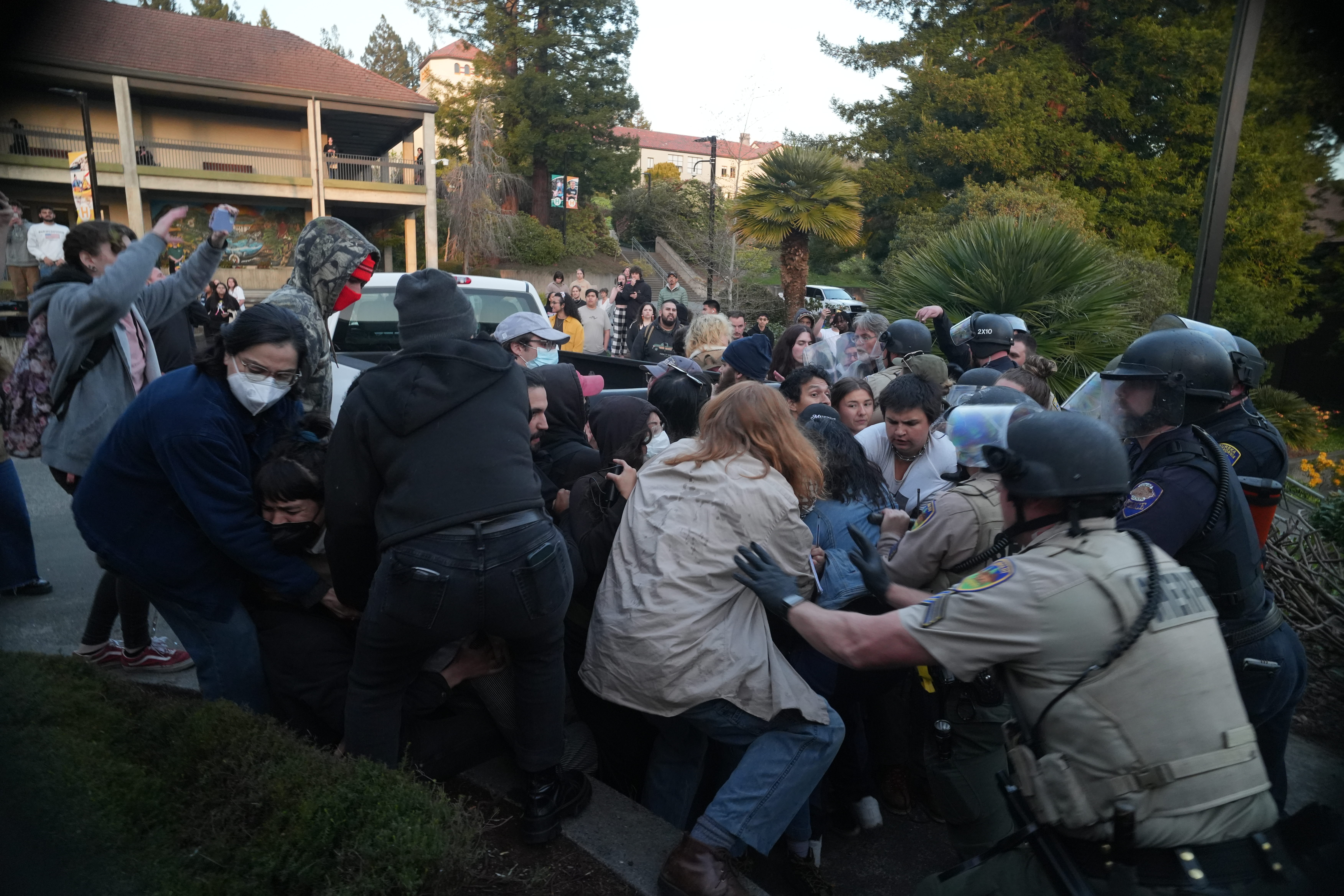
    Cal Poly Humboldt’s response to the pro-Palestine protest that occupied Siemens Hall from April 22 – 30, 2024, and ended in 32 arrests, was met with disapproval from the campus community. Just before the following semester, the university updated its Time, Place and Manner policy, which imposed restrictions on amplified sound and public access to campus. This was met with disappointment from activists and students alike.

    Emergency Operations Center and Policy Management Group

    When the protest first unfolded, the university activated its Emergency Operations Center (EOC) as required by the CSU Emergency Management Policy (EMP) and California’s Standardized Emergency Management System.

    “Those who serve on the EOC are trained employees who represent departments from across campus. Under this structure, they are tasked with making recommendations on operations, planning, logistics, administration and communications to the decision-making body called the Policy Management Group (PMG),” the EOC After Action Report (AAR) read.

    The university’s Emergency Operations Plan and Guidelines state that the PMG approves policies concerning emergencies before they occur. The plan and guidelines also clarify that the PMG does not take part in operational aspects of emergency responses, meaning they only make decisions with the advice of the EOC.

    After Action Reports

    The CSU EMP also requires that the university compile an AAR, a document detailing findings and insight gained as a result of the incident. Cal Poly Humboldt began its compilation of two AARs in late summer 2024, according to an email written by Acting Vice President for Administration and Finance, Mike Fisher, in response to a request to university marketing and communications for an interview. One report was for the EOC, and another was for Incident Command (IC) — the university’s emergency personnel, law enforcement and on-scene command. The process involved interviews with people involved in the EOC and IC along with the help of California Office of Emergency Services. The report was finished in November 2024.

    “The After Action Reports (EOC and IC) are based on the perspectives of those who were involved with the operational processes and structures and provided a starting point for a broader conversation,” Fisher said in the email.

    Wellbeing and Stewardship Team meetings

    On Jan. 21, the university sent an email to the campus community with both AARs linked. Along with the documents, the email introduced the members of the Wellbeing and Stewardship Team and announced five meetings to be held on campus involving the team.

    “The purpose of these conversations is to reflect together on the events of April 2024 and their impact on our campus and community,” the email said. “Our primary focus is to listen to your experiences, concerns, and ideas. We will share resources and information that are available, including mandated, operationally focused after-action reviews.”

    Aimed at engaging the campus community in conversations about the April 2024 protest, the meetings were held earlier this semester and included University Senate and Associated Students meetings and campus and staff council open forums. Three of these meetings offered world café-style community conversations, which were facilitated breakout group sessions that emphasized listening and participation from everyone in each group.

    “There have been many different lived experiences from individuals shared in our community conversations, including those facilitated by the campus wellbeing and stewardship group. These include a range of feedback from the campus community,” Fisher said. “This is important because these conversations provide a more inclusive picture of what happened and can help us learn from the event and improve our emergency response efforts.”

    Rouhollah Aghasaleh, assistant professor and University Senate faculty representative for the College of Professional Studies, was arrested at the protest in 2024. At the Jan. 28 University Senate meeting, they offered a framed photograph of their detainment to the Wellbeing and Stewardship Team.

    Reception of the After Action Reports

    Aghasaleh took issue with the AARs because neither said who specifically was in the EOC or PMG. Each AAR said the PMG was comprised of the President’s Advisory Team, University Council and government relations. According to the university’s most recent Emergency Operations Plan and Guidelines linked on the university website, dated Oct. 2018, the PMG consists of the president, provost, the executive director of the office of diversity, equity and inclusion, chair of the academic senate, associated student president, legal advisor, public information officer and vice presidents of academic affairs, administration and finance, student affairs and advancement.

    “Those two reports are not only insufficient but also are insulting our intelligence, our being. I spoke about this at some smaller meetings. There are concerns about if those members become known, then they might become attacked, or become targeted,” Aghasaleh said. “And I understand that’s a reality, and that’s unfortunate, but it’s important to remember what they did, like for instance, my own case, being suspended for five months.”

    Aghasaleh pointed out that the event summary of each AAR was only seven paragraphs long. Upon further inspection, the two summaries were identical save for one term in the last sentence of each, where it says EOC/IC was deactivated on May 20. 

    Strengths and areas for improvement

    Following the event summary, both AARs laid out what the EOC and IC did well and what they could have done better in response to the protest. The EOC AAR claimed three strengths and six areas for improvement, while the IC AAR listed three and five, respectively. For example, the EOC AAR noted that their good local relationships helped with resources and assistance. Both reports also had plans for addressing each issue, some of which have been accomplished. The report listed improving the IC and EOC interface as something that could be improved upon, which, according to the report, has been completed.

    “On the night of April 22 in particular, poor communications between the IC and EOC led to inter- and intra-team information gaps and consequently to tactical errors and inadequate operational planning,” the EOC AAR read. “The IC/EOC interface was not fully established until an IC Coordinator was assigned two days into the incident.”

    One of the strengths listed in the IC AAR was that no injuries were reported as a result of the 32 arrests made in the early hours of April 30, 2024. Areas for improvement included bettering management of public relations and technical issues with body-worn cameras. Dealing with both issues is in progress.

    Fisher noted that the AAR is only part of the story.  

    “I think this is a single reference point of a much more complex experience of an incredibly impactful event on campus,” Fisher said. “There is much more to learn beyond this report and I am encouraged by community conversations I have been a part of and I look forward to more.”

    Why form a Wellbeing and Stewardship Team?

    The organization of the team was first promised in a statement signed by university Interim President Michael Spagna, which was sent to all of campus via email on Oct. 29, 2024. According to the email, the team was formed to facilitate productive conversations and build trust.

    “We have work to do as a community to fulfill our potential. Some of that work is in progress, while much else remains to be done. To those who have expressed the need for more inclusive decision-making processes, we hear you,” Spagna’s statement said. “Over the last few weeks, we have been leaning on the collective expertise of our campus community, empowering students, faculty, and staff to help us reflect on and learn from the past and to build a safer, more supportive environment.”

    The Wellbeing and Stewardship Team saw potential in the conversations that took place in the meetings. From the same request for an interview to university marketing and communications, the Wellbeing and Stewardship Team responded collaboratively via email.

    “The conversations that have happened so far have given us valuable insight into how campus leadership handled the events and how the campus community felt about their response. Based on the feedback we received, we get the sense that these meetings created a meaningful space for some participants to share how the events affected their studies, work, sense of safety, and connections to both their close groups and the larger campus community,” the Wellbeing and Stewardship Team wrote. “We feel like there’s interest and value in continuing this dialogue – and finding ways for campus groups to come together and shape what we want our future to look like.”

    Moving forward

    Aghasaleh noted that the university may have the right intentions in its efforts to build trust back up between the university and the campus community.

    “I think there is some genuine intention to make things right, especially after President Spagna took the lead,” Aghasaleh said. “I do hear them having some genuine conversation to find ways to make things right.”

    Aghasaleh noticed a strain on the university’s relationship with students, which will not go away on its own.

    “I am very concerned right now with this widening gap between admin and students on campus … By giving ourselves more time, things are not going to get easier. I’m pretty sure some tensions will come up pretty soon, and I know we are not prepared,” Aghasaleh said. “We have not learned our lessons from last year.”

  • A.S. President Eduardo Cruz passionate about protecting rights, supports board members

    A.S. President Eduardo Cruz passionate about protecting rights, supports board members

    Friendly working relationships take time and effort to build and maintain, which Cal Poly Humboldt Associated Students (A.S.) President Eduardo Cruz has taken the initiative to do. Cruz wants to listen to and prioritize the needs of his board members. For example, once upon a board meeting, A.S. Administrative Vice President, Celena Tello-Linares, a sophomore data science major, desperately needed a pick-me-up to get through. Cruz asked Tello-Linares what she needed and she responded with another question wondering about the possibility of food at the meeting. Soon after, agenda items came with a side of chicken katsu.

    “It’s a good environment to be in, for sure,” Tello-Linares said.

    On Dec. 13, 2024, A.S. board members voted in Cruz as the next A.S. president after the previous president, Wysdem Singleton, stepped down on Nov. 15, 2024. Cruz was previously the board of directors’ legislative vice president.

    “I just really wanted the organization to continue and help bridge that gap between A.S. and students, because I feel like a lot of [people] think we’re administration and we aren’t, because administration has no play in Associated Students,” Cruz said. “ I just really wanted to bridge that gap and help A.S. be rebranded and have students know that we’re here for them in their time of need. And whenever they have an issue or problem, they could always come to us [to] voice their concern.”

    Cruz is passionate about his work, especially when it comes to supporting the rights of undocumented students and students in the LGBTQ+ community.

    “I really stand behind the undocumented and LGBTQ students, and since I feel like they’re really under attack right now with all their rights and everything, it feels really important to reinforce our support for them, and to be able to give the resources when they’re needed,” Cruz said.

    Tello-Linares appreciates Cruz and his commitment to A.S. in tandem with his care and communication efforts with his team.

    “I got really sick the weekend that our A.S. government budget was due,” Tello-Linares said. “I was in the hospital and I could not do anything.”

    Tello-Linares said that after she was home and able to work on the budget, Cruz reached out to see if she could get it done.

    “He was checking in, texting, answering any questions that I needed to get [the budget] done, and that really helped me push through a hard time. I was really grateful that he had that line of communication with me, and I felt like I could share what I was struggling with, with him.”

    According to Tello-Linares, communication is a strength of Cruz’s that has gotten stronger since stepping into his current role as A.S. president.

    “I feel like that’s something that he’s really been working on and has improved since being in office,” Tello-Linares said.

    According to Tello-Linares, Cruz could work on something else as well.

    “He works way too much, so sometimes his plate is overfilled,” Tello-Linares said. “So that’s probably something that I would say he needs to work on — delegating that out a little bit more.”

    Cruz also has a good relationship with Environmental Sustainability Officer Camille Fisher, a junior environmental science and management major, who said that when she was new to A.S. in the Fall 2024 semester, while Cruz served as legislative VP, Cruz helped Fisher navigate her role on the A.S. board.

    “I love working with Eduardo, just because he’s a very motivated individual, and especially in the very beginning of this year in the fall semester, when I first started working with Associated Students, I was still sort of figuring out what my role is exactly, and what to stay on top of and everything that is expected for me to do,” Fisher said. “And so adjusting to that was really good with Eduardo.”

    Eduardo still looks out for Fisher, ensuring that what needs to get done will be accomplished.

    “He emails me reminders just to make sure I stay on top of things, but in a very positive way,” Fisher said. “And he’s very determined, which I really respect.”

    Cruz aims to listen, provide support and encourage folks to engage in conversation.

    “I feel like my leadership is more like listening and seeing how I can help and being in the spaces, or if someone else on the board can better help in those situations, also involving them in the conversation, instead of just hoarding all that information to myself,” Cruz said. “Because I want to be someone who someone can come up to and talk to and have a nice conversation.”

    Savana Robinson is a senior journalism major and news editor of The Lumberjack, as well as a multimedia journalist and producer at Redwood News. She loves motorcycles, cats and video games.

  • New report highlights CSU’s controversial ties with oil lobbyist

    New report highlights CSU’s controversial ties with oil lobbyist

    By Eli Farrington

    The California State University has always been vocal about the role of higher education in fighting climate change, but a new report from climate research group F Minus suggests that the University’s ‘pro-climate justice’ stance may not be as transparent as it seems. 

    Founder and Executive Director of F Minus, James Browning, previously worked for Common Cause, a non-profit watchdog organization that promotes the core values of democracy and works to hold the American government accountable. During his time there, he worked on several campaign finance issues and corruption cases, which piqued his interest with lobbyists who had seemingly incompatible clients. As he continued to investigate, a pattern began to emerge. 

    “If you look at all these lobbyist lists, you see thousands of lobbyists who are clearly working to promote fossil fuels while also representing institutions like Cal State, whose students, faculty and neighbors are being devastated by the climate crisis,” Browning said. 

    The Origin of F Minus

    In July 2023, Browning launched F Minus, which he describes as a divestment campaign with a goal of pressuring institutions like the CSU system to stop working with lobbyists who are also employed by coal, oil and gas companies. His goal with F Minus is to raise awareness amongst educational institutions that employing lobbyists with ties to fossil fuels makes them responsible for byproducts of the fossil fuel industry.

    On Jan. 14, F Minus released a 25-page report titled “Hypocrisy 101: How Lobbyists for Higher Education Are Making the Climate Crisis Worse.” The report contains a list of every university in the country that employs a fossil fuel lobbyist. There are over 200, but the report focuses specifically on the top 20.

    “We profiled the top 20 schools because these are [the] schools where there’s a lot of good things happening on climate,” Browning said. “These schools have divested, but this good work is radically at odds with the bad things their lobbyists are doing on climate.” 

    The Cal State University section of the report articulates their hypocrisy regarding the climate crisis, highlighting the many ways in which the university’s contracts with oil lobbyists contradict its Higher Ed Climate Action Plan

    This plan, which was in part spearheaded by CSU Chancellor Mildred García — who sits as co-chair of the Higher Ed Climate Action Task Force — advocates for swift and immediate action to be taken by higher education institutions in the fight against climate change. 

    “The effects of climate change are harming people and communities across our country and the globe,” the plan reads. “These effects will only worsen in the decades to come … There is a critical opportunity for higher education to leverage its strengths to build knowledge, foster innovation, enhance communities, and model solutions to help build a sustainable, resilient and just world.” 

    In the Hypocrisy 101 report, F Minus points out the irony of this statement, noting that the CSU Chancellor’s office is directly responsible for the employment of lobbying firm Sloat Higgins Jensen and Associates, which is employed by Chevron as well. The firm also represents Pacific Gas & Electric, which has been blamed for over 30 wildfires since 2017, according to both NPR and PBS News

    “In June 2023, the California Faculty Association, representing 29,000 CSU faculty and staff across all 23 of its campuses, testified in favor of a bill (SB 253) that would require businesses with revenues exceeding $1 billion to disclose their Scope 3 emissions,” the report said. “Opposing the bill was CSU’s own lobbying firm, Sloat Higgins Jensen, on behalf of its client Chevron … CSU’s lobbying firm has represented Chevron on the wrong side of every major California climate bill over the past two years.”

    Backlash Against CSU

    Luis Angel Martinez, campaigns organizer for Fossil Free California, shared the report’s frustration with CSU, adding that the catastrophic LA fires are yet another example of the impact that the fossil fuel industry has on the environment. 

    “I think it’s completely unacceptable that the CSU system understands [the harm] that their students are going through when these climate disasters happen, and is still working with the perpetrators of that harm,” Martinez said.

    Martinez believes that the only way to hold fossil fuel companies accountable for the harm that they have caused to these communities — and to the planet at large — is to cut contact and demand financial reparations. 

    “As a former CSU student and a Los Angeles native, I am appalled that CSU and the UC system continue to employ lobbying firms that also represent fossil fuels,” Martinez said in an F Minus press release. “In the midst of the most devastating fires in our city’s history, it’s time to sever all ties with the industry that is responsible for this harm. The CSU system must no longer employ lobbying firms that also represent fossil fuels if they are to stand in solidarity with their own students and low-income communities of color being disproportionately harmed by the climate crisis.”

    Jennifer Marlow, an associate professor of environmental law at Cal Poly Humboldt, said in an email that the Hypocrisy 101 report provides more evidence of the fossil fuel industry’s pervasive underbelly. She noted that Cal Poly Humboldt has its own Climate Action Plan, which details, “strategies to reach carbon neutrality and climate resilience,” by 2045.

     “The timing of this [hypocrisy] is interesting, as the federal governmental structure for addressing climate change is being dismantled by the incoming administration,” Marlow said. “So my confidence is guarded right now — I can’t be confident about anything.”

    Responses from Climate Activists

    Marlow’s uncertainty echoes the general consensus among many climate justice advocacy groups, especially with President Trump beginning his second term in office. In his first few days, Trump signed executive orders withdrawing the United States from the Paris Climate Agreement, and terminating the EPA’s Office of Environmental Justice and External Civil Rights. These orders imply that the president intends to keep his “drill, baby, drill” promises, striking fear in the hearts of environmentalists everywhere, including student climate activists across the California State University system, whose tuition dollars are helping fund an industry that directly opposes the messages of the CSU’s Higher Ed Climate Action Plan. 

    Alicia Colomer is Managing Director of the Campus Climate Network, a coalition of student-led climate justice organizations fighting to push the fossil fuel industry off college campuses. 

    “The fossil fuel industry has been lying to the public about the causes and severity of the climate crisis for years,” Colomer said. “These companies use tactics like lobbying, PR and biased research to promote a false debate about climate change in order to continue business as usual.”

    The Campus Climate Network wants universities to have the opportunity to be climate leaders, innovate and find just solutions to the climate crisis.

    “It’s time for our universities to prioritize our futures over their relationships with the fossil fuel industry and cut all ties,” Colomer said. “It is hypocritical for our schools to on the one hand claim to care about climate justice and sustainability and on the other continue to fund and support the lobbyists that do Big Oil’s dirty business.”

    Many climate activists and members of the environmental movement across California were disappointed to learn of CSU’s problematic relationship with Sloat Higgins Jensen, including Scott Kelley, Associate Professor of Biology at San Diego State University. Kelley is quoted in Hypocrisy 101 expressing his disdain for the decisions of the Chancellor’s Office. 

     “Chancellor García has been vocal about the pressing need to address the climate catastrophe, which makes it shocking to learn that her office directly employs a lobbying firm that also works for Chevron, one of the biggest fossil fuel polluters on the planet,” Kelley said in the report. “Surely, CSU can find a higher-ed firm that does not also work for a company that is actively destroying California.”

    As a lifelong climate justice advocate, Kelley has watched the fallout of the climate crisis unfold before his own eyes. 

    “This has never happened in my lifetime,” Kelley told The Lumberjack. “No one has ever heard of this many fires. Nobody has ever seen this many hurricanes. Nobody has seen tornadoes in New York, where I grew up … These are the hottest days we have ever seen in human history — that is not normal.”

    Kelley expanded on his interpretation of Cal State University’s relationship with Sloat Higgins Jensen, saying that while he knows that CSU did not hire the firm based on their clients in the fossil fuels industry, he is sure that CSU is aware of these clients, and believes that the University should be seeking out a lobbyist with a more neutral or climate-friendly clientele portfolio. 

    “I know faculty whose houses have burned to the ground [in LA],” Kelley said. “The climate crisis is real. It’s hitting us in the face like a freaking sledgehammer. F Minus has shown that [CSU] is supporting, through lobbyists, the fossil fuel companies. We’ve got to take this seriously. Our own students are being hammered with it. Our faculty’s houses are burning to the ground … That is nuts. Anyone who says otherwise is just a liar, or has something to sell you.”

    Eli Farrington is a highly intelligent human life form working as the opinion editor for The Lumberjack. In his free time, he enjoys analyzing the complexities of the human condition. His passion for journalism knows no boundaries and exceeds time and space itself. 

  • New AS President aims to voice student needs to admin and prioritize undocumented and LGBTQ+ rights

    By Savana Robinson

    Cal Poly Humboldt Associated Students (AS) President Eduardo Cruz took office on Dec. 13, 2024, after the previous president, Wysdem Singleton, stepped down on Nov. 15, 2024. Before Cruz became AS President, he was the Board of Directors’ Legislative Vice President. Cruz strongly believes in protecting the rights of students who are undocumented and/or part of the LGBTQ+ community.

    “I think one of the main important things for me, just with this current administration, is reinforcing our support and resources for undocumented and LGBTQ students,” Cruz said. “It feels really important to reinforce our support for them, and to be able to give the resources when it’s needed.”

    Cruz explained his intentions of acting as a bridge between students and administration, making student needs and concerns known. 

    “We’re the official voice for students here on campus,” Cruz said. “So whatever their needs are, is what I’m going to advocate for on this campus, and that’s where I’m going to shift my goals to align with the campus community.”

    Cruz laid out his priorities, inspired by AS initiatives.

    “I’m gonna educate the students, I’m gonna allocate correctly, and I’m gonna advocate on their behalf,” Cruz said. “Regardless if it puts me in an awkward situation with admin, because the student voice is what we’re here for.”

    Savana Robinson is a senior journalism major and news editor of The Lumberjack, as well as a multimedia journalist and producer at Redwood News. She loves motorcycles, cats and video games.

  • Relocated from Campus Apartments: The last residents reflect on the dorms

    Relocated from Campus Apartments: The last residents reflect on the dorms

    By Andres Felix Romero

    At 4 a.m. after a long night of work, Tyler Acosta was finally able to get back to his Campus Apartment dorms for some much-needed rest. 9 a.m. rolled around as knocks from the housing department woke up Acosta. Upon answering the door, Acosta was informed that due to the mold in the building, all residents would need to evacuate their rooms within four days. Acosta groggily pulled himself out of bed, shocked — but not surprised — by the news. After all, he and his roommates had been dealing with mold on a daily basis, and it had invaded their kitchen, bathroom and bodies.

    Acosta headed over to the Jolly Green Giant Commons to find his new dorm placement. There, he walked into a chaotic scene. There, Campus Apartment students bustled about; most were happy to be out of the dorms. Others were upset due to needing to vacate a room where they shared a bathroom with one other person, now having to use communal bathrooms in the mostly freshman-populated Canyon Dorms. Acosta was lucky enough to be part of the group that upgraded to the more private College Creek Dorms. 

    Other residents who had to evacuate included Sam Ray, a zoology freshman brand new to Humboldt from Vista, California. Ray was happy to find a dorm placement on campus that met his dietary needs to avoid sickness. The school was able to provide him with a Campus Apartment dorm with his own kitchen to avoid food allergy contact.

    “I have celiac disease,” Ray said. “I can’t have gluten … or else I’ll get really sick. So [Housing] wanted me to have my own kitchen.”

    Despite Ray being able to have his own kitchen for his health, he and other residents questioned if the mold contributed to negative health conditions. Ray noticed how aspects of his health improved being away from the mold, however only after Ray experienced some losses.

    “I didn’t realize so much was because of the mold until now,” Ray said. “I had a couple of fish that were mysteriously dying, and we [thought] it might be the mold. Now [moved out], my eyes don’t hurt anymore. I can breathe.”

    Acosta similarly noted that once he left campus apartments for just a few weeks, chronic health issues such as his eczema no longer became a daily issue.

    “It’s a correspondent for my winter break,” Acosta said. “I broke out for the whole semester. I went home for winter break, and I had no eczema. It just went away.”

    Acosta also recalled battling the mold daily, always needing to scrub mold in his bathroom that would always come back. He also needed to maintain a supply of towels to clean up water pooling behind the toilet that would inevitably form mold. Acosta recalled a moment when he discovered how deep the mold went under the surface when the plastic trim of his bathtub began to crack.

    “I could push on [the trim], and you can just see black water coming out,” Acosta said. “The water was getting in between [the bathtub] and the wall, so [mold] just grew out of there.”

    The housing department on campus held concerns for the well-being of their residents, eventually bringing in a consultant to ensure the dorms were safe to live in. This eventually led the school to begin evacuating students from the apartments on Jan 19, days before the beginning of the spring semester. 

    “The consultant identified potential mold conditions, which could pose health concerns for individuals who may be sensitive to mold exposure, and collected samples,” read an email from Cal Poly Humboldt on Jan. 19. “While we wait for the sample results, the University is erring on the side of caution and acting on the consultant’s suggestion to move a group of students who live in a section of the building to a different residence hall on campus.”

    The school sent a follow-up email on Jan. 25 announcing the decision to relocate the remainder of the Campus Apartment residents due to the results of the sample.

    Students had to move only a few days before beginning their semester, and some felt that they were given a bad deal for having to move dorms, while others — such as Acosta — felt that the situation ended okay for them. His new dorm roommates even brought back memories of living with his family.

    “I was listening to them bicker the other day,” Acosta said, “That brought me back home. I [thought], ‘Nice, I have siblings again.’”

    The Campus Apartments are slated to be demolished to make way for a new parking structure and dorms. If there is anyone who may be concerned about repercussions due to mold from the Campus Apartments, they can make an appointment with the Student Health Center, TimelyCare, or another medical professional.

    Andres Felix Romero is a reporter and Community Liaison for The Lumberjack. Outside of reporting, he enjoys adventures, climbing trees, and scaling rocks. He also enjoys hikes with his dog.

  • Cal Poly Humboldt issues hotline to report ICE sightings on campus

    By Mia Costales

    Over 300 undocumented migrants were arrested on Donald Trump’s first day in office and an estimated 8,000 have been detained as of Feb. 4, according to Homeland Security. Even more unrest was sparked after Trump announced plans to start sending undocumented migrants to Guantanamo Bay, in which he boasted 30,000 beds at this detention center. 

    On Jan. 24, an email was sent out to all Cal Poly Humboldt faculty on behalf of Dr. Andrea Delgado, Assistant Professor of English and Dream Center Faculty Fellow, detailing how to support undocumented students amidst the Trump administration and heightened Immigration and Customs Enforcement (ICE) presence due to his executive order “Protecting the American People Against Invasion,” which “ensure[s] the efficient and expedited removal of aliens from the United States,” according to The White House website. 

    “Cal Poly Humboldt is committed to advocating for Immigrants’ Rights and protecting the information of its community members,” Delgado said, via the email sent out. “This includes safeguarding them from any form of violence or discrimination, preventing unlawful participation of individuals or local government and CPH representatives in immigration enforcement activities, and prohibiting collaboration with agents from Immigration and Customs Enforcement (ICE) or Customs and Border Protection (CBP).” 

    The email also included the phone number (707) 826-5177 to report any sightings of federal immigration officers on campus to Assistant Vice President and Chief Human Resources Officer Anthony Casas. 

    Centro Del Pueblo, an organization dedicated to supporting Latiné and Indigenous migrants in Humboldt County, also has a hotline at (707) 200-8091 to report and verify ICE sightings in the general area. The hotline went live after false ICE sightings at several grocery stores were reported in Eureka. Their Instagram @centrodelpueblo and their website CdPueblo.com both provide information in English and Spanish on what to do and say if a federal agent knocks on your door. Namely, do not open the door. Instead ask for them to slide a warrant under the door. If an officer does not provide a warrant with your name correctly spelled and a judge’s signature, you do not have to let them into your home or talk to them. You have the right to remain silent, the right to an attorney and the right to refuse an unlawful search. 

  • Should Spagna stay? Cal Poly Humboldt faculty show their support for the current interim president

    Should Spagna stay? Cal Poly Humboldt faculty show their support for the current interim president

    By Barley Lewis-McCabe

    Out of every Cal Poly Humboldt president, none have been like Michael Spagna.  Spagna has something few other presidents have had — and that’s a term limit. 

    Recently, a letter was written by faculty in the environmental sciences and management department detailing qualities they would like to see in the new president, and how they feel Micheal Spagna fits the bill. That letter was shared with other departments, who were encouraged to write their own. At the time of publishing, this second letter, which expands on broader issues, has been signed by over 350 faculty, community members, students and even Julie Fulkerson, former mayor of Arcata.

    An important thing to note is that Spagna is prohibited from applying, as per his contract agreement and CSU Chancellor Mildred Garcia’s order. But, he is able to be nominated for consideration — which is what the letters are doing — as well as showing the qualities the community looks for in a new president.

    When Tom Jackson stepped down, Spagna was appointed as the interim president. His job was simple — build back trust between the administration and faculty and students, but mostly hold down the fort until the official president showed up.

    But why do people feel this way? What makes Spagna such an appealing figure to so many? The magic words for most faculty are shared governance, which can be boiled down to the practice of consulting the people who will be affected by a decision before it’s made. Spagna was routinely said to be a strong proponent of the practice by faculty who have worked with him, while previous presidents have disregarded shared governance and made large-scale decisions without consulting the people who will be most affected by them. When asked for a statement on the push for him to be considered as the next president, Spagna reflected on the support he’s seen from the community.

    “Faculty have been welcoming and responsive, and I’m truly honored to have their support and their faith in me to lead Humboldt,” Spagna said via email. “A significant part of this effort requires being in community with not only faculty, but also students and staff. What that means is listening to and learning from them, while understanding their previous and current experiences to help this university better meet its educational purpose.” 

    In his short time here, Spagna has been seen at community events, arts productions, seminars, and has spoken to reporters. 

    When discussing the important qualities in a president, Allison O’Dowd, Environmental Sciences and Management chair, discussed the importance of having a qualified, empathetic president, particularly one who has prior experience in education. 

    “It’s important to have a president who has a history in academia, who’s actually taught classes, they know what that’s like,” O’Dowd said. “Someone who can be in our shoes in terms of relating to students and faculty, and see’s the mission of the university to be education.” 

    It’s not like he appeared out of nowhere — he has over 35 years in the CSU system, working both as a professor and administrator.

    Spagna listens. He’s met with department chairs to understand the needs of the university, and stressed the importance of the faculty perspective. In these meetings, Spagna has discussed his plans to expand the university’s health programs and strengthen community involvement with faculty. Along with that, he has shared ideas on how to actualize the ambitions of a polytechnic university. 

    Mary Virnoche, a sociology professor, expressed hope for Spagna’s consideration. 

    “I imagine Chancellor Garcia knew exactly who she was appointing to serve as our interim President,” Virnoche said. “He is the leader we needed on this campus on the cusp of tremendous change. I hope the Chancellor will consider the capacity, momentum, and support that President Spagna has built as she makes decisions about our President.”

    Students have the ability to be involved in the search for the next president. If you feel strongly in one way or another, email presidentsearch@calstate.edu, Chancellor Mildred Garcia herself, or CSU Associate Vice Chancellor and Chief of Staff Danielle Garcia to voice your opinion on what you want in the future president of Cal Poly Humboldt.

    Barley is a freshman journalism major, Photojournalist, and untraditional reporter, they like to cover interesting stories that center on social change, and human impact.

  • Donald Trump is Your President(?): Cal Poly Humboldt reacts to the presidental inaguration

    By Nick Escalada

    The interim period between the 2024 U.S. Presidential election day and Donald Trump’s official inauguration came on Monday, Jan. 20. At Cal Poly Humboldt, students and faculty alike have been expressing their strong opinions on this polarizing transfer of power from the very first day of classes. When campus reopened after the MLK Day of Service, which coincidentally lined up with the day of the inauguration, students gathered for a pro-Palestine march of resistance that put the University Police Department and the incoming Trump administration under the microscope. 

    Buildings were once again plastered with profanities and paint balloon explosions while hallways echoed with the now familiar drumming and chanting, but the crowd seemed charged with a fresher anger that one could only assume hailed from events of the previous day. Members of the protest shared a common sentiment of frustration and demoralization paired with insightful commentary on their motivations for taking action.

    Haley, an environmental science major, indicated her bleak expectations for the incoming administration while maintaining an air of hope as a dissident. “Generally [the next four years] seem not great, but I, like everyone here, came together to fight and protest [Trump]. Will anyone in power listen to it? Probably not, but we could still make it known that this is not a popular opinion amongst people.”

    Other students shared their concerns about particular policy decisions Trump promised to make in his second term. Ryan, a former biology major, declared his apprehensions. 

    “There’s a lot of things to be concerned about,” Ryan said. “A lot of dangers of accelerated political repression, anti-LGBT legislation, of accelerated ecological destruction.” 

    Ryan also shed light on the Georgia State Police’s killing of environmentalist Tortuguita, which was a major component of the march and an instance of police brutality he projects will be repeated under this new administration. 

    “This represents the fact that these multiple state governments are willing to spend such vast amounts of money and resources to push through these unpopular projects, demonstrates that they are actually scared of the power of popular, and that’s a very heartening thing, even if it’s awful.” 

    A natural resources student who goes by Skunk describes why he protests the new establishment through the march and beyond. 

    “The thing about this struggle is that you won’t care about it until it affects you personally, but by then it’s too late if you don’t speak up for the people who are being affected,” Skunk said. “I want to because I have a passion inside. But the thing is, if you don’t have anywhere to get it out, it can kill you — it can eat you inside. So, I want to inspire my fellow students and our communities like a ripple in a pond. I want the people who have been feeling unmoved by this to get out here and do something with us, because otherwise, nothing’s gonna happen.”

    “I expect that in the first 100 days of the new administration, President Trump will attempt to govern, in his words, ‘bigly,’” Dr. Stephanie Burkhalter, Cal Poly Humboldt political science professor, said. “He will concentrate on defining himself as the tough and decisive leader that America needs and wants. He has signaled to his populist supporters that he is willing to nominate loyalists to key positions in government leadership regardless of their lack of expertise or governing experience. Most of all, Trump seems driven to be perceived as meeting the expectations of his supporters and as competent in handling big issues that the country faces — whether or not that is truly the case. In this way he is like other politicians.” 

    Meanwhile, Professor John M. Meyer shared the disconcerting changes he noticed between the start of Trump’s 2016 term and his current one. 

    “The new administration is much more prepared to exercise power and opponents are much less visible,” Meyer said. “The administration is already taking advantage of this to initiate numerous executive orders on immigration, climate change, and foreign policy. I expect much more in the coming days. A goal is to overwhelm the opposition in order to maximize their impact. The immediate dangers are greatest for the most vulnerable among us, including people in the US without legal status, trans youth, and many others.” 

    These accounts may prove that the coming years could spell a dark time for many of us at Humboldt. However, those educated and impassioned about the policy issues that are now on the chopping block recognize that a future with positive change is still possible. A prominent bit of rhetoric against President Trump is that he is a threat to our very democracy, but it is uplifting to see that most people hold faith in that same democracy to ease the fears his administration now stirs. If anything, what has transpired on our campus in the past year should stand as an example of how changes of any magnitude can be made if enough people care.

    Nick Escalada is a sophomore at Cal Poly Humboldt majoring in wildlife conservation and management and minoring in journalism. He is thrilled to be spending his first semester on the Lumberjack team as a reporter, and is always on the lookout for a nature-related scoop. On his off days, you can find him hiking in the Arcata Community Forest, chilling on the beach, or grabbing a burrito downtown.

  • Local protestors against Trump march through Arcata and Cal Poly Humboldt campus

    Local protestors against Trump march through Arcata and Cal Poly Humboldt campus

    By Mia Costales

    One source did not give their name due to the nature of the protest and is referred to in the article with the pseudonym John Doe.

    By noon, a group of activists dressed head-to-toe in black had congregated in the Arcata plaza, flying Palestinian flags and bearing cardboard signs. Arcata community members gathered to protest in response to a national call to action against Donald Trump’s presidency on Tuesday, Jan. 21, as well as in support of the Palestinian martyrs and for Tortuguita, an environmental activist who was shot and killed by Georgia State Patrol officers in 2023. By 12:30 p.m., a group of several dozen people clad in black gathered around a large sign with the phrase “Fuck Trump, Viva Tortuguita, Free Palestine,” as a couple members of the group gave speeches. 

    Jasmine, a local activist who refrained from sharing her last name, gave a heartfelt speech in which they rallied the attendees to pursue a more anti-capitalist lifestyle.

    “What do we do?” Jasmine said. “We show up to events like this and we can organize our own. We can still contact our representatives or join class action lawsuits against Jared Huffman. We can help people like Leonard Peltier wants to. We can feed our friends or read a book together, sharing resources when we find them. We can boycott brands and products that are rooted in colonization and exploitation and we can disrupt their business. There are more people here who are doing the work to create an ethical future and you are wanted in that work however you show up, whenever you show up, however you can. It’s true that there is no power like the power of the people. We can bring the empire to its knees. Free Palestine, free Sudan, free Congo, fuck the U.S.A and fuck Donald Trump.”

    The group of protesters took to the streets around 1:00 p.m., marching up G Street. They blocked traffic as they marched up the road yelling chants such as, “Viva viva Palestina,” and, “When immigrant lives are under attack, what do we do? Stand up, fight back.” Their route took them past the Josiah Lawson memorial mural and up L K Wood Boulevard, where they eventually reached the library circle and made their way onto the Cal Poly Humboldt campus. 

    Protestors then marched from the quad to the forestry building, chanting, banging drums and drawing with chalk. Once they made it to the entrance of the forestry building, many entered the building, continuing to chant, play instruments and give speeches. Water bottles, burritos and flyers for Food Not Bombs Arcata were handed out. Faculty — such as Vice President, Chrissy Holliday, and Assistant Dean of Students, Heather Honig — attempted to mitigate the situation by asking protestors to clear a path for students. Protesters were quick to comply with requests and some even took it upon themselves to guard the entrance to ensure students could safely enter and leave the building. After leaving the forestry building, they marched over to the Natural Resources building where they continued to protest. As they were leaving, the fire alarm was pulled. The march continued on a path toward Harry Griffith Hall and eventually Siemens Hall. 

    “When I was in high school, I witnessed a city police officer attacking one of my classmates,” John Doe said. “And just doing research into the actions of the local police officers has led me down into a spiral of activism. I think now more than ever, community is something that is going to save us. Our governments obviously don’t represent us. Our oligarchs don’t represent us and we have to turn to each other.” 

    Mia Costales is a junior journalism major and the Life & Arts Editor for The Lumberjack. With an extensive background in music performance, she hopes to combine her love of music and the arts with her passion for localized news and activism to bring thoughtful and informed stories to the public.