The Lumberjack


Students Serving The Cal Poly Humboldt Campus and Community Since 1929

Category: News

  • Financial aid changes for students

    Financial aid changes for students

    By Bodhi Haugen

    A recently passed federal law referred to by some institutions as the One Big Beautiful Bill Act (OBBBA) was signed on July 4, 2025, and will bring significant changes to financial aid and loans for current and future students at Cal Poly Humboldt. 

    Some of these changes went into effect immediately, while others are scheduled to begin in the following months.

    The One Big Beautiful Bill Act: 2026-27 Changes to Federal Financial Aid article from Washington State University says that beginning July 1, 2026, if students are enrolled in less than 12 units, annual loan limits will be proportionately reduced for students accordingly. New borrowers enrolled in less than full-time will only be able to take loans proportional to their current credit load, with a requirement of at least half-time enrollment. If a student is taking six units in a semester, the student will be eligible 50% less in loan funding. 

    The Federal Student Aid Changes from the OBBBA by the National Association of Student Financial Aid Administration (NASFAA) says that Graduate PLUS loans will no longer be available starting July 1, 2026, which will primarily affect graduate students. Students may be eligible for an exception if the borrower has a federal direct loan made before July 1, 2026.

    Pell Grant eligibility will also change on July 1, 2026. The NASFAA says that under current rules, total financial aid cannot exceed a student’s cost of attendance. The proposed changes would further restrict Pell Grant eligibility for students whose aid already meets or exceeds that limit. Previously, students have been able to be fully funded by scholarships and receive the Pell Grant on top of their full cost of attendance. According to NASFAA, students whose Student Aid Index (SAI) is at least twice the amount of the current Pell Grants maximum of $7,395 will no longer be eligible. 

    Current undergraduate students at Cal Poly Humboldt who are enrolled in half-time or receiving various scholarships may be impacted in the following months. Current graduate students and parents are also at risk of foreseeable changes to loan restrictions.

    Changes to student loan repayment, the federal direct loan program, need analysis for Free Application for Federal Student Aid (FAFSA), grants and much more have been included in the final version of the bill that was signed into law. More information about these alterations can be found at nasfaa.org and the National Association of Independent Colleges and Universities at naicu.edu.

    Bodhi Haugen is a journalism major and writer for the Lumberjack at Cal Poly Humboldt. Bodhi is on KRFH and enjoys  reading, writing, photography, and art. You can reach him at bgh27@humboldt.edu.

  • Strays in Arcata

    Strays in Arcata

    By Nick Escalada

    The tranquil uptown neighborhoods of Arcata are frequented by many a wild animal, but among their most notorious visitors are feral cats. Cats are incidentally a tidy, low-maintenance pet popular among Cal Poly Humboldt students, who sometimes find themselves unable to care for their felines after they transfer or graduate. The Humboldt County Animal Shelter takes in cats who are too young or vulnerable for the streets.

    “So, you’re just starting college, you’re independent for the first time and you want to get your own pet under your name,” Rachel Norton, legal office assistant at the shelter, said. “You know, that’s great. I did the same thing when I was 22 — I had two dogs, and it was really hard.”

    In Norton’s experience, younger people often underestimate the weight of taking on a responsibility like pet adoption. Even relatively self-reliant animals like cats can bear complications that demand the care and resources one might associate with parenthood.

    “You could get taken advantage of financially, or you can end up with a pet that is not as medically or physically sound as it was advertised,” Norton said. “If you look deep inside and you’re like, ‘Yes, I can have this pet, I can financially provide,’ that includes if anything medical comes up. And sometimes, medical things will come up. A cat will get unexpectedly sick or unexpectedly injured. So, you need to be prepared to maybe spend between $200 and $2,000 at the vet if it comes up.”

    Animal control avoids picking up mature cats who don’t need medical attention, as they’re more likely to be eventually euthanized than adopted. Leaving them without spaying or neutering is when problems arise. Gestation in mother cats only takes six months, and their litters can reproduce themselves a mere eight weeks after.

    “One female cat can generate hundreds of kittens in one year because they can become fertile at four months old, or sometimes even earlier depending on that cat,” Norton said. “So, she has babies, those babies have babies four months later, and so on and so forth.”

    Norton believes that all cats are better off spending their entire lives indoors. After all, nearly every hazard, disease and violent encounter that afflicts a pet occurs outside the house.

    “They are getting into cat fights, they are transmitting illnesses, they are getting injuries,” Norton said. “I talked to someone last week whose cat came home with injuries, and suddenly it didn’t have an eye and its leg was in half.”

    The center is able to provide deworming and every essential feline vaccine except for rabies, but they do not accept surrendered animals from owners. Take a feral cat to a local rescue if it needs fixing or has medical or behavioral issues — but first, double-check that it doesn’t belong to a neighbor.

    There are, however, circumstances where owners are left with no choice other than to part ways with their companions. If you don’t know another family to entrust them with, refrain from the inhumane and illegal practice of pet abandonment and instead leave them in the care of one of the animal rescues recommended by the shelter. These include the Sequoia Humane Society, Miranda’s Rescue, Companion Animal Foundation, Humboldt Animal Rescue Team (HART), Sierra Pacific Furbabies, NorCal Pet Supply and Bless the Beasts of Humboldt County.

    “Sometimes, life happens,” Norton said. “If you absolutely have to rehome your cat, [these organizations] can all help with finding placement or, sometimes, owner surrenders.”

    Nick is the news editor at The Lumberjack, and studies wildlife and journalism with the goal of spreading his love of nature through media. Chat with him at ne53@humboldt.edu!

  • Hamnet is an intentional look into grief through art

    Hamnet is an intentional look into grief through art

    Reel Talk with Julia

    Hamnet is a film directed by Oscar-winner and 2026 nominee, Chloé Zhao, and is an adaptation of a bestselling book of the same name by Maggie O’Farrell. The story entails a fictionalized account of the real-life death of William Shakespeare’s 11-year-old son, Hamnet, and how the tragedy influenced the writing of his famous play, Hamlet.

    I watched this movie in my usual stomping grounds, Arcata’s Minor Theater. In my recent years of watching and reviewing films on a semi-regular basis, I can say with almost certainty that Hamnet is one of the most intentional and technically perfect films I have seen in a while. Not one scene felt unnecessary; every minute felt carefully and artfully arranged. A breath of fresh air, especially in a world of three-hour runtimes that now seem more like unpolished drafts in comparison. 

    Jessie Buckley is remarkable in this, and she is my personal vote for Best Actress this Oscar season. Buckley portrays Agnes, Shakespeare’s wife. In this role, she plays a strong woman in a way that isn’t often represented or applauded in the media. Typically, the strong woman trope is represented in her physical attributes, making them more masculine than maintaining feminine strength. Agnes, however, shows strength in her resilience in the face of intense grief and the sacrifices that she makes for her family. Although I could not directly relate to her, I admired her ability to remain true to herself no matter what.

    The young actor Jacobi Jupe — who plays Hamnet — and his older brother, Noah Jupe — who plays Hamlet — later in the film in a play. To clarify, there is a play within the film, which could be a bit confusing. The actors’ relationship was excellent and represented that intentionality I mentioned earlier. In this role, Jacobi represents childlike invincibility; that sense of ease and bravery most of us had before realizing that the world is dangerous. You rarely see such memorable emotion from a child actor, so I applaud Jacobi and hope he goes on to be the next McKenna Grace. 

    Shakespeare — played by Paul Mescal — writes Hamlet as his way to process the grief of losing his son. The character of Hamlet is, of course, based on Shakespeare’s son; a story within a story told through the play of Hamlet

    2026 is the year we got the new Oscar category “Best Casting.” I’m hopeful this award will go to Hamnet, as the choice to have Jacobi’s real-life older brother play Hamlet was legendary. It just adds this layer of purposefulness that tugs at the heartstrings of the viewer as well as the characters on screen.

    This film also struck a personal chord with me, as it deals with grief and how people mourn and move on with life after loss. 

    There’s a specific scene in the film where Hamnet’s twin sister, Judith, goes to her brother, who lies waiting to be buried. She touches him and immediately sobs, exclaiming that the body could not be her brother. 

    I related to that feeling so intensely, and this was the first time I felt my sense of grief reflected in film. It wasn’t that long ago that I was looking across the room at a loved one who passed away. I remember being immobilized, with this echoing thought pounding in my mind, that there was no reason for me to get any closer, because the person I knew wasn’t in the room with me. 

    I wanted to shine a light on grief with this review because it’s such a strange, uncomfortable thing, and it isn’t represented in film nearly as often as it should be for how universal the feeling is. The memory of the real-life Hamnet, who died over 400 years ago, continues to live on in one of the most famous stories of all time. To me, this feels like an important lesson that reminds us why it’s important to remember the people we’ve lost, even when it’s painful. Because when you speak of them, they live again through your memory.

    Julia is a journalism major and the co-EIC of the paper. She loves film and is a regular on Letterboxd. She also enjoys going on walks in the forest and taking pictures to relax. If you have a movie you’d like her to review, please email her at jk328@humboldt.edu.

  • A.S. appoints a new Social Justice officer

    A.S. appoints a new Social Justice officer

    by Nico Patakidis

    Associated Students (A.S.) has appointed Monika Mayhan as the new Officer of Social Justice, Equity and Inclusion (OSJEI).

    On Feb. 11, A.S. held their second board meeting of the semester in which Mayhan was voted in to fulfill the vacant position of OSJEI. Mayhan is a first-generation graduate student in the process of earning her masters in business, following her graduation last spring with a B.S. in Business Administration, Accounting. A.S. Executive Director Kendra Higgins expressed confidence in Mayhans ability to act as the OSJEI.

    “Just your experience at Cal Poly Humboldt and the different programs [Mayhan] utilized when [she was] an undergrad, [She] just has such a unique perspective,” Higgins said. “That makes [Mayhan] such a great candidate for this position.”

    Mayhan said to the board that she is looking forward to serving the student body in this new position after previously being involved in Associated Students.

    “I feel like I wanted to spread the word to students about all the wonderful things available to them that maybe they don’t know about,” Mayhan said. “I want everyone to have the equal chance to enjoy this campus community.”

    As a new member of the board of directors, Mayhan said that she will need time to adjust to her new role and responsibilities. The Lumberjack reached out to Mayhan for an interview, however Mayhan postponed until she had completed media training. 

    “I feel that, as a new officer, I am not prepared with all of the knowledge that is required of me given my new position,” Mayhan said over email. “I realized that I have much to assimilate before I can be an authority of my role in this manner.” 

  • Teamsters step up and strike for salary steps

    Teamsters step up and strike for salary steps

    by Barley Lewis-McCabe and Nico Patakidis

    Electricians, plumbers, repair people and mechanics all under the umbrella of the Teamsters union traded their tools for signs and rain ponchos to try and fix something much larger than a clogged toilet. 

    Teamsters Local 2010, the union that represents over 27,000 blue-collar workers across the California State University (CSU) system, began a 4-day unfair labor practices strike on Feb. 17 to protest the CSU’s refusal to pay contractually agreed-upon raises. On Cal Poly Humboldt’s campus, Teamsters were stationed at Granite Ave. and LK Wood Blvd., and in front of the College Creek Marketplace. 

    Teamsters aims to put pressure on the CSU administration to implement a salary steps program, as was outlined in the 2024-25 contract. The contract states that employees will be placed on the next highest salary step to their current pay and then advance two steps — a salary step being an incremental pay rate typically increasing based on years of service. Also outlined in the contract is a Salary Structure Adjustment (SSA), a one-percent increase applied to all steps within a classification.

    “The state legislature wrote the budget and they did it in kind of a weird way, so they believed the budget fully funded the CSU,” said Philip Bradley, Teamsters Unit-6 steward and university locksmith. “A portion of that money was deferred until [this July]… so that’s saying, we’re considering you fully funded, but you’re not actually going to get the money till next year. They have billions in reserve, and that’s billions with a B… according to our researchers, that money is all unrestricted, so it’s a matter of their priorities.” 

    The salary steps program and SSA are contingent on California’s final Budget Act of 2025 containing a new, unallocated, ongoing appropriation to the CSU, not less than $480 million above the final Budget Act of 2023. The CSU claims that this contingency was not met, as the state did not provide the CSU with any new, unallocated, ongoing General Fund appropriations. Additionally, the state deferred $144 million from the 2025-26 budget to 2026-27. While the state offered a zero-interest loan to offset this reduction, the loan must still be repaid in full, and the CSU claims this does not meet the standards required to enact compensation increases. 

    “The CSU is fully honoring all labor agreements that were negotiated and ratified through a collaborative collective bargaining process,” the CSU said in a statement on Budget and Labor Agreements. “CSU is acting in full accordance with the terms of the contracts and remains committed to transparency and honoring the agreements made with its labor partners.” 

    Teamsters feel that the CSU is capable of paying the proposed raises due to the governor’s final budget fully funding the CSU, in part with a $144 million deferred payment. Should the previously mentioned contingencies not be met, the CSU would have no choice but to re-open negotiations with the union, which took place in October. The reopened negotiations were mired with difficulties, and a lack of productivity. In December the Teamsters filed an Unfair Labor Practices claim, and contacted the Public Employee Relations Board (PERB).

    The Teamsters attorneys argue that the CSU violated the Higher Education Employer-Employee Relations Act (HEERA). The alleged violations include bargaining in bad faith, refusal to bargain and provide a counterproposal, refusal to provide responses to the union’s information requests. Additionally, attorneys found that the CSU is attempting to modify previously settled issues by offering the Teamsters a one-time payment of 3% of their current salaries rather than abiding by the contractual wage raises already agreed upon, claiming that bargaining must be reopened. Attorneys also determined that the CSU’s refusal to pay the raises was a violation of the contract writing. As of now, there has not yet been a hearing to address the Teamsters charges against the CSU.

    Bradley emphasized that the strike is not targeted at Cal Poly Humboldt or its students. Rather, he believes that it’s the only way for the CSU to engage with the Teamsters — because the strike means that the Teamsters will be withholding labor, any maintenance requests that are made, such as broken windows, leaking pipes and fire alarms will be responded to much slower as only the managers will be on duty. However, Bradley said that students should still put in work orders if needed. Additionally, the picket lines that the teamsters form may slow down traffic. Aside from the decreased level of service and additional traffic, Bradley does not anticipate any other setbacks from the strike. Cal Poly Humboldt also does not see any further disruptions. 

    “The University does not anticipate disruptions to student services. We will remain open, and classes will continue as scheduled during any strike activity,” Melissa Hutsell from Marketing and Communication said. “We ask members of our campus community to remain patient and respectful during this time.” 

    The current strike will last until Friday, Feb. 20, unless the Teamsters are able to reach a deal with CSU administrators. It will not last past Friday, and there are not any other planned strikes. However, Bradley did not rule out the possibility of calling another strike if an agreement cannot be reached, or even possibly a joint strike with other CSU unions sometime in late April-May. 

    Jake Wegant, facilities management mechanic and Teamsters Unit-6 steward, took shelter from the pouring rain under the awning of the marketplace.

    “We don’t want to be out here, we want to get back into it and do our jobs… we’re a big cog in this CSU wheel, making sure these buildings are safe and comfortable for students and staff,” Wegant said. “We love this community. None of us want to be out here but we have to fight for what’s right. We’re all energized, we’re pumped and hopefully this works. Hopefully the CSU chancellor gets off her high horse and changes her mind about things.”

    Barley is the opinion editor and an untraditional reporter who focuses on social change and stories with a real human impact. If you’d like to reach him for whatever reason email bl258@humboldt.edu.

    Nico is the photo editor with an interest in covering local government and political affairs. In his free time he enjoys hanging out and having fun with his friends. Reach him at np211@humboldt.edu.

  • Valentine’s Day date ideas from a single man

    Valentine’s Day date ideas from a single man

    by Nick Escalada

    Hey reader! A little osprey told me that you have a special someone to spend Valentine’s Day with. As a terminally single individual, that’s amazing to hear! I’m happy you’re happy!

    To ensure that you two stick together ‘til death do you part, I want to help you treat your honey baby extra right this year. Travelling beautiful Humboldt County these past few moons without a twin flame by my side has given me a lot of hypothetical date ideas I will never manifest. That’s where you come in! Using these first-rate Valentine’s Day plans, you shall realize your partner’s wildest fantasies and become the greatest lover to ever grace this campus.

    Junch/Jinner

    What better way to satisfy your hubby on V-Day than some comfort food at The J, or a taste of their “Latin” alternatives? Oooh, La Cucina, how exotic! Treat them to the same vegetable minestrone they had four hours ago, hand-feed them freezer-burnt broccoli and bathe them in non-existent chocolate milk. Showing restraint on big occasions at ol’ reliable joints like these will show your beloved that you’re financially conscious and ready for something serious.

    If you have the courage, make a toast to them in front of all the freshmen eating around you. They’ll probably give you a nice nickname for future reference amongst each other, like Romeo or Bella Swan!

    Ocean Skinny-Dip

    A wise man once told me you’ll never truly know someone until you’ve swam with them naked. Who? I forget, but we have the perfect au naturel bathing conditions on the North Coast, and it’s about time you and your better half took advantage of them. 

    Slip into the steamy 50-degree waters of Humboldt’s many beaches — any beach is a nude beach if it’s dark enough —  and yank your ball-and-chain in with you. If they say things like “I can’t see,” or “this feels unsafe without a wetsuit,” pat yourself on the back. You’ve rekindled that early stage of flirtation and playfulness!

    Gift Exchange

    Have you ever proudly handed your sweetheart a thoughtful present for a special day, only to be one-upped by theirs? That’s probably because gift-giving just isn’t your love language. Lucky for you, there are very straightforward, gendered principles that can keep you from spending more hours agonizing at the Bayshore Mall. 

    Anyone with a woman in their life will be warned of the monetary standards they hold their dating partners to. But as the recipient of at least one sensual female glance over his college career, I can tell you that Chrome Hearts and Nobu dinners simply aren’t what the ladies like. They only long for time with their best friend — chocolate. Any brand is sure to get you lucky that night, so pick your favorite from the vending machine. I like Baby Ruth.

    Oh, and men like sneakers and video games. If you’re a secret admirer and have something to offer, shoot me an email and we can talk.

    Surprise Double Date!

    If you’re feeling fancy, you can even plan an actual date for Valentine’s Day ahead of time. What you won’t tell your partner, though, is who will be joining you — your ex! There’s no method to test your bond with your boo more proven than reeling in the one that got away. Letting the two meet is bound to elicit some positive jealousy, reframing your affection as a treasure to be fought for and guarded like the One Ring. All you have to do is sit back and watch the sparks fly.

    I hope this list helps fortify your union with your soulmate ever more. After this Valentine’s Day, I’m sure you’ll be set for a long and serendipitous journey together. Mwahahaha… MWAHAHAHAHAHAHA!!! — 

    Nick is the fat fucking chud News Editor of the Cumberjack, and it’s so over for him. He spends his days watching Linus Tech Tips and eating Hint of Lime Tostitos on his empty twin bed. His mother says she’s proud of him, but if that can’t quell his emptiness, what will? For inquiries email ne53@humboldt.edu.

  • Spending Valentine’s Day in the green and gold

    Spending Valentine’s Day in the green and gold

    by Marielle Winuk

    I’ve woken up in a bed that’s not mine on Valentine’s Day for the past two years. Being on the track and field team, most Valentine’s Days I have woken up in a hotel bed in Michigan and spent the day competing. It’s not uncommon for athletes to compete or travel during holidays. 

    Some athletes are lucky enough to travel with their partner, such as Daniel Shaver on the men’s cross country team.

    Shaver travels with his girlfriend and enjoys the extra time they get to spend together. He and his girlfriend, Charlotte Leonard, are both Humboldt natives who attended Eureka High School and signed to Humboldt together.

    “We get to spend a lot of time together when we travel together,” Shaver said. “We like to watch shows with each other on the bus and I’ll give her a special kiss or something to help her feel good before her race.” 

    Not all student athletes observe Valentine’s Day or other American holidays. Basketball center Shakir Odunewu doesn’t celebrate some traditional American holidays because he didn’t grow up doing so. Odunewu is from Egypt and only celebrates Ramadan, Eid al-Fitr and Thanksgiving. Competing on holidays doesn’t affect his performance, and if anything, playing during Ramadan improves it. 

    “When I fast, I feel like I have more energy when I play,” Odunewu said.

    For many athletes, celebrations are often postponed or adapted around travel schedules, practices and games. Feb. 14 might be spent in a hotel room with teammates instead of at a candlelit dinner, but the meaning of Valentine’s Day is not lost.

    Track and field thrower Isabella Claussen will be competing in Michigan on Valentine’s day and is in a long-distance relationship. If she didn’t travel, her boyfriend considered driving up from Sacramento to Humboldt, but instead they are going to just text and call.

    “I don’t feel like I miss out on anything just because like we’re both really busy people and we both play sports so he’s very understanding of what’s going on this weekend,” Claussen said. “I think our plans are probably just gonna be a call for a little bit or just text, that sort of stuff, but we didn’t really have a whole bunch of stuff planned just because long distance is just kind of that way. We only get to see each other every couple months because of sports scheduling for both of us so smaller ‘holidays’ like these just don’t really work out for the both of us.”

    There are some upsides to celebrating on your own terms. You don’t have to fight other couples for a romantic dinner reservation. You can buy Valentine’s themed decorations and candy at a discounted price. Lastly, you get to celebrate the love of your sport on one day, and the love of your friends, family or partner on another day.

    This Saturday, multiple Humboldt teams will be spending their Valentine’s Day representing the green and gold. Therefore, if you weren’t able to find a romantic dinner reservation or activity, remember — nothing is more romantic than showing up to the Lumberjack arena to watch the men’s and women’s basketball games against San Francisco State this Valentine’s Day. The women’s team plays at 1:00 p.m. and the men’s game will be at 3:00 p.m.. The track and field team will compete at the Grand Valley Two Day Meet in Allendale, Mich.. The softball team will be spending Valentine’s day in Honolulu, Hawaii at Chaminade playing at 4:30 p.m..

  • What students should know about sex

    What students should know about sex

    by Jacqueline Zuniga

    College students experience a host of new freedoms when they leave home for the first time. As many freshmen border the ages of 17 and 18, sex is something they often think about, yet many may not know how to protect themselves. With misinformation they may hear from their friends or awkward conversations they weren’t paying attention to with their parents, they may have some unanswered questions. Cal Poly Humboldt’s Student Health and Wellbeing Services Center (SHWSC) serves to provide students with accurate information, whether it’s via brochure, their website or conversations with a clinical peer health educator. 

    Practicing safe sex is one of the most important ways to stay healthy in college, especially while navigating new experiences and relationships. Using protection such as condoms, dental dams and internal condoms can help reduce risk. Natalie Treacy, Health Educator and Lead for Check It and Peer Health believes that there is no such thing as 100% safe sex, but there are ways to ensure a positive experience for all parties.

    Many things are important when it comes to having sex, like boundaries, consent, expectations and knowing what you want. Communicate what you want and respect yourself and your partners. 

    “Use protection, get tested regularly and understand your contraception options,” Tracey said.

    When it comes to birth control, students may not know that they have multiple options.  The SHWSC has multiple options both hormonal and non-hormonal. They offer birth control pills, Nuva rings, implants, intrauterine devices (IUDs), Depo-Provera shots and transdermal patches. They also have emergency contraceptives available like Plan B and Ella. You can find them at a health vending machine on campus like at the Depot, Nelson Hall East, The J, HHM and mail room at College Creek for just $11. The center also has condoms, dental dams and underwear that functions as dental dams. Peer Health Educator Thea Lamers, a senior in social work, explained how students can make an appointment with a provider or peer health educator about what’s best for them.

    “If you make an appointment with a clinical parent educator, we can have this whole conversation with you, and then you can make an appointment with a provider, and then just get what you’re looking for,” Lamers said. 

    If a student finds themself in a situation where they have an unintended pregnancy the Health Center also provides medical abortions at a low cost. Lead for Health Education and Clinical Support Services Nira Friedman mentioned how students can talk to medical professionals if that’s something they want to do.

    “We do have information that we can share with people,” Friedman said. “A brochure, talking about a medical provider, talking to a clinical peer educator, they can talk to me as well.”

    A major topic students should really understand is the importance of sexually-transmitted infections (STI) testing. Multiple forms of testing exist at the SHWSC if you think you have been exposed. They have asymptomatic and symptomatic STI testing for chlamydia, gonorrhea, HIV, syphilis, trick and urinary tract infections. You can self administer these tests depending on what anatomy you have and what sex you’re having. There’s throat swabs, genital swabs, urine tests and blood tests. 

    “[You should test] anytime you may be at risk, like, had an encounter where you may have contracted an STI,” Lamers said.

    If you have been exposed, the SHWSC can provide antibiotics to help. 

    “You get a prescription through a provider, but also through an appointment of the clinical peer health educator, which is a dose of antibiotics,” Lamers said.

    Providers are able to prescribe Doxypep, an antibiotic that prevents STIs like chlamydia, gonorrhea and syphilis. Pre-exposure prophylaxis (PREP)is a prophylactic medication used to prevent contraction of HIV. Post-exposure Prophylaxis(PEP) is used if you have been exposed to HIV, stopping it from establishing an infection in your body.

    Understanding consent is one of the most important parts when navigating sexual experiences. It’s not just a yes or no, it’s an ongoing agreement that requires communication and respect. Zoë Banks from CHECK IT! says it should be a wholehearted affirmation that is continuous throughout the whole encounter. 

    At the end of the day, if the vibe isn’t an enthusiastic, ‘hell yes,’ then it’s a no,” Banks said.

    Consent is not only verbal, but physical as well. You can learn a lot about a person’s emotions by observing their body language, so it’s important to take notice. Boundaries can be set in between participating parties about what they are willing to do. Consent is an important factor when it comes to intimacy and should be taken seriously as well as discussed before any sexual encounter. 

    Jacqueline is a journalism major, a news manager for KRFH and she aspires to be a sports journalist one day

  • CSU ups admin pay, again

    CSU ups admin pay, again

    Barley Lewis-McCabe and Nico Patakidis

    Another increase in presidential pay across all California State University (CSU) campuses has been approved by the California State University (CSU) Board of Trustees in a meeting Nov. 2025. Among a base presidential salary increase as high as 20%, the meeting also saw the implementation of at-risk pay, and deferred compensation. Unlike at-risk pay and deferred compensation, the presidential base pay increases will be paid for using the CSU General Fund, which is composed of state funds as well as student tuition. 

    “Our philosophy is to get folks as close to the median as we can get while remaining financially sustainable,” Trustee Diego Arambula said. “What are the ways in which we might do that? Of course, base pay is one. That comes from the money we get from the state, from tuition.”

    CSU Trustee Jean Firstenberg introduced the programs to support the retention of presidents and attract qualified candidates. Deferred compensation programs provide an opportunity for university presidents to save an amount of their salary to be received at a later date and defer taxes until the compensation is received. At-risk pay is pay that is not guaranteed, but tied to performance. 

    These policies were passed to ensure CSU presidents reach the median pay for a university president in America. The CSU Chancellor’s office enlisted the help of Segal, a private investment firm, to determine a competitive salary and benefits package that would attract a qualified president to head a CSU. Segal found that 18 out of the 22 CSU presidents base salary fell below the 25th percentile of the market median, meaning that the base salary of presidents in the CSU system falls below the median pay of university presidents in the U.S.. Within Segal’s presentation, the market median of base salary was not stated.

    “It is based on achievement of specific goals throughout the year,” CSU Trustee Leslie Gilbert-Lurie said during the meeting. “I wanted to also make it clear that it is also linked to our northstar goal of market competitiveness and getting to median… it’s not only based on performance; it’s based on that they are under market getting to market.” 

    Reiterated throughout the meeting and within the agenda is the CSU’s goal of attracting competent faculty, staff and leadership through the means of offering competitive compensation. In 2023, the CSU board of trustees approved a multi-year tuition increase proposal in which tuition will increase by 6% until the 2028-2029 school year. The proposal for tuition increases also includes emphasis on the CSU’s goal of providing competitive and sustainable compensation. 

    The proposed base pay increases for CSU presidents would result in an additional estimated cost of $1,431,647 spent from the CSU General Fund. While he isn’t eligible for the new pay increases, President Richard Carvajal’s salary is $39,609 more than Interim President Spagna’s, amounting to $435,765. Humboldt California Faculty Association (CFA) President Ryder Dschida weighed in on appropriate uses of the Fund’s resources.

    “Can that money be spent better elsewhere? Like, say, improving accessibility on campus, or providing clean, safe, sanitary places to live for students on campus in the dormitories,” Daschida said. “Yes, it should be, it could be better spent on those types of things. On top of the president’s salary increasing by about $40,000, they also get a housing stipend of about $65,000 a year to pay for housing in Humboldt and [$1,000 monthly for] a car. So in reality, his salary is probably closer to almost $600,000 a year.” 

    Along with the at-risk and deferred compensation plans, Item 9 also proposed a removal of the 10% cap from salary adjustments for new presidents. Previously, new presidents were unable to receive a salary adjustment higher than 10% of the previous president’s salary. This policy is accompanied by annual fixed compensation increases that are guaranteed for current presidents. However, new presidents will not be eligible for these increases until completing their first triennial review as stated in Item 9 of the Nov. 19 2025 agenda. 

    “Our philosophy is to get folks as close to the median as we can get while remaining financially sustainable,” Trustee Diego Arambula said, discussing the third way they plan on increasing presidential funding. “What are the ways in which we might do that? Of course, base pay is one. That comes from the money we get from the state, from tuition.”

    The CFA thinks the presentation of these policies were more malicious. Base pay increases being paid for from tuition and state funds were only clarified once during the meeting, in contrast to the at-risk pay and deferred compensation funding source being explained thoroughly,

    “These aren’t half-truths; they’re lies by omission, plain and simple,” The CFA wrote in a statement on the meeting released Dec 11. “Despite the emphasis on the policy having nothing to do with students or the state, more than half of campus presidents will now see their base pay increase as a direct result of student tuition and state funds!” 

    Associated Students (A.S.) President Eduardo Cruz points out that the language used throughout board meetings can be difficult to follow — even more so for students who may not be familiar with these meetings. As a campus leader and president of A.S., Cruz understands that members can become captivated by the official terminology; they often struggle to account for those who may not understand it. Cruz said that while he can’t speak to the intentions of the board, the information presented was confusing, but overall accurate.

    “They should be held to a higher standard of clarity and plain language for that transparency aspect,” Cruz said. “They could have done a better job at being transparent when it came to what they were actually discussing.”

    Barley is the opinion editor and an untraditional reporter who focuses on social change and stories with a real human impact. If you’d like to reach him for whatever reason email bl258@humboldt.edu.

    Nico is the photo editor with an interest in covering local government and political affairs. In his free time he enjoys hanging out and having fun with his friends. Reach him at np211@humboldt.edu.

  • Arming the Artists Humboldt Brews hosts Arcata Rising, a community benefit fundraiser

    Arming the Artists Humboldt Brews hosts Arcata Rising, a community benefit fundraiser

    by Bodhi Haugen

    The warm smell of food and the golden glow of freshly poured beer welcomed Arcata performers and locals to the doors of Humboldt Brews this weekend.

    A three-day, all-ages event called Arcata Rising brought together over 50 bands to raise funds for those affected by the Jan. 2 fire near Arcata Plaza. In addition to live music, the fundraiser featured private auctions and community donations to support neighbors and business owners affected by the fire.

    The event was inspired by the fire’s proximity to Humboldt Brews. Shelley Ruhl, an owner of the brewery, said witnessing the fire firsthand motivated the decision to host the fundraiser.

    “I saw it happening and just really felt terrible for my neighbors and business owners, watching it and not being able to do anything,” Ruhl said. “That night, I said we should do a benefit concert.”

    The brewery was busy each day of the event, with organizers highlighting packed crowds and high community involvement. Event organizer Brian Swislow said Saturday reached capacity early in the afternoon.

    “Yesterday, we were close to capacity by 3 p.m.,” Swislow said. “It stayed sold out throughout the day, completely packed from 3 p.m until 1 a.m.”

    Swislow also spoke about the importance of local artists in Humboldt County and their role in fundraising efforts.

    “There are ways to raise funds for the community in multiple areas, and music and culture are big ones,” Swislow said. It would be great to see the community lean on the artists so that we can actually raise money, as opposed to awareness.”

    Arcata local Michael Lehaman, who attended the event to see a longtime friend perform, saw how Arcata’s community is supporting one another after the fire.

    “I think it’s really great that people are making something positive out of a tragedy,” Lehaman said.

    Musicians who participated in the fundraiser praised both the organizers and the diversity of performances. Musician and former instructor of Cal Poly Humboldt’s Marching Lumberjacks Jeremy Cotton, also known as The Wizard, said the event ran smoothly with a concise schedule.

    “I was here yesterday from about three in the afternoon until about 10 at night, and I saw a lot of bands,” Cotton said. “The two stages going back and forth, and such a tight schedule, made it super smooth. There was such a variety of music, you can’t beat it.”

    Wolf Navarro, singer and guitarist for War Möth, said he was impressed by how well the event came together over all three days.

      “Today, fundraising has been going great,” Navarro said. “I can’t believe how well it’s been organized and how everything just sort of melted together.”

    Bodhi Haugen is a journalism major and writer for the Lumberjack at CalPoly Humboldt. Bodhis is on KRFH and enjoys reading, writing, photography, and art. You can reach him at bgh27@humboldt.edu.

  • Wrestling ends Second Season back on a high note

    Wrestling ends Second Season back on a high note

    by Sadie Shields

    The Cal Poly Humboldt Wrestling team finished their season strong with one win and one loss against Simon Fraser University and Vanguard University. Their senior night performance earned them second place overall in the Mountain Pacific Sports Federation Championship (MPSF) this Sunday.

    On Friday, Jan. 30, the Lumberjacks defeated Simon Fraser with wins in the 125, 133, 141, 149 and 157 pound weight class with wrestlers Joe Anthony Perez and Garen Keshishian dominating their opponent by six points. 

    However, the Jacks’ momentum faded during their matchup against Vanguard, losing 18-21. Despite an early win at 125 pounds, where Dakota Sanders scored four points and Darrel Nguyen earned five points, it wasn’t enough to beat Vanguard. Even Sage Adie’s six point victory at 197 pounds couldn’t close the gap.

    On Sunday, wrestling travelled to Atherton, Calif., to compete in the MPSF Championship, finishing second overall in conference with 126 points, behind Menlo College. The Jacks claimed victory over San Francisco State University and Vanguard University and lost to Menlo College who earned 155 points, the strongest showing from Humboldt since the championship began last year. Sophomore Josh Neiwert won the MPSF title in the 133 pound bracket, becoming a conference champion. Wrestling earned eight additional podium finishes, including three second place finishes from Darrell Nanpuya, Eric Ruiz-Cornelio and Isaiah Miller, and five third place finishes from Carson Hatch, Joe Anthony Perez, Micaiah Montalbin, Nathan Vasquez and Sam Weinberg.

    The men’s wrestling team will be heading down to Golden Colorado for the National Collegiate Athletic Association (NCAA) Super Region IV Championship on Feb. 28. 

  • Humboldt’s newest president returns home

    Humboldt’s newest president returns home

    by Nick Escalada

    Prior to his departure, Interim President Michael Spagna imparted the Lumberjack with optimistic words about Cal Poly Humboldt’s next head administrator. Richard A. Carvajal of Valdosta State University in Georgia was characterized as a cooperative leader — open to peer input in completing the school’s polytechnic transition, keen on successful athletics programs and perhaps most importantly, hip to local culture as a former Humboldt resident.

    In a private Lumberjack interview near the end of his debut week, the president divulged more about his upbringing in Humboldt County and his excitement to return to a familiar setting. Born in Los Angeles, Carvajal’s family moved to the North Coast in his early years and held residences in Eureka, Hydesville and Carlotta, before his father eventually found employment in Oklahoma, bringing his family and teenage son with him.

    “The only way he convinced me to get in the station wagon and go was that he promised that we’d only be gone for a year or two, and then we’d get to come back,” Carvajal said. “It obviously took me a little longer than that to get back. My mother literally bawled when she found out that I was coming here, because this is personal for my entire family, and so this is a place I love.”

    Like many natives, newcomers and transients, Carvajal defines Humboldt by its unique natural beauty. Most of his memories of the region involve recreating in pristine wilderness, which he immediately got back to doing upon his return.

     “As a kid, right on my backyard was the Van Duzen River and [I would be] running through the forest and enjoying the river and fishing and all those kinds of things,” Carvajal said. “The day before I started work here, I’d spent a week just unpacking boxes and trying to move into our place. But I needed one day that I held back so that I could go to the ocean, and then I drove up a little north to the forest and just walked through the redwoods.”

    Carvajal arrives at an institution midway through a historic identity shift toward STEM education and hands-on learning. Left with the new expectations of the Cal Poly branding and millions in the state’s transitional funding left to manage, the president envisions a broader approach to finishing this transition.

    “Every place gets to define exactly what their version of Polytechnic can look like. Here, I met my wife in the theater. I have a real appreciation for the arts,” Carvajal said. “And so to know that those programs are going to continue to thrive here, while we also grow out our STEM programs and the like, and all of our students, no matter what major they’re in, we’re going to try to make sure that they have an experiential opportunity while they’re here.”

    One of Carvajal’s more attractive qualities as a candidate to the administration was Valdosta State’s excellent Division II athletics records under his leadership. Carvajal attended a Jacks basketball game during one of his early campus tours, where he handed out pizza to students and talked shop about sports.

    “I was talking with somebody during the course of the night, and they asked me about my past experience. And I said, ‘Well, what you can know about me is I like to win,’” Carvajal said. “It does communicate that championship culture to our public and to our supporters and to our own student body that we’re going to try to be good at what we do, whether that’s on the athletic field, in the court or in the classroom. I want us to have a championship culture in everything we do. I want us to be a place that is about winning.”

    Carvajal is the son of a Mexican-American immigrant, and expressed his intent to uphold Humboldt’s hispanic-serving label and assist students of all documentation statuses.

    “My wife, our new First Lady… she looks a lot like my mom, actually, she’s very fair-complected, blonde hair. Her family broke off all ties with her for picking me,” Carvajal said. “Does that mean that I understand what everyone has gone through in their own individual situation? No, but I absolutely understand what it’s like to be thought of as less than or different, and to suffer because of it. So while I still have much to learn about what we have done and what we’re going to continue to do, I want us to be a supportive place for our students.”

    A major point of controversy surrounding previous president Tom Jackson’s resignation was his heavy-handed response to the pro-Palestine student occupation of campus. Students now hold their breath that their incoming overseer will handle such events more gracefully, a hope that Carvajal acknowledged.

    “I love that the CSU and Humboldt are unequivocally committed to free expression here, and so I want this to be a place that is supportive for all,” Carvajal said. “I want all voices to be supported here. I want students to feel that those voices are supported here. What am I going to do? I’m going to be out there. I’m going to be very transparent. I’m going to communicate with folks in the same way I’ve been this week.”

    The president’s excursions into lecture halls and out onto the Quad on his first week have undoubtedly been for introductory purposes. However, Carvajal says he wishes to maintain that presence among his constituents until he, as he hopes, retires from Cal Poly Humboldt.

    “If I walked across campus, I really couldn’t do so without being asked several times to stop for selfies,” Carvajal said. “I want that experience. I want our students to know who their president is. I can’t do that by sitting in here.”

    Nick Escalada is the News Editor of The Lumberjack. He studies wildlife and aspires to be a nature journalist. Find him bouncing between Gist Hall and the science buildings and reach him at ne53@humboldt.edu!

  • Where do we Go From Here? The Aftermath of the Devastating Fire in the New Year

    Where do we Go From Here? The Aftermath of the Devastating Fire in the New Year

    by Serah Blackstone-Fredericks and Jasmin Shirazian

    Arcata Fire Department was heading back to headquarters when they spotted a devastating fire that broke out Jan. 2, which left scorched streets and collapsed buildings on the 800 block of 10th St. in downtown Arcata, Calif..

    Fire and medical agencies as far north as Trinidad and as far south as Weott came to contain the blaze, resulting in 2.5 million gallons of water being deployed at 9,000 gallons per minute.

    There were no reported injuries to civilians or firefighters and residents who were displaced from their homes are being assisted by the American Red Cross. The expected cost of damages are estimated to be at least $18 million.

    “Preliminary damage assessments indicate that seven businesses, including associated apartments, were destroyed, and at least five additional businesses sustained heat, smoke, or water damage,” the statement said. “Initial loss estimates are approximately $18 million; however, this figure may change as assessments continue.”

    The cause of the fire remains under investigation as the Arcata Fire District coordinates with the Humboldt County Fire-Arson Investigation team.

    Despite rumours regarding a gas leak, Chief Emmons confirmed in a special meeting held by Arcata City Council that the gas leak came later. Pacific Gas and Electric (PG&E) took action as soon as it was safe to turn off gas and power lines to prevent further damages. 

    By declaring this a local emergency, the county can determine if they have the resources to support. If not, the case moves onto the state so that funding can be found to clear the debris. In a special meeting, Arcata City Manager Merrit Perry shared that the focus has now shifted to debris, how to handle them so as to not release more toxins. .

    Local resources from the community continue to pour out to those impacted by the tragedy. Moss Oak Commons, for example, offered a Fire Relief Clinic, which provided emotional and mental support for all who attended but especially those who experienced the fire hands-on, including volunteers, supporters and spectators. 

    Marta Lapczynski, owner and proprietor of Good Day Shop, decided to start a grassroots effort to support the community. 

    “It was right here,” Lapczynski shared “People want to help. They don’t want to feel powerless.” 

    Lapczynski initiated a database and coordinated support for those who lost their homes, beloved pets and businesses in the tragedy of the fire. Lapczynski encourages the community to remain mindful of those who may still be in the midst of crisis.

    Meredith Maier from the Arcata Chamber shared that business has since slowed for the entire block.. Maier also mentioned that plans for art are already under consideration, and that a mural will happen when a permanent fence goes up.

    Dandar’s Boardgames and Books, one of the businesses demolished by the fire, co-owner Doranna Gilkey shared that there are Magic the Gathering game nights, which were previously hosted at their store, are currently being offered at Septentrio. 

    “Show up and play and keep the word out. If you have ever been curious, it is a great time to learn,” Gilkey said. “We are focused on our community building, third space role.” 

    10th Street Artist Collective is grieving differently. Decades of curation destroyed in what felt like an instant, according to owners Peggy Rivers and Van Shields 

    “I had a show scheduled for spring of 2027,” Rivers said. “It was really shocking and overwhelming.  “One of the things that was devastating about the fire and the supplies was [losing] the future.” 

    Serah Blackstone-Fredericks is a cross-disciplinary anthropology major, minoring in arts in health and narrative medicine. A multidisciplinary artist, mother, and multilingual global citizen, you can find her prancing in her garden or in her kitchen baking, fermenting, and exploring natural dye via experiments. Her work explores storytelling from a perspective of cultural humility, ever curious on shaped connections and how we live and heal. Feel free to connect with her at sb625@humboldt.edu.

    Jasmin Shirazian is the curly-headed copy editor of The Lumberjack. A locally and nationally published scribe, she dabbles in beats from breaking news to entertainment. You can catch her jumping continents in her free time, so try digitally through email: js760@humboldt.edu

  • Atmospheric Rivers flood Humboldt County

    Atmospheric Rivers flood Humboldt County

    by Sadie Shields

    An atmospheric river brought weeks of heavy rain to Northern California and the Pacific Northwest, dumping record-level precipitation in some areas and pushing rainfall totals above seasonal averages, according to the National Weather Service.

    Over 10 inches of rain were reported in Eureka from mid-December to early January, while Honeydew in southern Humboldt County has seen nearly 70 inches of rainfall since mid-October, according to National Weather Service meteorologist Jacob Boomsna.

    “An atmospheric river is a narrow band of moisture that usually brings moisture in from the tropics — long-lasting and intense,” Boomsna said. “Usually when we get those, it’s heavy rain and lots of precipitation.”

    Unlike hurricanes and typhoons, which are tropical storms that form over warm ocean waters with a defined center of low pressure and rotating winds, atmospheric rivers are long, narrow bands of moisture that transport water vapor from the tropics or subtropics toward higher latitudes. They don’t have wind-speed classifications, though they can still bring strong winds. According to Boomsna, Cape Mendocino on the Lost Coast recorded wind gusts near 100 miles per hour during the recent storm.

    The prolonged rainfall led to widespread flooding, especially in low-lying and river-adjacent areas of Humboldt County. Deputy Raleigh Willoughby, lead swiftwater rescue technician for the Humboldt County Sheriff’s Office, worked rescue operations during the December atmospheric river event.

    “During this most recent atmospheric river event, the areas that were most affected tended to be low-lying regions, river corridors and locations with poor drainage,” Willoughby said. “Communities near the Eel River, Freshwater Creek, Mad River, Elk River, Jacoby Creek and smaller tributaries experienced flooding, roadway impacts and rapid rises in water levels.”

    Rural roads, agricultural areas and locations where creeks cross under roadways were particularly vulnerable. Willoughby added that even areas that don’t usually flood can be impacted during prolonged or intense rainfall.

    With floodwaters moving quickly, officials stress that personal safety should always come first.

    “The most important advice is to prioritize personal safety and avoid taking risks,” Willoughby said. “If you are in a vehicle, do not attempt to drive through flooded roadways. Moving water is extremely powerful and can easily sweep a vehicle away.”

    Willoughby warned that if people become stranded, they should stay with their vehicle if it is safe, move to higher ground if necessary and call 911. Entering moving water on foot is also dangerous.

    “It takes very little depth and current to knock a person off their feet,” Willoughby said. “When in doubt, stop, wait and seek help rather than trying to self-rescue. If you cannot clearly see the bottom or determine how deep the water is, it should be treated as dangerous and avoided.”

    Warning signs include fast-moving water, muddy or opaque floodwater that may hide debris or washed-out roads and rising levels that cover familiar landmarks. Both local responders and weather officials emphasize preparation and patience during major storm systems.

    “Flooding and swift water incidents are some of the most dangerous situations both for the public and for first responders,” Willoughby said. “Many rescues are preventable if people slow down, plan ahead and respect the power of moving water.”

    Boomsna noted that while Humboldt County is currently experiencing a short dry period, there’s no cause for concern yet.

    “The [previous and recent] precipitation brought us above normal,” Boomsna said. “The little dry spell Humboldt is currently having is not something to worry about. There’s still plenty of time for more rain — hopefully not all at once.”

    Sadie is a junior communications major, journalism minor at Cal Poly Humboldt as well as an intern for the Cal Poly Humboldt Athletics Social Media team. She can be reached at sls331@humboldt.edu.

  • How weed reclassification could impact Cal Poly Humboldt cannabis studies

    How weed reclassification could impact Cal Poly Humboldt cannabis studies

    by Barley Lewis-McCabe

    President Trump signed an executive order on Dec. 18 delivering a recommendation from the Health and Human Services department (HHS) to the Drug Enforcement Agency (DEA) regarding marijuana. HHS recommended that cannabis be moved from a schedule I drug, or a highly addictive substance with no medicinal use, to schedule III, meaning it is significantly less abusive, and has legitimate medical usage. This executive order extends from a 2022 request from the Department Of Justice (DOJ) and HHS by President Biden to review how marijuana was scheduled. 

    There isn’t much of a difference between the two practically, rather it makes the federal government’s stance widely known, and brings attention to the debate.

    “​​The order to start it came from Biden, and the order to get on with it comes from Trump,” said Dominic Corva, former cannabis studies program lead. “The actual outcome, again, is going to be tied up in this long and fairly political process that involves multiple different government agencies, not just the DEA, right? The Food and Drug Administration (FDA) has a lot of power here. The health bureaucracy has some power here, HHS, pharmaceutical lobbies… honestly, it’s the same but different. It doesn’t really move the needle on anything.” 

    As per the executive order, the main intention of rescheduling marijuana is to increase access to medical marijuana products and increase research potential, but it could have a ripple effect throughout the cannabis industry at large. 

    “Loosening of the federal definition of cannabis and the classification of cannabis could allow for greater tax protection for businesses,” said local cannabis farmer and owner of Herb and Market Humboldt Chrystal Ortiz. 

    Cannabis businesses are usually taxed under the 280 E tax code, which stops businesses that engage in commerce of Schedule I and II controlled substances from being able to deduct business expenses. This means cannabis companies can’t write off things that other businesses can, such as rent, employee wages, and office supplies. Ortiz hopes that cannabis being reclassified to schedule III could lead to these tax burdens being lifted. 

    “[It] would be a huge benefit for retailers, distributors, manufacturers and other people in the supply chain,” Ortiz said. “Other potential benefits are more access to grant monies, more access to research trials, universities being able to access it easier… with the acknowledgment that cannabis has medicinal value.”

    Some of the federally recognized medicinal uses for cannabis are pain relief, assistance with nausea and vomiting in chemotherapy patients, as well as anorexia related to certain medical conditions. There are more holistic medicinal uses of cannabis such as sleep aid, anxiety relief, bath bombs to reduce stress and muscle pain, as well as skincare. 

    University Communications Specialist Melissa Hutsell commented on the possible reclassification of marijuana leading to a change in disciplinary procedure surrounding students found in possession of marijuana, even for medicinal usage.

    “At this time, it’s too soon to know whether any reclassification will result in any policy changes for the California State University (CSU) system,” Hutsell said. “CSU and campus policies remain unchanged, and the university continues to operate under existing federal and state laws.”

    Associate Kinesiology Professor Whitney Ogle researches how cannabis interacts with exercise. But due to restrictions around cannabis research on campus, her not being allowed to provide marijuana or bring inebriated people to campus, she relies on consumption lounges for her human research, although she’s unable to take university equipment off campus. Ogle hopes that the new administration will be more open to cannabis testing.

      “Humboldt County has been kind of the epicenter of cannabis for a long time, and so it would be really great if the university can support us to be able to get that research out from Humboldt,” Ogle said. “It should be coming from Humboldt and, so that’s what I hope happens, is that the university is supportive of doing more Cannabis research.”

    Barley is an untraditional reporter, photographer and opinion editor who focuses on stories about social changes that have a real human impact. If you’d like to reach him for whatever reason email bl258@humboldt.edu.

  • Protest January 23

    by Barley Lewis-McCabe

    A crowd of about 300 Americans fed up with the state of their country packed the sidewalk like sardines. The out-of-season sun burned the back of my neck. My socks were soaked with sweat and my bag could’ve weighed as much as me. It was 1 p.m., Friday, Jan. 23,  where Cal Poly Humboldt students and community members alike participated in the walkout protest against Donald Trump and his administration — organized by Students for a Democratic Society (SDS) — in a single file line snaking its way through Arcata. . 

    The walkout was filled with music —  a chorus of car horns, kazoos and finger cymbals followed the beat of a drum at the front. The protestors marched with the cadence of a battle-ready platoon, sharing a similar creed and a hunger to engage their First Amendment rights in nonviolent opposition.

    “Donald Trump has been re-elected, and in the past year, things have gone from zero to 15,000,” said AJ, safety team leader and political science student at College of the Redwoods.
“[Immigration and Customs Enforcement (ICE)] raids thousands of people a month, knocking on doors. We are [witnessing] fascism.”

    The protest was organized as a walkout in solidarity with the Free America Walkout, a national protest that occurred on Jan. 20, and was endorsed by the Humboldt Anti-War Committee, Humboldt Democratic Socialists of America, Freedom Road Socialist Organization and Centro de Pueblo. The protest was a part of the 5051 movement, a progressive community-driven activist movement holding anti-authoritaian principles.

     Protester Navi Lee was encouraged by the 5051 movement and wanted to see more students and community members get involved. 

    “I’m here to support my neighbors. I want to see more people out here,” Lee said. “I’m ready to keep doing this. I know that 5051, my friend is the head of it, and they are really getting on top of involving students more.”

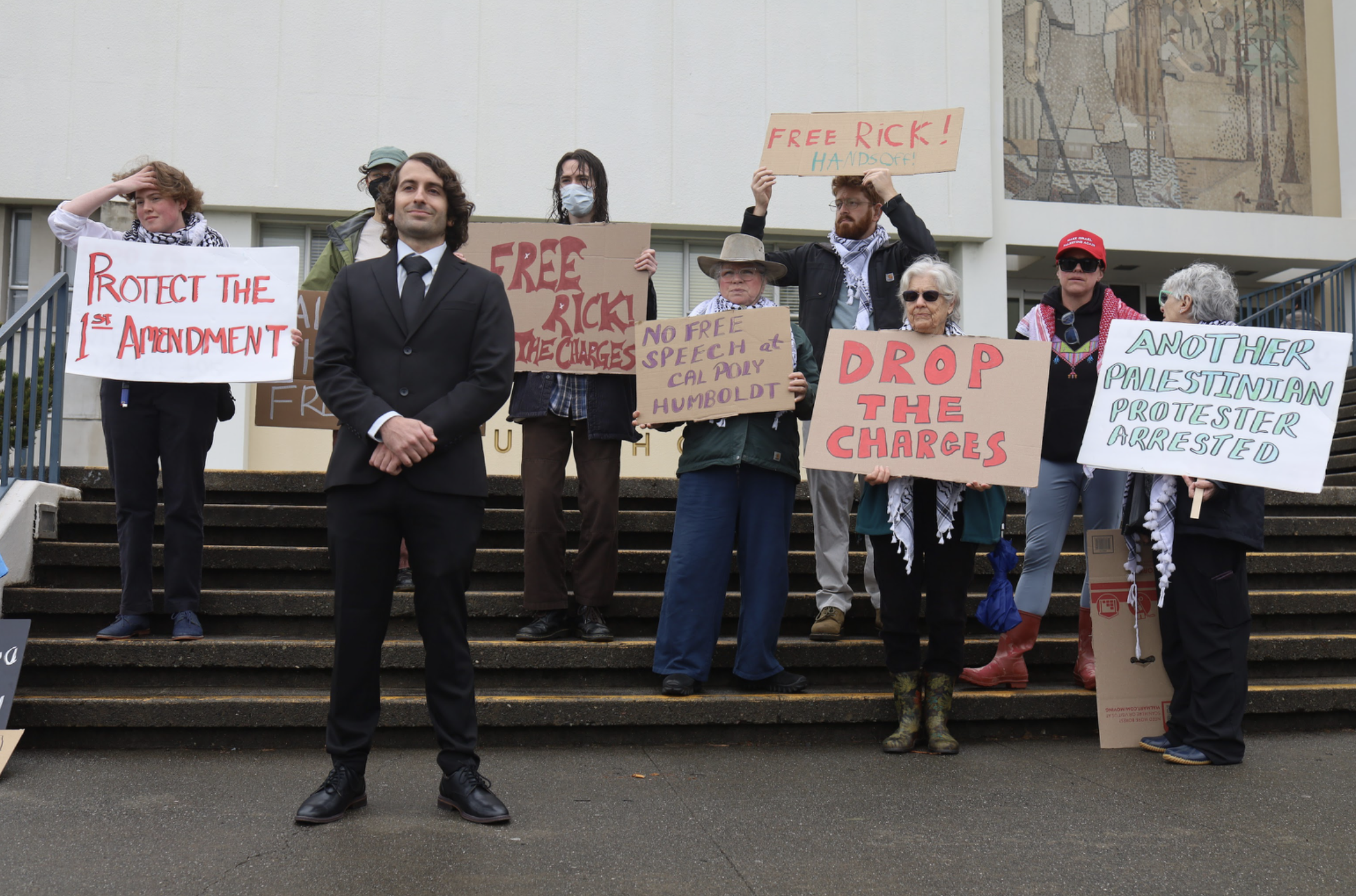
    Senior SDS Organizer Rick Toledo expressed the importance of peaceful protest amidst government corruption.

     “Prototesting is really, really important, and especially at a time when you’ve got ICE in Minneapolis,” Toledo said. “They’re calling on people all around the country to protest, because if we are doing that at the same time, everywhere, it does send a strong message to the federal government. What we’re hoping for with this is actually one, we want to send a message to the admin right away, that we want them to divest fully from these military contracts.” 

    According to an email sent from Communications Specialist Iridian Casarez in Oct. 2025, the university maintains that they are not directly involved in military contracts. 

    “The University’s endowment, which is managed by the Cal Poly Humboldt Foundation, does not include any direct investment in defense companies or any securities issued by Israeli companies or organizations, or to defense firms,” Iridian Casarez said.

    Eventually, the march reached the final destination: dead-center in the Arcata Plaza. Speakers from the endorsing organizations led sermons and called for a more peaceful world, including Executive Director of Centro del Pueblo Brenda Perez. 

    “Today, we came with our voices when there is no words to call the atrocities and the horror we’re seeing. We still have our voices,” Perez said. “[Centro del Pueblo] is a dedicated group of people learning every day how to support the immigrant, helping every corner, learning the hotline and making awareness and I want you to sing with me.” 

    Perez led the crowd in a call and response of ‘707-200-8091’. 

    “And when a member calls this number and tells us that ICE sit out at their doors” Perez said. “We are all going to go and say, ‘Fuck ICE! Out of here!’” 

  • President Carvajal tours campus on first day

    President Carvajal tours campus on first day

    by Nick Escalada

    Cal Poly Humboldt’s newest president, Dr. Richard A. Carvajal began his work this past Tuesday with a series of introductory appearances throughout campus. He kicked off the day by greeting students and faculty in the quad next to a tantalizing table of free donuts, before dropping in on several departments’ classes to spread the energy indoors.

    Carvajal’s debut culminated with a talk at the semester’s first University Senate meeting, where he divulged more about his connection to Humboldt and his intended approach toward leading the institution. He led his speech by expressing its personal significance to his life.

    “I told my wife about it, and she said, ‘do you realize that that will be the last first speech you ever give?’” Carvajal said. “And the reason I say that is because this is the final job I will ever have. I will retire from this position. In so many ways, this position is the culmination of my career. It’s such an honor for me to be here.”

    Carvajal was previously the longest-serving president of Valdosta State University in Georgia, where he stated he had no intention of leaving until he listened to a Humboldt forum expressing a desire for a new president to understand the local area. Despite hailing most recently from the South, Carvajal spent a portion of his childhood in Humboldt County and attributes his understanding of the campus community to his ties to the region.

    “After being born in Los Angeles, we left when I was really young. We came here and so this is the place that made me, me. I was here through middle school… I still wish we could have stayed.”

    At the climax of his speech Carvajal explained his leadership philosophy being rooted in the community he directs. 

    “What I bring is a process in which I firmly believe that if you have a group of people who know a place, who love a place and they’re working together, moving in the same direction, there’s almost nothing that they cannot accomplish,” Carvajal said.

    After a series of enthusiastic “Go Jacks,” Carvajal ended by addressing one of the major issues facing the university.

    “Why is enrollment such an issue? Because there is this thing called the demographic cliff. We know back to the Great Recession, in 2008 we can track it for the first time in America, we started having less babies,” Carvajal said. “Why? There are financial reasons for that, but we know year over year, that’s the case. And so here we are, 18 years later, because you can’t inject more babies back into the population, right? Once, when you clear a year, you clear the year. And so what we have to do to be successful? Well, we got to figure out a way to get a higher and higher market share and percentage of that smaller 18 year old class to come. And we’ve got to figure out a way to reach non-18 year olds, people who have some college and no degree and help them get to a finish line.”

    Nick Escalada is the News Editor of The Lumberjack. He studies wildlife and aspires to be a nature journalist. Find him bouncing between Gist Hall and the science buildings and reach him at ne53@humboldt.edu!

  • Where do we Go From Here? The Aftermath of the Devastating Fire in the New Year

    by Serah Blackstone-Fredericks and Jasmin Shirazian

    Arcata Fire Department was heading back to headquarters when they spotted a devastating fire that broke out Jan. 2, which left scorched streets and collapsed buildings on the 800 block of 10th St. in downtown Arcata, Calif..

    Fire and medical agencies as far north as Trinidad and as far south as Weott came to contain the blaze, resulting in 2.5 million gallons of water being deployed at 9,000 gallons per minute.

    There were no reported injuries to civilians or firefighters and residents who were displaced from their homes are being assisted by the American Red Cross. The expected cost of damages are estimated to be at least $18 million.

    “Preliminary damage assessments indicate that seven businesses, including associated apartments, were destroyed, and at least five additional businesses sustained heat, smoke, or water damage,” the statement said. “Initial loss estimates are approximately $18 million; however, this figure may change as assessments continue.”

    The cause of the fire remains under investigation as the Arcata Fire District coordinates with the Humboldt County Fire-Arson Investigation team.

    Despite rumours regarding a gas leak, Chief Emmons confirmed in a special meeting held by Arcata City Council that the gas leak came later. Pacific Gas and Electric (PG&E) took action as soon as it was safe to turn off gas and power lines to prevent further damages. 

    By declaring this a local emergency, the county can determine if they have the resources to support. If not, the case moves onto the state so that funding can be found to clear the debris. In a special meeting, Arcata City Manager Merrit Perry shared that the focus has now shifted to debris, how to handle them so as to not release more toxins. .

    Local resources from the community continue to pour out to those impacted by the tragedy. Moss Oak Commons, for example, offered a Fire Relief Clinic, which provided emotional and mental support for all who attended but especially those who experienced the fire hands-on, including volunteers, supporters and spectators. 

    Marta Lapczynski, owner and proprietor of Good Day Shop, decided to start a grassroots effort to support the community. 

    “It was right here,” Lapczynski shared “People want to help. They don’t want to feel powerless.” 

    Lapczynski initiated a database and coordinated support for those who lost their homes, beloved pets and businesses in the tragedy of the fire. Lapczynski encourages the community to remain mindful of those who may still be in the midst of crisis.

    Meredith Maier from the Arcata Chamber shared that business has since slowed for the entire block.. Maier also mentioned that plans for art are already under consideration, and that a mural will happen when a permanent fence goes up.

    Dandar’s Boardgames and Books, one of the businesses demolished by the fire, co-owner Doranna Gilkey shared that there are Magic the Gathering game nights, which were previously hosted at their store, are currently being offered at Septentrio. 

    “Show up and play and keep the word out. If you have ever been curious, it is a great time to learn,” Gilkey said. “We are focused on our community building, third space role.” 

    10th Street Artist Collective is grieving differently. Decades of curation destroyed in what felt like an instant, according to owners Peggy Rivers and Van Shields 

    “I had a show scheduled for spring of 2027,” Rivers said. “It was really shocking and overwhelming.  “One of the things that was devastating about the fire and the supplies was [losing] the future.” 

    Serah Blackstone-Fredericks is a cross-disciplinary anthropology major, minoring in arts in health and narrative medicine. A multidisciplinary artist, mother, and multilingual global citizen, you can find her prancing in her garden or in her kitchen baking, fermenting, and exploring natural dye via experiments. Her work explores storytelling from a perspective of cultural humility, ever curious on  shaped connections and how we live and heal. Feel free to connect with her at sb625@humboldt.edu.

    Jasmin Shirazian is the curly-headed copy editor of The Lumberjack. A locally and nationally published scribe, she dabbles in beats from breaking news to entertainment. You can catch her jumping continents in her free time, so try digitally through email: js760@humboldt.edu

  • Atmospheric Rivers flood Humboldt County

    Atmospheric Rivers flood Humboldt County

    by Sadie Shields

    An atmospheric river brought weeks of heavy rain to Northern California and the Pacific Northwest, dumping record-level precipitation in some areas and pushing rainfall totals above seasonal averages, according to the National Weather Service.

    Over 10 inches of rain were reported in Eureka from mid-December to early January, while Honeydew in southern Humboldt County has seen nearly 70 inches of rainfall since mid-October, according to National Weather Service meteorologist Jacob Boomsna.

    “An atmospheric river is a narrow band of moisture that usually brings moisture in from the tropics — long-lasting and intense,” Boomsna said. “Usually when we get those, it’s heavy rain and lots of precipitation.”

    Unlike hurricanes and typhoons, which are tropical storms that form over warm ocean waters with a defined center of low pressure and rotating winds, atmospheric rivers are long, narrow bands of moisture that transport water vapor from the tropics or subtropics toward higher latitudes. They don’t have wind-speed classifications, though they can still bring strong winds. According to Boomsna, Cape Mendocino on the Lost Coast recorded wind gusts near 100 miles per hour during the recent storm.

    The prolonged rainfall led to widespread flooding, especially in low-lying and river-adjacent areas of Humboldt County. Deputy Raleigh Willoughby, lead swiftwater rescue technician for the Humboldt County Sheriff’s Office, worked rescue operations during the December atmospheric river event.

    “During this most recent atmospheric river event, the areas that were most affected tended to be low-lying regions, river corridors and locations with poor drainage,” Willoughby said. “Communities near the Eel River, Freshwater Creek, Mad River, Elk River, Jacoby Creek and smaller tributaries experienced flooding, roadway impacts and rapid rises in water levels.”

    Rural roads, agricultural areas and locations where creeks cross under roadways were particularly vulnerable. Willoughby added that even areas that don’t usually flood can be impacted during prolonged or intense rainfall.

    With floodwaters moving quickly, officials stress that personal safety should always come first.

    “The most important advice is to prioritize personal safety and avoid taking risks,” Willoughby said. “If you are in a vehicle, do not attempt to drive through flooded roadways. Moving water is extremely powerful and can easily sweep a vehicle away.”

    Willoughby warned that if people become stranded, they should stay with their vehicle if it is safe, move to higher ground if necessary and call 911. Entering moving water on foot is also dangerous.

    “It takes very little depth and current to knock a person off their feet,” Willoughby said. “When in doubt, stop, wait and seek help rather than trying to self-rescue. If you cannot clearly see the bottom or determine how deep the water is, it should be treated as dangerous and avoided.”

    Warning signs include fast-moving water, muddy or opaque floodwater that may hide debris or washed-out roads and rising levels that cover familiar landmarks. Both local responders and weather officials emphasize preparation and patience during major storm systems.

    “Flooding and swift water incidents are some of the most dangerous situations both for the public and for first responders,” Willoughby said. “Many rescues are preventable if people slow down, plan ahead and respect the power of moving water.”

    Boomsna noted that while Humboldt County is currently experiencing a short dry period, there’s no cause for concern yet.

    “The [previous and recent] precipitation brought us above normal,” Boomsna said. “The little dry spell Humboldt is currently having is not something to worry about. There’s still plenty of time for more rain — hopefully not all at once.”

    Bio: Sadie is a junior communications major, journalism minor at Cal Poly Humboldt as well as an intern for the Cal Poly Humboldt Athletics Social Media team. She can be reached at sls331@humboldt.edu.

  • SIX FIGURES MADE, ZERO CLASSES TAUGHT

    SIX FIGURES MADE, ZERO CLASSES TAUGHT

    Tom Jackson: the highest paid professor who hasn’t taught a single class

    by Mia Costales

    Dozens of police officers in riot gear arrived at the scene on night one of Cal Poly Humboldt’s pro-Palestine encampment in April 2024. They moved in on the protestors, threatening them with pepper balls and rubber bullets. Sitting in the university’s highest office was a man many students and faculty held largely responsible for the riot police presence that night — Cal Poly Humboldt’s former president, Tom Jackson Jr.

    The summer following the protest, Jackson announced he would be stepping down from his presidency into an instructional faculty position. In a public records request obtained by The Lumberjack, Provost and Vice President of Academic Affairs Jenn Capps maintained her support for Jackson’s retreat to tenured professorship.  

    “This right allows for you to retreat to a solely instructional faculty position, subject to the terms set forth in the attached document,” Capps said via an email sent to Jackson. “Should you choose to exercise your retreat to an instructional faculty voluntarily, or be asked to leave your position as president, your salary would be adjusted to correspond to the maximum salary level for Instructional Faculty — Academic Year (Classification Code 2360) at the rank of Professor in the College of Professional Studies in effect at that time.”

    Jackson’s retreat to tenured professorship

    As of fall 2025, Jackson is not listed as faculty or staff under the School of Education or the College of Professional Studies website. Jackson is not listed as having ever taught a class at Cal Poly Humboldt despite retreating to his tenured professorship working with the College of Professional Studies and the College of Extended Education & Global Engagement. He is also not listed anywhere on the PeopleSoft database for instructor schedules under Campus Solutions, which tracks all instructors’ courses and assigned time for non-class activity. Every faculty member who has ever taught a class at Cal Poly Humboldt is listed. According to the spring 2026 course catalogue, Jackson is not projected to teach a course next semester either. 

    Despite his absence on campus during both his presidency and his tenured professorship, Jackson made $479,880.79 in 2024 according to Transparent California, with 2024 being the year he stepped down from his presidency. In 2023, he made $450,360.72 which is considerably less than the following year, even though he was president for the entire year. Jackson’s current instructional faculty compensation is $182,532.00 according to Marketing and Communications Specialist Melissa Hutsell, the highest amount possible that an instructional faculty member can earn per year. This makes him Cal Poly Humboldt’s highest-paid professor. 

    Hutsell explained that Jackson’s current role on campus is to support the International Service Learning Program in addition to developing coursework for Leadership Studies. 

    “Jackson transitioned into his faculty appointment after the fall 2025 semester had commenced,” Hutsell said. “His workload includes assigned time for [the International Service Learning Program and Leadership Studies]. Because faculty workload is entered by departments at the beginning of the term, Jackson’s Peoplesoft entry does not accurately reflect the true assigned workload. Because websites are updated manually, departmental sites commonly lag behind personnel changes.”

    Faculty and staff call for “immediate removal and termination” of Jackson

    On April 29, 2024, over 100 officers in riot gear arrived in vans and buses to the Cal Poly Humboldt campus at around 2:30 a.m., the final night of the pro-Palestine encampment. Ordered by Jackson, police detained protestors with zip ties and arrested about 25 people. Several hours later, a letter signed by 320 faculty and staff was sent to Chancellor Mildred Garcia, Governor Gavin Newsom and the California State University Board of Trustees, calling for the “immediate removal and termination” of Jackson and Chief of Staff Mark Johnson. 

    “We, the faculty and staff of Cal Poly Humboldt, urgently demand the immediate removal and termination of President Tom Jackson and Chief of Staff Mark A. Johnson from their positions at our institution,” the letter read. “Their repeatedly extreme and reckless actions in response to recent campus protests have systematically endangered students, staff and faculty, undermined the principles of shared governance and shattered any remaining trust in their leadership.”

    This letter followed a vote of no confidence in President Jackson on April 25, in which the general faculty of Cal Poly Humboldt stated they had no confidence in the leadership of Jackson or Johnson. 

    Jackson announces plans to step down

    In a letter sent to Chancellor Mildred Garcia on June 10, 2024, Jackson announced his decision to step down from his acting role as president of Cal Poly Humboldt. 

    “It is now time for me to step away as the president at Cal Poly Humboldt, and it is my request to do so prior to the start of the 2024-2025 Academic Year with my suggested last day being August 11, 2024,” Jackson said via email. “I look forward to speaking with you in the coming days to discuss my participation in the Executive Transition Program II and my transition to my tenured faculty role in the future.”

    However, Jackson had plans to step down from his position as president to tenured professorship as early as June, 2023. In a memo of correspondence between Dean of the College of Professional Studies Shawna Young and Co-Chair of the School of Education James Woglom on June 26, 2023, Woglom supported the recommendation of revising Jackson’s retreat rights to a tenured professor in the College of Professional Studies in the School of Education and Leadership Studies. Provost Capps, kinesiology professor Chris Hopper and associate professor Jill Anderson also shared their support for Jackson’s retreat in 2023. 

    The Lumberjack reached out to Young and Anderson about Jackson’s current role on the Cal Poly Humboldt campus, however they both declined to comment. The Lumberjack also reached out to Associate Vice President for Faculty Affairs Kimberly White who also declined to comment on Jackson’s current role.  

    The future of Jackson’s role on campus

    The future of Jackson’s role on campus is something that many faculty, students and community members continue to question. It is uncertain whether Jackson will teach a course in the future, but some faculty remain committed to working with him despite past controversies.  

    We started to work with Tom Jackson on a course in the summer of 2025, but those were preliminary, exploratory meetings and nothing has developed since,” Director for Center for Learning and Teaching (CTL) Enoch Hale said. “If Tom Jackson is slated to teach a course sometime in the future and he approaches the CTL, we will work with him as we do any educator at Cal Poly Humboldt.”

    Mia is a senior journalism major. She hopes to give a platform to underrepresented communities through her writing and provide the public with thoughtful and informed stories. In her free time she enjoys cooking, reading and playing the violin. Contact her at mdc140@humboldt.edu.

  •  Associated Students takes action

     Associated Students takes action

    by Nico Patakidis

    Associated Students (A.S.) held their last Board of Directors meeting of the Fall 2025 semester on Dec. 5, following the impeachment of the previous Officer of External Affairs and Officer of Social Justice, Equity, and Inclusion. 

    Throughout the semester, the A.S. sub-committee on bylaws has been working on updating various policies to be more clear to those who may not be familiar with the terminology used. A.S. Board Coordinator Chelsea Belden has been working on these policies and said that their goal is to remove outdated practices, update language to be more inclusive and ensure that the bylaws and policies align with one another. 

    “These policy updates are not new initiatives,” A.S. Executive Director Kendra Higgins said. “They have been listed as priorities for at least the past two years, but previous boards lacked the capacity to thoroughly review them. Now that we have an active board and functioning committees, we can move this work forward.”

    As seen in the 2025-2026 directors tracker, many policies being updated were assigned on Nov. 7 and forward. Higgins said that the process of deciding which policies are updated begins with the most straightforward and outdated policies. Many policies and bylaws are intertwined, meaning that they cannot be updated in a linear manner. Instead, groups of policies are reviewed and updated congruently. 

    Belden highlights the importance of updating the A.S. bylaws and policies as well as the importance of members’ compliance with them. The California State University (CSU) Chancellor’s Office recently audited CSU Northridge (CSUN), finding inadequate compliance with CSU policies and procedures. Mentioned in the audit was the need for CSUN’s A.S. to update their bylaws and policies to reflect current practices.

    “The recent events within our A.S. have absolutely no bearing on this project, but the findings of this audit have certainly highlighted for us the importance of being compliant,” Belden said over email.

    Following the A.S. standing committee reports were board reports, in which Administrative and Finance Vice President Nate Heron shared progress on a survey regarding A.S. sub-committee member compensation. The survey aims to capture the ideas of students and current sub-committee members regarding potential forms of compensation. Heron said that he also wishes for the survey to highlight other values and reasons for joining a committee.

    “I’m going at it [through] a lens of the conversation surrounding committees, because I don’t want it to be strictly on the compensation focus,” Heron said.

    While the survey has been sent out to current A.S. committee members, it is available for all students to complete. The survey is not currently posted anywhere, however Heron mentioned that committee members are free to forward it to anyone interested in taking it. Heron said that should this survey lead to committee members receiving compensation, the money would come from the $68 Associated Student Body student fee included in the cost of enrollment, as the A.S. budget does not currently have somewhere else to pull money from. Despite this, Heron notes that if there is a strong response to the survey calling for compensation, work would be done to ensure students are compensated. 

    “Implementing compensation would require adjustments in the next A.S. budget cycle, as there is no existing line item that could absorb this cost,” Heron said. “Realistically, allocating funding for compensation could require reducing funding for other A.S. programs and services that students currently rely on.”

    Next semester, A.S. board meetings will be held on Wednesday from 8 a.m. to 10 a.m. in NHE106 every other week, beginning Jan. 28, 2026. 

    Nico is a sophomore journalism major with an interest in covering local government and political affairs. In his free time he enjoys hanging out and having fun. Reach him at np211@humboldt.edu.
  • How to make burnout suck less during finals

    by Dylan Jewett

    Finals week — the week that every college student dreads from the moment the semester begins. From papers to exams and projects, students are working hard to make sure that their final grades are good enough to pass, keep scholarships and financial aid, and maintain their GPAs. But, what do you do when you’re working hard and everything still feels like it’s falling apart? 

    Fighting burnout isn’t easy, especially with all the excess stressors from attending a university. In moments where it feels impossible to take care of yourself and keep your head above water, there are ways to make this a better experience. As someone who has spent over nine years in therapy learning tools to help improve my mental health and focus, it’s only right that I help out my fellow college students and anyone else who may feel that the world is coming down.

    Burnout can be incredibly destructive if you don’t make it a point to focus on your needs. Trying to go in so many directions is incredibly hard and multiple finals have a way of doing that to you. Some of these suggestions may seem silly, but they can be helpful in calming you down and giving you the space to process the stress going on around you. Sometimes, more help is needed, and that is where mental health services can play a part. The Counseling and Psychological Services (CAPS) center on campus can help you talk and work through things that can be impacting your life and academic journey, or you can talk to TimelyCare at any time online for more urgent matters. 

    Dylan Jewett is a fourth year Journalism major at Cal Poly Humboldt. You can catch them wandering the forest, exploring the coast with their camera, enjoying live music, and crocheting little things in their free time. Contact them at daj59@humboldt.edu

  • Trump administration announces dismantling of Department of Education

    How will this affect the Cal Poly Humboldt campus?

    by Mia Costales

    On Tuesday, Nov. 18, the Department of Education announced that they will be moving parts of their department to other federal agencies. Among these parts are The Indian Education program, The Office of Elementary and Secondary Education, The Office of Postsecondary Education, the Foreign Medical Accreditation Partnership, Child Care Access Means Parents in School Partnership and the International Education and Foreign Language Studies Partnership. These offices will be moved to be in management with the Department of Health and Humans Services, Labor, Interior and State.

    Cal Poly Humboldt’s Communications Specialist, Iridian Cazarez, commented on how the campus is preparing to support students during this time. 

    “At this time, we are assessing the impact this announcement will have on campuses and students,” Cazarez said in an email. “The [California State University] is closely monitoring developments and working closely with legislators and other stakeholders to ensure that higher education opportunities remain accessible to all students.”

    These changes to the Department of Education leave many students on the Cal Poly Humboldt campus unsure if they will receive the same amount in student loans, financial aid and grants such as the Pell Grant.

    The Department of Education is responsible for issuing about $100 billion in student loans and over $30 billion in Pell Grants to universities every year. While students who receive aid or take out loans may not feel the effects of the Department of Education’s dismantling immediately, they may in the future. The U.S. student loan portfolio has now been transferred to the Small Business Administration (SBA), yet SBA administrator Kelly Loeffler announced that they would be cutting over 40% of its workforce. This leaves many skeptical of the SBA’s abilities to handle the student debt portfolio — as of 2025, over one million students have accrued hundreds of thousands of dollars in student loan debt according to the Office of Federal Student Aid website.

    On March 20, Trump signed the executive order Improving Education Outcomes by Empowering Parents, States, and Communities which set out to close the Department of Education and return authority over education to the states. 

    “Closure of the Department of Education would drastically improve program implementation in higher education,” the executive order reads. “The Department of Education currently manages a student loan debt portfolio of more than $1.6 trillion. This means the Federal student aid program is roughly the size of one of the Nation’s largest banks, Wells Fargo. But although Wells Fargo has more than 200,000 employees, the Department of Education has fewer than 1,500 in its Office of Federal Student Aid. The Department of Education is not a bank, and it must return bank functions to an entity equipped to serve America’s students.”

    Mia is a journalism major and the Editor in Chief of The Lumberjack. She hopes to give a platform to underrepresented communities through her writing and provide the public with thoughtful and informed stories. In her free time she enjoys cooking, reading and playing the violin. Contact her at mdc140@humboldt.edu.