By | Ali Osgood
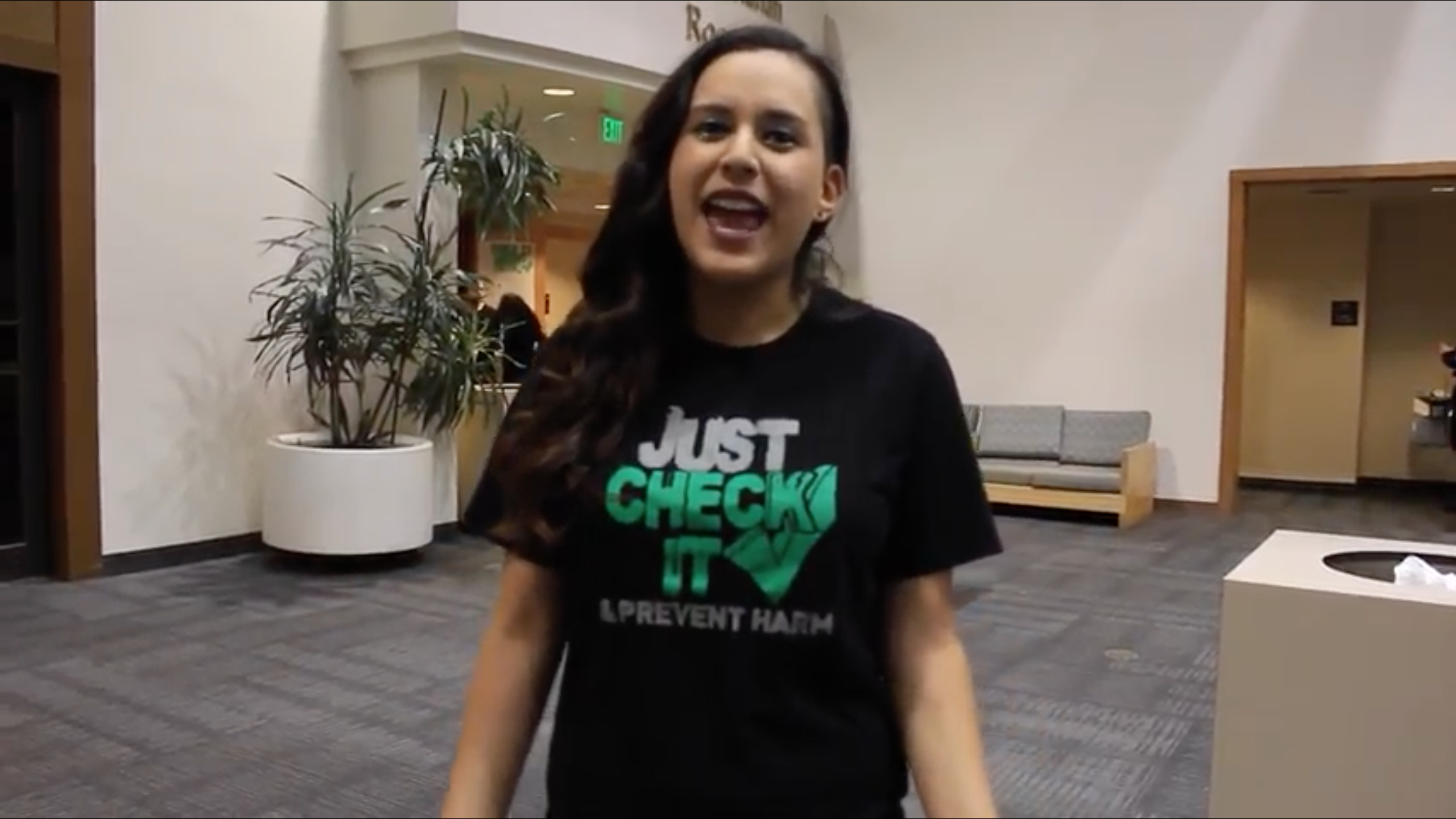
The highly successful student created program about preventing and responding to sexual assault at Humboldt State University celebrates it’s third year.
By | Ali Osgood
The highly successful student created program about preventing and responding to sexual assault at Humboldt State University celebrates it’s third year.

By Morgan Brizee
The peace pole that sits in front of the HSU Student Health Center has a strong history. Alistair McCrone, retired HSU president, placed the pole in memory of Al Elpusan who was a past HSU Associated Students president and died in 1990 from a car crash while in the Philippines.

“Al Elpusan spoke an unspoken language of peace,” McCrone said.
Elpusan helped in the process of moving the peace pole to its current location before he passed, but never got to see it put up. The peace pole was never properly dedicated or acknowledged after it was moved, but on Feb. 13 to kick off the International Education week it was re-dedicated.
The peace pole is a symbol of different meanings to many different people. According to the World Peace Prayer Society, peace poles symbolize the oneness of humanity and a common wish for a world at peace. The World Peace Prayer Society’s website shows peace poles around the world and the meaning behind them.
Joanne McGarry is a 61-year-old woman who works with U.S. Servas, a non profit organization that allows people to travel and do volunteer work and stay with a host for free. McGarry attended the peace pole re-dedication ceremony. McGarry said that it is important that HSU recognizes an element of history of peace. US Servas is a non-profit group that allows people to host travelers while travelers learn about different cultures and meet new people.

“The peace pole is an important symbolic, simple statement of peace, of being of peace here,” McGarry said.
During this time of confusion and anger for what is going on in politics, the reminder of peace is important. Emma Fox, an 18-year-old HSU freshman majoring in international studies, said that the world needs to be peaceful again especially with what has been going on recently.
“In this time with everything changing globally we need to remember that the world is a better place when it is a peaceful place and we need to get back to that,” Fox said.
The HSU peace pole has the phrase “May Peace Prevail on Earth” in Spanish, English, Russian and Hupa, one on each side of the pole. Around the globe there are thousands of peace poles to remind people of world peace. Each one in the world displays the same message of “May Peace Prevail on Earth” in different languages.
Lama Choyang is a Arcata local Tibetan Buddhist and opened and closed the Peace Pole re-dedication ceremony. She constantly repeated the words “May Peace Prevail on Earth” to keep it clear what the important message was. In her speech, she said that we need to rely on others in this time to create a peaceful world.
“The word peace has something to do with how we engage difference,” Choyang said. “We are called to have immense compassion.”

Peace is not only needed during this time in the political sphere but also with violence happening. Ron White, leadership program manager at Humboldt Area Foundation, talked about the recent and ongoing police violence and how peace is the solution.
“Truly peace cannot be full without justice,” White said. “Peace is deeply connected with shalom.”
Jonah Platt, the current Associated Student President, also talked about the recent violence and political issues going on.
“We live in a corrupt system,” Platt said. “I want to honor all who honor life.”
Peace means different things to different people but the common thought of it is about coming together as one in the world.
Mary Gelinas, the co-director of Cascadia Center for Leadership talked about the earth and it being connected to peace.
“Earth is the source of our peace,” Gelinas said.

By Curran Daly

If you grew up playing sports then you might find it difficult to give them up once you start college. Intramural sports offer a way to keep playing sports and meet new people. Logan Ashdale, a junior recreation administration major, and his intramural volleyball team won last semester’s A league championship. Last season’s championship was Ashdale’s team’s second win in successive semesters. This season they’ll be looking for their third championship in a row.
“We’ve won the last two semesters,” Ashdale said. “I just love it, obviously I want to keep winning, but if I can just be on the court for one extra night I might as well.”
Ashdale grew up up playing volleyball. He joined the club team when he got to Humboldt. He started to play intramurals as a way to be on the court one more night a week.
“I was originally playing on someone else’s team and then I had a bunch of new friends from the club team and I wanted to have my own team and run it the way I wanted,” Ashdale said. “I recruited all my friends and a lot of them happen to be really good and that’s how it got started.”
The best teams are often the teams that play together well and that comes from the relationships within the team.
“You gotta find people that you’ll play well with on the court, and I think it’s important to build those friendships on the court,” Ashdale said.
Friendships can be developed on and off the court. Diego Padilla is a senior geography major who has been playing soccer with the same group of friends since the first semester of his freshman year.
“My first day here at HOP [Humboldt orientation program] I met some friends and we played soccer every day since that first day of HOP,” Padilla said. “We heard of intramurals and we made a team and we’ve been playing together since first semester freshman year. We’ve grown closer and closer and we’re still playing today.”
Playing with the same group of people multiple times a week can create strong bonds and friendship. While, they struggled through their first few seasons, they continued playing and eventually started winning.
“Every year we picked up someone new and got better and better and it just clicked and we started winning,” Padilla said. Padilla’s teams last semester did very well.
“All my teams won last semester.” Padilla’s experiences playing intramural soccer with his friends has left him with advice for people just starting out.
“Don’t get discouraged when you lose, you’ll find these super good teams,” Padilla said. “Over time just keep at it and keep going you’ll find the people that work well together and win.”
Freshman environmental studies major Leo Meza played intramural soccer in his first semester at Humboldt. He isn’t playing this semester, but he still talks to all of the friends he made playing last semester.
“We did pretty good, a lot better than we expected,” Meza said. “And it was a lot of people who didn’t know each other and we got to meet new people that I’m still friends with now.”
In the future Meza hopes to be on a successful team and keep his friends together.
If you can get a group of friends together you can win and even if you lose, you’re still playing the games you love.

By Keaundrey Clark
Jacks Pass
Men’s Basketball
Humboldt State men’s basketball team saw its three-game winning streak snapped this past weekend as they lost 88-67 to UC San Diego Saturday Night.
Sophomore Nikhil Lizotte led the Jacks in scoring. He scored 19 points. Hitting four 3-pointers. Currently sitting in the California Collegiate Athletic Association, the Jacks would earn a spot in the conference playoffs if the season ended today. Home games against two of the CCAA’s top three programs await the Green and Gold. Sonoma State visits Lumberjack Arena Thursday, and HSU hosts San Francisco State for Senior Day Saturday. Fans are encouraged to wear black for Thursday’s Black Out Night promotion. Both games tip off at 7:30 p.m.
Women’s Basketball
Humboldt State women’s basketball fell to UC San Diego, 64-55 on Saturday in La Jolla. The Lumberjacks traded baskets with the Tritons early, and the teams were tied 15-15 at the end of the first quarter. San Diego closed the first half on a 10-2 run, and had a 31-24 lead at the break. The Tritons took advantage of their free-throw opportunities, and they converted 13-of-15 first half attempts
Tyra Turner scored 12 of her team-high 15 points in the second half, but it wasn’t enough for the Green and Gold. The Tritons led by 10 points through three quarters and by as many as 15 points with 5:11 left in regulation.
The Tritons shot 39.1 percent from the field and 50 percent from outside the arc. Dalayna Sampton was San Diego’s top performer with 19 points, nine rebounds, four assists and two blocks. She was 7-of-9 shooting and went 5-of-5 at the free-throw line.
Three Jacks scored in double figures, and Catharine Rees and Kindall Murie chipped in 10 points apiece. Turner dished out a team-best six assists.
HSU closes out the regular season in Lumberjack Arena with the first of two home games coming against Sonoma State Thursday. Fans are encouraged to wear black for the Black Out Night promotion.
Softball
Humboldt State softball took the No. 1 spot in this week’s National Fastpitch Coaches Association Top 25 released last week.
The Lumberjacks are off to a 5-0 start after traveling to Las Vegas for the Desert Stinger Tournament. HSU holds the top spot for the first time since the 2014 Week 1 poll.

By Danny Dunn

Humboldt State’s head football Coach Rob Smith understands that there is a stigma that comes with recruiting at Humboldt.
“We address the marijuana reputation head on and say yes that element exists here, but we think it exists anywhere…and that is not who we are,” Smith said.
Despite the stigma HSU’s football staff feels there are many reason’s for football recruits to choose to play for Humboldt.
“This is a football program with a proud tradition, and a solid success rate recently, seven consecutive years nationally ranked…that is what we focus on here,” Smith said.
The recruiting process is arguably the most important part of the offseason for college football programs. With all the turnover from season to season because of graduating seniors or students transferring elsewhere for eligibility purposes, coaches need to fill the voids that are left by these departures.
That is why Humboldt State Football is very fortunate to be returning a majority of their offensive core, including quarterback Robert Webber, running back Ja’Quan Gardner, and All-American lineman Alex Cappa.
“There is always a good group of seniors that leave, but I feel we have a good base to build around, and we have high expectations for next season,” Cappa said.
With the retention of the offensive core, it allows Humboldt State Football to focus primarily on the defensive side of the game when it came to recruiting.
Linebacker Curtis Williams remembers what it was like when he went through the recruiting process.
“It was stressful, but also exciting with the coaches showing an interest,” Williams said. “Overall I would say I enjoyed it.”
Williams went on to say that he felt that Humboldt State was the right fit for him.
“Out of the schools I visited with, Humboldt was the most family oriented,” Williams said. “The coaching staff really makes you feel wanted.”
Head Football Coach Rob Smith says that recruiting is really time consuming. He relies heavily on his coaching staff to help with the process, including setting up official visitation days where the recruits and parents can come see what Humboldt has to offer.
“I am upfront and honest with the recruits, and sell them on the athletic benefits at Humboldt State,” Smith said.
Smith went on to say that relationships are the key to landing a recruit.
“There’s no magic formula to it, just be yourself and develop a relationship with not only the recruit, but the recruits parents…and continually show that recruit that he is wanted at Humboldt State,” Smith said.

By Danny Dunn
With All-Star weekend in the rearview mirror, NBA teams can now focus on the trade deadline. Unlike other sports, a decent amount of trades actually get made in the NBA.
There have already been several trades throughout the NBA. Starting at the beginning of the season with the Oklahoma City Thunder trading forward Ersan Ilyasova to the Philadelphia 76ers for forward Jerami Grant. This trade has benefited both teams providing the Thunder with a wing defender, and the 76ers with a solid stretch 4.
It was pretty dead on the trade front until the start of February when things began to heat up around the league. Milwaukee Bucks center, Miles Plumlee, was dealt to the Charlotte Hornets for center Roy Hibbert and forward Spencer Hawes.
Miles was not the only Plumlee to get traded, his brother Mason Plumlee, center for the Portland Trailblazers along with a 2nd round pick, were sent to the Denver Nuggets for center Jusuf Nurkic and a first round pick.
Plumlee will be a solid backup big for the Nuggets, while Nurkic showed promise as a starting center before being overshadowed by Nuggets teammate and rising star Nikola “The Joker” Jokic.
The first big splash of the season was the trade by the Toronto Raptors to land power forward Serge Ibaka from the Orlando Magic for small forward Terrence Ross and a first round pick. The Raptors who are currently sitting with fourth best record in the Eastern Conference made this deal to hopefully close the gap between them and the Eastern Conference favorite Cleveland Cavaliers.
Speaking of the Cavaliers they traded center Chris “Birdman” Anderson to the Charlotte Hornets for a second round pick. The Cavs most likely made this move to open up a roster spot and possibly sign another playmaker.
The biggest trade of the season, at least biggest name, happened right after the all-star game. Sacramento Kings center DeMarcus Cousins and forward Omri Casspi were dealt to the New Orleans Pelicans for guard Buddy Hield, guard Tyreke Evans, and a first and second round draft pick. This deal will pair two of the league’s best big men together, Cousins and Anthony Davis.
There have been discussions between the Orlando Magic and Detroit Pistons, possibly trading Pistons guard Reggie Jackson for Magic forward Jeff Green and guard D.J. Augustin.
So who are the trade targets going into the deadline?
Realistic Targets: Phoenix Suns small forward P.J. Tucker can help teams as a wing defender. Next up, guard Lou Williams of the Los Angeles Lakers, he can definitely help bolster a playoff contenders bench. Dallas Mavericks center Andrew Bogut is a solid rim protector and can set screens like nobody else in the league, but do not ask him to score. Timberwolves forward Shabazz Muhammad is similar to Williams as a bench scorer, but can also defend a little and he is a bit younger. Philadelphia 76ers center Jahlil Okafur is a talented scorer in the post, and has had suitors already, the Bulls and the Celtics.
Out of Reach: New York Knicks forward Carmelo Anthony has been linked to the Cavaliers, Clippers, and even the Celtics. But he is out of reach mainly due to his massive salary. Brooklyn Nets center Brook Lopez, solid big man with skills in the post, but will likely have a huge price tag that no one will pay. Chicago Bulls forward Jimmy Butler is a name that has been linked to the Boston Celtics, but unless the Bulls are thinking about a complete rebuild, it is unlikely Butler is moved.
Other names to look for at the trade deadline: PG Brandon Knight, SF Luol Deng, SF Danilo Gallinari, PF Kenneth Faried, SF Wilson Chandler, SF Bojan Bogdanovic, PF/C Nerlens Noel, PG Rajon Rondo, PF Nikola Mirotic, PG Derrick Rose, PG Ricky Rubio, PG Deron Williams.

By | Iridian Casarez
Local
Arcata looks at rising sea levels
-The Arcata city council strategized a future plan for when rising sea levels take the low-lying side of Arcata. Arcata will protect and accommodate the encroaching waters where necessary. Eventually they will pull back to higher ground when the rising sea level makes alternatives unavoidable.
Source: Mad River Union
Hazard waste violations in Humboldt
-The Humboldt County Department of Health & Human Services, Division of Environmental Health (DEH) recently issued hazardous waste violation fines to four businesses that operate in Humboldt County. The businesses include Antich Automotive, Figas Construction, Hoopa Valley Ready-mix, and Pacific Gas and Electric Company.
A day without immigrants in Fortuna
-Centro de Pueblo activists marched through the streets of Fortuna and rallied in front of Fortuna City Hall for “a day without immigrants” protest. A day without immigrants is a day aimed at showcasing the impact immigrants have on the U.S. economy.
Source: Lost Coast Outpost
U.S.
Tornado hits San Antonio
-The National Weather Service confirmed Monday morning that a tornado hit San Antonio. Severe overnight storms ripped through south-central Texas, damaging more than 150 homes and injuring several people in San Antonio.
Source: USA Today
Utah republican resigns
-James Green, a Utah county Republican Party official resigned after receiving backlash for criticizing a bill in the state legislature designed to create equal pay criteria.
Green wrote a letter to the editor published in the Wasatch Wave and The Park Record on Wednesday Feb. 15, in which he argued against requiring equal pay because “if businesses are forced to pay women the same as male earnings, that means they will have to reduce the pay for the men they employ.”
Source: CNN
Uber under investigation
-Susan Fowler, a former Uber engineer, came forward with allegations of sexual harassment and discrimination, claiming that management repeatedly dismissed her complaints, protected a repeat offender and threatened to fire her for raising concerns. The accusations from Fowler, a former site reliability engineer prompted CEO Travis Kalanick to announce an “urgent investigation” on Sunday, Feb. 19.
Source: The Guardian
World
Britain to ban Trump
– British lawmakers on Monday kicked off a debate on whether to withdraw an invitation to President Trump for a state visit. The debate was triggered after a petition calling on the British government to cancel the state visit amassed more than 1.8 million signatures.
Russian ambassador dies suddenly
-Vitaly Churkin, the Russian ambassador to the United Nations, died suddenly Monday, Feb. 20. Churkin was at his desk when he died, the Russian Foreign Ministry confirmed. But the ministry didn’t give details about the circumstances of his passing.
Source: NBC
U.S. forces to stay in Iraq
-U.S. Defense Secretary Jim Mattis said Monday, Feb. 20, he believes U.S. forces will be in Iraq and in the fight against Islamic State militants for a while. Mattis said he is open to any request from his military commanders to aid the battle to retake Mosul.
Source: Washington Post
Source:

By Erin Chessin
A new Arkansas law will allow the father of a pregnant woman’s child to sue her if she gets an abortion. There are no exceptions that prevent the father from suing, even in instances of rape and incest.
The Arkansas Unborn Child Protection From Dismemberment Abortion Act was signed and passed on Feb. 16 by Arkansas Governor Asa Hutchinson, according to the Center for Reproductive Rights.
Many HSU students are concerned for how the law will affect women’s rights in the U.S. Sara Narajowski is a kinesiology major at HSU.
“The law is a huge step back for women’s rights,” Narajowski said.
She also said that all women deserve the choice to get an abortion because it is her body that is affected by the pregnancy.
“By pro-choice, every woman has the right to protect herself both physically and emotionally from having an unplanned pregnancy,” Narajowski said.
Abortion laws around the world vary, some countries are more strict about regulating abortion than others. While abortion is legal in the U.S, the new Arkansas abortion law could encourage other states to pass stricter abortion laws in efforts of discouraging women from choosing abortion. Students are concerned this law could cross over to different states and prevent women from having the choice to abort a child in the U.S.
Another debate that arises from the new law is whether the law is meant to undermine the Roe v. Wade decision in 1973, which gave women the right to get an abortion without having to state a reason.
Jason Martinez, a major criminal justice major at HSU, is shocked the law managed to pass.
“It’s unfair that a rapist can sue the mother of the unborn child for getting an abortion,” Martinez said. “It undermines how severe the act of rape is because the perpetrator can get money from committing a crime, without caring about the mother or the child.”
Martinez also said that a mother not being able to get an abortion can mean emotional and psychological consequences for the child’s life in result.
“People aren’t thinking about the child’s well being,” Martinz said. “If the mother has to have the child when she wasn’t financially prepared or was raped, this could cause psychological consequences for both the mother and baby.”
Kassidy Hayes is a biopsychology major at HSU.
“The law supports the subordination of women’s rights,” Hayes said.
Hayes said that she feels that abortion is not an easy choice, but it is a rightful choice women should have for the safety of her body.
“It’s interesting how these laws are being passed down by men, who will never know what it’s like to carry a baby,” Hayes said.
Currently, the American Civil Liberties Union of Arkansas is seeking to challenge the abortion bill in court before it goes into effect in 2017.

By | Iridian Casarez
According to the Washington Post, President Trump made comments about Sweden in a rally in Melbourne, Florida on Saturday, Feb. 18.
“You look at what’s happening last night in Sweden. Sweden, who would believe this?” Trump then mentioned the French cities of Nice and Paris, and the Belgian capital, Brussels. The three European cities were attacked by terrorists over the past two years. The comments were widely perceived in the U.S. as to suggest there was an attack in Sweden Friday night, but there was no attack.
President Trump named Lieutenant General H.R. McMaster as his new national security advisor on Monday, Feb. 20, replacing Michael Flynn. McMaster is a career Army officer and strategist according to the Los Angeles Times.
The Trump administration is planning to establish a revised executive order on immigration. The President says will “protect our people” while at the same time pass muster with courts that halted an earlier version, according to CNN. The new executive order will not impact green card holders.
President Donald Trump announced Thursday, Feb. 16, his plan to nominate Alexander Acosta as Secretary of Labor. Acosta would be the first Hispanic member of Trump’s Cabinet.
By Morgan Brizee
On Feb. 21 California Assemblywoman Sharon Quirk-Silva held a press conference at Sacramento State University’s campus library to talk about a new bill that she has written. Silva is the assemblywoman for the 65 th District of California covering the communities of Anaheim, Buena Park, Cypress, Fullerton, Garden Grove, La Palma, and Stanton. The new bill is called AB 393: The Student Protection Act. This new bill could halt any tuition increases in California for all public community colleges as well as state universities. The bill is also backed by the California Faculty Association(CFA).
A press release by Quirk-Silva said that,“Quirk-Silva authored AB 393: The Student Protection Act in light of the hard realities facing today’s college students, including the deepening of debt and long hours of work that are necessary to live while paying education costs, but that interfere with their studies.”

By Charlotte Rutigliano
Because enrollment decreased this past term, less students struggled to find openings in campus housing. Senior psychology major Victor Perez was able to change dorms from the campus apartments to the College Creek complex because there was the space available for the upgrade.
Stephen St. Onge, director of Housing and Residence Life, said housing normally starts off the fall semester with around 104 percent occupancy and drop a little in the spring.
Currently housing is at 96.5 percent occupancy, having more open spaces for female students than male students. This has been a trend over the past few years.
Twenty-four-year old transfer student Kimberly Encio said when she lived in the College Creek housing complex it was a little overcrowded. The only reason she decided to move off campus was the high cost of living on campus.
“If it wasn’t so expensive I would have stayed on campus,” Encio said. “I loved the convenience of it all, being able to come home between breaks, close to the library and class, all of it.”
According to St. Onge, one goal the housing department has is to provide a reasonable cost for on campus housing.
“One of the strongest factors in student retention is living on campus for at least one year,” St. Onge said.
Housing is not just focusing on the cost, they are also very focused on opening up more spacing for both new and returning students. St. Onge said they have increased the number of lottery seats for returning students by 100.
With the university getting larger there is more demand for housing both on and off campus for students. Both Perez and Encio agreed that the university should have another dorm complex on campus to help with overcrowding and so they could provide more spaces to new and returning students.
St. Onge said that the housing department is always open to suggestions and feedback from students and said they have an open forum on March 2 from 3:30 to 4:30 p.m. in the Jolly Giant Commons to discuss the potential for adding new housing on and off campus.
By Geneva Peppars
Local radio station KHSU is set to temporarily relocate from its broadcasting station in the Theatre Arts Building. The building is undergoing construction to make sure it is fit to stand an earthquake. A staggering $7.6 million will be allocated from bond and CSU funding to start the project this summer. The Theater Arts building will operate normally through the end of this semester and work will begin this summer, according to Jarad Petroske HSU public affair specialist. HSU is still in the process of sorting out where classes will move, but for the rest of the semester it’s business as usual.
However, the third floor of the Theatre Arts Building has been home to KHSU since 1960. KHSU is a noncommercial public radio station licensed to Humboldt State. Unlike classes, there is no summer vacation for KHSU. All day, seven days a week, KHSU is broadcasting to about 135,000 listeners. David Reed, KHSU Development Director & Interim Station Manager, explained that he has been told the project may take up to a year, but that won’t stop the airwaves from broadcasting from the radio station, it just may be from a few different locations.
“It will be hard, it will be fun, it will be an adventure,” Reed said.
Reed said the station will transition from three studios in the Theater Arts building to two temporary studios in Gist Hall and Wagner House.
Vinyls, satellite equipment and what Reed called the “brains of the studio”will stay on the third floor. The “brains” are the racks of equipment the station needs to be able to receive audio signals by satellite from NPR, automate local programming and stream over the internet. One of the biggest challenges of the transition is finding a home for the 25,000 cds in their music library that is accessible at all times to the over 90 staff, students interns and community volunteers.
Kevin Sanders, chief engineer for KHSU, explains that consolidating three studios to just two smaller ones could potentially affect scheduling issues. Although he is still waiting on the final word from facilities management, he does know that one studio will always be on air and the other will be strictly for production purposes. The way the studios are set up now, broadcasters are able to switch all studios from production to on air, which creates lots of space to pre-record and automate late night shows.
The new studios may not block outside noise as well as the old one, but Reed doesn’t believe listeners will notice a change in sound. “You know they might hear an occasional leaf blower,” Reed said. “But I am keeping happy thoughts.”
The current projected move date for the radio station is June 1. , two weeks before the KHSU June Pledge drive. Although the details have yet to be finalized, one thing is for certain KHSU will remain across the airwaves throughout Northwest California and Southern Oregon.
By | Iridian Casarez
Virginia Federal District Court Judge Leonie Brinkema issued a preliminary injunction against President Trump’s executive order on immigration on Monday, Feb. 13. The injunctions were issued based on the fact that it discriminates against Muslims, according to the Washington Post.
According to the New York Times, the Senate confirmed Steven T. Mnuchin,to be Treseary Secretary on Monday February 13, putting in place a key lieutenant to President Trump will help drive the administration’s plans to overhaul the tax code, renegotiate trade deals around the world and remake financial regulations. Mnuchin is a former Goldman Sachs banker and Hollywood film financier.
President Donald Trump and Canadian Prime Minister Justin Trudeau meet for the first time at the White House to talk about trade, a task force for women, and energy on Monday, Feb. 13.
Immigration authorities last week arrested 680 people who were in the United States illegally, according to the Washington Post. Fulfilling one of Donald Trump’s long campaign promise to crackdown on immigration.
By | Iridian Casarez
Local
El Pueblo Market caught fire
-El Pueblo Market located on Broadway Street in Eureka burned down in flames Feb. 8 according to the Eureka Times Standard.
U.S. District court judge rules in favor of salmon
-U.S. District Court judge William H. Orrick ruled that the U.S. Bureau of Reclamation and the National Marine Fisheries Service must release more water from the Klamath dams, on Feb. 8. Judge Orrick ruled that the Bureau had mismanaged the river, causing “irreparable” harm to the salmon according to the North Coast Journal.
Nursing program at HSU
– Six years ago Humboldt State University discontinued its nursing program. HSU and College of the Redwoods announced Wednesday, Feb. 8 they are working to bring a local nursing program back to Humboldt County in the fall 2018 according to the Redwood Times.
U.S.
Oroville dam overflows
-The Oroville Dam’s emergency spillway collapsed after the dam overflowed. Officials ordered residents living below the dam to evacuate Sunday in Oroville, Calif. according to the LA Times.
African Muslims march
-Around 200 African Muslims march in New York in protest of President Trump’s Muslim ban on Sunday Feb. 12. According to the Observer, protesters marched to defend the U.S. Constitution against President Trump’s executive orders targeting travelers from countries with high Muslim poplations and undocumented immigrants.
National Secretary Advisor resigns
-Michael T. Flynn, the U.S. National Security Adviser, resigned on Monday night after it was revealed that he had misled Vice President Mike Pence and other top White House officials about his conversations with the Russian ambassador to the United States, according to the New York Times.
World
North Korea missile tested
-North Korea has tested a ballistic missile this past weekend calling it a success. The missile was tested on Feb. 12 under the supervision of the North Korean leader Kim Jong Un according to North Korea’s Korean Central News Agency, KCNA.
Mexico protests Trump
-Thousands march in protest of United States President Donald Trump in Mexico City on Sunday Feb. 12. Many people were also holding signs in protest of their own President Enrique Peña Nieto for presiding over rampant corruption and violence at home according to The Guardian.
Candidate for chief minister found guilty
New Delhi, India’s Supreme Court convicted V.K. Sasikala, an advisor of the late chief minister of Tamil Nadu on Tuesday Feb. 14 in a corruption case that will put her behind bars and effectively end her bid to become chief minister of the southern state.
The court found Sasikala guilty in the disproportionate assets case, upholding a four-year jail term handed down by a lower court and banning her from seeking elected office for 10 years.
By Morgan Brizee
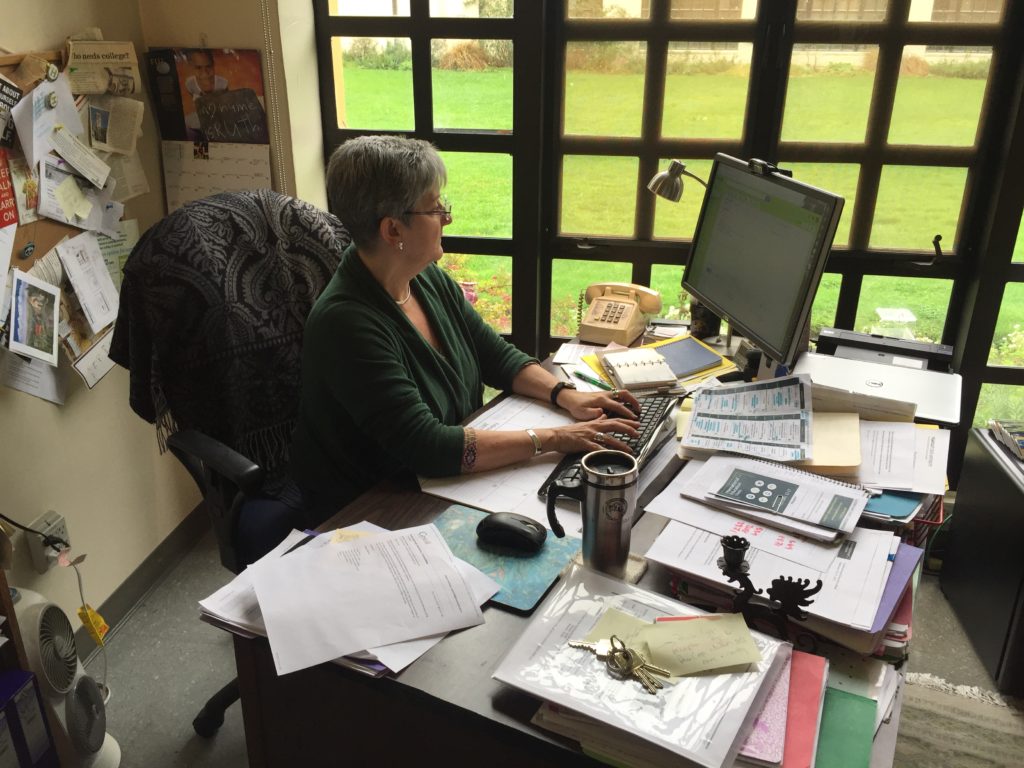
International Education Week is back at HSU. During International Education Week students, staff, and the community can listen to speakers address what is going on around the world from those doing research and work across the globe.
The International Education Week events are being held Feb. 13 through 17 from 9 a.m. till 9 p.m. in room 209 in the library fishbowl (unless otherwise noted on the schedule).
Ariana Hendren, a 22-year-old HSU International Studies major, is the president of the Global Connections Club at HSU and is responsible for managing the volunteers that work at each event.
“The lectures of International Education Week are both motivational and helpful for those who are interested in gaining more information about traveling and working abroad or studying international issues,” Hendren said.
Most of the speakers of the event are professors who work at HSU and do international research. Other speakers who are not HSU professors are the key note speaker which is Dr. Marga Gual Soler who is the project director at the Center for Science Diplomacy at the American Association for the Advancement of Science, Dorothy Ngutter who is a diplomat in residence, Erik Jens who is an instructor at the Department of Defense, and Sarah Sedlack who is an HSU alum and founder of a sex education program in Kenya called “What’s Not Said”.
Dr. Alison Holmes, HSU assistant professor of politics and program leader of the international studies department, said that school usually gets the guest speakers by anyone who is interested usually because it is hard to get people who are available to come up to HSU.
“Who we can get is often the first criteria,” Holmes said. “I’ve been working hard in the last two or three years to ensure CPS [College of Professional Studies] and CNRS[College of Natural Resources ] also have speakers and are engaged and having the keynote seemed like a good way to make sure that our colleagues in CNRS were also really involved in International Education Week.”
Holmes is also speaking during International Education Week on Feb. 15 at 9 a.m. in room 209 in the library fishbowl. Her lecture is called Global Diplomacy: Upside Down and Backwards.
International Education Week this year will have a different impact than past years because of President Donald Trump’s “Muslim” ban.
Mathew Derrick, HSU assistant professor of geography and co-organizer of the International Education week, said that international education is of most importance now because of what is going on politically.
““International education is always important, but it is especially important at this point in time,” Derrick said. “In short, it is critical that HSU students–and the broader citizenry–develop higher levels of geographic-global literacy.”
The definition of geographic-global literacy from National Geographic is the ability to use geographic and global understanding and reasoning to understand far-reaching decisions.
During International Education Week students can enjoy food, music, and films from around the world to fully submerse themselves into learning about the different cultures.
Celicia McLean, a 22-year-old HSU International Studies major, said that she is going to go abroad for work after she graduates in May so she is excited to listen to related speeches.
“International Education Week has a wide variety of discussions on issues and other aspects about our world presented by incredibly knowledgeable and experienced scholars,” McLean said. “The evening events are especially great locations for cultural exchanges through food, film, and music and are a must for a culture enthusiast, like myself.”
Even after graduating HSU, some students still feel connected and feel a want and need to give back to the school in some way. Sarah Sedlack graduated from HSU in 2013 with a BA in Psychology and was excited to be able to share her progress of the campaign, What’s Not Said, with the school during International Education Week. She will be giving her lecture on Feb. 15 at 10 a.m. in room 209 in the library fishbowl. Her lecture is called Let’s Talk Sex (In Kenya). Her lecture is talking about her campaign with teaching people to normalize talking about relationships and sexual health.
“It also feels amazing to be sharing a passion project and receive so much positive feedback from the community here, both on and off campus,” Sedlack said. “Because when communities benefit from international prevention efforts in the face of major sexualized violence and public health issues, all communities everywhere, benefit because we are all connected.”
Whether students are wanting to travel abroad for fun, work, school or just want to learn about what is going on around the globe, International Education Week will go over all of these and more.
Christiana Frye, HSU coordinator at the International Center, said that students should choose a couple of interesting lectures that are being given whether it be educational or just for fun.
“There’s all different kinds of things from all over the world, information about Africa, information about food justice, teaching abroad,” Frye said. “I also encourage people to attend one of the fun things in the evening because there is free food, on Monday night, there is good international food.”
By Charlotte Rutigliano
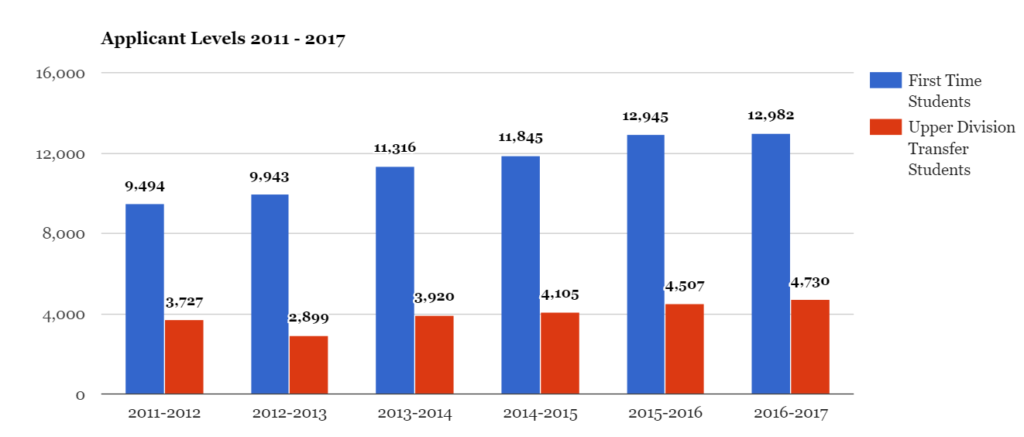
The days of generalizations may be in the university’s rear view as various department’s throughout Humboldt State aim to start writing personalized letters to prospective students due to a drop in enrollment this past term.
This is part of a plan the university has created to start focusing more on prospective students who applied and turning them into current students. Director of Admissions Steven Ladwig said every student needs to have a relationship with someone on campus before attending to make them feel more comfortable once they’re here.
This plan has been put into place with the hope that it will boost enrollment for the 2017-2018 school year. According to Nicholas Conlin, coordinator for Orientation and New Student Programs, enrollment only dropped this last year. There were about 200 to 250 fewer students than the university was hoping for.

The drop in enrollment was not a drastic one, and HSU was not the only California State University to see this drop.
“There were six CSU’s who didn’t meet enrollment numbers this term,” said Ladwig. “Chico, Fresno, Monterey Bay, San Bernadino, San Francisco, and Sonoma.”
The slight drop in enrollment last term didn’t affect the number of impacted majors [majors that have more students than the program accepts.] Additionally, the number of visitors to campus was not impacted.
HSU is known for its science programs with the most sought after majors being biology, botany, environmental resources engineering, wildlife and zoology. This past year however, both the social work and environmental management & protection departments became impacted as well.
John Panting, lead admissions counselor, said that there hasn’t been a decline in the number of tours given but the number of visitors does depend on the time of year, saying that November through January typically have less visits.
“In the beginning of February is when the number of visitors really starts to ramp up,” Panting said.
HSU, in an attempt to identify the contributing factors hired John Capaccio as Associate Vice President of Enrollment Management. Carpaccio’s role is simple — to increase enrollment without lowering admissions standards.


By | Ali Osgood
Hundreds of people rally on the steps of the Humboldt County Superior Courthouse on Saturday afternoon to support Planned Parenthood. Women, men, children and dogs clutch signs with Planned Parenthood logos and personal statements as they encourage honks from the cars passing by Fifth Street.
Rallies erupted across the United States on Saturday in opposition to defund Planned Parenthood. Member of the former Six Rivers Planned Parenthood Board, Carolyn Hino-Bourassa, helped organize the local event in just under a week.
“Hearing that they were targeting our own clinic in Eureka, we wanted to draw attention away from that,” Hino-Bourassa said.
#PPprotest, an organization that opposes abortion rights, helped organize 225 demonstrations in 45 states according to its website. They are urging for government defunding of Planned Parenthood. The Eureka clinic was not on the list of the 42 demonstrations scheduled in California.

The nationwide rallies prompted counter protests across the United States. Many in the local humboldt community felt it was important to stand in solidarity with the non-profit organization.
Johnathan Desoto was one of the supporters in the crowd in Eureka. Desoto has volunteered with Planned Parenthood as a registered nurse.
“I believe [Planned] Parenthood is an integral part to not just women’s health but community health in general,” Desoto said. “Health education is something that really works. Planned Parenthood is really something I believe in.”
The event organizers estimated up to 300 supporters on Saturday. Carolyn Hino-Bourassa was one of the event organizers.
“[I feel] overwhelmed, to say the least, for putting it together in under a week. It’s amazing,” Hino-Bourassa said. “One of the goals today was to make more connections and be very good at mobilizing several people very quickly, and I think we’ve proven we can do it.”
Abortion services account for less than 3 percent of Planned Parenthood’s services nationwide according to their annual report from Oct. 1, 2013 to Sept. 30, 2014. 45 percent of its services go toward testing and treating sexually transmitted diseases with 31 percent going toward contraceptive services.
Their largest single source of money comes from the federal government which makes up for nearly half of the organization’s funds. The other half comes from private contributions and other nongovernment sources.
Republican lawmakers across the United States are working to propose bills that cut public funding to all organizations that offer abortions. According to ABC News, House Speaker Paul Ryan has pledged “that Republicans will complete legislation to repeal and replace the Affordable Care Act this year and that he expected legislation to defund Planned Parenthood would be included.”
Dave Turner attended the Saturday rally in Eureka in support for Planned Parenthood. Turner is on the Board of Advocates as well as the Northern California Planned Parenthood Board of Directors. He is prepared to work hard to protect the local clinic and the organization.
“Many of our efforts are going to be focussed on working with our local government officials both at the state and federal level, because the funding of Planned Parenthood is a critical issue for us.” Turner said. “We are trying to appeal for some common sense in keeping Planned Parenthood funded and operating.”


By Iridian Casarez
Participants line up to plunge into the icy cold waters of the Humboldt Bay for the children’s Discovery Museum.
The Discovery Museum in Eureka held its 16th annual Perilous Plunge fundraiser Saturday February 11.
The Perilous Plunge is a fundraiser for the Discovery Museum where people dress up in costumes to jump into the Humboldt bay to raise money. The Discovery Museum is a science museum for kids. It is the only children’s museum in the area according to Kala Minkley the executive director of the Discovery Museum.
The Perilous Plunge is the only big fundraiser the museum throws and covers 20 percent of their yearly budget said Minkley. Plungers needed to raise at least $150 to jump into the bay.
Plunger Brenda Urueta was dressed as Prince. This was Urueta’s first time plunging. She was with the Humboldt Area Foundation group that was plunging into the bay dressed as “the fallen stars of 2016”. The Humboldt Area Foundation is a non-profit community foundation that gives grants, scholarships and resource library to non-profit organizations.
“I am doing the plunge because I decided I wanted to do something adventurous and at the same time help advance the mission of the Discovery Museum,” Ureta said.

Michele Stephens works for the Department of Health and Human Services and plunged into the bay with a group of her co-workers. The Department of Health and Human Services’ costume theme was beach inspired. This was Stephen’s second time plunging into the bay for the Discovery Museum fundraiser.
“It’s a great fundraiser for the Discovery Museum and the museum is a great part of the community,” Stephens said. “The water was super super cold.”
Jamie Corsetti from Corsetti Accounting Corporation raised over $2,000. This was Corsetti’s 10th year jumping into the Humboldt Bay for the Perilous Plunge fundraiser. “I do it to have fun,” Corsetti said. “I plunge to support the community and the Discovery Museum.
By Sarahi Apaez
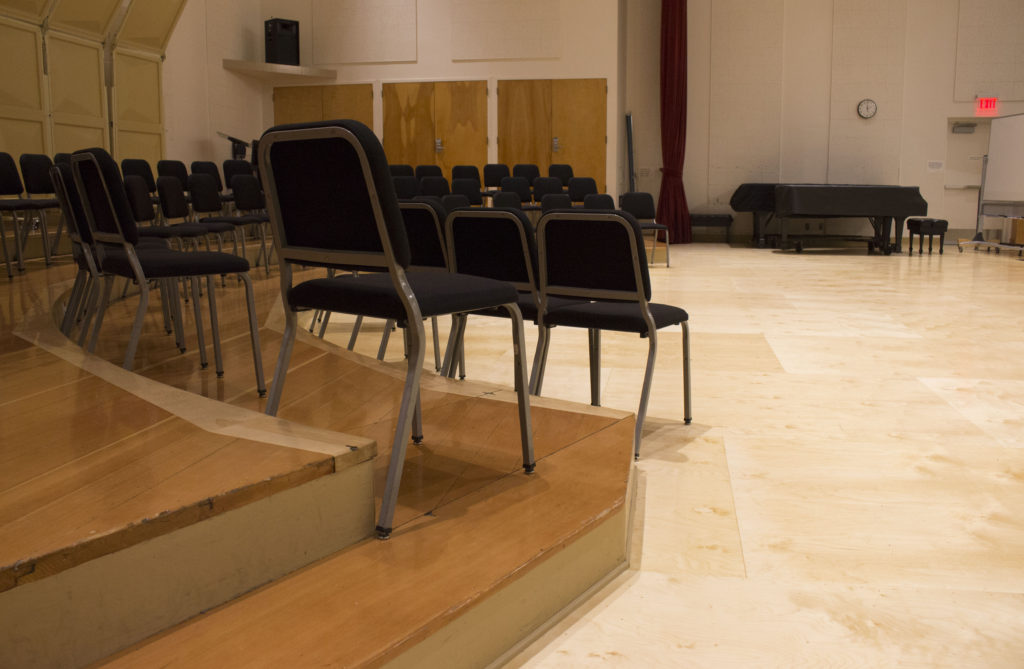
The glare from the new floor in Fulkerson Recital Hall makes it hard for music students to read their music. The glossy plywood covering the stage alters the light and acoustics in the Hall this spring.
Music student Telisha Moore has many complaints about the floor.
“It’s super shiny and distracting when standing on the stage and it is very hard to read music,” Moore said. “It doesn’t really feel like a performance stage anymore.”
This semester, students and faculty of the music department return from break to find big changes had been made to Fulkerson Recital Hall’s flooring.
As of Jan. 16, Fulkerson Recital Hall’s old growth pine flooring has been changed to plywood as a temporary fix.
With students walking in and out and equipment being moved back and forth, the Hall gets yearly damages. These damages include safety issues such as splintering.
Professor Brian Post, who is currently filling in as interim chair of the music department alongside Professor Paul Cummings, expresses concerns over the many issues that have come with the temporary changes to the floor.
At the end of every year, the floor is refinished, sanded down and gets a new coat of varnish on top, according to Post.

At the end of 2016, Facilities Management realized that the floor was too old to refinish and could not be sanded down any further.
In December, facilities management made final decisions to begin work on temporarily fixing the floor over winter break and would hold off complete replacement of the floor until a time when the stage is most open, according to Cummings.
Cummings biggest concern is when the temporary floor will be replaced with the permanent floor because the floor is almost always in use.
Fulkerson Recital Hall is used around 12 hours a day. Classes use the recital hall for rehearsals, it is used by center arts and even in the summer when HSU hosts music workshops. HSU hosts nationally recognized performers, speakers, and is a regional center for the arts. The community uses it as well as other departments on campus. The hall is meant to function as a community stage, as well as a department stage, according to Post.
Finding a time when the Hall is not in use is challenging. Times for the permanent replacement of the floor have not been set, due to how often the Hall is in use.
“If we’re lucky, this repair process will be done by Fall 2017,” Post said.
The music department had little knowledge to the extent of the changes that would be occurring in Fulkerson Recital Hall. According to Post and Cummings there was no communication about the floor being replaced between the Facilities Management and the Music Department.
“You can imagine our shock when we came back from winter break and we opened that door and saw a floor that doesn’t meet any kind of basic standard for a university music department primary performance facility,” Cummings said. “All changes were done without consultation to the music department.”
Professor Eugene Novotney is very familiar with Fulkerson hall as he spends 12 to 15 hours or more a week in the space. “I don’t think any consideration was given to how that gloss coated plywood floor altered the light and soundscape of the stage,” Novotney said.
Novotney and his students struggle with the acoustics and the reflection of the bright floor daily. “The floor is very reflective both of light and sound,” Novotney said.
The current acoustics in Fulkerson Recital Hall have been found to be hard for singers to work with. The Hall is in drastic need of attention from facilities management when it comes to the functionality and acoustic environment in order to be on a professional level said Novotney. The plywood floor that is currently in the room is an intermediate step towards a complete transformation that will occur in Fulkerson.
Music student Amber Rausch says her class was full of sarcastic reactions when they were first exposed to what had happened to the floor.
“Everyone was in shock on the first week of classes,” Rausch said. “The topic of the floor comes up in every class session.”

By | Carlos Olloqui
For some people, a fallen redwood in the middle of the forest is nothing more than another tree at the end of its time. For Jessie Groeschen, it is an empty canvas awaiting her chainsaw.
Groeschen is a local chainsaw artist who has traveled all around the world. She is also the author of Art of Chainsaw Carving.
“It all starts with my chainsaw, a piece of wood and an idea,” Groeschen said. “I just love what I do.”

Born in the Philippines, Groeschen moved to the U.S. at the age of two and has lived in Arcata for the past 10 years. She has been woodworking for over 20 years now.
“It was furniture first, but I was always interested in art,” Groeschen said. “Then I met Pat McVay, he was wood sculpting at the time and I studied with him for seven years before I struck out on my own.”
In 2015, Groeschen graduated from Humboldt State University with a degree in art.
“I was so close to campus I thought, ‘why not go back and finish school,’ and so I did,” Groeschen said.
Groeschen works from her shop located in the garage of her Arcata home. She is currently working on a number of projects including a pair of wood carvings for two siblings, one of a dragon and the other of a kestrel.
“I only use wood that’s already down,” Groeschen said. “I believe different types of wood all have their own personality and characteristics.”
During the month of February, Groeschen also makes “flaming hearts,” since it is the “month of love,” as she said.
“I don’t have a physical gallery where I sell my work,” Groeschen said. “I have a website, people contact me, and sometimes I just sell them at places around town.”
Jeni Sue Wilmore works at Almquist Lumber, a local lumber and woodworking supply company.
“We have sold some of Jessie’s carvings here, I enjoy watching her in action when she does demonstrations here,” Wilmore said. “She spent several days carving a bear and salmon sculpture in our parking lot, so original and creative.”
Some of Groeschen’s wood pieces can take her less than an hour to complete, others can take her over a year.
“It’s really just therapy for me,” Groeschen said. “I do this for myself.”
Not only is Groeschen an artist and an author, some say she is an inspiration.
Bill Weber is team captain at Arborwear, a tree climbing gear and apparel supply store in Ohio.
“Although I have not spoken to Jessie I know her work has inspired so many artists. She is a total badass,” Weber said. “What she does with a chainsaw will make you stare in awe.”
Arcata is just a temporary location for Groeschen. When the time is right she hopes to open her own cabin retreat for art and healing.
“I have some land in Minnesota and the cabin is already there,” Groeschen said. “I just want some place where people can go and woodwork, do ceramics, write, a place for all types of art.”

By Morgan Brizee

A long light grey table split the Recreation and Wellness Center room in half. Students and a staff member were on one side and the facilitator on the other during the One Breath meditation group class on Feb. 1.
Every Wednesday at 5 p.m., Craig Beeson teaches those who want to learn to destress and wind down. The group is run by Counseling And Psychological Services and is open to the HSU community including students, staff and faculty.
Beeson is a staff psychologist with a residential life focus and does workshops like One Breath in the resident halls on HSU campus.
“I noticed when this [One Breath Meditation workshop] was on my mind, preparing for it, I was getting stressed about it,” Beeson said. “This is counterproductive, I’m getting really stressed about a mindfulness presentation.”
With a new semester starting up again, and most students being far from home, it can be easy to get overwhelmed.
Karen Zurdta, a 23-year-old English grad student, talked about how coming to this class has taught her to love herself more.
“I was going through a tough time with school last semester and I got really sad and emotional,” Zurdta said. “I was having problems showing myself love and that I am worthy of good things.”
Beeson is using the book, “The Mindful Path to Self-Compassion” by Christopher Gerner, to teach the class about not fighting the feelings you have but instead accepting them. The class goes over how to cope with issues from anxiety to insomnia that many students can relate to.
Matt Cunningham, a 25-year-old senior English major, has been meditating for five years and even went to the City of Ten Thousand Buddhas in Ukiah, Calif. last spring to help with his practice of mindfulness.
“It’s kind of taught me to think of my thoughts and feelings as senses and to react to them like I would to any other sort of negative stimuli,” Cunningham said. “Mindfulness has helped me address those things more directly in a lot of ways.”
The class begins with a group discussion of feelings and how to address them in a positive way. After about 30 minutes, Besson directs the group to close their eyes and focus on their individual breathing. He then moves on to telling the group to focus on one body part at a time, relaxing each body part individually, until the group feels their body and mind is calm. Beeson ends class by checking in with each member of the group on how they feel afterwards.
“We talk about things like how to connect to yourself and live a more present, relaxed life,” Beeson said.
By | Iridian Casarez
Local
Arcata playhouse turns ten!
-The Arcata playhouse celebrated its tenth birthday with a two day celebration this past weekend.
Arcata police department has a crime website
-The Arcata police department now has a website that reports crimes in Arcata. Arcata.crimegraphics.com is the website that keeps watch on the crimes. The website includes tabs that follow the Arcata police daily bulletin, missing person, vehicle thefts, arrests with booking mugshots and crime charts.
U.S.
Tornados cycle through New Orleans
-Multiple tornados cycled through New Orleans causing major damage on February 7.
No success in suit
-U.S. District Judge Daniel Hovland says Dakota access pipeline protesters involved in a violent police encounter in North Dakota this past November are unlikely to succeed in a lawsuit alleging excessive force and civil rights violations.
World
Iran thanks Trump
-Iran’s supreme leader thanked the new American leader President Trump for showing the United States’ “true face” and justified Iran’s accusation of corruption in a speech on February 7.
Bomb blast in Kabul
-A bomb explodes outside the supreme court in the centre of the Afghan capital killing at least 20 on February 7. The attack is the latest in a series of attacks on the judiciary.
By | Charlotte Rutigliano
Mother Nature works against the California Department of Transportation making roads a little less traveled.
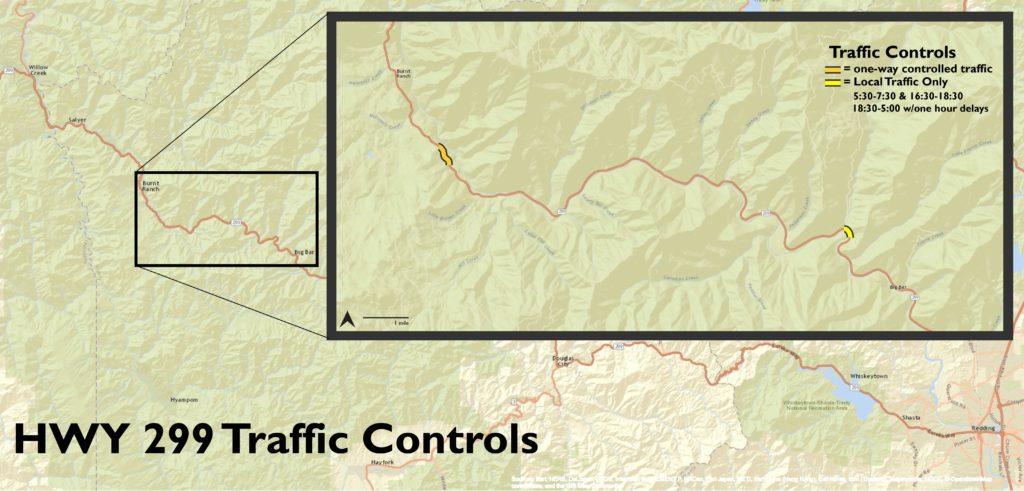
Since January 2016 the California Department of Transportation, known as Caltrans, has been doing construction on state Route 299. The ongoing project initially began with the placement of a drapery, netting that prevents rock fall, near Big French Creek Road. Due to weather conditions over the past year, Caltrans continuously raises their budget spending close to $6 million for this emergency work.
Because of all the construction on state Route 299, residents in both Humboldt and Trinity counties have had to take detours. Some of these detours are only open during certain hours of the day.
Trisha Coder is the District 2 Public Information Officer for Caltrans. Coder stated that residents have had to to take detours on state Routes 20 and 36 along with Interstate 5 over Oregon Mountain for several weeks.
“Two weeks ago we opened the temporary detour that we are building to local traffic, meaning anyone who works or lives in the Trinity/Humboldt area,” Coder said.
The detour is open from 5:30-7:30 a.m., 4:30-6:30 p.m. and overnight from 6:30 p.m. -5:00 a.m. There are one hour delays overnight due to the contractor working simultaneously overnight.
These delays not only affect residents along state Route 299 but programs at Humboldt State like TriO Upward Bound; a program that travels every three to four weeks between Humboldt and Trinity counties to provide academic services to high school students from limited income families.
Jen Dyke, TriO Upward Bound director, stated that with all the closures and construction on state Route 299 it takes longer to travel because they have to make a larger loop with the detours.
“Though it’s time consuming for the program, they’re doing great work, brave work,” Dyke said.
For now residents have to adjust to time restricted closure since Caltrans doesn’t expect to have state Route 299 fully open until mid-summer.
Additional information from Caltrans website about the work that has been done over the past year:
SR 299/BUCKHORN GRADE: 24/7 traffic control operations in effect between Redding and Weaverville. Expect delays up to 45 mins. The Capstone project is expected to be completed Winter 2016.
JUNCTION OF SR 3 AND 299-DOWNTOWN WEAVERVILLE: Paving is expected to begin following the Labor Day weekend, September 6, 2016. Paving will take place in the overnight hours and is expected to last about one-and-a-half weeks.
SR 299E/Near Ingot: One-way traffic control will be in effect Monday, August 1, 2016 to Friday, August 5,2016, 24 hours a day, near McCandless Gulch Curve. Crews will be performing curve straightening, widening the shoulders and installing metal beam guard rail. Motorists should expect delays between 10-15 minutes.
299 E/PIT ONE SHOULDER WIDENING: Crews are working to widen the shoulders at the narrow pass on Pit One Summit. 24 hour traffic control is in place. Expect 10-15 minute delays.