The Lumberjack


Students Serving The Cal Poly Humboldt Campus and Community Since 1929

Category: Opinion

  • Upperclassmen, your jealousy is warranted

    Upperclassmen, your jealousy is warranted

    by Elise Fero

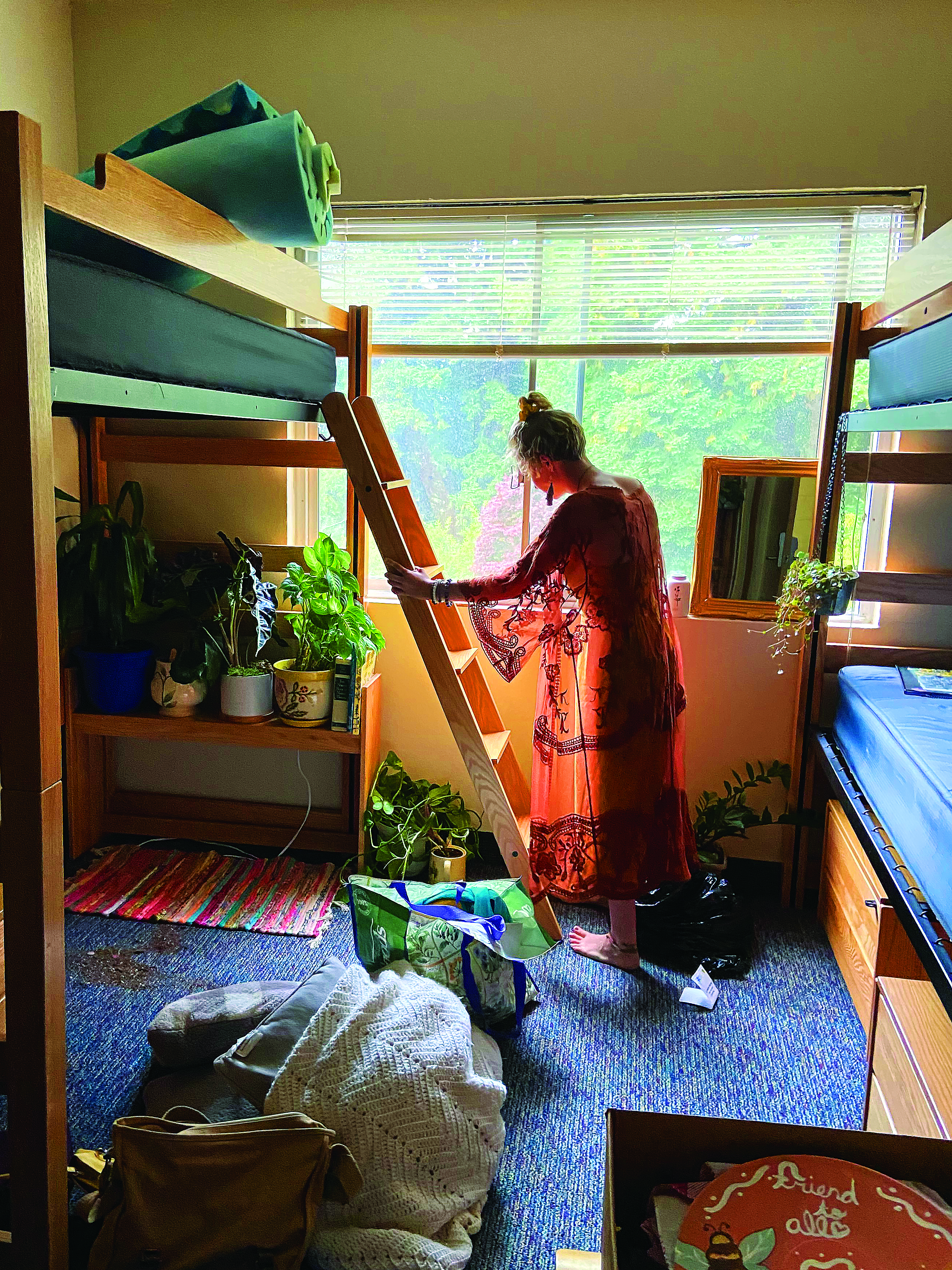
    Our lives were in empty dark rooms in the dorms, where sitting in the halls and talking was prohibited. Masks were to be on everywhere. Even the volleyball court outside the building couldn’t be used. We couldn’t be social. The only life we saw on campus was deer.

    This was my experience of freshman year during 2020-2021. Living in a tiny dorm with two bunk beds but no one to fill them; just my emotional support cat Winnie Fig and I, away from home for the first time in a new state. Online classes left the campus completely dead. No one played guitars in the music quad, no one rushed to class on their skateboard, and no one ate in the Depot. 

    Now it’s the Fall of 2022 and here come the incoming freshmen, ready to go to classes in person, to meet new people who aren’t hidden behind masks. What a different experience than my own freshman year. I can’t help but feel as if I have been cheated out of an exponential time in my life. Someone tell me why this is fair!

    Maybe I’m being ridiculous. People died in this pandemic and it affected other lives way more than mine, but I know plenty of others who feel just like I do. Our incredibly expensive education that we spent in our dorm rooms didn’t give us the classic “college experience” that others received before us (and after us.)

    I always imagined college to be the best years of my life, but the pandemic forced us all into silence, into being more antisocial than many of us were to begin with. 

    It’s not as if I didn’t get to have some classic experiences. Even after having COVID-19 during my first week of freshman year, I still found myself on the Lumberjack newspaper staff. During that semester we created a family inside the department, even though we only knew each other through a screen. 

    I have since changed my major multiple times, but the journalism program was my savior when the world shut down. For that I am eternally grateful.

    Now an environmental studies major, I still work for the Lumberjack. I am also starting to  meet people in my new major in-person– just like the freshmen are. 

    My jealousy is a bit extreme, I must admit. These new students are getting the experience I dreamed of. They can go to events without fear. They can dance through the halls of their dorms laughing and talking with other people. They can meet people! My gosh, they can meet people. What an advantage they have, which I didn’t get until this year. 

    It was hard to make friends and I often felt very alone. I remember the only times we saw our friends in those early days were when we snuck into the forest to say hello with our masks on. How scandalous! 

    I’m so happy for the freshmen, I truly am. They get the experience they deserve. And while they lost some of high school, I still think they’re getting the better end of this deal. I wish I missed parts of high school instead! I mean, I hated high school. 

    I know so many people who met the love of their life in college, a hope I always had as a kid. How could I do that while fully online? I just have to believe everything happens for a reason. The freshmen? They have endless opportunities for friends and love and joy in college social life. I wish I had that, too. 

    Let me express my gratitude as well. My freshman and sophomore years were still beautiful experiences that I wouldn’t trade for the world. But for those upperclassmen feeling jealous as you watch freshmen embark on their college journey, you aren’t alone. I promise, you aren’t alone.

  • Students are hounding for housing

    by Ione Dellos

    If you are on campus this semester to physically pick up this copy of the Lumberjack, then you know how rough the housing market is in Humboldt. On-campus housing is at capacity for the 2022-2023 academic year, leaving students hard-pressed to find housing elsewhere. 

    The solution our glorious polytechnic has come up with for solving the housing crisis includes housing students at the Comfort Inn in Arcata, where the familiar “HOUSING MOVE-IN” signs can be seen planted outside… the Patriot gas station on Giuntoli? For incoming students, will  moving them into a hotel for the year really give them the classic Humboldt experience? How will they go on a campus tour to the woods at 10 pm to engage in some completely legal activities in the forest? Will they still be able to experience the joy of traversing half a mile every morning from their dorm to the JGC for some subpar tater tots for breakfast? 

    There’s the additional hardship of inexperience in finding housing among the college age demographic, as this is many people’s first time leaving home, or really living on their own. I was just living on campus last semester and eating donuts from the J for breakfast every morning, now I’m expected to magically be responsible enough to get an apartment? If you don’t have previous rental experience, you don’t know what you’re getting yourself into, and there are some predatory property management companies in Humboldt that capitalize on that. With the reality of mainly in-person classes for this school year, the pressure to find housing near campus is on like never before. 

    Don’t even get me started on owning furniture! You will never realize how expensive a couch is until you have to buy one for yourself. Tables are also very expensive, but I could talk about how expensive furniture is all day. When hunting for housing, furniture is the least of your worries. Having an actual apartment to put it all in is priority number one, and with the aforementioned problems with the Humboldt housing market, it can be a tall task to tackle. 

    There are some helpful resources that the university does provide, like the off-campus housing liaison, who provides one-on-one support and advice to help you on your journey to find housing. Also, in case you abruptly lose housing or cannot find any in time, Humboldt does provide the Emergency Housing Program. This program is subject to availability, and they can be reached at dos@humboldt.edu. 

    Now, this isn’t supposed to be all doom and gloom. While it can feel impossible at times to find housing, it will only feel that way for a while. With the help of another roommate to scream with when the third property management company you’ve reached out to doesn’t get back to you, a few co-signers to make up for that 750-point credit score you do not have at twenty years old, and a small miracle, you too can find housing!

  • The trouble with true crime

    The trouble with true crime

    by Camille Delany

    As a high schooler, I’d often listen to podcasts while jogging in the country by my house, or when walking to school. As I searched for compelling entertainment in the nascent medium, one genre rose to the top: true crime. It wasn’t just me, either. The boom seemed to begin with the success of NPR’s Serial in 2014, after which podcast platforms became increasingly dominated by the genre. Rehashings of cold cases, mysterious disappearances, and serial killings became objects of public fascination, along with the real life stories of cults, shootings, and disasters. 

    True crime has long enjoyed mainstream popularity in the form of books and television, but the rise of podcasts and streaming has brought it to a wider audience than ever. However, my experience as an avid listener of true crime podcasts was not entirely positive, and I’ve also recently heard peers discuss negative aspects of their interest in crime stories.

    A friend who used to be a huge fan of a few specific true crime podcasts says she’s going to cut back on her listening, as it increases her anxiety. This parallels my experience; when I was a dedicated listener of crime podcasts, I noticed myself feeling paranoid and less willing to interact with people outside of my immediate circles.

    The true crime genre isn’t populated with tales of wage theft or corporate environmental destruction, even though crimes like these have enormous impacts and their perpetrators are rarely brought to justice. Even if we narrow our focus to violent crime, true crime narratives rarely follow the most common type of that, either.

    FBI homicide data for 2019 shows that in most cases of violent crime, both perpetrator and victim are male, and that they typically know each other. Trends like these aren’t apparent if your knowledge of crime statistics is informed by a true crime podcast feed, as I notice is increasingly common. 

    In my experience discussing the genre with friends and acquaintances, true crime consumption is linked with an idea of “research.” Often an enthusiasm for the genre is coupled with a belief that the information presented over the course of the narrative will aid in one’s survival. Engaging with it can become a vicious cycle. People who already feel themselves to be vulnerable are attracted to the genre, and the repetitive narratives of assault and kidnapping increase their anxiety. This keeps them returning in the hopes of gleaning insight into avoiding victimization. 

    However, it’s unlikely that consuming true crime media does much to improve the personal safety of women, in part because the type of crimes most frequently profiled are vanishingly rare, and exceedingly difficult to prevent. Women are already conditioned to fear strangers, even as, statistically speaking, acquaintances and domestic partners are far more dangerous. 

    The popular true crime podcast My Favorite Murder signs off with the glib tagline, “Stay sexy, don’t get murdered.” This about sums up the attitude of many true crime creators and audiences with which I take issue. The process of consuming a true crime narrative to reassure yourself that you could have seen the “warning signs” and avoided death, kidnapping, or sexual assault is a form of victim-blaming. 

    Also, the genre’s commodification of tragedy and violence is uncomfortable at best and, at worst, damaging to victims and their families. I’m not asking anyone to quit listening to their favorite podcast, just to think more critically about the media they engage with. What structures are supported by it? How does it make you feel?

  • The blood quantum conundrum

    The blood quantum conundrum

    by Matthew Taylor

    Over a century ago, two young women hid in the vegetation alongside the bay waters surrounding the small island of Tuluwat. Lying just off the coast of Eureka, Tuluwat is also known as Jaroujiji in Soulatluk, the language of the Wiyot Tribe. Those women’s English names were Matilda James and Nancy Spear. They were two of the few survivors of the Feb. 26, 1860 Wiyot Massacre. The massacre took place the night of the tribe’s most sacred of holy days, the World Renewal ceremony. Over 200 Wiyot people died that night at the hands of white Humboldt settlers. Nancy Spear and her sister Matilda James are my ancestors. I am a descendant of the Wiyot people, and yet I’m also white and thus experience white privilege.

    When my mother was little, my grandpa would often take her to the local powwows here in Humboldt. My grandpa is a registered member of the Wiyot Tribe and carries within him the history of our family’s struggles – a long history of generational trauma, mental illness, and alcoholism.

    My grandma, a non-Native person, was embarrassed to go to these events and cultural celebrations. She felt that because neither her husband nor children looked Native enough, they didn’t belong in that space. My mother and I grew up completely separated from that part of our family. Even today we are reluctant to reach back out to the tribe, not because we want government benefits or even full membership, but because we wish to gain what our family has lost – culture, history, heritage.

    Eddie Carpenter, a fellow reporter at the Lumberjack and registered member of the Hoopa Tribe, has had similar difficulties as a white-assumed Native person. Carpenter prefers not to be labeled as white-passing due to the term’s colonial history.

    “Despite being a tribal member I get mistaken a lot for being a white person,” Carpenter said. “As a child I kind of got bullied a little bit for being mistaken for that identity. Most of it was little microaggressions such as, ‘you don’t look native to me.’”

    We do differ in some experiences, though. Unlike Carpenter, my grandpa and his sister are the only members of my family who still make the federal minimum “blood quantum.” Also unlike Carpenter, I didn’t get the opportunity to be raised within my culture.

    “White-passing is an outdated term,” Carpenter said. “Because it is based on the ‘one drop rule’ of the Black/white binary categories within U.S. politics.”

    There is a lot of debate within Native American communities on the usefulness of blood quantum minimums. Some believe it helps to deter white people with minimal Native ancestry from taking government benefits that they often don’t need, while others, like Carpenter and I, believe that it is a harmful colonial system that has historically erased – and continues to erase – the existence and power of Native people. However, there is no doubt that Carpenter and I experience significant privilege due to our perceived whiteness. This is a truth we do not deny, and one that we try to actively be aware of when in Native spaces.

    “I do not self identify by colonial tools from imposed social structures that were used to conquer and divide my people from the inside out,” Carpenter said.

    I don’t wish to take up space that is not mine to take. But I don’t wish to deny a history that my family has nor reject a people, the Wiyot people, that are part of me.

    The experiences and connection that the Wiyot people have to this land is represented within my family. We are still healing from our generational trauma and we are still deeply in love with the land we now call Humboldt. In the years to come, my hope is to bring my family back into the community and to use my resources, connections and skills to give back to the tribe that gave me my mother, my grandfather, my great grandmother, and my life.

  • Insane Clown Posse has been misunderstood

    by Cheyenne Wise

    So many pro-Trump bootlicking racists think that Insane Clown Posse (ICP), formed by Shaggy 2 Dope and Violent J, is a band that speaks to their ideology and stands for the same beliefs. Some people perceive fans of ICP to be synonymous with white rural racists in this country. However, Juggalos—a term of endearment among fans, akin to Taylor Swift fans being called Swifties—and ICP have always preached inclusivity and freedom of expression.

    ICP is against racism, sexism, homophobia, transphobia and the destruction of civil rights. They even sat down with Chris Hansen to talk about their mutual hatred for sexual predators. Who wouldn’t want to hang out with Chris Hansen?

    They have fought for years to be seen and heard as valid, especially when the FBI labeled them as a violent gang. Juggalos come from all walks of life, from poor to rich, from all religions and backgrounds. If you are a Juggalo, you’re family.

    A self proclaimed Juggalo attacked a gay bar in 2006. In response, ICP’s manager Alex Abbiss said, “It’s quite obvious that this guy had no clue what being a Juggalo is all about. If anyone knows anything at all about ICP, then you know that they have never, ever been down or will be down with any racist or bigotry bullshit. In my opinion, the perpetrator of this crime committed these acts not because he was a Juggalo, but because he was a neo-Nazi. He subscribed to an ideology of racism and bigotry, and was quite clearly, in my opinion, out of his mind.”

    While they aren’t full-on political, they are vocal in what they hate and what they do to people they don’t like. In their 2015 song “Confederate Flag,” they really let people know their thoughts on the rebel flag and the people who wear it.

    I say fuck your rebel flag/ Out here pretending like you ain’t offendin’/ I say fuck your rebel flag/ You redneck judges with racist grudges/ I say fuck your rebel flag/ If you gotta tattoo, I’m aimin’ at you/I say fuck your rebel flag/You get punched in your faces reppin’ the racists

    Even before that, in the 1990s, they were singing:

    The country we live in was built by slaves/ Beat down and murdered and stuffed in their graves/ You put a slave owner on the one dollar bill/ And you want to know why I KILL PEOPLE!

    ICP took to selling a new batch of t-shirts in 2020 that were originally sold in the early ‘90s. It’s a Juggalo tearing and burning a Confederate flag with the words “Fuck Your Rebel Flag” on the back. They brought it back from the demands of their fans from the devastating events in 2020 with the killings of George Floyd, Ahmaud Arbery, Breonna Taylor and many others. Wearing it pisses off the right people and makes for great conversations with those that love ICP and those that love burning the rebel flag.

    While hip-hop/horrorcore mosh pit energy music might bit much for a lot of people, you have to admit putting out music that screams what they think so loudly is pretty cool. Maybe you’ve thought about some of ICP’s lyrics in your head and agreed with them but would never say it out loud. Maybe you’ve thought about picking up a heavy object and just so happening to swing it near a known sexual predator.

    I think the world could do with a little ICP in their lives. They are inclusive, body-positive, and LGBTQ+ safe. They don’t care about your bank balance and they stick up for all Juggalos no matter their background. Check out wikiHow’s How to Be a Juggalo: 12 Steps for more information.

  • Why do Cypress residents need an All Access meal plan?

    by Shane Jarvie

    I find it extremely redundant that Cypress residents are required to own an All Access meal plan. When I’ve asked school officials why they’re needed, they’ve just responded, “Cypress residents are required to have one of the All Access meal plans. Upperclassmen living areas that do not require a meal plan are College Creek and Campus Apartments, both of which have shared kitchen areas.”

    I’m a junior who’s lived on campus for three years now, and Cypress has the best kitchen out of every residence hall I’ve seen. Yes, even better than the one in College Creek apartments. Having lived in College Creek apartments as a sophomore, I’ve found that Cypress has more counter space and many more cabinets for storage space. The Cypress kitchen has offered my suitemates and I enough room and resources to cook for 20+ people once a week for Cypress eighth floor’s “family dinners,” where both sides of the floor come together for a weekly feast.

    A suite on Cypress can house up to twelve students, so I’d understand if we were required to have a meal plan due to the number of suitemates who share the kitchen. However, I can’t understand why we’re required to have an All Access meal plan.

    As a student working in the housing department as a Resident Student Services Assistant, I’ve had the opportunity to study each housing option and meal plan that the school offers. The more I learn, the less it makes sense that Cypress suites require an All Access meal plan.

    For anyone who isn’t aware how the on-campus meal plan system works, here’s a quote directly from the Meal Plans page on our campus housing website: “All living areas require a meal plan except College Creek and Campus Apartments. Residents of the Hill, Canyon, Cypress and Creekview Suites are required to have one of the All Access meal plans. Residents of Creekview Apartments are required to have any one of the meal plans.”

    The cheapest All Access meal plan is the 5-day All Access plan. It’s $5,000 per academic year, and contains all access meals to the J five days a week, including 300 Flex dollars and 66 or 62 meal exchanges per semester. (The housing website says 66, the dining website says 62.)

    One of the alternative meal plans that I’ll be using as a comparison is the Lumberjack 125. This meal plan that Cypress residents don’t have access to costs $3,500 per academic year, provides 125 meals in the J (which is honestly still more than enough J food for me), has 525 flex dollars, and 31 meal exchanges per semester.

    As someone who isn’t impressed with the food that Chartwells has to offer at the J, I’d much rather have the Lumberjack 125, which has 225 more flex dollars and costs $1,500 less per year!

    If I can’t convince school officials that Cypress residents should have access to the other meal plans available, I at least want an adequate answer to why we shouldn’t.

  • Our Flag Means Death gives the gays everything we wanted

    Our Flag Means Death gives the gays everything we wanted

    by Sophia Escudero

    In episode five of Our Flag Means Death, the two leads share a moment under the moonlight. Stede gently folds a piece of fabric that Ed’s mother had given him and tucks it neatly into a pocket of his waistcoat.

    “You wear fine things well,” he says, tenderly, and Ed looks up at him with nothing short of adoration in his eyes. He leans in, then stops himself, and as the two part ways they look back at each other, both clearly wanting more but unable to bring themselves to voice it.

    That’s pretty gay, I thought to myself, but I didn’t dare hope that this scene was intended as anything beyond bromance.

    I grew up on Tumblr as a queer kid at the height of Superwholock, reblogging edits of Emma and Regina from Once Upon a Time looking longingly at each other and watching conspiracy videos about how, if you really read between the lines, the BBC are totally going to make Johnlock canon in the next season of Sherlock. I believed that the new Star Wars trilogy would give us gay Jedi, and the MCU would give us gay superheroes. Eventually, this hope faded. Each new season of Sherlock was worse, each “first gay Disney character” was less relevant to the plot than the last, and every video I saw from a con featured actors and writers mocking fans in the audience for daring to ask if there would be queer characters.

    I grew to accept that any show that was not explicitly marketed as being about coming out or facing homophobia would ever have a central queer romance. Any scraps I got would be something confirmed on Twitter or by an actor in an AMA and the void would have to be filled by fanfiction.

    When I saw that Taika Waititi was producing a comedy about pirates, I was all in. I was pleasantly surprised when a side character was revealed to be nonbinary and used they/them pronouns. Frankly, my bar for LGBT representation in media is subterranean. If a single character is canonically queer, doesn’t die and is not treated as a joke by the narrative, I will embrace the work wholeheartedly. I don’t ask for much, but I still rarely get more than a “wait and see.”

    Every episode was tailor-made to convince me that this was a love story, but I refused to be tricked so easily. When these characters were found in suggestive scenarios, I accepted it as a joke, and when they shared moments of tenderness and emotional vulnerability, I accepted that they were just really good friends. Even when the cast and crew said, verbatim, “this is a love story,” I was certain they meant it in the nebulous way that a buddy comedy is a love story, and that if I read into it I was a stupid, greedy little homosexual trying to make pop culture gay. Hell, I made it to the ninth episode, where they kiss each other on the lips and make a plan to run away together, still half-convinced that this was some kind of friendship kiss found only in advanced queerbaiting.

    It shouldn’t be shocking to me that queer people exist in television and movies. As a queer person, I should know that we do. Yet, years of media telling me otherwise had convinced me that maybe I was wrong. It has been over a month since the season finale aired, and I haven’t recovered from the sheer impossibility of seeing a romance between two men as central to the plot in a show about something other than queer pain.

    These characters are in love. They kiss, they hold hands, they exist outside of subtext and punchlines. Some jaded part of me thinks that a second season must end in death and suffering, but the inner 14-year-old that was hopeful enough to suffer through four seasons of Sherlock dares to believe that maybe, just maybe, gay people can be happy outside of fanfiction.

  • Masking mental illness is a privilege

    Masking mental illness is a privilege

    by Lex Valtenbergs

    I could tell that the woman lingering at the bus stop was mentally ill within the first few moments of speaking to her, although it wasn’t my place to surmise what mental illness she suffered from.

    She asked me a question about the bus schedule and muttered something aloud as if in reply, but not to me. When her eyes met mine again, she blurted, “Oh!” as if she forgot I was there.

    My initial reaction was to fear her; I didn’t understand the inner workings of her mind nor their outward manifestations. I perceived her as volatile and therefore threatening.

    At that time, I was also going through a protracted depressive episode marked by the distinctive mistrust and self-sabotaging tendencies that are all too common in borderline personality disorder. As a result, I had little to no verve to engage with her.

    In our own respective ways we were unmasked.

    The difference between her and myself is that I have the privilege to mask, or hide the symptoms of my mental illness to the best of my ability. She’s always visible; not by choice but by circumstance.

    Ironically, my masking urge to ‘help’ in some way and assuage her symptoms that brought me discomfort was snuffed out by my own unmasked symptoms. I was defying the neurotypical script and the internalized ableism – discrimination against people with disabilities, mentally ill and neurodivergent people – that came with it.

    I got on the bus and sat down, trying to push away the dread and discomfort that were triggered by the brief interaction that I had with the mentally ill stranger at the bus stop.

    As if being summoned by telepathy, the woman appeared at the open back door of the bus and asked me another question that I didn’t have an answer to. Just before the back door slid shut, she snuck inside the bus without paying at the front and sat down across from me.

    For the next half hour or so, she had an ongoing dialogue with no one in particular, constantly shifted in her seat, and ripped up a handful of white paper straw covers from a fast food restaurant.

    At one point her eyes wandered to mine and she asked me, point-blank, “Are you okay?”

    I was baffled by her lucidity. I curtly replied, “I’m good,” even though I wasn’t. She didn’t push me like I feared she would.

    At the last northbound bus stop in Eureka, she abruptly stood up from her seat. She left a pair of brown moccasin boots under her seat. As she passed by me, she gently touched my shoulder and said, “I love you.”

    The physical contact was unexpected but not entirely unwelcome. When she told me that she loved me – a misplaced but sincere disclosure – I felt the burning touch of shame press firmly inward. What were the people around us were thinking? Would they associate me with her?

    It didn’t matter, I consoled myself. I always try to deconstruct any ableist narratives that crop up in my mind. Then I learn from it and strive not to repeat it again.

    If we dare to overcome our fear of judgement, we are more prepared to dig through the other discriminatory narratives that are ingrained in us.

    She turned around. “Could you be a dear and grab my boots for me?”

    I cynically inferred that she left her boots on purpose just so I could get them for her, but I realized that I couldn’t be certain. Even if I was, her intention wasn’t malicious. I stooped down to grab them, and brought them out to her.

    It felt like we understood each other as I handed her the boots. She took her boots from my hands, and then she was gone.

    I almost cried as I sat in silence, my heart twinging painfully with every second the bus pulled away.

    I am mentally ill. I am broken. I am whole, but not seamless. The woman on the bus couldn’t seal her cracks as well as I can, and that’s a privilege that weighs heavily on me.

  • Luddites aren’t who you think they are

    by Carlos Pedraza

    The Luddites emerged in the early 1800s, claiming to follow craftsman and folk hero Ned Ludd in expressing the rage of craftsmen and other workers who felt threatened by industrialization. Today, Luddite is used as an insult for technophobes, but the real Luddites didn’t hate technology. They wanted to protect their livelihoods and get better working conditions.

    Automation has always been a threat to workers. Unlike humans, machines don’t demand higher wages and can work 24/7. The Luddites would go to factories and smash machines with anything they could find. In 2013, delivery drivers smashed and stabbed robots in a modern display of Luddism, not technophobia.

    While new technologies can lessen work time, they usually are used by businesses and governments for control. Think of the algorithms that Amazon uses to manage their workers’ work time and breaks. I used to work as a service worker stocking shelves. I would get up at six in the morning and work till noon, with only two 15 minute breaks. If I knew that a machine was tracking me to keep me working and not take an extra five minutes, then I would be the first to stab it.

    In working jobs where I had no autonomy, I would be forced to smile at all times and repeat the same mindless boring tasks over and over again. The greatest disappointment was when I saw my paycheck, feeling robbed by how little it was. A higher wage or longer breaks would have made me feel less angry, but a machine doesn’t care about breaks or paying rent.

    Even if automation didn’t make me lose my job, then it would still cut my hours and thus my pay. I’m a Luddite not because I hate technology or want everything to be the same. I like progress and embrace change, but if automation is going to happen then it must be for the workers to decide when and how to do it, and to distribute the benefits among the people.

    Until then, if I see a machine control my time or push me out of a job, I will keep shouting, “down with all kings but King Ludd.”

  • Freshman FOMO

    Freshman FOMO

    by Nina Hufman

    I recently had an internal crisis: I realized that I am nineteen years old and almost done with my junior year of college.

    I just got out of high school a year ago and I already have to be thinking about real life. I just started college and it’s already almost over. I am most likely going to do a second major and stay in school for two years, partially because I really want a second degree and partially because I feel so unprepared to graduate.

    I was lucky enough to be able to be concurrently enrolled in college classes while in high school. I started taking online classes from a nearby community college when I was a sophomore and was able to earn my Associate’s degree halfway through my senior year. I transferred to Cal Poly Humboldt at eighteen years old as a junior. While I am grateful to have been able to save money and time, my circumstances come with their own set of challenges.

    It’s really difficult to relate to my peers, because my experience is not a very common one. I have one friend who is in pretty much the exact situation that I’m in. She transferred as a junior right out of high school. We talk a lot about how we missed out on the freshman experience and how difficult it is to relate to people who haven’t been in our situation.

    I don’t live in the dorms, I don’t eat in the dining hall, and I don’t have to take any annoying GE classes that have nothing to do with my major. While most people would agree that these experiences are awful, they get to commiserate and bond with others over those experiences.

    All of my friends and the people in my classes are juniors and seniors. I went straight from being in high school to being surrounded by people who are, for the most part, actual functioning adults who have goals and life plans. I feel like I’m so far behind; they’ve had three or four years to figure these things out and I’ve had one.

    My friends also don’t want to do any of the fun Humboldt things that freshmen do when they move here. I want to go to the beaches, go hiking, and explore this beautiful area, but I don’t want to do it alone. My friends have been here for years, they’ve already seen and done all of those things.

    People are usually shocked when they find out my age. They hit me with ‘I thought you were at least 21,’ ‘you’re so mature for your age,’ and ‘wow, you must be really smart.’

    The reality is that I have been a mini-adult since I was fifteen because I had to learn how to interact with adults in my college classes. The result of this is feeling out of place literally all the time. I’m simultaneously too young and too old for everything. I’m ready to start my life and be an adult, but I also feel like I missed out on my own adolescence.

  • Gas prices are guzzling away my bank account

    Gas prices are guzzling away my bank account

    by Angel Barker

    When I started driving in high school, my mom and I had a deal that she would buy gas every other time I needed to fill my tank. Once I started driving upwards of 500 miles a week, that went away and I had to start paying my own way. To be fair, it was reasonable: I had a part time job and was driving a lot.

    I have a different part time job now that pays more. However, with the rising price of gas and how far out everything is in Humboldt county, it doesn’t make a difference. I am still spending an average of $300 a month on gas, and my car takes regular.

    On average (when I am not traveling) I only drive to work, school, home, and Eureka once a week for an appointment, and I time it right so I can get gas at Costco where it is the cheapest.

    I should also say that I am not a thief. I did not actually steal my mom’s Costco card, she knows I have it. It is her way of helping me pay for gas.

    I was sad in high school when I had to pay around $40 to fill up my tank. Now I am hoping and praying to pay that again. My car holds 16 gallons of gas, so with the California average of $5.91 per gallon as of March 29, it would take $94.70 to fill my gas tank if it was empty.

    That’s almost $100 to fill up my little mini SUV! I cannot afford to buy a hybrid or electric car, so I am stuck paying these gut wrenching prices. I used to go to Dutch Bro’s a lot in high school, and it is crazy to me that a gallon of gas is now more expensive than a Rebel or a cup of coffee. I know all of us are feeling this pain, and a little piece of my soul dies every time I go to the gas station.

    I recently took a road trip towards Redding and down to Modesto, and gas was cheaper everywhere, even in Paradise, the town that completely burned down in 2018. They are still rebuilding the city and there are only a handful of open gas stations, and they are still cheaper than here.

    The only place where it was the same price or 10 cents more was in a tiny town that was out of the way of everywhere. Humboldt is not a tiny town in the middle of nowhere, it is a whole county in the middle of nowhere. I am now realizing why it is called the Lost Coast, because no one knows about us and it is expensive as heck to get gasoline here.

    As much as I am complaining about gas prices, I am still going to pay them. What am I going to do, bike to work? No, driving already takes 25 minutes. It would take forever to bike, and I do not have the option to not go to work or school.

  • César Chavez Day with YES

    César Chavez Day with YES

    by Eddie Carpenter

    In honor of César Chavez Day, the YES program hosted a volunteer event at the Potawot Community Food Garden in Arcata. It had an amazing turnout with a whopping 40 volunteers in attendance, caressed by the sunny blue skies and the refreshing Humboldt breeze.

    We were assigned tasks by being divided into five groups. I was grateful to be a part of a group that planted beds of squash. We did everything from scratch, laying out layers of black cover material across the four rows to keep the weeds from robbing the plants of their nutrients. We also covered the tops of the rows with white cloth.

    Gardening skills have practical value in my daily life. Prior to this experience, I had been a volunteer at Potawot through a program called the Intertribal Agriculture Council. Potawat’s head gardener Ed Mata gave me a handbook about gardening and I was mentored by a professional development specialist named Elaini Vargas.

    Maybe I was a little rusty on the terminology, but basic knowledge about soil health has since been ingrained into the recesses of my brain. I learned in a soils class that if you live in a mild climate, it’s estimated that it took 200 to 400 years for 1 centimeter of the soil to form. Vargas’ and Mata’s teachings directly impacted the mindset I had going into the YES serve-a-thon on César Chavez Day.

    Youth Educational Services (YES) is a collective on campus that provides students with opportunities to volunteer at local school and community sites. One of their goals is to connect hands-on service and in-class learning with awareness of the injustices and oppressions experienced by those they serve. Actions sometimes speak louder than words. Making donations and saying nice things about a cause is totally different from donating your time and bodily energy to a cause.

    According to mentalhealth.org, helping others can possibly help make you happier as a person. Through volunteering, I was able to make temporary connections through teamwork and group communication. This gave me a sense of community and made me feel like I belonged to a noble cause.

    If you want to see change in your self-esteem, you might want to consider doing good deeds, so we can manifest the world into a better place. Indeed, an outward reflection of finding happiness can in turn make you a happy person.

  • I’m a first generation college student

    I’m a first generation college student

    By Mekiah Glynn

    My mother dropped out of college after one semester and my oldest sister dropped out of two different colleges within the span of two years. I am the definition of a first-generation college student. A third of undergraduates are first-generation, yet we hear very little about the perspectives of these college students.

    Luckily for the third of us here at Cal Poly Humboldt, there are a lot of resources for students who don’t have parents that know how to walk us through each step of college life. With mentors and workshops, Humboldt has helped me with the transition into college.

    Moving eight hours away from my hometown to Humboldt was already a big transition for me, but it was significantly more difficult as a first-generation college student who didn’t have a lot of people to talk to about college. My mother has supported me throughout all of this as best she can. Still, no one prepared me for the mundane things you have to go through in college that most students just know about, such as which meal plan to pick, what you really need for classes, and how to manage your time.

    Those questions were answered by my RAMP mentor for the most part, which was really helpful during the year, but less so before the year started, when I was signing up for classes, housing, and meal plans. During the summer before I started, the only resource available was my sister who is a communications major at UC Davis. She didn’t have much knowledge about a smaller college or classes for an environmental studies major. Because of this, my first semester was really rocky. I failed a class, edited my meal plan, and struggled with online college classes.

    The workshops about organization, mental health, and finding a job were really helpful mid-way through my first semester. The school’s resources weren’t directed at first-generation college students, but they were still helpful.

    Going into my second semester of college was a bit easier. I was more used to the day by day and was more aware of the resources that were available. It was still a struggle. I couldn’t ask my mom about things that I’m sure most of you could ask your parents without even thinking about it, such as questions about how to contact my professors or how to deal with a roommate.

    Being a first-generation college student is hard. The pressure of wanting to succeed where your parents couldn’t and the need to figure out a lot of it completely by yourself will never be easy. There can always be more resources put into place that could help out the third of us that are here alone, but I do believe that Cal Poly Humboldt does a great job trying to help.

    Make sure to check out the basic needs section on Cal Poly Humboldt’s official website if you need any help with mental health, housing, food, etc.

  • The rising cost of visiting Humboldt

    The rising cost of visiting Humboldt

    by Cheyenne Wise

    As May is fast approaching, so is the dreaded inflation of renting in Humboldt. During the year you can get a hotel room or rent an Airbnb for a couple of bucks. On spring graduation weekend, hotel rates double and even triple in price.

    It’s not something uncommon in Humboldt but usually, high prices make it hard to find a place to rent. It’s an opportunistic extortion to get college students to overpay for rundown places. Housing is first-come, first-serve but to take advantage of people who don’t have money is gross.

    For some people, this is the first and only time they can make the trip to Arcata, and it’s to see their family member graduate which is an incredible opportunity that shouldn’t be missed. Just checking the hotels near campus the usual cost of a hotel room for two people is at most $150 at any point during the year. But when you look at the same exact hotels during the week of graduation is $600 for two people a night.

    At Cal Poly Humboldt, about 78% of full-time undergraduates receive some kind of need-based financial aid. That’s 78% of people whose families might not have the ability to see them walk across the stage and be handed their diplomas. Hotels and Airbnb hosts take advantage of people who want to support their loved ones.

    Forget peoples’ families for a second. What about the people who are graduating and haven’t lived in the area for some time because of the pandemic, who are trying to find a place to stay so they can be there for their own graduation? It’s not just the issue of finding a place to stay. The prices of buying a cap and gown are so high for something you will only wear once and not for a long time. I guess you could say the same thing about a wedding dress, but even those are absurd.

    Maybe I’m just someone who likes to count pennies and is a bit of a pessimist, but the price of graduating is excessive. We’ve already shoveled a bunch of money into the burning money pit of college so it would be lovely to be able to step away from the flames and not have to worry.

  • Student debt is coming faster than you might have thought.

    by Ian Vargas

    If you’re anything like me, there’s no way you can afford to pay for college on your own: you’ve probably got student debt. While you’re still taking classes, it feels like you don’t have to worry about it because graduation could be years away. It’s always looming on the horizon, far enough away that it seems like you’ll probably have it under control by the time you’ve actually got to deal with it.

    I am in my last semester as an undergraduate, so that horizon is closing in real quick for me and it’s scary as hell. My current debt is just shy of $20,000, which is slightly lower than the national average, but still by far more money than I than I’ve ever made at a job.

    Ideally college would help with that, but considering the job market, that’s no guarantee.That leaves me and many others with crushing debt in the position of having both a huge amount of uncertainty about what we’re going to do after college and a huge amount of certainty that whatever it is won’t be sufficient to not be living on the bare minimum.

    I appreciate my education. I plan on continuing it into graduate school, but this system feels as if it’s built more to place you into a position of permanent debt than to provide an education to people.

    Even if you’re lucky and don’t end up missing payments, you’re still paying about 10% of your income, and if you aren’t then you can rack up extra fees and put yourself even further back. On top of that are the countless other ways that you end up gouged for money while still enrolled like expensive but mandatory meal plans or fees for services that, depending on the current level of COVID lockdown, may not even be available to the students using them.

    According to educationdata.org, the average monthly payment for someone with a mid-paying job and in the same category of debt as myself is $393 over the course of six years, which is currently more than I even get per paycheck at work.

    These debts are what keeps people from buying homes or starting any kind of family. Ideally this whole thing should be free and improve peoples’ lives instead of operating off of a profit motive at all. But that’s a fight that seems like it will take way longer than any of us will be able to see through to the end.

    As students, we need to press for more scholarships and grants for students. Ones that don’t incur years of debt, and push back harder against tuition hikes that force students to either abandon their education or take out more loans. Otherwise, college becomes the exclusive domain of people who already have money, even more so than it already is.

  • Photo Essay: Contrary

    by Lex Valtenbergs

    Photo by Lex Valtenbergs

    Breathe in,

    breathe out

    Feel divine pneuma

    climb up your lungs

    and oxygenate your blood

    Lock yourself

    in the closet

    and throw away the key

    Shut your eyes

    and pray to God almighty

    To eradicate your sins

    But not the shame

    Straddle opposing parts of you

    like church pews

    Dangling legs and

    Roving eyes

    When will the sermon end?

    It ends with you

    and begins anew.

  • My bikini is not an invitation

    My bikini is not an invitation

    by Ione Dellos

    Here’s how getting stared at on the beach usually happens for me: I’ll be minding my business at the beach, neither having a good time or a bad time, just a time. I get the familiar feeling that I’m being stared at, and after a quick look around, there it is, an ogling pair of eyes looking me over. Just because I’m wearing a bikini to the beach does not mean that I am inviting any sort of negative attention. I am wearing this bikini to the beach because I thought it was cute when I bought it. Now, I am no longer having a time, but a bad time, all because some man couldn’t keep his eyes anywhere else but my body.

    I shouldn’t have to flip off and swear at men just to get them to leave me alone at the beach. I will not fight for scraps of respect but expect it paid in full. My body and gender don’t make me less than, and they don’t make me an object either.

    Not counting the fact that ogling random strangers is incredibly rude, you never know what’s going on in someone’s mind. This could be their first time wearing a bikini on the beach in a long time, or they could simply be wearing it because they bought it and want to get their money’s worth. They could have insecurities about their body that can be exaggerated by excessive staring, or maybe they just don’t like getting stared at (like most sane individuals).

    Despite being attracted to women, I can comfortably go to the beach without ogling women with no effort on my part. Believe it or not, not staring at women on the beach is incredibly easy! As a gay woman who grew up with gym locker rooms and camp changing rooms, I snapped my eyes away every time my friends would get changed, and I was terrified to even go in a Victoria’s Secret for the longest time. I know I have a different relationship with how I view women than your typical straight man with male pattern baldness. Also, as someone who possesses a body that gets stared at frequently, I know what it’s like to be stared at. I don’t like to do it to other people.

    When spring break rolls around this semester, straight men, find it in your hearts to not obviously stare at every woman wearing a bikini at the beach (eyes on the road, please). There is a whole world of gender identity behind the pair of boobs you’re ogling, and every feminine-presenting person isn’t necessarily feeling feminine on the inside. If you find that you just have to choose objectifying women over all other activities, then do the women in your life a favor and don’t hit the beaches this spring.

  • Take me out to the ball game

    Take me out to the ball game

    by Gabriel Zucker

    On March 5, the Cal Poly Humboldt softball team held their first home game this year. I was reminded of an easier time, where relaxing to live sports was an everyday escape from the rigor of school and work. During the next couple of hours, I experienced camaraderie, screaming fans and most importantly, tailgate food.

    Photo by Gabriel Zucker | Junior Pitcher, Megan Escobar pitches against Chico State on Saturday

    Walking around the softball diamond, my eyes fell on a group of parents huddled around a BBQ, waiting on the drumsticks to finish cooking. Walking closer and closer to the food I tried to avoid eye contact, instead focusing on taking photographs of the game. Almost immediately, one of the parents called me over.

    Richard Guevara, the father of one of the freshman softball players, yelled out, “Do you like ceviche?”

    Looking over I saw a stocky gentleman, decked out in Humboldt softball gear, a giant smile stretched across his face. He beckoned me over with the promise of ceviche and chicken. Next thing I knew I was talking and laughing with the parents, enjoying their food, and praising the beauty of Humboldt.

    Taking a bite of ceviche now, I’m transported to a time where sports was a shared experience. A time when sports was more than just the game, it was about the connections you made. After taking a moment to relish in the memories, I opened my eyes to a giant smile and a chicken drumstick.

    Sports is never just about the game; it is about the shared experience. At the softball game, a feeling I hadn’t experienced in year swept over me. Screaming fans, a sound I only recently heard in my dreams, washed over me like a wave. My heart flittered and danced, and as the smell of food and freshly cut grass hit me in the face. I stopped to smile.

  • Sharing is caring… unless it’s propaganda: The Russia-Ukraine Crisis

    by Kris Nagel

    Everyone has an impact on someone’s perspective of the world. Almost anything we do or say affects someone in some way. The same holds true for the things we post on social media. We are all influenced by the people around us. When the subject of our virtual discourse is something as poignant as international conflict, our sympathies can be weaponized without us even knowing it.

    Roughly half of Americans regularly get their news from social media, according to a 2021 study from the Pew Research Center. The information we share online can challenge our belief system but oftentimes reinforces it. Al Tompkins, a journalist with the Poynter Institute, says that truth gets little consideration when the content we share aligns with our worldview.

    “We tend to support those things that agree with your position on anything,” Tompkins said. “Whether it’s the designated hitter in baseball or invading Ukraine, we tend to repeat and share things that we agree with.”

    The internet has changed the way information is spread through society. It’s easier than ever to produce fake information.

    “The other piece of it is this,” Tompkins said. “Disinformation is a very powerful weapon. The Russians know it but, let’s face it, the Americans know it too. The American government, particularly through the CIA, has done lots of disinformation over the years. You would expect that they do, it’s kind of part of what they do.”

    Understanding that misleading content is built into our news feed requires us to take a critical look at what we share before we share it. Tompkins’ approach asks four questions:

    What do I know?

    What do I need to know?

    How does that source know what that source claims to know?

    And is there any other way to look at this other than the way that source is telling me?

    Vicky Sama saw the real-time effects of media coverage and propaganda in the several wars she covered during her career at CNN. Sama is now the department chair for Cal Poly Humboldt’s journalism and mass communications program.

    “So there’s two parts of war, usually,” Sama said. “You have the war, the actual war with fighting and then you have the information war, the propaganda war, and that is an essential part of what happens in war as well.”

    When we see things happening live, there isn’t an editing process that we can rely on to verify what we see. Live television, live broadcasting, and live streaming allow for that to happen. Now that consumers are a part of the distribution process, Sama argues they also need to be part of the editing process.

    “If everybody’s going to start considering themselves a journalist just because they have a cell phone, then they need to start doing the work of a journalist and start verifying the information before they put it out there as well,” Sama said.

    However, verifying everything we see is seldom an intuitive process. Kirby Moss, a Cal Poly Humboldt professor in the journalism department, teaches a range of media analysis classes. Moss said that the fundamental way to verify information is to look for other sources reporting on the subject.

    “I tell students, if you find some information that you’re researching on, try to cross-check it with at least three sources if you can,” Moss said. “And then they find out sometimes like, ‘Well I went to one source but the other source says something else, the other says something else,’ and so then they begin to question that message.”

    It takes familiarity to be confident that the information you get is credible. That is not to say that there aren’t tools we can use to check the things we share. Vicky Sama is working on adding a media literacy course for freshmen to the department catalog. In the meantime, JMC 309: Analyzing Mass Media Messages will be open for registration near the end of the semester. Online courses on media literacy are also available to everyone through the Poynter Institute.

    [DISCLAIMER: The Lumberjack rarely uses journalism department faculty as sources for stories. However, an exception was made for this story due to the expertise our professors have on this particular subject. Vicky Sama and Kirby Moss do not exercise editorial oversight on the content The Lumberjack publishes.]

  • To change or not to change

    To change or not to change

    by Eddie Carpenter

    Humboldt State University is now Cal Poly Humboldt, and with this shift comes a lot of rebranding. Cal Poly Humboldt’s marketing partner SimpsonScarborough recently sent out a survey regarding possible logo concepts. If the marketing and rebranding is at the heart of this process, I think that we are in a dire need of new mascot. After all, what does a lumberjack really represent?

    At first glance, it’s a kind of nod to how pervasive the culture of the timber industry used to be in Humboldt County. At one point in time, it dominated the local job market.

    My father was among the masses who used to log up in the hills and work the mill yards. Nowadays, the industry’s number of workers has been reduced to a fraction of what it used to be. Therefore, this figure has sort of faded to the background of the public imagination.

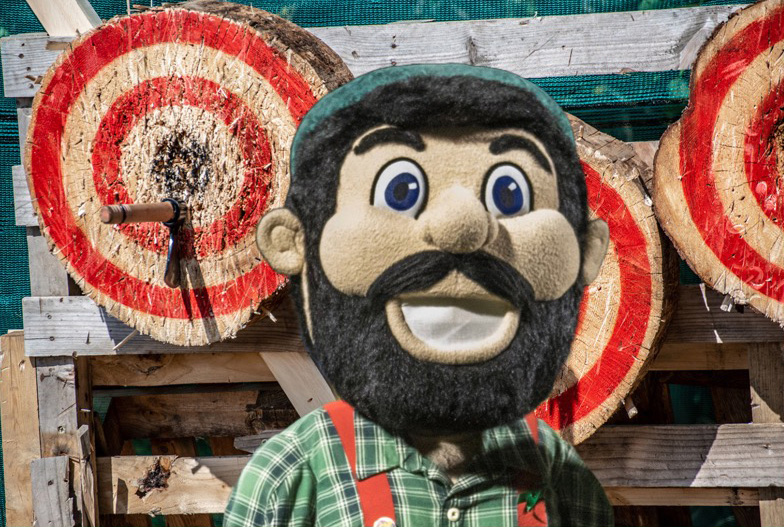
    When my friend used to go to the campus bookstore, she was always greeted by a lumberjack cutout that you could put your face in. This is where you too could’ve been a large bearded white man wielding an ax.

    Even in advertising, lumberjacks are portrayed asserting their dominance over nature with brute force.

    When I look at our mascot, I am reminded of the horrors committed by American settlers in Northern California. In my Native American Studies class, I learned about a book called Genocide in Northwestern California by Jack Norton. In the 1850s, white settlers saw the forests and valley floors as barriers to Manifest Destiny.

    There are pictures that depict how the invaders swaggered around mutilated tree trunks. In their final judgment, the white settlers had set fire to the entire forest in order to make sure that the redwoods were vanquished. In turn, Indigenous populations saw their homelands turn to ruins.

    I do not think an icon with such a checkered past is very representative of the social equity and diversity that our departments wish to strive for. It is the manifestation of white, cisgendered, heterosexual and patriarchal values.

    The question still remains: what should our new mascot be, if not Lucky the Lumberjack? I think that we should consider rebranding ourselves as the Cal Poly Humboldt Bigfoots.

    If a tree falls down in the forest and nobody is around to hear it— it must be Bigfoot! He is an anomaly that simply cannot be contained. He thrives by hiding in the foliage and greenery of his environment. Bigfoot could come to represent our local community’s stewardship of the environment.

    Whether you’re a skeptic or believer (or perhaps somewhere in between), you cannot deny the impact that the mighty Sasquatch has left around the world. Graduating as Cal Poly Humboldt Bigfoots could mean leaving nothing but footprints in our wake instead of taking from others.

  • Dear Mr. Putin

    by Cheyenne Wise

    In March 2020, Gal Gadot released the infamous “Imagine” video on her Instagram page, an asinine attempt to convey solidarity with a world being ravaged by COVID-19. The rich and famous banded together to imagine a world with “no possessions” while people around the country suffered a social, health and economic crisis wasn’t what the world needed at the time.

    The whole thing was cringy and overall tone-deaf. Step aside, Gal Gadot, because a new savior is here to stop the Ukraine crisis. Actress AnnaLynne McCord, self-proclaimed human rights activist and anti-human trafficking ambassador, released a slam poem video in an attempt to make Russian President Vladimir Putin stop and feel the love. McCord’s over 2-minute long video implies she might have been able to change the Russian leader had she had been his mother.

    Don’t worry Ukraine and everyone else, another white American has once again stepped up to the plate to put a stop to this devastation.

    “Dear President Vladimir Putin: I’m so sorry that I was not your mother. If I was your mother, you would have been so loved,” chanted McCord.

    Putin should be on his knees sobbing at the realization that all he needed was love, right? McCord continued, lamenting that if she was his mother, she would have died to make him warm, to protect him from the unjust, violence, terror, and uncertainty, and to “give you life.”

    If you aren’t convinced that American influencers can save the day, you need to look again. John ‘You Can’t See Me!’ Cena tweeted out, “If I could somehow summon the powers of a real life #Peacemaker I think this would be a great time to do so.” Cena wished upon a star that his DC character Peacemaker was real so he can help, making sure to tag the marketing account for the show.

    All that’s missing from this A-Team is our girl Kendall Jenner with her can of Pepsi to take the front lines.

    Watching the atrocities in Ukraine unfold on top of dealing with the savior complex of these influencers is just disgusting. These influencers are so sincere in thinking that they are uplifting the masses, when in reality they are doing the absolute least. The last time a group of influencers gathered together and actually created change was in the 80s, when “We Are the World” raised millions of dollars in aid of Africa.

    The performative activism of celebrities during these times is unneeded and repugnant. To them I say: keep your slam poetry and songs to yourself. The world doesn’t need cheering up, especially from people like you.

  • I am a queer Christian, not an oxymoron

    I am a queer Christian, not an oxymoron

    by Matthew Taylor

    My entire existence is a tightrope balancing act between two facets of myself, that are constantly told they cannot exist together. Yet these facets can not be divided from me nor from one another. I am queer. I’m a person of faith. I am a trans and bisexual Christian.

    As Lent rolls in, I often find myself having to reflect upon these two identities. I take this time of the year to re-orientate myself back to my spiritual core. It is a beautiful process that reminds me of my humanity and the love I receive everyday from my Creator, but it is a side that I often feel compelled to hide, just as I am often compelled to hide my queer side from the greater Christian community.

    It is a fine line. I’m constantly aware of my fellow queer peers’ religious trauma, something I’d never want to make them relive. It hurts, though, to know that my faith comes with so many automatic assumptions of my character.

    Some have ideas that I’m conservative in my politics or that I don’t affirm my own queer identity. I am neither of those, and neither are many other queer people of faith. So, I stay silent. Yet in this very silence I only continue to feed into the false narrative that all religious persons or persons of faith are non-affirming of queer identities, bigoted, or close minded.

    Growing up, I was extremely lucky to live in both a queer affirming and religious household. I was raised predominantly in a Christian denomination that had already begun to take the steps towards full LGBT+ inclusion by the time I was born.

    It is a huge privilege, one I constantly try to stay aware of. I also believe it is a statement of hope. I am living proof that one can grow up as Christian, as a religious person, and still fully affirm their own queer existence. It is because of this very truth that I continue to live knowing these two identities are not mutually exclusive.

    I don’t wish to proselytize or to convert any person to my own faith, nor to any religion in general. There is truth, validity and importance to be found in both agnosticism and atheism. All I wish is to break the narrative that all people of faith are non-affirming.

    This perception erases the amazing work that queer people of faith all around the world are doing to create rightful places for us in these sacred spaces. More frightfully, it gives more power to those of faith who may wish to silence us, oppress us or destroy us both within these religious spaces and out of them.

    I want to extend my love and validation to any fellow LGBT+ people out there who also desire to stay in or are currently part of any certain religion, whether you be Christian, Jewish, Muslim or belong to any other faith. There are people out there just like you, and there are resources out there that can allow you to flourish fully and wholly as you are.

    This Lent, as many like me take this moment to pause and self-reflect on ourselves, I hope to show through my actions and pure existence that religion and spiritual expression are as much a right to LGBT+ people as they are to others.

  • Men need to stop talking to me

    Men need to stop talking to me

    by Sophia Escudero

    Today, I was sitting at the bus stop with a significantly more male friend of mine when a man I had never seen before approached us and asked when the next northbound bus was coming. My friend didn’t know, but I pulled up the bus schedule on my phone and informed the stranger that he had another three minutes to wait.

    “Thank you,” the man said with a smile. “You know, I thought you were a huge bitch at first, but you’re actually really nice.”

    I am not a woman, but by accident of my birth, I am often perceived as such. I have experienced the casual misogyny and willingness of strange men to just say things that probably didn’t need to be said since at least the age of ten, when a man first leaned out of a car window and shouted the specifics of what he would like to do to me, and while he’s at it, to the small dog I was walking, in my general direction.

    I speak with experience when I say that men on the street will really say the most bizarre things and go about their day, while the person they shouted at just has to live with the garbage that they spewed without a second thought.

    What really gets me about this man specifically was his sincerity. He truly believed that he was paying me a compliment, and likely went about the rest of his day believing he’d had a pleasant talk at the bus stop.

    It is important to note that I had never seen this man before in my life. What was it that convinced him so thoroughly that I, a stranger at the bus stop minding my own business, was indeed a massive bitch? Was it my short, butchy hairstyle? My Captain Marvel t-shirt? The fact that my friend and I had just been discussing sexism in women’s sports when he got here? If so, why was I the only bitch? Shouldn’t the person agreeing with me be a bitch as well, if that was the case? While I know that when a man is a bitch he is weak and when a woman is a bitch she is a rabid animal, wouldn’t he be a bitch (masculine, derogatory) for cowing to my radical feminist notion that women should not be forced to expose more skin than they are comfortable with, even though he had brought that point up in the first place? Although, the man only told me, not him, that I was really nice and not a huge bitch. Perhaps he meant to suggest through omission that my friend was the huge bitch here?

    I wish I had said, “Oh no, I actually am a massive bitch. You were right the first time.”

    I am a feminist and a lesbian, and if this man’s general vibe was an accurate reflection of who he is, then I imagine both of those words are threats to him. Yet, if I had declared myself a bitch, would he have realized that maybe calling a stranger a bitch for no clear reason is a super weird thing to do? Or would he have laughed at my attempt to assert myself, before going home and complaining online that biologically, women can’t be funny?

    I refer to myself using all kinds of things people have hurled at me —dyke, bitch, man-hater and the like— and have reached the point where I embrace them. I’m a bitchy man-hating dyke on purpose, and I’m proud of it.

    I can certainly reclaim this for myself, but would this man on the street even register that I was subverting the patriarchy by refusing his words their intent? Would he care? Is this even about me?

    Unfortunately, I was too stunned by the fact that a person would just walk up to a stranger, congratulate them on not being as bitchy as anticipated, and think they did something to express all this in the three minutes before his bus got here. I could only say, “…okay?” in a voice I hope adequately expressed how much he was embarrassing himself, and resumed talking with my friend where we had left the conversation.To all the men who are thinking of saying something to a stranger in public, I say only this— don’t. In fact, don’t say anything to anyone, no matter where you are. Just don’t talk. To anyone. Please shut up forever, thank you.