The Lumberjack


Students Serving The Cal Poly Humboldt Campus and Community Since 1929

Tag: Arcata

  • Community honors migrations on walk through Goudi’ni

    Community honors migrations on walk through Goudi’ni

    by Steffi Puerto

    Bright colors, dance, laughter, singing, and conversation filled up the entire day in Goudi’ni (known as Arcata, California). Community organizations and members walked together from Arcata Playhouse to Carson Park to participate in the second annual Migration Day event on Oct. 1. By following the rhythm of the foot, the community was able to create solidarity and connections with one another by walking together. 

    The Migration Day event is a procession that celebrates the communities and cultures that reside in Goudi’ni. There were conversations and performances including theater movement, poetry, puppets and visual arts. 

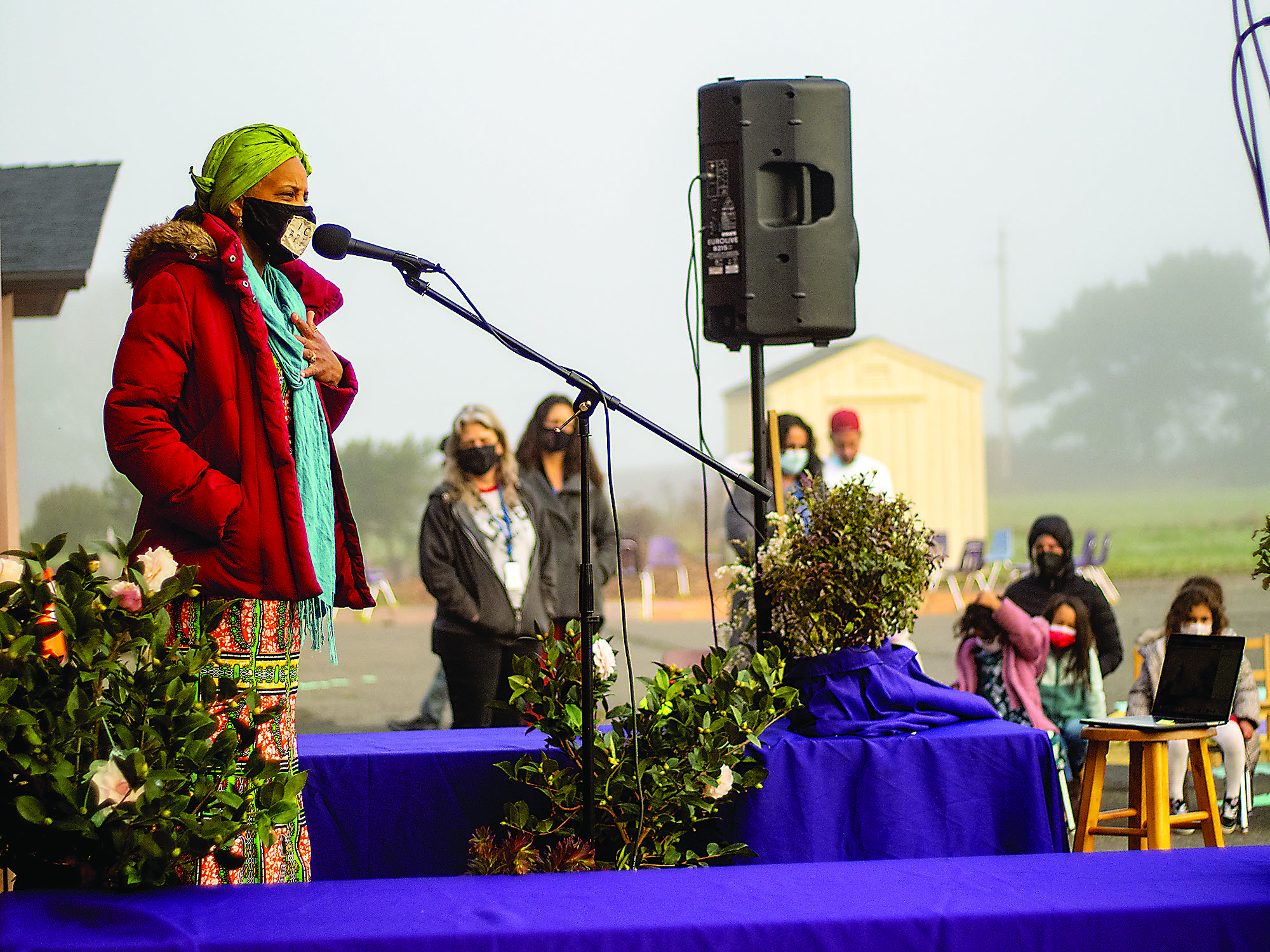
    Laura Muñoz, Round Story Coordinator and Enlace Communitaria for Arcata Playhouse was the main organizer of “Migrations.”  She welcomed everyone to the event, speaking in English and Spanish. Muñoz explained the significance of celebrating migration.

    “Migrations have happened since the beginning of the earth, and they will continue to happen,” Muñoz said. “It’s a dynamic that happens in the natural world, now we as humans know it holds this social, political and economical component, all of this celebrates migrations.” 

    There were seven procession locations and stops along the journey. At each location, walkers and community members engaged in different activities and performances that encompassed acts of migration in a localized fashion.

    The first location was at 8th Street Mural, where the Playhouse Movement Choir performed in theatrics. They made various animal noises as they moved with cutouts of fish, some dressed as crows, and others wearing wings of butterflies. These are all migratory species of animals that travel long distances in their natural life cycle. 

    The next location was at El Jardin Santuario. Here, Centro del Pueblo organizers gave walkers cempasúchil, an Aztec marigold significant in an Indigenous culture that is traditionally used to honor the dead. In this case, it was used to honor migrants who have lost their lives while crossing borders. 

    At G Street under the Cal Poly Humboldt Bridge, mobile musicians Ponies of Harmony carried their instruments on their bikes, singing songs as walkers listened and rested in the shade. 

    At Cahill Park, members of Humboldt Asian, Pacific Islanders in Solidarity (HAPI) guided walkers through the history of the Eureka Chinese Exclusion Act of 1885. These stories also embraced the resistance, resilience, and return of Chinese migrants despite the racism they faced during their migration.

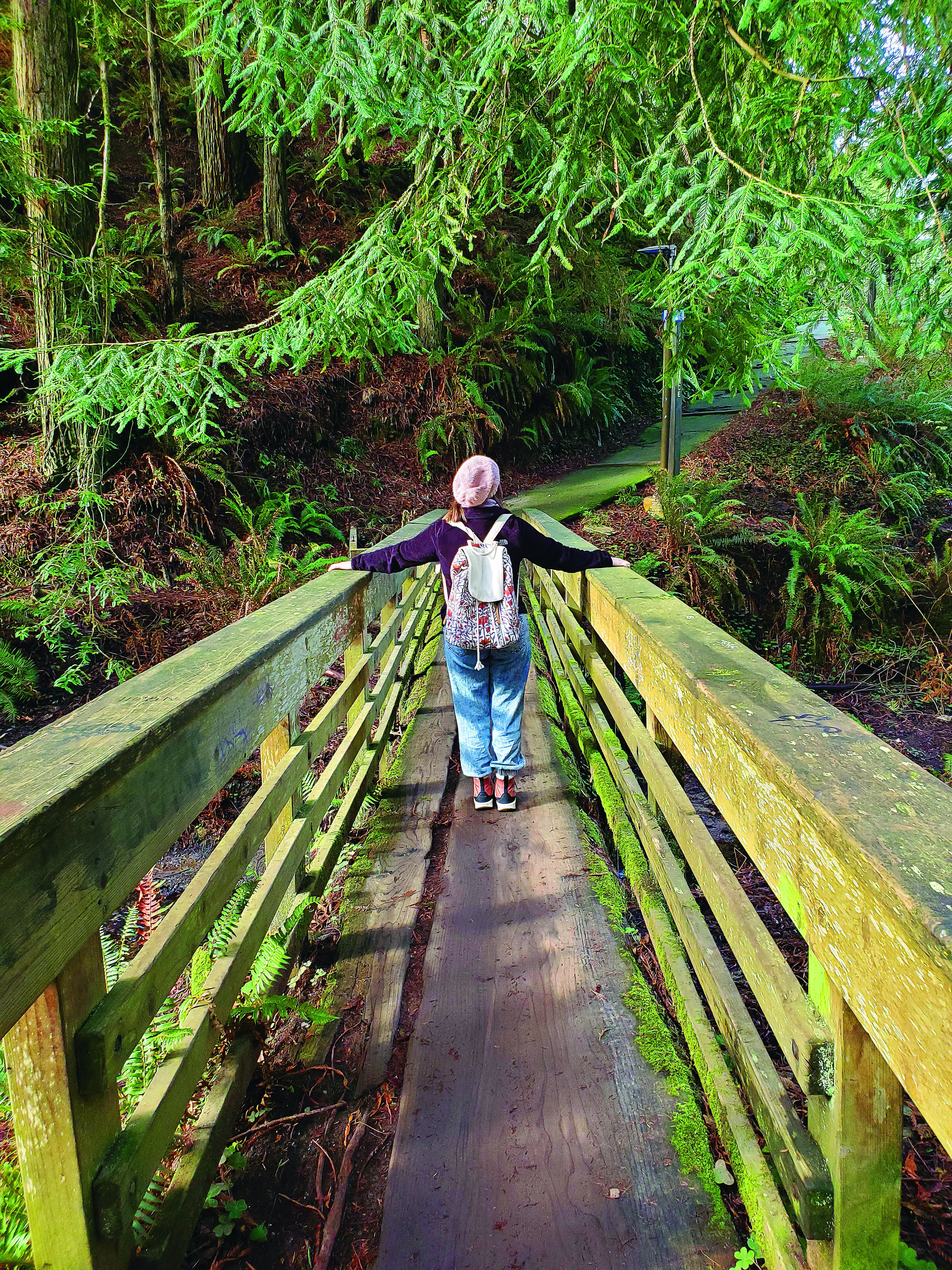
    Jones Creek Affirmation Bridge is where Caroline Griffith from the Northcoast Environmental Center welcomed everyone to walk in a “V” formation, to migrate together and enjoy the ambiance and ecological system of our environment. Like many of the animals that inhabit that environment, they also migrate near and far. 

    Abelos Gaumot, a Tribal Forestry major at Cal Poly Humboldt and the president of the Indian Tribal & Educational Personnel Program, joined and participated in the march. He felt motivated to stay after he wandered into the event, and was welcomed by participants. 

    “Realizing that we’re all in this crazy life together, and that’s not a human perspective it’s also including the plants, animals, and the environment,” said Gaumot. 

    At Chevret-Vaissade Park, Julio Cesar-Tores Garcia sang to the audience as they gathered together in the grass. Marchers rested there before the long walk to the Potawot Health Village.

    This is where Yurok community outreach specialist Laura Woods shared a personal story of loss, growth, and acceptance. She invited the community of participants to write down their stories and tear them up after they were done. 

    “I hope people take away something useful that they can use to release things that don’t serve them or their higher good, so they can travel lighter,” Woods said. 

    The parade concluded with someone in a 12 foot tall, flower-crowned Mother Earth costume leading walkers across Carlson Park at Mad River Parkway, where they cheered and waved flags celebrating the beauty of their own small migration.
  • Take a Hike, why dontcha: A guide to the best hiking spots near Cal Poly Humboldt

    Take a Hike, why dontcha: A guide to the best hiking spots near Cal Poly Humboldt

    by Alina Ferguson

    Cal Poly Humboldt is famous for its forest and hiking. Arcata is centrally located between hills, forests and beaches, so there are a lot of options for anyone looking to backpack, camp or simply take a hike. 

    Maired Sardina, program coordinator for the Center Activities Recreation and Wellness Center on the CPH campus, has some tips and trips for aspiring hikers.

    The Arcata Community Forest is right here on campus. It is easily accessible for those without cars or any other mode of transportation. This hike is relatively low intensity, so it is not required to be a seasoned or skilled hiker. 

    This hike is also safest for beginners or anyone new to the area, as it is connected not only to campus, but to the town as well, so it is difficult to get lost. “There are so many options to get back into town” said Sardina.

    According to returning senior, seasoned hiker and R.A. Alexis Quiroz, the Community Forest is best for beginners because there are resources available close by.

    “If you get lost or injured and you dial 911, it connects you to the UPD instead of the Arcata Police because the forest is within the school boundary,” said Quiroz. 

    Last semester, Olivia Greenwood, an education major here at Cal Poly, said she spent practically every day in the Arcata Community Forest. 

    “I was hiking like everyday last semester, I would hit the trail at like 4pm and I went pretty deep into the forest,” claimed Greenwood, “Hiking during covid was pretty isolating but kind of nice, to be alone with nature.” 

    A hidden gem that is really only ever traveled by locals, a part two to this hike, is called Beith Creek Loop. While not on the campus itself, it is a short distance away, within the Arcata main town. 

    A 10 minute drive away from the CPH campus, the Ma-Le’l Dunes are a historically significant hiking spot. These dunes lead to the waterfront. This route is the site of many historical events, which mostly occurred during the late 1990s and early 2000s, as protesters lived in trees. To find more information, the Humboldt Nature center has hikes available. 

    The Coastal Nature Center has a visitor center with plaques listing facts about the dunes and the nature around the dunes. 

    “That’s one of my favorite areas” said Sardina, “It’s gorgeous there” 

    Headwaters Forest Reserve is a progressive hike. The first mile is all paved, so it is most popular for casual strolls, skateboarding or dog walking. However, the next four miles are all trail, so the intensity picks up. 

    “You get to choose your own adventure,” said Sardina. “You can choose, I want to go a mile on the pavement, I want to go a mile on the trail, or you can choose to do all ten miles, 5 miles in and 5 miles out” 

    Fern Canyon is one of the busiest and most famous hiking spots in Humboldt. So much so that a permit is now required to get in until October 1st. The canyon itself is a flat hike, with fallen trees and trails partially submerged underwater. Hikers can park directly next to the canyon or hike in from the Prairie Creek Visitor Center, about a 11 mile round trip according to the National Park Service.  

    This hike is much further from campus, about a 40 minute drive. However, the hike leads to a beach called Gold Bluff, where camping out for the night is an option. 

    Prairie Creek Redwood National Park is home to the tallest trees in the world. To see these giants, it takes 45 minutes from campus, if not by car, then by bus as all Cal Poly Students can use their student IDs for free transport.  This is the spot for anyone looking to camp, or go backpacking for a day. Backcountry campsites are very common to find, a couple of the biggest being 44th Camp and Elon Camp. 

    “I couldn’t recommend it more,” Sardina said.

  • Students show out in solidarity for El Salvador

    Students show out in solidarity for El Salvador

    by Alana Hackman and Carlos Pedraza

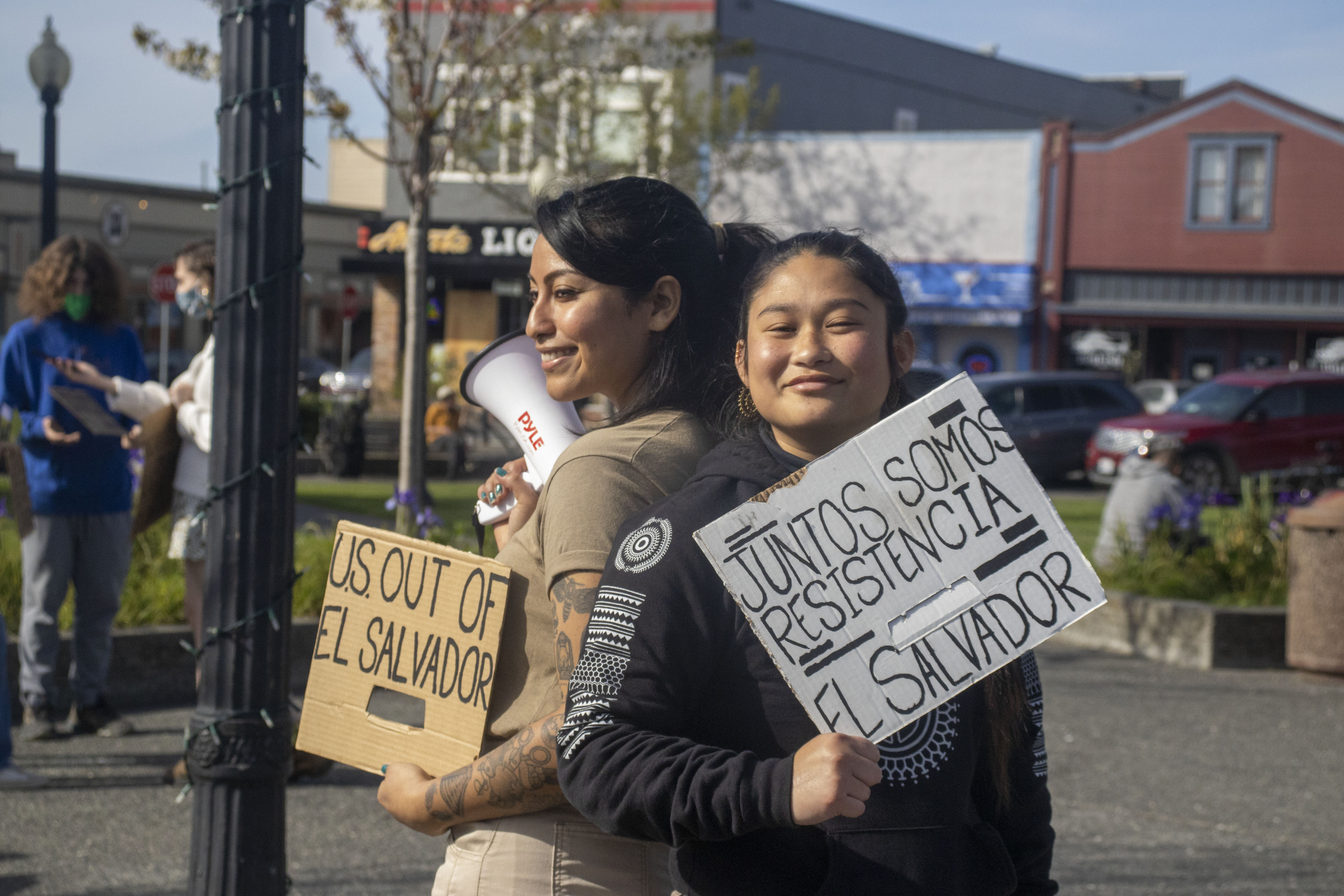
    Cal Poly Humboldt students and Arcata residents gathered around the plaza Thursday, April 7 in solidarity with El Salvador. The event was led by Klara Hernandez, a senior environmental studies student at Cal Poly Humboldt. Hernandez organized the event through her senior project and organization Eko Social Justice. Hernandez was also joined by Centro de Pueblo, an immigrant rights organization for Southern Indigenous communities also joined the event.

    Photo by Carlos Pedraza | Gathered crowd looks on during the speech at the Arcata Plaza on April 7.
    Photo by Carlos Pedraza | Gathered crowd looks on during the speech at the Arcata Plaza on April 7.

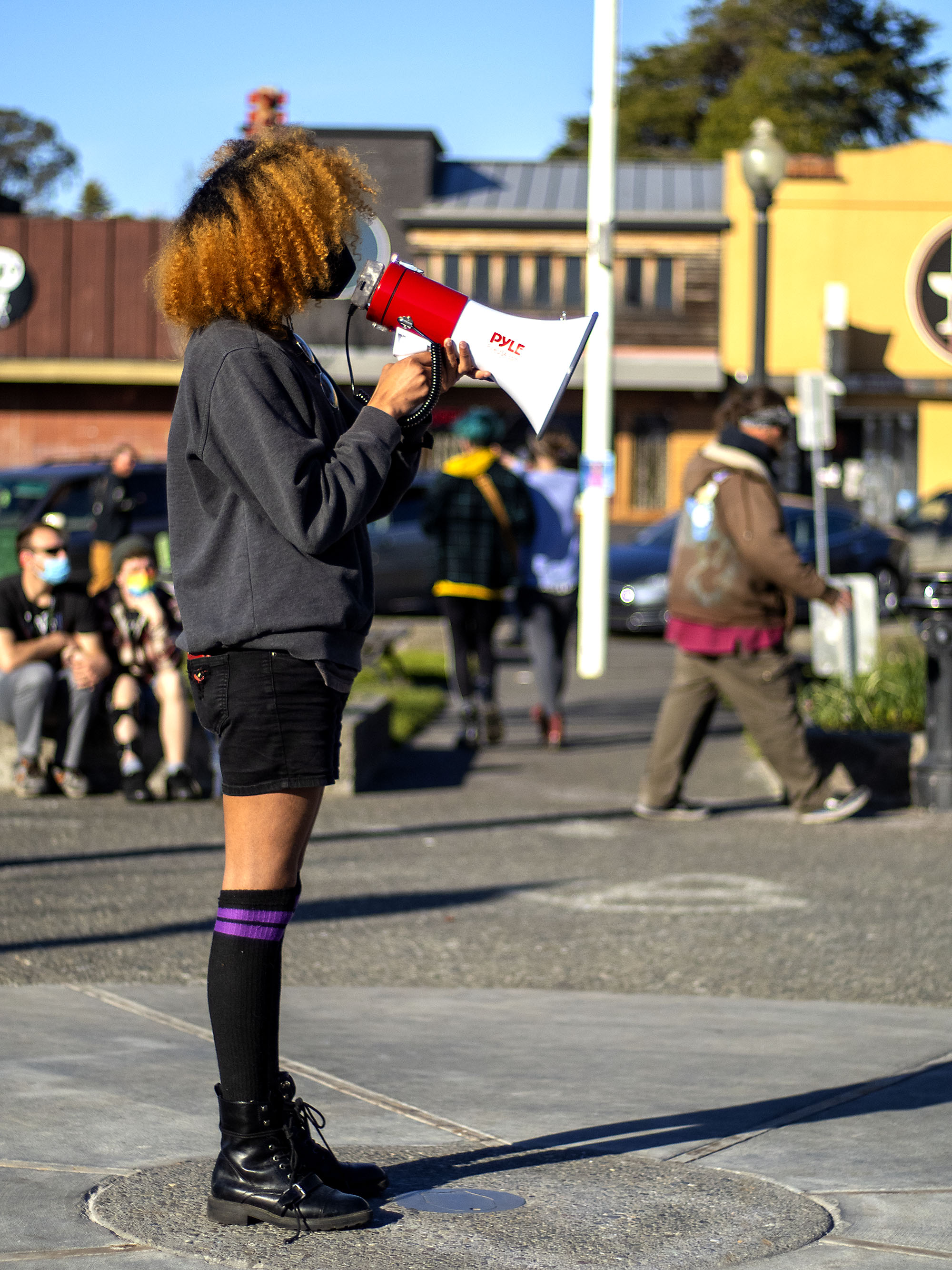
    The protest began at 4 p.m. and carried on into the evening around 6 p.m. Hernandez walked to the center of the plaza megaphone in hand and began her speech with a land acknowledgment and thoughtful address to her family who fled to the U.S. from El Salvador. Hernandez called for solidarity with the people of El Salvador and pointed out problems of racial discrimination against Indigenous and Afro-Salvadorian citizens as they are forced to adopt Spanish culture.

    Hernandez also addressed abortion laws in El Salvador and the rising violence and femicide rates in the country.

    “They imprison [women] even if it’s not your fault the baby didn’t make it,” Hernandez said.

    She continued to speak against many problems, including corporations privatizing and contaminating water, Bitcoin being adopted as their main currency is hurting those who don’t have access to it, and the LGBTQ+ community facing discrimination and violence in the country.

    An attendee of the protest was Alice Turk who heard of the protest from social media. The women’s rights issues spoke to her most and she feels people need to stand in solidarity with women everywhere.

    “I think the fact it’s a crime to have [an] abortion is something that needs to change, it’s a problem that is happening all over the place,” Turk said.

    Cal Poly Humboldt students Ben Cross and Evina Romero came out to the event also after being sent the social media post by friend and Cal Poly Humboldt psychology major Cheyanne Elam. Elam found out about the event through a class and was attending to learn more about what she can do for the people of El Salvador. All agreed it was important to use their privilege to be at this event and show their support for the citizens of El Salvador.

    “Immigrants from El Salvador and all over South America are being turned away at our borders, and the U.S. really has the ability to rectify these things,” said Cross.

    Photo by Carlos Pedraza | Klara Hernandez gives her speech to crowd while standing in the center of the plaza at the Arcata Plaza on April 7.

    Hernandez ended her initial speech with a call to action toward environmental justice and immigration rights for all. The crowd wavered cheers and screams from around the plaza flashing cardboard signs reading, “U.S. out of El Salvador,” “Women’s rights in El Salvador,” and “Indigenous sovereignty in El Salvador.” The signs were written in both English and Spanish. Hernandez mentioned her organization, Eko Social Justice, and that this event is an effort to use her voice for good and represent her home country of El Salvador in Humboldt County before her graduation and departure to Los Angeles this May.

    “The [Salvadorian] community is so tiny here that these things don’t get addressed. It’s like we’re invisible in this area so I wanna speak it out,” Hernandez said.

    Hernandez will be holding an art show at Brainwash Thrift Thursday, April 21 in solidarity with El Salvador. The event will be held from 2 p.m. to 6 p.m. and will include Hernandez’s own photography and art.

  • Jimmy Baca brings poetry to the people with Project Rebound

    Jimmy Baca brings poetry to the people with Project Rebound

    By Abraham Navarro

    A group of formerly incarcerated students picked up their ultra-wide pizza slabs and towering salad mounds from the counter at the Arcata Pizza Deli. They dragged two tables together, commandeering chairs from the surrounding tables and gathered for the feast. Each of the Project Rebound members were hungry for conversation with the famous award-winning Chicano poet, memoirist and member of the family Jimmy Santiago Baca.

    One of them asks him across the table as he takes a sip of his drink, “So, what’s the pale white monster that’s coming up to get you, Jimmy?”

    They were asking about an excerpt he read from a story where he steps out over frigid ice as it splinters beneath his weight to prove his love for his wife, Stacy.

    “Ah when you’re a kid you look deep in the water under the ice, you imagine all sorts of things,” Baca says.

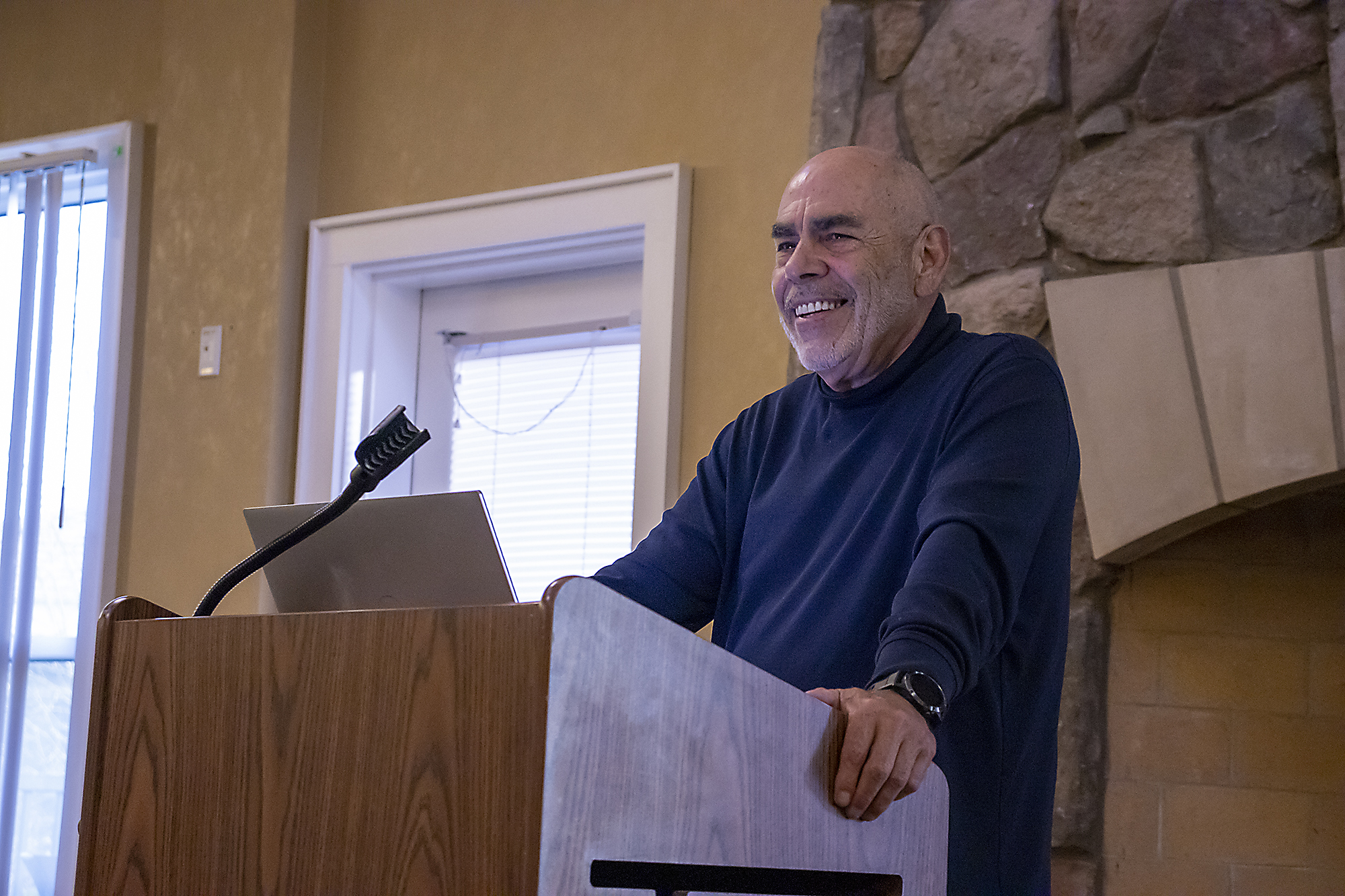
    Photo by Abraham Navarro | Jimmy Santiago Baca, Chicano Poet, speaks to Cal Poly Humboldt Project Rebound in the Great Hall on March 23.

    Baca has a deep raspy voice, and he lights up when he talks to the student. He has a shaved head, furrowed brow with welcoming brown eyes and a warm complexion. Although he’s bundled up against the Humboldt evening chill in a black turtleneck and a blue down jacket, he feels cozy and right at home amongst the formerly incarcerated and system-impacted students from Cal Poly Humboldt’s chapter of Project Rebound.

    Earlier in the evening in the Great Hall above the College Creek Marketplace he read exclusive excerpts from some of his unpublished work and other poems and stories of his during the Project Rebound’s third annual Reentry Forum.

    Project Rebound is a program for formerly incarcerated and system impacted students at Cal Poly Humboldt. According to their website they aim to empower individuals convicted of a crime in a county, state, or federal jurisdiction who have clearly expressed their desire and readiness to earn a degree at Humboldt.

    Baca has been to previous reentry forums, even attending via Zoom during the pandemic restrictions to show his support for Project Rebound and getting to know the members like Tammy Phrakonkham, 30, a Cal Poly Humboldt Project Rebound member and a returning graduate student majoring in geology in the fall.

    When Phrakonkham heard Baca read his stories and share his wisdom, she felt as though her experiences being formerly incarcerated were validated. Her family comes from Laos as refugees to the United States. Growing up in impoverished conditions, she remembers her brothers and uncles all working in gangs, and she followed suit. Phrakonkham was incarcerated for stealing cars and trafficking ecstasy.

    “It was all I knew,” she said. “When I listen to Jimmy, I feel like I’m not the only one.”

    Despite years of isolation due to the pandemic, Baca was happy to make an appearance in Humboldt to visit his friends at Project Rebound, the first event he said he has been to since COVID-19 caused the shift to online events.

    “You all have become like my adopted family,” he said to them. “If it wasn’t Project Rebound I wouldn’t have even gotten on that flight!”

    Baca was adamant that poetry was for the people, those who suffer and work, play, cry, feel, live and die; poetry was not something that could be hoarded by the wealthy, kept from the poor. It was created by the people and it should be given back to the people. By sharing his work with Project Rebound, Baca feels like he has done that, and he has made a family out of them in the process.

  • Humboldt Hot Air takes over local radio airwaves

    by Eddie Carpenter

    Nearly four years ago, Cal Poly Humboldt decided to abandon local-based programming for KHSU. This heartbreaking decision left local radio personalities with no creative outlet to broadcast from. Recently, some of those same people were able to redeem themselves on a radio station known as Humboldt Hot Air. In its humble beginnings, the station began as a simple recording studio. Any content that was created would be sent to a community-based radio station known as KZZH. In October 2021, station manager Neroli Devaney had set up a live streaming service, which gave rise to an underdog known as Humboldt Hot Air.

    “We are an online internet radio station,” Devaney said. “We are based in the Arcata Playhouse. We are very eclectic and diverse in our programming. We have talk shows [and] lots of music shows. We program every other day of the week except for Tuesdays.”

    Devaney made it clear that she was not the one who founded Humboldt Hot Air. However, the 24-year-old manager also shared what inspired her to take on this role.

    “I did four years of radio at UC Santa Cruz. When I was there, I worked at KZSC, which is the radio station on campus there,” Devaney said. “When I was there, I did a bunch of different stuff, I was also a hip-hop director through a bunch of events, I just found myself really into radio and really passionate about it. I am from Arcata and when I graduated from UC Santa Cruz, I came back to Arcata. When I was in high school, I used to volunteer with the Arcata Playhouse with their teen program, which is called Apprentice Entertainment. Jackie Dandeneau, who is executive director of the Arcata Playhouse reached out to me. [She] said that she started this project called Humboldt Hot Air. They were recording audio and they had this goal of eventually having a live stream…She asked if I wanted to get involved and I said yes. [I] thought it sounded really fun.”

    Devaney also explained how the former KHSU audience had become her most avid listeners.

    “When we started a lot of people felt that there was this need for community radio in Arcata. A lot of the DJs saw that we were doing Humboldt Hot Air and I started getting a couple old KHSU DJs,” Devaney said.

    “We’re still kind of attracting that crowd, which has been really awesome, especially for our own publicity,” Devaney said. “KHSU had this huge fanbase in the community, so to be able to bring DJs back and have them do their shows again– a lot of the community has had a positive response to that, those are our most popular shows, people will be like, ‘oh my god I listened to that show for thirty years and it’s back, that’s so amazing! It’s the same DJ.’ It’s just been really fun.”

    Humboldt Hot Air strives to one day become an FM station.

  • Goth Night at Richard’s Goat

    Goth Night at Richard’s Goat

    by Cherish Fulcher

    Photo by Lexi Rangel | (left to right) Lalo Rivera, Gigi Salazar, Chris Servi, and Josie Licavoli pose for a photo at Goth Night at Richard’s Goat on Feb 25.

    On Friday, Feb. 25, Richards’ Goat Tavern & Tea Room hosted its first ever Goth Night, created by recent Cal Poly Humboldt graduate Jamie Cocking. The event was a tribute to the Goth subculture, which originated in the United Kingdom in the early 1980s. The subculture is open ended, yet is heavily saturated with darker tone aesthetics and music.

    “I think goth subculture is all about expressing yourself in your truest form,” Cocking said. “Since I’ve lived here and have turned 21, I haven’t found any clubs or events with the music that I love to dance to, so I just decided to do it myself.”

    Being a small town, Arcata is not well-known for its nightlife. However, contributions to the scene, such as Goth Night, keep it going.

    “I just wanted to create a space where people could dress up as much as they wanted and not feel like they are sticking out like a sore thumb,” Cocking said. “Because for me, I mean everyday is Halloween.”

    Richards Goat will be hosting another Goth Night on April 9.

  • Cyclists fill streets in honor of late Arcata woman

    Cyclists fill streets in honor of late Arcata woman

    by Liam Gwynn

    Critical Mass cyclists took over the streets of downtown Arcata on Friday night, carrying flowers to the scene of a tragic accident that took the life of a mother. The bike ride was a memorial and demonstration to raise awareness for the problems facing cyclists and the dangers of unsafe driving.

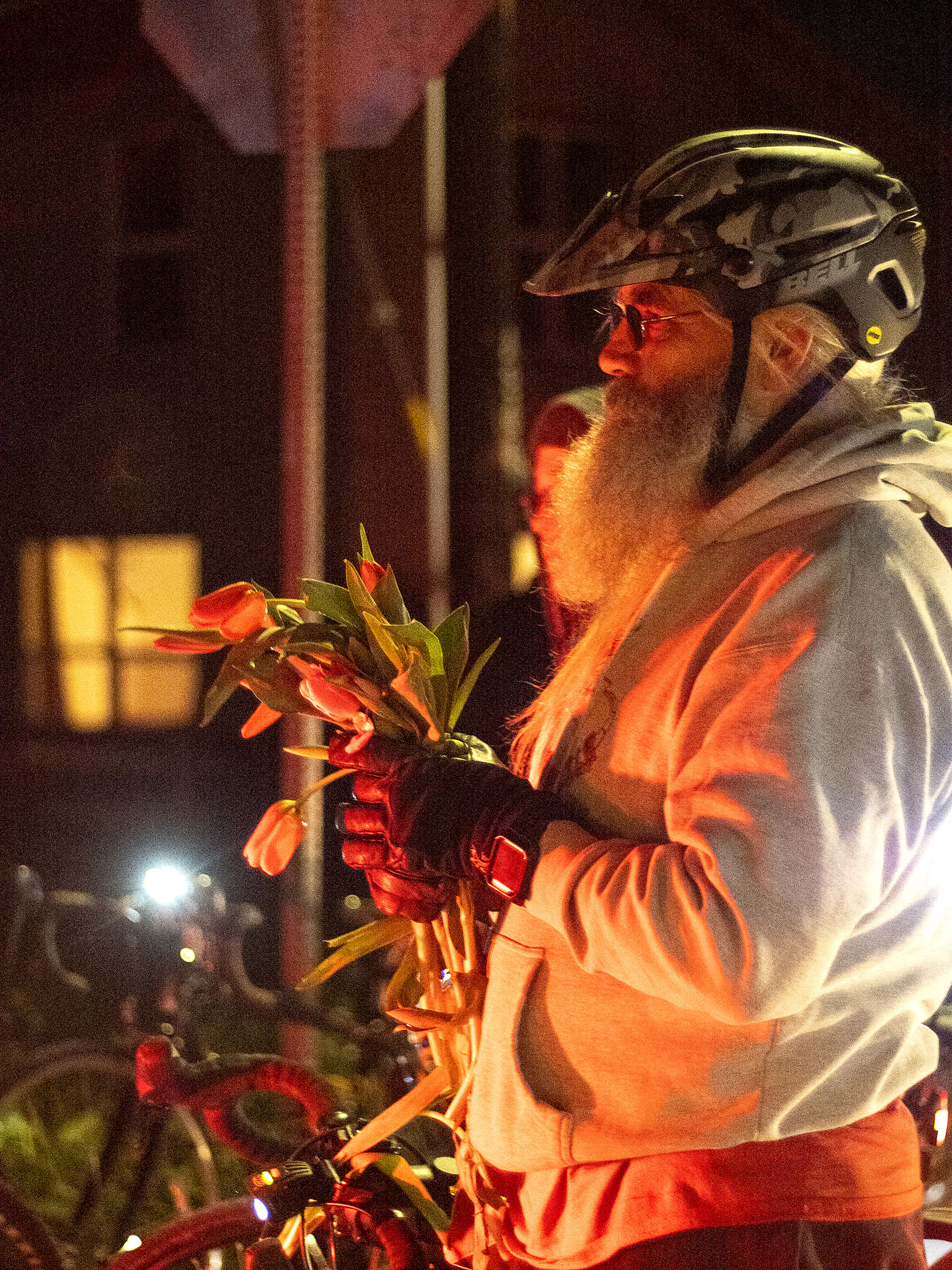
    Photo by Morgan Hancock | on Friday Feb. 25 Critical Mass cyclists left flowers for the late Jennifer Garcia who was struck by a car in January near the intersection of St. Louis Road and Janes Creek Drive in Arcata, California.

    This January, a 40-year-old mother was killed in Arcata after attempting to cross a crosswalk with her child. In a heroic last act, she pushed the stroller out of the way, saving the child. The local branch of Critical Mass hosted Friday’s bike ride to memorialize her life and put pressure on the city to make infrastructure changes with pedestrian safety at the focus.

    The group met in the Arcata Plaza where organizers handed out flowers to bring to the locations of two accidents involving pedestrians getting hit by cars. The peaceful demonstration took up the streets and blocked traffic on K st, Spear Ave, and finally the crosswalk of the fatal accident on St. Louis road. The group ended the night by regrouping at the Plaza. They then took turns telling stories of dangerous encounters they had with cars while cycling.

    Critical Mass is a peaceful international movement with a focus on promoting ecologically-friendly transportation and raising awareness for safe driving. Jonathan Maiullo is the lead organizer for the Arcata branch and explained how Friday night differed from the usual rides.

    “It’s important that the city be aware that we are paying attention and when a cyclist is killed or injured, something needs to change,” said Maiullo.

    Photo by Morgan Hancock | Young cyclist Felix O’donnell, practices safety with lights at the Critical Mass group bike ride on Friday, Feb. 25

    He explained how this issue requires local development that gives more freedom and safety to cyclists.

    “In the city, we just want greater visibility and that would come with having clear and separated bike lanes,” said Maiullo.

    Carisse Geronimo is the social media manager as well as an organizer for Critical Mass Arcata. According to Geronimo, the biggest problem facing the cycling community is the interactions between people driving cars and cyclists on the road.

    Johnny Newsome said he put flowers in his vest during the Critical Mass bike ride that took place in Arcata on Feb. 25 to remember the woman who died on the crosswalk.

    “The whole interface between cars and pedestrians and cyclists’ safety is a big problem. I think our structure is all backward and we shouldn’t feel like we have to yield to cars,” Geronimo said.

    Critical Mass hosts monthly bike rides in the plaza, however, many new faces showed up for the first time in order to honor the mother who was killed, including community member Johnny Newsome. He was drawn to the event after he heard where the accident took place.

    “I go through that intersection where that lady was killed all the time, and I got to admit I drive through there too fast sometimes myself,” Newsome said. “And you know it needs to be addressed. Some change has to be made on the street.”

    Critical Mass meets in the Arcata Plaza on the last Friday of every month at 6 p.m.

  • Community speaks on Black History Month

    Community speaks on Black History Month

    by Ollie Hancock

    35 to 40 community members gathered in the Arcata Plaza to speak about Black History Month on Feb. 17. A flyer, created by community organizer and artist Nikki Valencia, urged people to come out and show that their allyship wasn’t seasonal or conditional. When Valencia spoke in the plaza, they noted they did not feel that support.

    “This is the perfect time to center Black marginalized folks, but that energy is not here,” Valencia said. “Black History Month is about more than educating. It means nothing if you know Black people are struggling and do nothing about it.”

    Photo by Morgan Hancock | Steve Bell leads protesters in a chant at the Black History Month protest on the Arcata Plaza Feb. 17.

    Marlon Andrew Jones II, who works at Cal Poly Humboldt, spoke at the gathering. He said the voices supporting Black communities are never loud enough. Jones said that students, faculty, and admin need to listen to their communities if they want to support Black people.

    “If you’re a white person and you’re listening to this and it’s making you uncomfortable, it’s supposed to,” Jones said. “You’re not supposed to be comfortable, because there is a community that has lived in discomfort for so long.”

    In Jones’ speech, he urged empathy from white members of the community. The lived experience of Black Americans can be traumatic. Jones believes that white people need to do more than be accountable, they need to love their Black neighbors.

    “Love is an action, and that’s what the Black community needs,” Jones said. “We need people to love us enough to take action and make a difference. Sometimes you don’t know what someone is going through, but you can hold their hand through it.”

    Photo by Morgan Hancock | Raquel Bell speaks about the importance of valuing Black women at the Black History Month protest held on Feb. 17 in the Arcata, Ca. plaza.

    Raquel Bell is a local student who spoke on the importance of valuing Black women. Black women exist at intersections of systemic struggles and deserve love and support. Bell said that when Black women are uplifted, so is the society around them.

    “If you want change, first you need to love the Black woman,” Bell said. “Once her needs are met, you know everyone’s needs are met. Once you love a Black woman you change the world. The Black woman is strong, she is beautiful, she is me.”

  • There are no safe options for restaurants during the pandemic

    by Ian Vargas

    While there was only a lockdown for a short period of time in 2020, a lot of restaurants weren’t open for indoor seating. Businesses typically ended up dropping employees they didn’t need. They also had to adjust to significantly less income, and many closed down as a result.

    That’s obviously bad for the restaurant and the people who got fired, but the alternative is that both the employees and customers would have died of COVID-19.

    With the advent of the vaccine most of that has changed; most restaurants are open for both indoor and outdoor seating. They frequently stress social distancing and wearing a mask on your way in, but people are rarely seen sitting very far apart. Cal Poly Humboldt’s dining options have followed the same trajectory. As soon as people could get vaccinated, everything went back to mostly normal.

    Like many students, I’m very poor. When I came up to Humboldt and started looking for work, I did as many do and went to one of the restaurants nearby. This was when everything was still take out only. Businesses had been losing employees like crazy, so getting into something wasn’t too hard.

    Working in any place that has a lot of people coming in and out seems risky, but thankfully I did not typically have to see any customers. I could at least remain mostly isolated, aside from my coworkers. Once people could get vaccinated and everyone started reopening for indoor seating, that changed.

    Now I’m in close contact with unmasked and dubiously vaccinated customers all the time, my job feels very unsafe. Vaccines have given people a lot of inadvisable confidence about their safety. Vaccinated people can still get sick very easily, and even when you don’t get sick there is a danger of spreading disease with an asymptomatic infection.

    Restaurants are particularly dangerous in this regard since there isn’t any way to eat and keep your mask on. Food going down doesn’t push the germs back into your lungs. Walking in with a mask just to take it off as soon as you sit down doesn’t sound like an effective way of limiting the spread of an airborne disease.

    I don’t think restaurants are doing anything wrong, everyone has to get paid somehow after all. Rather, I think that they’re in a position where there isn’t any good options for a response. The initial 2020 lockdown should have been longer and more consistent, and everyone should have received monthly stimulus checks.

    Unfortunately that didn’t happen, which places people in the unfortunate position of risking whatever new strain comes around. At some point, one of them is going to start getting people way sicker than before and there’s no way we’re going to be able to deal with it. More places will close for good and more people will lose their jobs or their health.

  • The moving pieces under Humboldt

    by Carlos Pedraza

    Cal Poly Humboldt sits on top of a very seismically active part of the world known as a the Cascadia subduction zone. This area is composed of three tectonic plates under the ocean off of the Pacific coast.

    The Juan de Fuca, Explorer, and Gorda plates are subducting beneath the continental North American Plate, where the Cal Poly Humboldt campus is located.

    As the oceanic plates push against the continental plate, the friction created leads to deformation and faulting.

    “We live on that boundary where this is taking place, which leads to frequent earthquake activity,” said Cal Poly Humboldt geology professor Amanda Admire.

    In addition to the deformation from the Cascadia subduction zone, the Humboldt region is also influenced by the movement along the San Andreas Fault to the south. Humboldt stands on top of an intersection of three different plates pushing against each other.

    The plates themselves move very slowly, only a few centimeters every year. However, they still generate friction as they move against each other. This is the energy released during an earthquake and tsunami.

    Graphic by Carlos Pedraza and August Linton

    In the Pacific Northwest, both earthquakes and tsunamis are important to prepare for. The Redwood Coast Tsunami Work Group, an organization made up of local government officials, tribes, and relief groups, gives information and warnings in their “Living on Shaking Ground”magazine.

    The magazine states that “more than two-thirds of our large historic earthquakes have been located offshore within the Gorda plate.”

    A tsunami is created when an earthquake along a fault ruptures the seafloor, moving the entire water column and releasing that built-up energy, which moves out in all directions.

    The primary local tsunami hazard, the Cascadia subduction zone, is very close to Humboldt’s coastline compared to other regions in the Pacific Northwest.

    According to Admire, a tsunami produced along the fault between the Gorda and North American plates would only take approximately ten minutes to reach the Humboldt shoreline. In Oregon and Washington the fault is further from shore, allowing for more warning time should there be a tsunami.

    This much seismic activity can be exciting to study for geologists and scientists, but for people living in Humboldt it may be nerve racking. Admire said there is no need for panic, but that residents should prepare.

    The last mega earthquake along the Cascadia subduction zone was in 1700. However, there are still smaller instances of seismic activity as the plates move and push against each other.

    So when an earthquake happens: drop, cover and hold on. If you’re near the coastline, head for higher ground in case of a tsunami.

    To find more preparedness tools and tsunami evacuation maps for the region, check out the Redwood Coast Tsunami Work Group.

  • Dating in the time of COVID

    Dating in the time of COVID

    by Krisanne Keiser

    None of us thought we would wake up one morning and be told that we could no longer make connections the way we were used to. COVID-19 became a part of our daily lives, affecting us at every turn.

    Dating during a worldwide pandemic has impacted us all in unique ways, including CSH students.

    Local resident and Cal Poly Humboldt alumnus Olivia Brock shared their experience.

    “Dating during COVID times for me is for sure more online now at the beginning of talking to someone,” Brock said. “It definitely restricts what we do … all the dates I’ve been on have been outside usually somewhere in nature with a mask on.”

    Once you’ve managed to meet someone, COVID-19 precautions also complicate bringing them home. Having roommates means that bringing over a new flame has to involve conversations about masking, exposure, and testing.

    “But once enough of the outside dates and FaceTime dates have happened and it feels worth it, then we could move forward with figuring out how to add someone to our exposure bubble. It’s a lot of logistics and communication,” said Brock. “I enjoy FaceTime dates a lot, because I don’t have to leave my house and they’re easier to schedule.”

    Building connections online does have its advantages, according to Brock. She says it forces her to be more engaged in the conversation, because that’s the only way there’s any hope of forging an online connection.

    “Overall, COVID has forced me to go slower in relationships and communicate boundaries more effectively,” she said.

    History major Victoria Bankson often worries about the vaccination status of potential partners. She says that if the person she’s interested in has purposely chosen to avoid getting vaccinated, that completely changes her opinion of them and weighs into her decision to ultimately not date them.

    “I’m not going to mess around with somebody who’s unvaxxed, that’s just not right,” Bankson said. “We don’t have the same values if you’re that way.”

    She also shared that conversing online isn’t the most enjoyable way for her to get to know someone, but that having a phone conversation feels more intimate and comfortable.

    “I don’t like texting online, and I don’t feel like I’m the best communicator that way,” Bankson said. “I’m much more of a ‘give me a phone call’ [person,] which is very much opposite of what things are now.”

    Junior Franziska Daumberger doesn’t feel like COVID-19 changed the dating scene for her personally, but acknowledges that it added some new challenges.

    “People would either be careful about COVID and say like ‘oh I’m vaccinated’ or ‘I wear a mask’ or wanting to meet in outdoor places,” said Daumberger. “And then that’s further stipulation upon whether or not I was interested in them or not … if they didn’t care at the height of it I was like ‘I don’t wanna be even knowing you because your beliefs don’t align with mine.”

  • Tears, power-grabs, and calls for resignation

    Tears, power-grabs, and calls for resignation

    by Matthew Taylor

    The first of this semester’s weekly Associated Students (A.S.) meetings ended in frustration, tears, and calls for the president’s own resignation.

    Conflicts between members arose when President Jeremiah Finley refused to hold the official meeting. His own requirements mandated that the group make in-person quorum; he stated that the student body members which attended the meeting via Zoom would not count. Most members of the present student body and the guest speakers at the meeting voiced disagreement.

    “It’s not fair to place the blame on us,” Kate Bourne, Parliamentarian, said through Zoom. “You just won’t make this hyflex, you can’t just force people to come here. The quorum is met, we’re just not in person, we are all members of this.”

    It was only due to the arrival of Social Justice and Equity Officer Lizbeth Cano Sachez moments later that the meeting was allowed by President Finley to properly take place.

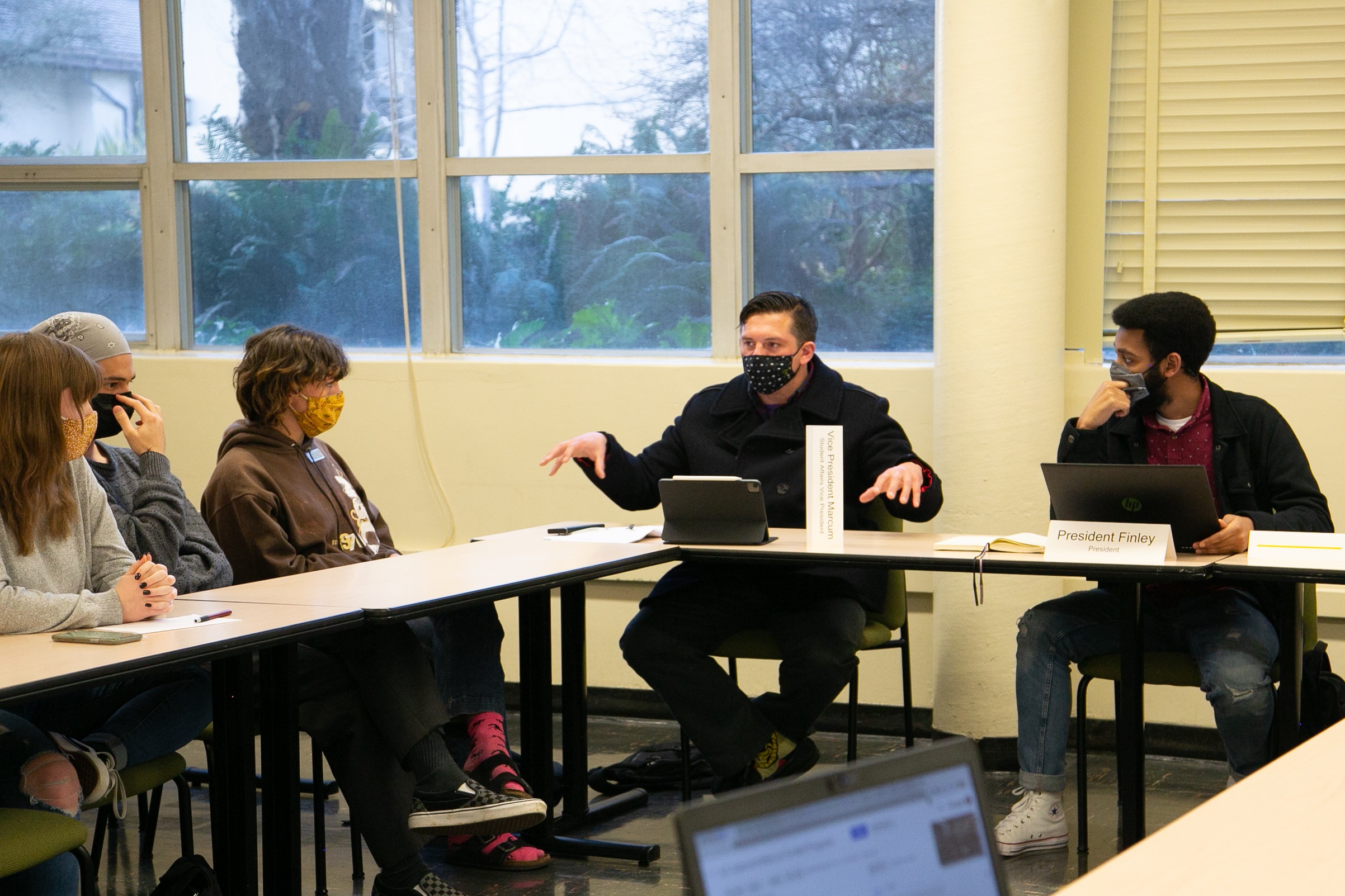
    Photo by Abraham Navarro | Student Affairs Vice President Chase Marcum and Social Justice and Equity Officer Lizbeth Cano Sanchez speak to President Jeremiah Finley at the Associated Students meeting in Siemens Hall on Feb. 5.

    Multiple different issues were discussed regarding the amount of power that President Finley has been exercising during his period of presidency. Issues such as his sole power as the Chair to pick and choose what goes on the agenda of meetings, and to choose which representatives may go to the A.S. & CPH Leadership Meetings.

    An expressed lack of communication and ignored emails towards the R.O.S.E House were also present. Director Payton Wills of the organization stated they had been trying to get in contact with A.S. for over 2 months. Members anxious about the eventually demolish of their house and subsequent subpar relocation adding more stress to the tense meeting.

    Emotions ran high when Sachez had to leave to host an event for El Centro, another important student-run organization. She explained that she would continue to participate via Zoom, but under his own ruling on in-person quorum not being met, Finley attempted to end the meeting prematurely.

    Due to the collective stress of the meeting, Sachez began to break down and pleaded with the president to allow her participation through Zoom.

    “I hope I’m not failing any of the members-” Sanchez said, holding back tears.

    “You should be allowed on Zoom. There’s no reason for that to be other than preference.” Kate Bourne said.

    Photo by Abraham Navarro | Social Justice and Equity Officer Lizbeth Cano Sanchez crying at the Associated Students meeting in Siemens Hall on Feb. 5.

    Vice President of Student Affairs Chase Marcum also offered his support, pleading with Finley to make an exception for Sanchez. Still, the president refused.

    “Everyone on Zoom wants this meeting to continue and meet the quorum,” said guest speaker Payton Wills, adding their own opinion. “Lizbeth wants it to meet quorum. All of the people sitting here want it to meet quorum. You are the only person, sitting here, against continuing this meeting. It makes no sense.”

    “Seeing as I’m not leaving, we can continue our meeting…” she said, sitting back down.

    Arguments between members continued to escalate, both Bourne and Sachez accused Finley of refusing to accept not only their previous work experience at A.S. but specifically their roles as female leaders. The angry scraping of chairs could be heard across the room as almost all people present begin to leave the room.

    Unofficially the meeting was adjourned only halfway through the agenda. Only members Marcum and Finley were left, tidying up the room in complete silence.

    In the aftermath of the meeting, Vice President Marcum and President Finley had very different takes on what had occurred.

    Photo by Abraham Navarro | Associated Students President Jeremiah Finley at the Associated Students meeting in Siemens Hall on Feb. 5.

    “Being Black and in this leadership role I bear a weight that many will not understand,” President Finley said. ”Still, I know the work must get done and solutions to issues must be given. So, when my fellow board members and cabinet members won’t show up in person not because they are not able, but because they have something better to do, I still make sure students’ requests are fulfilled because that is why I do what I do and where I find joy.”

    On the other hand, Marcum accused Finley of abusing his power as President and personally apologized on behalf of the A.S. to students and staff members who have suffered hardships under the organization’s current leadership.

    “I truly believe that [Finley] should step down in a dignified fashion,” he said. “Embrace humility, be humbled. It is the most important of all characteristics to carry with you once it is obtained.”

    The Associated Students’ next meeting is planned to take place this Friday, at 3 pm in the same location of Siemens Hall 117.

  • CAP 2.0: The plan to make Cal Poly Humboldt carbon-free

    by Liam Gwynn

    On Jan. 28, Cal Poly Humboldt released an ambitious draft updating the Climate Action Plan. This updated plan promises to have the school completely carbon neutral by 2045. If CAP 2.0 is accepted, the school will implement changes to reduce carbon output and create an ecologically healthier environment.

    Changes would include phasing out gas and replacing it with electric power, implementing new carbon offset projects, introducing a zero-waste plan, and making several changes to transportation on campus. The final draft of the plan will be submitted this April. The budget is not yet finalized, however, if the plan is signed off, it will cost anywhere from 4.4 million to 5.5 million.

    The Climate Action Plan started in 2016 to lower greenhouse gas emissions to levels last seen in the ’90s. They succeeded at that plan in 2020 and started their planning for Cal Poly Humboldt’s next goal, complete carbon neutrality by 2045. This plan came about after The 100 Percent Clean Energy Act of 2018 passed in California, requiring all California businesses to have 100 percent clean energy by 2045.

    Morgan King is a climate analyst at Cal Poly Humboldt and the author of CAP 2.0. For him, this new plan is about more than just meeting the requirements set by the state.

    “We are in the midst of a climate crisis and we understand that climate change events and disasters are already having an impact on our communities, our ecosystems, and our infrastructures,” King said.

    Graphics courtesy of Facilities and Management

    According to King, the main climate threats Humboldt faces are rising ocean levels, wildfires, and extreme weather conditions. These threats are daunting and King is under no illusion that the school has the ability to singlehandedly stop them.

    “Even if humanity took big steps today to curb our burning of fossil fuels, we’re still going to see these climate impacts for many years to come,” King said. ”So we need to start planning and preparing now.”

    Despite the ominous threat of climate change looming in the distance, plans like CAP 2.0 show that there are still people willing to make drastic changes to soften the damage humanity has caused.

    “We are starting to see that resilience and climate protection are becoming part of the culture at this campus,” King said ”We are seeing a greater level than ever before of engagement around these issues.”

  • Campus Community Remembers Local Legend

    Campus Community Remembers Local Legend

    by Kris Nagel and Ollie Hancock

    Ricky Smith, a longtime Arcata community member, was the victim of a deadly assault Wednesday, February 2. The community has spent the last week remembering Smith’s legacy. Known for his big smiles and peace-loving attitude, Smith regularly took to the corner of 17th and G Streets where the assault took place.

    Photo by Morgan Hancock | Community members gather at the corner of G St and 17th St.

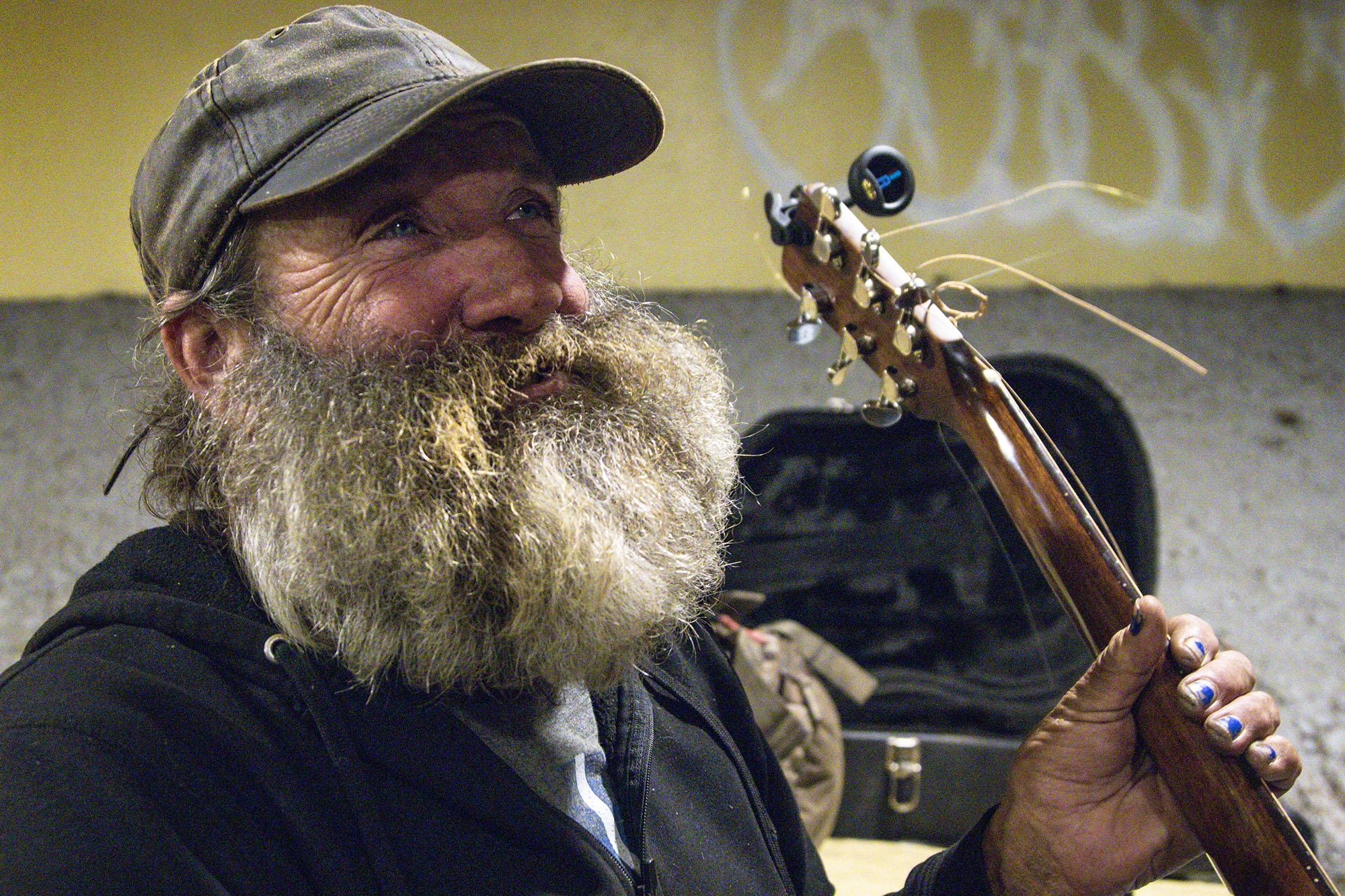
    Community members set up a memorial where Smith would spend his days playing songs for passersby. In the days since, the corner has seen people stopping by to share stories of the well-known busker and leave gifts around framed photos.

    Reports say that Smith was killed in a confrontation near the 17th Street footbridge around 5:30 p.m. Although CPR was attempted by two bystanders, he was unresponsive when police arrived on scene. Life saving efforts continued but Smith was pronounced dead shortly after being transported to Mad River Hospital.

    Smith was confirmed dead by Arcata Police the following morning. A 50-year-old Arcata resident was arrested at the scene and taken into custody and booked into the Humboldt County Correctional Facility for murder according to the Thursday press release.

    Photo by Kris Nagel | Arcata resident Ricky Smith plays his guitar on the corner of 17th St and G St on April 28, 2021.

    Smith’s daughter, Sara Smith, has set up a Facebook page for people to share memories of her father. A recent post on the page from Sara shows a note Ricky had made for himself, “Your attitude almost always determines your altitude in life.”

    Ricky Smith was known best for his kind smile, passionate songs, and place in the community reminding us to be good to one another. Though some memories are brighter than others, this moment of loss has brought many in the community to grieve the corner left vacant in Ricky’s absence.

  • Parking Pain Persists

    Parking Pain Persists

    For me, the start of the spring semester means the return of the eternal struggle to find a parking space. Many Cal Poly Humboldt students, both on and off campus, are finding it difficult to find a parking space. Even those of us who usually walk to campus are impacted by a lack of parking.

    The parking situation on and around campus is absolutely abysmal. Campus parking permits and metered parking are expensive and purchasing a campus permit does not guarantee that you will find an open parking space. $157 a semester is a lot of money to pay to not be guaranteed a spot to park. I know students who live on campus who can’t even park outside of their own dorms. I’ve talked to commuter students who have to move their cars multiple times a day to avoid being ticketed.

    You would think that living in an off campus house within a short walking distance of the school would resolve any parking issues. However, parking is still a huge problem for my roommates and I. One side of our street is 4-hour parking from 7 am to 5 pm, intended for students to be able to park off campus and walk if they don’t have a campus parking permit or if campus parking is full. The other side of the street is reserved for vehicles with residential parking permits. I have four roommates and we all have cars. That’s five vehicles that we have to try and fit in our parking zone, which we also share with our neighbors.

    Photo by Nina Hufman | The parking zone in an off campus neighborhood in Arcata, California.

    We can usually fit four of our cars in front of our house if we park as close to the edges of the residential zone as possible. Because my neighborhood is so close to campus, there are usually several student vehicles parked in the 4-hour zone. I often come home to find that our residential parking is full. I am then forced to parallel park, very poorly might I add, across the street from my house.

    Parking, specifically parking enforcement, is something my roommates and I commiserate about almost daily. We sit in our kitchen, talking about how much we hate the guy who enforces parking on our street. He’s a jerk, he takes his job way too seriously, and I honestly think he has it out for my brother. It feels like he targets our street, and my brother’s car specifically.

    He literally stopped my brother in the street to ask him which car was his and tell him that it’s illegal to remove chalk from the tires of your car. He kept moving his little, three-wheeled car in front of my brother to prevent him from walking away. During this interaction, he was in the way of one of my other roommates who was trying to park. Imagine being a middle aged man having beef with a 21-year-old who’s just trying to park in front of his house. That feels like an inappropriate interaction to have with an “authority” figure. As a college student who is just trying to get an education, the last thing on my mind is fighting with parking enforcement.

    I can’t help but think, if I’m fed up with the parking situation, it must be absolutely enraging to have purchased a campus parking permit, but never be able to park. It’s not the students’ fault that they’re parking in my neighborhood. To be honest, it’s a very convenient distance from campus, especially if you can’t park any closer. The real problem is that campus parking is so scarce.

    Cal Poly Humboldt students pay a lot of money for parking to only be able to park on campus sometimes. The issue doesn’t only impact the campus. Student vehicles overflow into the surrounding neighborhoods, creating a lack of parking for everyone who lives nearby.

  • Moon Cycles: queer-owned bike shop in Arcata offers alternative space in male-dominated industry

    Moon Cycles: queer-owned bike shop in Arcata offers alternative space in male-dominated industry

    Correction (2/4/22): Co-owners Sage and Sprout did not meet while looking for a job but instead meet years prior as mutual HSU students.

    Moon Cycles, a brightly colored bike shop located on the side of the road near the intersection of Foster and Alliance in Arcata, is hard to miss. The bike shop was founded in October 2016 by nonbinary duo Sage and Sprout, a queer tour de force.

    Sage and Sprout serve the local cycling community by offering a queer-friendly space that goes against the grain of the male-dominated bike industry. Even the shop name is a pun that alludes to queer identity.

    Photo by Alexis Valtenbergs | Sprout standing in the doorway of their store Moon Cycles in Arcata on Jan. 27.

    “It’s a play on words, the moon being associated with femininity and the menstrual cycle,” Sage said. “Even if we don’t feel like women, the moon is a signal to our queerness and difference.”

    Sue Hilton, a 71-year-old lifelong bicyclist, is a regular customer at Moon Cycles. Hilton first caught wind of the shop in the L-Word, a lesbian newsletter based in Humboldt County.

    “My friend Susan did an article for the L-Word, so once I heard about it I started going,” Hilton said. “I loved the idea since I’m a big bike rider. Just that they’re great people, and they’re queer-friendly.”

    Although Moon Cycles is queer-owned, it’s not just for queer people. Moon Cycles an accepting space for everyone, regardless of gender or sexuality.

    “I’ve seen that especially with men but like most people, if they come in and they don’t know the words for things, they’ll feel apologetic,” Sprout said. “We’re not looking down on anyone for not knowing correct terminology or what the names of parts are or stuff like that.”

    Sage and Sprout met in Humboldt County while trying to find jobs at other bike shops, to no avail. After facing gender discrimination in the hiring process and being looked over in lieu of men, they decided to open their own shop instead.

    Photo by Alexis Valtenbergs | Sage (left) and Sprout (right) inside Moon Cycles in Arcata on Jan. 27

    “One year, neither of us could find jobs here,” Sprout said. “We kind of just started scheming and thought, ‘well, maybe we should just try to open a bike shop.’”

    “There’s an important caveat there,” Sage added. “Which is that I applied to all the bike shops here and I felt – I knew – I was being discriminated against and judged by my gender.”

    Sage won a mechanic scholarship from Quality Bicycle Products. The scholarship was an attempt to include more women and gender-nonconforming people in the bike industry.

    “They were trying to bring women – and gender-nonconforming people more recently – into the world of bike mechanics so that the whole industry can get more diversified,” Sage said. “And they can tip the balance a little bit away from men dominating the whole thing.”

    Ever since Moon Cycles opened, Sage and Sprout have played an integral part in tipping the balance in Humboldt. To learn more about Humboldt’s first and only queer-owned bike shop, check out @arcatamooncycles on Instagram.

  • Students support community on MLK Day of Service

    Students support community on MLK Day of Service

    MLK Day is more then simply a day off, it holds an important message

    “These are revolutionary times. All over the globe men are revolting against old systems of exploitation and oppression, and out of the wounds of a frail world, new systems of justice and equality are being born.” said Martin Luther King Jr. in his A Time to Break the Silence speech.

    Last Monday marked the country’s annual day of recognition towards civil rights leader and minister Dr. Martin Luther King Jr. A contention day to some as increasing more citizens have come to see the commodification and sanitization of MLK’s legacy to be problematic. Many efforts have been made across the nation to realign this day with his actual messages of racial and economic justice, not only through the medium of peaceful protest, but also civil disobedience and radical structural change. Many of the MLK events in Humboldt could be found partaking in this national movement.

    Local bilingual and charter elementary school, Fuente Nueva, last Friday celebrated the upcoming holiday through a series of black guest speakers from organizations ranging from Black Humboldt, Eureka’s NAACP, B-Men, and many more. After the event’s collection of inspiring speeches, delivered to the awaiting children located in the front rows, all attendees were invited to walk a mile march in remembrance of MLK’s own March on Washington.

    HSU held its own MLK event on Monday as well. Starting in the early hours of 8am and hosted by Youth Educational Services (Y.E.S), the event was labelled “A Day On, Not A Day Off” and focused on community service volunteering. Guest speakers included our own Dean of Students, Dr. Eboni Ford-Turnbow, and prominent activist Bree Newsome. Volunteering activities ranged from on campus to off, Arcata to Eureka, and included a variety of public services. For many students and community members in Humboldt, MLK Day was not simply a vacation but an opportunity to give back and to keep Martin Luther King Jr’s dream truly alive.

    Photo by Morgan Hancock | HSU student volunteer on MLK day Monday Jan. 17.
  • Local Bilingual Charter School Teaches Children and Community About MLK’s Message

    Local Bilingual Charter School Teaches Children and Community About MLK’s Message

    The 5th grade students of Fuente Nueva lead the one mile march for Peace & Justice in Arcata on Friday, Jan 14th. Photo by Morgan Hancock.

    “So often MLK is portrayed in a very white-washed and sanitized way. I think he was portrayed in a very true way here today.” said Marche Hines, a mother of two children who currently attend Fuente Nueva Charter School. 

    On Friday, January 14th, three days prior to the upcoming national holiday of revered civil rights leader Dr. Martin Luther King Jr, bilingual charter school Fuente Neuva hosted an event entitled “Dreams Coming Alive” in his honor. Students, parents, and community members alike were invited to come and participate and to hear the voices and words of many important black community members and organizations from around the county. 

    One such speaker was James Braggs, an active member of Black Male Empowerment Network (B.MEN) and Black Humboldt, who opened the outdoor event at 8:30 am with a short land acknowledgement and prayer. Braggs expressed in both portions of his speech the importance of remembering history and learning from it. Reflecting on where we have grown, and being grateful, and reflecting on where we can improve, and changing it. 

    “Remembrance is critical,” Braggs said later that day during a personal one-on-one interview with the Lumberjack. “It’s important to acknowledge the history.”

    “King existed due to the work of thousands of ordinary people,” Braggs said as well, explaining how we often fail to see the bigger picture behind MLK’s events and actions. “[It] wasn’t just super smart politicians and leaders. It was mothers, fathers, brothers and sisters.”

    After Braggs opening prayer, president of the Humboldt county’s NAACP, Sharrone Blanck, stepped up to the stage, greeted by the children in the front and adults in the back. Blanck’s speech revolved around the ideas such as the importance of diversity in groups and the freedom for everyone to live life as their full selves.

    “We exist here as individuals and we have the privilege to be a part of groups,” Blanck’s said. “Who we are connects us to other people. I’m a black woman, I’m a Jewish woman, I’m a mom and a wife, I’m a friend, and all those parts of me I bring wherever I go.”

    April Koepke, attendee and parent of two students, noted this particular speech as being her favorite. 

    “[It’s] important for young people to know the values of working together and the equality of all.” she said, hoping that this speech will become an inspiration to her own children over the years.

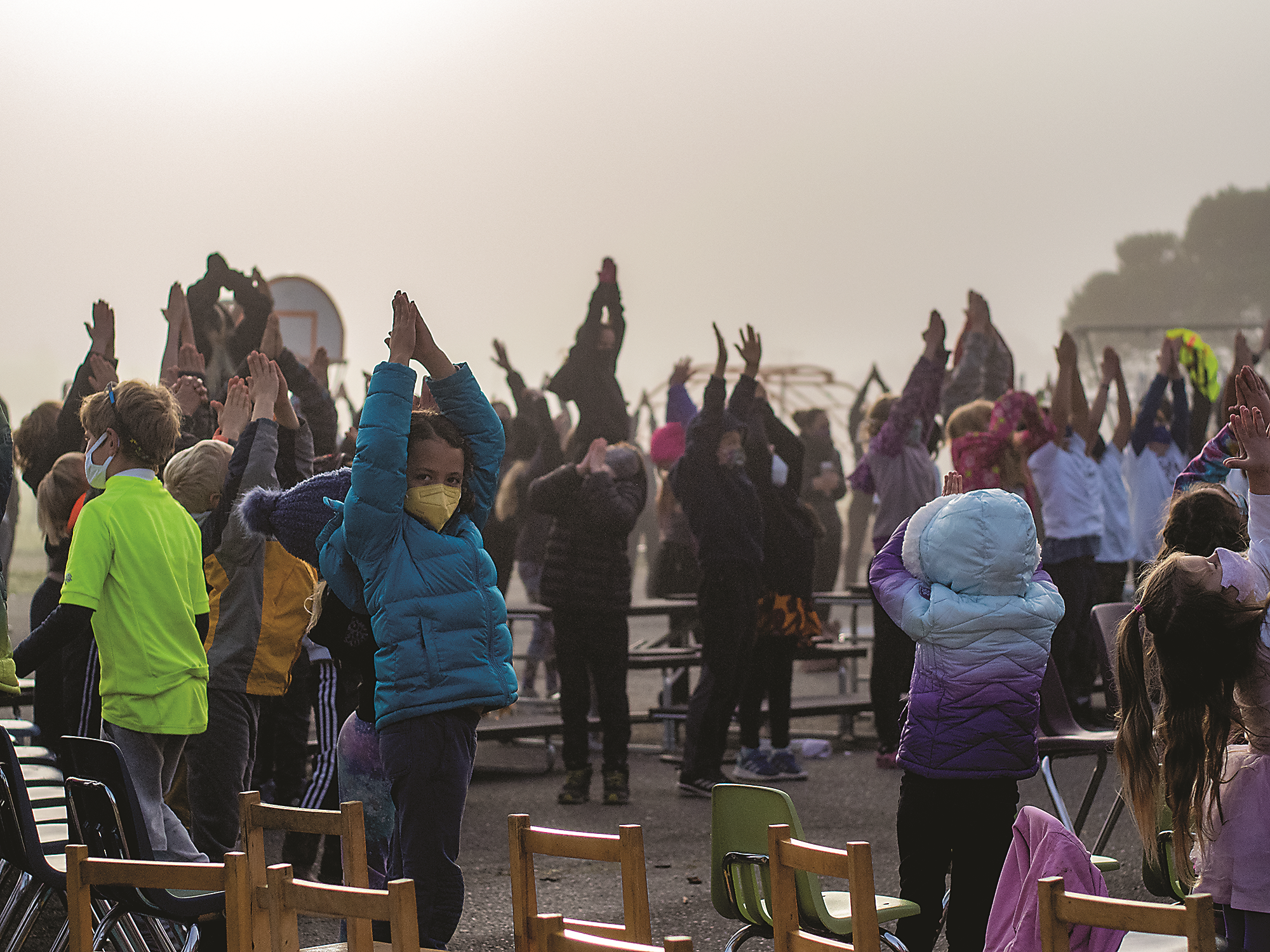
    Students, staff, and community members participant in a short yoga session before the start of the march. Photo by Morgan Hancock.

    Other important speakers included Dr. Kintay Johnson, current director of CR’s Multicultural Center, Lorenza Simmons, youth coordinator at HC Black Music & Arts, and Mo Desir, co-founder of Black Humboldt. Each telling their own unique story of how they empowered themselves and the people around them in Humboldt county in the struggle to have their voices as black people be heard. Never being afraid to point out the changes that still need to be made and the injustice still faced by their community everyday, in a way that not only adults could understand but the children as well.

    “[The event] let students of color know [that] they’re heard,” Hines said

    Cybele Porpee, another attendee and mother of a student, found the event inspiring.

    “It helped me review my own goals, hopes for the future, and engagement towards the community,” Porpoise said.

    “Diversity, multiculturalism, acceptance, everything he taught is important,” she added.

    The event hit its peak at 10:30, when students, staff, parents, and attendees alike were asked to participate in a mile march around the school, a moment to show students MLK’s often used tactic of righteous civil disobedience in practice and for both young and old alike to walk in the footsteps of not only him but of his many fellow protestors too.

    Fifth graders led the march through the school’s neighborhood. Each carefully held the main banner heralding the beginning of the protest. Towards the caboose of the group were the younger first grade students, carrying their own posters with messages for peace and equality. Each student along with their parents, staff, and attendees stepped in sync crying out for the peace and equality of all, and the respect, dignity, and right to life of every black and brown person locally and nationally.

  • Arcata’s fourth annual State of the City presentation

    Arcata’s fourth annual State of the City presentation

    At this year’s State of the City Arcata, presenters reflected on the current state of Arcata and what the future of the city will look like after 2020’s year of challenges.

    The presentation featured several representatives from the city of Arcata, Equity Arcata and Humboldt State University. Each presenter reflected on the outcomes that stemmed from the past year and what it meant for the community going forward.

    “I’m going to share some perspectives that we learned in 2020,” said Karen Deemer, Arcata city manager.

    Deemer highlighted the importance of the spirit that was seen throughout the community as the pandemic hit during March of last year. As businesses closed and some chose to stay open, the Arcata community made a concerted effort to buy locally.

    As the pandemic was disrupting the norms of society and affecting businesses, it was also highlighting deeper societal problems within Arcata.

    Christian Boyd, the racial equity intern for the city of Arcata, and Janaee Sykes, the student intern for the Office of Diversity, Equity and Inclusion on campus, represented Equity Arcata. They spoke about the importance of resources for BIPOC within the Arcata community.

    “COVID-19 brought racial disparities seen throughout the nation to the forefront of society,” Boyd said.

    Sykes said from the death of George Floyd to racist videos on campus and then the racial tension that surrounded the election, many Arcata residents reported feeling uncomfortable within the community.

    Equity Arcata was established in 2017 after community members met with student focus groups to hear out their issues and create solution-based strategies.

    Sykes said that after the murder of David Josiah Lawson in April 2017, it amounted to a breaking point for the Arcata community and the county. The tragedy opened many eyes to the deep-rooted issues of racism and discriminatory acts against BIPOC in the community.

    “Arcata Chamber of Commerce is committed to working with Equity Arcata and working to make Arcata a more prosperous and welcoming place for all the community,” Molly Steele, executive director of the Arcata Chamber of Commerce, said as Equity Arcata closed their portion of the event.

    HSU President Tom Jackson and Jenn Capps, the provost and vice president of academic affairs at HSU, spoke about the current state of the university, as well as plans for the future, specifically on becoming a polytechnic school.

    “We have been operating in emergency mode as a university,” Jackson said. “We are really trying to work on building infrastructure first then building for the future.”

    This includes planning for the fall semester and what that looks like amid vaccination distribution. Jackson emphasized that although the collective notion is that everything should be okay in the fall, science and technology are telling us to remain cautious.

    The university is trying to plan the best fall semester that it can, but it is very reliant on keeping the community and students safe.

    As for what the university’s plans are for the long term, Capps presented the projected timeline of the polytechnic self-study that will be conducted throughout this next year.

    “A lot of what is a polytechnic is already HSU,” Capps said.

    There are already two polytechnics that have been designated in the CSU system, but none that already exist in the Northern part of California. HSU would represent the region as a polytechnic through a collaborative approach with Humboldt County, the campus community, and the CSU Chancellor’s Office.

    Consultation of the Polytechnic Self-Study is expected to start at the beginning of March and continue throughout the summer. The expected due date for the completion of the self-study is Sept. 1.

  • Thrifty Arcata

    Taking a tour of the local thrift shops in Arcata during the COVID-19 pandemic.

    Directed and produced by Skylar Gaven.

  • Minor Theater is back after closure scare

    Minor Theater is back after closure scare

    GoFundMe saves The Minor Theater thanks to community support.

    The Minor Theater has reopened to the public after closing at the start of the COVID-19 outbreaks eight months ago.

    Reopening was never a certainty for Josh Neff, building owner and co-owner of The Minor.

    “I was trying to have an optimistic outlook and thinking this is something we can handle. We’re gonna get through it and it’ll take a few weeks then we’ll be back to some sort of new norm or a norm, but that was not the case,” Neff said. “We were nursing the business along by paying the minimal amount of bills and rent that we could and just kinda running out of money.”

    Coming into late July and early August, the likelihood of reopening was slim. But, on Sept. 28, the theater opened a GoFundMe page in hopes they would earn enough money to reopen.

    “It was either that or fold the business, that’s where we were at,” Neff said. “We didn’t want to ask for anything for free. That’s why we did the incentive program and gave them the discounted theater rentals in exchange for the donations.”

    Currently the GoFundMe has raised $32,805, well over their $20,000 goal, with 364 donors. This outpouring of support from the community came as a surprise to Neff.

    “I didn’t think it would be so generous and so fast,” Neff said. “I did expect that the community would have a heartfelt response to our donation request but I didn’t realize that it would come so fast and exceed our expectations like it did.”

    Travis Bille, a community member and donor to the Minor, expressed the significance and importance of keeping the Minor operating.

    “It’s a staple of the community,” Bille said. “I love this place.”

    Before they could open up, they had to make some health and safety changes first to comply with COVID-19 guidelines.

    “I put a two stage HEPA air filtration system in and it runs 24 hours a day,” Neff said. “We did a 60 percent seating capacity reduction, we implemented some COVID software that allows people to pick the actual seat they want to sit in, and you can buy it online and it automatically gets rid of the seats next to you on both sides. We did a bunch of enhanced cleaning safety protocols, obviously masks are being worn at all times.”

    On Oct. 9, the Minor Theater reopened its doors to the public for weekend showings with the new safety protocol in place.

    “We followed all the health and safety measures that the county guidelines put out and then we sorta went above and beyond and did everything else we could think of to do,” Neff said.

    Fans of the theater, like Christy Mast, were thankful that the theater was able to bounce back and begin showing again.

    “It was nice to just get back in with the community and be at the movies again,” Mast said.

    Neff is extremely thankful and overjoyed by the community’s effort to save his business. He recalls the day the Minor reopened with glee.

    “I couldn’t wipe the smile off my face the day that we opened,” Neff said. “Just to have the theater experience, have those doors open, have the marquee lit up, and have the popcorn machine running. It was glorious, everything you had hoped for.”

  • Sweet Mama Janisse hit hard by COVID-19

    Sweet Mama Janisse hit hard by COVID-19

    Local owner of Sweet Mama Janisse, Marie Janisse-Wilkins struggles to make up losses

    The Arcata community came together to save Marie Janisse-Wilkins, owner and operator of the local, soul food catering business, Sweet Mama Janisse, Inc., from eviction as COVID-19 has wiped away all her revenue for this year.

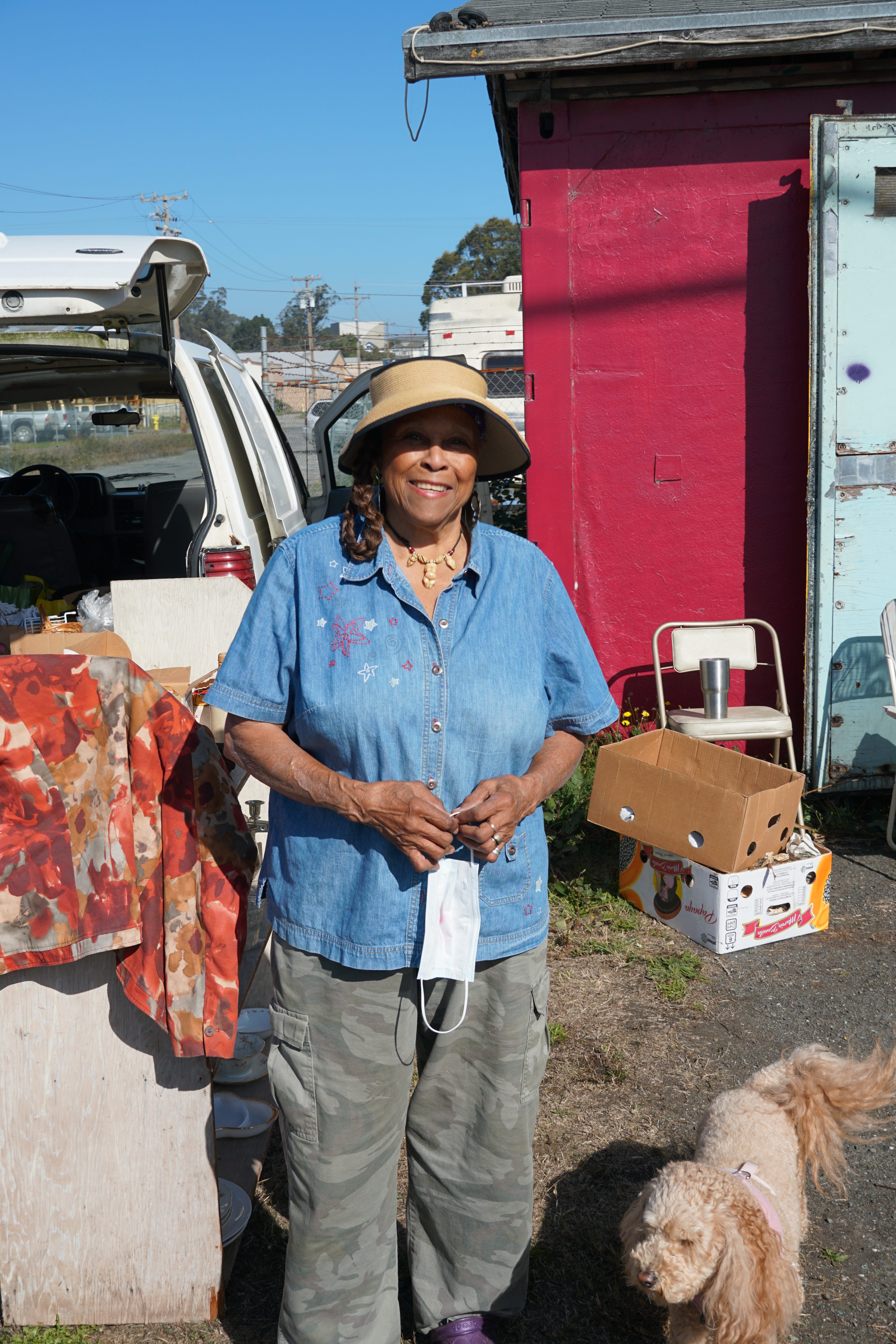
    During a garage sale Fri. Oct. 23, Janisse-Wilkins explained how she used her own money to start her business and when the business got into financial trouble, she refinanced her house to keep the business afloat, then COVID-19 struck.

    Janisse-Wilkins said she had paid all her bills before COVID-19 hit. Without the money from catering, she struggles to pay her mortgage.

    “[The banks] have no sympathy. They want their money. They want their money,” Janisse-Wilkins said.

    The Federal Reserve reported COVID-19 has disproportionately affected Black owned businesses. Janisse-Wilkins is Louisiana Creole, which includes a diverse heritage of European, African, and Indigenous America traditions.

    Shelter-in-place orders began in March and wiped away Janisse-Wilkins yearly schedule of catering for weddings, special events, graduation celebrations and the annual Independence Day celebrations in Eureka.

    The Federal Reserve said in a report titled “Double Jeopardy: COVID-19’s Concentrated Health and Wealth Effects in Black Communities” that while the national average of active small business owners dropped by 22 percent between Feb. and April, Black owned businesses saw a drop of 41 percent, almost twice the average, and the biggest decline of any racial group.

    This disparity is the result of historically unequal relationships to banks, increased likelihood of not being able to qualify for the Paycheck Protection Program and the higher rate of COVID-19 impact on Black communities.

    An online GoFundMe fundraiser started by Janisse-Wilkins’ friend, Julie du Bois, raised about $7,000 in two weeks. With a goal of $50,000, her friends have helped her host yard sales to sell off her possessions.

    Bob Dorn, friend of Janisse-Wilkins and writer of The Hum, a column that runs in the Mad River Union, received about 2000 of her books, mostly cookbooks, and decided to offer them in exchange for donations outside his storage unit at Arcata Bay Self Storage.

    “What she has going for her is she is an incredibly generous woman,” Dorn said.

    Nearing retirement age and without an income from her business, Janisse-Wilkins fears being homeless. She is currently unable to afford her rent, forcing her to ask for help.

    “It’s hard when you have to ask people to do something like this for you,” Janisse-Wilkins said.

    Oryan Peterson-Jones, Arcata City Council candidate, unloaded Janisse-Wilkins’ books from a storage unit and stated how he grew up in Arcata, and his first job was with Janisse-Wilkins as a dishwasher.

    “It was the best job I ever had,” Peterson-Jones said. “Marie was such an important person on my early development as a musician.”

    Peterson-Jones explained before Janisse-Wilkins moved to Humboldt in the 1990s, she worked at the Topanga Corral, which was a hot spot for rock and movie stars in the 1970s in Topanga Ca., just north of Hollywood.

    “She had all these stories and pictures of her with George Harrison, and the Rolling Stones,” Peterson-Jones said.

    Henry Saint Clair Fredericks, the multi-Grammy award winning musician known as Taj Mahal, is Janisse-Wilkins best friend. Fredricks even wrote a song, “Sweet Mama Janisse,” about her which tells of how good her cooking is. She even did two cruise gigs with Fredricks, called the Legendary Rhythm and Blues Cruise, where he sang and she did catering.

    Spencer Kennedy, another former dishwasher of Janisse-Wilkins, volunteered to help host a yard sale and recalled how Janisse-Wilkins made the restaurant feel special.

    “I hope we can get a lot of customers to make some money to make a difference,” Kennedy said. “I haven’t seen anyone walk out of the kitchen and talk to everyone in the restaurant. But Marie did that with every table.”

    Jannise-Wilkins said while she is able to cater during COVID-19 and sells a line of sauce, finding work is tough as clients are not booking very many events and employees are harder to find.

    “I just hope everything gets better and I can cook food for people again,” Janisse-Wilkins said.

  • HSU Prepares for more public safety power shutoffs

    HSU Prepares for more public safety power shutoffs

    King Salmon Power Plant promotes grid stability

    California has again warned residents of the potential and likely chances of Public Safety Power Shutoffs. With a larger range of the state being on fire this fall, more residents have been left without power in the midst of a pandemic.

    After the 2019 school year was impacted by power outages, HSU immediately sprung into action working toward a plan to improve the issue for students. While they couldn’t have predicted a pandemic would occur at the same time, they’ve created a plan to put into effect during these occurrences.

    Associate Vice President for Student Success Stephen St. Onge said HSU students would likely not even realize a power outage had occurred due to their new equipment. Since last year, housing has purchased two generators.

    “One is over $6,000 and it will power the JGC building, Cypress, the Canyon, and Sunset and Redwood,” St. Onge said. They also bought a portable generator to power College Creek.

    As well as the generators, the King Salmon Powerplant, based in Eureka, is now operating and handling Humboldt County’s future PSPS events. Cris Koczera is the emergency Coordinator for HSU’s Risk Management and Safety Services.

    “If we got notice of an impending PSPS right now, this year unlike last year, PG&E has been able to provide typically at least 48 hours of advance notice,” Koczera said. With this extra time, the school has been able to prepare more.

    “We already had one PSPS and there was no campus disruption because of the King Salmon Plant,” St. Onge said. “We had the generators ready to go – we were prepared this time.”

    This solves many of the problems that concerned students last year. Campus should function as normal this semester, without limited food, power and the need for students to leave their dorms to receive access. Even the elevators should be running for students who cannot rely on stairs.

    “We have since – knock on wood – solved those issues,” St. Onge said.

    In the instance the King Salmon Plant does not work and students live in an area uncovered by the new generators, HSU has another plan prepared.

    “We do have open spaces in other buildings, so we might consider if there’s a need to reopen up the JGC like before or relocating students temporarily to other spaces as well,” St. Onge said. “So we have those Plan C’s in place, as well.”

    Due to the COVID-19 pandemic, Koczera said the school would be reaching out to health officials to help determine the safest way to move students into one area.

    “We would be reaching out to public health to find a safe, viable way to still provide those levels of support and services,” Koczera said.

    So, while students have been preparing themselves to return to the University, HSU has been preparing for ways to help the student body through these issues.

    “It’s important for students to know that as an outcome of last year’s PSPSs, there’s been a group of folks, housing facilities, management, that have been working really hard,” St. Onge said. “We are prepared.”

    “Our commitment to supporting their educational work on campus is a serious commitment that we take,” St. Onge said.

    “The goal of the University has always been to get to a point where these PSPS events or rolling blackouts have the least amount of impact possible on our campus and on our students and on our ability to continue through the educational process,” said Koczera.