The Lumberjack


Students Serving The Cal Poly Humboldt Campus and Community Since 1929

Tag: Cal Poly University Humboldt

  • Humboldt International Film Festival hosts at Van Duzer Theatre

    by Lidia Grande-Ruiz

    The Humboldt International Film Festival (HIFF) team hosted a night of film sharing at the Van Duzer Theatre on November 3. The films were pulled from the HIFF archives and all have a common theme: discomfort and exploring it more through that feeling. 

    The films shown were “Simon” (2015, directed by Camille de Galbert), “Dancing with Scissors” (2019, directed by Steven Vander Meer), “Gone Sale” (2018, directed by Matt Meindel), “Aviary” (2021, directed by Lauryn Blottin), “Prey” (2018, directed by Jing Sun), and “The Quiet” (2019, directed by Radheya Jegatheva).

    “Change occurs at the point where it outweighs risks,” said Sarah Lasley, assistant film professor at CPH. “So when you are so uncomfortable that the fear of risks in change is no longer scary, we are kind of forced to make change.”

    Lasley continued to speak about the night. 

    “A lot of new wave films are intended to make the audience feel some kind of discomfort and these films occurred in a huge shift and change in sociopolitical climate,” Lasley said. “When you think about how that mixes in with discomfort, you know this idea on how discomfort outweighs risk, this change is occurring.”

    Students in the audience thought that the festival was cool and visually appealing. There were some who mentioned how certain films made them uncomfortable and freaked out, especially the film “Gone Sale,” which brings back memories of going to the mall but touches on consumerism. 

    “These nights are very successful nights because it is nice to see a variety of films coming to the school and the school has become a hub for all these international films,” said Ralph Valle, a film student and one of the co-directors of the film festival. “It is very honorable to be part of something like this. We get to distribute these films to a variety of people and it brings me joy because I get to see how people view life and movies that try to have some kind of message that they are trying to convey is pretty awesome to see.”

    All kinds of people, not just film majors, came together to see films that can resonate with everyone in some kind of way. The films emphasized that, while we may come from different backgrounds but we have one thing in common. We are impacted by what we see around us. From historical perspective to animation, at the end of the day, film brings us around and we discover at times not just people we never planned on meeting, but also a new side of ourselves.

  • Humboldt college merch should be affordable for students

    by Alina Ferguson

    Cal Poly Humboldt, while having relatively affordable tuition and options for scholarships and financial aid, is still robbing its students blind with the cost of apparel, food and general items at campus stores.

    One of the ways the school robs its students is apparel. For students it costs an arm and a leg. The hoodies and tees on sale at campus stores are much too expensive for most students’ budgets. Students should be paying discounted prices for their items, as many struggle just to get by. Most students have a heavy course load, debts from tuition and living costs, and not a lot of time for work. 

    The school should be able to offer apparel to students if not for free, then at a much reduced cost. Consider all the other ways they are finding to screw us out of our money, all the options they have taken off the meal plan. Quick side rant, it used to be possible to get two milkshakes on one meal plan. Sounds unbelievable, huh? The school has stopped offering a myriad of items for their meal exchanges, limiting the amount of options students now have for the meals that are covered in the amount that they have already paid. 

    Students wearing merch are a sort of free advertisement for the school, like a sponsorship deal. Typically sponsorships include some sort of incentive, like free apparel to compensate the wearer for representing the brand.

    Since we, the students, are already paying tuition, living costs, and the cost for food, we are not getting anything for free. For representing, or sponsoring the school, we should at least get some free merch as with most sponsorships.

    This is not necessarily exclusive to Cal Poly Humboldt, as many schools charge students for apparel. The fact that students are being charged is not so much the issue, rather how much we are getting charged. It would be more tolerable if Cal Poly Humboldt offered merch for students at a reduced cost. 

    The simple answer or solution to this “non-issue” as many see it: don’t buy apparel. If it is too much money, you don’t have to buy it. But it is nice to be able to rep your school, to walk down the street flaunting that you attend a Cal Poly. I pay to go here, I’m smart enough to. It’s a nice feeling. The school should “pay it forward” and discount merch for students.

  • Free Radicals chemistry club has fun with science

    Free Radicals chemistry club has fun with science

    by Dezmond Remington

    On Sep. 20 in room 564 of the science A building, approximately 20 people ingested a toxic chemical known as propylthiouracil. It was not a mass suicide attempt. It was not a Jonestown re-enactment, nor were they getting high. It was a meeting of the Humboldt chemistry club.

    Propylthiouracil is a chemical used to test if an individual is especially sensitive to taste, someone known as a “supertaster.” If the paper containing the substance was especially bitter, then chances are good that person is a supertaster. The members of the Free Radicals, the chemistry club on campus, were testing if they were supertasters. 

    “I just put poison on my tongue, so I guess I’m ok with anything,” laughed member Angela Takahara. 

    If the energy of the Free Radicals could be put into one quote, that would probably be it. 

    “People. That’s the best part,” club president Jack McLaughlin said. “It’s probably the best place for chemistry majors and a lot of other majors to socialize. It’s just a great community to have and to talk to, because not a lot of other people really understand chemistry…it’s nice to have people who understand you, where you don’t have to explain every other concept.”

    McLaughlin joined the club his freshman year, and hasn’t regretted it once. He said it’s an excellent way to get connected with important resources and more experienced students, as well as guest speakers who are in the industry or are teaching currently. 

    “It really helps guide newer students and even sophomores, juniors, and such towards figuring out what to do with their chemistry degree,” McLaughlin said, “And also how to make the most out of college.”

    The Free Radicals aren’t only open to those working on chemistry degrees, however. Shay Konradsdottir, the club’s Social Director and Events Coordinator, is a molecular biology and computer science double major, with only a minor in chemistry. Her favorite part of being in the club is putting events on, such as a tie-dye event the club held last semester to showcase the science of colors. 

    “As social coordinator here, I really enjoy planning the events and making fun things,” Konradsdottir said. “Making this stuff, and sharing this interest in the sciences and interest in chemistry in a way that’s not just ‘here’s what the reactions are called.’”

    And it is that interest in chemistry that binds all of the members together. McLaughlin said the nature of chemistry being everywhere was the appeal, and how it oftentimes was the key to understanding so much of life. 

    “[Chemistry] is like the building blocks of the universe,” McLaughlin said. “…I feel like I can pursue all of my passions for environmentalism and such through chemistry.”

    Senior Sam Emerson, attending his first meeting at the Chemistry Club, holds a similar viewpoint. 

    “I like figuring out what makes the universe run the way it does,” Emerson said. “It feels like getting to know the game engine behind everything…I’ve always thought life was really fascinating and that although the universe prefers disorder, there are certain, random spins of chemicals that happen to make order out of nothing.”

    Konradsdottir, who Emerson credits with convincing him to join the Free Radicals, has a much more personal background with science and how it interacts with their lives. She was diagnosed with Type 1 diabetes when she was young, and was a subject in medical studies. It was a defining moment in her life, she said, and it inspired her to become a doctor and help people. Eventually, she became interested in coding, and that led her to where she is today; gunning for an MD-PhD and potentially opening her own free clinic or making more effective medical diagnostic tools. 

    “I felt really awful about when I’ve heard stories from my friends or even some family members that were prevented from doing the things they loved doing because they got an injury or they got sick,” Konradsdottir said. “I myself, being a diabetic, there are lots of things I missed out on because I’m a diabetic, so being able to catch those things and prevent them from happening–that’s interesting to me.”

    Being the club events coordinator, Konradsdottir hopes to share that fascination with the rest of campus. Last semester, she went on a field trip where she got to make a pleasant-smelling chemical, but wasn’t allowed to take any home. If the club had unlimited money, she would hold an event where anyone could show up, get a free lab coat and goggles, and concoct something similar to what she got to make–with the difference being they would get to keep it. 

    “It’s fun! We just do fun stuff here,” McLaughlin said. “It’s not like actual work…you don’t have to understand anything about chemistry, so long as you show up with a good attitude.”

  • As students return to campus post-COVID, so do club sports

    As students return to campus post-COVID, so do club sports

    by Alina Ferguson

    COVID-19 disturbed, disrupted, and delayed many lives and events over the past few years. Club sports at Cal Poly Humboldt were no exception. Sport clubs that have been around since the 90s had to be put on hold, as none of their members could meet in person. Some clubs had to completely cancel competitions, events and all club activities. Now that it is once again safe to gather, club sports are making a comeback. Various clubs on campus are seeking to grow their numbers, and are once again practicing and competing as a group. 

    Archery

    The Archery club has a team that travels for competitions. This club is reliant on frequent practices, which was difficult to do away from the field. This year, with the participation of new freshmen, club membership is finally growing.

    “To join you need no experience or gear,” club president Zachary Gaydosh said. “Our practices [are] at the Student Recreation Center next to the football field on Saturdays 3 p.m. – 6 p.m. [and on] Thursdays 7 p.m. – 9 p.m.”

    Disc Golf

    Photo courtesy of Evan Connors | Disc Golf Team tournament in Monterey 2021

    President of the Disc Golf Club Malcolm Silva said he is looking for new members. Club membership was negatively impacted by COVID, as members could no longer meet together. Also, at the start of the pandemic, many of the players that had been on the team were in their final years at Humboldt and have since graduated. While the club as an organization was affected, Silva thinks the restrictions on activities during the pandemic were to the benefit of the solitary sport in some ways. When there was nothing else to do, many people just went out and practiced playing the game. The club itself could not partake in any competitions. 

    “That really gave us the time to hone our craft and get a lot better at it,” said Edwards Silva. 

    Silva said that they are losing a good chunk of their team this semester and he definitely wants to get more people in the Disc Golf Club this year.

    “We do Redwood Bowl every Sunday and on Wednesdays we do putting practice, that’s just where you throw the target at the basket,” said Edwards Silva.

    Slacklining

    If readers are interested in walking amongst the trees, so to speak, Slackjacks is the club for that. Slacklining is very popular among both students and locals. 

    Slackjacks is for all levels, including beginners. Most common slacklines are 1 inch or 2 inches in width; beginners would most likely start on a 2 inch. 

    Photo courtesy of Tori Lindvall | Aang Sterling on the line

    Aang Younger, a club member, said the real secret to walking on a slack line is mental. 

    Club President Joseph Aguilar mentioned the club was really born in 2018, but then had to take a hiatus during COVID. It has been difficult recruiting new members.

    This club not only teaches you to slackline, but it is also about community. Many people get together to jam, hangout, or even study for tests. 

    “We always have people who come and play guitar,” Sterling said. 

    Sterling also said they bring spirit cards, snacks, and circus props.

    “It’s just a bunch of kids playing,” Sterling said. 

    The Slack Jacks typically meet at the Mad River Pump Station on Sundays, known as Slack Sunday by its members. They have a loosely set time of 12:00 p.m. – 12:30 p.m. 

    Cycling

    Humboldt’s Cycling Club formed between the years of 2008-2009.

    Club president Ian Bowden says he feels that the pandemic definitely impacted this club; the season they were about to embark on in 2020 was completely canceled.

    “As a team we were struggling to find a way to organize any meetings and schedule COVID-safe group rides,” Bowden said. “During the 2020 season if we were to see people riding in the forest at the same time we would only wave before going down and continuing to ride alone.” 

    This kind of isolation impacted club morale and only a few people showed up to races in 2021. 

    Bowden said this season is gearing up to be one of their best yet. He feels they are back to nearly full membership. They are excited about their growing membership of 25 cyclists.

    “I personally have made great efforts to unite people and recruit riders to join the club, personally asking people when I see them riding in the forest if they go to the college,” Bowden said. “I love the cycling community in Humboldt and foresee a definite increase in interested people as the years keep coming.”

    The cycling club does both mountain and road racing. The club season opening on the 24th and 25th was hosted by Bowden. 

    “I am extremely excited for this race, as it is the first one that I have organized,” Bowden said, prior to the event. “I think we will have a good turnout from the schools in the division.”  

    Trash Pandas Soccer
    The Trash Pandas is a co-ed soccer team that welcomes players of all levels. They are technically not a club in the eyes of the university, though they do hold similar activities. They meet for practice every day on the field behind College Creek, and played their first game on Tuesday, Sept. 20 at 7 p.m. at the indoor soccer field.

    This group is for those who enjoy playing soccer, but may want less commitment than being on a university team. 

    “It’s cool to see the people who didn’t know how to play a couple weeks ago, are playing against the Division 2 soccer team,” said Zach Meyer. 

    How do I join?The Club Sports section of the Recreational Sports page on the University’s website illustrates more options, including fencing, Ultimate Frisbee, and men’s crew. Follow the Archery club’s activities @humboldtarchery on Instagram, and keep up with the Slack Jacks @humboldt_slackjacks.

  • Mycologists club: Fun-gis in the forest

    Mycologists club: Fun-gis in the forest

    by Alina Ferguson

    Mycology is a very young science, a baby in fact. Up until 1969, Fungi did not even have their own kingdom, as they do now, but were technically considered to be plants. Mushrooms are not plants, contrary to what many may believe.

    Some of the most prominent and common mushrooms in Humboldt are actually the edible ones such as the King Bolete and the Pacific Golden Chanterelle. According to Cal Poly Humboldt Mycology Club President Jack Mccann both of these mushrooms are very delicious. 

    Mccann said what brought him to the Mycology club was cooking. 

    “As a mushroom person I really love to cook,” said Mccann. “I think I like to cook first, that’s part of what got me into mushrooms, it’s just cause it opens a whole new world of food,” said Mccann.

    The club holds weekly mushroom hikes on Fridays, which are open to everybody regardless of club membership. This is a chance for the hikers to go out and experience the forest through a mycologist’s perspective.  Every alternating Friday, they host workshops and guest lecturers. These meetings are more targeted towards people who already know about fungi. 

    The Mycology club is having a two day DNA barcoding workshop on September 30th-October 1, 2022. The club members will learn about the process used to genetically test the species of a mushroom. This process can often lead to the discovery of new species. During the workshop, club members will see if there is a difference between different mushrooms on a genetic level. 

    “We’re gonna borrow a lab and, basically in a pretty sterile environment you separate the mushroom using some primers, seek out the genes you’re looking for and then amplify those genes so you could actually read them,” said Mccan.  

    Essentially, what Mccan said is that the club will be collecting mushrooms and then using their DNA to see if there are any genetic differences between species of mushrooms. 

    “The machine, known as a thermal cycler, gives you a visual representation of what it looks like, you compare it to what it’s supposed to look like, what you’re expecting.”
    All of the prep work will be done at the two day workshop. This includes the collection, the DNA sequencing and the comparison of the DNA. 

    Then, their guest speaker Damon Tighe will get back to them with the results. Tighe is a mycologist working out of Oakland and is working with the Company Bio-Rad. He is driving into Humboldt with all the equipment.

    The logging industry has a negative impact on mushroom culture. Unlike foragers, who simply take the ‘extension’ so to speak, of the fungi, what is known as the fruiting bodies, loggers do damage with their machines that dig into the ground. 

    Logging practices harm the mycelium, the other part of the fungus’ body.  Mycelium is a root-like network that grows under the soil, it is what produces the fruiting bodies we know as mushrooms. According to Tighe, mycelium is just the vegetative state of a fungus. 

    Treasurer Sam Parker said he was drawn to the foraging aspect of Mycology. 

    “I first learned to do that when I was around eight with morels, and I just love being out in the woods,” said Parker “Mushrooms are a very diverse lifeform and I feel like they just kinda tie everything together, and I just think they are just interesting to learn about,” said Parker.

  • Humboldt Alumni speak out against Homecoming in Hawaiʻi

    Humboldt Alumni speak out against Homecoming in Hawaiʻi

    by Oden Taylor and Ollie Hancock

    Humboldt’s alumni organization, Forever Humboldt, planned homecoming this fall in Lahaina, Hawaiʻi, on the island of Maui. In an email, the alumni organization shared their plans for a “fun spin” on homecoming where they would “spread the Lumberjack spirit” in Hawaii.

    Colleen Chalmers, Sabrina Gailler, and over 255 other alumni felt this plan did not reflect their values and what they had learned at the university. Chalmers and Gailler drafted an open letter in dissent, hoping the university would reconsider their plans.

    Chalmers is a Native woman who graduated from Humboldt with a degree in Journalism and Native American Studies in 2013 and now works in communications, racial equity, and homelessness policy. She felt that Forever Humboldt’s plans contradicted what she studied. She also felt the homecoming event doesn’t align with the school’s own vision, core values and beliefs, and purpose statements. 

    “The University consistently says that traditional ecological knowledge is central to solving environmental crises,” Chalmers said. “Then, [they] don’t listen to traditional ecological knowledge when it comes to choosing the   location of their next homecoming event or choosing how to engage in recruitment for new students.”

    The school cites Traditional Ecological Knowledge—TEK as a core tenant of learning across curriculums. Traditional Ecological Knowledge, decolonization, and sustainability are all terms used across the school’s stated principles. Kānaka Maoli—people indigenous to Hawaiʻi have been outspoken about the negative impacts of tourism on their place and people. Many alumni who signed the letter left comments of disapproval and disappointment.

    “The reality is that centuries of colonialism and racism have taken a toll on Kānaka Maoli, the land, and the water,” Chalmers said. “America has illegally occupied Hawai’i for 129 years. An institution like Humboldt that cares about equity and anti-racist work should care about it in all their decisions. I don’t see that in this decision to go to Hawaii during this time.”

    Their open letter has gained signatures from current and former students across nearly 70 different majors, representing graduates from 1973 through 2022. The letter was also endorsed by two nonprofits, Hawaiʻi People’s Fund and Seventh Generation Fund. Kānaka Maoli alumni Brissa Christopherson signed the letter and left a comment for admin and event planners. 

    “As a Kanaka Maoli and lifetime resident of Maui, I would highly encourage changing location for this event,” Christopherson wrote. “Our Maui community has been facing over-tourism, detrimental to natural areas and depleting limited water, in addition to the covid epidemic. Please stop perpetuating colonialist behavior with the fetishizing of our island culture.”

    The university issued a statement that they heard the concerns raised in the open letter. The university cited recruitment efforts and alumni in Hawaiʻi as reasons for the location of the event. The university intends to follow through with its plans to host homecoming in Hawaiʻi.

     “[The Univeristy] will distribute information about respectful and low-impact tourism to those who will be participating,” School representative Grant Scott-Goforth said.

  • Students frustrated with Title IX assault case handling

    by Angel Barker

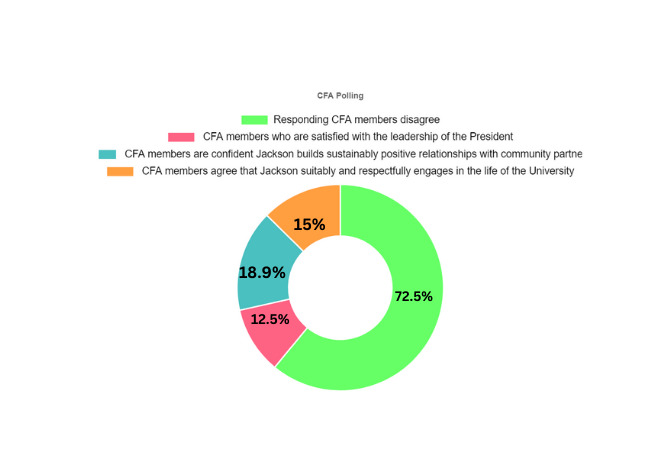
    Cal Poly Humboldt’s students, organizations, and community are unhappy with the Title IX office as well as President Tom Jackson after recent speeches and handling of cases.

    Title IX is the law adopted in 1972 that stipulates, “no person in the United States shall, on the basis of sex, be excluded from participation in, be denied the benefits of, or be subjected to discrimination under any educational program or activity receiving federal financial assistance.” (From Cal Poly Humboldt’s Title IX & Discrimination, Harassment, & Retaliation Prevention website). Title IX is also intended to protect students against sexual misconduct including harassment and assault.

    Female student Jane Doe (whose name has been changed for privacy reasons) reported an assault to Humboldt’s Title IX office in June. It is now September, and from her perspective, not much has been done. At one point in the summer, her case was lost.

    “This whole summer I went through without having responses,” Doe said. “I get there are multiple things they have to deal with, but how do you tell a victim…that you flat out lost her case [and message thread],” referencing an email she received from David Hickcox apologizing for the delayed response.  Hickcox is the Coordinator of the Cal Poly Humboldt Title IX office.

    Doe says due to rumors surrounding the university’s handling of Title IX reports, she did not want to file a report.

    “I didn’t want to go in the first place because I had heard of people putting multiple complaints in and nothing being done,” Doe said. “So I went in with [the mindset of] ‘we’ll see where it goes’.”

    The Title IX office told her they could do two things for her. First, she could get the support she might need, like withdrawing from classes, and having them monitor her academic progress. The other option was to go through a formal reporting process that leads to a thorough investigation of everything that happened. This choice could have led to getting her assailant expelled from campus, through the Student Conduct office. Doe chose the support option.

    “They didn’t make me comfortable to come clean about everything so I took the safer route,” Doe said. “I chose that one because I don’t want him to know what I have against him. That kind of defeats the purpose of having a Title IX.” Doe was told that if she took the investigation route, her assailant would be made aware of her accusation.

    Doe was assaulted in a campus housing dorm room, and now she doesn’t feel safe on campus. “I get a sinking feeling in my stomach. I see him everywhere,” Doe said.

    Students also feel like the Title IX office is not timely enough and that the process takes too long.

    “I think it just takes way too long for students to get the help they need,” said Iman Jackson, a senior who was sexually assaulted at an off-campus party. 

    “It is just a long process,” Jackson said. “Maybe if they warned people that it is a long process it might be better, but if you can’t do it in a timely manner, at least have a plan.”

    Jackson does not think that the process is meaningful enough. “I feel like they kind of fall short in regards to helping men who have been sexually assualted or harrassed,” he said. “I feel like if they want to change the rhetoric of being supportive and inclusive to all, I think they probably change how their procedure goes.”

    Students have taken to social media to express grievances against the Title IX reporting process. Student commenter Lexi Holloman commented on a Humboldt Poly Confessions Instagram post that her report was lost and that she had to file more than once.

    “I contacted Title IX and they said they have been handling the reports of [assailant’s name] in the ways that they can, and so I made another report because they didn’t even have my original report,” Holloman commented.

    When asked to respond to student accusations of lost cases and lack of response, Hickcox said that he was unaware of any lost cases but “encourages them to contact [his] office.”

    In response to feedback on social media, Hickcox said, “I’m aware of the [Humboldt Confessions page] and there is this perception that we do nothing.”

    “I looked at Humboldt Confessions today and I can tell you what I saw on there today is not an accurate representation of what Title IX is doing,” Hickcox said. “It makes Title IX’s job a lot harder when people don’t believe in the process.”

    Recently, President Jackson implied in a speech that it would be better to keep Title IX reports out of the media.

    “I hate being in the news, because we have so many positive things happening on our campus,” Jackson said. He also stated that the Title IX process is designed to resolve cases “behind the doors in a meaningful amicable way.”

    This speech damaged Doe’s opinion on the president and campus’ Title IX handling.

    “I was offended. Although I had no say in the media aspect of my assaulter, it made me shy away from going to the office and tainted my self esteem walking into my appointment,” Doe said. 

    Hickcox views the President’s remarks differently.

    “I understand that people are upset because they are inferring that he is saying to not report to Title IX,” Hickcox said. “I think the President is expressing frustration that when sensitive confidential Title IX details get into the media that it lowers the credibility of the process.”

    Students and student organizations like Students for Quality Education are calling on the university to take responsibility and make a better Title IX process. The following is a comment from Students for Quality Education.

    “We as Students for Quality Education denounce the words and actions done by President Jackson. He has furthered harm toward victims and survivors on campus and is an active perpetuator of rape culture. As the leader of a public university you’d expect his comments to be more in line with 2022 rather than the 1950s and you cannot expect systems and institutions of oppression to be fixed by whispers and behind closed doors. It took little to no courage for a man in power to say such things about victims and survivors as if we are still in the past. Secrets do not fix harm. President Jackson has failed to protect students, staff and faculty. Cal Poly Humboldt and the CSU as a whole needs to reform Title IX and continue to support and build on programs focused on supporting and bringing justice for victims and survivors rather than protecting a public image and defending institutions of harm.”

  • Recent break in at the campus apartments leads to questions of safety of the Cal Poly Humboldt dorms

    Recent break in at the campus apartments leads to questions of safety of the Cal Poly Humboldt dorms

    by Alina Ferguson

    During the summer of 2022, a unit of the campus apartment complex was broken into. The police were able to find and arrest the burglar. Executive Director of Auxiliary Operations Stephen St. Onge explained that the units were unoccupied during the break in and no students were harmed. 

    “Unfortunately when the Campus Apartments are not occupied, they become a target,” St. Onge said. 

    The Campus Apartments were not originally part of the campus. According to St. Onge, the building was bought to build infrastructure. 

    “The purchase of Campus Apartments, it was going to be for temporary housing,” St. Onge said. “Then the building was gonna be taken down and then an academic building was going to be put there.”

     Due to its origins, the building is outward facing, easily accessible from the footbridge that leads to Arcata. There is no gate and the doors to the bedrooms are what people see first.  These apartments do not use a key card to get in. Instead, they use a physical key issued to each student. 

     St. Onge mentioned that there is a rather robust camera system set up in the complex, lined with over 400 cameras.

    “We spent over 1.2 million dollars on a very robust security system, every entrance to every residence building has a camera on it,” St. Onge said. “If you go to Campus Apartments, I think it’s about 400 cameras.” 

     The surveillance system on campus can track someone’s whereabouts through the whole campus. 

    “If I could pull up a camera, you could see how detailed those things are,” St. Onge said. “You’re wearing a gray sweater vest right? So we could type into the search parameters, female, brown hair, gray sweater vest and they will- boop boop boop, and you put in a time parameter, and we could walk you across campus.” 

    Other campus housings has camera systems, and College Creek has a gate system. Access to the College Creek dormitory door requires first going through a locked gate. Then, there is an additional key to get into the actual apartment. The system of electric keys makes it safer to live at the apartments. If you lose or misplace your key, you can get it deactivated, which means even if someone picks it up, it cannot be used to gain access into your apartment, unlike the physical keys used for the campus apartments. 

    Since there are plans to demolish the Campus Apartments and replace them between the years of 2028 and 2029, there are no plans to install new safety features in the worn out building. All of the safety measures for Campus Apartments are reactionary safety measures, while other dorms have preemptive safety measures. 

    Jared Van Der Loo, a student at Cal Poly Humboldt, lives at Campus Apartments with three other male students. He said the apartment gets hot and stuffy, and often they will have to leave the screen and the door open, even at night. He said he thinks adding additional measures that other campus dorms have could improve the safety of the Campus Apartments. 

    “I feel somewhat safe in the campus apartments,” Van Der Loo said. “With there being four guys I think we can look out for one another. I also think safety from mold could be improved.” 

    Another student, Ralph Valle, who lives on the third floor of the Campus Apartments, said he personally does feel safe, but as he knows there have been incidents at the school, he is very weary.

    “In my mind I have been prepared for any weirdness,” Valle said. “Almost like a PTSD thing where I am ready to jump if someone tries to get in while I’m inside.” 

  • Question For Facilities Management

    by Carlos Pedraza

    On Wednesday, Sept. 14th the Cal Poly Humboldt Facilities Management and Smith Group in Nelson Hall presented their physical campus plan for expanding the campus to the community. The plan is in the discovery phase. 

    The forum was led by Associate Vice President of Facilities management Mike Fisher. A full work plan was shown beginning with the forum and ending in July 2024 when the final plan will be presented. 

    During the forum, students and community members asked questions of plans. A major concern from the community was housing. Throughout, there were questions and shouts about housing. When Fisher addressed the question and made the point that the University wants to work with the town of Arcata, a man in the crowd shouted, “It’s been a problem for 40 years,” referring to the housing crisis in Humboldt county. 

    Ed Fitzgerald, a retiree who has lived in Humboldt since 1973, said, “Adding more housing on the existing infrastructure is not a good idea, we need more infrastructure.” 

    In regard to housing, Fisher said, “You find a lot of the housing inventory has been absorbed by single family homes by non-students and that’s driving difficulties.”

    Fisher went on to state that to solve the housing problem will require a community effort with the university.  

    Candance Kelsey, a Humboldt alumni and local business owner, inquired how the plan would keep money local and in the community. Fisher responded, explaining there is public bidding and other opportunities for smaller businesses to work with the university. 

    “When there are suitable candidates that can [fulfill the bid], then they’re in the running,” Fisher said.

    Staff from the Student Disability Resource Center also brought up accessibility issues on campus and maintenance of current housing. Another question asked by a student was the plan for gender neutral and inclusive bathrooms. 

    The student speaker said, “I have to go five minutes away to use the bathroom for my classes.” 

    Audience member Arlene Wynn also asked for shower facilities for gender neutral students. 

    Rosa Sheng, a presenter from Smith Group, responded, “In our work as architects, the next phase of design is the inclusive all gender design.” 

    She explained how the planning wants to add gender inclusive bathrooms and lactation rooms in the new buildings and current ones. 

    Throughout the meeting students entered and left as classes started, repeatedly asking for the hour-and-a-half long forum to be at a more appropriate time for students and those who work 9 to 5 jobs. Fisher acknowledged the comments.

    The physical campus plan website is the point of contact for students, community members, and organizations to express their concerns or views to the University.

  • Cal Poly Humboldt Lacrosse team is looking to build with a much bigger roster

    Cal Poly Humboldt Lacrosse team is looking to build with a much bigger roster

    by Jake Knoeller

    It’s 5 p.m. on a Tuesday night early in September in the Fieldhouse. Training is already off and running. Many members of the team are very excited about what this team can potentially bring, especially with their newfound depth after struggling to finish last season due to a low amount of players. 

    “We’ve got numbers now,” said team captain Zack Gamble. “We spent all summer recruiting and finally having a full crew of guys that really know what they’re doing is an awesome feeling.” 

    Gamble has been playing lacrosse for 12 years, and his hard work is what earned him the position of captain. 

    “We put in a lot of time and a lot of work,” said Gamble. “It’s paid dividends so far.” 

    He is a goaltender, which comes with a lot of responsibility. According to him, lacrosse is a very robust sport. 

    “There’s something in it for everybody,” said Gamble. “Whether you like to be more physical like a hockey player, or be a little finesse-oriented like a basketball player.” 

    Gamble believes that once they get everybody on the same page and bonding as a team they will be a force to be reckoned with in the league. The coaches are also all in on this team after stepping up to find more players over the summer. 

    “We’ve got a lot of experience,” said head Coach Augustus Johnson. “A lot of these guys out here are new players for us but they all played in high school or they’ve played some kind of club ball a little bit.” 

    Johnson is hoping for the team to work on their game IQ before their first game.

     “I really want these guys to know what to do and when to do it,” said Johnson. “I want these guys to be like Steph Curry and just don’t stop running even when they don’t have the ball.” 

    Having the ability to substitute more with higher numbers will allow players to do this. Assistant coach Daniel Eggert feels good about the way the team connects and his relationship with the players. 

    “Last year I kinda got thrown in late into the year and it was a tough season all around, but you know I connected with everyone pretty well,” said Eggert. “It’s been much better this year so far, I mean the season’s looking pretty good right now.” 

    Eggert said the team is specifically skilled with their short-pulls and many of the players can rip the ball well. He said they just need to get to know each other better so they can be good at working together when it’s time to officially take the field. 

    The team will have to wait until February 2023 for their first official game, but they are planning to play some scrimmages in October and an alumni game on Nov. 5. 

    “That’ll be this current squad against myself and some of the other Humboldt alumni,” said Eggert. 

    Their early start to training shows how dedicated this team is to being successful. They have numbers and depth this year, which means they’re aiming to step up from the last few years.

  • Reese Bullen Gallery features faculty artwork

    Reese Bullen Gallery features faculty artwork

    by Nina Hufman

    The Staff and Faculty Exhibition is now open at the Cal Poly Humboldt Reese Bullen Gallery, featuring artwork created by members of the art department.

    The exhibition will run until Oct. 15. It features a variety of mediums from all of the divisions of the art and film departments. Isabela Acosta, a gallery attendant and art history major, was excited about the variety of work presented. 

    “It’s literally every faculty member from every art sector, and they’re presenting their work here which is super cool,” Acosta said. “You have jewelry, ceramics, sculptures, paintings, some videos, there’s some digital art that’s really cool. It’s just like a whole nebula of stuff.” 

    Photo by Angel Barker | Sarah Whorf’s “Palm to Pine”, 2005 at the Reese Bullen Gallery on Friday. The piece is a photo screen print construction.

    Students were excited to see their teachers’ work in a gallery setting. Jack Miklik, an English major, talked about the importance of featuring faculty work.

    “They’re practicing artists and teachers,” Miklik said. “It’s good to like, look and see if you enjoy the work that your instructor is making. I think it’s like one of the more important shows as students for us to see in the art department.” 

    Many of the artists featured in the exhibition were heavily impacted by COVID-19. Their works feature themes of isolation and a desire for connectedness. 

    “A lot of this work I think was done during like COVID so when you read their little manuscripts they just talk about like what they were doing during COVID and what came out of it,” Acosta said. 

    Dave Woody, a photography and film lecturer, has two pieces in the gallery. “Gabe” and “Madeline” are both silver gelatin prints created in 2022. In the card next to his work, Woody discusses how the pandemic has impacted his art.

    Photo by Angel Barker | Sarah Whorf’s “Palm to Pine”, 2005 at the Reese Bullen Gallery on Friday. The piece is a photo screen print construction.

    “The lessons learned during that period of isolation really helped me to value the time that I do have with friends and strangers,” Woody wrote. “These photographs included in this show feel reflective of my current state of thinking about images of people- a desire to connect and to embrace the beauty and mystery of life.”

    Dan Molyneux, a lecturer specializing in ceramics, also wrote about his experience of the pandemic. His featured work “Chroma Teapot” is part of a series of ceramic teapots that were created during the pandemic. 

    “As a ceramic sculptor, it became important to focus on this series of teapots/ewers over the course of the pandemic,” Molyneux wrote. “These are abstract vessels that project an idea of function rather than functionality itself but served me as a touchstone of sharing and community during a very isolated time.”

    COVID-19 was not the only subject of the faculty artworks. Sondra Schwetman, an associate professor who specializes in sculpture. Her piece “Witness” was created in 2019 from fabric, pigment, and steel. In her description of the piece, Schwetman writes about how her work embodies the themes of the female experience. 

    “My current body of work addresses the ambiguous space between reality and fiction where the female form and therefore females often dwell,” Schwetman wrote. “The works in this series concentrate on psychological, religious, cultural, and social issues that impact women everyday such as: reproduction and reproductive rights, illness and COVID-19, class systems, colonization, compliance, silence, and war.” 

    Marilyn Koch, a visiting faculty member who specializes in jewelry and small metals, discussed the concept of “self” in her two featured works, “We are a colony,” and “Year 30: Age Badges.” The pieces utilize unique mediums like hair and synthetic teeth.

    Photo by Angel Barker | Sarah Whorf’s “Palm to Pine”, 2005 at the Reese Bullen Gallery on Friday. The piece is a photo screen print construction.

    “It is egocentric in nature and at first glance, coyly uses replicas of the human body to simultaneously repel and entice us,” Koch wrote. “Beyond the skin, teeth, or hair, are themes of ephemeral youth, community, social norms, and a prominent objective: A desperate attempt to define the Self.”

    A wide variety of mediums and subject matter means that there is something that everyone can connect with. 

    “My favorite piece is this painting over here and it’s called ‘From palms to pines.’ It’s just about moving from SoCal to up here,” Acosta said. “There’s like the map of Los Angeles and Orange County that goes into the map of Humboldt County.”“Gina [Tuzzi]’s paintings are really nice,” said Martin Lopez, an economics and studio art major. “And the cars, the ceramic cars, are pretty sweet. Yeah, that shit’s tight.”

  • It’s time to axe the Lumberjack

    It’s time to axe the Lumberjack

    by Oden Taylor

    Pioneer, prospector, lumberjack— what do they all have in common? A significant role in the colonization of North America and a place as a California State University mascot. CSU mascots are rife with cultural insensitivity and, at times, blatant racism— if you don’t believe me, just google the San Diego State University Aztec Warrior

    The names of CSU campus newspapers also nearly always correspond with the school mascot. For example, CSU East Bay’s mascot is Pioneer Pete and the school paper, “The Pioneer.”   

    At Cal Poly Humboldt, “The Lumberjack,” both as a mascot and the name of our paper, symbolizes white supremacy and colonization. It is time for a change, starting with us. The Lumberjack must change its name to continue the removal of white power structures and symbols from indigenous land.

    Lumberjacks worked alongside prospectors during the gold rush, making way for new settlers to build towns and ravage the land for its resources. After the gold rush ended, lumberjacks cleared old-growth redwood forests well into the twentieth century.  

    In fact, only 5% of the original old-growth redwood forest stands from Southern Oregon to Central California, according to the Save the Redwoods League

    There have been many name changes taking place across Humboldt county, from the Gutswurrak Student Activity Center here on campus to the name restoration of Sue-meg State Park. This change comes after nearly 170 years of being called “Patrick’s Point” for Patrick Beegan, a private land owner and accused murderer of Indigenous people, including a Yurok boy. 

    As of 2018, CSU Long Beach abandoned its longtime mascot, Prospector Pete, for Elbee the Shark. Shortly after CSU East Bay claimed to do the same, saying goodbye to Pioneer Pete. Four years later they have yet to choose a new mascot, according to their website

    Unfortunately, despite the example set by other schools and the opportunity presented by an expensive rebrand, Cal Poly Humboldt did not find it necessary to retire the Lumberjack, telling El Leñador in March that there are no current plans to change the mascot.

    Though Long Beach has chosen a new mascot, neither campus changed the name of their newspaper. They remain Long Beach’s Daily Forty-Niner and East Bay’s The Pioneer. This lack of meaningful change promotes white supremacy in newsrooms, including ours. 

    We must move beyond just acknowledging the land we occupy and think critically about the messages we distribute and the symbols we use on it. 

    All CSU campus newspapers should reconsider what they call themselves and why. Does your publication’s name honor and represent your campus community? 

    It’s time we axed the Lumberjack. If the administration isn’t willing to do it, the change must start with us

  • An ode to “The Laundry”

    An ode to “The Laundry”

    by Jack Hallinan

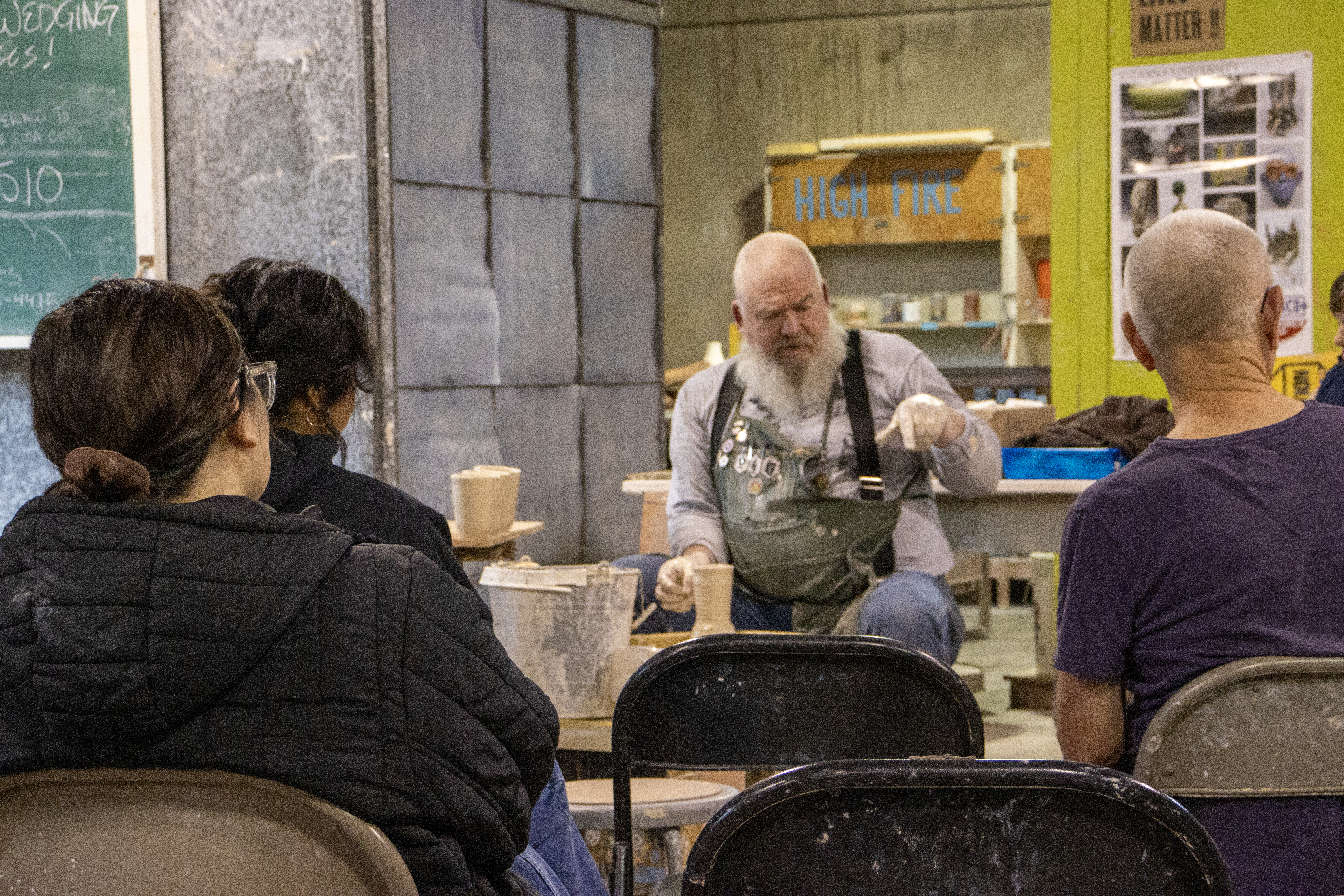
    Anyone who has paid a visit to the ceramics lab here at Cal Poly Humboldt knows that it’s not your typical classroom. The run-down warehouse looks more like an abandoned industrial space invaded by artsy 20-somethings, which, after a look at the history of the building, isn’t far from reality. However rough around the edges the lab may be, it is well loved by ceramics students and staff alike, which is why the recently proposed demolition of the building and its replacement with new housing and parking structures is a controversial topic. 

    While the new construction will provide much-needed parking and housing for Cal Poly Humboldt’s growing student body, the demolition of the art spaces is a cause for some sadness and reflection for the university’s ceramics veterans. Keith Schneider, who retired from his twenty year career as a ceramics professor at Humboldt last spring, reflected on the history of the building as well as his own personal connection to the space. 

    “Over the past 50 years, tens of thousands of students have developed their work and

    honed their skills here, made lifelong friends, and some even met their future spouses

    here in the lab,” said Schneider. 

    The lab’s long history begins with the Arcata Laundry, a commercial laundromat once located in the current ceramics lab location. Reese Bullen, who developed the ceramics program at Humboldt, was successful in purchasing the space under the condition that as a temporary lab, no major structural improvements were to be made to the building. In 1969, the ceramics department staff and students moved all of the laundry equipment out of the space themselves, and replaced it with the ceramics equipment that had previously been stuffed into an undersized room in Jenkins Hall. The ceramics lab continued to be endearingly referred to as “The Laundry,” and in the first few months of its existence as a classroom, former Arcata Laundry customers would wander into the studio with bags of dirty clothes wondering if they could still get them washed. 

    The proposed demolition of this unconventional yet beloved space is one of many small changes occurring throughout campus. The ROSE house and Bret Harte house are also set to be demolished, a decision that has received pushback from students and staff who feel that the charming, if outdated, buildings enrich the character and history of Humboldt’s campus. 

    “Someone said, the best art is made in spaces that look the least like classrooms,” Schneider said. “If you get a chance to walk through the lab, you will get a sense of what our students love about it. It’s not a classroom, it’s a funky old run-down industrial space, with remnants of the past everywhere you look.” 

    Since transitioning to a polytechnic university, Humboldt has received state financial support for the construction of several multi-million dollar projects. At least ten new buildings are listed on the school’s “Infrastructure Projects” web page, mostly including science labs and housing. Included in the prospective are plans to construct a new Campus Apartments building and parking structure where the current residence and ceramics and sculpture labs are now located. 

    According to the web page, the building complex will consist of “600-700 beds in total that will be built in relation to a new 650-stall parking structure.” While Cal Poly Humboldt students are undoubtedly in need of both housing and parking, a vital part of campus culture and art will be replaced by the facilities. Brandy Ayon, who is currently enrolled in their second class in the ceramics lab, expressed this sentiment. 

    “I will miss it. It’s bittersweet,” said Ayon. “The old-timey-ness and roughness of the building is very Humboldt. I’ll miss it, but I’m excited for the new opportunities a new space will bring.” 

    Ayon hopes that the new space will be like a blank canvas for students. It is unclear where the new studio will be located, or when it will be ready to use. The demolition of the ceramics and sculpture studios is proposed to be completed by 2026 and is expected to cost $2.5 million.  

    “A new building may come with all the latest technology, but the character and quality that students have come to love about the Laundry would be very difficult to recreate. A huge part of history will be lost when/if this building goes,” said Schneider.

  • Parking problems perpetuated by parking pass sales

    Parking problems perpetuated by parking pass sales

    by Nina Hufman and Cash Rion

    Every day, Cal Poly Humboldt students drive through full parking lots past rows and rows of parked cars as they desperately and often fruitlessly search for the rare and elusive open parking spot. This is the result of the university selling an excess of both general and residential parking passes in tandem with an increase in students due to the school’s new polytechnic status. There are more active passes than there are permitted parking spaces on campus, with active passes including both semester and year-long parking passes.

    “I’ve heard from a lot of students that don’t live on campus that it can be hard to find parking unless you get here really early,” said Evan Vieira, a wildlife and conservation major. “I’ve known students who have gotten here only as late as 9 or 10 am and have not found parking.”  

    A public records request revealed that, this semester, Cal Poly Humboldt oversold parking passes for both general and residential parking. As shown in the graphs, overselling parking is a growing trend across semesters, with 119 more general passes sold than there were parking spots, and 431 excess residential passes.

    “It sucks total ass,” said art education major Mikayla Nicholas. “I don’t personally drive but I have friends who do and it takes them at least 20-40 minutes [to find parking.] They sell way too many parking passes than they have spaces.” 

    The number of general parking passes sold has increased from last year. The number of active general parking passes increased by 79% from fall 2021 to spring 2022. The number of active general parking passes for fall 2022 has more than doubled since fall 2021, but the number of general parking spaces has remained the same. 

    Total active residential parking passes

    Meanwhile, sales of residential parking permits have stayed relatively consistent, being oversold each semester. In fall 2021 and fall 2022, 431 more passes were sold than there were spots for, and in spring 2021 the number rose to 579 oversold. Anyone with a residential permit that cannot find a space in resident-specific lots overflows into general parking lots. This further contributes to the lack of general parking.

    “I think it’s alright most of the time if you live on campus,” Vieira said. “I live in campus apartments so my car doesn’t move that often, so I’m typically in a parking spot.”

    While those who live on campus can generally find parking, students who drive to campus are becoming increasingly upset at the lack of available parking.

    “Horrible, absolutely horrible,” said Harrison McDonald, a wildlife management and conservation major. “Since I have an 8 am, I get pretty lucky, but when I don’t, it takes me anywhere from 10 to sometimes even 40 minutes if I can even find parking.”

    Many students are frustrated that they pay for general parking passes, only to have to pay for metered parking or to be unable to park on campus.

    “Humboldt for the year, you pay over 300 dollars for [a parking pass] and you’re not guaranteed a spot and you still have to pay for parking meters,” McDonald said. 

    Other students are frustrated by the message that they feel overselling parking passes sends. The university profits from parking pass sales, but has nowhere to put the extra vehicles. 

    “I did not know that [parking was oversold],” Vieira said. “I feel like that’s not great because then you’re kind of saying to a lot of students, ‘you can all park here,’ but then not actually having the spaces to give them parking.”

  • Scene Kids Make A Scene At Emo Night

    Scene Kids Make A Scene At Emo Night

    by Ione Dellos

    During the pandemic, the Van Duzer Theater Hall sat empty, no encores, no cheers, just silence. Tonight, that all changed. Dozens of black-clad students flooded the doors of the theater, brimming with anticipation for the chance to see one of their favorite songs from middle school played live before their eyes. There was no shortage of smudged eyeliner among the patrons who filled the theater for the sold-out show. 

    With this level of attendance for a show, there are a lot of moving parts involved. Amanda Kachevas, Programming and Event Coordinator for Center Arts, told me about the planning behind this event. They booked the band six months in advance, and had been setting up the concert since 10 am. The event ends at 1 am, so the Center Arts crew will still be there until 2 am breaking the whole thing down. When I asked Kachevas if she gets to go to sleep, she laughed at the prospect.

    “Never!” Kachevas said.

    At around 8:40 pm the band took the stage, and instantly started the show off with an electrifying on-stage presence. Their lead singer, Marcus Leonardo, belted out beloved emo numbers such as “I’m Not Okay” by My Chemical Romance and “Sugar, We’re Going Down” by Fall Out Boy. The lead guitarist, Stephen Henry, leapt around the stage as he shredded run after run, and would even place his guitar behind his head for complicated solos. 

    Concertgoer Liam Boyd, asked if he was having a good time at the show, responded enthusiastically.

    “YEAHHH!” Boyd said. 

    He beamed with joy that the band had played his favorite song, “Welcome to the Black Parade” by My Chemical Romance, just moments before. 

    The crowd coursed with energy, further fueled by the band playing nostalgic hit after hit. Songs from the concert included “Sugar, We’re Going Down” by Fall Out Boy, “I’m Not Okay” and “Teenagers” by My Chemical Romance, “King For a Day” by Pierce the Veil, “Dear Maria, Count Me In” by All Time Low, “American Idiot” by Green Day, “I Write Sins Not Tragedies” by Panic! At The Disco, and more. 

    Large crowds need an even larger security detail, so I asked the Center Arts staff what it’s like to work these events. Lavender Deng, a second-year student at Humboldt who works security for Center Arts, told me a little about what it’s like to work security for the school. 

    “It’s fun,” Deng said. “You just get to watch all of the shows and make sure nobody brings in something that they’re not supposed to.”

    Watching the electrifying setlist, I knew that I needed to get closer to truly capture the band’s presence. Thanks to the help of two concertgoers, Vance Fewell and Taylor Danel, I was able to work with the Center Arts staff to get in front of the barricade. Words cannot describe how incredible it was to get to see the musicians perform less than two feet from my face, and feel the barricade shake behind me as the crowd rocked with the music. 

    Overall, this was a wonderful concert, and it was a hell of a way to relive my middle school years (minus the middle school part).

  • Cal Poly Humboldt’s vertebrate museum opens to the public for the first time

    Cal Poly Humboldt’s vertebrate museum opens to the public for the first time

    by Alina Ferguson

    Cal Poly Humboldt’s campus has a vertebrate museum, dedicated to skulls, skeletons, skins, and tissue from various mammals and vertebrates, such as rats, mice, and sea mammals native to Humboldt county. This student-run museum has about 15,000 specimens, 9,000 of which are available for viewing. 

    The museum is now allowing all students a peek into their collections, which include rodents, otters, seals, and taxidermied elk. Students are also able to view the anatomical study processes such as dissection and labeling.

    Previously, the collection was only accessible to students within the wildlife major. The students would look through the collection and study the specimens, testing their ability to identify them. Now, for the first time since the museum was established in 1969, the museum is open to all students during their open hours on Monday from 11am to 4pm, and Tuesdays through Fridays 12pm to 5pm.

    Shea Daly, a senior who works in the lab and does most of the preparations, extended an open invitation to all students.

    “On the last Friday of the month, we are going to have open labs and live dissections, so come in and ask questions,” Daly said. “We are also trying to start up scientific drawing classes.” 

    Daly added that students from all majors are welcome to come in and watch the process of dissecting and skinning the animals.  

    “The students are very hands-on. They can do preps, they can do skeletonizing, which is the process of dipping the bones into an ammonia bath to make them whiter,” Daly said.

    In the past, the staff would forage and scrounge for their own specimens. According to Collections Intern Ezra Alberts, now they get most of their specimens from donations, people finding roadkill on the highway, and the marine mammal training program. 

    Silvia Pavan, the faculty advisor and grant funding organizer to the museum, explained that they typically only need to work with the skull of the animal, as it provides the most information. The rest of the bones are disposed of in a biohazard bin if there is no room for them in the lab or the museum. 

    Opening a freezer full of numbered vials of tissue samples, Pavan explained the process of tagging each animal and the importance of it. Once an animal has been skinned and deboned, each corresponding part must be labeled and numbered. This tracking lets them trace where the tissue samples came from, the food samples of the animal, and the genealogy of the species.

    The museum has a second room, the bug room, where they process the bones that have any remaining flesh or tissue still attached. The bones are placed into a container, where dermestid beetles eat away at everything but bone. Depending on the animal, the carcass may be there for a few days or a few weeks. 

    A large portion of the work the museum does is tissue sampling, genetics, and CT scanning. This work helps the scientists determine what it ate, where it came from, and ultimately, what killed it.

  • Against campus “cop-liments”

    Against campus “cop-liments”

    by Alana Hackman

    A few weeks ago, I accompanied a friend to the University Police Department after her wallet went missing during the Durand Jones and the Indications concert.

    While in hopeful pursuit of her wallet, I was quickly reminded of the dystopian nightmare we live in when I came face to face with a neatly stacked pile of yellow “PRAISE COUPONS” prominently displayed atop the UPD information desk. “When one of our officers or staff members treats you in an exceptional way, please let us know!”, the coupons exclaim in a migraine-inducing font combination of Papyrus and Comic Sans. There are also blank lines left for comments and the name of the officer or staff you wish to praise. 

    Good to know our Cal Poly windfall went to these babies. Who would’ve thought University police would need “good job” stars to get their jobs done? Although the pile did look pretty untouched the last time I saw it. After this experience, I pondered the reason for these praise coupons’ existence. 

    I wondered why UPD officers are the only ones with access to these praise coupons. Why can’t I give one to the nice lady at the housing desk? Or the groundskeepers who wake up at 5 a.m. to beautify our campus? Why isn’t there a pretty little stack of coupons at every help desk on campus to show some love to our staff? Sure, I could make my own coupons to show my appreciation, but how come the UPD gets the fancy ones on cardstock?

    I then began to wonder what the reason would be for an officer to receive these praise coupons.  Refraining from use of excessive force? Oh, I know, maybe we actually got someone to stay in the position of police chief for longer than a year?

    Then it hit me. It was right in front of my face the whole time. Praise kink. I realized that maybe all of the UPD officers might just have a little bit of a praise kink. Hey, I’m not judging you! This is the only plausible answer to why you have “PRAISE COUPONS” strewn about your department. I mean, you even give people the opportunity to mail the coupons to you if they slap a stamp on them. At least you’ve made it easier for the sender by pre-addressing them to the Chief of Police on the back of each card. It comes off as a little desperate to me, but I’m not here to yuck your yum. 

    I may have judged you too soon, UPD, when you’re just trying to find some pleasure in your work—literally. I wouldn’t say incorporating others into your fantasies is the most humane choice, but you’ve gotten away with far worse human rights violations. 

    For real though, students: show some appreciation for university staff that help you with your daily dilemmas without needing a PRAISE COUPON. Cal Poly Humboldt would crumble without their behind-the-scenes work. Remember kids, validate your local cop’s praise kink, because we don’t kink shame!

  • Cal Poly Humboldt spends nearly $16,000 replacing stolen sign letters over the summer

    Cal Poly Humboldt spends nearly $16,000 replacing stolen sign letters over the summer

    by Ollie Hancock

    Over the summer break, the iconic signs brandishing the school’s name lost their letters again and again. Vandals would rip the acrylic letters from the wall over the course of a few nights before they were replaced. The sign might stay intact for a few days, then the cycle would start again. The signs had only recently been changed to read “Cal Poly Humboldt” with the new polytechnic designation.

    The signs read like a game of hangman: “C_L PO_Y HUMBO_ _ _” one week and  “_AL _OLY _UM_O_ _ _” the next. Replacing the sign letters isn’t an easy process either. It requires one member of maintenance staff to place the letters on the facade while another climbs inside the sign to tighten them. An anonymous source, one of the vandals, explained that pulling them out was much simpler. 

    “It was easy,” the anonymous individual said. “They popped right off.” 

    When asked why they pulled the letters down, the vandal explained that they were dissatisfied with the school. They faced backlash over the anonymous chat app Yik Yak, where users complained that their actions would increase surveillance and police presence in the community. This appears to have been borne out, as cameras were installed on light poles facing some of the signs over the summer. 

    “I think that the school is wrong for bringing in more cops to solve the problem,” the anonymous source said. “Why spend so much time and money fixing it when you could do something to show legitimate support for the community instead? They seem more worried about the signs than their students.” 

    There were a total of 54 acrylic letters stolen or broken over the course of the summer. UPD is actively investigating these incidents as repeated acts of vandalism.

    “Unfortunately, signage is expensive and it’s costing the University thousands–nearly $16,000–to cover the amount of stolen lettering, replacement letters, and labor,” said Cal Poly Humboldt spokesperson Grant Scott-Goforth. “If we need to change all the signs to metal letters, it will cost the University at least an additional $12,000.” 

     “[UPD has] increased patrols, and we will pursue the maximum penalty when the people responsible for the vandalism are caught,” Scott-Goforth said. 

    For the last weeks of summer, the signs sat blank. Facilities Management was able to re-letter most of the signs by the start of the semester, so families and new students could identify the campus. Two signs still remain empty on the intersections of 14th and Union St., and 14th and B St. 

    In addition to the increased patrols and surveillance, the University is considering replacing the current sign letters with harder-to-remove metal lettering.

  • Comfortable at the Comfort Inn

    Comfortable at the Comfort Inn

    by Angel Barker

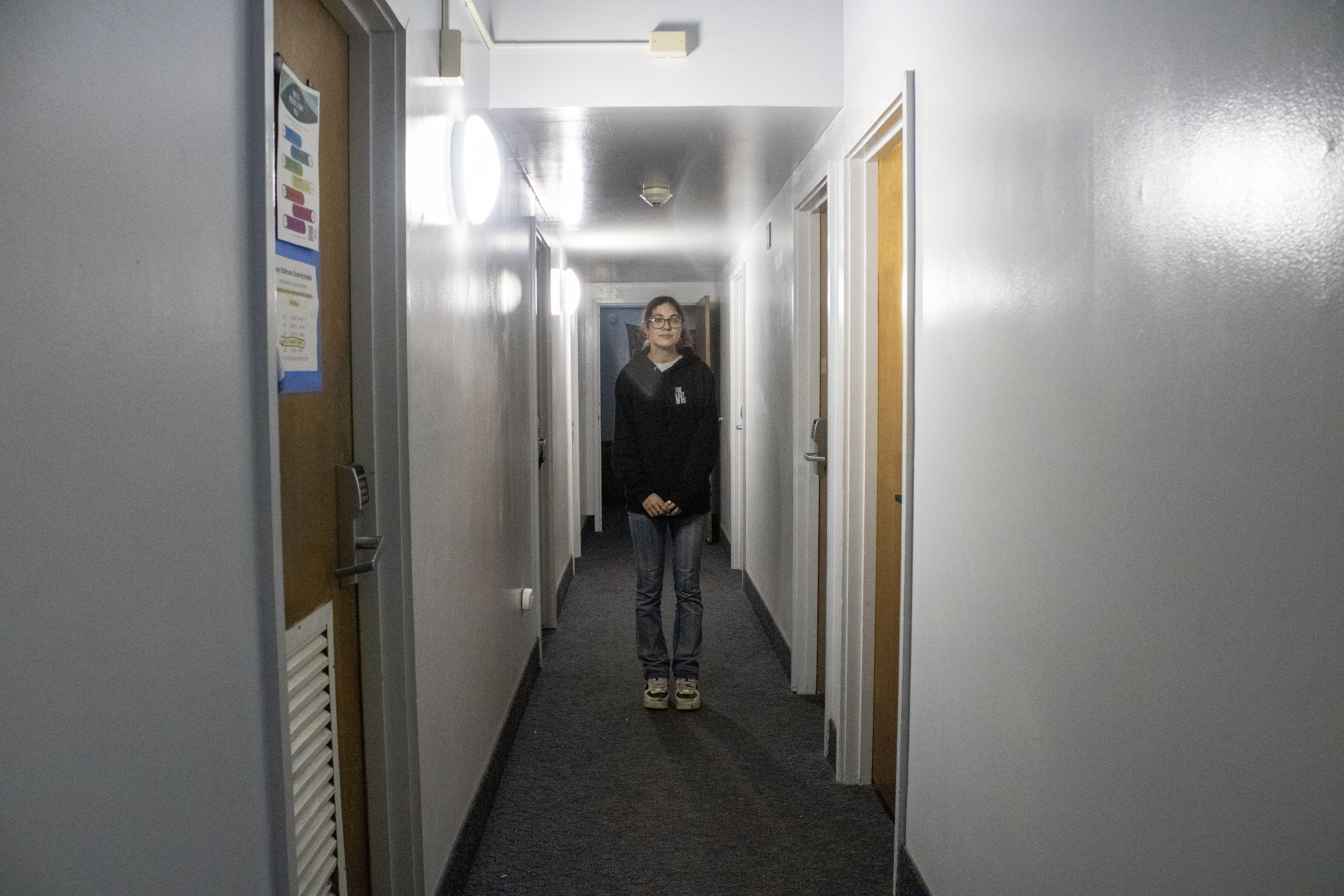
    Dorm life is an important part of the college experience, but what happens when your university does not have adequate housing for its population? They turn a hotel into a residence hall. The Comfort Inn in Arcata, located in the Valley West area, is now home to almost 100 upperclassmen students.

    The housing shortage is nothing new in Arcata. For students like Gabriela Mendez, a transfer student majoring in psychology, finding off-campus housing was unsuccessful.

    “I was hoping to find last minute housing off campus,” Mendez said, “but there was nothing.” 

    Mendez has a roommate in the hotel, as all rooms are double occupancy. Each is supplied with two beds, desks, and dressers.

    When asked her opinion about what it is like living in a hotel, Mendez said, “People can say ‘you don’t get the full college experience,’ and like, the college experience might be cool because I am a transfer student, but I am just grateful to have housing.”

    Osiel Palomino, a returning sophomore majoring in environmental studies and management, had the same reaction. 

    “If it wasn’t for that room, I would have held off on going back to school for another semester,” Palomino said. 

    Palomino lived on campus his freshman year in 2019-2020 right before the COVID-19 pandemic, and moved home and took a break from school until classes were back in person.

    Sarah Neumann, a business administration exchange student from Germany, is Mendez’s roommate.

    “We made a good situation,” Neumann said. “I like it because I think we have more space and privacy, especially with our own bathroom.”

    “One thing that I really love is each room has their own shower and bathroom. You don’t have to share one bathroom with the whole halfway, you avoid those problems,” Palomino said.

    In addition to each room having their own bathroom, they also have free amenities like linens, a minifridge, a microwave, TV with cable, housekeeping services, continental breakfast everyday, Wi-Fi, and pool and gym access.

    Compared to living in a freshman dorm on campus, Palomino said that living in the hotel still feels relatively the same.

    “You still feel the college experience because everyone living there is students,” Palomino said. “You still feel like you’re on campus even though you’re not.” 

    A large banner welcoming Cal Poly Humboldt students and the friendly front desk staff also help with that feeling.

    Staying connected can be difficult, but the RAs and the Office of Housing and Residence Life are hard at work to help the students feel included in campus life.

    “The RAs have little events, to make it feel like the real dorm college experience,” Mendez said.

    Neumann and Mendez even bought a whiteboard for the outside of their door.

    “People can just write anything, so we can still communicate with others when we don’t always see them,” Mendez said.

    Overall, students are satisfied with the University and the Comfort Inn solution to the housing shortage.

  • New arts faculty hit the scene

    New arts faculty hit the scene

    by Jasmin Shirazian and Jack Hallinan

    With the recent upgrade to a California Polytechnic, many changes have been occurring on campus. Among these changes is the addition of new arts faculty members Justin Maxon and Sarah Lasley.

    Justin Maxon is a photographer and educator who grew up on the Hoopa Reservation and in Eureka. He moved to Santa Cruz to attend Cabrillo College, where he had his first experience with photography in an academic setting. 

    “I wanted to do environmental science, and then I took a darkroom class and I was just like, ‘this is it,’” Maxon said. “I already loved photography, but I didn’t actually think that I could do it, then as soon as I took that class, I was like, ‘this is what I have to do.’”

    As an artist, Maxon’s focus lies in community based work that has an impact. Although he has a background as a journalist, he considers himself a documentary photographer who prefers to work on long term projects. Maxon’s recent work “A Field Guide to a Crisis” is an ongoing project in collaboration with people residing in sober living homes in Eureka. The work focuses on flipping the narrative of those dealing with substance abuse disorders by “repositioning them as experts in how to survive crisis.” Maxon brings this philosophy of community-based work to the classroom when he teaches his Professional Practices class. 


    “A lot of the folks in the program are like, ‘I wanna work in a specific communal context…’ Well, that can be your art form,” Maxon said. “How you collaborate with people, and the aesthetics of that collaboration and how that is visualized [can be art].”

    This semester Maxon is teaching Darkroom Photography I, Digital Photography I, and Professional Practices in Art. 

      Sarah Lasley, an award winning filmmaker, has joined Cal Poly Humboldt’s film department. Lasley previously taught at the Yale School of Art for over a decade, and later at the University of Texas San Antonio. Lasley is now a part of the Lumberjack family, teaching FILM 378, a digital production workshop showing students the ropes of video and film editing.

    Lasley has had her work featured in several film festivals, including the world-renowned AVIFF Cannes FIlm Festival in France. 

    Lasley has been creating art of all mediums from a very young age, though she began her filmmaking journey in 2006 during her time at Yale School of Art, where she was attending school for painting. 

    “A month into the painting program, I stopped painting and I picked up a video camera,” Lasley said. “Growing up, I had a VHS camcorder, and I would make stop motion animations with my Barbie dolls, so motion had always been in my groove.” 

    Lasley’s most well known film, “How I Choose to Spend the Remainder of my Birthing Years,” is a solo film she created during the COVID-19 quarantine lockdown, in which she replaces Baby in “Dirty Dancing.”

    “I had just moved alone, at the age of 38, to a city where I knew no one, away from everyone, as a single woman,” Lasley said. “I was like, I guess this is it. This is it for me, I’m going to just focus on being alone, and I was feeling down on myself, so I put on Dirty Dancing. I thought, ‘You know what would be so funny?’ To remove the 16 year old who’s romancing the 30 year old, and put like a 40 year old in there.”

    Lasley, who has been in the arts for over a decade, knows the struggles of being a student trying to get their foot in the door of the industry. 

    “Just never quit… going into an industry like film, you’re going to have so much burnout because there are big pockets of long hours,” Lasley said. “You can burn out fast, but what you can’t do is let go of making your own work and your own side projects.”

    Lasley currently has two upcoming screenings for her new film, “Welcome to the Enclave,” a contemporary think-piece on the different reactions received by the Black Lives Matter movement. The showings will be held at the Burb Contemporary in Sacramento, California and The MAC in Dallas, Texas.

  • Humboldt Triathlon team debuts

    Humboldt Triathlon team debuts

    by Dezmond Remington

    A grueling, painful, death march. Triathlon, in the minds of many people, can typically be summed up with adjectives like these. In this sport made up of three endurance events already immensely challenging on their own, competitors race in a 750 meter swim, a 20 kilometer bike ride, and a five kilometer run. The words “fun,” “supportive,” and “enjoyable” do not often come up. However, Head Cal Poly Humboldt Women’s Triathlon Coach Kinsey Laine hopes to build a team which embodies that positive energy.

    “My main goal for all of my athletes is that they enjoy their experience,” Laine said. “The way that they’re going to ultimately improve in the sport is by being excited to come to practice.”

    Laine has experience fostering these environments with her athletes. Before coming to Humboldt, Laine was a triathlon coach at Colorado Mesa University in Grand Junction, Colorado, and before that she was the swim coach at the University of Alaska in Fairbanks. While at Colorado Mesa in 2021, her team placed fourth at the National Championships in Tempe, Arizona, and had three All-American finishers. Laine has also raced long-course triathlon professionally, but that ended when the pandemic started and she started coaching at Colorado Mesa.

    This prior experience has prepared her to coach athletes like junior Elizabeth Odell and sophomore Emily Cates, who like triathlon as a way to avoid injury and seek new challenges. 

    When Odell first heard about the nascent triathlon team, she wasn’t too interested. However, the lower risk of crashing appealed to her, and she started learning how to swim and run this past spring. Though difficult, Odell said the process of picking up two new sports has been enjoyable. 

    “It’s been a good change. I’m not always comparing my times to how fast I was a year ago or something,” Odell said. “It’s just completely new. So all I’m seeing are gains and it’s just all pretty much getting better.”

    Getting away from the stress of injuries was also a motivating factor for Cates when she joined the triathlon team. From a running background, Cates had dealt with a spate of overuse injuries that had left her stressed and frustrated. Training for triathlon, where two out of the three disciplines are zero-impact, was attractive. 

    “I realized that running, just running, was not going to be sustainable for me,” Cates said. “And it’s a great opportunity to cross-train, and if I’m going to be cross-training that much on my own, I might as well race it and have another team atmosphere.”

    Cates has not quit running entirely; she is also on the cross country and track teams at Cal Poly Humboldt. Being a dual-sport athlete does have its challenges, Cates said, as it’s often tiring to train for two sports at once. Recently, she went straight from a swim workout directly to a mile repeat workout for cross country.  

    Hosting this unique sport puts CPH in a unique position– it is the only Division II school on the west coast to offer a women’s triathlon team. Only two other NCAA affiliated schools on the west coast have a team. Laine sees this fresh start as a great opportunity. 

    “I think in three to four years this team is going to be competitive at the national level for DII,” Laine said. “There are teams that have been around five or six seasons, but there is instability in those teams, so we’re not five to six years behind. I think we can come in, and then in a few short years be competitive against those schools.”

    Women’s triathlon in the NCAA is a new sport – the NCAA classified it as an “emerging sport” for women in 2014, and currently there are only 17 Division II schools that host triathlon. Triathlon is only available as a women’s sport in the NCAA. 

    The largest challenge facing the fledgling team is the late start– Laine was hired on a fairly short notice, and as such, there are only four races the team is scheduled for this season. 

    Recruiting is mainly coming from current students with a background in running or swimming or both. A few of the prospective athletes do have a past racing triathlon. The roster will be kept small, with the eventual goal of 9-12 athletes on the team.

    “[I want] a small, focused group of people that are very supportive of one another…but also really passionate about the sport,” Laine said. “As a coach, you can’t make them want to be better at triathlon–they have to provide that passion.”

    Odell agrees. She has a background in mountain biking, but when a bicycle crash in January fractured her neck and gave her a severe concussion, she had to re-evaluate how she wanted to compete. She had to drop out of most of her classes and move home, and could barely walk for two months. 

    “About two and a half months in, I was able to go for a two mile walk, and that was so exciting for me,” Odell said. “Just walking around the block my head would start pounding. It took me like five months to become a functional human being again.”

    The late start and injury-riddled pasts of many triathletes has not made getting the team off the ground easy. However, Cates said she couldn’t wait to race and see what her teammates can do. 

    “I’m excited to know them, to get to travel with them,” said Cates. “They seem like really awesome, dedicated people, and I think we’re going to make an awesome team this year.”

  • Take a Hike, why dontcha: A guide to the best hiking spots near Cal Poly Humboldt

    Take a Hike, why dontcha: A guide to the best hiking spots near Cal Poly Humboldt

    by Alina Ferguson

    Cal Poly Humboldt is famous for its forest and hiking. Arcata is centrally located between hills, forests and beaches, so there are a lot of options for anyone looking to backpack, camp or simply take a hike. 

    Maired Sardina, program coordinator for the Center Activities Recreation and Wellness Center on the CPH campus, has some tips and trips for aspiring hikers.

    The Arcata Community Forest is right here on campus. It is easily accessible for those without cars or any other mode of transportation. This hike is relatively low intensity, so it is not required to be a seasoned or skilled hiker. 

    This hike is also safest for beginners or anyone new to the area, as it is connected not only to campus, but to the town as well, so it is difficult to get lost. “There are so many options to get back into town” said Sardina.

    According to returning senior, seasoned hiker and R.A. Alexis Quiroz, the Community Forest is best for beginners because there are resources available close by.

    “If you get lost or injured and you dial 911, it connects you to the UPD instead of the Arcata Police because the forest is within the school boundary,” said Quiroz. 

    Last semester, Olivia Greenwood, an education major here at Cal Poly, said she spent practically every day in the Arcata Community Forest. 

    “I was hiking like everyday last semester, I would hit the trail at like 4pm and I went pretty deep into the forest,” claimed Greenwood, “Hiking during covid was pretty isolating but kind of nice, to be alone with nature.” 

    A hidden gem that is really only ever traveled by locals, a part two to this hike, is called Beith Creek Loop. While not on the campus itself, it is a short distance away, within the Arcata main town. 

    A 10 minute drive away from the CPH campus, the Ma-Le’l Dunes are a historically significant hiking spot. These dunes lead to the waterfront. This route is the site of many historical events, which mostly occurred during the late 1990s and early 2000s, as protesters lived in trees. To find more information, the Humboldt Nature center has hikes available. 

    The Coastal Nature Center has a visitor center with plaques listing facts about the dunes and the nature around the dunes. 

    “That’s one of my favorite areas” said Sardina, “It’s gorgeous there” 

    Headwaters Forest Reserve is a progressive hike. The first mile is all paved, so it is most popular for casual strolls, skateboarding or dog walking. However, the next four miles are all trail, so the intensity picks up. 

    “You get to choose your own adventure,” said Sardina. “You can choose, I want to go a mile on the pavement, I want to go a mile on the trail, or you can choose to do all ten miles, 5 miles in and 5 miles out” 

    Fern Canyon is one of the busiest and most famous hiking spots in Humboldt. So much so that a permit is now required to get in until October 1st. The canyon itself is a flat hike, with fallen trees and trails partially submerged underwater. Hikers can park directly next to the canyon or hike in from the Prairie Creek Visitor Center, about a 11 mile round trip according to the National Park Service.  

    This hike is much further from campus, about a 40 minute drive. However, the hike leads to a beach called Gold Bluff, where camping out for the night is an option. 

    Prairie Creek Redwood National Park is home to the tallest trees in the world. To see these giants, it takes 45 minutes from campus, if not by car, then by bus as all Cal Poly Students can use their student IDs for free transport.  This is the spot for anyone looking to camp, or go backpacking for a day. Backcountry campsites are very common to find, a couple of the biggest being 44th Camp and Elon Camp. 

    “I couldn’t recommend it more,” Sardina said.

  • Field Camp tests geology students’ knowledge and endurance

    Field Camp tests geology students’ knowledge and endurance

    by August Linton

    Field Camp for Cal Poly Humboldt’s geology majors is a month-long academic camping trip, and a foundational experience in the field that geologists remember with love. 

    Local field trips to places in Humboldt like Agate Beach and Big Lagoon are testing grounds for students used to dusty labs on campus. The university has a large library of rock samples, but students enjoy collecting their own. 

    “Agate Beach was a good one,” said Riley Clark, a CPH graduate and Field Camp returnee. “I’ve had structural geology trips there to look at faults and things like that, and sedimentary geology trips there to look at marine sediments.”

    Geology department classes teach both book knowledge and field techniques. One class called petrology, about the origin and microscopic structure of rocks, uses a technique called thin sectioning. With careful sanding, epoxy, and heat, students can make microns-thick samples of rock for microscope analysis. Field trips give students the opportunity to use these techniques at actual sites rather than in a lab.

    From May 29 to June 29, students from the program visited teaching sites in California’s Eastern Sierras for their capstone Field Camp, which is a more intense iteration of the geology field trip. Other geology programs also visit those same sites.

    “The first field site we went to we were alone, then at the next site there was Sac State, Montana State, a class from Wyoming, Northridge was there,” said graduated geology student Nay de la Torre. 

    Field Camp is analogous to a capstone project for geology students, a field-wide tradition that most programs participate in. It teaches students how to apply their knowledge, but also 

    Photo courtesy of Riley Clark | Roch Creek, an area that students were tasked with mapping near Bishop, California
    Photo courtesy of Riley Clark | Roch Creek, an area that students were tasked with mapping near Bishop, California

    The Poleta Formation is a common teaching location located in the Eastern Sierras, where different layers of sediment are exposed and can tell geologists about the geologic history of that place. 

    “It was deposited during the Cambrian…when California was covered in a shallow sea,” said de la Torre. “You could walk from LA to Las Vegas with water up to your knees.”

    This shallow sea still had tidal action, which geologists can tell based on those layers.

    “The tide would come in and come out, so during this time sandstone would be deposited, then when the tide went out the water would evaporate and deposit carbonate rocks like limestone,” de la Torre said.

    At a second location in the Inyo-White Mountains, students spent time studying igneous intrusions into the crust, called plutons. There are also several wide-reaching fault systems that span the area, which students were tasked with mapping. 

    “At one of our sites we saw a series of faults and then at another one we saw a series there,” said Clark. “It was neat to correlate those…we know that the same compression on the continent caused it.”

    De la Torre says this trip stretched the students to their limits mentally and physically.

    “Everything that you’ve learned, you use it at Field Camp, with every class since freshman year,” said de la Torre. “You don’t really have time to do much else other than go to the field, eat dinner, and go to sleep, cause you’re so tired every single day.”

    Weeks of complete isolation from everything other than a small group of colleagues, six to nine miles of hiking every day in baking sun, and living in tents for a month taxed the students, but also galvanized them. Their daily tasks, like surveying areas for map-making, mirror what they will be asked to do in their careers as geologists.

    “Field Camp feels like something that I’m going to remember for the rest of my life, because all the older geoscience people that I talk to still remember their Field Camp,” de la Torre said.