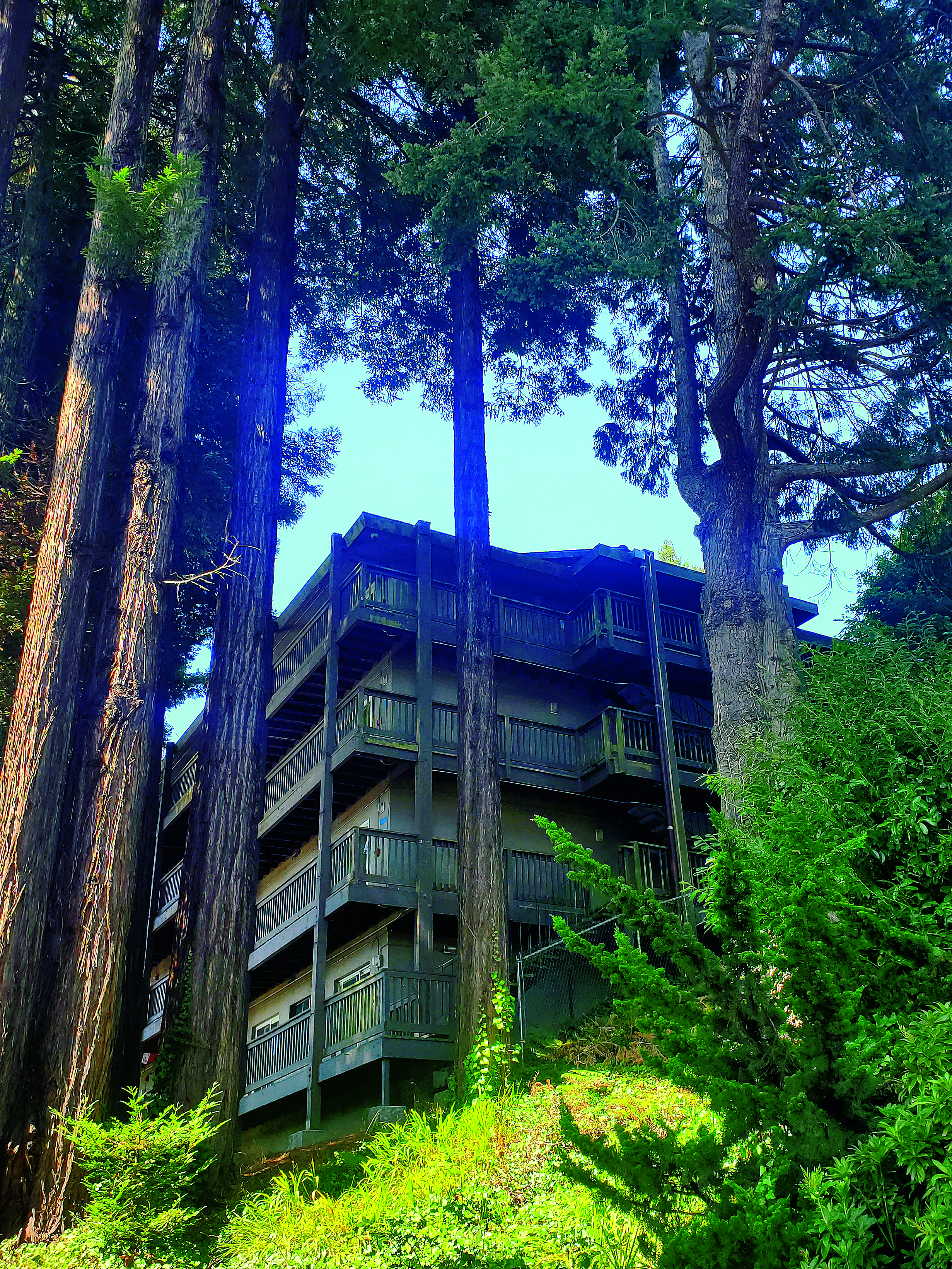
I hated living on-campus. The mold, the roommates, the noise? I only lived on-campus for a year, but I could never go back. Don’t get me wrong, if you have no other choices, I get it – I really do – but other than that, no thanks.
I don’t get why anyone would want to put themselves in a situation where they have to slum it with a shit-ton of other people when they could have their own space. I’m not paying 10k+ a year to live in half of a room with no private bathroom for 7 months, when I can pay half that and have a house year-round (AND MY OWN ROOM).
I lived in campus apartments on the ground floor, which meant I would wake up with ants crawling on me, and get sick at least once a month from the mold. Not to mention my roommate had the opposite schedule as me, staying up until 3 A.M. laughing and talking while I was trying to sleep, because I had practice at 6am the next day.
It was nearly impossible to fit all of the things I needed into my dorm room, considering we’re given such little space for our objects. Sharing a regular sized closet between two people and having no other space besides under our beds was obnoxious, and anytime I needed anything new I had no idea how I was going to fit it.
Off-campus is significantly nicer because I’m able to be in charge of my own spaces, I don’t have to share a room, and I have a private bathroom. I also got to choose my own roommates (shout out to them), which means no more randoms that make life extremely more difficult.
I will end by saying this: I spent my last 3 months of on-campus living on my friend’s couch walking a half mile each way to school so I didn’t have to share a room with my roommate and deal with the dorm space. It isn’t worth it to live on-campus.
Under the indie music umbrella lies the popular eccentric duo, Sylvan Esso. The band fuses electronic, folk and pop. Originally from Durham, North Carolina, singer Amelia Meath (35) and producer Nick Sanborn (40) played in Humboldt County for the first time at Cal Poly’s Van Duzer Theatre on August 28th. The band formed in 2013 and released their debut self-titled album a year later. Since then, they married in 2016 and have released five albums.
I was beside myself when I heard them playing “Die Young” from their second album, “What Now,” as I walked through the doors during soundcheck backstage. Being the fan I am, I immediately started singing and dancing on my way to my seat.
People of all ages – from kids to adults – were there grooving along. The stadium was packed. A lady tapped me on my shoulder and asked if her daughter could stand on my seat. I was happy to give her a better view, so I grabbed my things and b-lined to the balcony.
At the balcony, my favorite song, “Dress,” off their first album, started playing. The theater’s acoustics emanated the howling songbird of Meath’s voice and the crunching technicolor synth of Sanborn.
The funky duo that makes up Sylvan Esso fits in perfectly with Humboldt’s eccentric culture. Meath sported a bleached mullet and wore a leather two-piece and accompanying mesh gown at the beginning of the show that gave her an appearance similar to a singing phantom. Sanborn’s brown khakis and oversized long-sleeved shirt reminded me of the outfits you’d see freshman wear in the Canyon dorms. At one point, Meath disappeared backstage during one of Sanborn’s solos, only to reappear in an outfit that resembled a giant multicolored loofah, in which she danced happily.
Meath’s dance moves showed her skills not only as a singer, but a performer as well, invoking infectious feelings of freedom. There was a lovely moment between the married artists where Meath couldn’t help but smile as she sung their songs and stared into her partner’s eyes.
The set had a delightful amount of variety. It could be loud and poppy or could slow down and swoon the audience hypnotically. The dreamy kaleidoscopic lights and visuals kept up with the mood of the set.
Concert-goer Mike Hanson and his partner were visiting Arcata for the first time from Brooklyn, NY. Hanson has been a fan for a decade.
“Since it was at a college, we didn’t know what we were walking into,” Hanson said.
He was giggling while scanning the crowd of students and realized he was the same age as them ten years ago, when he would blast Sylvan Esso’s first album in his car smoking a blunt.
Nostalgia is why Allison Walstrom came to the show. “Die Young” brought tears to her eyes as it reminded her of her ex. She cringed and laughed.
“When you think about it, what a twisted relationship song,” Walstrom said.
Walstrom moved to Humboldt County in 2005 and pointed out how this was the first time it felt like a show from back in the day in Humboldt. I couldn’t agree more. Once the black market cannabis industry began its descent around six years ago, the big names in music rarely came anymore because Humboldt’s economy declined.
The university is finally reawakening Humboldt’s music scene again. At the end of last semester, I was excited to see a long-time favorite band, Portugal the Man, in the parking lot behind the Gist Hall. Another big name, Thundercat, will be playing soon at the Van Duzer Theatre on September 29th. Safe to say, people are looking forward to crushing good music again in Humboldt County.
What is schizophrenia? According to the American Psychiatric Association, schizophrenia affects less than 1% of the population. It is a chronic brain disorder with symptoms such as delusions, hallucinations and disorganized speech.
I got lucky. I got my diagnosis at the young age of 22, and the mental health system worked in my favor. This is not the case for most, and I want to raise awareness of that. Oftentimes, people suffer from symptoms for years without a diagnosis. Often they are gaslit or belittled. Being called crazy isn’t fun. That’s what I heard the lady next to me in the psych ward at Mad River Hospital say. She was right. It’s not fun, but getting help when you’re not in the right headspace is important. The stigma around mental health, schizophrenia specifically, needs to change. We should be treating those in distress with compassion because mental health can be a difficult topic to approach, especially if it’s regarding a loved one.
The first time I was put on a 5150 hold was because Sergeant Martin of the university police noticed that I wasn’t acting like myself. I misplaced my phone at the Student Activity Center, convinced someone had stolen it. I was telling him things like the person who took my phone put recording devices in my room, and that someone was out to get me. He transported me to Mad River Hospital, where I was put on a 5150 hold; involuntarily held there for my own safety. They ran some tests to make sure I wasn’t on drugs; my paranoia was high and I thought that the oxygen tank in my hospital room was going to explode. I could hear a ticking coming from a camera on the wall that was in sync with my heartbeat. They released me to my dad after one night.
The peak of my psychosis was the night after I was released from Mad River. I took a sleeping pill – never again. I walked and ran three miles from my house barefoot, thinking that someone had planted bombs all over Redwood Valley and that everything I loved would be blown to smithereens. Thank goodness a kind samaritan saw me hopping the fence to the freeway and called the authorities. My dad is a first responder and he told me that was the most fucked-up call he’d ever been on. I tore up my feet and traumatized my father that night.
The next day my parents took me to Ukiah Adventist and they put me on my second 5150 hold. I believe I should have gone straight to a psychiatric facility, but my feet were hurt pretty bad. I guess it made sense to keep me in the hospital for a couple of days, but the hallucinations I experienced there were unsettling. It felt like I lived through a horror movie. I could hear the happenings of what I believed to be a torture chamber in the room next to me. When I was finally transported – without my consent – I believed my whole family had been cut up and sewn into a big wad of flesh, and that I was being “saved” and sent away to start a new life. It took me about five days, and a lot of sedation, to realize that I had been in psychosis for over a week, having been in a manic episode for months. After months of therapy, I fully realized that what I experienced in the hospital was one big hallucination. When the psychiatrist told me I was schizophrenic and bipolar, everything finally made sense.
In total, I was put on a 5150 hold twice and 5250 once. A 5150 hold lets the facility keep you for 72 hours and 5250 lets them keep you for 14 days. I will say this until I die: 5150 patients should not be kept in hospitals unless they have severe injuries. In my experience, hospitals can be very triggering. It’s an unfamiliar environment; the sounds of the machines and people talking can make someone suffering from psychosis spiral into a worse condition.
Now that I have my diagnosis, have been on medication for six months, been in therapy, I look back on all of my delusions and hallucinations, and I don’t recognize that girl. She needed help, lots of help, but she got it. I’m very thankful for everyone who helped me when I wasn’t myself. I’m also appreciative of myself for being vulnerable enough to admit that I need help and accepting the help that was offered to me.
If you take away anything from my experience, please let it be this: listen to the people around you when they’re trying to help you. Say something if you notice a loved one is behaving strangely. No one has all the answers, especially not a manic college student, but that’s okay. The world is a scary place and sometimes our brains make it scarier, but we have each other and that is what’s most important.
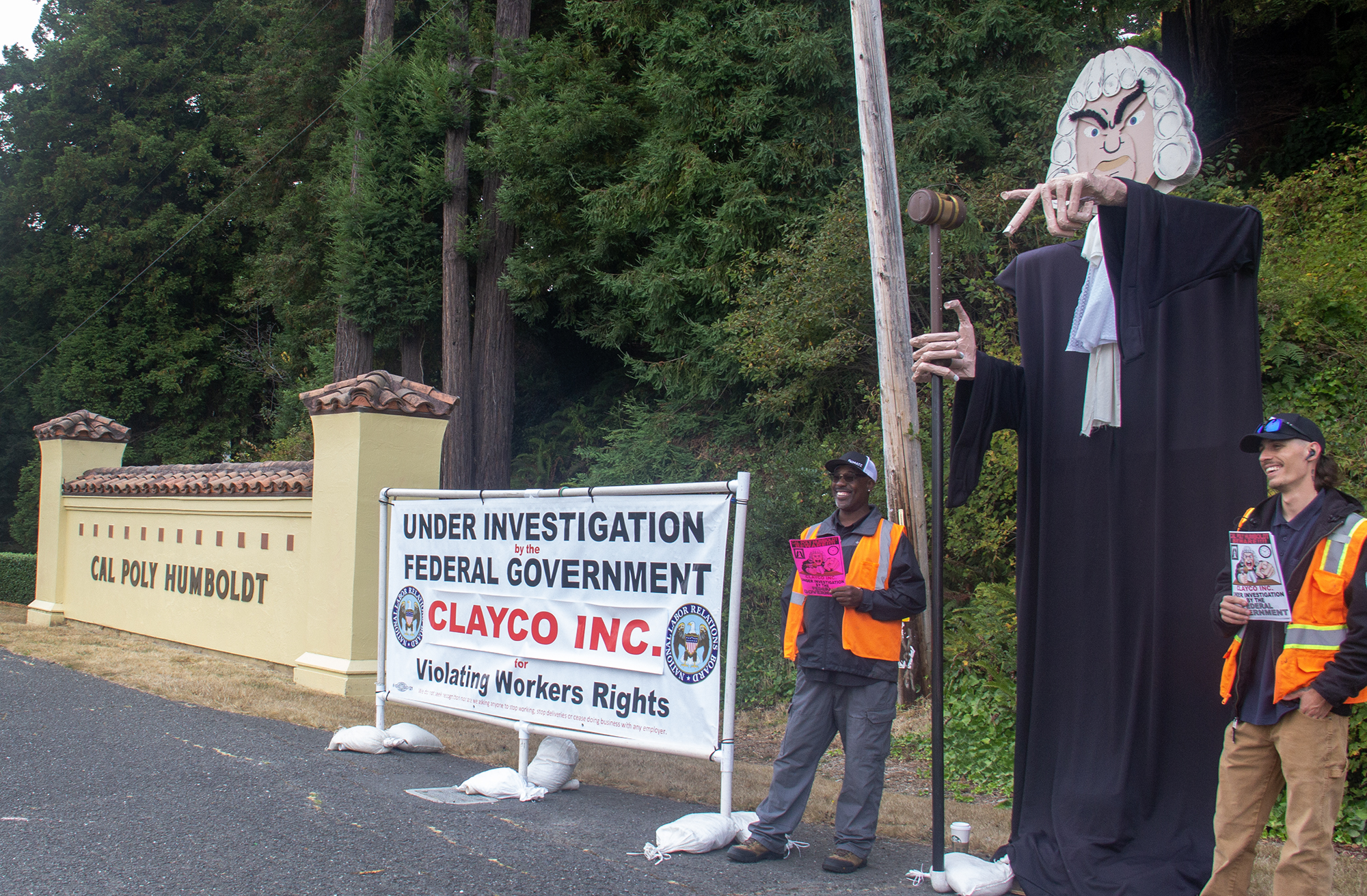
A giant stood on LK Wood. It was twice the height of the men around it, armed with a massive hammer and a demonic scowl. It pointed with a long, curled finger at every soul underneath its gaze, framed by a wooden wig and caterpillar eyebrows. It was a judge, and judge it did.
Photo by Alex Anderson | Members of the carpenters union placed a tall judge statue in front of the Cal Poly Humboldt entrance sign to protest Calyco
“Judgment day is coming,” it said. “Shame on you. Shame, shame, shame!”
No ogre was laying waste to Arcata. It was built as a protest by Local Carpenter’s Union 751 against Clayco, one the companies in the running to bid on the Cal Poly Health, Housing and Dining Infrastructure project, also referred to as #PLY106. The Union and their main goal is to bring the company’s legal issues and history of malpractice to the attention of the campus committee that awards infrastructure projects, and to the community in general.
THE CONSTRUCTION PROJECT
Construction on the Housing, Health, and Dining building is set to begin fall 2024. The new facilities include a new health center and dining hall, and will be able to house roughly 450-500 students. The facilities are planned to be operating by August 2026, or summer 2027 at the latest. The direct construction will cost at least $108.9 million and the guaranteed maximum budget is $131.9 million. The winning contractor will be announced in October of this year.
MALPRACTICE AND WORKING CONDITIONS
In a legally fact-checked letter from Union Local 751 to the CSU Board of Trustees, there is a list that cites Clayco’s history of legal issues due to allegations of malpractice. Clayco has been a defendant in at least 22 cases since March 2000. Since 2010, they have had at least 17 OSHA violations brought against them, resulting in fines around $81,336. Clayco’s legal issues include an active investigation by the Federal government concerning allegations of violating worker’s rights and harassment of union members, a pending case concerning allegations of wage theft, and a wrongful death lawsuit concerning a worker’s death that was settled last year.
OSHA Citation against Clayco documents details on Kirk Smith’s accident
In August 2017, Kirk Smith, an employee of the subcontractor Watson Companies Inc., fell 35 feet to his death while working on the construction of an Ulta Beauty warehouse in Fresno CA. The fall was a result of a weakened roof not being fixed for employees to safely work on, as well as a lack of warnings concerning the stability of the roof. Smith left behind a wife and children, who then sued Clayco along with Ulta and Watson for wrongful death in April 2018. Clayco, along with the other defendants in the case, eventually settled with the Smith family for $5 million in 2022. Attorney Brett D. Beyler, representing Smith’s family, wrote in the court settlement document that the incident was entirely avoidable.
“On August 9, 2017, Kirk Smith (the decedent) arrived at the Project,” Beyler wrote in the settlement document. “He was directed by Watson [Companies Inc.] foreman, Mr. Rabideau, to cut out the membrane and insulation on top of the metal decking. As Mr. Smith was cutting the membrane and insulation out with a hand knife, the weakened metal decking gave way like a trap door, causing Mr. Smith to fall nearly 40 feet to his death. This incident was entirely avoidable. Unfortunately, due to the negligence of Clayco and NDBS [National Design Build Services], Mr. Smith is no longer alive.”
WAGE THEFT
Decision by US District Judge John Mendez gives background info on allegations of wage theft
Clayco is currently in an active case regarding wage theft. These allegations are brought forth by labor rights organization, The Workforce Defence League (WDL), representing laborers who worked on Amazon Fulfillment Centers in Sacramento and Tracy who say that they have not been compensated for their overtime work or use of their own tools in the construction project.
According to the WDL, the laborers worked 58 hours a week and were promised $20-24 an hour. They weren’t fully paid for their regular or overtime hours, and they didn’t receive their work breaks and only got one meal break. They also didn’t get compensated for the missed breaks.
HARASSMENT OF UNION REPRESENTATIVES
NLRB charge against Clayco for allegations of harassing Union members
Clayco is also under current investigation by the federal government for allegations of violating workers’ rights as well as harassment of union representatives. Two separate documented charges brought against Clayco by the National Labor Relations Board were filed as recently as November 2021. They claim that the contractor unfairly fired a subcontractor from their position, and attempted to prevent the Carpenter’s Union from conducting their activities by barring them from Clayco properties and instructing Clayco employees to limit contact with Union representatives. Additionally, videos on the Local 751-run website, Claycofails.com, show alleged harassment of Union organizers. One instance alleges that a Clayco foreman followed and videotaped an organizer.
“[Clayco] interfered with the exercise of protected rights by firing a Union signatory subcontractor when Union Agents tried to access the site,” one document read.
“[Clayco] interfered with the exercise of protected rights by calling the police when the Union tried to access the job site, surveilled and videotaped Union agents and ordered workers not to talk to the Union,” according to the other document.
CLAYCO’S RESPONSE
In an email, Clayco’s Vice President of Marketing and Communications Sarah Green forwarded a statement from Clayco’s legal team. The statement said that Clayco is the target of a campaign of Union harassment. The statement made the case that the Union has no legal right to access any Clayco properties and that the Union’s ultimate goal is to get Clayco to sign a collective bargaining agreement with them.
“Since 2021, [Union members] have filed 11 unfair labor practice charges against Clayco with the National Labor Relations Board (NLRB),” according to the email. “8 out of these 11 charges have either been withdrawn or dismissed, and the remaining three charges will go to hearing in October [2023]. Nor does the [Union] report that the NLRB matters arise from the [Union] and/or its members attempting to forcibly enter two Clayco California projects despite having no legal bona fide right to enter those projects – resulting in them having to be removed by police.”
Labor Counsel for Clayco, Andrew Martone, adds that no one affiliated with Clayco has brought charges against the company through the National Labor Relations Board, and that any Federal investigation against Clayco is a result of Union actions only.
“No Clayco employee and no employee at any Clayco worksite has filed a complaint with the NLRB,” said Martone. “Charges brought are by the [Union], and they don’t represent any Clayco employee.”
Court document provided by Clayco that has been given a red flag by Westlaw
Green also stated that the Union has been misleading in their campaign.
“The [Union] misleads the reader to believe OSHA citations were issued against Clayco that were in fact issued to other entities,” said Green, “and reports OSHA Citations without informing the reader that OSHA found no violations existed.”
However, Lumberjack reporters were able to find OSHA violation documents concerning the death of Kirk Smith. Clayco shared a court statute with Lumberjack writers that documented tactics by the Union. However, the statute was labeled as “amended, repealed, superseded, or held unconstitutional in whole or part” by Westlaw, a legal research company. Unfortunately, since Lumberjack writers were unable to gain further access to Westlaw files, we are unable to say why it was labeled as such.
UNIVERSITY INVOLVEMENT
Lumberjack writers reached out to Procurement Specialist, Addie Dunaway of Contracts and Procurement department of Cal Poly Humboldt, as well as Humboldt Director Planning, Design & Construction, Kassidy Banducci of the Facilities Management Department. Both expressed a desire to comment, but were limited in their ability to speak as the bidding process is still active. Any comment on Clayco’s involvement from Cal Poly Humboldt staff and admin could violate legal obligations, as well as compromising fairness to the other three potential contractors.
University documents confims that Clayco, Sundt, and Swinerton are three companies on the shortlist for the #PLY106 contract. A fourth potential bidder is currently unconfirmed. The Union has also sent a letter to the Board of Trustees concerning Sundt’s history of malpractice.
Communications Specialist with the News and Information department, Grant Scott-Goforth, shared some information on the infrastructure project, though he was unable to comment on any allegations brought against potential contractors.
“The Committee remains diligent in their work towards a fair and equitable evaluation process governed under the provisions of the law in the state of California,” according to a statement released by the University. “Cal Poly Humboldt is committed to its responsibility under California regulations for public work projects and the better good of the construction industry. Any information regarding the performance or behaviors of proposing firms will be considered against CSU policies and State regulations.”
UNION AWARENESS
Union Organizers from Local 751 spread awareness to the campus community about where their money may be going—especially the funds that students give to the school as part of their tuition.
“How has a contractor with this history got this close to a major project?” said Harvey McKeon, a field representative for the Union. “Which, at the end of the day, is [funded by] public money, and it’s also by extension student’s money, and [the students] should have some sort of control and say over how that money is spent.”
The organizers from Local 751 want to make it clear that although they are a union, their endgame isn’t to try and have a union-backed construction company be awarded the contract. Rather, they want to ensure that a company with multiple legal issues and allegations of malpractice isn’t able to gain a foothold in the community and public works projects, and to try and create a better and safer working environment for all laborers.
“As a union, our recent track record has been to lift standards for workers whether they’re union or non-union,” McKeon said. “The reason why we are seeking to generate awareness about Clayco is because we want to draw attention to what Clayco does to workers that we don’t formally represent, but we care about their working conditions.”
Beyond a desire to bring Clayco’s past and current legal issues to light and try to create safer environments for workers, some organizers such as McKeon feel a personal responsibility to ensure a safe working environment for both contractors and the community at large due to their personal experience as a worker without union support. The union also wants those at Cal Poly Humboldt that awards infrastructure projects like #PLY106 and potential contractors that there must be precedence for companies rooted in ethics.
“I’ve been in jobs before I was a labor union organizer where I didn’t have anyone looking out for me because I wasn’t in a union, and I don’t think that’s a reason why you shouldn’t have people not look out for you,” McKeon said. “We’re trying to represent [all laborers] even if they’re not currently union members. It’s like trying to plant a tree whose shade you may never sit in.”
Editing note:
On Sept. 6, this article was edited to clarify that Clayco’s Vice President of Marketing and Communications Sarah Green shared Clayco’s statement from legal team with a reporter via email. The statement made the case that Clayco is the target of a campaign of Union harassment and that the Union has no legal right to access any Clayco properties and that the Union’s ultimate goal is to get Clayco to sign a collective bargaining agreement with them.
The article was also edited to remove reference to a contractor who’s bid on the project could not be confirmed.
By Peyton Leone and Carlina Grillo and Christina Mehr
The California State University Board of Trustees will vote on the Multi-Year Tuition Proposal on Sept. 13. If passed, tuition at all CSU campuses would rise by 6% for five years starting fall 2024 until fall 2028.
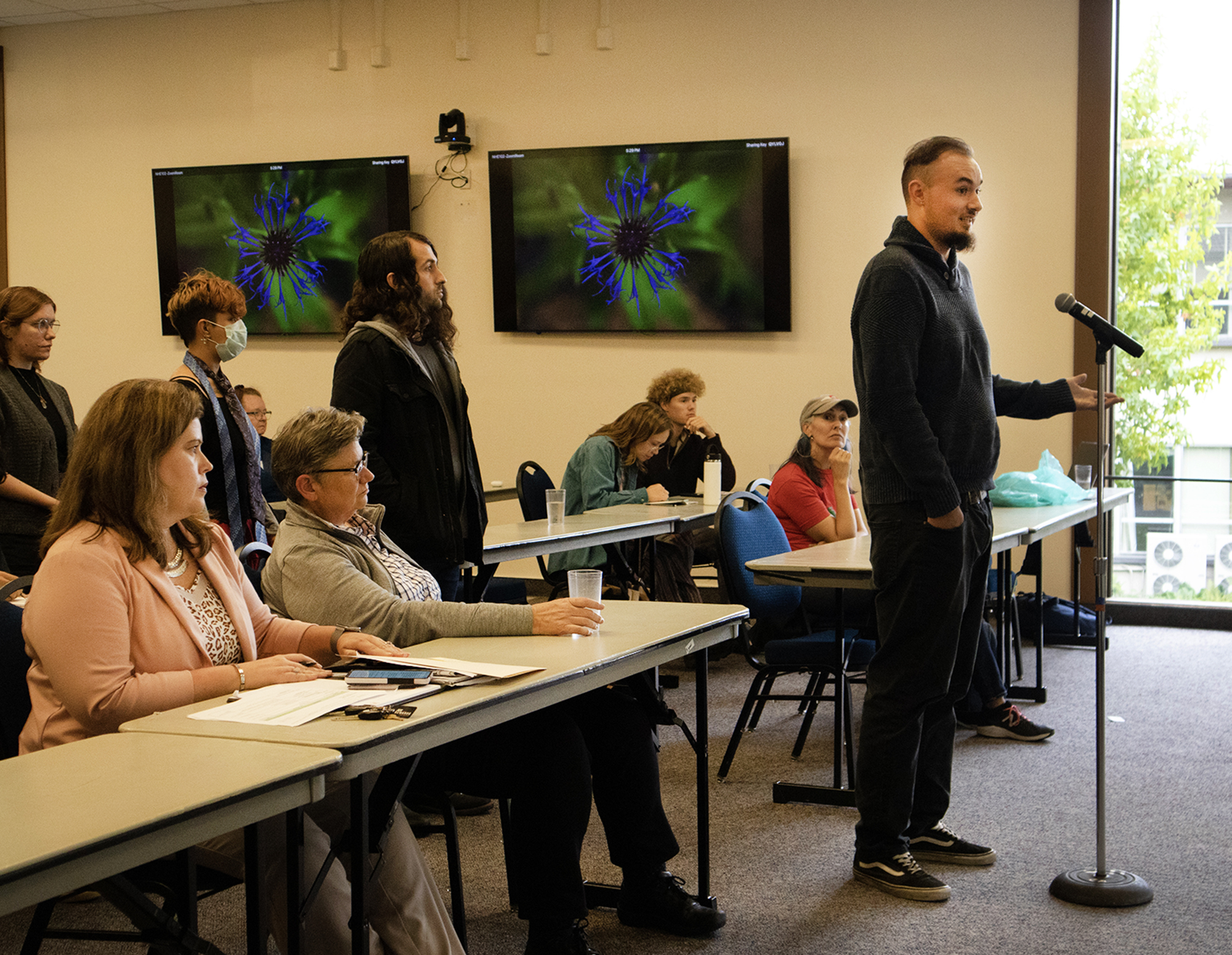
On Thursday Aug. 31 Cal Poly Humboldt’s Associated Students held a meeting to inform students about the tuition increase proposal. There were more than 30 people in attendance.
Photo by Jillian Wells. Students and staff gather at the Tuition Increase Town Hall on Aug. 31.
“The 6% increase covers all of the different levels of education,” said Amber Blakeslee, Executive Director of Finance and Budget at Cal Poly Humboldt. “So that’s undergraduate, credential and graduate student tuition. It also covers in-state tuition, out-of-state tuition, and the graduate business professional fees.”
For example, the proposal would raise the tuition rate of an in-state full-time undergraduate degree from the current $5,742 to $7,682 in fall 2028, a 34% increase over the first five years. This does not include the fees for each campus, which vary. This semester full-time student fees at Cal Poly Humboldt totaled $2,170.
The CSU system is funded from two main sources: tuition and state funding.
CSU reported in a document titled the “Sustainable Financial Model Workgroup Report” that there was a nearly $1.5 billion gap between money the system received and the costs to keep the CSU system running in 2021-2022.
The same report concluded that “even with aggressive assumptions about increases in-state general fund and tuition” would not be enough to close the gap.
The California State Student Association, a nonprofit group representing nearly 500,000 CSU students, unanimously voted to oppose tuition increases according to AS president, Sam Parker.
“The proposal lacks measurable outcomes, a clear termination date, and fails to articulate plans for generating other revenue sources,” CSSA said in a July 11 press release.
According to the Multi-Year Tuition Proposal, 60% of students at the CSU system would not be affected by increases. Their attendance is covered by the Cal Grant, Pell Grant or tuition waivers.
The proposal notes that increases will exceed the maximum Pell Grant award by over $280 by the 2028-2029 school year, and that Cal Grant may not rise to cover tuition raises into the future given.
Photo by Jillian Wells. Peggy Metzger, Director of Financial Aid, (left) addressing questions by Nova Presley (right) at the Tuition Increase Town Hall on Aug. 31.
“It discourages me from even wanting to continue through school,” said sophomore Sonny Buckner after the town hall meeting, noting that affording school and finding housing were affecting his time as a freshman. “…I barely even passed all my classes. It’s ridiculous that these are the things I have to put my priorities on when I came here to be a student.”
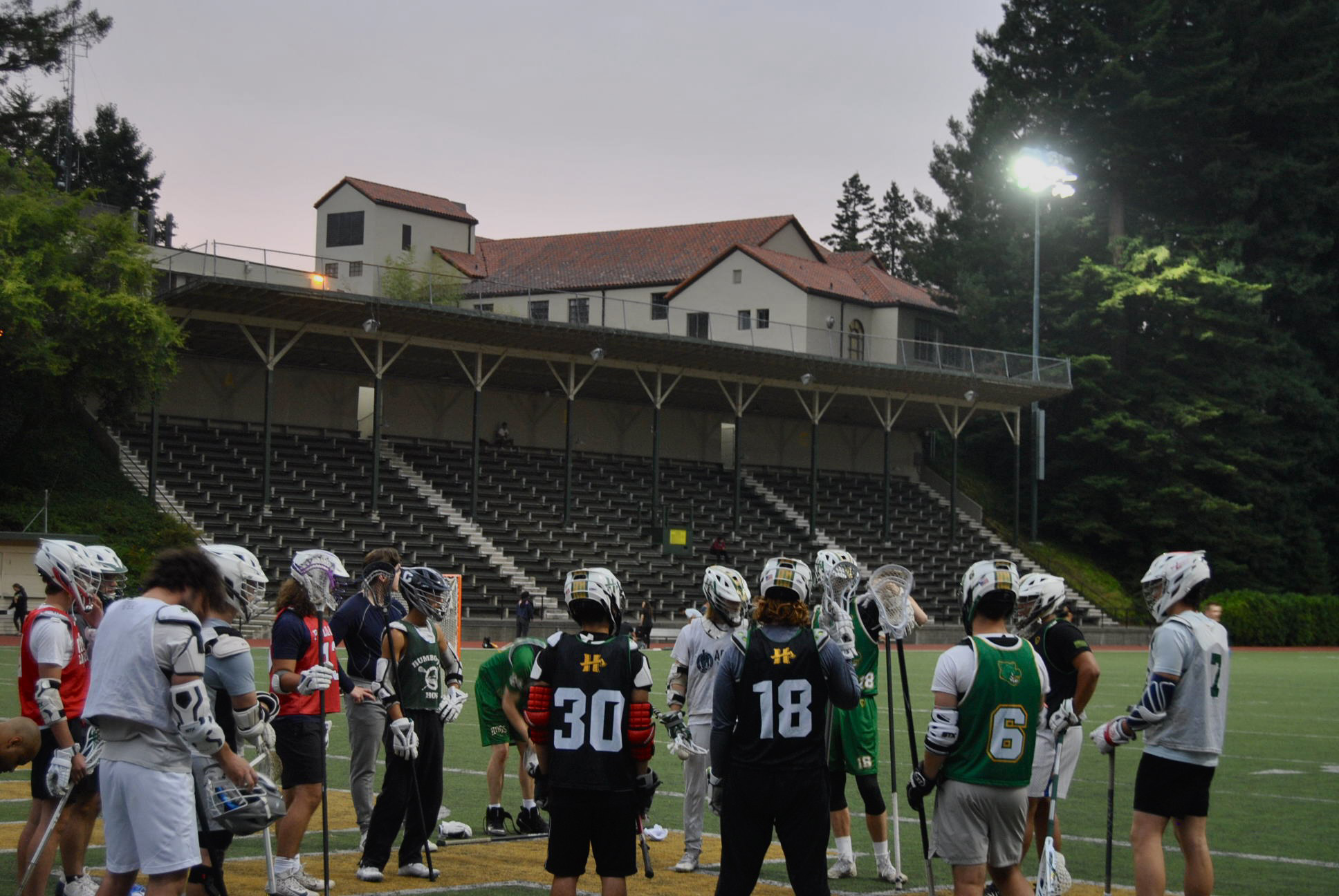
Cal Poly Humboldt’s Lacrosse team is celebrating its 40th year as an official club on campus. The team has grown in size to be the largest they have ever been, with nearly 30 members. They practice three days a week, yet still ensure that their athletes can prioritize school and keep the sport fun.
Head Coach Danny Eggert has been a part of the team for the past three years and is excited about the growth of the team. He’s looking forward to the improvement of the team and wants to see the players do the best they can.
“[The] goal [is] to win,” Eggart said. “To do better than before.”
Eggart is proud of the team’s club status and has no plans to push for the team to be a part of the NCAA sports. For now, their club is to hang out and have fun, and not be a job for his athletes.
Sophomore geology major and athlete Luca Ricci has been on the team since he came to Cal Poly Humboldt. Going into his second year, he is excited for the prospects of the upcoming season.
“I’m on the lacrosse team because I love the teamwork,” Ricci said. “We have a brotherhood on and off the field.”
Assistant Coach Gus Johnson himself used to be on the team from 2008-2011 and has been coaching since 2020. Though they are still early into their pre-season, he is excited for the competition coming into their upcoming season.
“It’s early, it’s the off-season,” Johnson said, “but playoffs are definitely the target this year.”
The team only had four athletes graduate out last year, and have eight to ten coming in. Their main goal for this season is to make it to the playoffs, try their best, while still having fun and making sure they aren’t overloading their students.
“We try to respect that they’re students first, it’s college and we want them to have fun,” Johnson said. “It means a lot. These guys have been here forever and to be consistent and still fill the team, it really speaks to how much these students care about it and want to play.”
With 40 years as a club, the team has made a name for themselves, continuing to grow and enjoy the space they have on campus. Anyone is welcome to join the club and can apply online under the recreational sports section of the Humboldt website.
“Hopefully, we come out as a winning team to represent 40 years of hard work.” Eggart said. “We have possibly 30 right now on the roster, so having numbers on there is amazing.”
I wish I could start this article with a funny anecdote about a billboard I once saw somewhere. I wish I could remember something about the giant ads on the side of the road that beg for your dollar with flaking stock photos of smiling people, content with their decisions to consume product X. That would make an incredible comparison to Cal Poly Humboldt’s website, but the problem is that they’re both too boring and too similar for it to even be clever.
The fonts are huge. The slogans are worn and used. It’s completely uninformative, incredibly boring, and entirely useless. It’s a 2.5 second elevator pitch meant for the uninitiated, the outsiders. What’s the real difference between a beer ad featuring a picture of a frosty bottle 12 feet tall and a glamor shot of a redwood on campus?
The website as it is designed now is simply the front-facing outlet for the administration’s constant hunger for more; more money, more students, more buildings, a Moloch filled with an evil lust. Very little is there for the current students, unless they figure out how to navigate its byzantine backrooms. Want an easy answer for when tuition is due? Good luck. How about some information about major requirements or how scholarships are processed? Have fun banging your head on your desk after searching relentlessly for an hour for an easy answer. How do I add a minor? Go fuck yourself.
The answers to so many really important questions aren’t on the website at all, as I’ve found out too many times, but trapped in the heads of some advisor I didn’t even know I had or a luddite department chair with an allergy to answering emails. Instead of taking the time to make a well-linked, easy to use website with simple answers to common questions for students, the website is filled with factoids about platitudes such as how many alumni graduate with practical experience or how strong the campus community is. Who cares? Whoever designed the damned thing made it really easy to find information about energy-saving programs that have long since gone broke or their supposed commitment to “inclusive excellence,” but not crucial need-to-know things for, say, disabled students or people here on a WUE scholarship.
If the website had simply always been this way, maybe there would be an excuse. Maybe it got grandfathered in, unable to face the challenges of a polytechnic with a lot of outside interest to the tune of over 20,000 applicants for this fall semester. However, it got redone this year, with brand-new typefaces and different photos, updated housing pages and a clearer “Purpose and Vision” page, whatever that means. Current students were not consulted on what they would have liked done with it outside of purely aesthetic choices, buried in a survey launched in one of dozens of official emails most students get.
It’s sad. It would be so nice if it was completely redesigned, with actual input from students beyond simple feedback on logos designed by East Coast marketing firms. There should be a focus on making the important stuff people want to know very clear. The website should function beyond mere solicitation. I hope there’s a push to change that. Make the big paragraph on the homepage claiming to “help you find the answers” true.
One morning, I was finishing up one of my mundane tasks at work when I overheard a discussion between my manager and a customer. The customer was a travel nurse and was stationed up here for the summer. Of course, the follow-up question to that information was, “Where are you from?” in response she goes, “Florida”.
That answer was a bit shocking to me. I’ve met people from New Jersey, Texas and even Canada up here – but Florida? My manager asked her how she enjoyed her time up here and through a slight chuckle she responded, “Well this is the most Florida place I’ve ever been to in California.”
At this point I had to laugh with her. I was never posed with a comparison that happened to be so spot on. It’s remained on my mind since then, so today I ask myself, is Arcata really the Florida of California?
I mean to start with the first difference: Arcata will never ever be comparable to the Sunshine State. Our muggy, gray clouds in August will speak for themselves. Although, there are some similarities if we want to look at the landscape. Starting with the lush vegetation, the Everglades and redwoods are quite synonymous. Same with our apex predators, like gators and black bears. We also share the same sandy beaches at close proximity.
I mean, Arcata is no girl’s spring break trip to Miami, but we do have lots of tourists coming through and even some hotties, if you’re into ecological preservation and bare feet – another shared similarity between the two vacation destinations but for completely different reasons. If you’re not near a beach, I don’t want to see those toes.
There seems to be many more similarities between the two; crazy amounts of drug peddling and always being able to count on the most insane conversation to be initiated between you and some stranger that approaches you on the street. Can’t forget the wannabe rappers that seem to be coming out of the woodwork all the time. Also, how both destinations seem to be a top pick for retirement communities.
I believe that one of the biggest similarities you can find between Florida and Arcata is that you can almost always expect the local headlines to hold the same zany crime bookings that are shared between the two coastal regions.
Any headline beginning with ‘Florida Man’ or ‘Humboldt Man’ can always promise the most insane crime story you’ll ever read. Must have something to do with the beaches and far right extremists that shack up on both coasts.
A quick peruse of Orlando Fox 35’s website under the keywords ‘Florida Man’ brings up cases such as a man dunking a woman’s head in tar, another throwing a barbecue at deputies and one stealing a hearse from a funeral home. You may think these are as crazy as it can get, but have you seen the recent headlines in the Lost Coast Outpost?
Let me entertain you with a few: The confiscation of 2,400 tabs of acid, a man setting fire to another man in Eureka, and my personal favorite, the man found with a handgun that was the size of a credit card along with drug paraphernalia.
Along with the crime, we can’t forget about the universities. Although there’s a few more to choose from in Florida than the small city of Arcata, I think they hold the same results of anticipation for students – to only be let down once they arrive. We can also count on the humidity to ruin your cute outfits and hair in both places.
All in all I think that anonymous travel nurse was right, Arcata is the most Florida place in California. Fresno may be the runner-up in reference to the crazies, but who vacations in Fresno?
Three new individuals with years of experience in education and community service have been selected for the roles of Dean of Students, Dean for the College of Extended Education and Global Excellence, and the Vice President of Enrollment Management and Student Success. Hailing from all corners of the nation, these leaders are here to accept the challenge to provide support to the academic institution and its community from their respective roles and offices.
Dr. Mitch Mitchell – Dean of Students
Fresh Dean of Students (DOS), Dr. Mitch Mitchell, began his position in Spring of 2023. He made his first major appearance in his role in the commencement ceremony. Mitchell wants to provide support to the students in any way he can to ensure their best chances of success.
“[My focus is] anything outside of the academic environment,” said Dr. Mitchell. “What students are thinking, what they’re passionate about, what they’re feeling, what they’re doing. I help cultivate whole students that are holistic that can go out and make a difference in this world.”
Dr. Mitchell wants to focus on supporting and expanding cultural centers on campus such as ITEPP and Umoja, as well as ensuring that this community is safe for students to be able to get their education and enjoy themselves.
“My goal is to make Cal Poly [Humboldt] the best place to live, learn, and thrive,” said Dr. Mitchell. “It’s ok to be your authentic self and be different. You’ll find people here that are part of your community here, so this is a place for everybody.”
Dr. Mitchell came of age with many of the odds stacked against him.
“I grew up with a survivor mentality,” said Dr. Mitchell. “I grew up in [Washington] D.C. during a tumultuous time, the height of the crack epidemic and it was the murder capital.”
Dr. Mitchell credits his introduction to higher education and the guidance of his fraternity brothers to smoothing out his rougher edges, and for providing a space where he felt safe to be his authentic self.
A lover of the outdoors, Dr. Mitchell wanted to come to Humboldt due to the lovely nature in the area. When he first visited Humboldt in Spring of 2023, he fell in love with the energy of the area. He noted that it wasn’t just the redwood backdrop, but the people of Humboldt that added to his love of this community.
“From the moment I stepped into Humboldt County, I felt the energy and people pouring into me.” said Dr. Mitchell. “When you come here and you feel the energy and you feel the love, it changes you, and you realize the difference from [other communities] is that it’s really an oasis here.”
From his first visit to the campus in April 2023, many noted his sharp suits and outfits, many of which have the school colors. When asked about his style, Dr. Mitchell explained that dressing sharp is essentially in his DNA.
“Fashion is an art form and a way to express yourself,” Dr. Mitchell explained. “It’s like music, it’s like painting. I will say that the [artform] is in my bloodline. My grandfathers on both sides were really some fly people. My father specifically had monogram collared shirts with his initials on them. I would say [fashion is] in me, and it’s on me.”
Dr. Cindy Bumgarner – Dean for the College of Extended Education and Global Engagement
Photo courtesy of Cal Poly Humboldt.
Coming off a position as Assistant Vice Provost for the Division of Undergraduate Education at UC Berkeley, Dr. Cindy Bumgarner became the Dean for the College of Extended Education and Global Engagement (CEEGE) on July 1st.
Dr. Bumgarner and her office focuses on supporting international students and students who study abroad through Global Engagement by offering immigration service support and academic counselors. On the side of Extended Education, Dr. Bumgarner supports graduates in their professional career, as well as students that are returning to their degree following a hiatus.
“I would imagine that some [students] just had life circumstances or needed to go out and do some work,” said Dr. Bumgarner, “or had something happen in their family, and they just really want to get back and complete their degree.”
On top of this, Dr. Bumhgarner and her office are working on developing certificates from the college such as one in IT. Although she has many tasks, she is excited to rise to the challenge. It’s this opportunity for growth and previous vacations to the Humboldt area while teaching at CSU Chico that drove Dr. Bumgarner to take up a position on this campus.
“[Humboldt] was a spot for me to cool off [from Chico in the summers], but I got to know the community and always sort of paid attention to what was going on the campus,” Dr. Bumgarner explained. “So the idea that I could bring a bunch of knowledge and positively contribute to a campus trying to reaminge itself just really appealed to me.”
Dr. Bumgarner is no stranger to intensity, challenge, and being under pressure. In her early college days, Dr. Bumgarner competed in Division I basketball for Indiana State University. It was this time as an athlete that she developed tenacity to prepare her for future challenges.
“The piece I learned from sports,” said Dr. Bumgarner, “is that when you set some goals, even if they’re not fully defined, if you know, ‘I want to help more, I want to do more, I want to contribute more,’ that can lead you in interesting ways.”
These lessons helped her as she was working on her undergraduate degree as well.
“In the educational process it was transformative to me,” said Dr. Bumgarner. “As a young poor kid, to realize that this undergraduate degree was going to completely change my life, and it did.”
Dr. Chrissy Holliday – Vice President for Enrollment Management and Student Success
Photo courtesy of Cal Poly Humboldt.
The honor of being Cal Poly Humboldt’s newest Vice President goes to Dr. Chrissy Holliday. Although she began her term in the position in January this year, this is her first fall on the Humboldt campus. In her role as the Vice President for Enrollment Management and Student Success, she is leading the team behind admissions, and continuing to support students that choose Humboldt as their campus to study.
“[We] make sure that our current students have the best experience they possibly can,” said Dr. Holliday, “and they successfully get to graduate and have their careers after that.”
Currently, Dr. Holliday is focusing on the growth of the new Cal Poly, and ensuring the infrastructure is available to sustain that growth. By renovating housing and dining, she aims to improve students’ overall academic experience. Overall, Dr. Holliday wants students to feel at home on the Humboldt campus, similar to how she felt at home in the community when she arrived at Humboldt.
“[Humboldt] feels like home,” said Dr. Holliday. “I want our students to have that same feeling. A lot of what we’re doing is looking at everything from recruitment all the way through graduation and asking, ‘how can we make this a better experience for our students?’”
Dr. Holliday is originally from North Carolina, just outside of Charlotte. For most of her education career, she has been steadily moving westward, working at South Carolina and then Colorado. The opportunity for challenge and growth at Humboldt pushed her to come to Arcata.
“[Cal Poly] Humboldt is poised for growth and greatness in a very different way than most higher-ed institutions right now,” said Dr. Holliday. “It really is the opportunity to be part of something different to help strategize how we serve all students in California.”
Besides professional reasons, Dr. Holliday also had personal reasons to take up a position at California’s newest Cal Poly.
“This place spoke to me a lot,” Dr. Holliday said. “I came here, smelled the ocean…growing up in the South, I had spent a lot of time on the coast. I told my husband that [Humboldt] smells like home.”
Outside of Dr. Holliday’s professional life, Dr. Holliday has a love for the horror genre. Her passion began with books through authors such as Christopher Pike and Stephen King. Her husband later helped to develop a fondness for horror films. One of Dr. Holliday’s favorite horror villains is Damien Thorne of The Omen.
In addition, Dr. Holliday is also an avid fan of music and concerts. One of her favorite experiences with live shows was seeing Nirvana and the Red Hot Chili Peppers perform at the same music festival. Dr. Holliday’s personal favorite show to date was Five Finger Death Punch. Even today, Dr. Holliday tries to make time for music.
“I’m going to one of my bucket list shows later this fall,” said Dr. Holliday. “I’m going to go see Rob Zombie and Alice Cooper!”
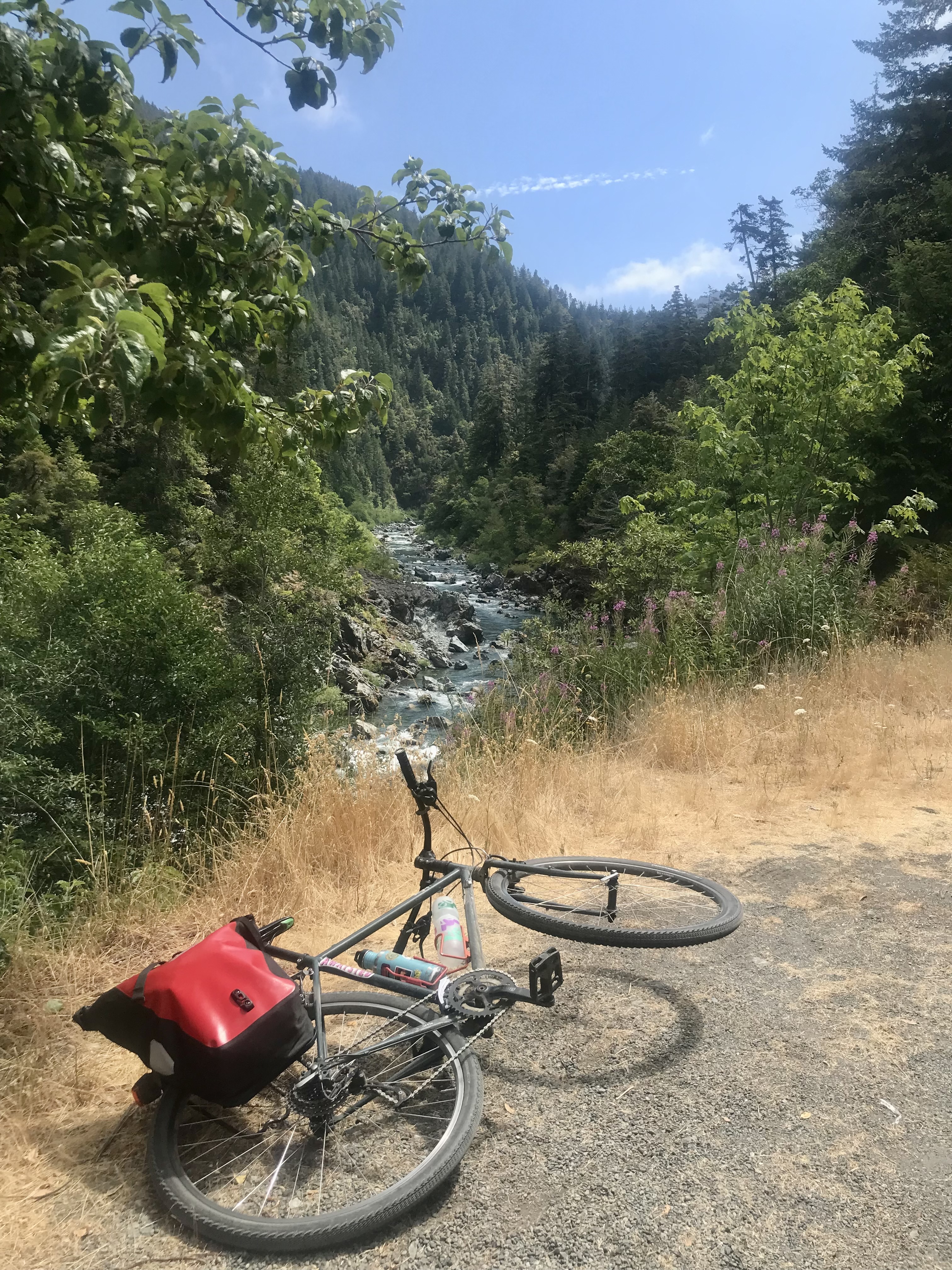
Do you like riding your bike? Do you like camping? Why not both! Humboldt county is a great place for beginner bike tourists to hit the road for the weekend to camp in its plethora of campgrounds and extensive open land.
This summer I rode my bike up the coast from Arcata to Crescent City, a total of 80 miles. Any time I go on a bike trip, I often hear people express their desire to do the same but feel like it’s beyond their reach physically or financially. I felt this way until a few years ago, when a group of women at my local bike shop hosted a beginner bikepacking workshop and group ride.
I’ve always been a bike commuter, but the longer mileage was new to me at the time. They lent me the bike bags to store my camping supplies and gave me the assurance I needed to do the ride. I’ve been hooked ever since. To be totally reliant on my own body, with everything I need on my bike, is the most liberating feeling I’ve ever experienced in my short existence.
Photo by Valen Lambert.
The first day of my Crescent City trip, I biked 40 miles up to Elk Prairie Campground in Prairie Creek Redwoods State Park. Many campgrounds have hike and bike sites for the less vehicular travelers and are as cheap as $5 a night. 40 miles may sound like a lot to some, but if you’re able-bodied, you’ll find that you’re more capable than you think you are.
Think of it this way: on average, a 40 mile day is typically (depending on elevation gain) a four hour ride, mainly spent in awe of the surrounding beauty. Depending on the time of year, that gives you plenty of daylight to take the time you need. The bike does a lot of the work for you, given you have several gears. Pedaling for a while is trance-inducing enough to make you forget you might be hurting. If you require frequent or long breaks, or feel you need to walk your bike at any point, you have every right to. Take some time and get yourself an ice cream, a beer, whatever. You’ve earned it.
The second day was the remainder of the 40 miles to Crescent City, where I stayed with a friend. Biking Newton B. Drury Scenic Parkway through Prairie Creek State Park was an unforgettable experience. Redwoods hundreds of feet tall swaying above, a lush and verdant old growth forest stretching in either direction. Going over Last Chance Grade was a bit of a mortality trip to say the least – heavily trafficked, steep, logging truck after logging truck and little to no shoulder. But when you go up a hill, you come down a hill, and that hill is long and electrifying. I had to clean off all the bugs flying into my big fat smile.
Crescent City is a place I never thought I’d be excited to talk about but alas, it’s in close proximity to some of the most beautiful spots I’ve seen on the California coast. The Smith River is the largest undammed river in California; clear, blue, and serene as can be. The Tolowa Dunes provided some enchanting and remote gravel-biking trails. The Pacific is not nearly as threatening of an ocean as it is at many of Humboldt’s beaches – in fact it was rather inviting. Will I live, love, and die in Crescent City? No. Would I write an article about it? Absolutely.
Photo by Valen Lambert.
I don’t think I’d recommend biking to Crescent City for a total beginner, only because of The Grade, but don’t fret because there’s plenty more opportunities for bike-bumming. Sue-Meg State Park is only an easy-breezy 23 mile northerly ride from Arcata, with plenty of hiking and bike sites. Roughly 25 miles north of Arcata is Big Lagoon State Park, equipped with hike and bike sites along, well, a big lagoon. Grizzly Creek Redwoods State Park sits on the beautiful Van Duzen River on Highway 36 and is a relatively flat 45 miles away.
First things first, you need a bike. Ideally with a rack on the back where you can hang your bags and strap whatever else on. Bike bags (AKA panniers) are pretty important, and can be found at Revolution Bicycles and Adventures Edge. You’ll also need some relatively lightweight camping gear. I personally just bring a down sleeping bag and an inflatable sleeping mat that I bungee on the top of my back rack, but some like to also pack a single-person backpacking tent.
Not sure if you want to drop some money on them yet? Check in with any camp or bike savvy friends of yours to see if you can borrow gear. Getting your hands on some bike bags and camping gear is your first step to freedom. The second step is to just start pedaling.
Barbie is everything –everyone and their mother was excited for the movie’s July 21st release, myself included. I was not disappointed. I laughed, I cried and I got “Push” by Matchbox Twenty stuck in my head for weeks.
In Barbieland, women can not only be anything; they are everything. The Kens however are simply there; they exist because Barbie exists, only living to get her attention. Ken (Ryan Gosling) himself says that his job is “just beach.” The Barbies believe their existence has solved issues for women, that their ability to be anything and everything in Barbieland extends to women in the real world.
Stereotypical Barbie (Margot Robbie), discovers the truth. She is exposed to the reality that women face each day, discovering that even the company that created her is not run by women. Meanwhile, Ken discovers the reality of being a man in the real world. He feels respected and empowered and someone even asks him what time it is.
Ken brings his new knowledge of the patriarchy to Barbieland. The Kens take over, turn all of the Barbie Dream Houses into Mojo Dojo Casa Houses, and brainwash all of the Barbies to serve them. To complete the patriarchy picture, the Kens are negatively impacted too. They sacrifice aspects of themselves in an effort to seem masculine and embody the “ideal man.” When Barbie returns, she breaks, feeling defeated after her experience in the real world and having her home taken away. Even worse, she has to suffer through a man playing the guitar and singing on a date.
Barbie feels that she isn’t pretty enough, smart enough or accomplished enough. Barbie is supposed to be perfect; always beautiful, always happy and always accomplished. This same standard is applied to women in the real world. We are expected to be beautiful but approachable, talented but humble, well dressed but modest. We’re told we’re too fat, too skinny, too emotional, too cold, too slutty, too uptight, too intimidating, too easy, too loud, too quiet – there is no way to win.
Despite this, my favorite moment in the movie is not one showing female rage, but female joy. Barbie is sitting on a bus bench, taking in the real world. She notices an old woman sitting on the other end of the bench. Barbie tells the woman that she’s beautiful. The woman responds, “I know it,” and Barbie laughs. This moment feels so special and beautiful to me. It made me ugly cry in the theater. I also liked that it called back to the Barbies all unapologetically owning their accomplishments and praising their own hard work.
In addition to the hard hitting themes, Barbie had an iconic wardrobe and soundtrack. “I’m Just Ken,” was obviously a standout, just one of Ken’s incredibly memorable moments. The dynamics of Barbieland were genius; of course the Barbies would float out of their houses, no one walks their Barbies down the stairs. I loved Weird Barbie. Alan was so endearing. It was cathartic to see America Ferrara, an actress who is often typecast, vent her frustrations at a society designed to work against her.
I loved Barbie. The movie showed that Barbie is not just a toy, she is a feminist icon and a source of inspiration. I felt seen, like my experiences and the experiences of other women were being validated. The joys and sadnesses of being a woman were perfectly shown in Barbie. I am Kenough and so are you.
On Feb. 4, CPH quietly updated the housing website without any notice to on-campus residents, leaving returning students to find out for themselves that they should not expect to live in the dorms or campus apartments for the remainder of their time at Humboldt.
On-campus housing will not be provided for any returning students. All on-campus housing will be reserved for new freshmen or transfers, starting in Fall ‘23. Should continuing students try to access housing through the university, they will be placed in temporary, off-campus housing.
“There was absolutely no email about it,” student Valeria Reggi said. “We found out by checking the website, which they updated with no warning.”
Due to a preexisting housing shortage that has left many students houseless, temporary options were explored in 2022 with the housing of over a hundred upperclassmen in the Comfort Inn motel.
A Feb. 6 email update stated that “because of the program’s success, we are excited to share that you now have the Super 8 and Motel 6 in Arcata as housing options managed by Cal Poly Humboldt.”
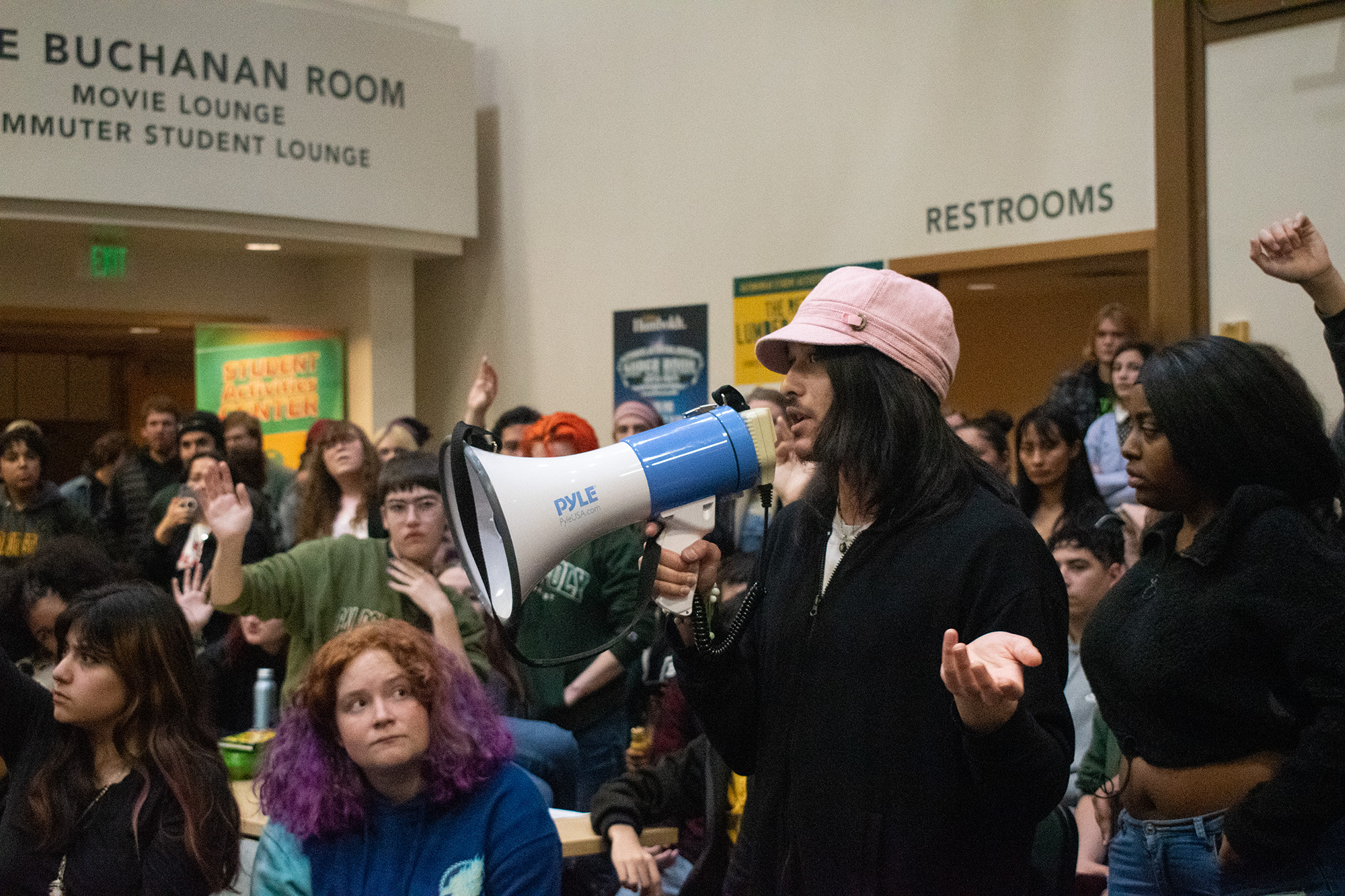
The email panicked current students, many of whom expected to return to on-campus housing in the fall. This prompted an immediate response. A post circulated on social media inviting students to gather that night to organize. At the meeting, a large crowd of students filled the Gutswurrack, voicing their concerns with over-enrollment and planning a protest scheduled for Wednesday, Feb. 8.
Filling every square foot of available standing room, students even packed onto the balcony. Organizer Lars Hansen spoke using a megaphone, and called on members of the crowd to voice their opinions on the new policy.
“We wanna know what’s going to happen to our housing, what’s going to happen to our community, and what’s going to happen to Humboldt,” Hansen said.
“I can’t fathom why you guys are accepting this many students when you can’t support them,” student Julia Kurtz said.
She questioned the logic of reserving the on-campus housing for freshmen and incoming transfers.
“If you are proud enough to put your current students in that housing, you should be proud enough to put new students in that housing,” Kurtz said.
Humboldt has a well-documented problem with student houselessness, a situation that some students said the new on-campus housing rules will make worse.
“I can just sleep in my car on campus, because that’s not any shittier than living in a motel, and it’s 10 to 15 times cheaper,” student Sam Mah said.
Many are considering dropping or transferring out of Humboldt in the wake of this announcement, according to students in attendance.
“You have capacity that’s limited and you’re putting no limit on the flow,” Jack Williams said.
Some raised concerns that the massive influx of students into the community without adequate on-campus housing to support them would strain relationships between students, the University, and the community.
“It seems like you just shift responsibility of building up infrastructure onto the community,” Alan Cooper said.
One of the main issues brought up by students was the lack of basic amenities at proposed housing locations. The rooms at the Comfort Inn don’t have kitchens, which poses a serious problem for students on EBT and those with dietary restrictions.
Students with disabilities are concerned with accessibility at the temporary housing locations. They also raised the issue that those who gain access to on-campus housing through their accommodations would be outed as disabled to their peers.
“Every single upperclassmen that has disabilities or problems with mental health, what the fuck are they going to do with us?” one student asked.
Photo by Cash Rion | Students from all walks of life show up for the student homelessness protest at Cal Poly Humboldt on Feb. 6.
The University administration was represented at the meeting by the newly appointed vice president for Enrollment Management & Student Success, Dr. Chrissy Holliday, as well as Indian Tribal and Educational Personnel Program (ITEPP) coordinator Sasheen Raymond and Stephen St. Onge, Humboldt’s Executive Director of Auxiliary Services.
Several of the students speaking purposefully gave admin a chance to respond to their comments, but often their response was lost, drowned out by the large crowd and interrupted by jeers. Holliday especially struggled to be heard over the crowd completely filling the Gutswurrack.
They offered little reassurance or explanation of substance, but expressed their sympathy for students impacted, and their commitment to hearing student perspectives.
“We will come and get beat up over it if we need to,” St. Onge said.
He explained that they were being required by the CSU to enroll more students in order to get funding.
“Now you need to hit this FTE [full time enrollment] and draft a plan to do it,” St. Onge commented. “We’re looking at some different options, hopefully in a week or two we’ll have some more information.”
Recent rumors and apparent email leaks indicate that the University is considering the purchase of a barge that would moor at the Eureka docks and house 650 students. At one point during the meeting, alleged evidence of the barge plan was airdropped to attendees’ smartphones.
University officials did not respond when asked for comment.
At the end of the day, the damage to morale was already done. Students felt betrayed by the administration. The school’s liberal reputation and reported recent influx of cash seemed incongruous with what many perceived as a shocking disregard for the housing policy’s impact on continuing students. At the end of the meeting, there was a call to bring the protest to the Arcata City Hall on Feb. 16.
“I thought ‘this is a school that’s going to see me, that’s going to hear me,’” Haley Kitchman said. “I’ve lived in motels and it’s traumatizing. It’s not easy, and it’s not okay.”
The Cal Poly Humboldt men’s rugby team brought home the Small College National Championship for the first time in their history at AVEVA Stadium in Houston, Texas on Sunday, Dec. 11, 2022.
The Lumberjacks defeated the Wayne State College Wildcats, from Wayne, Nebraska, with a 20-15 final score.
Humboldt was considered the underdog team going into the final, but their relentless pressure led them to a 15-0 halftime lead. The lead would eventually become 20-3, and despite an attempted Wildcat comeback, the Lumberjacks would experience victory at the sound of the final whistle.
“We had a good group of guys and we had the talent that we needed to win the championship, but when I kicked the ball out to end the game, it was just such a crazy feeling,” said fly-half Dante Cappellano. “I just ran around, basically hugging everybody.”
Cappellano had a huge role in the team’s success this season, calling the plays and kicking the ball to teammates or out of bounds.
The ability to kick the ball out as far down the field as possible is a very useful tactic in rugby, one that Humboldt used to their advantage this season.
“That’s how we defeated teams, especially in the postseason,” said Cappellano. “We definitely used that a lot.”
The Lumberjacks finished the season undefeated, and only got scored on by one team during the regular season, in a game where they defeated Oregon State 24-9. Humboldt’s best margin of victory was their 102-0 win over Cal State Monterey Bay to close out the regular season. This gave them a lot of momentum going into the playoffs.
“We were trying not to score towards the end of the game and it still just happened,” said Cappellano.
Their playoff run would end with what they envisioned as a dream at the beginning of the season: a national championship.
“It is definitely fulfilling for myself and the coaching staff, but more importantly, for these athletes to see how their commitment and hard work has paid off,” said head coach Greg Pargee.
According to many involved, this team was more than just some guys playing rugby. It was a brotherhood.
“All the guys get on so well with each other,” said flanker Cooper Alan. “You’d go down to breakfast and it didn’t matter who it was, you were sitting with your brothers on the rugby team, everyone was welcome and no one was ever alone.”
Alan grew up playing rugby in Australia and joined the team late into the season, but was still welcomed with open arms.
“I came out to watch their night game in the redwood bowl and there was just a feeling in the air,” said Alan.
The positive energy on the team was another huge factor in their successful season. Everyone getting along off the field led to on-the-field chemistry. All season, the team break before heading onto the field was ‘family.’
“That helped us just solidify that family aspect,” said Cappellano. “I loved every single one of those guys out there.”
This is a young team that is going to have a lot of returners next year, which gives them hopes and potential for a repeat. For now though, they get to enjoy the pride that their hard work earned them.
“I just want to thank the coaches and everybody else who helped us out there,” said Cappellano.
Ball is pitched. The crack of the bat echoes around the trees. The ball soars through the air and lands in the right center gap. Standing on second base is Izzy Starr clapping her hands and the crowd is cheering.
“I honestly was kind of nervous, because that’s a hall of famer right there [alumni pitcher Lizzy Prescott], so I was a little nervous,” Starr said. “But I was just excited to be out there amongst all these awesome people, awesome players.”
On Oct. 8, the university had its annual Cal Poly Humboldt Softball Alumni Game. This event has been going on since the late 80s and it brings past and present Humboldt softball players together to play the sport they all love.
Head Humboldt softball coach Shelli Sarchett explains that this event is about connecting the old with the new.
“It’s really just connecting the old with the new and have a chance for the alumni to talk about their experiences, and the hardships, and the fun that they went through, and relate to the newcomers, and help them with their journey,” Sarchett said.
The game started at noon on the Humboldt softball field and went for nine innings. The teams were split with current CPH softball players on one team and alumni on the other. A total of about 25 alumni were in attendance, this is about half compared to years past. According to Coach Sarchett the Hall of Fame Dinner that is the night before typically has an impact on attendance.
“It really just depends on the year, I think next year will be different because next year the 2008 National Championship team will go in, so I think there will be more people that will come back,” Sarchett said.
For pitcher Emily McAdams, this is her first ever alumni game. She was from the graduating class of 2022. She felt an unsaid pressure due to her playing against her old teammates but enjoyed seeing everyone again. McAdams also had a chance to meet alumni for the first time.
“It was really cool cause I honestly didn’t really know any of them since I came here during COVID and I didn’t really know much about Humboldt before I committed here and played here,” McAdams said. “So it was really cool to be able to interact with them, and ask them when they played here and all of that, and just hear about their stories.”
For Starr it was her second time playing in this event. This is her fourth year at the university. The event allowed her to reconnect with old teammates.
“I think my favorite moment was just seeing all my old teammates,” Starr said. “All three of them just made a huge impact on my life, and I just miss seeing them and getting to see them play.”
The Humboldt International Film Festival (HIFF) team hosted a night of film sharing at the Van Duzer Theatre on November 3. The films were pulled from the HIFF archives and all have a common theme: discomfort and exploring it more through that feeling.
The films shown were “Simon” (2015, directed by Camille de Galbert), “Dancing with Scissors” (2019, directed by Steven Vander Meer), “Gone Sale” (2018, directed by Matt Meindel), “Aviary” (2021, directed by Lauryn Blottin), “Prey” (2018, directed by Jing Sun), and “The Quiet” (2019, directed by Radheya Jegatheva).
“Change occurs at the point where it outweighs risks,” said Sarah Lasley, assistant film professor at CPH. “So when you are so uncomfortable that the fear of risks in change is no longer scary, we are kind of forced to make change.”
Lasley continued to speak about the night.
“A lot of new wave films are intended to make the audience feel some kind of discomfort and these films occurred in a huge shift and change in sociopolitical climate,” Lasley said. “When you think about how that mixes in with discomfort, you know this idea on how discomfort outweighs risk, this change is occurring.”
Students in the audience thought that the festival was cool and visually appealing. There were some who mentioned how certain films made them uncomfortable and freaked out, especially the film “Gone Sale,” which brings back memories of going to the mall but touches on consumerism.
“These nights are very successful nights because it is nice to see a variety of films coming to the school and the school has become a hub for all these international films,” said Ralph Valle, a film student and one of the co-directors of the film festival. “It is very honorable to be part of something like this. We get to distribute these films to a variety of people and it brings me joy because I get to see how people view life and movies that try to have some kind of message that they are trying to convey is pretty awesome to see.”
All kinds of people, not just film majors, came together to see films that can resonate with everyone in some kind of way. The films emphasized that, while we may come from different backgrounds but we have one thing in common. We are impacted by what we see around us. From historical perspective to animation, at the end of the day, film brings us around and we discover at times not just people we never planned on meeting, but also a new side of ourselves.
Cal Poly Humboldt, while having relatively affordable tuition and options for scholarships and financial aid, is still robbing its students blind with the cost of apparel, food and general items at campus stores.
One of the ways the school robs its students is apparel. For students it costs an arm and a leg. The hoodies and tees on sale at campus stores are much too expensive for most students’ budgets. Students should be paying discounted prices for their items, as many struggle just to get by. Most students have a heavy course load, debts from tuition and living costs, and not a lot of time for work.
The school should be able to offer apparel to students if not for free, then at a much reduced cost. Consider all the other ways they are finding to screw us out of our money, all the options they have taken off the meal plan. Quick side rant, it used to be possible to get two milkshakes on one meal plan. Sounds unbelievable, huh? The school has stopped offering a myriad of items for their meal exchanges, limiting the amount of options students now have for the meals that are covered in the amount that they have already paid.
Students wearing merch are a sort of free advertisement for the school, like a sponsorship deal. Typically sponsorships include some sort of incentive, like free apparel to compensate the wearer for representing the brand.
Since we, the students, are already paying tuition, living costs, and the cost for food, we are not getting anything for free. For representing, or sponsoring the school, we should at least get some free merch as with most sponsorships.
This is not necessarily exclusive to Cal Poly Humboldt, as many schools charge students for apparel. The fact that students are being charged is not so much the issue, rather how much we are getting charged. It would be more tolerable if Cal Poly Humboldt offered merch for students at a reduced cost.
The simple answer or solution to this “non-issue” as many see it: don’t buy apparel. If it is too much money, you don’t have to buy it. But it is nice to be able to rep your school, to walk down the street flaunting that you attend a Cal Poly. I pay to go here, I’m smart enough to. It’s a nice feeling. The school should “pay it forward” and discount merch for students.
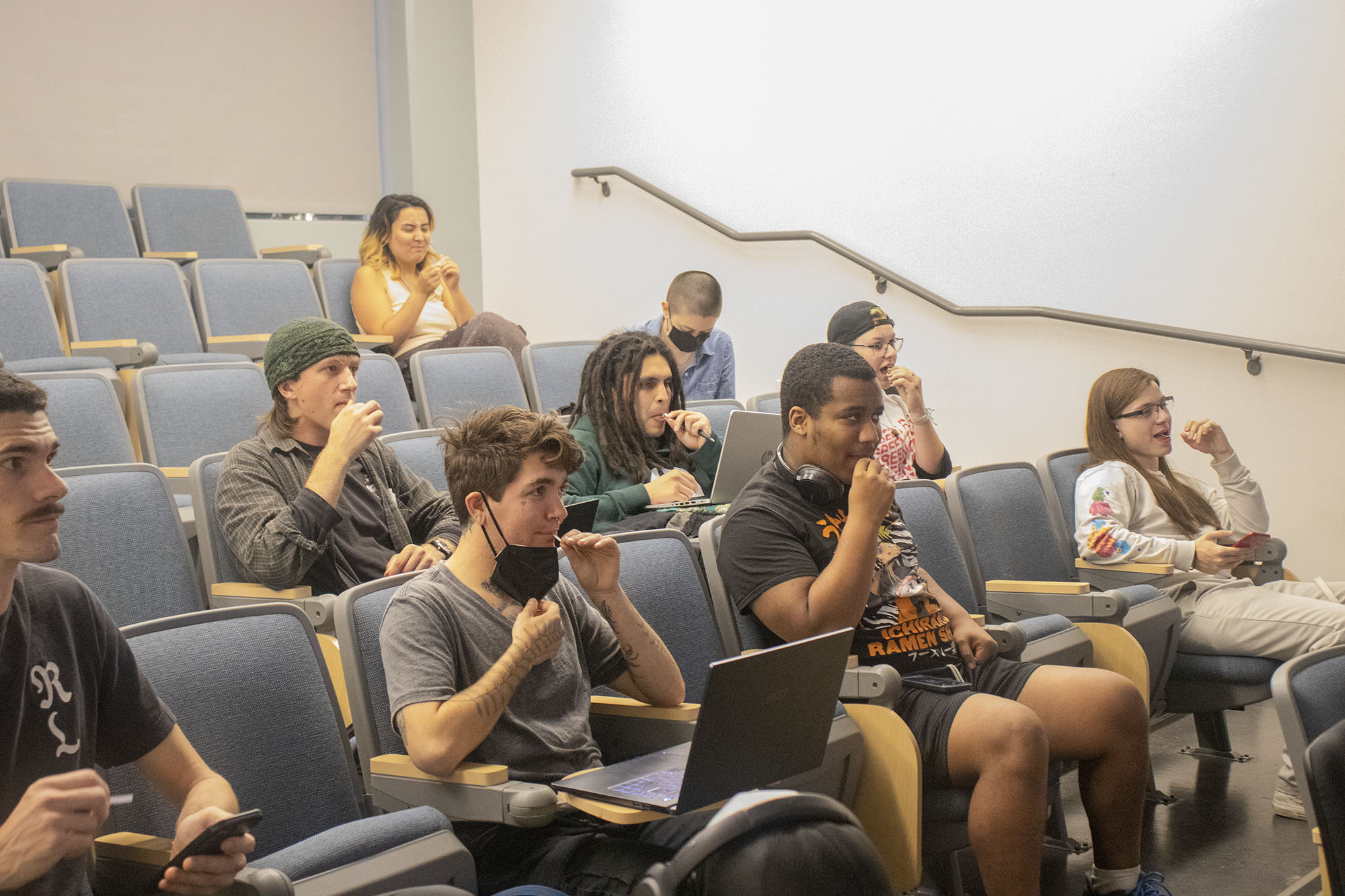
On Sep. 20 in room 564 of the science A building, approximately 20 people ingested a toxic chemical known as propylthiouracil. It was not a mass suicide attempt. It was not a Jonestown re-enactment, nor were they getting high. It was a meeting of the Humboldt chemistry club.
Propylthiouracil is a chemical used to test if an individual is especially sensitive to taste, someone known as a “supertaster.” If the paper containing the substance was especially bitter, then chances are good that person is a supertaster. The members of the Free Radicals, the chemistry club on campus, were testing if they were supertasters.
“I just put poison on my tongue, so I guess I’m ok with anything,” laughed member Angela Takahara.
If the energy of the Free Radicals could be put into one quote, that would probably be it.
“People. That’s the best part,” club president Jack McLaughlin said. “It’s probably the best place for chemistry majors and a lot of other majors to socialize. It’s just a great community to have and to talk to, because not a lot of other people really understand chemistry…it’s nice to have people who understand you, where you don’t have to explain every other concept.”
McLaughlin joined the club his freshman year, and hasn’t regretted it once. He said it’s an excellent way to get connected with important resources and more experienced students, as well as guest speakers who are in the industry or are teaching currently.
“It really helps guide newer students and even sophomores, juniors, and such towards figuring out what to do with their chemistry degree,” McLaughlin said, “And also how to make the most out of college.”
The Free Radicals aren’t only open to those working on chemistry degrees, however. Shay Konradsdottir, the club’s Social Director and Events Coordinator, is a molecular biology and computer science double major, with only a minor in chemistry. Her favorite part of being in the club is putting events on, such as a tie-dye event the club held last semester to showcase the science of colors.
“As social coordinator here, I really enjoy planning the events and making fun things,” Konradsdottir said. “Making this stuff, and sharing this interest in the sciences and interest in chemistry in a way that’s not just ‘here’s what the reactions are called.’”
And it is that interest in chemistry that binds all of the members together. McLaughlin said the nature of chemistry being everywhere was the appeal, and how it oftentimes was the key to understanding so much of life.
“[Chemistry] is like the building blocks of the universe,” McLaughlin said. “…I feel like I can pursue all of my passions for environmentalism and such through chemistry.”
Senior Sam Emerson, attending his first meeting at the Chemistry Club, holds a similar viewpoint.
“I like figuring out what makes the universe run the way it does,” Emerson said. “It feels like getting to know the game engine behind everything…I’ve always thought life was really fascinating and that although the universe prefers disorder, there are certain, random spins of chemicals that happen to make order out of nothing.”
Konradsdottir, who Emerson credits with convincing him to join the Free Radicals, has a much more personal background with science and how it interacts with their lives. She was diagnosed with Type 1 diabetes when she was young, and was a subject in medical studies. It was a defining moment in her life, she said, and it inspired her to become a doctor and help people. Eventually, she became interested in coding, and that led her to where she is today; gunning for an MD-PhD and potentially opening her own free clinic or making more effective medical diagnostic tools.
“I felt really awful about when I’ve heard stories from my friends or even some family members that were prevented from doing the things they loved doing because they got an injury or they got sick,” Konradsdottir said. “I myself, being a diabetic, there are lots of things I missed out on because I’m a diabetic, so being able to catch those things and prevent them from happening–that’s interesting to me.”
Being the club events coordinator, Konradsdottir hopes to share that fascination with the rest of campus. Last semester, she went on a field trip where she got to make a pleasant-smelling chemical, but wasn’t allowed to take any home. If the club had unlimited money, she would hold an event where anyone could show up, get a free lab coat and goggles, and concoct something similar to what she got to make–with the difference being they would get to keep it.
“It’s fun! We just do fun stuff here,” McLaughlin said. “It’s not like actual work…you don’t have to understand anything about chemistry, so long as you show up with a good attitude.”
COVID-19 disturbed, disrupted, and delayed many lives and events over the past few years. Club sports at Cal Poly Humboldt were no exception. Sport clubs that have been around since the 90s had to be put on hold, as none of their members could meet in person. Some clubs had to completely cancel competitions, events and all club activities. Now that it is once again safe to gather, club sports are making a comeback. Various clubs on campus are seeking to grow their numbers, and are once again practicing and competing as a group.
Archery
The Archery club has a team that travels for competitions. This club is reliant on frequent practices, which was difficult to do away from the field. This year, with the participation of new freshmen, club membership is finally growing.
“To join you need no experience or gear,” club president Zachary Gaydosh said. “Our practices [are] at the Student Recreation Center next to the football field on Saturdays 3 p.m. – 6 p.m. [and on] Thursdays 7 p.m. – 9 p.m.”
Disc Golf
Photo courtesy of Evan Connors | Disc Golf Team tournament in Monterey 2021
President of the Disc Golf Club Malcolm Silva said he is looking for new members. Club membership was negatively impacted by COVID, as members could no longer meet together. Also, at the start of the pandemic, many of the players that had been on the team were in their final years at Humboldt and have since graduated. While the club as an organization was affected, Silva thinks the restrictions on activities during the pandemic were to the benefit of the solitary sport in some ways. When there was nothing else to do, many people just went out and practiced playing the game. The club itself could not partake in any competitions.
“That really gave us the time to hone our craft and get a lot better at it,” said Edwards Silva.
Silva said that they are losing a good chunk of their team this semester and he definitely wants to get more people in the Disc Golf Club this year.
“We do Redwood Bowl every Sunday and on Wednesdays we do putting practice, that’s just where you throw the target at the basket,” said Edwards Silva.
Slacklining
If readers are interested in walking amongst the trees, so to speak, Slackjacks is the club for that. Slacklining is very popular among both students and locals.
Slackjacks is for all levels, including beginners. Most common slacklines are 1 inch or 2 inches in width; beginners would most likely start on a 2 inch.
Photo courtesy of Tori Lindvall | Aang Sterling on the line
Aang Younger, a club member, said the real secret to walking on a slack line is mental.
Club President Joseph Aguilar mentioned the club was really born in 2018, but then had to take a hiatus during COVID. It has been difficult recruiting new members.
This club not only teaches you to slackline, but it is also about community. Many people get together to jam, hangout, or even study for tests.
“We always have people who come and play guitar,” Sterling said.
Sterling also said they bring spirit cards, snacks, and circus props.
“It’s just a bunch of kids playing,” Sterling said.
The Slack Jacks typically meet at the Mad River Pump Station on Sundays, known as Slack Sunday by its members. They have a loosely set time of 12:00 p.m. – 12:30 p.m.
Cycling
Humboldt’s Cycling Club formed between the years of 2008-2009.
Club president Ian Bowden says he feels that the pandemic definitely impacted this club; the season they were about to embark on in 2020 was completely canceled.
“As a team we were struggling to find a way to organize any meetings and schedule COVID-safe group rides,” Bowden said. “During the 2020 season if we were to see people riding in the forest at the same time we would only wave before going down and continuing to ride alone.”
This kind of isolation impacted club morale and only a few people showed up to races in 2021.
Bowden said this season is gearing up to be one of their best yet. He feels they are back to nearly full membership. They are excited about their growing membership of 25 cyclists.
“I personally have made great efforts to unite people and recruit riders to join the club, personally asking people when I see them riding in the forest if they go to the college,” Bowden said. “I love the cycling community in Humboldt and foresee a definite increase in interested people as the years keep coming.”
The cycling club does both mountain and road racing. The club season opening on the 24th and 25th was hosted by Bowden.
“I am extremely excited for this race, as it is the first one that I have organized,” Bowden said, prior to the event. “I think we will have a good turnout from the schools in the division.”
Trash Pandas Soccer The Trash Pandas is a co-ed soccer team that welcomes players of all levels. They are technically not a club in the eyes of the university, though they do hold similar activities. They meet for practice every day on the field behind College Creek, and played their first game on Tuesday, Sept. 20 at 7 p.m. at the indoor soccer field.
This group is for those who enjoy playing soccer, but may want less commitment than being on a university team.
“It’s cool to see the people who didn’t know how to play a couple weeks ago, are playing against the Division 2 soccer team,” said Zach Meyer.
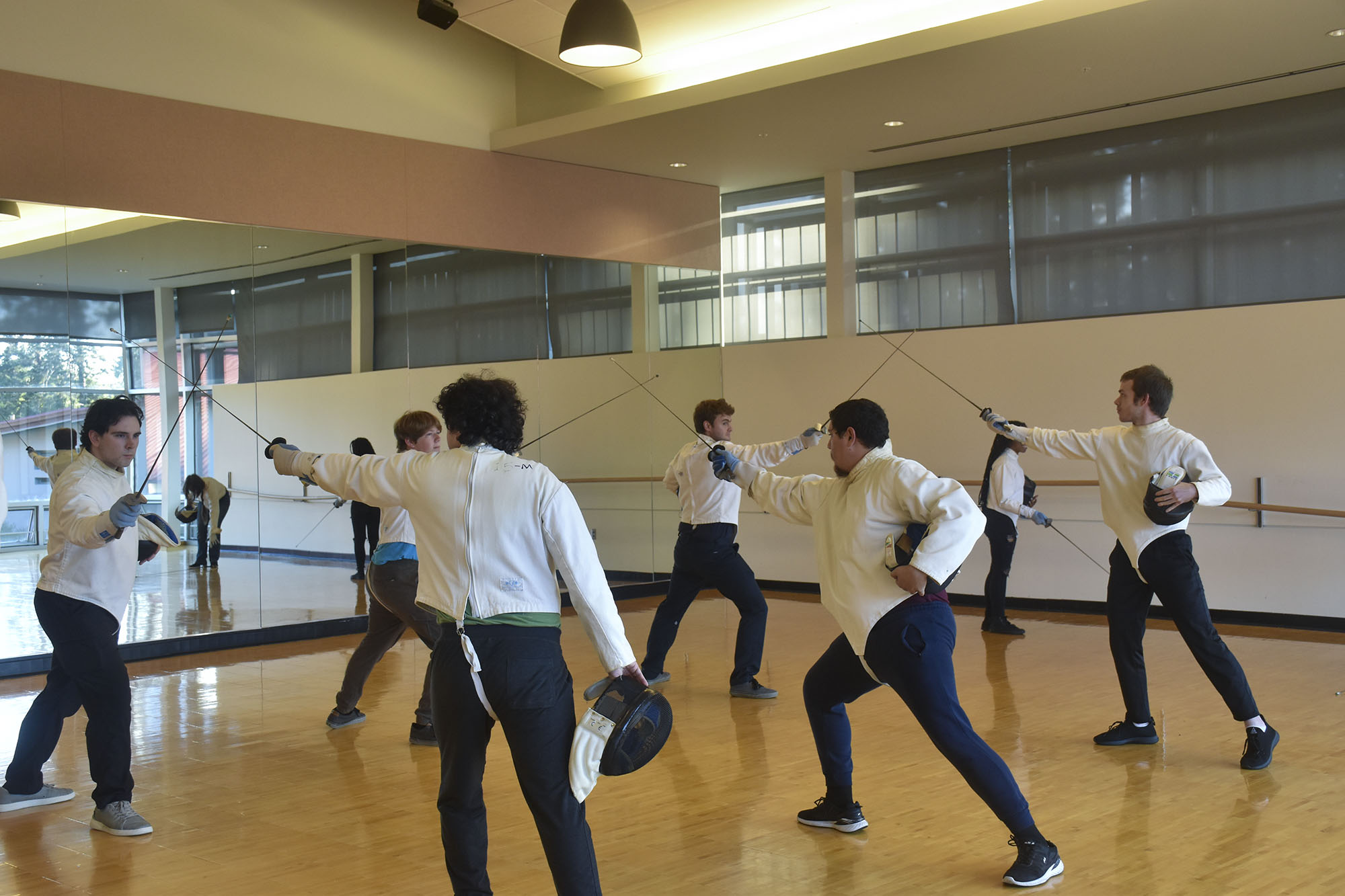
How do I join?The Club Sports section of the Recreational Sports page on the University’s website illustrates more options, including fencing, Ultimate Frisbee, and men’s crew. Follow the Archery club’s activities @humboldtarchery on Instagram, and keep up with the Slack Jacks @humboldt_slackjacks.
Mycology is a very young science, a baby in fact. Up until 1969, Fungi did not even have their own kingdom, as they do now, but were technically considered to be plants. Mushrooms are not plants, contrary to what many may believe.
Some of the most prominent and common mushrooms in Humboldt are actually the edible ones such as the King Bolete and the Pacific Golden Chanterelle. According to Cal Poly Humboldt Mycology Club President Jack Mccann both of these mushrooms are very delicious.
Mccann said what brought him to the Mycology club was cooking.
“As a mushroom person I really love to cook,” said Mccann. “I think I like to cook first, that’s part of what got me into mushrooms, it’s just cause it opens a whole new world of food,” said Mccann.
The club holds weekly mushroom hikes on Fridays, which are open to everybody regardless of club membership. This is a chance for the hikers to go out and experience the forest through a mycologist’s perspective. Every alternating Friday, they host workshops and guest lecturers. These meetings are more targeted towards people who already know about fungi.
The Mycology club is having a two day DNA barcoding workshop on September 30th-October 1, 2022. The club members will learn about the process used to genetically test the species of a mushroom. This process can often lead to the discovery of new species. During the workshop, club members will see if there is a difference between different mushrooms on a genetic level.
“We’re gonna borrow a lab and, basically in a pretty sterile environment you separate the mushroom using some primers, seek out the genes you’re looking for and then amplify those genes so you could actually read them,” said Mccan.
Essentially, what Mccan said is that the club will be collecting mushrooms and then using their DNA to see if there are any genetic differences between species of mushrooms.
“The machine, known as a thermal cycler, gives you a visual representation of what it looks like, you compare it to what it’s supposed to look like, what you’re expecting.” All of the prep work will be done at the two day workshop. This includes the collection, the DNA sequencing and the comparison of the DNA.
Then, their guest speaker Damon Tighe will get back to them with the results. Tighe is a mycologist working out of Oakland and is working with the Company Bio-Rad. He is driving into Humboldt with all the equipment.
The logging industry has a negative impact on mushroom culture. Unlike foragers, who simply take the ‘extension’ so to speak, of the fungi, what is known as the fruiting bodies, loggers do damage with their machines that dig into the ground.
Logging practices harm the mycelium, the other part of the fungus’ body. Mycelium is a root-like network that grows under the soil, it is what produces the fruiting bodies we know as mushrooms. According to Tighe, mycelium is just the vegetative state of a fungus.
Treasurer Sam Parker said he was drawn to the foraging aspect of Mycology.
“I first learned to do that when I was around eight with morels, and I just love being out in the woods,” said Parker “Mushrooms are a very diverse lifeform and I feel like they just kinda tie everything together, and I just think they are just interesting to learn about,” said Parker.
Humboldt’s alumni organization, Forever Humboldt, planned homecoming this fall in Lahaina, Hawaiʻi, on the island of Maui. In an email, the alumni organization shared their plans for a “fun spin” on homecoming where they would “spread the Lumberjack spirit” in Hawaii.
Colleen Chalmers, Sabrina Gailler, and over 255 other alumni felt this plan did not reflect their values and what they had learned at the university. Chalmers and Gailler drafted an open letter in dissent, hoping the university would reconsider their plans.
Chalmers is a Native woman who graduated from Humboldt with a degree in Journalism and Native American Studies in 2013 and now works in communications, racial equity, and homelessness policy. She felt that Forever Humboldt’s plans contradicted what she studied. She also felt the homecoming event doesn’t align with the school’s own vision, core values and beliefs, and purpose statements.
“The University consistently says that traditional ecological knowledge is central to solving environmental crises,” Chalmers said. “Then, [they] don’t listen to traditional ecological knowledge when it comes to choosing the location of their next homecoming event or choosing how to engage in recruitment for new students.”
The school cites Traditional Ecological Knowledge—TEK as a core tenant of learning across curriculums. Traditional Ecological Knowledge, decolonization, and sustainability are all terms used across the school’s stated principles. Kānaka Maoli—people indigenous to Hawaiʻi have been outspoken about the negative impacts of tourism on their place and people. Many alumni who signed the letter left comments of disapproval and disappointment.
“The reality is that centuries of colonialism and racism have taken a toll on Kānaka Maoli, the land, and the water,” Chalmers said. “America has illegally occupied Hawai’i for 129 years. An institution like Humboldt that cares about equity and anti-racist work should care about it in all their decisions. I don’t see that in this decision to go to Hawaii during this time.”
Their open letter has gained signatures from current and former students across nearly 70 different majors, representing graduates from 1973 through 2022. The letter was also endorsed by two nonprofits, Hawaiʻi People’s Fund and Seventh Generation Fund. Kānaka Maoli alumni Brissa Christopherson signed the letter and left a comment for admin and event planners.
“As a Kanaka Maoli and lifetime resident of Maui, I would highly encourage changing location for this event,” Christopherson wrote. “Our Maui community has been facing over-tourism, detrimental to natural areas and depleting limited water, in addition to the covid epidemic. Please stop perpetuating colonialist behavior with the fetishizing of our island culture.”
The university issued a statement that they heard the concerns raised in the open letter. The university cited recruitment efforts and alumni in Hawaiʻi as reasons for the location of the event. The university intends to follow through with its plans to host homecoming in Hawaiʻi.
“[The Univeristy] will distribute information about respectful and low-impact tourism to those who will be participating,” School representative Grant Scott-Goforth said.
Cal Poly Humboldt’s students, organizations, and community are unhappy with the Title IX office as well as President Tom Jackson after recent speeches and handling of cases.
Title IX is the law adopted in 1972 that stipulates, “no person in the United States shall, on the basis of sex, be excluded from participation in, be denied the benefits of, or be subjected to discrimination under any educational program or activity receiving federal financial assistance.” (From Cal Poly Humboldt’s Title IX & Discrimination, Harassment, & Retaliation Prevention website). Title IX is also intended to protect students against sexual misconduct including harassment and assault.
Female student Jane Doe (whose name has been changed for privacy reasons) reported an assault to Humboldt’s Title IX office in June. It is now September, and from her perspective, not much has been done. At one point in the summer, her case was lost.
“This whole summer I went through without having responses,” Doe said. “I get there are multiple things they have to deal with, but how do you tell a victim…that you flat out lost her case [and message thread],” referencing an email she received from David Hickcox apologizing for the delayed response. Hickcox is the Coordinator of the Cal Poly Humboldt Title IX office.
Doe says due to rumors surrounding the university’s handling of Title IX reports, she did not want to file a report.
“I didn’t want to go in the first place because I had heard of people putting multiple complaints in and nothing being done,” Doe said. “So I went in with [the mindset of] ‘we’ll see where it goes’.”
The Title IX office told her they could do two things for her. First, she could get the support she might need, like withdrawing from classes, and having them monitor her academic progress. The other option was to go through a formal reporting process that leads to a thorough investigation of everything that happened. This choice could have led to getting her assailant expelled from campus, through the Student Conduct office. Doe chose the support option.
“They didn’t make me comfortable to come clean about everything so I took the safer route,” Doe said. “I chose that one because I don’t want him to know what I have against him. That kind of defeats the purpose of having a Title IX.” Doe was told that if she took the investigation route, her assailant would be made aware of her accusation.
Doe was assaulted in a campus housing dorm room, and now she doesn’t feel safe on campus. “I get a sinking feeling in my stomach. I see him everywhere,” Doe said.
Students also feel like the Title IX office is not timely enough and that the process takes too long.
“I think it just takes way too long for students to get the help they need,” said Iman Jackson, a senior who was sexually assaulted at an off-campus party.
“It is just a long process,” Jackson said. “Maybe if they warned people that it is a long process it might be better, but if you can’t do it in a timely manner, at least have a plan.”
Jackson does not think that the process is meaningful enough. “I feel like they kind of fall short in regards to helping men who have been sexually assualted or harrassed,” he said. “I feel like if they want to change the rhetoric of being supportive and inclusive to all, I think they probably change how their procedure goes.”
Students have taken to social media to express grievances against the Title IX reporting process. Student commenter Lexi Holloman commented on a Humboldt Poly Confessions Instagram post that her report was lost and that she had to file more than once.
“I contacted Title IX and they said they have been handling the reports of [assailant’s name] in the ways that they can, and so I made another report because they didn’t even have my original report,” Holloman commented.
When asked to respond to student accusations of lost cases and lack of response, Hickcox said that he was unaware of any lost cases but “encourages them to contact [his] office.”
In response to feedback on social media, Hickcox said, “I’m aware of the [Humboldt Confessions page] and there is this perception that we do nothing.”
“I looked at Humboldt Confessions today and I can tell you what I saw on there today is not an accurate representation of what Title IX is doing,” Hickcox said. “It makes Title IX’s job a lot harder when people don’t believe in the process.”
Recently, President Jackson implied in a speech that it would be better to keep Title IX reports out of the media.
“I hate being in the news, because we have so many positive things happening on our campus,” Jackson said. He also stated that the Title IX process is designed to resolve cases “behind the doors in a meaningful amicable way.”
This speech damaged Doe’s opinion on the president and campus’ Title IX handling.
“I was offended. Although I had no say in the media aspect of my assaulter, it made me shy away from going to the office and tainted my self esteem walking into my appointment,” Doe said.
Hickcox views the President’s remarks differently.
“I understand that people are upset because they are inferring that he is saying to not report to Title IX,” Hickcox said. “I think the President is expressing frustration that when sensitive confidential Title IX details get into the media that it lowers the credibility of the process.”
Students and student organizations like Students for Quality Education are calling on the university to take responsibility and make a better Title IX process. The following is a comment from Students for Quality Education.
“We as Students for Quality Education denounce the words and actions done by President Jackson. He has furthered harm toward victims and survivors on campus and is an active perpetuator of rape culture. As the leader of a public university you’d expect his comments to be more in line with 2022 rather than the 1950s and you cannot expect systems and institutions of oppression to be fixed by whispers and behind closed doors. It took little to no courage for a man in power to say such things about victims and survivors as if we are still in the past. Secrets do not fix harm. President Jackson has failed to protect students, staff and faculty. Cal Poly Humboldt and the CSU as a whole needs to reform Title IX and continue to support and build on programs focused on supporting and bringing justice for victims and survivors rather than protecting a public image and defending institutions of harm.”
During the summer of 2022, a unit of the campus apartment complex was broken into. The police were able to find and arrest the burglar. Executive Director of Auxiliary Operations Stephen St. Onge explained that the units were unoccupied during the break in and no students were harmed.
“Unfortunately when the Campus Apartments are not occupied, they become a target,” St. Onge said.
The Campus Apartments were not originally part of the campus. According to St. Onge, the building was bought to build infrastructure.
“The purchase of Campus Apartments, it was going to be for temporary housing,” St. Onge said. “Then the building was gonna be taken down and then an academic building was going to be put there.”
Due to its origins, the building is outward facing, easily accessible from the footbridge that leads to Arcata. There is no gate and the doors to the bedrooms are what people see first. These apartments do not use a key card to get in. Instead, they use a physical key issued to each student.
St. Onge mentioned that there is a rather robust camera system set up in the complex, lined with over 400 cameras.
“We spent over 1.2 million dollars on a very robust security system, every entrance to every residence building has a camera on it,” St. Onge said. “If you go to Campus Apartments, I think it’s about 400 cameras.”
The surveillance system on campus can track someone’s whereabouts through the whole campus.
“If I could pull up a camera, you could see how detailed those things are,” St. Onge said. “You’re wearing a gray sweater vest right? So we could type into the search parameters, female, brown hair, gray sweater vest and they will- boop boop boop, and you put in a time parameter, and we could walk you across campus.”
Other campus housings has camera systems, and College Creek has a gate system. Access to the College Creek dormitory door requires first going through a locked gate. Then, there is an additional key to get into the actual apartment. The system of electric keys makes it safer to live at the apartments. If you lose or misplace your key, you can get it deactivated, which means even if someone picks it up, it cannot be used to gain access into your apartment, unlike the physical keys used for the campus apartments.
Since there are plans to demolish the Campus Apartments and replace them between the years of 2028 and 2029, there are no plans to install new safety features in the worn out building. All of the safety measures for Campus Apartments are reactionary safety measures, while other dorms have preemptive safety measures.
Jared Van Der Loo, a student at Cal Poly Humboldt, lives at Campus Apartments with three other male students. He said the apartment gets hot and stuffy, and often they will have to leave the screen and the door open, even at night. He said he thinks adding additional measures that other campus dorms have could improve the safety of the Campus Apartments.
“I feel somewhat safe in the campus apartments,” Van Der Loo said. “With there being four guys I think we can look out for one another. I also think safety from mold could be improved.”
Another student, Ralph Valle, who lives on the third floor of the Campus Apartments, said he personally does feel safe, but as he knows there have been incidents at the school, he is very weary.
“In my mind I have been prepared for any weirdness,” Valle said. “Almost like a PTSD thing where I am ready to jump if someone tries to get in while I’m inside.”
On Wednesday, Sept. 14th the Cal Poly Humboldt Facilities Management and Smith Group in Nelson Hall presented their physical campus plan for expanding the campus to the community. The plan is in the discovery phase.
The forum was led by Associate Vice President of Facilities management Mike Fisher. A full work plan was shown beginning with the forum and ending in July 2024 when the final plan will be presented.
During the forum, students and community members asked questions of plans. A major concern from the community was housing. Throughout, there were questions and shouts about housing. When Fisher addressed the question and made the point that the University wants to work with the town of Arcata, a man in the crowd shouted, “It’s been a problem for 40 years,” referring to the housing crisis in Humboldt county.
Ed Fitzgerald, a retiree who has lived in Humboldt since 1973, said, “Adding more housing on the existing infrastructure is not a good idea, we need more infrastructure.”
In regard to housing, Fisher said, “You find a lot of the housing inventory has been absorbed by single family homes by non-students and that’s driving difficulties.”
Fisher went on to state that to solve the housing problem will require a community effort with the university.
Candance Kelsey, a Humboldt alumni and local business owner, inquired how the plan would keep money local and in the community. Fisher responded, explaining there is public bidding and other opportunities for smaller businesses to work with the university.
“When there are suitable candidates that can [fulfill the bid], then they’re in the running,” Fisher said.
Staff from the Student Disability Resource Center also brought up accessibility issues on campus and maintenance of current housing. Another question asked by a student was the plan for gender neutral and inclusive bathrooms.
The student speaker said, “I have to go five minutes away to use the bathroom for my classes.”
Audience member Arlene Wynn also asked for shower facilities for gender neutral students.
Rosa Sheng, a presenter from Smith Group, responded, “In our work as architects, the next phase of design is the inclusive all gender design.”
She explained how the planning wants to add gender inclusive bathrooms and lactation rooms in the new buildings and current ones.
Throughout the meeting students entered and left as classes started, repeatedly asking for the hour-and-a-half long forum to be at a more appropriate time for students and those who work 9 to 5 jobs. Fisher acknowledged the comments.
The physical campus plan website is the point of contact for students, community members, and organizations to express their concerns or views to the University.
This website uses cookies to improve your experience. We'll assume you're ok with this, but you can opt-out if you wish. Cookie settingsACCEPT
Privacy & Cookies Policy
Privacy Overview
This website uses cookies to improve your experience while you navigate through the website. Out of these cookies, the cookies that are categorized as necessary are stored on your browser as they are essential for the working of basic functionalities of the website. We also use third-party cookies that help us analyze and understand how you use this website. These cookies will be stored in your browser only with your consent. You also have the option to opt-out of these cookies. But opting out of some of these cookies may have an effect on your browsing experience.
Necessary cookies are absolutely essential for the website to function properly. This category only includes cookies that ensures basic functionalities and security features of the website. These cookies do not store any personal information.
Any cookies that may not be particularly necessary for the website to function and is used specifically to collect user personal data via analytics, ads, other embedded contents are termed as non-necessary cookies. It is mandatory to procure user consent prior to running these cookies on your website.