The Lumberjack


Students Serving The Cal Poly Humboldt Campus and Community Since 1929

Tag: Cal Poly University Humboldt

  • Freshman FOMO

    Freshman FOMO

    by Nina Hufman

    I recently had an internal crisis: I realized that I am nineteen years old and almost done with my junior year of college.

    I just got out of high school a year ago and I already have to be thinking about real life. I just started college and it’s already almost over. I am most likely going to do a second major and stay in school for two years, partially because I really want a second degree and partially because I feel so unprepared to graduate.

    I was lucky enough to be able to be concurrently enrolled in college classes while in high school. I started taking online classes from a nearby community college when I was a sophomore and was able to earn my Associate’s degree halfway through my senior year. I transferred to Cal Poly Humboldt at eighteen years old as a junior. While I am grateful to have been able to save money and time, my circumstances come with their own set of challenges.

    It’s really difficult to relate to my peers, because my experience is not a very common one. I have one friend who is in pretty much the exact situation that I’m in. She transferred as a junior right out of high school. We talk a lot about how we missed out on the freshman experience and how difficult it is to relate to people who haven’t been in our situation.

    I don’t live in the dorms, I don’t eat in the dining hall, and I don’t have to take any annoying GE classes that have nothing to do with my major. While most people would agree that these experiences are awful, they get to commiserate and bond with others over those experiences.

    All of my friends and the people in my classes are juniors and seniors. I went straight from being in high school to being surrounded by people who are, for the most part, actual functioning adults who have goals and life plans. I feel like I’m so far behind; they’ve had three or four years to figure these things out and I’ve had one.

    My friends also don’t want to do any of the fun Humboldt things that freshmen do when they move here. I want to go to the beaches, go hiking, and explore this beautiful area, but I don’t want to do it alone. My friends have been here for years, they’ve already seen and done all of those things.

    People are usually shocked when they find out my age. They hit me with ‘I thought you were at least 21,’ ‘you’re so mature for your age,’ and ‘wow, you must be really smart.’

    The reality is that I have been a mini-adult since I was fifteen because I had to learn how to interact with adults in my college classes. The result of this is feeling out of place literally all the time. I’m simultaneously too young and too old for everything. I’m ready to start my life and be an adult, but I also feel like I missed out on my own adolescence.

  • Cal Poly Humboldt music department performs a once-in-a-decade recital

    Cal Poly Humboldt music department performs a once-in-a-decade recital

    by Sophia Escudero

    One o’clock on a Tuesday afternoon is not the usual time for a music recital. However, this particular performance was more than just a display of student skill. Accreditors from the National Association of Schools of Music were in attendance, after two days on campus visiting classes, listening to students perform, and ensuring the university meets standards for music programs. According to music department chair Cindy Moyer, this process is one that happens only once every ten years.

    “For this particular recital, what they wanted to see was the full spectrum of the program, which is why you can see there were all different music concentrations and students performing,” Moyer said.

    A highlight of the afternoon’s performances was staff accompanist John Chernoff’s rendition of a moody piano piece by composition major Theo Singer. The audience watched in captivated silence as Chernoff played through to the last, lingering note with an intensely focused expression, leaving the music hanging in the air for a moment, before breaking the spell as he turned to the audience with a wide smile and a quick bow, freeing the listeners to rapturous applause. Singer is a senior, but the performers comprised the full range of experience.

    “This was hard because we needed a real breadth of things, we had to find freshmen and sophomores,” Moyer said. “We do an honors recital every year and that’s pretty easy, students audition and the very best play— but that was not the goal here. The goal was not the most advanced, most skilled performers entirely, it was the whole spectrum of performers.”

    Marimba player Makani Bright was singled out by Moyer as a particularly talented senior performer. Bright has been playing for about 12 years, and has an upcoming senior solo recital on April 10. They are a double major in percussion performance and applied mathematics, finding beauty in both.

    “The way that I relate both of my majors in my mind is that I think of them artistically,” Bright said. “I think of mathematics as an art form, it’s perfect and there’s many beautiful things you can do within mathematics. Both of them, to me, are an art.”

    Bright’s piece, “Chain” by composer Kazunori Miyake, was not one they had previously performed before an audience. The instrumental composition had almost narrative elements, combining multiple different feelings and rhythms into a complex and beautiful melody.

    “I feel really good about it,” Bright said. “I feel like I was able to express what I wanted to express and I really enjoyed myself.”

    The majority of the music on display was instrumental, with pianists, percussionists, and a saxophone quartet as standouts, but music education major Pablo Murcia was selected to represent the vocal arts.

    “I’m very honored, honestly,” Murcia said. “I was the only singer chosen, and that’s quite an honor. I’m very flattered, and happy that some people came out to support me. That was nice.”

    Murcia’s piece was an aria from Mozart’s Don Giovanni, “Deh, vieni alla finestra.” He performed in Italian, but his smooth baritone voice, expressive performing style, and connection with the music (which has been part of his repertoire since last semester) carried the story of the song to the audience.

    “Don Giovanni, he’s a Don Juan, he’s a player, and he’s trying to get the attention of a woman at her window,” Murcia said. “The whole piece is just him saying, come to me, come to me, trying different tactics to get her attention, and she just keeps sort of playing coy, and finally, by the end of the piece, she finally gives into his charms.” He laughs. “Quote, unquote charms— he’s kind of a narcissistic jerk, but yeah.”

    Music department ASA Samantha Heppe was excited to be involved in such an important production for the university.

    “I’m just excited for our music students to showcase their talents,” Heppe said. “This recital is in honor of the accreditation team, so this type of recital won’t happen again for another ten years.”

  • A University Center hidden on campus

    A University Center hidden on campus

    by Matthew Taylor

    The University Center (UC) is a husk of what it used to be since its contract was terminated by Cal Poly Humboldt’s administration back in December of 2020. Before then it was an auxiliary organization to the university in charge of many student events and activities. Many members had been left hurt, with most refusing to speak on the record due to a fear of legal or social reprimand by the university. A majority of the UC’s responsibilities have been transferred to the Student Activity Center. In its current state, the UC exists to provide pensions to its retirees and use reserve funds for various student programs. There are some members, however, who see its end as a bittersweet conclusion.

    “In my position, I see both sides,” said Wendy Sotomayor, UC Executive Director and Student Activity Center Director, the bittersweet sadness in her voice apparent throughout the interview. “I’m excited but I’m also sad. The UC was very valuable and did a lot of good for the students here. In the end, though, I think the students are getting a better package.”

    She expressed, along with many of her colleagues, that she still saw the letter of termination as the administrations ‘means to an end’, but also saw the validity in the problems stated within it. In some ways, the UC’s own response to the administration may have further solidified its decision to end the contract.

    “Our response didn’t really include any [tangible] changes to the actual administration’s complaints,” Sotomayor said.

    Much of the mistakes made by the UC at the time, referenced in the letter of termination, were based simply on miscommunication and misunderstanding. Certain allegations, such as that of fraud, were later confirmed to be completely unfounded. Still, legitimate mistakes existed and deserved to be fixed. The financial risk of loaning the Arcata Community Pool $300,000 was huge in hindsight of the COVID-19 pandemic, and due to its distant relationship to the university didn’t qualify well under “its mission”. Steps were made to fix these problems before termination, but in the eyes of the university’s administration that wasn’t enough.

    “We couldn’t fix it after the fact,” Sotomayor said.

    The introduction of lawyers to the mix didn’t make the situation any better in her eyes either. Instead of coming to the table it became only lawyers talking to lawyers. In the end, lawyers on each side may have convinced them that each was totally in the right.

    “[Many UC members] wholeheartedly believed they did nothing wrong,” Sotomayor said, expressing that at the time even she felt similarly.

    Since the termination, the administration has given most of UC’s previous tasks to the Student Activity Center. The program controls Center Arts, General Operations as well as a new program called Conference and Event Services (CES). Center Activities is now under Athletics and is located at the Student Recreation Center (SRC).

    “So much personal feelings got involved,” Sotomayor said. “And [I’m] not sure we could have gotten [to where the SAC currently is ourselves].”

  • César Chavez Day with YES

    César Chavez Day with YES

    by Eddie Carpenter

    In honor of César Chavez Day, the YES program hosted a volunteer event at the Potawot Community Food Garden in Arcata. It had an amazing turnout with a whopping 40 volunteers in attendance, caressed by the sunny blue skies and the refreshing Humboldt breeze.

    We were assigned tasks by being divided into five groups. I was grateful to be a part of a group that planted beds of squash. We did everything from scratch, laying out layers of black cover material across the four rows to keep the weeds from robbing the plants of their nutrients. We also covered the tops of the rows with white cloth.

    Gardening skills have practical value in my daily life. Prior to this experience, I had been a volunteer at Potawot through a program called the Intertribal Agriculture Council. Potawat’s head gardener Ed Mata gave me a handbook about gardening and I was mentored by a professional development specialist named Elaini Vargas.

    Maybe I was a little rusty on the terminology, but basic knowledge about soil health has since been ingrained into the recesses of my brain. I learned in a soils class that if you live in a mild climate, it’s estimated that it took 200 to 400 years for 1 centimeter of the soil to form. Vargas’ and Mata’s teachings directly impacted the mindset I had going into the YES serve-a-thon on César Chavez Day.

    Youth Educational Services (YES) is a collective on campus that provides students with opportunities to volunteer at local school and community sites. One of their goals is to connect hands-on service and in-class learning with awareness of the injustices and oppressions experienced by those they serve. Actions sometimes speak louder than words. Making donations and saying nice things about a cause is totally different from donating your time and bodily energy to a cause.

    According to mentalhealth.org, helping others can possibly help make you happier as a person. Through volunteering, I was able to make temporary connections through teamwork and group communication. This gave me a sense of community and made me feel like I belonged to a noble cause.

    If you want to see change in your self-esteem, you might want to consider doing good deeds, so we can manifest the world into a better place. Indeed, an outward reflection of finding happiness can in turn make you a happy person.

  • Painting it teal for sexual assault awareness

    Painting it teal for sexual assault awareness

    by Matthew Taylor

    Pamphlets and papers flew around the UC Quad. Three teal blue tables stood to the right of The Depot entrance, pushed up close to the SAC’s concrete stairs. Dozens of paint bottles cluttered the leftmost table while various pins cluttered the right. April is international recognized as Sexual Assault Awareness month and The North Coast Rape Crisis Team alongside its on campus program Campus Advocate Team (CAT) have worked together to host its annual Take Back the Night week. The week-long event lasts from April 4 to April 7 and includes activities such as Denim Day, Clothesline Project Workshop, and Take Back the Night.

    Photo by Matthew Taylor | Liliana Cortez (center) speaking with students on the UC Quad about Teal Day on April 4.

    Tuesday marked Teal Day, a day dedicated to the awareness of sexual assault survivors and their stories. Students at the tabling event were encouraged to paint their expressions of positive growth and healing. By the end, all the small canvases would be placed together to form a larger mural. Liliana Cortez, the Violence Prevention Advocate at the Women’s Resource Center, expressed that the mural was an optional part of the activity.

    “It’s up to them,” Cortez said. “If they want to create their piece and keep it, or if they want to go ahead and give it to us so we can make it part of [the mural].”

    Together with Cortez, CAT Education Coordinator Kira Morse was also present at the table.

    “We provide services here on campus for survivors of sexual assault,” Morse said. “We have counseling, we have an office here, and we also respond out if there’s any incidents or things like that and help with [things] like Title IX and accommodations.”

    Rachel Mack, a Rangeland Resource Management major, was one of the handful of students painting at the table.

    Photo by Matthew Taylor | Painting by Rachel Mack created during the Teal Day event at the UC Quad on April 5.

    “It’s nice to have something positive as well as it being important for what it stands for,” Mack said, whilst painting her sunflower piece. “I think [it’s] really important for survivors to be able to have control over their own situation.”

    Alexa Farias, a Critical Race, Gender & Sexuality Studies major, expressed this event is very important to her work and role within Students for Violence Prevention.

    “We actually want to be part of the whole Speak Out, because it’s a really good way to show people what it feels like to really look through the situations,” Farias said.

    Speak Out is one of the many sub-events planned within Friday’s Take Back the Night program. This event will provide a safe space with counselors on hand for survivors to ‘speak out’ about their experiences and tell their stories.

    “The main movement and push with Take Back the Night is that people can feel safe here on campus and have their voices heard,” Morse said. “I feel a lot of times that survivors feel like they’re hush hushed. There’s not that open space where people can name their experiences. Take Back the Night, there is a lot of this amazing support where people feel comfortable.”

    Friday’s event will begin with a speech by Dr. Rachel King that will culminate into a rally and the aforementioned Speak Out event. Lasting between 6 to 10 pm, the event will end in a vigil dedicated to the victims of sexual violence.

    “I feel like [this] is really good,” said psychology major John Clark. “If this could happen at most events, then people would start to see that this is a [common] thing that we should talk about.”

  • Slack is Back at Cal Poly Humboldt

    Slack is Back at Cal Poly Humboldt

    by Liam Gwynn

    Ethereal flute, harmonious tarot prophecies, and a faint vaguely skunkish smell: you’d think it was a description of a sixties wet dream. However, you would be wrong, that dream is very much alive in Humboldt county, particularly with a group of students who have started a slacklining group that meets every Sunday.

    Before the pandemic, Cal Poly Humboldt had a thriving slacklining community with a club that would meet weekly. The club fell apart in 2020, however, one former member has gathered a group of fellow slackers and begun the process of getting this group turned into an official club at Cal Poly Humboldt. Joseph Aguilar, organizer of the prospective slacklining club, joined the original club in 2019 and has been slacklining ever since.

    “I love how when you’re on [the slackline] it’s just you, you have to be focused and present, and in that moment and you have to be hyperaware of all the muscles in your body,” Aguilar said. “It’s really good for core strength and all sorts of stuff.”

    Aguilar decided to start throwing “Slack Sundays” with a group of his friends and it gradually blossomed into a communal gathering of musicians, slack enthusiasts, and an assortment of nature lovers.

    The atmosphere at “Slack Sunday” was laid back and welcoming. Unlike many sports activities, there was no sort of competitive spirit or pressure to perform perfectly. People stretched back on picnic blankets and relaxed while others painted, played a variety of instruments, gave tarot card readings, threw a frisbee, and even tossed around a boomerang. Others came just to meet new people and hang out.

    The skill levels at “Slack Sunday” were equally diverse. For some, it was their first time and veterans held their hands and gave tips on how to cross. On the opposite side of the spectrum, genuine professionals showed off their skills with remarkable tricks on a line five feet off the ground.

    Photo by Abraham Navarro | Gabriela Vargas and Joe Mallory, both experienced slackliners do tricks and balance on their lines at the Mad River Pump Station on March 22.

    One of those professionals was Gabriela Vargas. She started by slacklining in her hometown Mexico City and moved to the US after receiving a sponsorship for competing in a trick line competition. Vargas originally moved to Colorado but was attracted to Arcata because of the slacklining culture that exists here.

    One issue that many professional slackliners face is debilitating injuries. Vargas said one injury she had forced her out of the competitive space after a leg injury that took six months to recover.

    “I like to take my healing slow, because if you don’t let it fully heal and just go back to doing it, it can get chronic and I don’t want that to happen,” said Vargas.

    Despite the setback from her injuries, Vargas has continued to expand her skills and has become proficient in highline, when a slackliner is harnessed to the slackline and balances over massive heights. Vargas showed a picture of her slacklining over an incredible drop of over 6,500 feet.

    People enjoy slacklining for a variety of reasons but one central theme is the benefits of achieving mental and physical balance when on the line. The appointed treasurer of the prospective club Ella Feick explained how her passion for slacklining stemmed from that need for balance.

    “You’re thinking in your head, you’re breathing in your body, and you’re focusing on your balance in a way that you’re not typically. If you’re stressed out or having a hard day you can’t really be thinking about all that stuff, you’re just there,” Feick said. “It’s a very present activity.”

    “Slack Sundays” are hosted every Sunday from 12-5 p.m. at the Mad River Pump Station 4 – Disc Golf Course.

    Photo by Abraham Navarro | Destiny Vera, Joey Agualar, Ella Feic, Ang Younger and Younger, all students interested in the Slacklining club on campus, at the Mad River Pump Station on March 27.
  • Hustle and bustle at the Associated Students

    Hustle and bustle at the Associated Students

    by Matthew Taylor

    In the wake of reimagining the Associated Students, all hands are on deck. More staff and members have resigned over time as the major deadlines of AS’ yearly budget and the next election cycle fast approach. The Board of Directors has played musical chairs with itself after Finley’s impeachment in a scramble to fill the most critical positions. The AS is quickly becoming a phoenix out of its ashes. Reinvigoration among its most loyal members has been felt across the organization, and student participation and interest have been at an all-time high since the pandemic first hit.

    “[We’re] tapping into the core program,” Chase Marcum, the current Administrative Vice President, said. “Teamwork makes the dream work.”

    Since refocusing on the budget, Marcum and the Finance Committee have utilized all the help they can get from resources such as the Student Legal Lounge, CCAT, and the work of their predecessors.

    “We forget that a lot of passionate previous leadership had the foresight to give students templates and guidance,” Marcum said. “[We have] the ability to look back.”

    The yearly budget plans to increase funds for the Asian, Desi, Pacific Islander Collective (APIC) and various other cultural centers on campus. Funding is also being put into Scholars without Borders and expanding the list of study-abroad countries provided at Cal Poly Humboldt. The Student Legal Lounge may also receive higher funds to put into aid for Dreamer students.

    Discussions around previous legislation, bylaws, and organizational structures continue. Plans to review and update the AS Personnel Code along with many of Finley’s previous legislation are in the works. Reviews will ensure that all legislation and bylaws protect student representation and autonomy within the organization. The Bylaws Committee, alongside Legislative Vice President Gio Guerrero, has also begun negotiations with the Dean of Students to utilize the resources from HR to avoid future internal conflicts.

    Above all, the AS is hopeful for the new election cycle. Voting will commence between April 18-22, and students will be emailed the ballot. Guerrero said that last year only 3-4 people ran for mostly uncontested positions, but this semester almost all the positions have at least one person running for so far. The signature process to get on the ballot has also been waived, making it easier to apply. The results of the elections will be posted on May 6.

    “There’s some work ahead of us, but we’ll make it through and persist,” Guerrero said. “We’re going to be okay as an organization.”

    The next Board of Directors meeting will be held this Friday, April 8, at Nelson Hall East 106 from 3 to 6 p.m. As always, these meetings will be open to the public and are now entirely accessed via Zoom. For access to meetings or further inquiries, the AS can be contacted at (707) 826-5410 and through its email at as-staff@humboldt.edu.

  • Students jam out on campus

    Students jam out on campus

    By Lex Valtenbergs

    On a sunny day in early March, Wildlife sophomores Olie Espinoza and Dee Naranjo played guitar and conga drums in a hidden alcove near the Art Quad. The sound of the impromptu music could be heard from several feet away.

    Photo by Abraham Navarro | Dee Naranjo Plays the Conga drum he uses for for class near the art quad on March 7.

    Espinoza (@itsolie_909 on Instagram) just started learning how to play guitar last year and has been playing it ever since.

    “I picked it up in maybe June of last year,” Espinoza said. “It’s definitely something that I always wanted to do and I never got a chance to do it.”

    Espinoza and Naranjo met in the dorms during their freshman year and jam together whenever they get a chance. Naranjo (@deedeedeedeedeedeedeeeeeee on Instagram) didn’t play any drums prior to learning how to play the congas in a class that they took to fulfill a General Education requirement.

    “I just took it as a GE class for the credits, for the art section of GE,” Naranjo said. “I saw it, it sounded cool. I’ve only been taking it for a month so far, so I don’t know much but it’s been really fun.”

  • I’m a first generation college student

    I’m a first generation college student

    By Mekiah Glynn

    My mother dropped out of college after one semester and my oldest sister dropped out of two different colleges within the span of two years. I am the definition of a first-generation college student. A third of undergraduates are first-generation, yet we hear very little about the perspectives of these college students.

    Luckily for the third of us here at Cal Poly Humboldt, there are a lot of resources for students who don’t have parents that know how to walk us through each step of college life. With mentors and workshops, Humboldt has helped me with the transition into college.

    Moving eight hours away from my hometown to Humboldt was already a big transition for me, but it was significantly more difficult as a first-generation college student who didn’t have a lot of people to talk to about college. My mother has supported me throughout all of this as best she can. Still, no one prepared me for the mundane things you have to go through in college that most students just know about, such as which meal plan to pick, what you really need for classes, and how to manage your time.

    Those questions were answered by my RAMP mentor for the most part, which was really helpful during the year, but less so before the year started, when I was signing up for classes, housing, and meal plans. During the summer before I started, the only resource available was my sister who is a communications major at UC Davis. She didn’t have much knowledge about a smaller college or classes for an environmental studies major. Because of this, my first semester was really rocky. I failed a class, edited my meal plan, and struggled with online college classes.

    The workshops about organization, mental health, and finding a job were really helpful mid-way through my first semester. The school’s resources weren’t directed at first-generation college students, but they were still helpful.

    Going into my second semester of college was a bit easier. I was more used to the day by day and was more aware of the resources that were available. It was still a struggle. I couldn’t ask my mom about things that I’m sure most of you could ask your parents without even thinking about it, such as questions about how to contact my professors or how to deal with a roommate.

    Being a first-generation college student is hard. The pressure of wanting to succeed where your parents couldn’t and the need to figure out a lot of it completely by yourself will never be easy. There can always be more resources put into place that could help out the third of us that are here alone, but I do believe that Cal Poly Humboldt does a great job trying to help.

    Make sure to check out the basic needs section on Cal Poly Humboldt’s official website if you need any help with mental health, housing, food, etc.

  • Nimby threatens Cal Poly Humboldt student housing

    By Gabriel Zucker

    The California housing crisis can be summed up with one question: to build or not to build? The status quo has always favored single-family homeowners. The recent win for NIMBY (Not in My Back Yard) over UC Berkeley has brought light to the biggest problem California college students are going to face for the foreseeable future: the lack of affordable housing.

    California Governor Gavin Newsom passed a stack of bills focused on fixing the California housing crisis. The biggest bill was Senate Bill Number 9, which allows a four housing unit on a single-family lot. This prioritizes affordable housing for future generations and moves away from the outdated practice of single-family zoning.

    NIMBYs are local homeowners against affordable housing in their neighborhoods. They argue that their home values will drop and they will lose the peacefulness of single-family-owned housing communities if affordable housing structures were built in the area.

    The California Supreme Court sided with NIMBY in a court case against UC Berkeley, going against California’s push towards affordable housing. This forced the school to cut admissions by 2,500 students for the 2022 fall semester. NIMBY won because they argued that UC Berkeley was accepting more students than they could house.

    College students all over California are beginning to feel the effects of the housing crisis. Demand is rising while the options are dwindling. There is a lack of options and if this does not change other colleges will soon be forced to cut their enrollment.

    NIMBYs recent win highlights the division between single-family housing communities and the growing need for affordable housing. College towns are at the epicenter of this issue. College campuses will never be able to house their entire student population. Students rely on the surrounding community to find housing.

    The NIMBY movement is fighting against this change, wanting to preserve a way of life that does not exist anymore. The single-family home is not possible anymore in a changing climate and ever-growing homeless population. NIMBYs are clinging to their current comfortability instead of adapting to the needs of the next generation.

    Cal Poly Humboldt Students will soon feel the effects of this landmark decision. The influx of new students is a great thing for the university’s status but the campus will soon face tough decisions if they do not adapt to the changing times and work with the community to build more affordable housing in the surrounding area.

    A giant problem this semester has been the lack of parking on campus. Students must park farther and farther away from their housing because of the increase of students and stagnation of parking spaces. I had to spend months trying to find an apartment off-campus this past semester. There are already tell-tale signs of the strain the student body is putting on the schools’ resources. If UC Berkeley is a sign of things to come we must adapt before it is too late.

  • Sex toys for the soul

    Sex toys for the soul

    By Alana Hackman

    The college experience is something you hear about before you get the chance to step foot on campus. Whether it’s beer talk with dad or sorority rushing advice with mom, we all get a little taste of the dining hall food and frat parties from the people closest to us before our own orientation day, but they usually skim over one major detail: sex. Blame it on your nearing 20s or the newfound freedom of living hours away from your parents, but sex is definitely a part of the college experience. Whether you participate in it or not, with sex comes sex toys.

    Graphic by Sierra Cosper

    Cal Poly Humboldt’s Peer Health Educators (PHE Humboldt) are here to promote sexual and mental health on campus. The program is funded through the Student Health Center and works to provide student-to-student education surrounding sexual and mental health. The peer educators apply their and others’ experiences to create interactive health promotions such as workshops or guest speakers. The program also focuses on sexual wellness within yourself as well as with partners. The educators encourage the use of sex toys and even have some silicone dildos on display in their office located in the Recreation and Wellness Center in room 127.

    The current Peer Health Educators are Sierra Cosper, Selena Aguilera, and Emily Black. All have been with PHE for over two years now. Cosper explained how they feel there is still a stigma around sex toys and sex education as they experienced it first hand as a peer health educator. Cosper also noted that discussion about sex toys and the use of sex toys sometimes intimidates those who identify as male and is more taboo in their daily discussions compared to women.

    “Sometimes when I talk to them [men] about the job I’m doing they’ve said ‘oh why would I come in here to know anything,’” said Cosper. “ There’s this idea with men and sex toys that they can’t be better than their penis.”

    Black also added they have a tendency to leave out the part about sex toys when explaining their job role to new people they have met to avoid assumptions. She also mentioned how she lacked exposure to toys and sexual wellness before coming to CPH and participating in PHE events.

    The group recommended the local storefront Good Relations in Eureka for those interested in dipping their toes into the world of sex toys for a wide selection of toys in discrete packaging as well as informative and helpful staff.

    “If you’re too embarrassed to go, you gotta remember they’re choosing to work there, they want people to come,” said Aguilera.

    “And then come,” joked Cosper.

    “They want you to be as healthy and comfortable about it as possible,” said Aguilera.

    The group also advised beginners to use toys by themselves before introducing them to a partner as it can cause some miscommunication sometimes. Although, all agreed using toys doesn’t have to be solitary and using them with others is an experience as well.

    Graphic by Sierra Cosper

    “It puts a lot of pressure on relationships sometimes, like ‘I’m not good enough’ feelings cause you’re using this toy, but they’re actually just really fun,” said Cosper. “You can’t expect your partner to get you off every time also.”

    “It’s supposed to enhance your experience not take anything away from it,” added Aguilera.

    Black, Cosper, and Aguilera also encourage proper care of sex toys to avoid sexually transmitted diseases or infections. They recommended a lot of toys are able to be boiled but toys usually come with care instructions on how to clean and properly care for them, also mentioning to steer clear of toys made of porous material and the use of silicone lubes on silicone toys to avoid degradation over time.

    “Something people forget to do sometimes is clean communal toys, which are more popular in queer communities,” said Cosper. “The communal strap-on, you should be using condoms on it between each person. Same with vibrators to avoid any risks of spreading.”

    The PHE educators all agreed they encourage more open discussions about sex toys to break the fears and taboos surrounding them, which is exactly what they’re doing within their roles on campus.

    Black encourages students to participate in their tabling events to enter a safe space for open conversations about sexual health and wellness.

    “Everyone gets embarrassed, but liking what you like is sexy,” said Aguilera. “Not being afraid to show what you like is nothing to be ashamed about, you know.”

    Join the Peer Health Educators at their annual Sexland event on April 23, a sex-positive, kink-based, informative event including sex toy giveaways and much more.

  • Jimmy Baca brings poetry to the people with Project Rebound

    Jimmy Baca brings poetry to the people with Project Rebound

    By Abraham Navarro

    A group of formerly incarcerated students picked up their ultra-wide pizza slabs and towering salad mounds from the counter at the Arcata Pizza Deli. They dragged two tables together, commandeering chairs from the surrounding tables and gathered for the feast. Each of the Project Rebound members were hungry for conversation with the famous award-winning Chicano poet, memoirist and member of the family Jimmy Santiago Baca.

    One of them asks him across the table as he takes a sip of his drink, “So, what’s the pale white monster that’s coming up to get you, Jimmy?”

    They were asking about an excerpt he read from a story where he steps out over frigid ice as it splinters beneath his weight to prove his love for his wife, Stacy.

    “Ah when you’re a kid you look deep in the water under the ice, you imagine all sorts of things,” Baca says.

    Photo by Abraham Navarro | Jimmy Santiago Baca, Chicano Poet, speaks to Cal Poly Humboldt Project Rebound in the Great Hall on March 23.

    Baca has a deep raspy voice, and he lights up when he talks to the student. He has a shaved head, furrowed brow with welcoming brown eyes and a warm complexion. Although he’s bundled up against the Humboldt evening chill in a black turtleneck and a blue down jacket, he feels cozy and right at home amongst the formerly incarcerated and system-impacted students from Cal Poly Humboldt’s chapter of Project Rebound.

    Earlier in the evening in the Great Hall above the College Creek Marketplace he read exclusive excerpts from some of his unpublished work and other poems and stories of his during the Project Rebound’s third annual Reentry Forum.

    Project Rebound is a program for formerly incarcerated and system impacted students at Cal Poly Humboldt. According to their website they aim to empower individuals convicted of a crime in a county, state, or federal jurisdiction who have clearly expressed their desire and readiness to earn a degree at Humboldt.

    Baca has been to previous reentry forums, even attending via Zoom during the pandemic restrictions to show his support for Project Rebound and getting to know the members like Tammy Phrakonkham, 30, a Cal Poly Humboldt Project Rebound member and a returning graduate student majoring in geology in the fall.

    When Phrakonkham heard Baca read his stories and share his wisdom, she felt as though her experiences being formerly incarcerated were validated. Her family comes from Laos as refugees to the United States. Growing up in impoverished conditions, she remembers her brothers and uncles all working in gangs, and she followed suit. Phrakonkham was incarcerated for stealing cars and trafficking ecstasy.

    “It was all I knew,” she said. “When I listen to Jimmy, I feel like I’m not the only one.”

    Despite years of isolation due to the pandemic, Baca was happy to make an appearance in Humboldt to visit his friends at Project Rebound, the first event he said he has been to since COVID-19 caused the shift to online events.

    “You all have become like my adopted family,” he said to them. “If it wasn’t Project Rebound I wouldn’t have even gotten on that flight!”

    Baca was adamant that poetry was for the people, those who suffer and work, play, cry, feel, live and die; poetry was not something that could be hoarded by the wealthy, kept from the poor. It was created by the people and it should be given back to the people. By sharing his work with Project Rebound, Baca feels like he has done that, and he has made a family out of them in the process.

  • Lifted mask mandate polarizes student opinions

    Lifted mask mandate polarizes student opinions

    By Eddie Carpenter

    On March 14, face mask requirements were lifted on Humboldt’s campus as a way to transition back to normal operations. This has created polarizing views towards how students and staff going maskless might affect the local community. Some students have chosen to ditch the masks while others still embrace them.

    Photo by Eddie Carpenter | Dillon Harp still wears his mask in solidarity with his peers.

    Local musician Dillon Harp expressed how one’s personal choice can affect the community as a whole.

    “As an African-American and knowing that my family has elders in it…the mask is just really there to protect others,” Harp said. “Obviously the mask can let particles in like more so than let particles out…Wearing your mask is really just about kind of looking out for the community for me. I ain’t really unmasking anytime soon. If we can all come together a little and see some of the basic logic behind protecting each other, our elderly family members- I think we can all help out and just keep the mask on a little longer.”

    Carlos Ochoa-Silvas, a rangeland resource major, expressed how masks gave him skin problems.

    “Wear a mask if you have symptoms of anything or if you feel like you’re not a hundred-percent,” Ochoa-Silvas said. “When I heard about it, I was mostly excited just because I didn’t like wearing the mask. I kept breaking out underneath and it was really irritating my skin.”

    Political science major Lake McLeod believes that Humboldt’s recent transition could not come at a better time than this.

    “Personally, I agreed with it. I think that eventually, we do have to kind of return to some kind of sense of normalcy,” McLeod said. “You know after two years of being masked…and the cases are down, so I feel like at this point we should learn to live with COVID like we do [with] the flu.”

    English and CRGS major Mireille Roman thinks of wearing a mask as an act of solidarity.

    “I would say that because it’s not a mandate now, it’s kind of become a personal choice to what you want to do with it,” Roman said. “But your personal choice still impacts people at the end of the day. I think the best way that my professor put it was like ‘I’m going to stand in solidarity with people who can’t take off their masks.’ Because there’s people who [are saying] ‘I’m perfectly healthy. I’m vaccinated. I’m good.’ Yeah, but just because you’re fine doesn’t mean that other people are going to be in a position to do so as well… but I think it really dictates the environment of a classroom when the professor chooses to wear a mask or not. Until the numbers are better and just nationally we’re more responsive to this, I’m probably going to keep wearing my mask.”

    Between March 15 and March 22, Humboldt County Public Health reported 72 new COVID-19 cases with 2 new hospitalizations.

  • Humboldt Hogs go Ham: CPH Men’s Lacrosse

    Humboldt Hogs go Ham: CPH Men’s Lacrosse

    by Morgan Hancock

    This week saw two home games for the Humboldt Hogs, Cal Poly Humboldt’s own men’s lacrosse team. The team put up a fight during their Saturday game but ultimately lost to Chico.

    They didn’t let the Wildcats go easily. A strong defense led by goalie Zack Gamble held off the Wildcats for nearly the whole game. The score stuck at 1-7 until the last five minutes of the game.

    The Hogs were down but not giving any room for the Wildcats to score. At around four minutes left on the clock, Humboldt goalie Zack Gamble received a penalty after reacting to a less-than-savory hit from one of the Wildcats.

    “We may lose on the scoreboard, but we send that other team back to where they came from hurtin’,” Gamble said. “This season, we’re not underdogs– we’re like the junkyard dogs. The one thing every team has said about us is we never quit.”

    The Hogs only have twelve members on their team, leaving only one sub. The Wildcats continuously pulled from athletes on the bench while the Hogs gave them sixty minutes of hell. With Gamble out on penalty, there were no subs. River Galas, another defender, quickly swapped out stick and pads to fill the Gamble-sized hole in front of the net. The final score of 1-13 was a vast improvement from Wednesday’s game.

    “It was one of our closer games,” Hunter Hartman said. “Chico is normally a really good team, so it was cool to see this game be a close one. It’s really hard with no subs. We’re definitely gassed. The better half of our game is usually the second half since we’re used to being gassed and the other team isn’t.”

    The team is already getting psyched for the next game on April 9 against the UC Santa Cruz’s Banana Slugs. Substitute coach Sam Barton thinks the team is improving and makes up for a lack of players.

    “These kids got some good fight in them,” said Barton. “These guys are working hard, they got three more games left, and Santa Cruz has always been a good rival game.”

  • Doug Smith curates space for Black liberation

    Doug Smith curates space for Black liberation

    by Lex Valtenbergs

    Growing up as a Black person who attended a predominately white school in his hometown of Palmdale, California, Doug Smith learned early on how to code-switch, or alter his behavior to fit white societal norms. Still, his peers expected him to act a certain way because he was Black.

    “People had perceptions of what it was like to be Black; they have their own ideas,” Smith said. “I remember one time a new Eminem song had come out and some white dudes in my P.E. class knew the lyrics and I didn’t know the lyrics, and they’re like, ‘Oh, so we’re Blacker than you are.’”

    Smith’s formative lived experiences with code-switching and microaggressions – subtle statements or actions that are discriminatory against members of marginalized groups – made him very cognizant of other peoples’ perceptions of him early on.

    “That was really my first understanding of code-switching,” Smith said. “I would totally present differently because I was really conscious of how people were perceiving me.”

    As a Cal Poly Humboldt international studies alumnus, staff member and graduate student majoring in English, Smith has been involved in the campus community since 2013. Today, he is the coordinator at the Umoja Center for Pan African Student Excellence at Cal Poly Humboldt, a position that he has held since July 2019.

    “It’s such a rare opportunity for Blackness to be centered,” Smith said. “So I really want Black students to be able to make it theirs.”

    Smith’s vision for the Umoja Center going forward is to foster Black student development, including but not limited to publishing their writing, and foster Black liberation by curating spaces that are made for and by Black people. Amplifying Black voices that often get silenced or ignored is key.

    “[I’m] always visible because I’m a Black person, because you stand out,” Smith said. “But then at the same time, I think that oftentimes my voice isn’t always audible or isn’t always heard.”

    Although the Umoja Center is first and foremost a space for Black students, faculty and staff, it’s open to everyone on campus.

    “I think it’s so cool that we have an educational, Black-centric space [at] a university that really has an opportunity to educate our campus and local community,” Smith said.

    To learn more, visit the Umoja Center in Room 206 at Nelson Hall East, follow @umojahumboldt on Instagram, or go to umoja.humboldt.edu. To get involved, attend an event listed on the website or volunteer with the Umoja Center on Fridays from 11 p.m. to 3 p.m. at Bayside Park Farm on Old Arcata Road.

  • The rising cost of visiting Humboldt

    The rising cost of visiting Humboldt

    by Cheyenne Wise

    As May is fast approaching, so is the dreaded inflation of renting in Humboldt. During the year you can get a hotel room or rent an Airbnb for a couple of bucks. On spring graduation weekend, hotel rates double and even triple in price.

    It’s not something uncommon in Humboldt but usually, high prices make it hard to find a place to rent. It’s an opportunistic extortion to get college students to overpay for rundown places. Housing is first-come, first-serve but to take advantage of people who don’t have money is gross.

    For some people, this is the first and only time they can make the trip to Arcata, and it’s to see their family member graduate which is an incredible opportunity that shouldn’t be missed. Just checking the hotels near campus the usual cost of a hotel room for two people is at most $150 at any point during the year. But when you look at the same exact hotels during the week of graduation is $600 for two people a night.

    At Cal Poly Humboldt, about 78% of full-time undergraduates receive some kind of need-based financial aid. That’s 78% of people whose families might not have the ability to see them walk across the stage and be handed their diplomas. Hotels and Airbnb hosts take advantage of people who want to support their loved ones.

    Forget peoples’ families for a second. What about the people who are graduating and haven’t lived in the area for some time because of the pandemic, who are trying to find a place to stay so they can be there for their own graduation? It’s not just the issue of finding a place to stay. The prices of buying a cap and gown are so high for something you will only wear once and not for a long time. I guess you could say the same thing about a wedding dress, but even those are absurd.

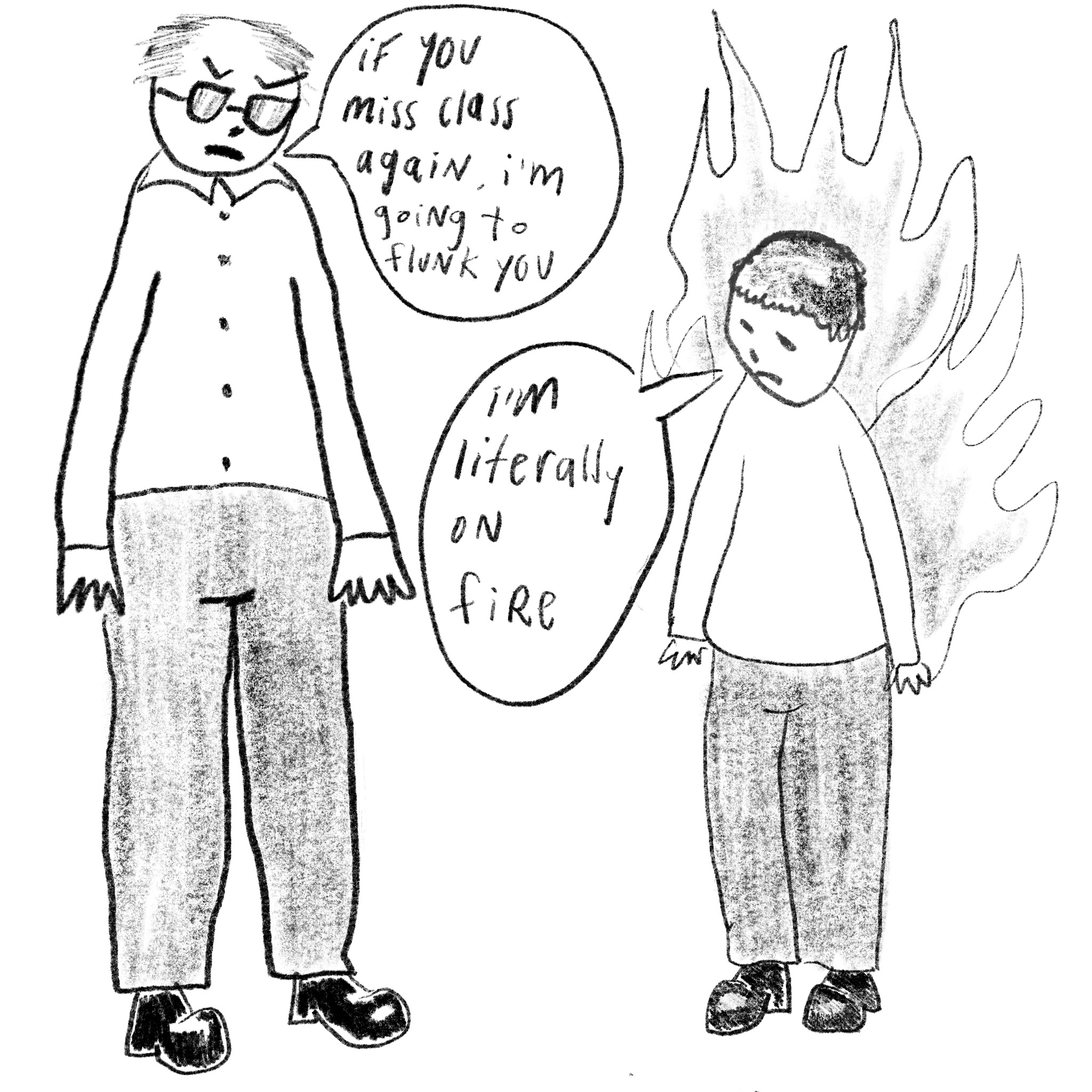
    Maybe I’m just someone who likes to count pennies and is a bit of a pessimist, but the price of graduating is excessive. We’ve already shoveled a bunch of money into the burning money pit of college so it would be lovely to be able to step away from the flames and not have to worry.

  • Something Rotten! opens at Cal Poly Humboldt

    Something Rotten! opens at Cal Poly Humboldt

    by Nina Hufman

    The Cal Poly Humboldt School of Theater’s production of Something Rotten! was entertaining, energetic, and full of innuendo. On opening night last Friday, March 25, patrons filled the Van Duzer Theater to see the comedy, set in the 16th century.

    From the opening song, ‘Welcome to the Renaissance,’ the cast dazzled in beautiful costumes on a stunning set. All of the actors are extremely talented singers and performers. It was clear that they all put in a lot of work and are proud of what they have accomplished. Jeremy Stolp, an English Education major who played one of the lead roles, Nick Bottom, feels that being in theater is a rewarding experience.

    Photo by Michael Thomas | Jeremy Stolp (left) and Miah Carter (right) star as power couple Nick and Bea Bottom.

    “Theater is such a privilege and so much fun to do,” Stolp said. “If you ever have the opportunity, I suggest you try it.”

    The musical was incredibly entertaining. Some of my favorite scenes included Shakespeare’s John Cena-esque entrances, Bea’s hope for a gender-equal future, and the show’s lampooning of religion. One of the best songs was “Will Power,” featuring a leather pants-clad William Shakespeare (Jaese Lecuyer) and his crowd of adoring fans. I also enjoyed “A Musical,” a comic number during which fortune-telling Nostradamus (Sammi Pietanza) tells Nick Bottom that the next big thing in the theater will be musicals, all while wearing a hat that I am convinced was a paid actor. Many of the jokes are meant to be ironic, making fun of musicals and the theater. The way that this is incorporated into the story is very clever.

    The cast was rightfully proud of what they accomplished and are looking forward to adding to each performance in future shows.

    “I don’t think that they (the cast) expected the reaction that they got so when they did it was just this moment of awe,” said Katie Lem, a member of the ensemble. “Everybody standing up at the end was such a beautiful moment for everybody.”

    Photo by Michael Thomas | Zoë Saylor performs an upbeat musical number about the bubonic plague.

    One of the most compelling performances was Miah Carter as Bea, Nick’s wife. Throughout the play, Bea disguises herself as a man to maintain several different jobs and help her husband financially and push for gender equality. Carter’s performance showcased her talents as an actor and singer, particularly in her solo “Right Hand Man.”

    “This is my first ever lead, so this was a good step up for me,” Carter said.

    Carter says that theater is a great community to be a part of and that they are all incredibly supportive of one another.

    “All of us were so proud of what we pulled through,” Carter said. “I love everyone in this cast.”

    The cast and crew are looking forward to continuing to develop this musical as they perform it more.

    “I’m excited for the depth and complexity that we kind of add into it every single show,” Lem said. “Not every night is the same.”

    The musical is running this weekend on Friday and Saturday at 7:30 p.m and on Sunday at 2 p.m. The musical will have you loving to hate William Shakespeare right along with the Bottom brothers.

    Photo by Michael Thomas | From left to right: Zoë Saylor, Sophia Escudero, Jeremy Stolp, Jaese Lecuyer, Jake Hyslop, Michael Jaye, and Miah Carter pose on set of Something Rotten!
  • Last Cal Poly Humboldt home track meet of the year

    Last Cal Poly Humboldt home track meet of the year

    by Eddie Carpenter

    On March 26, Cal Poly Humboldt hosted an invitational track meet. The Jacks have competed in a total of six meets so far. This was Humboldt’s first official home track meet of the season. The event kicked off with the women’s and men’s 4×100 meter relay. It was a blink-and-you-miss-it experience consisting of six rival teams.

    Sophomore Joy Hano competed in the long jump, 100-meter hurdles, 100-meter open, and the 4×400 meter relay. She described how ecstatic she felt during her events.

    Photo by Morgan Hancock | Joy Hano leads the 100-meter hurdles at the Cal Poly Humboldt Track invitational on March 26

    “I had this energy in my body just being home,” Hano said. “After a really long stretch on the road, it felt amazing. It was super exciting. Literally, I could not contain my excitement all week long. It’s just an amazing feeling being home. So happy that we have great weather today and a great showing.”

    Hano set new personal records in all of her events. After some hardships in long jump at an OSU meet, Hano was able to come back and set a personal record by five inches. She placed first place in the 100-meter hurdles with a time of 14.85 seconds, third in the 100-meter run, and set a personal record by 0.2 seconds with a time of 12.63 seconds. She also competed in the 400-meter relay where she dropped a second from her personal best time.

    Decathlete Travis Allen believed that the invitational helped him prepare for upcoming meets.

    “I had some highlights. Did pole vault, cleared a couple heights,” Allen said. “Did the hurdles, got a PR there… Going to these events, you’re not going to see improvements every single time, but if I can get more points here and there overall, that’s going to help my decathlon.”

    Distance runner Elliot Portillo was enthusiastic about his performances and those of his peers.

    “Today I ran the 1500 meter and the 1000 meter. I think that the training we’ve been doing- we’ve been out here pretty much since January,” Portillo said. “I think now as we get into the mid of our season, everyone’s been seeing a lot of improvement. Even if you see today, a lot of people came away with personal bests in a kind of more low-key event…Everyone came out today much more confident in their ability to execute when it matters.”

    Portillo hopes to put a time on the record list at the school before he leaves.

    Humboldt’s first section of 4×100 men’s relay team placed third with a time of 3:34.02. Their second section of 4×100 men’s relay was not recorded because they did not finish. In the women’s 4×400 meter relay, Humboldt placed second with a time of 4:02:87. Humboldt athletes are now preparing for the Mike Fanelli Track Classic on March 31.

  • Student debt is coming faster than you might have thought.

    by Ian Vargas

    If you’re anything like me, there’s no way you can afford to pay for college on your own: you’ve probably got student debt. While you’re still taking classes, it feels like you don’t have to worry about it because graduation could be years away. It’s always looming on the horizon, far enough away that it seems like you’ll probably have it under control by the time you’ve actually got to deal with it.

    I am in my last semester as an undergraduate, so that horizon is closing in real quick for me and it’s scary as hell. My current debt is just shy of $20,000, which is slightly lower than the national average, but still by far more money than I than I’ve ever made at a job.

    Ideally college would help with that, but considering the job market, that’s no guarantee.That leaves me and many others with crushing debt in the position of having both a huge amount of uncertainty about what we’re going to do after college and a huge amount of certainty that whatever it is won’t be sufficient to not be living on the bare minimum.

    I appreciate my education. I plan on continuing it into graduate school, but this system feels as if it’s built more to place you into a position of permanent debt than to provide an education to people.

    Even if you’re lucky and don’t end up missing payments, you’re still paying about 10% of your income, and if you aren’t then you can rack up extra fees and put yourself even further back. On top of that are the countless other ways that you end up gouged for money while still enrolled like expensive but mandatory meal plans or fees for services that, depending on the current level of COVID lockdown, may not even be available to the students using them.

    According to educationdata.org, the average monthly payment for someone with a mid-paying job and in the same category of debt as myself is $393 over the course of six years, which is currently more than I even get per paycheck at work.

    These debts are what keeps people from buying homes or starting any kind of family. Ideally this whole thing should be free and improve peoples’ lives instead of operating off of a profit motive at all. But that’s a fight that seems like it will take way longer than any of us will be able to see through to the end.

    As students, we need to press for more scholarships and grants for students. Ones that don’t incur years of debt, and push back harder against tuition hikes that force students to either abandon their education or take out more loans. Otherwise, college becomes the exclusive domain of people who already have money, even more so than it already is.

  • Cal Poly Humboldt Directors in the spotlight

    by Carlos Pedraza

    In the Van Druzer theater on Thursday, March 3 for the first time since the start of the pandemic student films were shown to a live audience. Around 40 people came to the showing of Cal Poly student films. Several of the films were made in the fall of 2020 there showing being delayed by the COVID pandemic.

    The short films ranged from psychedelic, documentary, serious, and funny; some of the films were a combination. The audience made sounds of laughter, shock and sadness reacting to each film with emotion equal to the film itself.

    A film director who was in the audience was Kylie Holub, a senior film major. Holub directed and wrote the film “Abstraction” in the fall of 2020. They film . During the pandemic Houlb said “ just keeping our crew really lean and realing thinking about how to tell stories with minimum actors.”

    The narrative film “Abstraction” is the story of a beach treasure hunter finding an alien artifact and the fallout of her discovery. The unknown and aliens being major inspiration for the film.

    Holub said “ you see a lot of people with metal detectors, we know very little about the ocean and aliens are fun to play around with.”

    Another director was alumnus Valerie Rose Campbell created the experimental film “Recipe for Young Mothers.”. Campbell goes through the recipe of banana bread while she narrates the experience of a young mother and her attempts to reclaim her life from an abusive relationship and societal expectations of a mother.

    The COVID pandemic heavily impacted the creation of the film Campbell said “ everything got done digitally and that was really hard.”

    The film is inspired by Campbell’s own experience in the local family system. “ How it felt so unjust for my kids and family.” said Campbell describing her own life experiences.

    There will be another film showcase in the fall of 2022 showing films created in the spring.

  • Latinx artists collaborate on chorus

    by August Linton

    Like the blossoms of our early spring, genuine and vulnerable artistic collaboration is blooming at Cal Poly Humboldt.

    The Toyon Multilingual Literary Magazine’s ‘SANA, SANA: Hope and Healing for Latinx Communities in Times of Precarity’ was a contest that asked for submissions of poetry, with the intention of having the winning entries set to music.

    The poem selected to be interpreted into a choral work by the award-winning composer Carlos Cordero was Alannah Guevara’s ‘Fresh Fruit.’ It is a deeply affecting rumination on vulnerability and intergenerational trauma, filled with haunting and tender images of bruised fruit and parental care.

    Guevara says that she wrote the poem thinking of her father, who passed over ten years ago. She’s a native of California’s Central Valley, where many Latinx people have settled and work on the area’s vast orchards. Guevara is half Mexican; she sees in her family and in her community an unwillingness to discuss the painful past, and an unending hope for the future.

    “I have really vivid memories of going to an orchard in the town I grew up in… It all melded together, these words that I had and these memories,” said Guevara. “Here in Southern California, who’s working in those orchards is Latinx people, Mexican people. And it got me thinking about my familial trauma, my generational trauma, the things that my dad left me to deal with.”

    Graphic by August Linton

    Guevara is about to become a parent herself. In ‘Fresh Fruit,’ she feels the protection and hope that her parents struggled to give her, and also the intense desire to protect and uplift her own child.

    The final choral piece is deeply beautiful, modern, and connected to the emotional core of Guevara’s poem. Cordero was a fantastic composer for the ‘SANA SANA’ project, both as a stunningly talented musician and also as a member of the Latinx community.

    Cordero’s Friday talk, hosted by CPH’s El Centro Académico Cultural, focused heavily on his personal struggle towards vulnerability, and how that has affected his compositions and musical career.

    Cordero’s writing process is a very visual one, although his medium is entirely auditory. He works with charts of inter-connected words and line graphs of emotional intensity to visualize his compositions in a more visceral way.

    “[Vulnerability] isn’t always going to come back to you immediately, but it’s coming to build or to open that door for people who want to connect with you,” Cordero said. “I’ve learned in art that I open up the door, I don’t make you come in. All I can do is present myself.”

    He recounted a story of opening up about his family’s experience of losing his younger sister to members of a choir he was working with. They came to him with stories of their miscarriages, of their losses, and that allowed the whole group to access an emotional connection that was not visible before.

    Cordero is originally from Maracaibo, Venezuela, and now lives in Austin, Texas. He says he, like Guevara, has struggled with an unwillingness to have hard conversations with his family about the traumas they’ve experienced.

    His piece ‘¡Ayúdame!’ was written as a “Venezuelan plea for life.” Members of the choir cry out “ayúdame, escúchame” (help me, listen to me) in Cordero’s attempt to communicate the suffering and disillusionment of the Venezuelan people.

    However, ‘¡Ayúdame!’ also represents the importance of being vulnerable, both by asking for help and by letting other people support you.

    Cordero spoke about the expectation within Latinx families and communities that people be strong, that they don’t show their struggles. As he struggled with the trauma of being Venezuelan in the midst of an ongoing humanitarian crisis, Cordero realized that he sorely needed help, that people need to ask for help.

    “[In ‘Fresh Fruit,’] Alannah showed me that the struggle is OK. It says to our kids, to our generation, to our families: we want to show that everything is ok but we can also share in their struggles,” said Cordero.

    The Cal Poly Humboldt University singers will perform ‘Fresh Fruit’ on Sunday, April 24th, alongside other musicians performing other works from the ‘SANA SANA’ project.

  • Take me out to the ball game

    Take me out to the ball game

    by Gabriel Zucker

    On March 5, the Cal Poly Humboldt softball team held their first home game this year. I was reminded of an easier time, where relaxing to live sports was an everyday escape from the rigor of school and work. During the next couple of hours, I experienced camaraderie, screaming fans and most importantly, tailgate food.

    Photo by Gabriel Zucker | Junior Pitcher, Megan Escobar pitches against Chico State on Saturday

    Walking around the softball diamond, my eyes fell on a group of parents huddled around a BBQ, waiting on the drumsticks to finish cooking. Walking closer and closer to the food I tried to avoid eye contact, instead focusing on taking photographs of the game. Almost immediately, one of the parents called me over.

    Richard Guevara, the father of one of the freshman softball players, yelled out, “Do you like ceviche?”

    Looking over I saw a stocky gentleman, decked out in Humboldt softball gear, a giant smile stretched across his face. He beckoned me over with the promise of ceviche and chicken. Next thing I knew I was talking and laughing with the parents, enjoying their food, and praising the beauty of Humboldt.

    Taking a bite of ceviche now, I’m transported to a time where sports was a shared experience. A time when sports was more than just the game, it was about the connections you made. After taking a moment to relish in the memories, I opened my eyes to a giant smile and a chicken drumstick.

    Sports is never just about the game; it is about the shared experience. At the softball game, a feeling I hadn’t experienced in year swept over me. Screaming fans, a sound I only recently heard in my dreams, washed over me like a wave. My heart flittered and danced, and as the smell of food and freshly cut grass hit me in the face. I stopped to smile.