One morning, I was finishing up one of my mundane tasks at work when I overheard a discussion between my manager and a customer. The customer was a travel nurse and was stationed up here for the summer. Of course, the follow-up question to that information was, “Where are you from?” in response she goes, “Florida”.
That answer was a bit shocking to me. I’ve met people from New Jersey, Texas and even Canada up here – but Florida? My manager asked her how she enjoyed her time up here and through a slight chuckle she responded, “Well this is the most Florida place I’ve ever been to in California.”
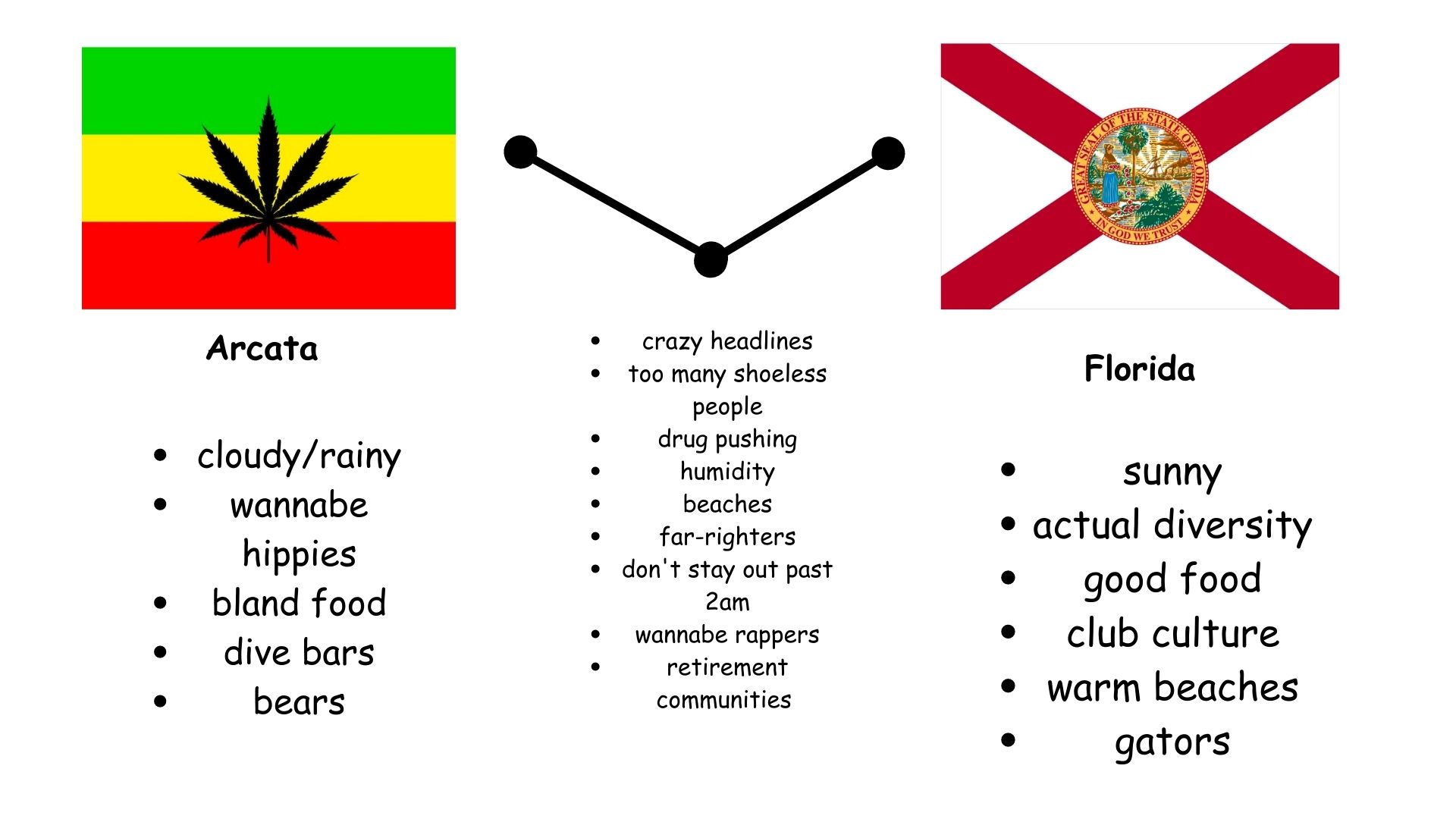
At this point I had to laugh with her. I was never posed with a comparison that happened to be so spot on. It’s remained on my mind since then, so today I ask myself, is Arcata really the Florida of California?
I mean to start with the first difference: Arcata will never ever be comparable to the Sunshine State. Our muggy, gray clouds in August will speak for themselves. Although, there are some similarities if we want to look at the landscape. Starting with the lush vegetation, the Everglades and redwoods are quite synonymous. Same with our apex predators, like gators and black bears. We also share the same sandy beaches at close proximity.
I mean, Arcata is no girl’s spring break trip to Miami, but we do have lots of tourists coming through and even some hotties, if you’re into ecological preservation and bare feet – another shared similarity between the two vacation destinations but for completely different reasons. If you’re not near a beach, I don’t want to see those toes.
There seems to be many more similarities between the two; crazy amounts of drug peddling and always being able to count on the most insane conversation to be initiated between you and some stranger that approaches you on the street. Can’t forget the wannabe rappers that seem to be coming out of the woodwork all the time. Also, how both destinations seem to be a top pick for retirement communities.
I believe that one of the biggest similarities you can find between Florida and Arcata is that you can almost always expect the local headlines to hold the same zany crime bookings that are shared between the two coastal regions.
Any headline beginning with ‘Florida Man’ or ‘Humboldt Man’ can always promise the most insane crime story you’ll ever read. Must have something to do with the beaches and far right extremists that shack up on both coasts.
A quick peruse of Orlando Fox 35’s website under the keywords ‘Florida Man’ brings up cases such as a man dunking a woman’s head in tar, another throwing a barbecue at deputies and one stealing a hearse from a funeral home. You may think these are as crazy as it can get, but have you seen the recent headlines in the Lost Coast Outpost?
Let me entertain you with a few: The confiscation of 2,400 tabs of acid, a man setting fire to another man in Eureka, and my personal favorite, the man found with a handgun that was the size of a credit card along with drug paraphernalia.
Along with the crime, we can’t forget about the universities. Although there’s a few more to choose from in Florida than the small city of Arcata, I think they hold the same results of anticipation for students – to only be let down once they arrive. We can also count on the humidity to ruin your cute outfits and hair in both places.
All in all I think that anonymous travel nurse was right, Arcata is the most Florida place in California. Fresno may be the runner-up in reference to the crazies, but who vacations in Fresno?
The California housing crisis can be summed up with one question: to build or not to build? The status quo has always favored single-family homeowners. The recent win for NIMBY (Not in My Back Yard) over UC Berkeley has brought light to the biggest problem California college students are going to face for the foreseeable future: the lack of affordable housing.
California Governor Gavin Newsom passed a stack of bills focused on fixing the California housing crisis. The biggest bill was Senate Bill Number 9, which allows a four housing unit on a single-family lot. This prioritizes affordable housing for future generations and moves away from the outdated practice of single-family zoning.
NIMBYs are local homeowners against affordable housing in their neighborhoods. They argue that their home values will drop and they will lose the peacefulness of single-family-owned housing communities if affordable housing structures were built in the area.
The California Supreme Court sided with NIMBY in a court case against UC Berkeley, going against California’s push towards affordable housing. This forced the school to cut admissions by 2,500 students for the 2022 fall semester. NIMBY won because they argued that UC Berkeley was accepting more students than they could house.
College students all over California are beginning to feel the effects of the housing crisis. Demand is rising while the options are dwindling. There is a lack of options and if this does not change other colleges will soon be forced to cut their enrollment.
NIMBYs recent win highlights the division between single-family housing communities and the growing need for affordable housing. College towns are at the epicenter of this issue. College campuses will never be able to house their entire student population. Students rely on the surrounding community to find housing.
The NIMBY movement is fighting against this change, wanting to preserve a way of life that does not exist anymore. The single-family home is not possible anymore in a changing climate and ever-growing homeless population. NIMBYs are clinging to their current comfortability instead of adapting to the needs of the next generation.
Cal Poly Humboldt Students will soon feel the effects of this landmark decision. The influx of new students is a great thing for the university’s status but the campus will soon face tough decisions if they do not adapt to the changing times and work with the community to build more affordable housing in the surrounding area.
A giant problem this semester has been the lack of parking on campus. Students must park farther and farther away from their housing because of the increase of students and stagnation of parking spaces. I had to spend months trying to find an apartment off-campus this past semester. There are already tell-tale signs of the strain the student body is putting on the schools’ resources. If UC Berkeley is a sign of things to come we must adapt before it is too late.
California’s passing of proposition 22 on Nov. 5 represents a frustrating history of workers’ rights being trampled by the overwhelming influence of greed in politics.
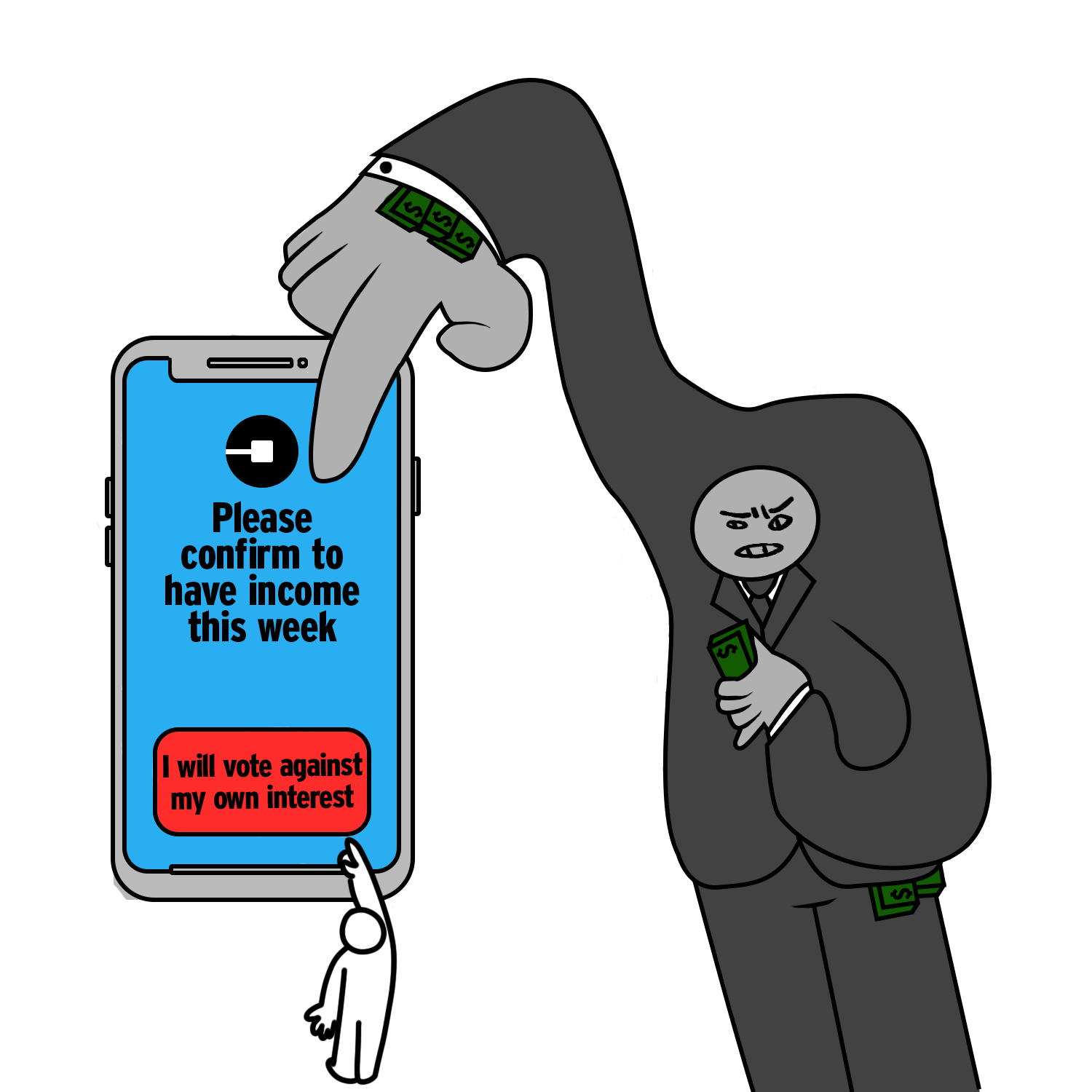
This proposition forces app-based workers to be classified as independent contractors, rather than employees. This classification allows companies like Uber, Lyft and Doordash to pay their workers significantly less than California’s guaranteed minimum as well as provide them with worse benefits than would be guaranteed as a full-time employee.
This proposition was vehemently opposed by labor unions that represented drivers. Unfortunately they were hugely outspent in advertising by the corporations that funded the ballot initiative for prop 22. Advertisements for a yes on prop 22 were incredibly misleading and placed on Amazon, YouTube and even inside of Uber’s app. They misleadingly claimed being an independent contractor provided workers with the freedom to receive benefits while driving on their own schedule.
In fact, under prop 22 drivers are only guaranteed benefits after 25 hours of engaged driving time. Engaged driving time is defined by prop 22 as time actively spent with a rider in the car, or a delivery in progress. With drivers reporting that they spend over half of their time waiting for a pickup, this could require workers to put in more than 40 hours a week for less benefits than a full-time California employee.
The reason that companies like Uber and Lyft are able to continuously influence political campaigns is due to the fact that within the US, companies enjoy and exercise the same level of freedom of speech granted by the First and Fourteenth Amendments that residents due.
In a 1886 Supreme Court case, Chief Justice Morrison Waite said that “the Court does not wish to hear argument on the question whether the provision in the Fourteenth Amendment to the Constitution which forbids a state to deny to any person within its jurisdiction the equal protection of the laws applies to these corporations. We are all of opinion that it does.”
Two years later, the Supreme Court made the ruling official stating, corporations had equal protection under the law as they were merely expressing and acting on behalf of the people that created and ran them.
These rulings are what set the stage for one of the most important court cases in the history of politics within the US, Citizens United v. FEC.
In the rulings of the case, Justice Anthony Andrews, joined by other Justices of the court, wrote that corporations were protected under the First Amendment to freely express their opinions on matters both domestic and political.
Furthermore, Justice Andrews wrote in the majority opinion that the US government was not responsible for creating an equal playing field regarding the use of money, changing the rules of campaign financing, leading to the rise of super Political Action Committees. These PACs could acquire an unlimited amount of funds from corporations, individuals and other PACs to use for supporting political candidates and proposals.
The consideration for corporations did not always extend to laborers. The US has a history of ruling against labor unions, going as far back as 1806, where the first case regarding a labor strike occurred with Commonwealth v. Pullis. The Philadelphia Mayor’s court ruled that leaders of a union strike were guilty of conspiring to raise their wages after labor strikes failed to do so. This established a precedent that labor unions were illegal, something that stood until 1842.
The ferocity companies and governments demonstrate when quelling labor organizations should be all the evidence needed that labor organizations are effective. The total number of workers murdered in response to labor organization in the United States is unknown, but the number of workers killed by law enforcement, company militias, and other anti-labor forces during labor disputes numbers in the thousands. If labor organizations did not work, no one would drop bombs on striking workers and, knowing the risk, no one would strike if it did not benefit them.
The US Government has often been hostile to labor organizations. During the early years of the industrial revolution, the legality of collective bargaining was uncertain, but often led to convictions and fines. Even when collective bargaining was legalized, the National Guard and local law enforcement were responsible for violence against labor organizers.
Resistance to collective bargaining should be expected from people who became as powerful as they did by appealing to moneyed interests. No one in a position of wealth and power can be relied upon to betray their source of power. Greed is bipartisan, and workers should not rely on institutions to grant them rights if those same institutions have proved hostile in the past.
Though the labor victories of the past still benefit workers immensely, companies are doing everything they can to undermine those victories. Prop 22 is one in a long line of examples. It undermines workers rights and chips away at our hard won standard of living. It should be a warning sign that no labor struggle is ever over. It will be an ongoing fight against corporate greed, but joining a union and standing in solidarity with workers across divisions of nationality, race, gender and economic background will benefit yourself and your community.
California has again warned residents of the potential and likely chances of Public Safety Power Shutoffs. With a larger range of the state being on fire this fall, more residents have been left without power in the midst of a pandemic.
After the 2019 school year was impacted by power outages, HSU immediately sprung into action working toward a plan to improve the issue for students. While they couldn’t have predicted a pandemic would occur at the same time, they’ve created a plan to put into effect during these occurrences.
Associate Vice President for Student Success Stephen St. Onge said HSU students would likely not even realize a power outage had occurred due to their new equipment. Since last year, housing has purchased two generators.
“One is over $6,000 and it will power the JGC building, Cypress, the Canyon, and Sunset and Redwood,” St. Onge said. They also bought a portable generator to power College Creek.
As well as the generators, the King Salmon Powerplant, based in Eureka, is now operating and handling Humboldt County’s future PSPS events. Cris Koczera is the emergency Coordinator for HSU’s Risk Management and Safety Services.
“If we got notice of an impending PSPS right now, this year unlike last year, PG&E has been able to provide typically at least 48 hours of advance notice,” Koczera said. With this extra time, the school has been able to prepare more.
“We already had one PSPS and there was no campus disruption because of the King Salmon Plant,” St. Onge said. “We had the generators ready to go – we were prepared this time.”
This solves many of the problems that concerned students last year. Campus should function as normal this semester, without limited food, power and the need for students to leave their dorms to receive access. Even the elevators should be running for students who cannot rely on stairs.
“We have since – knock on wood – solved those issues,” St. Onge said.
In the instance the King Salmon Plant does not work and students live in an area uncovered by the new generators, HSU has another plan prepared.
“We do have open spaces in other buildings, so we might consider if there’s a need to reopen up the JGC like before or relocating students temporarily to other spaces as well,” St. Onge said. “So we have those Plan C’s in place, as well.”
Due to the COVID-19 pandemic, Koczera said the school would be reaching out to health officials to help determine the safest way to move students into one area.
“We would be reaching out to public health to find a safe, viable way to still provide those levels of support and services,” Koczera said.
So, while students have been preparing themselves to return to the University, HSU has been preparing for ways to help the student body through these issues.
“It’s important for students to know that as an outcome of last year’s PSPSs, there’s been a group of folks, housing facilities, management, that have been working really hard,” St. Onge said. “We are prepared.”
“Our commitment to supporting their educational work on campus is a serious commitment that we take,” St. Onge said.
“The goal of the University has always been to get to a point where these PSPS events or rolling blackouts have the least amount of impact possible on our campus and on our students and on our ability to continue through the educational process,” said Koczera.
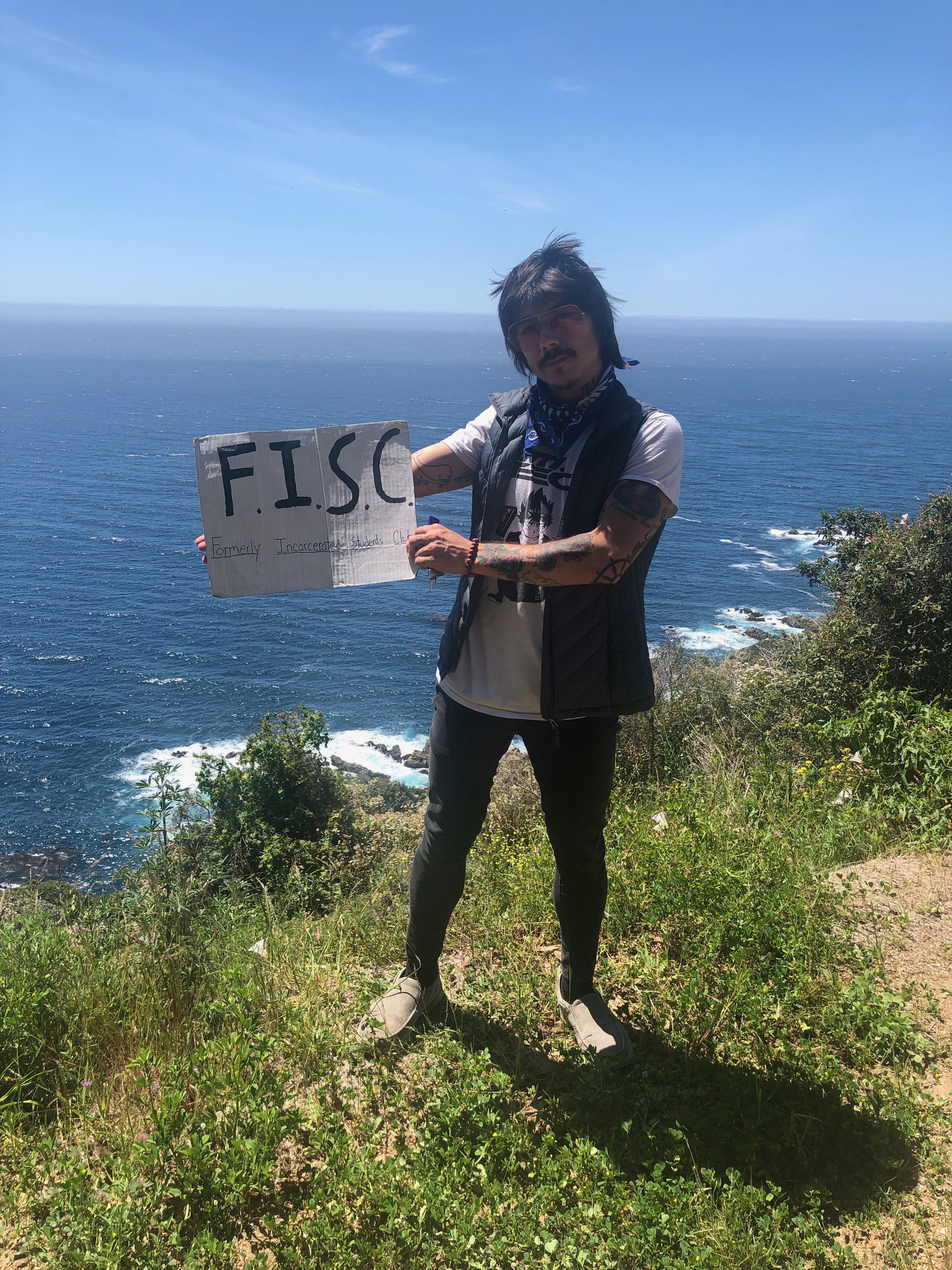
When the entire world is going mad and cities are in disarray and the economy is through the tubes and the government is ordering the people to stay indoors and keep distant from human contact and all the unknowns and uncertainties and precariousness are causing anxieties and confusion and insane isolated thinking, then the only logical solution is to search for the magnificent eternal golden light in Big Sur where Jack Kerouac lost his illumination and was succumbed to mad mad maddening disillusion and deterioration of mind.
Amidst a global pandemic and forced isolation (both for curving the spread of the disease and government say-so) Kerouac’s “Big Sur” may seem like an unlikely companion during cabin fever tendencies but he nails the coffin of loneliness surrounded by madness…and we are swimming in madness in 2020 and social distancing is causing us loneliness…he may be known for traveling on the road but the majority of his writing deals with the personal struggle of the unrevealed and intangible and intrapersonal relationships with exile and aloneness.
It was time to go back to find some sanity while the whole world was ravaging in chaos.
Last week I received a card from my obaasan written in shaky cursive:
“I’m not myself now/can’t think much things now…” Her youngest son died in the middle of all this virus business and the experience of losing her youngest before her own passing into the next existence and not being able to perform a proper Japanese funeral has weighed a heavy heart on my nearly 90-year-old reincarnation of the bodhisattva Quan Yin. The letter is marked from Monterey, my hometown, just a couple dozen miles from Big Sur, which I am currently in the thick of. Whereas Kerouac fell into his madness, I was born into mine…and it was time to go back to find some sanity while the whole world was ravaging in chaos.
Passing San Jose on the 280 at rush hour, or what normally is, and we stop not one time and I am convinced there is a God in heaven and miracles exist and coincidences mean something more than just what they don’t.
A pitter patter of rain began to fall as my partner and I sped away from our Arcata apartment and headed down the curvy empty roads of the 101 en route to console an ailing mother from 6 feet away. My paint-scratched and hood-dented Volkswagen happily ate the white lines through redwood country, wineries, extending bridges and golden rolling hills full of deer and foxes and chirping birds. With everyone staying in doors, the urbanized are becoming again what Gary Snyder calls “wild.” Only 10 cars on the Golden Gate Bridge and all of the city, void of the Tenderloin, which sidewalks are unseen due to the amount of popup tents and stretched out tarps and rucksacks rolling in the gutters. Passing San Jose on the 280 at rush hour, or what normally is, and we stop not one time and I am convinced there is a God in heaven and miracles exist and coincidences mean something more than just what they don’t. Seven hours and not a minute more since we left Humboldt County the magnificent sand dunes of my childhood explode into view as the sun sinks behind cannery row, the fisherman’s wharf and into the pacific.
We knock on the windowpane glass without warning. My obaasan, 4-foot-5 in frame in blue uwabaki and nearly all white thick Hokkaido curls reminiscent of the ancient Ainu people of our ancestors opens the door white as a ghost. We appear as road warriors traveling to find oil but she is happy nonetheless to see her most handsomest grandson and granddaughter in law (I know this because she tells us so in a faint whisper of grief). She is nearly silent and full of half smiles and sad lonely eyes staring off into a point in space I am unable to see. There is nothing more difficult than to deny a Japanese grandmother’s invitation of hot food and conversation… but these are harrowing times and one must put down their foot for the betterment of others… especially kindhearted compassionate grandmothers who want nothing more than to fill bellies and tell stories.
Without being able to hug her or get close enough for her to hear me hurt my soul but the space we shared amidst all the craziness going on filled my heart with such joy that I could feel the sanity I had lost while sheltering in place replenish.
We part for the night with three bows and head to Big Sur first thing in the morning. We were supposed to spread the ashes of my uncle but bureaucracies have slowed down (who would have thought possible they could move even slower) and checks clearing takes longer and so we had no urn and only mandatory intention of flying down the beautifully rugged pacific coast cliffs hugging the Santa Lucia Mountains to the east and infinite deep neon blue waters crashing west. All parks are closed and scattered hikers from who-knows-where park along the highway to hike in. We stop at Bixby Creek of Kerouac’s “Big Sur” but it is not the same for all the turnoffs are filled with parked cars and tourists and selfies… or maybe it is the same because on his last hitchhiking adventure up from Big Sur to Monterey 1,000-2,000 cars passed him by and he was no longer able to relate. We ate lunch beneath the shade of an oak tree 100 feet above the water and 15 miles from the hot springs. We were by ourselves with the lonely wails of the sea and the roaring of the waves and the ghostly spirits of Kerouac and my uncle.
On our way out of town we said goodbye to my grandmother. She stood behind the screen door as we stood in the sun with bandanas and masks wrapped around our faces. She was in a cheerier mood and her energy level was heightened. She wore full smiles behind her grief and talked about the chaos of the world being unbalanced. Without being able to hug her or get close enough for her to hear me hurt my soul but the space we shared amidst all the craziness going on filled my heart with such joy that I could feel the sanity I had lost while sheltering in place replenish. Kerouac pronounces, “The more ups and downs, the more joy I feel. The greater the fear, the greater the happiness I feel,” and I believe it to be important we share the same intimacies while we are submerged in the unknown dangers of threats and hazards.
HSU briefly required registration for two public webinars as a security measure
Update, April 22: Humboldt State Vice President of Enrollment Management Jason Meriwether penned a letter to The Lumberjack, making the case that HSU did not violate California law. Read it here.
Editor’s note: Grace Caswell is a student in Journalism Department Chair Vicky Sama’s media law course. Almost the entire staff of The Lumberjack has also had Sama as an instructor in journalism courses.
Humboldt State University hosted public meetings via Zoom to inform the public about its projected enrollment decline and budget cuts April 13 and 15. However, as a security measure protecting the university from “Zoom bombings,” HSU enacted mandatory registration requirements prior to entering the meetings in violation of California state law.
“Zoom bombings” describe a new term for an infiltration or hijacking of a Zoom session with the intent to harass and disrupt the session. With an increase in Zoom users, from 10 million in December 2019 to more than 200 million in March of 2020, Zoom CEO Eric S. Yuan released a statement April 1 detailing additional measures being taken to enhance Zoom security over the next 90 days.
HSU Vice President of Enrollment Jason Meriwether claimed HSU has experienced Zoom bombings and enacted the registration as an additional security measure. The additional measures required the public to respond twice via Google forms before being sent the Zoom meeting invitations, basically giving the administration, a government body, the power to sift through and deny public access.
An approved registration screen for one of HSU’s enrollment and budget webinars held April 13 and 15.
HSU Chair of the Department of Journalism and Mass Communication and media law professor Vicky Sama alerted and engaged with HSU administration, specifically Meriwether, on the violations being committed.
“Using ‘security’ reasons to require the public additional registration to access a public meeting on the people’s business does not satisfy the openness and liberties that our Constitution provides,” Sama said in an email. “In addition to violating state law that I explained in my earlier email.”
“The unintentional message is that some people are not welcome and/or we at HSU don’t want the public to know what is going on.”
Vicky Sama, HSU journalism chair
Sama said the additional requirement for the public to register prior to receiving an invitation was tantamount to reviewing their qualifications.
“The email did not justify the registration nor did it outline its purpose, raising suspicions that the university doesn’t want certain people to attend or know what is going on,” Sama wrote. “The unintentional message is that some people are not welcome and/or we at HSU don’t want the public to know what is going on.”
Specifically, HSU’s actions against the public violated the Brown Act and Bagley-Keene Act. Both California state acts provide assurance of rights to the public. Sommer Ingram Dean, staff attorney for the Student Press Law Center, explained how these security measures directly conflict with both acts.
“Section 54953.3 of Brown says ‘A member of the public shall not be required, as a condition to attendance at a meeting of a legislative body of a local agency, to register his or her name, to provide other information, to complete a questionnaire, or otherwise to fulfill any condition precedent to his or her attendance,’” Dean explained in an email.
“Section 11124 of Bagley Keene says ‘No person shall be required, as a condition to attendance at a meeting of a state body, to register his or her name, to provide other information, to complete a questionnaire, or otherwise to fulfill any condition precedent to his or her attendance.’”
Sommer Ingram Dean, staff attorney for Student Press Law Center
Additionally, Dean cited the Bagley-Keene Act and the measures it provides ensuring the public’s rights.
“Section 11124 of Bagley Keene says ‘No person shall be required, as a condition to attendance at a meeting of a state body, to register his or her name, to provide other information, to complete a questionnaire, or otherwise to fulfill any condition precedent to his or her attendance,’” Dean wrote.
Sama informed Meriwether of the illegal activity violating both the Brown and Bagley-Keene Acts April 13, citing the specific sections mentioned above. In response, Meriwether continued with the registration in place and adjusted the meetings by offering public links.
“Since this issue was just raised today, it appears to me that the best thing to do is to move forward with today as planned,” Meriwether said in an email. “We will also explore hosting a third event. We will provide both the option for registration and the public link for the already scheduled event on Wednesday. The entire point of having these events was to be transparent.”
Since then, the links to the April 13 and 15 meetings went public. However, the concern more surrounds HSU’s decision to filter through the public’s right to access a public meeting regarding matters directly impacting them.
The registration requirement, Sama wrote, amounts to intimidation and goes against the spirit of openness and transparency, and “reeks of sneakiness.” In a time of crisis, government bodies can use the mirage of security to deny the public their right to voice their opinions. Ultimately, it can amount to an abuse of power against the public.
Here’s how HSU received the trees and where you can find them
Humboldt State University has a handful of redwood trees grown from seeds that went to the moon.
In 1971, astronaut Stuart Roosa brought around 500 tree seeds with his personal items on the Apollo 14 NASA mission to the moon. Roosa intended to test the seeds to see if space radiation would affect their germination. While he never set foot on the moon, he orbited the moon 34 times while his colleagues walked the lunar surface.
When Roosa returned, he sprouted most of the seeds. NASA then sent the seedlings around the world. Around 1976, HSU received a handful of redwood seedlings and planted them around campus. Some of those trees remain near the theatre arts and natural resources buildings and near the Campus Center for Appropriate Technology and Facilities Management.
Blue mussels are a type of edible bivalve found in cold coastal waters. These orange-fleshed, blue-shelled mollusks are high in vitamin B and iron. Mussels and other bivalves feed by filtering water throughout their body. Bivalves, including mussels, can be deadly if consumed during red tide conditions.
You can forage for mussels along the California coast legally with a California fishing license. The legal daily limit for mussels is 10 pounds and you must carry a scale with you. Do not use tools to scrape mussels off rocks. This damages the mussel beds and is prohibited for mussel collecting. Instead, get a sturdy pair of gloves to twist and yank the mussel free from its byssal thread attachments (also known as beards) that secure it onto rocks.
Mussel gathering is prohibited in Humboldt County every year from May 1 to October 31 due to the warmer climate during this time, which facilitates the proper conditions for toxic algae blooms. Mussel quarantine may vary year to year. Always call the shellfish bio-toxin hotline before you plan on foraging.
Bio-toxin information line: (800) 553-4133 shellfish toxins/quarantine information
Editors note: This article previously stated an incorrect limit on mussel harvesting and has been corrected. We have updated information about mussel quarantine. Updated January 21, 2021
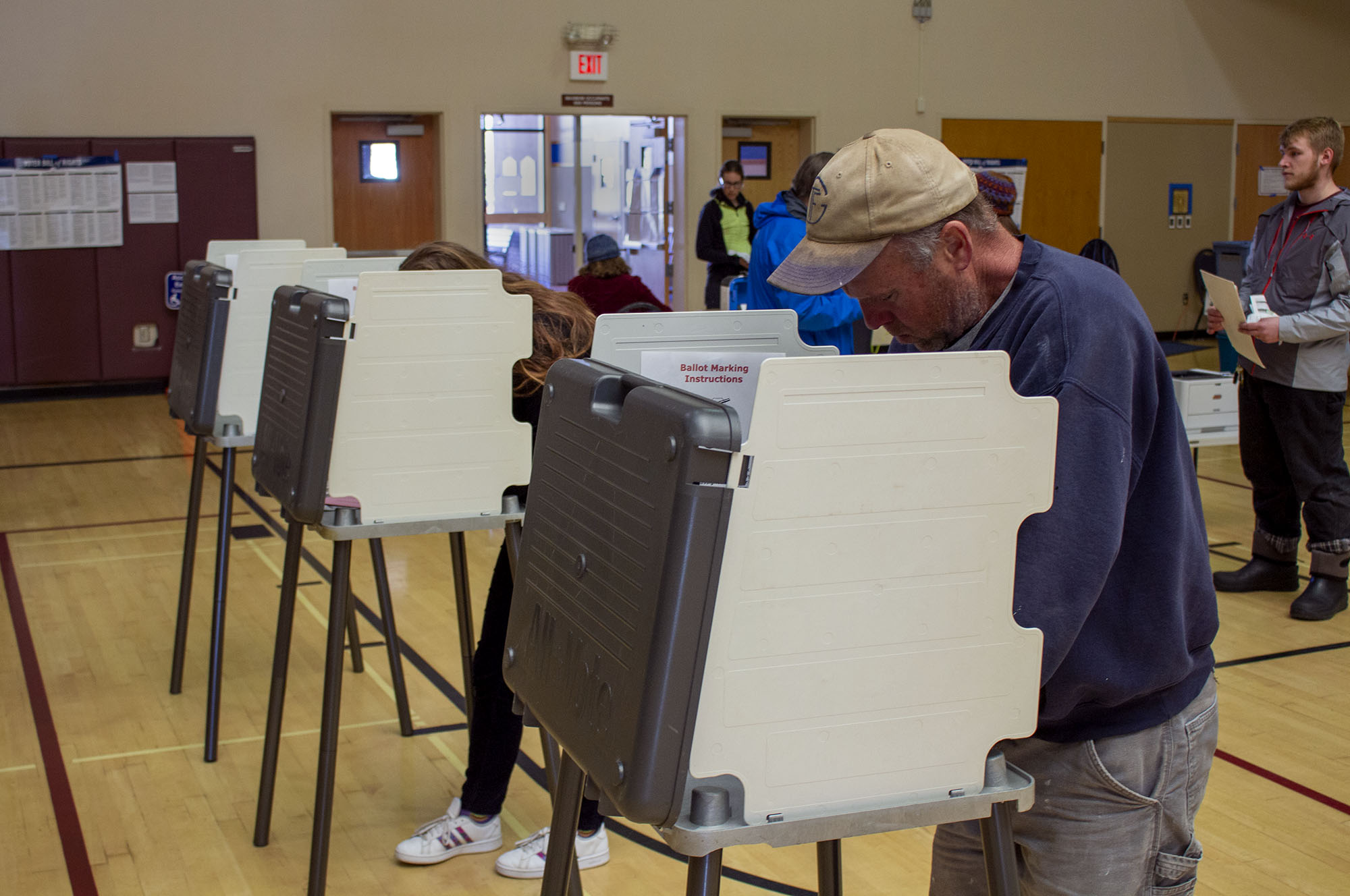
Vermont Senator Bernie Sanders won the California primary. With more than 400 delegates up for grabs, Sanders consistently polled higher for California Democrats leading up to the primary. Sanders’ progressive platform drew a coalition of voters and strong support from unions across the country.
Tuesday night marked the biggest event in the primary season. Fourteen states plus American Samoa held primaries Tuesday, with 1,357 delegates to be allocated. That is just over a third of the delegate total needed to win the Democratic nomination.
Humboldt County overwhelmingly voted for Sanders. Part of California’s second congressional district, Humboldt voters choose six delegates to send to the Democratic National Convention in July. Tuesday night reports around 9:30 p.m. showed Sanders leading Humboldt with 42.4% of the vote, followed by Massachusetts Senator Elizabeth Warren with 14.5%.
Sanders led California overall with 28.7% of the vote. Michael Bloomberg was second with 18.8%. Biden was third at 17.2%.
Biden had a surprising surge in support in other states. Biden is running as a moderate, citing the need to beat President Donald Trump in the general election. Though Sanders draws support from demographics with generally low-voter turnout, Biden’s campaign claims a candidate running too far to the left will discourage many potential Democratic voters from showing up in November.
“I believe that Sanders is still going to be the delegate leader. And he has the enthusiastic base needed to beat Trump.”
Billy Cook
This boost in support may be a result of the recent dropouts of Indiana Mayor Pete Buttigieg and Minnesota Senator Amy Klobuchar. Both candidates were running moderate campaigns similar to Biden’s. Sanders had been accumulating significant momentum in the early primary states. Before Tuesday, many viewed Biden’s campaign as an insignificant challenge to Sanders’ campaign.
One of Humboldt County for Bernie 2020’s lead organizers, Billy Cook, remained hopeful that Sanders will win the nomination.
“I believe that Sanders is still going to be the delegate leader,” Cook said. “And he has the enthusiastic base needed to beat Trump.”
Since 2016, Sanders has drawn support around his long-standing progressive platform. His main campaign points are Medicare for All and the Green New Deal. Many Humboldt residents cited these policies as the main draw to support Sanders.
Sanders supporters in Humboldt County have been hard at work campaigning to get residents to vote for Sanders. They have regularly sent crews to canvass Arcata, Eureka, McKinleyville and Blue Lake. One of their strategies is to reach out to voters face-to-face. A few members of the group have also set up tables with voting and candidate information in pedestrian areas around Humboldt as well.
Another organizer for Sanders-supporters in Humboldt, Evan T. Nixon, said Super Tuesday made the race more complicated. Nixon said that the strategy for organizers in Humboldt is going to change. Their focus will shift to states that have not yet voted in the primary, like Oregon and Arizona.
Making a difference in the dunes by hand, plant-by-plant
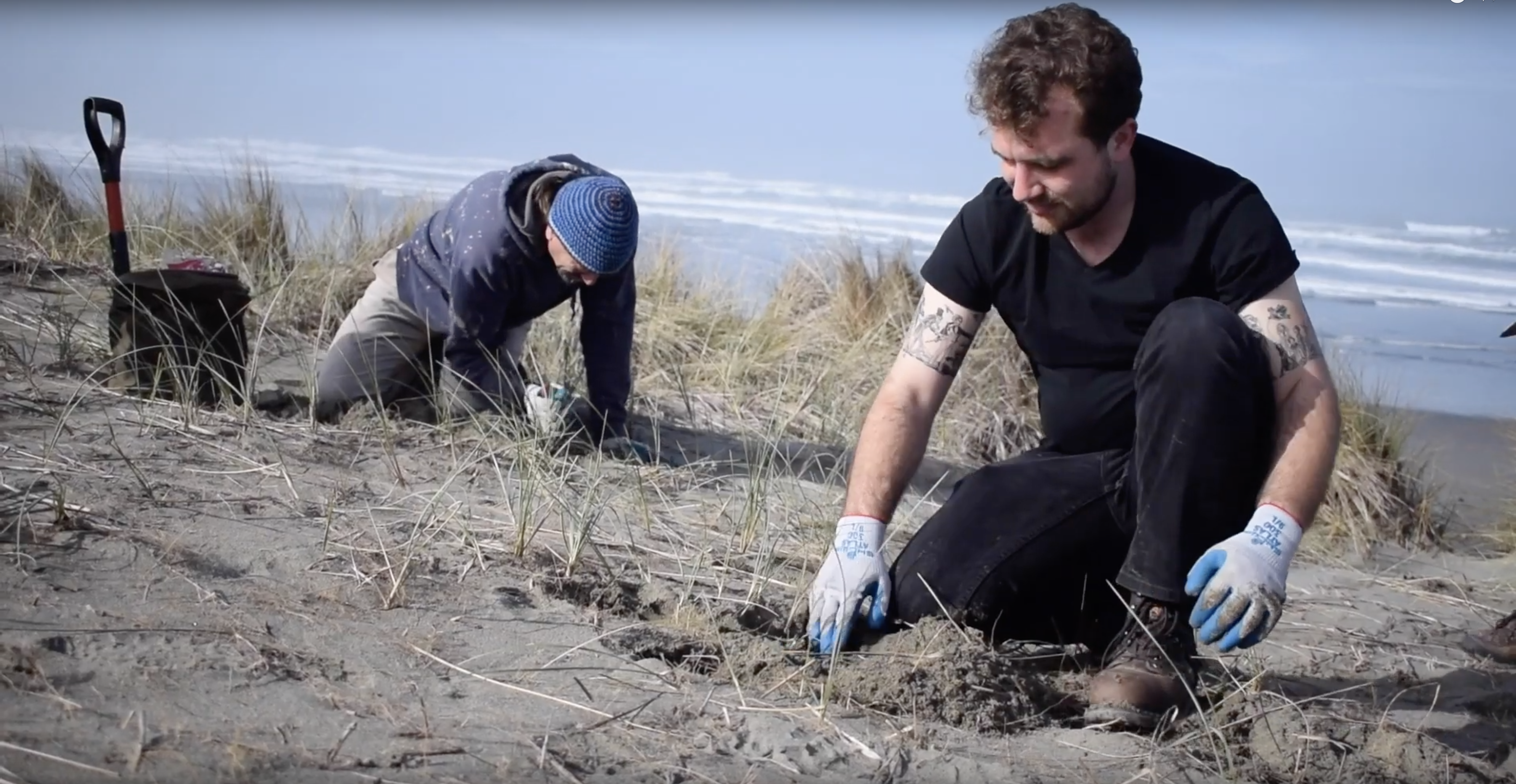
Volunteers visited the Manila Dunes in Arcata Feb. 15 to tug invasive grasses from the sands in a monthly gathering facilitated by Friends of the Dunes. The volunteers of all ages from youthful college students to gray-haired, retired locals removed beach grass to allow native plants to repopulate the dunes.
Clarifying the legality of betting on the Super Bowl
When you think of Super Bowl betting, you might think of a couple friends harmlessly betting $50 on their hometown team. But Super Bowl betting is illegal in California.
In 2015, the Association of Government Accountants estimated that people illegally wagered around $145 billion on sports betting. The AGA seeks to increase government accountability and transparency, according to its site.
Clearly, even if it’s invisible to most, a lot of money is being illegally transferred through sports betting.
Under California Penal Code 330, California state law says that gambling is illegal, with the exception of Native American reservation casinos, card clubs, charitable gambling, horse wagering and the California State Lottery.
On Sunday, Feb. 2, the San Francisco 49ers will play the Kansas City Chiefs for the 2020 Super Bowl. Whether you’re watching the game or just going to a party to eat barbecue, you probably at least know someone that’s going to be watching, and more than likely, know someone placing a bet on the outcome of the game.
In California it’s illegal to bet on the Super Bowl or sports of any kind, but people bet on the game anyway. In the 1990s the prohibition on sports betting began and all sports betting became illegal nationwide.
Congress passed the Professional and Amateur Sports Protection Act in 1992, which banned governmental entities from legalizing sports wagering.
Yet in a 2018 United States Supreme Court case, Murphy v. National Collegiate Athletic Association, the Court overturned PASPA due to its conflict with the Tenth Amendment.
“Congress can regulate sports gambling directly, but if it elects not to do so, each State is free to act on its own,” Justice Samuel Alito said.
Online betting is a popular form of wagering on the Super Bowl, but when you go to place a bet, you have to confirm your state of occupancy—thereby restricting Californians.
Under California Penal Code 330, California state law says that gambling is illegal, with the exception of Native American reservation casinos, card clubs, charitable gambling, horse wagering and the California State Lottery.
“Every person who plays or bets at or against any of those prohibited games, is guilty of a misdemeanor, and shall be punishable by a fine not less than one hundred dollars ($100) nor more than one thousand dollars ($1,000), or by imprisonment in the county jail not exceeding six months, or by both the fine and imprisonment,” the code says.
So if you plan on betting on this upcoming game, know what you’re getting yourself into.
How planting trees can serve as one branch of a climate action plan
In the face of climate change, all scales of society, from government to corporations to individuals, are looking for ways to emit less and sink more carbon. The internet latched onto the tree-planting solution, but it’s important the right trees are planted in the right place at the right time.
The climate crisis is the dominant issue of this decade. According to Robert H. Socolow and Stephen W. Pacala, who wrote the article “A Plan to Keep Carbon in Check” in 2006, the world must avoid emitting about 200 billion tons of carbon over the next 50 years.
To make the problem manageable, Socolow and Pacala turned the required reduction into one-billion-ton “wedges.” The paper contained strategies that could be scaled up by 2050 to reduce carbon emissions by one million tons per year. For example, a wedge would be achieved if the number of miles traveled by the world’s cars was cut in half or if global deforestation was halted within 50 years.
Tree planting has become one of the most popular solutions in popular culture. Ecosia and Team Trees are two internet campaigns working to plant millions of trees.
A consistent goal in climate science is net zero emissions. In other words, the volume of greenhouse gasses going into the atmosphere needs to equal the volume coming out. With a record 37 billion tons of carbon dioxide emitted in 2018, that’s a daunting task. To achieve this goal, society needs to emit less carbon and increase nature’s carbon sinking, or the natural process of turning carbon dioxide gas into solid matter.
Top minds of the world are putting their heads together to come up with solutions, ranging from modernized public transportation to alternative energy technology to lifestyle changes toward less consumption. Beyond that, policy makers and scientists are working closely with everyday people to educate, inspire and solve the crisis.
Locally, Humboldt State University, the City of Arcata and Humboldt County have prepared climate action plans. In the spring of 2019, five public workshops were hosted by the county to get ideas from community members on an action plan. The primary goal of these plans is to reduce emissions to pre-1990 levels by 2030.
2030 is the nearest milestone in climate policy. According to the Intergovernmental Panel on Climate Change Special Report on Global Warming, global emissions will need to fall 45% from 2010 levels by then to be on track for the net zero emissions goal for 2050. This ideal timeline would limit global warming to the best-case 1.5 degree Celsius increase in average temperature, a goal which still brings with it real climate change.
Trees in Patrick’s Point State Park in Trinidad, CA on March 16, 2017. | Photo by Collin Slavey
Tree planting has become one of the most popular solutions in popular culture. Ecosia and Team Trees are two internet campaigns working to plant millions of trees. A number of science-based YouTubers have published videos explaining the project, including SmarterEveryDay, Mr.Beast and Aspect Science.
Trees are a valuable ally in the battle against climate change because they sequester carbon. A tree’s bark is made out of carbon. During photosynthesis, plants turn sunlight, water and carbon dioxide into glucose. The glucose molecule, along with other essential nutrients, turns into plant matter like leaves, branches and roots, effectively storing carbon in a solid state.
For this ordeal to be successful, it’s essential the people planting trees understand the silvics of those trees. Silvics is the study of the life history and characteristics of forest trees, and without understanding it, the newly-planted trees are more likely to die.
With the Earth at a critical time in its life history, the top minds of the world are opting for some deep breaths, planning and deliberate, well-informed environmental action.
Largest intentional blackout in California history keeps millions without power while the state burns
Over two million people across Northern California were without power on Sunday. Pacific Gas & Electric is working to restore power, but the company has scheduled another Public Power Safety Shutoff, this time for Tuesday morning.
Despite the shutoffs, fires are burning across the state. The Kincade Fire, a 66,000 acre fire in northern Sonoma County, was only 5% contained as of Monday at 3 p.m. Located just northwest of Santa Rosa, the Kincade Fire has forced more than 180,000 people to evacuate, including the towns of Windsor and Healdsburg.
There are no casualties or missing persons reported as of yet, but 80,000 structures are at risk. Firefighters from as far south as Pasadena and as far north as Oregon have reported to the scene to try and stop the fire from pushing west across Highway 101.
PG&E’s shutoff is an unprecedented intentional blackout, and is the largest intentional blackout in history, according to theLos Angeles Times. The utility’s goal is to prevent high winds—which have reached upwards of 100 miles per hour in some parts of Sonoma County—from sparking wildfires.
In a PG&E press conference on Saturday, CEO and President of the utility company—but not the entire corporation—Andy Vesey said the company’s goal is safety.
“Right now we have a big, historic event coming at us,” Vesey said. “We have two and a half million customers being impacted. There’s a real threat to public safety and that’s why we’re doing this.”
Yet, across the nation, media outlets are questioning PG&E’s shutoffs.
Articles from Time, The Nation and ProPublicahave claimed that PG&E’s shutoffs may not actually reduce wildfire risk. The shutoffs could prevent debris from sparking fires from electrical wires, but that is not the only cause of wildfires. Abraham Lustgarten for ProPublicapoints to cigarettes, barbecues, generators (which are used extensively during shutoffs) and cars as other common fire starters.
“The blackouts solved nothing, of course,” Lustgarten wrote. “De-energizing the electrical grid is a bludgeon: imprecise, with enormous potential for collateral damage as people deal with a darkened world. It doesn’t even eliminate fire risk.”
To Lustgarten’s point, a structure fire on the east side of the Arcata Plaza erupted Sunday afternoon, likely caused by a generator at the Big Blue Cafe, according to reporting by the Times Standard. While firefighters contained the blaze and no injuries were reported, initial estimates for the damages are as high as $2 million.
“It’s more than just climate change. It’s about the failure of capitalism to address climate change. It’s about decades of mismanagement. It’s a story about greed.”
Gavin Newsom, California Governor
In some instances, it seems the shut offs weren’t implemented in time to prevent electrical lines from sparking fires. PG&E admitted that it registered a failed jumper cable at one of its transmission towers near the possible ignition point of the Kincade Fire right before the fire began. The area of the fire was set for a Public Safety Power Shutoff, but it didn’t begin until 28 minutes after the fire started.
The outages have pressed some government officials to speak out against the corporation and its tactics. California Governor Gavin Newsom called out PG&E for greed and mismanagement in a press conference on Thursday.
“It’s more than just climate change,” Newsom said. “It’s about the failure of capitalism to address climate change. It’s about decades of mismanagement. It’s a story about greed.”
Vermont Senator and presidential candidate Bernie Sanders tweeted that it was time to think about public ownership of utilities.
Amidst the outages, PG&E’s stock has plummeted to all-time lows. On Saturday, Governor Newsom encouraged Warren Buffet’s Berkshire Hathaway to buy PG&E.
In the Saturday press conference, Vesey declined to entertain questions about PG&E’s tainted image. Vesey said those discussions can come later as they will focus on the public’s safety for now.
“No matter how much we focus on the past, it will not help us at all today or tomorrow,” Vesey said. “We take lessons learned, we take actions, we put in our programs and we work responsibly.”
For now, California is under a statewide declaration of emergency by Governor Newsom, who has promised to hold PG&E accountable.
“We will hold them to an account that they’ve never been held to in the past,” Newsom said in a press conference. “We will do everything in our power to restructure PG&E so it is a completely different entity when they get out of bankruptcy by June 30th of next year.”
Although areas of Humboldt County have the “all clear” for power restoration, another PSPS may be scheduled for Tuesday morning
Parts of Humboldt have been given the “all clear” to begin line inspections and restorations for the current Public Safety Power Shutoff.
“PG&E notified Humboldt County Office of Emergency Services (OES) that portions of Humboldt County have been given the “All clear” for the weather event and will begin the restoration process as soon as conditions allow,” the latest update from the Humboldt County Office of Emergency Services said.
However, PG&E has also notified the county that another PSPS event may affect Humboldt as early as Tuesday morning.
“PG&E also notified OES that another weather event is scheduled for Tuesday 10-29-19 at 6 a.m. which will also result in a possible Public Safety Power Shutoff (PSPS),” the update said.
OES says it expects “a small window of time” between the two shutoffs, and urges residents to use the time to once again prepare to have no power.
“As always, this information from PG&E is subject to change,” the update said. “Updates will be provided as soon as they become available.”
Our first PSPS was a wakeup call, now it’s time to go into the next blackout more ready than ever
In early October, Humboldt County residents trailed around the block at gas stations hoping to fill up their tanks and stripped local grocery stores of food, water and battery operated lights. The Public Safety Power Shutoff made us realize how often we take electricity for granted, and how we use power for most of our daily activities. Simple tasks like cooking, cleaning, eating, working and watching television all require some form of electricity.
Some locals were fortunate enough to have gas-operated stoves to make and warm food, but most of the LJ staff didn’t. Many of us rent apartments or live on campus and have electric stoves, so something as simple as warming a can of beans was nearly impossible.
With the lights out, it felt like we time traveled back to the 1800s. The usual ways of entertainment were off the table, and when we went shopping in preparation most of us didn’t consider buying board games or downloading movies to a laptop. When it came down to sitting in a dark room with nothing to do we made a pact that the next time we would be better prepared.
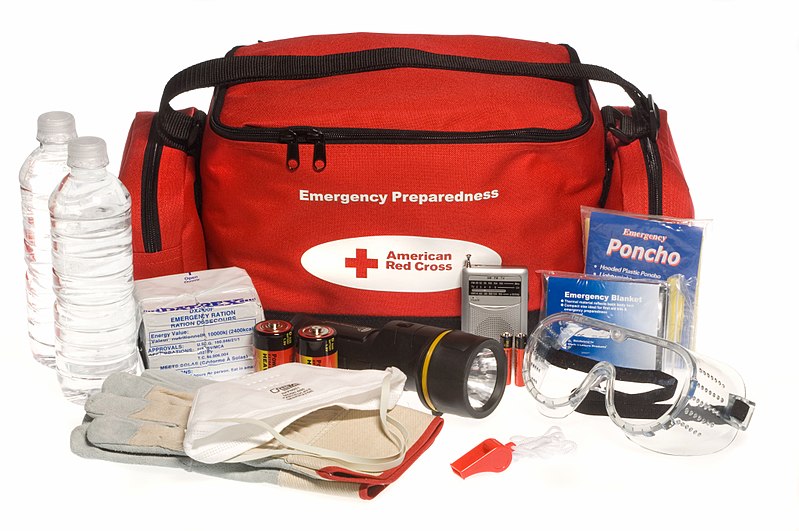
Having a bag prepped for extreme situations could be lifesaving, and with a little forward thinking, your bag could be ready in minutes.
Here some items we think you should grab from the store or make sure you have before the power outage:
Flashlights and batteries. An obvious choice, but oil or battery-operated lanterns work great, too.
Candles and matches/lighters. This is Humboldt, so we wouldn’t be surprised if most people had a lighter on hand or nearby, but if you don’t you should look into easy means of lighting candles (or that oil lamp) to have some light once the sun goes down.
Cash and gasoline. When the electricity is down, systems are down. This generally means that stores –if open– can’t take cards because they have no way of charging them. This can also include gas stations. We recommend filling up and taking out some cash just in case you need to buy something or drive during the blackout.
Water. You need a minimum of one gallon of water per day per person. We recommend having even more and making an effort to conserve. During the initial PSPS, the City of Arcata urged residents to minimize sewer use and conserve water to the best of their ability. That’s a good rule of thumb, and especially smart if the power outage last longer than before.
Ice. You’ll need lots of ice if you’re interested in trying to save any of the food that was already in your fridge or freezer. We also recommend moving expensive perishables to the freezer and using gallon baggies filled with water as makeshift ice packs to help keep food cold. A cooler filled with ice is also a great option. If you have the money and the storage space, buying a cooler for emergencies like these and any future camping trips could really come in handy.
First Aid kit. You may already have one hanging around. If so, check the the kit to make sure it’s well-stocked and move it to a central place in your home. Communicate the new location with any family or roommates so it’s accessible for any who may need it.
Canned goods. Think of foods you wouldn’t mind eating cold. There’s no need to buy something that will make you gag when you’re trying to stay fed.
Fruit. Apples, bananas and oranges are just a few options. Fruit doesn’t need to be refrigerated and it can help keep your blood sugar up as well as making sure you have some daily fiber, potassium and vitamin C.
Non-perishable snacks. Crackers and chips make an easy snacks but they don’t replace an actual meal. If you have means of warming up water, we recommend grabbing some potato flakes and pasta to keep that stomach from grumbling.
A French press and some pre-ground coffee. If you’re a coffee drinker then we would highly recommend grinding some coffee today. Your future self will thank you. Thankfully a French press doesn’t require electricity, but it does require hot water. If you have an electric stove, instant coffee may be your best bet to get that caffeine fix.
Beef jerky and granola bars. For all you meat eaters, jerky is a great way to keep your protein levels up if you despise cold beans. Granola bars are also great. They’re convenient and versatile, and depending on the bar, they can be a good source of fiber and protein.
Applesauce, puddings and fruit cups. Your pick. But if the power’s out for a while you might get sick of Saltines and canned corn. To keep your mood up, give yourself a treat with a chocolate pudding, or enjoy a sweet, but semi-healthy snack with an applesauce or fruit cup.
Playing cards and boardgames. Whether it’s just you or a group, a deck of cards could most definitely come in handy. Playing cards or boardgames is a great way to pass the time. We recommend a regular deck of cards to start before moving into heavier, emotional games like Uno or Monopoly that could take a toll on your relationships.
Sleeping bags and blankets. It may not be the coldest time of the year, but if you’re used to having your electric heat on, then you’re in for a wake up call. Sleeping bags and blankets, as well as sweats, long socks, hoodies and beanies will help you stay warm while your heater can’t. It’s also good practice if you’re looking for ways to lower that pesky PG&E bill.
An emergency radio. If you’re lucky, you’ll never need to use one, but having a weather radio on hand can be lifesaving. Radios can help you find hot coffee, hot food, shelter or even a place to charge your phone. Some weather radios even double-up as lights and backup chargers.
Portable chargers. These are a great investment. We recommend having one fully charged at all times. If anything happens you can make sure your phone doesn’t lose its battery. If cell towers are active or have backup generators during a blackout, having enough phone battery to call family or friends to keep them updated or ask for updates can be essential.
While all of these items are helpful and important, it’s vital to try and stay calm when the outage hits. Extreme situations can cause mass chaos, and it often becomes more dangerous and stressful than it needs to be. Check our website for updates, sign up for Humboldt County alerts to stay in the know and remember to only call 9-1-1 in emergency situations.
The upcoming blackout is expected to affect 36 counties across Northern California and last longer than before
The extreme weather at the heart of the upcoming Public Safety Power Shutoff is expected to begin Saturday early evening and last until midday Monday, according to Pacific Gas and Electric.
Despite original calculations that included only 32 counties and 640,000 PG&E customers, new information from the utility estimates the shutdown could impact 850,000 customers and possibly affect 36 counties across Northern California.
PG&E Corporate Spokesperson Deanna Contreras confirmed the updated calculations in a phone interview.
“This time there are some distribution lines that are in the PSPS scope,” Contreras said. “Whereas last time the PSPS was in transmission lines coming from outside of Humboldt that provide power here.”
Contreras emphasized that she wanted customers to understand the reasoning behind the shut-offs.
“I want people to understand why we’re doing this,” Contreras said. “It’s not just because it’s windy. I want people to understand that this is because there are serious wildfire risks during these weather events.”
Contreras’ tone matched that of the latest PG&E press release.
“The weather event could be the most powerful in California in decades,” PG&E’s statement said. “With widespread dry Northeast winds between 45-60 miles per hour and peak gusts of 60-70 mph in the higher elevations.”
According to Contreras, PG&E is working to minimize the shutoffs and is already working on a restoration plan for when the weather subsides. Contreras said the utility giant has requested help from other energy companies to speed inspections and repairs.
“These crews are expected to be staged and briefed on the restoration plan by Sunday evening,” Contreras said. “If weather progresses as expected, restoration could begin in some portions of the affected area as early as Monday afternoon.”
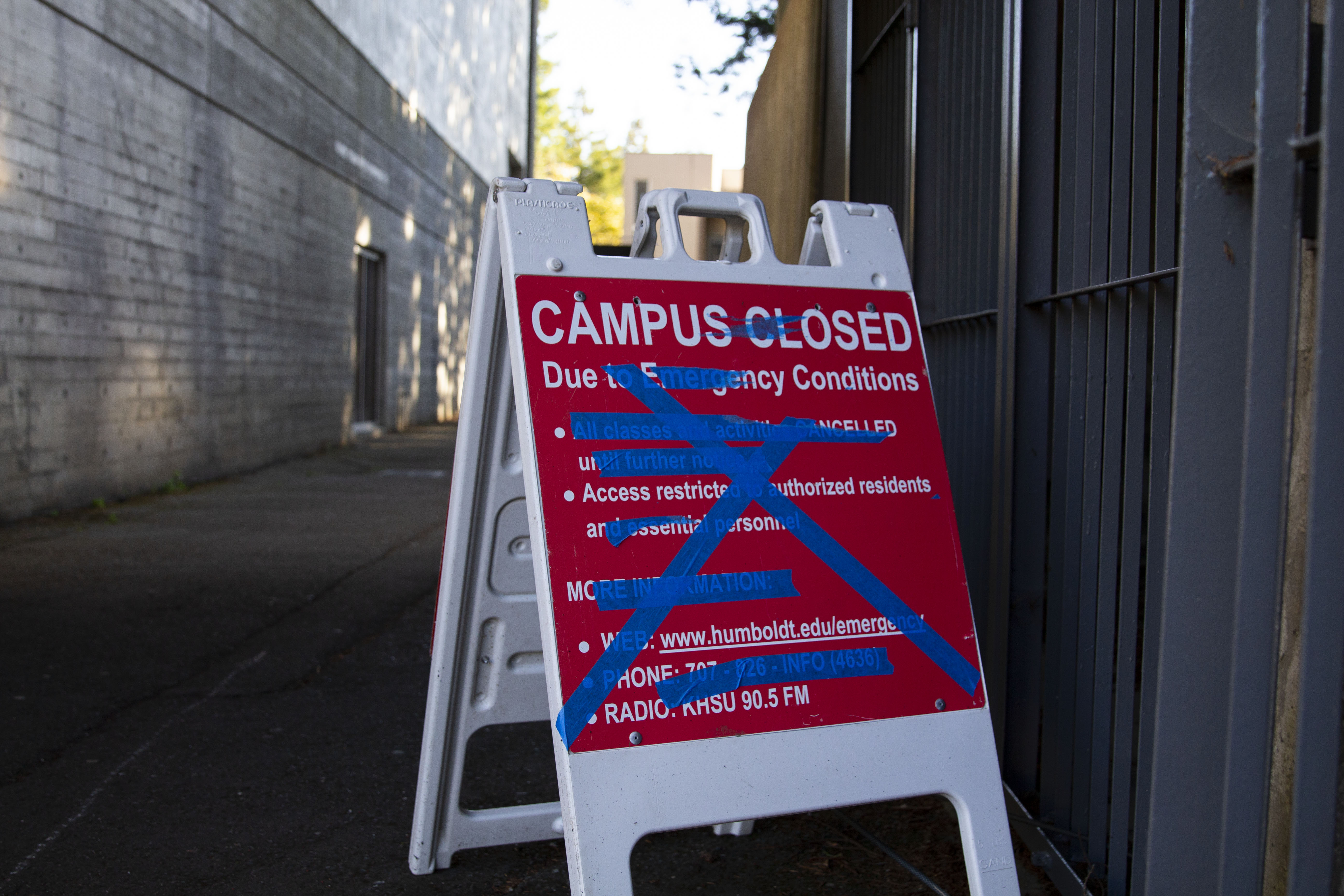
In response to the likely shutdown, Humboldt State will close campus from 9 a.m. Saturday through the end of Monday, Oct. 28, and encourages faculty and staff to grab belongings from offices and classrooms before buildings lock for the weekend.
During the outage HSU Dining Services will offer free meals at the J after 5 p.m. Saturday through Monday evening for staff and students that bring their HSU identification. To help prepare residents for the PSPS, Humboldt County Office of Emergency Services also posted a list of nine power outage tips to its Facebook.
“Have food for 2-3 days on hand that doesn’t require refrigeration and can be cooked on a camp stove or outdoor grill,” OES said in its post. “Remember though, never use a camp stove indoors.”
The PG&E press release is copied below:
Pacific Gas and Electric Company (PG&E) today said it continues to monitor a potentially powerful and widespread dry, hot and windy weather event expected to begin impacting the service area Saturday between 6 and 10 p.m. and lasting until midday Monday.
PG&E will need to turn off power for safety several hours before the potentially damaging winds arrive. It’s important to note that as this weather system sweeps from north to south over a period of two days, PG&E customers across Northern and Central Californiawill feel the effects of hot, dry winds at different times, which means outage times will vary, as well.
The potential Public Safety Power Shutoff (PSPS) is expected to affect approximately 850,000 customers and may impact portions of 36 counties across portions of Humboldt, the Sierra foothills, Western Sacramento Valley, North Bay, and across the greater Bay area, Monterey Bay and northern Central Coast on Saturday, Oct. 26. Customers in the southern-most portion of PG&E’s service area in Kern County could have power shut off for safety on Sunday, Oct. 27.
Predictive data models indicate the weather event could be the most powerful in California in decades, with widespread dry Northeast winds between 45-60 miles per hour (mph) and peak gusts of 60-70 mph in the higher elevations.
Winds of this magnitude pose a higher risk of damage and sparks on the electric system and rapid wildfire spread. The fire risk is even higher because vegetation on the ground has been dried out by recent wind events.
Given the forecast and conditions, PG&E is advising its customers of the potential for a widespread PSPS lasting several days, intended to prevent a catastrophic wildfire. As this intense weather event approaches the service area in the next 24 hours, PG&E’s forecasts will offer sharper detail, noting that the scope may continue to change on the number of customers who will be affected.
Once again, PG&E did not initially include all of Humboldt in its outage prediction. But according to OES, all of Humboldt County will be affected.
Due to possible extreme weather conditions and fire risk, all of Humboldt County is expected to lose power when Pacific Gas and Electric implements a Public Safety Power Shutoff early Saturday afternoon.
“The latest information from PG&E is that all of Humboldt County is now in scope for this PSPS power outage,” a Humboldt County Office of Emergency Services Facebook post said on Thursday evening.
PG&E began notifying specific customers of the possible outage on Thursday evening and will continue to do so. The utility also told OES that their online address look-up tool wasn’t up to date as of Thursday night, but will be updated soon.
According to a post from the Humboldt County Government’s website, the outage is expected to last longer than the previous, which was only 28-hours, and residents should prepare to be without electricity for up to four days. The county also said the length of the outage and estimated time power could return is completely up to PG&E.
OES also made a post with nine tips for preparing for the outage. The list is copied below.
Are you prepared in the event the PSPS affects Humboldt County? There is still time to gather supplies and take steps to be ready if the power shuts off.
Here are some tips to help you get prepared.
1. Have food for 2-3 days on hand that doesn’t require refrigeration and can be cooked on a camp stove or outdoor grill. Remember though, never use a camp stove indoors.
2. Have 1 gallon of water, per day, per person for drinking and cleaning.
3. Have flashlights, battery operated lanterns or candles in a convenient location. Remember, if you are using candles, never leave them unattended, within reach of children, and keep them away from flammable items.
4. Keep your refrigerated items cold by freezing water bottles. When the power goes out, transfer the frozen bottles around items in your fridge to help keep them cold. You can also transfer items to the freezer once the power is out to keep them cold. Remember to only open your fridge when absolutely necessary and make it quick. Don’t open your fridge to check to see if it’s cold.
5. If you are getting close to needing a refill on prescriptions, do it soon.
6. Fuel up your vehicle.
7. Have cash on hand. When we lose power retailers may lose the ability to run debit and credit cards.
8. Remember to check on your neighbors. We are all in this together and we strengthen our community by pulling together.
9. Sign up for Humboldt Alert, Humboldt county’s emergency notification system. We will send out notification alerting you to any emergency that may affect you, not just a PSPS event. Click our link at the top of our Facebook page or visit Humboldtgov.org/alerts to sign up today.
For more information on preparedness, visit Ready.gov.
Alison Holmes, Ph.D. spent her sabbatical researching whether California acts as its own nation
California has the means to be its own nation. It’s big, it’s wealthy and it’s been disrupting the status quo by acting internationally.
“California has been acting outside the box,” Humboldt State University Associate Professor and International Studies program leader Alison Holmes said. “They’ve been going and doing stuff with China, Mexico and Canada. It’s like, ‘Wait, you’re not supposed to do that. That’s not what international relations theory says, it’s not what the U.S. Constitution says, it’s not what all kinds of other rules suggest.’ So how are they doing that?”
Holmes spent her sabbatical last school year researching California and talking with state officials and those the state has dealt with.
In August, Holmes presented her research to the Center for California Studies at Sacramento State University in a presentation called, “California as a Nation-State: Innovative or Inevitable?”
In her research, Holmes found that cities and industries within California may act internationally, but the state itself doesn’t typically act as its own nation.
“We do things internationally but we don’t do them in a coordinated fashion,” Holmes said.
Holmes grew up in Oklahoma, but she moved to the United Kingdom after volunteering in Belfast during college. Holmes lived in the United Kingdom for 25 years, where, among other things, she worked for and advised the Liberal Democrats and worked as the Deputy Head of Corporate Communication Strategy for the BBC.
In 2005, Holmes completed her doctorate in London and then became a speechwriter for Ambassador Robert Tuttle.
“When I worked for the ambassador, I became very interested in international relations and diplomacy,” Holmes said.
California likes to think that it’s an innovator. We’re really big and proud about how we do stuff. And actually we’re not at the front of that innovation edge; a lot of other places in the world have been doing this for a long time.”
Alison Holmes, Ph.D.
When Holmes moved to California, she saw a perfect opportunity for research.
“California makes an excellent case-study, because it is the fifth largest economy in the world,” Holmes said. “But it is a sub-national unit of a huge, hegemonic, vast, largest-nation power.
Holmes said California’s international actions are part of a larger globalization trend.
“What a lot of international relations theory will tell you is that globalization has meant a bunch of people who aren’t nation-states have started to do things on the international stage,” Holmes said.
With this in mind, Holmes said that while California might be innovative for the United States, it isn’t elsewhere.
“California likes to think that it’s an innovator,” Holmes said. “We’re really big and proud about how we do stuff. And actually we’re not at the front of that innovation edge; a lot of other places in the world have been doing this for a long time.”
Holmes also said non-state entities acting internationally brings up questions about the very nature of sovereignty.
“When does a sovereign not have sovereignty?” Holmes said. “At what point do state relations at the international level become a foreign policy? My point here is that our traditional ideas of sovereignty are ill-equipped to describe what we see in the real world.”
Holmes says there are three future goals for California: the establishment of an agency focused on international policy, the honoring of tribal relations and the inclusion of tribes in international policy, and the coordination of city and county international efforts with state efforts.
Holmes ended her research presentation with an urge to take advantage of California’s diversity across all of its communities.
“That is the only way to create a robust local-global citizenship and to turn California’s state-nation vision of unity from diversity into a reality,” Holmes said.
Locally, Holmes said Humboldt is more global than it might think. Holmes urged Humboldt residents to connect local actions with outside, global forces.
“I worry that Humboldt is a little too proud of being the Lost Coast or being behind the Redwood Curtain,” Holmes said. “Privileging what they perceive to be the local over the global, to the point of seeking to disconnect from rather than engage with the world outside.”
Holmes said ignoring global events has consequences.
“If you don’t understand these things, you’re not really paying attention to what’s happening, how you can take advantage of that, how you can be a part of that and how it doesn’t have to roll over you like a steamroller,” Holmes said. “Because otherwise it will.”
However, Holmes cautioned that connecting local issues with the rest of the globe doesn’t mean people should start blaming external forces for all local problems.
“Trying to understand it is not the same as trying to find somebody else to blame,” Holmes said.
Holmes suggested that freshmen coming to HSU would likely benefit from learning intercultural communication strategies that international studies students use.
“There is culture shock,” Holmes said of new HSU students. “There is intercultural communication issues between the different groups of people who turn up here.”
While HSU politics professor and international relations teacher Noah Zerbe said Holmes’ work goes beyond the scope of his expertise, he did agree with the importance of paying attention to the rest of the globe.
“Stuff that happens globally affects us everywhere,” Zerbe said. “It affects us here as well.”
California’s prowess has led some to believe that California should secede from the United States.
Marcus Ruiz Evans, president of Yes California, the largest organization dedicated to California’s secession, said he believes California would be better off on its own.
“The basic idea is that California is held back financially because it’s part of America,” Ruiz Evans said over the phone.
“The basic idea is that California is held back financially because it’s part of America.”
Marcus Ruiz Evans
Ruiz Evans said Yes California and the #CalExit movement started back in 2011. Since then, it has seen significant growth, especially following the election of Donald Trump.
However, Ruiz Evans said that the movement’s growth led to a divide in its supporters that left the movement momentarily stagnant.
“With success came civil divorce,” Ruiz Evans said.
Nevertheless, Ruiz Evans said he firmly believes California should secede. Ruiz Evans said that California, on its own, wouldn’t have to fight with the president or the rest of the country, wouldn’t have to fight with federal immigration laws and would save billions of dollars.
Ruiz Evans also said California is held back politically and financially, and that he believes a split is only logical.
“We think it’s inevitable,” Ruiz Evans said.
Yet, when asked, Holmes put a damper on such enthusiasm.
“I am not sure ‘doing it alone’ is ever a great idea,” Holmes said. “I think while California is rich by many standards, if they had to pay for all the things that the federal government currently does, our situation would change rapidly. California could go that route, but revolutions rarely end well or the way the instigators intended. Be careful what you wish for.”
Students learn how agriculture and water intersect, and how water can be impacted from outside sources
Agriculture is the foundation of modern society. California’s Central Valley keeps millions of people fed from its acres of cultivation, but that much land, and work, requires a lot of water.
Matthew Lotakoon, the president of the Water Resources Club at Humboldt State University, worked as a youth leader with the Tulare County Farm Bureau. The program provided local students with agricultural work in Tulare County and sometimes across the state of California. Lotakoon said his big take away was that agriculture is the economic backbone of the state.
“No other industry in California matches agriculture’s economic productivity,” Lotakoon said. “There is a complex environmental solution to maintain biodiversity and economic livelihood.”
Lotakoon said that the landscape of the Central Valley changed throughout its history. Most of the Central Valley has been soaked with water flowing off the Sierra Nevada mountain range. Since then, the agriculture industry has worked to serve the need for reliable food, a need that has been persistent and dominant.
“No other industry in California matches agriculture’s economic productivity. There is a complex environmental solution to maintain biodiversity and economic livelihood.”
Matthew Lotakoon
“Historically, the Central Valley has been very productive,” Lotakoon said. “Most of the Central Valley was riparian areas, lots of swamps and reoccurring wetlands. Vast herds of elk and pronghorn lived on the landscape. And now, little towns like Porterville and Tulare have appeared and agriculture fields are everywhere.”
To support a growing population of people, cities and roads were built on land that had previously been underwater, or at least waterlogged. The fertile ground was ideal for the agriculture industry. A decision was made in the 19th century to develop the Central Valley into a bread basket. A thirsty bread basket.
“For the limited amount of water we have, we have to consider how to use it to preserve biodiversity while farmers are trying to maintain their livelihood,” Lotakoon said. “The farmers are good people, it is water policy in the Central Valley that is the challenge. Once partisan politics gets involved, it gets very messy.”
Sustainable agriculture practices are the North Coast’s solution for feeding people in an appropriate way. To farm sustainably, resources including water, land and feed are used responsibly to prevent them from being depleted. The goal is to produce food forever. But farmers have to be conscious of where they get their water from, to avoid polluted crops.
Shail Pec-Crouse feeds her kunekune pigs. Pec-Crouse owns and manages a farm which practices sustainable farming, meaning she will be able to farm how she does today, forever. | Photo by August Davidson
Shail Pec-Crouse owns Tule Fog Farm, a sustainable animal farm in the bottoms of Arcata. Her 22-acre property is home to pigs, sheep, turkeys and cows raised in a way that won’t damage the land they live on. Her operation is not very resource-intensive, although she did say working on the farm is a full-time job.
At the moment, Pec-Crouse’s farm is hooked up to the municipal water system. It is an expensive alternative, but considering the local Sun Valley Floral Farm uses the herbicide RoundUp on nearby fields to prepare them for growing flowers, it is a safe alternative.
“The field will be green one day,” Pec-Crouse said. “And orange the next.”
It isn’t unreasonable to believe the toxic herbicides infiltrate the soil and work down into the groundwater. Infiltrationis when soil absorbs water that falls on its surface. The water fills in crevices and pores between soil particles to create something of an underground lake called an aquifer. Depending on the chemical, infiltrating water can carry toxins into the aquifer.
Watershed professor Joe Seney said groundwater contamination is a big management challenge. The use of herbicides, industrial waste, poorly constructed septic systems and urban runoff often pollute groundwater. Pollution poisons drinking water, destroys local ecosystems and can cause land to be infertile.
Emma Flewell is studying environmental policy and planning at Humboldt State and worked with Ahtna Facilities Services to clean up a former Naval petroleum reserve in Bakersfield. The oil field contaminated a nearby aquifer and will take decades to clean up. The groundwater in the aquifer was used as tap water by a nearby neighborhood until people started getting sick.
“The farmers are good people, it is water policy in the Central Valley that is the challenge. Once partisan politics gets involved, it gets very messy.”
Matthew Lotakoon
“There are a lot of aquifers that have the potential to be used for municipal water, but it’s sad because some of them are polluted,” Flewell said. “Being in environmental science and management, cleanup jobs are common. There have to be people who clean up the messes we make.”
Flewell said there should have been legislation long ago to prevent aquifer pollution. She said it would be less expensive to not pollute in the first place than pay for the cleanup. Since the process to restore toxic sites takes years, the work needs to start as soon as possible.
The Tule Fog Farm is an example of how a polluted landscape can be restored to be productive again. The farm is a remediation site, which means the ground the farm is on was once polluted but has since been restored. It takes knowledge and technology to restore land, and it should be an inspiration for future remediation.
Lotakoon said consultation and collaboration with farmers is important moving forward. He stressed nobody is evil and it’s important to accommodate people and consider cultural differences and mannerisms.
“Farmers are decent people trying their best to do good,” Lotakoon said.
CSU Chancellor Timothy White sends update regarding ongoing HSU president search
A message containing an update for the Humboldt State University President search was sent campus wide today. According to CSU Chancellor Timothy White the eighth HSU president will be announced May 22, 2019. This will be in between the end of the spring semester and beginning of summer session classes when no students will be on campus.
The last update from the administration was when they held an open forum for the first meeting of the Trustee’s Committee for the selection of the president on February 4, 2019. The Lumberjack has been unable to speak with Lisa Rossbacher on her departure as of yet.
Rossbacher will retire at the end of June after a controversial five-year run as HSU president. Under her presidency HSU lost their football team, the Third Street Art Gallery, the community radio station KHSU and not to mention what many observed as a lack of responsiveness for the April 15, 2017 fatal stabbing of HSU criminal justice major, David Josiah Lawson.
According to the press release the search is “on track” and there has been interest to fill the position of HSU president across the country. Finalists will be chosen and ultimately interviewed by the full Board of Trustees.
The press release is as follows:
Sent on behalf of the CSU Office of the Chancellor:
The search for the next Humboldt State University president is on track. From a sizeable group of candidates that included interest from across the country, the search committee has culled the pool to a handful of semifinalists.
From that group, finalists will be interviewed by the full Board of Trustees. We are on schedule to announce the eighth HSU president on May 22, 2019.
A growing and thriving HSU is key to the prosperity of the North Coast community. It provides transformational educational opportunities and generates a substantial economic impact for the region.
Thank you to everyone who attended the forum on campus or who has shared input about the knowledge, skills or experience requisite of the next campus president. Your feedback has been invaluable as we work diligently to identify the next HSU president.
Participants enjoyed live music, gift and food vendors despite absence of Tall Ship Lady Washington
Nautical fanatics flocked to the Eureka wharf last weekend for the arrival of the Tall Ship Hawaiian Chieftain and the inaugural Salt and Fog Fish Fest.
Guests were invited to tour the ship, which serves as a mobile home for its crew of 14. The festival was scheduled to coincide with the arrival of the ship, and participants could take a trolly car from the main event to the nearby harbor where the ship was docked.
Originally, the Hawaiian Chieftain was supposed to arrive with her sister ship, the Lady Washington. But stormy weather forced the wooden-hulled vessel to turn back and seek shelter in Bodega Bay.
To the crew of the Hawaiian Chieftain, the ship is both their home and their livelihood. | Photo by Silvia Alfonso
Chieftain’s Program Coordinator and Chief Gunner Kate Dingus said the Chieftain only made it through because its twin motors allowed it to maintain speed through the storm.
“It was pretty rough going for us as well, but luckily we made it through without having to turn around,” Dingus said. “The Washington should be meeting us up here Sunday afternoon.”
According to Dingus, the Chieftain is a unique vessel, sort of a ‘frankenboat’ with a steel hull and a unique sail set referred to by Dingus as a “split topsail gaff-rigged ketch.”
The Hawaiian Chieftain was constructed in 1988, and served as a cargo vessel before being acquired by Gray Harbor in 2005. | Photo by Silvia Alfonso
Launched in 1988, the ship transported cargo between the Hawaiian islands before being acquired by Grey Harbor in 2005. Now the ship tours the coasts with its sister vessel, providing sailboat enthusiasts with the unique opportunity to tour a tall ship.
One of those enthusiasts was Beth White. She drove down from Oregon with a friend just to see the ships this weekend, and paid to sail around the bay on the Chieftain.
“I was hoping to get to see the Washington, but I still had a great time,” White said. “My favorite part was the cannon firing, it was so loud!”
Kate Dingus demonstrates the gyroscopic abilities of the Hawaiian Chieftain’s specialized compass, called a binnacle. | Photo by Silvia Alfonso
Several blocks away from the Chieftain’s dock, the Salt and Fog fest was bustling, with live music, a chowder cook-off and a Coast Guard helicopter fly-by. The event spanned the entire weekend, with a pub crawl featuring 21 local bars and restaurants Friday, and a by-the-bay 5k foot race on Sunday.
Event Coordinator Tera Spohr said the festival was intended to pay homage to Eureka’s seafaring and ocean-fishing heritage, and was scheduled to coincide with the Tall Ship’s arrival.
“Everything we do locally has to do with the bay, and we thought we should celebrate some of our local artists and businesses with an event on the harbor,” Spohr said. “Every booth you see here is locally owned and operated.”
The crew of the Chieftain know when to take things seriously, and all safety precautions are rigorously practiced. | Photo by Silvia Alfonso
The festival hosted a wide variety of local shops. The standards like Humboldt Chocolate and Mad River Brewing were drawing big crowds, but more unique businesses like Phyl’n cold-pressed juice delivery and All Dogs Biscuit Bakery, which serves boutique doggie treats, also received lots of attention.
The most eye-catching exhibit belonged to Dan McCauley, a local scrap artist who showed up with a massive metal crab with articulating legs mounted to the back of a pickup truck. Named “Decapodium” and originally built for Burning Man, the crab sat at the entrance of the festival, drawing in people off the street.
The Hawaiian Chieftain pulls in after a successful tour around the Humboldt Bay. | Photo by Silvia Alfonso
McCauley was selling his beautifully crafted scrap sculptures, and said he liked the effect his artwork had on people.
“It’s nice to inspire people to not throw shit out,” McCauley said. “Reusing is important. Really important for my life, as it’s how I make a living.”
As the festival died down, the Chieftain‘s crew was celebrating a successful day with pizza, a treat they only have access to while docked. Dingus has spent several weeks aboard the Chieftain, and several months on the Washington before that.
As a member of the crew, she follows a set schedule and routine for meals and daily chores and responsibilities. She described life on the ship as very free, but said there was a lot to take seriously at the same time.
“You feel a different kind of love, both for the people and the boat. It’s not platonic, but it’s not romantic either,” Dingus said. “They become your family, or closer than your family, because there’s stuff you can talk about with your crew that your family would never understand.”
Controversial student housing gets another attempt in Arcata
In August of last year Arcata City Council voted against a proposed housing development called Village Student Housing Project, or simply “The Village.” Although the city council opposed The Village project, they reserved the notion that if changes were made in development plans they would reconsider, that time has come.
“What we are trying to do on the 30th is to bring community back together,” David Loya, director of community development for Arcata, said. “We want to get a sense of the concerns with the council and provide a working environment so our community can provide feedback to the council.”
Humboldt County, along with the entire state of California, is falling short for affordable housing while the wealth gap between rich and poor grows larger. According to the nonprofit Housing Association of Northern California, the state is short of 1.5 million affordable rental homes. Humboldt County needs 3,300 new housing units with 1,300 of those being for low-income residents, according to the California Department of Housing and Community Development. Loya said the staff at Arcata City Hall is excited to continue dialogue on The Village and that they support the project because of the housing crisis we are in.
“Students can’t find housing in Arcata,” Loya said. “They look to McKinleyville or Eureka and the city needs to play a role in fighting for student housing.”
The Village’s proposal was brought before the city council six times before being shut down by a split vote of two for and two abstaining with one vote absence. The city council received hundreds of letters and tens of hours of public testimony from divided community members. The original development plan for The Village was to be an off-campus student-only housing project, but city council members wanted the project to integrate more than just HSU students.
City council member Susan Ornelas said in a letter written to The Village developer, David Moon, that “while we need student housing, we need every kind of housing in this community. We need professor housing, we need millennial professional housing, we need housing for young families.” Loya said Ornelas had discussions almost immediately with AMCAL after the project was opposed, addressing concerns with marketing housing instead of only student housing.
“The project was critiqued by quite a bit of people because of its expense,” Loya said. “But the reality is it’s expensive to live anywhere in Arcata with the average rent being $600-650 per room. The apartments on Foster Ave. are upwards of $800 which isn’t really affordable to students, but that’s where they’re finding to live.”
According to the City of Arcata, the project owner has reconsidered its development plans and has modified the project to include both open market and student oriented development as well as other “substantial changes.” Loya said the meeting will be open to the public and the developers will be there to answer questions.
“We would love to hear students talk at the meeting and tell us any ideas they have about the project,” Loya said.
City council meeting on The Village will be January 30, 2019 | 5:30 – 7:30 p.m. | Arcata City Hall Council Chamber | 736 F Street
This website uses cookies to improve your experience. We'll assume you're ok with this, but you can opt-out if you wish. Cookie settingsACCEPT
Privacy & Cookies Policy
Privacy Overview
This website uses cookies to improve your experience while you navigate through the website. Out of these cookies, the cookies that are categorized as necessary are stored on your browser as they are essential for the working of basic functionalities of the website. We also use third-party cookies that help us analyze and understand how you use this website. These cookies will be stored in your browser only with your consent. You also have the option to opt-out of these cookies. But opting out of some of these cookies may have an effect on your browsing experience.
Necessary cookies are absolutely essential for the website to function properly. This category only includes cookies that ensures basic functionalities and security features of the website. These cookies do not store any personal information.
Any cookies that may not be particularly necessary for the website to function and is used specifically to collect user personal data via analytics, ads, other embedded contents are termed as non-necessary cookies. It is mandatory to procure user consent prior to running these cookies on your website.