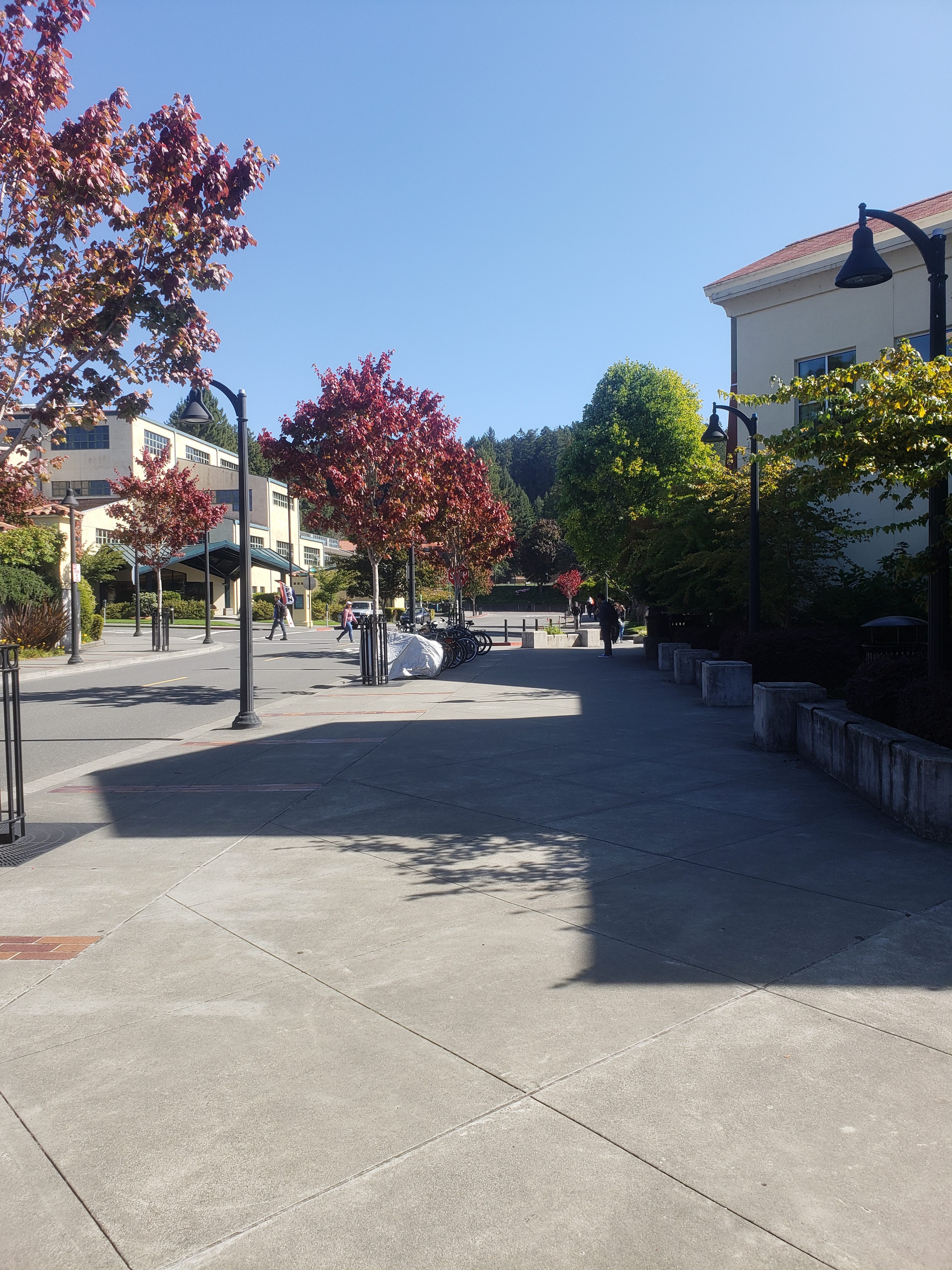
Between cranking out assignments, having a social life, and enjoying living, most college students have enough on their plate. That’s why most colleges have off-campus housing offices. Humboldt had been without an off-campus housing liaison for over a month, but now one student has stepped up to the plate.
Iris Perla-Blanco is an engineering major currently working 10 hours a week at the Housing and Residence Life Center (HRLC). Since the liaison position has been empty, Perla-Blanco has assumed all of the position’s responsibilities.
“Students will contact the housing department and they will forward it to me and then I’ll send them resource emails, or more specific ones,” Perla-Blanco said. “If they are having legal issues with their landlords, I’ll direct them to sources I know or to the Student Legal Lounge.”
In addition, she handles all interactions, emails, phone calls, appointments, resources, and she writes a newsletter that gets sent out every Friday. Perla-Blanco enjoys writing the weekly newsletter because individual property owners can contact her, fill out a Google form, and then have all their information in one place for students.
“There are also the cases where a lot of people come from SoCal or the Bay Area and can’t get up here to look at a place, which is definitely something you want to do before committing to renting a property,” Perla-Blanco said. “We have 45-minute slots you can book and I will go look at the property and scout it out, ask any questions, take videos, get to know the [landlord], and then I’ll report back to them so they can have a better feel.”
Todd Larsen, Senior Director of Housing Ops and Auxiliary Services, oversees the program. Having a real estate license, he has his foot in the door with property owners. Larsen believes that the housing market is slow right now, but is ramping up for fall.
“The market is softer, so the volume of calls and inquiries has dropped significantly,” Larsen said. “Maybe one or two inquiries per day, but it’s picking up for fall.”
The HRLC is expecting a new employee starting Monday. Part of their duties will be working alongside Perla-Blanco by picking up some off-campus housing responsibilities. Larsen claims that as more housing buildings open, more stress will be taken off the off-campus housing team.
“As we build more buildings, like when Craftsman Mall opens in fall of 2025, we will need less and less off-campus housing support because that adds another 964 beds for upperclassmen,” Larsen said. “Then, we’re working on a new project – housing, dining, health, which is 305 beds, and that comes online fall of 2027. We are [also] being really intentional at pricing at the same price as College Creek on campus.”
Cal Poly Humboldt’s President Tom Jackson addressed the construction of Craftsman Mall in the Feb. 1 issue of the Eureka Times Standard.
“Once completed, this project will add nearly 50% more student housing,” Jackson stated. “It will help students today, and well into the future, be able to afford the Humboldt experience that our alumni value so highly.”
The program looks like it will always have a place for students.
“It will always be a student-assisted position because we want to employ students, and it’s great for resume building,” Larsen said.
If you were considering living on campus next year, submitting your housing application just got expensive. The university is now charging a $100 nonrefundable application fee to apply to live in student housing. While this application fee is nonrefundable, it does not ensure housing for students who apply.
According to Cal Poly Humboldt housing, the $100 housing application fee is not an additional cost to students. It is treated as an initial deposit and is credited towards the housing and meal plan charges.
“We had to reinstate the application fee because we had too many students completing housing applications and holding spaces who weren’t serious about living on campus, preventing other students who did want to live on campus,” said Bria Kupras, a representative for Humboldt Housing & Residence Life. “Currently, the application fee is nonrefundable.”
Once admitted into student housing, that $100 deposit will go to housing and meal plans.
For those students who are Pell Grant eligible, with verification from financial aid, they could receive a waiver. If a student is struggling to come up with the payment, another option would be the short-term loan program through Student Financial Services.
Skylar Rawitch is a first-year psychology major living in the Cypress dorms.
“The fee has definitely gotten me thinking about the worth of it,” Rawitch said. “I don’t think that it is fair, especially because the payment fee does not guarantee you housing. If it was optional to pay and guaranteed you housing… I may feel differently.”
“Submit your online application and pay the $100 nonrefundable application fee. The $100 will be applied to the housing and meal plan charges, unless the application is canceled where the application fee will be forfeited,” the university’s official housing website states.
The application fee seems to be an incentive for applicants to only apply if they are seriously considering living on campus.
“How is it in the best interest of a school that’s supposed to take care of their students and keep them safe to charge them even more when people already are struggling to afford it?” Rawitch said. “They aren’t getting the money back if they do not get housing, and for some people that $100 could be gas money, grocery money, etc., and they would be losing out on that because they were applying for something that [isn’t] guaranteed.”
Emma Sundberg is a molecular and cellular biology major in their first year at Humboldt. They currently live in Campus Apartments.
“I think it’s awful having us pay more to apply when we already have to pay so much,” Sundberg said. “There is no need to spend money on an application.”
Jess Carey, a biology major in their junior year, has also faced obstacles due to the fee. The application fee has deterred them from applying despite needing it due to housing insecurity over the summer.
“I understand that the whole point is to allow the school to get a more accurate idea of how many students to plan for,” Carey said. “But on the other hand, creating yet another barrier to accessible housing stretches the already weak trust of the students in our administration to meet our needs and encourage a livable, desirable college experience. My trust in the administration has been damaged even more from this situation.”
Kimberly Alexsandra, a sophomore journalism major, has experienced the dorms of varying communities on campus.
“I could see why the application fee is necessary, due to the chaos created by the projected overflow of students that applied for housing last spring that didn’t end up attending, which left the school with a worse rep and vacant dorms,” Aleksandra said. “$100 right out of pocket is too much for me and I’m sure others could relate, and for it to be nonrefundable is crazy. As a student who’s lived on campus for two years in different locations, I really don’t think anything about on campus housing is realistically credible enough for a nonrefundable application fee to be needed just to apply.”
As reported in the Sept. issue of The Lumberjack, Clayco was in the running for the Health, Dining, and Housing project alongside other construction companies Swinerton and Webcor. These companies ultimately lost out to Sundt Construction, for the contract. In late October, the facilities department released the winners of the construction contracts for upcoming campus projects and repairs. Sundt also won the contract for the Craftsman Mall Student Housing project.
Clayco was the subject of a protest campaign by the Local Carpenter’s Union 751 at the beginning of the semester. For weeks, Local 751 set up signs and built a wooden speaking judge sculpture around campus while handing and posting flyers condemning Clayco. Local 751 representative Ruhama Tereda also spoke at the public forum section at the CSU Board of Trustees meeting to speak against Clayco. Although the campaign wasn’t as intense, Local 751 also wrote letters and spoke at public forums to the CSU Chancellor and Board of Trustees condemning Sundt, citing a history of malpractice by the construction company.
Cal Poly Humboldt served what is essentially an eviction letter to students experiencing homelessness and residing in vehicles such as vans, campers, RVs and motorhomes on-campus. To provide a comprehensive understanding of this evolving situation, we’ve compiled a timeline of key events in this ongoing story.
Wednesday, Oct. 25 – Initial Notice
Cal Poly Humboldt sent out a campus-wide announcement on Wednesday, Oct. 25, that sent shockwaves through the campus community. In the announcement, the university said that they have decided to enforce a previously overlooked policy, stating that students living in their vehicles on campus would have to find housing elsewhere due to “unsanitary and unsafe conditions.”
This abrupt announcement took the community of students living in alternative housing by surprise as many of them have been living in alternative housing for multiple semesters without incident.
“University policy will soon be enforced without exception,” the email stated.
The announcement didn’t highlight any specifics in regards to what the unsanitary conditions were, or how this policy would be enforced. The Marketing and Communications department for the university declined to comment on these questions.
For many students living in alternative housing, being on campus is crucial, because it’s the only viable way they can afford to get an education. With the increasing prices of tuition and everyday living, several students stated that if they’re forced to move off campus, that will cause them to leave permanently.
“It’s really hard for me to be able to live any other way,” said Carrie White, a senior biology major. “If I was forced to move, I would probably have to drop out of school.”
Students also prefer to live in their vehicles on campus because with the community they’ve built, it adds another layer of safety.
“We park close together because we look after each other … it feels a lot safer,” White said.
Friday, Oct. 27 – Alternative Living Club
The Alternative Living Club held its first official club meeting, which was originally meant to inform others who are interested in living in alternative housing. Instead, due to the recent announcement, they had an open discussion about the RV sized elephant in the room: the university evicting them.
The meeting was packed with students and faculty alike, who were concerned about the recent policy enforcement. The club meeting, which was led by President Maddy Montiel and Vice President Brad Butterfield, asked club goers to help support their cause by signing their petition to stop the eviction, and continuing to share their mass emails.
“We are now going to push for the campus to offer us resources and amenities in a way that would actually help us,” Montiel said.
Samuel Parker, President of Associated Students (AS), stated that AS would continue to pressure administration and figure out the root of the issue.
“It just came out of nowhere,” Parker said.
Many of the students at the meeting stated that the solutions the university provided in the email such as temporary housing were just that— temporary, and not a real solution for them. They say being on campus is the only concrete solution.
Tuesday, Oct. 31 – Official eviction letters have been served
On the afternoon of Tuesday Oct. 31, in parking lot G11, a heated meeting erupted between students and administrators after eviction letters were handed to students who have been living on campus in their vehicles.
Students pushed back against the decision and stated that there was no communication beforehand and that the enforcement and timing of this policy is extremely problematic for their safety and well-being. The unsigned letter of eviction stated:
“If this vehicle remains parked on campus after noon on November 12, it may be towed at your expense. Additionally, the owners of those vehicles that require towing may be referred to the Dean of Students for disciplinary action.”
At the tense Tuesday meeting, students waited for Cris Koczera, Interim Director of Risk Management & Safety, Stephen St. Onge, the Executive Director for Student Engagement & Enterprise Services, and Dr. Mitch Mitchell, the Dean of Students, who presented the letters of eviction.
At the meeting, Koczera stated that the sanitary issues are what brought the conversation up, but that ultimately they are going through with the eviction due to the violation of campus policy that has been long overlooked. Koczera added that the camping on campus was getting out of control.
“It’s not camping, it’s homelessness,” White said, adding that this is a reflection of the administration, and instead of pushing them off campus into county resources that are already full, they should do something about it and work with the students.
Students also raised concerns over the technicalities of what enforcement would look like. For instance, according to Koczera, students would be able to park their vehicles all day and overnight, but sleeping in the vehicle overnight is what violates policy and could lead to citation.
When asked how they would determine if students were sleeping in their vehicles, Koczera said that it would be both the Parking and Transportation Services and the University Police Department observing the vehicles. If they see behavior that leads them to believe there are people occupying them, a citation could be issued.
Students continued to press the administrators about the evidence there was of them being unsanitary. Students argued that this evidence was not proof of them being unsanitary. Koczera stated that there had been several complaints about the students living in their vehicles on-campus, including that photos were taken of buckets with human waste, and a photo of feces on the pavement. Koczera would not say who took the photos.
Caleb Chen, a graduate sociology student who lives in alternative housing on campus, stated that he does in fact have a bucket outside of his vehicle that’s been there since mid-August. However, it’s used for foraging and collecting rain water.
“There has never been human waste in this bucket,” Chen said. “I use it to transport foraged goods that I eat. It’s a before bucket for human food not an after bucket for human waste. For the school administration to send an email to the entire campus accusing a handful of students of spreading human waste around campus is straight up slanderous.”
Photo by Alex Anderson | Associate Vice President for Student Success Mitch Mitchell (left) and Chris Koczera (dressed in blue next to right of Mitchell) the director for risk management & safety services at Cal Poly Humboldt serve a perceived eviction letter and campus resource flyers to those living in their vehicles on campus on Oct. 31. Maddy Montiel (dressed in white) expresses concerns for the students who will be effected by the decision.
Tuesday, Oct. 31 – Senate Meeting
Alternatively housed student eviction notices was a topic of discussion at the university senate meeting on Oct. 31 in Nelson Hall. Faculty raised concern over the new policy and the negative effects that would be placed on students. The wording of the schoolwide email regarding the new enforcement of the university’s parking policy alarmed several faculty members who were in attendance.
Associate Professor in the Sociology department Michihiro Clark Sugata raised concerns over the new parking enforcement policy and the school wide email that was sent out on Oct. 25. Sugata worried about the new enforcement policies and the effects that would have on the well being of the students involved. Sugata felt the students were being wrongly characterized as unsafe and unsanitary.
“Regardless of the fact, if it is a policy issue, policy could be changed and the central fact should fall onto what is the best interest of our students and protection of their well being,” Sugata said. “And this is where the other two rationals become incredibly problematic…the language was that this was creating unsafe and unsanitary conditions for the community as a whole. Thus, our students were being framed as dangerous and dirty. And these are classic tropes that are used to criminalize certain populations.”
There are several campuses in California that have taken action to help students who are living alternatively. Long Beach Community College and UC Santa Cruz have set up alternative housing options and have provided services to students living alternatively. Specifically, LBCC set up a safe parking program that connects students who shelter in automobiles to a designated location for overnight parking.
Cal Poly Humboldt Sociology Professor Josh Meisel referenced LBCC’s safe parking program as a potential model that Cal Poly Humboldt could explore in order to look out for the well-being of students. Meisel proposed to the senate that the issue should be agendized, and that senate members should open a dialogue to discuss what is needed to help students.
“These are our students, they are not to be feared and there are models out there that we could potentially explore,” Meisel said. “There’s a model program at Long Beach community college that provides a safe place for students to park and have access to facilities on campus overnight.”
The meeting concluded with the senate agreeing to set a time during next week’s meeting to discuss the eviction matter in depth and review what further actions will be taken.
Thursday, Nov. 2 – Protest
Citing the university’s lack of compromise and inability to reach an agreement with students, students are organizing a protest on Thursday, Nov. 2 in the G11 parking lot at 11:00 am and will run all day into the night. The homeless students living in vehicles encourage those who wish to show their support, to bring signs, set up tents if you have one, park your cars and occupy the space.
Disclaimer: Brad Butterfield is an editor for The Lumberjack, however he did not help write or edit this article.
Amidst housing shortages and the increasing cost of everyday living in recent years, students are looking to an alternative way of living: vanlife. The term “vanlife” means exactly like what it sounds like, living in a van, but the term encompasses various mobile living options such as trailers, campers, motorhomes and RVs.
For students seeking a more affordable lifestyle, vanlife is a compelling solution. According to Maddy Montiel, a senior environmental science major with five years of vanlife experience, this choice has allowed them to avoid the cost of traditional housing. Ultimately, Montiel hopes to never pay rent through college. On-campus housing, depending on the type and meal plan, can range from $5,000 to $15,000 per year. In contrast, by parking their motorhome on campus (with a general parking pass) Montiel saves about $500 on gas per month and their monthly living expenses can be as low as $300 for essentials, making it a financially sensible choice.
“I’m choosing to do this instead of putting myself into an insane amount of debt in order to pay rent somewhere,” said Montiel. “I’ve always wanted to do it and can’t see myself living another way.”
Similarly, student van-lifer Steven Childs, a senior wildlife major, explained that while it may not be his preferred lifestyle, it aligns with his financial priorities.
“If you think about it, the whole point of me being here is to study and go to school and learn. At the end of the day, your room generally is a place for you to put your head and sleep,” said Childs.
Students are also being drawn to vanlife because of the freedom and independence it offers. When living on wheels, the world becomes your front porch.
“It’s definitely a pro to be able to wake up on the beach, and pretty much wherever you want to wake up”, said Bohdi Haugen, a freshman doing vanlife.
Haugen also added some of the advantages that come with owning a van, including that it really feels like your own; a feeling you may not necessarily have when you’re renting someone else’s space. Jaikyn Russel, a freshman studying forestry, who shares a van with Sierra Cole and their dog Indy, believes vanlife is a lot more doable than people think it is. Cole added that one of the draws of vanlife is being able to travel and always have your home with you.
Even with all of the benefits of vanlife, it doesn’t come without its challenges, notably not having a bathroom.
“I’ve grown pretty familiar with public restrooms nowadays,” said Haugen.
Montiel added that vanlife often gets glorified, and that there are some harsh realities that come along with it, including dealing with every aspect of your consumption because resources are limited. For instance, Montiel mentioned that they have to always have propane or else they won’t have a way to cook food, boil water or keep their appliances running. Montiel also noted the less-than-glamorous aspects of vanlife.
“You have to deal with your own shit – literally in every regard, you have to deal with your own shit,” said Montiel.
But despite this challenge, they believe it forces you to have a shift in mindset and become more sustainable.
Students embracing this lifestyle feel that there is a sense of community among vanlifers. Haugen has met many other like-minded people who are in the same situation as him. Montiel further elaborated that they and other vanlifers have formed close-knit bonds, organizing events such as cookouts and beach bonfires together. These connections provide a support system for those navigating the challenges of this lifestyle.
While this lifestyle isn’t for everyone, it can be cost effective, rewarding, and freeing for those who do it. If you’re interested in embracing this lifestyle, Montiel noted that an alternative living club is underway. The club’s first meeting will be Friday, Oct. 27 at 3:30 p.m. in Library room 114.
“We’re hoping to use that to create a space for students who live like this and students who are interested in living like this, to come and talk about it and learn about it and advocate for more resources,” said Montiel.
Two-and-a-half miles north of campus stands the seven-figure “temporary solution” to Cal Poly Humboldt’s current housing crisis. However, this fall semester did not bring the thousands of additional students that had been expected, and 331 bed spaces remain vacant in the on-campus dorms. Despite the difficulties presented by living out of a hotel room, students spoke – mostly – positively about life at the Comfort Inn.
Cal Poly Humboldt’s lease agreement with the Comfort Inn commenced on Aug. 11 and will expire May 12, 2024, for a total of 275 nights. The 49 rooms at the hotel cost the university $100 per night. By the end of the lease, the university will have paid $1,347,500 to the Comfort Inn.
During normal hotel operations, the city of Arcata charges a ‘transient tax’ of 10% the cost of the room. With the university’s lease, the city of Arcata will not earn its normal 10% tax from the Comfort Inn for the 275 nights that students will call it home. Representatives from the city of Arcata were not immediately available for comment regarding the loss of tax revenue.
Given the fact that 331 empty bed spaces remain vacant on campus, the Comfort Inn lease could appear like an ugly $1.3 million stain on the university’s management of funds, but perhaps that’s not fair. Enrollment was expected to jump by 2000 students this fall and the university had an obligation to plan for every scenario. Additionally, the university allowed students who were accepted this fall to defer enrollment until next spring, creating a potential housing shortage come spring. The Comfort Inn lease was kept as an insurance measure by the university.
“To meet the needs of our students and prepare for a possible influx of more students, the university provided the option of living in university-managed off-campus bridge housing like the Comfort Inn,” said Aileen Yoo, Director of News & Information in a statement. “It’s meant to be a temporary solution as we move forward with building additional housing facilities over the next several years.”
In spite of the price tag and lower-than-predicted enrollment, the university kept the Comfort Inn as a housing option, in part because they had to. They had advertised the hotel as a housing option for many students.
“We also sought to honor the fact a number of students specifically chose to live in the Comfort Inn, even when offered the option to move back onto campus,” Yoo said. “Continuing our contract allows us to not only plan for the future, but to reduce uncertainty and disruption of housing locations for those students.”
Importantly, all students currently housed at the Comfort Inn are there by choice.
“Students who are currently residing in the Comfort Inn have chosen to stay there, even when the university offered them the opportunity to move back on campus and live in residential halls,” said Yoo.
Neither Sherie Cornish Gordon the Vice President of Administration & Finance, Donyet King the Senior Director for Housing & Residence Life, nor Steve Relyea the Executive Vice Chancellor responded to interview requests.
The money spent is particularly concerning on the backdrop of the recent CSU tuition hike. Regardless, the students of Cal Poly Humboldt that have been caught in the crosshairs of the university’s rapid expansion, should be the number one priority. Happily, it seems that students now housed in the Comfort Inn are quite content, one might even say they are… (relatively) comfortable.
“It’s not a shitty place, it’s really not. People are like, ‘Oh that sucks you guys are living there,’” said Luis Castro, a student living in the Comfort Inn. “I’m like, ‘No, it’s chill. It’s our own thing.’ In my opinion it’s better than living on campus.”
In fact, there are a number of notable benefits to life in the Comfort Inn that students are stoked on.
“It’s quiet. You don’t have the loudness of the community on campus,” said Dylan Harrison, another student who resides in the hotel. “We have our own community here. We have breakfast every morning. We got a pool downstairs if I want to go swimming, or go to Jacuzzi. We have our own laundry as well.”
In addition to the jacuzzi and laundry, students housed at the Comfort Inn have cleaning services twice a week, free breakfast, and gated parking. Still, there are drawbacks to making a hotel room a home. Namely, the absence of a kitchen. Fortunately, the university has crafted a creative compromise for the students living without a kitchen.
“They got a deal with this diner called Pepper’s and we use our meal exchanges there, or flex money,” Harrison said. “If I want a burger, instead of going and getting a burger that some student made on campus, who just wants to get paid – I could go to a diner where these people want to make burgers. And they like making burgers. And they got good burgers.”
In addition to top notch burgers, students are relishing the first floor snacks provided by the hotel.
“If you want to get something to eat – let’s say you want snacks on campus – then you have to go to the marketplace and pay for it. And here you just go downstairs and just get a yogurt that’s already stocked,” Castro said.
Naturally, the perks of life at Comfort Inn must be weighed against its inconvenient undesirable location miles from campus.
“There is a little bit of a disconnect, socially, you know, between big events that are going on [on campus]. But, I mean, the people that I have met here are pretty cool,” said Andres Arteaga, another student resident of the hotel. “Seeing as it’s my first year here, I did actually really want to be on campus. I do like the vibe on campus, but at the same time, It just feels like our own area here in this section of the town.”
All things considered, the situation seems decent for students living at the Comfort Inn, but it is far from an ideal college housing arrangement. Directly across the street from the Comfort Inn stands, ‘The Grove,’ a hotel recently converted to a homeless shelter. Behind that, in an undeveloped stretch of land that backs up to highway 101, a small community of homeless folks have put up shop and don’t appear to be leaving anytime soon.
“It’s like a 15 feet deep pool and 20 feet diameter wide and there’s tarps and there’s like, people just living over there,” Harrison said. “It’s crazy. You see it off the 101, they’re always burning fires. There’s a lot of people over there. You hear them at nighttime, [and] they’re always screaming.”
Logistically, it appears the university has set students up for success with multiple options for transport to the campus grounds. Working in tandem with Arcata Mad River Transit, the university created a new route that runs 7am to 10pm to transport students, for free, to and from the campus. The bus does not run on Sundays, but students have the option to call the University Police Department for a ride at any time, if need be.
“I take the bus to school,” Harrison said. “There’s three options every hour. If you miss all three buses, you’re a dumbass.”
I lived on campus for two years without a car. I am now currently living off campus, in another city actually, with a car and I can say without a doubt, to me, living on campus was actually a very nice experience. I will explain why, and I promise it will make sense.
I miss the convenience of living on campus. I could walk across the grounds in ten minutes, which is good because if it’s late at night, and I want to visit a girlfriend, it is not a problem. I felt safe and confident walking long distances across campus.
It’s just about accessibility and location to me; I could easily rest after class, it’s been a long class day but I still have another couple to go. I could chill in my room, change my clothes, eat, maybe get to watch an episode of my favorite TV show and still make it to class EARLY. Campus is also centrally located, making it easy to walk into town or go to the grocery store. You can explore and get in some exercise, two birds with one stone.
Living off-campus makes me long for the redwoods. Living on-campus allowed me to go on a hike between classes. I am in the redwoods after all, and it is amazing that we have trails here in our backyard when living in the dorms.
I also feel like most on-campus quarrels begin with sharing a room. For many, it’s their first time doing so. I’ve been used to sharing a room my whole life, so it was never an issue for me. Having an older sister really prepared me for any roommate, as I learned how to communicate efficiently, calmly and just learned to let some things go. Yes, you may get a bunk, or a roommate, but at least if you’re locked out, someone can let you in.
Of course, living on-campus does require you to make some compromises, like the fire alarms. They do not stop unless an RA comes and calls someone else. With maintenance requests, they did do good work when requested, with the work being done quickly and efficiently. Also one of the maintenance men was really cute. I miss that.
Okay, hear me out on this one, in a way, you save money, because you have to buy less. If you are anything like me – I sincerely hope you are not – then a trip to Target for one thing turns into buying so much that I need a UHaul to bring it back, and guess what? There is no room in the dorms for all of that stuff. So, it keeps me from buying an insane amount of junk, which I have been doing since moving off-campus. I apparently need 6 pillows and 40 wooden bowls, because I’m into the look of wood currently. I love wood, wooden bowls, wooden plates, just wood.
At the end of the day, for me it is all about nostalgia. Campus was the first place I lived by myself, without my parents. The convenience and accessibility campus gave me makes me miss it now.
I hated living on-campus. The mold, the roommates, the noise? I only lived on-campus for a year, but I could never go back. Don’t get me wrong, if you have no other choices, I get it – I really do – but other than that, no thanks.
I don’t get why anyone would want to put themselves in a situation where they have to slum it with a shit-ton of other people when they could have their own space. I’m not paying 10k+ a year to live in half of a room with no private bathroom for 7 months, when I can pay half that and have a house year-round (AND MY OWN ROOM).
I lived in campus apartments on the ground floor, which meant I would wake up with ants crawling on me, and get sick at least once a month from the mold. Not to mention my roommate had the opposite schedule as me, staying up until 3 A.M. laughing and talking while I was trying to sleep, because I had practice at 6am the next day.
It was nearly impossible to fit all of the things I needed into my dorm room, considering we’re given such little space for our objects. Sharing a regular sized closet between two people and having no other space besides under our beds was obnoxious, and anytime I needed anything new I had no idea how I was going to fit it.
Off-campus is significantly nicer because I’m able to be in charge of my own spaces, I don’t have to share a room, and I have a private bathroom. I also got to choose my own roommates (shout out to them), which means no more randoms that make life extremely more difficult.
I will end by saying this: I spent my last 3 months of on-campus living on my friend’s couch walking a half mile each way to school so I didn’t have to share a room with my roommate and deal with the dorm space. It isn’t worth it to live on-campus.
by Angel Barker, August Linton, and Dezmond Remington
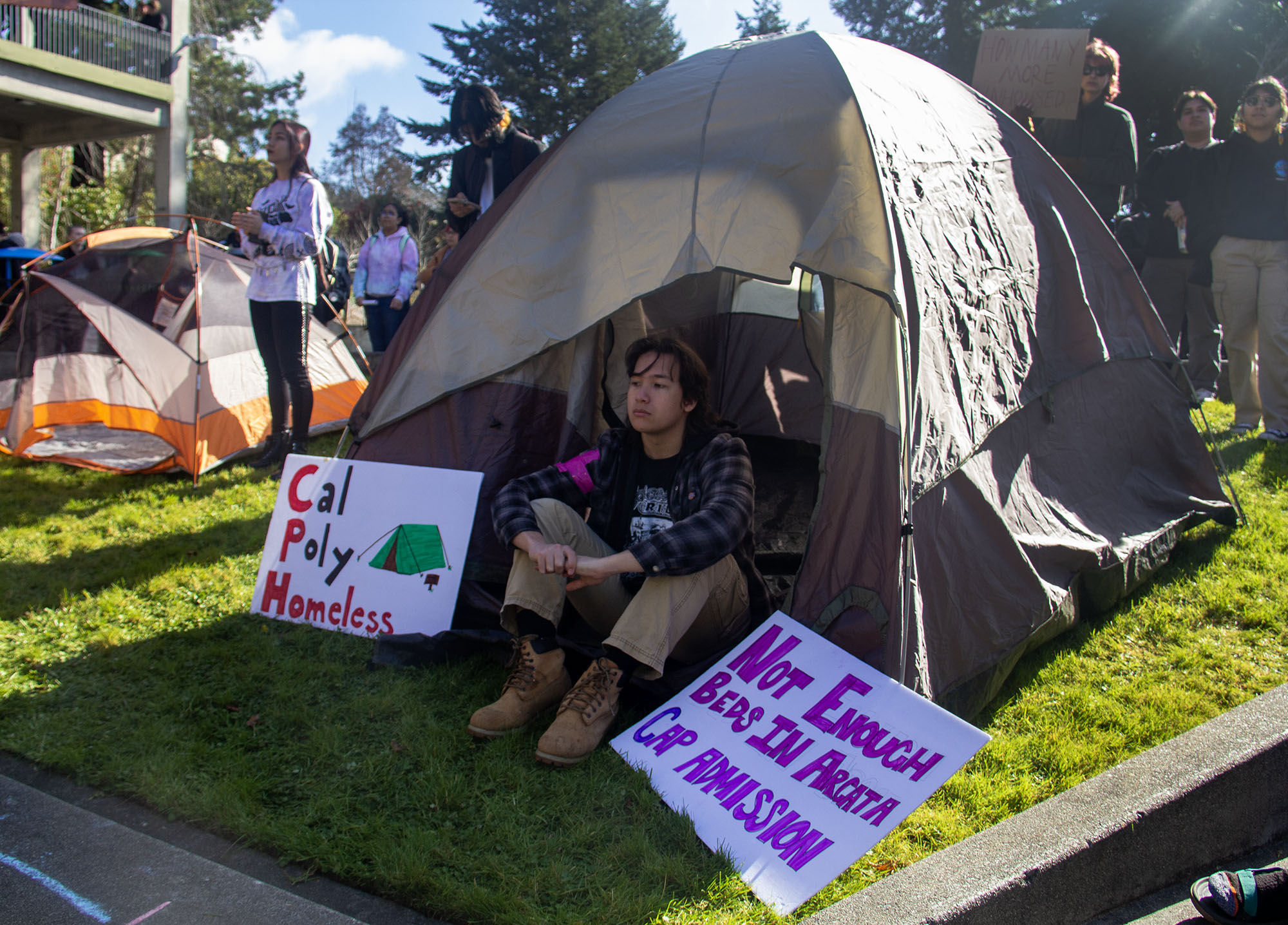
A housing protest on Feb. 8 in the U.C. quad drew hundreds of frustrated students, many of whom stayed for several hours. Dozens of students used the open mic to share their thoughts with the crowd about the housing crisis, and the impact of the university’s recent announcement that returning students would not be offered the option to live on campus in the fall.
In the end, the University relented, announcing on Feb. 10 that 600 on-campus beds in Creekview and the College Creek apartments would be reserved for returning and transfer students. In a meeting of the Associated Students Board of Directors, CPH Executive Director of Auxiliary Services Stephen St. Onge provided other updates on the University’s ongoing plans for student housing in Fall 2023.
Students will not be penalized for leaving on-campus leases early, and will receive partial refunds if they choose to live elsewhere.
St. Onge said that the University is working on an amenity package for those students who will be living in the ‘bridge housing’ off campus. There are no details yet on what this package will include, or when this information will be available. The housing website explains that students are collaborating with admin on this.
Students were frustrated by the lack of concrete answers provided by St. Onge on some pressing subjects, as he avoided speaking definitively on any topic outside of specific updates on housing.
At the Feb. 8 protest, Ashe Kolden talked about their experience with being homeless. They moved up to Humboldt right as classes were starting in 2020 with their partner. They weren’t able to find a place to live, so for a period of a whole month they lived in a tent with their partner in a campsite in Samoa. The housing coordinator on campus wasn’t able to help them, but they were eventually able to independently find a spot they could afford.
“I’m really lucky to have a tent, I’m really lucky to have a camping stove, and I’m really lucky to have [been homeless] while school wasn’t in,” Kolden said. “I’m imagining students living in those situations while school is in….I’m just scared for every student here who’s going to have a similar experience that I did, because 99 beds at the inn is not enough for all the students who are about to be kicked off campus.”
Plenty of people simply let their feelings loose about the decision, condemning the university administration. University president Tom Jackson in particular was a target, even though he was not present. One student yelled, “Tom Jackson, if you’re listening, fuck you, you’re a little bitch.”
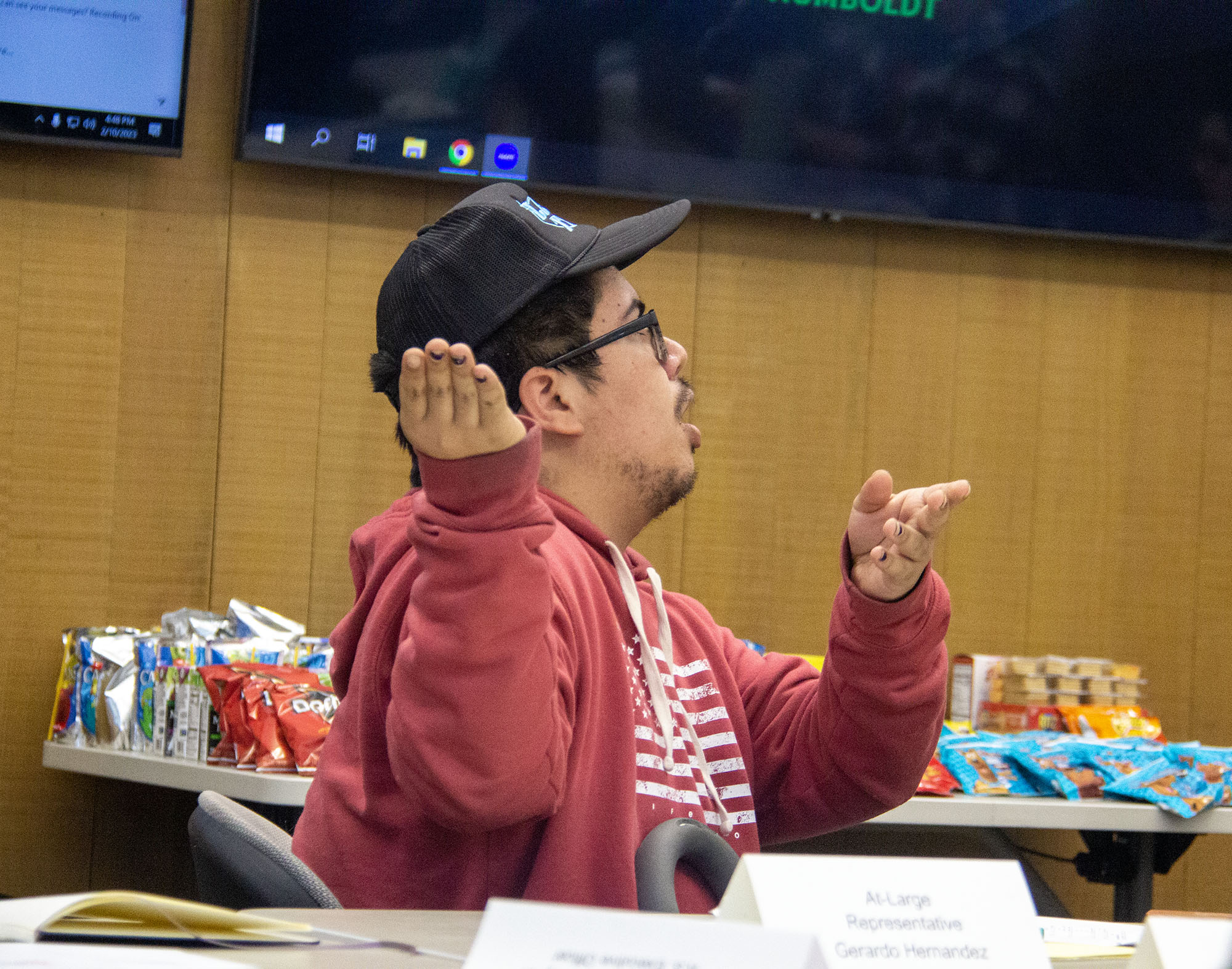
Some of the comments were more hopeful. Associated Students At-Large Representative Gerardo Hernandez spoke to the crowd, saying that the Associated Students were there to help.
“What I say to [a fifth of CPH students being homeless] is, that’s bullshit…we’re here to advocate for you,” Hernandez said. “We’re all screwed…we need to stand together.”
Chrissy Holliday, Vice President for Enrollment Management and Student Success, says the University’s goal is to provide roughly 1000 off-campus beds for returning students, adding an additional 650 beds. Where those beds will be located is unknown.
The themed housing communities on campus, including Rainbow/Gender Inclusive, Sankofa House, Native American Living, and La Comunidad will maintain their number of students, including returning students, according to St. Onge.
“There are groups from, I would say, some of the more vulnerable populations, members of the BIPOC community, LGBTQ community, foster youth,” St. Onge said. “We will save spots on campus for them to continue on campus should they desire.”
Lower-level administrative positions have been on the front lines of the university’s response to controversy in the wake of last week’s housing announcement.
“I know I, myself, the folks who work in housing, our campus administration, we hear the concern, and we feel it,” Holliday said. “None of this is anything that we do lightly. We are doing everything we can to put the pieces together for our students in a way that alleviates as much of the concern and the negative impact as we can.”
“There’s not going to be as many beds as will probably fill the need, but we are going to open some up,” St. Onge said.
University officials confirmed that 600 beds on campus would be reserved for transfers and continuing students In a Q&A posted on the CPH housing website on Feb. 10. At a meeting the same day of the Cal Poly Humboldt Associated Students Board of Directors, CPH executive director of auxiliary services Stephen St. Onge provided other updates on the University’s ongoing plans for student housing in Fall 2023.
The 600 housing spots will be opening up on campus on April 13 and 14, according to St. Onge.
“There’s not going to be as many beds as will probably fill the need, but we are going to open some up,” said St. Onge.
Executive Director for Auxiliary Operations Stephen St. Onge fields questions from member of the public Johnathon Macias during the A.S meeting on Feb 10.
Students will not be penalized for leaving on-campus leases early, and will receive partial refunds if they choose to live elsewhere.
St. Onge said that the University is working on an amenity package for those students who will be living in the ‘bridge housing’ off campus. There are no details as of yet on what this package will include, or when this information will be available. The housing website elaborates that students are collaborating with admin on this.
Executive Director for Auxiliary Operations, Stephen St. Onge, fields questions from the Associated Students Board of Directors during the housing insecure students meeting on Feb 10.
Students were frustrated by the lack of concrete answers provided by St. Onge on some topics, as he avoided speaking definitively on any topic outside of specific updates on housing. Lower-level administrative positions have been at the forefront of the university’s response to controversy in the wake of last week’s housing announcement.
The AS Board of Directors discussed a resolution to increase awareness, advocacy, and support for housing-insecure students.
Co-author Ashley Calkins said that the main goal of the resolution is to increase the AS’ advocacy on behalf of the student body in issues of housing insecurity.
“I think that it’s important that the administration knows where we stand on this so that we can advocate for the students,” said co-author Gerardo Hernandez, At-Large Representative. “It’s important that the students know where we stand on this.”
Hernandez spoke about his experience as an R.A. after the housing policy was announced. He says his residents were freaking out about whether they would have to stay over the summer or even transfer to other universities.
Associated Students At-Large Representative Gerardo Hernandez poses questions for Stephen St. Onge, the Executive Director of Auxiliary Operations at CPH.
“I think that every student right here that has been expressing anger has every right to, and I’m pissed off too,” said Hernandez.
The themed housing communities on campus, including Rainbow/Gender Inclusive, Sankofa House, Native American Living, and La Comunidad will maintain their number of students, including returning students, according to St. Onge.
“There are groups from, I would say, some of the more vulnerable populations, members of the BIPOC community, LGBTQ community, foster youth,” St. Onge said. “We will save spots on campus for them to continue on campus should they desire.”
On Feb. 4, CPH quietly updated the housing website without any notice to on-campus residents, leaving returning students to find out for themselves that they should not expect to live in the dorms or campus apartments for the remainder of their time at Humboldt.
On-campus housing will not be provided for any returning students. All on-campus housing will be reserved for new freshmen or transfers, starting in Fall ‘23. Should continuing students try to access housing through the university, they will be placed in temporary, off-campus housing.
“There was absolutely no email about it,” student Valeria Reggi said. “We found out by checking the website, which they updated with no warning.”
Due to a preexisting housing shortage that has left many students houseless, temporary options were explored in 2022 with the housing of over a hundred upperclassmen in the Comfort Inn motel.
A Feb. 6 email update stated that “because of the program’s success, we are excited to share that you now have the Super 8 and Motel 6 in Arcata as housing options managed by Cal Poly Humboldt.”
The email panicked current students, many of whom expected to return to on-campus housing in the fall. This prompted an immediate response. A post circulated on social media inviting students to gather that night to organize. At the meeting, a large crowd of students filled the Gutswurrack, voicing their concerns with over-enrollment and planning a protest scheduled for Wednesday, Feb. 8.
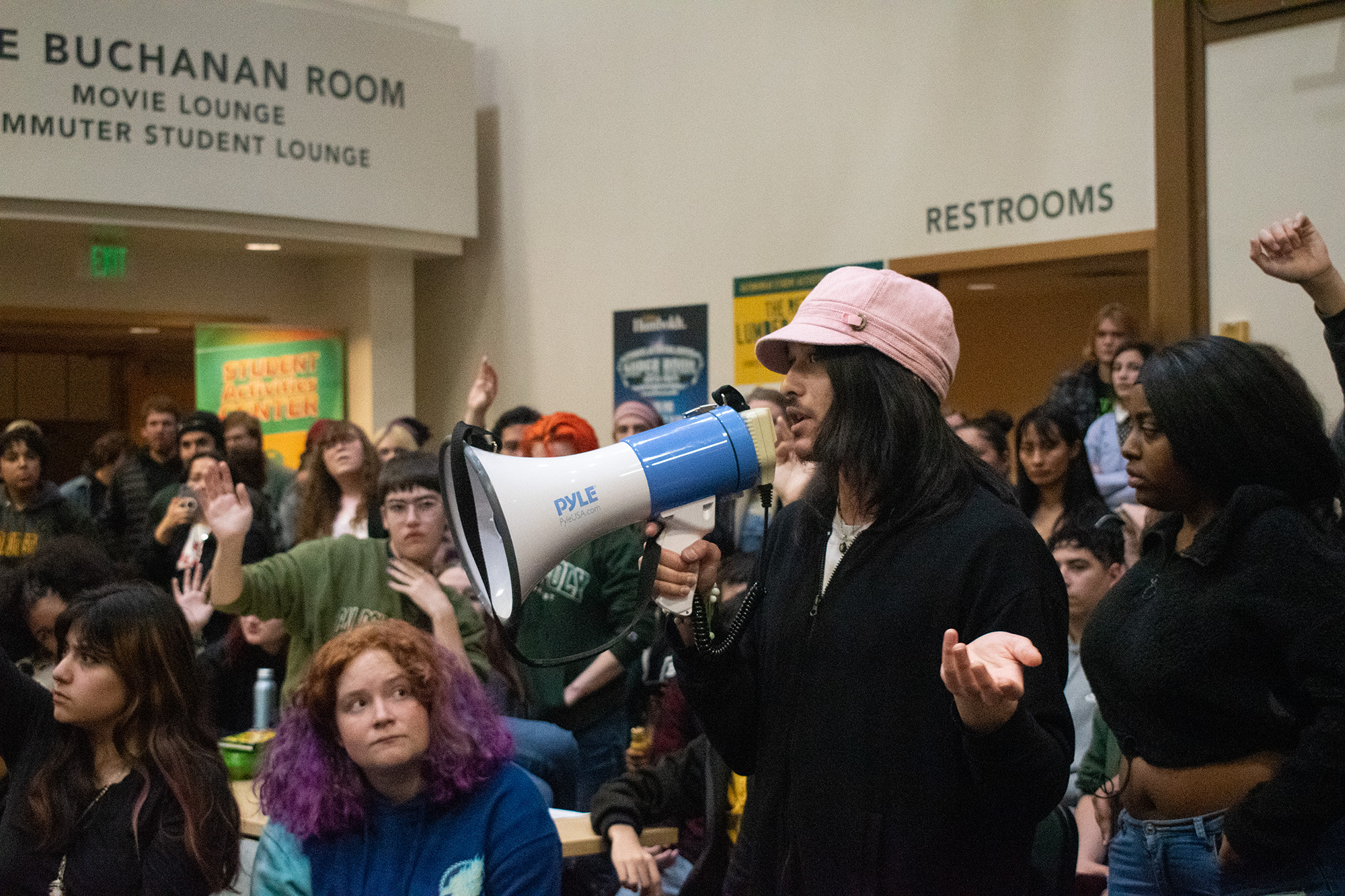
Filling every square foot of available standing room, students even packed onto the balcony. Organizer Lars Hansen spoke using a megaphone, and called on members of the crowd to voice their opinions on the new policy.
“We wanna know what’s going to happen to our housing, what’s going to happen to our community, and what’s going to happen to Humboldt,” Hansen said.
“I can’t fathom why you guys are accepting this many students when you can’t support them,” student Julia Kurtz said.
She questioned the logic of reserving the on-campus housing for freshmen and incoming transfers.
“If you are proud enough to put your current students in that housing, you should be proud enough to put new students in that housing,” Kurtz said.
Humboldt has a well-documented problem with student houselessness, a situation that some students said the new on-campus housing rules will make worse.
“I can just sleep in my car on campus, because that’s not any shittier than living in a motel, and it’s 10 to 15 times cheaper,” student Sam Mah said.
Many are considering dropping or transferring out of Humboldt in the wake of this announcement, according to students in attendance.
“You have capacity that’s limited and you’re putting no limit on the flow,” Jack Williams said.
Some raised concerns that the massive influx of students into the community without adequate on-campus housing to support them would strain relationships between students, the University, and the community.
“It seems like you just shift responsibility of building up infrastructure onto the community,” Alan Cooper said.
One of the main issues brought up by students was the lack of basic amenities at proposed housing locations. The rooms at the Comfort Inn don’t have kitchens, which poses a serious problem for students on EBT and those with dietary restrictions.
Students with disabilities are concerned with accessibility at the temporary housing locations. They also raised the issue that those who gain access to on-campus housing through their accommodations would be outed as disabled to their peers.
“Every single upperclassmen that has disabilities or problems with mental health, what the fuck are they going to do with us?” one student asked.
Photo by Cash Rion | Students from all walks of life show up for the student homelessness protest at Cal Poly Humboldt on Feb. 6.
The University administration was represented at the meeting by the newly appointed vice president for Enrollment Management & Student Success, Dr. Chrissy Holliday, as well as Indian Tribal and Educational Personnel Program (ITEPP) coordinator Sasheen Raymond and Stephen St. Onge, Humboldt’s Executive Director of Auxiliary Services.
Several of the students speaking purposefully gave admin a chance to respond to their comments, but often their response was lost, drowned out by the large crowd and interrupted by jeers. Holliday especially struggled to be heard over the crowd completely filling the Gutswurrack.
They offered little reassurance or explanation of substance, but expressed their sympathy for students impacted, and their commitment to hearing student perspectives.
“We will come and get beat up over it if we need to,” St. Onge said.
He explained that they were being required by the CSU to enroll more students in order to get funding.
“Now you need to hit this FTE [full time enrollment] and draft a plan to do it,” St. Onge commented. “We’re looking at some different options, hopefully in a week or two we’ll have some more information.”
Recent rumors and apparent email leaks indicate that the University is considering the purchase of a barge that would moor at the Eureka docks and house 650 students. At one point during the meeting, alleged evidence of the barge plan was airdropped to attendees’ smartphones.
University officials did not respond when asked for comment.
At the end of the day, the damage to morale was already done. Students felt betrayed by the administration. The school’s liberal reputation and reported recent influx of cash seemed incongruous with what many perceived as a shocking disregard for the housing policy’s impact on continuing students. At the end of the meeting, there was a call to bring the protest to the Arcata City Hall on Feb. 16.
“I thought ‘this is a school that’s going to see me, that’s going to hear me,’” Haley Kitchman said. “I’ve lived in motels and it’s traumatizing. It’s not easy, and it’s not okay.”
Dorm life is an important part of the college experience, but what happens when your university does not have adequate housing for its population? They turn a hotel into a residence hall. The Comfort Inn in Arcata, located in the Valley West area, is now home to almost 100 upperclassmen students.
The housing shortage is nothing new in Arcata. For students like Gabriela Mendez, a transfer student majoring in psychology, finding off-campus housing was unsuccessful.
“I was hoping to find last minute housing off campus,” Mendez said, “but there was nothing.”
Mendez has a roommate in the hotel, as all rooms are double occupancy. Each is supplied with two beds, desks, and dressers.
When asked her opinion about what it is like living in a hotel, Mendez said, “People can say ‘you don’t get the full college experience,’ and like, the college experience might be cool because I am a transfer student, but I am just grateful to have housing.”
Osiel Palomino, a returning sophomore majoring in environmental studies and management, had the same reaction.
“If it wasn’t for that room, I would have held off on going back to school for another semester,” Palomino said.
Palomino lived on campus his freshman year in 2019-2020 right before the COVID-19 pandemic, and moved home and took a break from school until classes were back in person.
Sarah Neumann, a business administration exchange student from Germany, is Mendez’s roommate.
“We made a good situation,” Neumann said. “I like it because I think we have more space and privacy, especially with our own bathroom.”
“One thing that I really love is each room has their own shower and bathroom. You don’t have to share one bathroom with the whole halfway, you avoid those problems,” Palomino said.
In addition to each room having their own bathroom, they also have free amenities like linens, a minifridge, a microwave, TV with cable, housekeeping services, continental breakfast everyday, Wi-Fi, and pool and gym access.
Compared to living in a freshman dorm on campus, Palomino said that living in the hotel still feels relatively the same.
“You still feel the college experience because everyone living there is students,” Palomino said. “You still feel like you’re on campus even though you’re not.”
A large banner welcoming Cal Poly Humboldt students and the friendly front desk staff also help with that feeling.
Staying connected can be difficult, but the RAs and the Office of Housing and Residence Life are hard at work to help the students feel included in campus life.
“The RAs have little events, to make it feel like the real dorm college experience,” Mendez said.
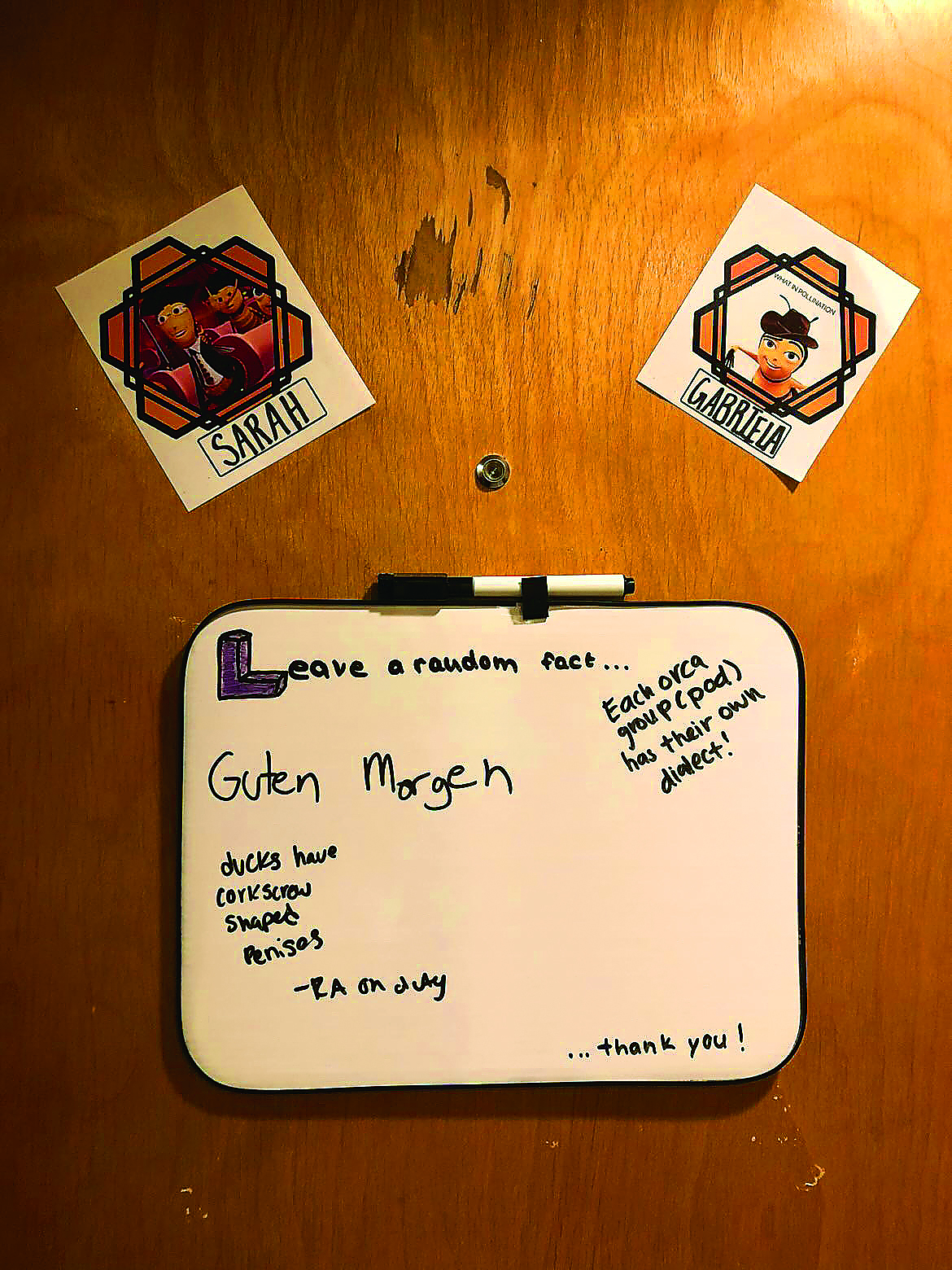
Neumann and Mendez even bought a whiteboard for the outside of their door.
“People can just write anything, so we can still communicate with others when we don’t always see them,” Mendez said.
Overall, students are satisfied with the University and the Comfort Inn solution to the housing shortage.
If you are on campus this semester to physically pick up this copy of the Lumberjack, then you know how rough the housing market is in Humboldt. On-campus housing is at capacity for the 2022-2023 academic year, leaving students hard-pressed to find housing elsewhere.
The solution our glorious polytechnic has come up with for solving the housing crisis includes housing students at the Comfort Inn in Arcata, where the familiar “HOUSING MOVE-IN” signs can be seen planted outside… the Patriot gas station on Giuntoli? For incoming students, will moving them into a hotel for the year really give them the classic Humboldt experience? How will they go on a campus tour to the woods at 10 pm to engage in some completely legal activities in the forest? Will they still be able to experience the joy of traversing half a mile every morning from their dorm to the JGC for some subpar tater tots for breakfast?
There’s the additional hardship of inexperience in finding housing among the college age demographic, as this is many people’s first time leaving home, or really living on their own. I was just living on campus last semester and eating donuts from the J for breakfast every morning, now I’m expected to magically be responsible enough to get an apartment? If you don’t have previous rental experience, you don’t know what you’re getting yourself into, and there are some predatory property management companies in Humboldt that capitalize on that. With the reality of mainly in-person classes for this school year, the pressure to find housing near campus is on like never before.
Don’t even get me started on owning furniture! You will never realize how expensive a couch is until you have to buy one for yourself. Tables are also very expensive, but I could talk about how expensive furniture is all day. When hunting for housing, furniture is the least of your worries. Having an actual apartment to put it all in is priority number one, and with the aforementioned problems with the Humboldt housing market, it can be a tall task to tackle.
There are some helpful resources that the university does provide, like the off-campus housing liaison, who provides one-on-one support and advice to help you on your journey to find housing. Also, in case you abruptly lose housing or cannot find any in time, Humboldt does provide the Emergency Housing Program. This program is subject to availability, and they can be reached at dos@humboldt.edu.
Now, this isn’t supposed to be all doom and gloom. While it can feel impossible at times to find housing, it will only feel that way for a while. With the help of another roommate to scream with when the third property management company you’ve reached out to doesn’t get back to you, a few co-signers to make up for that 750-point credit score you do not have at twenty years old, and a small miracle, you too can find housing!
Editor’s note: In this article, Ella Moore was misquoted as saying the ROSE House needed to hire a moving company to move out over the summer. This was incorrect. A.S. requested the ROSE House hire staff to move out, not a moving company.
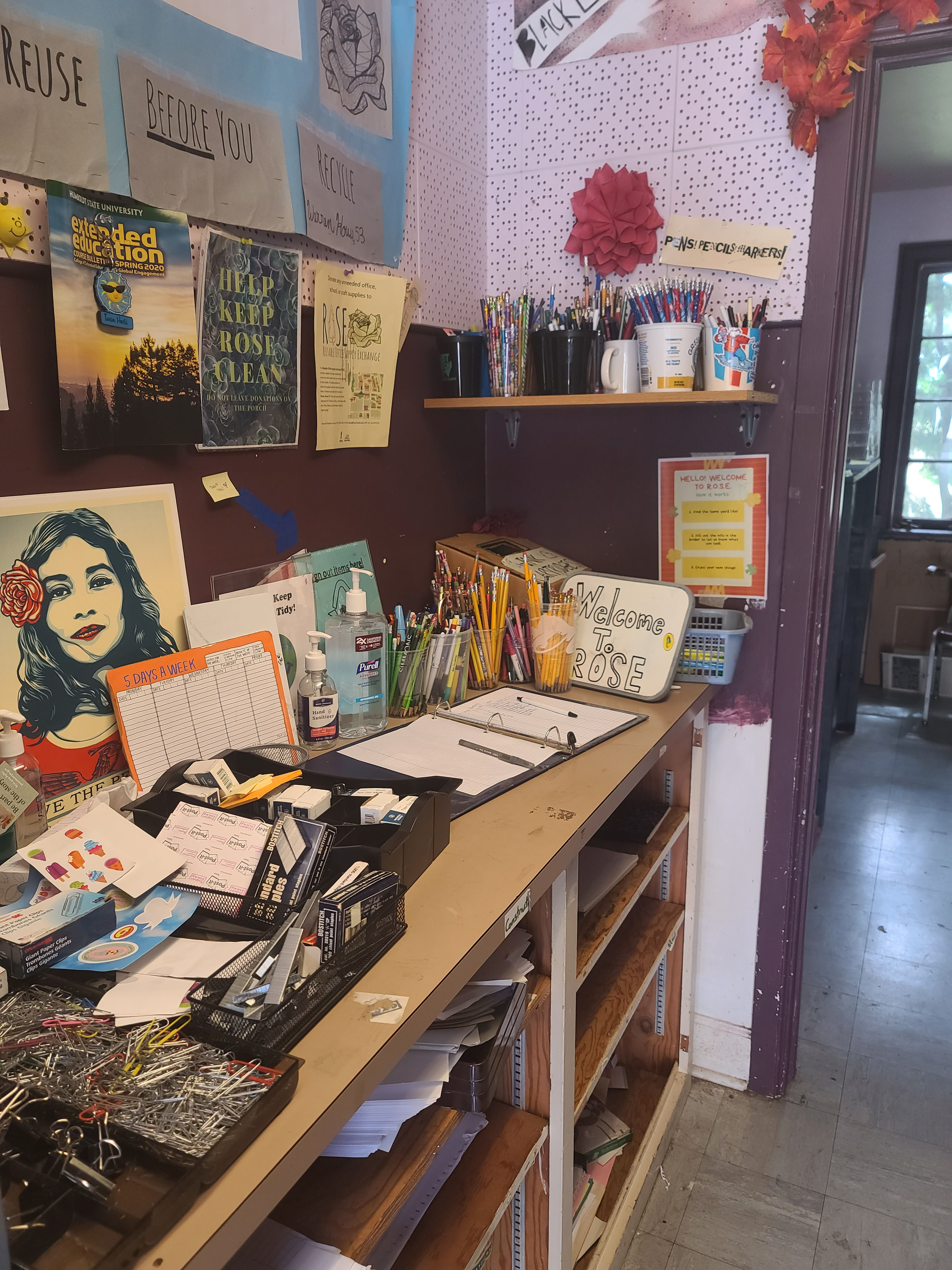
The Reusable Office Supply Exchange, currently located between the Campus Apartments and Bret Harte House, accepts donations of unused office supplies and provides resources for students in need of them. The house has been ordered to move with all of its materials to Nelson Hall in an unknown room.
This order was sudden, Ella Moore, co-director of the ROSE House, said.
“Last semester, right before the summer, they told us we would need to hire staff to move out over the summer. And just two days ago, we were told we needed to be out by September 1st,” Moore said.
While the Rose House is still accepting donations and is giving access to students, Moore continued to explain how the move will interrupt the program.
“This is definitely going to interrupt our programs, take hours away from real work,” Moore said.
Some of the shelves in the ROSE House are empty now, but many of them are filled with supplies. Rows of manila folders and binders from small to large still hug the walls of the building. Textbooks and unused scantrons are found in the building.
“The Rose house means a lot to us,” ROSE House co-director Hannah Wholsanchez said. “It’s a nice place to hang out and create opportunities for students to live sustainability.”
Its door is remaining open to students who still come in periodically. Student Whitney Messer was visiting the House after viewing the prices at the Cal Poly Bookstore.
“This totally saved my bacon. I’m on loans, no support from family.” Messer said.
Messer gave a tour of the buildings and their supplies, expressing gratitude to the organizer.
In August of every year, a new batch of students fills the dorms, apartments, and homes in Arcata neighborhoods. Overbearing parents pilot SUVs in a line around the block on check-in day. Students scramble through Craigslist listings in search of a last-minute opportunity. It’s no secret there is a housing shortage in Arcata, but the new polytechnic designation will increase demand. Cal Poly Humboldt expects to double in enrollment in the next six years. There are plans to build infrastructure, but they won’t be available until 2025 at the earliest. During this in-between period, the school will provide “bridge” housing. Steven Onge, a representative of Housing and Residence Life, explained the plan to master-lease nearby hotels to house students in the meantime.
“We’ve been working with it for over a year [and] we’ve developed relationships with several hotel owners and property managers,” Onge said. “This property was nice. There’s a pool there, and laundry is included, so we think the location was good, and the amenities are good.”
This academic year, the Comfort Inn will house almost 98 students with amenities like maid service and free continental breakfast. Residence Life is doing their best to make it a genuine college dorm experience with group dinners. Students can take the bus to campus in about 10 min.
“We’ve got some vending machines which will have fresh food in them, and we’ll do weekly community dinners and events to support students,” Onge said. “I’m hoping to get a food truck that we can use.”
Students still aren’t convinced. Kirby Marks, a nonbinary student, was made to choose between staying in male or female dorms when the gender-neutral dorms were unavailable in their building.
“I had to call them, and I was like, ‘I have no choices. There is no housing for me to choose from. I will not be able to live on campus. What’s going to happen?” Marks said. “So I had to change my gender marker to male so that I could actually get into housing.”
Opportunities for housing off campus are few and far between. Senior Humboldt student Zack Gamble says the high demand for housing allowed landlords to take advantage of students.
“It’s too easy to be a bad landlord out here,” Gamble said. “You don’t have the opportunity to turn down a place because you might not get another one for a few months.You have to take what you can get no matter how run-down decrepit it is.”
Since moving to Humboldt, Gamble has experienced his fair share of shakey Humboldt housing, from dry rot-ridden houses that shift with every earthquake to out-of-code heaters that require DIY maintenance. Gamble thinks the school should look critically at how the polytechnic designation will impact housing.
“You can’t increase your student base every year but have nowhere to put them,” Gamble said.
Ash McElroy is a proudly disabled student. They came to Cal Poly Humboldt well aware of the hills and stairs the campus was built upon. McElroy informed Housing they would need an accommodating dorm for their mobility aid, Housing assigned McElroy to the notably inaccessible College Creek dorms on the hill.
“To their credit, they put me on the first floor, but I could not get my chair through the door,” McElroy said. “I was like, hey, this is not working. Can we move me?”
Housing took months to reply after denying the dorm was inaccessible in the first place. McElroy requested at least adding a push button to get in the door.
“They told me that actually my building was accessible and they didn’t know what I was talking about,” McElroy said.
In an email to McElroy, Housing said a locksmith had confirmed that the press to open button does work.
“I had to have the SDRC go and take pictures of the building to prove that there is not one. Like how’s [Housing] straight-up gaslighting me about this?” McElroy said. It would take a few more months before housing accommodated McElroy’s needs.
13% of Cal Poly Humboldt students have a disability, the second-highest rate of disability in any Cal State University. Humboldt is right behind Cal State Maritime Academy, which has only 600 students. At the Student Disability Resources Center, Mary Smith and one other part-time staff advisor address accessibility needs on campus. Smith believes the access to green space, small classrooms, and positive learning environment attract students with disabilities to Humboldt’s campus.
“We feel like we’re drowning,” Smith said. “We have nearly 800 students with registered disabilities and one and a half advisors. At California State University San Bernardino, the ratio of accessibility advisors to students is one to 65. At Cal Poly Humboldt, the ratio is one to 500.”
“A majority of the disabilities on campus are psych disabilities. It used to be learning disabilities,” Smith said. “Learning disabilities are much more manageable. It requires some training and accommodations, but usually, you set them up, and they’re good to go. Psych disabilities are a much more revolving door. You can’t set someone up, and they’re just good to go. The level of services is way more intense.”
In the past years, between the pandemic and Cal Poly Humboldt’s fiscal history, Smith has struggled with job security.
Two years ago, the administration offered a retirement buy-out offer. Smith took it and retired.
“They never replaced me, and they called me back…I have so many asks, and I also have absolutely no job security,” Smith said.
The strain of an undersupported SDRC can go undetected by non-disabled admin, faculty, and students. It is not something that disabled students have the privilege to ignore. Alicia Martin is a Cal Poly Humboldt grad student and the founder and director of Adaptable, the campus club for students with disabilities.
“We’re the only club that serves this population of students on campus, and there’s a lot of pressure,” Martin said. “We’re not funded by A.S. It’s all just completely our time and our energy. And we love doing it, but it’s overwhelming. Because we end up having to support students who can’t access food. Who can’t get into buildings. Who aren’t able to hear or see their lectures. Who are months behind in course work because their accommodations aren’t met.”
Martin is working with students on campus to transition to a post-pandemic world. The pandemic forced to change and exacerbated problems that impact students with disabilities. On the other hand, with so many people adapting to the pandemic new adaptive technologies became commonplace.
“Some of this technology is very useful,” Martin said. “We have people who don’t use sign language and rely heavily on lip-reading, and so Zoom was great. Now, they’re transitioning back to the classroom.”
Students with disabilities continue to support each other despite the obstacles and limited bandwidth on campus. They find support from each other while advocating for universal design. Universal design centers on usability and access for all. It often makes life more convenient for everyone when design is accessibility-based. Accommodating issues on a need basis frames people with disabilities as a problem.
“We are not the problem,” Martin said. “[Campus operates] on a medical model of disabilities. In a social model, the people who say I can’t are the problem, not me.”
I find it extremely redundant that Cypress residents are required to own an All Access meal plan. When I’ve asked school officials why they’re needed, they’ve just responded, “Cypress residents are required to have one of the All Access meal plans. Upperclassmen living areas that do not require a meal plan are College Creek and Campus Apartments, both of which have shared kitchen areas.”
I’m a junior who’s lived on campus for three years now, and Cypress has the best kitchen out of every residence hall I’ve seen. Yes, even better than the one in College Creek apartments. Having lived in College Creek apartments as a sophomore, I’ve found that Cypress has more counter space and many more cabinets for storage space. The Cypress kitchen has offered my suitemates and I enough room and resources to cook for 20+ people once a week for Cypress eighth floor’s “family dinners,” where both sides of the floor come together for a weekly feast.
A suite on Cypress can house up to twelve students, so I’d understand if we were required to have a meal plan due to the number of suitemates who share the kitchen. However, I can’t understand why we’re required to have an All Access meal plan.
As a student working in the housing department as a Resident Student Services Assistant, I’ve had the opportunity to study each housing option and meal plan that the school offers. The more I learn, the less it makes sense that Cypress suites require an All Access meal plan.
For anyone who isn’t aware how the on-campus meal plan system works, here’s a quote directly from the Meal Plans page on our campus housing website: “All living areas require a meal plan except College Creek and Campus Apartments. Residents of the Hill, Canyon, Cypress and Creekview Suites are required to have one of the All Access meal plans. Residents of Creekview Apartments are required to have any one of the meal plans.”
The cheapest All Access meal plan is the 5-day All Access plan. It’s $5,000 per academic year, and contains all access meals to the J five days a week, including 300 Flex dollars and 66 or 62 meal exchanges per semester. (The housing website says 66, the dining website says 62.)
One of the alternative meal plans that I’ll be using as a comparison is the Lumberjack 125. This meal plan that Cypress residents don’t have access to costs $3,500 per academic year, provides 125 meals in the J (which is honestly still more than enough J food for me), has 525 flex dollars, and 31 meal exchanges per semester.
As someone who isn’t impressed with the food that Chartwells has to offer at the J, I’d much rather have the Lumberjack 125, which has 225 more flex dollars and costs $1,500 less per year!
If I can’t convince school officials that Cypress residents should have access to the other meal plans available, I at least want an adequate answer to why we shouldn’t.
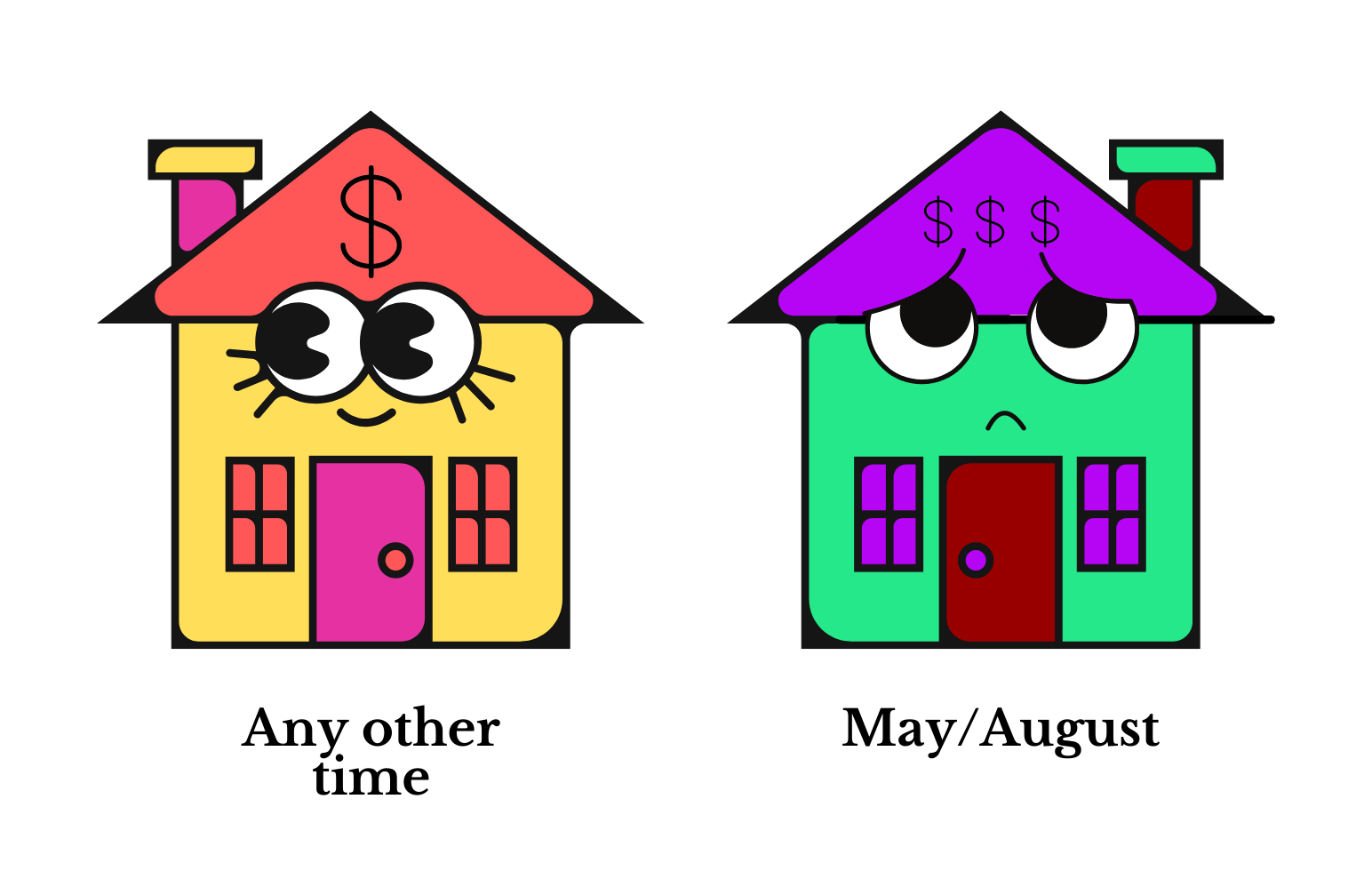
As May is fast approaching, so is the dreaded inflation of renting in Humboldt. During the year you can get a hotel room or rent an Airbnb for a couple of bucks. On spring graduation weekend, hotel rates double and even triple in price.
It’s not something uncommon in Humboldt but usually, high prices make it hard to find a place to rent. It’s an opportunistic extortion to get college students to overpay for rundown places. Housing is first-come, first-serve but to take advantage of people who don’t have money is gross.
For some people, this is the first and only time they can make the trip to Arcata, and it’s to see their family member graduate which is an incredible opportunity that shouldn’t be missed. Just checking the hotels near campus the usual cost of a hotel room for two people is at most $150 at any point during the year. But when you look at the same exact hotels during the week of graduation is $600 for two people a night.
At Cal Poly Humboldt, about 78% of full-time undergraduates receive some kind of need-based financial aid. That’s 78% of people whose families might not have the ability to see them walk across the stage and be handed their diplomas. Hotels and Airbnb hosts take advantage of people who want to support their loved ones.
Forget peoples’ families for a second. What about the people who are graduating and haven’t lived in the area for some time because of the pandemic, who are trying to find a place to stay so they can be there for their own graduation? It’s not just the issue of finding a place to stay. The prices of buying a cap and gown are so high for something you will only wear once and not for a long time. I guess you could say the same thing about a wedding dress, but even those are absurd.
Maybe I’m just someone who likes to count pennies and is a bit of a pessimist, but the price of graduating is excessive. We’ve already shoveled a bunch of money into the burning money pit of college so it would be lovely to be able to step away from the flames and not have to worry.
“I was cleaning and found that mold had covered the entire under part of my mattress and also my belongings,” Charlena Valencia said. “There was also visible infected mold on my clothing.”
Valencia, a Humboldt State student, grew worried after finding large amounts of mold in her home as well as beginning to break out in a concerning rash. Valencia said the rash started on their hands. They were originally treating it as eczema and assumed it was due to repeated hand washing and sanitizing. Soon the rash spread to their entire body and they seeked further medical advice.
With medical confirmation from a physician that mold was the cause of their health issues, the student brought up the situation to their landlord. The student claims the landlord showed no concern and an explicit negligence of the matter.
Valencia and their partner, Joelle Montes, spoke at the Arcata City Council meeting on Feb. 3 pleading for more strict regulations for landlords.
“Myself and others would like to see regulations put in place to protect the community from these types of situations,” Montes said. “The students are an obvious important part of this community and economy, they should be recognized for their contributions. All tenants should be valued and protected.”
The two HSU students also brought up the electric and gas hazards they struggled with, including a gas leak.
“My partner and I had no functional heating and after spending night after night in the freezing cold and recent storms, I finally called PG&E myself,” Montes said. “We might not have ever known we had a leak if I did not do that.”
Due to the gas leak, the apartment was red tagged and they were immediately evicted. According to The City of Arcata’s Substandard Housing Renter Guide a landlord must provide other housing accommodations in this type of situation.
“If the inspector find that problems to be so hazardous as to create an immediate threat to life or limb, the City may proceed with eviction due to the hazardous conditions,” the Substandard Housing Guide says. “Eviction would be an extreme case, and if it were to happen, it is the obligation of the landlord to provide temporary lodging.”
“She only got us one day at a motel,” Montez said.
The students had to make their own accommodations after that one night. Luckily, Valencia and Montez had a friend offer them a room to temporary stay in. Although they now have safe temporary housing, the situation continues to put extreme stress and pressure on the two students.
“This whole problem has really affected my academics. I had to literally drop all my classes to deal with all of this,” Valencia said. “We’re students, how are we supposed to work and do academics on top of all this?”
Council member, Emily Goldstein, responded to the two students through the Zoom city council meeting with a hopeful acknowledgement of their hardships.
“Very impressed with you young people willing to stand up for yourselves and I think it’s something as a council we should really consider looking into infractions for rental properties and safety standards for our renters in Arcata,” said Goldstein. “Their story I think we all know is not unique and that’s really unfortunate.”
It’s encouraging to see officials recognize students like Valencia and Montes, and Goldstein’s not the only one stepping up.
A new program led by the university’s Off-Campus Housing Coordinator, Chant’e Catt, aims to better the relationships between landlords and tenants. It hopes to help out students in situations like Valencia and Montes. It’s called the Good Neighbor program and it’s been in the works for over two years.
Catt says the program was born through a lot of ground-up community research. They held half a dozen town hall meetings on the topic.
“We invited landlords, students, community members, pretty much anybody that has to do with housing to come in and talk about their experiences with housing,” Catt said.
They found that a lot of tenants need resources to help them understand how to rent, what their rights and responsibilities are, and what the process is actually like.
“Sometimes our families can’t teach what it’s like to be a good tenant. Sometimes we don’t get the information we need in our family systems to adult well,” Catt said.
But being a good tenant is only half of it. Being a good landlord is crucial in building strong community relationships. It’s a landlord’s duty to provide a habitable living environment.
While this may be true, we also know that some landlords don’t even deal with tenants housing related issues. Students like Valencia and Montes complain about landlords that simply ignore their complaints of mold, gas leaks, or lack of electricity.
Prioritizing housing related issues, following all the city regulations and creating habitable conditions for tenants are important practices to form good relationships within our community. The problems we see between landlords and tenants stem from systematic issues and a lack of understanding on both sides. Programs that aid in educating tenants and landlords, such as the Good Neighbor program have the potential to be extremely beneficial to our community.
“Landlords have equity and they are taking a chance and a risk renting to people,” Catt said. “Sometimes people don’t know how to take care of their place, but there are also landlords out there that don’t follow proper rules.”
There needs to be stronger tenant-landlord relationships, as well as better regulated consequences for both parties. Regardless of their behavior, tenants often do not get their deposit back, meanwhile a neglectful landlord seems to have minimal consequences.
“Beyond the law and all that, we’re human. We should not be having people sleeping in mold infested bedrooms or exposed to gas leaks or broken heating in 30 degree weather,” Valencia said.
Firefighters who test positive for COVID-19 will be housed on campus to complete their quarantine period.
Humboldt State University will provide quarantine housing to United States Forest Service firefighters in the event that someone on their teams tests positive for COVID-19. Housing will be for the individuals who were potentially exposed to positive COVID-19 individuals.
HSU has set aside two dormitory buildings, Maple and Hemlock, which can house up to 20 firefighters each.
Firefighters are expected to avoid the dining halls and not share spaces with students. The US Forest Service is requiring employees to adhere to quarantine orders, limiting them to individual rooms. Rooms are located in the same building, separate from housing residents.
HSU has not been requested to provide meal delivery. The US Forest Service has contracts with vendors for meal delivery.
All of the protocols were developed by the CDC, California Public Health and Humboldt County Public Health. Similar to the isolation rooms that have been set aside for HSU students who’ve tested positive, rooms will be sterilized prior to forest service stays and again after they’ve left.
Aside from COVID-19, Forest Service firefighters have stayed overnight for transition housing during the fire season.
Stephen St. Onge, associate vice president for student success at HSU, is impressed with the university’s speedy response towards CAL Fire’s request.
“There was a group that was moving from one fire to another and couldn’t find a place to stay,” Onge said. “We mobilized and we’re able to support that, I am proud of HSU for being able to do that.”
The group that stayed on campus slept for a few hours until transitioning to the next fire. None of the firefighters that stayed overnight were tested positive for COVID-19. A contract is currently in the works to see if CAL Fire needs more transition housing from HSU.
Typically, fire agencies try to keep hotel rooms open for fire evacuees by finding alternative housing. During COVID-19, it is extremely important that they find non-congregate living for quarantine.
As a state entity with lots of amenities in a rural region, HSU often partners with state, local, and federal agencies, nonprofit organizations and others to provide support.
Housing struggles at Humboldt State continue to be a problem for students
Homelessness at Humboldt State University is a major issue. The mess is only becoming more muddled and students are left to fend for themselves.
Senior at HSU majoring in history, Alfred Silva, is mostly living out of his car. His housing search has been limited because he owns a dog and because he’s a single male, which according to Silva is unattractive to landlords. Not having an address has proven particularly challenging for him.
“I need to take medication all the time,” Silva said. “Now I don’t have anywhere for my medication to be mailed to my house. So, I gotta figure out other ways to get it. I gotta go to the doctor’s office and bug them there and it’s kind of hard.”
Silva has been looking for alternative methods of living including camping, but hasn’t had any luck.
“I can’t find anywhere to camp,” Silvia said. “The only place I found that will allow me to sleep is the back of the HSU parking lot.”
If anything, Silva believes COVID-19 has attracted more people to Humboldt than in past years, and that’s become a big roadblock for him when it comes to finding a home.
“I think the influx of people coming into town right now is just ridiculous,” Silva said. “It’s like you got people that are not even students – many, many, many people that are not even students – they’re just flooding the place right now.”
On the flipside, Silva believes the landlords are as equally guilty in manufacturing the housing crisis in Humboldt County.
“It kind of hurt their wallets a lot because they’re relying on HSU students to pay rent all this time and then when they took off and that happened, it really hurt them,” Silva said. “So now they’re just trying to survive like everyone else but charging rent. When one person’s drowning, they’ll do anything to survive. They’ll even drown another person.”
In a similar situation, HSU senior and biology major Grace Rhoades, moved back up to Humboldt because of a job opportunity they got working for one of the labs at HSU. Landing secure housing has been difficult, but they’re grateful to be subletting a friend’s house until the end of the month.
“There’s just a lot of applying for things, application fees,” Rhoades said. “With COVID, you don’t even really get to see anything or meet anybody in person, you just pay the fee and then like maybe a third of the time they get back to you about the status of your application.”
Even with a roof over their head, Rhoades is still feeling the anxiety of not knowing where they’ll live next month.
“I’m definitely a homebody, I like to know that I have a place,” Rhoades said. “I’ve kind of moved away from home and that’s not really much of an option anymore.”
HSU Off-Campus Housing Coordinator Chant’e Catt recognizes how students are being affected by COVID-19 and finding housing.
“What’s been really hard is students who moved out of town needing people to take over their leases and landlords not being really flexible sometimes with that,” Catt said.
For Catt, another issue that arises is between roommates because of disputes over the extent to which they will abide by COVID-19 rules while sharing a communal living environment.
“People have wanted to break their leases because their roommates don’t respect the restrictions around COVID,” Catt said. “Which puts them in precarious situations where they have to find a new place to live or find somebody to replace their roommate, which could put them into situations where they can’t pay rent.”
Catt has her doubts surrounding the idea that COVID-19 contributed to homelessness at HSU.
“I don’t know if COVID changed anything,” Catt said. “I feel like it’s all the same and that’s because it’s always been so bad.”
Humboldt State University reopens campus and student housing for new incoming students.
Universities across the nation are experiencing a drop in enrollment this year due to COVID-19 and Humboldt State University is no exception. With around a thousand new students moved into single-occupancy rooms on Aug. 17, HSU remains determined on reopening campus and providing student housing for the fall semester.
Among those returning is second year HSU student, Bryce Hunt. Hunt lived on campus prior to in-person instruction ending and he knew he would be returning to campus.
“I had already made my decision internally,” Hunt said. “I knew a majority of my friends were coming back up and I needed to get out of my home and my hometown.”
For Hunt, the adjustment to life on campus during the pandemic has been fairly easy. While he admits the absence of resources such as in-person advising has been a hindrance, he feels the school is taking strong protective measures.
“I like that they’re offering free coronavirus testing,” Hunt said. “They’ve been open about the fact that they have had cases.”
Hunt feels that campus is safe as long as everyone takes proper precautions and follows the advised county health guidelines.
“Even with everything going on, I want to be here, because I’m happy here.”
Adrian Black
“I feel fairly comfortable,” Hunt said. “I know I’m taking the protective measures so I can to be safe. I don’t think it’s bothering me as much as it did after spring break.”
Adrian Black, a second year student at HSU, is staying off-campus but remaining in Humboldt. Without any in-person classes, Black made their decision partially out of want, and partially out of need.
“I don’t really have any other place to live,” Black said. “My parents don’t have room for me. Besides, I really like living here. Even with everything going on, I want to be here, because I’m happy here.”
While they had previously considered not returning to HSU after last semester’s disorganized attempt at online classes, Black decided to give this semester a try. Driven by both a passion for learning and a fundamental hunger for something to do, Black returned. However, they’re disappointed in the lack of resources and social-outlets available to students.
“A lot of the charm of being a student is being on campus, interacting with students and faculty,” Black said. “I feel like clubs and such are going to be lacking since we can’t do in-person meetings. It limits what types of clubs are allowed and accessible and puts a damper on social lives.”
With students and faculty better prepared for online classes, new precautions in place and the world adjusting to a new reality, they believe that it can be a good semester.
“I have high hopes, and I hope that by next year, things will have gotten better,” Black said.
On May 21, Humboldt State University sent out an email announcing that it would be submitting a proposal to the CSU system requesting for a hybrid learning environment where there would be a mixture of face-to-face and online instruction. June 6, another email was sent out confirming that HSU would be able to operate virtually and in-person as needed.
According to the official HSU email, “the University’s academic program has perhaps the highest proportion of courses with a hands-on component in the CSU.”
About a quarter of all HSU courses involve labs and other activities and experiences that can’t really translate online and half of those course sections are able to be taught in-person this upcoming fall.
Regarding all other courses that involve less tangible experiences, like lectures and seminars, they will continue to operate online.
Following the acceptance by the CSU system, HSU can now ramp up its thorough planning process beginning this summer. HSU is also considering a return to a fully online learning environment if things worsen. For now, it will be a hybrid of face-to-face and online instruction.
As for the details of HSU’s plan for the fall semester:
Health and Safety
Steps will be taken to ensure the health and safety of people on campus like limiting capacity and mandating face coverings for all who step foot on HSU turf.
Social Responsibility
Students and faculty will be expected to be socially responsible when returning to campus and remain vigilant in keeping themselves safe.
Schedule
Courses taught in a face-to-face manner will start and finish with virtual interactions to go over safety measures, and all face-to-face parts of courses will start after the initial virtual interaction and end on Nov 6. just in time for the second virtual interaction.
Housing
The combined capacity in HSU’s residence halls will not exceed 1000 students and students will be placed in single-occupancy rooms. Dates and times for moving in will be spread out.
Dining
Dining services will not be as frequent on campus. Takeout and food-delivery will be available to students but buffet-style and self-serve food will not be.
Faculty and Staff
A majority of employees will continue to telecommute. Workers deemed essential will come back to campus to work more regular hours. Employees over the age of 65 will continue to telecommute as well.
Athletics and Recreational Activities
HSU will enact a four-stage plan intended to gradually allow student-athletes and related staff to come back to campus. The availability of recreational activities will increase in conjunction with the availability of recreational activities in the county.
This website uses cookies to improve your experience. We'll assume you're ok with this, but you can opt-out if you wish. Cookie settingsACCEPT
Privacy & Cookies Policy
Privacy Overview
This website uses cookies to improve your experience while you navigate through the website. Out of these cookies, the cookies that are categorized as necessary are stored on your browser as they are essential for the working of basic functionalities of the website. We also use third-party cookies that help us analyze and understand how you use this website. These cookies will be stored in your browser only with your consent. You also have the option to opt-out of these cookies. But opting out of some of these cookies may have an effect on your browsing experience.
Necessary cookies are absolutely essential for the website to function properly. This category only includes cookies that ensures basic functionalities and security features of the website. These cookies do not store any personal information.
Any cookies that may not be particularly necessary for the website to function and is used specifically to collect user personal data via analytics, ads, other embedded contents are termed as non-necessary cookies. It is mandatory to procure user consent prior to running these cookies on your website.