Despite Humboldt State University going digital, campus housing remains open
Humboldt State University President Tom Jackson announced via email March 18 that the school would be going entirely online, and he encouraged students to vacate campus housing if possible.
“It is important we reduce the number of people on campus,” the email read. “We encourage students who can return to a home off-campus to do so. We will not displace students who are facing housing insecurities or homelessness.”
“They should have just made the choice before people left for spring break to keep it as safe as possible.”
Calista Tutkowski
Freshman Calista Tutkowski was among those who decided to move back home after learning that classes would transition online. Tutkowski considered her choice the right one for her own physical and mental wellbeing.
“It felt like things were just going to get worse and worse on campus and around the world, so if I was going to be doing online classes, I wanted to be home with my family,” Tutkowski said.
Tutkowski was frustrated with the sudden notice from the school. By the time the school sent out the notice that they were going online and encouraging students to leave the dorms, she had already gone home for spring break and was out of state. Like many other students, she had to return to campus to pick up her things, potentially putting herself and others at risk by traveling.
“They should have just made the choice before people left for spring break to keep it as safe as possible,” Tutkowski said.
Some students are still on campus. Emma Bradley-Solis is one of those who elected to remain in campus housing despite virus concerns.
“I live in Washington and it is a lot worse there,” Bradley-Solis said. “I thought it would be smarter for me to self-quarantine here.”
According to an April 7 Enrollment Management report, about 300 students remain on campus. Most of the campus facilities are closed, including the library, computer labs and University Center.
With the severely reduced numbers of students left behind, pickings are slim. There isn’t much variety left in the food selection, and many staples such as rice, pasta and fresh fruit are out when Bradley-Solis goes to the marketplace. For students who rely on J-points to eat, this is both a serious problem and a waste of the money spent on their meal plans.
“I feel like they could take care of the students still here better—like better food,” Bradley-Solis said. “We paid a lot of money for J-points.”
California houses, shelters and aids homeless as COVID-19 cases continue to rise
With at least 151,278 homeless individuals in California, measures to keep them safe and healthy during the current shelter-in-place order are crucial.
Governor Gavin Newsom and his administration have sought ways to provide shelter and temporary homes for the homeless. On March 18, Newsom published a statement addressing what actions are to take place to ensure that everyone in the state maintains their health.
“People experiencing homelessness are among the most vulnerable to the spread of COVID-19,” Governor Newsom said. “California is deploying massive resources to get these vulnerable residents safely into shelter, removing regulatory barriers and securing trailers and hotels to provide immediate housing options for those most at risk. Helping these residents is critical to protecting public health, flattening the curve and slowing the spread of COVID-19.”
To help with the crisis, Newsom released $150 million to local governments to pursue leases with hotels and motels for temporary shelter. An additional $650 million is said to be released on April 1 from last year’s budget, to ensure that enough supplies are given to shelters and other medical resources. Shelters all over the state are struggling to gain more medical supplies and are losing volunteers.
Around 130 homeless individuals are staying in shelters around Arcata and Eureka.
“This is one of the biggest challenges our homeless system has ever seen,” Deputy Secretary for Homelessness for the Newsom administration Ali Sutton said. “And our population is one of the most at risk.”
Newsom also said he and his administration are working on creating leases lasting a few months with hotels and motels in order to house more homeless. According to an article from The Latest, Newsom announced 2,400 more hotel and motel rooms have been secured to house those on the streets, with 1,900 of those rooms coming from San Diego alone. There are now 4,000 rooms secured statewide. San Diego plans to continue sheltering the homeless by moving them to the city’s Golden Hall, the downtown Convention Center (home to Comic-Con), and other vacant rooms in hotels.
Humboldt County is also working to gain more shelters, rooms and supplies for those on the streets. Around 130 homeless individuals are staying in shelters around Arcata and Eureka. Some shelters have already taken place like Eureka Rescue Mission and Arcata House Partnership.
Each shelter in Humboldt County is expected to receive $300,000 in order to keep up with medical resources and other supplies, but shelters might still need more help to make sure they have everything they need. Eureka Rescue Mission, for example, had to close their thrift store, which was a main source of income, making sheltering the homeless more difficult as the pandemic continues.
The city of Arcata, along with AHP, have been working together to find other ways to help. After calling and surveying businesses and other organizations, Arcata was able to secure two parking lots in town. The lot on G Street can maintain at least 19 people, while the Transit Center lot can hold up to 15 people. Tents inside the lot are recommended to be six feet apart. AHP is working with Affordable Housing Homeless to ensure portable showers, sinks and bathrooms are provided for the lots. The lots can also expect to soon see mobile health services to make sure individuals are healthy.
The Centers for Disease Control and Prevention set out guidelines for how to manage tent camps, recommending that local law enforcement should not force individuals out of the camps unless there is immediate housing available for them to go to.
Hotel and motel rooms, meanwhile, are still in the process of being secured for more individuals. Arcata is also giving out food at the Arcata Food Pantry on Wednesdays from 4 p.m. to 6 p.m at the Trinity Baptist Church.
I woke up on St. Patrick’s day—my birthday—to sobbing. My roommate was curled up on her bed, across the room, crying her eyes out. She cried for half an hour, if not more, because she’d just received the Humboldt State email canceling our graduation and asking students to leave campus if they were able. An achievement she has been working toward for seven years and one I have been busting my ass off for four years was all taken away in seconds.
Instead of celebrating and going to the bars—in true St. Paddy’s day fashion—I spent the day in quarantine having to tell my family to cancel their plane tickets and Airbnb reservations because I wasn’t going to be able to walk.
As one of the students left on campus, it’s strange, to say the least. When my roommate and I go for walks or head to get food from OhSNAP!, the university looks like a nightmarish scene from some dystopian novel. Usually, the only people you’ll find walking around campus are construction workers, nurses or other essential HSU staff. Every once in a while there’s the odd student or two, using what little resources are left available on campus.
In front of the health center, a tent is set up to greet all students where they sanitize their hands and grab a face mask before being allowed to enter the building—even students who just need to pick up medication from the pharmacy.
The only students allowed to be seen at the health center are those who show severe symptoms like a fever, sore throat or difficulty breathing. But for those of us who need regular prescriptions through their pharmacy, be it for anxiety medication, emergency inhalers, birth control pills or other medications they offer, we can still access the pharmacy during their posted hours.
In my opinion, this is one of the most concerning aspects of COVID-19. Students and community members cannot be tested through campus for the illness unless they are extremely sick, which leaves carriers with less severe symptoms to go untested.
Before campus was closed, my roommate and I came down with a cough and fatigue that wouldn’t seem to go away so we decided to visit the health center to see what was wrong, maybe a bit paranoid that we might have contracted the coronavirus somehow. But who isn’t a little paranoid during this pandemic?
We were seated outside and only admitted into the entrance of the health center one-by-one. A blood pressure monitor, thermometer and other equipment were set up in the hallway, with two nurses wearing masks and gloves. We were given masks, examined and told that, unfortunately, if we did not show severe symptoms, they were unable to test us.
In my opinion, this is one of the most concerning aspects of COVID-19. Students and community members cannot be tested through campus for the illness unless they are extremely sick, which leaves carriers with less severe symptoms to go untested.
My roommate and I were told we had post-viral infections and given medicine to treat that, but the truth is, we could very well have had the illness and not known because of arbitrary rules only allowing people very ill to access tests.
I’m still sad that graduation was canceled and I know that it’s a momentous accomplishment that I will never get back. But it’s more important to me that we keep people safe than having the chance to walk across the football field to accept a degree.
There are “asymptomatic” carriers of COVID-19, meaning there might be tons of people in the area infected with the coronavirus without any knowledge they are sick. There might be people who have mild symptoms who are unable to be tested and are unintentionally spreading illness because they think they aren’t that sick. We aren’t only putting the health of students at risk by not testing those concerned they might have the illness, we are endangering the nurses and doctors who are still working through the health center, members of the community that students might come into contact with while grocery shopping or performing essential tasks during quarantine.
But this isn’t only a concern in Arcata. The reason behind such arbitrary testing rules is because, as reported by The New Yorker, there is a critical shortage in medical equipment necessary to perform tests. This is why those who are extremely ill are being prioritized over people who don’t show as many symptoms. We simply do not have the resources to test everyone, so people infected with the illness are falling through the cracks, living their normal lives and potentially spreading the illness because they are unaware they even have it.
While those who are sick, but not sick enough, cannot get tests, celebrities who show no symptoms of COVID-19 are allowed to be tested, leaving medical professionals, sick patients and community members to wonder if their lives are less important than the rich.
I’m sitting in my dorm right now going a bit stir-crazy, still trying to find things to do to occupy my time while I practice social distancing in quarantine. Last week, my roommate and I painted canvases to pass the time. I started learning embroidery because I was that bored and today I went to my Zoom English class, then spent the day writing and watching movies with my roommate. We’ve downloaded TikTok just to pass the time.
I’m still sad that graduation was canceled and I know that it’s a momentous accomplishment that I will never get back. But it’s more important to me that we keep people safe than having the chance to walk across the football field to accept a degree.
Since March 15 HSU has sent out over a dozen emails on their response to COVID-19
Here is a summary of emails Humboldt State University has sent out since March 15.
March 17: HSU informed students of its efforts to supply students with reliable laptops from the library as well as internet access for students without a reliable connection. HSU provided a list of locations where the university’s Eduroam Wi-Fi connection is strongest, as well as a list of services that are providing free Wi-Fi services during the COVID-19 crisis.
March 19: HSU informed students of Humboldt County’s shelter in place order. HSU confirmed that essential employees would be asked to continue to work on campus, and all others would work by teleconferencing. In a second email on the same day, HSU confirmed rumors that commencement, originally planned for May 16, would be canceled. HSU asked in a now-closed Google form for creative alternatives to celebrate graduation.
March 21: HSU released a more detailed email regarding its policies related to essential employees and payroll. Positions listed as essential included public safety, information technology, the library, University Center, health center, Oh SNAP!, residence life, dining, facilities management, research continuity, business services, payroll and mail distribution. HSU announced that its payroll department would be working on creating digital timesheets for employees working from home and that emergency pay would not be in effect as it was during the blackouts of the fall 2019 semester.
March 23: HSU revealed its guidelines on returning to campus. HSU asked students returning to Humboldt from areas with community spread or international destinations to self isolate for at least 14 days before returning to campus. HSU also advised students who are feeling ill to contact the Student Health Center at (707) 826-3146 before visiting the center.
March 24: HSU asked that students who live in on-campus housing and were on any of these three flights to contact Housing and Residence Life at (707) 826-3451:
March 16: United flight #5827 from Los Angeles Airport to Arcata
March 18: Delta flight #4124 from Seattle, Washington to Medford, Oregon
March 18: United flight #5555 from San Francisco Airport to Arcata
March 26: HSU announced that the library would close on Friday Mar. 27 in response to the ongoing COVID-19 situation.
March 27: HSU extended the deadline for changing the grading mode of classes to May 9. HSU said it’s looking into expanding the number of courses that can be switched to credit/no credit, as well as lifting restrictions on the number of courses that can be taken as credit/no credit.
March 30: HSU announced the closure of Siemens Hall’s computer labs and the University Center to reduce transmission of COVID-19.
Refunds for various fees are available for Humboldt State students in the midst of the COVID-19 outbreak
With closures and cancellations occurring left and right, many Humboldt State University students are wondering what kinds of refunds they can receive from the university. Here’s a list of them.
Tuition and Fees:
Tuition and campus-based fees will continue on as normal for students that are taking courses from their professors to receive grades that factor into graduation.
If a student wants to withdraw from all spring semester courses, they must act by April 5 to be eligible for a prorated refund of tuition and fees.
Classes that students with financial aid are withdrawing from will be looked over and potentially adjusted based on the amount of days enrolled.
Housing and Parking:
If students leave on-campus housing, they will get prorated refunds for both housing and dining fees once they check out.
Automatic refunds will be doled out to students graduating in spring or summer 2020. For more information, email HSU-cash@humboldt.edu
For unopened and unused regalia, refunds will be issued using the same method the order was placed with.
For the Graduation Writing Proficiency Exams on March 28 at 9 and 11 a.m. and April 11 at 9 and 11 a.m., all charges will be returned to the students’ accounts and refunds will follow if the student doesn’t have outstanding charges. Keep in mind that the GWPE is still required to graduate, and will be held online for the time being.
Proposed housing project survives but gets thrown back for modifications
The controversial housing project, The Village, survives another round of votes from Arcata City Council. March 6 was the second public meeting at City Hall this year after The Village’s development was voted against last October. Although most community members who spoke out opposed the project, city council members, Sophia Pereira, Paul Pitino, and Susan Ornelas, voted to keep the project as long as it was sent back to developers, AMCAL, for alterations.
“I appreciate looking at the other options AMCAL brought forward,” Pereira said. “But given the high demand for housing students will live in any type of housing that is available. We have homes built specifically for single families but we see students living in them because they need a place to live. We need to consider moving forward.”
The Village’s original project called for a four 4-story building, 240 unit and 800 beds for purpose built student housing. Last year the community was divided on whether or not they wanted such a large infrastructure to be built in residential neighborhoods off campus.
The plan was untimely voted against but the city council proposed a revision that included both students and open market housing. Mayor Bret Watson was the only person to vote against his fellow city council members but was originally a proponent for the revision.
“Everyone needs housing and we have heard this on all levels,” Watson said. “But the only way that I am interested in this project is if it is 65 percent and 35 percent (student to open market ratio) and doesn’t exceed over 602 beds.”
The new revisions for The Village has 400 beds strictly for student housing and 150 beds for open market and families. Of the 150 beds, half of them must be single bedroom and the other half available for units with two or three bedrooms.
Although Watson wouldn’t budge from 602 beds, the rest of the city council allowed for a 5 percent increase or decrease to that number, which would make it around 630 beds in total. This allows AMCAL developer, David Moon, and his partners to develop a new plan that they can resubmit with Arcata City planning commission.
“Our Turlock project is rated the number one student housing project in the state of California,” Moon said. “The property that sits behind the project has gone up in value by 10 percent and in two years we have had it 100 percent leased.”
Not everyone is convinced with what Moon said. President of Arcata Coalition for Responsible Housing, Eric Jules said The Village is too big and ACRH does not support the project moving forward. Jules reminded the city council that HSU was once a partner of the project but is no longer involved.
“This is a lot to ask for one area of the city,” Jules said. “We want a healthy development for the site and The Village isn’t that.”
Other community members voiced concerns about traffic, pollution and effects on climate change that The Village might bring. Keenan Milton of Coalition for Responsible Transportation Priorities said the current climate change is occurring because of the last 100 years of building design.
Milton said projects like The Village contribute to this and we need to change the way we build our infrastructure. Milton was also concerned with the amount of cars that would be added to the city because of The Village.
“If you build a parking lot people will fill it up with cars,” Milton said. “Having parking attached to an apartment is a subsidy for people owning cars. People without cars should pay less rent.”
There was one community member who fought for The Village project, Rollin Richmond. Richmond is a board member at The Betty Kwan Chinn Homeless Foundation and said housing is pertinent for the community and we need to provide housing for students.
“Housing is an important issue and particularly in Arcata,” Richmond said. “Nineteen percent of students are homeless. I don’t have advice on the plan options to pick but we need housing.”
Anyone who has to deal with high-headed college students is going to have the occasional ill-mannered day. But is taking advantage of a college student’s vulnerability in renting a home justifiable because one is having that ill-mannered day? Or is it just your way of demeaning my lack of knowledge about a topic you excel at? Just because I’m 20 and I’m attempting to learn how the real world works, doesn’t give you the right to belittle my understanding on a matter I’m trying to grasp.
If you’re a college student living in Arcata, you know exactly what I am talking about. Property management around Humboldt State University is extremely poor, from the landlords “helping” to rent the space to the space itself.
Young adults are leaving on-campus housing in hopes of finding a comfortable home in town and a safe place to reside for the remainder of their time in college. Several students have not only had problems with finding housing, but have found substances like mold in their homes, including myself.
I recently moved from a studio apartment to a two-bedroom because my boyfriend and I needed more space to live comfortably. Aside from the property managers being extremely rude throughout the moving process, I found black mold in my shower the very first time I used it. I should not find mold in my home after moving into a space that the property management stated on paper, had been thoroughly cleaned.
It is only fair that properties are kept up in terms of maintenance, and do not have substances like black mold at all! It’s as if these housing management companies around here just don’t care. They are in the office at eight in the morning, and out by five in the afternoon with no other concern.
I mean, maybe I have this imaginary standard of how professional property managers should be and how clean new homes should look, or maybe I am simply addressing an issue that many don’t have the time to.
If the property managements are not going to enhance their customer service or even their properties, I feel that Humboldt State should take the initiative in helping students find adequate housing as they move off-campus.
Chant’e Catt has recently become HSU’s Off-Campus Housing Coordinator, in hopes of helping homeless students find a home as well as teaching students the do’s and don’ts of dealing with property managements with a new program called the Educated Landlord-Tenant Program. I think this project start-up is a great solution to college students figuring out their off-campus housing, but not enough of us know about it. The housing project has already held several discussions that have been open to all students and community members.
One way or another, college students should not have to choose between living homeless or living in a dirty home with substances like mold. If a property manager is going to take money from a college student’s very tight budget, the least they can do is ensure that the home they provide is safe and clean.
Unfortunately, this is an issue in more college towns than just Arcata. It’s a national problem and it’s something I feel should be addressed sooner than later.
As the busy students of Humboldt State University get back into the swing of things, some students are in the unfortunate situation of being homeless.
While many think no actions have been taken, it is easy to notice the many construction projects that have popped up around town.
The one closest to campus is located on Foster Avenue. These buildings are beginning to catch attention.
According to Alyson Hunter, City of Arcata’s senior planner, this construction is part of a project known as the Sunset Terrace Apartments.
“The city had known the developer’s plans for the site long before construction started,” Hunter said.
Construction began in 2014 in several phases. The property developer, Kramer Investment Corp., posts pictures of the construction process on their website.
It is going to be a 142-unit apartment complex consisting of solely one bedroom and one bathroom units.
While Alex Hunt of Kramer Investment Corp. was unable to release more information, he said that the first phase was nearing completion.
“We’ll have to coordinate with PG&E to finish the first phase,” Hunt said.
At this point, rent prices are unknown, but residents of other properties managed by Kramer Investment Corp. say similar units go for around $700 per month.
Recent HSU graduate Nathaniel Matteson had been homeless for three months last semester.
“I was looking really hard and I could not find anything,” Matteson said. “It would have been really nice to have something like this as an option.”
Future students of HSU may not have to worry about housing as much as students are today, as this project is not the only one in the area. On Feb. 13, a city council meeting will be held to discuss further steps on what is known as The Village Student Housing Project.
According to City of Arcata’s website, it is proposed to house 800 beds specifically for students. It will be a multi-story complex at the end of I Street and St. Louis Road, which is across the freeway from campus.
These projects could make housing a smaller problem than it is among the students at HSU. As for now, the eventual completion and opening of the Sunset Terrace Apartments will decide whether homeless students will have some relief of trying to find a place to live.
Being homeless is a spot where not many people would like to be but if the situation appears you always need to be prepared.
The Homeless Student Advocate Alliance (H.S.A.A), a club at Humboldt State, put on a three day event to inform, share and educate the students and community about the severity of homelessness in Humboldt County.
Chant’e Catt, president of the club, said for this being their first annual three day event it was educational and they got their message across.
“Our main purpose of the event is to let other homeless students know they’re not alone,” Catt said. “And I believe we achieved a majority of that.”
Catt said the first day of the event was more personal for others by students and members of the community sharing their own stories of past and present times of homelessness in their life. Catt herself even spoke about her own times being homeless when she and her family first moved to Humboldt County.
“I first hand know the struggles of moving from place to place,” Catt said.” For my first 14 weeks in Humboldt County I was constantly trying to find a secure place for me and my two children.”
Catt said majority of the students that are homeless at HSU are not because they do not have the money. but purely because the lack of housing Humboldt State and the County provides.
Daniela Parada, another member of the club, said the second night of the event was the most eye-opening night. The night went into the meaning of what being “homeless” actually is.
“We wanted to talk about the stigma and labeling that gets put on the homeless community,” Parada said. “Most people assume that anybody who is homeless is dirty, smelly and just plain ole gross.”
Parada said most of the time that is hardly ever the case. According to her, a person who goes from couch to couch but still showers daily, dresses nice, etc., is still considered homeless. Would you still call that person smelly and gross?
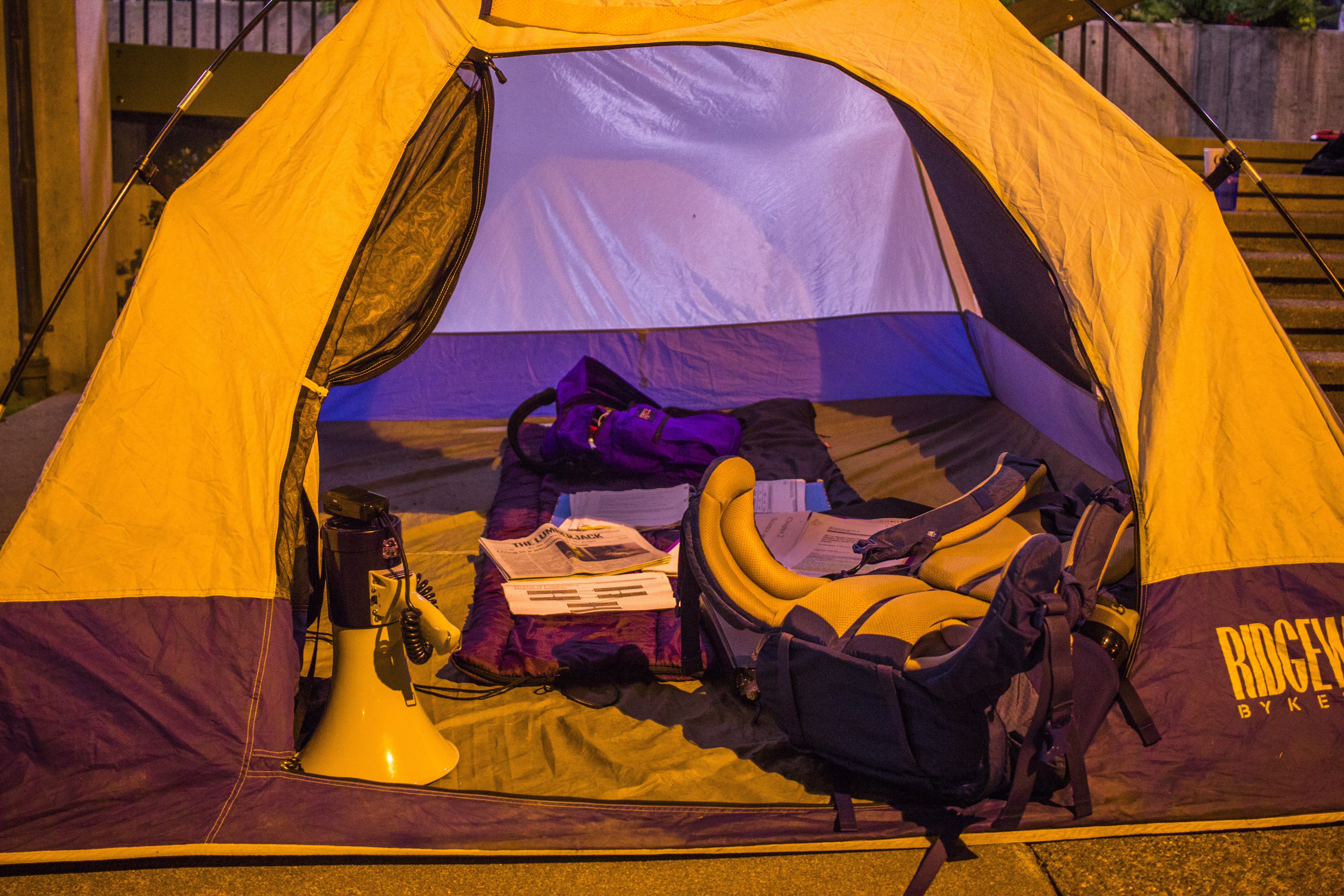
Parada said the last night of the event was the most hands-on activities they put on. They showed students and members of the community how to put together and take down a tent and also how to start a fire almost anywhere.
“Personally this was the most educational night for people who attended our event,” Parada said. “Even though we could not start a real fire, people definitely got the hang of how to start one.”
Arri Sanders, a senior at HSU, said how the event was personal and a huge eye-opener for her.
“I remember when one of my best friends was going through a similar situation,” Sanders said. “I honestly did’t realize some of the embarrassments or things homeless people had to go through until hearing it first hand.”
Sanders said even though her friend wasn’t nearly in as bad as a spot as some she still realized part of what she went through. Sanders said now looking back at it she wishes she would have tried to offer her friend more then what she did.
Sanders had one last message for people who have friends who are homeless.
“Please! Please! Even if they don’t ask for it, offer any help you can, because they do need it.” Sanders said.
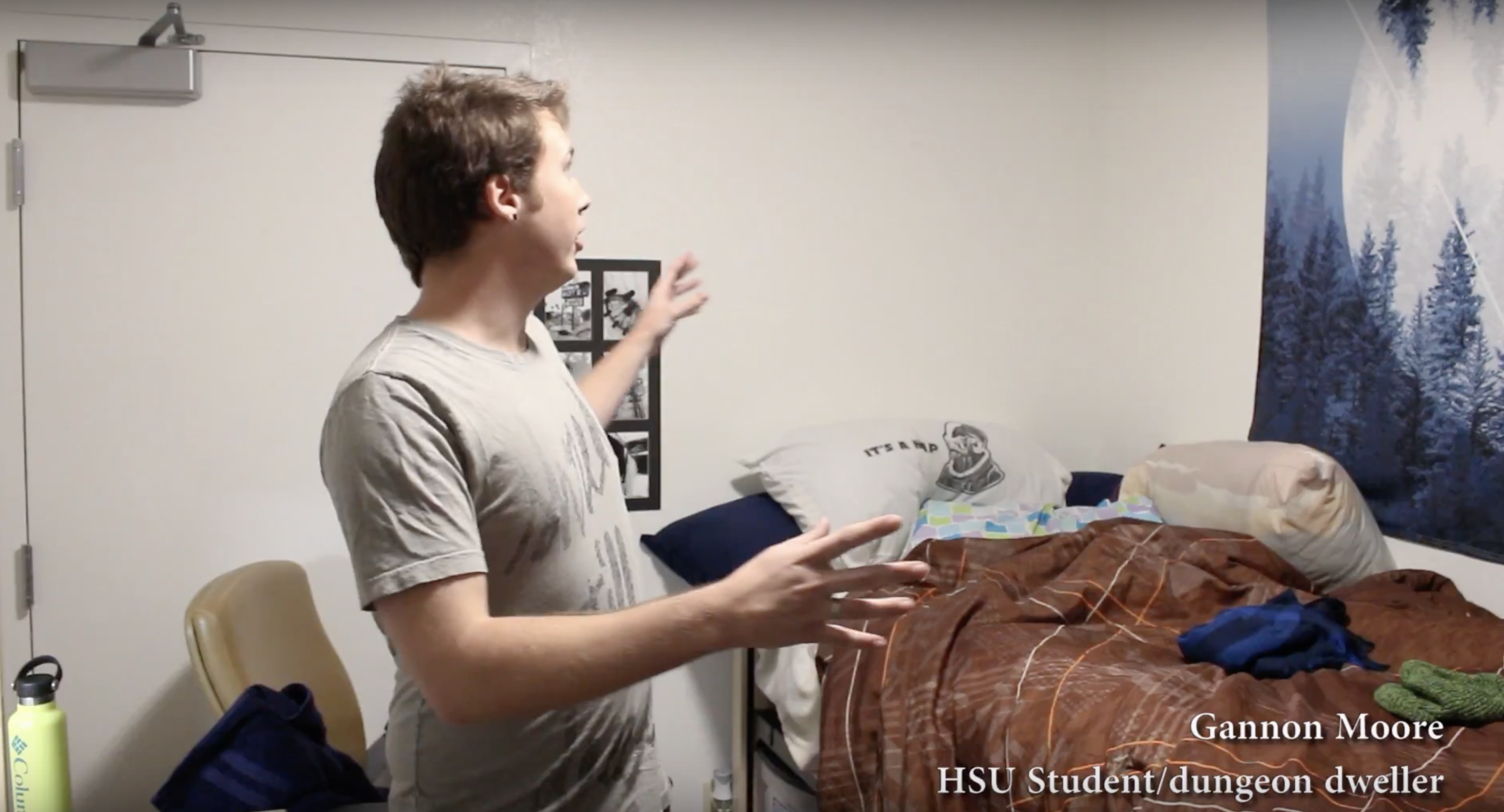
HSU student Gannon Moore was excited to have his own room for the first time, but his excitement didn’t last long. It died out when he saw his assigned windowless bedroom for the first time.
“As soon as I got there a lot of those hopes were dashed, everything was dashed,” Moore said.
In the summer of 2016, HSU housing and residence life decided to convert 23 kitchens in Juniper and Laurel at Creekview into bedrooms with no windows to accommodate more student housing.
The Director of Housing and Residence Life Stephen St. Onge said these rooms were built because of the urgent need for housing. He said that housing is not trying to capitalize on it, but only trying to combat the issue of homelessness.
Freya Mitchell is an international exchange student from the United Kingdom. She also was assigned a similar bedroom with no windows. Freya Mitchell was disheartened when she arrived this past August to her windowless assigned room after a long flight from the UK.
“Is this what I came for? Why have I flown all this way to this tiny room? It’s a bit claustrophobic and you can’t have any natural air flow in it,” Freya said
David Mitchell is Freya’s father and is an architect from the UK. He said he was shocked to know that there are dorm bedrooms with no windows.
“We [his family] were surprised that they even have that sort of room, to be honest,” David Mitchell said. “We’ve paid for a legitimate room and what we’re getting is a storeroom.”
He said windowless bedrooms like the ones in Creekview are illegal in the UK. In his opinion, those rooms shouldn’t have been used as bedrooms.
As an architect, David Mitchell thinks that there are several fundamentals that are wrong with such bedrooms, one of which is the lack of natural daylight and natural air flow.
“I don’t think that room should be used as a bedroom,” David Mitchell said. “I think their [HSU housing] decision to convert that room is driven by money. I think it’s driven by profit.”
Freya’s mom, Michelle Mitchell, also doesn’t think it’s acceptable to have a room without a window.
“Our friends would say ‘how’s Freya getting on in America?’ and we say she’s living in a cupboard,” Michelle Mitchell said. “Everybody we spoke to about it was horrified.”
After several efforts have been made by Freya, her family, and the HSU’s international students office, Freya was assigned a different room with windows.
“I didn’t wanna stay in that room it was horrible,” Freya said. “I just can’t believe that they’ve got rooms like that.”
According to the international residential code, bedrooms are required to have windows or a second door for air ventilation, natural light and to be used as an escape in case of an emergency. Though the 23 converted bedrooms in Juniper and Laurel at Creekview don’t have a window, they have another exit door that leads to the outside.
Patricia Rivera is another student who moved into Mitchell’s windowless room after she moved out. Rivera lives right across the hallway from Moore and both of them agree that their small converted windowless bedrooms lack proper ventilation and have no natural light.
“It gets really stuffy within like five minutes,” Rivera said. “It’s constantly dark no matter what’s in there.”
When the heat is turned on in Moore’s suite, his room gets very hot compared to other rooms in the suite due to the insufficient ventilation.
“My room gets boiling hot because there’s no ventilation,” Moore said. “All the heat from the vent gets into the room and just sit it has nowhere to dissipate to.”
Moore used to open the door that leads to the outside to get some fresh air, but he can’t prop the door open anymore.
“I can’t leave my door open because the RAs say ‘you gotta close your door, you can’t leave your door open’ even if I’m in the room.” Moore said.
Moore said he’ll sometimes wake up sweating from his overheated room.
“When I’m overheating at night, I have to open my door, go walk out into the hallway and just stand there,” he said. “I stand there sometimes in my boxers because I’m freaking overheating and I have nothing else to do.”
Both Mitchell and Moore agree that living in a room like this affected their mental health. Moore noticed that he started to get frustrated easier than ever before.
“I started getting angrier and it’s honestly because I’m not seeing any natural light,” he said. “It’s like I’m in solitary confinement.”
Before Mitchell was relocated and during the time she was in one of the windowless bedrooms, she tried to stay away from her room as much as possible.
“I didn’t spend much time in the room really I stayed out as much as I could,” Mitchell said. “You’re going to go crazy if you stay there.”
J.D. Andreas is another student also currently living in one of the converted windowless bedrooms. He said he wakes up not knowing what time it is because it’s always dark in his room.
“You wake up, you don’t know if it’s midnight, you don’t know if it’s 3 p.m. because it’s just pitch black in there,” Andreas said.
Andreas and his suitemates found humor in what they called “messed up things.”
“My roommates and I were always like ‘yo I’m going to take a nap in J.D’s room. I don’t know if it’ll be three hours or 18,’” Andreas said.
Moore’s girlfriend, Hannah Klein, calls him Harry Potter because he lives in a “cupboard,” she said. He said his windowless room also became an inside joke for him and his friends.
“Anytime anybody complains about their room,” Moore said. “We tell them at least you have a window, at least you don’t have the dungeon room.”
Chant’e Catt and Mike Barnes, along with the Homeless Student Advocate Alliance (HSAA), are seeking to create a greater connection for students, the university, and the community. Something they plan on doing with the upcoming events after fall break.
Catt is the founder and president of the HSAA. She said that an estimated 15 percent of students experience homelessness while attending HSU.
Catt founded the HSAA last September to give a voice to students experiencing homelessness.
“I eat, breathe and sleep this club,” Catt said. “This club is support for students who find themselves seeking housing.”
Barnes, who is the current vice president for HSAA, said the three-day event is one of the biggest events they’ve done on campus, especially since they’ve taken on a lot of the event planning and marketing.
“If I described this event in one word, it would be ‘necessary,’” said Barnes.
Barnes said there isn’t enough information for students who have housing insecurities.
According to Barnes, the event will include both student and community led organizations, such as the Affordable Homeless Housing Alternatives, Inc. (AHHA).
Nezzie Wade is president of the board of AHHA. Wade said that they have worked with several groups of students at the university on housing-related issues and projects.
Both Catt and Barnes said this event will open up a dialogue for students and will help bridge the local community with the student community.
Barnes said that it might be hard to find seating for the first two days of the events because of how much support they’ve gotten from the community.
————————
Day 1 – Nov. 28 from noon to 1 p.m. on the HSU University Quad.
Afternoon sustainability fair consisting of student innovations and ideas of sustainable living outside of traditional dwellings.
Housing: Indigenous Insights 6 p.m. to 8 p.m. in the Native American Forum at HSU.
A night of storytelling featuring Jene McCovey, an open forum for attendees to share their stories.
Day 2 – Housing: Social Justice Insights Nov. 29th from 6 pm to 8 pm in the Native American Forum at HSU.
Perspectives on social justice and breaking stigma. Featuring a Native Speaker and Vernon Price, a highly knowledgeable advocate for homelessness rights and co-star in I Am I was Homeless, a featured video to be shown; faculty members from the Department of Social Work, members of the Multi-Cultural Center, Affordable Homeless Housing Alternatives and more representatives from HSU.
Day 3 – Housing: Innovative Insights Nov. 30 from 8 p.m. to 12 p.m. in the University Center Quad at HSU.
The final day of the summit will consist of an idea fair, featuring student, faculty, and community projects focusing on anecdotal solutions to housing insecurity. The workshop will provide opportunities to acquire skills that will help support the lifestyle should you encounter it.
Todd Larsen, associate director of Housing and Residence admits there is not enough housing on campus for every student who wants to live on campus.
“This year we have a record number of returners and transfers,” Larsen said. “We had 800 returners apply for the 600 spots we have.”
The housing office is trying to take some of the stress off of students looking for off campus housing. The housing office has held four events now to help students find housing.
Their final event held on April 24, gave students an opportunity to meet with real estate management groups. Kimberly Morris was at the event with Kramer Investment Corporation talking with students about renting apartments for them next semester.
“We try to make it as easy as possible for first time renter,” Morris said. “We try to get the parents involved to help students through the process.”
Sol Dinay, a freshman physics major, attended the event held by housing. He has already seen about a dozen houses and is hoping to secure his housing for next semester soon.
“It’s just a matter of getting an app that gets approved,” Dinay said. “I’m not that worried cause I know we’ll eventually get a place.”
Dinay tried to get an early start looking for houses and has some advice for people just barely starting out.
“Try getting started on Craigslist because the application process is just an email,” Dinay said. “Apply to as many places as you can cause most will get denied.”
Levi Mazza a freshman business major already lives off campus. Mazza found a house last May when he came up with his friend and current roommate. For him the hardest part of finding housing was getting his calls returned.
“Everyone is extremely flaky up here,” Mazza said. “If you find a property, annoy the property manager by phone and in person.”
He believes that by constantly contacting the manager you have a better chance to get a face to face meeting. It is in this first meeting that impressions are made that can determine whether or not you get the house.
“When you do meet them in person be well dressed, make eye contact,” Mazza said, “and shake there hand multiple times.”
Because enrollment decreased this past term, less students struggled to find openings in campus housing. Senior psychology major Victor Perez was able to change dorms from the campus apartments to the College Creek complex because there was the space available for the upgrade.
Stephen St. Onge, director of Housing and Residence Life, said housing normally starts off the fall semester with around 104 percent occupancy and drop a little in the spring.
Currently housing is at 96.5 percent occupancy, having more open spaces for female students than male students. This has been a trend over the past few years.
Twenty-four-year old transfer student Kimberly Encio said when she lived in the College Creek housing complex it was a little overcrowded. The only reason she decided to move off campus was the high cost of living on campus.
“If it wasn’t so expensive I would have stayed on campus,” Encio said. “I loved the convenience of it all, being able to come home between breaks, close to the library and class, all of it.”
According to St. Onge, one goal the housing department has is to provide a reasonable cost for on campus housing.
“One of the strongest factors in student retention is living on campus for at least one year,” St. Onge said.
Housing is not just focusing on the cost, they are also very focused on opening up more spacing for both new and returning students. St. Onge said they have increased the number of lottery seats for returning students by 100.
With the university getting larger there is more demand for housing both on and off campus for students. Both Perez and Encio agreed that the university should have another dorm complex on campus to help with overcrowding and so they could provide more spaces to new and returning students.
St. Onge said that the housing department is always open to suggestions and feedback from students and said they have an open forum on March 2 from 3:30 to 4:30 p.m. in the Jolly Giant Commons to discuss the potential for adding new housing on and off campus.
This website uses cookies to improve your experience. We'll assume you're ok with this, but you can opt-out if you wish. Cookie settingsACCEPT
Privacy & Cookies Policy
Privacy Overview
This website uses cookies to improve your experience while you navigate through the website. Out of these cookies, the cookies that are categorized as necessary are stored on your browser as they are essential for the working of basic functionalities of the website. We also use third-party cookies that help us analyze and understand how you use this website. These cookies will be stored in your browser only with your consent. You also have the option to opt-out of these cookies. But opting out of some of these cookies may have an effect on your browsing experience.
Necessary cookies are absolutely essential for the website to function properly. This category only includes cookies that ensures basic functionalities and security features of the website. These cookies do not store any personal information.
Any cookies that may not be particularly necessary for the website to function and is used specifically to collect user personal data via analytics, ads, other embedded contents are termed as non-necessary cookies. It is mandatory to procure user consent prior to running these cookies on your website.