In honor of Women’s History Month, we ask Humboldt State students who their female idols are and why
Share who your female idols are in the comments to be featured in future videos.
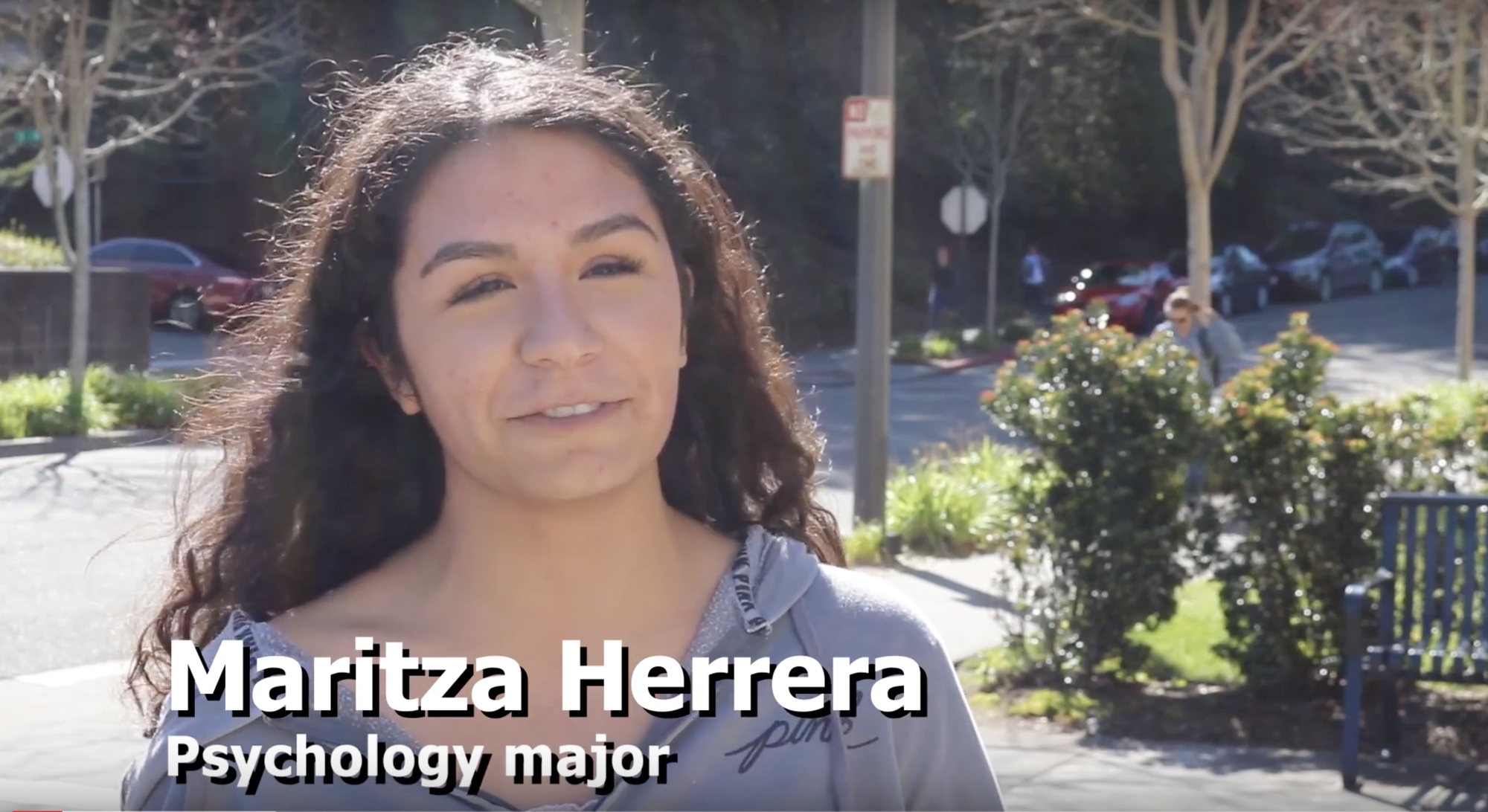
Share who your female idols are in the comments to be featured in future videos.
By T. William Wallin and Freddy Brewster
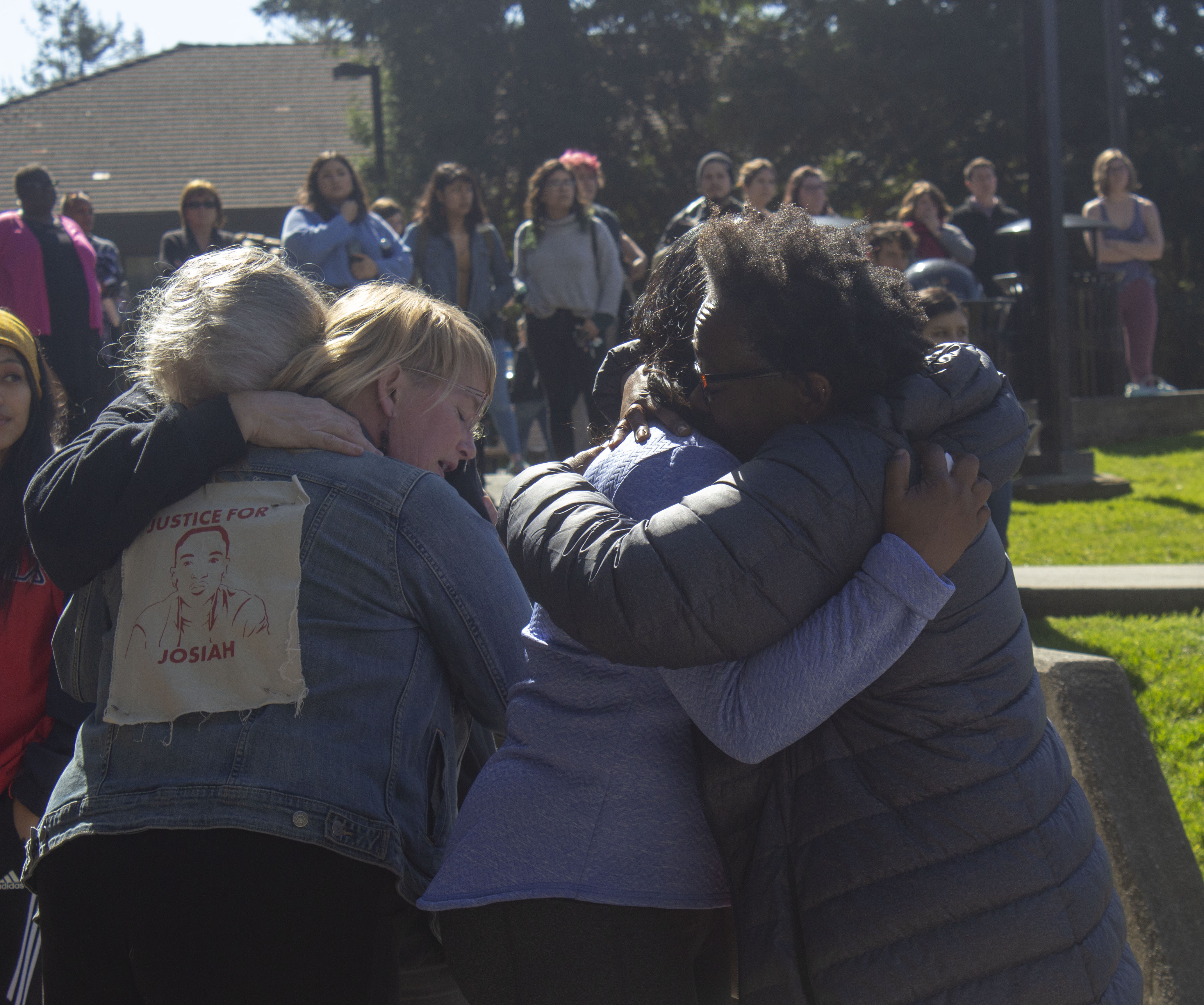
“My son needs you more now than ever, stand for him and fight for him.” These words were spoken by Charmaine Lawson to a crowd of grieving students, faculty, administrators and community members at the UC quad on Friday March 15.

“Thank you everybody for being here,” Lawson said. “We will see how the system treats people who aren’t from here, we shouldn’t be judged by the color of our skin but by our character. My son was a man of character.”
On Wednesday March 13, a grand jury declined to indict any person in the fatal stabbing of Charmaine Lawson’s son and murdered HSU student, David Josiah Lawson. This lead to protests at the Humboldt County Courthouse and Justice For Josiah Committee to hold a gathering for Justice For Josiah on campus.

Lawson has been a presence in Humboldt County in the last 23 months since her son was murdered. She has brought attention of her son’s death to CSU Chancellor, Timothy White, CSU Chairman, Adam Day, as well as California’s attorney General Xavier Barrera.
“Your life is not supposed to be taken like my son’s,” Lawson said. “I am not going anywhere, I’m a fighter and will be fighting until the end. I need you help and your support. We have to let people know about Josiah.”

Justice For Josiah Committee member Nathaniel McGuigan said his thoughts on the grand jury’s decision was unforgivable. He said this stops the progression of the efforts of Justice For Josiah and “shows how the system supports white supremacy and the capitalist state”. Although McGuigan is disappointed with the decision he is optimistic on moving forward.
“As long as we hold them accountable there is hope,” McGuigan said. “Without pressure nothing can be done.”

A.S. President Jazmin Sandoval shares McGuigan’s disappointment. She said that the University has not been involved with the students since Josiah’s murder and students have been having to help other students.
“Charmaine just wants our support and she’s got it,” Sandoval said. “I’m hoping we are going to do our best. I don’t have faith in the criminal justice system but I have faith in the people.”

Sandoval said HSU administrators wanted to have a moment of silence for Josiah but students rejected their plan because of their absence in the past 23 months. The Gathering For Justice For Josiah was put together by Lawson and the J4J Committee.
“We did this gathering so students could be there for Charmaine,” Sandoval said. “We aren’t going to stop until we get justice for Josiah.”

HSU President Lisa Rossbacher was among the crowd listening to Lawson and said “there is no such thing as enough for times like this.” Rossbacher said she was sad for Charmaine and her family and the friends of Josiah.
“The city and university are working together to make sure that this place is safe for all of our students,” Rossbacher said. “When we talk about justice for Josiah I think we need to make sure we change society into something that is fair and equitable for all.”
Arcata Police Chief Brian Ahearn agrees and said UPD and APD have been working together and have a healthy collaboration in place. Ahearn said he attended the Gathering For Justice For Josiah to stand in solidarity with Lawson, Josiah and the HSU community. Ahearn said he is confident they will solve this case and bring justice for Josiah.
“We are going to get this done,” Ahearn said. “We are going to identify without any doubt who killed Josiah.”


Starting at 10:00 am on March 19th, members of the Students for Quality Education will be advocating for disarming campus police and security along their peers at the Board of Trustees meeting at the Office of the Chancellor in Long Beach, California as part of their “No Harm, Disarm!” campaign. The demand is one of many to address student safety on campus, which also includes working to create community-led crisis intervention and response teams, investing in more mental health counselors and supports, investing in Black resource centers and other cultural centers, mandatory de-escalation and unconscious bias training for all campus police and security, and more.
Members of the campus and local news media are invited to attend:
Board of Trustees meeting/March 19th at 10:00am
Office of the Chancellor/Long Beach
Office map with parking information: https://www2.calstate.edu/maps-and-directions-to-chancellors-office
Members of the Students for Quality Education will be at the meeting.
Following the meeting, SQE students will be available to speak to media and reporters.
BACKGROUND
We want ALL students to feel safe on our campus. Instead of funding more firearms and officers on our campuses, our CSU’s should be investing in proactive and preventative solutions, like more mental health counselors and cultural centers for students.
Regardless of how students react to police, campus police officers should undergo mandatory de-escalation and unconscious bias training to adequately deal with situations regarding all students. We recognize the over-policing of black and brown students and demand our CSU work with communities to explore alternatives to police and find solutions to police and student disparities. We want our schools to start adopting restorative justice practices to redefine what justice looks like in our communities, focusing less on punishment, and more on healing and repairing harm.
More information about our “No Harm, Disarm!” campaign and our demands can be found here: http://csusqe.org/noharmdisarm/
ABOUT STUDENTS FOR QUALITY EDUCATION (SQE): Students for Quality Education was formed in the 2007-2008 academic year by students in the California State University (CSU) system to build the student movement for educational rights in public higher education. They are assisted in their efforts by the California Faculty Association. For more information about SQE and information about chapters, go to http://csusqe.org.
For more information contact: ealcantar@calfac.org
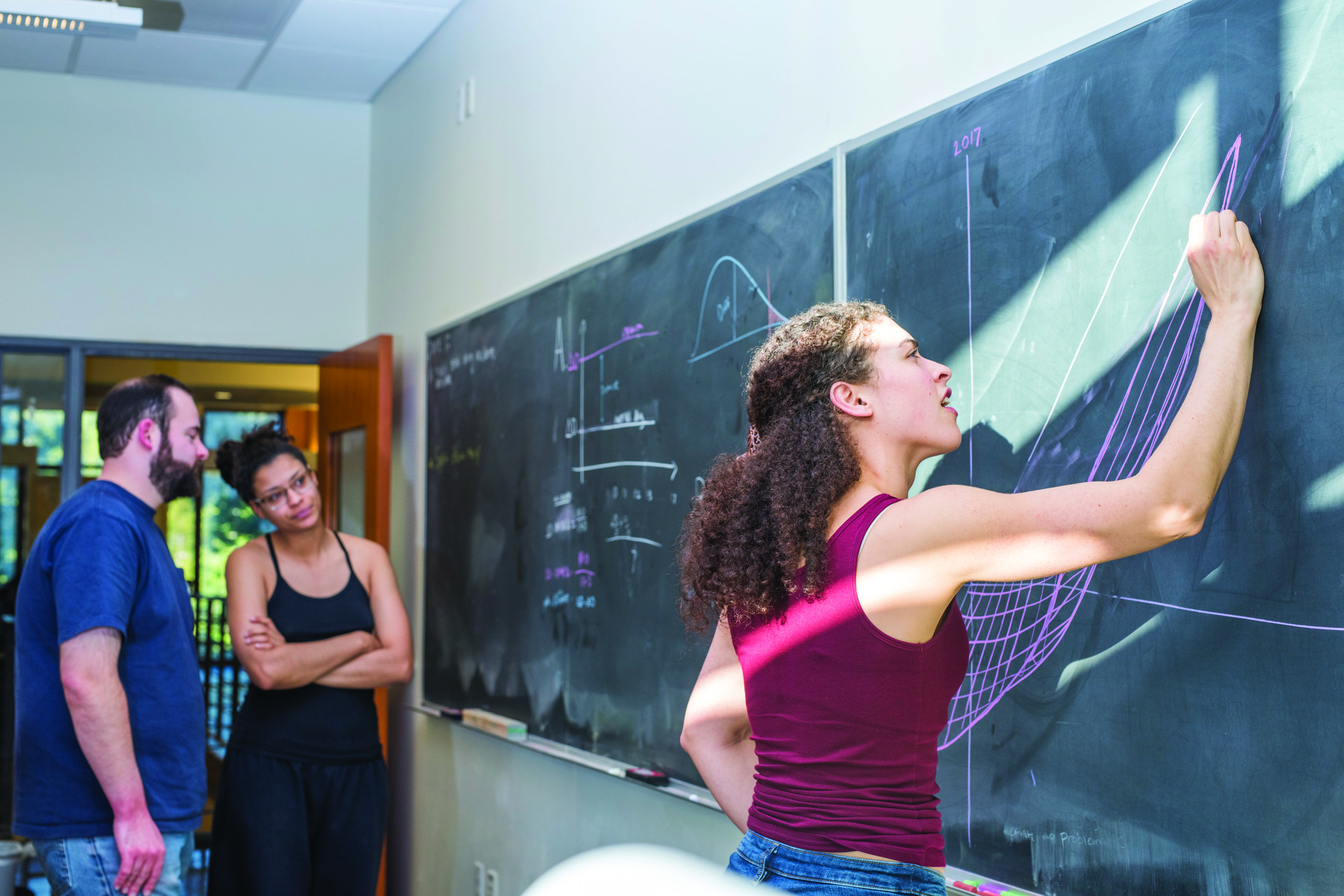
Humboldt State students recently took part in the Mathematical Contest in Modeling, a large undertaking with over 900 institutions around the world participating. Teams are challenged to solve a complex, open-ended real-world math problem.
About half of the teams participating worldwide fail to even solve the problem. One of the teams from HSU received a hypothetical disaster situation, and was briefed on how to best provide surveillance and medical delivery to Puerto Rico following the recent hurricane. They figured they could supply three cities with two years of medical supplies.

Johnny Rasnic, a mathematics major at HSU, enjoys being active within the math department.
“Here the department is small but they try to keep things active for the math majors,” Rasnic said.

Rasnic applied his knowledge fully to this competition. His favorite aspect of this competition is the collaboration.
“People see things that you don’t. Two brains is better than one,” Rasnic said.
To Rasnic, this competition is about making the impossible possible. It’s about taking a mathematical truth and applying it to certain situations to find more true statements.

There was one team from HSU who was tasked with finding out how to evacuate the Louvre in Paris as quickly as possible. They made their evacuation plan as specific as possible, and made different potential plans of evacuation for different potential solutions.
Astrophysics and applied mathematics major at HSU, Gynell Higby gave advice to people looking to compete in the future.
“Be prepared,” Higby said.

One group from HSU focused on the opioid crisis. They were given data on opioid incidents in five states: West Virginia, Kentucky, Pennsylvania, Ohio and Iowa.
Briana Ramirez, applied mathematics major at HSU, was on the team tackling this problem.
“Basically, the purpose of the problem was to see the driving drugs of the opioid crisis and the driving demographic that uses the most opioids,” Ramirez said.

The demographics for this crisis were shown on an excel sheet which the group looked over. They were given 96 hours to tackle the problem. They laid out code on a computer, but just as they were close to solving the problem, the power went out and all of their code got wiped clean.
So, they started over with a sleepless night. After hours of grinding work, they found that Ohio has the biggest opioid crisis, but Kentucky has the largest demographics that use the most opioids.

The teams used different aspects of their intelligence. This was Ramirez’s second time participating in the competition.
“We’re really using all of our education in one setting,” Ramirez said. “It’s an academia competition. But we’re not getting graded on it and we kind of have the full range of our creativity and all our knowledge to go into something productive.”

Ramirez went on to share the positive aspect of collaboration in this math modeling. she said that since the team os divided into groups of three, people can bring a lot of different skills to the table.
“Bringing all of our education together was something really beneficial,” Ramirez said. “It kind of reinforces your learning through however many years of college you have.”

Hold it like a cigarette, shove it up the nostril as far as you can and blast the plunger. These are the directions on how to properly administer Narcan nasal spray to a person overdosing on opioids.
Ocean Capewell, masters of social work and intern for HSU Health and Well Being, and Mira Friedman, lead for Health Education and Medical Clinic Support Services at HSU, hosted the second-ever Narcan training at HSU on March 11.
“As far as we know there are no other CSU campuses that offer this type of training,” Capewell said. “This is new to Humboldt and very exciting.”

Narcan is generic for the drug Naloxone which Capewell said is an opioid antagonist. Capewell said our brains have opioid receptors and Naloxone confuses the receptors so they do not attach to opioids coming into the brain. The easiest form of Naloxone, demonstrated by Capewell and Friedman during the training, is through a nasal spray. Capewell said they wanted to have “the lowest barrier form” on campus so anybody can use it.
“It is very safe and has had no problems for people using it,” Capewell said. “It is only useful for people using opioids but more important it’s for loved ones, house mates and friends to have. Once you overdose you wont be able to administer it yourself.”

Capewell instructed those at the training on what to do when someone is overdosing. Capewell said to first call 911 and then hold the Narcan nasal spray in between two fingers so you don’t accidentally deploy it. Next you place the spray as far up the nostril as you can and hit the button. Capewell said “they don’t have to be breathing” for the spray to work because it gets in the mucous membrane. Afterwards lay them on their back and apply rescue breathing, which is two quick breaths and then one breath every five seconds for the next two minutes.
[perfectpullquote align=”right” bordertop=”false” cite=”Mira Friedman” link=”” color=”” class=”” size=”17″]“Eureka police just got Narcan and saved someone over the weekend. The Eureka library has saved someone recently who was using in the bathroom. It’s pretty amazing.”[/perfectpullquote]“They are going to feel terrible when they wake up,” Capewell said. “They will most likely be withdrawing, which is one of the worst experiences a person can have. They may be vomiting, shaking and unable to control their bowel movements but they’ll be alive.”
Friedman said Naloxene distribution began in 2003, and within the first year overdose deaths decreased by 42 percent. Friedman said local distributors in Humboldt County include Public Health North Coast Aids Project, Redwoods Rural Health Center, Humboldt Area Center for Harm Reduction (HACHR), and Cloney’s Pharmacy.
“Eureka police just got Narcan and saved someone over the weekend,” Friedman said. “The Eureka library has saved someone recently who was using in the bathroom. It’s pretty amazing.”

Friedman said that there is a stereotype of people who use opioids as all needle users or living on the street. She said that 40 percent of opioid overdoses involved a prescription drug and that really challenges the myths and stigmas revolving around opioid addiction. Friedman also said that Naloxene is not treatment but something used to prevent death.
“We’re interested in giving people information on harm reduction like data and statistics,” Friedman said. “Especially being in Humboldt because this issue is so great.”
Psychology senior Victor Ahumada was one of the attendees at the training and said he was there because he knows there is an opioid crisis, especially in Humboldt. Ahumada said when there are available trainings he wants to take advantage of them. Although he has never dealt with anybody overdosing, Ahumada now carries Narcan with him just in case.
“I think this is something everyone should know about,” Ahumada said. “Everyone may not necessarily have to carry Narcan but they should know this is a huge problem. It’s important to be aware and be a part of the prevention.”
The next Narcan trainings will be held in April:
Tuesday, April 6 at 12 p.m. Nelson Hall room 106
Tuesday, April 23 at 5 p.m. Library Fishbowl
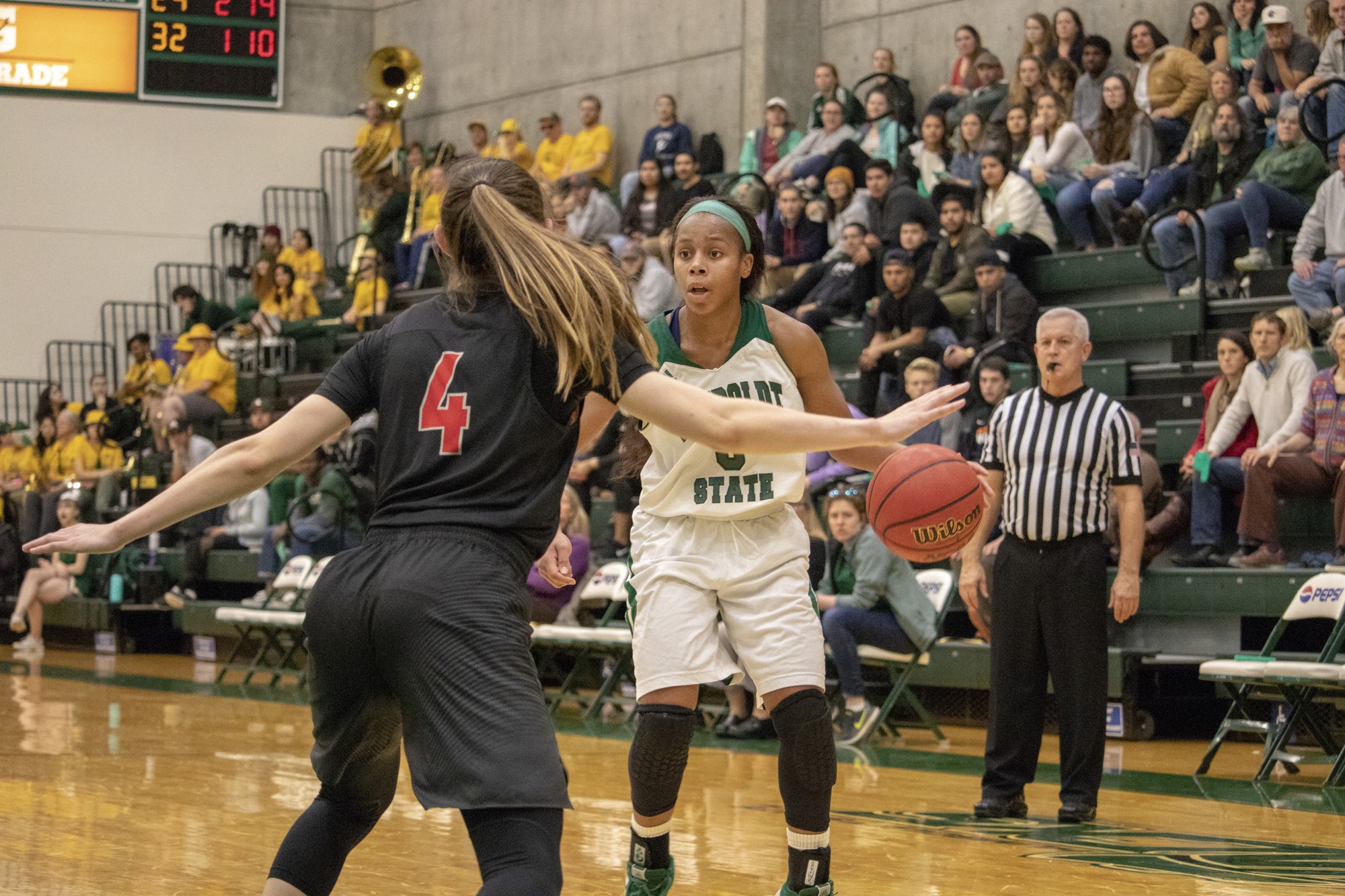
It was a heartbreaking night for the HSU women’s basketball team as the Cal State East Bay Pioneers came into Lumberjack Arena and stunned the raucous home crowd by beating the Jacks 72-62, eliminating HSU women’s basketball from the CCAA conference tournament.
The Pioneers used great shooting and forced a lot of turnovers to beat the Jacks on their home floor. The Pioneers shot 57 percent from the floor and capitalized off of costly turnovers by the Jacks late in the game.
[perfectpullquote align=”right” bordertop=”false” cite=”Head Coach Michelle Bento-Jackson” link=”” color=”” class=”” size=”18″]“East Bay punched us, and we didn’t punch back. They outplayed us, out-toughed us and they played like they wanted it a whole lot more than we did.”[/perfectpullquote]The Jacks were able to start the game well, outscoring the Pioneers 17-16 in the first quarter of the game. The second quarter was a high scoring and exciting affair as both teams traded three-pointers.
Senior guard Jovanah Arrington was on fire in the second quarter, sinking three treys and totaling 13 points in the first half alone. Unfortunately, the Jacks defense was not able to close out on the Pioneer shooters as they hit five three-pointers of their own. The Jacks still made it a close game at halftime with the Pioneers leading 39-37.

Scoring would not come as easy for the Jacks in the second half. They were able to get the Pioneers to turn the ball over 14 times, but often had trouble executing on the offensive end as they missed several shots at the rim. The Pioneers shot at a 52 percent clip in the second half while the Jacks only hit 33 percent of their shots. The Pioneers used their potent offense to outscore the Jacks 33-25 in the second half to eventually win the game.
“East Bay punched us, and we didn’t punch back,” Head Coach Michelle Bento-Jackson said. “They outplayed us, out-toughed us and they played like they wanted it a whole lot more than we did.”
Three Jacks players ended up playing all 40 minutes of the game, as Bento-Jackson only used six players throughout the game. Madeline Hatch and Gabrielle Carbajal were the only players to be subbed out of the game. However, Bento-Jackson was not making any excuses for the players.
“Overcoming those moments where your backs are against the wall is a sign of mental toughness,” Bento-Jackson said. “It’s not a physical fatigue thing.”

What made this loss even more heartbreaking was the fact that two seniors were playing in their last game at Lumberjack Arena. Senior guard Jovanah Arrington lead the team in scoring at 18 points and senior forward Isamar Conde turned in a solid performance as well, getting eight points and four rebounds.
“It’s definitely a special moment to play in this arena for the last time,” Arrington said. “It’s a really fun experience being able to play here.”
Despite the first round loss in the conference tournament, this may not be the last game that the Jacks play this season. Their fate rests in the hands of the NCAA division two selection committee. They would’ve needed to win the conference to get an automatic bid to the NCAA tournament, but they still could be selected as an at-large bid.
The Jacks gain the No. 7 seed in the NCAA West Regional. HSU will travel to San Diego and play No. 2 Northwest Nazarene on Friday, March 15 at 2:30 p.m.

Economics majors discussed a recently-released study regarding the effects of the 2006 Secure Fence Act at an open forum, held last Friday at Fiesta Grill and Cantina.
The Secure Fence Act added 548 miles of wall, fencing or other physical barrier to the existing barriers along the southern border. Carlos Rodgers was one of the two economics majors hosting the panel, and found much of the information in the study to be surprising.
“I was surprised that the impact per worker was so small,” Rodgers said. “The gain in wages felt by uneducated Americans is small compared to the wage reduction for college-educated Americans.”
The study, released last November, found that wall expansion harmed college-educated U.S. workers by $4.35 per person annually, and boosted the wages of uneducated Americans by 36 cents. The construction itself cost the nation $2.3 billion, or about $7 in taxes per person according to the study.

Economically, Mexico didn’t benefit from the wall expansion either. The study found that educated Mexican workers lost roughly $2.99 in annual income, and less-educated Mexicans lost $1.34.
Estrella Corza, another economics major who attended the forum, recognized the ineffectiveness of walls as a solution.
“On both sides of the wall, there wasn’t progress,” Corza said. “No one benefited from this.”
In addition to being economically unfavorable, the study found that the wall expansion barely changed the number of people who illegally cross the border. According to the study, the new pieces of wall built after 2006 reduced the number of Mexicans living in the United States by just 0.6 percent, or about 82,650 people.
As the forum continued, it became clear that the wall was ineffective as a solution to the illegal immigration problem.
Attendee David B. joked, “Has anyone considered a moat?”
Nicola Matthews, an economics professor at HSU, stated what some people were thinking about halfway through the forum.
[perfectpullquote align=”right” bordertop=”false” cite=”Nicola Matthews” link=”” color=”” class=”” size=”17″]”Politicians often blame immigrants for the shrinking middle class. They are looking for someone to blame.”[/perfectpullquote]“Assuming calculations are correct, moving forward we don’t want to build more walls,” Matthews said. “Isn’t that the consensus?”
With that, the discussion moved to alternative solutions. Ideas like cracking down on illegal-immigrant-hiring businesses and guest-worker programs were floated, but the final consensus was that the best way to curb illegal immigration would be to improve the wages and quality-of-life in Mexico, so less people would feel the need to immigrate.
Despite being a charged topic the forum didn’t get heated or argumentative, and the participants saved political discussion until the forum was wrapping up. They acknowledged that many other factors like xenophobia, bias and racism play a role in the decision to build a wall.
“Politicians often blame immigrants for the shrinking middle class,” Matthews said. “They are looking for someone to blame. ‘Why is my family suffering?’”

By: Freddy Brewster and T.William Wallin
Nearly fifteen people gathered outside of the Humboldt County Courthouse Wednesday night to protest the grand jury’s decision to not bring charges in the murder of Josiah Lawson.
Lawson was stabbed during a house party in Arcata on April 15, 2017. Among the protesters is Jill Larrabee, a Justice for Josiah (J4J) organizer and friend of Charmaine Lawson.
“I am infuriated with the decision, I don’t have words for it,” Larrabee said. “We have been out here for almost two years and it feels like we are getting robbed of justice. It’s the same story that has been happening for forever.”
Larrabee said she has been involved in the J4J movement in since the beginning but became more intimately involved in January of 2018.
“It is my duty to get involved,” Larrabee said. “I wanted to pick up when the students had to focus on school.”
Eric Martin of McKinleyville also showed up to protest the grand jury’s decision. Martin grew up in Burlingame, Calif. and move to Humboldt to attend school at HSU. Martin graduated in 2007 with an art degree and became involved in the J4J movement last summer.
“I am upset and I feel really angry that they aren’t going to do anything,” Martin said. “I thought there had been enough of an investigation to bring the murderer in.”
Meg Stofsky is a member of the local NAACP chapter and showed up to demand for something to be done in this case as well. Stofsky is relatively new to Humboldt county having moved here from Upstate New York in 2017.
“I’m shocked about how far behind the times the racial issues are here,” Stofsky said. “I love Charmaine Lawson and she needs justice, but it wasn’t served yet again.”
Remember to wear green this St. Patty’s Day to avoid getting pinched! Abel Anaya asked HSU students what their St. Patrick’s Day traditions and plans are. Share your traditions with us in the comments below!
Not every paycheck is worth the work. We asked Humboldt State students what their worst job experiences have been. Share your stories in the comments to be featured in future videos.
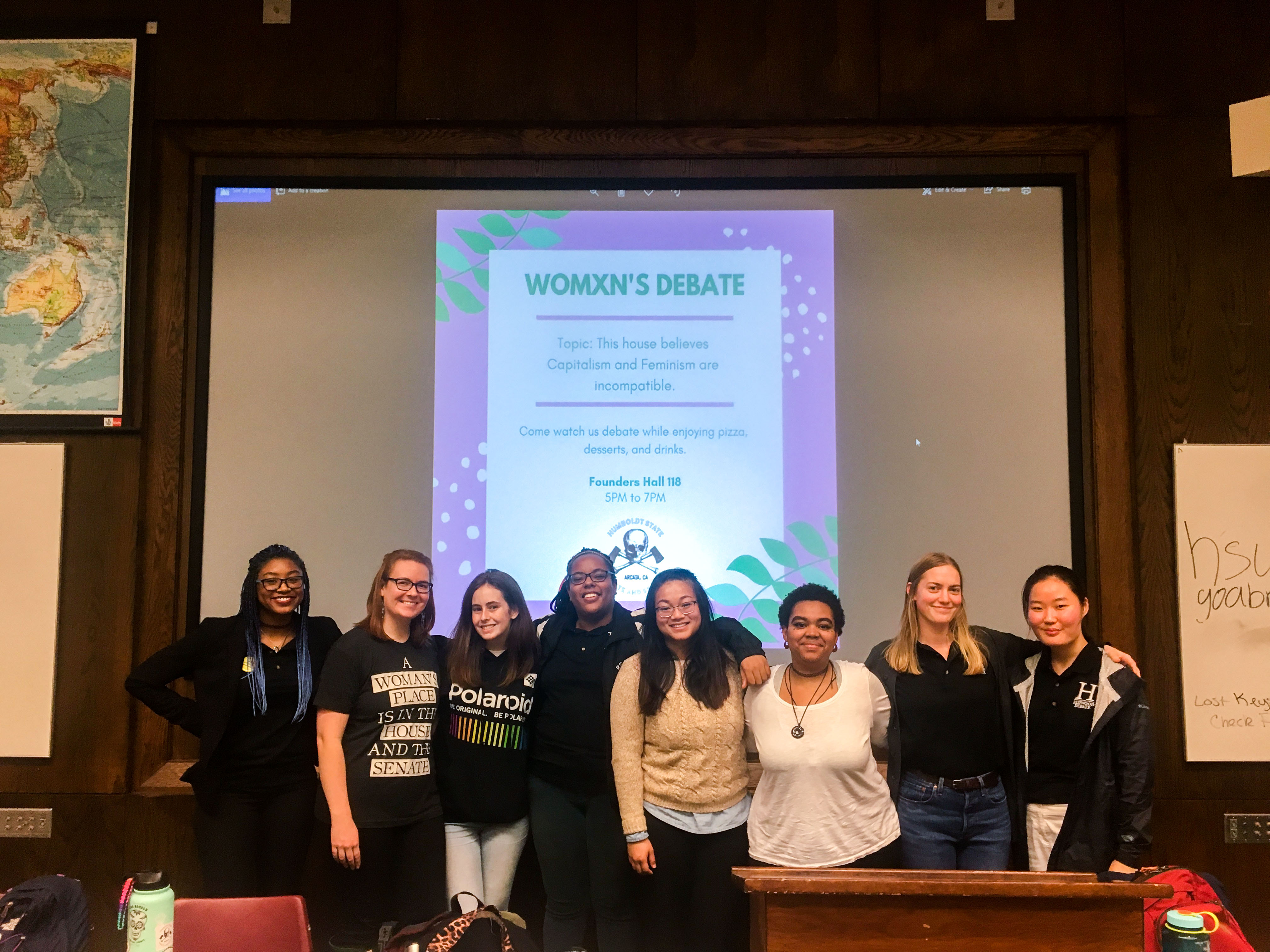
A thunder of knocking agreement filled Founders Hall 118 on Wednesday by a crowd consisting of mostly students who were eager to hear a debate focused on the incompatibility of capitalism and feminism.
Women from HSU’s debate team presented their speeches in front of a crowded room using the British Parliamentary debate format that consists of four teams where each person is given seven minute to present.
[perfectpullquote align=”right” bordertop=”false” cite=”Leslie Rossman” link=”” color=”” class=”” size=”18″]“[We] cannot fight the system if we are always fighting just to survive.”[/perfectpullquote]
Kimberly Nguyen, the prime minister, opened the debate by defining the motion and proposing a radical change by feminists, suggesting they should avoid teaching for profit, working with conglomerate media, and selling bestselling books with publishing conglomerates.
“We will not try to solve for capitalism in this debate,” Nguyen said. “Instead, we are only having a conversation about how the two are incompatible.”
After a heated discussion professor Leslie Rossman, who identifies as a socialist feminist, recapped the event reminding the audience that capitalism is an inherently exploitative system and it will continue to sell social movements like feminism for a profit. Rossman continued to describe how capitalism will constantly reproduce scarcity and leave citizens in a state of insecurity.
“[We] cannot fight the system if we are always fighting just to survive,” Rossman said.
Debate coach and professor, Aaron Donaldson was delighted by the crowd turnout and how well the women debated the topic.
“I think they did a great job of showing why our team is so respected in the circuit,” Donaldson said.

This debate prepared the team for Nationals that will take place at Clemson University in South Carolina in mid-April, where they will compete against teams like Harvard and Yale. Sydney Verga, an environmental studies major, highlighted the struggles of competing at tournaments due to budget cuts.
“Last year we got lucky because nationals was closeby at Stanford,” Verga said. “We normally cannot fly to these tournaments because it’s too expensive.”
Many suggest bake sales to raise money for these tournaments, but the biggest struggle they face is reaching out to debate program alumni who they’ve lost contact with over the years. Recently the clubs office recognized them as a club so they are able to fundraise, although the team is finding it hard to raise money.

The team spent weeks preparing their arguments, making sure they were charitable to both sides, making sure none of the arguments were off topic. A goal for this debate was to demasculinize the space and make it as diverse and inclusive as possible.
“Capitalism and feminism are really dense topics,” Nguyen said. “We don’t want to mischaracterize anything.”
Typically the debate team finds themselves presenting in small rooms with an even smaller crowd, but the turnout at the event prepared them for larger spaces and skills to become better public speakers.

Donaldson was thankful to have the team present in front of peers, friends, and teachers because, it meant that their hard work wasn’t limited to invisible corners of campus and people are caring about the amount of work and research that goes into preparing for events like this.
“It brings a lot of excitement [for] the chance to give a speech,” Donaldson said.

The Journalism Code of Ethics is what every journalist follows, whether they are a writer from a multi-media conglomerate or a student run newspaper. We of the Lumberjack newspaper hold these code of ethics to heart, as it helps us navigate the world of becoming a journalist and presenting our stories to readers or viewers.
One of the most vital rules we follow is to never show our work to the sources. We strive to make our stories as accurate as possible, and when we are asked by sources to preview a story before it’s publish, it will most likely not happen. We follow this rule because it takes away the independence of a journalist from gathering, writing and editing their story. If we were to share the story it would no longer belong to the writer, it instead implies that it belongs to the source. Our job as journalists is to seek the truth to a story and report it. Allowing someone to preview the story takes that away from us.
Previewing a story for a source also sets a precedent of having to allow every source in the Lumberjack newspaper to preview a story. Hypothetically speaking, say we allow a story to be previewed by source. But because a minimum amount of sources for a story is three, that means having to allow those sources to preview the story as well. Not only that, but other stories have to follow the same thing as well. It not only takes away the story from the writer, but it takes time needed for the news to be published.
The only time a journalist is allowed to share what they wrote for a story, is if they are talking about something complex like quantum physics. In this case, an expert can be consulted for accuracy.
We understand the concern of a source wanting to preview a story is for accuracy purposes, but it’s up to us as journalists to be accurate in our story. If more clarity is needed in a story, the journalists will most likely ask for it.
Student journalism can be an unpaid profession. Some students have to juggle running the news, while also attending classes. We have a rare luxury of making mistakes in the Lumberjack, but we learn from them.
Mistakes are bound to be made. When we make mistakes, we answer questions of accuracy and make necessary correction as soon as possible. For us it’s a learning experience to run the Lumberjack. We are held to a high standard for delivering an accurate and fair story to our readers, so much so that we’ve won awards for our excellence. We pride ourselves in delivering stories for our readers.

The social norm of bathrooms has always been one restroom strictly for women and one for men. Humboldt State University has not put a gender-neutral bathroom with multiple stalls within the campus.
There are plenty of unisex single-stalled restrooms but not multi-stalled gender-neutral bathrooms. Cory Strauss, a rangeland resources major with an emphasis with soil, is on his last year at HSU. Strauss was one of the first to push gender-neutral bathrooms into place and recruit more people to become aware of this issue.
Strauss said that facilities management were hesitant to put gender-neutral bathrooms on campus due to unsure coding.
“They wanted me to do a school-wide survey to see if there was even a need for these bathrooms,” Strauss said. “There wasn’t anyone within facilities opposed to this idea, just uncertainty and they were just very busy to hurry this process along.”

A lot of people don’t know that much information on gender inclusivity or the LGBTQ community, so people like Strauss also want to get these problems known so people are aware of issues like these.
“It gives a physical space to start meeting and understanding one another,” Strauss said. “We want to have workshops to get information out there about the LGBTQ community, information in the bathroom about these things. If people have never looked into what these different words means, such as binary versus trans versus cis, it is an easy area to give out information on this.”
The main buildings being focused on putting gender-neutral bathrooms are the Behavioral Social Science, Music A and B, Science A, B, C, and D, the library, the Theatre Arts building and the Harry Griffith Hall.
Film major Jazmin Sandoval, also the president of the Associated Students, continuously fights for gender-neutral bathrooms.
Sandoval said the the library and theatre arts are the easiest buildings to add gender-neutral bathrooms to because they are currently being retrofitted and remodeled.
“The BSS because it is on top of a hill and it is very secluded and it has a ton of bathrooms but no gender-inclusive restrooms,” Sandoval said. “Harry Griffith hall might be a pilot project just to feel it out because there is an excessive amount of bathrooms in there where there is four bathrooms by each other”.
These students have a lot of future planning for these bathrooms to take place. They want this campus to cater to all students who are in the LGBTQ community and even single parents who want to take their kids to the bathroom without feeling uncomfortable. They want everyone to feel safe and comfortable while attending Humboldt State University.
Sandoval said that potentially there may be gender-neutral bathrooms in fall 2019 but there’s no guarantee.
[perfectpullquote align=”right” bordertop=”false” cite=”Neesh Wells” link=”” color=”” class=”” size=”17″]”It has been statistically proven that zero percent of trans people have not attacked or used these bathrooms to take advantage of anyone.”[/perfectpullquote]
“That’s why we’re doing all the planning now so we can have things structured and we can start to implement it next fall,” Sandoval said. “We are hoping to start Harry Griffith Hall sooner, rather than later because it would be very easy to convert one of the multi-stall into a gender-inclusive bathroom, but we have out eyes set on next fall.”
Many people get the wrong idea as to why these gender-neutral bathrooms are necessary. Neesh Wells, the director for EDC and a business administration major emphasizing in marketing, takes part in trying to get gender-neutral bathrooms.
“It has been statistically proven that zero percent of trans people have not attacked or used these bathrooms to take advantage of anyone,” Wells said. “Trans people have never assaulted anyone in a bathroom, most attacks are actually from people who are non-trans attacking those who are trans.”
If you have any questions or want to get involved with this movement, there are meetings every Friday, 11:30-12:30 at facilities management in the facilities conference room. You can also contact Cory Strauss at Cds383@humboldt.edu, Jazmin Sandoval at js3852@humboldt.edu, or Neesh Wells at inw7@humboldt.edu.
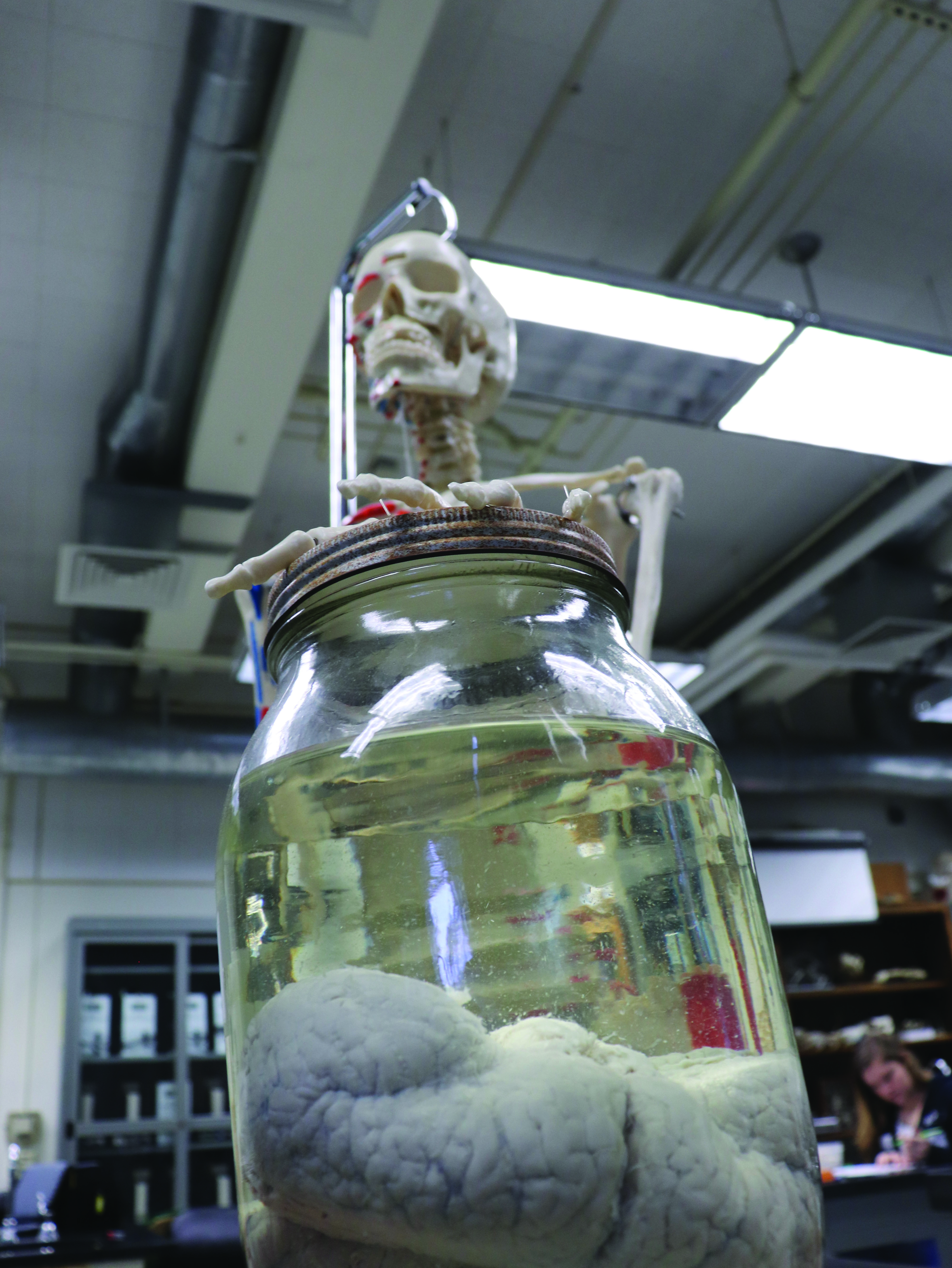
For many, the sight of a lifeless body is enough to make them spew their lunch. But for many in the sciences, it’s not a problem. The presence of lifeless bodies and the smell of embalming fluid is so commonplace for professor Moana Giacomini that she can enjoy a burger and chocolate chip cookies in the same room.
“I’ve been around them for so long in physical therapy school that it doesn’t bother me,” Giacomini said. “We had to dissect things all the time.”

HSU has four and a half human cadavers on campus—one is just a torso. Students in the kinesiology, pre-med and biology departments are among those who get to handle the cadavers. Two of the cadavers are male and all are on a five-year loan from UC Davis. The bodies sit in steel tanks filled with a solution of phenoxyethanol and water.
Each of the cadavers are used for different purposes, but all are dissected. One of them sits with their skin flayed back revealing muscles, tendons and ligaments. Others are in a similar condition and are used to exam to the reproductive, nervous and urinary systems among others. After pulling off body parts and organs students place them into their corresponding bucket, so nothing gets mixed up when they are reassembled.
“It is very important that we get to have these guys,” Giacomini said. “A book can never give you what a cadaver can. Especially the brain. Holding it. Feeling it. Understanding the size is important. That’s what makes this class special. There are a lot of [universities] that don’t have any.”

Kinesiology student Martin Gordillo sat within two feet of the cadavers, fully engulfed in a hamburger and textbook as chemical smells wafted from the bodies. Gordillo was unfazed, but admitted that it was a little weird.
“It’s pretty cool to touch and feel the body,” Gordillo said. “Learning from a model is different. You don’t get to see the muscles. I’m a hands-on learner and getting to see a muscle, a vein or artery is pretty intense.”

Not everybody in the anatomy classes are as chill as Giacomini and Gordillo are the around lifeless bodies. Giacomini said that she had one student who refused to touch the cadaver all semester, but still managed to get an A. Gordillo said that he has had a few lab partners with similar responses.
“I had a lab partner last semester who would gag a little when he was near them,” Gordillo said. “I had another one that didn’t want to touch them, but she got over it.”

The number of lifeless bodies on campus are not just limited to the human form. HSU has a wide array of animal specimens for students to dissect. John Reiss is a professor of zoology and teaches students about the internal structures of our non-human counterparts.
“They are used for understanding how animals work and how they compare to others,” Reiss said. “We use worms, crayfish, squids, sharks, frogs, fetal pigs. For invertebrates, we are trying to understand what makes things work and how they evolved into humans.”

Reiss said that in one of his classes students dissect sharks. The whole process takes about a third of the semester and students start at the tail and work their way to the head. It is also not uncommon for students to work on large sea mammals as well. Reiss said that HSU has whales, dolphins and sea lions and that the specimens “come in waves.”
“It is really cool that our students have hands on experience,” Reiss said. “A lot of larger universities have eliminated that, and that is what makes HSU a good school. Would you rather look at a picture, or get in there and do some hands-on learning?”

That hands-on learning is what brought junior Evan Miller to HSU all the way from Washington D.C. Wildlife major Miller is currently working on a project comparing the bones and muscles between moles and shrews. This summer he is heading to Madagascar to study lemurs.
“I love D.C., but I didn’t have the opportunities that I have here at HSU,” Miller said.
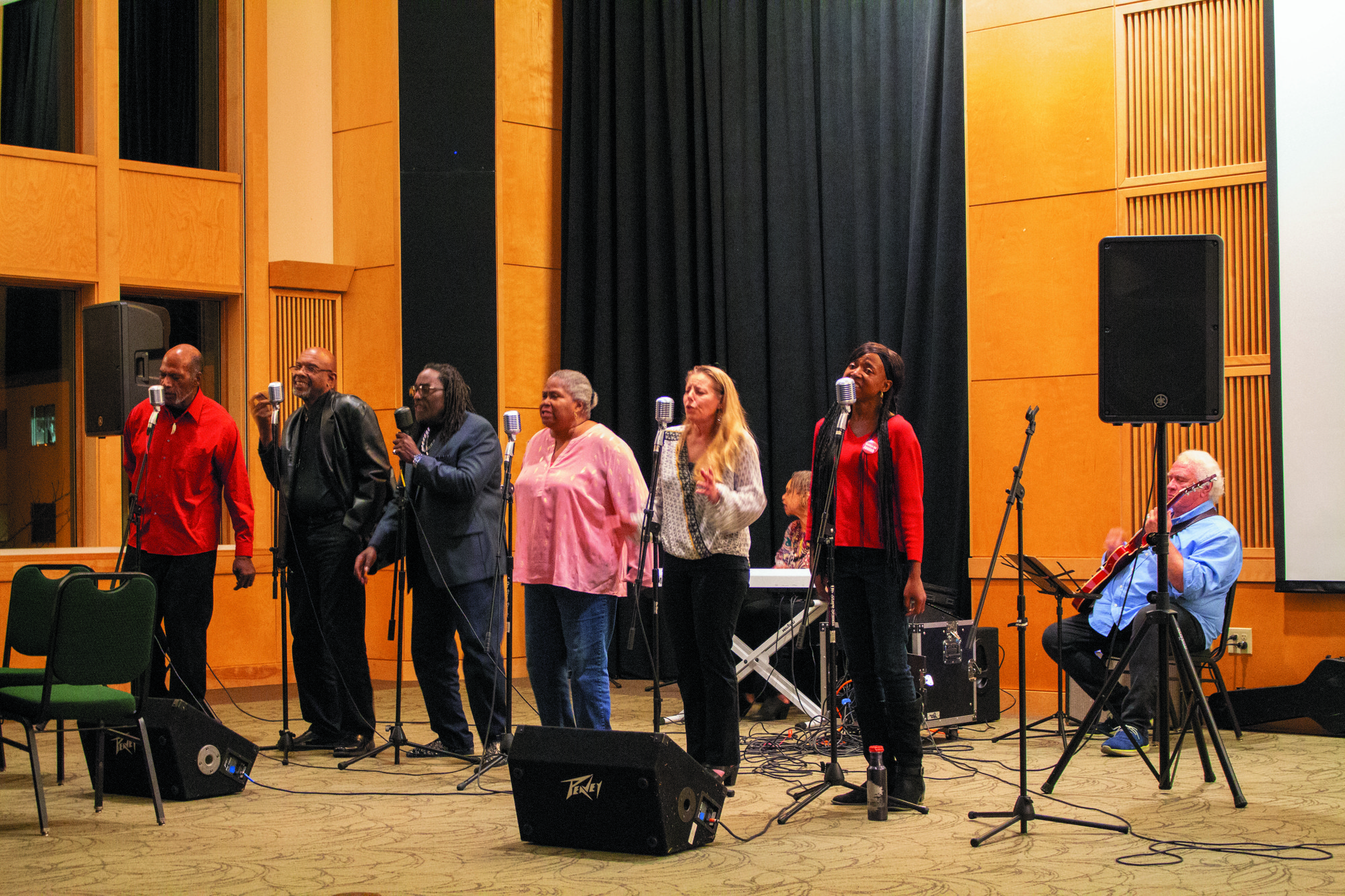
As the sun set and people shuffled into the KBR HSU club and sisterhood, The Legacy welcomed about 50 students and community members to their annual Brotha’s and Sista’s Appreciation Night.
This was a night filled with gospel music, good food and love spread all throughout the crowd. Every seat was filled and the room was bustling with noise as The Legacy ladies opened up the night with the Nu Heavenly Tone singers.
As the night went on a table filled with food was open and the members of The Legacy served everyone while enjoying a Black History Month playlist. As community members and students ate fried chicken, potato salad and bread rolls there were a few videos that started to play. One video in particular showcased The Legacy and why their members thought it was important to appreciate black students.

Taye Triggs, the director of student life, attended the event with her daughter who will be giving her own workshop Saturday afternoon on how it is to be a young black girl in Humboldt County. Triggs mentioned that this event was not closed off to those who are not black.
“It’s an opportunity for people to come together for all people of all races,” Triggs said. “To bring awareness to some very pertinent people for Black History Month.”
As people cleared off their plates The Legacy played videos of spoken word that pertained to Black History Month and the empowerment of men and women of color who might feel otherwise. A spoken word video in particular touched on the need for men to be open with their emotions and not be afraid to express how they truly feel.
Spanish major and first year Legacy member, Monze Garcia shared that this event has been in the works since the end of last semester. Having collaborated with the Social Justice Summit’s week-long event, they were able to settle on a date to bring this celebration to fruition. Being a part of a group of women that do volunteer work constantly and trying to bring together community members, this event was a success.
“We try to promote a good community for women of all ethnicities that need empowerment and encouragement and be there for each other,” Garcia said.
As the event came to an end The Legacy led with a saying that the audience was welcome to join in. The Legacy members would start by saying, “My love is…” and the audience would shout out words for how they would finish off the phrase. The night was one of self-love and appreciation of others and ourselves.
“To come together and know the community that’s around us,” Garcia said, “and support one another as minorities.”
For transparency Editor-in-Chief, Dajonea Robinson is a member of The Legacy.
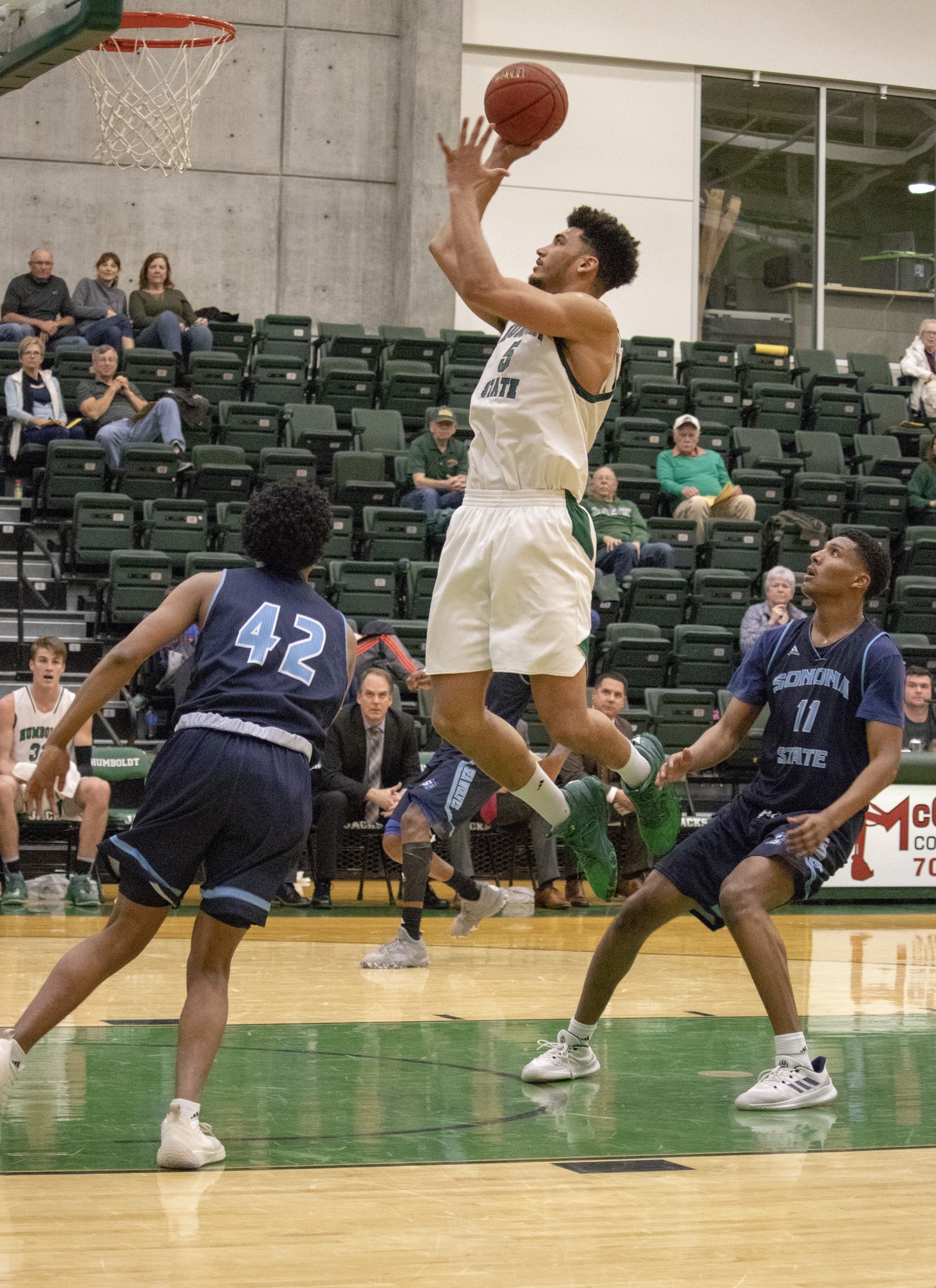
The Lumberjacks men’s basketball team clinched a spot in the California Collegiate Athletic Association tournament with a 12 point win over Sonoma State University. HSU improved to 11-10 in Conference play and 17-12 overall on the season.
Junior guard Jackson Strong shot 40 percent this year in both field goals and three-pointers. Also, Strong now has the second most three-pointers made in Humboldt State history for a single season.
“My three shot just felt really good in tonight’s game,” Strong said. “Jamarlin and I got up shots after shootaround today. Honestly, in warmups, I think I hit two three-pointers out of however many, and I wasn’t feeling it then. I don’t know what it was.”
Strong missed in warmups but made it count when it mattered most, helping the Jacks get a possible 7th seed in the CCAA tournament. Strong would lead all scorers with 23 points and six rebounds and shoot 7-10 from the three-point line.

Physicality started early between the Seawolves and the Jacks on Thursday night. In the first quarter, junior guard Jamarlin Jackson delivered a quick 18-foot jumper over the Seawolves guards to get the Jacks rolling. This was a competitive quarter with Sonoma fighting back hard each time HSU would go on a run.
Later in the first quarter, junior forward Justin Everett drove to the basket, and the Seawolves defenders watched alongside some 500 fans as Everett threw down a one-handed dunk with authority. This dunk from Everett brought the crowd to their feet and the cheers continued all night.
Junior forward Calvin Young II started the second quarter with an aggressive layup. Young was physical as well when grabbing boards as he compiled eight rebounds in the game.
Strong put the Jacks on a long run throughout the second which led to a timeout. Driving and using his body to fade away and drain jumpers was impressive, as was his ball-handling skills.

Strong hit a big three to start his night off, and would drain six more before the final buzzer. The defense was playing great in the second quarter and contained Sonoma throughout. The Jacks kept the Seawolves shooting under 33 percent, and headed into the second half with a 34-24 lead.
Head coach Steve Kinder said that the defensive effort was the key to the game.
“Being able to keep Sonoma to 40 percent from the floor as well as they transition,” Kinder said. “I thought we did a nice job surviving their runs and getting stops at crucial times and countering on the offensive end.”
Everett started a run to begin the second half with a couple of excellent jumpers and got HSU up 16, their largest lead of the night. HSU controlled the third quarter and entered the fourth with Strong hitting his hot streak. Strong continued to catch and shoot, only taking three’s in the game.
Despite Sonoma pulling to within seven in the fourth quarter, Strong continued to hit from behind the arc. He would pull up from behind a screen, receive the pass and shoot instantly. The quick release combined with well-timed screens shut down the Seawolves’ ability to pressure Strong.
The fourth quarter was competitive, and you could tell that there was tension on both sides with occasional chatter at one another during free throws and hard fouls on both teams. HSU just wanted to get into the tournament, no matter what seeding.

Jamarlin Jackson and Justin Everett both put in 16 points and make crucial shots for the Jacks. Kameron Curl also added eight points and five rebounds.
The Jacks take on San Francisco State on Saturday for their regular season finale at 7:30 p.m. in the Lumberjack Arena. It’s also Senior Night for the Jacks and a night to honor former HSU coach Frank Cheek. The Jacks will then play Tuesday in the CCAA Tournament (Schedule TBD).
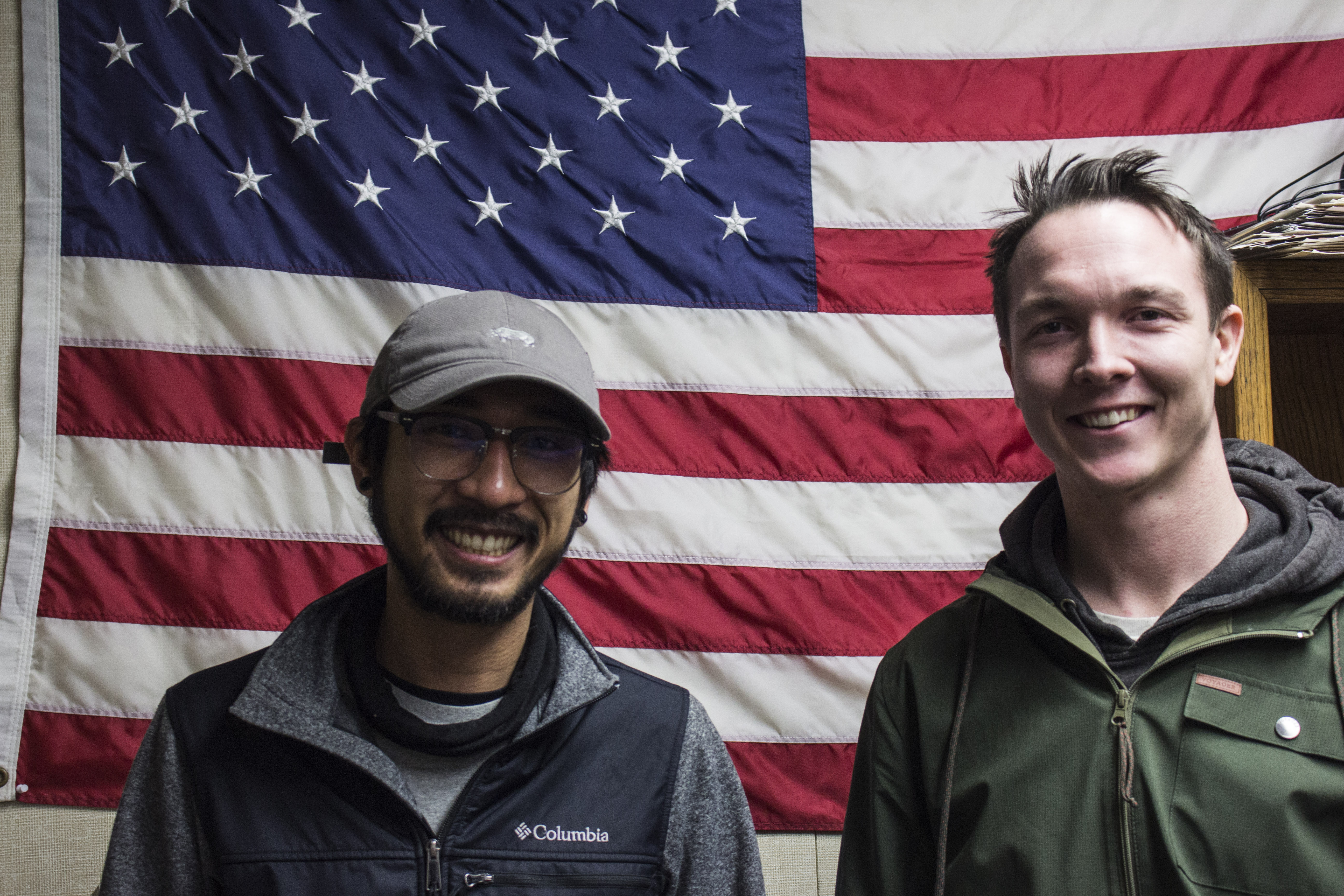
Driving back to Humboldt County after the Lightning in a Bottle music festival, Sean Dent found out his roommate kicked him out for no reason. Immediately after hearing the news he got into a car accident. Fresh out of the military and brand new to Humboldt State University, Dent felt lost in 2016. After weighing out his options he went straight to the VETS Office’s outdoor program and went on his first hiking trip with other veterans. The trip changed his life forever.
[perfectpullquote align=”right” bordertop=”false” cite=”Sean Dent” link=”” color=”” class=”” size=”18″]”I lived in my car a few months while looking for a place. It wasn’t until I found a community here that helped my mindset. That community was other vets.”[/perfectpullquote]
“It was my first trip and my favorite trip,” Dent said. “I was foreign to California and recently out of the Army. The hike was beautiful. A mentor brought me in and gave me strength. He physically reached out because it helped him in the past.”
Dent is an environmental science and management major with an emphasis in ecological restoration. Originally from Virginia, Dent enlisted in the Army “out of necessity” because that was his best option. While enlisted in the military from 2012-2015, Dent was stationed in Louisiana until he was deployed to Afghanistan.
“It was a hard transition into college,” Dent said. “I lived in my car a few months while looking for a place. It wasn’t until I found a community here that helped my mindset. That community was other vets.”
 The Veteran’s Office gives out free pint glasses for veterans. | Photo by T.William Wallin
Environmental resource engineer Paulo Martin had a similar experience when first enrolling at HSU. Martin was born in the Philippines and was stationed in South Korea from 2009-2013. He now handles the VETS Office’s social media and promotes the positive events they’e doing, such as the outdoor program. Martin said the VETS Office takes care of soldiers transitioning into students but would like to see more vets coming in.
“It’s weird coming from a soldier training for war or getting gassed everyday,” Martin said. “We are told what to think everyday and as a student it isn’t like that, we are told to think for ourselves. The outdoor program helps with that transition.”
Both Dent and Martin didn’t think they would like backpacking or hiking because of all the ruck marching they had to do in the military. But as civilians Martin said his favorite trip is the hiking trip. Through the outdoor program HSU veterans take multi day trips to places like the Trinity Alps or for the upcoming spring break, Mt. Bachelor, for snowboarding. After a three day hike they will end the trip with white water rafting.
“At first if you tell someone in the army you’re going hiking they roll their eyes,” Martin said. “But being able to hike without a weapon and a 50 lbs. bag has made me love hiking.”
Coming from a military background Martin is used to being with a squad and the outdoor program creates a similar community for him. Martin said vets have more pitfalls and rough personalities, having a platform to go out in nature that is different than the toxic state of the army is refreshing.
“I don’t like to talk to regular citizens about my military experience,” Martin said. “But with other vets we’re on the same plane and can relate with one another. Some people freak out about my stories.”
 Kim Hall founded the HSU’s veteran’s resource center over 30 years ago and started the outdoor program in 2009 as a therapeutic program for soldiers transitioning into students. | Photo by T.William Wallin
Veteran program administrator Kim Hall created the outdoor program in 2009 through Outward Bound. The program was created as a wilderness therapy to support veterans transitioning as HSU students. Hall also established the HSU VETS in 1990, the veterans resource center on campus. It was one of the first in the state as well as being one of the largest today, serving around 500 military affiliated students.
“At the time there was a lot of vets coming in trying to navigate the CSU system,” Hall said. “I was working in administration and saw the need for more. I liked working with them better than traditional students. What keeps me coming back to campus are the vet students.”
Dent said the outdoor program has brought a lot vets who are new to the area together and life long friendships have bonded. Dent said he has met his best friends in the outdoor program, like Paulo Martin.
“I can’t even explain what the outdoor program has done for me,” Dent said. “We’re always looking for a challenge. Going through a challenge together like hiking or snowboarding builds camaraderie deeper than normal friendships because we’re going through the same things. I now have life long friends.”
Next Veterans meeting is at E&O bowling in Blue Lake on March 8 at 7:30 p.m.
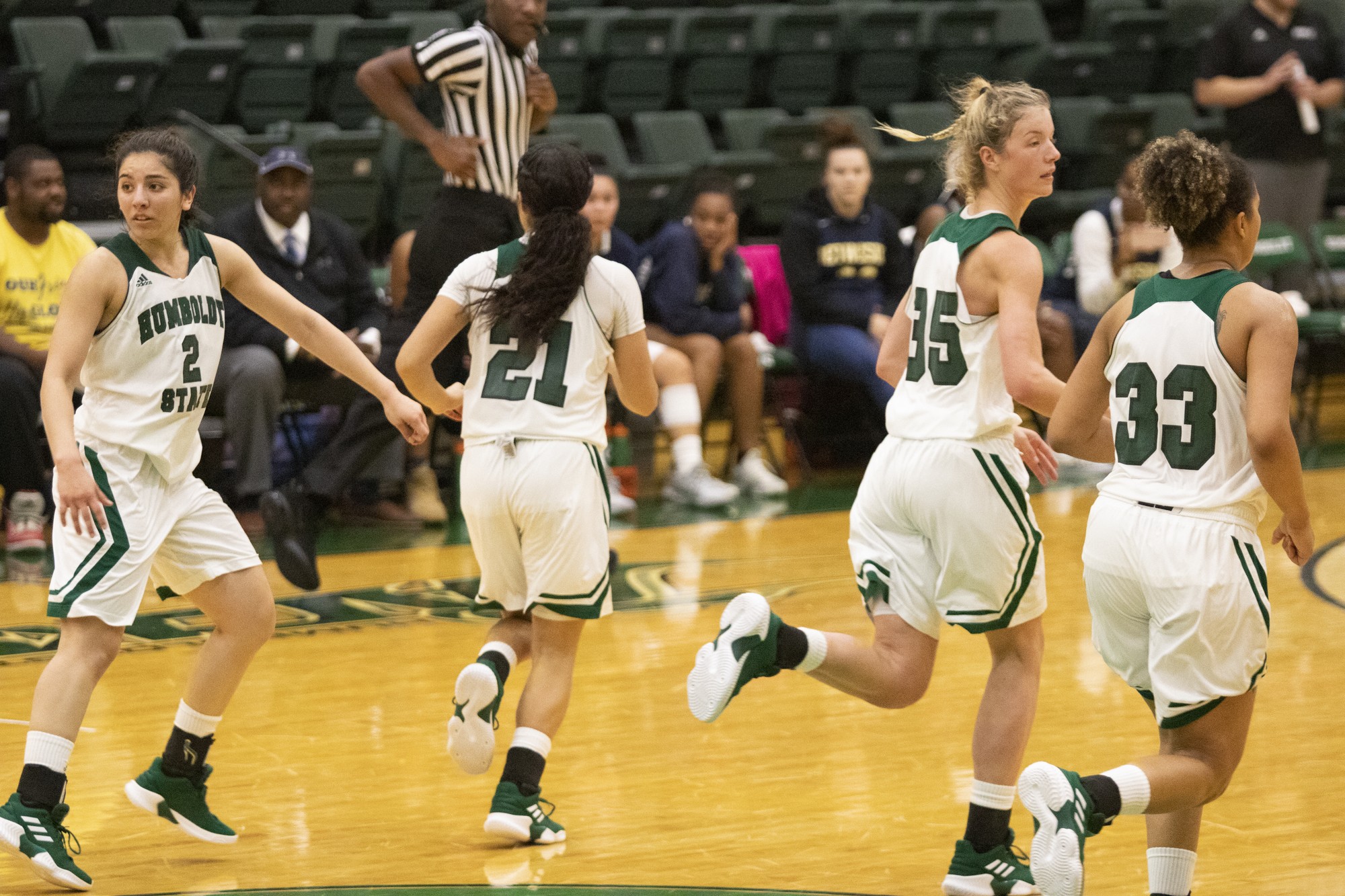
Isamar Conde led with 16 points and Humboldt State turned down Sonoma State after a 58-53 win, Thursday night in the Lumberjack Arena.
Humboldt State head coach Michelle Bento-Jackson said that the Ladyjacks were up and down during the game.
“We just have to stay focused and keep playing our game,” Bento-Jackson said.
The Lumberjacks showed off their home court advantage as they took a quick five-point lead over Sonoma State. Just two minutes in, Humboldt State led 10-5 after Madeline Hatch nailed a 3-pointer. The Lumberjacks held strong on offense with a first-quarter lead of 15-12.

Sonoma State ran into the second quarter with heavy defense but still scored fewer points than the Lumberjacks before the half. Gabrielle Carbajal contributed five points, three of which came from a jumping 3-pointer and Alexia Thrower walked into the locker room at halftime with 10 rebounds. Despite their aggressive defense, the Seawolves struggled on offense ending the quarter with only six more points under their belt. The Lumberjacks led 27-18 at halftime.
Sonoma State kept it close after opening the third quarter with a 12-4 run. Humboldt State missed more shots than they needed to and the Seawolves quickly caught up with only a three-point trail and two minutes left to play in the quarter. After Thrower added two points to the Lumberjacks’ score, Conde hit a 3-pointer at the buzzer which put Humboldt State back on top with a 44-35 lead.

“Isamar and Tyra both received some fouls early on tonight,” Bento-Jackson said. “It’s tough to be able to still stay aggressive in those moments but as Isamar has done many of times, she came out and hit some big 3-pointers for us tonight. She gave us that momentum to finish off the game.”
The Seawolves found their first lead of the game after hitting a 13-0 run at the start of the fourth quarter, and Humboldt State trailed 44-48. With three minutes to play, Conde and Jovanah Arrington hit back to back 3-pointers as the Lumberjacks returned to a leading score of 52-50. After the Seawolves failed attempt at a last minute trick play, Conde was fouled with three seconds on the clock and with one more point added to their score, the Lumberjacks defeated the Seawolves 58-53.
Another win for Humboldt State gives them at a 16-5 conference record, and 18-6 overall. The Lumberjacks will host new competitor this year, San Francisco State in the last home game of the regular season.
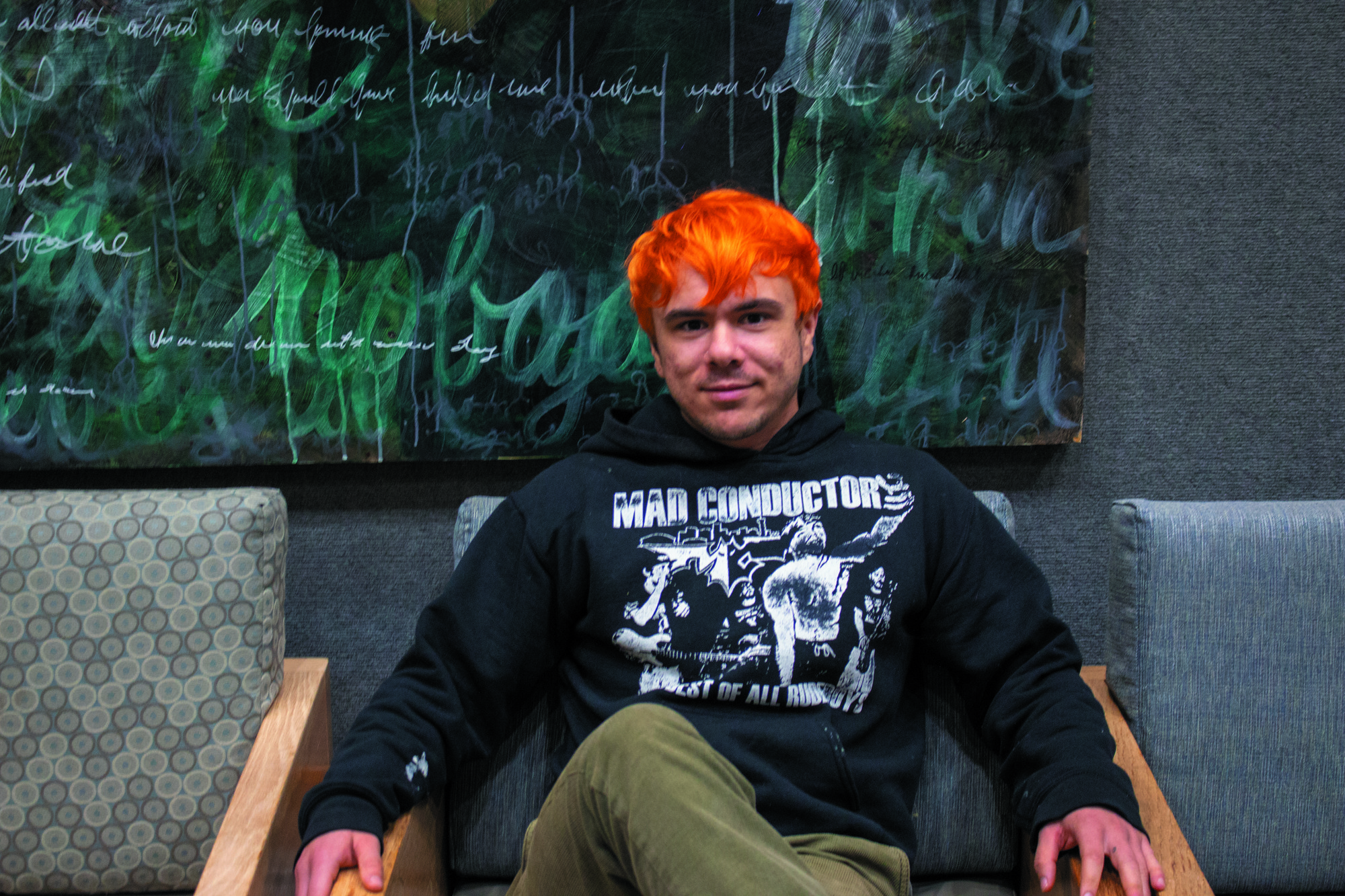
Deema Hindawi and Oliver Winfield-Perez are critical race, gender and sexuality students who advocate for student safety and equality. They’re both from the Bay Area and are community organizers and volunteers. They look at local and campus issues and work together to resolve problems that affect students. You can usually see them at community meetings or social justice events.

What are you studying at HSU?
Hindawi: I am double majoring in criminology and justice studies, CRGS (ethnic studies) and minoring in communications student advocacy.
Winfield-Perez: Critical race gender and sexuality studies.
Why did you pick these areas of study?
Hindawi: I picked these majors because I have always been fascinated with law and ethnic studies has always tugged on me and I want to learn more.
Winfield-Perez: I was originally was a child development major when I came to HSU, but I came to CRGS after taking a community organizing class with Dr. Marisol Ruiz Gonzalez in the education department. I came to CRGS from my own experience as a trans queer person of color in the world. My experiences with homophobia and transphobia, being othered and disrespected have lead me to know that something isn’t right, that we deserve a better world, that a better world is possible. CRGS has given me that, has given me a space to analyze, critique, dismantle and create alternatives.
Where are you originally from?
Hindawi: San Francisco.
Winfield-Perez: I was born in Hayward, Calif. in the East Bay, but my family moved around a lot for work. I spent most of my childhood in Riverside, the Central Valley and Santa Barbara county, then I moved back to the East Bay for high school.
What is your role in Associated Students and why did you want to join?
Winfield-Perez: I’m the external affairs representative. I act as a link of communication with other CSUs, state and federal policy/legislation and Humboldt State. I serve as Humboldt’s representative for the California State Student Association, (Student Government for all the CSUs, with 23 representatives) and attend monthly plenary meetings where we discuss legislation, policy and advocacy for students in higher education. I currently have a resolution on the floor at CSSA for Justice for Josiah/Students of Color Safety, hopefully it’ll pass in March. I also chair, the Lobby Corps committee, which as it sounds, is a lobbying committee.
I originally joined because I see student government as an institution which holds many contradictions and faults, but holds space for potential support for meeting the immediate needs and supporting the wellbeing of students across campus.
What clubs are you involved with on campus and what do you with them?
Hindawi: WRC (Women’s Resource Center) anti-racism coordinator, MCC (MultiCultural Center), SQE (Students for Quality Education), and MEChA (Movimiento Estudiantil Chicano de Aztlán).
How do you juggle your workload?
Winfield-Perez: Honestly I am very controlling and particular about my schedule. I work best early in the morning, so often I’ll wake up around 5 or 6 a.m. to get readings done for classes. I have a detailed planner for the semester where I schedule out what I’m going to do every waking hour. It’s quite exhausting and stifling, but it has helped me stay accountable for my commitments and keep up with classwork.
Being an outspoken and involved student, what would you like to see at HSU change that would benefit students?
Hindawi: Tuition, racism, ignorance against race, removing the mascot, stop recruiting students of color without informing them about the racism, J4J.
What’s the plan after graduating?
Hindawi: Grad School.
Winfield-Perez: I’m looking to intern at an organization in the bay which organizes around prison abolition, prisoner support, anti-policing work, such as Critical Resistance, Legal Services for Prisoners with Children, or one of the many others, so hopefully that works out. Other than that, I plan to take a year or two off before applying to some California Ph.D programs in Women and Gender studies, American Studies or Ethnic Studies. I really just want to give myself space to grow and learn, and not rush into grad school or force myself to go. I want it to be a semi-enjoyable experience if possible.
What has been your favorite experience in Humboldt?
Hindawi: Going outdoors.
Winfield-Perez: Community. I’ve met so many amazing, dedicated students, faculty, staff and community members who are so passionate about creating safe, accountable and loving communities. I see people busting their asses on the daily building campaigns for justice, holding elected officials accountable, creating networks of community solidarity and support, working to end racism, sexism, colonialism and oppression in our areas. To be a part of that has been so rewarding and I will always cherish my time here.
What are you most passionate about?
Hindawi: Justice.
Winfield-Perez: I’m extremely drawn towards critical prison studies, abolitionist work and anti-policing work. I see this effort as central in the emancipation of queer and trans people across the globe, who are specifically targeted, attacked, exploited and othered by carceral violence. As a queer and trans person of color, ending the prison industrial complex means not only can my communities be free, but I will be free as well, even as a person outside the material confines of prison walls.
I haven’t had much experience organizing around abolition, but am definitely moving towards it, and feel it is necessary for me to do.
I’m also honestly very passionate about writing. I love the feeling of starting with one subject with a piece of pen and paper, letting go and ending up in a space you didn’t even know was inside you. I’ve made amazing self-discovery through writing, processed grief, internalized racism and sexism, my own self doubt and confusion.
Who is an inspiration for you and why?
Hindawi: Marisol Ruiz because she always pushes students to be more than we have ever thought.
Winfield-Perez: All the people out there fighting for an end to white supremacy, settler colonialism, heterosexism and capitalism in their communities on a daily basis. All the people out there committing their lives to making a better world for the next generation. This is inspiring to me because I know first-hand that organizing is difficult, it is draining and you’re always coming up against people who don’t see you, who want to dehumanize you, silence you. And some of the people doing the hardest work are trans and queer women of color, who face some of the most gross and dehumanizing treatment. I have so much respect for organizers.
Who has been your favorite professor at HSU?
Hindawi: Marisol Ruiz
Winfield-Perez: The CRGS department is full of amazing, caring and intellectual professors, who will break down dense theory like Foucault to you, and who really see you, and listen to you when you share your struggles as a student, and show it in their actions. If I have to pick one though, I have to say Dr. Kim Berry. She teaches courses like Theory and Methods, Sex, Gender and Globalization and “Queer” Across Cultures. The most impactful knowledge I’ve gained from Kim is a strong critique and understanding of global capitalism, its intricacies, the big institutions which extract wealth and dehumanize people. She’s really able to take huge complex ideas and communicate them in a digestible, entertaining fashion. In her classes I can’t help but be 100 percent focused.
What volunteer work or outside organizations have you been apart of? How has it changed you?
Hindawi: Everything I mentioned earlier has changed how I view organizing and justice.
Winfield-Perez: I’ve been a part of Youth Educational Services since my freshman year. I directed and volunteered for the Queer Mentoring and Advocacy Program, which works with queer youth in the community to organize around their needs, provide support, and train educators on how they can better support queer youth in classrooms. I’ve also been a member of MEChA since my sophomore year, and recently joined Students for Quality Education in the fall of 2018.
I’ve also worked with organizing groups off campus intermittently, such as with Justice for Josiah and the campaign to remove the statue of William McKinley.
What advice do you have for incoming students?
Hindawi: Keep your eyes open and if you are a person of color please keep your eyes open a bit wider because Humboldt is not as safe as we are made to believe.
Winfield-Perez: I really hope incoming students are able to just give themself space to be and take care of their own needs. If you’re struggling with motivation and mental health, don’t be afraid to take some time off, don’t be afraid to listen to what you need and act on it. The university is always talking about four year graduation rates, which I do think can be important financially. But the reality is that college is difficult as hell and sometimes you just can’t keep pushing, you can’t suck it up and keep going, and that’s okay. I wish I would have given myself that space in times when I was really struggling. I feel like I would have had time to heal, grow and accept myself.

The latest documentary to depict Humboldt County investigates a murder within the cannabis culture atop the infamous Murder Mountain. But Murder Mountain, named after the actions of the Carson serial killers in the Rancho Sequoia area of Alderpoint, is only a small piece in Humboldt County’s cannabis culture. On Wednesday evening in the Kate Buchanan Room a group panelist of media practitioners and active members in the cannabis community discussed the other side of that mountain.
[perfectpullquote align=”right” bordertop=”false” cite=”Chrystal Ortiz” link=”” color=”” class=”” size=”17″]”Instead of finding a way to bridge our likeness, it has built on the fact that we are different… Local press should recognize they do shape culture.”[/perfectpullquote]
The event, The Other Side of Murder Mountain, was part of HSU’s 25th annual week long Social Justice Summit. Panelist Chrystal Ortiz, a board member of the International Cannabis Farmers Association, said as a resident of Humboldt County she is impacted by the local press on cannabis.
“Local opinions and local press has shaped the world view of the people who live here in the ability to continue to create discord,” Ortiz said. “A cannabis leaf on the cover sold newspapers. The representation in the press was negative because cannabis was in the crime section. If we went back 20 years we would be hard press to find any positive press of cannabis.”
Ortiz believes local press has a responsibility and perspective with covering cannabis and has an effect on how we relate with one side or the other. She said local press has had an impact on how our community relates with the cannabis culture within Humboldt County and plays a part in shaping it.
“Instead of finding a way to bridge our likeness it has built on the fact that we are different,” Ortiz said. “Such as what we do for our kids is different than what they do for their kids or what our jobs are like with what their jobs are like. But I am glad to see that changing and it has been changing. Local press should recognize they do shape culture.”

Panelist Rio Anders, Co-founder of SoHum Guild, agreed with Ortiz and said it’s hard to live in a bubble in Southern Humboldt and hear a story like Murder Mountain because it has no real reality based on his life. Anders said recently there’s been a constant feedback of negativity but recognizes that crimes like that in Murder Mountain are real.
“It’s real and I’m not saying it isn’t but it didn’t bring people into conversation,” Anders said. “It only allowed people to cast judgment on each other. This shapes the discourse between the cannabis community which is a part of this community.”
[perfectpullquote align=”left” bordertop=”false” cite=”” link=”” color=”” class=”” size=”15″]Not all stories of Humboldt County are that of vigilantes and missing persons that happen in places like Murder Mountain.[/perfectpullquote]
Moderator Dominic Corva of the Center for the Study of Cannabis Policy, asked the panelists what does it even matter what people outside of Humboldt County think of people in Humboldt County in media representations. Editor for the Lost Coast Outpost Hank Sims said stories like that of Murder Mountain are the stories people hear outside of Humboldt County and have ramifications.
“People in the Marijuana industry in particular are sometimes facing backlash and competition in the industry who say growing in Humboldt County is unsafe,” Sims said. “Murder Mountain and stories like it has shaped perception of Humboldt County from those outside of Humboldt County.”

Not all stories of Humboldt County are that of vigilantes and missing persons that happen in places like Murder Mountain. Chrystal Ortiz was quick to respond with positive representations she’s experienced when in 2016 a journalist for NPR camped on her property in the Avenue of the Giants because he couldn’t find open camping.
“When he [NPR reporter] came through he camped on my farm and the California Report then became his experience on my farm and how different it was than he expected,” Ortiz said. “When that aired I got call after call after call…about how my friends wanted to come visit and how proud they were.”
Panelist Deidre Pike, department chair of the HSU Department of journalism and mass communication, said the NPR California Report on Ortiz’s farm was a great example of how culture is shaping our story telling and there’s a feedback loop of shaping going on. Pike suggested a positive spin on Murder Mountain in which a theme park is built with a memorial for Garret Rodriguez.
“Maybe you can make Murder Mountain a tourist attraction,” Pike said. “You already have in place farms with farm tours. You can do an educational tour with permaculture and train folks to do permaculture and then they show others. It’s an idea that may demystify that culture of the scary outlaw culture and maybe honor the good outlaw culture.”
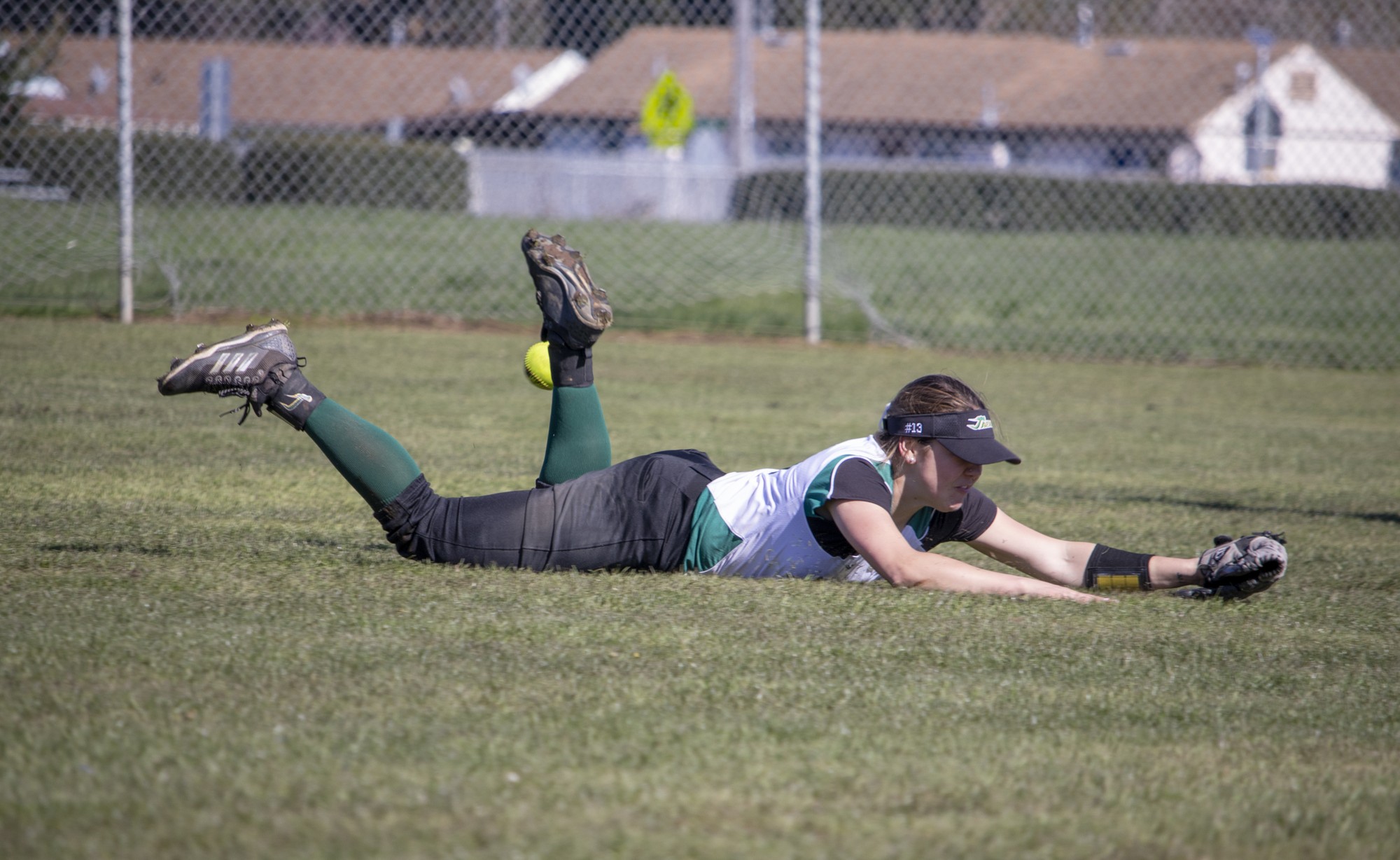
The Humboldt State softball team struggled to score runs and couldn’t keep the bats of the San Francisco State Gators quiet as the Jacks were swept Friday at McKinleyville High School. The threat of impending rain on Saturday forced the Jacks to play three straight games on Friday, totaling 21 innings of softball and stretching from nine in the morning until five in the evening.

Playing three straight games in one day might seem like a daunting task, but it didn’t change how the Jacks approached the three games. “It doesn’t change how we play the game,” Outfielder Illa Haley said. “We have to be strong and be tough.”
Game one was a pitcher’s duel as the Jacks fell to the Gators 2-1. HSU pitcher Lexee Sheiring put up a shutout on the board until the top of the 6th inning, when the Gators were able to deposit two solo home runs over the fence. Sheiring was able to put up good numbers despite having the loss on her record, allowing only two runs on seven hits and only one walk.

Sheiring’s effort in the pitcher’s circle was unfortunately bested by SF State pitcher Emily Mitchell, who pitched a complete game and allowed one run on eight hits and struck out five while letting four runners get a free base via the walk. The only offense came from HSU’s power source and designated hitter Rylie Carlier, who crushed a solo home run in her first at-bat of the day.
Unfortunately for the Jacks, the sleeping beast awoke for the Gators as they beat the Jacks in game two by a score of 13-2. Jacks pitcher Megan Holt struggled in the first inning, only getting one out and allowing seven runs to score on five hits before she was taken out of the game. However, there was a defensive highlight by HSU Right Fielder Lauren Lipe as she snagged a line drive just before it hit the ground and fired the ball to First Baseman Mariah Tovar to double up the baserunner at first.

Game three got off to a promising start for the Jacks. Megan Holt started in the circle again and faired much better than her earlier outing, going three innings and allowing one run on two hits. The Jacks would jump out to a 3-1 lead in the third inning as Illa Haley hit a hard line drive triple that would net her two RBI’s. However, Lumberjack pitching would not hold the Gators for long as they scored five runs in the last two innings to win the game 6-3 and complete the sweep.
Carlier said that since the batters saw the pitchers three times in a row should’ve helped the batter out.
“But we struggled today,” Earlier said.

The struggle to score runs also put a damper on the team’s mood at the end of the day.
Head coach Shelli Sarchett said having only five runs in three days is unacceptable. “We’re a better hitting team than that, but it’s early and I hope this lights a fire under everyone’s behinds,” Sarchett said.
The Jacks will make the long trek down to La Jolla, Calif. to play the 17th ranked UC San Diego Tritons on Friday and Saturday. The next home series is March 8 and 9 against Cal State Dominguez Hills.
Ben Bouchard’s love of badminton drove him to start the badminton club last semester. This past Sunday nearly 20 members of his club showed up to smack birdies from one side of the net to the other.
Bouchard said he hopes to compete with other schools one day, but acknowledged HSU’s rural location. He mentioned reaching out to other schools, but for now wants to focus on the fundamentals.
[perfectpullquote align=”right” bordertop=”false” cite=”Olivia Chang” link=”” color=”” class=”” size=”16″]“I like how casual it is and relaxed, it is not super competitive… Everyone, no matter their skill level, can drop in and play.”[/perfectpullquote]
“I just want to hone our skills and get better,” Bouchard said. “I know the Bay Area has a lot of tournaments so we’ll see.”
Bouchard said he originally started the club to meet other players and to allow people to better their skills. He said that what draws him to badminton are the strategic and mental aspects of the game. It is something that he found more passion in than other traditional sports.
“I was training to be on the track team, but I always ended up coming back to badminton,” Bouchard said. “It is more fun and it’s a nice break from school.”
Zoology senior Olivia Chang went to the gym to get a break from her studies and to play a few games with friends.
“I really need the exercise,” Chang said. “I usually sit around and study, so it is great to get a good workout.”

Chang is a member of the club and has been going to the meetups every Sunday since October. Chang also takes dance lessons at Redwood Raks in Arcata, but particularly looks forward to badminton every week.
“I like how casual it is and relaxed, it is not super competitive,” Chang said. “Everyone, no matter their skill level, can drop in and play.”
Psychology senior Giselle Velasquez also played this past Sunday. Velasquez said she likes to compete and enjoys playing people who are better than her.
“There are so many people that are good and they teach you all sorts of skills,” Velasquez said.
[perfectpullquote align=”left” bordertop=”false” cite=”Ben Bouchard” link=”” color=”” class=”” size=”18″]“It allows me to disengage… When I’m playing badminton, that’s all I’m doing.”[/perfectpullquote]
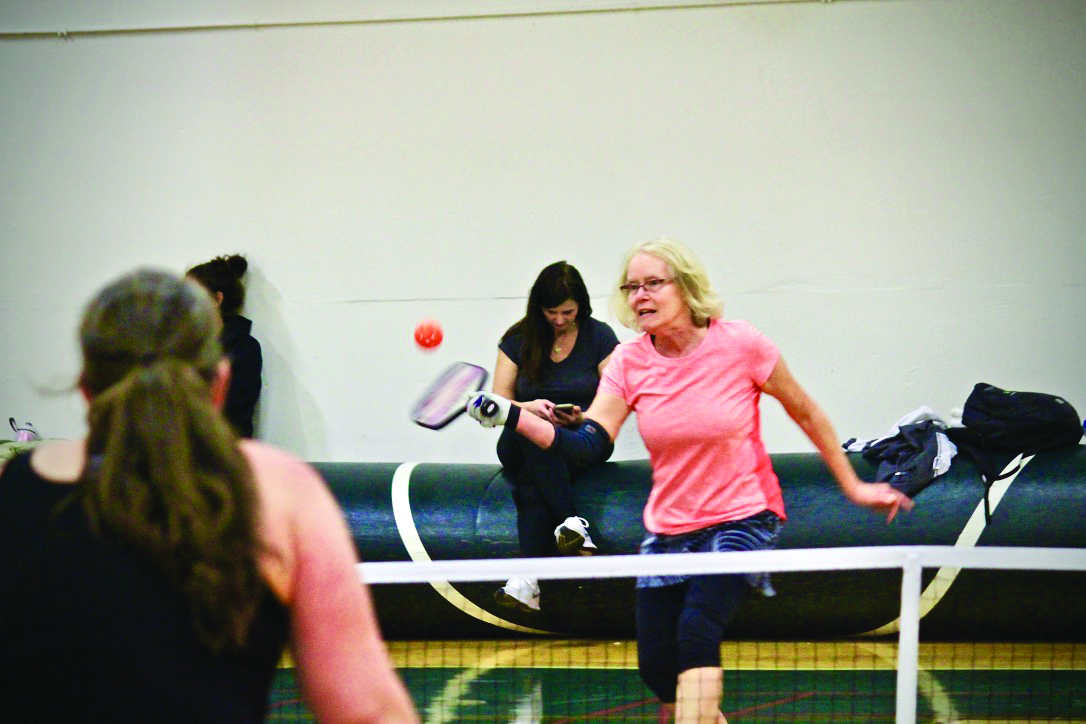
The pickleball club was also at the gym. Karen Soiker is an avid pickleball player, as well as an HSU alumnus who grew up in Sunny Brae. Soiker is retired and in her free time travels the world with her paddle, always ready for a game. Next month she is headed to Amsterdam with six local pickleballers for a clinic hosted by a professional.
“It keeps me active,” Soiker said. “I like to compete, but for some folks who don’t it is a very social sport. You meet, you play, you go out to lunch. It is pretty fun.”
Soiker said that the pickleball meetups have been happening for about six years at HSU. Soiker also said the sport is growing.
“There is also a meet-up at the Adorni Center in Eureka,” Soiker said “We are bursting at the seams.”
Soiker and Bouchard’s passion for their pastimes show. For Bouchard, his love of the sport stems from summer times with his family and the state of mind he enters when playing.
“It allows me to disengage, when I play it just fully takes over,” Bouchard said. “When I’m playing badminton, that’s all I’m doing.”