The Lumberjack


Students Serving The Cal Poly Humboldt Campus and Community Since 1929

Tag: HSU

  • Yellow vests in the quad

    Yellow vests in the quad

    Clubs and activities fair disrupted by Party for Socialism and Liberation

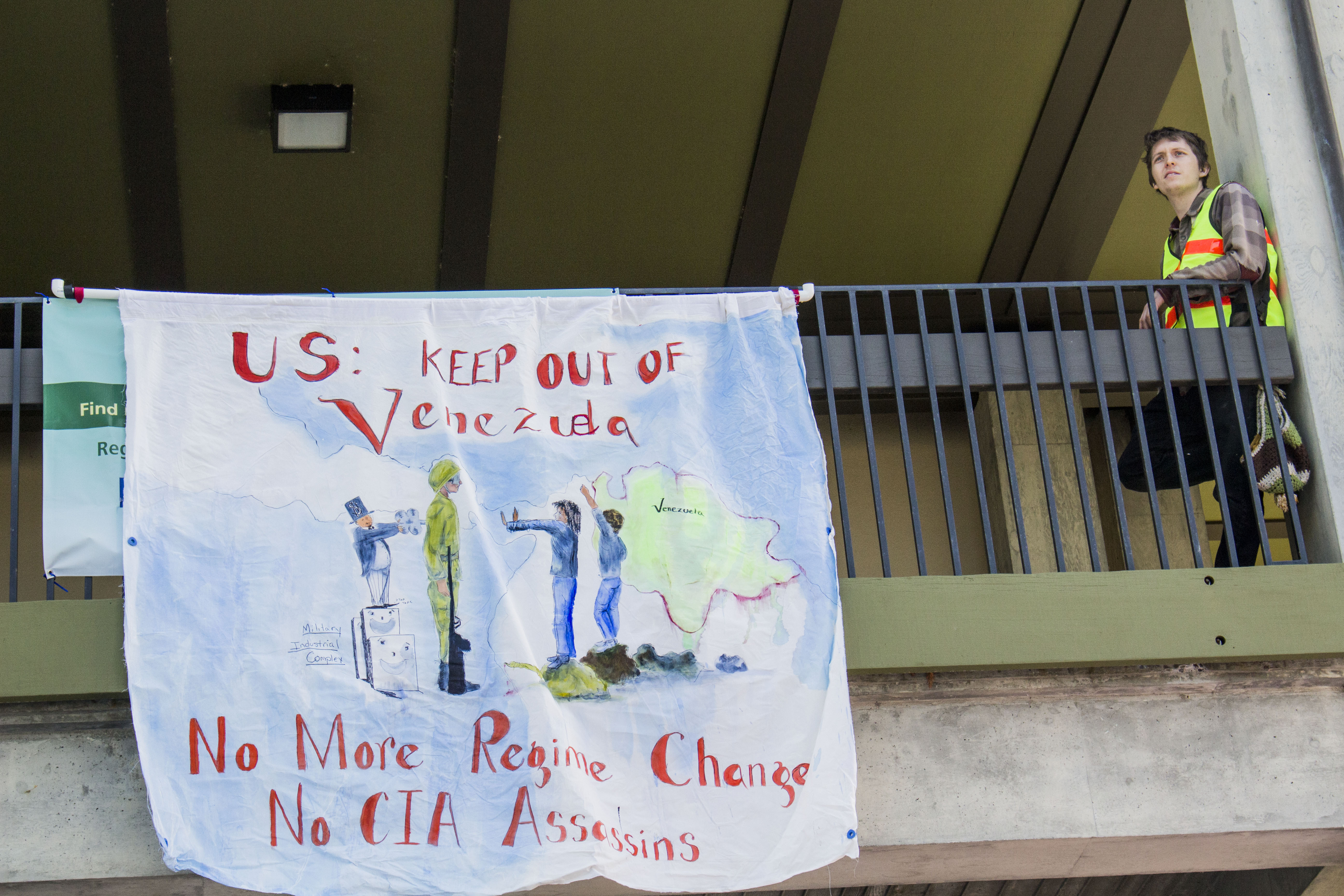
    Beneath scattered clouds and a radiant blue sky, HSU’s clubs and activities fair kicked off with students posing in yoga postures, walking along slacklines, juggling pins…and dropping an eight foot handmade banner protesting US involvement in Venezuela. The sun glared off yellow vested activists as they went around passing out fliers titled “Oppose the US-backed coup in Venezuela.”

    IMG_9900.jpg Nathaniel McGuigan, member of the Party For Socialism and Liberation, handed out fliers calling for oppostion of American involvement in Venezuela during clubs and activtites fair at HSU on February 6th 2019. By T.William Wallin

    “We’re here to disrupt this event and pass out information,” Nathaniel McGuigan, member of the party for socialism and liberation, said. “This is basically to tell people why to back Venezuela, to defend the Bolivarian revolution, the Venezuelan people, and president Maduro.”

    It’s of no surprise that the American government has had its hands in Latin America for decades, trying to influence its agenda by any means. They did it before with Guatemalan president, Jacobo Arbenz, in 1954, as well as Chilean president, Salvador Allende, in 1973, not to mention Ronald Reagan and the Contras in Nicaragua.

    Recently the democratically-elected government of Nicolas Maduro broke relations with the US government and ordered the removal of their embassy. The Trump administration is backing a member of the Popular Will party who gained no votes, Juan Guaido, and declaring him president even though Maduro was re-elected last year with 67 percent of the vote.

    “Students should support the revolution and as working class people it’s our duty to stand up to other countries sovereignty,” McGuigan said. “We oppose countries in power that overthrow regimes that benefit their people.”

    IMG_9907.jpg Simone Rani McGowan, member of Earth Guardians, and Nathaniel McGuigan, member of the Party For Socialism and Liberation, handed out fliers calling for oppostion of American involvement in Venezuela during clubs and activtites fair at HSU on Feb. 6. Photo by T.William Wallin

    Standing next to McGuigan, yellow vest included, was Simone Rani McGowan, an environmental studies major and member of the Earth Guardians. McGowan said her club and the PSL team up quite often, usually raising awareness on tuition struggles and campus climate, but with heavier topics as well such as marching in solidarity with the Honduran caravan.

    “This whole idea is to support community and to remind people of the compassion needed in these issues,” McGowan said. “Every day we have to reconnect with our humanity. It’s important to educate our youth in resistance.”

    Chad Friefeld, member of Climate Change Club, agrees with McGowan and said that one of the main things for students to know is American history is full of examples of US corrupted involvement in latin america.

    “We are trying to break through the western capital media which is not portraying the truth in Venezuela,” Friefeld said. “We want to talk to people about this coup and that the Trump administration and Venezuelan opposition is not democratic. We are standing in solidarity to help spread the word.”

    IMG_9895.jpg A handmade sign opposing American invovlement in Venezuela was hung above the clubs and activities fair at HSU on February 6th 2019. By T.William Wallin

    Among the handful of yellow vests and crowd of students tabling was UPD officer Chance Carpenter. Carpenter was at the event talking with all the clubs and opening up for any questions or comments to be addressed. Because it was Wednesday, it was Carpenter’s shift but he said he was the face of UPD for the day and acting as the safety advocate. When asked about the PSL banner, Carpenter said it was above his pay raise for a comment but he does like free speech.

    “I certainly do like people exercising their free speech,” Carpenter said. “I’ve had to actually protect people in the past on campus who had conflicting difference with other groups.”

  • OPINION: Fake service dogs a real problem

    OPINION: Fake service dogs a real problem

    Disguising your pet as a service dog is not only illegal, but a danger to those who actually need them

    Service dogs, defined by the Americans with Disabilities Act, is a “dog that has been individually trained to do work or perform tasks for an individual with a disability. The task(s) performed by the dog must be directly related to the person’s disability.”

    While you may miss your pup during school, bringing an untrained service dog on campus is dangerous to a trained service dog and their handler, sometimes referred to as a team. Not only are service dogs trained to alert and task to certain triggers, when untrained dogs are in the area acting up, it can distract a service dog from alerting their handler and can potentially be life threatening.

    Not all disabilities are visible, so you should not automatically assume that because you can’t see something “wrong” with a person, the service dog is fake.

    If you are unsure if the dog is a service dog, you can ask them two questions defined by the ADA, “ (1) is the dog a service animal required because of a disability? and (2) what work or task has the dog been trained to perform? Staff are not allowed to request any documentation for the dog, require that the dog demonstrate its task, or inquire about the nature of the person’s disability.”

    IMG_0030.JPG
    Christina Samoy waits for Kai, the service dog in training, to touch her hand with her nose on Sunday, February 3. | Photo by Bowie Cargile

    For those who are in need of a service dog, paying an organization to fully train a dog can be thousands of dollars. “Organization-trained service dogs can cost up to $25,000,” according to the American Kennel Club.

    Self training is an option. The only risk with self training is that not all dogs are suitable for working and it may take years for a dog to be fully trained. The AKC estimates “the dropout rate for organization-trained service dogs can be as high as 50 to 70 percent.”

    If you see someone training their dog in public or working with their service dog, ask to pet their dog before assuming you can. Although the team is in public, it does not mean you have the right to pet their working dog.

    Petting a dog when uninvited can be triggering for some when strangers get too close. It is extremely distracting to a team that is training in public when every few minutes someone asks to pet the dog or makes sounds to get the dog’s attention, so be mindful and wait until given permission.

    IMG_0023.JPG
    Kai looks back while practicing her wait command during training on Sunday, Feb. 3. | Photo by Bowie Cargile

    While Humboldt State University’s policy “strongly encourage[s] handlers to use an identifying vest, tag, leash, or other visible method to indicate to the general public that the animal is a service dog,” they are not required by the ADA.

    At the end of the day, a service dog and their handler is a team that would like the same respect as everyone else. If you get to know the dog’s name, make an effort to know their handler’s name.

    There’s no need to feel like you can’t make eye contact with the team, but just remember that when the team is working, it’s best not to distract them.

    If you’ve been given the option to have an emotional support animal, know the ADA does not give your animal the same access that service animals have.

    Many landlords have had potential renters lie about their animal being a service animal, so when people with actual service dogs apply for the space, they are sometimes rejected or are expected to pay additional rent for their animal, which is illegal under the Fair Housing Act. However, landlords can ask for a pet deposit to cover any damages that may be done by the service animal.

    The next time you think about bringing your pet to class or other areas where pets aren’t allowed, consider leaving your pet at home for the safety of others. If you aren’t in need a service animal, don’t buy a vest and put it on your pet so you can take them into public spaces.

    IMG_6439.JPG
    Christina Samoy and Kai, a service dog in training, take a break from their training session on Sunday, Feb. 3. | Photo by Bowie Cargile
  • Tigers zero, Jacks rugby heroes

    Tigers zero, Jacks rugby heroes

    Jacks triumph in the Redwood Bowl

    The Jacks dominated scrum set pieces winning all seven keeping the ball in possession for its high-powered offense. Restarting play using the scrum, the forwards packed closely, head down, and engaged the other team, gaining the ability to swing the ball out to a potential line breaker. A series of excellent passes and jukes found HSU with a 2-on-1 advantage looking to score.

    2.jpg
    Adonis Johnson picks up a loose ball resulting in a turnover for the Tigers. | Photo by Matt Shiffler

    Senior number 14 Adonis Johnson caught the high pass and secured the ball. Johnson didn’t pass and instead just kept running full speed ahead, straight for the UOP player and try line.

    ”I saw him and I was thinking, I’m going to run him over,” Johnson said. ”And I did but somehow he kicked the ball out of my hand as he fell backward.”

    The offense was led by Johnson, who would score 12 total points in the 38-0 shutout against the University of the Pacific Tigers in the Redwood Bowl on Feb. 2.

    The Jacks played an effective first half, putting 19 points on the scoreboard. These points came from field awareness and handling the ball quickly off of passes. This edge helped momentum and was able to showcase the speed of center all-league selection number 15 Dalvin Jamal-Milton. Jamal-Milton was on full display as he caught a pass, made one Tiger miss breaking their line, and rocketed down the near sideline. With two Tigers to beat, Jamal-Milton threw a forearm that stopped the incoming tackler in his tracks. The second Tiger was too late or didn’t want to get the same outcome and Jamal-Milton tiptoed past the line for his first try of the game.

    “Our team is aggressive this year,” coach Greg Pargee said. “We play as a team and we are looking 100% better than we were this time last year.”

    The UOP squad had size but couldn’t keep pace with the Jacks in the second half. During loose play, HSU was able to steal nine of the Tigers possessions. Many of these came deep down the pitch, forcing the Tigers to lose clock and energy with zero points in return. When the Tigers finally broke out with big runs past the Jack’s line Jamal-Milton was there cleaning up in the open field, with chase-down tackles and monster hits. Number 12 of the visiting Tigers found space to run outside multiple times and you could see him scanning, trying to find where Jamal-Milton was flying in from.

    The Jacks offense closed out the game with another 19 points. Try scorers for the Jacks were Adonis Johnson (2), Cameron Arnold (2), Dalvin Jamal-Milton (1), and Cameron Whitney (1).

    “We were able to see mistakes early and coaching was great,” senior center and rugby club vice president Andre Hascall said. “Big positive is that 38-0, got to love that.”

    3.jpg
    The referee calls out instructions during a scrum between HSU and UOP. | Photo by Matt Shiffler

    It’s early in the season but the Jacks can’t help but be excited with returning players like Dalvin, Adonis, flanker Thomas Bradley, Cameron Whitney, and two props Colin Coletto and Joseph Johnson. To add more depth to the already impressive roster three former HSU football players, Tumanako Te’i, Jason Uipi, and Latufeao Kolopeaua, took their tackling from the gridiron to the pitch.

    National championship aspirations are on everyone’s mind from both players and coaching staff. Last year the Jacks were able to reach the regional championships but fell to Mira Costa. The Jacks are celebrating 45 years of rugby in the redwoods and coach Vince Celotto played for the Jacks in the 1980s when they competed against top schools and old division-I rivals.

    When asked about the possibility of HSU turning club rugby into one of its official sports to fill the void created by the loss of the football program.

    “We’re like the kids in an amicable divorce. Community and administration are at odds right now and we’re just trying to make it clear to everyone that we want to win a national championship this year,” Celotto said. “We understand the commitment and our trip is to make these guys the best rugby players they can be, some people want to see us succeed and others want to see us fail.”

    Come support Jacks rugby as they face the Otters of Monterey Bay this weekend at 1 p.m. on the College Creek Field.

  • Administration hosts open forum

    Administration hosts open forum

    Community expresses expectations for incoming president

    The president of Humboldt State University makes a salary of nearly half a million dollars and yet 20 percent of our university students are homeless.

    This was just one of many comments expressing neglected issues from the community during the presidential forum held at the Kate Buchanan room on Feb. 4.The event was filled with people in powerful positions that ranged from the Arcata Police Department’s Chief of Police to the Chairman of the Karuk Tribal Council to the Board of Trustees Member for The California State University, Peter Taylor.

    “The meeting today is going to be focused on hearing from all of you students, faculty, staff, and the community,” Taylor said to a nearly filled room. “Your all represented on this committee but it’s important for all of you in the hall today to share with us your perspectives on helping us finding the best and most successful next president for Humboldt State University.”

    IMG_9843.jpg
    Yadira Cruz, representing HSU students, and Timothy White, chancellor of CSU system, were taking notes as community expressed what a the new HSU president should like during the presidential forum in the Kate Buchanan room on Feb. 4. | Photo by Tony Wallin

    Lisa Rossbacher, the current president of HSU, announced Oct. 1, 2018, that she would be retiring after a short lived and controversial presidential term. Among the controversies, Rossbacher was asked to step down from her position by Charmaine Lawson while speaking in front of the CSU Board of Trustees. Lawson’s son, David Josiah Lawson, was stabbed to death at an off campus party and Rossbacher was criticized for her lack of responsiveness to one of her students being murdered. Failing to even reach out to Lawson after the tragedy. Earlier in 2018 the NAACP asked HSU to cease all efforts to recruit students of color until certain conditions are met, including ensuring that sufficient support systems are in place so “students of color thrive in this community.”

    [perfectpullquote align=”right” bordertop=”false” cite=”” link=”” color=”” class=”” size=”18″]Please, I urge you to find somebody who cares about students and cares about these issues.[/perfectpullquote]

    “We want the students to do well and succeed,” Lisa Pelicher, member of Justice For Josiah, said to the forum panelists. “They’re not going to succeed if they are ending up homeless and they are not going to succeed if we aren’t addressing safety issues like in the Josiah Lawson case.”

    Pelicher’s voice was raised in passion when addressing the neglect she has seen from the university. She said that she was outraged about the disconnect between the university and the community. Pelicher has been involved in multiple community organizations structured around important social justice issues such as the NAACP and Housing Equity Group in Arcata. She has written in the past to CSU Chancellor Timothy White addressing these issues without response.

    “I have asked if a couple of buildings could be opened up or we could have an emergency transitional shelter,” Pelicher said. “I know you’re doing studies and everything but the time for studies has passed. I do not want to hear of one single student having to sleep in our community forest or in their car. Please, I urge you to find somebody who cares about students and cares about these issues.”

    IMG_9849.jpg
    Community members filled the Kate Buchanan room during the presidential forum and voices their opinions on what a new HSU president should look like on Feb. 4. | Photo by Tony Wallin

    Other members of the community voiced similar concerns. The common themes were that the current administration has not listened, they are failing at safety, not meeting the basic needs of food and shelter, and mostly they have not been doing enough for students of color in a mostly white populated area. Fabian Cuevas, a senior in political science, was one of the students to address this very issue and to call out the president and current administration for not paying attention when they speak.

    [perfectpullquote align=”left” bordertop=”false” cite=”” link=”” color=”” class=”” size=”15″]We like to say Humboldt State is such a progressive campus and Humboldt County is such a progressive area, but there are still a lot of issues that affect many residents here in our community.[/perfectpullquote]

    “We don’t feel that connection and the safety that we are eager for and that we demand as students here,” Cuevas said. “ Not just people of color, but as humans that are falling victim to a lot of crisis and a lot of issues that not only affect our university but our community, our country, our state, our nation, and overall the whole world.”

    Cuevas went on to tell the panel that President Rossbacher has never gone to their rallies or events and never reaches out her support. He said he thinks a president should be a symbol for what this university stands for instead of a person looking at students economically as clients.

    “Unfortunately, the truth is we like to say Humboldt State is such a progressive campus and Humboldt County is such a progressive area but there are still a lot of issues that affect many residents here in our community,” Cuevas said. “We need at this university a president that identifies that truth and recognizes what we go through. To speak to us directly and offers us that safety net.”

  • Me Too comes to Humboldt

    Me Too comes to Humboldt

    Tarana Burke, civil rights leader and Me Too icon, gives a lecture to HSU

    Tarana Burke, one of the leading and founding voices of the Me Too movement, came to speak at HSU on Sunday Feb. 3. There was a sold-out crowd and Maya Williams, a senior majoring in psychology, took the stage to introduce the civil rights icon and activist.

    “Having Tarana Burke come here is important because we are on a college campus where sexual violence occurs,” Williams said. “This got me into thinking about more activism. I don’t know what step to take but I am definitely considering something.”

    1b2b89bc-cba4-4b05-a75b-42f3412f6762.jpg
    Maya Williams stands in front of the stage after introducing Tarana Burke on Sunday Feb. 3 | Photo by Freddy Brewster

    Burke has been a part of the social justice movement for over 25 years, having started her activism in her hometown of the Bronx. She was first drawn to activism by the infamous Central Park Five case, where five young men were wrongfully accused of sexually assaulting a woman jogging through the New York City Central Park. Media coverage of the case painted the young men in a grossly negative light and Burke felt that she could no longer sit aside and watch.

    “We were protesting the way the newspaper portrayed them,” Burke said to the crowd. “I knew then that I wanted to be an organizer.”

    IMG_9829.jpg
    Tanara Burke, founder of the #metoo movement, shares her story at HSU on Sunday Feb. 3. | Photo by Tony Wallin
    [perfectpullquote align=”right” bordertop=”false” cite=”Tarana Burke” link=”” color=”” class=”” size=”20″]”How do I explain to a seventh-grader, that ‘baby this isn’t love, this is a crime’?”[/perfectpullquote]

    The roots of Me Too come from Burke’s own experiences with sexual violence, as well as the stories she heard when she was working as a camp counselor in her early 20s. At this time Burke said that when she would have one-on-one conversations with the young girls of the camp, stories of sexual violence would come out.

    “The stories of sexual violence were so normalized,” Burke said. “There are so many layers of oppression that people built protections around them. How do I explain to a seventh-grader, that ‘baby this isn’t love, this is a crime’?”

    Around 2005 Burke said that she started a Myspace page for the movement because it was a place where it could live and where others around the country could access information. She also used AOL chat forums and found the response from other survivors of sexual violence to be numerous and growing.

    “There would be no Me Too movement if literally 19 million people didn’t go to their computers and type Me Too,” Burke said. “This is not my movement. That is not how a movement works.”

    Burke went on to voice her concerns about how there’s a lack of proper leadership in this country. She said that young people have the power to make change. She expressed how there is a collective power in a movement and how we’re currently in a unique historical moment and people must work together to see the future they want. This message of collective action and activism struck a chord with Flow Lemus, a criminology and justice studies junior.

    “It is important to have Tarana Burke here because of what is going on with Title IX,” Lemus said. “They are trying to make it on an even playing field for both parties. Tarana Burke being here is allowing me to push back on the administration.”

    24706020-2b9e-490e-ba3a-ec4ec5eed4b4.jpg
    Flow Lemus, Associated Students Presents member and criminology studies major, attended the discussion by Tarana Burke on Sunday Feb. 3 | Photo by Freddy Brewster

    Lemus said she is currently having problems with her own Title IX case and blames the administration for a lack of support. Lemus said that she wants to work with survivors of domestic and sexual assault in the future and is considering sticking around Humboldt after she graduates to fight for the rights of indigenous people as well as other people of color.

    [perfectpullquote align=”left” bordertop=”false” cite=”Tarana Burke” link=”” color=”” class=”” size=”17″]”It is important to take what you have, to make what you need. It is hard work and heart work. This is about sowing seeds.”[/perfectpullquote]

    “I switched to be a criminology major and I am happier because I can help my community,” Lemus said.

    After Burke’s lecture, there was a round of questions and answers from the audience. A few women stood up and spoke about their history of being a survivor of sexual assault. Burke listened intently and offered advice when she could. She said that there is still a lot of work to do in regard to the Me Too movement and that there will be a set of public service announcements released later this year. For a parting piece of advice, Burke quoted an old saying from a civil rights leader.

    “It is important to take what you have, to make what you need,” Burke said. “It is hard work and heart work. This is about sowing seeds.”

  • The search is on

    The search is on

    CSU Board of Trustees lists demands for new Humboldt State President

    The search is on for HSU’s new president with a public forum to be held on Monday, Feb. 4 from 1 p.m. to 3 p.m. in the Kate Buchanan Room. On Thursday night, there was a pre-forum set in place to brainstorm demands that the public would like to be included for the California State Board of Trustees to consider when selecting a replacement for current president Lisa Rossbacher.

    Some of the demands listed for the Board to consider are for the incoming president to be more engaged with the student population as well as the community; to support efforts to fund diverse communities; to be more engaged with conversation about climate change; and to have a strong “demonstrated history of social justice,” among other issues. Tay Triggs, Student Engagement and Leadership Dean, was in attendance at the meeting and felt that the new president will have to do more when it comes to cultural and racial equity at HSU.

    “I hope our new president is more vocal about their support of what the Office of Diversity, Equity, and Inclusion is trying to do,” Triggs said.

    During the nearly two-hour long meeting there were six different tables set up that discussed a variety of topics for 20 to 30 minutes at a time. Some of the topics discussed included: Budget and Fundraising; Campus and Community Engagement; Diversity, Inclusion, and Equity; Recruit and Retention; and Vision and Leadership.

    Although the meeting was open to the public as well as to the student body, most of those in attendance were non-students. However, Jazmin Sandoval, a senior majoring in film and current president of the Associated Students, was in attendance voicing her concerns for what she would like from the next president.

    “I would love to see the next president have more of an equitable lens when it comes to the indigenous community and to be cognizant of the racial tensions,” Sandoval said. “I also want them to be excited and to want to be here for the long term.”

    The shortcomings of the current administration were also discussed during the meeting with many people feeling that current president Rossbacher did not do enough outreach and lacked transparency.

    “I am a transfer student and had no idea about the racial tensions on this campus,” Sandoval said. “I think what fell short is the lack of communication and the sensitivity around a lot of things that have happened on this campus in the last couple of years.”

    The university will be sending out an email with the minutes and full list of proposed demands on Friday.

  • No more opioid deaths

    No more opioid deaths

    Lifesaving drug, Narcan will be given out for free starting this semester

    Starting this semester students, faculty, and members of the community will be able to obtain Naloxone, the lifesaving drug that reverses opioid overdoses, for free and without a prescription on campus. Every Thursday from 10 a.m. to 2 p.m. the Humboldt County Public Health Van will be parked behind the Student Health Center where people can pick up Naloxone, also known as Narcan, as well as access other services.

    “Narcan is a preventative measure used to prevent overdoses, it is a lifesaving medication,” said Mira Friedman, lead for Health Education and Clinic Support Services. “The van has been offering HIV and hepatitis testing, as well as PREP navigation services for a couple years now. They recently added Narcan.”

    Humboldt county is in the midst of an opioid epidemic and the Narcan services are part of a growing outreach to prevent overdoses. According to a report by the County Administrative Office, “In 2016 there were 156,444 opioid prescriptions, or more than 114 prescriptions per 100 residents.” The two following years saw a slight drop in numbers, with 2017 having 135,617 prescriptions issued and 2018 having 123,616 prescriptions written out to a population of about 136,000, according to statistics from California Department of Public Health.

    Heroin seizures are also on the rise in Humboldt. In 2018 there were about 35 pounds of heroin seized in Humboldt county, compared to 2017 when only 10 pounds were seized. So far in 2019, one recent drug bust resulted in the seizure of six pounds of heroin along with $6,000 in cash on Jan. 28.

    According to a public records request there were 57 deaths due to drugs and alcohol in 2018 in all of Humboldt, and 22 of them were linked to opioids. So far, Narcan is the only drug approved by the FDA that has the ability to be administered as a nasal spray and is designed to be used without any sort of significant training. However, Friedman and a social work intern will be leading training sessions on the use of Narcan later this semester. Friedman said that the sessions will teach students and other attendees about opioids and provide more background knowledge about Narcan. The trainings that Friedman will be leading are in collaboration with the Humboldt County Public Health Department.

    “They have been wonderful collaborators,” Friedman said. “They’ve worked with the library and the police departments.”

    Brian Ahearn, Chief of Police for the city of Arcata, said that his officers do not carry Narcan, but said that a few officers have gone through training.

    “The preservation of life takes precedent over any other outcome,” Chief Ahearn said, “including law enforcement.”

    Opioid use affects people of all backgrounds and can plague the general public. Jessica Smith, the program director at the Humboldt Area Center for Harm Reduction located in Eureka, said that they offer Narcan services and a clean needle exchange among other services to a large number of people, some of whom come in multiple times a week.

    “We see on average 20-35 people a day,” Smith said. “In a week, we can see upwards of 200 people. We provide our services because we understand that we are amidst an epidemic and overdose prevention is the first step.”

    Smith said that they have experienced some push back from the local residents because of their needle exchange program, but felt that it was unjust since they are one of the few places in the county that have programs where addicts can access clean syringes. Smith also said that they keep track of how many people come back for more Narcan and ask them if they had to use it to prevent an overdose.

    “Having the proper tools to stay alive is the first step in making better life choices,” Smith said. “By empowering them, we believe they will become the most effective tool at preventing overdoses.”

    A previous version of this article listed the Humboldt Area Center for Harm Reduction as the only place in Humboldt County that provides clean syringes. (Updated: 1:42am 02/06/19)

  • OPINION: How I learned to embrace the reusable water bottle

    OPINION: How I learned to embrace the reusable water bottle

    Humboldt State hasn’t sold water for years now, is it the right call?

    HSU banned water bottles from campus almost nine years ago. This was done to combat plastic waste and instead have students bring their reusable bottles by using the campuses water bottle station.

    It’s great that the University is making an effort in removing plastic waste. According to Humboldt State Now, HSU was the third public university in the nation to remove water bottles from campus. The issue however, is why is there still sugary drinks like soda, sports drinks, and juice still being stocked on campus?

    At first, I was annoyed with the fact that water bottles were banned for sale, but after an interview with Tall Chief Comet, HSU’s sustainability director, it made me consider that there are good intentions to the ban.

    “There was economic, social justice, and natural sustainability reasons why the ban was put in place,” Comet said. “Most of the people who wanted the ban were HSU students, not just faculty.”

    According to Comet, the production that goes into making water bottles for sale, is sold to consumers for nine times more than the price of getting water from the municipal taps.

    Just from 2009 alone, HSU’s Waste- Weduction & Resource Awareness Program Humboldt’s Take Back the Tap discovered that the total number of water bottles sold at HSU was 80,000.

    “The production, transportation, storage and disposal of bottled water to meet HSU’s annual bottled water demand requires approximately 43 barrels of oil per academic year and releases 35,300 pounds of carbon dioxide into the atmosphere,” the WRRAP website said.

    While the ban does have good intentions, there is a negative side-effect to the ban. Students who come to places like the J or the Campus Marketplace to eat only have unhealthy choices of drinks loaded with sugar. You must have a reusable water bottle in order to drink water.

    “The Oh SNAP! program from HSU is looking into the nutritional trade off of the ban,” Comet said

    Ron Rudebock, HSU’s dining service director, mentions how 15 years ago HSU was licence with Pepsi, only carrying Pepsi products in campus stores. However, a couple of years ago Pepsi failed to renew the license. HSU was then free to sell whatever products they wanted.

    “Since then, we’ve been able to expand our variety of choices for students to drink,” Rudebock. “We have Kombucha and tea’s for a healthier choice; what we have in stock is based on how it (beverage) does in sales.”

    There are many factors as to why the ban was put into place and they are valid reasons. The trade off was students’ health on what choices they have on campus, unless students are bringing reusable water bottles.

  • University administration failed to notify students of white supremacists on campus

    University administration failed to notify students of white supremacists on campus

    By Tony Wallin and Freddy Brewster

    College campuses nationwide targeted with white nationalist posters

    IMG-9710.JPG
    Stickers representing the white nationalist hate group, Identity Evuropa, were found on the campus of CSU San Marcos the same week as posters reading “its okay to be white” on Humboldt State’s campus in Oct 2018. Courtesy of CSU San Marcos.

    On Nov. 1, 2018 unpermitted fliers were hung throughout HSU’s campus stating “it’s okay to be white,” which were part of a nationwide recruitment effort by white nationalist groups. The incident prompted UPD to patrol the campus tearing down the fliers and looking for any of the individuals responsible. The incident went unreported by the university administration and left some students worried and confused as to what was happening.

    “At that moment, all of us were on edge and upset that that was going on and we weren’t told about it until the end of the day,” said Laura Garcia, a junior majoring in social work. “I am Mexican and was pretty on edge and scared.”

    Garcia gathered over 30 signatures from students who were upset over the lack of attention the incident received and submitted them along with a prepared statement to the University Senate on Nov.13, 2018. Garcia’s statement outlined the group’s frustrations about being kept in the dark about the potential danger to their lives and demands for more safe spaces for students of color.

    “They didn’t do enough and they still haven’t told the students about it,” Garcia said. “I feel like we should have got an email like ones that go out when a student dies. I was waiting all that weekend to get an email but didn’t get anything. It is rude that we didn’t get anything. What if something happened?”

    According to the minutes from the University Senate meeting on Nov. 13, 2018, University Police Chief Donn Peterson “reported that some fliers… had recently been posted around HSU by a person or persons who, based on their attire, are potentially white nationalist(s) or white supremacist(s).” The fliers, and the lack of university response, are yet another issue on campus where some students of color feel let down by the current administration.

    “When the next group got up I realized that this is a recurring topic and issue,” Garcia said. “I knew it was an issue before with Josiah. They said it is an inclusive school, but it is not.”

    According to the minutes from the senate meeting, University Senator Jeffrey Dunk, a professor of environmental science and management, acknowledged a Washington Post article that stated “the intent of the fliers is to stir up trouble and recruit white nationalists.” Despite the acknowledgement of the intent of the fliers, HSU administration still failed to notify students, unlike other universities.

    IMG-9706.JPG
    Stickers representing the white nationalist hate group, Identity Evuropa, were found on the campus of CSU San Marcos the same week as posters reading “its okay to be white” on Humboldt State’s campus in Oct 2018. Courtesy of CSU San Marcos.

    CSU San Marcos had similar posters spread across their campus that bore only a logo that represents Identity Evuropa; a white nationalist organization deemed by Southern Poverty Law Center as a hate group on the “forefront of the racist ‘alt-right’s’ effort to recruit white, college-aged men and transform them into the fashionable new face of white nationalism.”

    Margaret Chantung, Associate Vice President of communications at San Marcos, said this wasn’t the first time racist advertisements were found on campus. Chantung said the President of San Marcos made the decision to release a statement across the campus the morning the posters were found to inform their student population of the incident, unlike HSU administration.

    “This came across the heel of national events where people had the sense of ‘What is happening here?’ like two shootings of African Americans and the Tree of Life shooting and we were already going to send out a solidarity message about that,” Chantung said. “I know every campus has issues with these occurrences and we aren’t unique to this.”

    Chantung said at 8 a.m. the posters were found by a staff member who then brought it up their boss and then University Police. Both the President and University Police at San Marcos felt it necessary to issue out a statement as soon as possible.

    “There was a national conversation already happening about hate and bias and for us [issuing a statement] felt like the right thing to do,” Chantung said. “From our President’s perspective it was important to her to condemn the message being spread across the campus. We wanted to make sure the campus knew we condemn anything that promotes racism, antisemitism, violence, homophobia and any kind of discrimination.”

  • From the Editor: Dare to dream unapologetically

    From the Editor: Dare to dream unapologetically

    The Lumberjack has its first African American woman as editor-in-chief in 90 years

    In 1929 the Lumberjack as we know it today put out its first newspaper. Ninety years later I became the very first African American editor-in-chief in the history of the Lumberjack. To be true to myself, I identify first as an African American but I am also a woman who has made monumental history. Without first acknowledging that it took 90 years for someone who looks like me to hold this position disregards our history.

    If I’m being honest, it is disheartening that it took nine decades for an African American to be elected for this position. It shouldn’t have taken that long. However, I’m very pleased that the past 90 years of the LJ will soon be digitized. History will be made easily available for the public. They’ll be able to look back on our past and reflect or criticize how far we have came as a university and as a society.

    The way that the editor-in-chief is elected is through a democratic election process. Each candidate gives their statements to our classmates that explain who we are, our experience and our plans for the newspaper. Afterward, there is an election where each student votes who they think should be the next editor-in-chief.

    As a young black journalist coming from Oakland, I naively doubted my abilities to lead this paper, but my peers were confident in my leadership. After all, flowers never pick themselves.

    When I look around my peer group, I see young journalists who motivate me to become the best that I can be. They motivate me to challenge the current ideologies that surround us and they dare me to dream of accomplishing things much bigger than myself.

    My goals for this paper is to keep it cultured and to represent its student body. However, I plan to remain truthful to the realities that surround us and to do so unapologetically.

    I invite you to stand with me on this platform and walk this journey with me. As Dr. Martin Luther King, Jr. said, “Faith is taking the first step, even when you don’t see the whole staircase.”

    Sincerely,

    Dajonea Robinson

  • Marijuana a no-go on CSU campuses

    Marijuana a no-go on CSU campuses

    40 adults charged with weed possession since legalization

    From Nov. 30, 2016 to Nov. 29, 2018 University Police issued 81 citations for marijuana possession, according to a public records request. Five of those citations were issued to minors, 36 were issued to adults between the ages of 18 and 20, and 40 infractions were issued to people over 21 in a state where marijuana is legal.

    “The rule in California is, you can possess up to one ounce of marijuana, but the campus can have their own policy and that can be different,” explained Adrian Kamada, Deputy District Attorney for Humboldt county. “Basically, with legalization it is decriminalized and not completely legal.”

    California State Universities have the authority to enforce their own policies using the University Code of Rules and Regulations. According to the UCRR, HSU was granted the authority to “enact rules and regulations governing the conduct of all persons upon the campus in Arcata and upon the satellite areas under the jurisdiction of the [university] president.” Since the university is technically state property, it does not have to abide by local ordinances that govern the surrounding areas.

    Angelica Preciado-Nessen, records and dispatch supervisor with UPD, said the university uses three to four laws to issue citations for marijuana possession on campus. Charge 11357 (A) (2) is used to charge for possession of marijuana or concentrates for adults ages 18-20, Charge 11357 (A) (1) is used to charge for possession by a minor and UCRR 5200 which states “any drug, narcotic or controlled substance… is prohibited on the university campus.”

    “They’re all infractions, they go away after so many years,” Preciado-Nessen said. “If we do not choose to enforce them, the federal government can pull our funding. We would not be able to fund ourselves with just state funding.”

    On Nov. 9, 2016 former Governor Jerry Brown signed Proposition 64, the Adult Use of Marijuana Act, allowing the recreational use of marijuana. This let individuals in California over 21 possess up to one ounce of marijuana and no more than 8 grams of cannabis concentrates.

    “Under 18 is generally a diversion and drug education program, 18 to 20 is a ticket,” Deputy DA Kamada said. “Over one ounce and over 21 is a misdemeanor up to a $500 fine and up to 6 months in jail. Same with over 8 grams of concentrates.”

    The public records request also revealed 34 complaints between August 2016 and December 2018 for marijuana smells, with most complaints coming from the Canyon and Jolly Giant common areas. There were 257 incidents where UPD responded to calls for suspected drug activity with 78 of them resulting in some sort of citation. Of the 257 incidents, 130 of them were called to the Canyon and Jolly Giant areas. During that same time period, only one person was charged for selling marijuana and four people were charged with 11377 (a), possession of a controlled substance. Deputy DA Kamada said that individuals charged with 11377 (a) were most likely caught with meth, MDMA or mushrooms. Three people were charged with 11350 (a), most likely for possession of heroin or cocaine according to Deputy DA Kamada.

  • MLK march in Eureka

    MLK march in Eureka

    The sun shined bright and warm on the morning of Jan. 21 as nearly 200 people showed up at the Humboldt county courthouse to commemorate the legacy of Dr. Martin Luther King Jr. The event was put on by Centro del Pueblo, Justice for Josiah, NAACP and the Seven Generation Fund for the Rights of Indigenous People. Nathaniel McGuigan, a senior majoring in biology, was there to show his support.

    “I am here to commemorate the radical legacy of Martin Luther King and to further demand justice for the family of Josiah Lawson,” McGuigan said.

    The event kicked off at 10:30 a.m. with a speech from Yurok tribal elder Jene L. McCovey. McCovey blessed the event and acknowledged some of the problems currently happening in the country such as the family separation policy and the migration problems at the U.S/Mexico border. The event at the courthouse featured a number of speakers from a variety of organizations. Renee Saucedo, volunteer organizer for Centro del Pueblo, was the first to take the stage after McCovey’s blessing and spoke of some of the problems people of color in Humboldt face.

    “There is still racial profiling, racial bias, poverty and homelessness,” Saucedo said to the crowd. “By us being here today, we are showing that we are going to continue to fight to change these things.”

    IMG_3153.JPG
    Deema Hindawi sharing her experiences in Humboldt County on Jan. 21. Photo by Freddy Brewster

    Deema Hindawi, a junior majoring in criminology and justice studies, also gave a speech detailing her experiences here in Humboldt. Hindawi spoke of micro-aggressions and how students of color feel othered in the community. Charmaine Lawson, mother of the late Josiah Lawson, was also in attendance and gave a riveting speech.

    “I stand here still waiting for justice to be served and I’m not going anywhere,” Lawson said to a cheering crowd. “When we send our children to college, we want them to come back alive.”

    Lawson also demanded justice for Corey Clark and Garret Rodriguez; both victims of unsolved murders here in Humboldt. After the speeches a march took place, ending at the Adorni Center on Waterfront Drive in Eureka. The chiefs of police for Eureka and Arcata were in attendance, as well as Fifth District Supervisor Steve Madrone and Allen McCloskey, Union Leader for the National Health Care Workers. Brian Ahearn, chief of police for the city of Arcata, said that he attended the event at the invitation of Steve Watson, Eureka’s chief of police.

    “I’m here to build solidarity and to recognize Martin Luther King Jr., to remember Josiah Lawson and all victims of violence,” Ahearn said. “Today is about healing and continuing the process.”

    IMG_3229.jpeg
    MLK marchers cross 3rd and L Street in Eureka on their way to the Adorni Center on Jan. 21. Photo by Freddy Brewster

    Ahearn is fairly new to the area and has come in amidst a number of resignations from local law enforcement; most of whom have been involved with the Lawson case. Ahearn has expressed a desire to build bridges and to tear down barriers between the community and law enforcement. Chief Steve Watson of Eureka PD expressed similar desires.

    “I am here to support our community coming together,” Watson said. “Events like this are good to build bridges. I long for the day that these uniforms we have on are not feared.”

    Correction: A previous version of this article listed McCovey as a Wiyot tribe member. (Updated 9:25 a.m. 1/24/19)

  • FAFSA payments remain unaffected during government shutdown

    FAFSA payments remain unaffected during government shutdown

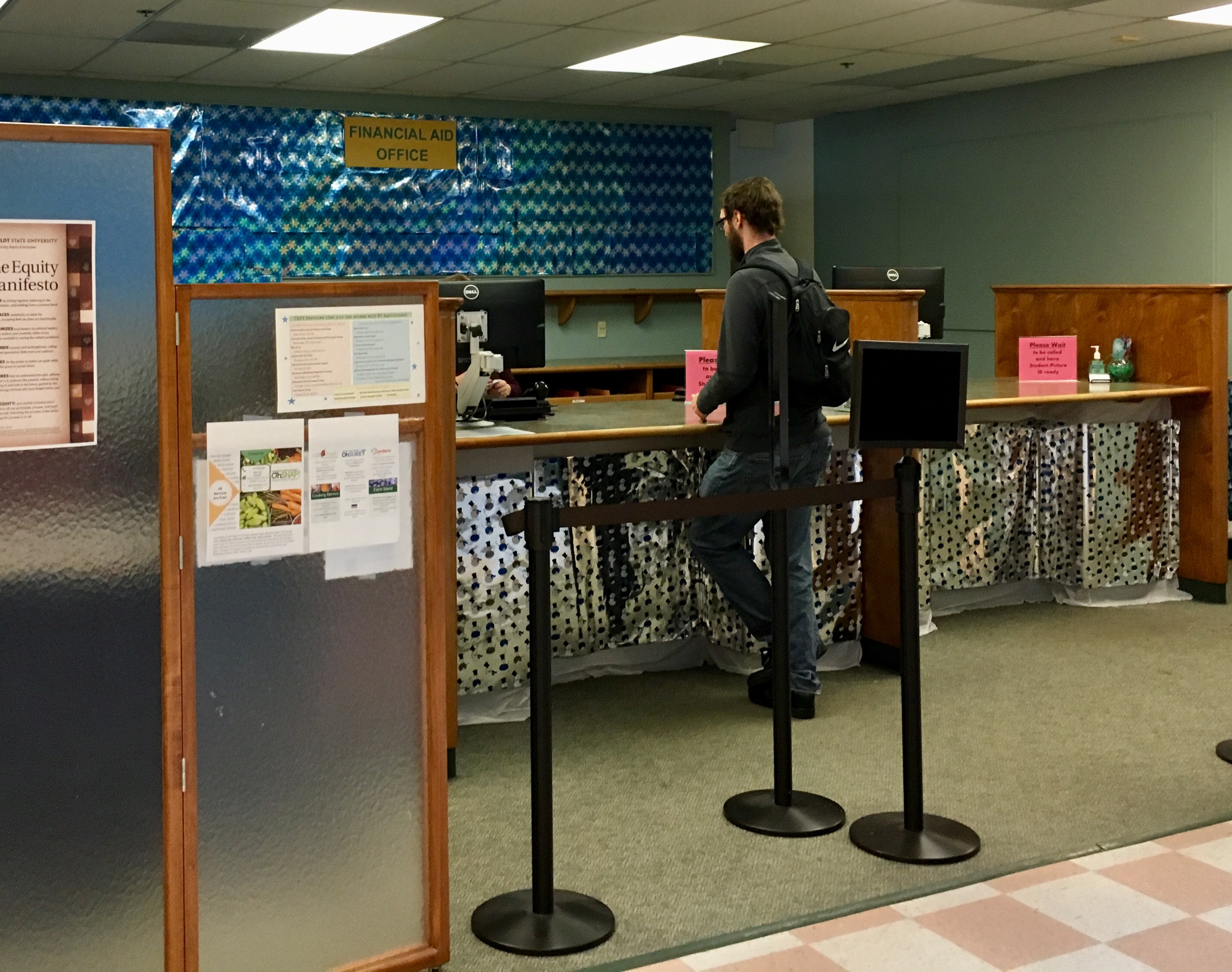
    With the current federal government shutdown looking to continue indefinitely, financial aid disbursements should remain unaffected for now. However, according to Peggy Metzger, director of the financial aid office at HSU, about 50 to 60 students may see some setbacks.

    “The biggest impact is the students selected for verification and not being able to get information from the IRS,” Metzger said.

    The first financial aid disbursements are set to be released on Monday Jan. 14. About 30% of the students who file for financial aid must go through a verification process through the IRS, to ensure that they need the funds they claim. Metzger said that the Department of Education has recently loosened their regulations and that the verification process should be easier.

    “We can work with any students that may need the help,” Metzger said. “As long as the Federal Student Aid office stays open we should be fine. In previous shutdowns, the Department of Education has always stayed open.”

    Operators in the HSU financial aid office have said that they have received phone calls from students inquiring about any possible effects from the shutdown, but the university has yet to issue any sort of formal statement. The lack of notice from the university has some students worried about what may be happening with their disbursements.

    “The university hasn’t said anything, I haven’t got their usual emails,” said Anthony Julien, a senior majoring in zoology. “We got the email that something was due, but we didn’t get anything about [disbursements] being held up. I am concerned about it since the shutdown is going to continue.”

    Steven Schafer, an environmental science and monitoring junior, is also concerned about the shutdown’s effects.

    “I need my money to go to school,” Schafer said. “I need FAFSA. The university probably isn’t going to release a statement. I’m not optimistic about it to say the least.”

    Metzger, who has been employed at HSU for 17 years, said she has been out of the office doing work with the admissions office lately and had not seen the need to release a statement.

    “I had not thought about it, but it may not be a bad idea,” Metzger said. “I am always cautious about causing more questions than are necessary and more worry when there doesn’t need to be.”

    When questioned if the university was doing enough to let students know what was going on, Schafer had this to say.

    “No, they are definitely not doing enough,” Schafer said. “It is so stupid.”

  • Too soon to tell

    Too soon to tell

    Humboldt State University looks to cut classes earlier for low enrollment

    Clarissa Cardenas is a first year student double-majoring in French and international studies. Initially, she enrolled in the wrong French class and had to switch and enroll into a different class a couple days into her first semester. If that class had been cut due to enrollment she would’ve never had the opportunity to enroll late.

    For spring semester Humboldt State University is attempting to cut classes earlier for low enrollment than previous semesters, putting situations like Cardenas’ in jeopardy. Before classes wouldn’t get cut until after winter break and up until the first day of the semester, sometimes longer.

    “I get nervous because the French program is small and if they cut those classes before school even starts then students have to scramble looking for classes,” Cardenas said.

    Vice provost of the dean for undergraduate and graduate studies Rock Braithwaite said cutting classes is routine and happens every semester. It occurs in the transitional stage between the end of one semester and the beginning of the next. Braithwaite said they’re trying to do a better job identifying and assessing class enrollment so they can address cutting classes sooner.

    “I’m almost embarrassed to say it but cutting classes happens up to the first day of the semester,” Braithwaite said. “Students are contacted if and when substitutions are needed.”

    Cardenas said that cutting classes early is taking away the opportunity for students to enroll in vital classes if they enroll late. She knows logistically the university has to cut classes, but said students get the short end of the stick.

    “Students enroll late in classes all the time and to cut those classes is very one-sided,” Cadenas said. “We shouldn’t be punished for enrolling late and should be given the opportunity to search for classes.”

    Junior film major Alfonso Trejos said cutting classes early can potentially affect students’ financial aid. Trejos said it’s a better outcome if the school cuts classes later so students are already enrolled and qualify for financial aid. If the class is cut due to low enrollment while he is already enrolled a professor can show open classes to take.

    “School is expensive and it comes down to the money most of the time for people,” Trejos said.

    Maria Sanchez is a junior in social work and plans on interning her last semester. Sanchez said she doesn’t want to overload herself while interning, so she’s taking more than the unit cap of classes. She has to petition for the extra units she enrolls in and that takes time.

    “Sometimes I’m not even able to enroll in a class until the first day of the semester,” Sanchez said.

    IMG_3591.jpg
    Screen grab of social work course rotations.

    The more time students have to search for classes without fear of having them cut, Sanchez said is best. She said it isn’t a huge deal to wait to cut classes like the school has been doing but for students cutting classes early is detrimental.

    “In my department if you don’t get in or pass a class you have to wait an entire year to take it again,” Sanchez said.


  • Unknown beginnings

    Unknown beginnings

    Editor’s Note: Lumberjack reporter Ju’Wan Murphy is on the Humboldt State University football team.

    After the final game against Simon Frasier, Humboldt State University coaches set up a showcase to help players show off their talents

    Forty plus coaches came from near and far to scout HSU football players as they showcased their agility and athleticism. Coaching staff, Josh Irvin helped set up the event for his players.

    “It was an opportunity for college players to perform and interact with teammates, regardless if they weren’t able to play in games this year,” Irvin said. “They’ve fought for me all year long, and I’m not going to stop fighting for them until they found a new home.”

    The coaching staff also sent out an updated list to almost every college in the nation. The list had athletic accomplishments, academics, and eligibility standing. Players, fortunately will not receive the normal transfer penalty of being forced to sit out a year. Instead, they will be granted full access as soon as they enroll in the new college. Players also met with the compliance officer to explain the process. Irvin believes the showcase went well and is committed to mentoring players that need it.

    “It’s always an honor when players trust you enough to ask your opinion about the future,” Irvin said.

    The next few weeks are critical for players because, decisions will be made and new homes must be decided. Many factors are at play for athletes including year, eligibility, out of state tuition, and scholarships. All this before they step on their new team’s field.

    For junior defensive back Ereon Nash, the time of football ending isn’t ideal. He’ll have to navigate credits and scholarships he’s received are all out of state schools in South Carolina, Nebraska, and Colorado. Nash had a season in which his numbers doubled in important defensive back stats like pass deflections and tackles.

    “I got to make the best of it,” Nash said. “My plan is to go somewhere my units transfer over so I’m not too far behind in school and where I would be good financially.”

    Family is also important to Nash’s decision because of the distance away from home.

    “My family thinks this whole situation is unfortunate but they will support me no matter where I choose,” Nash said. “I’m still undecided if I want to leave in January or after the spring semester.”

    IMG_9985.jpg
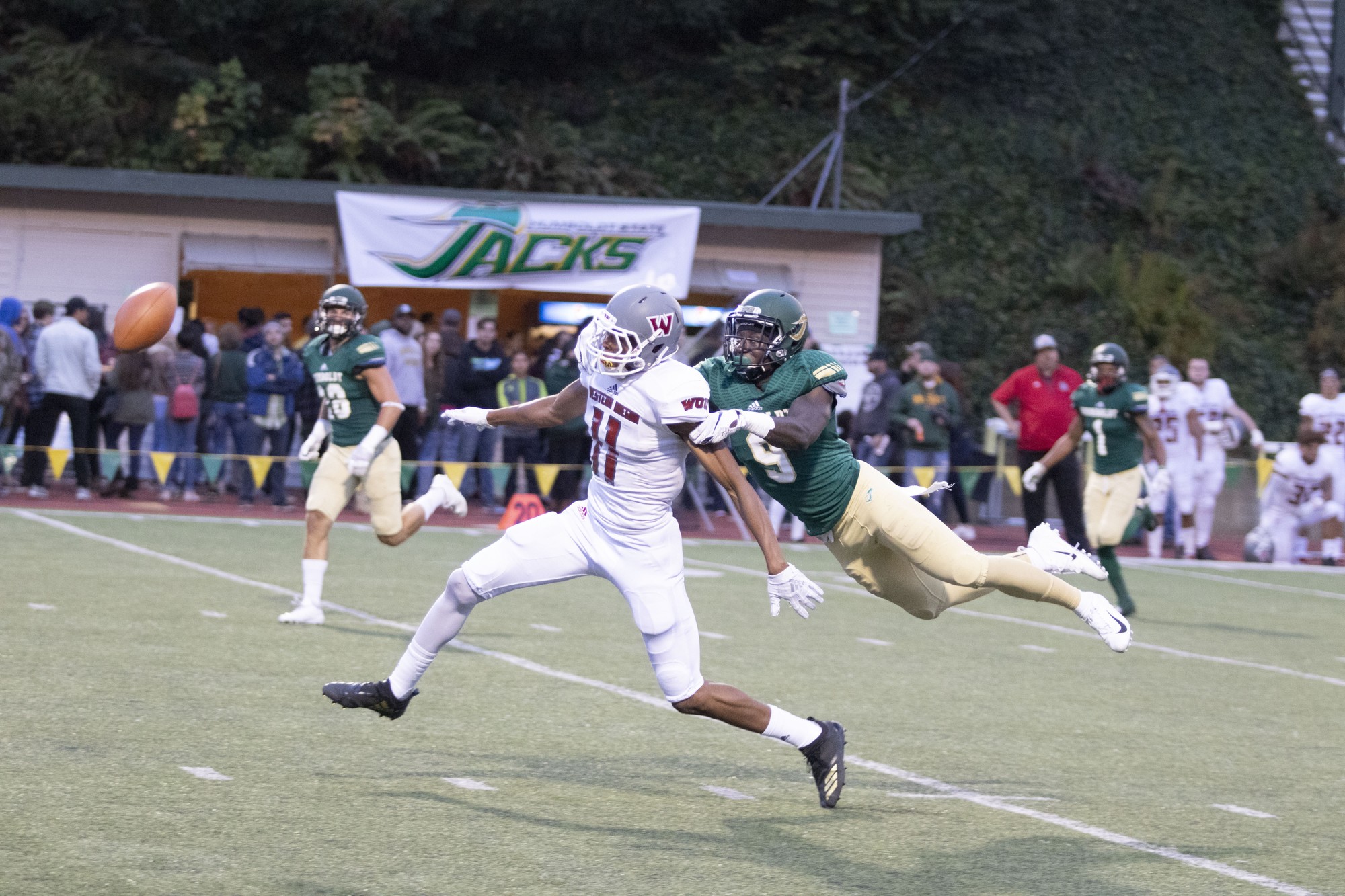
    HSU Lumberjack gets tackled by Western Oregon opponent on Oct. 27. | Photo by Matt Shiffler.

    Other players like redshirt sophomore linebacker Demetrick Watts could find success in the change due to his eligibility for two more years. Watts had a breakout season getting his first opportunity this year to start all 10 games and left his mark in all of those in some fashion. Watts finished this season with one defensive touchdown, second in tackles, and made the first team all-conference.

    “The situation that happened with the program is messed up, I’m the type of person to finish what I start and I won’t be able to do that here,” Watts said.

    His decisions during the break will be looking over his official division two offers from Central Washington, Central Missouri, and the University of Central Oklahoma. These schools are a high caliber of division two football but Watts will wait till just past Christmas to decide. The division one schools are his main focus right now because of the year he had at the Redwood Bowl.

    “Just keeping my options open,” Watts said. “Sam Houston, Portland State, and Samford are on the list.”

    Freshman defensive lineman Tajma Magee was a walk-on in the spring earned his playing time this fall and has to start that process all over again. Magee is not like Watts or Nash who was recruited, he chose Humboldt out of high school for academics. Magee had a nice spring which propelled him to come back in the fall and for the 2018 season. Now Magee is just like the other athletes searching for a new home. Magee has been in contact with a few schools but the only schools that offered scholarships are Ottawa University, Tabor College, and Kansas Wesleyan University.

    Even though Magee has to start his recruitment process all over it he feels like it’s an honor being wanted by other universities after overcoming everything he has been through.

    “Coming out of high school I didn’t really have any schools interested,” Magee said. “Now having the opportunity to have school paid for is a blessing in disguise.”

    IMG_1564.jpg
    Redwood Bowl is nearly empty at HSU football program comes to an end. | Photo by Amanda Schultz.
  • EDITORIAL: Overcoming this final stretch of stress

    EDITORIAL: Overcoming this final stretch of stress

    Breathe in. Breathe out.

    Stress and anxiety are an everyday part of student life. But with the final weeks of school upon us, there are more triggers than ever to make students feel stressed. The Lumberjack knows several tips to ensure that you perform your best in the last days of the semester.

    It’s easy to neglect the self and only focus on the tasks you’ve been assigned. Although your projects and homework are important, it’s critical to consider your physical and mental health as you finish up the semester.

    Many CSU students struggle with getting enough sleep. Exhaustion makes it harder to maintain a low level of stress, and higher levels of stress make it difficult to sleep, so the cycle continues.

    Make sure to get enough sleep during the final weeks, as insufficient amounts will affect your performance on final projects and exams. It’s counter-intuitive to sleep less while trying to get more done, as the quality and speed of work will be lower than if you had enough sleep.

    If you’re having trouble relaxing your mind and body to sleep, an effective, healthy method to calm yourself is drinking a mug of hot herbal tea. Not all teas will help you sleep, though. The best teas for relaxation and sleep are herbal teas like lavender, chamomile, peppermint and Valerian root.

    Caffeine is a popular choice for college students when it comes to finals week studying. While a cup or two of coffee can definitely enhance focus and drive to complete a tedious task, it can also have unpleasant side effects, especially when too much is taken quickly. It’s especially important to moderate your caffeine levels during these busy times.

    Think for a second, is that fourth cup of coffee or second yerba mate tea really worth it? Too much caffeine can cause extreme anxiety and restlessness, making it even harder to stay mentally healthy during these last weeks. Drinking caffeine too late in the night can also make it difficult to get quality sleep, making challenging finals even more intense.

    Just because finals are here doesn’t mean school is all you should focus on. It’s smart to take breaks and have time to yourself, where your studies aren’t the priority. It’s unrealistic to think we can devote all our time and energy into academia. Treat yourself to something nice and relaxing, especially if your anxiety levels are soaring through the roof.

    Remember folks, it’s not the end of the world and you can get through this. Moderate your caffeine consumption, do something nice for yourself and don’t forget to breathe. It will be over before you know it!

    For additional stress relief, in the coming week HSU will be hosting a few different events throughout campus including a game night, the annual pancake dinner and therapy dogs visiting the library.

  • Devouring dermestids

    Devouring dermestids

    Visiting HSU’s Vertebrate Museum

    In a dark room flesh-eating beetles consume dead animals. That sounds like a scene straight out of a horror movie, but this is a room on campus at the Humboldt State University Vertebrate Museum.

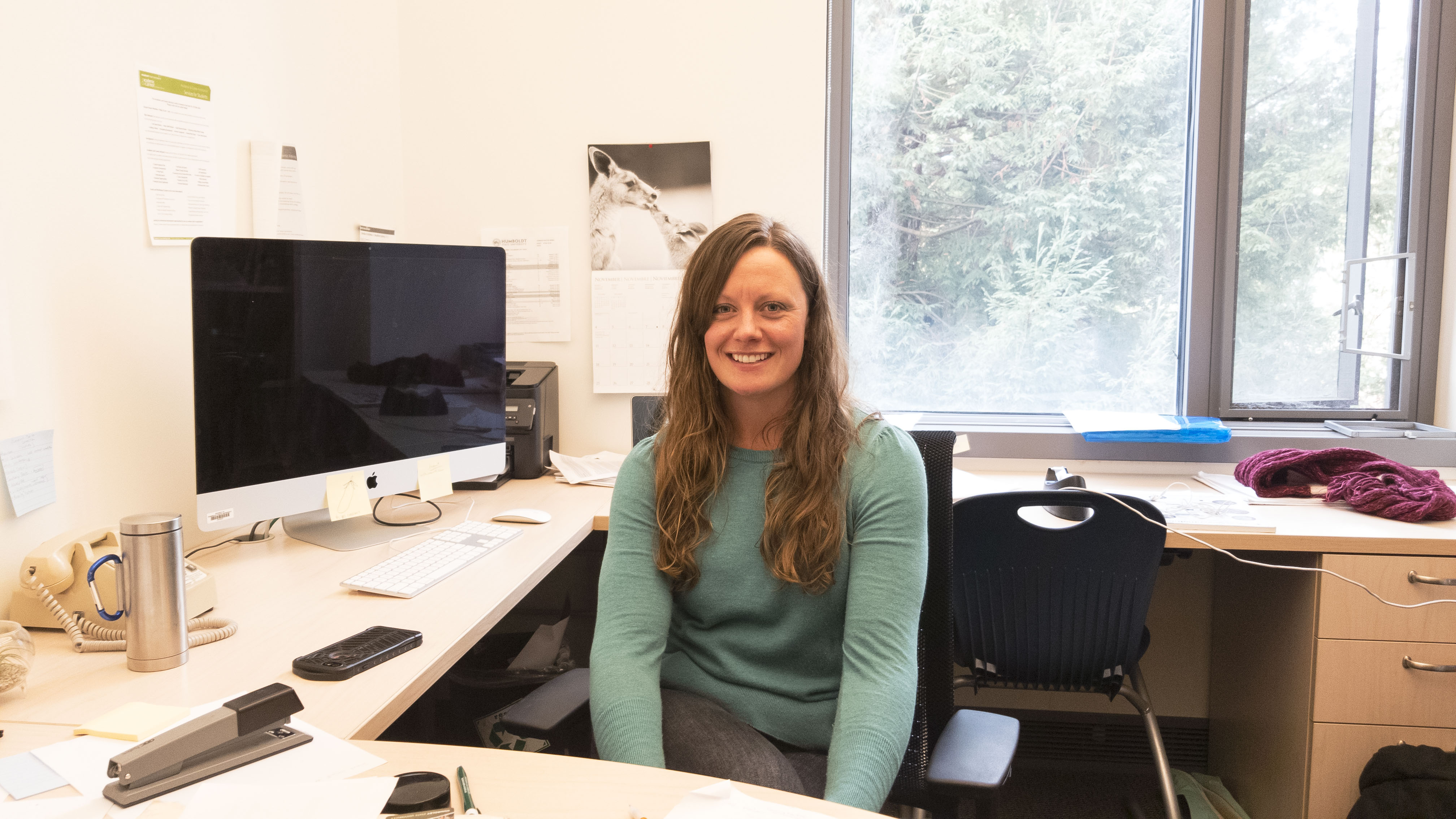
    Melissa Hawkins. is the current curator at HSU’s Vertebrate Museum. She has always been interested in animals, and told her parents she wanted to be a veterinarian at the age of six.

    “I did my masters in reptiles and have done bird research as well,” Hawkins said. “I just love vertebrates.”

    IMG_8744.jpg
    Melissa Hawkins poses next to a whale bone outside the beetle room at the HSU Vertebrate museum. Photo by Walter Hackett

    Hawkins got her bachelor’s and master’s degree at Western Illinois University and her PhD. at George Mason. She applied for the museum curator position at HSU toward the end of 2016, and said she was excited to come to Humboldt.

    “The first thing I said to myself was, ‘Wait a second, is that a redwood tree?’” Hawkins said.

    Aside from her curator duties, Hawkins teaches mammalogy and evolution. Much of her research focuses on next-generation sequencing methods. She loves the discovery aspect of her research.

    “For a moment in time you’re the only person that knows a fact in the the scientific world,” Hawkins said.

    IMG_8710.jpg
    Stuffed and preserved chipmunks catalogued in a collection room at the HSU Vertebrate Museum. Photo by Walter Hackett

    We left her office and move down the hall to one of the collection rooms. Hawkins pulled out a drawer containing rows of small chipmunks, each one splayed out neatly and accompanied by a catalog tag.

    “Feel how soft they are,” Hawkins said.

    At this point the small rodents in the drawer have all been stuffed with cotton and preserved, a lengthy process that is carried out at the museum itself. Some of the specimens in the drawer date back to the early 80s.

    “I call it creepy arts and crafts,” Hawkins said.

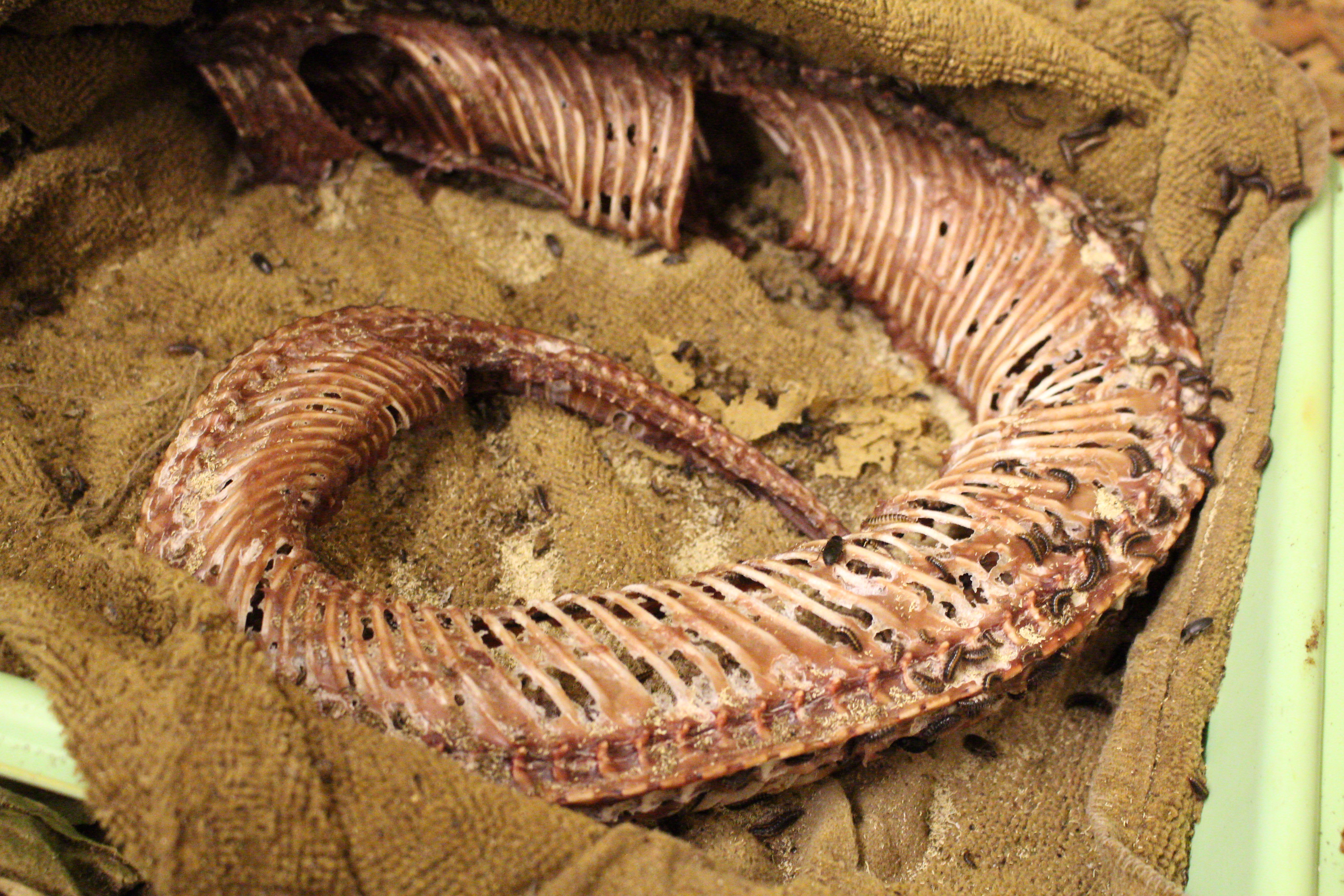
    From there went to see the flesh-eating beetles. The beetles remove all the flesh from the bones for any specimens the museum wants to preserve. They do the work that human hands cannot.

    Dr. Nicholas Kerhoulas is the HSU Vertebrate Museum collections manager and is responsible for looking after the Dermestid beetle colony.

    “Don’t stay in there too long,” Kerhoulas said. “It’ll stay on your clothes.”

    We went outside and entered a small dark room. The powerful smell hits your nostrils instantly.

    “Here’s the local talent,” Hawkins said.

    Hawkins walked over to a box against the wall and opened the lid. A soiled rag resembling a burlap sack is inside. She removed a cover to reveal a snake carcass covered with beetles.

    “They like to feel snuggly and warm,” Hawkins said.

    Kerhoulas said the snake has taken the beetles some time to get through.

    “I think a combination of cooler weather and perhaps that snake not being their favorite is making it take a while longer than I would have expected,” Kerhoulas said.

    We headed upstairs to the museum prep room, where the team worked to prep a dolphin specimen for the beetles. Removing as much flesh as they can before giving the bones to the beetles will speed up the process. The team has to be careful though, because if they leave the bones with the beetles too long they’ll start to eat into the bones.

    “Once the colony gets going they are hungry little buggers,” Hawkins said.

    IMG_8740.jpg
    Dr. Nicholas Kerhoulas removes flesh from a striped dolphin carcass in the HSU Vertebrate Museum in preparation for the beetle colony. Photo by Walter Hackett

    The prep room smelled like fish. This particular specimen is a striped dolphin that washed up in Crescent City and died shortly after washing ashore. Hawkins explained that these dolphins are typically found in the deep sea and the team is curious to find a cause for the beaching.

    Kerhoulas and with Stella Yuan, a graduate student that works with Hawkins in the museum, are equipped with gloves and knives and removed as much flesh and blubber from the bones as they can.

    “I hope you don’t have a weak stomach,” Hawkins said.

  • Something in the sauce: Humboldt Brews

    Something in the sauce: Humboldt Brews

    Humbrews’ wings make students’ stomachs happy 

    Arcata can get fairly chilly once the sun goes down. In response, many flock to Humboldt Brews on Saturday nights for drinks, food and to hang with friends.

    Located on 856 10th St., Humboldt Brews (or Humbrews for short) is a great place to immerse yourself in the Arcata lifestyle. With 25 beers on tap, award winning hot wings and a banquet room/nightclub for shows, there aren’t many places around to get a more complete college town vibe.

    As you walk in, there is an instant feeling of Humboldt State University as many of the patrons are wearing HSU gear while they wait for their drinks. There are sports broadcasts on all televisions with a distinct focus on the Bay Area’s teams like the Golden State Warriors or San Jose Sharks.

    Not too many people yet as its only 7 p.m. but the servers do well in making sure everyone has their drinks filled. Along with a pool table, seating for the restaurant and even some old school arcade games, Humbrews has everything you’d want from a college bar. The bar transforms from a mellow early dinner setting to a more energetic “party” setting as more people start to pile in to escape the cold.

    What better way to warm up from the cool breeze than with hot wings?! Humbrews offers a basket of wings including a side of french fries and some celery as a palate cleanser for $10. The sauces vary depending on the bravery of the customer, but for the fan of traditional wings you can’t go wrong with the hot buffalo sauce. A perfect amount of spicy earns this wing its “award-winning” title as soon as you take a bite.

    Portions are sized reasonably to what you’re paying and you’ll have extra hot buffalo sauce to dip your fries in after. This goes great while treating yourself or watching a game with friends on the large projector screen in the back of the restaurant.

    For those who dare, you can also try Humbrews’ handmade “Suicide Sauce” which is made from many different spices including the notoriously hot “ghost pepper” for an extra $2. Ask for the “Suicide Sauce” on the side to enjoy at your own pace. If you don’t mind sweating through your shirt, this sauce will definitely have you breathing fire.

    Ordering a pound of wings ($12) with a side of “Suicide Sauce” can be fun with a large group as everyone grabs a wing and a dab of sauce to see who can ride the bull without getting kicked off. Wash it down with one of Humbrews’ many beers or ciders. One of the best is from Eureka’s own Humboldt Cider Company called Hibiscus Hemp Cider. A pint of Hibiscus Hemp cider ($6) along with a pound of wings will have you full and feeling good all for under $20.

    Humbrews sets itself apart from other Arcata bars with its variety of quality food choices and upbeat vibe. It is also well lit so you don’t get the creepy, “dingy” feeling that other Arcata bars give off. It’s open daily at 11:30 a.m. until 2 a.m. on most nights. Stop by after class and you might be able to catch happy hour from 3 p.m. – 6 p.m. for drink specials.

    Overall, Humbrews is a staple bar for the HSU student or any Arcata resident with its exceptional drink choice and consistently well-made food, not to mention the hottest wing sauce you can find in Humboldt County!

  • Deven’s top seven pump up songs

    Deven’s top seven pump up songs

    Seven songs that’ll electrify your soul

    Whether you are about to go out for the night, practicing for the big game, or getting ready to ask that person out, we all have our songs that pump us up and get our blood flowing in anticipation. Here are my top 7 pump up songs:

    1. “Eye of the Tiger” – Survivor
    We start with the quintessential pump up song from Rocky III. You will always feel epic when listening to this song. Channel your inner Sylvester Stallone and take on the day!

    2. “Get on the Floor” – Michael Jackson
    Michael Jackson has a lot of pump up songs, but this one doesn’t get the credit it deserves. It’s groovy, it’s funky, and it always gets me out of my seat and onto my feet.

    3. “Learn How to Watch” – Carnage, Mac Miller, and MadeinTYO

    Whenever this song plays, I immediately feel like I am walking into a wrestling ring as someone is taking off my robe and yelling in my ear to pump me up. Nobody can mess with you when you’re playing this song

    4. “Glowed Up” – KAYTRANADA and Anderson Paak

    This is a song for when your just simply feeling yourself. You look good today and you know it. You’ve come a long way and you are killing it. Also KAYTRANADA’s house-esque hip hop beats blend amazingly with Anderson. Paak’s raspy but soothing voice.

    5. “Sabotage” – The Beastie Boys

    The Beastie Boys also have a wide catalog of pump up songs, but this one stands out the most to me. With the multiple breakdowns and build ups, chunky guitar chords and a record scratching solo, this song was destined to be one of the best pump up songs.

    6. “Good Vibrations” – Marky Mark and the Funky Bunch

    The song and video are incredibly cheesy, but every time it comes on it always lifts my mood. Part of it might be how it’s so fun to watch a young Mark Wahlberg rapping and dancing around. And to top it off, everyone who knows the song always sings along to chorus.

    7. “Final Countdown” – Europe

    Just in time for finals, this is one of the most important pump up songs in history. You could add this song to the background of anything and it immediately becomes more impressive. The opening riff that is sustained throughout a lot of the songs is one of the most instantly recognizable riffs of all time. And just like with Good Vibrations, your going to get everyone in the room singing “It’s the final countdown!”


  • The Educated Landlord and Tenant Program has been brought to the table

    The Educated Landlord and Tenant Program has been brought to the table

    Tenants, landlords and community members were invited to discuss the development of the ELT Program during town hall meeting

    A study done by the CSU office of the chancellor found that one in five Humboldt State students reported being without housing one or more times last year.

    Humboldt State’s off-campus housing coordinator, Chant’e Catt hosted a meeting on Nov. 30 in the Great Hall on campus to discuss this major concern of housing and other potential issues that lay ahead for student renters and landlords in Humboldt County.

    “We’re looking to get feedback and create connections in the community,” Catt said.

    Catt has been collecting data since Aug. to develop a program called the Tenant and Landlord Education Program. This program is centered around educating local landlords and student tenants. Catt’s goal is to raise awareness about equitable practices and cohesion between the two sides.

    “We want to create open communication and bridge the gap between the community and campus,” Catt said.

    SB.TOWN.HALL.IMG_9254.JPG
    A frustrated community member goes on about privatization in housing while event organizers Ashley Bradshaw and Chant’e Catt listen in the back. Photo by Sean Bendon

    Sasheen Raymond, a support administrator in the social work department on campus, explained the need for good communication between tenants and landlords. Raymond also called attention to the issue of finances in some cases.

    “The goal is coming to some sort of agreement between students and landlords,” Raymond said. “ We want to know where the middle ground is for both sides.”

    Raymond and Catt have been working to create a donor supported stipend that could be applied to student housing deposits in the future. This could help create a better system for student housing and alleviate some of the pressures students face when looking to find off campus housing.

    Humboldt State’s associate director of housing, Todd Larsen supports the idea of the program.

    “They’re trying to create a better future for the students,” Larsen said.

    SB.TOWN.HALL.
    Ashley Bradshaw listens as a community member voices their concerns at the landlord and tenant town hall meeting held in the Great Hall. Photo by Sean Bendon

    Catt and her associates have been working to reach out to students about their concerns by emailing well over a 1000 students and holding open meetings in the UC Quad. Students and landlords alike have come forward to express their fears in hopes of finding a balance.

    “Today’s meeting was a synthesis of all the concerns students and landlords presented us with,” Catt said. “We asked them what they didn’t like and now we’re working on it.”


  • Meet the Professors: Amber Gaffney

    Meet the Professors: Amber Gaffney

    Social psychology professor Amber Gaffney opens up about her hobby and profession

    Dr. Amber Gaffney, social psychology professor at Humboldt State University, has traveled all over California for her studies. She received her bachelor’s degree at HSU in 2006 and her doctorate at Claremont Graduate University in 2014. In between she traveled to Mexico and Canada for her past hobby, professional bike racing.

    “I like to be athletic,” Gaffney said. “The idea of riding my bike professionally came when I was in grad school, which is pretty late in the career, but I wanted to do it.”

    Gaffney participated in many tournaments in her professional cycling career. While it was expensive, it was all worth it for her.

    “Since teaching here at HSU, I have not been able to go cycling professionally anymore, but I still like to go for runs when I get the chance,” Gaffney said.

    Gaffney comes from Denny, California a small town east of Willow Creek.

    “It’s a town in the middle of nowhere,” Gaffney said. “People won’t understand rural towns until they go to Denny”.

    Gaffney became a psychology professor at HSU after years of studying. She teaches social identity and social influences. Her expertise is how social identity is affected by political party alliances.

    “We research on how your political alliance can shape your view of the world,” Gaffney said.

    One of her research papers was on the 2016 presidential election. She looked at how the Trump administration grew to represent the Republican party.

    “We called that concept ‘prototypicality’,”Gaffney said. “We looked at pre-2016 election, and it was fairly low, but post-2016, it increased. So that meant that more Republicans viewed Trump as representative of the Republican party.”

    Dr. Gaffney explains the textbook definition of prototypicality is ‘a set of attributes that best defines your group in a specific context with respect to another group’. In the context of Gaffney’s research, the aspects of the Republican party can be shaped because of Donald Trump’s leadership.

    Gaffney is very passionate about teaching social psychology, and as a psychologist she has fun lecturing and teaching in her classes.

    “I want students to look at the psychological mechanisms of why people support certain groups,” Gaffney said. “When we talk about prejudices, when we talk about inter-group relations, when we talk about inter-group bias, these are things that almost everyone has experienced.”

    This story was corrected at 9:56pm on Dec. 6. The previous version of the article listed Gaffney as only having graduated with a masters degree from Claremont Graduate University. 

  • Students present the Margaret Kelso short play festival

    Students present the Margaret Kelso short play festival

    Six original 10 minute plays directed and written by Humboldt State students

    A student based team of six directors, six playwrights, 15 actors and a crew of 12 people backstage, launched the preview of the Margaret Kelso play festival on Nov. 28.

    Production manager Michael Thomas said the Margaret Kelso Play Festival has been around for decades but only happens occasionally.

    “The festival is named after Margaret Kelso who taught playwriting,” Thomas said. “We wanted to thank her for many years of service and contribution to dramatic writing.”

    "Contrary"
    Actors Rosemary Allison-Brown, and Victor D. Para acting out a scene from the play”Contrary.” Photo courtesy by Michael Thomas.

    The festival consists of six 10 minute plays that are written and directed by HSU students. The director of the play “Contrary” is theatre arts senior Sammi Stowe. Stowe said the job of the director is to create the world of the play. She is also excited to see new faces in crowd during opening night on Nov. 29.

    “It’s always exciting to see someone’s first reaction,” Stowe said. “There’s nothing quite like watching someone’s first time seeing your art.”

    "Injection"
    Actors Brianna Fergus, and Katie Lem acting out a scene from the play “Injection.” Photo courtesy by Michael Thomas.

    Freshman biology major Katie Lem played the role of Juliet in the play “Injection.” Lem feels very excited for opening night. She’s happy that everyone is doing their best and looks forward to see how everything turns out.

    “I want there to be a big energy coming out into this show, and I want everyone to accept it with open arms,” Lem said.

    Theatre arts senior, Madison Glee, was apart of the play “Adjustments.” She was nervous in front of the preview crowd but she said the nerves washed away. Glee is looking forward to working with her co-actor during opening night and gauging the reactions and energy with a different audience.

    “It’s different every night but it’s beautiful every night,” Glee said.

    The opening show will be on Nov. 29 at 7:30 pm in the Gist Theater.

    Short play festival dates and times
    Screen grab of dates and times of the Margaret Kelso short Play Festival.
  • Forever dedicated to the game

    Forever dedicated to the game

    Lumberjacks football player named GNAC Player of the Week

    Editor’s Note: For transparency, Skye Kimya is the Lumberjack Sports Editor

    Humboldt State University’s sophomore safety Adam Herrera was named Great Northwest Athletic Conference special teams player of the week after an outstanding performance in Lumberjack football’s game against Central Washington on Oct. 27.

    The following week Herrera continued to hold down the defense as he intercepted the ball against Azusa Pacific in their second to last game of program history. Herrera talks about how he predicted his opponents play, and just like that he was able to outsmart them and regain possession of the ball for the Lumberjacks.

    “I saw the play happening right in front of me,” Herrera said. “And I just opened up right away towards the post. He threw the ball, so I ran up under it.”

    Herrera had a successful 2018 football season. He finished with 23 tackles and 19 assisted tackles for a total of 42, two interceptions for a total of 76 yards and a touchdown and 562 return yards with a game high of 193 total yards against Central Washington.

    IMG_0309.JPG Adam Herrera side peddles as he waits for the offense to make a move in a home game against Central Washington on October 27. Photo credit: Walter Hackett

    Football has been one of Herrera’s greatest passions for a majority of his life. Starting at a young age in elementary school, he knew football was something he would continue to pursue. Getting more serious about the sport, he knew he wanted to play for his local high school team in Los Banos, Calif.

    Playing both offense and defense for the Los Banos High School Tigers, Herrera hustled hard to earn his accolades, including MVP and offensive player of the year multiple times.

    As he took on unfamiliar positions such as quarterback, high school football challenged Herrera to become a well rounded athlete, as well as a versatile player on the football field.

    “He was a phenomenal player and a great teammate,” Head coach of Los Banos High School football Dustin Caropreso said. “He was a leader. Adam showed up to practice everyday and never complained.”

    Not only did Herrera join varsity as a sophomore but he was captain of the Los Banos Tigers both his junior and senior year.

    “When I found out he won GNAC player of the week it was pretty special,” Caropreso said. “He’s worked really hard to get to where he’s at, and it couldn’t have happened to a better person than Adam.”

    Though Herrera is known as a football player, he is also a son, big brother, and student. Family and friends have always been important to him and his daily life. His parents and grandparents had always been some of his biggest supporters as they watched him play growing up.

    “It had been a while since he received any recognition for all of his hard work,” Adam’s mother Cynthia Gonzalez said. “So it was nice to hear him receive the GNAC award in college.”

    His girlfriend Skye and closest friends Ereon, Watts, and Mark continuously inspire him to be the best he can be. Ereon Nash and Demetrick Watts play right beside Herrera on the defensive side of the Lumberjacks.

    IMG_7742.jpg Ereon Nash, Demetrick Watts, and Adam Herrera gather for photos after their 2018 homecoming game against Simon Fraser. Photo credit: Skye Kimya

    As a brother to four younger siblings, Herrera has been a huge role model and support system within his family. His only brother Moses is following in his footsteps as he too plays football and is already a recognized all-star on his Pop Warner League team.

    “Every time before a football game he calls me and pumps me up,” Moses Herrera said. “He tells me how to play the game, and he is always encouraging me.”

    As HSU’s football team completed their final season, Herrera accomplished a lot within his football career, but he’s not done yet. He has already been contacted by outside coaches and is looking to play at another university for the last two years of his collegiate career. Herrera hasn’t made any decisions yet in regards to football next fall but awaits opportunities.

    “I don’t want this to be my last year,” Herrera said. “I’ll continue to do what I need to do to keep playing football and if everything goes well for me I hope to continue on to the next level.”