The Lumberjack


Students Serving The Cal Poly Humboldt Campus and Community Since 1929

Tag: HSU

  • No car, no problem

    No car, no problem

    HSU’s JackPass offers students unlimited city bus access

    By Alexandria Hasenstab

    Humboldt State student Miami Liscano was having an enjoyable spring break until their car broke down. They knew they would need to find a new means of transportation. Luckily, Liscano already knew about the JackPass, a program that allows students access to the city buses with just a swipe of their student I.D. card.

    “I used to use the bus a lot my freshman year,” Liscano said. “If I didn’t have the bus, I would have never left campus.”

    An Arcata-Mad River Transit bus driving down H Street. | Photo by Robert Perez

    Liscano is now a sophomore and, like many other students, takes the bus due to a lack of a personal vehicle. But JackPass is not only for students without cars. It’s an effort to reduce the number of students who drive to school as well as reducing HSU’s carbon footprint.

    According to the 2016-2017 catalog, the JackPass offers students unlimited free rides on the Arcata & Mad River Transit System, the Redwood Transit System, and the Eureka Transit System. This means students can take the bus all the way from Scotia to Trinidad and even to Willow Creek for a day at the river.

    However, the JackPass is not free. Every student pays for it whether they use the bus or not. A portion of HSU registration fees, amounting to $29.02 a semester, is used to fund the JackPass according to Humboldt State’s financial services webpage.

    For students who live out of town like senior Noah Dunkley, the JackPass is a necessity.  

    “I totally agree it’s worth paying for the bus pass in our tuition,” Dunkley said.

    Dunkley lives in Eureka. In order to get to school and back home he has to take the Redwood Transit System. A monthly pass for the RTS is $60 according to their website. This means that a student would pay twice as much for a one-month RTS pass as they do for a 5-month JackPass.

    Charles Burdick is the public transit manager for the Arcata-Mad River Transit. According to Burdick, over 70 percent of bus riders for the Arcata-Mad River Transit are HSU students. He believes that the JackPass is beneficial because it lessens the number of students parking on campus and increases the use of the city bus.

    “There’s a lack of parking there [at HSU],” Burdick said. “They would rather students not take their cars to campus.”

    Humboldt State has been notorious for inadequate parking spaces. According to HSU’s parking and commuter services website, a parking pass for the fall and spring semesters is $315. The parking pass does not ensure students will find a spot.

    JackPass is a great deal for HSU students, but students who use the local transit do experience some flaws.

    “The bus will come either really late or really early,” Liscano said.

    To avoid missing the bus Liscano uses an app called Transit that offers accurate, real-time predictions for public transit arrival times.

    Dunkley has also experience some flaws on the RTS including sagging bus seats and fights breaking out on the bus, but he feels like these flaws are ignorable.

    “Overall it’s a pleasant experience,” Dunkley said. 

    KBBus
    Graphic by Kelly Bessem
  • The personality behind Burger Records

    The personality behind Burger Records

    Co-founder of Burger Records visits HSU

    By Sarahi Apaez

    The man behind Burger Records, Sean Bohrman, co-founded a record label and built a scene from the ground up.

    Bohrman graduated from HSU in 2004 with a minor in graphic design and a degree in journalism.

    Burger Records is a record label, a record shop, and a social media entity. Currently located in Fullerton, California , the record shop was an idea created by Bohrman and his bandmate and business partner Lee Rickard.

    Bohrman is from Anaheim and started the Burger Records label as a way to promote his band, Thee Makeout Party!, with his bandmate and business partner Lee Rickard.

    Once graduated from HSU, Bohrman landed a job as Art Director of a Fishing and Boating Company where he worked in a small cubicle where his coworkers had worked for 30 plus years.

    After four and a half years of working with this company, Bohrman decided to leave to pursue something bigger. By leaving his job six months early he lost out on about $12,000 since the company did not have to match his 401k.

    “But it was worth it,” Bohrman said. “It was the best decision I ever made for sure.”

    Bohrman has sacrificed his entire life for the label and the shop. For seven years he lived in the back of the Burger Records shop since it’s opening in 2009.

    There are currently 1,000 bands on the label and only five people on Burger staff working the shop, the label, publishing, and running social media.

    “We started a record label and a record store and had no idea how to run either,” Bohrman said. “I designed the website and I don’t know how to design websites.”

    Bohrman has very meticulous to do lists. His passion lies in discovering all of the music associated with Burger Records himself.

    “I’m a control freak, that’s why I do everything,” Bohrman said.

    “We never stop talking or working on Burger Records,” Bohrman said. “We put 100 percent of ourselves into this company.”

    Burger Records, for many people, will go down in history as a movement that happened. From 2009 to present day, Burger Records is a subculture for many youthful people to hold on to.

    Sean Bohrman speaking to journalism students at the Bret Harte House. | Photo by Sarahi Apaez

    What separates Burger Records from any other major record label is how they manage their social media. Every social media account is filled with content written by the character called Burger Records created by Bohrman who writes everything in all caps and three exclamation points.  

    Burger Records ventured into an untapped business in it’s time which is creating cassette tapes. The label creates cassette tapes for bands who are signed on to another label.

    ”It only takes two weeks to make a cassette tape which is convenient for when bands go on tour and need something to sell for their merch table,” Bohrman said. “It is also very inexpensive, it costs a $1.25 to make a tape and we make 250 for each band.”

    When the company started, they were first losing money because for the first two years they were supporting it with their job.

    “When we started I put 100 dollars in and Lee put 100 dollars in,” Bohrman said.

    His taste in music has also been a big help along the way.

    “I have a knack for discovering new music,” Bohrman said. “I’m going to take all of the good records here in Arcata, so don’t even try finding anything good later.”

    “Even if the store has failed I would still feel better about it than had I not ever done it and had I grown up and said ‘what if I started a record label.”

    Bohrman never saw himself as a trendsetter but that’s what he has done.

    “It’s really hard to sit and take in everything we’ve done and everything we’ve accomplished,” Bohrman

    Bohrman feels that whenever something amazing happens and it’s gone, then there’s always something on the horizon

    “Maybe later on in life I’ll get to appreciate all the really cool things that have happened,” Bohrman said.

    Bohrman and everyone who works at the shop tries to have the most fun while working long days and nights on Burger Records.

    “Everything we do is a joke,” Bohrman said. “We’re good at saying that’s so funny, let’s do that.”

    ADVICE: HOW TO START A BUSINESS by Sean Bohrman.


    • “It’s all about sacrifice, you’re going to have to skip meals, you’re going to have to work when other people are having fun.And if you’re out having fun there is someone else at home working to be better than you are,”
    • “You have to be working all of the time to stay ahead of everybody”
    • “It’s just total 100 percent dedicate to a cause, an idea, and following through with it, even with the stupidest ideas.”
    • “Stay true to yourself.”
  • KHSU public radio faces possible defunding

    KHSU public radio faces possible defunding

    By Curran Daly

    Humboldt State’s radio station, KHSU, is facing a 16 percent funding decrease under Donald Trump’s proposed 2018 Budget Outline.

    KHSU has an annual operating budget of just over a million dollars. In 2016, KHSU received $175,061 in grants from the Corporation for Public Broadcasting. CPB is the largest source of funding for public radio. With the complete defunding of the CPB, KHSU would have to look elsewhere for funding.

    Peter Fretwell, KHSU’s new general manager, was attracted to the position as general manager at KHSU due to it’s large community involvement.

    “KHSU is near the top, if not the top of the most listened to stations in Humboldt county,” Fretwell said. “In my experience community involvement is important and I was attracted to Humboldt county and KHSU because of the deep community engagement.”

    KHSU is a noncommercial, public radio station, supported by Humboldt State University. KHSU is largely community based on and acts to provide intellectual perspectives on local and national issues.

    KHSU receives a large amount of their funding from donations from the community. In 2016 $336,289 was donated in listener support. It is this kind of support from the community that will be able to maintain KHSU’s ability to broadcast.

    KHSU is a vital resource for the community. Humboldt is relatively cut off from the world and in the face of potential natural disaster, public radio would be vital for public service.

    The recent budget outline, released on March 16, called for a complete cut to CPB funding. Similar stations with similar communal obligations all around the country face these cuts as well. Patricia Harrison, CPB’s president and CEO, outlined the importance of public media in a statement made after the budget outline was released.

    “The elimination of federal funding to CPB would initially devastate, and ultimately destroy public media’s role in early childhood education, public safety, connecting citizens to our history, and promoting civil discussions,” Harrison said.

    Fretwell has seen proposed cuts to CPB before and believes that, as before, the CPB will be able to retain its funding.

  • The translators of Humboldt County

    The translators of Humboldt County

    By Sarahi Apaez

    During the spring preview introduction in the Lumberjack Arena, Rosamel Benavides-Garb watched and listened through his headset as his students translated for the parents of incoming HSU freshmen.

    Benavides-Garb, the chair of the department of world languages and cultures, teaches a translation and interpretation class at HSU. Students get to experience real service learning through translating for middle schools and high schools in the county during parent teacher conferences through a community outreach partnership with the Humboldt County Office of Education, as well as events at HSU such as spring preview.

    These students are helping their community and the wave of Latinx students with parents who don’t speak English. Most high schools and middle schools are not in compliance when it comes to the need for translators at parent teacher conferences according to Benavides-Garb. HSU students get to play a huge role in translation services when it comes to student success in the county. 

    IMG_0635
    Rosamel Benavides-Garb listening through his earpiece during Spring Preview.

    Benavides-Garb feels that translation and interpretation services are very necessary especially in the high school setting.

    “Parents have never heard their child’s teachers say that their child is an excellent student,” Benavides-Garb said. “Students are forced to be translators for their parents during these interactions and they have no idea how to translate that they themselves are excellent students.”

    Students like Carlos Sanchez have been translating alongside Benavides-Garb since taking his translation and interpretation class in 2014.

    Sanchez believes that through the field work for the translation and interpretation class has provided him with many opportunities for him to grow as a student and as an individual.

    These students get real practice that they put on their resume through this service orientated class. They help their community as they take these classes.

    “Bilingualism is something that is dear to me,” Benavides-Garb said.

    With HSU as a Hispanic-Serving Institution with an influx of Latinx students, classes offered and taught by Benavides-Garb serve a very important purpose to students, the institution, and the community.

    Rosamel Benavides-Garb assisting students in the translation of the book African Masks.

    IMG_0697
    Rosamel Benavides-Garb assisting students in the translation of the book African Masks.

    “HSU makes students into bilingual professionals,” Benavides-Garb said. “It takes a lifetime to acquire a second language but a lot of students at HSU are already bringing that.”

    But just because a student is bilingual does not mean they can translate. Students learn interpretation in Benavides-Garb’s class which is the exact translation with all of the cultural complexions.

    Benavides-Garb’s translation and interpretation class has had the opportunity of translating the book “African Masks” by James Gaasch from English to Spanish. The class is currently in the proofreading process where they work in groups to editing the translations bit by bit.

    The book about the collection which was on exhibit at HSU is currently being sold on Amazon and after being translated in Spanish, it will be available for sale in Spanish speaking countries.

    Alejandro Arredondo, a senior psychology major, is currently in the translation and interpretation field study class and has been translating the book “African Masks”.

    “It’s a great opportunity to share a culture’s story in various languages,” Arredondo said.

    After learning about the context and the message of the book, Arredondo feels confident about contributing to these stories and documents.

    The Department of world languages and culture is creating a connection to these stories and documents to HSU.

    “It has been a relentless call for service, providing translation services for our community,” Benavides-Garb said.

  • Q & A with new dean Lisa Bond-Maupin

    Q & A with new dean Lisa Bond-Maupin

    By Iridian Casarez

    HSU will soon welcome its new dean of the College of the Arts, Humanities and Social Science, Lisa Bond-Maupin. Bond-Maupin is starting as the new position in July. She is coming from the University of Arkansas.

    Q: Where are you from?

    A: I  grew up mostly on the coast of California and Baja California. We lived in Ensenada BC ( Baja California), Inglewood, Chula Vista, San Diego, Santa Cruz, and Ferndale, California. Much of that time we lived on a sailboat my father built. We sold the boat and moved to dry land when I was in high school. I attended Ferndale High School until my senior year when my parents bought a farm in Missouri and we moved to the Ozarks. I loved Humboldt County as a young person. And I still do.

    Q: Where are you currently working now?

    A: I became the Founding Dean of a brand new college of Social Sciences and Communication at the University of Arkansas Little Rock three years ago. I have had the privilege of working with students, staff, and faculty to build this college and establish a college identity and community. That is what I am doing now and until my last day here at the end of May.

    Q: What made you interested in applying for the dean position at HSU?

    A: Humboldt State University has had a clear and consistent identity and set of commitments as long as I can remember. I knew of HSU’s reputation for leading in environmental sustainability before it was something people were really talking about. I was aware of HSU’s commitment to social justice. I have always been intrigued by HSU’s uniqueness.

    Q: What can you bring to HSU as the new dean of the College of the Arts, Humanities and Social Sciences?

    A: I look forward to using my experience to support faculty in the achievement of their professional goals as I learn more about their passions. I know that HSU is different in significant ways and my knowledge will grow as I learn from my colleagues there. I am ready to partner to explore meaningful and sustainable approaches to growing programs and deploying resources at HSU. I am committed to student success.

    Q: What are you looking forward to most?

    A: I am looking forward to making new friends and being part of the community of scholars at Humboldt State University. I look forward to collaborating, celebrating, and laughing together. I look forward to contributing to a sustainable and strong future for our programs, college, and university.

  • HSU takes back the night

    HSU takes back the night

    By Charlotte Rutigliano

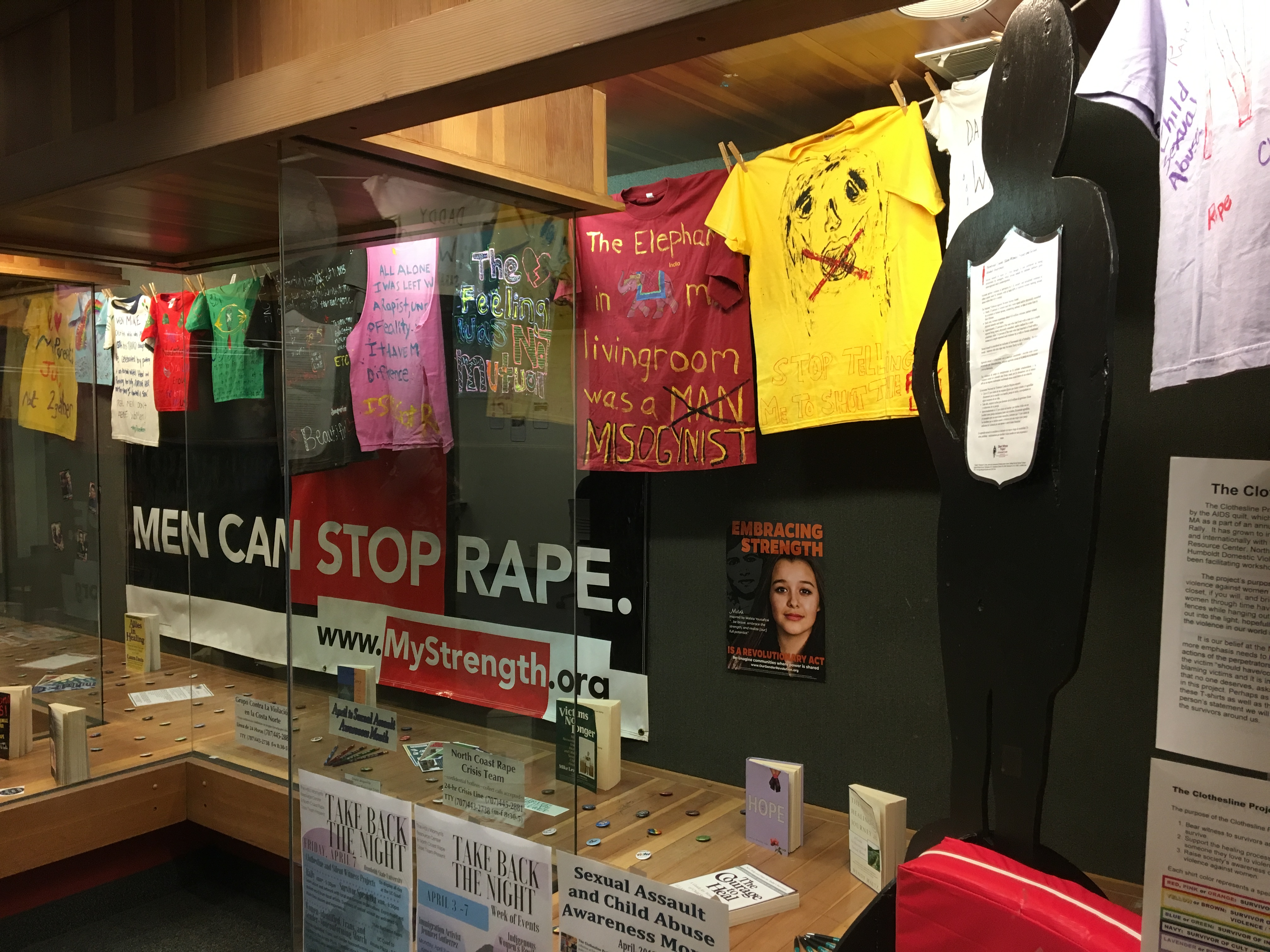
    Students, faculty and members of the community came out to the Kate Buchanan Room this past Friday to show their support for survivors of sexualized violence.

    One student who came out to show support was graduate student Irene Vasquez.

    “I think it’s wonderful that the university cares about the students and is spreading awareness like this,”  Vasquez said.

    The university has been the host of the take back the night events since the mid-1980’s. Take Back the Night was co-sponsored by the North Coast Rape Crisis team and the Women’s Resource Center.

    Paula Arrowsmith-Jones, Community Outreach Coordinator for the North Coast Rape Crisis Team,  said that these events have been going on since the 1970s but have been held on and off campus since the mid-1980s.

    “Back in the 70s women were told not to go certain places at night without a male chaperone,” Arrowsmith-Jones said. “Because if something happened it fell on the women. These events were created to reclaim everyone’s right to go somewhere and not get hurt.”

    According to Arrowsmith-Jones, it’s important for the university to hold events like this because there is so much shame, secrecy and denial that surrounds sexualized violence, it’s about raising awareness for those who don’t think it happens. CFR69 - TBTN 1

    Take back the night student coordinator and graduate student Ariel Fishkin said we are living in a rape supported society, where individuals are taught that “rape culture” is okay and where victim blaming is too common.

    “I have experience with sharing,” Fishkin said. “People don’t realize that it’s a systemic thing that’s why we have these events.”

    Take Back the Night was part of a week long event to let survivors know that they are believed. The week long event took place during sexual assault awareness month.

    “Sexual violence is so prevalent,” Arrowsmith-Jones said “we want to show people affected that they are supported, we have counselors at all the events to help.”

    The university does have a lot of student activism with Check It, Peer Health Education, and the Women’s Resource Center. Fishkin hopes to continue to bring awareness to this issue as a campus to the community.  

    Sophomore zoology major Katie Marks said it is amazing that the university is doing this because she knows people who have experienced sexualized violence and she wants to be a part of the change for a world without violence.

    “Hopefully this will inspire other universities and communities to change too,” Marks said.

  • Remembering the 2014 Spring Preview bus crash

    Remembering the 2014 Spring Preview bus crash

    By Iridian Casarez

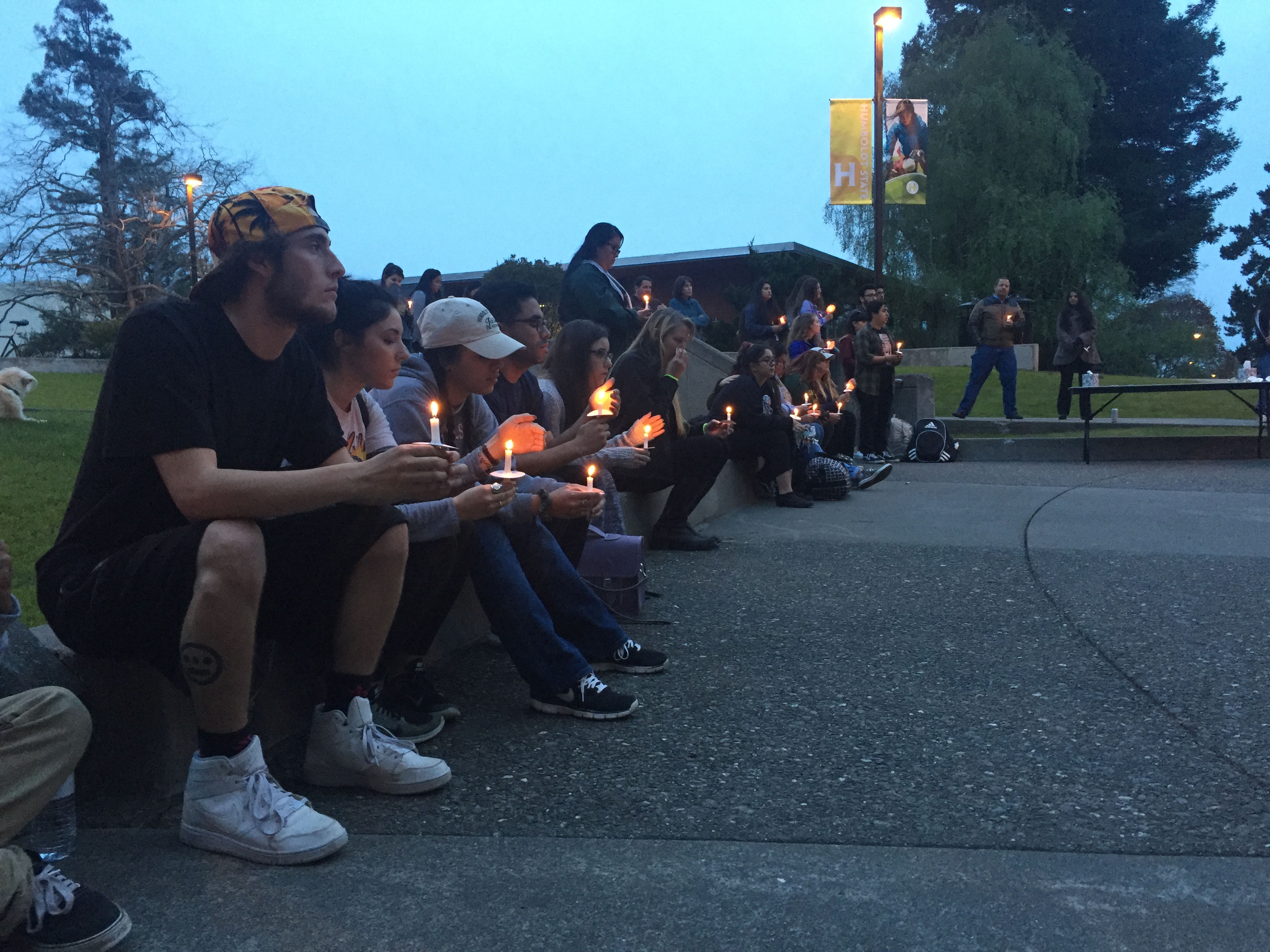
    An HSU student assembled a candle lit vigil to remember the 2014 Spring Preview bus crash.

    Yulisa Salas, a second year English and critical race and gender studies major, put together a vigil to honor the victims of the 2014 Spring preview bus crash that killed 10 people, including potential HSU students.

    “I put together the vigil for one of my friends who passed due to the accident, Adrian Castro,” Salas said. “There was no vigil last year for the incident so I decided to take matters into my own hands.” 

    IMG_3513
    Enter a caption

    In 2014, a Spring Preview bus filled with faculty, staff and potential HSU students from southern California was headed toward HSU when a Fedex truck collided into it. Salas’ friend and classmate, Adrian Castro, was one of the victims in the crash. Salas said she felt angry, hurt and disappointed that there was no vigil planned to remember and recognized those impacted by the bus crash.  According to Salas, it only took her a day to put together the vigil, relying on social media and the support of her friends and family.

    “I told myself there needs to be a vigil that recognizes those that were affected,” Salas said. “If HSU didn’t plan a vigil it just shows that HSU doesn’t care about their students, especially those who were affected by the crash that are now students.”

    The vigil started out with Salas speaking about memories she shared with Castro. She then opened the mic to those who wanted to talk and open up about the bus accident.

    Angie Flores-Cruz spoke about how the bus accident affected her. 

    IMG_3521
    Monica Ramirez speaking about how the bus crash has impacted her. Photo by Iridian Casarez

    “I take this experience not to let it hold me back but to push me to achieve,” Flores-Cruz said to the crowd. “I feel stronger to hear from other survivors, thank you for your support.”

    Many other survivors and friends of victims took the mic to express the way the bus crash impacted them and how it is still impacting them.

    Karina Rivas, an economics major, came to support her friend and roommate who was on the bus that crashed. Rivas was a freshman at HSU when the bus crash happened. She said when news broke out about the crash her parents called her worried about her. IMG_3516

    “I didn’t know that my roommate was a part of the crash until we became roommates,” Rivas said. “It’s very tragic what happened, so I came to show my moral support.”

    Salas said she hopes to continue to put together the vigil every year for victims and people affected by the crash.

    “It’s important for us and the school to recognize that this tragedy is still impacting lives,” Salas said. “It’s important for us to keep the memories and stories of those who have passed alive.”

  • Softball Field Inaccessible

    Softball Field Inaccessible

    By Danny Dunn

    One of the greatest aspects of playing sports is the ability to play in front of a home crowd. Unfortunately, Humboldt State’s top rated softball team has not been able to play a single game this season on their own home field.


    The team had to play their last home series in McKinleyville located about 5 miles north of Humboldt State University.  

    This did not prevent fans from coming out and showing their support for the softball team. Sydney Roberts, who plays second base for the Lumberjacks, said fans had

    creative ways to come out and watch the team.

    “In McKinleyville we had people ride up on horses to come watch our game,” Roberts said. “Locals love us, they support us, and we cannot have their support if we cannot play at home.”

    Roberts spoke on whether the team will be able to even play a home game at Humboldt this season.  

    “We cannot if it rains two days in a row at Humboldt,” Roberts said. “We are hoping to play our first home game against Chico on April 10th…we have already had to reschedule twice already with them.”

    Roberts went on to say how she would like to play at least a couple of home games at HSU in her senior year, and considering that the softball team is one of the winning teams on campus it would be great to play at home for the fans to see.

    “We do not lose at home,” Roberts said. “But we do not get the opportunity everyone else gets playing on their home field…it is harder to keep yourself pumped up when you do not have that home field advantage.”

    Breonna Bejaran, who plays catcher and 1st base for the lumberjacks, says that playing at home can really energize the squad.

    “We really feed off of the home crowd energy,” Bejaran said. “Something should have been done along time ago with the success of our team, not just this team, but past teams also…there  should be a field that is playable for us in Humboldt County…I would love to play here as senior at least once.”

    Pitcher Madison Williams expresses her feelings about not being able to play at home.

    “It is definitely frustrating having to play all of our games on the road,” Williams said. “But we cannot control the weather…Our home field is in bad condition and it would be dangerous to play on right now.”


  • 13 Jacks qualify to two prestigious Division I track meets

    13 Jacks qualify to two prestigious Division I track meets

    By Erin Chessin

    Track and field coaches Sarah Ingram and Scott Pesch were frustrated to find that very few of the athletes they entered into two Division I track meets made it.

    They entered  a total of 13 HSU athletes into two prestigious Division I track meets; the 90th Clyde Littlefield Texas Relays and the Stanford Invitational.

    “The ones we entered who didn’t make it had very strong marks,” Ingram said. “It’s really surprising.”

    Four women, Ariel Oliver, Alyssabeth DeJerez, Marisa McCay and Kori Gilley, qualified for Texas Relays, hosted by University of Texas in Austin. No men qualified for Texas Relays.

    Ingram and Pesch entered in the same four women they had entered into Texas Relays into Stanford Invitational as a backup in case their entries were rejected. Three more women were entered into Stanford Invitational. Two high jumpers, Ellie Earl-Rouse and Brailee VandenBoom, qualified.

    Ingram said distance events at Division I tournaments, such as the 800, the 1500, the 5k and the 3000 meter steeplechase, are highly competitive and are tougher to get into. When junior Tatiana Gillick did not qualify in the 1500 meters with her impressive 4:31, Ingram and Pesch were shocked.

    “That was like a slap in the face,” Ingram said. “If you have a better mark than somebody, you deserve to be there.”

    Both coaches expressed that division 1 track and field meets often favor division 1 over division 2 athletes when they receive the entries.

    Luckily, six males and four females made it into the entries for Stanford Invitational.

    Mario Kaluhiokalani, a sprinter on HSU’s track team, will be racing for the second year in a row at Stanford Invitational this weekend.

    “Last year I only made it for the 110 meter hurdles,” Kaluhiokalani said. “I’m hoping to get a provisional mark in both my events this weekend.”

    Kaluhiokalani will be running the 110 meter hurdles and the 400 meter hurdles at Stanford Invitational.

    While ten athletes will be competing in Palo Alto and three in Austin, Texas the rest of the track and field squad will be competing in San Francisco at the 2017 San Francisco Distance Carnival.

    The meet will be hosted by San Francisco State on Friday, March 31 through Saturday, April 1, 2017.

    One athlete is actually competing at both Stanford Invitational and San Francisco Distance Carnival. Junior transfer Corey Berner said he is looking forward to running the 100 and the 200 meters at Stanford and the 4 by 100 meter relay at San Francisco.

    “It’s definitely going to be a busy weekend. There’s going to be good competition at both meets,” Berner said.

    The sprinter is aiming to get pulled to fast times in his events since he will be running up against Division I athletes.

    “Stanford will definitely be my main focus,” Berner said. “The competition is there at Division I tournaments.”


    Clyde Littlefield Texas Relays

    1. Alyssabeth DeJerez led the way with another strong performance in the 400m hurdles. She finished 10th against top level division one competition. DeJerez finished in a time of 58.96.
    2. Ariel Oliver placed tenth in the Shotput throwing 44-00.00.
    3. Marissa McKay ran a 14.59 in the 100m hurdles
    4. McKay Placed 14th in the High Jump clearing 5-05.00.
    5. Kori Gilley saw her outing cut short when she was injured in the 300m steeplechase trying to avoid a fallen runner.

    Stanford Invite

    1. Teigan Eilers placed 5th in the Javelin throw with a toss of 56.05m.
    2. Also placed 13th in the High Jump, clearing 1.91m.
    3. Calvin Herman placed 13th in the 400m hurdles with a time of 54.26.
    4. Mario Kaluhiokalani placed 24th in the same event coming in at 56.29.
    5. Corey Berner placed 24th in the 100m dash with a time of 11.22.
    6. Ellie Earle-Rouse placed 6th in High Jump clearing 1.60m.
    7. Bailee VandenBoom finished 9th.


  • HSU faces $6 million budget deficit

    HSU faces $6 million budget deficit

    By | Andrew George Butler

    The who’s who of Humboldt State University gathered on April 4 at 10 a.m. to discuss the University’s budget deficit. The meeting was lead by the University Resources and Planning Committee, a sub-committee made up from HSU administrators, faculty, and students. The committee, known as URPC, works as a conduit between the CSU main office and HSU’s administration to help address and deal with budget issues.

    The URPC first addressed a charge made by Lisa Rossbacher, who was absent from the meeting. Rossbacher called for the URPC to balance the 2017-2018 budget, identify solutions to the recent drop in enrollment, and create a two-year plan for HSU’s budget. This plan is split into two phases.

    Phase one will take effect this coming year and will save HSU $1 million over the next year. Phase one will draw 83 percent, or about $800,000 from personnel cuts. Phase two will not be set in stone until the end of October, this year. However, URPC has discussed areas of the university open to cuts. Possible phase 2 cuts may include: $1 million from the Instructional/academic colleges, $250,000 from Student Services, $400,000 from Administrational costs, and $400,000 from Informational Technologies.

    HSU will face its eighth consecutive year of deficit spending. The deficit is expected to grow by $500,000 during the 2017-2018 year, to a staggering $6 million. In addition to a growing deficit, HSU is expected to see its second consecutive year of decreased enrollment; roughly 3.5 percent less students are expected to attend HSU during the 2017-2018 year.

    Furthermore, HSU expects to be 543 students short of its expected 7,603 Full Time Equivalent Student Enrollment, set by the CSU main office. Failing to reach this threshold could result in further cuts to HSU’s funding.

    The budget deficit continued to grow even as HSU’s enrollment rose during the first half of this decade. HSU simply spends too much money per student, and a solution to HSU’s budget deficit will include cuts to how much money is spent on each student’s education during their time at HSU according to URPC. HSU spent $15,810 per student during the 2015-2016 year. The average amount of money spent per student for other small CSU schools during that year was $14,339. Matching the CSU average would save HSU $5.7 million a year.

    These potential budget cuts will occur during Rossbacher’s new graduation initiative. The initiative calls for a doubling of HSU’s current graduation rate by 2025. This includes bringing underrepresented minority students and student beneficiaries of the Pell Grant graduation rate to even with the rest of HSU. UPRC did not explain how Rossbacher’s graduation initiative would coincide with budget cuts that affect students.

    Mark Rizzardi, faculty co-chair on the URPC, led much of Tuesday’s budget discussion. At the conclusion of the meeting Rizzardi said, “all the low hanging fruit has been picked, so it’s time to cut.”

    The URPC only briefly addressed the nearly $1 million athletic department deficit, and did not discuss any possible cuts to athletics. Read The Lumberjack next week for an in-depth look into the athletics deficit and the future of HSU athletics.

    *This story has been edited to fix the correct date for the meeting. From March 4 to April 4.

  • Breaking: Kyle Zoellner to be released following Pre-trial hearings

    Breaking: Kyle Zoellner to be released following Pre-trial hearings

    By Curran Daly

    23-year-old Kyle Zoellner will be released following the week long pre-trial hearing that took place this week.

    Judge Dale Reinholtsen decided after hearing four and a half days of testimony that the prosecution did not have sufficient evidence to proceed to trial.

    Zoellner was arrested and held on the April 15 stabbing death of 19-year-old Humboldt State student, David Josiah Lawson.

    The Arcata Police Department released a statement shortly after Judge Reinholtsen made his decision.

    “After five days of testimony, this afternoon a Superior Court Judge ruled there was insufficient evidence to hold Kyle Zoellner in the death of David Josiah Lawson.  The following are statements from Arcata Vice-Mayor Sofia Pereira and Police Chief Tom Chapman:

    Vice-Mayor Pereira: ‘My thoughts are with the Lawson family, our community and the students at HSU. We continue to grieve and search for answers to this senseless act of violence. The city and the police department’s focus must continue to remain on achieving justice for Josiah. I have been in communication with the Police Chief and I know our officers are continuing their work on this case. Once the investigation is complete the city will also review all aspects of our response to this tragedy. I have confidence in our police department’s dedication to solve this murder and I support their efforts to find the truth.’

    Chief Chapman: ‘The result of the preliminary hearing does not change the vigor in which we will continue to pursue this case. The men and women of the Arcata Police Department are committed to justice for Josiah. As shown by the sworn testimony at the hearing, this case is difficult. However, we will not stop our investigation. Our focus will remain on this investigation and the pursuit of justice.’”

    The Lumberjack will continue to provide updates as more information becomes available.

  • An HSU student’s seizure survival story

    An HSU student’s seizure survival story

    By Erin Chessin

    Ryanne Bailey in the hospital with her father, Mark Rivero | Denise Bailey

    Senior recreation major Ryanne Bailey was 17 years old when she woke up and could not recognize anyone, even her own parents.

    “That’s when they told me I had a seizure,” Bailey said.

    One minute Bailey was taking a shower, the next thing she knew she was riding in an ambulance on the way to the hospital.

    “I woke up and started pulling the IVs from my arms,” Bailey said. “I didn’t know what was happening.”
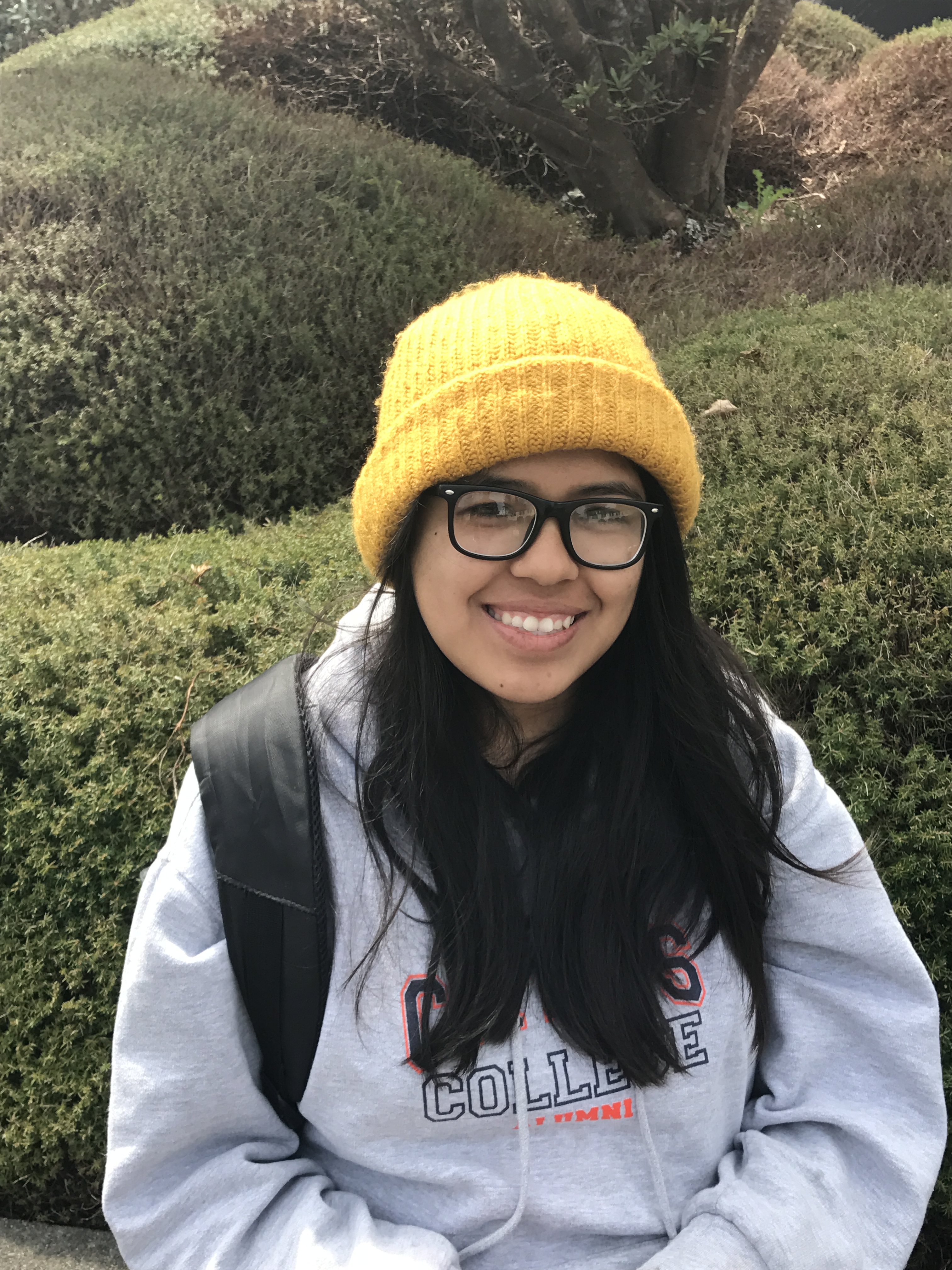
    Earlier in the day before the incident, Bailey had a busy schedule. She skipped breakfast, went to class and made an effort to catch up on school work. She had an extensive amount of homework to catch up on after being gone for a week and a half on a school-related field trip to Washington D.C. She didn’t get back to her hometown in Las Vegas until late Sunday evening.

    Without having much to eat that day, Bailey went to a two-hour long track practice, followed by another two-hour long Powder-Puff football practice. Strained and drained from the day’s activities, she took a nap at her grandma’s house while waiting for her parents to pick her up and take her home.

    At home, the demand of school work and the physical exhaustion from sports was taking a toll on her. She decided she needed a hot shower after dinner. It was around 10 p.m.

    That’s when things took a turn for the worst.

    “We heard something loudly banging against the wall, so I ran to the bathroom to see if she was okay,”   Bailey’s mother, Denise Bailey, said.

    The water was still running when she saw her daughter shaking uncontrollably in the bathtub. Her mother picked her up out of the shower and set her on the floor.

    Mark Rivero, Bailey’s father, is a retired firefighter. He had seen numerous people have seizures before in the 20 years he worked at the City of Las Vegas Fire Department. Still, his heart could not handle it when he witnessed his own daughter have a seizure. “This was by far the hardest seizure to watch,”  Rivero said.

    Bailey’s mother called 911. She waited outside for the ambulance to arrive, shaken by the culmination of events.

    “When Mark said she had stopped breathing, I stepped outside. I couldn’t watch my daughter die,” Denise Bailey said.

    Emergency personnel arrived to the family’s home in a matter of minutes. Firefighters were handling her when Bailey woke up and tried to reach to turn off the water in the shower.

    There are three possible outcomes that can happen to a person after they have had a seizure.

    Firefighters told Bailey’s parents she would either wake up and continue what she was doing, her brain would reset itself and she won’t remember anything that happened, or she will gain abnormal strength and act violently.

    Everyone was shocked to witness the 17-year-old display all three behaviors.

    Bailey tried to push the firefighters off of her. When she fell asleep again, they were successful in getting her into the ambulance.

    Then she woke up again during the ride. She tried to pull the IVs out of her arms. Ambulance personnel quickly stopped her and informed her she had a seizure and needed to keep them in.

    “I was so confused. I didn’t know what was happening,” said Bailey.

    Bailey was rushed into emergency care. Doctors ran an entire panel of drug tests on her, and conducted various tests throughout the next couple of days to figure out the cause of the seizure. All results of the tests, the CAT scan, X-Ray, MRI, and blood sugar analysis, came back negative. Even the MRI showed her brain was in perfect condition.

    A nurse relayed to Bailey’s parents that they were going to have to do a spinal tap on her in order to test for meningitis.

    Meningitis can have fatal results if not treated promptly, however Bailey’s parents were skeptical of the spinal tap. If done incorrectly, a spinal tap can cause permanent paralysis of the spine.

    Bailey’s parents allowed the doctors to administer the spinal tap. The procedure was the most painful experience Bailey has ever endured till this day.

    “It’s excruciating pain, and a slow process too,” said Bailey.

    The cerebrospinal fluid was tested for meningitis and came back negative. The family was relieved, but frustrated at the same time to still have no idea what caused the seizure.

    For the next two weeks, Bailey suffered adverse side effects from the spinal tap. She could not bend her knees, which made walking an agonizing pain.

    Bailey continued to go to school, her teachers showed understanding.

    HSU recreation major, Ryanne Bailey | Samantha Kerby

    Denise Bailey had not recovered from the emotional distress of her daughter’s seizure. For the next couple of weeks after the incident she slept in the same bed as her daughter every night. Whenever something drops on the floor, Denise is quick to rush into the room.

    “I’m a very protective parent. But when you have seen your daughter nearly die, you tend to be overprotective,” Denise Bailey said.

    Bailey has not had any more seizures since the one that occurred when she was 17 years old. Even at 22 years old, the possibilities of having another seizure in any moment at any time is daunting, but taking medication helps assure her that she is safe.

  • Writer Chris Abani visits HSU

    Writer Chris Abani visits HSU

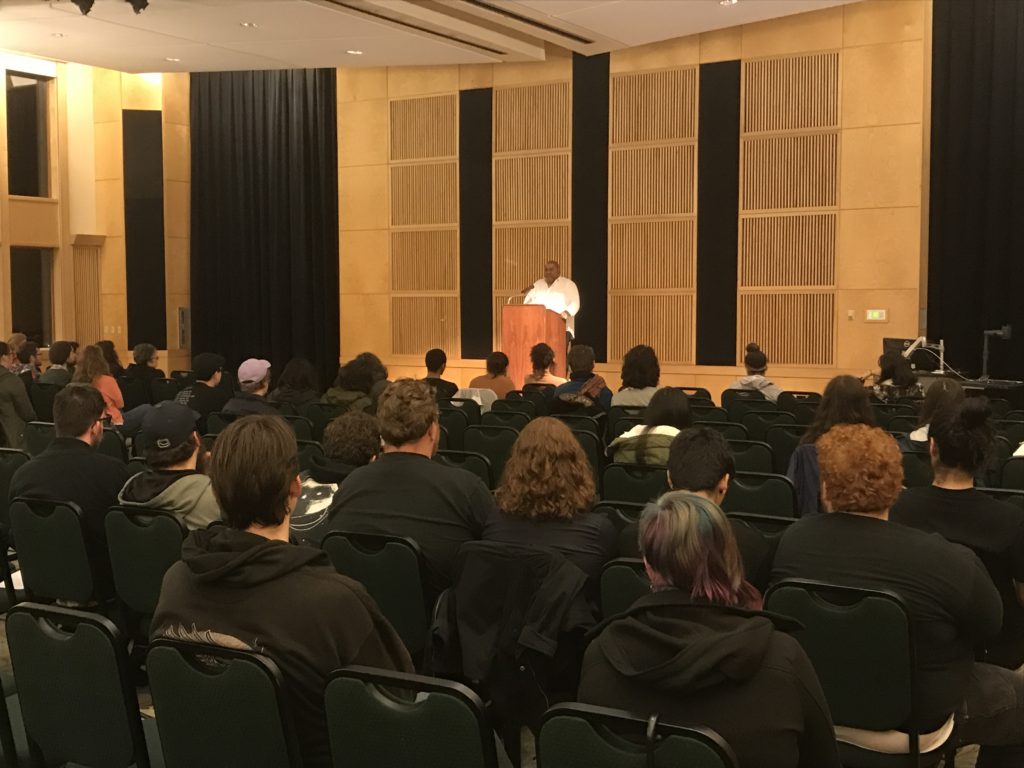
    Humboldt State University hosted radical author and poet Chris Abani for our Visiting Writer series on March 29. He visited a couple of writing-based classes and talked with students. He also held a reading and talk in the Kate Buchanan Room.

    Chris Abani | Andre Hscall

    “The classes are around writing, so I’ve been mostly discussion craft,” Abani said. “As well as addressing worries that writers have.”

    Chris Abani is a Nigerian-American author and poet. He is from Afikpo, located in in southern Nigeria. His most recent award-winning writing is his book “The Secret History of Las Vegas.” A suspenseful novel where a detective and a doctor must solve a crime while one is haunted by their past of betrayal during apartheid in Africa. This book won the 2015 Edgar Award for best paperback.

    The overall goal of Abani’s writing is to show readers the experience of those born and raised in the troubled nation of Nigeria.

    “I’m interested in people more than places,” Abani said. “Places show what distinct differences we have, but once you peel away those distinctions you’ll see how similar we all are.”

    Abani is known for speaking out against unjust governments. Abani was arrested three times in Nigeria for his novels and plays that were seen as an attempt to overthrow the government.

    He was released from jail in 1991, moved to the United Kingdom and then to the U.S. in 2001.

    “Everything that happens to us in life has an impact on our writing,” Abani said.

    Abani currently resides in the U.S. and is a professor at Northwestern University in Illinois. While in Nigeria, he attended Imo State University and earned a bachelor’s degree in English. He also earned a masters in gender studies at Birkbeck College in London and a masters in English at The University of Southern California.

    At the event in the KBR, was mainly a crowd of student writers. One of these students in attendance was senior English major, Nicolas Poulter. While actually interested in Chris Abani’s talk, Poulter had the incentive of extra credit as well.

    “It was interesting, and provoking to get to hear that perspective,” Poulter said.

    Students and other guests in attendance had the opportunity to ask Abani questions after his speech. Sophomore environmental studies major Joey Hajduk had the chance to ask Abani a question.

    “I asked him personally about his suffering in prison,” Hajduk said. “I was worried about not being able to connect, but Chris saw that, and he told me that everybody has a pain and that you can’t put pain in a hierarchy.”

    Technology, especially the smartphones that most people have with them on a daily basis have already changed the way people write and opened up a new realm of possibilities in storytelling.

    “All writing is so deeply linked to technology, language is a technology, writing is a technology and the internet,” Abani said. “Now there are more blogs than there are books.”

    A true fan of stories, being a storyteller himself. Abani loves different forms of stories such as television and movies.

    “Within a day I’ll watch shows like “Dating Naked”, “The Kardashians”, the new “24”, a documentary on National Geographic,” Abani said. “I am a big fan of story.”

    Abani’s point is that you can find story in everything, it’s all connected. From the architecture in Founder’s Hall to the various books in our Library.

    “Stories are everywhere,” Abani said. “Everything is a story.”

  • HSU’s head is in the clouds

    HSU’s head is in the clouds

    By Charlotte Rutigliano

    HSU has been discussing making the switch to the cloud network over the last year, in hopes to improve file access for students and increase storage space.

    Anna Kircher, who is the chief information officer for Information Technology Services, said currently students have 200 megabytes available on the user drives provided by the university, and about 15 gigabytes available through their school google account, though those 15 gigabytes include Gmail, Google drive and Google photos.

    “The university is at the point to either move to the cloud or buy more servers,” Kircher said. “It’s cheaper and better to move to the cloud then to buy more hardware.”

    Kircher said moving to a cloud network would allow for larger individual students files and office collection files.

    Switching to a cloud network may sound like a good idea to some, but for students like junior marketing major Jessica Rocha, it raises concerns.

    “I do have concerns about the safety and privacy of things stored in the cloud,” Rocha said.

    Kircher said the university has been spending a lot of time talking about security.

    “Two of the most important things to us are making sure that students only have access to their own files,” Kircher said. “And two, that this new system would not be hackable.”

    Kircher said the university will most likely decide the vendor based off of the level of security they offer.

    According to Kircher, who said the technology services budget is not going up, it would be less expensive to switch to the cloud network, though the end cost would depend on the vendor that the university chooses to go with.

    According to Kircher there are four different vendors that the university is looking into for switching to their cloud network, Drobox, Box.net, Microsoft One Drive, or Google.

    This switch would take place over the summer to be fully available in the fall of 2017.

  • Celebrating Culture and Success at the HSU Big Time

    Celebrating Culture and Success at the HSU Big Time

    The HSU Big Time, presented by the Indian Tribal & Educational Personnel Program, is a social gathering with dancing and cultural sharing events. What makes this event unique from other gatherings, is that it takes advantage of the campus to use this event as an educational opportunity for the community. Vincent Feliz, Chumash Master of Ceremonies, explained the songs and prayers during the event and introduced the dance groups from the Santa Ynez Chumash to the Tolowa Nation in Del Norte County. Each dance group also said who they are and where they come from, then lists the songs they sing. Along with the dance demonstrations, there were many cultural sharing events outside the arena that featured men’s and women’s gambling, basket weaving, carving, and a children’s tour of the fish hatcheries.

    Photo by Stella Stokes

    Feliz began the Big Time with a prayer with Julian Lang, a local Karuk storyteller. Then Feliz sang a grounding song with Lyn Risling, a local Yurok/Karuk/Hupa artist.When Feliz introduced the first dancers, the Maidu tribe, he explained they were one of the first tribes ITEPP invited to dance. They invited more tribes to dance and incidentally, Feliz said they decided to bring other California tribes. Chairs surrounded the dance arena in the West Gym, and each dance demonstration brought in a bigger crowd.

    After the Chumash singers finished, Feliz invited the ITEPP alumni and students who are graduating this year to the arena. He called out everyone by each name.

    “People wonder how we treat our introvert Indians,” Feliz said to the crowd. “We call them out.”

    A crowd of 30-40 people came, including some HSU faculty like Pimm Allen, who is one of the coordinators of the Big Time. They were met with a Chumash honoring song to thank them. Earlier that morning, ITEPP hosted an alumni breakfast to honor them.

    Photo by Stella Stokes

    Feliz emphasized the importance of  educated Indigenous people and the need for the Indigenous youth to succeed on a national and state level. On the HSU Fast Facts of the fall 2016 semester, there were a total of 89 students identifying as American Indian which makes up about one percent of the total student population. That population reflects the one percent of the national American Indian population in the U.S. at nearly three million citizens, according to the 2010 U.S. Census. The ITEPP’s mission is, “to facilitate and promote academic success and self-efficacy for primarily Native American Indian students at Humboldt State University.”

    Students in ITEPP like Bryce Baga and Adrian Romo would hang out at the Brero House, where ITEPP is located. They would study, talk to the advisors, or just hang out with other students. Baga also offers beading classes on his free time. He admits that being a double major in Native American Studies and Economics can be difficult.

    “It’s two completely different ways of thinking,” Baga said. “In my NAS classes, it’s all about community and connection. But in Economics, it’s all about-”

    “Supply and demand,” Romo said.

    “Yeah,” Baga said. “Just make money.”

    They were on the table to sell t-shirts to benefit ITEPP. There were more tables that featured non-profits and health programs from United Indian Health Services. The men’s gambling tournament was hosted by a newly founded non-profit called Ancestral Guard, whose goal is to teach Indigenous youth their culture. Founder Sammy Gensaw IV hopes to connect with Chile to fight for their water rights, just as the local tribes are fighting for water rights on the Klamath River. Having a student’s culture validated helps them succeed and help their communities, and the Big Time celebrates that.

  • HSU graduate making a name for himself

    HSU graduate making a name for himself

    By Morgan Brizee

    At just 2 years old Eddie Medrano and his four siblings were forced into the foster care system. Medrano is now a 22-year-old Humboldt State graduate, and soon to be USC masters graduate, who created and owns his own business. Medrano was in and out of eight foster homes between the ages of 2 to 5, and diagnosed with Langerhans Cell Histiocytosis tumors. He is now graduating from the University of Southern California with a master’s in business.

    “My mother had a drug addiction and was an alcoholic,” Medrano said. “My father was nowhere to be found.”

    They were taken into the foster care system after their mother left them home alone for three days. When Medrano was 6 years old, he and his oldest brother Jorge were adopted by the Medrano family. He finally felt like a normal kid after being adopted.

    “They gave me my first holidays, birthdays but best of all they gave me the feeling of unconditional love,” Medrano said. “They helped me with my PTSD, depression, ADHD and so many other things that I was finally living my dream childhood.”

    Medrano lost contact with his oldest sister Bonnie. His second oldest sister Lupita committed suicide at 23. Angel, his second oldest brother, was adopted to a separate family.

    Then, when Medrano was 9 years old, he was diagnosed with Langerhans cell histiocytosis tumors.

    Photo by Eddie Medrano

    According to the National Cancer Institute’s website, “Langerhans cell histiocytosis is a type of cancer that can damage tissue or cause lesions to form in one or more places in the body. Langerhans cell histiocytosis is a rare cancer that begins in LCH cells [a type of dendritic cell which fights infection].”

    Medrano’s basketball coach was the one who helped catch the signs of cancer by noticing that Medrano was limping during a game. The doctors found tumors in Medrano’s hips and skull after performing x-rays and Magnetic Resonance Images.

    “I went through countless radiation treatments, surgeries and chemotherapy treatments,” Medrano said.  “I felt cheated and because I was brought up with Catholicism, the only person I could ask why me, was God.”

    Medrano didn’t understand why get got cancer. He was afraid of everything being taken away from him after finally getting the life he wanted.

    “I had no control of what was going on but luckily I started improving slowly through countless treatments and surgeries, I was on my way to remission,” Medrano said. “When I was young I was blinded by the pain and anger to see the amount of support I had throughout my battle.”

    After graduating high school Medrano went on to Cuyamaca Community College in San Diego. He was on their track team and received an AA degree in communication. He then transferred to Humboldt State and joined the track team, but his major changed.

    “After one semester, my passion for business directed me to work more in class in hopes of attending USC Marshall’s MSEI [Master of Science In Entrepreneurship & Innovation] Program,” Medrano said.  “Whether it was selling things on craigslist, working as a marketing employee or starting my own company, business was something that has always been in my life.”

    Medrano had a love for skateboarding and figured that he could find a way to make a business out of it. Hunter Fine, Humboldt State communication instructor, was not only an instructor to Medrano but also a friend. Fine also loved skateboarding like Medrano.

    “He gifted me a poster of Eazy-E that featured him with a local venice brand deck,” Medrano said. “I knew right then and there that I had to continue my dream of starting a skate brand company.”

    Medrano saw skateboarding not just as a hobby but a business venture. It wasn’t until after he graduated HSU and started at USC Marshall’s MSEI program that he learned how hard it was going to be to turn his dream into a reality.

    “It wasn’t that easy, yeah I had all these great ideas and designs, but as my professor for the feasibility class at USC, Albert Napoli would say, what problem are you solving?” Medrano said. “I took a step back, visited some local skate parks in Long Beach, where I currently live and just watched the skaters until something enlightened me.”

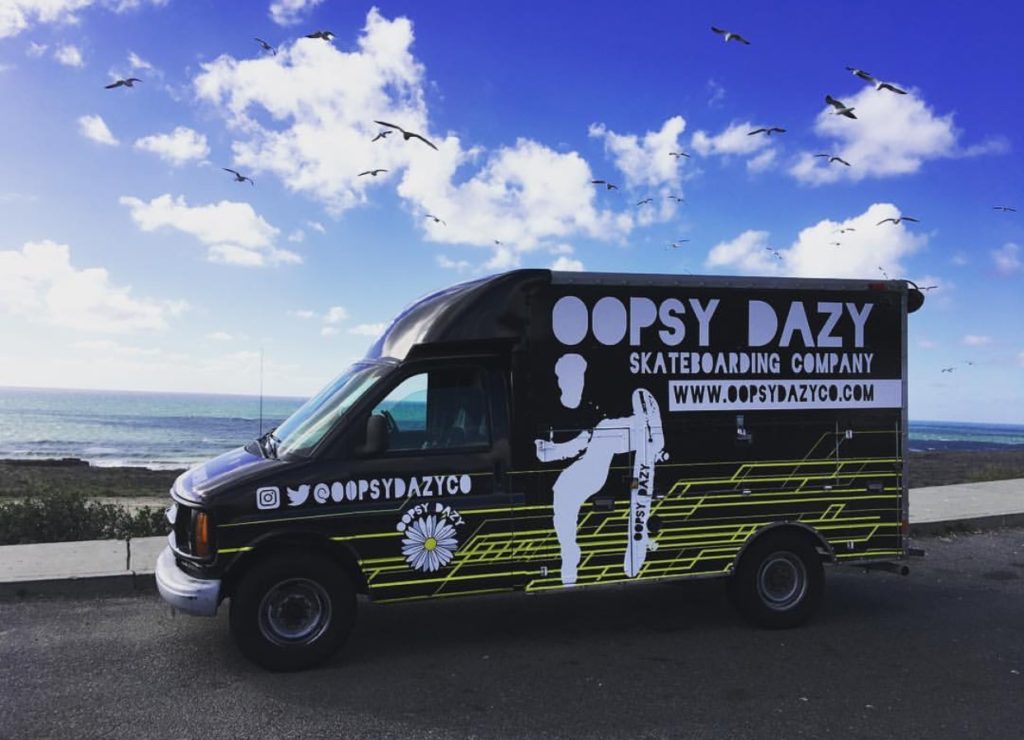
    Medrano learned after watching the skaters for hours that the skaters boards were snapping or getting damaged. The skaters would have to stop skating until they found a shop to get their skate boards fixed. His business would be a mobile truck to help the skaters fix their boards and get back to skating. The mobile truck is available in Los Angeles and San Diego at skate parks.

    “This is where OOPSY DAZY Co. comes in,” Medrano said. “We provide on-site products through our mobile store but overall we fill that huge gap and problem of distribution that typical skate-shops create.”

    Medrano saw skaters needing a place to fix their boards on the spot immediately at the skate parks so they don’t have to wait to get back on their boards. He noticed that boards can break down easily after hours of skating and that wax for the boards were hard to find also.


  • Student Strategies: Office Hours

    Student Strategies: Office Hours

    By | Onaja Waki

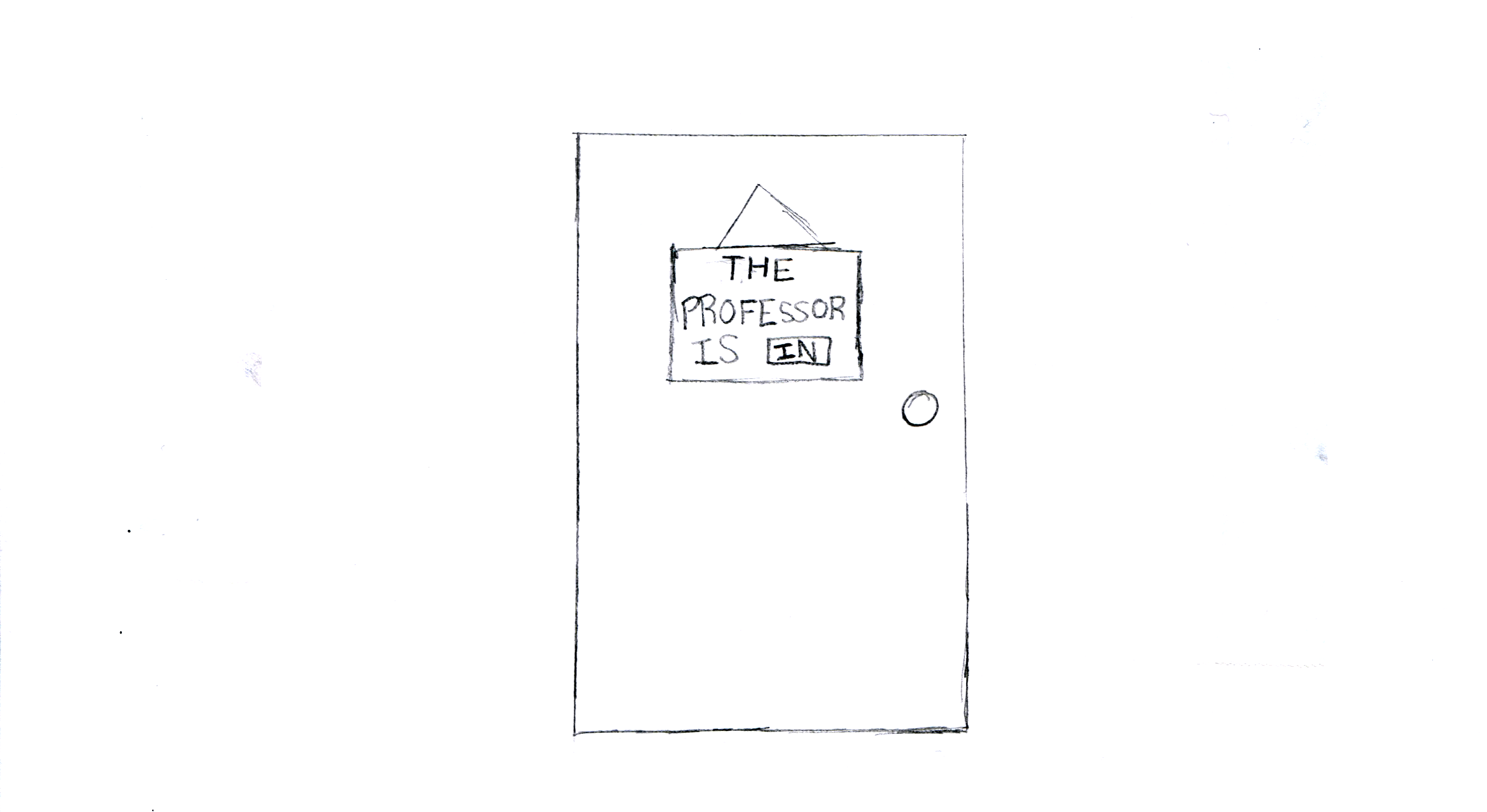
    There may be times when students need that extra one on one time with their professor for things like making up assignments and exams, discussing grades or getting clarity on homework or a project. These are the reasons professors offer their students office hours. Most professors and lecturers have the days and times on their syllabus. However, not all teachers abide by their assigned office hours which sometimes makes it a hassle for students to meet with their teacher.

    There are a few HSU professors that some students claim are hardly available during their office hours. However, when trying to get in contact with some of these professors for an interview they never responded.

    In addition to reaching out to some of the teachers who students feel aren’t always at their office hours, a lot of HSU teachers who are always at their designated office hours responded with confidence about their abidance to their listed times.

    Dan Faulk, a political science professor said that his students can always find him in Founders Hall room 118, and that he’s available even when his office hours are over.

    If you asked the teacher across the hall from me, you would discover that not only am I at my office for my office hours, but that I stay until way past my office hours, if there is a line of students outside my office door, or if students want to continue a conversation past normal office hours,” Faulk said. “My office hours are always right after class, so I am always in my classroom or at my office after class.”

    Spanish professor Anna Montoya said the most reliable way to set up a meeting with her is through phone or email, and that she is always open to working with students on times to meet. “The best way to get a hold of me is through email or phone,” Montoya said.“ I’m also open to setting up a time to meet.”

    Faulk and Montoya are some of the many professors here at HSU who abide by their office hours making it easier for students to meet with their teacher when needed. But for students who may experience the opposite with their professor, they can

    use some of these strategies students have used while on their academic journey here at Humboldt State:

    Samantha Pincus

    Major: Forestry Wildland Fire Management Major

    “I’ve found that emailing them with two different times during their office hours that I know I can meet up works and they’ll choose one,” Pincus said. “Even though it’s inconvenient to set up a meeting, it guarantees that they’ll be available.”

    College of The Redwoods Student Naiomi Leitu:

    Major: Nursing

    “I usually follow them after class and ask them to answer my questions right away,” Leitu said. “Or I email them on their personal email!”

    Yadi Cruz

    Major: Criminology and Justice Studies

    “Usually emailing them before showing up to their office hours, making an appointment with them, or asking them in person what time they’re going to be there,” Cruz said.

    Tre’von King

    Major: Business Management

    “I try emailing them ahead of time. Some teachers don’t go to their office hours because no one shows up,” King said. “If you let them know in advance then they know when and where to be.”

    Jhsiri Massey

    Major: Art Education

    “Email the shit out of them until it’s damn near annoying,” said Massey.

    Alby Alawoya

    Major: International Business

    “I’ve had that problem in the past and honestly I just called my teacher out in front of the class,” Alawoya said. “I also left a note on the door that said ‘students look up to you, and you’re example of keeping your word makes a difference.’ After that my professor sent an apology email to the entire class.”

    Treanna Brown

    Major: Criminology

    “I don’t have any strategies that could get them to show up to their office hours,” Brown said. “But I do think that they should make reasonable office hours. As students we aren’t as flexible as them. We work 9-5 jobs on top of however many units we have to take during the semester. Our campus is suppose to be the place where professors are more engaged but I don’t see that as much as I did my freshman year.”

    Cynthia Godinez

    Major: Psychology “I don’t think I’ve had that issue,” said Godinez. “All the professors I’ve had are good with meeting with students, and if they can’t make their office hours they’ll reschedule for another time. But I think a good strategy to prevent teachers from missing their office hours could be to just talk to them and suggest that they actually be there. Or maybe talk to someone that runs their department so they can figure out why that professor can’t make their office hours.”  

  • The Spring Deal-Breaker: Midterms on the day after break

    The Spring Deal-Breaker: Midterms on the day after break

    By | Erin Chessin

    Earlier this month, HSU students enjoyed a much needed week long spring break, but not everyone was relaxing.

    While classes may have adjourned for a week, school work continued in motion. Students said they spent the free week studying for midterms because they were scheduled on the day they came back from the break.

    Nicole Heighes is a senior psychology major at HSU. Heighes had a midterm on the Monday after spring break and a speech in her senior seminar the day after

    “It defeats the purpose of spring break when professors place midterms on the Monday or Tuesday after the break,” Heighes said.

    She spent hours studying over the break, going over study guides and preparing for her speech.

    “You need a few days after Spring Break to get back into school-mode,” Heighes said.

    Daniel Burrell, a biology professor at HSU, said he always considers the break when planning his midterms.

    “I like to grade midterms over the break and thus plan my midterms before the break,” Burrell said.

    He believes stepping away from schoolwork allows students to maximize their relaxation time.

    “I feel that students prefer to finish their exams before break so they have the break to relax,” Burrell said.

    Stephanie Toste, a senior business marketing major, typically has lots of homework throughout the week. Like Heighes, she had a midterm on the Monday after spring break and found herself using the break to study.

    “Luckily I didn’t have any homework to do after the break, but I had a midterm the day we got back,” Toste said. “I prefer to have midterms before the break because that week is dedicated to getting a break from school.”

    Some benefits come out of having midterms scheduled after spring break. Toste said that without class interrupting study time, students might be able to focus more on their midterms. “On the other side of things it allows students to not stress about going to class while trying to study for midterms,” Toste said.

    There are seven weeks of the spring semester left. With no more breaks aside from Cesar Chavez Day coming up this Friday, studying and school work is in full swing till the end of the semester.

  • HSU students share their thoughts on the tuition increase

    HSU students share their thoughts on the tuition increase

    Jacqueline Gomez, junior, engineering "It was like a slap in the face because they're not telling us where the money's going. And I know Lisa [Rossbacher] got a salary increase. So she can get a salary increase, but we have to pay more tuition?"
    Jacqueline Gomez, junior, engineering “It was like a slap in the face because they’re not telling us where the money’s going. And I know Lisa [Rossbacher] got a salary increase. So she can get a salary increase, but we have to pay more tuition?”
    Brian Taylor, freshman. "If it was going somewhere to actually improve my time here, that'd be okay. But I'd want to know exactly where the money is going. I obviously don't want to pay the extra money because I'm already going to have a lot of debt for four years of something I don't even necessarily want to do, but I have to do because that's what society has put in front of me.”
    Brian Taylor, freshman. “If it was going somewhere to actually improve my time here, that’d be okay. But I’d want to know exactly where the money is going. I obviously don’t want to pay the extra money because I’m already going to have a lot of debt for four years of something I don’t even necessarily want to do, but I have to do because that’s what society has put in front of me.”
    Dèsha Arthur junior computer science. "I don't think it's justified. I don't think it's valid. The benefits that it's going to bring - I don't think the students think it's worth while to charge us more. If you're raising tuition you should be benefitting the students more.”
    Dèsha Arthur junior computer science. “I don’t think it’s justified. I don’t think it’s valid. The benefits that it’s going to bring – I don’t think the students think it’s worth while to charge us more. If you’re raising tuition you should be benefitting the students more.”
    Sarah Dunn, junior, religious studies. "I just think it's bulls**t because it's not going to fund something worth funding. No one - no student at least - is going to benefit from it. The CSU system just seems as corrupt as the government that runs it.”
    Sarah Dunn, junior, religious studies. “I just think it’s bulls**t because it’s not going to fund something worth funding. No one – no student at least – is going to benefit from it. The CSU system just seems as corrupt as the government that runs it.”
    Khalil Robinson,senior, zoology and biology. "My biggest issue is that there isn't enough transparency with what they're doing with the money going towards tuition. They say we need it to build facilities to get more reach with the students. But then when the time comes we're like 'where is it? Why aren't we getting longer library hours? Why do people in the dorms have to pay for toilet paper?'”
    Khalil Robinson,senior, zoology and biology. “My biggest issue is that there isn’t enough transparency with what they’re doing with the money going towards tuition. They say we need it to build facilities to get more reach with the students. But then when the time comes we’re like ‘where is it? Why aren’t we getting longer library hours? Why do people in the dorms have to pay for toilet paper?’”
  • Criminal Justice Dialogue

    Criminal Justice Dialogue

    By | Iridian Casarez

    When Vanessa Vrtiak started volunteering at the Humboldt County Correctional Facility, she noticed that the inmates didn’t have many resources needed for success after release.

    Vrtiak is a graduate sociology student at HSU. Vrtiak coordinated and organized the Criminal Justice Dialogue. The dialogue centered on discussing and identifying challenges and resources related to currently and formerly incarcerated people. (jump)

    “I organized the event because there is a need for support services for people impacted by the criminal justice system,” Vrtiak said. “It’s supposed to be a correctional facility meaning we’re going to help you.”

    Hector Verdugo speaking to correctional officers and law-enforcement at the Criminal Justice Dialogue. Photo courtesy of Vanessa Vrtiak.
    Hector Verdugo speaking to correctional officers and law-enforcement at the Criminal Justice Dialogue. Photo courtesy of Vanessa Vrtiak.

    Vrtiak now works at the Humboldt County Correctional Facility as the programs coordinator for reintegration work. She helps incarcerated people get the resources they need to succeed while they are in jail. She helps them find a ride home when they are released, a job, and housing. According to Vrtiak, people who have gone to jail often have trouble finding work and housing when they are released. A study by Urban Institute found that only 45 percent of formerly incarcerated men are employed eight months after they are released from prison.

    “When people go to jail they are forgotten about and when they get out they’re still being punished,” Vrtiak said. “These are people who deserve second chances.”

    Vrtiak said that incarcerated people are a part of the community. If the community invests in them they improve the community as a whole.

    “I’m a firm believer in helping incarcerated people get better,” Vrtiak said.

    Vrtiak worked alongside other sociology students and the Sociology, Criminology and Social Justice club to organize the event.
    Ian Kochinski is a sociology major at HSU and the president of the Sociology, Criminology and Social Justice club at HSU. Kochinski was approached by Vrtiak to help organize the dialogue. Kochinski had been interested in helping with the dialogue since day one.

    “Prisoners are locked in a hole and we hardly ever see them so it’s hard to empathize with them and address the inequalities they face,” Kochinski said. “I think they are deserving of a little more attention.”

    The dialogue was a week long discussion filled with guest speakers who were impacted by the justice system. Hector Verdugo is part of Homeboy Industries, a gang intervention program centered in Los Angeles. Verdugo came to HSU to speak at one of the discussions. He spoke about what life was like as a gang member in Los Angeles and the trauma he faced.

    The housing reentry roundtable talking about housing facilities in Humboldt county. Photo courtesy of Vanessa Vrtiak.
    The housing reentry roundtable talking about housing facilities in Humboldt county. Photo courtesy of Vanessa Vrtiak.

    “I saw a lot of things that went on in my house like overdoses and people getting shot,” Verdugo said. “I was scared but I had to act tough.”

    Verdugo said he met the founder of Homeboy Industries as a gang member ready to change his life.

    “I want to give an understanding that gang members are people that just need to heal,” Verdugo said.

  • The Vote is In, Tuition Goes Up

    The Vote is In, Tuition Goes Up

    By | Maricela Wexler

    On March 22, the California State University Board of Trustees voted 11-to-8 to increase student tuition for the 2017-18 academic year by $270 for undergraduates.  There are over 100,000 more students enrolled in the CSU system today than in 1985 and concurrently funding has decreased by 2.9 percent. The state’s gradual abandonment of CSU funding commitments has pressured the Board of Trustees to find alternative financial support for institution services.

    The recent vote came as a blow to students and their families statewide who are already struggling with the costs of education.  The CSU system is a public institution that relies on state funding to provide high quality education for its students. (jump)  With diminishing state support, universities increasingly rely on students and their families to fill the void.

    An increase of $270 for the 2017-18 academic year is especially tolling for the large number of low-income students currently enrolled in the CSU system. According to a report commissioned by CSU Chancellor Timothy White, 1 in 10 CSU students today experience homelessness during their college career and one in five do not routinely have enough food. Amidst rising living costs, the state of California is investing $6,888 per student in the California State University system as opposed to the $11,607 it invested in 1985.

    The recent Board of Trustees decision strengthens pre existing barriers to higher education for current and prospective low-income students. Additionally, the quality of education students receive is compromised due to insufficient resources. As detailed in the California Faculty Association Spring 2017 report, “Equity Interrupted”, instead of providing a system designed to maximize access and quality for the benefit of the state of California, CSU’s are shrinking access to higher education because of increased tuition, and failing in its duty to support the new generation of CSU students so that they will help our state prosper in the 21st century.

    Cost of tuition is not the only thing that has changed in California over the last 30 years. According to the CFA report, the CSU had over 150,000 more students in 2015 than it had in 1985, a student body increase of 64 percent over those 30 years. In 1985, 63 percent of the CSU student body identified as white, and only 27 percent identified with another ethnic group. By 2015, this changed to 26 percent and 62 percent, respectively. CFA Associate Vice President Dr. Cecil E. Canton said in front of the State Assembly in 2016, “as the student body of the CSU became darker, funding became lighter.”

    Students around the state have been advocating for the CSU system to reclaim its title as the “people’s university” by demanding  free, safe, inclusive, and quality higher education. Students opposing tuition hikes are now moving attention towards the updated budget proposal to be submitted by Governor Jerry Brown’s office this May. Those fighting tuition hikes have not lost hope. There is potential for the Board of Trustees to vote against tuition hikes in the future, which could put pressure on the state to increase the education budget. Other proposals and bills have surfaced, including Assembly Bill 393 which would prohibit California State University and the California Community Colleges from increasing tuition and any mandatory student fees until the end of the 2019-2020 school year.

    Student groups currently focusing on this issue at Humboldt State University include: M.E.Ch.A., HSU Green, I.N.R.S.E.P., Double Dare Ya, Humboldt Unity Coalition Front, and Associated Students of HSU, and Power Up!. To find out more about the recent tuition hikes, relevant upcoming legislation, and how the CSU Board of Trustees operates, visit the Cal State website.

    Maricela Wexler submitted this piece on behalf of Power-Up! A student advocacy group at HSU. Power-Up!

    Photo of HSU’s Power Up! members discussing organizing strategies and tactics to address unequal access to higher education. Photo courtesy of Maricela Wexler
    Photo of HSU’s Power Up! members discussing organizing strategies and tactics to address unequal access to higher education. Photo courtesy of Maricela Wexler
  • Editorial: Where is our President?

    Editorial: Where is our President?

    By | The Lumberjack Editorial Board

    Oh where, oh where, oh where in the world is Humboldt State University President Lisa A. Rossbacher? President Rossbacher has been at best unavailable, and at worst dismissive and non communicative with The Lumberjack. The Lumberjack works to engage with and provide a voice for the HSU community.

    By deciding not to engage with The Lumberjack, Rossbacher is deciding not to engage with her campus community.
    As the president of Humboldt State University, Rossbacher is in charge of supporting the campus community. A key component of delivering that support is communicating with and being available to the campus media.

    Just like any governmental official, Rossbacher is held accountable to the public through the media.

    The Lumberjack has time and time again reached out to Rossbacher for comments on the ongoing athletic deficit, the recent tuition hike, and even parking with not one response.

    The Lumberjack is not only a media outlet but a mandatory class for all Journalism majors. Shutting out The Lumberjack also shuts out the 40 students who take the class every semester from having an opportunity to complete well-sourced, informative stories.

    In doing this, she fails to reinforce HSU’s mission to support its students educational opportunities.
    Failing to communicate with the media distorts the facts, it leaves people confused, and it fails to promote transparency — the chief responsibility of a community’s leader.
    On occasion, we students gather and sing, shout and even march to support the issues that are important to us; however, the one thing that has been missing during all this time is the voice of our university leader President Rossbacher.
    The Lumberjack staff would like to hear from President Rossbacher. The student body deserves a chance to hear from the president within the pages of its own, historic newspaper.
    We need a president that is present.

    One that shows up for the student body not only in making policy, but in communicating what steps, if any, are being taken to protect students and Humboldt State University’s values.