The Lumberjack


Students Serving The Cal Poly Humboldt Campus and Community Since 1929

Tag: HSU

  • I don’t tell people I’m autistic. I’m trying to change that.

    By Griffin Mancuso

    When I was 14 going into my freshman year of high school, my mother enrolled me with a new therapist shortly before school started. My parents were concerned about the transition to high school and wanted me to have a support system. I also went to my hair stylist right before so that I’d look presentable for the first day of school.

    Just after getting my modernized Karen cut trimmed and getting in the car to go to my appointment, my mother turned to me and told me I was diagnosed with autism spectrum disorder (ASD) at four years old. She didn’t want to confuse me when I was younger and didn’t want the therapist to tell me first.

    I was livid, but somehow relieved. I finally had a reason for the continual failure to connect with my peers as a child; I had an answer to the “why?” that had plagued me since I started my education. I had a reason, which meant I had a path forward.

    Besides telling the entire campus I am autistic before even getting into this article, it’s normally something I don’t bring up. I had witnessed how neurodivergent people were treated throughout my childhood, and my greatest fear was being associated with them. I didn’t want to be “special.” I hated being talked down to by adults and peers. I was infantilized and dismissed until I eventually figured out how to pass as neurotypical.

    When I tell people I’m autistic, I’m usually met with surprise. I’m ashamed to say that I feel a bit relieved when I’m told that I don’t seem autistic or that they never would have guessed I was. Internalized ableism is a hell of a beast. I want to embrace my autistic identity, but I also want to blend into neurotypical society. Letting myself unmask means less built-up stress and being able to get things done, but blending in means having friends and job opportunities.

    With the life experience I have now, I have found that there is a lack of education on ASD among the general public and the medical field. I have been assessed for ASD twice because a therapist I had a few years ago didn’t believe I was autistic. Since autism assessments are based on outdated research, I was genuinely afraid that the psychologist doing the test wouldn’t believe me either. I’ve been met with hospital staff declaring me neurotypical after two minutes of knowing me.

    An autism assessment is almost traumatic in and of itself. There is no established test for older children and adults. The current test is made for young children and involves playing with toys and reading picture books. Having to play pretend with Barbies at 17 years old to prove you’re autistic is a little humiliating. I stomached the preschool voice that all adults use with autistic people and whatever juvenile task I was given to prove that my experience was real.

    I don’t want my autism to be defined by suffering and shame. I try to make connections with other neurodivergent people and allow myself to use resources that will help me. Being a part of a community has helped me cope with the stress of blending into neurotypical society. I still put on the mask when I go about my day, but I now have times when I can unwind with people who understand my experience.

    Autism has become much more visible in mainstream media since I was younger. There are autistic social media influencers and shows with autistic characters. While we aren’t quite there yet as a society, I have seen monumental progress in the normalization of autistic people. We now see a wider diversity of experiences and, with new social media platforms, we can see those experiences in everyday life.

    Our society was not made with neurodivergent people in mind. Being neurodivergent can look different for every person, and who are we to decide who gets to have the label and who doesn’t? Neurotypical people haven’t taken me seriously even with a diagnosis. 

    One of the biggest contributors to internalized ableism is worrying about what the majority thinks; worrying that the autistic community won’t be taken seriously because of your individual experience. You don’t have to prove to anyone that you are autistic, nor do you have to tone yourself down to make everyone else comfortable. You are allowed to put a label on your experience so you don’t have to continue asking yourself, “Why?”

  • What you need to know about the 2024-2025 FAFSA Form

    What you need to know about the 2024-2025 FAFSA Form

    by Carlina Grillo

    One soft launch and a three month delay later, the revamped 2024-2025 FAFSA form has officially opened for submission. Dubbed the, “Better FAFSA, better future,” FAFSA.gov was made available 24 hours a day on January 8, after a tedious waiting period. 

    According to the FAFSA website, for most financial aid programs in California, the application is due no later than April 2, 2024. Along with an application submitted, the Cal Grant requires a school-certified GPA. 

    Historically, FAFSA has always launched on Oct. 1. This year, tensions were high as FAFSA waited until two weeks before the form was released to announce their availability date as Dec. 31. During this time, the website headlined with words like “soft launch” and “available periodically.” Community response to this change was overwhelmingly negative. 

    The comment section on the FAFSA Instagram @federalstudentaid is constantly streaming with complaints from customer service being unresponsive to the dashboard not refreshing. 

    “No one’s getting a Pell Grant if we can’t actually fill out and submit our FAFSA forms,” one commenter said . 

    “The new FAFSA form will also help 1.5 million more students receive the maximum Pell Grant amount,” according to the federal student aid instagram account. 

    Finally, if you have a parent contributor who isn’t exactly tech-savvy, make sure to have them on speed dial for their inevitable questions. The form may have gotten simpler, but it’s not always fool-proof.  

    The Cal Poly Humboldt financial aid office was unavailable for comment at the time of this article.

  • Cal Poly Humboldt charges non-refundable $100 deposit to apply for on-campus dorms

    Cal Poly Humboldt charges non-refundable $100 deposit to apply for on-campus dorms

    by Christina Mehr and Jasmin Shirazian 

    If you were considering living on campus next year, submitting your housing application just got expensive. The university is now charging a $100 nonrefundable application fee to apply to live in student housing. While this application fee is nonrefundable, it does not ensure housing for students who apply.

    According to Cal Poly Humboldt housing, the $100 housing application fee is not an additional cost to students. It is treated as an initial deposit and is credited towards the housing and meal plan charges. 

    “We had to reinstate the application fee because we had too many students completing housing applications and holding spaces who weren’t serious about living on campus, preventing other students who did want to live on campus,” said Bria Kupras, a representative for Humboldt Housing & Residence Life. “Currently, the application fee is nonrefundable.”

    Once admitted into student housing, that $100 deposit will go to housing and meal plans. 

    For those students who are Pell Grant eligible, with verification from financial aid, they could receive a waiver. If a student is struggling to come up with the payment, another option would be the short-term loan program through Student Financial Services.

    Skylar Rawitch is a first-year psychology major living in the Cypress dorms.

    “The fee has definitely gotten me thinking about the worth of it,” Rawitch said. “I don’t think that it is fair, especially because the payment fee does not guarantee you housing. If it was optional to pay and guaranteed you housing… I may feel differently.” 

    “Submit your online application and pay the $100 nonrefundable application fee. The $100 will be applied to the housing and meal plan charges, unless the application is canceled where the application fee will be forfeited,” the university’s official housing website states.

    The application fee seems to be an incentive for applicants to only apply if they are seriously considering living on campus.

    “How is it in the best interest of a school that’s supposed to take care of their students and keep them safe to charge them even more when people already are struggling to afford it?” Rawitch said. “They aren’t getting the money back if they do not get housing, and for some people that $100 could be gas money, grocery money, etc., and they would be losing out on that because they were applying for something that [isn’t] guaranteed.”

    Emma Sundberg is a molecular and cellular biology major in their first year at Humboldt. They currently live in Campus Apartments. 

    “I think it’s awful having us pay more to apply when we already have to pay so much,” Sundberg said. “There is no need to spend money on an application.”

    Jess Carey, a biology major in their junior year, has also faced obstacles due to the fee. The application fee has deterred them from applying despite needing it due to housing insecurity over the summer. 

    “I understand that the whole point is to allow the school to get a more accurate idea of how many students to plan for,” Carey said. “But on the other hand, creating yet another barrier to accessible housing stretches the already weak trust of the students in our administration to meet our needs and encourage a livable, desirable college experience. My trust in the administration has been damaged even more from this situation.”

    Kimberly Alexsandra, a sophomore journalism major, has experienced the dorms of varying communities on campus. 

    “I could see why the application fee is necessary, due to the chaos created by the projected overflow of students that applied for housing last spring that didn’t end up attending, which left the school with a worse rep and vacant dorms,” Aleksandra said. “$100 right out of pocket is too much for me and I’m sure others could relate, and for it to be nonrefundable is crazy. As a student who’s lived on campus for two years in different locations, I really don’t think anything about on campus housing is realistically credible enough for a nonrefundable application fee to be needed just to apply.” 

  • Students should support the CFA strike

    by Alexandra Berrocal

    First, they came for our housing.

    Then, they came for our alternative housing students.

    Now, they are coming for our professors.

    When is this going to end?

    At this time, it is easier than ever to develop an ‘us versus them’ mentality. However, we need to remember that students and professors are all in this together. When we stood up for the right to basic housing last year, professors stood with us. When students living in their vehicles were, for heaven’s sake, cruelly kicked out of the school parking lots, professors stood with us. Professors have always been our allies in a world that seems to be squeezing us tighter and tighter. 

    Let’s make this clear: the world is becoming a harsher and harsher place to live, and universities, unfortunately, are not exempt from this. Students can still struggle throughout their college experience for all kinds of reasons. Despite the university attempting to make it easy for students to access mental health resources and disability accommodations, accessing those services can still be hard for people. We need them now more than ever.

    I personally cannot justify the university only giving staff a month of parental leave. How can anyone justify leaving a new baby without their parent at daycare after only a month? Professors should have a semester of parental leave, at least. That should just be common sense, and I don’t understand how that isn’t the law of the land. I also cannot believe that some of the lecturers who are so willing to share their expertise with the students are not making liveable wages. This is unconscionable. I believe that college professors and lecturers deserve the greatest respect because they pass down important knowledge and educate the new generation. This respect should extend to transgender and non-binary staff. It is basic common sense that there should be access to gender-neutral bathrooms for faculty. Students these days claim to care about trans rights, yet fail to advocate for their leadership’s rights to these same facilities. Universities claim to be bastions of progressive ideals yet they pay lip service to trans students, while simultaneously neglecting their own faculty. Speaking of faculty, my former faculty advisor was swamped with work that was completely unrelated to teaching last semester and I know that he is not alone. My advisor has had to do more administrative work lately with less time to focus on her passion for teaching. From my point of view, that’s pretty crazy – and not in a good way.

    When we protested, our teachers stood with us. It’s time for us to stand with them.

  • CFA settles and calls off strike after one day, Teamsters settle over weekend

    CFA settles and calls off strike after one day, Teamsters settle over weekend

    by Andres Felix Romero

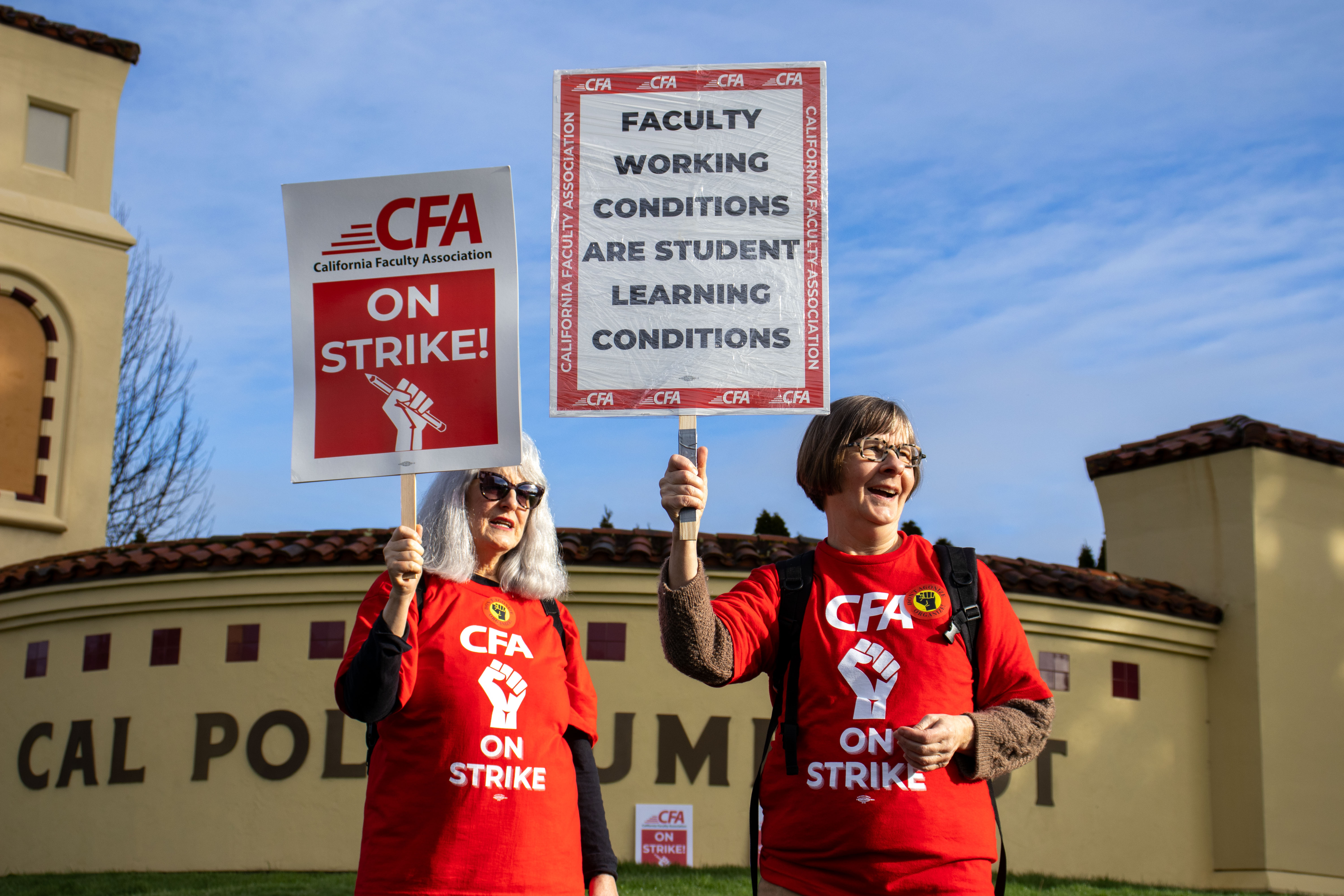
    Across the California State University system, thousands of students expected a pause in classes, thousands of faculty expected to trade in their pens and markers for picket signs and thousands of skilled laborers were prepared to drop their tools for the week of Jan. 22-26 to strike.

    However, the Teamsters 2010 announced Friday, Jan. 19 they reached an agreement with the Chancellor’s Office. After one day of a weeklong planned strike, it was announced by the California Faculty Association (CFA) the night of Jan. 22 that they and the Chancellor’s office had settled with a tentative agreement as well. Campus operations are set to return to full swing by the end of this week. 

    Teamster’s Agreement Highlights

    The Teamsters were able to secure an immediate 5% pay increase, with back pay retroactive to July 1, 2023. They were also able to establish a step-pay system, meaning that skilled laborers within the CSU system will have a pay increase each year. Teamsters were also able to maintain their pension, medical benefits, and their emergency pay.

    With the Teamsters able to get back to work and have an agreement for a solid contract in order with better pay, skilled laborers on the Humboldt Campus such as locksmith Phillip Bradley felt a sense of relief. 

    “Obviously [having an agreement in place] just takes a lot of stress off,” Bradley said. “Uncertainty creates a lot of anxiety.”

    Librarian Carly Marino drums while crossing 14th St. | Photo by Griffin Mancuso

    CFA Agreements Highlights

    The CFA also secured a 5% increase in pay retroactive to July 1, 2023. There is planned to be another 5% increase on July 1, 2024, effectively giving faculty a roughly 10% increase in pay. However, the 2024 increase is contingent on the state not cutting CSU funding. There will also be more protections in place for faculty dealing with police, and improved access to gender-inclusive restrooms and lactation spaces. Also for faculty that are new parents, paid parental leave has increased from six to 10 weeks.

    Faculty, such as English professor Sarah Ben-Zvi, had to find ways to balance parenthood with work. Despite the support of her department to make her maternity leave as smooth as possible, she still felt some struggle. She felt that the increase in time for maternity leave was appreciated, but it may not be enough. 

    “It’s definitely a step in the right direction, but I still don’t think it’s enough time,” Ben-Zvi said. “I feel like it was not until maybe three months after my kid was born, that I started to feel almost human again… and able to give my students what they deserve, which is a great teacher who is on her game.”

    Another mother and professor with a newborn is English professor Tessa Head, who was on the picket line with her 14-month-old child. Head feels that a paid semester of parental leave would be beneficial for not just parents but the students as well. 

    “[A semester of parental leave] would give you time to bond with your babies and take care of them, to form that secure attachment,” Head said. “And for students, I think it would provide better learning conditions because they would have a faculty member who is present for the whole semester.”

    CFA faculty rights chair Loren Cannon was present on the picket line striking his drum and leading strikers. He shared his thoughts on the outcome of the tentative agreement.

    “We really did make some gains,” Cannon said. “I guess [the Chancellor’s Office] didn’t expect us to actually pull off a strike or something, because we only struck for one day [then came to a tentative agreement with the Chancellor’s Office].”

    Richard Toledo leads faculty and students across 14th St. holding signs on the picket line. | Photo by Griffin Mancuso

    Student Reactions

    With notice being given by faculty not to expect classes this week, some students made plans for work or travel. Students like Criminology and Social Justice Major Jocelyn Douglas faced some struggles when they scheduled extra shifts at work this week, only to be told that class would be back in session. The short notice has left students such as Douglas feeling disorganized.

    “I took this opportunity of thinking that I had a week off of school to work 60 hours with both jobs that I work at, to be able to catch up on bills,” Douglas said. “Being a full-time student and working full-time, sometimes conflicts with each other. And with less than a 24-hour notice that we do have to attend school, and with my classes being mandatory for attendance, I’m kind of conflicted about [choosing] between work and school. Thank God the teachers are being pretty lenient so far.”

    Scene of Strike

    As for the strike itself, dozens of faculty and their supporters were on the picket line. They danced with their signs to the passing cars that honked their support, all the while they moved to energizing music blaring over speakers. Some signs read, “5% don’t pay the rent,” “California Strike University” and “You can’t put students first if you put faculty last.”

    Students were present on the line to support their faculty. Students such as accounting major Lealu Freedom felt an obligation to support their professors due to the past support they have given to her. 

    “[If faculty have better conditions they] can devote more time to their students, and create a more enjoyable experience versus focusing so much on trying to get their needs met,” Freedom said. “It’s kind of like a student. You know, if the student’s struggling with housing, they’re not gonna be able to learn. Same thing with a teacher, if they’re struggling with basic needs, they are not gonna be able to teach.”

    What’s Next

    Language for the contracts will be rewritten based on the tentative agreement, and the CFA is expected to vote on whether or not to officially ratify the contract within the coming weeks to months.

    Although the CFA and Teamsters unions made gains in this situation, CFA President Marisol Ruiz acknowledges that there is still work to be done.

    “When we are striking, we’re striking for better working conditions for all,” Ruiz said. “For all the faculty and the students, we should all be supportive and in unison working together to fight. There’s still a 6% increase of tuition hikes, and that’s a fight that needs to continue to happen.”

  • Letter to the Editors

    To our Cal Poly Humboldt Family, 

    Associated Students do not stand nor condone any kind of disrespect. We value everyone’s thoughts, opinions, and presence within AS. 

    We are aware of an unsettling situation that occurred during our Executive cabinet meeting on Feb. 4 concerning members of the Associated Students and members of AS Core Programs at Cal Poly Humboldt. 

    During the meeting, President Jeremiah Finley was uncooperative with fellow board members and had cut the meeting short. During this meeting, the WRRAP’s R.O.S.E branch team was expecting a response from the board, but would not move forward due to solely wanting in-person attendance. 

    In addition to this, President Finley neglected his team by failing to acknowledge the presence of appointed members who joined through Zoom, assuming that, “they only joined through Zoom simply because they didn’t want to be in attendance in person,” though this was not the case. 

    First and foremost, we, the Associated Students do not accept or tolerate the sort of behavior that was presented on that evening. We understand the concern, the anger, and the feelings of disrespect. You are heard and your feelings matter. 

    Next, we find it critical, to be honest with our student body and with each other. Unfortunately, there has been an unhealthy power dynamic within AS. There have been many issues regarding communication, equality, and access to opportunities. These are issues AS members have been dealing with but have managed to persevere through while keeping our student body and AS Core Programs at the top of their priority list. We are actively working towards community building and furthering our relationships with our staff and student leaders. 

    Due to the continuous amounts of disrespect and unacceptable behavior, AS will be moving forward with the impeachment process. 

    Associated Students stands for the purpose to educate, empower, and most importantly elevate all student voices. 

    Signed, 

    Associated Students of Cal Poly Humboldt

  • Humboldt Athletes are ‘DAM WORTH IT’

    Humboldt Athletes are ‘DAM WORTH IT’

    by Morgan Hancock

    Photo by Morgan Hancock | Gracie Kasberger finishing the 400M Log Relay on Feb. 12 at the Cal Poly Humboldt Redwood Bowl.

    Athletes live in a culture of perfection and pressure that can lead to high stress, these Cal Poly Humboldt students want to address that. Gracie Kasberger founded this campus’ branch of Dam Worth It. Dam Worth It is a nonprofit that supports athletes struggling with mental health. Athletes’ mental health has become a bigger conversation since the recent double feature Olympics. High-profile athletes are setting precedents by putting their mental health first. Students like Kasberger are laying the groundwork for a new culture in athletics. 

    Kasberger is a kinesiology major and track athlete, she saw a need to support her peers. The athletics department doesn’t have any counseling services for athletes, so students are on their own. They balance classes, practice, work, and self-care. Kasberger expressed that students will often put their mental health on the back burner. 

    “I’ve noticed more pro athletes coming out about their mental health and saying that they are struggling,” Kasberger said. “It’s something that is being normalized. Athletes go in and get help when they’re injured, but they’re not doing the same for their mental health. We’re bringing attention to it, we want athletes to have access to help and feel like they can speak out.”

    Photo by Morgan Hancock | Travis Allen in the 60M hurdles on Feb. 12

    Travis Allen is a track athlete who opened his season at the Green and Gold event last weekend. Allen expressed how sports can offer a mental haven for athletes, but with it also comes added stress.

    “Mental Health is often overlooked, especially with athletes,” Allen said. “Teammates are like a family, there is a lot of support from each other.” 

    Each athlete filled out a card with the reason why they are ‘dam worth it’.

    “I’m ‘dam worth it’ because I am me,” Allen said.

    Sue Grigsby, Lumberjack class of ‘79  track hall of famer and record shatterer, attended the legacy event. Grigsby has seen the pressures change for students over the years. Students have increased pressures from athletics and an unstable world. 

    “If you have a vision problem or dental problem or a knee injury you seek help,” said Grigsby. “Athletes should do the same for their brains. It’s okay to seek help, there are ways to get help.”

    Student-Athletes often define themselves by their sport. They use athletic success as a measure of their worth. Clara Lenihan struggled to define herself outside of her sport once she ended her soccer career.

     “When I introduce myself I start with ‘oh I play soccer,” Lenihan said. “Now that I don’t play anymore I don’t know what to say. Sports is such a big part of our lives.” 

  • AS President Finley’s refusal to resign leads to more conflicts

    by Matthew Taylor

    Prior to the AS meeting last Friday at Siemens Hall, President Finley received a letter by the collective student body calling for his resignation that evening. If he failed to do so, actions would be taken towards impeachment. This letter was written in part due to his actions at the previous AS Meeting on Feb. 5th, which can be read about here.

    “I have come to understand that recently there are many that felt disrespected,” Finley said, in response to the letter during the meeting. “Reduced to only a vote to count as opposed to the valued team member they are throughout the year by my unintentional behavior.”

    The president continued in offering apologies to any members he may have unintentionally hurt over the past months. He pleaded with the student body to talk personally with him and to allow him to end his final semester, both as a student and president, without burnt bridges. He explained that the extra weight of responsibility expected of him as a Black leader in a predominantly white university may have also gotten the better of him.

    “I cannot leave till I have had a chance to put in order what is out of place for those that are hurt and be your champion once again,” Finley said, ending his speech and thus refusing to resign.

    No members present at the time had further comment. Conflict between Board members and the president continued later on in the meeting, however, as Finley attempted to appoint a new student for Legislative Vice President.

    “First, I want to apologize to you,” At-Large Representative Gio Guerrero said, to the new candidate. “Our Associated Students are in a really big hurdle at the moment, internally. I don’t feel confident that we can support an additional new member on this Board until we get through [this] storm.”

    All other Board members, excluding Finley, concurred with this sentiment. Members expressed that they did want the candidate to be appointed but only once internal conflicts had been figured out. Finley accused the Board of allowing personal opinions of him to cloud their decision. All members present disagreed and appointed Student Affairs Vice President Marcum and Guerrero to keep in contact with the candidate. Plans to properly vote in this appointee are scheduled to happen at the next AS meeting.

    The next AS meeting will be held on Friday, Feb. 18, at 4 pm in Siemens Hall 117.

  • Hunt for new police chief continues despite adversity

    by Carlos Pedraza

    Cal Poly Humboldt is struggling to find a new police chief in the wake of yet another resignation

    For the last two years, Cal Poly Humboldt’s University Police Department has been plagued with resignations at the very top of their hierarchy. Anthony Morgan, the most recent chief, resigned early in Jan. 2022 after a year in the position.

    UPD is still in the early stages of searching for a new chief.

    “Cal Poly Humboldt has not yet made the public announcement for accepting applications,” said Grant Scott-Goforth, a communication specialist in the CPH’s News and Info department.

    The search for UPD’s next leader will be nationwide. Representatives from different university sources will be involved in the decision, including students, faculty, and university police department staff.

    “The University aims for a July 1, or sooner, start of the new permanent chief,” said Scott.

    Morgan was only the latest chief of the campus police to resign. Cal Poly Humboldt’s current acting chief of police is Peter Cress, a 25-year police veteran. He started his career at what was then Humboldt State before moving to Sacramento, and eventually returning to UPD in 2021. Cress stated he will likely apply to become the permanent chief of police.

    Even if the position is filled, the UPD has barely enough officers to be fully staffed. With a more critical eye on police nationwide, the UPD is struggling to maintain leadership and swear in new officers.

    “A lot of people have just said no, they are not interested in living under that kind of criticism,” said Cress.

    For students interested in giving their input for the hiring process or for UPD, the police conduct bi-weekly phone calls with students. The university directory also provides all officers’ contact information, and the general UPD contact number is 825-55-55.

  • Symptomatic and want to teach online? Steer clear of Cal Poly Humboldt

    by Liam Gywnn

    Dr. Christopher Aberson came into contact with COVID-19 the weekend before he was supposed to teach. He requested the school let him teach over zoom and his request was denied. The school would not let him switch his modality despite the Omicron surge and the numerous COVID-19 cases reported on campus.

    “I was told I was not authorized to change modality. After several emails, clarification came that I could not move online. I have symptoms. I am well enough to teach. Not allowed to,” said Dr. Aberson.

    Dr. Aberson is the Professor of Psychology at Cal Poly Humboldt and came into contact with the virus after one of his son’s friends tested positive. He claims that this issue is larger than his individual case.

    “My issue with the surge has and continues to be that faculty who agreed to teach in person are not being allowed to change to online. Faculty agreed to teach in person at times when it seemed we had gotten over the hump and were headed toward a better situation,” said Dr. Aberson in an email, he continued. “In both the fall and spring semesters, as I understand it, most requests to change to online were denied. Both semesters began during surges.”

    Dr. Aberson has been outspoken about a number of issues on campus and believes that could be playing into why he wasn’t allowed to teach online.

    “I have been outspoken about under-compensation of chair duties — it is a full-time job but during the summer and other off times, we are grossly under-compensated for our time. Also, campus safety and working conditions during both the delta and omicron surges,” said Dr. Aberson.

    The California Faculty Association (CFA) negotiated a Memorandum of Understanding (MOU) with campus administration regarding teaching during COVID-19. The document was signed by CFA and Cal Poly Humboldt management. Dr. Aberson presented a passage from the MOU that explicitly supports his position.

    “During the time that an employee may be waiting for an appointment or for testing results every effort should be made for them to be able to work remotely,” states the MOU.

    Prior to Dr. Aberson’s situation, the CFA had already made an official statement addressing the administration and their lack of leniency.

    “No faculty member should be forced to work in conditions that put themselves or their loved ones at risk, especially when there are alternatives,” states a press release provided by the CFA.

    CFA Humboldt president Loren Cannon still supports this idea and thinks the administration needs to be more flexible in situations like Dr. Aberson’s.

    “We have urged that Administration approve all such requests for temporary, or sometimes permanent change in modality,” said Cannon.

    Cannon acknowledges that for some cases transitioning to online can be difficult, however for many other classes transitioning online for a week or two is relatively easy.

    “I believe that at this time, as we still are not ‘in the clear’ of this incredible health crisis, we need to trust each other and make decisions that recognize the complexity of individual context,” said Cannon.

    Leadership has yet to make an official statement regarding the MOU breach and has also failed to respond to our request for an interview.

  • Black chemists celebrate diversity at Umoja Center event

    by August Linton

    Claps and cheers echoed through Founders Hall 118 during the Umoja Center’s Black Excellence in STEM event, probably far more than had graced the room in quite a while. Many HSU community members filled out the seats, just as their enthusiasm and passion filled the room.

    Dr. Kim White, Cal Poly Humboldt professor of chemistry, hosted the event at the request of Umoja Center for Pan African Academic Excellence.

    After an indigenous land acknowledgement, she began by paying homage to several Black scientists under whom she studied. One of these was Dr. Loyd Noel Ferguson, the first Black person to earn a PhD in chemistry from UC Berkeley.

    “He was the original backyard chemist, he synthesized moth repellent and stain removers in his backyard in Oakland when he was growing up,” White said. “He also used his academic talent not only to propel his own career but also to create opportunities for others.”

    She also spoke fondly about Dr. Phillip Crews, a UC Santa Cruz professor of chemistry known for his involvement in diversity programs.

    “Phil instilled in me a strong desire to use my privilege for the benefit of others… seeing him use his strengths to lift up others was pretty fundamental in the trajectory of my career,” White said.

    Dr. Chris Harmon, another member of Cal Poly Humboldt’s chemistry department, spoke next. He spoke on the importance of acknowledging and celebrating the growing diversity within science.

    “It matters where you come from, it matters what language you grew up speaking, and absolutely the color of your skin matters, Harmon said. “When I got into chemistry, one of the things that I loved was all of these rich, beautiful colors that you would see in the lab… if we celebrate the colors of the chemicals why can’t we celebrate the colors of the chemists?”

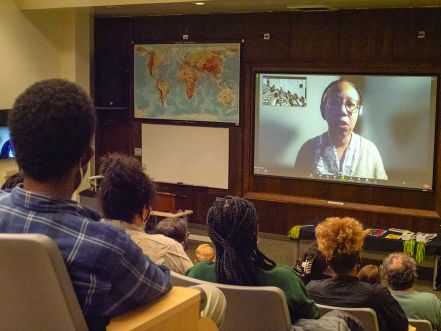
    Photo by Morgan Hancock | Dr. Kensha Clark speaks to students of her work in chemistry via Zoom at Founders Hall on Feb 11

    Harmon introduced Dr. Kensha Clark, a highly celebrated and accomplished Black chemist currently teaching at the University of Memphis.

    After brief technical problems, she appeared on the projector screen, Zooming in to the event.

    Clark discussed her work, both as a private sector chemist with Chevron and as an academic. Her current fields of interest include molecular electronics, solar energy conversion, and small molecule activation, among others.

    In her lab, she makes sure that students of all backgrounds feel welcome.

    “I think [our diversity] makes our science all the better,” Clark said.

    When she was a student, however, Clark felt that her interest in science was quashed. She described only being encouraged to become a writer or an artist, all the while never wavering from her passion for science.

    Even though strong familial support allowed her to achieve her dream, Clark is still faced with a shocking lack of diversity in her field.

    “By default, you are the representative of your people,” Clark said. “It makes it exciting when one sees up-and-coming scientists of color.”

    Photo by Morgan Hancock | Asia Anderson explains her research into membrane protein isolation on Feb 11.

    Cal Poly Humboldt student Asia Anderson took the stage after Clark, to a joyous round of applause from the audience. A transfer student from College of the Redwoods, Anderson is obviously beloved to the campus community.

    She spoke about the community and support that she has found while studying chemistry at Cal Poly Humboldt, and how her mother’s going back to school to study English inspired her.

    “I feel like every step of the way I’ve had this ushering of peers around me… I will also be the first person in my family to graduate from college,” Anderson said.

    Anderson’s research during her undergraduate degree at Cal Poly Humboldt has been in the targeted extraction of membrane proteins. She said that the proteins’ sensitivity to light means that further study could illuminate ways to use these proteins for targeted medication delivery.

    After graduation, Anderson will study to receive a graduate degree at UC Santa Cruz.

    The Umoja center hosted this event in collaboration with NSBE, the National Society of Black Engineers. Demi Ogunwo is a masters student in Cal Poly Humboldt’s Energy Technology and Policy Program, and spoke at the event as the president of the school’s NSBE chapter.

    “NSBE offers a platform for students to network and get mentored by … Black professionals,” Ogunwo said. “It’s not for engineers alone, it’s for all STEM students.”

    NSBE is a community focused on supporting Black scientists, whether academically or professionally. They will be hosting a social hangout for students potentially interested in joining this Friday Feb. 18, from 1 pm to 3 pm in the University Upper Quad.

  • Food forests flourish at Cal Poly Humboldt

    by Ollie Hancock

    CCAT courses are back this spring. One of the classes on the roster this semester is Organic Gardening. In this one-unit course, students will learn the basics of gardening. Students grow their plots in the campus community garden using sustainable techniques.

    Since the pandemic disrupted CCAT operations, the course has not been offered. Now, the course has returned, and students have a lot of work ahead of them. Ben Cross is a political science major who’s more than excited to be back in the Buckhouse.

    “I’ve got lots of passion for this, and it’s an amazing area to learn it,” Cross said. “If there is a place I’d want to take this class, it’s at Humboldt. I want to have my garden and tend to it with confidence.”

    Julia Simmons is the student instructor of ENST 123.

    “We’re teaching the basics of what goes into gardening,” Simmons said. “I want to focus on how plants affect each other. Some plants have nitrogen-fixing properties and support other plants in the soil. I want to teach students to cultivate ecology and grow food forests.”

    Food forests are a farming technique that mimics the natural patterns found in ecosystems. Growing plants interact with each other in a network of reciprocal relationships. The result is healthy biodiversity, nutrient-rich soils, and a sustainable food source.

    Agroecologic farming methods have the potential to localize food systems and make them more efficient. A 2018 study titled “Permaculture—Scientific Evidence of Principles for the Agroecological Design of Farming Systems” by the EU Institute for Environmental Science establishes environmental damages caused by industrial agriculture. Monoculture causes biodiversity loss, soil degradation, and alteration of biogeochemical cycles and greenhouse gas emissions. The study cited food forests to remedy the damage done by monoculture.

    Monoculture is the standard agricultural practice in the United States. Crops are planted in rows, where they can be most efficiently harvested by machine. Though it is convenient for machinery, this practice does not benefit plants or local ecologies. Without ecological support and context, isolated crops require fertilizers and pesticides to grow.

    Plants can fend off pests and fertilize each other in food forests. One example Simmons describes is the three sisters. This pairing of beans, squash and corn, comes from traditional ecologic knowledge.

    “They grow really well together, and they use each other to grow well,” Simmons said. “The beans provide nitrogen for the other plants to grow. Ground cover [from the squash leaves] keeps weeds from growing.” The tallest sister, corn, acts as a trellis for the beans to climb up. Growing together, they protect each other and help one another flourish.

    “We’re going to be working in the community garden. We’ll design food forests with their own ecologic networks,” Simmons said. “I want anybody to be able to garden, and everyone should garden.”

  • Students dive into oceanic research

    Students dive into oceanic research

    by Nina Hufman

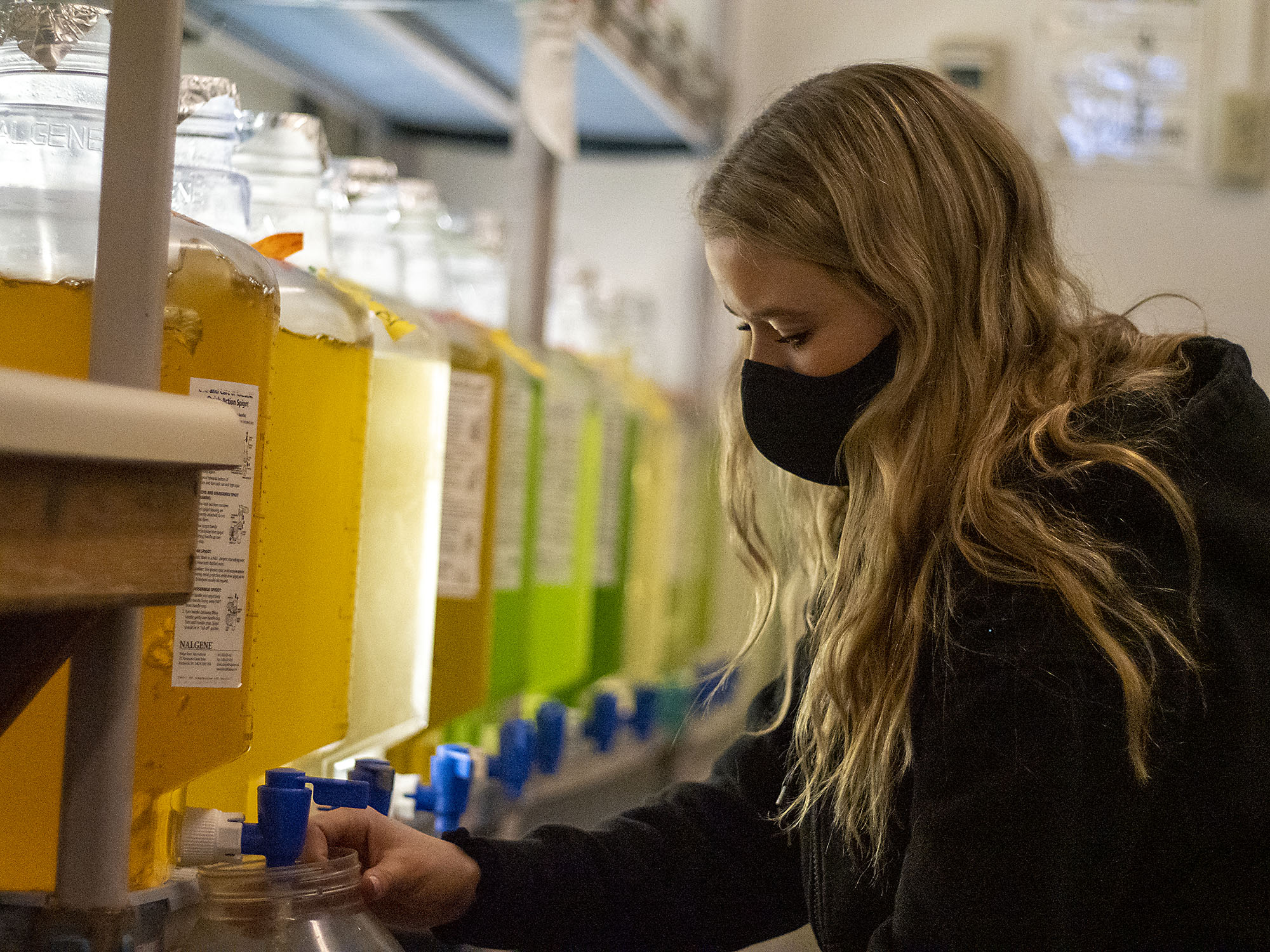
    At Cal Poly Humboldt’s marine lab, graduate students run between the workspaces and laboratories, students stir beakers of brine shrimp instead of cups of coffee, and Percy the giant pacific octopus (Enteroctopus dofleini) tugs on the fingers of the lab tech feeding him.

    Photo by Morgan Hancock | Percy the giant Pacific octopus (Enteroctopus dofleini)

    Percy’s isn’t the only interesting face one can see at the lab. Other notable critters include Gaia the red octopus (Octopus rubescens), Eleanor the Wolf Eel (​​Anarrhichthys ocellatus), and Butters the Albino Dungeness Crab (Cancer magister). Sea stars, baby jellyfish, sea urchins, clingfish, nudibranch, sea cucumbers, and anemones are among the lab’s other aquatic residents. There are also rockfish older than most of the people working at the lab.

    “There’s so much potential at this place for doing even more than we are now,” said Lab Director Rick Zechman.

    Although it’s currently closed to the public due to COVID-19, the students and staff of the Telonicher Marine Lab are offering guided virtual tours and virtual educational programs. Cal Poly Humboldt students also have the option to visit and explore the lab in person.

    If they want more experience than a visit will offer, students can sign up for courses in oceanography, fisheries biology, and marine biology, which all include instruction at the marine lab.

    Marine naturalist Jordyn Neal is in charge of tours.

    “Most of my job is public outreach,” Neal said. “I try to inform the public on the fish here, and conservation.”

    Neal gives guided tours of the lab and is in charge of the summer school program. She says that one of her main goals is to bridge the gap of scientific literacy.

    Neal is a fifth year marine biology major who is currently doing shark research outside of her degree. She takes CT scans of shark species living at different depths in the water column and looks at the morphology of their ears. Neal’s focus is on how the depth of the water in which a species lives impacts the structure of its ears.

    Photo by Morgan Hancock | Eleanor the Wolf Eel (​​Anarrhichthys ocellatus)

    The marine lab also hosts a number of grad students doing research projects, including Rose Harman. Harman is currently working on her master’s thesis and grant applications to fund her research. This summer, Harman will be studying habitat usage and predation of leopard sharks in Humboldt Bay.

    “Our new plan is to do field work combined with lab experiments,” Harman said. “One of my goals is to publish my research.”

    Graduate students Marzia Fattori and Kalani Ortiz are doing their research on growing bull kelp in Humboldt Bay. Ortiz’s project is focused on kelp as an agricultural product. She is currently growing the seaweed on string, and will be outplanting it to kelp farms in the bay until it reaches a harvestable size.

    Fattori’s project is focused on conservation. She is growing bull kelp on gravel and on ceramic tiles to see which substrate is more effective. In the second stage of her research, Fattori will grow the bull kelp in warmer water to examine the impact that rising ocean temperatures will have on kelp populations.

    The marine lab has two classrooms, a running seawater system, and access to the Coral Sea, a 90ft research vessel. Lab director Zechman says the lab is situated on an important part of the Pacific coastline, where students can expect a learning experience that is unique to Cal Poly Humboldt.

    “Our intention is to be a different kind of polytechnic,” Zechman said. “How many CSUs have a marine lab and a research vessel?”

  • Jacks on track

    by Eddie Carpenter

    Cal Poly Humboldt hosted the annual Green and Gold track meet at the Redwood Bowl on Feb. 12. In the past, the Green and Gold has been an invitational meet open to alumni as well as all local athletes, but due to precautionary measures and local COVID-19 restrictions, only collegiate entries were permitted.

    The event kicked off with the national anthem, and the Cal Poly Humboldt track and field athletes all joined at center field for an ecstatic cheer. It was a beautiful, sunny day with nothing but blue skies, perfect weather to run in.

    Head track and field coach Sarah Ingram says a huge amount of effort went into preparing the Jacks for this event.

    “We’ve been training since August… both on the track and in the weight room,” Ingram said. “It was a really fun atmosphere. The 400-meter log relay is not something we usually have, but it was a team bonding event.”

    Women’s team captain Joy Hano is also proud of her team’s strategy for game day.

    “We spent a lot of time visualizing and training. Mindful training is what we did the most,” Hano said. “I do the 100-meter hurdles, long jump, and today I did the 150 meter and the log relay. It felt great. There were a lot of nerves, but being here in front of our home crowd made it all worth it and made the nerves go away.”

    College of the Redwoods coach Reed Elmore shared what it was like to see his former athletes compete at last weekend’s scrimmage.

    “[As a coach], you don’t always get the best athletes. Our main goal is to get our athletes to work together as a team. We want them to compete with each other and not against each other,” Elmore said. “It’s exciting! We’re a developmental program. We take kids that need love and a little extra time. Humboldt does something different. We’ve been working with Sarah and Jamie to bridge that gap. [We make] sure everyone feels supported. We had a good performance, but our important races are at the end of the season.”

    Junior thrower Savannah Henninger wrote down all the marks for the throwing events. She is one of those athletes who transitioned from a Corsair to a Lumberjack.

    “It was definitely super weird. It’s not necessarily better or worse,” Henninger said. “It was a different atmosphere. Both Sarah and Reed are amazing advocates for their athletes, so that really helped a lot. I saw a lot of team support. Everybody was cheering their teammates on as best as they were able to, there was a lot of camaraderie going around.”

    In the latter half of the scrimmage, many athletes participated in the 400-meter annual log relay. As the last athlete rounded the corner, a member of the crowd shouted out, “Better start running with a purpose!”

  • My mental illness makes me a better leader

    My mental illness makes me a better leader

    by Lex Valtenbergs

    You sleep too much or too little and neglect your personal hygiene. You’re a ticking time bomb that can’t be defused. You oscillate between extremes like a pendulum. Your own thoughts wage war against you and, in some circumstances, the people around you.

    Being mentally ill is a constant struggle, and that is only the surface of it.

    In my case, I have undiagnosed traits of borderline personality disorder (BPD), specifically a subset of the disorder called quiet BPD, as well as comorbid anxiety and depression.

    To be clear, I am not diagnosed due to being assigned female at birth (AFAB) in a rural county, one with a disproportionately high rate of Adverse Childhood Experiences (ACEs) and inaccessible or understaffed mental healthcare facilities.

    Seeking and getting a diagnosis from a psychiatrist is also protracted and difficult, especially during the ongoing COVID-19 pandemic.

    It must also be said that being branded borderline in our society is not ideal, especially as someone who was is perceived as female. There is a lot of stigma around the four Cluster B personality disorders: narcissistic, borderline, histrionic and antisocial personality disorder.

    I stigmatized narcissism in particular, before I became self-aware and realized that narcissism is merely the inverse of codependency. Both stem from traumatic formative experiences with maladaptive object constancy and abandonment, but they manifest differently. For me, narcissism was a mirror into my own dark traits that I wasn’t able or willing to peer into.

    Most borderlines are stuck in an incredibly alienating and painful catch-22. The people who understand us aren’t necessarily healthy for us, and the people who don’t understand us are usually stabilizing for us. Couple that with the chronic emptiness that borderlines endure daily and you quickly rack up a series of short, toxic relationships that end in violent staccato.

    The Western culture of individualism makes things worse for mentally ill people. In our society, we have a tendency to overlook our ability to affect other peoples’ lives. We also have the tendency to sell ourselves short. We would rather shrink than dare to take up space. The latter is contingent upon us being vulnerable, which includes the risk of failure.

    Because my judgment is skewed by my mental illness, I make a lot of mistakes. I assume the worst of people who don’t deserve it. I misread peoples’ intentions before giving them the benefit of the doubt, or idealize people who haven’t yet earned my trust or respect. These behaviors open me up to exploitation and abuse. I can also be abrasive, intense and even callous, but that doesn’t mean that I don’t have compassion or remorse.

    If anything, I feel too much, more strongly and longer than the average person does. I constantly emotionally regulate myself, to grapple with my volatile moods and intense emotions. Most of these emotions go inward towards myself rather than radiate outward.

    Believe it or not, my mental illness makes me a better leader. Because I am mentally ill, I have put myself in situations where I needed to be held accountable for the sake of myself and people around me.

    I couldn’t play the victim. I had to own up to my behavior, even though it stemmed from something out of my control. At the end of the day, I am fully responsible for my choices and the consequences.

    Owning up to your dark side every time it creeps up and wreaks havoc enables you to build healthy, strong relationships. Relationships are hard work.

    Good leaders have good relationships. Good relationships are contingent on accountability, boundaries, trust and clear communication.

    The first step of realizing your ability to lead others and trying it is hard no matter what, but mentally ill people just have more barriers to overcome.

    I have had to learn how to use the dark side of my mental illness to harness my light and use it to influence others around me. The skills that I’ve developed to cope with my borderline traits, anxiety and depression allow me a self-insight which is extremely useful.

    Every day, we have the choice to be a positive or negative influence in the lives of people we know. Try to go against the grain of your darkest tendencies of your humanity and use your light as a guide.

  • Disconnected

    by Cheyenne Wise

    These past few years have created this heavy and strange feeling that has found itself settling on my chest. It’s a constant feeling of disconnect—a disconnect from my peers, professors, friends, and even family. I’m staring at a black screen or the muted faces of people I should know, but it feels like I’m watching a TV show.

    I was 21 when COVID-19 hit, and now I’m 24. I’ve already lost most of my early 20s, and I don’t know when I’m ever going to get it back. A lot of people are telling me, “well, you could have gone out and partied with your friends or traveled” as if COVID-19 doesn’t exist or like I’m not terrified of getting sick. I was supposed to be a graduate and living in another state working a dream job, but here I am, sitting in my room in my hometown, waiting for my next class to start while getting ready for work. I’m not unhappy with where my life is, but I’m not exactly delighted with everything. I love my jobs, my coworkers, and the fact that I’m living with my childhood best friend, but some part of me is mourning the loss of what could have been, just like many people.

    I miss having exciting conversations with my peers and being excited about my classes. The disconnect and lack of inspiration are like a smack to the face when I sit down to log onto Zoom for my lecture. I’ve become one of those black screens that remains muted, and I hate it. Even writing has become a struggle for me. I’m a storyteller, but all I have is nothing when I sit down to write. There’s no ‘aha’ moment of what story needs to be told or list of potential events to look to reporting on.

    I know I’m not alone in this feeling because I see it everywhere. Other college students are no longer being inspired by their studies. I just wish I had some great advice on mediating a solution, but I don’t. It’s a dreadful feeling, and I feel a particular type of guilt for not having a remedy.

  • Let the bodies hit the floor at RWC

    Let the bodies hit the floor at RWC

    by Matthew Taylor

    On Monday, Feb. 7, the deep and thunderous sounds of student bodies hitting the floor echoed down the halls of Cal Poly Humboldt’s Recreation and Wellness Center. Instructor Mairead Sardina, the department’s Adventure Program Supervisor, pushed student after student onto large cushioned mats. She instructed them to copy her previously demonstrated method of proper falling. This was the second class within Sardina’s “Intro to Self Defense” workshop.

    The course focused on utilizing multiple different martial arts techniques for the purpose of self defense and self empowerment. Lessons within the course included energy cultivation and energy negating practices. Students first began with a simple guided meditation by the instructor.

    “We’re trying to push away the outside world,” Sardina said. “But the reality of meditation is it makes us more connected to the outside world, by being more connected to ourselves.”

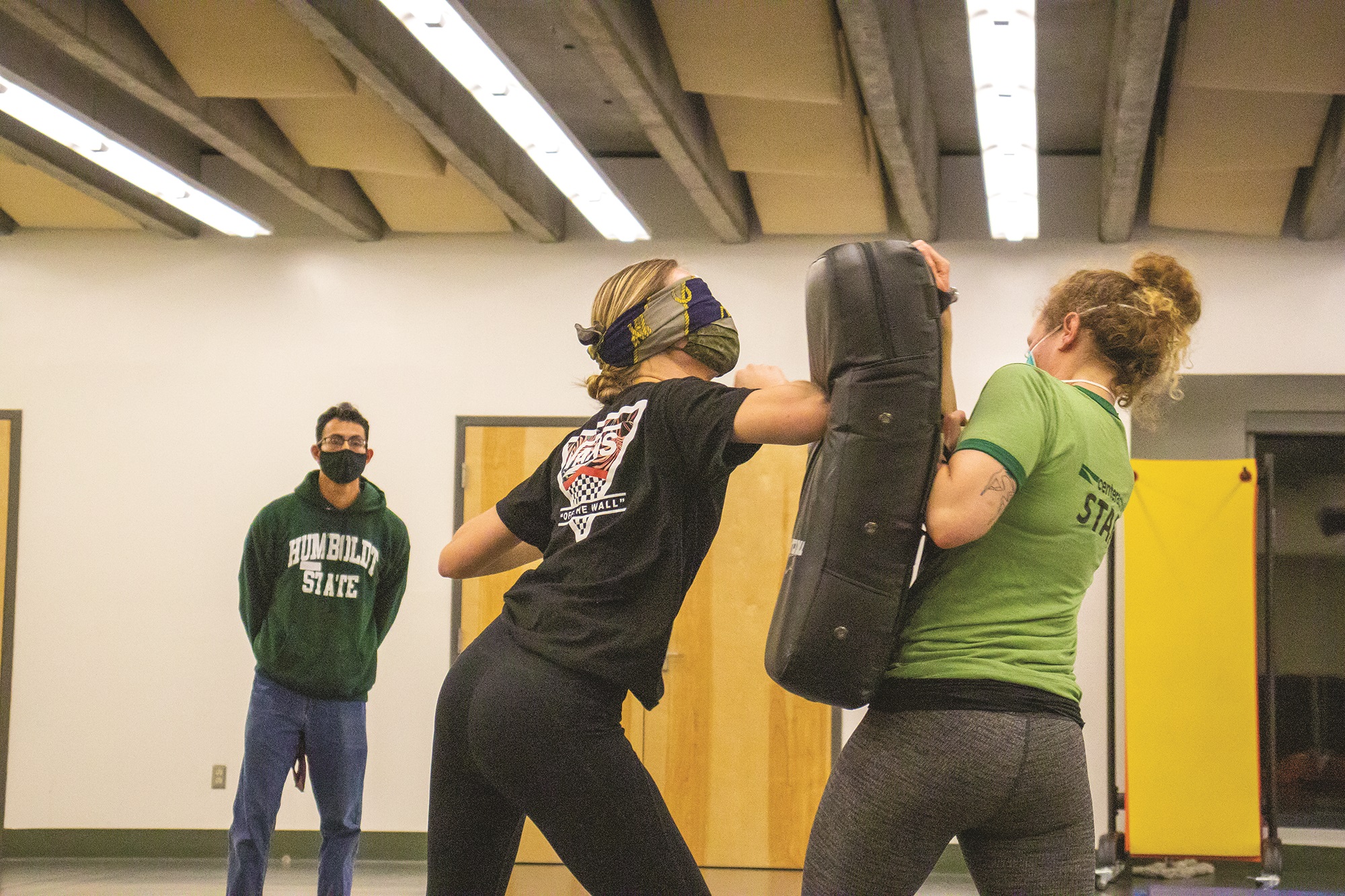
    As the evening progressed the lessons became more physical and hands-on. Lessons would involve activities such as swinging each other around with a red rope and fighting against the instructor whilst blindfolded.

    “The human brain is amazing, it can do insane things,” Sardinia said. “If a parent can flip a car off of a child, we can protect ourselves.”

    Many of the students laughed at each other as they attempted many of the strange yet effective techniques. An audible shock heard amongst them whenever they found themselves accomplishing a seemingly impossible task.

    Photo by Matthew Taylor | Instructor Mairead Sardina (right) teaches blindfolded Theodore Lee (left) to use his other senses when in combat at the Reaction and Wellness Center on Feb. 7.

    “[The classes have] been fantastic,” Theodore Lee, a major in wildlife conservation, said. “I’ve always wanted to learn martial arts and this made me understand the concepts.”

    Another student and participant, Ada Erlewine, a biology major, explained that she had been searching for a self defense course to go to for awhile. She stated that her friend had found the course while checking the RWC website and told her.

    “[I] wanted to be more confident in my body and my power,” Elrewine said, explaining why she joined. “[It’s my] first extracurricular outside of schooling since transferring during COVID.”

    These were the last scheduled workshops, however, future courses may be offered if enough students express interest by reaching out to cntract@humboldt.edu.

  • Drop In and Skate Out: Latin Edition

    Drop In and Skate Out: Latin Edition

    by Matthew Taylor

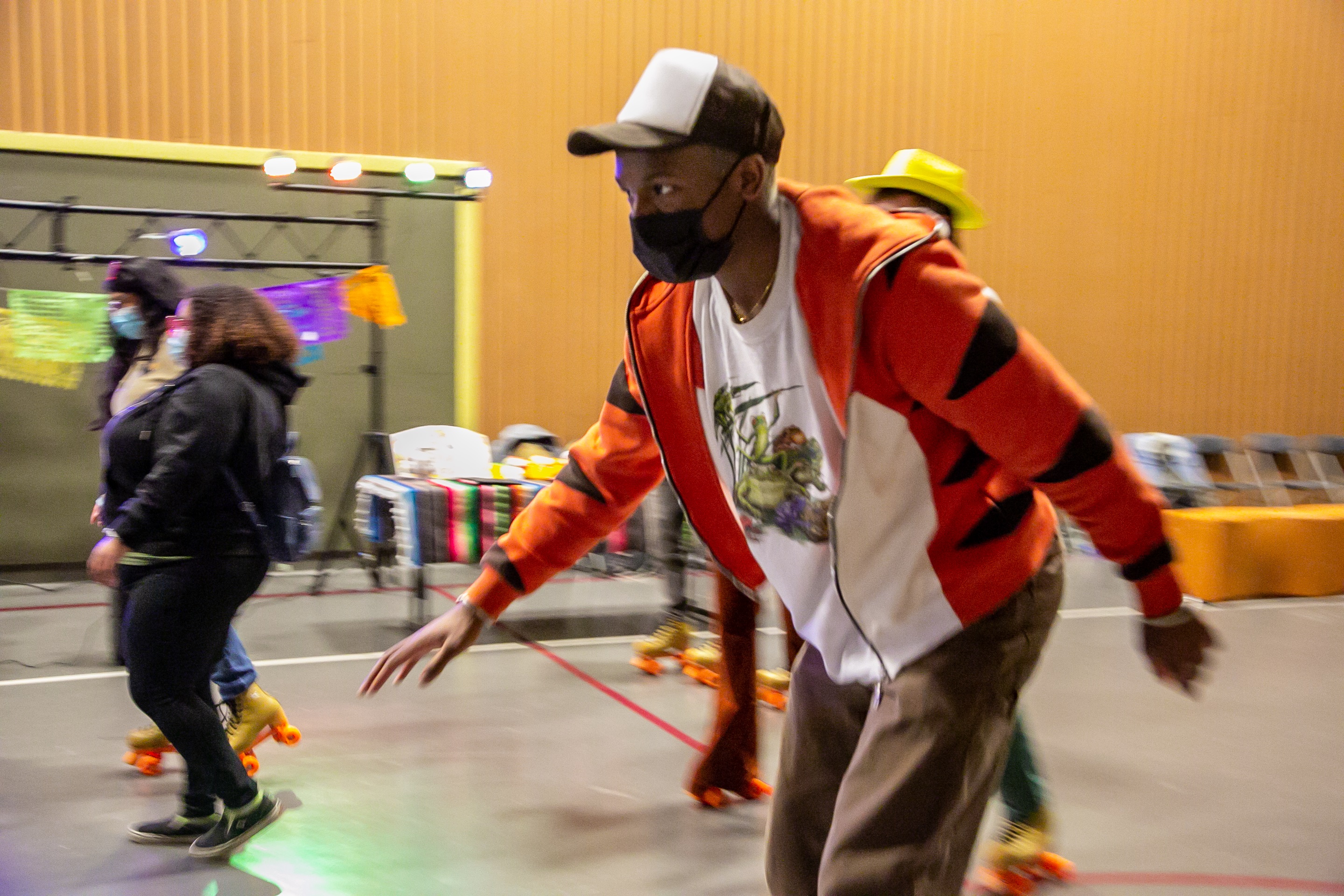
    A flurry of rainbow colors whipped by as Cal Poly Humboldt students both old and new skated side by side across the West Gym’s floors. Outfits ranging from the mundane to the elaborate, with glitter dotting the faces of many, could be seen throughout the room.

    Near the entrance of the gymnasium, two tables were draped in sarapes and decorated with marigolds, sugar skulls, and an assortment of popular Mexican candies. Behind these tables stood a large speaker and multi-colored spotlights, as well as over thirty chairs where students would fight to get the tight roller skates onto their feet.

    Volunteers collected donations for the El Centro Académico Cultural de Humboldt (El Centro) ‘Graduacion Latinx’ ceremony.

    “The first [Skate Night] was just a phone speaker,” Taylor Sachez, an ESM major, said whilst putting on her own skates. “Since then we’ve got a DJ and sponsor.”

    El Centro is that sponsor. Under the ideas and leadership of Giovanni Guerrero, ESM major and a student staff member of the organization, this Latin-themed skate night was born. This project has been in the works since the fall semester of last year.

    “I heard about HSU having skate nights,” Guerrero said. “I wanted to combine the skate night with Latin music to make it a kinda party.”

    Photo by Abraham Navarro | Cal Poly Humboldt Students round the corner in the West Gym during Roller Skate Night on Feb. 4.

    A party it certainly was. Students skated in circles around the linoleum floor, but many also danced together, swinging each other around with the momentum of their wheels.

    Latin music blasted through the speakers and through the skaters’ bodies, with the DJ, known as B1g $uave, interjecting every few minutes to liven the crowd up. When he’s not spinning the tunes, B1g $uave is José Juan Rodriguez, wildlife biology major and student staff member at El Centro.

    Cal Poly Humboldt students and friends Norma Francisco and Cierra Holmes heard about the drop-in skate nights through El Centro’s sponsorship.

    “I would go [skating] occasionally, mainly while in middle school,” Holmes said. “I think ice skating is easier.”

    “I think this is easier,” Francisco replied with a laugh. “I was nervous to come, both to skate for the first time and from being off-campus for so long.”

    Both friends were able to agree on one thing though, the event was fun and had good vibes.

    Kumami Jackson, a local science major, explained that he’d been skating on and off since the 3rd grade but skateboards pretty regularly.

    “It’s kinda the same motion,” he said.

    A few couples dotted across the room could also be seen skating together. One such couple was Jessica Ordaz, a mathematics education major, and her partner Gilberto Gamboa. He held her arm or hand all night as she attempted to learn how to skate. She was the event specialist for El Centro, but this was one of her first times doing this kind of skating.

    “I’m very grateful for the people here, I want to encourage people to come out,” El Centro staffer Guerrero said nearing the end of the event. “[El Centro] is planning [other] events, Ciencia Para Todos and Cafe con Chisme.”

    Ciencia Para Todos (Science for All) will be hosting the creation of their bilingual science children’s book this Friday at 3 pm in Nelson Hall 206, and community talk space Cafe con Chisme will meet on Friday, Feb. 18th at 3 pm in Nelson Hall 205.

  • The moving pieces under Humboldt

    by Carlos Pedraza

    Cal Poly Humboldt sits on top of a very seismically active part of the world known as a the Cascadia subduction zone. This area is composed of three tectonic plates under the ocean off of the Pacific coast.

    The Juan de Fuca, Explorer, and Gorda plates are subducting beneath the continental North American Plate, where the Cal Poly Humboldt campus is located.

    As the oceanic plates push against the continental plate, the friction created leads to deformation and faulting.

    “We live on that boundary where this is taking place, which leads to frequent earthquake activity,” said Cal Poly Humboldt geology professor Amanda Admire.

    In addition to the deformation from the Cascadia subduction zone, the Humboldt region is also influenced by the movement along the San Andreas Fault to the south. Humboldt stands on top of an intersection of three different plates pushing against each other.

    The plates themselves move very slowly, only a few centimeters every year. However, they still generate friction as they move against each other. This is the energy released during an earthquake and tsunami.

    Graphic by Carlos Pedraza and August Linton

    In the Pacific Northwest, both earthquakes and tsunamis are important to prepare for. The Redwood Coast Tsunami Work Group, an organization made up of local government officials, tribes, and relief groups, gives information and warnings in their “Living on Shaking Ground”magazine.

    The magazine states that “more than two-thirds of our large historic earthquakes have been located offshore within the Gorda plate.”

    A tsunami is created when an earthquake along a fault ruptures the seafloor, moving the entire water column and releasing that built-up energy, which moves out in all directions.

    The primary local tsunami hazard, the Cascadia subduction zone, is very close to Humboldt’s coastline compared to other regions in the Pacific Northwest.

    According to Admire, a tsunami produced along the fault between the Gorda and North American plates would only take approximately ten minutes to reach the Humboldt shoreline. In Oregon and Washington the fault is further from shore, allowing for more warning time should there be a tsunami.

    This much seismic activity can be exciting to study for geologists and scientists, but for people living in Humboldt it may be nerve racking. Admire said there is no need for panic, but that residents should prepare.

    The last mega earthquake along the Cascadia subduction zone was in 1700. However, there are still smaller instances of seismic activity as the plates move and push against each other.

    So when an earthquake happens: drop, cover and hold on. If you’re near the coastline, head for higher ground in case of a tsunami.

    To find more preparedness tools and tsunami evacuation maps for the region, check out the Redwood Coast Tsunami Work Group.

  • Gone Foraging

    by Morgan Hancock

    Edible and medicinal plants grow in every corner of campus. Students can learn to forage for them in Campus Center for Appropriate Technology’s new Foraging class. Josefina Barrantes and Sandra Zepeda are the student instructors of ENST 123. The course expands on their research of ethnobotany on the Cal Poly Humboldt campus.

    Ethnobotany is the study of plants and how people use them. Zepeda and Barrantes spent the last year mapping and researching edible plants on campus. Their map shares a location, name, and photos of plants with ethnobotanical purposes. Students will use the map along with information taught in the class to forage on campus sustainably. The map includes native plants that grow in the area and non-native plants used in landscaping.

    “It’s comparable to urban foraging because we’re not actually nature, we’re on a university campus,” Zepeda said. “A lot of the edible plants on campus are not native, they’re just for decorative purposes.”

    The course will highlight how plants like mountain pepper (Tasmannia lanceolata) can serve as a seasoning alternative and also have medicinal uses.

    “This plant was significant to aboriginal people, they used it to make medicines and tinctures,” Zepeda said, between nibbles of a leaf. Indigenous groups used the mountain pepper to treat stomach aches, colic skin disorders, and toothaches.

    As its name suggests, the mountain pepper is spicy, but it is not quite a pepper. Instead, it is a shrub that uses a tricky chemical reaction to taste spicy, rather than capsaicin like many spicy plants. The pepper taste comes from the compound polygodial, a C15 sesquiterpene.

    According to a study published by The Australian Institute of Food Science and Technology titled “Native Australian fruits — a novel source of antioxidants for food,” the mountain pepper had more than three times the antioxidant levels of blueberries.

    The instructors shared some of their favorite foragable plants on campus. The Dog Rose (Rosa canina) provides bright red hips packed with vitamins and has many common health benefits.

    Some campus plants have simple uses, like in-between-class snacks. Bolivian fuchsia (Fuchsia boliviana) offers bright flowers and juicy berries. The strawberry tree (Arbutus unedo) also has round edible fruits.

    The ENST 123 course is the result of several attempts to bring sustainable foraging on campus. Barrantes and Zepeda are enabling students to rethink food sustainability.

    “We started this project so that we could add more edible landscape,” Barrantes said. “To show this is what we have and we could do more, and also supports the desire for more sustainable food projects, like the food sovereignty lab or starting an off-campus farm.”

  • Dating in the time of COVID

    Dating in the time of COVID

    by Krisanne Keiser

    None of us thought we would wake up one morning and be told that we could no longer make connections the way we were used to. COVID-19 became a part of our daily lives, affecting us at every turn.

    Dating during a worldwide pandemic has impacted us all in unique ways, including CSH students.

    Local resident and Cal Poly Humboldt alumnus Olivia Brock shared their experience.

    “Dating during COVID times for me is for sure more online now at the beginning of talking to someone,” Brock said. “It definitely restricts what we do … all the dates I’ve been on have been outside usually somewhere in nature with a mask on.”

    Once you’ve managed to meet someone, COVID-19 precautions also complicate bringing them home. Having roommates means that bringing over a new flame has to involve conversations about masking, exposure, and testing.

    “But once enough of the outside dates and FaceTime dates have happened and it feels worth it, then we could move forward with figuring out how to add someone to our exposure bubble. It’s a lot of logistics and communication,” said Brock. “I enjoy FaceTime dates a lot, because I don’t have to leave my house and they’re easier to schedule.”

    Building connections online does have its advantages, according to Brock. She says it forces her to be more engaged in the conversation, because that’s the only way there’s any hope of forging an online connection.

    “Overall, COVID has forced me to go slower in relationships and communicate boundaries more effectively,” she said.

    History major Victoria Bankson often worries about the vaccination status of potential partners. She says that if the person she’s interested in has purposely chosen to avoid getting vaccinated, that completely changes her opinion of them and weighs into her decision to ultimately not date them.

    “I’m not going to mess around with somebody who’s unvaxxed, that’s just not right,” Bankson said. “We don’t have the same values if you’re that way.”

    She also shared that conversing online isn’t the most enjoyable way for her to get to know someone, but that having a phone conversation feels more intimate and comfortable.

    “I don’t like texting online, and I don’t feel like I’m the best communicator that way,” Bankson said. “I’m much more of a ‘give me a phone call’ [person,] which is very much opposite of what things are now.”

    Junior Franziska Daumberger doesn’t feel like COVID-19 changed the dating scene for her personally, but acknowledges that it added some new challenges.

    “People would either be careful about COVID and say like ‘oh I’m vaccinated’ or ‘I wear a mask’ or wanting to meet in outdoor places,” said Daumberger. “And then that’s further stipulation upon whether or not I was interested in them or not … if they didn’t care at the height of it I was like ‘I don’t wanna be even knowing you because your beliefs don’t align with mine.”

  • Caribbean cuisine comes to campus

    Caribbean cuisine comes to campus

    by Angel Barker

    A new local restaurant opened on the Cal Poly Humboldt campus. Located inside the College Creek Marketplace, Taste of Bim is now serving the public. The grand opening for this Caribbean-inspired spot happened on Wednesday, Feb. 2.

    Gabrielle Long is the owner of the Eureka-based restaurant. She was accompanied to the grand opening by her mother Verna. Long says she is excited for the opportunity to bring a fresh set of flavors to campus.

    Photo by Abraham Navarro | Gabrielle Long, owner of Taste of Bim and her mother Verna Long serve up carribean cuisine at the ribbon cutting ceremony on Feb. 2 outside the College Creek Marketplace.

    “Bim is slang for Barbados,” Long said in her statement before the ribbon-cutting ceremony, “I want to continue to spread Caribbean love and flavor.”

    The menu will go through rotations depending on the day of the week, featuring many items including plantains, jerk wings, burgers, curry chicken, and more.

    “A Taste of Bim seeks to satisfy your soul via your taste buds in a warm and classy atmosphere,” the restaurant’s website says on its welcome page. “Our cozy little restaurant specializes in Caribbean cuisine inspired by our family’s heritage.”

    This all authentic food is now available to students, staff, and the public. James Richards, Resident Dining Director, was ecstatic for the opening.

    “It is the kind of place you’re going to go and leave full,” Richards said in his speech.

    Richards went to the restaurant prior to the opening on campus and loved it. Taste of Bim was recommended to him by Dr. Jason Meriwether, Cal Poly Humboldts Vice President, who also loved the food.

    “The food spoke for itself,” Long said. “Dr. Meriwether came down and tried the food and he loved it.”

    All that was left was the logistics. College Creek Marketplace had an open spot for new food and it was a perfect place to add some flair and flavor.

    Many people came out for the grand opening ribbon-cutting ceremony. There were free samples and swag. Janaee Sykes, Social Events Specialist in the Admissions office went for two reasons.

    Photo by Abraham Navarro | Cal Poly Admissions speciallists Rickiyah Mcgrady and Janaee Sykes, enjoy carribean cuisine at the Taste of Bim ribbon cutting ceremony on Feb. 2 outside the College Creek Marketplace.

    “I came out to support local black business. It’s quite refreshing to have them on campus,” Sykes said. “I really liked the cod fritter, it was probably my favorite. I usually don’t like fish but it is not super fishy.”

    Sykes mentioned she had been to the original spot before and it was always delicious with great customer service.

    “The customer service was 20 out of 10, totally recommend,” Sykes said.

    “The plantains are really delicious,” said Admissions Counselor Rickiyah McGrady. “And the beef empanada is just delicious.”

    Many Cal Poly Humboldt faculty and staff showed their support for the new business during the grand opening.

    Featuring all student employees, Taste of Bim is now open Monday through Friday from 11 am to 7 pm. Head there any day of the week to experience flavors from Barbados and the Caribbean.

  • Tears, power-grabs, and calls for resignation

    Tears, power-grabs, and calls for resignation

    by Matthew Taylor

    The first of this semester’s weekly Associated Students (A.S.) meetings ended in frustration, tears, and calls for the president’s own resignation.

    Conflicts between members arose when President Jeremiah Finley refused to hold the official meeting. His own requirements mandated that the group make in-person quorum; he stated that the student body members which attended the meeting via Zoom would not count. Most members of the present student body and the guest speakers at the meeting voiced disagreement.

    “It’s not fair to place the blame on us,” Kate Bourne, Parliamentarian, said through Zoom. “You just won’t make this hyflex, you can’t just force people to come here. The quorum is met, we’re just not in person, we are all members of this.”

    It was only due to the arrival of Social Justice and Equity Officer Lizbeth Cano Sachez moments later that the meeting was allowed by President Finley to properly take place.

    Photo by Abraham Navarro | Student Affairs Vice President Chase Marcum and Social Justice and Equity Officer Lizbeth Cano Sanchez speak to President Jeremiah Finley at the Associated Students meeting in Siemens Hall on Feb. 5.

    Multiple different issues were discussed regarding the amount of power that President Finley has been exercising during his period of presidency. Issues such as his sole power as the Chair to pick and choose what goes on the agenda of meetings, and to choose which representatives may go to the A.S. & CPH Leadership Meetings.

    An expressed lack of communication and ignored emails towards the R.O.S.E House were also present. Director Payton Wills of the organization stated they had been trying to get in contact with A.S. for over 2 months. Members anxious about the eventually demolish of their house and subsequent subpar relocation adding more stress to the tense meeting.

    Emotions ran high when Sachez had to leave to host an event for El Centro, another important student-run organization. She explained that she would continue to participate via Zoom, but under his own ruling on in-person quorum not being met, Finley attempted to end the meeting prematurely.

    Due to the collective stress of the meeting, Sachez began to break down and pleaded with the president to allow her participation through Zoom.

    “I hope I’m not failing any of the members-” Sanchez said, holding back tears.

    “You should be allowed on Zoom. There’s no reason for that to be other than preference.” Kate Bourne said.

    Photo by Abraham Navarro | Social Justice and Equity Officer Lizbeth Cano Sanchez crying at the Associated Students meeting in Siemens Hall on Feb. 5.

    Vice President of Student Affairs Chase Marcum also offered his support, pleading with Finley to make an exception for Sanchez. Still, the president refused.

    “Everyone on Zoom wants this meeting to continue and meet the quorum,” said guest speaker Payton Wills, adding their own opinion. “Lizbeth wants it to meet quorum. All of the people sitting here want it to meet quorum. You are the only person, sitting here, against continuing this meeting. It makes no sense.”

    “Seeing as I’m not leaving, we can continue our meeting…” she said, sitting back down.

    Arguments between members continued to escalate, both Bourne and Sachez accused Finley of refusing to accept not only their previous work experience at A.S. but specifically their roles as female leaders. The angry scraping of chairs could be heard across the room as almost all people present begin to leave the room.

    Unofficially the meeting was adjourned only halfway through the agenda. Only members Marcum and Finley were left, tidying up the room in complete silence.

    In the aftermath of the meeting, Vice President Marcum and President Finley had very different takes on what had occurred.

    Photo by Abraham Navarro | Associated Students President Jeremiah Finley at the Associated Students meeting in Siemens Hall on Feb. 5.

    “Being Black and in this leadership role I bear a weight that many will not understand,” President Finley said. ”Still, I know the work must get done and solutions to issues must be given. So, when my fellow board members and cabinet members won’t show up in person not because they are not able, but because they have something better to do, I still make sure students’ requests are fulfilled because that is why I do what I do and where I find joy.”

    On the other hand, Marcum accused Finley of abusing his power as President and personally apologized on behalf of the A.S. to students and staff members who have suffered hardships under the organization’s current leadership.

    “I truly believe that [Finley] should step down in a dignified fashion,” he said. “Embrace humility, be humbled. It is the most important of all characteristics to carry with you once it is obtained.”

    The Associated Students’ next meeting is planned to take place this Friday, at 3 pm in the same location of Siemens Hall 117.