The Lumberjack


Students Serving The Cal Poly Humboldt Campus and Community Since 1929

Tag: HSU

  • Drop In and Skate Out: Latin Edition

    Drop In and Skate Out: Latin Edition

    by Matthew Taylor

    A flurry of rainbow colors whipped by as Cal Poly Humboldt students both old and new skated side by side across the West Gym’s floors. Outfits ranging from the mundane to the elaborate, with glitter dotting the faces of many, could be seen throughout the room.

    Near the entrance of the gymnasium, two tables were draped in sarapes and decorated with marigolds, sugar skulls, and an assortment of popular Mexican candies. Behind these tables stood a large speaker and multi-colored spotlights, as well as over thirty chairs where students would fight to get the tight roller skates onto their feet.

    Volunteers collected donations for the El Centro Académico Cultural de Humboldt (El Centro) ‘Graduacion Latinx’ ceremony.

    “The first [Skate Night] was just a phone speaker,” Taylor Sachez, an ESM major, said whilst putting on her own skates. “Since then we’ve got a DJ and sponsor.”

    El Centro is that sponsor. Under the ideas and leadership of Giovanni Guerrero, ESM major and a student staff member of the organization, this Latin-themed skate night was born. This project has been in the works since the fall semester of last year.

    “I heard about HSU having skate nights,” Guerrero said. “I wanted to combine the skate night with Latin music to make it a kinda party.”

    Photo by Abraham Navarro | Cal Poly Humboldt Students round the corner in the West Gym during Roller Skate Night on Feb. 4.

    A party it certainly was. Students skated in circles around the linoleum floor, but many also danced together, swinging each other around with the momentum of their wheels.

    Latin music blasted through the speakers and through the skaters’ bodies, with the DJ, known as B1g $uave, interjecting every few minutes to liven the crowd up. When he’s not spinning the tunes, B1g $uave is José Juan Rodriguez, wildlife biology major and student staff member at El Centro.

    Cal Poly Humboldt students and friends Norma Francisco and Cierra Holmes heard about the drop-in skate nights through El Centro’s sponsorship.

    “I would go [skating] occasionally, mainly while in middle school,” Holmes said. “I think ice skating is easier.”

    “I think this is easier,” Francisco replied with a laugh. “I was nervous to come, both to skate for the first time and from being off-campus for so long.”

    Both friends were able to agree on one thing though, the event was fun and had good vibes.

    Kumami Jackson, a local science major, explained that he’d been skating on and off since the 3rd grade but skateboards pretty regularly.

    “It’s kinda the same motion,” he said.

    A few couples dotted across the room could also be seen skating together. One such couple was Jessica Ordaz, a mathematics education major, and her partner Gilberto Gamboa. He held her arm or hand all night as she attempted to learn how to skate. She was the event specialist for El Centro, but this was one of her first times doing this kind of skating.

    “I’m very grateful for the people here, I want to encourage people to come out,” El Centro staffer Guerrero said nearing the end of the event. “[El Centro] is planning [other] events, Ciencia Para Todos and Cafe con Chisme.”

    Ciencia Para Todos (Science for All) will be hosting the creation of their bilingual science children’s book this Friday at 3 pm in Nelson Hall 206, and community talk space Cafe con Chisme will meet on Friday, Feb. 18th at 3 pm in Nelson Hall 205.

  • The moving pieces under Humboldt

    by Carlos Pedraza

    Cal Poly Humboldt sits on top of a very seismically active part of the world known as a the Cascadia subduction zone. This area is composed of three tectonic plates under the ocean off of the Pacific coast.

    The Juan de Fuca, Explorer, and Gorda plates are subducting beneath the continental North American Plate, where the Cal Poly Humboldt campus is located.

    As the oceanic plates push against the continental plate, the friction created leads to deformation and faulting.

    “We live on that boundary where this is taking place, which leads to frequent earthquake activity,” said Cal Poly Humboldt geology professor Amanda Admire.

    In addition to the deformation from the Cascadia subduction zone, the Humboldt region is also influenced by the movement along the San Andreas Fault to the south. Humboldt stands on top of an intersection of three different plates pushing against each other.

    The plates themselves move very slowly, only a few centimeters every year. However, they still generate friction as they move against each other. This is the energy released during an earthquake and tsunami.

    Graphic by Carlos Pedraza and August Linton

    In the Pacific Northwest, both earthquakes and tsunamis are important to prepare for. The Redwood Coast Tsunami Work Group, an organization made up of local government officials, tribes, and relief groups, gives information and warnings in their “Living on Shaking Ground”magazine.

    The magazine states that “more than two-thirds of our large historic earthquakes have been located offshore within the Gorda plate.”

    A tsunami is created when an earthquake along a fault ruptures the seafloor, moving the entire water column and releasing that built-up energy, which moves out in all directions.

    The primary local tsunami hazard, the Cascadia subduction zone, is very close to Humboldt’s coastline compared to other regions in the Pacific Northwest.

    According to Admire, a tsunami produced along the fault between the Gorda and North American plates would only take approximately ten minutes to reach the Humboldt shoreline. In Oregon and Washington the fault is further from shore, allowing for more warning time should there be a tsunami.

    This much seismic activity can be exciting to study for geologists and scientists, but for people living in Humboldt it may be nerve racking. Admire said there is no need for panic, but that residents should prepare.

    The last mega earthquake along the Cascadia subduction zone was in 1700. However, there are still smaller instances of seismic activity as the plates move and push against each other.

    So when an earthquake happens: drop, cover and hold on. If you’re near the coastline, head for higher ground in case of a tsunami.

    To find more preparedness tools and tsunami evacuation maps for the region, check out the Redwood Coast Tsunami Work Group.

  • This is not the Humboldt State University you are looking for

    This is not the Humboldt State University you are looking for

    Humboldt State University no longer exists. On Jan. 26 at the hour of high noon, the California State University’s (CSU) Board of Trustees voted in unanimous agreement to allow HSU to become the state’s third official polytechnic university. Instantly, students all across campus within mere minutes after the vote could find that every website, social media, and program owned by HSU had changed their titles to Cal Poly University Humboldt.

    However, the name change is far from the only changes to come for Cal Poly Humboldt. Aside from furthering the school’s expansion into more hands-on learning approaches, the university also hopes to strengthen and add a plethora more to its collection of STEM majors including cannabis studies, applied fire science & management, data science, energy systems engineering, engineering & community practice, geospatial information science & technology, mechanical engineering, and software engineering.

    According to Provost Jen Capps, a substantial amount of funding towards this transition will also go to new student housing developments on campus, more diverse staff employment, and increasing tribal membership from the 13 local surrounding tribes. By 2029, they hope to at least double the current average enrollment rate.

    There’s no doubt that the change will spark a new era of existence for what was once Humboldt State University, though in the opinion of many students this development feels like nothing more than a simple name change.

    “It’s just a name I guess, it’s the same school,” said Brandon Patino, a major in environmental science & management, while playing pool with his friend in the Students Activity Center. His friend agreed and expressed honestly his own lack of knowledge regarding the whole change.

    “Honestly, I’m graduating this semester,” said Nataly Cruz, a major in zoology, explaining that the change will barely affect her. “Not sure if this is true but we’ll be graduating as Cal Poly [alumni].”

    Her friend, on the other hand, expressed a level of excitement regarding the university’s official change to a polytechnic.

    “I think the name gives it a type of prestige and I like that,” said Kamaya Killebrew, a major in cellular molecular biology. “I hope they hold true to the name.”

    Killebrew further explained that she hopes the school continues its hands-on approach to teaching as it was one of the key traits that drew her to enrolling to begin with. While speaking with her friend, she said that the two should obtain HSU labelled merchandise before it’s all gone.

    As should be expected, not everyone was as happy about this announcement. Over the past months, arts and humanities majors have been particularly anxious about this change as traditionally polytechnics largely focus on STEM majors. Many believe that this change could lead to even less budget and enrollment rates being allocated to these departments.

    Other anxieties such as tuition prices and alumni diploma validation have also sprung up, especially on Cal Poly Humboldt’s Instagram announcement post.

    “Can y’all keep tuition the same until I graduate please and thanks” commemted Anna Caro, a major in marine biology.

    While California polytechnics on average do run slightly lower than the average CSU university, it is hard to tell whether this change is general will cause prices to stay the same or rise over the coming years.

    In another comment, Jenny Martinez Cortes, an alumni in Spanish language studies and communications, asked whether or not their diploma under the name HSU would still be valid. The official Instagram stated, “Very. Arguably more than ever.”

  • Justice for Josiah

    Anyone with information regarding the David Josiah Lawson case is encouraged to call the APD’s 24-hour confidential tip-line at (707) 825-2590 or the APD Dispatch Center at (707) 822-2424

    On April 15, 2017, Humboldt student David Josiah Lawson was fatally stabbed at an Arcata house party around 3 am. McKinleyville resident Kyle Zoellner, 23, was taken into custody relating to the incident. After five days of the preliminary hearing, the judge ruled that there was not sufficient evidence to hold Zoellner and the suspect was released despite witness testimonies.

    Since this day, David Josiah Lawson’s mother, Charmaine Lawson, has fought endlessly to bring justice to her son. There have still been no arrests made and Charmaine Lawson pleads for those in the community who know something about what happened to come forward.

    Over the past four years, approaching five, there has been a documentary made about the injustice of David Josiah Lawson and the case has attracted the attention of a number of murder mystery channels.

    Danielle Hallan is a true crime YouTuber who investigates unresolved cases through news outlets, speculations of investigators, journalists and family members. Charmaine Lawson encouraged the video that was made by Hallan about the Lawson case to be shared to the Humboldt community to keep the case alive with hope that justice will be served.

  • Parking Pain Persists

    Parking Pain Persists

    For me, the start of the spring semester means the return of the eternal struggle to find a parking space. Many Cal Poly Humboldt students, both on and off campus, are finding it difficult to find a parking space. Even those of us who usually walk to campus are impacted by a lack of parking.

    The parking situation on and around campus is absolutely abysmal. Campus parking permits and metered parking are expensive and purchasing a campus permit does not guarantee that you will find an open parking space. $157 a semester is a lot of money to pay to not be guaranteed a spot to park. I know students who live on campus who can’t even park outside of their own dorms. I’ve talked to commuter students who have to move their cars multiple times a day to avoid being ticketed.

    You would think that living in an off campus house within a short walking distance of the school would resolve any parking issues. However, parking is still a huge problem for my roommates and I. One side of our street is 4-hour parking from 7 am to 5 pm, intended for students to be able to park off campus and walk if they don’t have a campus parking permit or if campus parking is full. The other side of the street is reserved for vehicles with residential parking permits. I have four roommates and we all have cars. That’s five vehicles that we have to try and fit in our parking zone, which we also share with our neighbors.

    Photo by Nina Hufman | The parking zone in an off campus neighborhood in Arcata, California.

    We can usually fit four of our cars in front of our house if we park as close to the edges of the residential zone as possible. Because my neighborhood is so close to campus, there are usually several student vehicles parked in the 4-hour zone. I often come home to find that our residential parking is full. I am then forced to parallel park, very poorly might I add, across the street from my house.

    Parking, specifically parking enforcement, is something my roommates and I commiserate about almost daily. We sit in our kitchen, talking about how much we hate the guy who enforces parking on our street. He’s a jerk, he takes his job way too seriously, and I honestly think he has it out for my brother. It feels like he targets our street, and my brother’s car specifically.

    He literally stopped my brother in the street to ask him which car was his and tell him that it’s illegal to remove chalk from the tires of your car. He kept moving his little, three-wheeled car in front of my brother to prevent him from walking away. During this interaction, he was in the way of one of my other roommates who was trying to park. Imagine being a middle aged man having beef with a 21-year-old who’s just trying to park in front of his house. That feels like an inappropriate interaction to have with an “authority” figure. As a college student who is just trying to get an education, the last thing on my mind is fighting with parking enforcement.

    I can’t help but think, if I’m fed up with the parking situation, it must be absolutely enraging to have purchased a campus parking permit, but never be able to park. It’s not the students’ fault that they’re parking in my neighborhood. To be honest, it’s a very convenient distance from campus, especially if you can’t park any closer. The real problem is that campus parking is so scarce.

    Cal Poly Humboldt students pay a lot of money for parking to only be able to park on campus sometimes. The issue doesn’t only impact the campus. Student vehicles overflow into the surrounding neighborhoods, creating a lack of parking for everyone who lives nearby.

  • Campus vandalism causes student outrage over school policy

    Campus vandalism causes student outrage over school policy

    A security camera was vandalized somewhere on campus, so the school responded to this by sending out an email to everyone who lives on campus. This email was simple— someone was messing with the security cameras, and if that person wasn’t caught, everyone who lives in the building would be fined for the damages.

    This announcement caught many students off guard. The email didn’t give out the information of which building was impacted, or what students would be getting charged.

    “Unless a specific individual’s responsibility can be determined, ALL members of a living area will be charged for damages,” said HSU Housing & Residence Life. “The cost to repair, relocate, adjust and/or clean damaged cameras is $150 per incident and identified individuals will be adjudicated through the conduct process.”

    Questions about how much individual students are going to be charged were left unanswered. Donyet King, the Senior Director of Housing & Residence Life says that the fine is regrettable but routine when it comes to vandalism cases.

    According to Section V of the license agreement, “Damage or loss of common area furnishings, equipment and physical plant unless specifically assigned to individuals shall be equally divided among all members of the living group that have reasonable access to the common area.”

    King stressed that faculty would prefer to charge students who were directly involved and are open to information from the public.

    “It’s helpful if students report any suspicious behavior or share any information they have with us that so we can address the issue with the responsible person,” said King.

    Several Cal Poly Humboldt students vented their frustrations with this arrangement on an Instagram page “HSU Confessions”. This page allows students to send in anonymous “confessions” which are then posted by the page’s creator for students to interact with. One post was a screenshot of the security camera email with the caption “Thanks guys…”

    The comments were brimming with furious students.

    “If these mf’s think they can force me to pay for repairs for something I had no hand in breaking, they better rethink, bc I am not afraid to contest this s***,” said one particularly upset student. A majority of the comments were thinking along similar lines. Students called into question why the school would come after student money instead of trying to solve the issues with the security that’s supposed to protect students.

    “Shouldn’t you literally have them on camera messing with them? So either the cameras are s*** or they just want us to snitch. Either way they f****** suck,” said one irritated student.

  • Polytech Budget Forum breaks down $433 million spending plan

    On Jan 28, a Polytech Budget Open Forum was hosted by the Budget, Finance, and Reporting Working Group. The forum broke down how funds for the Cal Poly transition would be distributed.

    The Budget, Finance, and Reporting Working Group is composed of 15 campus and community members. While their membership overlaps with the University Resources & Planning Committee (URPC), they are responsible for the oversight and management of $433 million and $25 million in collaboration with Cal Poly Humboldt’s Chief of Staff and Provost.

    The forum was held to clarify any questions community members may have had. This discussion came before a proposal outlining the polytechnic transition was to be submitted to the Chancellor’s office on Monday. The funds for this proposal are currently held central at the Chancellor’s Office, which means that the Budget & Finance Team must make an annual request to disperse those funds to the university. Their initial request that was made in Fall 2021 was approved, however it was on the condition that they present financial planning updates to the Chancellor’s Office every January and July.

    Executive Director of Budget & Finance Amber Blakeslee broke down an overview of the $25 million Polytechnic Spending Plan to the attendees.

    “Collaboration is really at the heart of what we’re doing. The polytechnic transition is being implemented with a $25 million plan. This is being spent over a six year period,” Blakeslee said. “This is an iterative planning process. These plans will continue to be refined as we go.”

    The updates to the prospectus are intended to reinforce polytechnic prosperity in the first two years (2021-22 and 2022-23) in areas such as faculty for program development, staffing, information technology, recruitment, advising, infrastructure, e.t.c. One of the working group’s goals is to launch and sustain new academic programs in Fall 2023. Previously, students had uncertainties of what tuition rates would look like as we make the transition to polytechnic.

    “Tuition rates are set at a system level, not a campus level. Becoming a polytechnic would not increase tuition.” Blakeslee said.

    The Budget, Finance, and Reporting Working Group also tried to highlight the change from the prospectus in terms of cause and impact. Investments to faculty and staff and are central to their planning, and additional investments are to be made in the future.

    “We’re actively hiring 16 new positions to help out with the plan’s new buildout,” Blakeslee said. “The marketing and rebranding is everything.”

    Thirteen staff positions have recently and are currently in the process of being filled, with additional recruitments forthcoming. In the initial planning estimate, the Budget and Finance Team is working to implement a total of $2,993,000 in ongoing expenditures for year 1 (2021-2022). Meanwhile, they are also refining plans for a total of $8,469,000 in ongoing expenditures in year 2 (2022-23). This is to align with iterative planning needs.

    If you have polytechnic related questions or ideas, you can email poly@humboldt.edu or reach out to the applicable implementation team.

  • “Something Rotten” is happening this spring

    “Something Rotten” is happening this spring

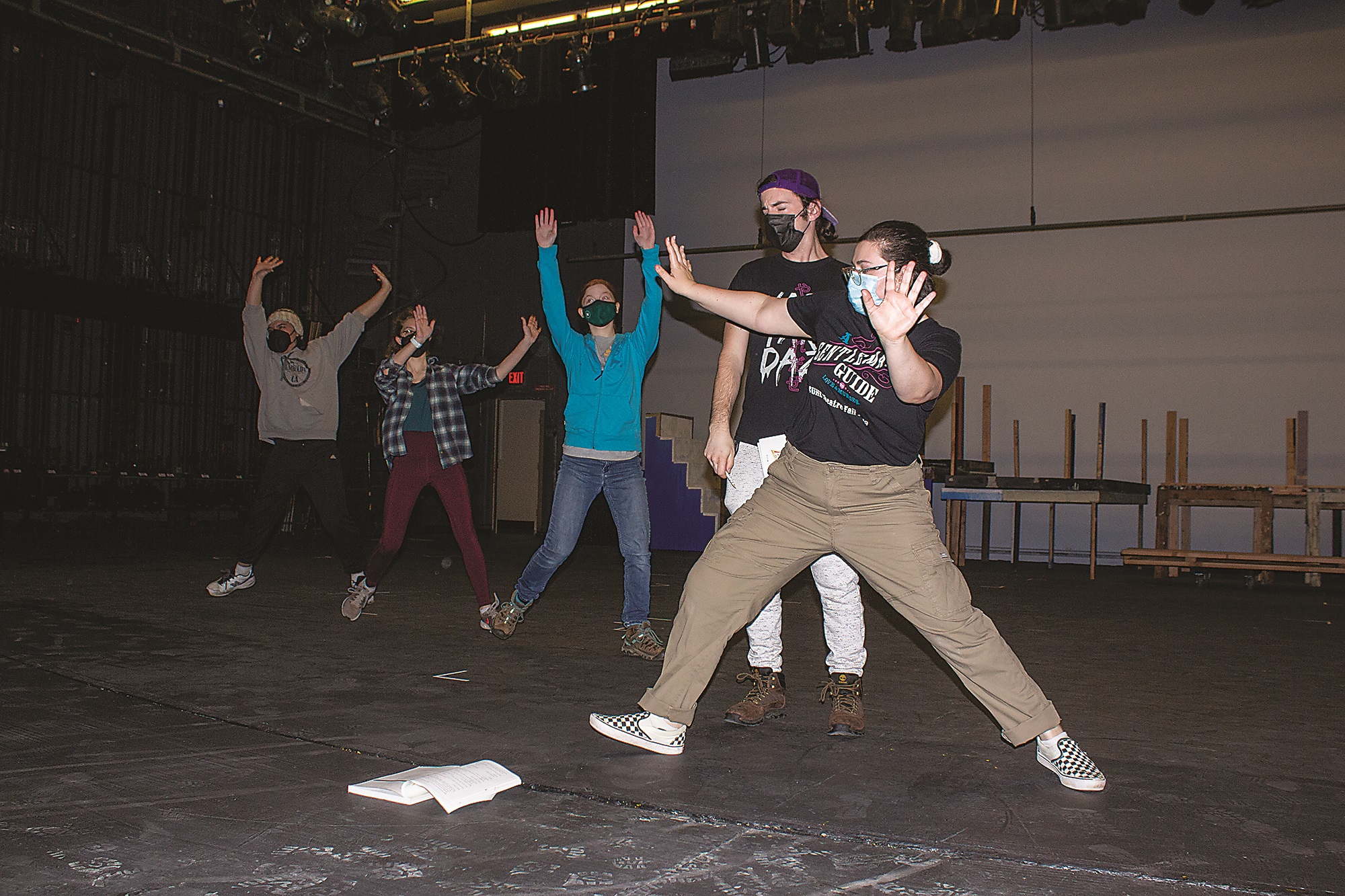
    The cast and crew of Cal Poly Humboldt’s spring musical have been meeting for two weeks now, ever since the start of the semester. Rather than fully polished scenes, their rehearsals consist of bare-bones run-throughs, scripts in hand and tape on the floor where the set will eventually be.

    The show is “Something Rotten,” a farcical comedy set in an anachronistic 16th century. The two main characters, the Bottom brothers, invent the concept of a musical and feud with their rival, Shakespeare. The show re-characterizes The Bard as a rocker, not dissimilar to a Freddie Mercury type charismatic frontman.

    “The show is about love, relationships, ego, and anachronism,” said director Michael Thomas. “You’ll see a cell phone or two, there might be a modern toilet plunger.”

    Although “Something Rotten” is set in the Renaissance, the music and dancing are rooted in Broadway tradition. At this particular rehearsal, choreographer Carrie Walpole was working with the cast on the dancing for the track “A Musical.”

    This number will feature the cast tap-dancing, and is best described as a classic musical theater style composition. Another track, “Will Power,” performed by the character of Shakespeare, is unmistakably rock. The Bard croons out his famous lines “Shall I compare thee to a summer’s day? Thou art more lovely and more temperate,” over a driving bass line.

    “It’s more like a rock musical, it’s a very upbeat score,” said Thomas.

    Cast members and crew alike were required to be at Wednesday’s rehearsal for most of the evening. Stage manager Ian Aguilera and his two assistant stage managers Benji Salisbury and David Fisher spend just as much time as the actors, if not more, preparing for and producing the final musical.

    Before the rehearsal had even started, before the director or most of the cast had arrived, Aguilera was at Van Duzer Theater, preparing.

    “Tech and acting are kinda fifty fifty,” said Aguilera, when asked about how much the crew do behind the scenes. “The director’s not here, I am.”

    With the support of the crew literally behind the scenes, the musical’s cast can do their best work. While the actors go over scenes, Aguilera sits at the front of the stage assisting with minute production details and even helping with direction.

    “Something Rotten” takes advantage of its self-aware premise for comedic effect.

    “It’s a musical about a musical,” said Aguilera. “It’s [the main characters] versus Shakespeare.”

    In one scene, the soothsayer Thomas Nostradamus, played by Sammi Pietanza, looks into the future of theater. He says that the characters will break into song and dance, and a glass of wine at concessions will cost an exorbitant amount of money.

    Pietanza’s character acting is silly, joyful, and extremely animated, even at this early stage of production. They said that it’s easier for the director to scale back an overdone performance than to draw more out of a timid one. They were the center of attention on stage, striking wizardly poses and speaking the script with mystical energy.

    “The character [Thomas Nostradamus] is like a human goblin,” Pietanza said. “Like a Danny DeVito kinda trash rat.”

    This energy that Pietanza brings seems emblematic of the production as a whole. It’s a whole lot of passionate people, coming together to make something silly, dramatic, and distinctly musical theater.

    Director Michael Thomas is looking forward to what will hopefully be a live, in person performance of “Something Rotten” in April.

    “People should come see it because it’s a fun, silly evening,” said Thomas. “It’s full of action, it’s colorful and upbeat.”

  • Free iPads pop up at HSU

    Free iPads pop up at HSU

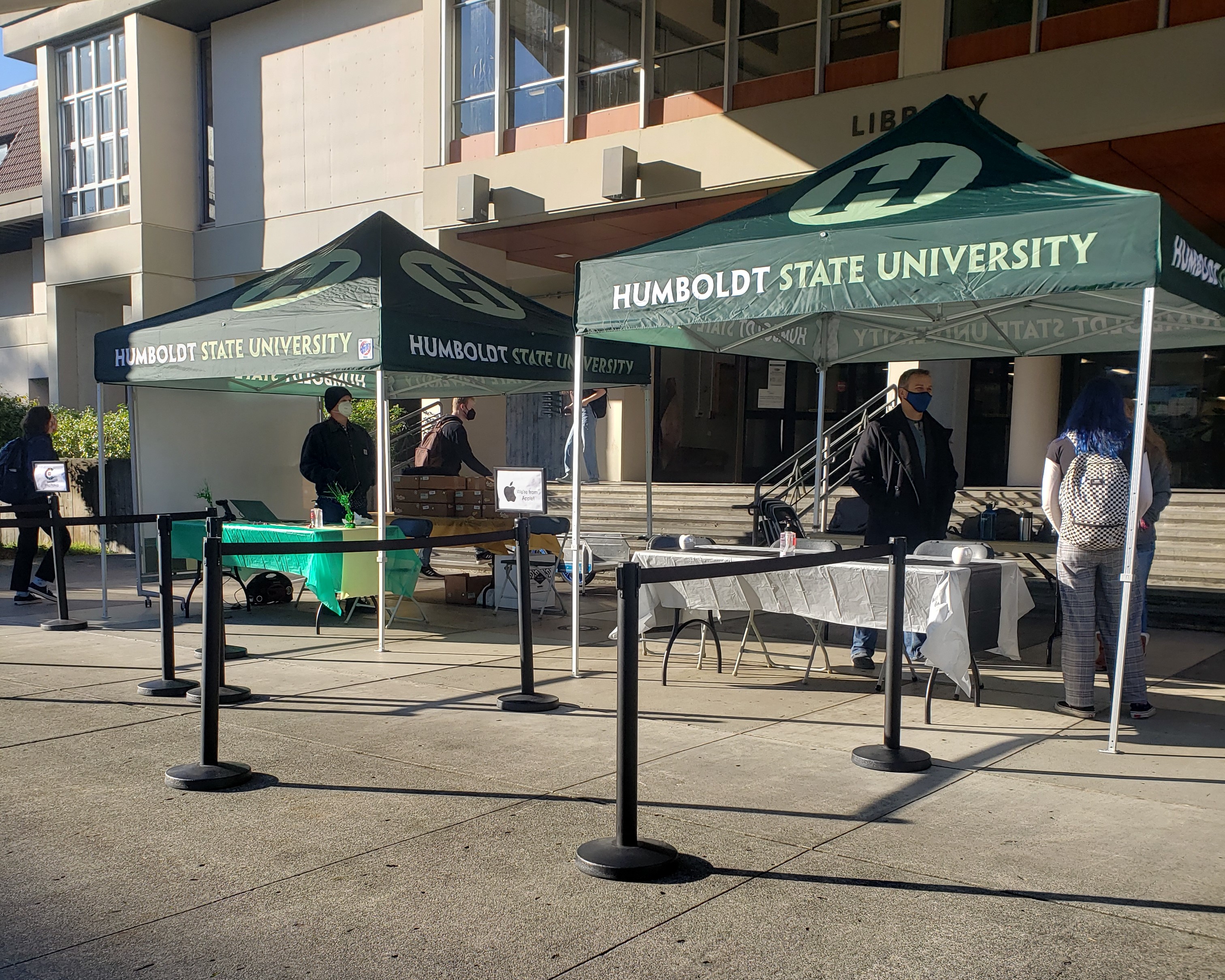
    Humboldt State University set up tents in front of the library and gave out free iPads to incoming freshman and transfer students on Jan. 19.

    The iPads were provided by the California State University Connectivity Contributing to Equity and Student Success (CSUCCESS) Initiative. CSUCCESS was created by the CSU in partnership with Apple. It debuted at HSU’s campus last fall and returned this semester.

    Oceanography junior and transfer student Angelina Mayo got an iPad from CSUCCESS. She just transferred from Shasta College, where she worked as a tutor while attending school. A student that she tutored during the time used an iPad to take notes.

    “I think it was just an incentive, and I wanted to try it because I saw a student at Shasta College use it and help keep her organized,” Mayo said. “She was more prepared for our tutoring sessions than some of my other students because of keeping her files together.”

    HSU Library Student Assistants adorned the cardboard iPad boxes with HSU stickers. Stickers that are free for the taking at the Information Technology Services desk on the first floor of the library. Mayo stuck a green ‘H’ sticker on the h-button of her keyboard.

    Photo by Alexis Valtenbergs | Apple Senior Account Manager Jenni Beck (back) helps transfer student Angelina Mayo (front) set up her free iPad outside the library on Jan. 19.

    “I signed up for EOPS and got ‘swag,’ that’s what they called it,” Mayo said as she typed in her HSU ID and password on her new iPad. “And amenities.”

    One of the amenities that Mayo opted for was the free iPad.

    The goal of the CSUCCESS Initiative is to make technology more accessible to higher education students in the CSU system, especially in the backdrop of the ongoing COVID-19 pandemic that relegated students and faculty alike to remote Zoom classes.

    “The biggest reason for that is to ensure equity and access,” Apple Higher Education Senior Account Manager Shawn Vandergriff said. “To provide the same level of technology to every student.”

    According to Vandergriff, HSU has provided iPads to approximately 700 HSU students since CSUCCESS came to campus last semester. His goal is to bridge what he referred to as the ‘digital divide’ in higher education, which is often overlooked.

    Eligible HSU students get to keep their free iPad throughout the duration of their academic career at HSU. Apple Care insurance will cover up to two instances of breakage, according to Vandergriff.

    The CSUCCESS program is expected to return to HSU again in the fall.

    “As long as we have a budget to do that, I can see it happening into the future,” HSU Customer Care IT Consultant Andy Pierce said.

    To learn more about CSUCCESS at HSU, visit its.humboldt.edu/csuccess.

  • HSU Basketball bounces back after COVID-19

    HSU Basketball bounces back after COVID-19

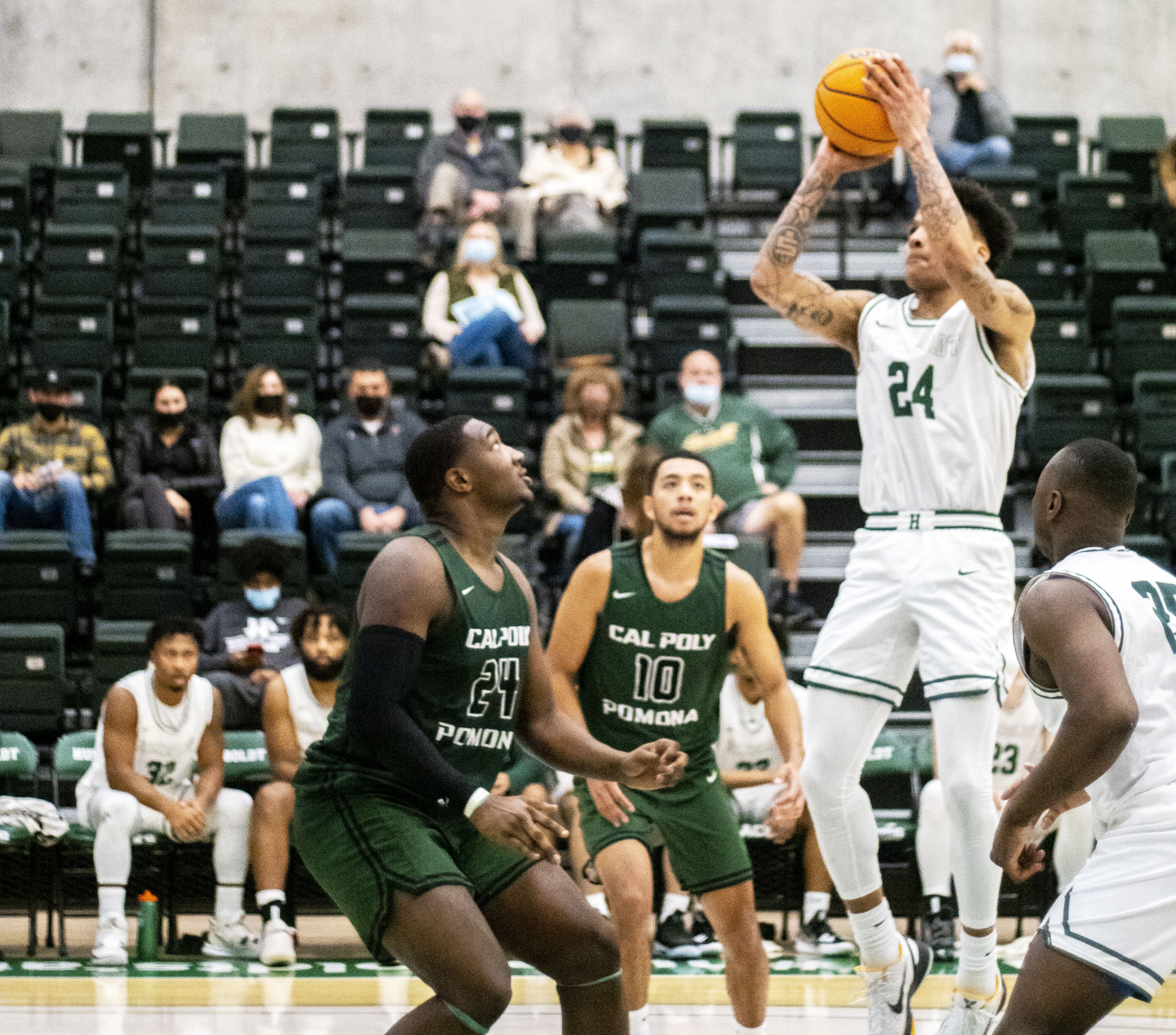
    Basketball season is speeding up this month with both the men’s and women’s teams heading on to away games.

    The women’s team continued their competitive season with a game that resulted in double overtime and a loss for Humboldt State.

    “This (week) will be a tough stretch for us,” Coach Michelle Bento-Jackson said. “It’s a road trip that involves both a northern and southern team so the travel, in general, will be more gruesome than normal road trips.”

    The team will travel to play against East Bay and Dominguez Hill. East Bay is currently undefeated and, similar to HSU has a strong defense.

    “We had an outbreak of COVID within our team,” Coach Bento-Jackson said. “Since we came back from break we only had two practices under our belt.”

    With the team recovered and back to regular practice they have their spirits high and are keeping up with COVID-19 protocol to have safe games throughout the season.

    The men’s team is continuing their competitive season which has been a struggle with more COVID-19 outbreaks.

    “I’m always worried about one of my guys getting COVID,” Coach Tae Norwood said. “We test frequently. We test before we play our opponents.”

    The players are also very responsible for their personal safety against COVID-19 with social distancing, wearing their masks, and avoiding large gatherings. The players have a 100% vaccination rate and a 95% booster rate.

    “I really focus on the effort from my guys,” Coach Norwood said. “They play hard but we gotta do a better job of executing it.”

    The basketball players will be continuing to practice and work on their defense before their games against East Bay and Dominguez Hill this week. AJ Sims is back and continuing as the leadership of the team and the best shooter. With more players stepping up, the team is hopeful about the rest of the season.

  • The HSU student’s guide to COVID-19 in spring 2022

    The HSU student’s guide to COVID-19 in spring 2022

    There is currently a surge in COVID-19 infections worldwide and in Humboldt County due to the rise of the Omicron variant. In an article titled “Potential Rapid Increase of Omicron Variant Infections in the United States,” the CDC has cautioned that this iteration of the virus is more transmissible than previous forms.

    “Increases in infections are most likely due to a combination of two factors: increased transmissibility and the ability of the variant to evade immunity conferred by past infection or vaccination,” the article states.

    Most spring semester classes at HSU are planned to take place in person, even as county infection rates soar beyond any previous peaks. According to county data, Humboldt County saw a peak of 256 new COVID-19 cases on Jan 3. This dwarfed the Delta variant peak of 101 new cases on Aug 9, 2021.

    However, hospitalizations remain well below the rates recorded during the Delta peak of August 2021, according to the NYT’s data sets.

    It is inevitable that some students will be exposed to and catch COVID-19. The responsibility of each is to limit their personal risk while also protecting others from infection.

    Following the HSU masking guidelines and getting your vaccine booster as required by the University will make you less likely to contract the virus. Vaccine boosters also greatly reduce the chance of a severe or even symptomatic infection.

    A study released by the UK Health and Security Agency found that, “Among those who had received 2 doses of Pfizer or Moderna, effectiveness [against symptomatic disease] dropped from around 65 to 70% down to around 10% by 20 weeks after the second dose.”

    Boosted individuals enjoy a re-up of their protection: “65 to 75% [at 2-4 weeks,] dropping to … 40 to 50% from 10+ weeks after the booster,” according to the study’s findings.

    “Deadline for full vaccination, including a booster shot, is Jan. 23,” according to the CSU Chancellor’s vaccine mandate. Exemptions are available, on the condition that recipients commit to a weekly test.

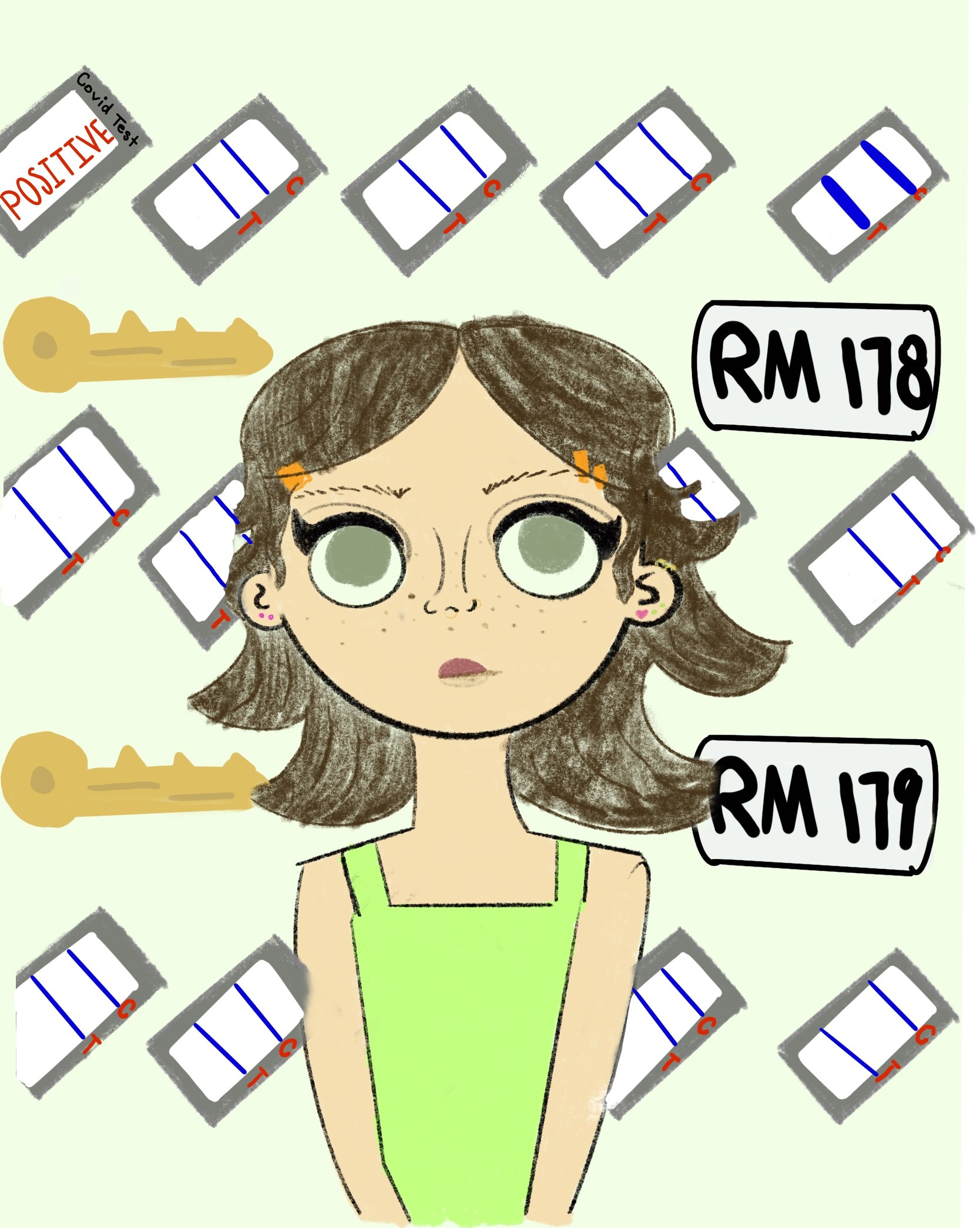
    After a positive COVID-19 test, you are required to contact Student Health & Wellbeing Services at (707) 826-3146 and report your infection. You may also be advised to get a PCR test if you tested positive with a home test.

    Testing positive for COVID-19 means you should also keep a close eye on your personal health. Mad River Hospital’s guidelines for at-home assessment of COVID-19 symptoms state that a persistent fever of 103-104°F, bloody material produced when coughing, and/or difficulty breathing are signs that you should go to the ER.

    In the absence of more severe symptoms, the hospital’s website advises that infected persons “keep warm and rest as much as possible … take plenty of fluids … and for fever, take Tylenol in normal doses.”

    Once you’ve taken care of your health, you should also take steps to limit the exposure of people around you to the virus.

    According to Humboldt County isolation and quarantine guidelines, those who test positive for COVID-19 must isolate for at least 5 days.

    “Isolation can end if a test collected on or after day 5 is negative and the individual is not experiencing symptoms or symptoms are resolving,” states the county website. The guidelines also advised to “wear a well-fitting mask around others for a total of 10 days.”

    Graphic by Morgan Hancock
  • Punk Patchwork

    Punk Patchwork

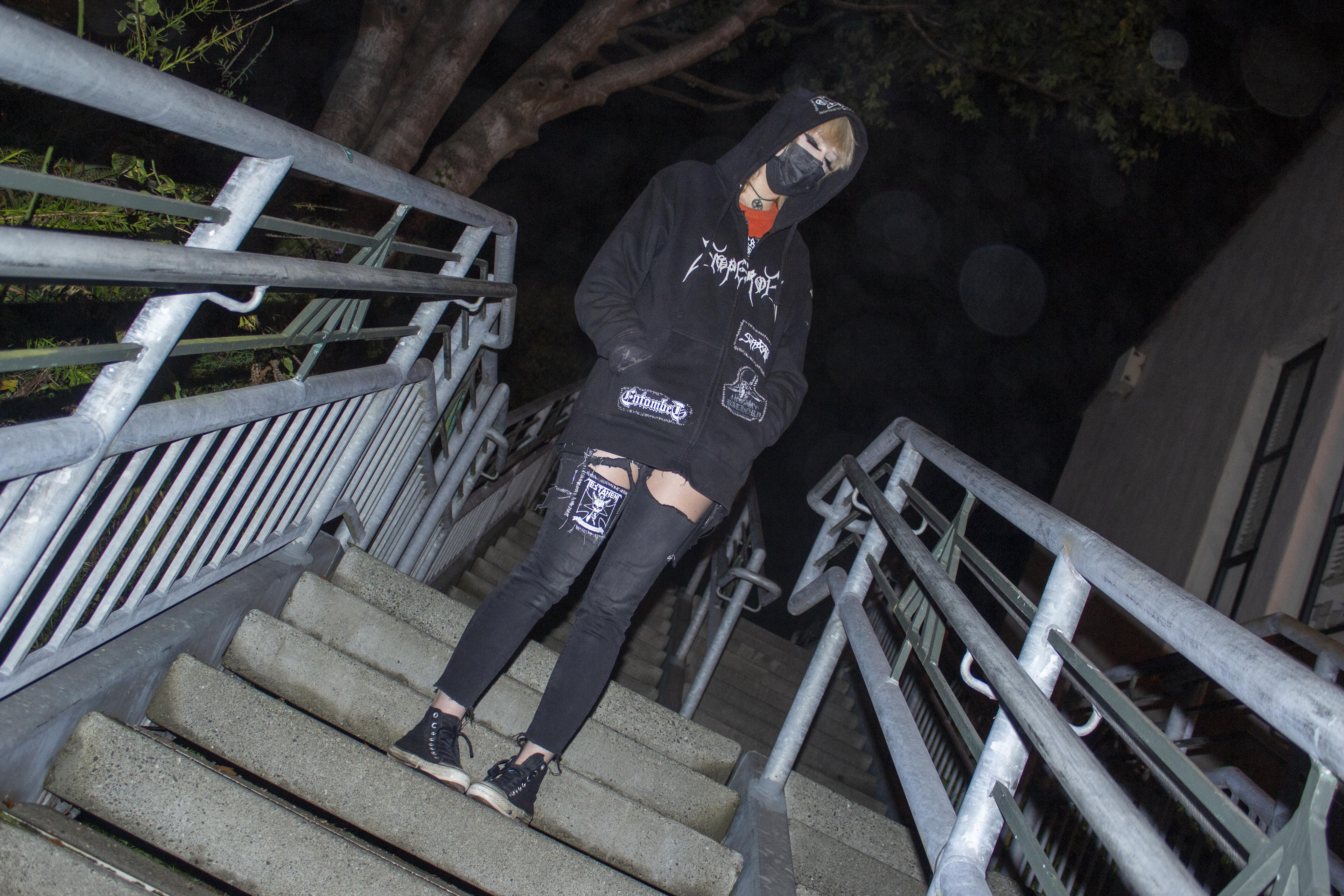
    About half of Xoë Sioux’s wardrobe is covered in scraps of fabric, plastered with the names and logos of various bands and bits of art.

    “The whole thing about punk is to dress your own way, how you want to look and not fit into society’s views of you, and so a big part of it is like creating your own clothes,” Sioux said.

    Wearing patches on their clothes identifies Sioux to other members of their subculture.

    “Other punk kids, or metal kids, or anybody in the subgenre- if they see it and they appreciate it, then that makes me happy,” Sioux said.

    According to Sioux, the history of decorating clothes with patches dates back to the origin of punk itself in the 70’s and 80’s.

    “People were creating patches for all the bands that they liked, like The Clash, Discharge, Sex Pistols unfortunately,” Sioux said. “They started stitching them onto their clothes to create a statement.”

    Patches also serve as free advertising for the bands they represent. Nat Cardos, who came up in the southern California punk scene and now plays in several local bands, explains the process.

    “You have these punks who buy your patches at your show that you make yourself,” said Cardos. “When they sew them on people will see them, and be like, oh, what’s that band.”

    In addition to the aesthetic value they add, patches also help extend the longevity of garments. When the original fabric gives way, a patch can allow one to continue wearing the item of clothing for years to come. Many punks have taken to using more durable dental floss to secure their patches rather than sewing thread.

    “I like the look of it, and they stay together way better in my opinion,” Sioux said. “And they make me smell good because I smell like mint.”

    Sioux’s favorite patch is from a band called Bathory, her favorite band of all time. The band took inspiration from the Countess Elizabeth Báthory de Ecsed of the former Kingdom of Hungary, who was infamously convicted of torturing and killing hundreds of girls and women, in what some say was an effort to retain her youth. The patch, in classic alternative style, depicts a disembodied goat head above the band’s name in gothic script.

    For the people that wear them, patch jackets can be a chronicle, the time and place where each patch was attached forever sewn into the fabric. Cardos recalls exactly what their first patch was as it is still on one of their jackets.

    “I bought it online, and you’re probably going to have to censor this, but it says: ‘fuck all crooked cops, may their corpses rot,’” Cardos said. “It’s my favorite patch I own.”

    Cardos says that patch-making is an integral part of the DIY subculture within punk. In addition to buying patches that bands sell as merch, most also make some of their own patches. There is no set method.

    “A lot of people make them using either screen-printing ink and canvas, or a lot of people also will just use sharpie if they have a light enough fabric for it,” said Cardos.

    Sioux has some guidelines for others looking to get into wearing patches.

    “It’s really fun to dress weirdly, and dress out of the norm, and patches make you look really cool,” Sioux said. “But I definitely highly recommend listening to the music that you’re putting onto your clothes, nobody likes a poser.”

  • Students support community on MLK Day of Service

    Students support community on MLK Day of Service

    MLK Day is more then simply a day off, it holds an important message

    “These are revolutionary times. All over the globe men are revolting against old systems of exploitation and oppression, and out of the wounds of a frail world, new systems of justice and equality are being born.” said Martin Luther King Jr. in his A Time to Break the Silence speech.

    Last Monday marked the country’s annual day of recognition towards civil rights leader and minister Dr. Martin Luther King Jr. A contention day to some as increasing more citizens have come to see the commodification and sanitization of MLK’s legacy to be problematic. Many efforts have been made across the nation to realign this day with his actual messages of racial and economic justice, not only through the medium of peaceful protest, but also civil disobedience and radical structural change. Many of the MLK events in Humboldt could be found partaking in this national movement.

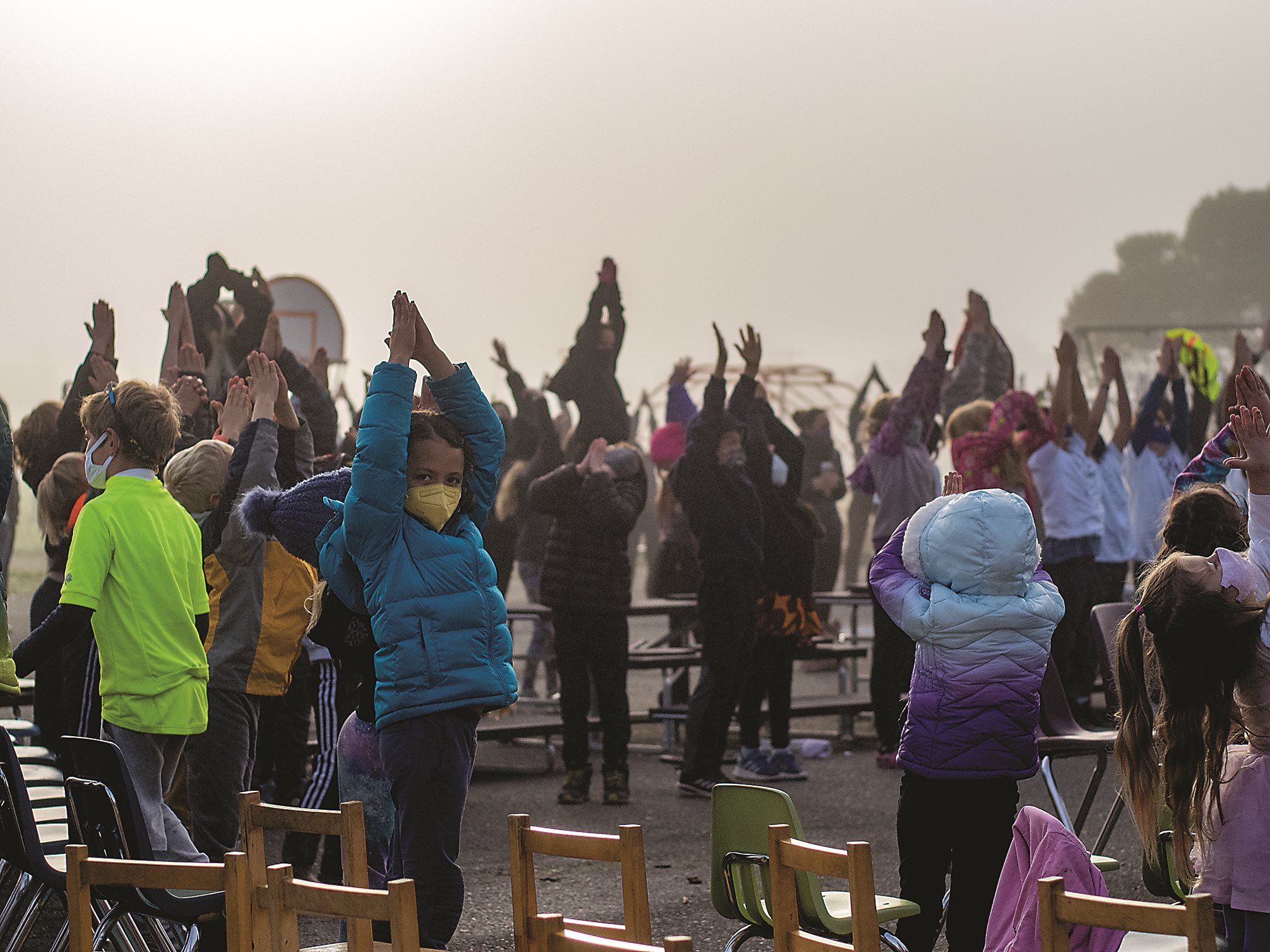
    Local bilingual and charter elementary school, Fuente Nueva, last Friday celebrated the upcoming holiday through a series of black guest speakers from organizations ranging from Black Humboldt, Eureka’s NAACP, B-Men, and many more. After the event’s collection of inspiring speeches, delivered to the awaiting children located in the front rows, all attendees were invited to walk a mile march in remembrance of MLK’s own March on Washington.

    HSU held its own MLK event on Monday as well. Starting in the early hours of 8am and hosted by Youth Educational Services (Y.E.S), the event was labelled “A Day On, Not A Day Off” and focused on community service volunteering. Guest speakers included our own Dean of Students, Dr. Eboni Ford-Turnbow, and prominent activist Bree Newsome. Volunteering activities ranged from on campus to off, Arcata to Eureka, and included a variety of public services. For many students and community members in Humboldt, MLK Day was not simply a vacation but an opportunity to give back and to keep Martin Luther King Jr’s dream truly alive.

    Photo by Morgan Hancock | HSU student volunteer on MLK day Monday Jan. 17.
  • The HSU Library is finally open

    For the first time since 2017, the HSU library is fully open to students.

    The HSU library reopened on Jan. 18th after the completion of the Seismic Retrofit project. This project was undertaken to reduce structural damage from seismic activity.

    Changes to the library are mostly structural apart from the lower floor, which underwent a complete remodeling. This included repainting, new carpet and flooring, and new window coverings. A new sprinkler system was implemented throughout the entire building as well as new roof tiles and lighting.

    Jason Maugh was the Project Manager and was brought on board to work for HSU in 2016. This project has been in the works for years before this and was originally brought to attention in the 90s. According to Maugh, In 1993 CSU did an evaluation of all of HSU’s buildings and found that the library posed a risk to the general public in the event of serious seismic activity. They were not able to provide the funding for fixing this problem until 2015, over 20 years later.

    The project was dragged on for even longer after the completion of the original plans in 2020.

    “The state fire marshal looked at the changes as a building addition which triggered sprinkling the whole four story building,” said Maugh. This is the reason the library has been in construction for so long, since the school did not originally plan on putting in new sprinklers and had to request additional funding from CSU. Despite the arduous process, the library is now mostly complete and much safer in the event of a serious earthquake.

    There is still some exterior construction being undertaken but it has no impact on students’ accessibility to the library and all facilities are available to students regardless.

    Due to recent spikes in COVID-19 throughout Humboldt county, access to the library has been limited exclusively to HSU students and faculty for the foreseeable future. Each student must have their student ID ready in order to access the facilities.

  • University requires booster by January 23

    University requires booster by January 23

    Starting Jan 23, students, faculty, and staff must be fully vaccinated to use campus facilities. This Humboldt State announcement was made in December shortly after students left for break. Anyone not able to receive a vaccination or booster can submit for an appropriate exemption. Following an updated certification date, the university said the likelihood of infectious spread in the classroom will be low given vaccination requirements, mandatory testing, masking, and other efforts made by the school.

    In a press release sent to all students earlier this week, HSU clarified full vaccination status as ”attesting that you are fully vaccinated (including a booster if eligible) or have submitted for the appropriate exemption.” Recipients of the Pfizer and Moderna vaccines are eligible for boosters five months after completing their initial series. Johnson & Johnson recipients can get a booster two months after their initial dose.

    The university asked that those who have already received the booster should go into their student portal and complete the attestation about vaccination status. Students can do so by logging into their Health Portal at myhumboldt.edu. To find a vaccination clinic in your area, visit My Turn California (myturn.ca.gov). However, clinic availability in some areas is limited, including Humboldt County.

  • Stop the surge

    Recently, I saw a petition that advocated for the delay of in-person HSU classes by two to three weeks. Is this too much to ask? Logically, I think that what these advocates stand for deserves careful consideration. Humboldt county’s rates of coronavirus cases are the highest that they have been since the beginning of the pandemic. As of January, the county has averaged 213.9 cases on a weekly basis. Throughout the CSU and UC systems, an abundance of schools have decided to do remote learning for the first month. Why should Humboldt State be an exception to this? This reminds me of any disaster movie ever made. The last group people want to listen to is the scientists. We’re in the middle of a global crisis, yet people and our own institutions want to deny it. It almost feels like the world is on fire, however, I’m one of the few that sees the fire and acknowledges it as an inherent problem with our society. We cannot have another surge! Our local facilities don’t have the capacity to house any more COVID-19 patients. A couple of months ago I was trying to find an appointment for gallbladder surgery. Usually, medical emergencies would have been taken care of at Saint Joseph Hospital in Eureka. Instead, I was scheduled for surgery at Mad River Hospital in Arcata, supposedly because all of the hospital rooms at Saint Joseph Hospital were at full capacity. With rising numbers, I can only imagine how hard it would be to find an appointment for gallbladder surgery now as compared to then.

    The coronavirus has also disproportionately affected Indigenous communities in the inland area. As of January 13, 2022, Public Health Officer Eva Marie Smith has detected an Omicron case in the Hoopa Valley Indian Reservation. With a total of 109 active cases, Smith believes that the tribe is likely experiencing a mix of Delta and Omicron with a predominance of Omicron within the next few weeks. Due to the latest Covid surge, Hoopa Tribal Chairman Joe Davis has authorized a level 4 shutdown of all non-essential operations for at least two weeks. The Omicron surge has also recently caused staff shortages at Saint Joseph Hospital.

    Early studies suggested that the Omicron variant can just as easily infect vaccinated people as it can the unvaccinated population. It can be said with confidence that anyone can be infected by the widespread virus. In addition, it would be wise for Humboldt State to require all students to be tested weekly regardless of their vaccination status. Vaccinated people are just as likely to transmit the Omicron variant as someone who is unvaccinated. If that isn’t enough, it can also reinfect. It seems no matter how much you tell someone to not touch the stove, they have to touch it for themselves in order to figure out what the consequences are. By signing the petition, we can mitigate such catastrophic events from further happening.

  • New roommates and COVID concerns

    New roommates and COVID concerns

    Spring semester has begun, and like many other Humboldt State students living on-campus, the lone twin XL mattress in your room has probably been filled with a randomly selected roommate during your last few weeks of the fall semester.

    Before I get into any details, this is not some big scheme I have to get my three new roommates out of my apartment or to make anyone feel unwelcome here at HSU. If you’re paying tuition, who am I to say you aren’t welcome in my shared apartment, which is technically school property.

    The issue is that I’m scared of my roommates and I think many other students feel the same. I’m not terrified at the fact that three more people in an apartment I already shared between two other girls may cause some bathroom lines, extra dishes in the sink, and more people to be noise-conscious of. I actually am looking forward to the company. I’m terrified of how easy it is to spread COVID-19 or Omicron, or whatever variant has sprung up since this has been published at the rate the virus has been mutating.

    My campus apartment is small. It holds one room for our one toilet and one shower. There are three rooms all shared between six of us with a tiny kitchenette. I don’t know much about my new roommates yet. Where they’ve been, who they’ve seen, if they are immunocompromised, or what. I also don’t think I have the right to ask or know. I just have to cross my fingers and hope to God when I move back that they’ve taken the precaution to get tested before they move in so we all don’t end up in isolation our first two weeks of the semester getting late bagged meals delivered to our door.

    Still, who am I to be wary when the concern goes both ways. They know nothing about me, where I’ve been, who I’ve seen, if I’ve been tested or not, and they probably assume it may be inappropriate to ask as well. We’re all sleeping with one eye open, peering over at the possible positive COVID-19 test our roommates or myself can easily become.

    Soon enough we’ll begin interrogating each other at the door about who we’ve seen and where we’ve been to avoid a repeat of March 2020, where the fateful email to flee our residence halls came because of the lack of isolation rooms on campus and influx of cases.

    Sounds pessimistic but could easily be our reality as it has been before. Humboldt State is not being transparent enough to its student body, especially those paying to live on campus and eagerly moving up to Arcata for their first taste of on-campus classes. These are exciting times and I wish my new roommates could experience them COVID-free but the risk is far too high to do so. HSU needs to implement stricter testing for anyone moving back to campus and rethink the possibility of in-person classes soon to make those living on campus and those entering campus for classes feel safer and to avoid another COVID-19 breakout.

  • Humboldt’s Hostile Housing

    Humboldt’s Hostile Housing

    By: Rachel Marty

    “I was cleaning and found that mold had covered the entire under part of my mattress and also my belongings,” Charlena Valencia said. “There was also visible infected mold on my clothing.” 

    Valencia, a Humboldt State student, grew worried after finding large amounts of mold in her home as well as beginning to break out in a concerning rash. Valencia said the rash started on their hands. They were originally treating it as eczema and assumed it was due to repeated hand washing and sanitizing. Soon the rash spread to their entire body and they seeked further medical advice.

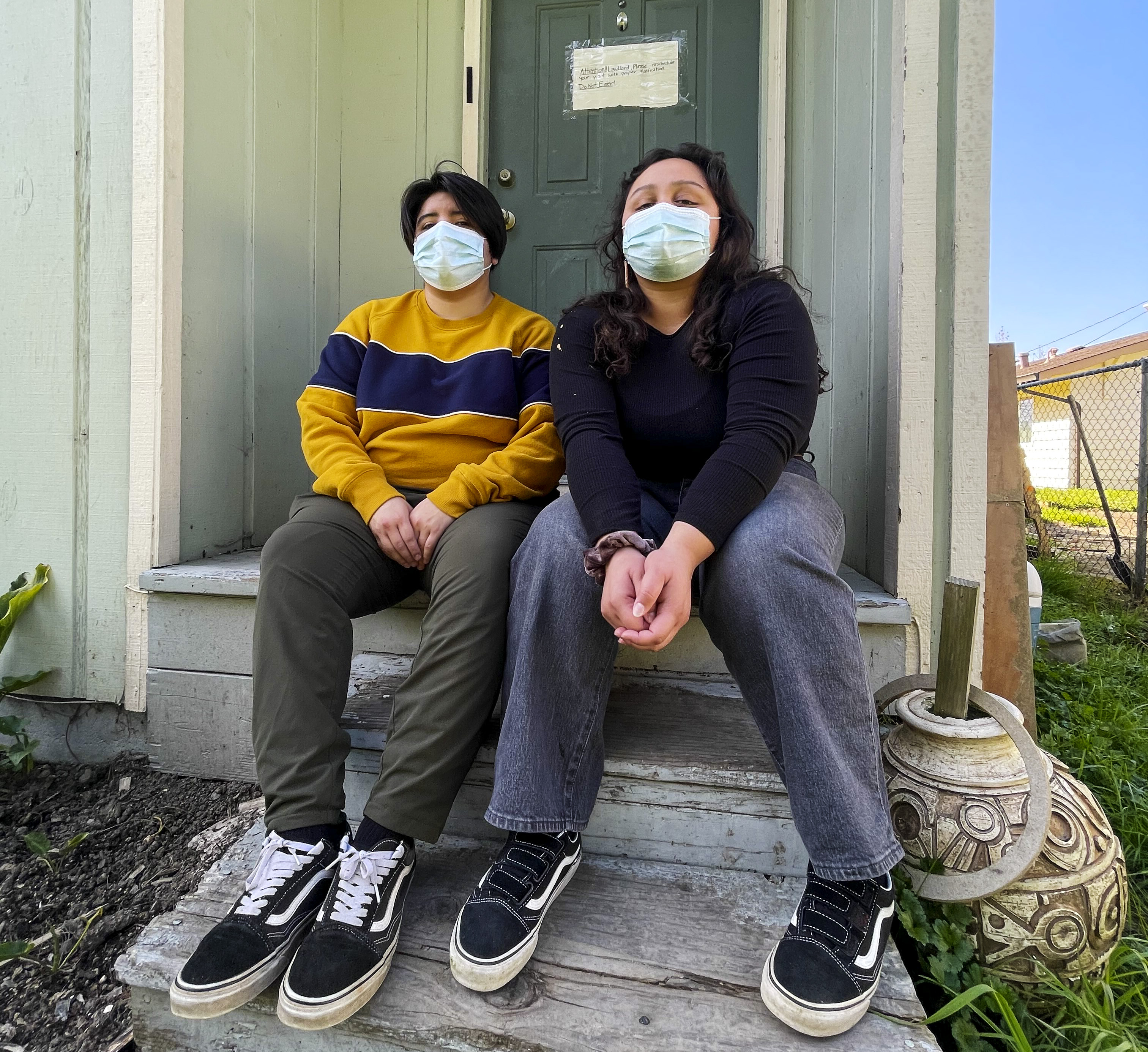
    With medical confirmation from a physician that mold was the cause of their health issues, the student brought up the situation to their landlord. The student claims the landlord showed no concern and an explicit negligence of the matter. 

    Valencia and their partner, Joelle Montes, spoke at the Arcata City Council meeting on Feb. 3 pleading for more strict regulations for landlords.

    “Myself and others would like to see regulations put in place to protect the community from these types of situations,” Montes said. “The students are an obvious important part of this community and economy, they should be recognized for their contributions. All tenants should be valued and protected.”

    The two HSU students also brought up the electric and gas hazards they struggled with, including a gas leak.

    “My partner and I had no functional heating and after spending night after night in the freezing cold and recent storms, I finally called PG&E myself,” Montes said. “We might not have ever known we had a leak if I did not do that.”

    Due to the gas leak, the apartment was red tagged and they were immediately evicted. According to The City of Arcata’s Substandard Housing Renter Guide a landlord must provide other housing accommodations in this type of situation. 

    “If the inspector find that problems to be so hazardous as to create an immediate threat to life or limb, the City may proceed with eviction due to the hazardous conditions,” the Substandard Housing Guide says. “Eviction would be an extreme case, and if it were to happen, it is the obligation of the landlord to provide temporary lodging.” 

    “She only got us one day at a motel,” Montez said. 

    The students had to make their own accommodations after that one night. Luckily, Valencia and Montez had a friend offer them a room to temporary stay in. Although they now have safe temporary housing, the situation continues to put extreme stress and pressure on the two students. 

    “This whole problem has really affected my academics. I had to literally drop all my classes to deal with all of this,” Valencia said. “We’re students, how are we supposed to work and do academics on top of all this?” 

    Council member, Emily Goldstein, responded to the two students through the Zoom city council meeting with a hopeful acknowledgement of their hardships. 

    “Very impressed with you young people willing to stand up for yourselves and I think it’s something as a council we should really consider looking into infractions for rental properties and safety standards for our renters in Arcata,” said Goldstein. “Their story I think we all know is not unique and that’s really unfortunate.”

    It’s encouraging to see officials recognize students like Valencia and Montes, and Goldstein’s not the only one stepping up.

    A new program led by the university’s Off-Campus Housing Coordinator, Chant’e Catt, aims to better the relationships between landlords and tenants. It hopes to help out students in situations like Valencia and Montes. It’s called the Good Neighbor program and it’s been in the works for over two years.

    Catt says the program was born through a lot of ground-up community research. They held half a dozen town hall meetings on the topic. 

    “We invited landlords, students, community members, pretty much anybody that has to do with housing to come in and talk about their experiences with housing,” Catt said. 

    They found that a lot of tenants need resources to help them understand how to rent, what their rights and responsibilities are, and what the process is actually like.

    “Sometimes our families can’t teach what it’s like to be a good tenant. Sometimes we don’t get the information we need in our family systems to adult well,” Catt said. 

    But being a good tenant is only half of it. Being a good landlord is crucial in building strong community relationships. It’s a landlord’s duty to provide a habitable living environment. 

    While this may be true, we also know that some landlords don’t even deal with tenants housing related issues. Students like Valencia and Montes complain about landlords that simply ignore their complaints of mold, gas leaks, or lack of electricity. 

    Prioritizing housing related issues, following all the city regulations and creating habitable conditions for tenants are important practices to form good relationships within our community. The problems we see between landlords and tenants stem from systematic issues and a lack of understanding on both sides. Programs that aid in educating tenants and landlords, such as the Good Neighbor program have the potential to be extremely beneficial to our community. 

    “Landlords have equity and they are taking a chance and a risk renting to people,” Catt said. “Sometimes people don’t know how to take care of their place, but there are also landlords out there that don’t follow proper rules.”

    There needs to be stronger tenant-landlord relationships, as well as better regulated consequences for both parties. Regardless of their behavior, tenants often do not get their deposit back, meanwhile a neglectful landlord seems to have minimal consequences. 

    “Beyond the law and all that, we’re human. We should not be having people sleeping in mold infested bedrooms or exposed to gas leaks or broken heating in 30 degree weather,” Valencia said.

  • Impending mergers threaten Humboldt’s identity

    Impending mergers threaten Humboldt’s identity

    The merging of departments within the College of Arts Humanities & Social Sciences will lead to the detriment of distinct programs and the appeal of Humboldt State as a unique university. 

    As smaller departments are pressured to combine in order to meet the demands of budget cuts that add up relentlessly in the face of the COVID-19 pandemic, we run the risk of losing the focused, intimate education that drew students to campus in the first place. 

    Due to low enrollment the journalism and communication departments have submitted a proposal to Dean Roseamel S. Benavides-Garb, suggesting they be combined, for fear of losing the departments altogether – a fear that is shared among many of the smaller departments on campus.

    One practical benefit of combining the journalism department with the communication department is the opportunity it would allow for courses to be offered more often with more students in the department. On the flip side, combining departments presents the potential to strip each major of its individual identity. While the increased size of the combined department could potentially attract more attention to each discipline, the lack of distinction between the two could also prove confusing and drive prospective students away. 

    Higher education is a step away from the general, scattershot education of grade school. We learn what we’ll focus on, and begin developing specific skills. We also begin to add to the greater pool of knowledge for our chosen field of study. The less our education hones in on a specific field, the more it feels like a shallow high school class – lacking the depth that student’s pay for when they attend a university. 

    While the emphasis of the study of communication is on the underlying meaning of how we communicate, the primary concern for most journalism students is the application of skills to make media of our own. Journalists are already required to take communication classes which prepare them for their chosen focus. Communication classes are valuable to journalists. Every member of our editorial board has taken a communication class which has shaped our perspective, just as our other general education classes impart valuable lessons. 

    Combining departments also comes with grave concerns that the departments will lose lecturers and potentially some of the classes they teach as former chairs are forced to move into teaching positions. This would cost journalism students opportunities to interact with more media professionals and those lecturers would be placed in danger of losing pay and the health insurance they have come to rely upon for themselves and their families. 

    The proposed plan not only throws the student experience in the department into question but ultimately, the merger’s promise to cut $180,000 in expenses annually feels almost like chump change in comparison to the monster deficit the university currently faces. At the end of the day, administrators, students and faculty have to ask themselves whether or not all this restructuring will benefit the university in the long term. Cuts save some money in the short run, but they represent a greater loss to the university and the Humboldt community.

    Some good will come of department mergers. We all have a lot to learn from each other. As journalism students, we will welcome our peers from the communication department and the value their program will add to ours in regards to the developing fields of ethics and theory of communication. Understanding how we interact with the world through language and the culture of communication is critical to operating as an effective journalist. 

    We hope that we can offer greater knowledge of media literacy. Today especially, media literacy is an essential skill any student with a university education should have, and it is crucial that students across all disciplines are armed with the tools to critically assess, analyze and critique media so that they can be more mindful of the media they consume.

    We also hope to impart our own personal experience writing about our university. All of us hear stories of poorly run programs, incompetence at the top of the HSU ladder, haphazard cuts, and a lack of forward thinking. We speak to staff who are afraid of the repercussions for simply telling us their stories. If we want to make HSU a better place, where else might $180,000 per year be saved?

  • HSU community petitions to Push Pause on projected cuts

    HSU community petitions to Push Pause on projected cuts

    The California Faculty Association has received more than 3,000 signatures pushing for Humboldt State to hold off on making budget cuts during the current pandemic. The petition has grabbed the attention of many among the greater HSU community. On Feb 18, a meeting organized by the HSU chapter of the CFA was held over Zoom to discuss the ramifications of the class and faculty job cuts including the impacts that they would have on both students and faculty.

    Nicola Walters, a lecturer in the politics department and the organizing chair of the Humboldt CFA, spoke on her experiences over the years as both a student and now a faculty member at HSU. Frightened by what she is witnessing all around her, she wants to fight for what is right.

    “I’ve also sat in countless department meetings and watched the people who taught me, who I look up to, who make this university a place worth attending left bewildered and broken by administrative agendas that herald shared governance, but instead demand cuts to programs, classes, and jobs,” Walters said. “I’ve listened to my colleagues describe feeling disposable, exhausted, terrified, and traumatized while we grapple with overhauls to our campus.”

    Walters remarked on the contrast of HSU receiving lots of federal funding as of late against HSU slashing jobs and classes.

    “Putting profit over people’s jobs doesn’t fit with our university or our community,” Walters said. “Our campus isn’t adverse to change, it’s adverse to practices that violate trust and perpetuate cuts against our campus community. Implementing changes while faculty are unable to protect their interests is an administrative strategy and is not the way forward.

    Another key speaker was Dr. Cutcha Risling Brady, an associate professor and department chair in the Native American Studies department. Brady talked about the impact that any additional cuts would have on students. More specifically, she introduced the idea that students are feeling out of control because they are already dealing with family deaths and other hardships during the pandemic but to see faculty and staff that they rely on for support is next level unacceptable.

    One of these students, senior communication major Anastasia Tejada, is concerned that one of the closest allies in her department, lecturer Leslie Rossman, could very well have her position cut in due time. Rossman helped Tejada get into a graduate school at the University of Nevada, Reno, and secure funding for it.

    “That would not have happened without her support and guidance,” Tejada said. “I would not know where to start and in all honesty, I probably wouldn’t be headed into higher education if it was not for her.”

    Tejada was not surprised that HSU president Tom Jackson was not in attendance for the Push Pause meeting and thinks it is reflective of his entourage as a collective.

    “He has been very silent this entire time he has been missing,” Tejada said. “From almost every important conversation, the fact that he couldn’t even show up to listen just proves the point that the administration does not care about its lectures or faculty.”

  • Updates on Testing and Vaccinations for COVID-19 at HSU

    Updates on Testing and Vaccinations for COVID-19 at HSU

    Coronavirus testing will be available for all HSU students and employees in a matter of days. Here are some details on testing and vaccinations for students at HSU.

    Testing

    Beginning this month, Humboldt State, in cooperation with HealthQuest, will be offering free coronavirus tests on campus for all HSU staff, faculty, and auxiliary employees. An HSU ID will be needed when it comes time to take the test but HealthQuest will only bill insurance directly, so there is no need to worry about paying up-front.

    Students who are residing on campus will be tested when they move in and then again seven to 10 days later. These students will be contacted by Housing regarding arranging testing appointments.

    Athletes will be frequently tested as mandated by NCAA and County Public Health protocols.

    Vaccinations

    The University is currently working with County Public Health on plans to give out the vaccine to all HSU staff, faculty, and employees who would like to receive the vaccine when available. HSU aims to administer vaccinations to students when allowable based on state and county prioritization and vaccine availability.

    Additionally, all Humboldt County residents who want to be given the COVID-19 vaccine are able to submit their contact information through an online interest form to be alerted when doses are available for their tier.

  • COVID-19 Testing for Move-in Day

    COVID-19 Testing for Move-in Day

    Move-in day is Feb 19, and the Student Health Center is preparing to test the many students returning to campus after winter break. Due to the sharp rise of COVID-19 cases in California at the end of 2020, the school pushed back the date for students to return to their dorms. Now, hundreds of students from all over are returning to HSU and the Student Health Center is getting ready to test all of them, particularly if the planned return to limited face-to-face classes begins in the fall semester.

    According to HSU spokesperson Grant Scott-Goforth, the school has been testing constantly to keep an eye on campus COVID-19 cases.

    “They have been administering a few hundred tests per week, but that’s expected to go up as students move back and face-to-face classes commence,” Scott-Goforth said. “The Health Center has conducted a total of 5,013 tests since they began testing.”

    All this comes not long after a new strain of the virus, which is more contagious, was first reported in Humboldt County. While Humboldt had been lucky enough to have relatively low rates of positive cases, those numbers have steadily increased and pushed the county into the highest restrictive COVID tier. This comes at a time when many still do not qualify for vaccines and those who do have difficulty getting them.

    HSU is anticipating about 350 students which may increase the number of positive significantly. According to Scott-Goforth the positivity rate on campus is relatively low.

    “The positivity rate is 1.3% among students, and has increased slightly since testing began,” Scott-Goforth said. “For comparison, the positivity rate for Humboldt County is 4.03% and statewide it’s 6.9%.”

    Continued lockdown means the negative effects on students’ mental health are likely to continue as well. According to Student Health Operations Coordinator Elizabeth McCallion. The counseling office is maintaining several programs made to help students deal with stress and to socialize with other students on campus.

    “We have two support groups that students moving back on campus would particularly benefit from,” McCallion said. “The first is Breaking Isolation, which is focused on finding support, connection, and understanding in this time of social distancing. The second is the living on-campus support group, which is a great group for building community with others living on campus.”

    The links to both support groups can be found on the Counseling web page.

    Despite the risks and challenges of living on campus during the pandemic, many students remain hopeful that the school will provide adequate safety precautions to keep them from getting sick or helping them if they do with quarantine rooms and medical care. HSU student America Hernandez thinks the school is doing a decent job at keeping students safe.

    “I do think they are doing a good job,” Hernandez said. “Since they require COVID tests to move in and encourage self-evaluation of symptoms.”

  • Students and staff are afraid of HSU administration

    Students and staff are afraid of HSU administration

    Humboldt State nearly broke me in a way that I did not know was possible. After months of nearly obsessive reporting and looking for the truth, I became a burnt shell of a person with depression with no desire to write again.

    While News Editor for The Lumberjack, I covered the actions that the administration was taking regarding the University Center, who previously ran many of the student-facing services on campus before being formally shut down in December of 2020.

    What started as a piece about the UC group eventually connected to the Humboldt Bay Aquatic Center and the possibility of, what seems to me now, the administration taking advantage of the pandemic to put forth plans with as little input from students or staff as they needed.

    Over the course of the semester, I spoke to a wide variety of sources, both on and off the record, for hours via any method that I could. Some were angry at what they perceived as an intentional lack of communication and the others were tired of the way that members of the administration seemingly acted on their own authority when executing plans, without thinking of the consequences for those beneath them.

    The one common thread amongst them all, however, was a sense of fear about what may happen if they were caught expressing themselves in a manner that was critical of HSU.

    I was told stories of long time, dedicated workers, literally working in supply closets and rooms with water pipes running overhead because their offices were being claimed for other things that the administration deemed more important. Staff told me point blank that they were ordered not to talk to the press by higher ups and could face repercussions.

    I listened to Zoom meetings where student workers testified for the importance of these programs and how unsure they were of how they would react if they did not exist in the same way.

    Every time, their anxieties seemed to fall on deaf ears as the plans continued to move forward without care.

    When I wasn’t reporting I was listening to my friends, fellow students, talk about how they felt abandoned by HSU. I saw panic attacks and depression sweep over them like waves on the shore during a thunderstorm.

    Even now when the topic comes up the most common reactions are that of anger and confusion at why any of this seems to be happening while the entire education system is experiencing unprecedented difficulty.

    Words cannot express the emotions that I saw and what reporting all of this did to me, or how hard it is for me to type this. For a while, I was angry at what I thought was apathy from others over what seemed like such an important story.

    Eventually I realized that it wasn’t that others didn’t care what the administration was doing, it was the fact that no one had the energy to combat any of it. How could anyone try to fight back against this injustice when everything else was already so demanding? It seems to me that these large shifts of power and control occurred during a time when people were distracted by the world around them.

    I wrote at the beginning of this that I never wanted to write again, and for a while that was true. Before the semester even ended I began to clock out mentally of classes and conversations. On one or two occasions, I came close to crying in Zoom classes due to absolute emotional exhaustion. I kept my head down, went to work and tried to bury these feelings, and just let it all go.

    But I couldn’t. I had to write this, partially as a form of catharsis but mostly to state my opinion on what I think are unjust actions.

    I am taking this semester off to better myself and I plan on returning in the fall. When I do, I will write with everything that I have. HSU knocked me down, but I will not let it break me.