John Chernoff doesn’t carry most of the music he plays with him. Instead, the students he plays with bring it to him. He’s been the on-staff piano accompanist at Cal Poly Humboldt for what he figures to be about 16 years, playing a larger volume of music daily than probably anyone else on campus.
Chernoff plays at choral rehearsals, other ensemble practices, and individual sessions with any music student who needs accompaniment. Piano is often a catch-all substituted for what will eventually be other instruments, so Chernoff ends up filling a lot of roles for almost every type of music student.
“I play with basically anybody who needs a piano to be played with them,” he said.
One of his favorite types of music to play during working hours is when he accompanies the school’s musical theater rehearsals. He studied classical music up to the post-grad level, but says he appreciates the multi-faceted nature of musical scores.
Chernoff practices his craft almost every day. He’s able to sight-read any piece of music put in front of him almost flawlessly, and it seems ridiculous that the Music Department ever functioned without him. Learning new music quickly has always been one of his strengths, he says.
However, he is only one person, solely responsible for the needs of many students. Anybody who works with him knows well his constant, almost harried-seeming air as he rushes from practice room to practice room.
“The transition between [personal and professional] worlds is a rough one for me,” Chernoff said. “I have to confess, once you’ve heard vocal warmups enough times it’s kind of like water torture. It’s an inexorable ascent of key. So sometimes I’m not too eager to get to the beginning of certain things.”
Becoming a professional musician wasn’t always Chernoff’s goal. He first learned to play piano as a child, and says it was something he deeply loved, but mostly fell into. Even while seriously studying music, he thought that he would fall back to working in tech.
“I think the moment it happened actually was, there was a year where I was working as a computer programmer … I remember I would go into the office, and there would be people who didn’t know who Mozart was.”
At conservatories, concert pianists mostly learn virtuosic solo music, but he found that playing collaboratively was more fulfilling to him as a musician.
Photo by August Linton | John Chernoff plays the piano in a Music Room B practice room on Feb 22.
“There’s only so many notes you can jam into your brain when you’re learning solo piano music, before it starts to become kind of obnoxious … chamber music always seems like it has a more genuine purpose,” Chernoff said.
Upcoming March 4 and 5, the Eureka Symphony Orchestra will be debuting an original piano concerto composed by Chernoff as a part of their show ‘Inspirations, New and Timeless.’ He’s been working on the piece since before the pandemic.
“I have often been pressed into duty to play piano concertos with the Eureka Symphony, which is a fun thing to do,” Chernoff said.
The piece, simply titled ‘Piano Concerto,’ is Chernoff’s way of melding the 19th century golden age of classical piano with 21st century sensibilities.
“The 19th century tends to be the era where the piano shines particularly, so many great composers wrote for the piano at that time,” said Chernoff. “So that’s sort of part of my DNA. The thing is we can’t really write in that idiom today completely, because it’s not us. But it is a lot of us.”
The idealism of Debussy or other composers involved in the romanticism of the 19th century created an extreme, modernist reaction, according to Chernoff. He views this concerto as a sort of counter-counter reaction.
“I think what’s happened, is … [the cynicism of modern musical sensibilities] not really enough, modernism in a lot of ways has not worked out that well for humanity,” Chernoff said.
Another aspect of the piece, one which is uniquely reflective of Chernoff himself, is what he describes as a sort of awkwardness.
“When we write music, we can’t help but express our own personalities and such,” he said. “It’s alright to see the strings once in a while; I hope people can forgive the imperfections, the awkward turns of phrases, that all-too imperfect humanity the piece tends to have.”
Even after playing piano for other people’s projects all day, Chernoff goes home and continues to pursue his musicality. He plays jazz piano, and explores what bluegrass on the piano would sound like.
He’s also a zealous chess player, and still codes for fun occasionally. Merging three of his largest passions, he created a computer program which assigns musical traits to different moves within chess games.
Chernoff also livestreams on Twitch as @zugaddict: playing chess, performing different piano pieces, or even streaming the digital fantasy card game Hearthstone. He says he tried playing chess and piano simultaneously on a stream once, but that the act of multitasking took away the musicality.
“I try to do a lot of different things,” he said. “This piano piece of mine too, does this a lot, it has trains of thought it gets obsessed with.”
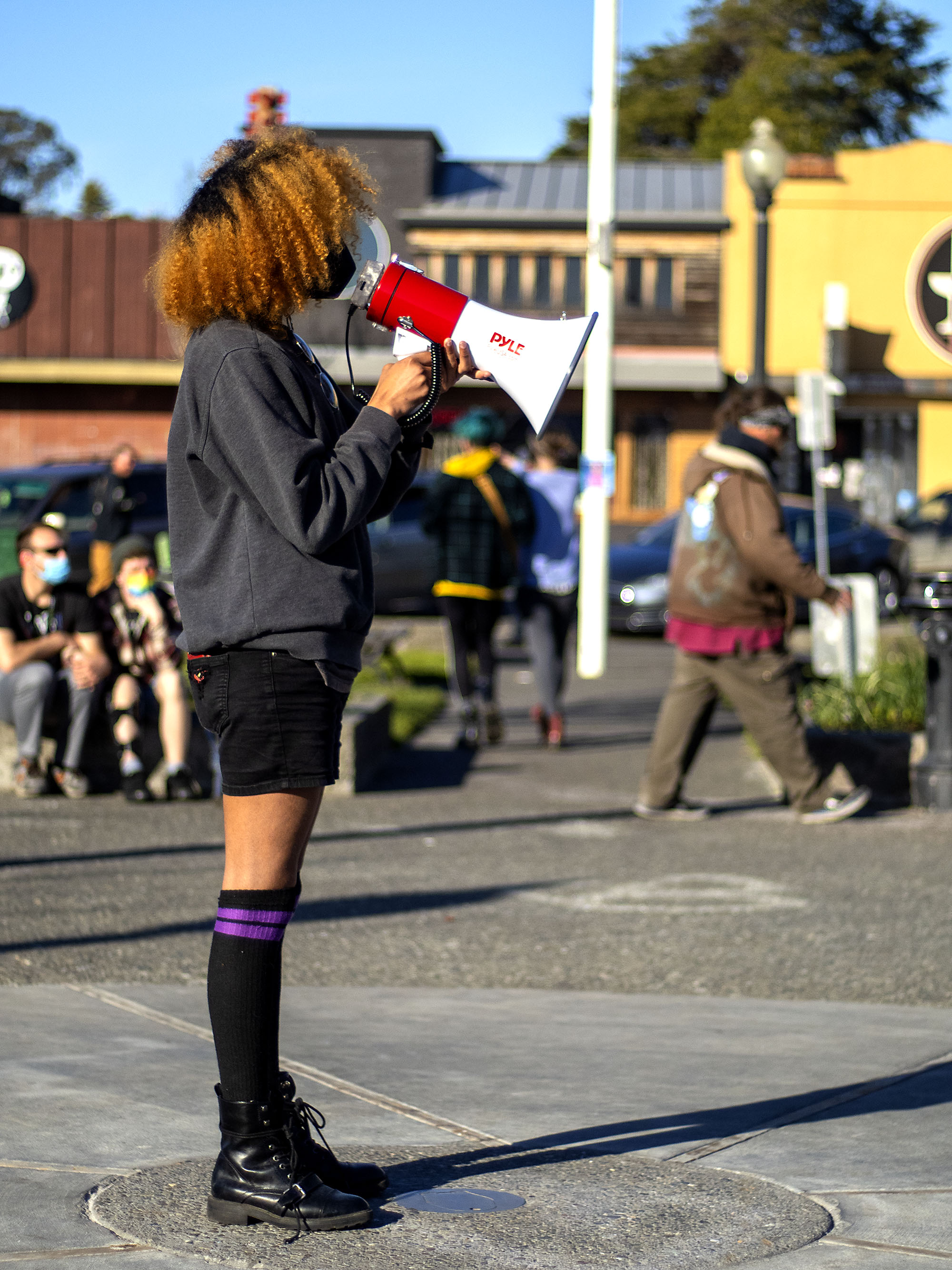
35 to 40 community members gathered in the Arcata Plaza to speak about Black History Month on Feb. 17. A flyer, created by community organizer and artist Nikki Valencia, urged people to come out and show that their allyship wasn’t seasonal or conditional. When Valencia spoke in the plaza, they noted they did not feel that support.
“This is the perfect time to center Black marginalized folks, but that energy is not here,” Valencia said. “Black History Month is about more than educating. It means nothing if you know Black people are struggling and do nothing about it.”
Photo by Morgan Hancock | Steve Bell leads protesters in a chant at the Black History Month protest on the Arcata Plaza Feb. 17.
Marlon Andrew Jones II, who works at Cal Poly Humboldt, spoke at the gathering. He said the voices supporting Black communities are never loud enough. Jones said that students, faculty, and admin need to listen to their communities if they want to support Black people.
“If you’re a white person and you’re listening to this and it’s making you uncomfortable, it’s supposed to,” Jones said. “You’re not supposed to be comfortable, because there is a community that has lived in discomfort for so long.”
In Jones’ speech, he urged empathy from white members of the community. The lived experience of Black Americans can be traumatic. Jones believes that white people need to do more than be accountable, they need to love their Black neighbors.
“Love is an action, and that’s what the Black community needs,” Jones said. “We need people to love us enough to take action and make a difference. Sometimes you don’t know what someone is going through, but you can hold their hand through it.”
Photo by Morgan Hancock | Raquel Bell speaks about the importance of valuing Black women at the Black History Month protest held on Feb. 17 in the Arcata, Ca. plaza.
Raquel Bell is a local student who spoke on the importance of valuing Black women. Black women exist at intersections of systemic struggles and deserve love and support. Bell said that when Black women are uplifted, so is the society around them.
“If you want change, first you need to love the Black woman,” Bell said. “Once her needs are met, you know everyone’s needs are met. Once you love a Black woman you change the world. The Black woman is strong, she is beautiful, she is me.”
Tucked away in a small alley behind Six Rivers Solar on Broadway in Eureka is John Gibbons Glass. At his glass art workshop, Gibbons can be found coaxing hot molten glass into stunning art pieces or after melting down raw glass in his homemade furnace.
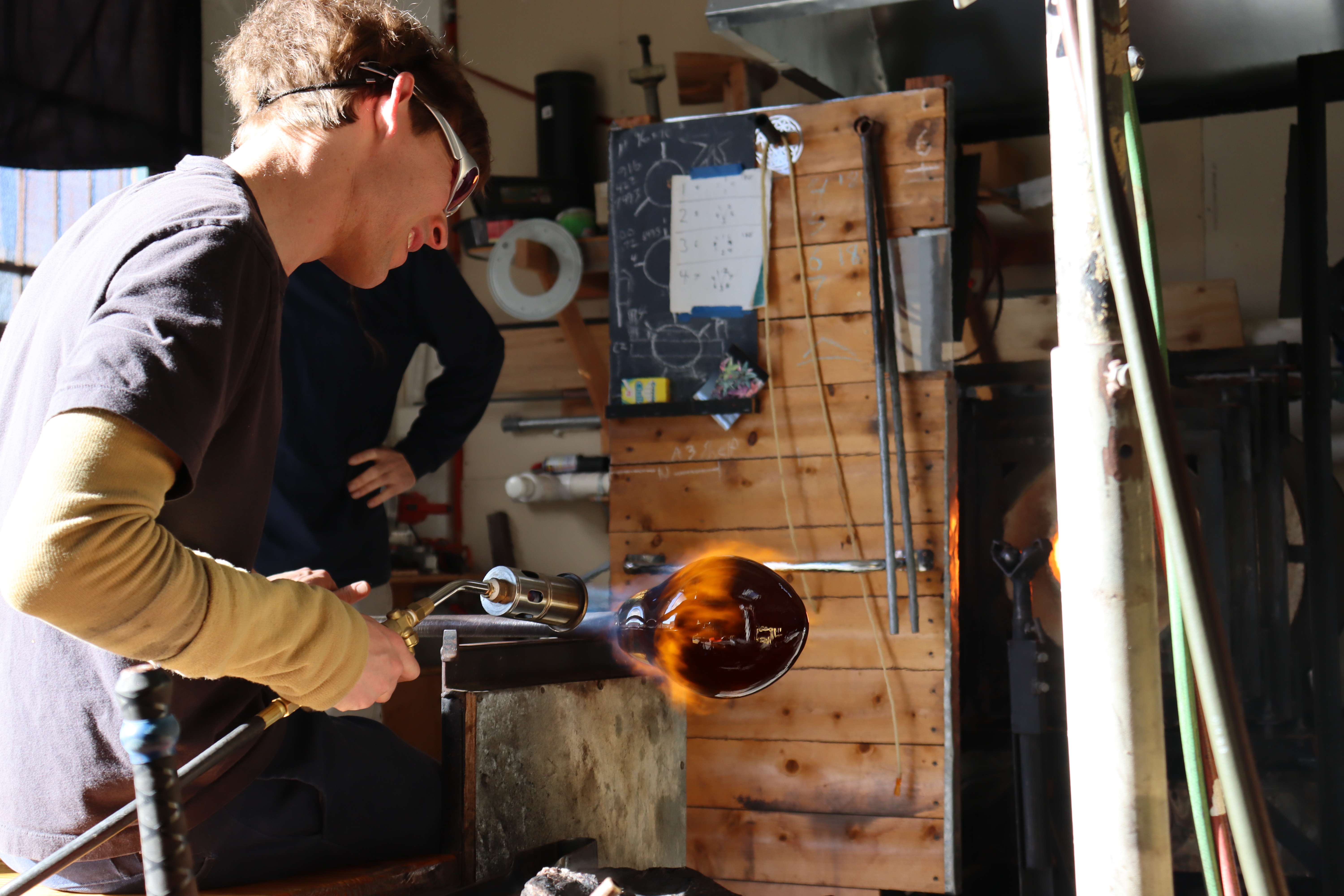
Photo by Lex Valtenbergs | John Gibbons (left) and Matthew Gagliardi (right) shaping a glass sphere at Gibbons’ glass art shop in Eureka on Feb. 1
Gibbons was first introduced to glass art by his father at antique glass shows when he was five or six years old. He’s been hooked ever since. While studying glass art at college, he dreamed of it when he slept.
“All I could think about was blowing glass,” Gibbons said. “I dreamed about it every night for a year.”
The glass artist community in Humboldt County is small but tight-knit. Matthew Gagliardi, a glassblower with three decades of experience under his belt, has worked with Gibbons for the last five years. Gibbons and Gagliardi both use soft glass, a fluid type of glass that is ideal for sculpting.
“We all kind of work with each other,” Gagliardi said. “There’s only so much of us in the county that work with soft glass.”
Photo by Lex Valtenbergs | Michelle Coelho diverts heat from John Gibbons’ face with wooden heat shields while Gibbons shapes a glass sphere in his shop in Eureka on Feb. 1
Michelle Coelho is another one of the few Humboldt-based glass artists who works with soft glass. She has been doing it for 20 years, about as long as Gibbons has. Gibbons, Gagliardi and Coelho all specialize in Venetian glassblowing, a technique that dates back to the 8th century AD. The type of tools that they use goes back to the 14th century AD.
The trio worked in synchronized harmony on the morning of Feb. 1 to transform a glob of raw glass into a beautiful pendant light, a lime green sphere with a hypnotic spiral pattern rolled into the glass on a steel table – a marver – and inlaid with a mold.
“It’s like a well-orchestrated dance,” Coelho said. “John’s body language tells us what to do next. It’s not so much verbal, it’s visual.”
They were constantly in motion to prevent the glass from losing its temperature and shattering or drooping down towards the floor like viscous honey falling off a honeycomb, as Coelho put it. They have to be on sharp alert at all times. Not only is the glass is heated up to over 2,000 degrees Fahrenheit, the operating costs involved are expensive as well.
“There’s a lot of trust, and also money,” Gibbons said. “You gotta trust them not to break your investment because there’s a lot of money that goes into it.”
Photo by Lex Valtenbergs | A close-up shot of a hypnotic pendant light made by John Gibbons, Matthew Gagliardi and Michelle Coehlo at Gibbons’ glass art shop in Eureka on Feb. 1
Gibbons hired a media assistant in April 2021 to vamp up his online presence. Makayla Sandifer worked in information technology before she found a niche in media production and picked up the job at Gibbons’ shop.
As a Black woman in a white and male-dominated field, Sandifer enjoys the opportunity to work in such a dynamic space that fosters her creativity.
“It’s honestly awesome,” Sandifer said. “It allows me to bring diversity to spaces that didn’t have it previously and to reflect that in my work. It’s super gratifying.”
The product photos that Sandifer takes for Gibbons’ Etsy profile do justice to his vibrant glass art pieces. Whimsical starfish vases, turtles with bubbles of glass trapped inside their shells, and light fixtures adorned with alluring spiral patterns boggle the mind with their complexity, vibrant colors, and otherworldly beauty.
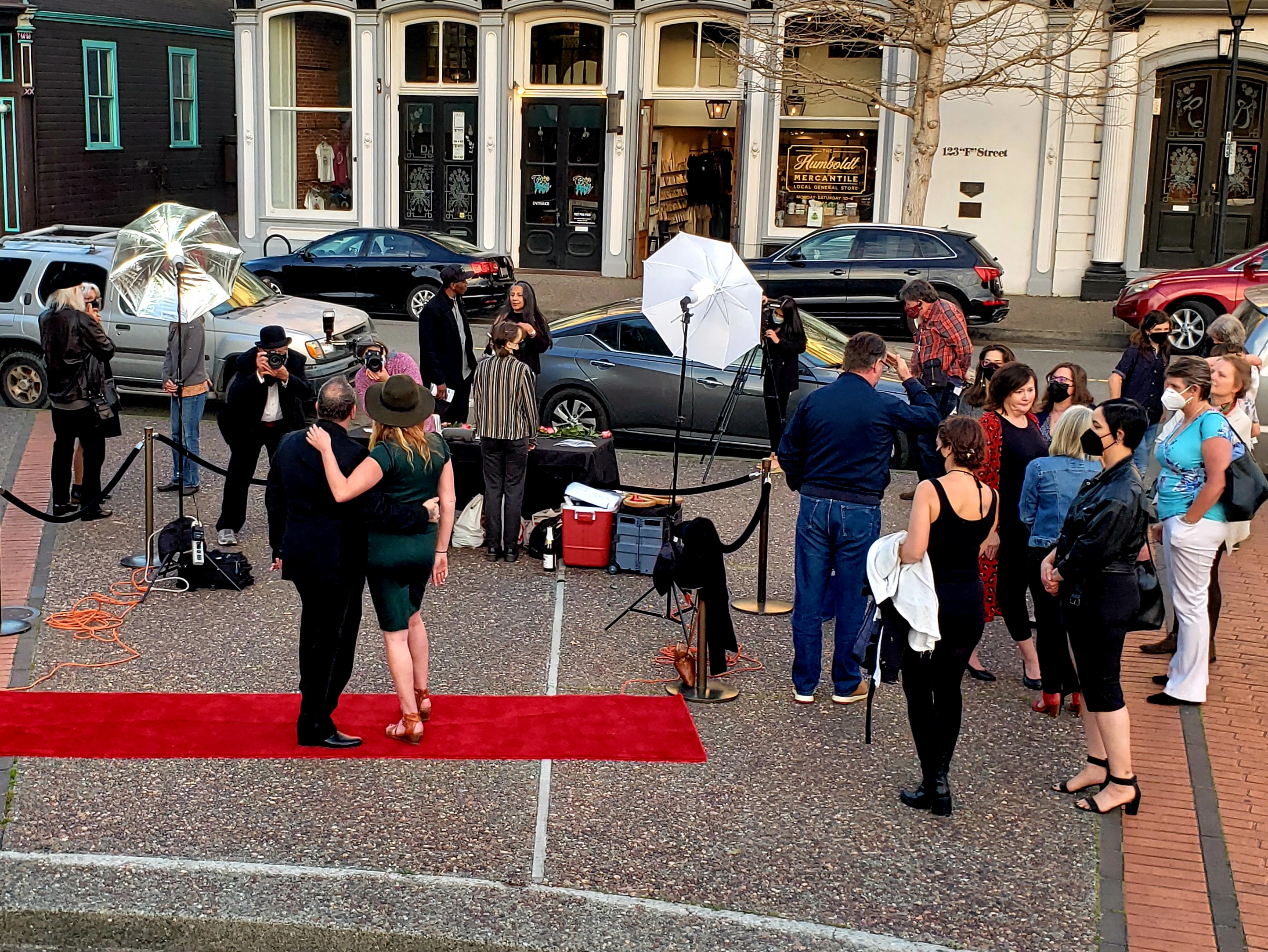
On Friday, Feb. 11, the A24 movie “The Sky is Everywhere” premiered on Apple TV+, accompanied by a red carpet event in Old Town Eureka. Filming took place locally on such locations as Moonstone Beach, Arcata High School, College of the Redwoods, and Sequoia Park, and over 500 locals were involved in the production, myself included.
The film itself explores the grief of Lennie Walker, a high school girl grappling with the sudden loss of her idolized older sister. Lennie, portrayed by actress Grace Kaufman, finds herself caught between a grief-forged connection with Toby, her late sister’s boyfriend (Pico Alexander), and Joe, an intriguing new music student fresh from a Parisian conservatory (Jacques Colimon), but more than that, she finds herself torn between mourning and moving on.
Director Josephine Decker depicts this world through a lens of magical realism. Lennie’s inner turmoil causes a storm around her only she can see, and the act of playing music literally leaves her walking on air. While these slightly surrealist aspects could serve to take one out of a film, here it serves to highlight Lennie’s turbulent emotions and sense of unreality. The visuals help set “The Sky is Everywhere” apart from many other YA dramas, while characterizing it with a certain twee sensibility and aesthetic.
The film’s minor characters round out the ensemble with heart and soul. Tyler Lofton’s nice guy Marcus, Ji-Young Yoo’s supportive bestie Sarah, and Jason Segal’s stoner uncle Big are all highlights, but Cherry Jones as Lennie’s grandmother Fiona is the standout star of the ensemble. Jones grounds the piece with her kind yet authoritative presence, quietly stealing the show without detracting from her costars. Though the film focuses on Lennie, it, unfortunately, does so at the cost of the people around her. We never get more than one or two shallow notes on many of the people populating this world, despite the actors turning in genuine performances with what they were given.
Still, nothing is quite like seeing my own hometown (and in one scene about four minutes in, my own face) filmed so beautifully and professionally on the silver screen. Humboldt is on full display here, with every scene reminding the local viewer of a place they know well. A jubilant dance scene appears before the Old Town Gazebo, a heartfelt apology takes place in the streets of Ferndale, and the Arcata Presbyterian Church hosts the funeral that sets so much into motion. The emotion of seeing one’s home in this way was one shared by Deputy Director of the Humboldt Film Commission Nate Adams, who I interviewed at the red carpet.
Photo by Sophia Escudero | Eureka Mayor Susan Seaman cuts the red ribbon commemorating the Old Town gazebo as a site of filming Feb. 11.
“It’s overwhelming, trying to focus on the movie and seeing the locations, and the people, and the art, and even my friend’s stickers made it into the movie,” Adams said. “It’s just overwhelming to see so much of Humboldt.”
Film Commissioner and HSU alum Cassandra Hesseltine teared up as I asked her about her experience helping create this production.
“I cried at the end of the movie yesterday when I watched it,” Hesseltine said. “Part of why I cried is because I love working in film. I wanted to work in film since I was five. Besides the content of the movie, and it is a beautiful movie, the reason why I cried was just to think about how all this happened in my community, that I helped it happen, and it was really, really special.”
“The Sky is Everywhere” is available for streaming at Apple TV+.
While there was only a lockdown for a short period of time in 2020, a lot of restaurants weren’t open for indoor seating. Businesses typically ended up dropping employees they didn’t need. They also had to adjust to significantly less income, and many closed down as a result.
That’s obviously bad for the restaurant and the people who got fired, but the alternative is that both the employees and customers would have died of COVID-19.
With the advent of the vaccine most of that has changed; most restaurants are open for both indoor and outdoor seating. They frequently stress social distancing and wearing a mask on your way in, but people are rarely seen sitting very far apart. Cal Poly Humboldt’s dining options have followed the same trajectory. As soon as people could get vaccinated, everything went back to mostly normal.
Like many students, I’m very poor. When I came up to Humboldt and started looking for work, I did as many do and went to one of the restaurants nearby. This was when everything was still take out only. Businesses had been losing employees like crazy, so getting into something wasn’t too hard.
Working in any place that has a lot of people coming in and out seems risky, but thankfully I did not typically have to see any customers. I could at least remain mostly isolated, aside from my coworkers. Once people could get vaccinated and everyone started reopening for indoor seating, that changed.
Now I’m in close contact with unmasked and dubiously vaccinated customers all the time, my job feels very unsafe. Vaccines have given people a lot of inadvisable confidence about their safety. Vaccinated people can still get sick very easily, and even when you don’t get sick there is a danger of spreading disease with an asymptomatic infection.
Restaurants are particularly dangerous in this regard since there isn’t any way to eat and keep your mask on. Food going down doesn’t push the germs back into your lungs. Walking in with a mask just to take it off as soon as you sit down doesn’t sound like an effective way of limiting the spread of an airborne disease.
I don’t think restaurants are doing anything wrong, everyone has to get paid somehow after all. Rather, I think that they’re in a position where there isn’t any good options for a response. The initial 2020 lockdown should have been longer and more consistent, and everyone should have received monthly stimulus checks.
Unfortunately that didn’t happen, which places people in the unfortunate position of risking whatever new strain comes around. At some point, one of them is going to start getting people way sicker than before and there’s no way we’re going to be able to deal with it. More places will close for good and more people will lose their jobs or their health.
Last week I talked about how one of my main fears while traveling during a pandemic is contracting the virus. Well, it happened. To get back to the United States, you have to show a negative COVID-19 test within the last 24 hours. My trip was planned from Thursday to the following Friday. I got tested on Thursday, Jan. 20, and planned to fly out on Friday, Jan. 21. The test came back negative, and I genuinely felt fine.
I get home Friday night and still feel fine, just tired from traveling. Saturday and Sunday roll around, and I am still okay. On Sunday evening, I feel a trickle in the back of my throat and think nothing of it. On Monday morning, I go to work as usual at 3:45 am, absolutely exhausted with a sore throat. I figured I was dehydrated. It was the same thing on Tuesday, except a cough had developed.
I called my doctor because it was getting to the point of being sick. Having asthma makes me immunocompromised, and I have never had a cold that was just a cold. It always turns into pneumonia or bronchitis, so I was worried. I really do not have the time to be sick as a full-time student working part-time.
The nurse comes in and talks to me about my symptoms and wants to test me since it had been five days since my last test. It comes back positive. The doctor sends me home with a quarantine flyer, which is the end.
Before I went to Mexico, I received my booster shot on Jan. 3. I tested positive 22 days after I got my booster shot. The symptoms I had weren’t mild, but they also weren’t super severe. I had a cough, sore throat, fatigue, headache, runny nose, shortness of breath, body aches, etc. I think my weirdest symptom was that my teeth hurt like it felt like I had braces again, and I had just gotten them tightened. I also had shooting pains in my back.
Three people so far have blamed it on travel or on me for traveling. It felt very judgmental and almost degrading. I could have gotten it at work, school, the grocery store, or from people I know. I am pretty sure I got it in a restaurant in Mexico, but the same thing could have happened here. Don’t blame me for living my life and having fun.
I do not think it is fair to judge the ones you love or anyone for that matter on their decisions to travel or whatever they do in their personal time, especially if they are safe. I wore a mask on the plane, the airport, around town, and in the restaurant except when eating. I did my part, and I still got COVID-19.
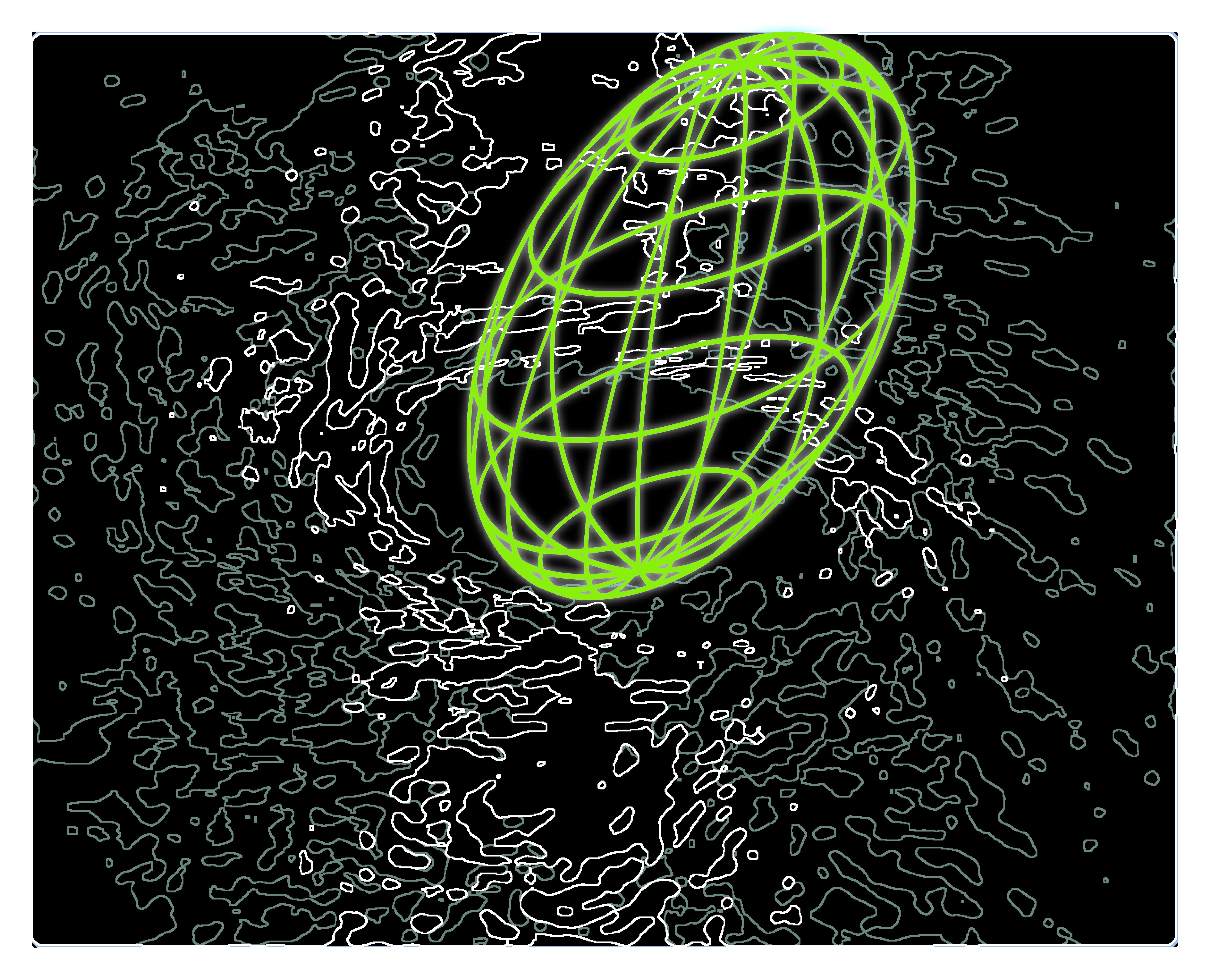
Cal Poly Humboldt sits on top of a very seismically active part of the world known as a the Cascadia subduction zone. This area is composed of three tectonic plates under the ocean off of the Pacific coast.
The Juan de Fuca, Explorer, and Gorda plates are subducting beneath the continental North American Plate, where the Cal Poly Humboldt campus is located.
As the oceanic plates push against the continental plate, the friction created leads to deformation and faulting.
“We live on that boundary where this is taking place, which leads to frequent earthquake activity,” said Cal Poly Humboldt geology professor Amanda Admire.
In addition to the deformation from the Cascadia subduction zone, the Humboldt region is also influenced by the movement along the San Andreas Fault to the south. Humboldt stands on top of an intersection of three different plates pushing against each other.
The plates themselves move very slowly, only a few centimeters every year. However, they still generate friction as they move against each other. This is the energy released during an earthquake and tsunami.
Graphic by Carlos Pedraza and August Linton
In the Pacific Northwest, both earthquakes and tsunamis are important to prepare for. The Redwood Coast Tsunami Work Group, an organization made up of local government officials, tribes, and relief groups, gives information and warnings in their “Living on Shaking Ground”magazine.
The magazine states that “more than two-thirds of our large historic earthquakes have been located offshore within the Gorda plate.”
A tsunami is created when an earthquake along a fault ruptures the seafloor, moving the entire water column and releasing that built-up energy, which moves out in all directions.
The primary local tsunami hazard, the Cascadia subduction zone, is very close to Humboldt’s coastline compared to other regions in the Pacific Northwest.
According to Admire, a tsunami produced along the fault between the Gorda and North American plates would only take approximately ten minutes to reach the Humboldt shoreline. In Oregon and Washington the fault is further from shore, allowing for more warning time should there be a tsunami.
This much seismic activity can be exciting to study for geologists and scientists, but for people living in Humboldt it may be nerve racking. Admire said there is no need for panic, but that residents should prepare.
The last mega earthquake along the Cascadia subduction zone was in 1700. However, there are still smaller instances of seismic activity as the plates move and push against each other.
So when an earthquake happens: drop, cover and hold on. If you’re near the coastline, head for higher ground in case of a tsunami.
To find more preparedness tools and tsunami evacuation maps for the region, check out the Redwood Coast Tsunami Work Group.
None of us thought we would wake up one morning and be told that we could no longer make connections the way we were used to. COVID-19 became a part of our daily lives, affecting us at every turn.
Dating during a worldwide pandemic has impacted us all in unique ways, including CSH students.
Local resident and Cal Poly Humboldt alumnus Olivia Brock shared their experience.
“Dating during COVID times for me is for sure more online now at the beginning of talking to someone,” Brock said. “It definitely restricts what we do … all the dates I’ve been on have been outside usually somewhere in nature with a mask on.”
Once you’ve managed to meet someone, COVID-19 precautions also complicate bringing them home. Having roommates means that bringing over a new flame has to involve conversations about masking, exposure, and testing.
“But once enough of the outside dates and FaceTime dates have happened and it feels worth it, then we could move forward with figuring out how to add someone to our exposure bubble. It’s a lot of logistics and communication,” said Brock. “I enjoy FaceTime dates a lot, because I don’t have to leave my house and they’re easier to schedule.”
Building connections online does have its advantages, according to Brock. She says it forces her to be more engaged in the conversation, because that’s the only way there’s any hope of forging an online connection.
“Overall, COVID has forced me to go slower in relationships and communicate boundaries more effectively,” she said.
History major Victoria Bankson often worries about the vaccination status of potential partners. She says that if the person she’s interested in has purposely chosen to avoid getting vaccinated, that completely changes her opinion of them and weighs into her decision to ultimately not date them.
“I’m not going to mess around with somebody who’s unvaxxed, that’s just not right,” Bankson said. “We don’t have the same values if you’re that way.”
She also shared that conversing online isn’t the most enjoyable way for her to get to know someone, but that having a phone conversation feels more intimate and comfortable.
“I don’t like texting online, and I don’t feel like I’m the best communicator that way,” Bankson said. “I’m much more of a ‘give me a phone call’ [person,] which is very much opposite of what things are now.”
Junior Franziska Daumberger doesn’t feel like COVID-19 changed the dating scene for her personally, but acknowledges that it added some new challenges.
“People would either be careful about COVID and say like ‘oh I’m vaccinated’ or ‘I wear a mask’ or wanting to meet in outdoor places,” said Daumberger. “And then that’s further stipulation upon whether or not I was interested in them or not … if they didn’t care at the height of it I was like ‘I don’t wanna be even knowing you because your beliefs don’t align with mine.”
On Jan. 28, Cal Poly Humboldt released an ambitious draft updating the Climate Action Plan. This updated plan promises to have the school completely carbon neutral by 2045. If CAP 2.0 is accepted, the school will implement changes to reduce carbon output and create an ecologically healthier environment.
Changes would include phasing out gas and replacing it with electric power, implementing new carbon offset projects, introducing a zero-waste plan, and making several changes to transportation on campus. The final draft of the plan will be submitted this April. The budget is not yet finalized, however, if the plan is signed off, it will cost anywhere from 4.4 million to 5.5 million.
The Climate Action Plan started in 2016 to lower greenhouse gas emissions to levels last seen in the ’90s. They succeeded at that plan in 2020 and started their planning for Cal Poly Humboldt’s next goal, complete carbon neutrality by 2045. This plan came about after The 100 Percent Clean Energy Act of 2018 passed in California, requiring all California businesses to have 100 percent clean energy by 2045.
Morgan King is a climate analyst at Cal Poly Humboldt and the author of CAP 2.0. For him, this new plan is about more than just meeting the requirements set by the state.
“We are in the midst of a climate crisis and we understand that climate change events and disasters are already having an impact on our communities, our ecosystems, and our infrastructures,” King said.
Graphics courtesy of Facilities and Management
According to King, the main climate threats Humboldt faces are rising ocean levels, wildfires, and extreme weather conditions. These threats are daunting and King is under no illusion that the school has the ability to singlehandedly stop them.
“Even if humanity took big steps today to curb our burning of fossil fuels, we’re still going to see these climate impacts for many years to come,” King said. ”So we need to start planning and preparing now.”
Despite the ominous threat of climate change looming in the distance, plans like CAP 2.0 show that there are still people willing to make drastic changes to soften the damage humanity has caused.
“We are starting to see that resilience and climate protection are becoming part of the culture at this campus,” King said ”We are seeing a greater level than ever before of engagement around these issues.”
Anyone with information regarding the David Josiah Lawson case is encouraged to call the APD’s 24-hour confidential tip-line at (707) 825-2590 or the APD Dispatch Center at (707) 822-2424
On April 15, 2017, Humboldt student David Josiah Lawson was fatally stabbed at an Arcata house party around 3 am. McKinleyville resident Kyle Zoellner, 23, was taken into custody relating to the incident. After five days of the preliminary hearing, the judge ruled that there was not sufficient evidence to hold Zoellner and the suspect was released despite witness testimonies.
Since this day, David Josiah Lawson’s mother, Charmaine Lawson, has fought endlessly to bring justice to her son. There have still been no arrests made and Charmaine Lawson pleads for those in the community who know something about what happened to come forward.
Over the past four years, approaching five, there has been a documentary made about the injustice of David Josiah Lawson and the case has attracted the attention of a number of murder mystery channels.
Danielle Hallan is a true crime YouTuber who investigates unresolved cases through news outlets, speculations of investigators, journalists and family members. Charmaine Lawson encouraged the video that was made by Hallan about the Lawson case to be shared to the Humboldt community to keep the case alive with hope that justice will be served.
MLK Day is more then simply a day off, it holds an important message
“These are revolutionary times. All over the globe men are revolting against old systems of exploitation and oppression, and out of the wounds of a frail world, new systems of justice and equality are being born.” said Martin Luther King Jr. in his A Time to Break the Silence speech.
Last Monday marked the country’s annual day of recognition towards civil rights leader and minister Dr. Martin Luther King Jr. A contention day to some as increasing more citizens have come to see the commodification and sanitization of MLK’s legacy to be problematic. Many efforts have been made across the nation to realign this day with his actual messages of racial and economic justice, not only through the medium of peaceful protest, but also civil disobedience and radical structural change. Many of the MLK events in Humboldt could be found partaking in this national movement.
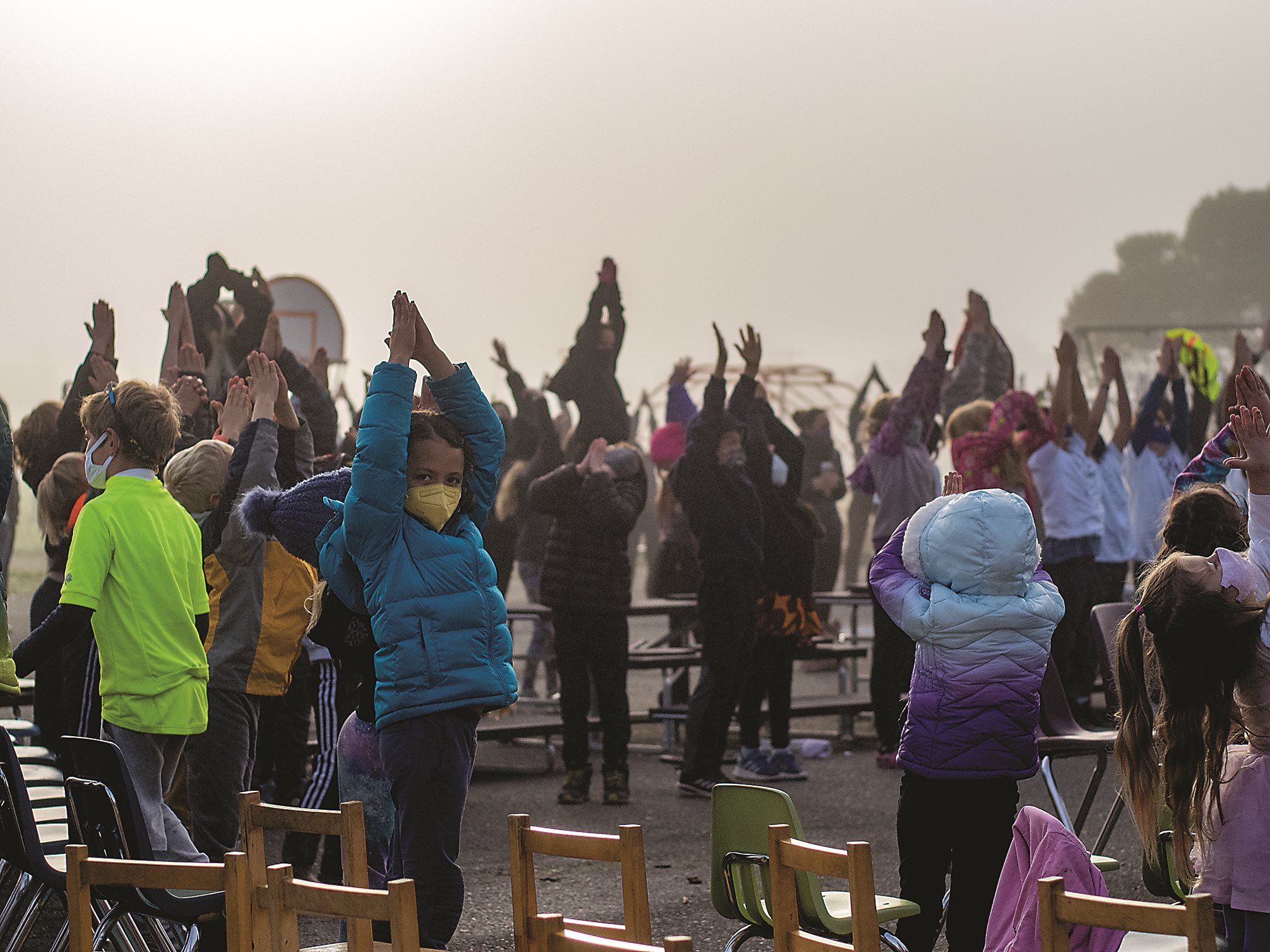
Local bilingual and charter elementary school, Fuente Nueva, last Friday celebrated the upcoming holiday through a series of black guest speakers from organizations ranging from Black Humboldt, Eureka’s NAACP, B-Men, and many more. After the event’s collection of inspiring speeches, delivered to the awaiting children located in the front rows, all attendees were invited to walk a mile march in remembrance of MLK’s own March on Washington.
HSU held its own MLK event on Monday as well. Starting in the early hours of 8am and hosted by Youth Educational Services (Y.E.S), the event was labelled “A Day On, Not A Day Off” and focused on community service volunteering. Guest speakers included our own Dean of Students, Dr. Eboni Ford-Turnbow, and prominent activist Bree Newsome. Volunteering activities ranged from on campus to off, Arcata to Eureka, and included a variety of public services. For many students and community members in Humboldt, MLK Day was not simply a vacation but an opportunity to give back and to keep Martin Luther King Jr’s dream truly alive.
Photo by Morgan Hancock | HSU student volunteer on MLK day Monday Jan. 17.
Part of a statewide effort to slow COVID-19 cases, Humboldt county enters a heavily restrictive tier.
Humboldt County moved into a heavily restrictive tier as part of a statewide COVID-19 response. California saw a rise of cases within the past weeks, reporting 57,000 new cases within the past seven days. Governor Gavin Newsom said this will slow down any plans of reopening.
Part of a 40 county reorganization, Humboldt has been moved from the lowest tier into the second highest tier, with 4.8 cases for every 100,000 tests conducted.
42 percent of positive, reported Humboldt county cases have occurred within the Latinx community, despite making up only 12.3 percent of the population according to 2019 US Census Bureau data.
In a Humboldt Health Alert sent out on Nov. 16, Humboldt County Health Officer Dr. Teresa Frankovich said that the current case rates could possibly move Humboldt into the most restrictive tier.
“Since the state first implemented the Blueprint framework, they’ve signaled that they could move faster if conditions warranted,” said Frankovich. “Our recent data shows why that makes sense because this virus is moving faster than we have ever seen, and rapid response can help to slow the upward trajectory.”
Under the new tier list all bars, breweries and distilleries will be closed while wineries can be open outdoors only. Restaurants, retail shops and places of worship can be open “…indoors at maximum 25% capacity or 100 people, whichever is fewer,” according to the Humboldt Health Alert.
The CDC and the Humboldt Department of Health and Human Services both highly advise against having gatherings for the holidays as this will most likely increase the spread of COVID-19.
“We simply need to stop traveling and stop gathering, especially indoors. It isn’t safe, and it is impacting our schools and our business communities,” Frankovich said in the health alert. “The upcoming holidays need to be single household celebrations if we want to get through this pandemic with fewer hospitalizations and fewer lives lost.”
Nationwide, cases continue to spike. The New York Times is currently tracking around 11.4 million cases reported nationwide and nearly 250,000 deaths attributed to the virus, as of time of publication.
The Center for Disease Control has predicted that “…the number of newly reported COVID-19 deaths will likely increase over the next four weeks, with 5,500 to 13,400 new deaths likely to be reported in the week ending Dec. 5, 2020. The national ensemble predicts that a total of 260,000 to 282,000 COVID-19 deaths will be reported by this date.”
Writer Anthony Aragon details his experience of accidentally joining a pro-Trump car rally.
It all started on Sun., Nov. 1, when hundreds took to the streets of Humboldt County to embark on a political car rally to voice adamant support for current President Donald Trump. The organized caravan of Trump loyalists began the trek in Fortuna around 2 p.m., ending in McKinleyville later that afternoon.
What came as no I surprise to me with a track record of bad luck, I got stuck in the middle of this parade while out in Eureka doing my normal, weekend errands.
Once I merged from the corner of Sixth street onto Broadway, I knew I was in trouble.
Surrounding me was a fleet of lifted trucks and muscle cars boasting banners and American flags flooding the majority of the street. The sounds of revved truck engines and chants of USA from vehicles grew louder as we traveled north towards Arcata.
As we approached the Eureka courthouse I could see protestors lining the sidewalks on both sides of the street. The small restless crowds chanted in disapproval of the arrival of the conservative coalition. Adversaries were clearly at odds with one another, each party growing more aggressive in verbal taunts. At one point while waiting for the street light to turn green I looked to the individuals on the left side of the road and gave a small smile of approval against the other vehicles stuck in traffic. Evidently, this smirk was mistaken as a sign of disrespect and two female protestors began to shout and throw middle fingers at me while I sat in dismay.
After what seemed like an eternity the light finally turned green. Trying my best to maneuver past the vehicles participating in the rally, I couldn’t help but begin to read the flags plastered with Trump propaganda. Amongst the various banners that waved freely through Highway 101, one struck me in particular:
“Trump 2020 NO MORE BULLSHIT.”
The irony of watching the divide between local, sprung a question into my mind that I’m still trying to come to terms with: how did we become this divided as a nation?
In the last four years since Trump’s administration has taken office, our culture has become separated in which respecting political beliefs that differ from your own is increasingly more difficult. Polarizing topics such as immigration reform, the constant fight for equality amongst BIPOC, climate change and dealing with the repercussions of COVID-19 have added fuel to the already volatile fire that is in America.
As time grew closer to election day, the uncertainty of what direction the United States would be headed towards became nerve racking. Attending college during a pandemic in a rural area that lacks diversity has been shrouded in lingering doubts. Paying full-priced tuition for an education that feels subpar, while studying an industry that has been bastardized by Donald Trump is hard to reconcile with. The feelings of frivolity I’ve felt as a college student in such an uncertain era have been amplified by the fear of what is to come in Humboldt County since Trump has lost the election.
Four days after Tuesday’s, Nov. 3, election it has been officially announced democrat candidate, Joseph Robinette Biden Jr., has won the presidential race of 2020. Though the future seems hopeful, the divide in our nation doesn’t dissipate when Biden takes his eventual oath in office.
On Nov. 7, Biden held a press conference in Wilmington, Delaware to announce his victory. Within minutes of his speech, it felt incredibly refreshing to not be subjected to coded language and devised rhetoric that became the norm in past years.
With public gatherings limited, Oktoberfest celebrations are confined to the crib this year
October has become synonymous with leaves changing colors, pumpkin spice lattes and the beloved “spooky season.”
Amongst the spirited festivities exclusive to fall, one tradition reigns supreme in the hearts of many beer lovers around the world: Oktoberfest. With the absence of Halloween parties, pumpkin patches and Oktoberfest festivals this year, October just feels different.
Though many of the celebrations and fairs that pay homage to German heritage have been canceled to lower the spread of COVID-19, beer drinkers around the world are rushing to store shelves in hopes of tasting commemorative ales from their favorite breweries.
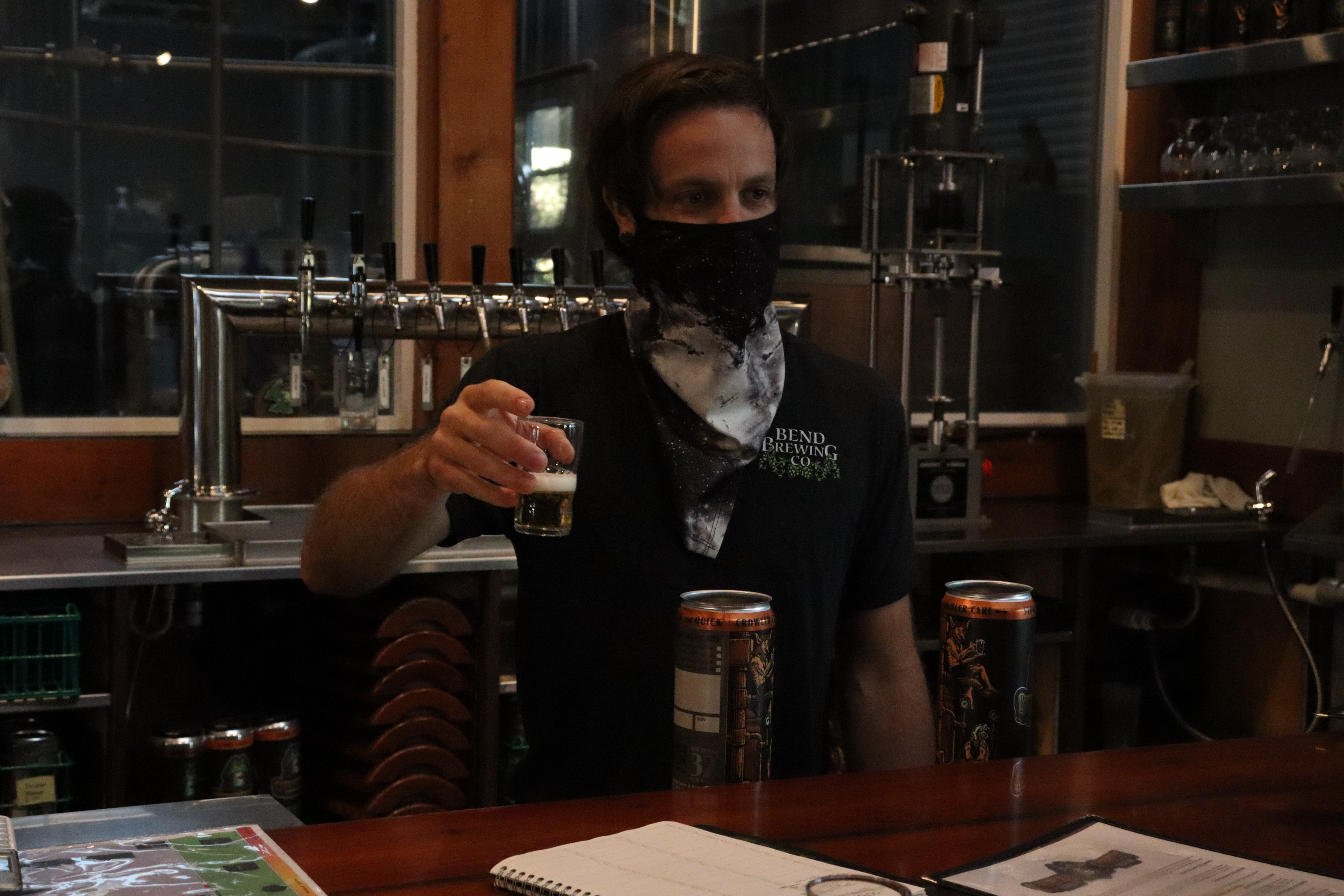
Fortunately for Humboldt County residents and Humboldt State University students who enjoy the occasional pint between study sessions, there is no shortage of local craft breweries pumping out beer to consume year-round. The assortment of IPA’s, lagers, ales and sours offered at the local brew houses are guaranteed to satisfy the most fastidious of beer connoisseurs.
On Sun., Oct. 18, I visited Redwood Curtain Brewing Co. in Arcata, hoping to sample a variety of brews that compliment the changing seasons. Unfortunately, RCBC is taking a breather on concocting their traditional German inspired lagers that are usually available this time of the year.
Refusing to leave in defeat, employee Chris Galleron, assisted me in scouring their selection to find some substitutes that are adequate for any at home Oktoberfest celebration. I left with three crawlers filled with different brews ready to be enjoyed, a nice change of pace from cases of Pabst Blue Ribbon and poorly crafted mixed drinks most of us endear in our college careers.
First up was Muddy Nut Bush, which is made in collaboration with Muddy Waters Coffee Company in the neighboring city McKinleyville.
At first glance I was taken back by the idea of a coffee infused beer, especially one that utilizes a rather potent cold brew. My original expectations were tainted by long nights during finals week, where caffeine fuels overnight cramming sessions and last minute procrastination. The nutty beer is infused with Muddy Water’s cold brew, which delivers a smooth and robust finish at 4.2 percent ABV. I found myself pleasantly surprised by the aroma of this one, the coffee notes derived from the cold brew creates a rather sweet flavor that is subtle yet delicious.
Next up, in the second generous sized canister was Logger in the Dark. This international dark logger is Redwood Curtain’s closest comparable option to a traditional German Lager.
Logger in the Dark is exceptionally balanced despite its amber color and bright aroma. Malty notes complimented the sweet hints of caramel and chocolate. By no means lacking flavor, this dark beer delivers a dessert like taste without overpowering your palette coming in at 4.4 percent ABV. This dark beer is perfect to pair with a warm, hearty meal on a cold autumn evening in Humboldt.
Last up in our three pack of crafted malt elixirs was my personal favorite, Sticky Fingers IPA. This Indiana Pale Ale is affectionately named after the long lasting crop Humboldt County is infamous for.
This beer is the hoppiest of our three picks, but possibly the most flavorful. The crisp hazy tones of Sticky Fingers is balanced by the bright citrus hues that are tasted at the end of each sip. A Redwood Curtain favorite amongst its customers, this IPA is sure to please anyone looking for an ale with a bite. Measuring in at 6.1 percent ABV, this brew will definitely give you a run for your money, creating a mellow sensation for drinkers.
Regardless of how different things might look this fall, the spirit of Oktoberfest lives throughout Humboldt County. So, grab a pint of your favorite local brew, hold your glass up high and cheers to the uncertainty this year has presented us with.
Spring semester that consisted of conference calls with teachers while relaxing at home crazed returning students overwhelmed by large lesson plans and a full workload.
Nicole Matonak, a zoology major at Humboldt State University, manages a part-time job at the Marine Lab and five classes worth of homework.
“There are times where I wish I wasn’t working so I could focus on school stuff,” Matonak said. “It feels like there is not enough hours in the day for everything I need to do.”
Matonak’s methods of getting homework done on time revolve around scheduling out the week in advance. She’s made a habit of setting time aside to relax. Matonak is taking a yoga class this semester and has been trying to do other exercises to reduce stress.
“Lately when I feel like I am zoning out,” Matonak said. “I try to stretch and practice headstands and I feel like it gets my blood flowing.”
Matonak lives in Humboldt County and relies on surrounding outside nature to exercise or study without distractions.
“Charging my iPad, my notebook and my computer and taking it to the beach and studying in my car,” Matonak said. “I think that’s been the best way for me to work and not have distractions.”
Mikayla Nicholas is an art education major at HSU and is taking upper-level art courses.
“I knew that some of the art classes would be high-end, project-wise,” Nicholas said. “But I didn’t really expect the level to still be this high online.”
Being overwhelmed by the work in her classes and miscommunication with professors, Nicholas finds relaxation by baking bread.
“I enjoy baking and cooking as something to do that’s easy and stress-free,” Nicholas said.
For students overwhelmed by stress, Liza Auerbach Ph.D. has your back. Auerbach is a clinical psychologist with the HSU Counseling and Psychological Services program.
Auerbach suggests students learn their rhythms of productivity and dedicate that time to accomplishing tasks.
“I am a big believer in psychological inertia and momentum,” Auerbach said. “The longer that we are not doing something the harder it is to get started.”
Auerbach also recommends students falling behind in classes contact professors and be forward with concerns, instead of struggling alone or giving up altogether.
“If the stress of what’s going on in the world and in our own minds is interfering with our ability to perform,” Auerbach said. “Reach out and let them know.”
Students struggling can also call CAPS during business hours to schedule a one on one therapy session, included in the cost of your student fees.
CAPS is open by phone from 8:30 a.m – noon and 1:00 p.m-4:30 p.m.
Humboldt State demands double masking on campus, does more layers equal more protection?
You’ve probably read the headlines: Wearing a Mask Prevents the Spread of COVID-19. But which mask you choose could affect how protected you and others really are.
Masks were first mandated in Humboldt County on April 24 when Health Officer Dr. Teresa Frankovich introduced an order requiring all members of the public wear facial coverings while inside a facility other than their residence. Since Humboldt State University was required to close campus prior to that, the university announced safety precautions on Aug. 4, which included wearing face coverings with at least two layers of 100% cotton. This was done in conjunction with the reopening of campus for the fall semester.
The Centers for Disease Control and Prevention (CDC) urges people to wear masks with at least two or more layers of washable, breathable fabric. Masks need to be worn covering both your mouth and nose at all times.
Director of News and Information Aileen Yoo stated, “HSU is following recommendations from the CDC. Its website is also a great resource for information on different types of protective gear.”
According to the Association of American Medical Colleges (AAMC), “studies have shown a double-layer cloth face covering was significantly better at reducing the droplet spread caused by coughing and sneezing, as compared to a single-layer one.”
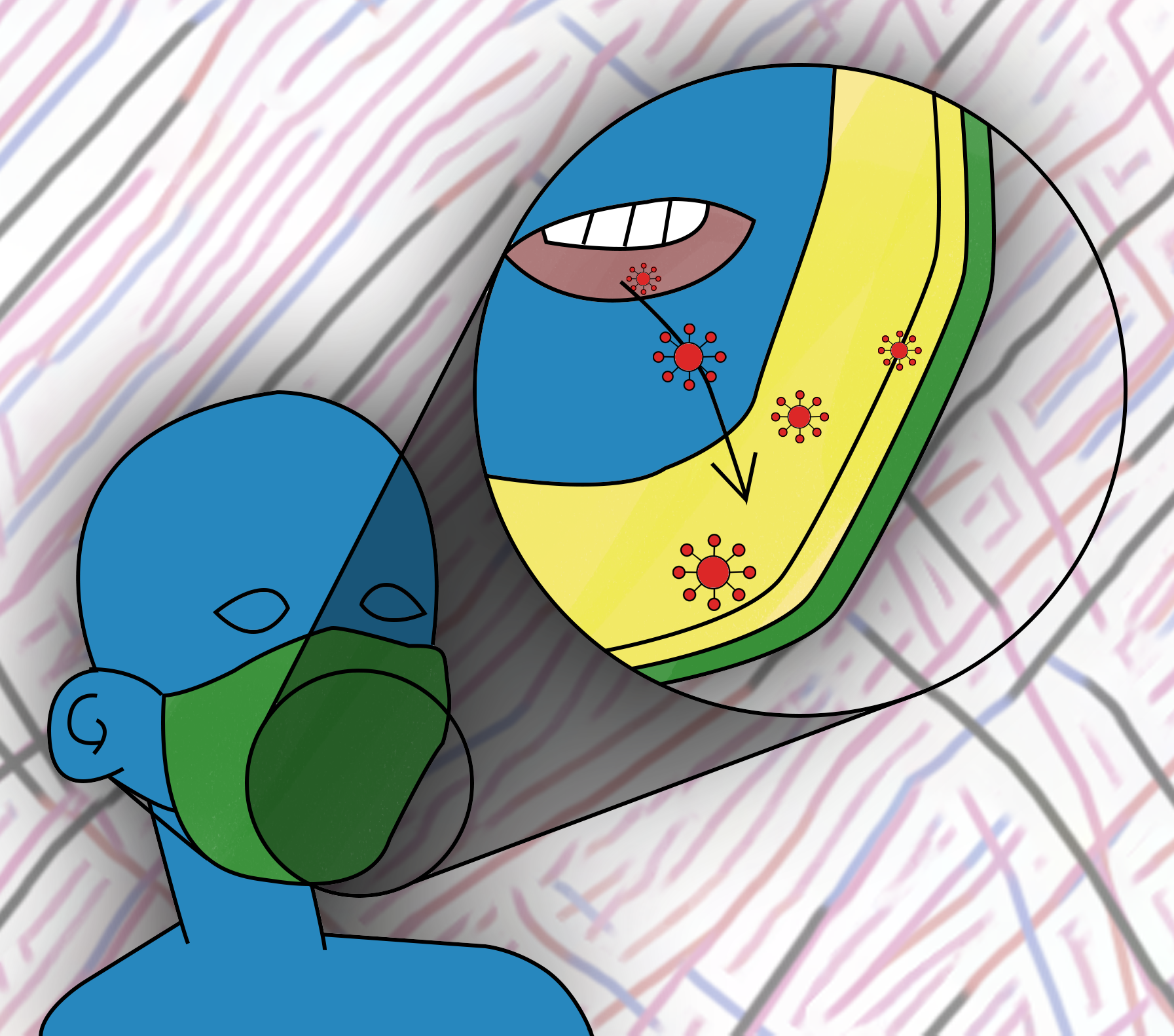
Mark Wilson, a microbiology professor at HSU believes that “the main goal of mask wearing is to reduce the emission of droplets and aerosols from a person infected with the coronavirus, by trapping emitted droplets in the fabric. Mask-wearing can reduce the transmission of airborne diseases like coronavirus.”
Wilson added that when deciding on the type of masks, “the tighter the weave of the material, and the more layers it has, the more effective it will be at filtering out particles.”
May Chu, an epidemiologist at the Colorado School of Public Health, as quoted by NPR said, “a good option is a mask made of two layers of a tight-weave fabric with a built-in pocket where you can place a filter.”
A University of California, San Francisco article reported that based on a simulation, researchers predicted that 80 percent of a population who wear masks would reduce the spread of COVID-19 more than being on lockdown. Further, the Institute for Health Metrics and Evaluation projected that 33,000 deaths could be prevented by October 1 if 95 percent of the population wore masks in public.
Many researchers have looked into N95 masks which are made out of many layers of fine polypropylene fibers. They are able to block at least 95% of small airborne particles but only when worn correctly. Though they are proven to be effective, the short supply should be reserved for medical professionals and first responders.
A recent Duke study rated a fitted N95 and a three-layer surgical mask as the top two protectors, followed by two layer cotton masks.
According to an article by Science Daily in July, a team of Australian researchers did a study comparing the effectiveness of single and double layer cloth face coverings. They used LED lighting to film the airborne droplets. Their results showed that double layer face coverings prevented more droplets from spreading.
HSU students can be provided with double layer masks at the campus Police Department, the first floor of Student and Business Services building, Jolly Giant Commons, College Creek Market and the Parking Kiosk.
How fire suppression is a mixed bag in Humboldt County
Every fire season, blankets of smoke roll over Humboldt County. Here on the coast, that’s as close to wildfires as some of us get. But our practice of fire suppression is a relatively new state for our woodlands and the lack of fire is taking its toll on the county.
“Humboldt county’s interesting. Most of the county really hasn’t experienced much fire over the last few decades,” said Jeffery Kane, associate professor of fire ecology and fuels management at Humboldt State University.
High levels of rainfall and a more temperate climate contribute to a lower risk of fire, but that doesn’t mean fire isn’t a natural part of Humboldt’s environment.
“When there are ignitions, and there are ignitions here from lightning and humans from time to time, they are usually fairly easy to put out,” Kane said. “That nice fog layer, that’s going to moderate fire behavior.”
Inland Humboldt county is not as protected by our temperate, coastal environment. But Kane said that quick fire suppression may not be the safest or most environmentally friendly way to manage wildfire in the long term.
“The thing that we know is most effective is to treat areas with a combination of thinning and burning,” Kane said.
The suppression of small wildfires can make future fires more difficult to control. Dense canopies and the buildup of dry fuel makes fire more dangerous. By thinning the forest, the trees become less tightly packed. When the canopy has more gaps, fires spread slower. Then after the canopy is thinned, a prescribed burn can take care of the natural dry fuels and remaining debris created from thinning. Thinning and burning can make an area less vulnerable to uncontrolled wildfires.
Although Humboldt is relatively protected, this area still would see wildfire activity every few years if not for the relatively recent introduction of American colonizers. Due to the danger of wildfire to settlers and property, wildfire is almost completely suppressed.
Disturbance Ecology Professor Rosemary Sherriff studies the impact fire suppression has on local woodlands. She thinks there can be a balance between protecting settled areas and letting wildfires run their course.
Lightning strikes and Indigenous burning would have introduced fire to local oak woodlands. These woodland areas suffer without the fire that shaped the ecosystem.
“In the past few years we’ve had fires that have gone into more urban areas, a lot of it stemming from more wildland areas,” Sherriff said. “There’s been a substantial amount of urban-woodland interface and these are really extremely hazardous places to live.”
In addition to providing more fuel to fires, the removal of wildfire has come at the cost of native biodiversity. Removing a natural phenomenon that was encouraged by local Indigenous tribes has consequently impacted our landscape. Local ecosystems are adapted to wildfire and removing fire allows fire sensitive species to grow without natural inhibitors.
“Inland we have oak woodlands, for example, that historically would have had a lot of fire,” said Sherriff.
Lightning strikes and Indigenous burning would have introduced fire to local oak woodlands. These woodland areas suffer without the fire that shaped the ecosystem.
“What we’ve seen is a lot of encroachment of native douglas fir into these oak woodlands,” Sherriff said. “So there’s been a loss of the oak woodland open areas.”
This loss of oak woodlands can be seen throughout Humboldt County. This destroys native biodiversity. But fire suppression is not the only consideration.
“Fire suppression has certainly shaped the landscape,” Sherriff said. “We can’t disregard the fact that settlements and communities and ranches and homeownership and the cannabis that’s happening also shapes and reshapes the landscape and can contribute significantly to shifts in fire behavior.”
The balance between human settlement and fire suppression is a difficult medium to reach.
“It becomes extremely tricky when it’s someone’s livelihood,” Sherriff said. “It’s very easy to sit at the university and say ‘yeah, more fire on the landscape’ but it’s extremely hard to make it happen with all the structures and policies in place.”
Lenya Quinn-Davidson is an advisor for the University of California Cooperative Extension. One of her projects is the Humboldt County Prescribed Burn Association. It’s a loose cooperative of land owners and community members that implement prescribed burns. While structures and policy is slow to change, they’ve proactively decided to put fire back into their land themselves.
“A lot of people want to use prescribed fire,” Quinn-Davidson said. “By the time we’re actually there lighting the fire, there’s already been a ton of work making sure that it’s safe, effective and that it won’t get out of control. It’s not like we’re just going out and lighting things off.”
Prescribed burning is a tool that landowners can use for fuels management, invasive species control and habitat restoration. The encroaching firs that Sherriff studies are a main target of controlled burn.
“We’re losing our oaks at a pretty astonishing rate,” Quinn-Davidson said. “So a lot of the landowners that have oak woodlands really want to use prescribed fire to get in there while those firs are small and kill the firs. The oaks survive just fine because they’re very fire adapted.”
Though douglas firs are native, there are some invasive species that landowners can keep back with prescribed burns. There are invasive species of grass like the medusa head that smother local grasslands. Ranchers want to make sure their cattle grazing lands are free of medusa head.
“It creates this thick thatch that prevents other plants from growing, so it turns into this homogeneous field of grass that nothing can eat.” Quinn-Davidson said.
Fire is necessary for keeping our natural landscape healthy and biodiverse. Where forest and human settlements meet, controlled burning can help maintain a healthy habitat with less danger to human life. With those buffer zones established, wildfire can be allowed to burn in a controlled manner, establishing a careful balance between fire and safety.
Quinn-Davidson thinks getting to a meaningful scale of fire management will take a combination of state intervention and owners taking control of their land.
“It’s a real community thing.” Quinn-Davidson said. “People just love it.”
Eureka protesters gathered in front of the Humboldt County Courthouse
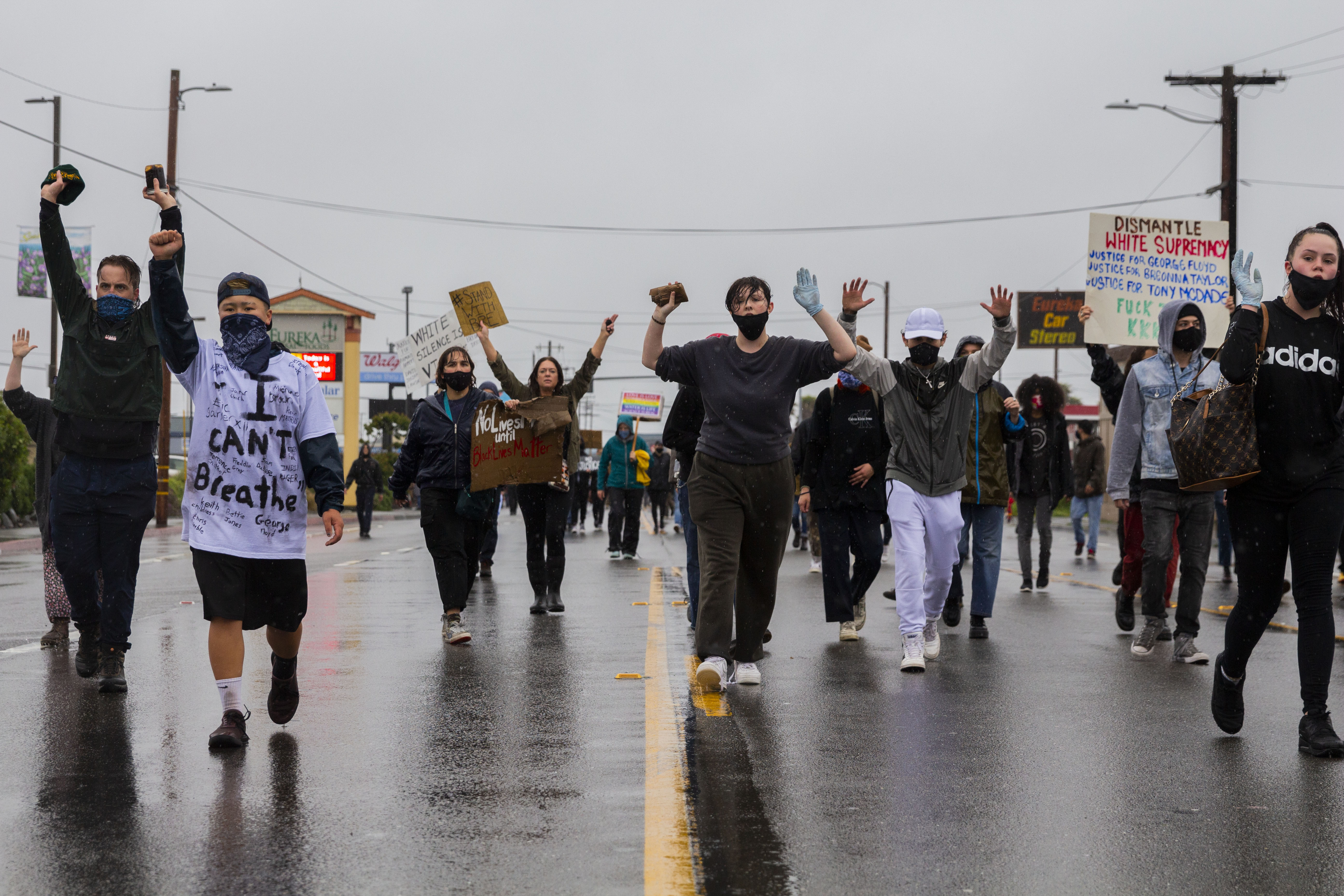
Hundreds of community members gathered in the rain outside of the Humboldt County Courthouse, Sat. May 30, to protest the death of George Floyd who was murdered while in police custody in Minneapolis, MN. From 3 to 10:30 p.m. demonstrators marched through Eureka up to the Slough Bridge, back through town and then down Broadway. Law enforcement was largely cooperative with demonstrators, blocking intersections as people made their way through traffic. Chants could be heard the entire way even as groups split up and went to various parts of the city.
Demonstrators walkin front of the Humboldt County Courthouse to protest police brutality and racism in Eureka, CA on May 30 following the death of George Floyd in police custody in Minneapolis.
A demonstrator walks thorugh the street to protest police brutality and racism in Eureka, CA on May, 30 following the death of George Floyd in police custody in Minneapolis.
Demonstrators walk past the post office though the street to protest police brutality and racism in Eureka, CA on May 30 following the death of George Floyd in police custody in Minneapolis.
A demonstrator holds up a rose above the crowd as they confornt Eureka Police Department officers in front of the Humboldt County Courthouse to protest police brutality and racism in Eureka, CA on May 30 following the death of George Floyd in police custody in Minneapolis.
Demonstrators walk down Broadway to protest police brutality and racism in Eureka, CA on May 30 following the death of George Floyd in police custody in Minneapolis.
As the group returned to the courthouse tensions flared at the sight of several police vehicles, which were soon removed from the scene. Eureka Police Chief Steve Watson was present at the protest and spoke with demonstrators as the crowd dispersed and headed away from the courthouse. These demonstrations in Humboldt are some of countless that have sprung up across the nation following Floyd’s murder.
Demonstrators stop a police vehicle at an intersection as they make their way thorugh Eureka down to Boroadway to protest police brutality and racism in Eureka, CA on May 30 following the death of George Floyd in police custody in Minneapolis. The vehicle attempted to make it’s way slowly though the gathered people and left with a broken back window.
Demonstrators confront Eureka Police Department officers in front of the Humboldt County Courthouse to protest police brutality and racism in Eureka, CA on May 30 following the death of George Floyd in police custody in Minneapolis.
Demonstrators push back against a police vehicle as it attempts to move past the gathered crowd as they protest police brutality and racism in Eureka, CA on May 30 following the death of George Floyd in police custody in Minneapolis.
Demonstrators walk thorugh the street through the rain to protest police brutality and racism in Eureka, CA on May 30 following the death of George Floyd in police custody in Minneapolis.
Demonstrators confront Eureka Police Department officers in front of the Humboldt County Courthouse to protest police brutality and racism in Eureka, CA on May 30 following the death of George Floyd in police custody in Minneapolis.
With the pressures of the pandemic mounting, people are stuck with an impossible choice
On Friday, May 1, around 100 people gathered in front of the Humboldt County Courthouse to demand the reopening of businesses deemed non-essential by the government. With signs like “Every Business Is Essential,” it is clear that the protesters are not being properly supported during this time of crisis.
The government’s attempts to mitigate the spread of the virus have been controversial with over a million reported cases so far. Social distancing is the most effective measure we can take to prevent unnecessary deaths since the swab test is inaccurate and limited at the moment. Unfortunately, mandatory lockdowns and halts to employment in order to support social distancing efforts have left many without jobs and a way to earn a steady, livable wage.
“This crisis is really illustrating both the violence of inequality and also the need for another economic system.”
Thomas Piketty
Everyone has a wide range of debts, rents and other expenses to pay for during this time. If we want to prevent the spread of the virus we need to support disenfranchised workers, not force them back into unsafe working conditions. With 59% of Americans living paycheck to paycheck, for those keeping track at home, the percentage cuts for units is not reasonable to expect them to be able to handle all of their expenses with a one-time stimulus check of $1,200. The writer of the book “Capital in the Twenty-First Century” and economist Thomas Piketty believes that a pandemic like this holds the potential to change dominant narratives about how we should organize our society and build our economy.
“This crisis is really illustrating both the violence of inequality and also the need for another economic system,” said Piketty.
The Americans most impacted by the pandemic are going to be the poorest, most vulnerable members of our society. For as long as our country has existed, so has the divide in quality of life, poverty, and access to government assistance in times of crisis.
We need a societal structure that values every life.
Due to our country’s reliance on employer-based healthcare, every company that is forced to lay off its workers in this necessary time of crisis is creating large swaths of vulnerable, uninsured people. The natural response is to want to go back to work and blame the government for taking away your insurance and employment so you can continue to provide for yourself and your loved ones. The only problem is that we have a virus on our hands, so one is forced to either ignore the dangers of returning to work or slowly drain themselves financially as the dues of existing in our society add up. This is not a fair choice nor a choice we should have to make.
This is our societal structure functioning as it was designed to. When healthcare is tied to employment and to wealth, we are nudged into believing our right to exist is tied to employment and to wealth. When certain marginalized groups are underemployed or possess less wealth, our system is tacitly stating that those groups are worthless.
We need a societal structure that values every life. That means universal healthcare, education, job guarantees, housing and access to technology. Without universal healthcare, there isn’t a solid system for distributing care during a pandemic, and the right to one’s own life is decided by socioeconomic status. Without job guarantees, people are set adrift during emergencies, not knowing if they will be able to get back to work after it’s all over. Without universal housing, a pandemic can leave many unsure if they will have a roof over their head in a month’s time. Without access to technology, some will lose education, jobs, communication with the outside world and entertainment to occupy the time.
But more than all these things, we need a structure that prioritizes us. If everything starts falling apart because of one pandemic, maybe it wasn’t the most stable structure to begin with. An economy that does better when its workers die is like a car that goes up in value when it kills the passenger. The structure should exist to support you. This pandemic is exposing our economic structure for what it has always been. A burden that crushes the marginalized and the vulnerable. A $1,200 check, a rent freeze and a free face mask are only small band-aids on a gushing head wound. Normal, everyday life is why everything is falling apart in the first place.
All we can do is build a system that protects every person within it and values life from the ground up. A system that lets numbers of people die will die along with them. It is a system bound to fail.
NFL Green Bay Packers pick up Eureka standout in the 2020 Draft
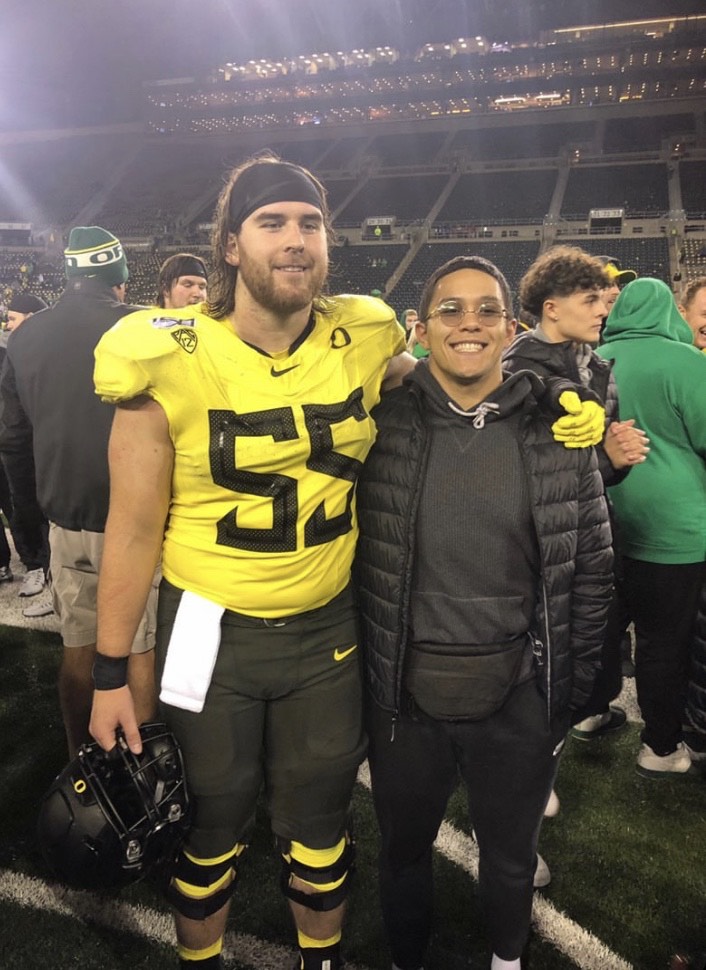
You’re watching the 2020 NFL Draft. It’s the sixth round and the Green Bay Packers are on their 29th pick. The Packers are about to make a life altering call to a player who will soon have the chance of playing alongside the quarterback legend, Aaron Rodgers. A familiar Humboldt County name flashes across the screen. Former local Eureka high school alumnus and University of Oregon center, Jake Hanson has just been drafted as the 208th overall pick for the Green Bay Packers for this upcoming 2020-21 season.
A key component of Hanson’s journey began when he signed to play for the Oregon Ducks in 2015. During his four seasons playing with the Ducks, Hanson started almost every game. During his first three seasons, Hanson didn’t allow a single sack with a total of 2,738 snaps. The starting center received a total of two honorable AP second team Pac-12 All Conference recognitions.
Tyson Miller is a local MMA pro fighter, former high school teammate and good friend of Hanson’s. Miller and Hanson initially met in kindergarten but it wasn’t until the two went to a football camp together their freshman year when they really hit it off and started hanging out. Miller sees what many fans have noticed on social media since the draft. Hanson comes in at almost 6’5”, 303 lbs, his size works to his advantage.
“First of all, his size,” Miller said, “He was bigger than most of the other lineman on the field.”
Size is not the only key feature that stands out about Hanson. Miller points to Hanson’s effort on the field as a big upside.
“He’s going to be a professional football player.”
Tyson Miller
“Jake is going to give it 100%,” Miller said. “If somebody demanded more than 100%, he was more than willing to give more than 100% right back.”
The dedication and game mentality that Hanson possesses is one that is truly admired by not only Miller, but by others as well. The ability to turn up the heat in a game is sets athletes apart from one another.
“[He is] going to be a professional athlete,” Miller said, “He’s going to be a professional football player.”
Hanson is going to be a memorable name within the community and make an unforgettable mark for the Packer Nation.
In an article by Forbes, Packers General Manager Brian Gutekunst pointed out Hanson’s work ethic and personality as a positive for the teams newly acquired offensive lineman.
“Just really a model of consistency and another culture guy,” Gutekunst said. “The kind of guys that we like to bring into our offensive line room.”
While the Packers have their seven year veteran center Corey Linsley under contract for another year, there is no doubt that Hanson will be Linsley’s backup for this upcoming season. Hanson is going to be a great asset to the Packers. His strength, size and quick feet will play a pivotal role in his movement of helping block the defensive line. I am predicting that with time, after the team continues to work with him and his snap consistency, he will be their starting man.
If you’re looking to watch some football and don’t know what to do without Humboldt State’s football program but still want that local spin, be sure to tune into some of the Green Bay Packers match ups. Remember to look for #67 on the field.
Everything you might want to know about the 2020 census
The United States Census Bureau has fulfilled the constitutional obligation to count every human in the country since 1790. Every home in the United States should have received an invitation to participate in the 24th United States census by April 1.
“The census tells us who we are and where we are going as a nation,” the Bureau’s website said.
The census is a measure of what’s going on in American communities. The data collected from the census helps communities determine where to build infrastructure, from schools and supermarkets to homes and hospitals. Beyond that, California District One (Humboldt County included) House Representative Jared Huffman said it’s a fundamental element of the United States.
“The significance of everyone participating goes so far beyond that,” Huffman said in an email through his spokesperson. “Having a complete picture of the people in communities across the country determines how folks are represented and makes sure everyone has a voice in the decisions their government makes. That’s the foundation of our democracy.”
In the past couple of years, the Trump administration tried to politicize the census as they pursued the addition of a citizenship question, but they failed. To be clear, there is no citizenship question on the 2020 census.
John Meyer, chair of the Humboldt State politics department, explained how an accurate census requires trust between the federal government and residents.
“The goal of the census was an accurate count of who residents are and where they live,” Meyer said. “The citizenship question discouraged that.”
“Students today are the most diverse demographic, and if you’re not counted, other resources will not follow.”
Nicola Walters
Meyer said answering the census should have no personal impact on respondent’s lives, and that there should be no arrests nor barriers to voting following a response. Meyer said immigrants from other countries, especially those with authoritarian, surveillance-heavy governments were often wary of answering the questions for fear of retaliation.
The U.S. Census Bureau has been politicized in the last few years, but the law prevents the Census Bureau from sharing information with law enforcement. The information is supposed to be kept strictly confidential.
“It is in the interest of powerless people to answer the census,” HSU American government lecturer Nicola Walters said. “Students today are the most diverse demographic, and if you’re not counted, other resources will not follow.”
Walters said she would have liked to see the citizenship question on the census. The census is a rare opportunity for scientists like her to collect data on the entire population, rather than just the samples she’s used to. Nonetheless, she is looking forward to the results of the 2020 census.
According to the Census Bureau’s website, many of the planned elements of getting a full count, including door to door interviews, will be postponed.
“The 2020 Census is underway and the most important thing you can do is respond online, by phone, or by mail when you receive your invitation,” the Census press kit said. “Responding now will minimize the need for the Census Bureau to send census takers out into communities to follow up.”
California houses, shelters and aids homeless as COVID-19 cases continue to rise
With at least 151,278 homeless individuals in California, measures to keep them safe and healthy during the current shelter-in-place order are crucial.
Governor Gavin Newsom and his administration have sought ways to provide shelter and temporary homes for the homeless. On March 18, Newsom published a statement addressing what actions are to take place to ensure that everyone in the state maintains their health.
“People experiencing homelessness are among the most vulnerable to the spread of COVID-19,” Governor Newsom said. “California is deploying massive resources to get these vulnerable residents safely into shelter, removing regulatory barriers and securing trailers and hotels to provide immediate housing options for those most at risk. Helping these residents is critical to protecting public health, flattening the curve and slowing the spread of COVID-19.”
To help with the crisis, Newsom released $150 million to local governments to pursue leases with hotels and motels for temporary shelter. An additional $650 million is said to be released on April 1 from last year’s budget, to ensure that enough supplies are given to shelters and other medical resources. Shelters all over the state are struggling to gain more medical supplies and are losing volunteers.
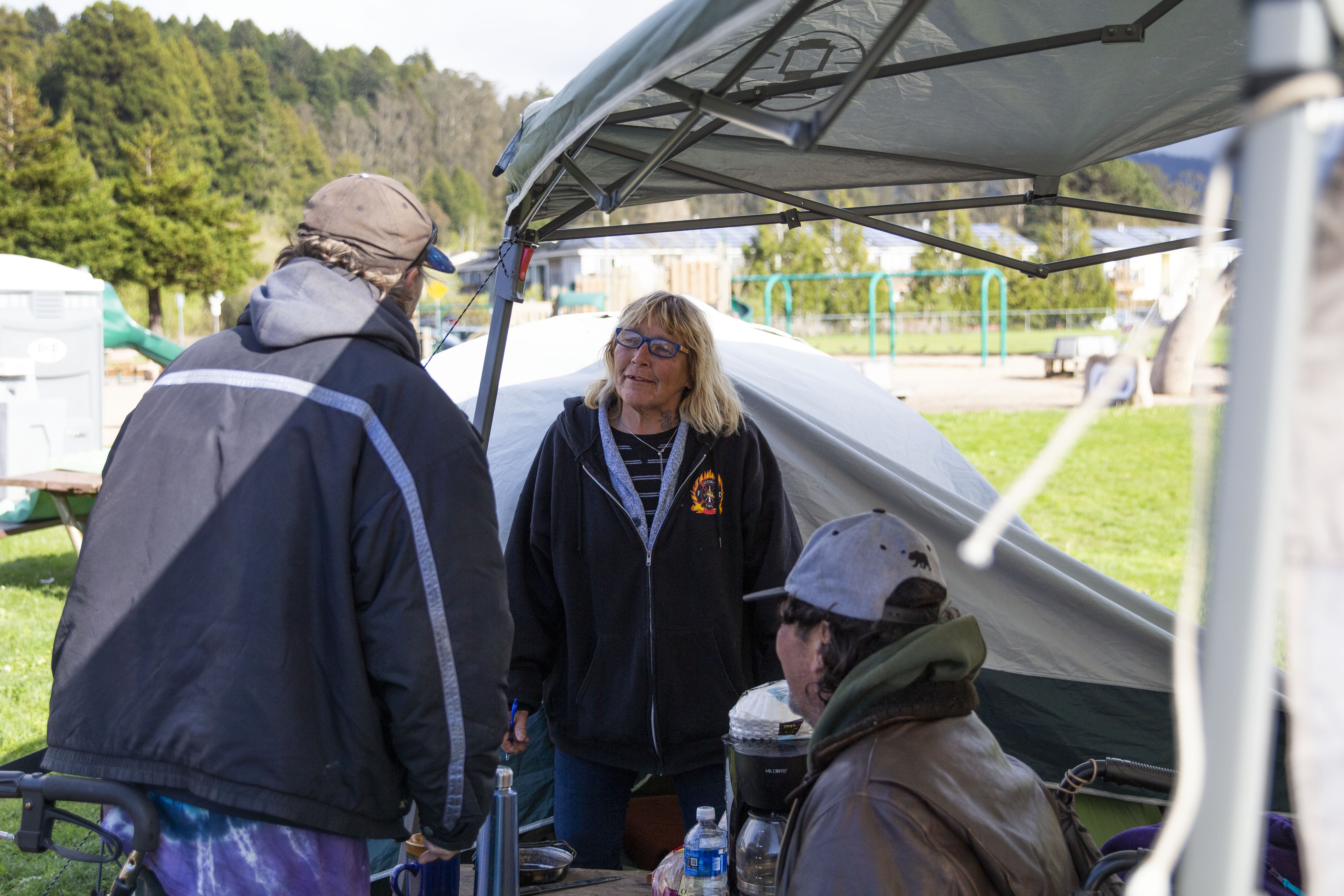
Around 130 homeless individuals are staying in shelters around Arcata and Eureka.
“This is one of the biggest challenges our homeless system has ever seen,” Deputy Secretary for Homelessness for the Newsom administration Ali Sutton said. “And our population is one of the most at risk.”
Newsom also said he and his administration are working on creating leases lasting a few months with hotels and motels in order to house more homeless. According to an article from The Latest, Newsom announced 2,400 more hotel and motel rooms have been secured to house those on the streets, with 1,900 of those rooms coming from San Diego alone. There are now 4,000 rooms secured statewide. San Diego plans to continue sheltering the homeless by moving them to the city’s Golden Hall, the downtown Convention Center (home to Comic-Con), and other vacant rooms in hotels.
Humboldt County is also working to gain more shelters, rooms and supplies for those on the streets. Around 130 homeless individuals are staying in shelters around Arcata and Eureka. Some shelters have already taken place like Eureka Rescue Mission and Arcata House Partnership.
Each shelter in Humboldt County is expected to receive $300,000 in order to keep up with medical resources and other supplies, but shelters might still need more help to make sure they have everything they need. Eureka Rescue Mission, for example, had to close their thrift store, which was a main source of income, making sheltering the homeless more difficult as the pandemic continues.
The city of Arcata, along with AHP, have been working together to find other ways to help. After calling and surveying businesses and other organizations, Arcata was able to secure two parking lots in town. The lot on G Street can maintain at least 19 people, while the Transit Center lot can hold up to 15 people. Tents inside the lot are recommended to be six feet apart. AHP is working with Affordable Housing Homeless to ensure portable showers, sinks and bathrooms are provided for the lots. The lots can also expect to soon see mobile health services to make sure individuals are healthy.
The Centers for Disease Control and Prevention set out guidelines for how to manage tent camps, recommending that local law enforcement should not force individuals out of the camps unless there is immediate housing available for them to go to.
Hotel and motel rooms, meanwhile, are still in the process of being secured for more individuals. Arcata is also giving out food at the Arcata Food Pantry on Wednesdays from 4 p.m. to 6 p.m at the Trinity Baptist Church.
Looking to the past to learn about the present pandemic
There’s a saying that goes something like, “In order to prevent future mistakes, we should look to the past for guidance.” While this current pandemic may be new to all of us, humans have gone through this before. Some of the more recent pandemics include the SARS virus, the H1N1 virus, Ebola and HIV.
The term pandemic is defined as something “occurring over a wide geographic area and affecting an exceptionally high proportion of the population.” Obviously, the current COVID-19 virus fits into this category. While some of the aforementioned pandemics did not enact a devastating, history-altering toll on Humboldt County, another pandemic did.
From 1918 to 1920, the Spanish flu swept across America, resulting in an estimated 675,000 deaths according to the U.S. Department of Health and Human Services. The first official report of the Spanish flu in California was reported Sept. 27, 1918, just two weeks after an outbreak on the East Coast. By November 1918, the total cases throughout the state hit about 115,000—overwhelming doctors and government officials from north to south.
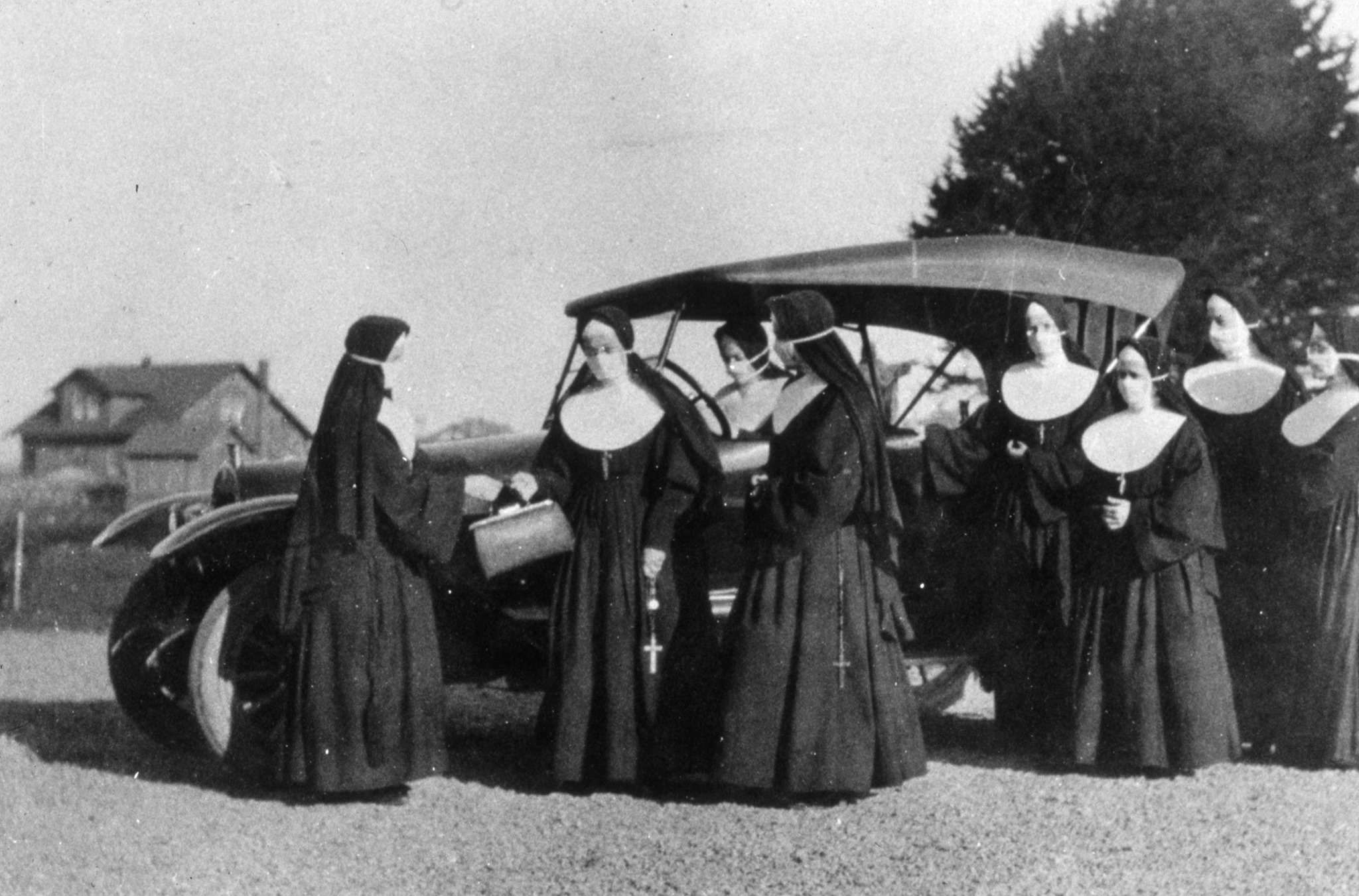
One of three doctors that helped Spanish flu patients in the Ferndale area.
Although Humboldt County sits in an isolated area protected by the “Redwood Curtain,” the area was soon amassed in its own troubles combatting the illness. Humboldt County had a population of about 37,000 people with Eureka holding around 12,000. The Spanish flu resulted in around 200 deaths (although it is thought to be much higher) and thousands grew ill.
In 2012, Humboldt State alumnus and McKinleyville native Jeff Benedetti-Coomber wrote a detailed history of the impact the Spanish flu had on Humboldt County. For it, he was awarded the Charles R. Barnum History Award by HSU’s history department. For his research he scoured through old newspaper clippings for primary source documentation. He read academic analysis on how the Spanish flu affected the entire nation and he cited Matina Kilkenny, a researcher and local author for the Humboldt Historical Society who also wrote about the impacts the Spanish flu had on Humboldt County.
What prompted Benedetti-Coomber to focus on the Spanish flu was its lack of local research. As his peers decided to look into European history, he decided to focus his attention on the effects locally.
“I was walking through the graveyard in Arcata and noticed a family of graves, not necessarily related to the [Spanish] influenza but it got me thinking about what effects the flu may have had because it was around the same time,” he told me over the phone from his place in Los Angeles. “Once I started researching it I saw how it did affect the county and I was pretty amazed.”
Benedetti-Coomber’s senior thesis, titled “Death In the Redwoods: The Effects of the Spanish Influenza on Humboldt County,” spans 30 pages and breaks down how each town dealt with the outbreak. He highlights what preventative measures seem to have worked and where officials, the public and the media went wrong and what they got right.
“It’s just like today when you tell people to do something and they kind of resist. A lot of people had that with the Spanish influenza and it was a reason a lot of people died, because they didn’t take it seriously.”
Jeff Benedetti-Coomber
Some of the highlights from his research that still stand out to him are how Eureka initially closed all schools, which flooded the streets with children. They soon changed their minds and brought the kids back into the school to try to quarantine the children. Another nugget of research that sticks out in his mind has to do with masks and the public’s initial reluctance to wear them.
“It’s just like today,” Benedetti-Coomber said, “when you tell people to do something and they kind of resist. A lot of people had that with the Spanish influenza and it was a reason a lot of people died, because they didn’t take it seriously.”
When the Spanish flu hit Humboldt, the United States was in the middle of World War I and young men from Humboldt were signing up to join the war effort. There were war rallies and large gatherings of people throughout the towns in Humboldt in the fall of 1918 as the Spanish flu began to creep in.
“Although the Great War was still the main focus in Humboldt County, more and more citizens were beginning to take notice of the spreading pandemic,” Benedetti-Coomber wrote.
Some of the newspapers in Humboldt at that time seem to have downplayed the seriousness of the Spanish flu. Benedetti-Coomber points to an ad that was in the Humboldt Standard by Vicks VapoRub that was “disguised as an article… and it assured readers that the [Spanish flu] was ‘Nothing new simply the Old Grippe and la Grippe that was the epidemic in 1889-90.’”
Benedetti-Coomber wrote that it is believed the Spanish flu was brought to Humboldt County by locals traveling to other parts of the state to help care for sick family members and then returning before symptoms started to show. By mid-October 1918, reports of the Spanish flu were starting to pop up in the local newspapers.
“The Humboldt Times also reported that there were roughly 150 cases in Eureka by [Oct. 22] and hospitals were short staffed. Doctors were so busy they did not have the time to report new cases or treat the majority of their patients.”
Jeff Benedetti-Coomber
“The Humboldt Times and Humboldt Standard newspapers offered daily accounts of what was happening,” he said, adding that they also seemed to not care about the Spanish flu at first.
On Oct. 12, 1918, four cases were reported in the Humboldt Times and those infected were quarantined in a “‘safe house’” on 8th Street where they could be quarantined and cared for,” Benedetti-Coomber wrote.
At first, the mayor of Eureka downplayed the danger to the public, but two days later, five more people were infected. By Oct. 22, 1918 there would be more than 150 cases and one death.
“According to the Humboldt Times, Mrs. Garber Dahle was the first person in Humboldt County to die from the deadly virus,” Benedetti-Coomber wrote. “The Humboldt Times also reported that there were roughly 150 cases in Eureka by [Oct. 22] and hospitals were short staffed. Doctors were so busy they did not have the time to report new cases or treat the majority of their patients.”
Action to combat the Spanish flu across the county began to take root. Arcata was the first town to pass a requirement that all residents had to wear a mask while out in public, and by Nov. 7, 1918, the entire county was required to do so. Emergency hospitals were soon established across the county with some residents offering up their homes for the infected.
Arcata escaped the pandemic with only four deaths, but the same can’t be said for Eureka and especially for the logging camps in the remote areas of the county. The number of cases grew in the urban areas, and by Oct. 23, 1918, the logging camps were left to fend for themselves.
“Logging camps and small towns were informed by the newspapers and from local physicians that they would have to face the Spanish Influenza on their own as all of the county hospitals were completely full,” Benedetti-Coomber wrote while citing a Humboldt Times article titled “Influenza Increases Alarmingly in Two Days.”
Young women wearing masks in Humboldt County.
But one logging camp was able to escape the pandemic with no cases at all. In her article, “Missing Faces,” Matina Kilkenny reported how Carl Munther set up a quarantine system for his workers who decided to go into town. (Kilkenny’s article has a number of great photographs of life in Humboldt County during the Spanish flu.)
“Munther required every person returning to camp… to stay four days in a tent he’d pitched some distance from the workers’ cabin,” Kilkenny wrote, adding that the returning workers were also required to work and eat separately from their peers. “Thanks to their boss, very few men chose to leave the Barrel Company camp and not one case of influenza occurred there.”
Sisters of St. Joseph wearing masks during the Spanish flu. The sisters helped many patients in Humboldt from 1918-1920.
Throughout her research, Kilkenny was able to find where a number of hospitals were set up across Humboldt. There was a Red Cross Hospital in Korbel, Arcata, Blue Lake and Eureka. Kilkenny also came across an interview between a member of the Sisters of St. Joseph of Orange in Eureka and a man named Brad Geagly. Kilkenny wrote the following:
“[Mother Bernard] sent [the Sisters] out in twos, in cars provided by the Red Cross. She armed each Sister with a kit containing camphor and sweet oil, castor oil, and mustard plasters. Into the homes… the sisters came, arriving at seven o’clock and leaving at the end of a 12-hour shift, to be replaced by two other Sisters. They would attend first to the adults….They would bathe the delirious victims completely, rubbing their chests deeply with the camphorated oil. Mustard plasters would be applied, and then the sisters would wrap the sick tightly in whatever woolen material they could find; then they would tend the children. Once they had been bathed and medicated, the sisters turned to washing linens or cleaning house. They fed their charges warmed milk and broth prepared from the food furnished by the Red Cross.”
Kilkenny noted that, generally, it was the poor who were admitted into the hospitals, while the more well-off were cared for in their homes. Because of this the actual tally for those infected and the deaths attributed to the Spanish flu is unknown. Kilkenny also points out how the Native American tribes were hit hard by the Spanish Flu as well.
“Of the [11] Native Americans whose deaths are on record at the County Courthouse, five were from Table Bluff, two from Hoopa, one from Miranda, one from Orleans, one from Requa, and one was a laborer at Korbel,” Kilkenny wrote. She also noted evidence that many Native Americans often refused treatment by White settlers around this time period.
Kilkenny was also able to find county death records from that time and noted that between Sept. 1, 1918 and April 1919, 175 Humboldt residents died with 91 of them between the ages of 20 and 40.
And so what can we learn from this history?
There is evidence that social distancing works by the example set by Carl Munther at his logging camp and how travel throughout the state can spread the virus. We can see how hospitals were eventually inundated with those infected with the Spanish flu and how staff were stretched thin. We can also see how it is important to get ahead of a pandemic and try to prepare as much as possible.
Humboldt County seems to be doing just that. They have recently distributed around 30,000 pieces of personal protective equipment to first responders and medical staff across the county. Humboldt State chipped in and prepared 1,250 COVID-19 test kits. Also, as I’m sure you are aware, we are in a “shelter in place” order that was enacted to help stop the spread of the virus and to give medical staff the ability to fight the virus without being overwhelmed.
Towns across Humboldt are also doing their part to help prevent an outbreak. Trinidad passed a moratorium on all short-term rentals and added some pretty forceful consequences to anyone who breaks it.
“Over the course of the meeting, council members added some teeth to the resolution with language saying that a single violation may result in the City revoking a proprietor’s short-term rental license for up to a year,” the Lost Coast Outpost’s Ryan Burns recently reported, adding that the county may consider a similar measure.
A stained glass piece by Humboldt artist Colleen Clifford.
As this thing progresses, we are all going to have to make some sacrifices, but we’ll get through it. Help out the elderly and the immunocompromised if you can. Help out each other by not going out or attending pretty much any gathering of any number of people.
Let’s all work together — but at least six apart — to help “flatten the curve.”
This website uses cookies to improve your experience. We'll assume you're ok with this, but you can opt-out if you wish. Cookie settingsACCEPT
Privacy & Cookies Policy
Privacy Overview
This website uses cookies to improve your experience while you navigate through the website. Out of these cookies, the cookies that are categorized as necessary are stored on your browser as they are essential for the working of basic functionalities of the website. We also use third-party cookies that help us analyze and understand how you use this website. These cookies will be stored in your browser only with your consent. You also have the option to opt-out of these cookies. But opting out of some of these cookies may have an effect on your browsing experience.
Necessary cookies are absolutely essential for the website to function properly. This category only includes cookies that ensures basic functionalities and security features of the website. These cookies do not store any personal information.
Any cookies that may not be particularly necessary for the website to function and is used specifically to collect user personal data via analytics, ads, other embedded contents are termed as non-necessary cookies. It is mandatory to procure user consent prior to running these cookies on your website.