Spring semester that consisted of conference calls with teachers while relaxing at home crazed returning students overwhelmed by large lesson plans and a full workload.
Nicole Matonak, a zoology major at Humboldt State University, manages a part-time job at the Marine Lab and five classes worth of homework.
“There are times where I wish I wasn’t working so I could focus on school stuff,” Matonak said. “It feels like there is not enough hours in the day for everything I need to do.”
Matonak’s methods of getting homework done on time revolve around scheduling out the week in advance. She’s made a habit of setting time aside to relax. Matonak is taking a yoga class this semester and has been trying to do other exercises to reduce stress.
“Lately when I feel like I am zoning out,” Matonak said. “I try to stretch and practice headstands and I feel like it gets my blood flowing.”
Matonak lives in Humboldt County and relies on surrounding outside nature to exercise or study without distractions.
“Charging my iPad, my notebook and my computer and taking it to the beach and studying in my car,” Matonak said. “I think that’s been the best way for me to work and not have distractions.”
Mikayla Nicholas is an art education major at HSU and is taking upper-level art courses.
“I knew that some of the art classes would be high-end, project-wise,” Nicholas said. “But I didn’t really expect the level to still be this high online.”
Being overwhelmed by the work in her classes and miscommunication with professors, Nicholas finds relaxation by baking bread.
“I enjoy baking and cooking as something to do that’s easy and stress-free,” Nicholas said.
For students overwhelmed by stress, Liza Auerbach Ph.D. has your back. Auerbach is a clinical psychologist with the HSU Counseling and Psychological Services program.
Auerbach suggests students learn their rhythms of productivity and dedicate that time to accomplishing tasks.
“I am a big believer in psychological inertia and momentum,” Auerbach said. “The longer that we are not doing something the harder it is to get started.”
Auerbach also recommends students falling behind in classes contact professors and be forward with concerns, instead of struggling alone or giving up altogether.
“If the stress of what’s going on in the world and in our own minds is interfering with our ability to perform,” Auerbach said. “Reach out and let them know.”
Students struggling can also call CAPS during business hours to schedule a one on one therapy session, included in the cost of your student fees.
CAPS is open by phone from 8:30 a.m – noon and 1:00 p.m-4:30 p.m.
Humboldt State demands double masking on campus, does more layers equal more protection?
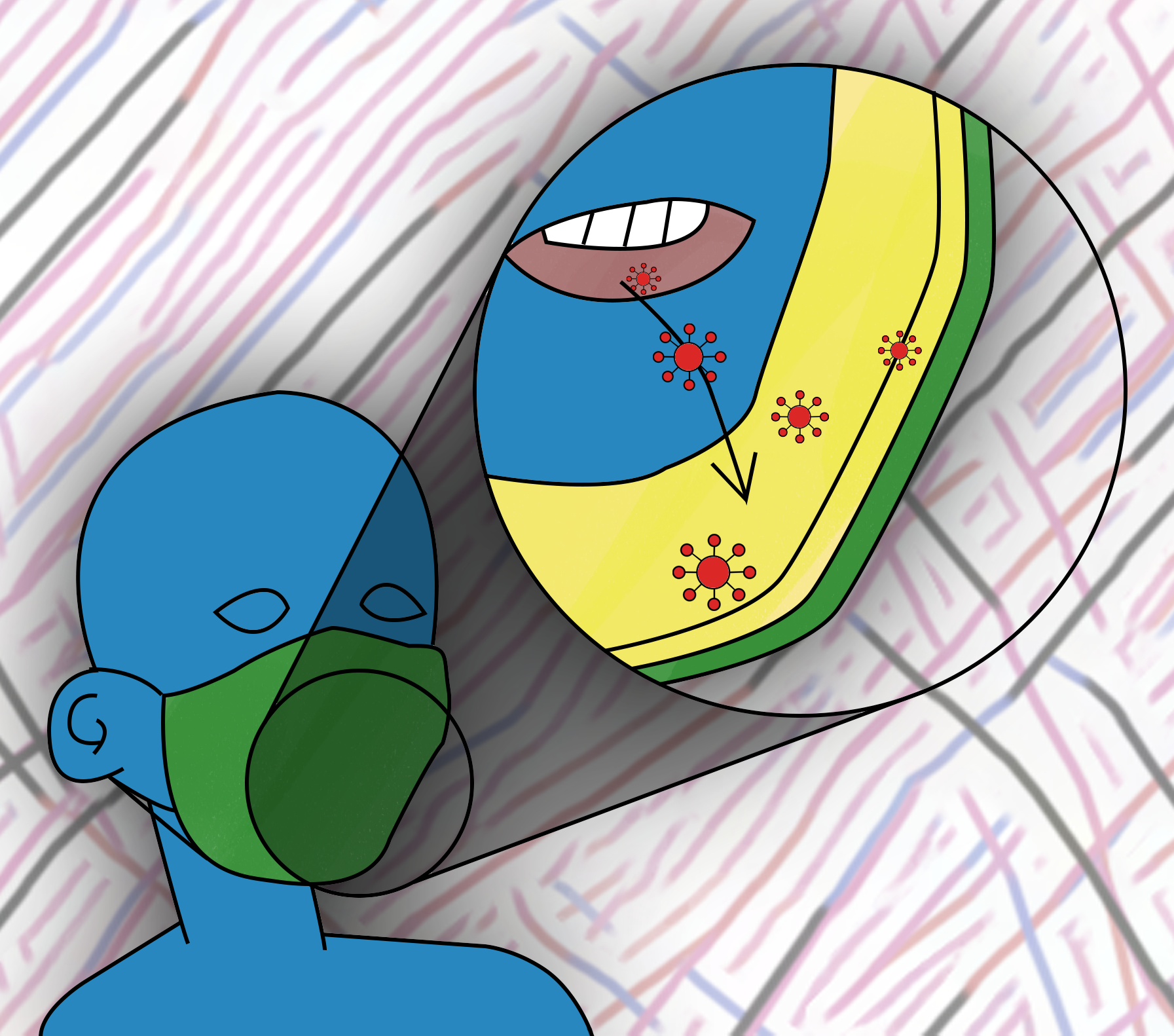
You’ve probably read the headlines: Wearing a Mask Prevents the Spread of COVID-19. But which mask you choose could affect how protected you and others really are.
Masks were first mandated in Humboldt County on April 24 when Health Officer Dr. Teresa Frankovich introduced an order requiring all members of the public wear facial coverings while inside a facility other than their residence. Since Humboldt State University was required to close campus prior to that, the university announced safety precautions on Aug. 4, which included wearing face coverings with at least two layers of 100% cotton. This was done in conjunction with the reopening of campus for the fall semester.
The Centers for Disease Control and Prevention (CDC) urges people to wear masks with at least two or more layers of washable, breathable fabric. Masks need to be worn covering both your mouth and nose at all times.
Director of News and Information Aileen Yoo stated, “HSU is following recommendations from the CDC. Its website is also a great resource for information on different types of protective gear.”
According to the Association of American Medical Colleges (AAMC), “studies have shown a double-layer cloth face covering was significantly better at reducing the droplet spread caused by coughing and sneezing, as compared to a single-layer one.”
Mark Wilson, a microbiology professor at HSU believes that “the main goal of mask wearing is to reduce the emission of droplets and aerosols from a person infected with the coronavirus, by trapping emitted droplets in the fabric. Mask-wearing can reduce the transmission of airborne diseases like coronavirus.”
Wilson added that when deciding on the type of masks, “the tighter the weave of the material, and the more layers it has, the more effective it will be at filtering out particles.”
May Chu, an epidemiologist at the Colorado School of Public Health, as quoted by NPR said, “a good option is a mask made of two layers of a tight-weave fabric with a built-in pocket where you can place a filter.”
A University of California, San Francisco article reported that based on a simulation, researchers predicted that 80 percent of a population who wear masks would reduce the spread of COVID-19 more than being on lockdown. Further, the Institute for Health Metrics and Evaluation projected that 33,000 deaths could be prevented by October 1 if 95 percent of the population wore masks in public.
Many researchers have looked into N95 masks which are made out of many layers of fine polypropylene fibers. They are able to block at least 95% of small airborne particles but only when worn correctly. Though they are proven to be effective, the short supply should be reserved for medical professionals and first responders.
A recent Duke study rated a fitted N95 and a three-layer surgical mask as the top two protectors, followed by two layer cotton masks.
According to an article by Science Daily in July, a team of Australian researchers did a study comparing the effectiveness of single and double layer cloth face coverings. They used LED lighting to film the airborne droplets. Their results showed that double layer face coverings prevented more droplets from spreading.
HSU students can be provided with double layer masks at the campus Police Department, the first floor of Student and Business Services building, Jolly Giant Commons, College Creek Market and the Parking Kiosk.
How fire suppression is a mixed bag in Humboldt County
Every fire season, blankets of smoke roll over Humboldt County. Here on the coast, that’s as close to wildfires as some of us get. But our practice of fire suppression is a relatively new state for our woodlands and the lack of fire is taking its toll on the county.
“Humboldt county’s interesting. Most of the county really hasn’t experienced much fire over the last few decades,” said Jeffery Kane, associate professor of fire ecology and fuels management at Humboldt State University.
High levels of rainfall and a more temperate climate contribute to a lower risk of fire, but that doesn’t mean fire isn’t a natural part of Humboldt’s environment.
“When there are ignitions, and there are ignitions here from lightning and humans from time to time, they are usually fairly easy to put out,” Kane said. “That nice fog layer, that’s going to moderate fire behavior.”
Inland Humboldt county is not as protected by our temperate, coastal environment. But Kane said that quick fire suppression may not be the safest or most environmentally friendly way to manage wildfire in the long term.
“The thing that we know is most effective is to treat areas with a combination of thinning and burning,” Kane said.
The suppression of small wildfires can make future fires more difficult to control. Dense canopies and the buildup of dry fuel makes fire more dangerous. By thinning the forest, the trees become less tightly packed. When the canopy has more gaps, fires spread slower. Then after the canopy is thinned, a prescribed burn can take care of the natural dry fuels and remaining debris created from thinning. Thinning and burning can make an area less vulnerable to uncontrolled wildfires.
Although Humboldt is relatively protected, this area still would see wildfire activity every few years if not for the relatively recent introduction of American colonizers. Due to the danger of wildfire to settlers and property, wildfire is almost completely suppressed.
Disturbance Ecology Professor Rosemary Sherriff studies the impact fire suppression has on local woodlands. She thinks there can be a balance between protecting settled areas and letting wildfires run their course.
Lightning strikes and Indigenous burning would have introduced fire to local oak woodlands. These woodland areas suffer without the fire that shaped the ecosystem.
“In the past few years we’ve had fires that have gone into more urban areas, a lot of it stemming from more wildland areas,” Sherriff said. “There’s been a substantial amount of urban-woodland interface and these are really extremely hazardous places to live.”
In addition to providing more fuel to fires, the removal of wildfire has come at the cost of native biodiversity. Removing a natural phenomenon that was encouraged by local Indigenous tribes has consequently impacted our landscape. Local ecosystems are adapted to wildfire and removing fire allows fire sensitive species to grow without natural inhibitors.
“Inland we have oak woodlands, for example, that historically would have had a lot of fire,” said Sherriff.
Lightning strikes and Indigenous burning would have introduced fire to local oak woodlands. These woodland areas suffer without the fire that shaped the ecosystem.
“What we’ve seen is a lot of encroachment of native douglas fir into these oak woodlands,” Sherriff said. “So there’s been a loss of the oak woodland open areas.”
This loss of oak woodlands can be seen throughout Humboldt County. This destroys native biodiversity. But fire suppression is not the only consideration.
“Fire suppression has certainly shaped the landscape,” Sherriff said. “We can’t disregard the fact that settlements and communities and ranches and homeownership and the cannabis that’s happening also shapes and reshapes the landscape and can contribute significantly to shifts in fire behavior.”
The balance between human settlement and fire suppression is a difficult medium to reach.
“It becomes extremely tricky when it’s someone’s livelihood,” Sherriff said. “It’s very easy to sit at the university and say ‘yeah, more fire on the landscape’ but it’s extremely hard to make it happen with all the structures and policies in place.”
Lenya Quinn-Davidson is an advisor for the University of California Cooperative Extension. One of her projects is the Humboldt County Prescribed Burn Association. It’s a loose cooperative of land owners and community members that implement prescribed burns. While structures and policy is slow to change, they’ve proactively decided to put fire back into their land themselves.
“A lot of people want to use prescribed fire,” Quinn-Davidson said. “By the time we’re actually there lighting the fire, there’s already been a ton of work making sure that it’s safe, effective and that it won’t get out of control. It’s not like we’re just going out and lighting things off.”
Prescribed burning is a tool that landowners can use for fuels management, invasive species control and habitat restoration. The encroaching firs that Sherriff studies are a main target of controlled burn.
“We’re losing our oaks at a pretty astonishing rate,” Quinn-Davidson said. “So a lot of the landowners that have oak woodlands really want to use prescribed fire to get in there while those firs are small and kill the firs. The oaks survive just fine because they’re very fire adapted.”
Though douglas firs are native, there are some invasive species that landowners can keep back with prescribed burns. There are invasive species of grass like the medusa head that smother local grasslands. Ranchers want to make sure their cattle grazing lands are free of medusa head.
“It creates this thick thatch that prevents other plants from growing, so it turns into this homogeneous field of grass that nothing can eat.” Quinn-Davidson said.
Fire is necessary for keeping our natural landscape healthy and biodiverse. Where forest and human settlements meet, controlled burning can help maintain a healthy habitat with less danger to human life. With those buffer zones established, wildfire can be allowed to burn in a controlled manner, establishing a careful balance between fire and safety.
Quinn-Davidson thinks getting to a meaningful scale of fire management will take a combination of state intervention and owners taking control of their land.
“It’s a real community thing.” Quinn-Davidson said. “People just love it.”
Eureka protesters gathered in front of the Humboldt County Courthouse
Hundreds of community members gathered in the rain outside of the Humboldt County Courthouse, Sat. May 30, to protest the death of George Floyd who was murdered while in police custody in Minneapolis, MN. From 3 to 10:30 p.m. demonstrators marched through Eureka up to the Slough Bridge, back through town and then down Broadway. Law enforcement was largely cooperative with demonstrators, blocking intersections as people made their way through traffic. Chants could be heard the entire way even as groups split up and went to various parts of the city.
Demonstrators walkin front of the Humboldt County Courthouse to protest police brutality and racism in Eureka, CA on May 30 following the death of George Floyd in police custody in Minneapolis.
A demonstrator walks thorugh the street to protest police brutality and racism in Eureka, CA on May, 30 following the death of George Floyd in police custody in Minneapolis.
Demonstrators walk past the post office though the street to protest police brutality and racism in Eureka, CA on May 30 following the death of George Floyd in police custody in Minneapolis.
A demonstrator holds up a rose above the crowd as they confornt Eureka Police Department officers in front of the Humboldt County Courthouse to protest police brutality and racism in Eureka, CA on May 30 following the death of George Floyd in police custody in Minneapolis.
Demonstrators walk down Broadway to protest police brutality and racism in Eureka, CA on May 30 following the death of George Floyd in police custody in Minneapolis.
As the group returned to the courthouse tensions flared at the sight of several police vehicles, which were soon removed from the scene. Eureka Police Chief Steve Watson was present at the protest and spoke with demonstrators as the crowd dispersed and headed away from the courthouse. These demonstrations in Humboldt are some of countless that have sprung up across the nation following Floyd’s murder.
Demonstrators stop a police vehicle at an intersection as they make their way thorugh Eureka down to Boroadway to protest police brutality and racism in Eureka, CA on May 30 following the death of George Floyd in police custody in Minneapolis. The vehicle attempted to make it’s way slowly though the gathered people and left with a broken back window.
Demonstrators confront Eureka Police Department officers in front of the Humboldt County Courthouse to protest police brutality and racism in Eureka, CA on May 30 following the death of George Floyd in police custody in Minneapolis.
Demonstrators push back against a police vehicle as it attempts to move past the gathered crowd as they protest police brutality and racism in Eureka, CA on May 30 following the death of George Floyd in police custody in Minneapolis.
Demonstrators walk thorugh the street through the rain to protest police brutality and racism in Eureka, CA on May 30 following the death of George Floyd in police custody in Minneapolis.
Demonstrators confront Eureka Police Department officers in front of the Humboldt County Courthouse to protest police brutality and racism in Eureka, CA on May 30 following the death of George Floyd in police custody in Minneapolis.
With the pressures of the pandemic mounting, people are stuck with an impossible choice
On Friday, May 1, around 100 people gathered in front of the Humboldt County Courthouse to demand the reopening of businesses deemed non-essential by the government. With signs like “Every Business Is Essential,” it is clear that the protesters are not being properly supported during this time of crisis.
The government’s attempts to mitigate the spread of the virus have been controversial with over a million reported cases so far. Social distancing is the most effective measure we can take to prevent unnecessary deaths since the swab test is inaccurate and limited at the moment. Unfortunately, mandatory lockdowns and halts to employment in order to support social distancing efforts have left many without jobs and a way to earn a steady, livable wage.
“This crisis is really illustrating both the violence of inequality and also the need for another economic system.”
Thomas Piketty
Everyone has a wide range of debts, rents and other expenses to pay for during this time. If we want to prevent the spread of the virus we need to support disenfranchised workers, not force them back into unsafe working conditions. With 59% of Americans living paycheck to paycheck, for those keeping track at home, the percentage cuts for units is not reasonable to expect them to be able to handle all of their expenses with a one-time stimulus check of $1,200. The writer of the book “Capital in the Twenty-First Century” and economist Thomas Piketty believes that a pandemic like this holds the potential to change dominant narratives about how we should organize our society and build our economy.
“This crisis is really illustrating both the violence of inequality and also the need for another economic system,” said Piketty.
The Americans most impacted by the pandemic are going to be the poorest, most vulnerable members of our society. For as long as our country has existed, so has the divide in quality of life, poverty, and access to government assistance in times of crisis.
We need a societal structure that values every life.
Due to our country’s reliance on employer-based healthcare, every company that is forced to lay off its workers in this necessary time of crisis is creating large swaths of vulnerable, uninsured people. The natural response is to want to go back to work and blame the government for taking away your insurance and employment so you can continue to provide for yourself and your loved ones. The only problem is that we have a virus on our hands, so one is forced to either ignore the dangers of returning to work or slowly drain themselves financially as the dues of existing in our society add up. This is not a fair choice nor a choice we should have to make.
This is our societal structure functioning as it was designed to. When healthcare is tied to employment and to wealth, we are nudged into believing our right to exist is tied to employment and to wealth. When certain marginalized groups are underemployed or possess less wealth, our system is tacitly stating that those groups are worthless.
We need a societal structure that values every life. That means universal healthcare, education, job guarantees, housing and access to technology. Without universal healthcare, there isn’t a solid system for distributing care during a pandemic, and the right to one’s own life is decided by socioeconomic status. Without job guarantees, people are set adrift during emergencies, not knowing if they will be able to get back to work after it’s all over. Without universal housing, a pandemic can leave many unsure if they will have a roof over their head in a month’s time. Without access to technology, some will lose education, jobs, communication with the outside world and entertainment to occupy the time.
But more than all these things, we need a structure that prioritizes us. If everything starts falling apart because of one pandemic, maybe it wasn’t the most stable structure to begin with. An economy that does better when its workers die is like a car that goes up in value when it kills the passenger. The structure should exist to support you. This pandemic is exposing our economic structure for what it has always been. A burden that crushes the marginalized and the vulnerable. A $1,200 check, a rent freeze and a free face mask are only small band-aids on a gushing head wound. Normal, everyday life is why everything is falling apart in the first place.
All we can do is build a system that protects every person within it and values life from the ground up. A system that lets numbers of people die will die along with them. It is a system bound to fail.
NFL Green Bay Packers pick up Eureka standout in the 2020 Draft
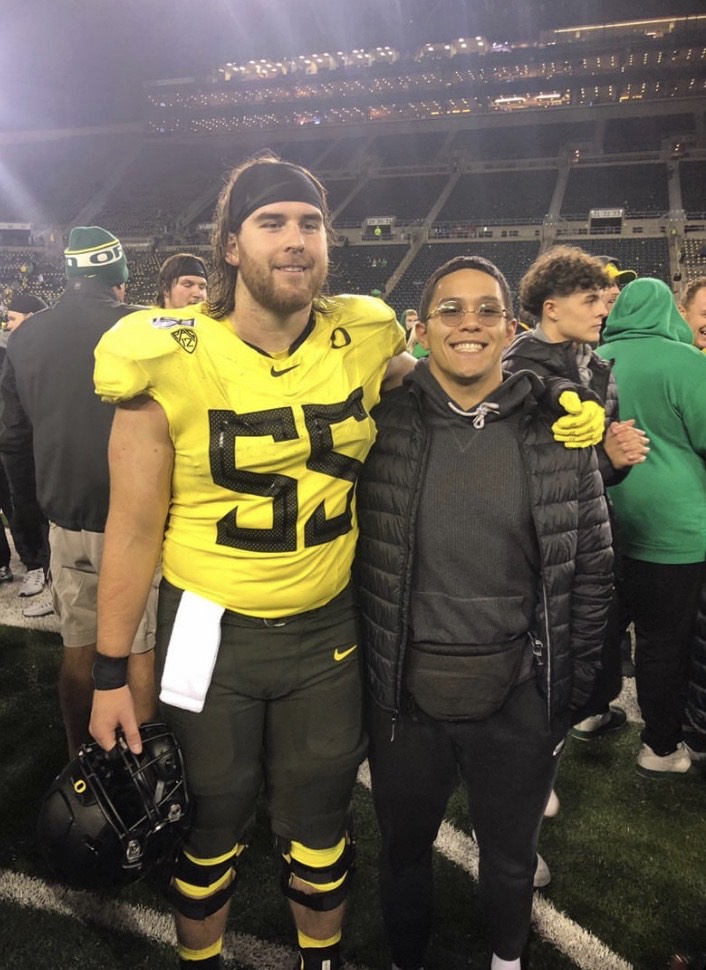
You’re watching the 2020 NFL Draft. It’s the sixth round and the Green Bay Packers are on their 29th pick. The Packers are about to make a life altering call to a player who will soon have the chance of playing alongside the quarterback legend, Aaron Rodgers. A familiar Humboldt County name flashes across the screen. Former local Eureka high school alumnus and University of Oregon center, Jake Hanson has just been drafted as the 208th overall pick for the Green Bay Packers for this upcoming 2020-21 season.
A key component of Hanson’s journey began when he signed to play for the Oregon Ducks in 2015. During his four seasons playing with the Ducks, Hanson started almost every game. During his first three seasons, Hanson didn’t allow a single sack with a total of 2,738 snaps. The starting center received a total of two honorable AP second team Pac-12 All Conference recognitions.
Tyson Miller is a local MMA pro fighter, former high school teammate and good friend of Hanson’s. Miller and Hanson initially met in kindergarten but it wasn’t until the two went to a football camp together their freshman year when they really hit it off and started hanging out. Miller sees what many fans have noticed on social media since the draft. Hanson comes in at almost 6’5”, 303 lbs, his size works to his advantage.
“First of all, his size,” Miller said, “He was bigger than most of the other lineman on the field.”
Size is not the only key feature that stands out about Hanson. Miller points to Hanson’s effort on the field as a big upside.
“He’s going to be a professional football player.”
Tyson Miller
“Jake is going to give it 100%,” Miller said. “If somebody demanded more than 100%, he was more than willing to give more than 100% right back.”
The dedication and game mentality that Hanson possesses is one that is truly admired by not only Miller, but by others as well. The ability to turn up the heat in a game is sets athletes apart from one another.
“[He is] going to be a professional athlete,” Miller said, “He’s going to be a professional football player.”
Hanson is going to be a memorable name within the community and make an unforgettable mark for the Packer Nation.
In an article by Forbes, Packers General Manager Brian Gutekunst pointed out Hanson’s work ethic and personality as a positive for the teams newly acquired offensive lineman.
“Just really a model of consistency and another culture guy,” Gutekunst said. “The kind of guys that we like to bring into our offensive line room.”
While the Packers have their seven year veteran center Corey Linsley under contract for another year, there is no doubt that Hanson will be Linsley’s backup for this upcoming season. Hanson is going to be a great asset to the Packers. His strength, size and quick feet will play a pivotal role in his movement of helping block the defensive line. I am predicting that with time, after the team continues to work with him and his snap consistency, he will be their starting man.
If you’re looking to watch some football and don’t know what to do without Humboldt State’s football program but still want that local spin, be sure to tune into some of the Green Bay Packers match ups. Remember to look for #67 on the field.
Everything you might want to know about the 2020 census
The United States Census Bureau has fulfilled the constitutional obligation to count every human in the country since 1790. Every home in the United States should have received an invitation to participate in the 24th United States census by April 1.
“The census tells us who we are and where we are going as a nation,” the Bureau’s website said.
The census is a measure of what’s going on in American communities. The data collected from the census helps communities determine where to build infrastructure, from schools and supermarkets to homes and hospitals. Beyond that, California District One (Humboldt County included) House Representative Jared Huffman said it’s a fundamental element of the United States.
“The significance of everyone participating goes so far beyond that,” Huffman said in an email through his spokesperson. “Having a complete picture of the people in communities across the country determines how folks are represented and makes sure everyone has a voice in the decisions their government makes. That’s the foundation of our democracy.”
In the past couple of years, the Trump administration tried to politicize the census as they pursued the addition of a citizenship question, but they failed. To be clear, there is no citizenship question on the 2020 census.
John Meyer, chair of the Humboldt State politics department, explained how an accurate census requires trust between the federal government and residents.
“The goal of the census was an accurate count of who residents are and where they live,” Meyer said. “The citizenship question discouraged that.”
“Students today are the most diverse demographic, and if you’re not counted, other resources will not follow.”
Nicola Walters
Meyer said answering the census should have no personal impact on respondent’s lives, and that there should be no arrests nor barriers to voting following a response. Meyer said immigrants from other countries, especially those with authoritarian, surveillance-heavy governments were often wary of answering the questions for fear of retaliation.
The U.S. Census Bureau has been politicized in the last few years, but the law prevents the Census Bureau from sharing information with law enforcement. The information is supposed to be kept strictly confidential.
“It is in the interest of powerless people to answer the census,” HSU American government lecturer Nicola Walters said. “Students today are the most diverse demographic, and if you’re not counted, other resources will not follow.”
Walters said she would have liked to see the citizenship question on the census. The census is a rare opportunity for scientists like her to collect data on the entire population, rather than just the samples she’s used to. Nonetheless, she is looking forward to the results of the 2020 census.
According to the Census Bureau’s website, many of the planned elements of getting a full count, including door to door interviews, will be postponed.
“The 2020 Census is underway and the most important thing you can do is respond online, by phone, or by mail when you receive your invitation,” the Census press kit said. “Responding now will minimize the need for the Census Bureau to send census takers out into communities to follow up.”
California houses, shelters and aids homeless as COVID-19 cases continue to rise
With at least 151,278 homeless individuals in California, measures to keep them safe and healthy during the current shelter-in-place order are crucial.
Governor Gavin Newsom and his administration have sought ways to provide shelter and temporary homes for the homeless. On March 18, Newsom published a statement addressing what actions are to take place to ensure that everyone in the state maintains their health.
“People experiencing homelessness are among the most vulnerable to the spread of COVID-19,” Governor Newsom said. “California is deploying massive resources to get these vulnerable residents safely into shelter, removing regulatory barriers and securing trailers and hotels to provide immediate housing options for those most at risk. Helping these residents is critical to protecting public health, flattening the curve and slowing the spread of COVID-19.”
To help with the crisis, Newsom released $150 million to local governments to pursue leases with hotels and motels for temporary shelter. An additional $650 million is said to be released on April 1 from last year’s budget, to ensure that enough supplies are given to shelters and other medical resources. Shelters all over the state are struggling to gain more medical supplies and are losing volunteers.
Around 130 homeless individuals are staying in shelters around Arcata and Eureka.
“This is one of the biggest challenges our homeless system has ever seen,” Deputy Secretary for Homelessness for the Newsom administration Ali Sutton said. “And our population is one of the most at risk.”
Newsom also said he and his administration are working on creating leases lasting a few months with hotels and motels in order to house more homeless. According to an article from The Latest, Newsom announced 2,400 more hotel and motel rooms have been secured to house those on the streets, with 1,900 of those rooms coming from San Diego alone. There are now 4,000 rooms secured statewide. San Diego plans to continue sheltering the homeless by moving them to the city’s Golden Hall, the downtown Convention Center (home to Comic-Con), and other vacant rooms in hotels.
Humboldt County is also working to gain more shelters, rooms and supplies for those on the streets. Around 130 homeless individuals are staying in shelters around Arcata and Eureka. Some shelters have already taken place like Eureka Rescue Mission and Arcata House Partnership.
Each shelter in Humboldt County is expected to receive $300,000 in order to keep up with medical resources and other supplies, but shelters might still need more help to make sure they have everything they need. Eureka Rescue Mission, for example, had to close their thrift store, which was a main source of income, making sheltering the homeless more difficult as the pandemic continues.
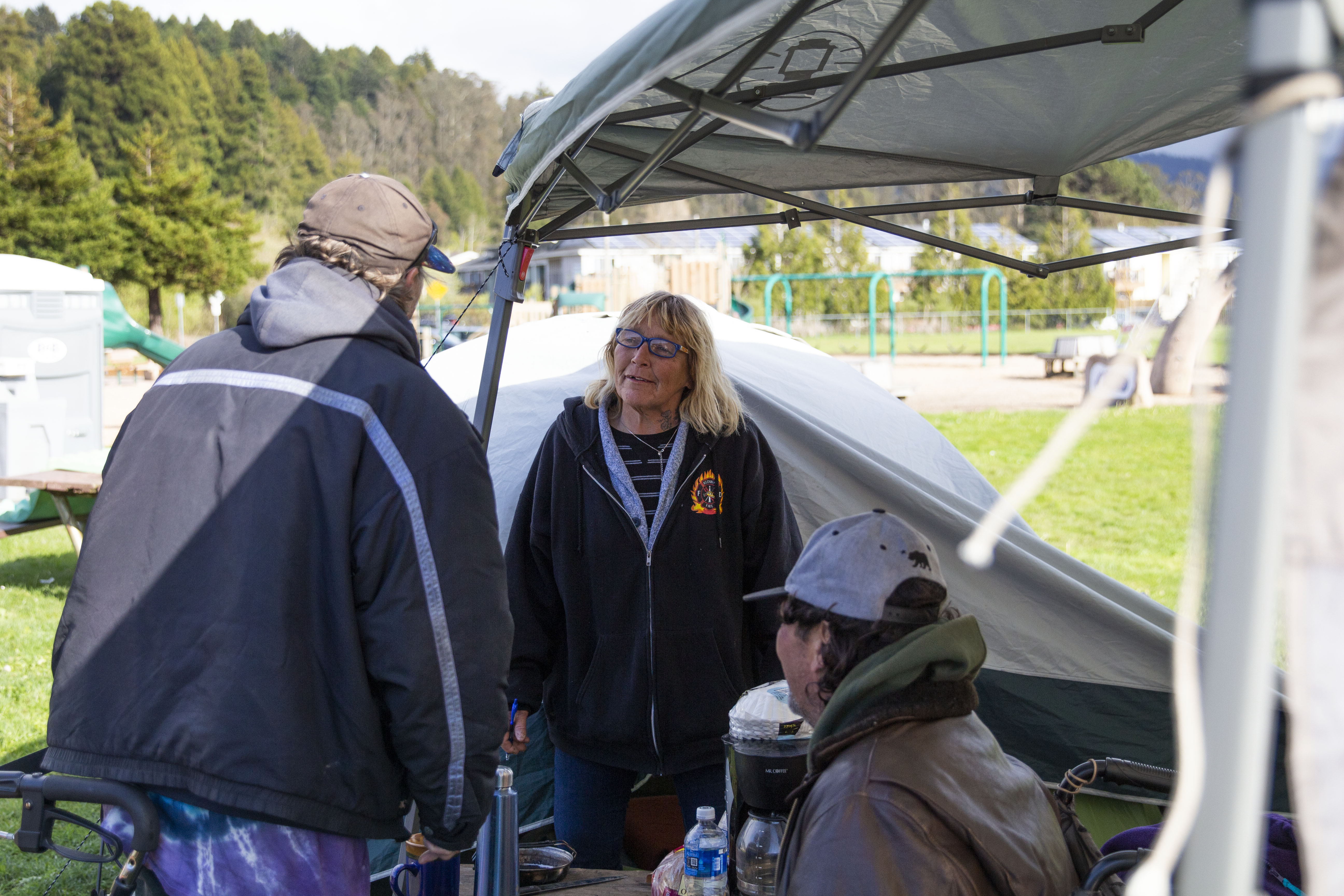
The city of Arcata, along with AHP, have been working together to find other ways to help. After calling and surveying businesses and other organizations, Arcata was able to secure two parking lots in town. The lot on G Street can maintain at least 19 people, while the Transit Center lot can hold up to 15 people. Tents inside the lot are recommended to be six feet apart. AHP is working with Affordable Housing Homeless to ensure portable showers, sinks and bathrooms are provided for the lots. The lots can also expect to soon see mobile health services to make sure individuals are healthy.
The Centers for Disease Control and Prevention set out guidelines for how to manage tent camps, recommending that local law enforcement should not force individuals out of the camps unless there is immediate housing available for them to go to.
Hotel and motel rooms, meanwhile, are still in the process of being secured for more individuals. Arcata is also giving out food at the Arcata Food Pantry on Wednesdays from 4 p.m. to 6 p.m at the Trinity Baptist Church.
Looking to the past to learn about the present pandemic
There’s a saying that goes something like, “In order to prevent future mistakes, we should look to the past for guidance.” While this current pandemic may be new to all of us, humans have gone through this before. Some of the more recent pandemics include the SARS virus, the H1N1 virus, Ebola and HIV.
The term pandemic is defined as something “occurring over a wide geographic area and affecting an exceptionally high proportion of the population.” Obviously, the current COVID-19 virus fits into this category. While some of the aforementioned pandemics did not enact a devastating, history-altering toll on Humboldt County, another pandemic did.
From 1918 to 1920, the Spanish flu swept across America, resulting in an estimated 675,000 deaths according to the U.S. Department of Health and Human Services. The first official report of the Spanish flu in California was reported Sept. 27, 1918, just two weeks after an outbreak on the East Coast. By November 1918, the total cases throughout the state hit about 115,000—overwhelming doctors and government officials from north to south.
One of three doctors that helped Spanish flu patients in the Ferndale area.
Although Humboldt County sits in an isolated area protected by the “Redwood Curtain,” the area was soon amassed in its own troubles combatting the illness. Humboldt County had a population of about 37,000 people with Eureka holding around 12,000. The Spanish flu resulted in around 200 deaths (although it is thought to be much higher) and thousands grew ill.
In 2012, Humboldt State alumnus and McKinleyville native Jeff Benedetti-Coomber wrote a detailed history of the impact the Spanish flu had on Humboldt County. For it, he was awarded the Charles R. Barnum History Award by HSU’s history department. For his research he scoured through old newspaper clippings for primary source documentation. He read academic analysis on how the Spanish flu affected the entire nation and he cited Matina Kilkenny, a researcher and local author for the Humboldt Historical Society who also wrote about the impacts the Spanish flu had on Humboldt County.
What prompted Benedetti-Coomber to focus on the Spanish flu was its lack of local research. As his peers decided to look into European history, he decided to focus his attention on the effects locally.
“I was walking through the graveyard in Arcata and noticed a family of graves, not necessarily related to the [Spanish] influenza but it got me thinking about what effects the flu may have had because it was around the same time,” he told me over the phone from his place in Los Angeles. “Once I started researching it I saw how it did affect the county and I was pretty amazed.”
Benedetti-Coomber’s senior thesis, titled “Death In the Redwoods: The Effects of the Spanish Influenza on Humboldt County,” spans 30 pages and breaks down how each town dealt with the outbreak. He highlights what preventative measures seem to have worked and where officials, the public and the media went wrong and what they got right.
“It’s just like today when you tell people to do something and they kind of resist. A lot of people had that with the Spanish influenza and it was a reason a lot of people died, because they didn’t take it seriously.”
Jeff Benedetti-Coomber
Some of the highlights from his research that still stand out to him are how Eureka initially closed all schools, which flooded the streets with children. They soon changed their minds and brought the kids back into the school to try to quarantine the children. Another nugget of research that sticks out in his mind has to do with masks and the public’s initial reluctance to wear them.
“It’s just like today,” Benedetti-Coomber said, “when you tell people to do something and they kind of resist. A lot of people had that with the Spanish influenza and it was a reason a lot of people died, because they didn’t take it seriously.”
When the Spanish flu hit Humboldt, the United States was in the middle of World War I and young men from Humboldt were signing up to join the war effort. There were war rallies and large gatherings of people throughout the towns in Humboldt in the fall of 1918 as the Spanish flu began to creep in.
“Although the Great War was still the main focus in Humboldt County, more and more citizens were beginning to take notice of the spreading pandemic,” Benedetti-Coomber wrote.
Some of the newspapers in Humboldt at that time seem to have downplayed the seriousness of the Spanish flu. Benedetti-Coomber points to an ad that was in the Humboldt Standard by Vicks VapoRub that was “disguised as an article… and it assured readers that the [Spanish flu] was ‘Nothing new simply the Old Grippe and la Grippe that was the epidemic in 1889-90.’”
Benedetti-Coomber wrote that it is believed the Spanish flu was brought to Humboldt County by locals traveling to other parts of the state to help care for sick family members and then returning before symptoms started to show. By mid-October 1918, reports of the Spanish flu were starting to pop up in the local newspapers.
“The Humboldt Times also reported that there were roughly 150 cases in Eureka by [Oct. 22] and hospitals were short staffed. Doctors were so busy they did not have the time to report new cases or treat the majority of their patients.”
Jeff Benedetti-Coomber
“The Humboldt Times and Humboldt Standard newspapers offered daily accounts of what was happening,” he said, adding that they also seemed to not care about the Spanish flu at first.
On Oct. 12, 1918, four cases were reported in the Humboldt Times and those infected were quarantined in a “‘safe house’” on 8th Street where they could be quarantined and cared for,” Benedetti-Coomber wrote.
At first, the mayor of Eureka downplayed the danger to the public, but two days later, five more people were infected. By Oct. 22, 1918 there would be more than 150 cases and one death.
“According to the Humboldt Times, Mrs. Garber Dahle was the first person in Humboldt County to die from the deadly virus,” Benedetti-Coomber wrote. “The Humboldt Times also reported that there were roughly 150 cases in Eureka by [Oct. 22] and hospitals were short staffed. Doctors were so busy they did not have the time to report new cases or treat the majority of their patients.”
Action to combat the Spanish flu across the county began to take root. Arcata was the first town to pass a requirement that all residents had to wear a mask while out in public, and by Nov. 7, 1918, the entire county was required to do so. Emergency hospitals were soon established across the county with some residents offering up their homes for the infected.
Arcata escaped the pandemic with only four deaths, but the same can’t be said for Eureka and especially for the logging camps in the remote areas of the county. The number of cases grew in the urban areas, and by Oct. 23, 1918, the logging camps were left to fend for themselves.
“Logging camps and small towns were informed by the newspapers and from local physicians that they would have to face the Spanish Influenza on their own as all of the county hospitals were completely full,” Benedetti-Coomber wrote while citing a Humboldt Times article titled “Influenza Increases Alarmingly in Two Days.”
Young women wearing masks in Humboldt County.
But one logging camp was able to escape the pandemic with no cases at all. In her article, “Missing Faces,” Matina Kilkenny reported how Carl Munther set up a quarantine system for his workers who decided to go into town. (Kilkenny’s article has a number of great photographs of life in Humboldt County during the Spanish flu.)
“Munther required every person returning to camp… to stay four days in a tent he’d pitched some distance from the workers’ cabin,” Kilkenny wrote, adding that the returning workers were also required to work and eat separately from their peers. “Thanks to their boss, very few men chose to leave the Barrel Company camp and not one case of influenza occurred there.”
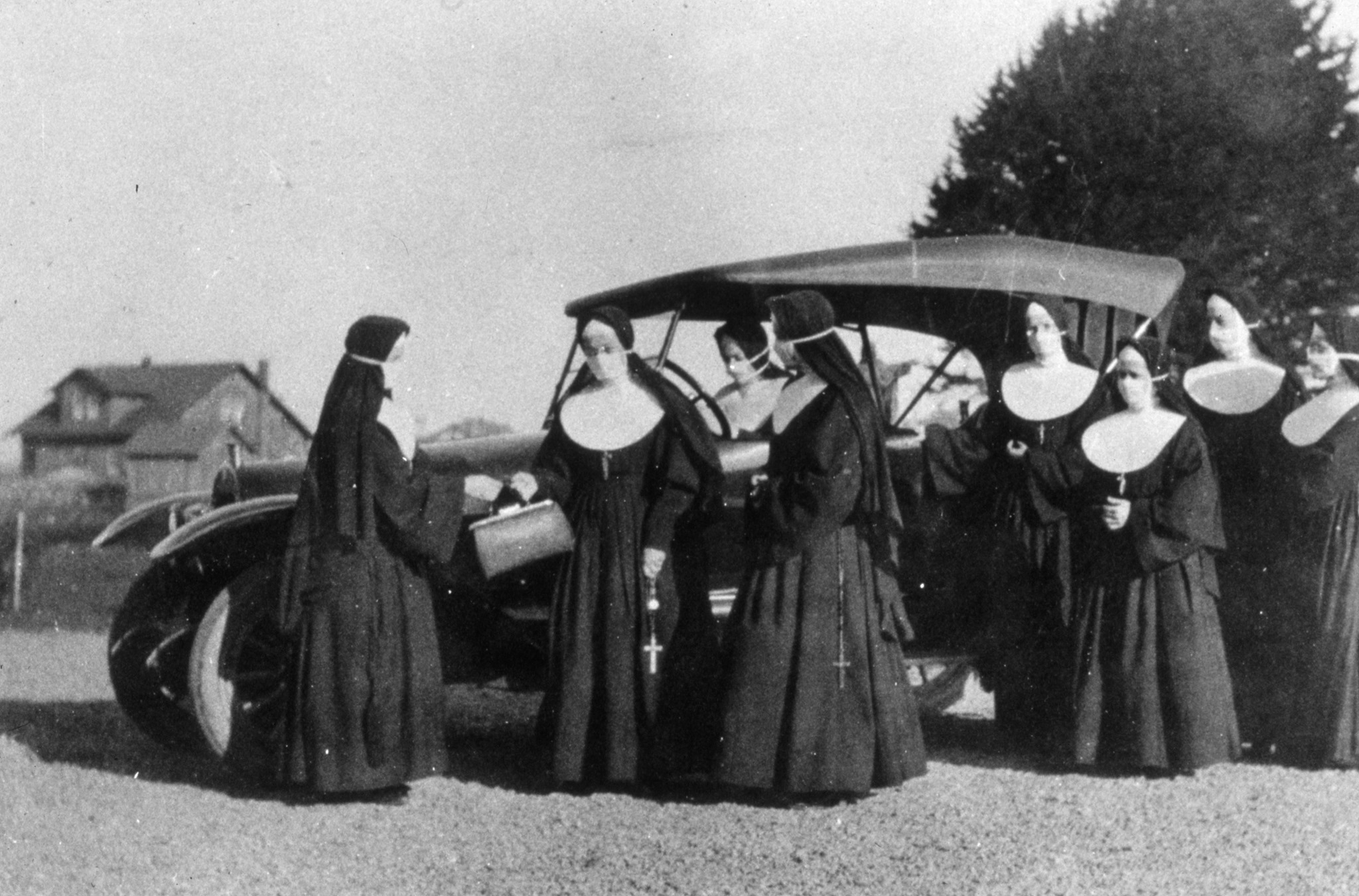
Sisters of St. Joseph wearing masks during the Spanish flu. The sisters helped many patients in Humboldt from 1918-1920.
Throughout her research, Kilkenny was able to find where a number of hospitals were set up across Humboldt. There was a Red Cross Hospital in Korbel, Arcata, Blue Lake and Eureka. Kilkenny also came across an interview between a member of the Sisters of St. Joseph of Orange in Eureka and a man named Brad Geagly. Kilkenny wrote the following:
“[Mother Bernard] sent [the Sisters] out in twos, in cars provided by the Red Cross. She armed each Sister with a kit containing camphor and sweet oil, castor oil, and mustard plasters. Into the homes… the sisters came, arriving at seven o’clock and leaving at the end of a 12-hour shift, to be replaced by two other Sisters. They would attend first to the adults….They would bathe the delirious victims completely, rubbing their chests deeply with the camphorated oil. Mustard plasters would be applied, and then the sisters would wrap the sick tightly in whatever woolen material they could find; then they would tend the children. Once they had been bathed and medicated, the sisters turned to washing linens or cleaning house. They fed their charges warmed milk and broth prepared from the food furnished by the Red Cross.”
Kilkenny noted that, generally, it was the poor who were admitted into the hospitals, while the more well-off were cared for in their homes. Because of this the actual tally for those infected and the deaths attributed to the Spanish flu is unknown. Kilkenny also points out how the Native American tribes were hit hard by the Spanish Flu as well.
“Of the [11] Native Americans whose deaths are on record at the County Courthouse, five were from Table Bluff, two from Hoopa, one from Miranda, one from Orleans, one from Requa, and one was a laborer at Korbel,” Kilkenny wrote. She also noted evidence that many Native Americans often refused treatment by White settlers around this time period.
Kilkenny was also able to find county death records from that time and noted that between Sept. 1, 1918 and April 1919, 175 Humboldt residents died with 91 of them between the ages of 20 and 40.
And so what can we learn from this history?
There is evidence that social distancing works by the example set by Carl Munther at his logging camp and how travel throughout the state can spread the virus. We can see how hospitals were eventually inundated with those infected with the Spanish flu and how staff were stretched thin. We can also see how it is important to get ahead of a pandemic and try to prepare as much as possible.
Humboldt County seems to be doing just that. They have recently distributed around 30,000 pieces of personal protective equipment to first responders and medical staff across the county. Humboldt State chipped in and prepared 1,250 COVID-19 test kits. Also, as I’m sure you are aware, we are in a “shelter in place” order that was enacted to help stop the spread of the virus and to give medical staff the ability to fight the virus without being overwhelmed.
Towns across Humboldt are also doing their part to help prevent an outbreak. Trinidad passed a moratorium on all short-term rentals and added some pretty forceful consequences to anyone who breaks it.
“Over the course of the meeting, council members added some teeth to the resolution with language saying that a single violation may result in the City revoking a proprietor’s short-term rental license for up to a year,” the Lost Coast Outpost’s Ryan Burns recently reported, adding that the county may consider a similar measure.
A stained glass piece by Humboldt artist Colleen Clifford.
As this thing progresses, we are all going to have to make some sacrifices, but we’ll get through it. Help out the elderly and the immunocompromised if you can. Help out each other by not going out or attending pretty much any gathering of any number of people.
Let’s all work together — but at least six apart — to help “flatten the curve.”
HSU students are under-informed and unprepared for the beast that is mold
It accumulates like there’s no tomorrow, unleashing its inner animal at every turn. No damp area is safe from the monster of mold. What can students do to fight it?
The rainy season is still around in Humboldt. Lurking amidst the hundreds of buildings students live in—and may be stuck in—is a hidden and nasty phenomenon—mold.
Mary Gaviglio, a freshman business administration major, has had first-hand experiences with mold, from seeing it grow on a bowl of cereal she left out overnight to meeting someone who was severely affected by it.
“He’s actually allergic to the mold spores here, so he gets really excited because they’re in the air,” Gaviglio said.
Gaviglio also remarked on how it’s easier to breathe in Humboldt than where she is from in Southern California.
“I usually get sinus infections when the Santa Ana winds come in because of all the pollutants, and now that I’ve moved here, I actually breathe a lot better,” Gaviglio said.
Dr. Miriam Peachy, an accredited practicing naturopath in McKinleyville and a mold expert, gave a breakdown of the ins and outs of mold and mold illnesses.
There are five different kinds of mold and the mold that humans can see is called active mold. Mold reproduces through spores, which get in the air, fly around, settle on surfaces and eventually begin to grow as moisture emerges.
Mold toxins, the waste products of mold, are what can get people sick. Most people aren’t affected by most kinds of mold, but for those with weakened immune systems or allergies, extended exposure to some mold can cause nausea, headaches and cold sweats.
“I’ve had people literally sleep outside because they didn’t have anywhere else to live.”
Dr. Miriam Peachy
Colton Trent, an environmental science senior, talked about how he’s dealt with mold in his apartment. His bathroom is in the middle of his apartment and has no window and an old ventilation fan, which makes for a messy situation in the winter when humidity is high.
“Whenever me or my roommates take showers or if we leave the door closed for too long, the condensation collects on the ceiling and the walls,” Trent said. “And we have to clean the walls and the ceiling pretty frequently because mold spots will start to grow.”
No matter where you stand in the mold illness spectrum, there are steps that can be taken to treat it.
The first step is distancing yourself from the mold, which means permanently leaving the environment in which the mold is taking over.
Unfortunately, in Humboldt, the lack of housing is a known factor that is doing the mold illness treatment process no favors.
“Too many people are afraid to rock the boat or lose their rental and they don’t have anywhere to go and they don’t know if the next place they go will be moldy,” Peachy said. “It’s almost impossible to find a place that’s not moldy here.”
The next step in treating mold and mold illness is remediation. That is to say, removing and replacing anything and everything that might’ve contracted mold from kitchen wooden cabinets all the way to furniture.
“I’ve had people literally sleep outside because they didn’t have anywhere else to live,” Peachy said.
The final step in the process is washing and cleaning everything that can be wiped down or otherwise cleaned like clothes and metal surfaces.
Above all, Peachy stressed the importance of getting a dehumidifier, as it can work wonders and is the most basic way of combating the spread of mold.
Photographer and Sports Editor Thomas Lal captured these scenes from around Arcata on March 21 at the end of spring break at the beginning of Humboldt County’s shelter in place order.
The storefronts on the Arcata Plaza look out on mostly empty streets.An employee sits at a computer while a sign advertises that the business is still open during the first week of a shelter in place order.The shelves in the Arcata Safeway.The Humboldt State Library.A lone person walks through the mostly empty parking lots at Humboldt State University.The Humboldt State Library.The Humboldt State Library.A single person works at the Humboldt State Library.A carton of eggs sits on the shelves at the Arcata Safeway.A lone person stands just off of the Arcata Plaza.An employee puts up a sign in the door of the Jitter Bean on the Arcata Plaza.
The Weeknd’s fourth album, “After Hours,” has arrived
The R&B villain, better known as The Weeknd, has returned with his fourth studio album, “After Hours.” In this album, The Weeknd revisits the same themes of drugs, lust and heartbreak found in previous releases, but this time, with a different approach. In the past, his music has come off generally unapologetic, but “After Hours” brings a mix of emotions on his lifestyle.
After nearly a decade of partying and coming onto the scene in 2011, The Weeknd reveals on track eight, “Faith,” that he’s spent the last year sober. Still battling the urge to return to the fast life, The Weeknd comes to terms with the choices he’s made in “After Hours” and the mental war he’s fighting to avoid making those same mistakes.
Coming into this project, The Weeknd set the tone by dropping two pop singles at the end of November, claiming the top position on the Billboard Hot 100 chart with his lead single, “Heartless.” His follow up, “Blinding Lights,” is currently peaking at number two on the Hot 100 chart in the wake of the album release. He followed up in the second half of February with the title track, “After Hours,” as an unofficial single. The song is slow to build, but is equal parts patience and pop, making it clear that the pop-star style is here to stay.
“I will always prefer his earlier stuff. It’s just a sound you couldn’t have found anywhere else at the time.”
Alexa Noperi, HSU film major
Alexa Noperi is a film major at Humboldt State University, and she hasn’t been happy with The Weeknd’s direction since he dropped “Starboy.”
“I will always prefer his earlier stuff,” Noperi said. “It’s just a sound you couldn’t have found anywhere else at the time.”
The Weeknd’s gradual transition to pop music has left some of his day-one fans behind in the darkness of his mixtapes. Made official by his 2016 album “Starboy,” the style shift can be attributed to the success of his biggest single, “Can’t Feel My Face,” along with other pop efforts on “Beauty Behind the Madness,” including “Earned It” and “Angel.”
When he released his first EP, “My Dear Melancholy,” in 2018, the day-one fans that were left behind were delighted by the return of a dark Weeknd. With his latest release, The Weeknd is likely to disappoint hardcore fans again, as he mostly leaves behind the dark, moody atmosphere of his earlier music to make room for the pop sound that generated so much success with “Starboy.”
“After Hours” is a rollercoaster of indecisiveness. The Weeknd’s desires constantly clash with one another on his quest for true happiness.
The album begins with chilly instrumentals that build into their own pop section. The Weeknd flaunts his typical unremorseful attitude, claiming, “It’s too late to save our souls,” on the song “Too Late.”
“After Hours” is the most consistently solid project The Weeknd has dropped so far.
Track four, “Scared To Live,” marks the first shift in his approach. He begins to express remorse for his actions, as well as an authentic desire to leave the fast life behind on the stand-out track “Snowchild,” reinforced on the next song, “Escape From LA.”
Unfortunately, The Weeknd relapses, back to the fast life on his song, “Heartless.” This marks the beginning of the pop-star section that dominated the sound of “Starboy,” this time, with a heavy ’80s electro-dance influence.
“After Hours” then enters its final section, returning to the slower, chilly instrumentals that opened the album on the “Repeat After Me” interlude. The Weeknd concludes his fourth album, echoing a desire to leave the fast life behind and asking for one last chance at a normal life.
Though it may be missing the unique, dark sound of The Weeknd’s early music, found on songs like “D.D.” and “The Hills,” as well as the beauty and optimism found on “True Colors” and “I Feel It Coming” from “Starboy,” “After Hours” is the most consistently solid project The Weeknd has dropped so far.
“It’s not bad background music to try on jeans to. But I don’t think I will be playing it again.”
Isabelle Eddisford, HSU political science and dance major
This album marks a growth in his discipline, but also in experimentation. Following the massive success of “Starboy” and the widely-positive reception of “My Dear Melancholy,” the less-than-spectacular “After Hours” might just leave all of his fans a little disappointed.
Isabelle Eddisford, an HSU student studying political science and dance, felt disappointed that the new songs sounded the same. She described the album as something that would be playing in an Abercrombie and Fitch store.
“It’s not bad background music to try on jeans to,” Eddisford said. “But I don’t think I will be playing it again.”
With predicted first-week sales of 400,000 units for “After Hours,” The Weeknd’s continued success in the pop genre may mean the death of his dark times.
In 2018, In-N-Out Burger announced the start of construction for a new location in Eureka. Now at the beginning of March, the new restaurant located at 2616 Broadway Street nears completion.
The upcoming restaurant currently seeks job applicants for entry-level positions, suggesting the location will be opening soon, but an exact date is currently unavailable. They plan to interview applicants on March 2 and 3.
Department of Health and Human Services quells concerns
The Humboldt County Department of Health and Human Services informed the public Feb. 20 via press release they had received confirmation of one confirmed case of coronavirus in Humboldt County. A close contact of the confirmed patient has symptoms and is also being tested for the disease.
Information has come, and will continue to be provided from the California Department of Public Health and the U.S. Centers for Disease Control and Prevention.
The DHHS has since been fielding questions from the concerned community.
The Lumberjack spoke with Hava Phillips, the supervising public health nurse at DHHS. If you are concerned that you may have contracted the disease, she asked that you call them before visiting their department.
For now, the county is not considering this a public outbreak, and the ill individuals are self-isolated and under close watch by the Public Health Communicable Disease Surveillance and Control Unit. This doesn’t mean they’re not prepared for the disease to spread.
“We are making sure we have the infrastructure in place if this were to become a larger outbreak,” Phillips said.
Phillips said because it’s also flu season, people should be following basic precautions to prevent the spread of communicable diseases of all varieties, summed up by these tips from the DHHS press release:
• Stay home when you are sick.
• If you have a fever, stay home or go home if you are already at work or school, and stay home for at least 24 hours after you no longer have a fever (without the use of fever-reducing medicine).
• Wash your hands frequently and particularly before eating or drinking.
• Promote good hand hygiene in your home by educating household members and making sure soap, hand sanitizers and tissues are available.
• Avoid touching your face, particularly your eyes, nose and mouth.
• Encourage proper cough etiquette. Cough or sneeze into a tissue, sleeve or arm. Do not use your hands.
• Perform routine surface cleaning, particularly for items which are frequently touched such as doorknobs, handles, remotes, keyboards and other commonly shared surfaces.
The Humboldt County Department of Health & Human Services Public Health Branch has received confirmation from the California Department of Public Health and the U.S. Centers for Disease Control and Prevention (CDC) of one case of COVID-19 in a Humboldt County resident. A close contact who has symptoms is being tested as well.
This marks the first confirmed case of the novel coronavirus in Humboldt County. Presently, the ill individuals are doing well and self-isolating at home, while being monitored for symptoms by the Public Health Communicable Disease Surveillance and Control Unit.
Close contacts of these individuals will also be quarantined at home and monitored for symptoms by Public Health staff. With the amount of foreign travel by county residents, including travel to China, it is not surprising that a case has emerged locally. Additional cases may occur either in returning travelers or their close contacts.
“It’s important to remember that the risk to the general public remains low at this time,” said Humboldt County Health Officer Dr. Teresa Frankovich. “Despite the fact that Humboldt County now has a confirmed case of COVID-19, there is no evidence to suggest that novel coronavirus is circulating in the community at large.”
Frankovich added that transmission in the U.S. to date has been among close contacts and not among the general public.
Public Health suggests the following precautions to prevent the spread of COVID-19 and all infectious diseases, including common illnesses like colds and flu:
Stay home when you are sick
If you have a fever, stay home or go home if you are already at work or school, and stay home for at least 24 hours after you no longer have a fever (without the use of fever-reducing medicine).
Wash your hands frequently and particularly before eating or drinking.
Promote good hand hygiene in your home by educating household members and making sure soap, hand sanitizers, and tissues are available.
Avoid touching your face, particularly your eyes, nose and mouth.
Encourage proper cough etiquette. Cough or sneeze into a tissue, sleeve or arm. Do not use your hands.
Perform routine surface cleaning, particularly for items which are frequently touched such as doorknobs, handles, remotes, keyboards and other commonly shared surfaces.
The county’s Communicable Disease Surveillance and Control Unit will continue to provide updated information about COVID-19 to health care providers, hospitals and schools, as well as the general public.
The county’s Communicable Disease Surveillance and Control Unit will continue to provide updated information about COVID-19 to health care providers, hospitals and schools, as well as the general public.
If you are ill and in need of medical care and have been in China within the previous two weeks or have been in contact with an individual who has COVID-19, please contact your health care provider or emergency department before presenting for care. Arrangements will be made to have you evaluated in the safest manner possible for health care staff and other patients.
Humboldt County is known for its beautiful forests, but sudden oak death threatens its trees
Sudden oak death is the common name for a disease that started infecting trees 20 years ago and has since killed over a million trees—including trees in Humboldt County.
“It is caused by a microscopic fungus-like organism, Phytophthora ramorum, a lethal, canker-causing pathogen of certain oaks and tan oak trees,” UCCE wrote.
Susan Marshall, a wildland soils professor at Humboldt State University, is involved in two grant programs that deal with pathogens like sudden oak death. Marshall is connected to Christopher Lee, an HSU alumni with a Ph.D in forestry from the University of Missouri, who now works as a forest pathologist at the California Department of Forestry and Fire Protection.
“It gets into the vascular tissue that is just underneath the bark, and it kills that tissue,” Lee said. “If it does that in several different places around the circumference of the tree, then it will eventually kill a band of tissue all the way around.”
If the Phytophthora ramorum does kill the tissue all around the tree, the tree is effectively girdled. Generally, live tissue transports water and nutrients up the tree, but if those pathways are blocked lower down, everywhere above the infection dies. The organism infects the tree’s circulatory system and can spread to the nutrient tissue and water-conducting tissue, xylem and phloem, essentially starving the tree and clogging it up. A full ring is a sure death sentence.
“As far as these diseases go, it would probably be worse under a warmer and wetter sort of scenario.”
Christopher Lee
Marshall and Lee described Phytophthora ramorum as being like a fungi or brown algae, with characteristics similar to closely related plant pathogens. Specifically, they are in the class Oomycota, which are a distinct line of fungus-like eukaryotic microorganisms. They are fungus-like because they have a long, branching net-like structure like the hyphae of fungi. They are algae-like because they descend from the same phylum, Heterokontophyta, as many algae.
Phytophthora ramorum is not the only pathogen that affects trees, but it is the most visible and the most deadly, devastating thousands of acres of forest. In California, sudden oak death has been most prominent in and around Sonoma County, according to reporting by the Times Standard.
Humboldt County’s dense forests of tan oak, the main host for the disease, is at especially high risk of tree death. Humboldt’s weather and climate are an unfortunately-inviting environment for sudden oak death. The dense oak forests in the area means both greater humidity and a shorter distance for a pathogen to travel.
“As far as these diseases go, it would probably be worse under a warmer and wetter sort of scenario,” Lee said.
The recent fires around California also have an indirect connection to Phytophthoras. The loss of vegetation limits the way pathogens spread due to a wildly new arrangement. It is good to note heat from fire can sometimes help slow a pathogen’s spread by eradicating an area where the pathogen had a large presence. Lee noted that if the root system of a tree isn’t fully dead, however, Phytophthoras may have a chance of surviving in its host.
The main goals of the programs Marshall is involved with are to identify the disease more rapidly and figure out how to slow its spread.
There isn’t a specific way to control a disease like this, but Marshall said rapid testing of plants in nursery stock may catch Phytophthora ramorum before it can infect new hosts.
“Every year that [we] can buy that [sudden oak death] doesn’t leapfrog into some other county and cause quarantines and regulations on those counties is a little bit of economic damage that they’ve staved off,” Lee said.
Sudden oak death has only affected one percent of Humboldt’s trees, but its impacts in California and Oregon demand researchers like the ones Marshall and Lee are involved in will be continuing to study it and find newer and faster ways to help manage the remaining forests along the coast.
Keep your commentary to yourself and let me have a laugh, please
Sitting in the audience of a comedy show, I expect laughter. After dealing with long shifts at work, assignment deadlines that are past due and staggering grades, that’s what I want.
After living in Humboldt County for a little over a year, I was ecstatic to hear about Savage Henry Comedy Club from my former classmate and local comedian Peter Nelson. Never would I have imagined such a beautiful place to exist and to remind me that it’s okay to laugh at anything.
It became my mission to attend more comedy shows and try out some material for more open mic nights at Savage Henry. In November I was blessed with attending my first late night comedy show featuring Kyle Kinane. The night started off perfect as the air filled with laughter. But the mood changed when some audience members felt the need to be included in the comedian’s routine.
It’s not a rare occurrence for audience members to disrupt a comedy show.
If I had a dime for every time a movie theater reminded me to silence my phone and exit the area with my non-existent crying child, I would have enough for another movie ticket.
Unfortunately, comedy shows have always faced problems with talking audience members. Common sense seems to vacate the premises when it comes to comedy. Who thinks that just because they paid money to see an act, they’re entitled to becoming the most hated person in that venue?
Thankfully, comedians are usually experienced with enduring this kind of behavior, with the exception of Seinfeld star Michael Richards.
However, for Kinane it was a cake walk dealing with a dreadlocked couple and their redundant responses during his routine. My mood the entire night was a mixture of laughter, anger and finally relief as the obnoxious couple got up and left (but not without loudly announcing that they had a baby at home).
Had I known this earlier, I would have called Child Protective Services to alleviate the audience of this comedy sabotage.
Kinane was a trooper and finished strong. He received an applause not just for his resilience, but also for putting on a late show since his Friday and Saturday night shows sold out.
It’s not a rare occurrence for audience members to disrupt a comedy show. I’ve been present when these atrocities are committed and I’m relieved when they’re dealt with. My favorite distractions are people texting during a comedy show and getting called out, especially since the responses are usually ridiculous.
When I saw Al Madrigal live a couple summers ago, I sat next to a woman who couldn’t seem to put her phone down. When she was finally called out by one of the opening acts, she tried justifying her actions.
“My friend is having a baby right now and she’s keeping me updated,” she said.
Instead of showing sympathy, the opening act trashed her for the remainder of his set.
If you can’t fathom the idea of someone else speaking, perhaps you need to reevaluate yourself and forego the comedy show.
I will never understand why people feel they have the right to interrupt a comedy show. Standup comedy is my way of taking a breath of fresh air from a rough week. For it to get obstructed by someone that doesn’t respect the art of making people laugh is just blasphemy.
Winter storm moving in Wednesday evening may cause power outages
Residents of Humboldt, Mendocino and Lake Counties should prepare for possible power outages during the winter storm rolling in Wednesday evening, according to a press release from Pacific Gas and Electric.
“PG&E meteorologists are expecting the cold front to move into Humboldt County tonight and will work southward into Mendocino and Lake Counties,” PG&E Spokesperson Deanna Contreras said in a press release sent to The Lumberjack. “We are expecting power outages due to wind and rain and also on Thursday due to snow accumulation in the upper elevations.”
The release said PG&E will mobilize crews to remain on-call throughout Wednesday night to respond to any outages. The release also noted that PG&E plans to activate its Operations Emergency Centers.
The release went on to provide a number of safety tips during the storm, which is forecasted to last at least into Thursday, with “unsettled weather” possibly lasting into next week.
Tips included not touching downed wires, avoiding the use of candles and turning off appliances to prevent fire hazards when power is restored. See the press release copied below for the full list of tips.
PG&E Alerts Customers: Have a Plan for Cold, Wet and Windy Weather
Potential Outages Are Possible Due to Approaching Weather
EUREKA / UKIAH / CLEARLAKE, Calif.—With unsettled weather expected to return to its service area this week, PG&E is asking customers to have a plan for inclement weather and be prepared for unexpected power outages.
PG&E meteorologists are forecasting a change in the weather pattern over Northern and Central California later this week. The most impactful storm of this pattern will start on Wednesday afternoon with wind, rain and mountain snow and last into Thursday. Unsettled weather may continue over the weekend and into the following week.
“An impactful winter storm is on the way and we’re asking customers to have a plan to keep themselves and their families safe. Our team of meteorologists is closely tracking the weather system and working with our employees in the field to stage resources and ensure we’re prepared to restore power safely and quickly,” said PG&E senior meteorologist Evan Duffey.
PG&E is closely tracking the weather system and will be mobilizing crews and materials into areas expected to feel the brunt of the storm, so they can get to work and restore service to impacted customers more quickly.
PG&E’s meteorology team has developed a Storm Outage Prediction Model that incorporates real-time weather forecasts, historical data and system knowledge to accurately show where and when storm impacts will be most severe. This model enables the company to pre-stage crews and equipment as storms approach to enable rapid response to outages.
Storm Safety Tips:
Never touch downed wires: If you see a downed power line, assume it is energized and extremely dangerous. Do not touch or try to move it—and keep children and animals away. Report downed power lines immediately by calling 911 and by calling PG&E at 1-800-743-5002.
Use flashlights, not candles: During a power outage, use battery-operated flashlights, and not candles, due to the risk of fire. If you must use candles, please keep them away from drapes, lampshades, pets and small children. Do not leave candles unattended.
Have a backup phone: If you have a telephone system that requires electricity to work, such as a cordless phone or answering machine, plan to have a standard telephone or cellular phone ready as a backup.
Have fresh drinking water, ice: Freeze plastic containers filled with water to make blocks of ice that can be placed in your refrigerator/freezer during an outage to prevent foods from spoiling. Blue Ice from your picnic cooler also works well in the freezer.
Secure outdoor furniture: Deck furniture, lightweight yard structures and decorative lawn items should be secured as they can be blown by high winds and damage overhead power lines or property.
Use generators safely: Customers with standby electric generators should make sure they are properly installed by a licensed electrician in a well-ventilated area. Improperly installed generators pose a significant danger to customers, as well as crews working on power lines. If using portable generators, be sure they are in a well-ventilated area.
Turn off appliances: If you experience an outage, unplug or turn off all electrical appliances to avoid overloading circuits and to prevent fire hazards when power is restored. Simply leave a single lamp on to alert you when power returns. Turn your appliances back on one at a time when conditions return to normal.
Safely clean up: After the storm has passed, be sure to safely clean up. Never touch downed wires and always call 811 or visit 811express.com at least two full business days before digging to have all underground utilities safely marked.
Mental health grant seeks to address adverse childhood experiences in Humboldt
A new $5 million grant from the U.S. Department of Education will be placing Masters of Social Work students at Humboldt State University in Eureka City Schools and Del Norte County schools as stipend workers.
“The grants themselves are funding positions at Eureka City Schools and also the Del Norte Unified School District,” Director of Field Education at HSU’s Department of Social Work Yvonne Doble said. “It’s actually a full time benefited position that’s being brought on at the school side to support our students.”
Announced Nov. 20, the funds will come from the U.S. Department of Education Mental Health Service Professional Development Program.
Nearly $1 million of the grant will be going to Humboldt State to help support the students and get them prepared for applying for the Pupil Personnel Services Credential, which is necessary for social work students to be hired by schools.
“A large portion of that is coming specifically for the stipends for the students,” Doble said. “We plan to offer a class for stipend recipients, where they will receive faculty guidance and support regarding school social work practice.”
The grant will be placing Masters of Social Work students at HSU in varying levels of schools throughout Del Norte and Humboldt Counties.
“It looks like we are going to have eight students this next fall, maybe more, and that will move up to 13 to 15 students by year four of the grant,” Doble said.
“Our region, for a number of reasons, has California’s highest ACEs rates in Humboldt and Del Norte County,” Jack Bareilles, the Northern Humboldt Union High School District grants administrator and an author of the grant, said. “You’re looking at approximately a third of all kids are being raised in families with four or more of the ten ACEs. So there is just a real need for that here, and I believe that’s one of the reasons we got funded.”
A graph taken from the HSU California Center for Rural Policy Sept. 2017 report on adverse childhood experiences.
ACEs can include things like alcohol and drug use or violence in the home, housing insecurity and food insecurity.
“Locally, there is a real need for support for students and support for families,” Bareilles said. “Social workers are uniquely qualified to provide, and that being said, we actually have a real shortage of social workers in the schools. It’s just something that we haven’t had before.”
Bareilles said the shortage comes from the lack of PPS credentials for students, and also because social workers, which are different from counselors and school psychiatrists, are mainly used in larger cities. Now, the PPS credential will be offered at HSU.
“Kids and schools and families will be helped, and when push comes to shove, that is the most important thing.”
Jack Bareilles
“The role of school social workers is to really help address social and emotional needs of our students,” Doble said. “It’s not just about academic counseling. It’s about providing resources to children and families. It’s about providing opportunities to developers, opportunities to repair harm that’s occurred.”
Bareilles said doing social work in school systems differs greatly from social work in other categories because the public schools operate under different processes than normal organizations.
“Having these interns work two days a week for a whole year working in a high school or middle school or elementary school, they will emerge from their MSW program with a real sense of, ‘Oh this is how schools work,’” Bareilles said. “So whether or not they are employed as a school social worker or some other child-serving social worker, they will really have a better ability of connecting the dots and getting kids what they need.”
Bareilles said the grant is a huge win for mental health support in Humboldt County and will help provide many troubled youths with the resources and personnel that they need.
“Kids and schools and families will be helped, and when push comes to shove, that is the most important thing,” Bareilles said.
The students behind the sign comparing Humboldt to genitalia discuss their curated material
Humboldt State University has been abuzz in the last few weeks with speculation about a photo of a joke written on a sign by women. This photo, taken by myself, was printed in a parody newspaper, The Dumberjack. The Dumberjack, while produced as parody of The Lumberjack, is created as part of a separate class.
The stated intention behind the sign was to poke fun at the Humboldt County climate by relating the rainy weather to female genitalia. Six girls, Caroline Voorhees, Marian Porter, Rashell Martell, Sabrina Ott, Shannon Coburn and Whitney Burns, live in a College Creek apartment together. The original creator of the sign was Caroline Voorhees, but all of the girls have their own take on the sign’s meaning.
Question: What are your feelings toward the sign?
Marian Porter: “I personally thought it was funny. There definitely were no negative intentions for the sign. Before Caroline puts out a new sign, we all give our consent to what is being represented to our dorm.”
“I guess I am sort of happy the school takes things seriously, but they should focus on other things because there are other things more important than a dorm sign.”
Rashell Martell
Caroline Voorhees: “I felt bad that I might have hurt someone’s feelings and hurt their day. Being the person who wrote the sign, I never would have thought about it as being non-consensual. I wouldn’t want to hurt someone’s feelings or make them feel like I was making light on their bad situation. That wasn’t what I was trying to do, I was trying to talk about sex culture and have fun.”
Whitney Burns: “I also think anyone can read anything and take it in a wrong way which shouldn’t stop people from making jokes.”
Rashell Martell: “I was actually the one to find out our sign was the one being talked about in the email and I mentioned it to everyone in our group chat. More or less I found it funny. Even though I didn’t make the sign, I gave consent for the sign to be put out. I guess I am sort of happy the school takes things seriously, but they should focus on other things because there are other things more important than a dorm sign.”
Shannon Coburn: “I didn’t think anything of it and I thought we had so many worse signs. I could see how you can take it that way if you wanted to, but it was weird that they focused their time on a sign and not things that are actually happening on campus.”
Sabrina Ott: “It seems like they blew things out of proportions and it doesn’t seem like something people are focusing so much on. I also felt really bad for the newspaper. We were more worried that the newspaper took fault for something we did.”
Question: Did you think the sign meant what HSU administration decided it meant?
Caroline Voorhees: “When you are in a frame of mind to read something negatively you will. Whoever misinterpreted my joke must have been having a bad day, or had a friend that had a bad encounter, and that wasn’t the purpose of the sign. I feel bad for those people who are going through something in their life in order for them to think that statement was negative, because it was a positive statement.”
Question: How did you personally come up with the joke?
Caroline Voorhees: “It started off as just a joke living in Humboldt where it is raining all the time, but the other part came about because I did a paper on sex positivity and culture about sex and how it is not talked about often. It is definitely shamed, for women especially. So I tried to incorporate that with the weather and being sex positive and how you should enjoy yourself before you have sex with someone and how everyone should be happy all the time.”
A message from the whole dorm: “We do take people’s opinions and complaints seriously and we are sorry that we hurt anyone’s feelings, but that is not going to change our sense of humor and we will try to be more mindful in the future.”
Many organizations around Humboldt County provide warm clothing for little or no cost
With winter right around the corner, it’s important that less fortunate and displaced individuals have access to food, shelter and basic necessities.
Humboldt County has among the highest rates of homelessness in the state. With the steep temperature decline of the winter, coats, socks and warm clothes become an extreme necessity.
Robert Lohn, the founder of Coats for the Cold, one of the largest coat drives in the county, spoke on the need for warm clothes during the upcoming months.
“There’s a flock of families, individuals and couples who go to food banks and can’t afford food,” Lohn said. “Let alone warm clothing.”
Lohn started the movement 12 years ago with just 20 coats. Since then, the movement has gained major recognition from across the county to help collect, clean and store clothes that are redistributed to underprivileged children in schools. The amount of jackets received has greatly increased over the years, but Lohn still prioritizes spreading the word.
“The big picture is to show other parts of the community what we do, how we did it and how the other areas could do it as well,” Lohn said.
Coatsforthecold.org provides a lengthy list of drop-off locations ranging from McKinleyville to Garberville. Drop-off boxes are distributed at the beginning of December through to January.
“If anybody is in desperate need of a pair of pants or some shoes, and we have it, we will get it to them.”
Steven Thompson St. Vincent de Paul Employee
A drop-off box for warm clothes was placed on the first floor of the Behavioral Social Sciences building on Monday, Dec. 2 and will remain there through January. Warm clothes to donate include: jackets, sweaters, pants, hats, blankets, socks and gloves. Backpacks are welcomed as well.
Another place to donate is the at the Third Annual David Josiah Lawson Coat Drive, which takes place on Dec. 15 at 3 p.m. on the Arcata Plaza.
The St. Vincent de Paul non-profit organization in Old Town Eureka is also a great resource for people who would like to donate, or are in need of daily necessities. They provide bag lunches and free clothing. They are open seven days a week, besides the first two weekends of the month.
Steven Thompson, a worker at St. Vincent’s, says there is no specific criteria needed in order to receive the items that are offered.
“If anybody is in desperate need of a pair of pants or some shoes, and we have it, we will get it to them,” Thompson said.
Not only do shelter and coat drives work for donating, but Angel’s of Hope Thrift Store is another place where people can donate their warm clothes.
According to employee Jasmine Oakshotte Angels of Hope is open every Tuesday, Wednesday and Friday, 11 a.m. to 4 p.m.
Oakshotte says that they have plenty of warm clothing, but it is the process of getting it out to the public that makes it difficult.
“It’s just about man power for us because we are a small group,” Oakshotte said. “There’s only four of us that price the stuff. So getting through it all, like we have bunches of it, it’s just that we have to get it out.”
Volunteers are more than welcome and will receive store credit by volunteering for the thrift store. They also have deals throughout the week for enrolled HSU students, including receiving half-off clothing Wednesdays, Saturdays and Sundays.
If you’re in need of warm clothes this winter, consider using the above organizations and stores around Humboldt County that provide them at either no cost or for very cheap.
It’s always important to drive safely, but especially for motorcyclists in the rain
Riding a motorcycle is a very exhilarating experience, and just like driving a car, it becomes a little more dangerous in the rain.
Humboldt County is no stranger to the rain, and if two-wheel transportation is your main way of getting around, here are some things to think about before you ride.
Proper Gear: Pants and a sweater aren’t going to cut it. Water resistant gear is highly recommended so you don’t freeze, it can impair both your decision making and ability to maneuver the bike. If you can afford it, heated vests and gloves are a great investment. You are better off with boots than sneakers, and luckily a dual-purposed pair of water resistant hiking boots will do the trick.
Check Your Bike: Wet roads mean less traction. After it rains, oil comes up to the surface of the roads, so make sure your tires aren’t worn out. Leaning and shifting your weight is a critical part of riding. You don’t want the bike to go sliding because of bad tread. Check your brake pads, lights and do any other regular maintenance you may not have kept up on before riding out in bad weather.
Puddles are NOT Fun: In a car or truck it can be fun to make huge splashes. However, puddles can be deceiving and even a small pothole can send you flying off your bike. If possible, always safely maneuver around puddles.
Rainbow Roads Are For Mario Kart Only: The pretty little swirls of color you see are just oil puddles waiting to send your bike swerving. Be extra careful at stop signs and lights; cars and trucks sometimes sit at intersections for a while and any leaking oil adds up.
Stay On Pavement: Try to avoid riding on painted lines, manhole covers or any other shiny/metallic surfaces in general. If it was slippery when dry, it is even more dangerous when it rains, especially given that the reduced tire grip can lead to hydroplaning. If you have to go over something, avoid any sudden inputs such as quick acceleration or slamming the breaks.
Slow and Smooth: Ease off the throttle sooner and give yourself more room to stop. Take turns at lower speeds so you can keep a safe and constant speed, and don’t shift your weight too abruptly. Sudden actions like slamming on the breaks and quickly switching your weight can put you down quickly even in good weather.
Find A Dry Path: Trucks and cars clear paths when they drive, pushing away water and other debris. Ride in their tire tracks, but that doesn’t mean tailgate them. You need to give yourself extra room to brake in the rain.
As always, remember to have fun! Riding a motorcycle is a drastically different experience than driving a car, and they’re meant to be enjoyed. Humboldt is a beautiful place to explore, from the ocean to the forests there are no shortages of great views, and the rain doesn’t need to deter you from that experience.
This website uses cookies to improve your experience. We'll assume you're ok with this, but you can opt-out if you wish. Cookie settingsACCEPT
Privacy & Cookies Policy
Privacy Overview
This website uses cookies to improve your experience while you navigate through the website. Out of these cookies, the cookies that are categorized as necessary are stored on your browser as they are essential for the working of basic functionalities of the website. We also use third-party cookies that help us analyze and understand how you use this website. These cookies will be stored in your browser only with your consent. You also have the option to opt-out of these cookies. But opting out of some of these cookies may have an effect on your browsing experience.
Necessary cookies are absolutely essential for the website to function properly. This category only includes cookies that ensures basic functionalities and security features of the website. These cookies do not store any personal information.
Any cookies that may not be particularly necessary for the website to function and is used specifically to collect user personal data via analytics, ads, other embedded contents are termed as non-necessary cookies. It is mandatory to procure user consent prior to running these cookies on your website.