I wasn’t prepared for the school year to end so abruptly
I’m no good at saying goodbye. Give me no time to prepare, and I think I’m even worse. Amidst the COVID-19 pandemic and the sudden end of the rest of my in-person senior year in college, I’ve had to say goodbye to several friends and colleagues with little warning.
This abrupt ending has thrown me off. I hate to whine, but I wasn’t ready to part ways with so many people. It takes time to reflect on others and consider what I want to say when I might never see them again.
No goodbye is easy, and no goodbye ever feels adequate. But it takes a while for the reality of a goodbye to settle in. The natural buildup of expectation over the course of the last semester of college, which Dan Chiasson wrote about for The New Yorker, helps to ease the transition between college life and post-college life.
Of course, not getting to say a proper goodbye is small potatoes compared to more serious issues people are facing right now, like losing jobs, homes or loved ones. Those things are awful, but they don’t make the little things suck any less.
Of course, not getting to say a proper goodbye is small potatoes compared to more serious issues people are facing right now, like losing jobs, homes or loved ones. Those things are awful, but they don’t make the little things suck any less.
In day-to-day life, it’s easy to let the specifics of what you appreciate about someone go unnoticed. Saying goodbye, for me, requires a bit of excavation into those little things. With some time, I can at least have a couple words to say. Even if what I say is inadequate, something is better than nothing. A couple words can signal a greater appreciation I might be trying to articulate.
In my most recent goodbyes, I’ve tried to give thanks to the person for whatever they’ve done that has made them worth a goodbye in the first place. I try to let them know what I think of them. Then I probably wish them luck. And finally, I might just say “bye,” which is too small a word to encompass all the emotion in a parting of ways.
There’s nothing wrong with any of that. It just hasn’t felt adequate. And it hasn’t helped that we’re supposed to be avoiding getting too close to anyone. Hugs or anything like them are off the table.
Maybe all I’m really getting at is that saying goodbye is one hell of a difficult task, and doing so right now almost feels cruel. Being a true digital age child, I browsed the internet for tips on saying goodbye and got some vague ideas and a suggestion to give the person a memento—which, again, doesn’t seem smart right now.
But no matter how much you prepare, goodbyes are always going to hurt.
If you’ve made it this far, congratulations, you get my cliché takeways: if you have the chance, make your goodbyes worthwhile. Take time. And if you don’t have to say goodbye to someone yet, treasure them, and let them know how much you appreciate them as a friend or colleague or whatever else.
You never know when the world might be struck by a pandemic and you have to say goodbye without warning. Be grateful and appreciative and let those that matter know it. Oh, and wash your hands and stay the hell home as much as possible.
Humboldt State student newspaper wins four first place California College Media Association awards
The Lumberjack won 14 California College Media Association Excellence in Student Media awards for a variety of work in 2019. The Lumberjack took home four first place awards, seven second place awards and three third place awards at the CCMA awards banquet Feb. 29 in San Francisco.
Vanessa Flores (top left), Tony Wallin (bottom left) and Jose Herrera look through awards won by HSU journalism students at the California College Media Association Excellence in Student Media awards banquet Feb. 29 in San Francisco. | Photo by Megan Bender
A dream of illusions and piano prowess with Igor Lapinski
I know a little about magic. And by the end of Polish pianist and magician Igor Lapinski’s Feb. 22 show, I knew I had witnessed something good.
“Your free will,” Lapinski said in an almost-cliché line that sounded much more convincing with his Polish accent and navy suit, “is just an illusion. A dream.”
He then pulled a signed dollar bill out of an unopened kiwi.
Lapinski interlaced illusions with piano pieces by Frédéric François Chopin, the Polish composer. Lapinski, originally from Poland, teaches as an assistant music professor at the University of Oklahoma.
“He’s going to do something I think we haven’t seen in Humboldt,” music Professor Daniela Mineva and former teacher of Lapinski said before he took the stage. “I’ve been waiting 18 years to bring him here.”
Hands, he said, are capable of both the sublime and the violent.
The crowd of mostly older locals sat in a semicircle on the Fulkerson Recital Hall stage around Lapinski and his piano. Rather than have the crowd sit in the hall seats, Lapinski had chairs arranged around him for an intimate experience.
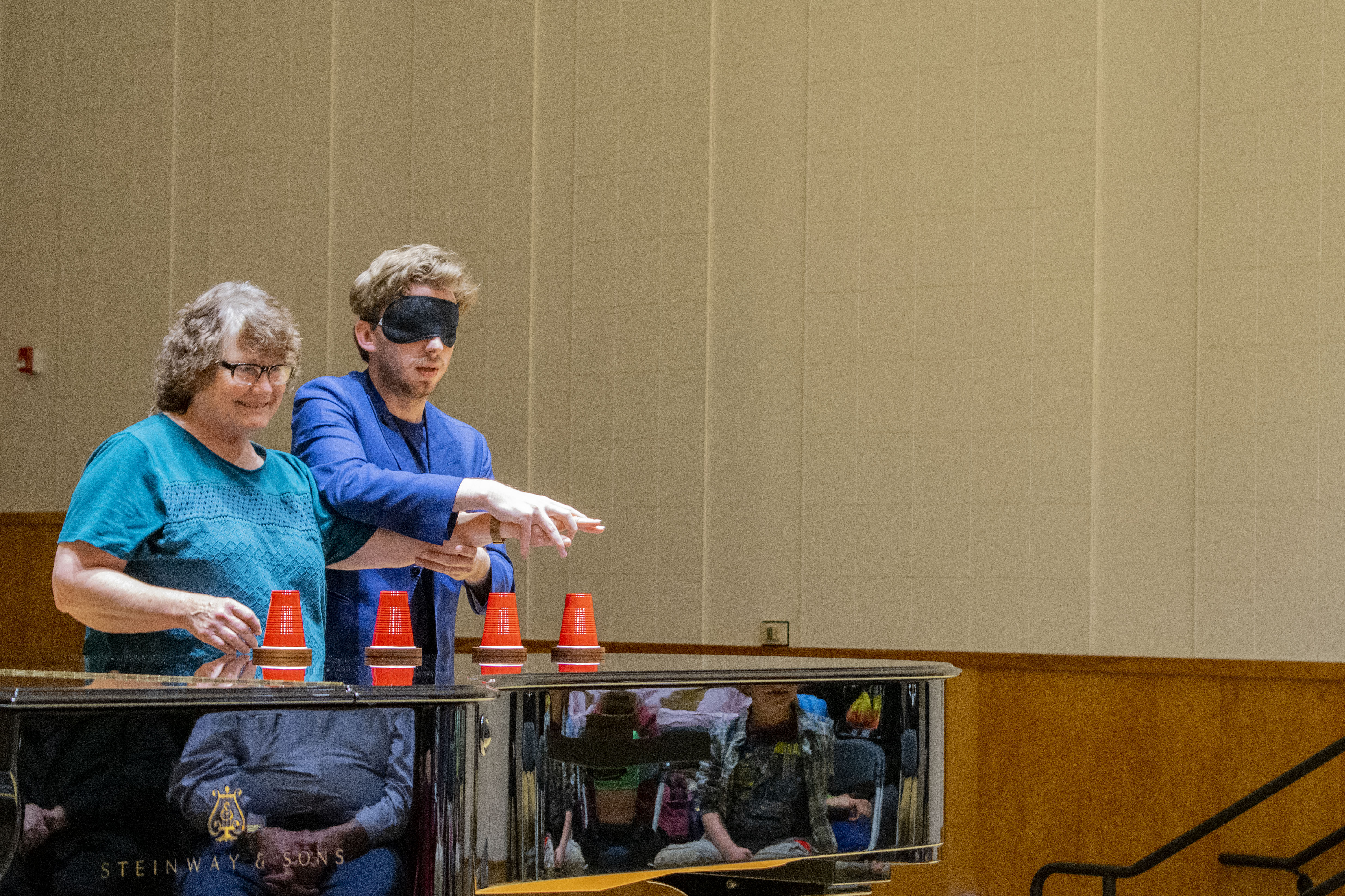
Lapinski fluctuated between musical pieces of chaos and pieces of order. He rapped on “a haunting desire to belong.” In a three card monte-style routine with red solo cups and a single metal spike, he noted the opposing potentials within people.
Hands, he said, are capable of both the sublime and the violent.
He then shrugged off the thought and smashed his and an audience member’s hands down onto the cups in a game of Russian roulette.
Multiple effects relied on the appearance and disappearance of letters—mostly written by Lapinski, with one supposedly written by his mother. The letters framed the performance in the idea of belonging, as Lapinski brought the audience along on an imaginary plane ride and read letters from home.
I have to confess, because I know a bit about magic, I’m not a good judge of it. I spent about two of my teenage years learning magic tricks. I know the basics, and I can recognize standard sleight-of-hand moves.
I’m no longer what magicians call a layperson. Even when I don’t know exactly how a trick is performed, it’s conceivable. It’s rare for me to see something inexplicable. But it does happen.
Piano-playing magician Igor Lapinski performing his routine in the Fulkerson Recital Hall at Humboldt State University Feb. 22. Lapinski combined sporadic piano playing with audience-involved illusions. | Photo by James Wilde
Any attendee of Lapinski’s show can expect to exit with a smile on their face, or at least, a warm feeling in their mind. I can deduce how Lapinski performed his effects—but several of them I can only grasp loosely. For a layperson, his performance may be miraculous, not just puzzling.
Magicians ultimately seek to produce miracles. The central argument of “Designing Miracles,” a well-regarded book by magician Darwin Ortiz, is that a magician should seek to produce an effect that doesn’t make the audience ask, “How do they do it?” Instead, the goal is, “How is that possible?”
It’s slight, but this marks the difference between a trick and a miracle. A trick is a matter of deception that can be explained by a magician’s actions. A miracle is just that: pure magic that a magician merely facilitated. In the ideal, the performance transcends trickery and becomes magic.
In the moments after Lapinski’s show, the audience agreed on his excellence.
“He’s totally amazing,” a woman behind me said.
“He’s a delight,” Mineva, the professor, said.
“He’s hilarious,” a man beside me said. “He’s great.”
At the very least, you can escape into a dream for just over 60 minutes. Lapinski finished with one last letter and one last piece by Chopin.
“And so with this piece,” he said, “I wish you all a good night.”
Making a difference in the dunes by hand, plant-by-plant
Volunteers visited the Manila Dunes in Arcata Feb. 15 to tug invasive grasses from the sands in a monthly gathering facilitated by Friends of the Dunes. The volunteers of all ages from youthful college students to gray-haired, retired locals removed beach grass to allow native plants to repopulate the dunes.
The Humboldt County Department of Health & Human Services Public Health Branch has received confirmation from the California Department of Public Health and the U.S. Centers for Disease Control and Prevention (CDC) of one case of COVID-19 in a Humboldt County resident. A close contact who has symptoms is being tested as well.
This marks the first confirmed case of the novel coronavirus in Humboldt County. Presently, the ill individuals are doing well and self-isolating at home, while being monitored for symptoms by the Public Health Communicable Disease Surveillance and Control Unit.
Close contacts of these individuals will also be quarantined at home and monitored for symptoms by Public Health staff. With the amount of foreign travel by county residents, including travel to China, it is not surprising that a case has emerged locally. Additional cases may occur either in returning travelers or their close contacts.
“It’s important to remember that the risk to the general public remains low at this time,” said Humboldt County Health Officer Dr. Teresa Frankovich. “Despite the fact that Humboldt County now has a confirmed case of COVID-19, there is no evidence to suggest that novel coronavirus is circulating in the community at large.”
Frankovich added that transmission in the U.S. to date has been among close contacts and not among the general public.
Public Health suggests the following precautions to prevent the spread of COVID-19 and all infectious diseases, including common illnesses like colds and flu:
Stay home when you are sick
If you have a fever, stay home or go home if you are already at work or school, and stay home for at least 24 hours after you no longer have a fever (without the use of fever-reducing medicine).
Wash your hands frequently and particularly before eating or drinking.
Promote good hand hygiene in your home by educating household members and making sure soap, hand sanitizers, and tissues are available.
Avoid touching your face, particularly your eyes, nose and mouth.
Encourage proper cough etiquette. Cough or sneeze into a tissue, sleeve or arm. Do not use your hands.
Perform routine surface cleaning, particularly for items which are frequently touched such as doorknobs, handles, remotes, keyboards and other commonly shared surfaces.
The county’s Communicable Disease Surveillance and Control Unit will continue to provide updated information about COVID-19 to health care providers, hospitals and schools, as well as the general public.
The county’s Communicable Disease Surveillance and Control Unit will continue to provide updated information about COVID-19 to health care providers, hospitals and schools, as well as the general public.
If you are ill and in need of medical care and have been in China within the previous two weeks or have been in contact with an individual who has COVID-19, please contact your health care provider or emergency department before presenting for care. Arrangements will be made to have you evaluated in the safest manner possible for health care staff and other patients.
Humboldt State University investigation is ongoing
Humboldt State University announced Feb. 14 it was investigating flyers posted in campus bathrooms alleging a faculty member solicited paid sex from students.
The flyers showed a series of apparent phone messages between a student and a faculty member. In the messages, the faculty member asks the student for sexual contact in return for money.
The flyers also include a demand for faculty members using positions of power to exploit students to be outed and for HSU to hire more counselors of color.
HSU confirmed on Feb. 18 it was investigating the allegations and had made progress beyond the flyers. HSU Spokesperson Grant Scott-Goforth said they could not share any further details.
“It’s under investigation and it’s a personnel issue, so there are a lot of privacy issues,” Scott-Goforth said in an email. Scott-Goforth also declined to tell the Times Standard if HSU has cancelled any classes.
Multiple anonymous student sources have confirmed to The Lumberjack that the classes of one faculty member have been cancelled and a substitute has taken over since the initial flyer investigation was announced. It’s not confirmed that these cancellations are tied to the investigation.
Title IX Coordinator David Hickcox also told the Times Standard the investigation has not been classified as a Title IX case, as no accusers have come forward.
HSU included multiple contacts for anyone with more information or for anyone who had been harmed, including the Campus Advocate Team, Counseling and Psychological Services, the Dean of Students Office, the Title IX Office and the National Sexual Assault Hotline.
Breaking down the power and importance of global funk music
A few minutes into his talk on global funk music, local DJ and Humboldt State University Communication Department Chair Maxwell Schnurer stumbled into a definition of funk.
“If you want my definition of funk, that might be it: revolutionary praxis with a desire to get down,” he said.
Schnurer’s talk on Feb. 10 flowed quickly. His enthusiasm for the tracks he played trickled into the audience of about 20 students, who nodded and laughed along. But Schnurer later gave a more serious definition.
“I find global funk to be ethical, significant and real,” he said.
Alison Holmes, associate professor and the lead of the international studies program at HSU, facilitated the event. Holmes eagerly offered context to the presentation as part of HSU’s 20th Annual International Education Week. Schnurer’s talk was just one of 45 scheduled hours of material that over 1,000 students and staff were expected to attend.
“It’s a showcase for all the global things we do in the community,” Holmes said.
“I think that funk has a certain feeling. It makes you move and it makes you dance and it makes you feel all of these different things, but if you actually listen to it, the things that are being said are of importance.”
Skye Freitas, communication major and film minor
Near the end of Schnurer’s talk, he gave the audience a take-home message. Most music artists, he said, have been historically ripped off—especially artists of color. He urged students to pay artists for their work.
“Does that make sense? That ethically, as we move forward, we try to be aware of the politics of power,” Schnurer said. “And that often times means that we are going to have to pay up for information.”
After the presentation, Skye Freitas, a communication major and film minor, said she loved Schnurer’s presentation—Schnurer is her adviser—and gave a surprisingly passionate explanation of the importance of music.
“I think that funk has a certain feeling,” Freitas said. “It makes you move and it makes you dance and it makes you feel all of these different things, but if you actually listen to it, the things that are being said are of importance.”
Schnurer skipped across the globe with audio clips to give the audience a taste of different funk styles. The first stop: Nigeria and Afrobeat pioneer Fela Kuti’s song, “Pansa Pansa.”
“He hexes and challenges the Nigerian government at this level while being—literally at various points—a revolutionary and also a candidate for president of Nigeria,” Schnurer said.
“Honestly, this could be like an hour-long, three-unit course.”
Maxwell Schnurer, local DJ and communication department chair
The next stop on the funky foray was Brazil and the music of Tim Maia. In describing the Brazilian funk scene, Schnurer explained the underground spiritual game—or the use of funk music by artists to express their spiritual selves.
Schnurer called Maia’s album perhaps the greatest Brazilian funk album ever, but only after noting its joint inspirations of a heavy dose of LSD and a cult pamphlet.
“You know, those things I would maybe not be inspired by or take away from the Tim Maia story,” he said.
Schnurer flew the room to Japan to meet Haruko Kuwana, and then to India with a soundtrack from a compilation album, Pysch Funk Sa-Re-Ga! Schnurer said many funk tracks remain hidden as instrumental movie soundtracks. He finished with a short profile video on El Rego, a funk artist from Benin in West Africa.
Schnurer paused midway through the talk.
“Honestly, this could be like an hour-long, three-unit course,” he said. “If I were to criticize my own lecture I would say that there is something kind of disrespectful about name-dropping dozens of interesting global musicians without giving them all musical space.”
Rachael Thacker, another communication major, hadn’t taken any classes with Schnurer, but admitted she would attend just about anything he does for his interesting takes. Thacker knew little about funk.
“Just my first impression was that you can groove to it, you can dance to it and you can relax to it,” she said.
Thacker planned to ask Amazon’s Alexa to play some funk later.
A hand sprang up when the talk ended.
“Will you teach a class on this?” a student asked.
The group chuckled and Schnurer hemmed and hawed. He wasn’t sure.
While he pondered making a class out of the talk, Schnurer left the audience with an appropriately funky anecdote.
“Let me encourage that maybe it’s time to buy the like Thai funk box set for your brother for Christmas from Mike in the attic,” he said.
The Humboldt State University budget proposal is under overview from President Jackson
What?
The University Resources Planning Committee of Humboldt State University submitted its budget proposal to HSU President Tom Jackson on Dec. 23, 2019. The URPC spent last semester meeting each week to form a new budget to address a projected $5.4 million budget deficit for the next three fiscal years.
The proposal includes $2,500,000 of cuts from instruction, $720,000 of cuts from academic support, $420,000 from student services, $1,070,000 from institutional support and $690,000 from operations and maintenance of plant.
The total cuts amount to 4.4% of the total budget. The cuts would equal 4.4% of the instruction, academic support and operations and maintenance of plant budgets, 3.5% of the student services budget and 4.9% of the institutional support budget. The proposal must be approved by Jackson to come into effect.
When?
The URPC discussed the proposal in the University Senate Jan. 28, and will discuss it again Feb. 11., according to URPC Co-Chair James Woglom.
Why?
The budget deficit stems from HSU’s enrollment decline. Less tuition makes for a smaller budget. When Woglom spoke with The Lumberjack previously, he noted that the URPC has designed a scalable budget model, or a budget that allows HSU to be more flexible with its money as the University’s priorities change. Despite the cuts, Woglom assured The Lumberjack that the URPC was seeking to limit any negative impacts on students’ education. Thus far, HSU has publicly announced plans to phase out employees only through attrition, or not rehiring select employees, rather than outright cutting positions.
The coronavirus continues to spread across the globe
What is it?
A new coronavirus strain has afflicted over 20,000 people across the globe, according to data from Johns Hopkins University. A coronavirus is a type of virus found in mammals and birds. Most coronaviruses are mild, but certain strains can be severe and potentially fatal. Previous notable strains include SARS (severe acute respiratory syndrome) and MERS (Middle East respiratory syndrome).
The new strain, scientifically called 2019-nCoV, has symptoms including fever, cough and shortness of breath. As of Feb. 4, over 400 people have died from the virus in China, with one reported death in the Philippines and one reported death in Hong Kong.
Where is it?
The virus strain began in Wuhan in China’s Hubei province. Eleven people have been confirmed with the coronavirus in the United States, with hundreds being screened. A case has been confirmed in the Bay Area, but no cases are known in Humboldt County.
Should I be concerned?
Thus far, those who have died from the disease have had other illnesses that limited their immune system, according to the World Health Organization. The disease is mainly spread through coughing or sneezing. The virus can cause pneumonia.
The United States State Department raised the threat level of the virus to level four, the highest level, on Jan. 31, meaning that travel to China is no longer advised. Many airlines have since canceled or reduced flights to China.
The World Health Organization determined coronavirus to be a Public Health Emergency of International Concern on Jan. 30. The virus has spread to at least 27 countries.
According to a report by The Guardian, the current estimated mortality rate for the coronavirus is around 2% (though this is likely high, as many people without severe symptoms may not have gone to hospitals). Seasonal flus typically have around 1% mortality rates, while SARS has a mortality rate of 10%. Given current evidence, panic doesn’t appear warranted.
Several administrative changes at HSU suggest high turnover
In the last three months, three Humboldt State University administrators jumped ship. A game of musical chairs has since taken place as staff have shuffled around to fill the gaps.
Since November, HSU has appointed a new interim provost, interim college dean, Title IX coordinator, Student Health Center director and Human Resources staff recruitment manager.
While it’s unclear how the changes will affect HSU, the shifts appear in line with data suggesting high turnover rates among college administrators.
The changes began in November, when Provost and Vice President for Academic Affairs Alex Enyedi left HSU to become the 11th president of the State University of New York, Plattsburgh.
Enyedi served as HSU’s provost and vice president of academic affairs since 2015 after leaving Western Michigan University, where he served as a biology professor and dean of the College of Arts and Sciences.
Enyedi left WMU amid controversy as his contract expired despite a petition of support with 1,300 signatures, according to reporting from the North Coast Journal. Enyedi said he believed his contract was not renewed due to his requests for raises for female college employees. WMU pointed to enrollment declines and budget adjustments—familiar phrases for HSU—as the cause of his departure.
“The turnover rate for deans or directors of education topped the list at 22%, while the rate for provosts sat second-highest, at 21%, according to the analysis. Presidents or chancellors came in third, at 18%.”
Data from Higher Education Publications
HSU announced Dean of the College of the Arts, Humanities and Social Sciences Lisa Bond-Maupin as interim provost on Nov. 26. While Bond-Maupin serves, HSU said it would search for the next provost.
“There will be a national search for a new Provost, with opportunity for input and participation from individuals across campus,” the Nov. 26 announcement said. “Details of the search plan will be shared when they are finalized.”
HSU then appointed Spanish Professor Rosamel Benavides-Garb to take Bond-Maupin’s place. Benavides-Garb previously served as associate dean of CAHSS and chair of the World Languages and Cultures program.
On the same day as the Enyedi announcement, Nov. 20, HSU announced Executive Director of Student Health and Wellbeing Services Dr. Brian Mistler had resigned and taken the job as Chief Operating Officer of Resolution Care in Eureka.
In Mistler’s place, Associate Vice President of Student Success Stephen St. Onge now leads the Student Health Center alongside Dr. Karen Selin and Dr. Jen Sanford. The Nov. 20 press release noted that the plans for the future of the SHC’s leadership would be revealed in January. In the meantime, the release made a promise to students.
“In honoring HSU’s commitment to our students, we are looking into opportunities to expand hours and services for students starting the Spring 2020 semester,” the release said.
“Marcus has been an invaluable team member and has served HSU, with his many years of experience, during a time of great change and uncertainty for Title IX departments across the country,” the release said.
Taking Winder’s place is Human Resources Staff Recruitment Manager David Hickcox. Hickcox worked for HR and as an investigation officer for the Title IX Office for the last two and a half years, according to the release.
Recruitment Manager Nicole Log, who, according to the release, has served HSU for five and a half years in the HR department, then took Hickcox’s place.
Finally, Interim Director of Academic Resources Holly Martel got to remove the “interim” from her title on Nov. 18. Martel, who served as the interim director since 2017, has worked at HSU for 24 years in a variety of roles, from financial planning to personnel management.
According to 2016 data from Higher Education Publications, a company that publishes college data in its online Higher Education Directory, college administrators experience high rates of turnover compared to other administrators.
The turnover rate for deans or directors of education topped the list at 22%, while the rate for provosts sat second-highest, at 21%, according to the analysis. Presidents or chancellors came in third, at 18%.
A summary of the analysis gave a variety of possible causes for the high rates.
“When compared to other administrators, the cause for such high-level turnover can be linked to many diverse issues such as growing financial, faculty, Board and political pressures,” the summary said. “Also, traditionally colleges and universities have made leadership selections from within, minimizing risk.”
However, the analysis did not list the administrative turnover rates with which it compared college administrative turnover rates. The Lumberjack has reached out to Higher Education Publications and will update this story online when we receive a response.
The Lumberjack has also reached out to HSU for comment. We received word that HSU Associate Vice President of Human Resources David Montoya and his team are gathering turnover data and will have a comment at a further date. We will update this story online when we receive said comment.
An HSU memo sent out Jan. 21 revealed results from a spring 2019 Great Colleges to Work For survey conducted at HSU. The national survey, intended to inform institutions about workplace culture, sheds some light on the status of the HSU administrative staff.
Across 15 categories, the HSU results came back most positive in the job satisfaction, compensation, pride and supervisors or department chairs categories. The results came back most negative in the senior leadership, policies and faculty, administration and staff relations categories.
HSU will hold two presentations in Goodwin Forum, one on Jan. 24 and one on Feb. 4, to further discuss the findings with faculty and staff, according to the memo.
Humboldt State has no direct input on chancellor search committees
No one from Humboldt State University sits on the search or advisory committees for the next CSU chancellor, and the closest forum to give feedback to the committee is in Sacramento.
“It’s roughly a dozen people on these committees combined, and unfortunately,” CSU Senior Director of Public Affairs Mike Uhlenkamp said. “Unfortunately we’re not able to get that far north because of the travel considerations.”
The CSU Board of Trustees has appointed a search committee and an advisory committee to select the next chancellor. The search committee includes the Board of Trustees Chairman Adam Day, the vice-chair, current CSU Chancellor Timothy White and eight other trustees.
The stakeholder committee includes two CSU faculty representatives, a staff representative, a student representative, an alumni representative and two campus president representatives. These representatives hail from Sonoma State, San Francisco State, CSU Sacramento, San Diego State, CSU San Marcos, California Polytechnic San Luis Obispo and Cal Poly Pomona.
“There isn’t currently anyone from HSU on those committees,” HSU Communications Specialist Grant Scott-Goforth wrote in an email.
According to CSU data, graduation rates are currently at all-time highs. Four-year graduation rates for first-time college students have risen from 19% in 2015 to 27% in 2019, and six-year graduation rates have risen from 57% in 2015 to 62% in 2019.
The two committees are currently undergoing what they are calling a “listening tour” to gather feedback for the search process.
“It’s a fairly tight group and so they went with, for all intents and purposes, the leaders from those groups,” Uhlenkamp said.
Four public forums at Sacramento State, CSU East Bay, the Chancellor’s Office and Cal Poly Pomona were held on Nov. 12, 13, 20 and 22, respectively. Two more public forums were held on Dec. 3 and 5 at CSU San Marcos and Fresno State.
All of the forums can be streamed or viewed online, where you can also submit feedback.
“We are 23 campuses, one university,” Uhlenkamp said. “So we’re looking for everyone to provide some sort of feedback. And everyone’s going to have different forms of feedback, and one of the great things about the University is that we’re so diverse and so different.”
White announced his plan to retire on Oct. 22. He has served as chancellor since 2012 and will remain chancellor until the end of the 2019-2020 academic year.
White, a first-generation Argentinian-American, most notably launched in 2015 the Graduation Initiative 2025, a CSU-wide push to increase graduation rates.
According to CSU data, graduation rates are currently at all-time highs. Four-year graduation rates for first-time college students have risen from 19% in 2015 to 27% in 2019, and six-year graduation rates have risen from 57% in 2015 to 62% in 2019.
“The Board of Trustees is very pleased with the current direction of the University,” Uhlenkamp said. “And by direction, I refer to the fact that enrollment is close to an all-time high, graduation rates are at all-time highs, the funding from the state of California is at an all-time high. The dollars that we receive from donors is also at an all-time high—so it’s effectively a golden age of being a CSU student. So they want to maintain that trajectory.”
Uhlenkamp said the committees will take the feedback they receive over the next two months to make a position description and then use that to gather a pool of candidates. Following multiple rounds of interviews, the committees will choose a group of finalists to be interviewed by the full 25-person Board of Trustees.
“More than using students as photo opportunities, we need a Chancellor who will do whatever it takes to secure what students need to succeed.”
Uhlenkamp said the committees want someone who can maintain the current CSU trajectory while also bringing their own vision. As for the longevity of the next chancellor, Uhlenkamp said current higher education leaders tend to serve for shorter lengths than in the past.
“While, yes, we do want to have consistency, I don’t think that there is a specific number put on how long they want this individual to serve for,” Uhlenkamp said.
On Nov. 20, the California Faculty Association wrote an open letter to the CSU Board of Trustees detailing its desires for the next chancellor.
The letter began by asking for a chancellor dedicated to student success.
“More than using students as photo opportunities, we need a Chancellor who will do whatever it takes to secure what students need to succeed,” the letter said. “Knowing that success means more than four-year graduation rates, our new Chancellor should be committed to helping students follow their own paths unfettered.”
The letter went on to call out the lack of labor representation in the stakeholder committee, calling it “a serious oversight.”
“We need a leader who will change the toxic culture of disrespect for labor at the CSU, and value the work of all employees who serve the system,” the letter said.
The letter ended with a request for an open search process allowing participation.
“We look forward to working with a new Chancellor who will partner with us in these efforts,” the letter concluded.
The committees expect to select the next chancellor by summer 2020.
Supreme Court set to determine future of over 700,000 people
The Supreme Court of the United States heard oral arguments on Nov. 12 that will determine the future of more than 700,000 immigrants brought to the United States by their parents as children.
The Court’s decision isn’t expected until sometime next year, possibly as early January or as late as the summer. The majority decision will likely depend on Chief Justice John Roberts’ decision, as the remaining four liberal justices and four conservative justices are expected to vote in support of and in opposition to DACA, respectively.
Eighty minutes of oral arguments sustained a packed courtroom on the legality of the rescission of the Deferred Action for Childhood Arrivals policy. Three to four million immigrants that live in the United States arrived illegally as children. DACA protects about 700,000 of those immigrants from deportation and makes them eligible for work permits.
The DACA program, which requires that recipients renew their status every two years, is currently only accepting renewals, not new applications.
Seiri Aragon, a 27-year-old DACA recipient, advises first generation, low-income students for Academic Talent Search at Sonoma State University. Aragon, who was born in Oaxaca de Juárez, México and came to the United States in 1997 at age five, said in a phone interview that she has no choice but to pay close attention to the news surrounding DACA.
“It’s kind of hard not to pay attention,” Aragon said. “Because it’s a real, big part of my life, and so anything that could jeopardize my life here definitely should be of some importance to me.”
Seiri Aragon’s first grade school photo. After Aragon moved to the U.S., she began her first grade year in Petaluma, Calif.
Seiri Aragon, a 27-year-old DACA recipient moved to the United States at five-years-old. | Photo by Deija Zavala
Aragon went to high school in Petaluma before completing undergraduate programs at Santa Rosa Junior College and SSU. She then went to the University of Texas to complete a master’s program.
Aragon signed up for DACA when it first came to be in 2012. While Aragon has doubts about the logistics of how a mass deportation could take place in the event of DACA’s rescission, she acknowledges that individual DACA recipients could easily be targeted and deported.
“For a really long time I thought that because we were kids, we would be given a chance,” Aragon said. “But I feel like both Republicans and Democrats in government pretty much just use students like me, kids like me or folks like me as pawns in their political game. As soon as you realize that, you just get so discouraged that at some point you’re just like, ‘Well, if they want to throw me out, they’ll throw me out.’”
Solicitor General Noel Francisco argued in support of DACA’s rescission in the courtroom. Francisco said DACA “maintained in perpetuity a program that actively facilitated violations of the law by hundreds of thousands of individuals.”
“For a really long time I thought that because we were kids, we would be given a chance.”
Seiri Aragon
Francisco suggested that an executive action ordering the government not to enforce the law had questionable legality. Francisco also reminded the Court that DACA was never intended to be permanent.
“DACA was always meant to be a temporary stopgap measure that could be rescinded at any time, which is why it was only granted in two-year increments,” Francisco said. “So I don’t think anybody could have reasonably assumed that DACA was going to remain in effect in perpetuity.”
Francisco argued that a ruling on DACA’s actual legality would be unnecessary. Instead, Francisco believed that President Donald Trump’s attempted rescission of DACA in 2017 was legal and should be allowed to go forward—thus eliminating any need to rule on DACA itself.
Attorney Theodore Olson argued against the rescission of DACA. Olson said such an impactful rescission necessitated a review by the Court.
“The decision overturned a five-year enforcement policy of deferred action that had enabled DACA recipients under other unchallenged laws and regulations to apply for employment authorization, seek driver’s licenses and other benefits,” Olson said.
While Justice Neil Gorusch acknowledged what he called “sympathetic facts,” Gorsuch and Justice Brett Kavanaugh questioned Olson’s stance.
“What’s the legal limiting principle you’d have this Court adopt?” Gorsuch asked.
Olson returned to his initial point on the significance of DACA.
“All we’re saying is that it should be subject to review in the context of the big picture,” Olson said.
When asked if Olson believed that the executive had the power to rescind DACA, Olson said “yes.” Thus, Olson’s argument rested on doubts of the explanation behind the rescission.
President Barack Obama put DACA in place in 2012 as an executive action after Congress failed to pass the Development, Relief and Education for Alien Minors Act. The DREAM Act offered a path to citizenship for some immigrants brought to the United States as children.
With DACA, Obama intended to give Congress time to come up with permanent immigration legislation. No such legislation has come to fruition, and in 2017, President Donald Trump attempted to rescind DACA.
The Trump administration has called DACA illegal and unconstitutional, but lower courts have disagreed. In June, the Supreme Court agreed to hear the case to determine if the rescission of DACA was legal.
About 11 million total undocumented immigrants lived in the United States in 2017, according to the Pew Research Center, and about 100 undocumented students currently attend Humboldt State University, according to an August press release.
HSU released a statement Nov. 21 detailing its commitment to DACA and undocumented students. The release noted HSU’s resources available for undocumented students, including a clinic scheduled for Dec. 6 and 7 in which the Coalition for Humane Immigrant Rights will cover the DACA renewal fee for the first 20 renewals.
“We would like to firmly reassert our commitment to being an inclusive campus which provides access and support for all students, staff, and faculty members within our HSU community,” the release said.
The future for DACA recipients if the policy is rescinded is uncertain. The Department of Homeland Security website has a list of frequently asked questions regarding DACA’s rescission.
“Current law does not grant any legal status for the class of individuals who are current recipients of DACA,” the site says. “Recipients of DACA are currently unlawfully present in the U.S. with their removal deferred. When their period of deferred action expires or is terminated, their removal will no longer be deferred and they will no longer be eligible for lawful employment.”
The site says that once a DACA recipient’s status expires, their case will not be “proactively” provided to Immigrations and Customs Enforcement unless they receive a notice to appear in immigrations court. According to the site, this policy may change at any time without notice.
In an analysis conducted following Trump’s move to rescind DACA in 2017, the bipartisan political organization FWD.us estimated that removing DACA recipients from the workforce would cost $460 billion in gross domestic product over a decade.
When asked what she will do if DACA gets rescinded, Aragon paused.
“I don’t know,” Aragon said. “I really don’t know. I’m just looking out for allies at this point.”
Aragon said that while having DACA is a privilege compared to other undocumented immigrants, she, like Olson, pointed out that a large part of the program is providing basic citizen privileges like being able to file taxes or apply for driver’s licenses.
“The privilege is to bring equity to essentially what we are, which is American,” Aragon said.
For the next few months, DACA recipients across the United States, including Aragon, will await the word of the nine justices. Aragon said she hopes for DACA’s reinstatement, at the very least.
“I feel like I’m asking for crumbs,” Aragon said. “Because at this point, I’m so disappointed that I’m like, ‘Can you just, one, not take away the program, and two, maybe reopen it to people who qualify?’ That’s it, that’s all I want.”
Only four students attended the first University Resources and Planning Committee’s public budget forum, according to Associated Students President Yadira Cruz.
Around 50 faculty, staff and community members were in attendance as well, according to Art Education Assistant Professor and URPC Co-Chair James Woglom.
Woglom said the URPC’s presentation, which can be found online at budget.humboldt.edu, focused on the URPC’s work toward creating a scalable budget model, or a budget that can be altered periodically to represent changing values.
“It ends up bringing more people into the process of decision-making, and thus hopefully reflecting more people’s feeling of what we want this organism to do,” Woglom said of the URPC’s new model.
James Woglom, art education assistant professor and University Resources and Planning Committee co-chair, checking his laptop in the Humboldt State Univeristy library on Nov. 14. Woglom said the URPC has created a new scalable budget model that allows for more flexibilty and input from the HSU community. | Photo by James Wilde
URPC has been meeting over the course of the semester to form a three-year budget for Humboldt State. Woglom said the first step for deciding where to allocate funds is to clarify which values HSU should prioritize.
Besides the forum, the URPC is taking feedback online through an online submission form, a Google survey designed to scale which campus values are most important and a pie chart budget simulator that allows proposals of how HSU should divide funds. Woglom said he’d also be happy to take suggestions through direct emails.
While Cruz said she appreciated the existence of the online feedback forms, she said they can be obscure due to budgetary jargon.
“Although it’s available, it might not be accessible in that way,” Cruz said.
The Google survey, which is not yet released, lists a series of California State University values and asks the respondent to rate how much they agree with each one.
“It’s not saying that we want to devalue any of them, but it’s trying to get a quantitative sense of where the University’s priorities are in terms of allocation of resources based across a series of ideas,” Woglom said. “And then hopefully with that quantification we can make decisions based on where we can make things happen.”
The URPC’s current projections show a $5.4 million budget gap by the 2021-2022 school year, which reflects the impact of reduced tuition due to declining enrollment. According to the presentation, every 100 students generate about $560,000 in tuition.
The University Resources and Planning Committee pointed to declining tuition numbers as the cause of HSU’s current projected $5.4 million budget gap.
Joseph Reed, a political science and economics double major and a student representative on the URPC, said the key challenge has been ramping down the budget with the declining student body.
“It’s kind of been hard to keep this budget for about 8,000 students when we don’t have 8,000 students anymore,” Reed said.
Cruz said the budget should focus on the students HSU has now, and not the students it had in the past.
“Being in that cutting mindset is potentially jarring for morale. I mean, you’re coming from a space where you’re like, ‘Alright, what do we have to not do this year?’”
James Woglom
“I think every campus goes through these sorts of financial challenges, but I think how we move forward is centering students,” Cruz said.
Reed said the URPC has no plans to cut whole departments. Instead, Reed said cuts are more likely to be smaller and broader across the board.
“Every department is being affected, but each one has its own budget, so each one has its own certain amount that it’s being reduced by,” Reed said.
Over the past three years, URPC reduced the budget by $11.5 million. However, Woglom emphasized a difference between past and future cuts due to the new scalable budget model.
“[In the past] we’ve cut what we’ve determined to be at the fringe of the project of the University—so maybe not in direct agreement with the strategic plan of the University or the general values of the University,” Woglom said. “Being in that cutting mindset is potentially jarring for morale. I mean, you’re coming from a space where you’re like, ‘Alright, what do we have to not do this year?’”
The University Resources and Planning Committee showed three possible enrollment and budget scenarios in its Nov. 7 public forum presentation.
With the new model, Woglom said HSU can start with a specific budget number and then distribute it to the things HSU values most. Woglom said the budget can be continually changed, which allows HSU to scale back up or down if monetary realities change.
“We don’t want to make hurried and necessary decisions every year,” Woglom said.
The URPC uses Financial Information Reporting Management System codes, which are used in higher education to categorize expenses by their function, to compare HSU’s spending to other CSUs.
FIRMS codes break down HSU’s spending into five categories: instruction ($56.6 million in the current budget), institutional support ($21.6 million), operations and maintenance of plant ($16.3 million), academic support ($15.6 million) and student services ($12 million). Each of these categories represent a FIRMS program, and the budget determines what percent of the total amount of funding goes to each category.
Using these categories, the URPC also compares HSU’s spending to other CSUs. According to the presentation, spending at HSU in comparison to similar-sized campuses for the 2017-2018 school year was 17% higher at HSU for instruction, 24% higher for academic support, 3% higher for student services, 10% higher for institutional support and 1% higher for operations and maintenance of plant.
The presentation also showed three possible scenarios for the future of enrollment and its effects on the budget. The best case scenario, called the growth scenario, shows a leveling off of the enrollment decline and a budget gap in the $4 million range by the 2021-2022 school year.
The current scenario, upon which URPC’s projections are based, shows a continued decline that leads to the budget gap of $5.4 million. The worst-case scenario shows further decline and a budget gap of up to $7 million by the 2021-2022 school year.
The URPC’s current budget plans are based on the middle scenario of a $5.4 million gap.
Woglom said the URPC still has to figure out how to allocate its funding to keep current programs intact.
Budget projections from the University Resources and Planning Committee’s Nov. 7 public forum presentation show a $5.4 million budget gap by the 2021-2022 school year.
“It raises interesting questions about where you can move within that,” Woglom said.
Just one day after the URPC’s public forum, HSU released a campus announcement detailing the process for filling staff vacancies during the current enrollment decline and budget deficit. The announcement said that while current staff positions will not be eliminated, positions deemed “non-critical” by the vice president of the relevant division won’t be backfilled when a person leaves that position.
Woglom confirmed that announcement.
“The intention of the University at this point is to work to determine where attrition will happen and backfill positions in that manner,” Woglom said.
This backfiring process does not apply to faculty, according to the announcement.
The URPC’s next and final public forum is scheduled for Dec. 3 at 11:30 a.m. in the Goodwin Forum, during which the public can review the URPC’s draft plan before it is sent to the University president for review. Woglom urges everyone to give their input.
“Any ideas that people have that they’d like to share with us, the better our decision-making process can be,” Woglom said.
“I think [student input is] a challenge in itself,” Cruz said. “But I think that just because it’s challenging doesn’t mean it shouldn’t be pursued.”
Yadira Cruz
Reed and Cruz said they don’t think two public forums are enough to gather sufficient student input.
“I think overall we should be making a stronger effort to connect with students and get their overall opinions,” Reed said.
Reed suggested that the URPC should seek to get input not just from some students, but from the majority of students. Cruz agreed.
“I think that’s a challenge in itself,” Cruz said. “But I think that just because it’s challenging doesn’t mean it shouldn’t be pursued.”
HSU’s Dining Services employees don’t receive a free meal while on shift
While many food service employees receive heavily discounted meals or one free meal per shift, dining services student employees at Humboldt State University get the same meal discounts as anyone who pays with J-points: 25% off.
Abigail Rosales, junior communications major and a floor manager at The Depot, said employees frequently complain about the minimal discount.
“It would be nice to know that our job and our work is valued,” Rosales said. “Because if we’re just getting the same discount as people who already live on campus, then there’s not really an incentive food-wise. Obviously we’re getting paid, but it’s always a nice bonus if you get any benefits while working here.”
Rosales previously worked at the fast-casual restaurant chain, The Habit Burger Grill. Employees received a free burger and fries every shift, and got 50% off everything else.
Rosales said a free or more discounted meal per shift would likely make for a better workplace.
“I think if we did get that, a lot of us would be a little less grumpy,” Rosales said. “Because sometimes we’re tired or hungry, and sometimes we just don’t have money on us, so we get irritated.”
Abigail Rosales, a junior communications major, standing in The Depot at Humboldt State University on Nov. 8. Rosales, a floor manager at The Depot, said student dining employees often feel irritated with the lack of an extra discount, but never feel like they can do anything about it.
William Weinberg, a forestry senior and College of Natural Resources representative and vice chair, said over the phone that he’d be interested in seeing HSU try a pilot program giving free meals to student employees.
“I think it would be cool if it did happen, or if they ran a pilot to see if it would work,” Weinberg said. “Would the costs of that free meal maybe make up for more work ethic, more happier workers?”
Rosales said many student employees bring their own food or have to clock out from work early to go home and eat before their next class to avoid paying for a meal. But according to Rosales, even a cheap meal would be helpful.
“Even just like the fries and a corn dog,” Rosales said. “I think those are the two cheapest things. If we just get that, that’ll probably be enough for a lot of people.”
Director of Dining Services Ron Rudebock pointed to money as the primary issue behind the lack of an extra discount for student employees.
Rudebock, who has been the director of dining services for 15 years, said declining enrollment has reduced dining services income, while increases in minimum wage and insurance prices, alongside efforts to provide more organic and local food options, have increased costs.
“It’s unfortunate, because we’re trying to keep our food costs lower while our costs are going up,” Rudebock said. “So how do you balance those two?”
Dining services at HSU are not run by the university, but instead by the University Center. The UC is a nonprofit auxiliary corporation that works with HSU, but is not owned or operated by the school. The UC operates on-campus entities like dining services, the library, Center Arts and Center Activities.
While student fees provide money for some of the services, Rudebock said dining services runs entirely on the income from student food purchases.
In fact, Rudebock said dining services has to pay HSU rent for their facilities along with utilities, garbage, internet and so on.
“It’s a separate business,” Rudebock said. “And we actually pay the university money.”
All California State University Dining Services are run by auxiliary corporations, according to CSU Public Affairs Manager Hazel Kelly. We have reached out to all CSUs to determine which CSU dining services provide free meals to student employees.
Thus far, only five CSU’s have responded.
Student employees at CSU Bakersfield and CSU Monterey receive free meals during shifts, and according to a representative for Sonoma State, SSU student employees get free meals for shifts longer than four hours and free snacks for shifts shorter than that. San Francisco State gives its student employees a free meal if they work a shift longer than five hours, and CSU Chico gives students meals for $2.50 for shifts longer than four hours. In addition, Chico gives student employees 10% off all food items purchased on campus.
Director of Dining Services Ron Rudebock in his office on Nov. 8. Rudebock said dining services has hit tough times lately due to declining enrollment and increased expenses. | Photo by James Wilde
Any profit that dining services makes goes back into its operations, according to Rudebock. Rudebock pointed to The J’s more than 25-year-old dishwasher as one example of an upcoming expense. Rudebock said the dishwasher will cost around $250,000 to get replaced.
“We need the reserves to be able to pay for everything so we can stay in business,” Rudebock said. “But we don’t have a set of stockholders. We don’t have—you know, like a corporation has a set of stockholders that have got to make money. We don’t have a magic investor.”
Rudebock said the UC lost around $100,000 in each of the last two power outages, during which The J offered free meals to students, faculty and staff. Rudebock said HSU may only partially reimburse dining services for those costs.
In regard to free meals, Rudebock said that dining services doesn’t have any plans to provide a larger discount for student employees. However, Rudebock said the issue is not off the table. HSU could suggest larger discounts for student employees to the UC, and while the UC does not have to follow HSU’s suggestions, Rudebock said it wants to work with the university.
“We need the reserves to be able to pay for everything so we can stay in business. But we don’t have a set of stockholders. We don’t have—you know, like a corporation has a set of stockholders that have got to make money. We don’t have a magic investor.”
Ron Rudebock
HSU Director of News and Information Aileen Yoo said via email that HSU hasn’t suggested the UC adopt free meals due to the impacts it could have on prices.
“We understand that offering free or more heavily discounted meals for student employees would be a financial burden for the UC and likely mean a price increase for all HSU students who may not necessarily have the means to cover those additional expenses,” Yoo said.
At the moment, HSU dining services employs about 350 students and 26 full-time employees, which, according to Rudebock, is the highest proportion of students to full-time employees in the CSU system.
Aileen Dominguez, a senior political science major who works as a student assistant at The Depot, said she sometimes wishes there were more full-time employees because when she started the position she felt she was never properly trained.
“I was just kind of put in with my coworkers who actually just said, ‘Oh, this is what we do, or this is how we do it—or this is how the girl before taught me how to do it,’” Dominguez said.
Dominguez said this has led to confusion and she’s not always sure how to train new employees.
Aileen Dominguez, a political science senior, studying in the library on Nov. 10. Dominguez works as a student assistant at The Depot. Dominguez suggested that a bigger discount for dining service employees might increase sales. | Photo by James Wilde
“I’ll say, ‘This is what you do, I think. At least, this is how I’ve seen the other girls do it,’” Dominguez said.
As for meal discounts, Dominguez echoed Rosales.
“I think we all talk about it,” Dominguez said. “But they probably don’t have enough money to feed us all.”
Dominguez said she only eats at The Depot when she has to—typically on Thursdays, when she is on campus all day. She said that employees frequently go to Oh Snap or elsewhere instead of buying food on campus.
Dominguez suggested that a larger discount might actually help bring in more business, but she doubts that one will be offered.
“I just feel it’s unfair that we kind of have to choose,” Dominguez said. “Like, ‘I don’t want to eat this right now, because I have to buy other things,’ or say, ‘I’m just gonna go eat a cup of noodles at home because this burrito isn’t worth it.’”
Rosales made a similar statement.
“On our end, we kind of pick and choose if we want to pay for something,” Rosales said. “If we’re really that hungry to pay for it or if we’ll just deal with it and not.”
This story will be updated if and when other responses for comments are received.
Some areas of Humboldt County still don’t have power, however power will potentially be restored by tonight
UPDATE 10/29/19 5:25 p.m. : According to the Humboldt County Office of Emergency Services alerts, “PG&E has advised that Humboldt County is no longer in teh scope for a Public Safety Power Shutoff tonight and power will remain on.”
They also said at this time the National Weather Service does not see more weather patterns that would cause another PSPS event in the near future.
UPDATE 10/29/19 4:24 p.m. : PG&E has now stated Humboldt County will be affected by a third power outage on Oct. 29 at 7 p.m. rather than the previously reported 9 p.m.
UPDATE 10/2/19 10:00 p.m. : According to a PG&E press release Humboldt county is expected to lose power on Oct. 29 at 9 p.m. This is the most current information as of Oct. 28 at 10 p.m.
Pacific Gas and Electric Company announced in a press release they will shut power off for a third PSPS event scheduled for Oct. 29.
The utility said the next weather event responsible for the third PSPS may begin Tuesday at 6 a.m. According to the Humboldt Office of Emergency Services, power will likely be turned off before that time, although the exact time of the shutoff remains unclear.
The third PSPS event is expected to last until the afternoon of Wednesday, Oct. 30.
Power was restored at Humboldt State University mid-morning Monday, but the campus remains closed through the duration of Tuesday. There is no update for Wednesday classes as of 5:20 p.m.
PG&E has reported it could take up to 48 hours to assess the damage from the Oct. 26 PSPS, but said it is attempting to restore power to customers before the next shutoff. According to the utility company, it is possible not all customers will have their power restored before it goes off again.
Amidst the shutoff, the Student Recreation Center is open temporarily till midnight. HSU is inviting students, staff, faculty and their families to eat for free at the J until campus reopens. Parking permits are not required during the shutdown.
This story is ongoing and timing is subject to change due to changing weather patterns.
Largest intentional blackout in California history keeps millions without power while the state burns
Over two million people across Northern California were without power on Sunday. Pacific Gas & Electric is working to restore power, but the company has scheduled another Public Power Safety Shutoff, this time for Tuesday morning.
Despite the shutoffs, fires are burning across the state. The Kincade Fire, a 66,000 acre fire in northern Sonoma County, was only 5% contained as of Monday at 3 p.m. Located just northwest of Santa Rosa, the Kincade Fire has forced more than 180,000 people to evacuate, including the towns of Windsor and Healdsburg.
There are no casualties or missing persons reported as of yet, but 80,000 structures are at risk. Firefighters from as far south as Pasadena and as far north as Oregon have reported to the scene to try and stop the fire from pushing west across Highway 101.
PG&E’s shutoff is an unprecedented intentional blackout, and is the largest intentional blackout in history, according to theLos Angeles Times. The utility’s goal is to prevent high winds—which have reached upwards of 100 miles per hour in some parts of Sonoma County—from sparking wildfires.
In a PG&E press conference on Saturday, CEO and President of the utility company—but not the entire corporation—Andy Vesey said the company’s goal is safety.
“Right now we have a big, historic event coming at us,” Vesey said. “We have two and a half million customers being impacted. There’s a real threat to public safety and that’s why we’re doing this.”
Yet, across the nation, media outlets are questioning PG&E’s shutoffs.
Articles from Time, The Nation and ProPublicahave claimed that PG&E’s shutoffs may not actually reduce wildfire risk. The shutoffs could prevent debris from sparking fires from electrical wires, but that is not the only cause of wildfires. Abraham Lustgarten for ProPublicapoints to cigarettes, barbecues, generators (which are used extensively during shutoffs) and cars as other common fire starters.
“The blackouts solved nothing, of course,” Lustgarten wrote. “De-energizing the electrical grid is a bludgeon: imprecise, with enormous potential for collateral damage as people deal with a darkened world. It doesn’t even eliminate fire risk.”
To Lustgarten’s point, a structure fire on the east side of the Arcata Plaza erupted Sunday afternoon, likely caused by a generator at the Big Blue Cafe, according to reporting by the Times Standard. While firefighters contained the blaze and no injuries were reported, initial estimates for the damages are as high as $2 million.
“It’s more than just climate change. It’s about the failure of capitalism to address climate change. It’s about decades of mismanagement. It’s a story about greed.”
Gavin Newsom, California Governor
In some instances, it seems the shut offs weren’t implemented in time to prevent electrical lines from sparking fires. PG&E admitted that it registered a failed jumper cable at one of its transmission towers near the possible ignition point of the Kincade Fire right before the fire began. The area of the fire was set for a Public Safety Power Shutoff, but it didn’t begin until 28 minutes after the fire started.
The outages have pressed some government officials to speak out against the corporation and its tactics. California Governor Gavin Newsom called out PG&E for greed and mismanagement in a press conference on Thursday.
“It’s more than just climate change,” Newsom said. “It’s about the failure of capitalism to address climate change. It’s about decades of mismanagement. It’s a story about greed.”
Vermont Senator and presidential candidate Bernie Sanders tweeted that it was time to think about public ownership of utilities.
Amidst the outages, PG&E’s stock has plummeted to all-time lows. On Saturday, Governor Newsom encouraged Warren Buffet’s Berkshire Hathaway to buy PG&E.
In the Saturday press conference, Vesey declined to entertain questions about PG&E’s tainted image. Vesey said those discussions can come later as they will focus on the public’s safety for now.
“No matter how much we focus on the past, it will not help us at all today or tomorrow,” Vesey said. “We take lessons learned, we take actions, we put in our programs and we work responsibly.”
For now, California is under a statewide declaration of emergency by Governor Newsom, who has promised to hold PG&E accountable.
“We will hold them to an account that they’ve never been held to in the past,” Newsom said in a press conference. “We will do everything in our power to restructure PG&E so it is a completely different entity when they get out of bankruptcy by June 30th of next year.”
Some coastal redwoods are growing faster than expected and scientists aren’t certain why
Many redwoods in Northern California are growing at unexpected—even record-breaking—rates. While redwoods only remain in a tiny portion of the world, they appear to be in good health.
“People talk about saving the redwoods,” Humboldt State University Professor of Forest Ecology Steve Sillett said. “The redwoods, as long as we don’t cut them down, are doing just fine. The question is, can they help save us?”
The answer is complicated.
“The Redwoods and Climate Change Initiative found that one Del Norte County redwood put on 2,811 pounds in 2014, a record-breaking annual growth.”
The RCCI, a research partnership studying redwood health since 2013, found surprising growth in redwoods located away from dry forest fringes or recent fires.
By estimating tree weight based on the tree’s measured width, height and volume, the RCCI found one Del Norte County redwood put on 2,811 pounds in 2014, a record-breaking annual growth.
The cause of the increased growth is uncertain. Sillett, who sat in his lab beside tree rings which he used to measure age and growth, said climate change may or may not play a role in the increased growth. Sillett said the Clean Air Act of 1970 may have cleaned the air enough to allow more sunlight on the trees.
“What happened is, the air cleared,” Sillett said. “And with clear air, you get more light, and so it could very well be that this increase in growth rate that we see very strikingly in some of these trees, starting in the late 60s and early 70s to present, is just because of increasing air quality.”
Beyond climate and air quality, Sillett said multiple factors likely contribute to increased growth. Sillett also said the growth won’t necessarily last.
“I think that there’s very much a limit to what redwoods or any vegetation can achieve,” Sillett said.
A redwood tree ring in HSU Professor Stephen Sillett’s lab Aug. 28. | Photo by James Wilde
A sudden spread of redwood forest also seems unlikely, Lucy Kerhoulas, an assistant professor of forest physiology, said. Kerhoulas said redwoods already have to work hard to reproduce via seed. Climate change might make reproduction even more difficult.
“Successful seedling germination and establishment might be really challenging under a warming and drying climate,” Kerhoulas said.
In other words, redwoods are doing well, but they’re not about to reclaim their lost forests.
Sillett emphasized that many living redwoods are maintaining their normal growth despite less successful reproduction.
“It’s not the case that they’re responding uniformly,” Sillett said. “But what we do see is that in the prime parts of their range, which is, say, north of San Francisco and relatively close to the coast, the rates of wood production are higher than they were in the not-too-distant past.”
Redwoods store large amounts of carbon, especially in their prime ranges, but Sillett said that won’t offset the carbon dioxide produced by humans.
“There’s not enough land in the world to plant with redwood forest,” Sillett said, “that would allow them to save us from what we’re doing to the atmosphere’s chemistry.”
This website uses cookies to improve your experience. We'll assume you're ok with this, but you can opt-out if you wish. Cookie settingsACCEPT
Privacy & Cookies Policy
Privacy Overview
This website uses cookies to improve your experience while you navigate through the website. Out of these cookies, the cookies that are categorized as necessary are stored on your browser as they are essential for the working of basic functionalities of the website. We also use third-party cookies that help us analyze and understand how you use this website. These cookies will be stored in your browser only with your consent. You also have the option to opt-out of these cookies. But opting out of some of these cookies may have an effect on your browsing experience.
Necessary cookies are absolutely essential for the website to function properly. This category only includes cookies that ensures basic functionalities and security features of the website. These cookies do not store any personal information.
Any cookies that may not be particularly necessary for the website to function and is used specifically to collect user personal data via analytics, ads, other embedded contents are termed as non-necessary cookies. It is mandatory to procure user consent prior to running these cookies on your website.