The Lumberjack


Students Serving The Cal Poly Humboldt Campus and Community Since 1929

Tag: life and arts

  • Hawthorn Gathering

    Hawthorn Gathering

    By Ursula Newman


    On a warm, sunny afternoon on Foster Avenue in Arcata, eager helpers gathered at the newly-purchased university farm plot for a volunteer work day. The March 27 event brought together some of the Humboldt community to support the Critical Agriculture Studies & Agroecology program (CASA). The day consisted of an unofficial launch of the student farm’s Healing Justice Garden with the planting of a black hawthorn tree alongside other medicinal herbs and flowers.

    The program — housed in the College of Arts, Humanities & Social Sciences within the Department of Environmental Studies — aims to educate students about agricultural practices through a social justice lens. 

    Throughout the day, conversations focused on the importance of planting for protection and healing in the context of interpersonal and state violence. The intimate group of volunteers primarily consisted of social work students and faculty — many connected to Project Rebound and justice system–impacted research — a handful of university staff and faculty in sustainability, environmental studies and critical race and gender studies, as well as a few graduate students in anthropology and environmental studies. 

    Although the event was public — in the sense that it was posted to the new CASA instagram account — many of the attendees were already acquainted with program leader and Environmental Studies Professor Renée Byrd.

    “I don’t know that we’ve advertised a work party for the whole farm yet, but, we’re kind of trying to build up in a sustainable way, and manage the flow of all the different people that want to be involved,” Byrd said. “It’s slower, maybe than all of us would want, but I feel like we’re kind of [still] building up capacity and infrastructure.”

    When asked about how attendees heard about the Healing Justice Garden workday, Byrd referenced the need to develop a network of working groups to manage interest. 

    “[Its] people who I know have particular expertise, or were excited about various aspects that are out here working,” Byrd said. “We’re developing a network of working groups underneath the land collective that will focus on various areas, [or ways] people can plug in. Like a pond and hydrology working group, a compost working group ect.”

    As volunteers arrived, Byrd expressed her interest in leading abolition and re-entry focused, land-based healing work, and using this space as part of that vision.

    “There are a lot of answers that we as humans don’t have right now. But, if we look to the more-than-human world, there’s so many ways that we can be guided,” Byrd said. “I’m interested in thinking about plants as [a bridge] to help us in that transition between the world we have now and the world we’re building.” 

    The gathering focused on the design and development of the Healing Justice Garden, one of many projects starting up on the 2-acre section of land that’s currently in use. Modeled after a medicine wheel, the garden will have a central space with a stone altar and four paths leading to garden rooms, each featuring different plants and benches for visitors. On the southern edge, volunteers planted the native black hawthorn tree, known for its heart health benefits and significance in various cultures throughout history.

    Other projects on the property include a planned student gathering space with medicinal herbs, a space for the Rou Dalagurr Food Sovereignty Lab to farm and a Black Ecology space at the end of the plot with a greenhouse designated for student-led projects. In the coming months, they will be allowed to expand farther into the approximately 20-acre plot and begin to work the soil on 8 acres total. 

    Another project in the space is hosted by the Milpa club on campus, where students and community members part of the Aquilli Metzli group work to bring people together to discuss cultural identity and agriculture practices. They plan to host monthly events on the land and grow traditional crops like corn, beans and squash.

    Adrianna Salgado, a cooperative member with Aquilli Metzli, described the importance of making space for cultural reconnection. 

    “We’re thinking a lot about Indigenous peoples of the Americas as our ancestors, and how do we make space for that within this new agriculture department?” Salgado said. “How do we make space for traditional agriculture and reclaim that? So much of the food we consume comes from exploited Latinos, our culture, our traditions. So, how do we create a space to bring students to reconnect with that on a different level, especially with so many Latino students coming to Cal Poly [Humboldt]?”

    This sentiment reflects a key goal of the student farm space: to bring together diverse knowledge systems into a shared space for learning and rehabilitation.

    That interdisciplinary collaboration is also taking form in building infrastructure. Engineering students are currently designing a handwashing station to support future workdays on the farm.

    First-year engineering student Addison Gartenlong is part of a team working on the project through her Engineering 205 class. She explained that currently, all water use is coming from a tank that must be filled with water for them to then use.

    “The [new handwashing] system is going to work with the rain catchment system that’s out here, that a previous [Engineering 205] class had built last semester.” Gartenlong said.

    The goal is to complete construction of the handwashing station by the end of this semester. In the case that the rainwater catchment were to run dry, the station will have the ability to use the tank as backup. However, Gartenlong explained so far the rainwater catchment seems to be sufficient.

    Plans for a nearby greenhouse will allow water from both the handwashing station and rainwater catchment to be used for irrigation, supporting sustainable water use.

    Byrd emphasized that the student farm’s strength lies in its ability to bring together different forms of knowledge and apply lived experience to the agricultural approach.

    “Part of our Polytech vision, right, is that it’s about being place-based. It’s about being hands-on,” Byrd said. “Right now we have a long, long legacy of environmental justice and ecological justice-centered programming. This [project] very much makes sense for who we are. Part of the argument that I’ve made is that the North Coast has a very distinctive food system with a lot to teach the rest of California.”

    While projects on the new land begin to start up, Byrd expressed that this event is an important step towards more community engagement.

    As the semester comes to a close, organizers are working to develop systems that will allow more students and faculty to participate in the space. With more volunteer days and possibly an opening ceremony hosted on the farm in the fall, those interested in getting involved have much to look forward to.

    “We’re developing the forms for faculty to fill out to decide to bring a class here; a research proposal process, so the graduate students, undergrads and faculty can propose the research they want to do out here,” Byrd said. “There’ll be lots of different ways to plug in and contribute. We’re just still developing the infrastructure processes to manage the number of people who are excited about it.” 

    Ursula Newman is a journalism major, Lumberjack science editor and Humboldt local. You can find her all over the county doing all kinds of things. Contact her at uon1@humboldt.edu.

  • KyleGPT: What it means to be human

    KyleGPT: What it means to be human

    By Jasmin Shirazian 

    At the crossroads of human connection and technological development sits an app on the app store that comments on the ever-evolving reliance on artificial intelligence (AI): KyleGPT. Over a span of three nights, Kyle Roshan Namgostar developed KyleGPT out of frustration with how humans have interacted with AI — and partially because he thought it would be funny. Namgostar graduated from Cal Poly Humboldt in 2025 with a degree in computer science, and has been developing software since he was 10 years old. 

    “KyleGPT is a human-to-Kyle communication channel,” Namgostar said. “That answers the artificial intelligence problem of people transitioning from relying on one another to relying on a machine, which inherently removes us from what it means to be human.”

    Namgostar is a first generation college student of Iranian and white descent. As a child, he used Youtube to learn how to create different worlds online as he played games like Five Nights at Freddy’s and Minecraft. Namgostar’s background in tech gives him ample opportunities to blend digital realms with artistic commentary on his field. While his qualms with AI usage fuel his art, his main frustration lies with the lack of ethics poised by tech companies that push the software out. Namgostar understands and sympathizes with the masses who are being told that if they don’t learn to incorporate AI into their work, they will become redundant. 

    “I think that human beings are special because of their ability to adapt and cooperate with one another and socialize,” Namgostar said. “It is very scary to be told over and over again in your classes, by potential employers, the Internet and influencers online, CEOs and the executives that run this world, that if you don’t learn how to use artificial intelligence to your benefit, eat it for breakfast, lunch and dinner, that you are going to fall behind and you are going to fail.”

    In turn, he created KyleGPT: an app with a similar interface to that of ChatGPT, where anyone can ask questions that Namgostar can answer directly himself — and there’s a chance one of his responses will be to Google it yourself. But, nevertheless, he created an app to get people to text him instead of using AI; an app that holds a mirror to the human connection lost in AI conversations. Namgostar also worries about the risks that come with unstructured AI use, such as underage access to character AI apps. 

    “Kids are forming parasocial relationships with fictional characters and people,” Namgostar said. “Kids who cannot fully grasp the fact that what they’re talking to is not a real person.”

    Traditional machine learning and generative AI are two separate beasts, according to Namgostar. Generative AI is generally built on massive foundation models, such as large language models, that then runs through massive datacenters that deplete communities of local resources, such as water. Smaller scale models, on the other hand, can be run with much less energy. 

    “Generative AI is a whole monster, and it uses a lot of energy,” Namgostar said. “It’s the kind of thing that’s running constantly on those data centers that are using a shit ton of water, and then there’s smaller models, because I think it’s more of a spectrum. [For smaller models], there’s data in and there’s data out, and it doesn’t try to expand on that, interpolate or extrapolate that. It’s usually really quick and can usually run locally on [a personal] machine, rather than on some data somewhere.”

    Through concern, frustration, anger and angst, Namgostar retaliates against big tech by using ethically sourced, locally hosted AI to create software that can be mutually beneficial for both the user and the creator without using excessive amounts of energy.

    “I still believe that, because a group of people are so set on using AI to collect our data, train it and commit all these atrocities, make us economically and socially and culturally and educationally rely on them,” Namgostar said. “It is important for us to fight back, and for me, that means prioritizing human connections and prioritizing human intelligence, while recognizing that they are going to move a lot faster with their tools.”

    While KyleGPT is Namgostar’s first development, it is far from his last — he is currently working on a social media platform where users can interact with one another, rather than just him. For now, KyleGPT is available on the App Store for human-to-Kyle connection. 

    Jasmin Shirazian is the award-winning, curly-headed copy editor of The Lumberjack. Her beats range from breaking news to covering local performances. In her free time, she enjoys leaving the country and spending time with her cat. Inquiries can be sent to js760@humboldt.edu.

  • A Memorable Moment: Love, Music, Unity at the 32nd Annual Social Justice Summit 

    A Memorable Moment: Love, Music, Unity at the 32nd Annual Social Justice Summit 

    By Serah Blackstone-Fredericks

    The 32nd Social Justice Summit is a week-long event that hosts a forum for humility to reside on campus via workshops, knowledge sharing and dancing. This year’s theme, “Moving Together: Expression in Action,” was felt, heard, and seen deeply. When I walked into Dandha Da Hora’s workshop, I did not know what to expect. As I sat recovering from the flu, I could not shake that I wanted to be well enough to attend Da Hora’s talk midweek. Something about the messaging whispered I needed to be in her presence.

    Marjie Wolfe, a graduate student in the Environment and Community program, was heavily involved in Da Hora coming to Humboldt. “When I heard the theme, I thought Da Hora’s body of work would be perfect for this event,” Wolfe said.

    Upon arriving, I was grateful to be seated near the speaker herself. A warm presence enveloped the room as Da Hora dove right into the connection between community and liberation within the Afro-Brazilian community in Salvador, Bahia, Brazil, where she is from. She invited attendees to move in closer to spend time together collectively and to embrace connection. Da Hora shared about Ilê Aiyê (Ee-leh Ah-ee-yah), a community that created a space and movement to empower youth to dream bigger and explore outside of their hometown. Her talk wove a beautiful tapestry of oral history, from the oppression and exclusion of Black and Brown bodies in Brazil at Carnival, to the work her community has invited with Ilê Aiyê, and closed with a beautiful crescendo of rhythms with a vibrant music presentation. She paid respects to everyone who taught her and supported her to be where she is today, and by the end of her talk, I felt so captivated I wasn’t ready for it to be over.

    “Samba keeps us alive and maintains our tradition,” Da Hora said.

    At the end of the presentation, organizers of the summit provided lunch for the attendees. The food did not disappoint — tenderly prepared by Pupuseria San Miguel, we enjoyed delicious pupusas with bean and cheese, accompanied by two salsa choices: mild and spicy, along with curtido, a delicious tangy side of veggies to top the pupusas. After having one, I realized I needed to save the other or I’d be too full to dance.

    I then migrated outside, a bit tardy for a dancing component. The participatory movement brought me to life; I felt the rhythm starting to move and lift me. The drums beckoned my hips to sway, my feet to spin and my arms to open. As a generous group of us all moved together, the rain oscillated from pouring to misting, yet no one seemed to feel cold. Bystanders were invited to join as the group continued to grow. The audience enjoyed watching the brave humans that decided to take up dancing in the rain. The beat of the rum, rumpi, lê (room-room-pee-lei) in our hearts and within us. As the dancing portion finished, Danda invited us to sing a song together. At the end, we closed out with appreciation and aché (ah-shay) to the heavens. We shared how we felt, and we connected eyes with strangers in a way that brings a stillness of nostalgia to the page as I think about the moment.

    I returned later that evening for Da Hora’s dance class, which was filled with students, dancers, her accompanist, Annie and community members alike. After one of the best dance warmups of my life, we jumped right into a flowing routine of movement that connected each dance phrase to the next with intense passion and care.

    Danda made the eight hour trek from Santa Cruz, California with some of her musicians, to grace us with her lively presence, dynamic speaking, and community connective song and dance.

    There is something about embodying authenticity that draws community to you; in turn, the community will replenish your cup. In arriving with an open heart, I learned more about myself and about how I can support my individuality within blossoming. With the beat of the rum, rumpi, lê reverberating in my heart, the wisdom of Da Hora’s words linger many days later. I can’t wait until she returns to Humboldt.

    Serah Blackstone-Fredericks is a cross-disciplinary anthropology major, minoring in arts in health and narrative medicine. A multidisciplinary artist, mother, and multilingual global citizen, you can find her prancing in her garden or in her kitchen baking, fermenting, and exploring natural dye via experiments. Her work explores storytelling from a perspective of cultural humility, ever curious on  shaped connections and how we live and heal. Feel free to connect with her at sb625@humboldt.edu.

  • Can the resident LJ film enjoyers predict the Oscar’s winners?

    Can the resident LJ film enjoyers predict the Oscar’s winners?

    Kaylon Coleman and Julia Kelm

    The 98th annual Academy Awards are just around the corner. Whether you care about the awards or not, you definitely know some film nerd who does. You know, that guy who backed you into the corner at a party and told you against your will why Timothée Chalamet’s balls are orange. This article is for him to complain about, and for you to use as rage bait when you see him again.

    To avoid boring you to death, we’ll focus on the more “major” categories. Such as best actor and actress, best original song, best animated film, directing and best picture.

    I think it’s a safe bet to expect One Battle after Another and Sinners to be the MVPs of the night. Both films have consistently won awards leading up to the Oscars and will likely sweep most of the categories.


    Best Actor:

    Julia: The likelihood of Michael B. Jordan winning best actor has greatly increased. Chalamet, the previous academy favorite, ruined his chances after basically calling opera and ballet pointless in an interview. Theater kids try not to piss me off challenge: impossible.

    Kaylon: Honestly, I think Michael B. Jordan has it in the bag. Chalamet claims Marty Supreme is his magnum opus, which may be true for the time, but he needs some more experience under his belt. I could see it potentially going his way, but Jordan is my favorite to win.

    Best Actress:

    Julia: Best actress is 100% going to be Jessie Buckley. She has swept every previous award cer

    emony. I love Emma Stone, but she doesn’t need another Oscar. 

    Kaylon: I can’t lie, I haven’t seen Hamnet yet, but from what I have seen, it looks like Jessie Buckley is the favorite to take it home.

    Best Animated film:

    Julia: KPop Demon Hunters, I think, has a good chance at winning the best animated film category. Although it’s kinda mid, I’d be happy to see Disney lose again for the fourth time in a row since Encanto. 

    Kaylon: I’m stuck between KPop Demon Hunters and Zootopia 2. Zootopia 2 is the only piece of media Disney has dropped in recent years that could contend with best animated film, but the cultural significance of KPop Demon Hunters can’t be beat I think. Zootopia 2 just didn’t have enough time to ruminate while KPop Demon Hunters had all of Gen Alpha in a chokehold. I say 60-40 KPop Demon Hunters.

    Best original song:

    Julia: If KPop Demon Hunters wins, that means Golden is probably going to win best original song. I Lied to You in the Sinners soundtrack is the winner in my heart, no matter what — but if money’s on the line, I’m betting on Golden.

    Kaylon: I agree entirely. Once again KPop Demon Hunters is so culturally significant, but Sinners is just as notable. When we look back on 2025, we’re gonna remember the spirits scene from Sinners while KPop Demon Hunters fades into the blur that is animation. Yes, I’m biased. But, I feel like I Lied to You has it.

    Best Directing:

    Julia: Paul Thomas Anderson is likely to take the cake on this one. He has been nominated 14 times, but never won. I don’t know what it is, but I have a gut feeling it’s about time the academy finally throws him a well-deserved bone.

    Kaylon: I have the same gut feeling as Julia, except mine is for Ryan Coogler. Yes, Anderson has yet to win an Oscar, and is seasoned in his field — and the Oscars love to give out honorary Oscars — but I think Coogler deserves it. The Oscars also love to play in the face of Black people, but I think the significance of Sinners just can’t be denied.

    Best Picture:

    Julia: Best picture wins are often linked with directing wins. However, I think things could be different this year and Sinners will take the best picture spot. In all honesty, I’m feeling pretty 50-50 between Sinners and One Battle after Another. So, if this is the one you’re betting on, perhaps reconsider in favor of one of the more predictable categories.

    Kaylon: Now for the Crème de la Crème the real magnum opus — Best Picture. There’s a good plethora of films to choose from, ranging from the future cult classic F1 to the unforgettable Marty Supreme. Yet, I think we all know it’s down to the two titans for Best Picture – Sinners and One Battle After Another. And I think it comes as no surprise that my choice is 100% Sinners. Yes, it’s my personal favorite to win, but I just can’t not see it as the actual winner. Sinners sweep is in bound. Mark my words, folks.

    Kaylon Coleman is a senior journalism major with a concentration in news and a minor in communications. He is the Life & Arts editor for LJ, Marketing and Communications lead for the Umoja Center and and a part-time radio DJ and merch manager for KRFH. If you have a topic you want him to discuss, email him at kc403@humboldt.edu.

    Julia is a journalism major and the co-EIC of the paper. She loves film and is a regular on Letterboxd. She also enjoys going on walks in the forest and taking pictures to relax. If you have a movie you’d like her to review, please email her at jk328@humboldt.edu.

  • Woman Down is romanticized toxicity 

    Woman Down is romanticized toxicity 

    By Alba Galvan

    Book Review: Woman Down

    W.T.F. — that’s what I think about the book Woman Down. I have read 22 out of 23 of Colleen Hoover books, and although she’s considered problematic for her novels often romanticizing toxic and abusive relationships. Hoover is an instant buy for me every time. She has a way with words that tends to draw readers into her books.

    Hoover is a top-selling author, having sold over 50 million books worldwide and being titled a bestselling author by the New York Times. I even have a tattoo inspired by one of her books, so when I say I know her writing and that I know when one of her books is bad or good — you best believe I’m telling the truth. 

    Woman Down brought so many emotions out of me that I haven’t felt in a while, discomfort, enjoyment, sadness and the passion to want to read again. It was so unrealistic that it took me a whole day to fully process my emotions once I finished reading the book.

    This book is one of my least favorite books by Hoover after Maybe Someday and not because the writing was bad; it was good and simple. This book definitely got me out of a reading slump, but I dislike this book because of how selfish and stupid the female main character was from start to finish.  

    Woman Down is about an author named Petra Rose who’s been struggling with writer’s block after a movie adaptation of her latest book receives backlash. So, as a getaway, she decides to go on her yearly retreat to a secluded cabin on a lake.

    While on this trip, she expresses on a video call with her best friend that she feels her books are too unrealistic and that’s why she’s been in a slump. When asked if she would welcome the idea of the unrealistic becoming realistic, she agrees, and is then dragged into her fantasies when she meets and begins to lust over a married cop who is willing to help her find inspiration for her book. 

    Petra is now in a cycle of being unable to separate reality from fiction, and falls for this married cop, Saint, who is willingly cheating on his wife to help her find inspiration for her book. 

    Hoover starts the book by clarifying that its storyline isn’t based on her own life, and asks readers not to compare the two just because both her and her main character are writers. Although the first half of the book was filled with so much whining and complaining about her last movie adaptation that it sounded like Hoover was venting through Petra. It’s hard not to compare both real life author Hoover and book author Petra, given the backlash and the drama that happened. 

    The rest of the book is filled with plot twists after plot twists – this is where the spoilers come, Saint  helps Petra experience things she hadn’t gone through to bring her inspiration. One night, he decides to break into her cabin to give her the experience of fear so she can authentically write what her characters will go through in her book. Petra believes this is a life-or-death situation, and when she finally realizes it’s Saint, instead of going home AND CALLING THE COPS, SHE FORGIVES HIM! She forgives the same man who made her believe she almost died and reduces what happened to her as a misunderstanding. 

    What I didn’t like about this book is how much the phrases, “you wanted this,” and “you asked for this,” appear. The amount of guilt-tripping that Saint puts on Petra throughout the story is disgusting and disturbing. Only then is it revealed that she is married with children, and this story takes a bigger turn with darker tones as stalking, possessiveness and cheating become common throughout the book.

    This book ended in the most bothersome way, and all I can say is this was a two-and-a-half-star rating out of five for me. I went into this book blind, and it brought out so many conflicting emotions. It’s sitting heavily on me as I STILL try to process what I read, because I truly disliked this book and the characters. 

    Do I recommend this book? No, but if you can separate reality from fiction and realize how everything in this book is not a reflection of how love should be perceived, and you don’t romanticize the stalking and victim-blaming that goes throughout the book, then yes. Read it and form your own opinion. 

    Alba she/her, LumberJack reporter. Journalism major who loves to read and write. She’s very passionate about sharing and listening to different opinions and loves self-expression. Contact email: agg83@humboldt.edu 

  • Taiko Drums and Lion Dancers ring in the Lunar New Year at Cal Poly Humboldt

    Taiko Drums and Lion Dancers ring in the Lunar New Year at Cal Poly Humboldt

    By Sadie Shields

    Lion Dancers swayed

    while the taiko drums beat and people chattered as the Lunar New Year event kicked off in the Kate Buchanan Room (KBR), hosted by the Asian, Desi, Pacific Islander and Middle Eastern and North African Center (ADPI-MENA).

    Students, faculty and community members gathered to celebrate Lunar New Year’s Year of the Horse on campus Friday, Feb. 27, from 5 to 8 p.m.

    Student Staff Lead of ADPI-MENA, Shaun Masuda, discussed the event’s overall growth.

    “Last year, we were averaging around 100 people for our bigger events,” Masuda said. “This year, we were just at about 200 people who signed in, including students and community members… which was a significant increase from our turnout last year.”

    The growth was visible as every table and chair was filled to the brim with community members, staff and students. Masuda believes the increase in participants has something to do with the space this year, including the accessibility benefits of the KBR space.

    “We like to host in the KBR not only in the addition of having a big space inside, but also because it’s easily accessible to students and the community, being in the student activity center,” Masuda said.

     The Lunar New Year is celebrated not only in China but also in nine other Asian countries and globally. There are twelve animal Zodiac signs in total in the Lunar New Year, with this year being the year of the Fire Horse. Those born in the Year of the Horse are said to be energetic, creative, confident, cheerful and responsible. You are considered to be born in the Year of the Horse if you were born in 1954, 1966, 1978, 1990, 2002 and 2014. Next year is the year of the Goat.

    Gary Ronnie, the leader of Taiko drummers in Humboldt, explains how much the culture means to him and what it means to share it. According to the United States Census Bureau, only 3.2% of Humboldt County’s population accounts for Asian residents. 

    “There is such a small percentage of Asians in this county that I love, that we are out there and we’re playing music to share the culture,” Ronnie said. “It’s really important. Involve other people. Connect with music.”

    Emily Hsu smiled as she shared her own journey. 

    “I’ve been doing Taiko since I was a kid, maybe in seventh grade,” Hsu said. “I played in Anaheim for a long time, and they went to a group in L.A. After that, I moved to Chicago and played in Chicago for a while, and now I’m here.”

    For three hours in the KBR, culture was not just discussed — it was heard, tasted, worn and shared. As students trickled out into the cool Friday night, the sense of community lingered long after the taiko drums fell silent, music still playing as the ADPI-MENA Center began cleaning up.

    Bio: Sadie is a junior communications major, journalism minor at Cal Poly Humboldt who has an interest in covering and taking photos for sports and wildlife journalism, and a slight interest in breaking news. She can be reached at sls331@humboldt.edu.

  • Geologist digs up an ancient civilization at The Miniplex

    Geologist digs up an ancient civilization at The Miniplex

    By: Will Bishop

    Humboldt County is not often a place where stars land. Our biggest city, Eureka, feels as though, past a certain hour in the depths of night, you could imagine an apocalypse had occurred — wiping the scourge of humankind from the streets. Yet there is a certain pull, an uncategorizable allure that sometimes draws a very bright thing into our orbit. And so, it has happened once more. The inexplicable, almost baffling gravity of The Miniplex has pulled in yet another star. Like our own miniaturized pet black hole. Landing an intimate set with Animal Collective’s own Brian Weitz, currently on a tour under his moniker, Geologist.

    Opener Complex Crown, the stagename of local electronic artist Max Brotman, established a heady atonal atmosphere. Primarily driven through rhythmic gymnastics rather than conventional melodic structures, it’s very much the sort of music you need to buy into entirely, or it will sound like nothing at all. As someone who buys into this sort of thing all the time, who owns stock in Richard Devine and loves killing the vibe with extremely confusing music that makes everyone go, “Why are you doing this?” — I thought it was very cool. A sort of full-body aural wash. Music to rewrite the polarity of your atoms. A projector displayed live video synth-driven visuals courtesy of Wil Bruce. Brotman also wielded a harmonium, establishing a precedent of artists throughout the evening using instruments I had never seen before in my entire life. 

    Thus bringing us cleanly to the hurdy-gurdy man himself: Geologist. I wasn’t entirely sure what his live act would consist of. Weitz, known for using a headlamp onstage because of the sheer amount of knob fiddling necessary to fulfill his role within Animal Collective, has until this year been the solo projectless member of the group. That changed with this year’s release of his debut album, Can I Get a Pack of Camel Lights?, a psychedelic post-rock journey with the aforementioned hurdy-gurdy taking center stage.

    The hurdy-gurdy is a very unusual instrument; something between a guitar, a piano and a gramophone. It conjures a sort of funereal aura, recalling that time you went to war for the independence of Scotland, when you and all of your friends were brutally slaughtered under the yoke of British expansionism. When hearing a hurdy-gurdy as played by Brian Weitz, it is more akin to experiencing a tranquil and voluntary heat death in the high deserts of the mind. Beholding cacti morph into shamanic entities of mysterious power and ambiguous intentions while you pound Arnold Palmers — periodically looking down at the visage embossed upon the can and watching him rapidly age 7,000 years over and over again while asking yourself, “Why 7,000 years?”

    Standing in the tightly enclosed and low-capacity environment of The Miniplex, mere feet from the man while he conjured forth ancient beings from a great beyond, clicking pedals on and off — sans headlamp—  and absolutely hurding the flippin’ gurd. It was easy to feel as though he was playing this show specifically and entirely for you. With only one small, rhythmically confused individual standing in front of me, my eyes were as if magnetically locked to his fingers — clacking with tap dancer’s grace and the speed of genetically modified super gazelles. To witness such esoteric mastery, like the revival of some arcane Byzantine art, was an experience that can truly only be summarized with an enigmatic riddle: what spins round and round, walks five hundred steps and always ends up exactly where it started? The hurdy-gurdy, baby.

    Bio: Will Bishop is a Cal Poly Humboldt journalism major. He is prone to writing essays about things that bother him and fictional works about things that also bother him, but in different ways. A highly bothered individual and a lover of cinema, music, large trees and rocks. He can often be found in the woods, dancing to bring down the sky.

  • My Interview With Jordan Bentley

    My Interview With Jordan Bentley

    By: Kaylon Coleman

    Last Thursday, Feb. 19, I had both the privilege and the opportunity to conduct my second high-profile Q&A style interview, this time with CEO of Hypland, Jordan Bentley. The event, titled Passion to Paycheck: In Conversation with Jordan Bentley, was hosted by the Umoja Center for Pan African Student Excellence as part of their Black Liberation Month events and festivities.

    Bentley is a Class of 2024 Forbes 30 Under 30 honoree and the visionary founder of Hypland, a global streetwear brand redefining the intersection of anime, gaming and fashion. What originally started out as a hustle in high school has since cultivated into a multimillion dollar business, spawning high-impact collaborations with iconic franchises such as Yu-Gi-Oh!, Hello Kitty, Naruto and One Piece. In 2024, Hypland opened its first flagship retail store in the heart of LA’s Little Tokyo. Bentley’s work has been featured in publications like Forbes, Complex, Hypebeast and more.

    Before the actual Q&A started, I was able to converse with Bentley about various topics including relationships, gaming and, of course, anime. It was during this time when I realized just how down to earth Bentley truly is. If there’s one thing I want to highlight from our interactions, it’s Bentley’s character. Throughout the entirety of Bentley’s visit, he took the time to ask the name of every person he encountered, and truly seemed to care about the conversations at play. 

    After some thoughtful conversation and riveting chess matches between my co-facilitator Stanley Checa-Valdez and Bentley, it was time to set up for the event. It was then that I started to feel the weight of the assembly start to build. Seeing flocks of people shuffle in, secure their complementary goodie bags graciously provided by Bentley and reserve their seats, it felt like the spotlight was pointed at me. I’m generally good about public speaking, but this felt real, like an actual spectacle. However, the combination of meeting Bentley beforehand, plus the crowd starting to fill with those I love made my nerves dissolve almost entirely.

    After introductions were made, the panel was on its way. The Q&A consisted of 12 questions split between me and my co-facilitator in which we asked Bentley a variety of questions spanning from his apprenticeship under Virgil Abloh, to his time on Sweet Life: Los Angeles to how hustling chips in high school equipped him with the practices he’d then go on to utilize running a multimillion dollar business.

    Bentley provided thoughtful and insightful pieces of advice that anyone — not just business students — could walk away with. One key takeaway was to try, try, try. The best way to figure out your passion is to try everything. If it doesn’t work out, hey, at least you tried. Failure isn’t definitive. Instead it’s a tool. It’s a building block that either takes you one step closer to your goals or helps align you with what your goals truly are.

    Another key takeaway from the panel was to build relationships. Bentley reflected on how the biggest thing he took from college was the relationships he built and the different perspectives he gained therefrom. He challenged students to leave their comfort zones and to seek connections outside of their circle. As a journalism student this heavily resonated with me as it’s cemented into us that networking is half the battle of the college experience. 

    This advice transcended just personal relationships as well. Bentley mirrored the “closed mouths don’t get fed” sentiment when the panel transitioned to Q&A from the audience and a member inquired about a potential internship opportunity. Bentley respected the hustle, saying opportunities go to those who ask and promised to connect after the event.

    To close out the night, Bentley along with all of the Umoja Center Staff went out to dinner in Eureka and we were able to talk a little more afterwards, with him stating that if we ever need anything his line is always open and to feel free to reach out anytime. 

    Kaylon Coleman is a senior journalism major with a concentration in news and a minor in communications. He is the life and arts editor for LJ, Marketing and Communications lead for the Umoja Center and a part-time radio DJ and merch manager for KRFH. If you have a topic you want him to discuss, email him at kc403@humboldt.edu.

  • Dancing and playing into Fiesta Folkloricas “Viva La Revolución”

    Dancing and playing into Fiesta Folkloricas “Viva La Revolución”

    By Sadie Shields 

    Colorful skirts swept across the stage, live mariachi filled the auditorium and traditional dances from all across Latin America reflected both history, celebration and identity.

    The festival began to the sound of the Hueso Coyoleras, also known as Aztec dancer foot rattles, filling the quiet room. The Aztec dancers walked from the entrance to the stage to begin the show, as the festivities of Fiesta Folklorica began.

    From showing revolutionary imagery, to celebration, to love, the Fiesta Folklorica show was created to represent the culture behind Latin America and give the Latin community a voice at Cal Poly Humboldt, a Hispanic-serving institution.

    Hosted at the Van Duzer Theater on campus, the event brought together student performers, musicians and community members for three nights that honored heritage through movement, music and storytelling. Dance groups representing different regions performed throughout the evening, each piece telling a story through costume, rhythm and expression. 

    For many performers, the event represented months — and sometimes years — of preparation. Luna Salinas, a junior music education major, described their journey into Danza.

    “I’ve been dancing for two years in Danza Azteca,” Salinas said. “I was doing it in the class first and then I got introduced to this whole production.”

    Carlos Jaimes Gaytan, a senior in wildlife conservation and management has also been in Danza Azteca for a year.

    “I was introduced to the club by Keneti Pinones and Naeem Alston to their Danza Azteca club with yolotl,” Gaytan said. “It’s been an amazing journey and I love every bit of it.”

    Beyond performance, Cesar Nuñez, a senior music major and musician, emphasized the deeper meaning behind the event — especially in a small Northern California community.

    “It’s important to hold this type of event in Arcata because it gives us Latinos a voice, and it shows a community,“Nuñez said. “Our culture and how we have fun, how we like to party,  it kind of shows the world that we’re not scared. We’re here, and we’re loud and proud about it all.” 

    The evening included moments of celebration and cultural pride, with audience members cheering and performers sharing their passion for dance and its importance to their culture. 

    “I think [Fiesta Folklorica is] important because they want us to feel shame, but I am not [ashamed] about my culture. Through this experience of dancing and singing our heritage, I have adopted so much pride in the process,” Salinas said. “We’re not going anywhere. And if you just leaned into it, you would find the life and love within it.” 

    Sharing the same sentiment, senior biology major Gala Villavicencio has cultural and personal connections to Danza as well.

    “Danza Azteca specifically has so many layers to it. It has deep roots that we’re blessed to spread,” Villavicencio said. “I just know that it connects back to my family, and even though I carry them with me, they haven’t had that opportunity to learn about Danza Azteca. And here I am out in Humboldt, learning, educating and doing my best to make them proud.”

    Before leaving, Jaime Gatan shared how he wants to let his culture be more known.

    “I want to show, I want to educate, I want my culture to be known, in that it shows other people that [you] too can do things like this wherever you go, however small or little, however big or small,.” Gatan said.“ You are a representative in the area. And we’re doing a really good job here representing our culture and trying our best to educate other people about it.”

    Director Jacqueline Silva, professor and the director of Fiesta Folklorica, explained how the performances represent the stories of the Latin culture.

    “Our dances tell stories which can represent historical events, courtship, animals native to the land and much more. La Revolución is an homage to Las Adelitas [female soldiers] of the Mexican Revolution,” Silva said. “They were such an integral part of war and unfortunately, were not giving the recognition they deserved. Now many groups honor their heroic actions on stage and we felt it was important to share this with our community.”

    Through music, dance and community, Fiesta Folklorica served as both a celebration and a reminder that culture continues to live and grow. Wherever people choose to carry, they will not be silenced. 

    Sadie is a junior communications major, journalism minor at Cal Poly Humboldt who has an interest in covering and taking photos for sports and wildlife journalism, and a slight interest in breaking news. She can be reached at sls331@humboldt.edu.

  • Wuthering Heights

    Wuthering Heights

    By Alba Galvan

    I had to use the bathroom for two straight hours, but I refused to go as the movie Wuthering Heights had me glued to my seat. 

    The cinematography in this movie was perfect; if there were things in this movie that the director Emerald Fennell did right, it was the visuals, costumes, hair, makeup, lighting, and music that captured the dark gothic vibes spectacularly.

    I have not read the book by Emily Brontë, published in 1947, but from what I gathered from TikTok, X and other social media apps, the general consensus of those who read it was disappointment in the movie adaptation. Critics claimed it was nothing like the book, but rather a self-insert of director Fennell’s personal fantasy, starring white-boy-of-the-month: Jacob Elordi.

    The male protagonist, Heathcliff, played by Elordi, received backlash that the character got whitewashed, and in Hollywood, this is common with roles meant to be played by non-white actors. There were previous adaptations in which Heathcliff was played by white actors, but in the book, Heathcliff is described as dark-skinned. Elordi, on the other hand, is again, a white man — from Australia. Many of the book’s crucial scenes were cut, like the ghost scene, and there were also a lot of sex scenes that were not necessary, as they were not in the book, leading to disappointment from the readers because they felt the movie had sexualized the original plot of the book. 

    As someone who didn’t read the book, I enjoyed Wuthering Heights for what it was: a tragedy. This movie had me in a trance, I fell in love with Heathcliff. Between you and me, I would make the same choices Isabella Linton did, but only because of how handsome Heathcliff was. Keep in mind that this movie is not to be romanticized. This movie is about two toxic people being horrible towards each other. The choices they made affected those around them in the most cruel ways possible. 

    I wouldn’t call this the all-time best movie I’ve ever seen. Trailers for the film made me believe this would be a love story, especially because it was released on Valentine’s Day. Since I didn’t read the book, I only knew what was shown in trailers. 

    If you plan to watch this movie with family, be warned, it has many, and I mean MANY, intimate scenes. I learned that the hard way by inviting my younger sister and mother to watch the movie with me. It was awkward. 

    I left this movie crying. I entered with a full face of makeup and left the theater with a bare face. What I did like about this movie — other than the aesthetics and how handsome Jacob Elordi was — is the message at the end of the movie. Spoiler incoming, I liked how it showed how two people can love each other so much it hurts, and still don’t end up together. They manage to hurt each other because of pride and miscommunication — that is what made me cry; that is what has been weighing on me for days after I’ve seen the movie. 

    This movie will be interpreted differently by everyone. I know my mom and I disagreed about what the message behind the movie was. If you have read the book, you may or may not like it and interpret it differently. In my personal opinion. I give this movie a 3/5 star review. 

    Alba she/her, LumberJack reporter. Journalism major who loves to read and write. She’s very passionate about sharing and listening to different opinions and loves self-expression. Contact email: agg83@humboldt.edu 

  • Blood on the dance floor

    Blood on the dance floor

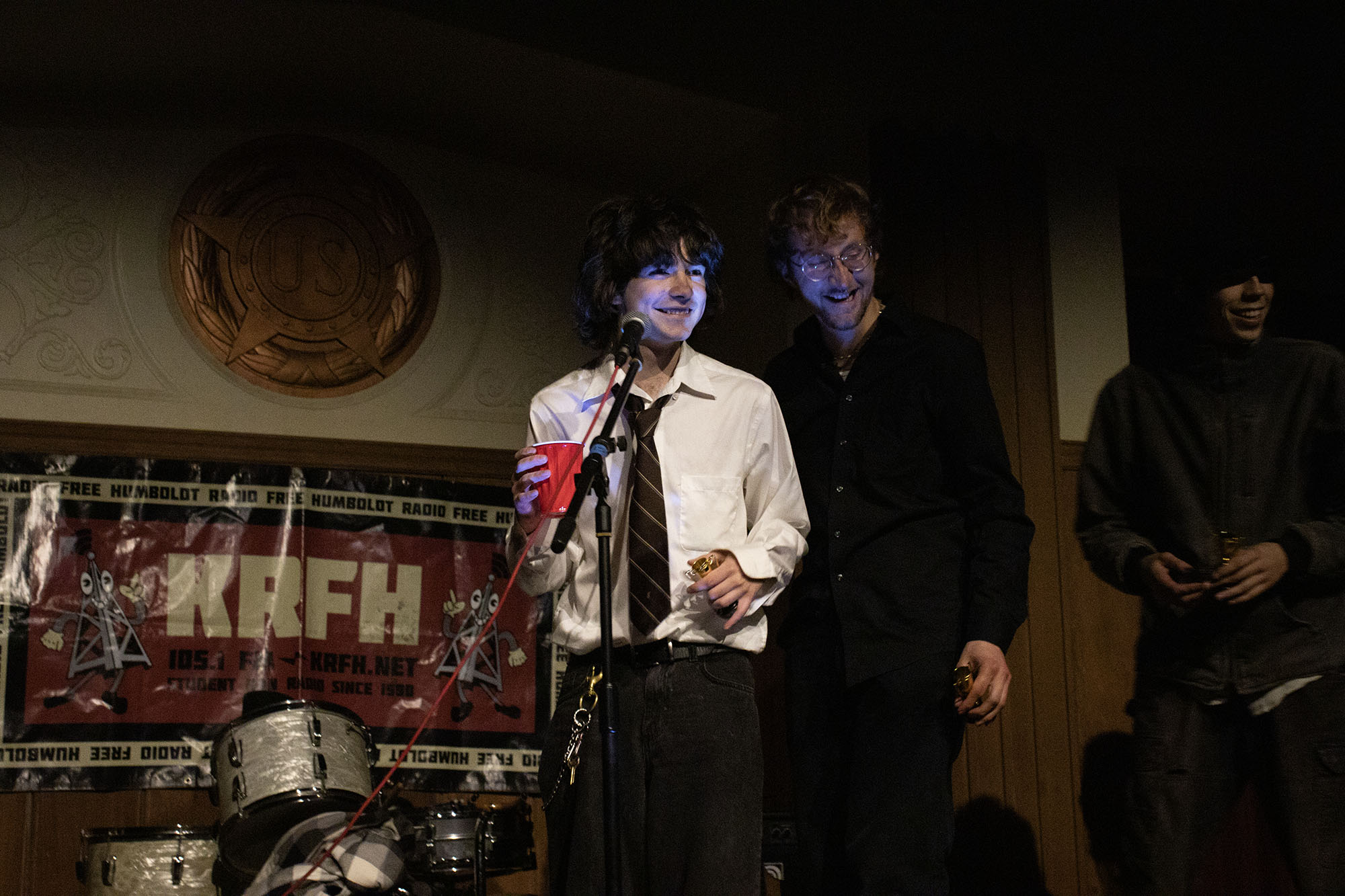
    By Will Bishop

    With the wind howling and the sun sinking, five challengers entered the Arcata Veterans Hall. While generally a place for people whose battles have already been fought, this night was an exception. It was time for a long awaited return; a resurrection of something once thought to be dead and buried — the reemergence of 105.1 KRFH Radio’s Battle of the Bands (BotB) on Saturday, Feb. 21.

    “I’ve seen posters, like, vintage posters in the station of old BotBs, but I don’t think we’ve done one in a minute,” said KRFH Station Manager Miranda Ricks, a senior year journalism major. “This was kind of a little passion project of mine because I think it’s so — I don’t want to use the word cliche, but it’s such a movie trope to have a BotB, and I’m just really happy we were able to pull it off.” 

    Attendees were encouraged to scan QR codes located around the premises to vote for their favorite act, while merch tables could be found all over offering both band specific loot, as well as good ol’ fashioned KRFH memorabilia. Around 6 p.m., the first band took the stage.

    Datura Blues: Starting things off with a moody and atmospheric bang were KRFH BotB vets Datura Blues. Consisting of multiple Humboldt State University (HSU) alums including Oryan Peterson-Jones, who wrote his own ethnomusicology major called “Music as a cultural metaphor.” From 2000-2004, they played every KRFH BotB, and were valiantly defeated every time. 

    “We’re not a winning band,” Peterson-Jones said. 

    Given their sound, a purely instrumental cosmically minded psychedelic maelstrom, this is no surprise. Many of history’s greatest heroes are unsung in their time. 

    Speaking of history, Peterson-Jones’ legacy with KRFH goes all the way back to 1994, with his high school band entering the fray as young upstart contenders. He would go on to become program director and music manager, and even become close friends with KRFH founder Gary Melton. A true KRFH hall of famer if ever there was one. 

    Heaven’s Taint: A lineup choice clearly intended to give the audience whiplash. Regarding the contrast between the first two bands, frontwoman Sunny Breed, a Cal Poly Humboldt (CPH) alum with a psychology major, said, “We’re gonna break that trance, we’re gonna break it up.” Breed, in the purest sense of the word, is a rockstar. A performer equal parts electric and elastic, pogoing around the stage in a pair of white framed shades and spitting out every word.

    Lady in Waiting: It was time for the youths to take the stage to make everybody sad and introspective. This was the band’s first ever live performance, but listening to them you would never be able to tell. Like a newborn baby that’s inexplicably and disturbingly an adult man with a job and a drinking problem, they have arrived fully developed and ready to talk about what ails the world with whoever will listen. 

    The main songwriting duo at the heart of the group, Jack Sparks and Sophia Rudoni, are both art majors at CPH. Additionally, Rudoni is one of KRFH’s own, operating under the alias DJ Beeprincess. 

    The band’s influences are diverse and eclectic, emphasizing 90s New York bands like trip hop innovators Bowery Electric, and Japanese shoegaze act Pasteboard. Their third song, Martial Law, had more modern, political influences. 

     “Next song is about the president of the United States, fuck that guy. Fuck [Immigration and Customs Enforcement],” Sparks said.

    Shortly followed by a student making a quick announcement onstage regarding last week’s Siemens Hall occupation and the upcoming open forum scheduled for Friday, Feb. 27 at 8 a.m.

    Eradescents: By this point in the evening the audience had reached its peak size, and it was time for crowd-pleasing act Eradescents to take the stage. With only three members, they were the smallest band in competition, but they had heart to spare and powered through a rambunctious set rife with memorable moments. From a charged performance of Don’t Want to Know If You Are Lonely by Hüsker Dü to the band being honored with the first and only thrown novelty thong of the night — which swiftly wound up on the drummer’s head for the duration of their set. This was precisely the kind of performance you affiliate with a classic BotB experience.

    Pennies for Pluto: Announcing themselves with an improvised ditty about the event, the band quickly launched into an absurdly impressive set demonstrating virtuosic chops from every member. Frontman and bleeding heart of the band Orion Jesse Paul delivered a soaring vocal performance and shredding licks in equal measure.

    This marked the end of our lengthy and tumultuous journey. Each combatant had said their piece and now it was time for the audience to decide. Out of a grand tally of 112 votes in all, the winner of this most hallowed of tournaments was none other than Lady in Waiting. For their efforts each band member received a KRFH shirt, pin, patch and poster, as well as a slot in an upcoming Local LIXX session, a radio promo, and the opportunity to have their recorded music uploaded to KRFH’s automated system for that sweet sweet airtime.

    Will Bishop is a Cal Poly Humboldt journalism major. He is prone to writing essays about things that bother him, and fictional works about things that also bother him but in different ways. A highly bothered individual, and a lover of cinema, music, and large trees/rocks. He can often be found in the woods, dancing to bring down the sky.

  • Winging it at BSU Trivia Night 

    Winging it at BSU Trivia Night 

    By Marielle Winuk

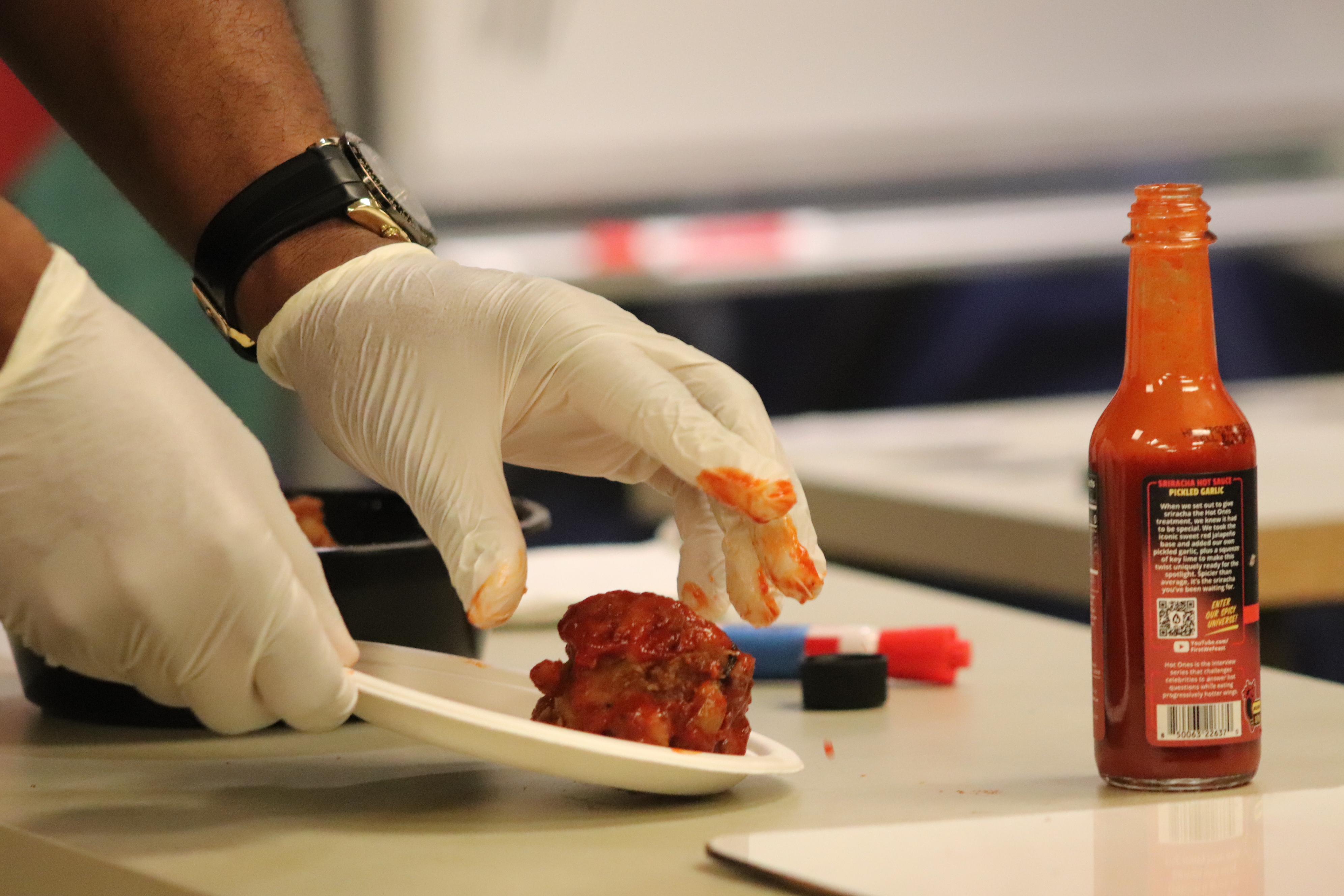
    Taste buds sizzled on the tongues of sweating students as they scrambled to answer trivia questions and test their Black History Month knowledge at the Black Student Union ‘Hot Ones’ trivia event on Feb. 16. 

    Jei Farner, a bio chemistry and cellular biology major, hosted the four teams, titled Black Pepper, Black Power, Heartburn and Jalepeople through three different rounds.

    The round one categories consisted of Black history, film and tv, and music. The points earned in round one determined what level of hot sauce the teams received on their wings in round two. 

    In round two, it was time to face the first round of hot sauce. Black Power and Heartburn each sent up two members to compete in the Black Math category. Before answering, the team had to eat the hot wing and then answer the question. The first hot sauce used was called Tropical Amariallo, which had a heat level rating of six out of 10. Team Heartburn answered the most questions correctly, advancing them to the final round. The second match up was between Jalepeople and Black Pepper, with Black Pepper moving on to the finals. 

    In the final category, things started to get… hot. There were five wings on the table, and competitors raced to take at least two bites of the increasingly spicy wings while answering the trivia questions correctly. The wings got progressively spicier as they went down the line, and the final wing had The Last Dab Thermageddon hot sauce with a heat level of 11 out of 10. 

    Two gallons of milk and the cold outdoor air became essential to combat the spicy wings. Black Pepper went through their five hot wings and questions, and emerged victorious with a winning time of 12:23. 

    Marielle is a junior journalism major with an interest in politics and sports. She can be contacted at mmw146@humboldt.edu

  • Seven years after the killing of Josiah Lawson, Arcata still mourns his loss

    Seven years after the killing of Josiah Lawson, Arcata still mourns his loss

    By Eli Farrington

    On April 15, 2017, David Josiah Lawson, an HSU sophomore, community leader, and member of the Black community, was killed at a house party in Arcata. He was sprayed with bear mace and then fatally stabbed six times after he was falsely accused of stealing someone’s cell phone. 

    On the seventh anniversary of Josiah’s passing, members of the Arcata community gathered in the square to honor his time on earth with a candlelight vigil and call for justice to be served. 

    Sarai Bordeaux, community member and former Humboldt State University student, spoke about the lack of justice surrounding Josiah’s case. She was heartbroken to hear that nothing was being done to bring Josiah’s attacker to justice. 

    “The fact that people knew who did it, knew who was involved, and very much could have done something, but didn’t, has stuck with me throughout my entire context in moving back to Humboldt,” Bordeaux said. “I’m a substitute teacher, and I work in the community, and to hear that there’s an event to celebrate Josiah’s life in the midst of a space that has done nothing to get justice for him just made me really want to come out.”

    For Bordeaux, the vigil served as a firm reminder that the Arcata community hasn’t forgotten about what happened to Josiah, and that the strength, persistence, and power of the community as a whole has the power to make positive change and make Arcata a safer place for people of color. As much as she loves the tight-knit community of Arcata, Bordeaux knows that it can be a bit intimidating and unwelcoming to marginalized communities coming here for the first time, especially when it comes to getting housing, jobs, and meeting locals. 

    “As much as I love coming out here, and as much as I need to come out here and see the community and know that we’re all still grieving, as much as I want space to be held for us, I am tired of holding it in trauma. the vigils that we hold are a visible display of our trauma,” Bordeaux said. “[The vigils] are important because people need to know that this is what we’re still dealing with here. We have to keep holding vigils because our folks keep getting murdered. We have to keep coming out to honor the lives of those that we have lost.” 

    Marlon Jones II, a community leader, activist, and organizer of the vigil, shared Bordeaux’s desires to create a safer and more accessible Arcata for people of color. He acknowledged the hard work and dedication of places like El Centro and the Umoja Center, but he expressed the fact that many black and brown students still feel unsafe outside of these environments. 

    “Through the vigils, I’ve met so many amazing people who all have this common goal of just making this place safer for Black and brown people, and providing these spaces where we can just exist,” Jones said. “Places where we can be ourselves and not feel threatened by this white supremacist, patriarchal society that tells us that we have to conform to certain spaces, or that we don’t belong in them at all.”

    Jones believes that Josiah’s vigil will continue to impact the community and motivate people to take action and seek justice, even when it may not be easy. 

    “It’s important to remember how to remain hopeful in a place that surrounds you with hopelessness,” Jones said. “It’s important to be the answer to the question … to understand that we the people, as a community, are the solution to this. We have to understand how powerful we are.”

    A major source of hope for the Justice for Josiah Committee and all of its supporters is Charmaine Lawson, Josiah’s mother. After Josiah’s passing, Jones was introduced to Charmaine. She immediately took him under her wing and showed him unconditional love and support. While she wasn’t able to attend the vigil this year, she has attended every year in the past, and even often comes on a regular basis, making the long trip up to Humboldt from Southern California to honor her son’s life and continue to spread love in Arcata. 

    “[Charmaine] does so many things for the Arcata community, despite the lack of justice,” Jones said. “She does so many things out of love and gratitude because that’s just who she is. That’s who her son is, even though he’s no longer with us physically. This young man was on the path to changing the world positively, and he was taken from us, through that avenue. There’s been so much love and support behind getting that justice, behind putting those minute steps into action, going to the courthouses, calling the [District Attorneys], and making sure that they know that this is important. Not just to Arcata, but to California, and to anybody that has had to deal with a missing or murdered person.”

    Charmaine Lawson’s goal since her son’s passing has been to continue to uplift the Cal Poly Humboldt and Arcata community. Her passion and positivity inspired countless others to follow in her footsteps, including Romi Hitchcock Tinseth, a community leader and organizer of the vigil. When Tinseth heard about Josiah’s murder, she immediately knew that she had a responsibility as a mother to take action and help the cause in any way that she could. 

    “It’s no wonder that DJ [David Josiah] was a spectacular human being, because his mother is a spectacular human being,” Tinseth said. “She has devoted her energy to carrying on the love that DJ gave, that is a product of her love. So she comes here, she does good in this community, she does the work that DJ would be doing, and she has come often every single month on the 15th, for years now. And it has been seven years. This is the first anniversary of DJ’s death that she was not here, because she chose to surround herself with her family in Southern California and celebrate DJ’s life that way.”

    Seven years after his passing, Josiah’s positive impact on the community is still being felt in many different ways, giving Tinseth and many others an outlet for creating a better Arcata and a better world. 

    “[He was] an incredible student at Humboldt State University, a leader, a person who was dedicated to changing people’s lives for the better, and fighting for justice in the world,” Tinseth said. “In fact, he was a criminology and justice studies major. He was President of Brothers United at Humboldt State, and just an amazing, good human being.”

    Michihiro Sugata, Cal Poly Humboldt Criminology & Justice Studies Program Coordinator, Associate Professor of Sociology, and former teacher of Josiah’s, spoke about who Josiah was as a student and a man. According to him, Josiah had a contagious smile that brought people in and kept them engaged. Josiah brought so much light and energy to his class, and his positivity was infectious. He loved to learn new things and take on new challenges, and he wasn’t afraid to discuss difficult topics. 

    “Losing Josiah was like watching hope die,” Sugata said. “I’ve never articulated it this way before, but Josiah was the type of student that [educators] put our hope in. He was the type of student that makes you believe that the challenges of this world can be met and overcome — he instilled hope in all of us and to lose that was just devastating. But I know he wasn’t the only one, and to see young people showing up to the vigil, to see young people painting murals and writing poetry about Josiah, that brings back the hope.”

    The vigil was ultimately a celebration of Josiah Lawson’s life, a life that was taken far too soon. But it was also a sobering reminder that justice has still not been served. 

    “These vigils remain important for many reasons,” Sugata said. “They keep us connected to one another, and keep us connected to the broader fight for injustices in our community and beyond. Just as important, the vigil serves as a symbol for the continued struggle for racial justice within this community and this country. For those of us who knew Josiah, gathering in community and fighting for just causes isn’t just an act of remembrance. It’s a way to honor the man he was and the life he lived. These are the things he embodied.”

  • Student dancers bring art to life in the Van Duzer

    By Dezmond Remington

    Dance Visions can’t be summed up in a few simple opening sentences. 

    The concert can’t be judged as a whole because of the six students and three faculty that choreographed 10 different dances, all performed by dancers from Humboldt’s dance department. Each dance had its own different look. There were fairy tales, night clubs, and cabaret halls all on stage, as well as a few more archetypal modern dance pieces. 

    It was a celebration of aesthetics. Though none of the costumes or lighting was overly elaborate, it was all rich. No dance was boring to watch. All of the dances were a thrill to watch as performers contorted and flipped, swayed and leaped. Broken Boundaries, a dance choreographed by professor Linda Maxwell and performed by just three dancers, looked like a moving painting. 

    Though the pieces by the professors were perfectly, reasonably interesting, the most entertaining and daring performances came courtesy of the student choreographers. Alli Bush’s 8te was a neo-burlesque extravaganza. Miriam Allen’s Evocative Pigment juxtaposed three different colors in a dazzling display of light and motion that was wholly captivating.

    The one criticism that could be thrown at Dance Visions is that art usually has some kind of meaning, a meaning that many of the dances seemed to lack. What significance or idea they expressed wasn’t easy to pick up on, though I’m no professional art critic.

    But how much does that even matter? Dance Visions was a beautiful spectacle, a fun look into the minds of Cal Poly Humboldt’s dance auteurs and performers. Meanings or messages can be overrated when it comes to critiquing art, especially at a college level when people are just learning how to express themselves. It was joyous, a delight to the senses. That in itself is a meaning. 

  • Horoscopes except it’s the type of milk you drink

    Horoscopes except it’s the type of milk you drink

    Dumberjack is out now! Find it on a newsstand near you!

    Courtesy of Dumberjack reporter, Radio Rebel

    OAT – If you drink oat milk, you probably have a Costco membership just to buy the bulk boxes of Kirkland brand cartons that don’t last nearly as long as they should. You might be a psych major holding a vape right now, and if you aren’t – you’ve thought about it. 

    SOY – Are you someone who doesn’t eat meat? You might be a soy milk drinker. It’s time to take that much needed social media break and maybe pick up that book that’s been collecting dust on your bedside table. Extra points if the book is anything other than fantasy. 

    WHOLE – In a world of 100 different types of milk, with a new milk type trending every day, it can be hard to stick to your roots. Whether you’re only drinking whole milk in your coffee or by the glass, you’re proud to be an American. 

    GOATS – You grew up shopping at the local health food store and it shows. If you drink goat milk, you were probably homeschooled but turned out pretty okay. When you pull up to the picnic, you’re definitely bringing the Humboldt Fog, and we thank you for it. 

    HEMP – A cannabis studies major, obviously. Hemp milk drinkers prefer chai over coffee and will engage in long form conversation about plant medicine. Long hikes in the woods are fun, and the mushrooms are fruitful, but it might be time to consider making some friends to join you.

    MACADAMIA – As a macadamia milk drinker, you’re either an art major who spends way too much money at your local coffee shop, or you just had macadamia milk for the first time because they were out of hemp milk. I’ll see you later at the open mic. 

    LACTOSE FREE – You’re a freak! Or lactose intolerant. Either way, you’re getting freaky in the bedroom. Lactose free milk drinkers are extremely well hydrated, and pretty buff considering the size of the hydroflask they’re always lugging around. How does it feel spending your paychecks on Lactaid?

    ALMOND – you’re the kind of person who takes 20-minute showers and leaves the water on while you’re brushing your teeth. Humboldt is the dream for you because you’ve been on travel influencer TikTok since you were 15. We’ve already seen that picture of your hiking boots hanging off Strawberry Rock, no need to post it every sunny weekend. 

    COCONUT – If you’re sitting in your dorm room still grieving the fact the only coastal town college you got into was Humboldt… you might be a coconut milk drinker. You had to buy your first warm jacket six months ago, and your surfboard doesn’t get used nearly as much as it used to. It’s okay though, you’ve got your outdoor recreation class to keep you busy. 

    BREAST MILK – What. There are only 3 types of people drinking breast milk: babies, curious husbands, and creepers who frequent Craigslist. If you’re a college student, stay away from all three. 

    graphics by TeenyTinyRat and Radio Rebel
  • Jasmin’s corner; what-ifs

    Jasmin’s corner; what-ifs

    Hello Jasmin, 

    I have this special person with whom I had a long standing relationship with. Going to college sort of brought an end to things and we came to a mutual understanding, so the breakup wasn’t bad at all and we’re still friends. It’s been 3 long hard lame ass years and she still pollutes my mind – it’s ridiculous. I can say I’m over the emotional heartbreak, but I still think I’m hung up on the idea that something might come of the future when I’m making big money and able to support that type of relationship. I saw them recently after a year or two of not talking and they seemed interested, though maybe I’m delusional. What’re your thoughts on revisiting relationships and do you think it’d be a good idea to try and pick up the pieces, or should I continue on as is? 

    Friend, you’re not over the emotional heartbreak or the girl. Leaving for any reason besides losing feelings or realizing your partner was actually a bum the whole time is always going to leave you with unresolved feelings and daydream-ey what-ifs. 

    If you think she’s interested, I don’t see why you wouldn’t at least try – especially if you’re not long distance. If you are, consider where you might both be in the future before you get too excited. No one should have to suffer through a long distance rekindle with an ex. You very obviously are holding out for this girl, so I definitely recommend not seeking anyone else romantically until you figure out your feelings and what to do with them. We don’t want anyone else getting their feelings hurt. 

    I don’t know the reasons behind your breakup, but I do insist that you reflect on the bad parts of your relationship and not only the warm, fuzzy memories. I will never tell you not to follow your heart – I actually encourage it. If you don’t think the timing is right, you’re right – it never is. We’re given the cards we’re dealt and have to figure out how to play them accordingly. You can show your love without having a big money job. The future isn’t promised and we have to act while the people we love are still around us. Just try to not be too aggressive or forthcoming with it.

    All in all, the only person that can tell you what to do is you. Would you rather suffer through the what-ifs or just find out for yourself? Is finding out for yourself worth the potential let-down of a second breakup? You tell me. 

    xoxo,

  • Depressing Dishes: recipes for when you’re feeling down

    By Alexandra Berrocal

    I normally don’t like spinach because people typically serve it raw. Many people don’t like “creamed” spinach either. Try this recipe. It isn’t raw, or creamed. It is simple to make. It is also very nutritious because it includes soybean paste, which adds nutrients. According to a research paper called Effects of Doenjang, traditional Korean Soybean paste has anti-obesity, anti-diabetic, anti-cancer, and anti-inflammatory properties. Garlic is also known as a natural antibiotic. The blanching in the cooking process also leaves most of the nutrients intact, unlike the boiling process in other recipes. 

    Depressed people often don’t feel up to doing anything fun. It was my goal in publishing “I am the darkness”, my recent cookbook, to let people know they aren’t alone in their depression. And, if they want to cook a recipe along the way, well, that’s great too!  The tofu recipe is also easy to multiply in case you want to serve it to others. The tofu recipe, on the other hand, is a simple, tasty way to prepare tofu. Usually tofu is a bit bland, but the sauce counters this. It is a good way to add more protein to your diet. You can combine the spinach and the tofu into a simple meal, if you like.

    SOY SPINACH

    1 bunch spinach (or other greens)

    Salt

    1 tablespoon soybean paste

    1 minced clove garlic

    1 tablespoon sesame oil

    Toasted sesame seeds

    Wash spinach and remove dead leaves and roots. Blanch spinach for about 20 seconds in boiling water. Cool with cold running water. Gently squeeze to get out as much excess water as possible. Add soybean paste, garlic, and sesame oil. Mix it all by hand. Sprinkle some sesame seeds on top as garnish.

    PAN FRIED TOFU

    1 package medium firm tofu

    1 tablespoon avocado oil

    1 green onion

    4 teaspoons soy sauce

    2 teaspoons rice vinegar

    1 teaspoon sesame seeds

    1 teaspoon sugar

    Blot the tofu with paper towels. Cut the tofu block in half, then into slices.  Grease the pan with the oil. Place the tofu in the pan without overlapping or touching. Put the lid on the pan and cook for three minutes on high heat, or until crispy and golden brown on one side. Repeat on the other side.

    Thinly slice green onion, and combine all other ingredients in a bowl for the sauce. Enjoy!

  • An excerpt from Sanctuary

    An excerpt from Sanctuary

    Sanctuary: A book of essays on faith (with some romantic poetry mixed in) 

    By Alexandra Berrocal

    I

    Dream of

    Red hair and

    Soft green eyes. 

    The eyes of my mother.

    I have dreamed of her for

    Decades upon decades and

    Centuries upon centuries.  I paint

    Her because she is clear when all fades.

    The one thing I reliably recall.

    She walks into the front door of my space

    I feel like she has entered myself

    And with every painting she sees

    She gazes into my soul.

    A soul that’s filled with her.

    For time after time

    I look at her

    And feel I

    Collapse 

    In.

    Graphic by Griffin Mancuso
  • To fuck or not to fuck… your co-workers

    To fuck or not to fuck… your co-workers

    By Christina Mehr and Andres Felix Romero

    To fuck:

    Do you like making money? Do you like making love? Well, why not combine the two?

    I believe in messing around with the people you work with. The dating pool in Humboldt is already limited, so you have to take them where you can get them. If you’re already spread so thin between classes, homework, and work, why not get spread by someone you are literally getting paid to see? It’s the best of both worlds. 

    There’s plenty of benefits to being in cahoots with your coworkers, like getting to flirt with them in passing, sharing rides to work if you share the same schedule, or sneaking away together on breaks. On the plus side, if your work is getting overwhelming, you can turn that into sexual frustration towards that coworker. It creates some fun and exciting drama in an otherwise boring workplace. Having a work crush is amusing and gives you some more motivation to actually want to go to work. 

    However, I understand the opposing side of, ‘what if we break up or get in trouble?’ or whatever, but honestly if you’re at a minimum-wage college job, just go ahead and do it for the plot. 

    To not fuck:

    Workplace romance – it’s fun and exciting, but also a potential threat to you and your emotional wellbeing. I’m not disagreeing that a romance in the workplace isn’t a bit of a thrill, but from another perspective, you might be walking into a game where everybody can lose. 

    Obviously, things can get awkward if the passion fizzles out. Breakups hurt and can be as devastating as losing a loved one. Sometimes, breakups can be amicable. However, how many of you have had those relationships (or situationships) end with your gut feeling like it’s been poisoned? The lovely person who once made you smile suddenly turns into a bitter and painful relationship? 

    Want to know the cherry on top of the heartbreak cake? Imagine losing someone you care deeply about, then seeing them when you walk into the place that pays your bills, and seeing customers flirt with your former beloved. Jealousy is a poison, and it’ll infest your workplace and create tensions and conditions that are toxic and unbearable.

    Now, flirting in itself is a whole other beast of ethics, however the general rule is to back the hell off when someone isn’t showing interest or signs that they’re uncomfortable. At a bar or party, it’s easier for someone who isn’t interested to get some distance from your flirting skills. At a workplace, your crush is probably stuck with you. Do you really want to risk making your crush uncomfortable? Do you really want to make it awkward when y’all work together? Do you really want to go to human resources (HR)?

    If you have a little crush, it’s not the end of the world. A lesson I’ve learned is that it can be harder to control our feelings, but we are in control of our actions. I agree that the rush can be fun, but all highs have to come down when we come back to reality. It’s like a bong rip just before a morning class. It sounds great, and for a while, you feel like you’re walking on the clouds doing something you really shouldn’t be doing.

  • From the psych ward to the newsroom

    From the psych ward to the newsroom

    By Savana Robinson

    March 8, 2023, I was released from a psychiatric facility with two diagnoses: schizophrenia and bipolar I. A year later, I’m doing better than ever. I’ve got a nice job as a multimedia journalist, I’m close to graduating, and I have a great group of people who care about me. Getting here wasn’t easy – I had to reconstruct myself as a person. It took a lot of support, therapy, and medication, but I did it.

    I went back to the fundamentals of me. I left Humboldt and moved back into my childhood bedroom in Redwood Valley. The pink walls with pastel butterflies and flowers, my rock collection, and my numerous stuffed animals helped gently bring me back to where I needed to be.

    The first few weeks of being back in the world were scary. I wasn’t in psychosis anymore, but the paranoia and hallucinations of onset schizophrenia were still present. I had been started on medication for it a few days before I was released, but it still took some time and help to be manageable. I’ve been in therapy since the day I got out of the facility, which has helped tremendously. Of course, I chopped off my hair. Some people believe that hair holds on to memories, so I got a bob. I loved it for a while, but I eventually mourned my long hair. 

    Per my routine-abiding father’s suggestions, I started by waking up early, making my bed, walking the dogs, and making breakfast. I took it one day at a time and eventually, I was thriving. I had to drop advanced photojournalism, and I couldn’t use the school’s camera anymore, but I love taking photos, so I bought my own. 

    Photography is another form of therapy for me. It’s relaxing and lets me express my creativity. I got a job doing photography and blog writing at a mini golf course in Ukiah. I continued with a few of my classes from home, doing online work when I wasn’t taking pictures. I finished out the semester and by the summer, I felt that my medications had leveled out enough to feel “normal.” I didn’t feel like I was moving through jello anymore.

    Halfway through the summer, I decided that I wanted to go back to Humboldt, despite my parents’ protest. I found out my friend had a vacant room, so I moved back to Arcata and went back to school in person. I was a bit nervous, but I was confident that I would be fine. I worked on The Lumberjack and continued to take photos. I started doing sports photography and made some money doing it. I even did my first wedding photography gig. In January, I got my job at Redwood News. I’m just getting started in my career, but I’m optimistic for the future.

    After being released from the psychiatric facility, I had no idea where I’d be in a year. I was hopeful that I’d be somewhat successful, but I didn’t expect to be working as a professional journalist. If I had to do my year of healing all over again, I’d do it the same, because I’m very happy with how I turned out.

  • Mar’s Gaming Garage: HI-FI Rush

    Mar’s Gaming Garage: HI-FI Rush

    By Mario Orozco

    Every good game has music. Usually a game’s music plays in the background and has no actual effect on the gameplay. This week’s game uses music differently, it’s not just in the background of your gameplay, but part of the mechanics of the game itself. Justin Crittenden, a software engineering major, recommended “HI-FI Rush” to me, a rhythm-based action game released in 2023. Before I played this game, I was under the false impression that it would be like other rhythm games, but “HI-FI Rush” isn’t like anything I have experienced before. 

    This game has a really simple story, but it was well executed and had my complete attention throughout the playthrough. It did a fantastic job taking a simple plot and making it feel entertaining and fresh. One aspect of the game that I enjoyed was the art style. The characters are cel-shaded, giving the game a comic book like appearance and the main bosses of the game each had beautifully detailed freeze frames that contributed to this design. Another aspect I enjoyed were the characters; each character had clear motives and reasoning behind their actions which is extremely important. The characters were also very entertaining, the main cast had fantastic chemistry with each other and it was fun to see them interact and grow together. 

    The main aspect of the game that makes it memorable is the gameplay – the combat is amazing. There is a constant beat playing throughout the game and combos performed exactly on this beat increase the effectiveness of your attacks, which is also used to parry enemy attacks. The beat is useful in ways outside of combat too. It is used to move faster and assists in traversing through the levels. The style of gameplay temporarily switches a few times in specific portions, it even becomes like “Guitar Hero” in a few battles with buttons needing to be pressed exactly on time to the song playing in the background.

    Like always, there are a couple negatives that I would like to address. The first is the design of the levels. Most of them have a similar feel, following the same general outline. This is okay though, the main focus is the combat, which is fun enough for the repetitive nature to not really matter. The other issue is how difficult the timing can be. In the later stages of the game, there are just way too many enemies attacking you all at once to be able to focus on hitting your opponents with rhythm. Instead, it turned into me just dashing around chaotically, randomly swinging at everything close to me. If this is a problem, you can just turn the difficulty down and it’ll make staying on rhythm more manageable.

    “HI-FI Rush” took me a grand total of nine hours and one minute to complete. It is evident through playing the game that the developers had a blast making it, and it feels like a passion project. I rate this game a 4 out of 5, and if you like fast paced, hack-and-slash gameplay, then I strongly recommend this game to you. “HI-FI Rush” is definitely worth the purchase. 

    If you have any games you would like me to review you can email marsgaminggarage@gmail.com.

  • New shark discovery offers glimpse into a lost world

    New shark discovery offers glimpse into a lost world

    By Brad Butterfield

    326 million years ago, Arkansas was underwater and teeming with an unusual, gill-covered shark, a shark that is now called Cosmoselachus mehlingi after a years-long project led by Dr. Allison Bronson, a Cal Poly Humboldt professor. The unique conditions in the Fayetteville Shale preserved the precious cartilage that was critical in digitally reconstructing an accurate image of the ancient shark, which was named to honor Carl Mehling, a senior museum specialist for the American Museum of Natural History (AMNH). The shark’s ancient origins and recent identification have been made possible by CT scans, digital reconstruction, and years of careful work carried out by Bronson alongside Alan Pradel, John Denton, and John Maisey. The findings were recently published by the journal Geodiversitas.

    Cosmoselachus mehlingi is distinctly important, according to Bronson, due to the fact that its ancestors survived a catastrophic mass extinction that killed 95% of the fish population in the Devonian period.

    “In the wake of these extinctions, we often have what we call an adaptive radiation where the groups that make it through can then diversify into all these niches that were left open,” Bronson said.

    The acidic and anoxic environment of Arkansas’ Fayetteville Shale preserved the shark’s delicate cartilage for millions of years until the 1970’s, when Royal and Gene Mapes, the husband and wife duo, discovered the fossil. The Mapes would eventually donate the specimen to the AMNH. 

    “Cartilage is really rare in the fossil record, because it’s soft and squishy, and usually microbes break it down before it can fossilize,” Bronson said.

    The rare preservation of the shark’s cartilage allowed Bronson and her collaborators to use CT scanning to digitally reconstruct the ancient shark’s biological structure and identify one of its most unique attributes, gill covers.

    “It’s made of little rays of cartilage that grow off of its gill arches,” Bronson said. “In our shark, unlike anything that’s been described in any cartilaginous fish, they’re all fused together.” 

    The gill covers may have functioned to help close the gill openings, according to Bronson. Though gill covers are found today in ratfish, Bronson and her colleagues’ statistical testing showed that it is unlikely that ratfish are descendents of the group of fishes that includes Cosmoselachus mehlingi. Additionally, the digital reconstruction revealed that the ancient shark had widely spaced teeth with tooth-like scales in between.

      Bronson and her colleagues’ work to identify Cosmoselachus mehlingi gives scientists a valuable glimpse into our ancient world and another datapoint that aids in our understanding of evolution over time.

    “Once you have an understanding of the long branching pattern of evolution, you can reconstruct the way that traits evolved over time with a group like cartilaginous fishes that’s been successful for more than 400 million years, and made it through multiple mass extinction events to now be the dominant predators of the ocean,” Bronson said. “A lot of evolution is just like, if it ain’t broke, don’t fix it.”

  • Smelting in the water

    Smelting in the water

    Cal Poly Humboldt fisheries professor is working with local tribes to create better fishing stewardship practices.

    By Gabriel Zucker

    Jose Marin Jarrin is a new assistant professor in the department of fisheries biology at Cal Poly Humboldt. He is leading a new form of fishery science in Northern California, using empathy and understanding when talking with impoverished communities. He is originally from South America and he never forgets where he came from. 

    “Being Latinx, I’m also from a historically excluded community,” Marin Jarrin said. “So I saw a lot of similarities.”

    Marin Jarrin was recently awarded a little over $1.1 million from the California Climate Action Seed Grant to research climate change resilience by looking at tribal fishery practices. His goal is to reinvigorate Northern California fishery research, while also building a center that will last for years. 

    He is working with the California Department of Fish and Wildlife and multiple local tribes, such as The Blue Lake Rancheria, Resighini Rancheria, Tolowa Dee-Ni’ Nation, and other smaller indigenous communities. Each native group was able to pick a fish that has historical and cultural value to their tribe. The fish that are being mainly researched are green sturgeon and smelt. Five grad students are working with Marin Jarrin, acting as liaisons for the different Rancherias. On top of doing research all over Northern California, the tribes and researchers have a monthly meeting where they go over the progress and find where they can improve.

    Creating a trusting relationship with the Indigenous communities is important. To solidify this relationship, Marin Jarrin signed a data sharing agreement with all of the tribes, giving them final say on what information is published. Historically this has not been the case, and some even admitted they had never been asked to do this before.

    “The researchers would go in, ask the tribes to participate, and then the tribes don’t get a say on how the data is used,” Marin Jarrin said. “And so, one of the things we wanted to ensure is that the tribes had complete ownership of that data. For the most part, they’re not too concerned about fishery species, they’re more interested in preserving their cultural data and history. What they don’t want is for people to just take information from them and disseminate in ways that are sometimes not correct or hurtful to the tribe.”

    Laurie Richmond is an environmental science and management professor at Cal Poly Humboldt. She has worked with the tribes for years, working a quarter time for California Sea Grant as an extension specialist. Where she connects local communities with coastal science knowledge. Her role for the study is in a partner advisory role, where she offers advice and direction when grad students need a new perspective. She has been working with Marin Jarrin since the beginning of the grant and is elated at the way he is going about his research.

    “I think it’s a really new way to be a scientist that I think [Marin Jarrin] is pursuing,” Richmond said. “It’s really exciting and it requires a lot of skills that scientists don’t always have, like building partnerships and facilitating and thinking about ethics. He’s done a great job of trying to learn those things, and he has some of those because of his unique background that he brings as a scientist.”

    To record the biodiversity of the fish in different areas, grad students are using environmental DNA metabarcoding techniques, giving them data about all of the animals that have come into that area.

    “If a fish swims by, it’ll leave its DNA in the water column,” Marin Jarrin said. “If you were to collect a sample and filter out the DNA from that, you can identify what species of fish was there. The idea is that if you then go around taking samples throughout the whole coast, you can identify all the fish – actually, not just fish. From bacteria all the way to mammals.”

    Before conducting this research, they had to work with the California Fish and Wildlife department. The advisor on the grant is Kenneth Oda, a former Humboldt State University student, who is with the Marine Region and works on the State Managed Finfish Research and Management Project. Oda gives advice and helps review the proposals before they are submitted. 

    “I was just asked to be an advisor… we approve protocols, if they’re gonna be taking fish, we need to have that spelled out, and the methodologies as well,” Oda said. “We review their permit application and then approve it. I also help them with protocols regarding surf perch and red tail.”

    Olivia Boeberitz, one of the graduate students on the team, just moved to Humboldt. She chose Humboldt partly because of this research project, and the opportunity to work closely with Indigenous tribes. She has been studying fisheries since 2020, focusing on fish that inhabit both freshwater and green water. This made the transition from inland to coastal easier. 

    “I’m working specifically with Blue Lake Rancheria on green sturgeon… I’m designing a project to get some baseline information on how green sturgeon are using Humboldt Bay,” she said. “There hasn’t been much of any research, at all, of green sturgeons in this area.”

    Boeberitz is in the methods phase of her research project. She is running through a couple ideas for data collection. She wants to use acoustic receivers, alerting if any previously tagged fish are using these areas. She is also planning to use satellite tags  on fish off the coast. None of the actual research will be conducted until the summer.

    Right now, she is most excited about working and meeting with the tribes. She has worked with tribes before, but never one on one.

    “I see and talk to them very frequently,” Boeberitz said. “As soon as I produce any drafts for my proposal, as soon as I come up with a schedule, they’re going to be incorporated every step of the way. Their feedback is both incredible and extremely valuable. I’m working on this project for them, they’re the center of this project. They’re guiding me – giving the guidance they need to start putting together what our goals are.”

    Marin Jarrin is changing how people view the scientific process. He is finding paths of communication that are not usually seen in western science. He is not just doing research, he is creating positive social change.

    “I want to help communities that have been historically excluded, to be better – better informed and the different techniques and methods they could be using to manage their fisheries,” Marin Jarrin said. “We want to empower people right. Our community to tribal communities, but to the community at large in the far north of California, so that they feel they are more capable of being stewards of their resources. But also, the students that we bring, we want to prepare the best students we can because they can go out… and bring this idea of diversity, equity, and inclusion to the next job that they take.”