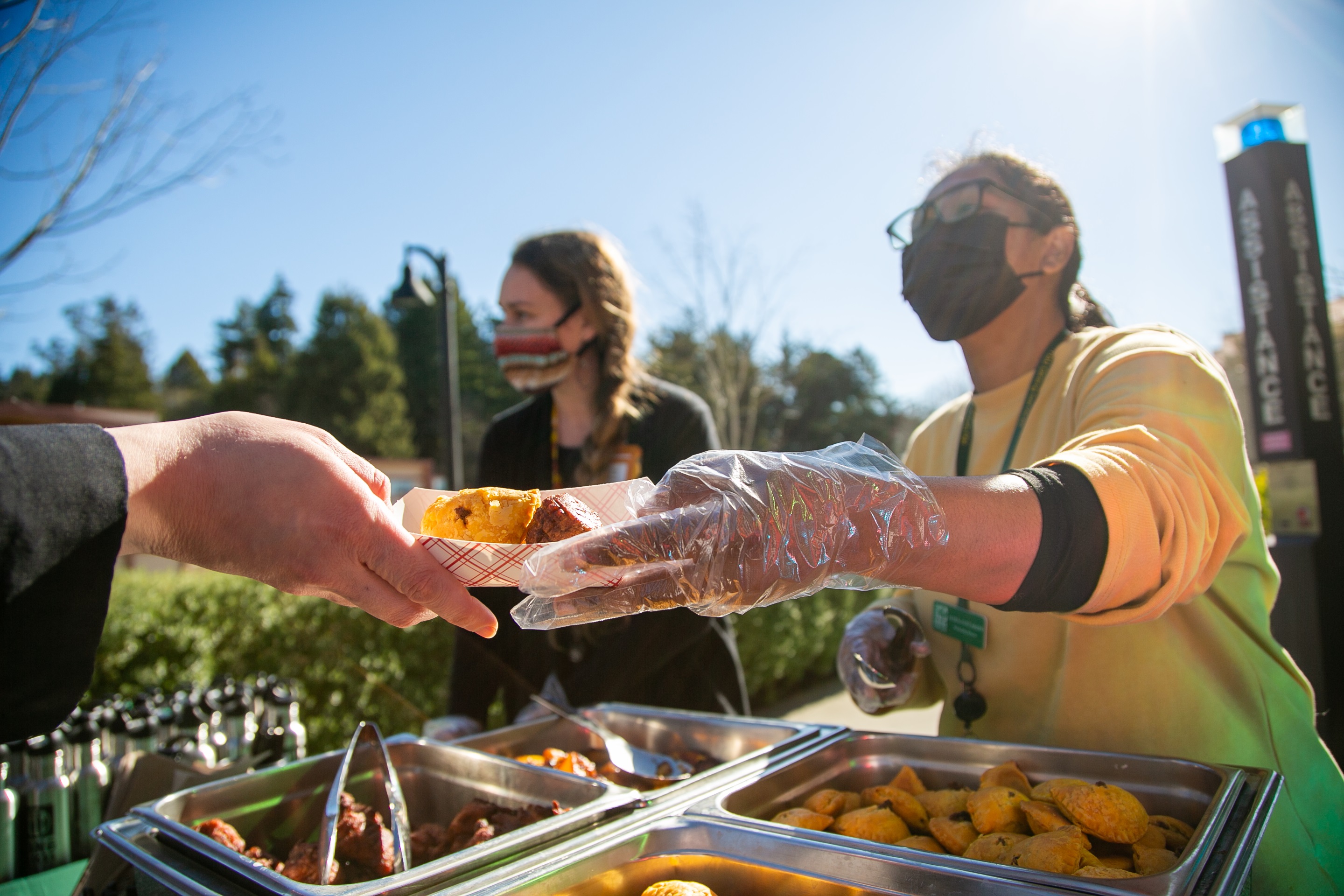
A three-week-long Food Summit is on campus, and you’re invited. On-campus organizations El Centro, HEIF, Umoja Center, the Food Sovereignty Lab, Oh Snap!, WRAPP, and La Comida Nos Une all collaborated to make this event happen.
Liszet Burgueno, Developmental Manager for the Humboldt Energy Independence Fund (HEIF) and environmental resource engineering major, talked about the nature of the event.
“The Food Summit is a collaborative event where multiple campus organizations came together to start conversations about food justice, food sovereignty, and to give people food,” Burgueno said.
The first week was about the general topics to introduce people to the issues of food sustainability and justice. This week is about jobs and exploration in the food industry, and next week is about environmental justice and social justice.
HEIF is funding the Food Summit according to Katie Koscielak, Cal Poly Humboldt’s sustainability analyst and advisor for the event.
“The campus has done other food summits, but not in several years, and this is the first one funded by HEIF,” Koscielak said.
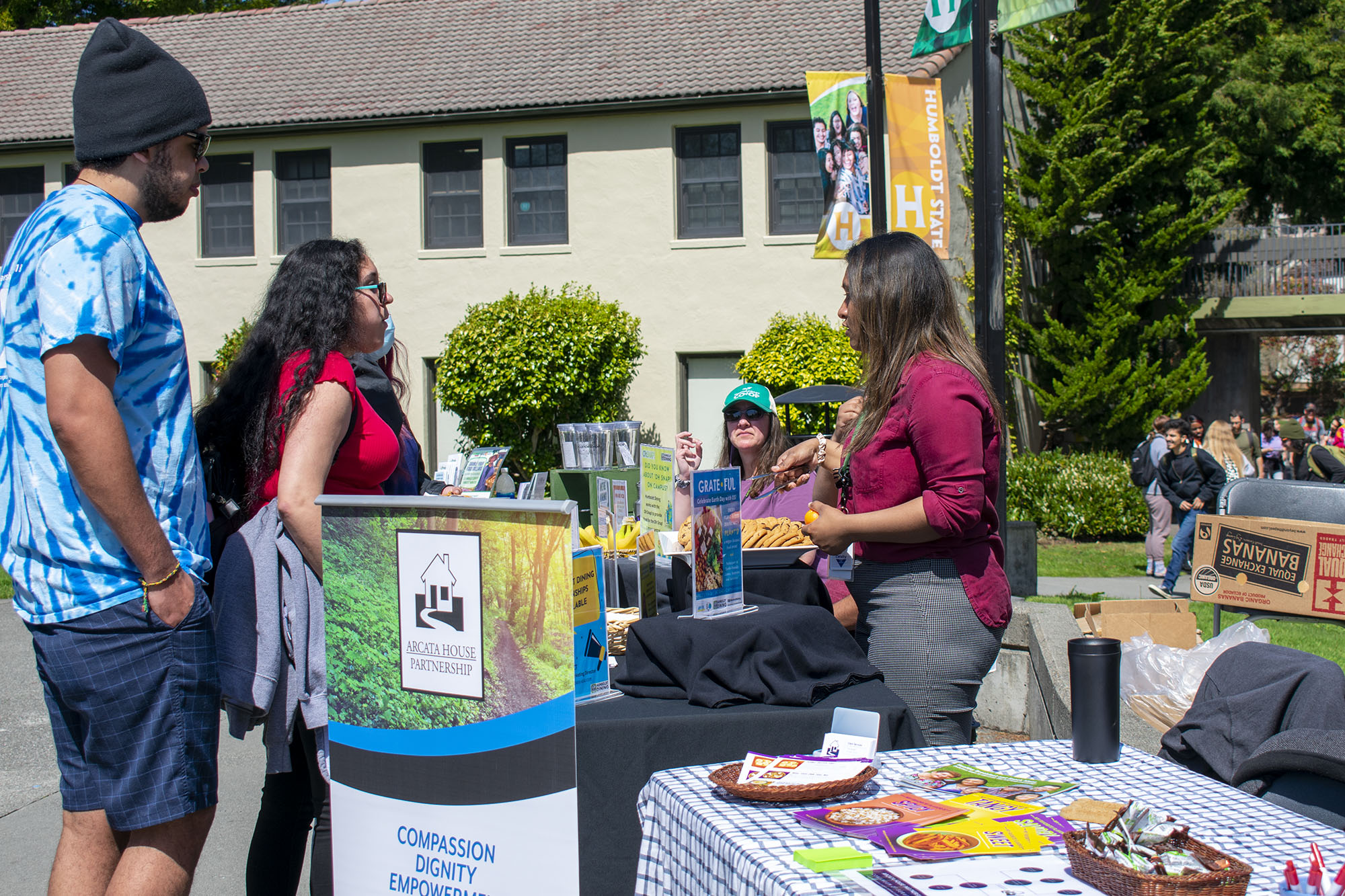
Photo by Angel Barker | Katie Koscielak, sustainability analyst for the campus, and Liset Burgueno, development manager for HEIF and environmental resource engineering major at the table for HEIF at the food summit on April 6.
HEIF funds sustainability projects on campus through instructionally related activities fees that students pay for each semester. Past projects have included water refilling stations, compost bins, lots of lighting upgrades throughout campus, hand dryers, and many more. These projects take effect when students submit proposals to the organization.
“Last semester, El Centro came to HEIF and submitted an idea paper, where they wanted to get reusable utensils,” Burgueno said.
Darin Torres, criminology and journalism major, pitched the idea this semester for a food summit. Torres spearheaded the ideas and planning, and after months of collaborating with many campus groups and local organizations, the event planning has been successful.
“I am really proud of what we’ve done so far,” Torres said. “Education is power.”
This event is not only to educate, but to get students involved with interactive events to help make the planet a better place. This event is really important to Torres, as food insecurity is a huge part of the greater Humboldt community.
“We have issues with indigenous cultures’ food not being respected,” Torres said. “Food is a major insecurity in Humboldt County, we have students who face hunger and homelessness so much. So we just wanted to incorporate it all into the food summit.”
“We have regenerated, and hopefully it will continue,” said Fernando Paz, coordinator for El Centro.
According to Paz, the event itself is, a way to really reflect on our carbon impact in terms of food that we use.
This Thursday, April 14, there will be a film screening of Gather hosted on Zoom, and on Friday there is a plant tour on campus and an opportunity to volunteer at Bayside Farm. Many more events are also scheduled throughout the week. To find the whole event schedule, go to https://lcae.humboldt.edu/food-summit.
“This event is made for you in mind, it was made for students, by students,” Torres said.
The 68th edition of Toyon, Cal Poly Humboldt’s multilingual literary magazine, was released on Tuesday, March 29. It is the culmination of a year of work by the staff, through forced distancing caused by COVID-19, across vast distances, and from a multitude of perspectives.
Contributions to this year’s Toyon came from countries around the globe. The submission base’s broad scope means that works in many languages are featured. Some of the works originally submitted in a language other than English are presented in both languages, and some of the translation work is only available online on Toyon’s website.
Maurizio Castè’s ‘Germogli verdi,’ or ‘Sprouts of green,’ published in both the original Italian and translated into English by Toti O’Brien, is a gently insistent witness to the beauty of spring, and to nature’s resilience in the face of climate change. This is a theme that surfaces at other points in Toyon 68, in Dobby Morse’s “The Fate of the Earth,” “Climate Change” by Larissa A. Hul-Galasek, and Meghan E. Kelley’s “What’s Left for the World to Say?”
In these works, there is a deep veneration of both nature’s delicacy and of her strength. There is also an anger that seems to well up from deep within the Earth; anger for the future of humanity in the face of a climate apocalypse and for the fate of the natural world in our aftermath.
There are many other standout poetic works in Toyon 68. The magazine’s opening work “Each Time I Held a Dying Bird” by Grace E. Daverson pulls the reader into delicately described and emotional pocket memories. As Daverson methodically describes each bird she has known, the wild joy of holding a bird in one’s hand and the childlike wonder of shining a flashlight into developing eggs organically melt into the glass-sharp grief of not being able to protect the ones you love.
Toyon also publishes short stories, academic literature, and visual art.
“Dismantling Structural Systems of Oppression Through a Revolutionized Pedagogy” by Ambar A. Quintanilla systematically explores the institutional barriers to education which Latinx and Black students face, multiplied by conditions during the COVID-19 pandemic. Quintanilla’s emotional connection to the subject matter as someone who has experienced these barriers (and who has seen the people she cares about be affected by them) is as important to the piece as her efficient and insightful analysis of the complex contributing socioeconomic factors.
Among the magazine’s small selection of visual art, “Thinking” by Ernie Iñiguez and Mario Loprete’s “Concrete Sculptures” stand out. “Thinking” is a polished and pastel digital illustration of a meditating robot, while “Concrete Sculptures” is photos of the artist’s graceful and haunting sculptures of folded clothes.
The theme of Toyon 68 is “hope and healing,” which is self-evident from the works within. The contributors’ love for this world and for the always painful process of healing is strung throughout the magazine, as taut and musical a guitar string. Healing takes time, passion, work, and love, and Toyon 68 has all of those. On the back cover of the volume, their sendoff is this:
“WARNING: This product contains love, anxiety, dysphoria, tenderness, birds, affection, grief, orange juice, trauma, anger, and maternal bonds. Side effects may include self-reflection and a sense of inner peace.”
One o’clock on a Tuesday afternoon is not the usual time for a music recital. However, this particular performance was more than just a display of student skill. Accreditors from the National Association of Schools of Music were in attendance, after two days on campus visiting classes, listening to students perform, and ensuring the university meets standards for music programs. According to music department chair Cindy Moyer, this process is one that happens only once every ten years.
“For this particular recital, what they wanted to see was the full spectrum of the program, which is why you can see there were all different music concentrations and students performing,” Moyer said.
A highlight of the afternoon’s performances was staff accompanist John Chernoff’s rendition of a moody piano piece by composition major Theo Singer. The audience watched in captivated silence as Chernoff played through to the last, lingering note with an intensely focused expression, leaving the music hanging in the air for a moment, before breaking the spell as he turned to the audience with a wide smile and a quick bow, freeing the listeners to rapturous applause. Singer is a senior, but the performers comprised the full range of experience.
“This was hard because we needed a real breadth of things, we had to find freshmen and sophomores,” Moyer said. “We do an honors recital every year and that’s pretty easy, students audition and the very best play— but that was not the goal here. The goal was not the most advanced, most skilled performers entirely, it was the whole spectrum of performers.”
Marimba player Makani Bright was singled out by Moyer as a particularly talented senior performer. Bright has been playing for about 12 years, and has an upcoming senior solo recital on April 10. They are a double major in percussion performance and applied mathematics, finding beauty in both.
“The way that I relate both of my majors in my mind is that I think of them artistically,” Bright said. “I think of mathematics as an art form, it’s perfect and there’s many beautiful things you can do within mathematics. Both of them, to me, are an art.”
Bright’s piece, “Chain” by composer Kazunori Miyake, was not one they had previously performed before an audience. The instrumental composition had almost narrative elements, combining multiple different feelings and rhythms into a complex and beautiful melody.
“I feel really good about it,” Bright said. “I feel like I was able to express what I wanted to express and I really enjoyed myself.”
The majority of the music on display was instrumental, with pianists, percussionists, and a saxophone quartet as standouts, but music education major Pablo Murcia was selected to represent the vocal arts.
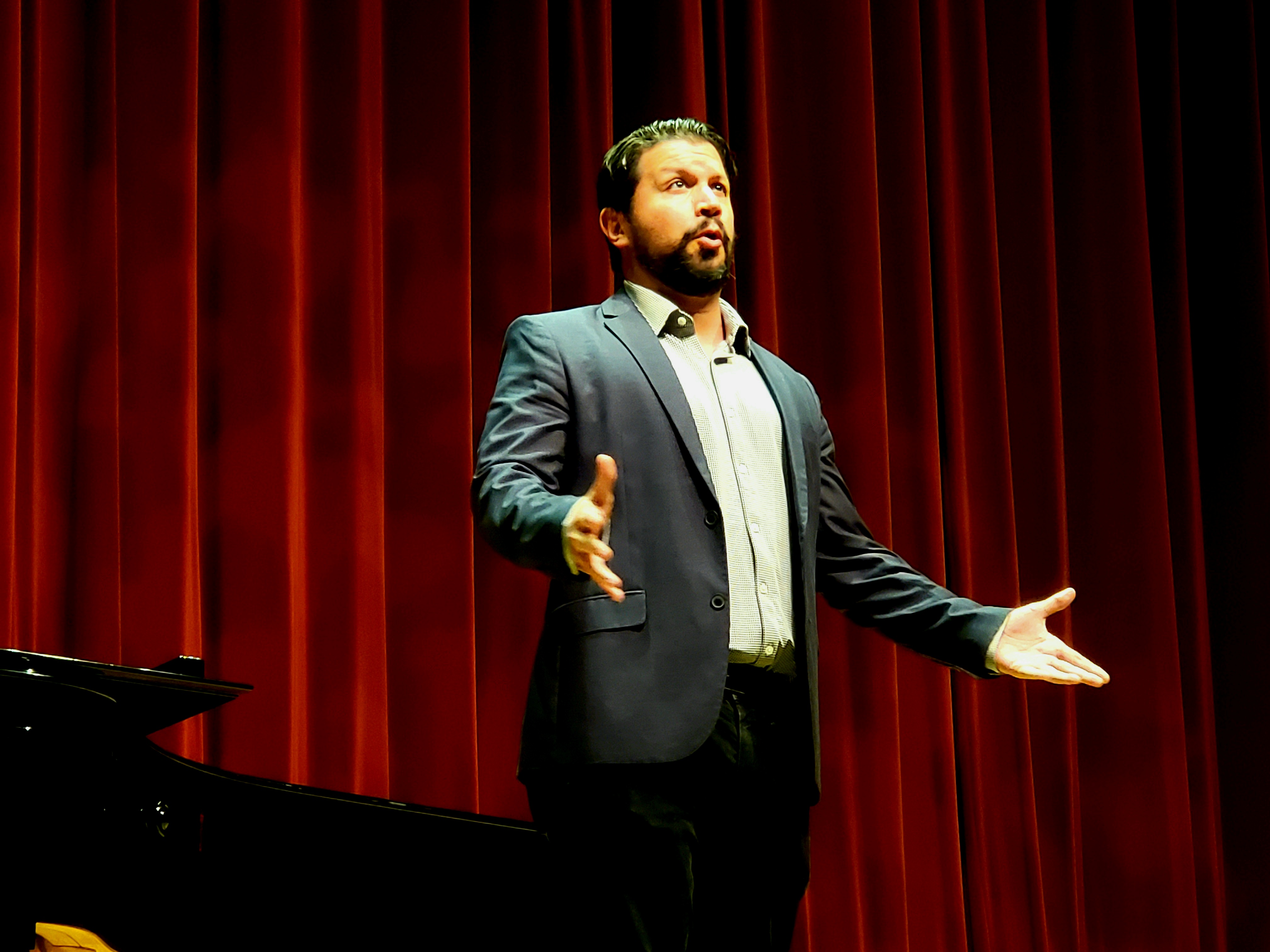
“I’m very honored, honestly,” Murcia said. “I was the only singer chosen, and that’s quite an honor. I’m very flattered, and happy that some people came out to support me. That was nice.”
Murcia’s piece was an aria from Mozart’s Don Giovanni, “Deh, vieni alla finestra.” He performed in Italian, but his smooth baritone voice, expressive performing style, and connection with the music (which has been part of his repertoire since last semester) carried the story of the song to the audience.
“Don Giovanni, he’s a Don Juan, he’s a player, and he’s trying to get the attention of a woman at her window,” Murcia said. “The whole piece is just him saying, come to me, come to me, trying different tactics to get her attention, and she just keeps sort of playing coy, and finally, by the end of the piece, she finally gives into his charms.” He laughs. “Quote, unquote charms— he’s kind of a narcissistic jerk, but yeah.”
Music department ASA Samantha Heppe was excited to be involved in such an important production for the university.
“I’m just excited for our music students to showcase their talents,” Heppe said. “This recital is in honor of the accreditation team, so this type of recital won’t happen again for another ten years.”
Pamphlets and papers flew around the UC Quad. Three teal blue tables stood to the right of The Depot entrance, pushed up close to the SAC’s concrete stairs. Dozens of paint bottles cluttered the leftmost table while various pins cluttered the right. April is international recognized as Sexual Assault Awareness month and The North Coast Rape Crisis Team alongside its on campus program Campus Advocate Team (CAT) have worked together to host its annual Take Back the Night week. The week-long event lasts from April 4 to April 7 and includes activities such as Denim Day, Clothesline Project Workshop, and Take Back the Night.
Photo by Matthew Taylor | Liliana Cortez (center) speaking with students on the UC Quad about Teal Day on April 4.
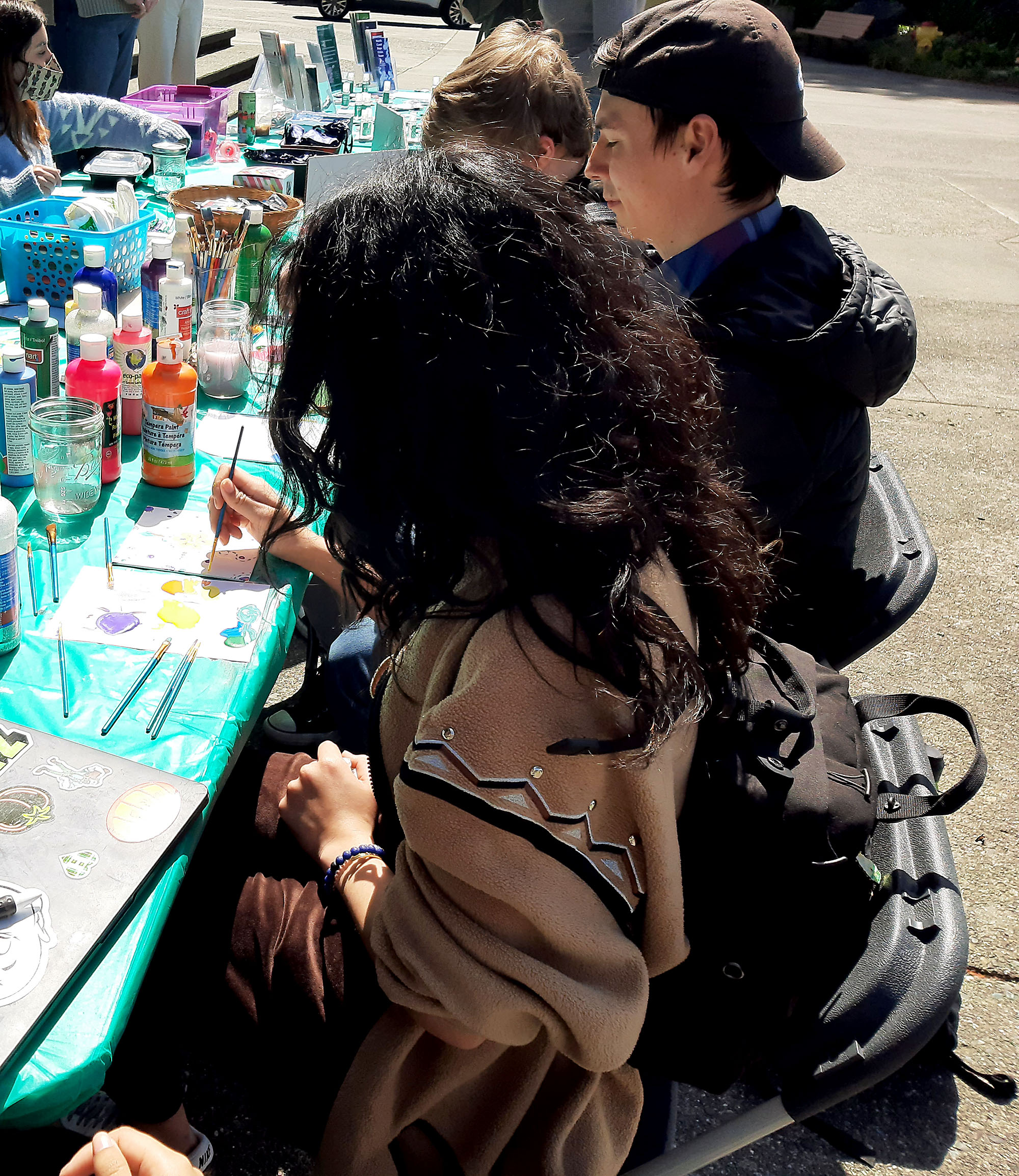
Tuesday marked Teal Day, a day dedicated to the awareness of sexual assault survivors and their stories. Students at the tabling event were encouraged to paint their expressions of positive growth and healing. By the end, all the small canvases would be placed together to form a larger mural. Liliana Cortez, the Violence Prevention Advocate at the Women’s Resource Center, expressed that the mural was an optional part of the activity.
“It’s up to them,” Cortez said. “If they want to create their piece and keep it, or if they want to go ahead and give it to us so we can make it part of [the mural].”
Together with Cortez, CAT Education Coordinator Kira Morse was also present at the table.
“We provide services here on campus for survivors of sexual assault,” Morse said. “We have counseling, we have an office here, and we also respond out if there’s any incidents or things like that and help with [things] like Title IX and accommodations.”
Rachel Mack, a Rangeland Resource Management major, was one of the handful of students painting at the table.
Photo by Matthew Taylor | Painting by Rachel Mack created during the Teal Day event at the UC Quad on April 5.
“It’s nice to have something positive as well as it being important for what it stands for,” Mack said, whilst painting her sunflower piece. “I think [it’s] really important for survivors to be able to have control over their own situation.”
Alexa Farias, a Critical Race, Gender & Sexuality Studies major, expressed this event is very important to her work and role within Students for Violence Prevention.
“We actually want to be part of the whole Speak Out, because it’s a really good way to show people what it feels like to really look through the situations,” Farias said.
Speak Out is one of the many sub-events planned within Friday’s Take Back the Night program. This event will provide a safe space with counselors on hand for survivors to ‘speak out’ about their experiences and tell their stories.
“The main movement and push with Take Back the Night is that people can feel safe here on campus and have their voices heard,” Morse said. “I feel a lot of times that survivors feel like they’re hush hushed. There’s not that open space where people can name their experiences. Take Back the Night, there is a lot of this amazing support where people feel comfortable.”
Friday’s event will begin with a speech by Dr. Rachel King that will culminate into a rally and the aforementioned Speak Out event. Lasting between 6 to 10 pm, the event will end in a vigil dedicated to the victims of sexual violence.
“I feel like [this] is really good,” said psychology major John Clark. “If this could happen at most events, then people would start to see that this is a [common] thing that we should talk about.”
Ethereal flute, harmonious tarot prophecies, and a faint vaguely skunkish smell: you’d think it was a description of a sixties wet dream. However, you would be wrong, that dream is very much alive in Humboldt county, particularly with a group of students who have started a slacklining group that meets every Sunday.
Before the pandemic, Cal Poly Humboldt had a thriving slacklining community with a club that would meet weekly. The club fell apart in 2020, however, one former member has gathered a group of fellow slackers and begun the process of getting this group turned into an official club at Cal Poly Humboldt. Joseph Aguilar, organizer of the prospective slacklining club, joined the original club in 2019 and has been slacklining ever since.
“I love how when you’re on [the slackline] it’s just you, you have to be focused and present, and in that moment and you have to be hyperaware of all the muscles in your body,” Aguilar said. “It’s really good for core strength and all sorts of stuff.”
Aguilar decided to start throwing “Slack Sundays” with a group of his friends and it gradually blossomed into a communal gathering of musicians, slack enthusiasts, and an assortment of nature lovers.
The atmosphere at “Slack Sunday” was laid back and welcoming. Unlike many sports activities, there was no sort of competitive spirit or pressure to perform perfectly. People stretched back on picnic blankets and relaxed while others painted, played a variety of instruments, gave tarot card readings, threw a frisbee, and even tossed around a boomerang. Others came just to meet new people and hang out.
The skill levels at “Slack Sunday” were equally diverse. For some, it was their first time and veterans held their hands and gave tips on how to cross. On the opposite side of the spectrum, genuine professionals showed off their skills with remarkable tricks on a line five feet off the ground.
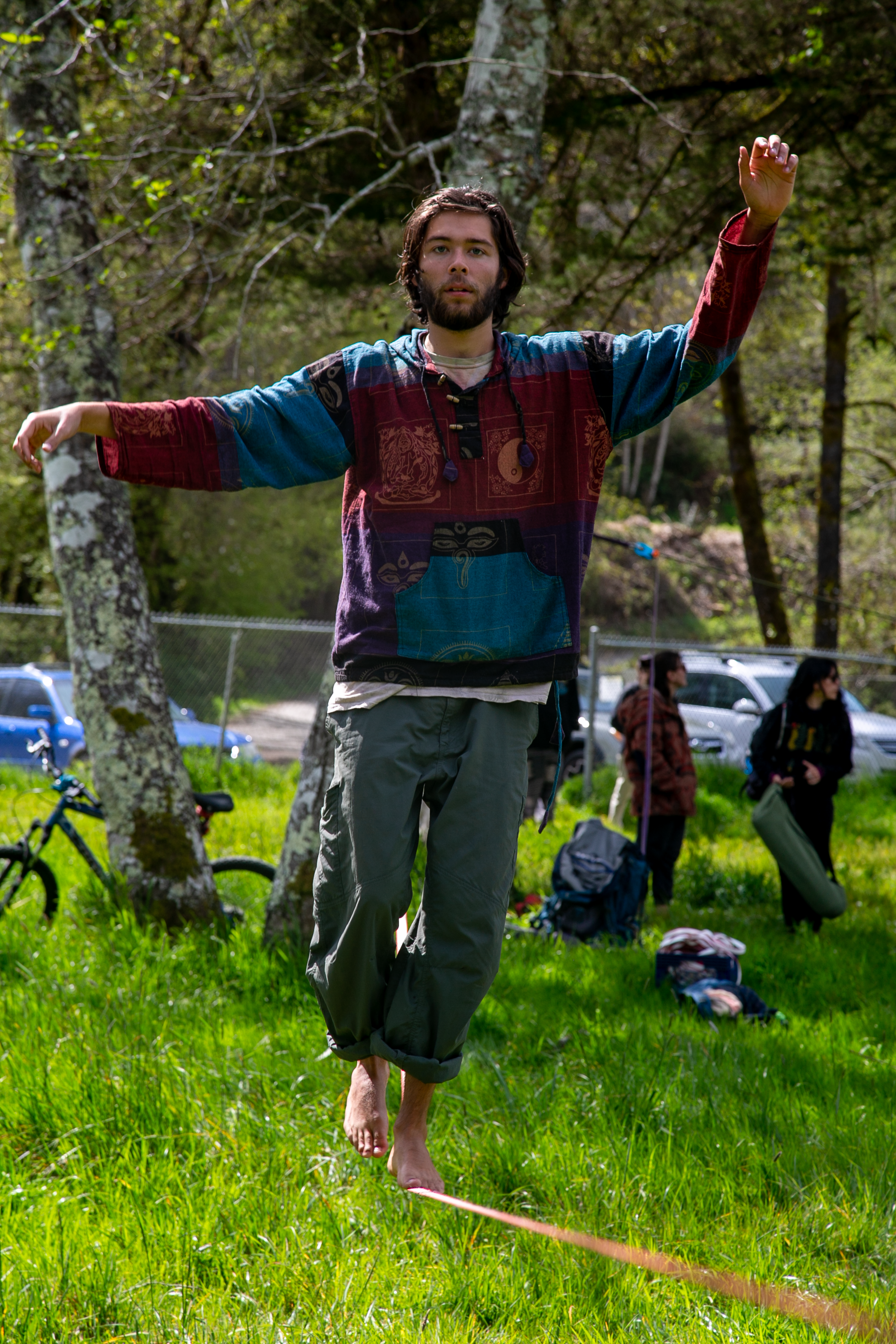
Photo by Abraham Navarro | Gabriela Vargas and Joe Mallory, both experienced slackliners do tricks and balance on their lines at the Mad River Pump Station on March 22.
One of those professionals was Gabriela Vargas. She started by slacklining in her hometown Mexico City and moved to the US after receiving a sponsorship for competing in a trick line competition. Vargas originally moved to Colorado but was attracted to Arcata because of the slacklining culture that exists here.
One issue that many professional slackliners face is debilitating injuries. Vargas said one injury she had forced her out of the competitive space after a leg injury that took six months to recover.
“I like to take my healing slow, because if you don’t let it fully heal and just go back to doing it, it can get chronic and I don’t want that to happen,” said Vargas.
Despite the setback from her injuries, Vargas has continued to expand her skills and has become proficient in highline, when a slackliner is harnessed to the slackline and balances over massive heights. Vargas showed a picture of her slacklining over an incredible drop of over 6,500 feet.
People enjoy slacklining for a variety of reasons but one central theme is the benefits of achieving mental and physical balance when on the line. The appointed treasurer of the prospective club Ella Feick explained how her passion for slacklining stemmed from that need for balance.
“You’re thinking in your head, you’re breathing in your body, and you’re focusing on your balance in a way that you’re not typically. If you’re stressed out or having a hard day you can’t really be thinking about all that stuff, you’re just there,” Feick said. “It’s a very present activity.”
“Slack Sundays” are hosted every Sunday from 12-5 p.m. at the Mad River Pump Station 4 – Disc Golf Course.
Photo by Abraham Navarro | Destiny Vera, Joey Agualar, Ella Feic, Ang Younger and Younger, all students interested in the Slacklining club on campus, at the Mad River Pump Station on March 27.
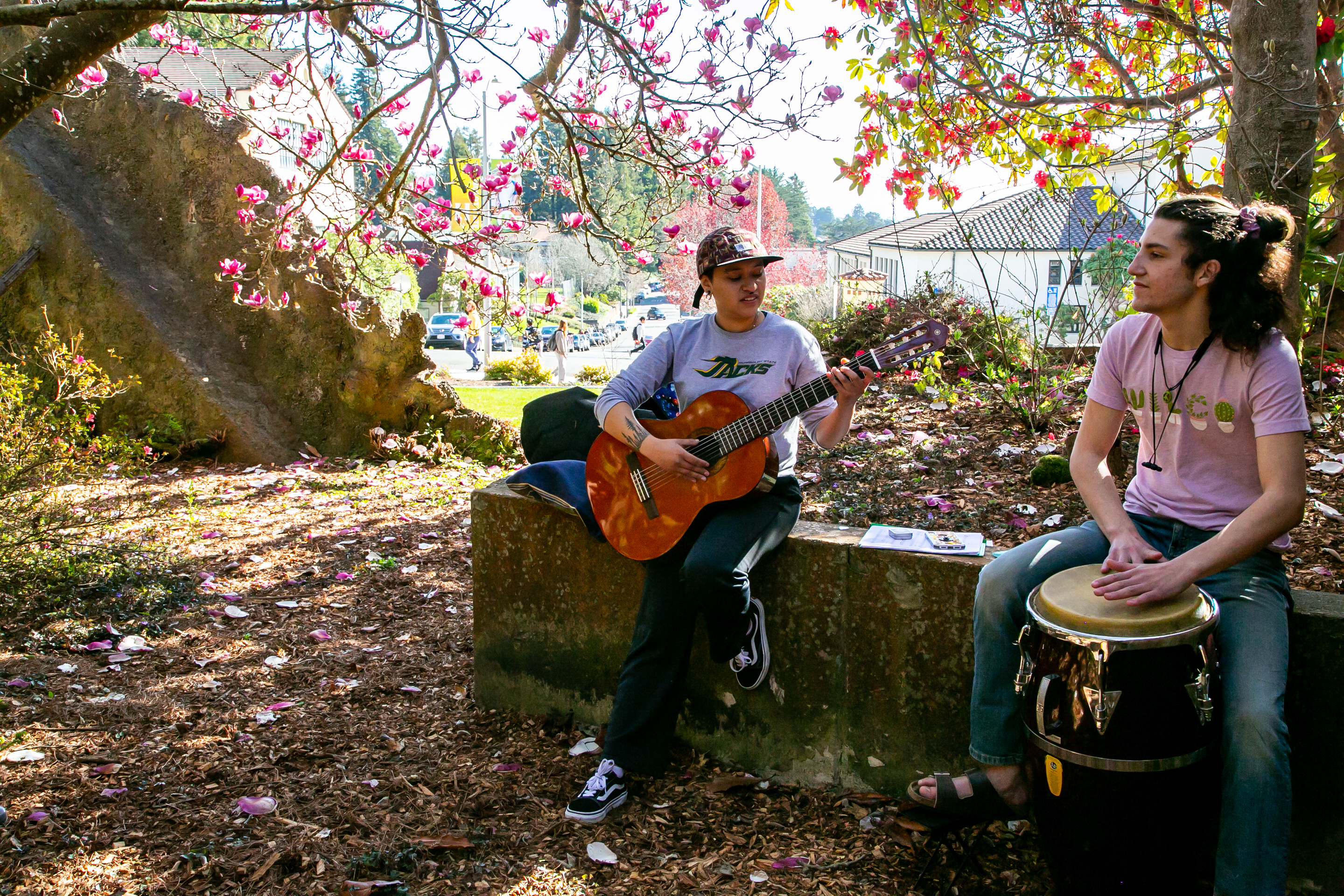
On a sunny day in early March, Wildlife sophomores Olie Espinoza and Dee Naranjo played guitar and conga drums in a hidden alcove near the Art Quad. The sound of the impromptu music could be heard from several feet away.
Photo by Abraham Navarro | Dee Naranjo Plays the Conga drum he uses for for class near the art quad on March 7.
Espinoza (@itsolie_909 on Instagram) just started learning how to play guitar last year and has been playing it ever since.
“I picked it up in maybe June of last year,” Espinoza said. “It’s definitely something that I always wanted to do and I never got a chance to do it.”
Espinoza and Naranjo met in the dorms during their freshman year and jam together whenever they get a chance. Naranjo (@deedeedeedeedeedeedeeeeeee on Instagram) didn’t play any drums prior to learning how to play the congas in a class that they took to fulfill a General Education requirement.
“I just took it as a GE class for the credits, for the art section of GE,” Naranjo said. “I saw it, it sounded cool. I’ve only been taking it for a month so far, so I don’t know much but it’s been really fun.”
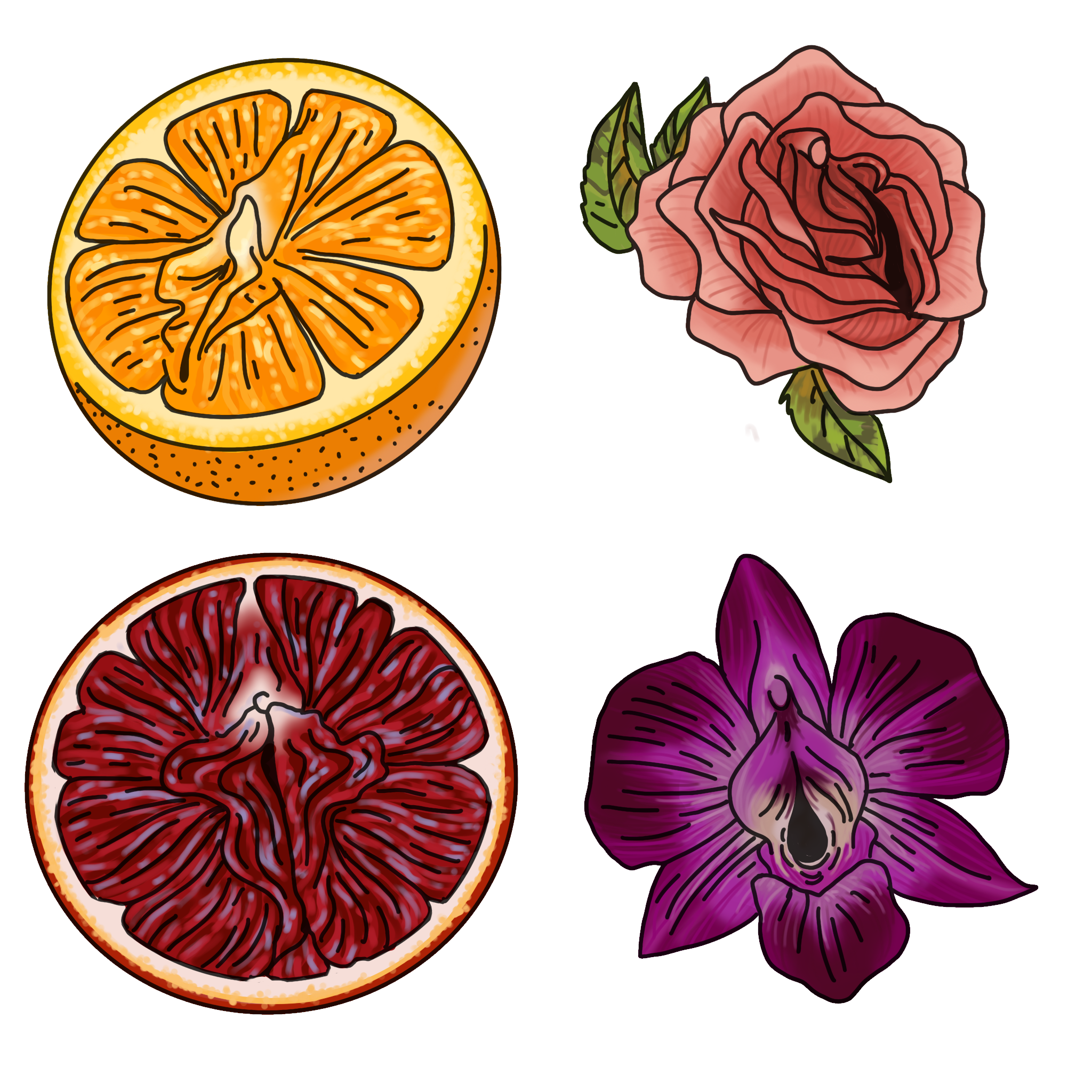
The college experience is something you hear about before you get the chance to step foot on campus. Whether it’s beer talk with dad or sorority rushing advice with mom, we all get a little taste of the dining hall food and frat parties from the people closest to us before our own orientation day, but they usually skim over one major detail: sex. Blame it on your nearing 20s or the newfound freedom of living hours away from your parents, but sex is definitely a part of the college experience. Whether you participate in it or not, with sex comes sex toys.
Graphic by Sierra Cosper
Cal Poly Humboldt’s Peer Health Educators (PHE Humboldt) are here to promote sexual and mental health on campus. The program is funded through the Student Health Center and works to provide student-to-student education surrounding sexual and mental health. The peer educators apply their and others’ experiences to create interactive health promotions such as workshops or guest speakers. The program also focuses on sexual wellness within yourself as well as with partners. The educators encourage the use of sex toys and even have some silicone dildos on display in their office located in the Recreation and Wellness Center in room 127.
The current Peer Health Educators are Sierra Cosper, Selena Aguilera, and Emily Black. All have been with PHE for over two years now. Cosper explained how they feel there is still a stigma around sex toys and sex education as they experienced it first hand as a peer health educator. Cosper also noted that discussion about sex toys and the use of sex toys sometimes intimidates those who identify as male and is more taboo in their daily discussions compared to women.
“Sometimes when I talk to them [men] about the job I’m doing they’ve said ‘oh why would I come in here to know anything,’” said Cosper. “ There’s this idea with men and sex toys that they can’t be better than their penis.”
Black also added they have a tendency to leave out the part about sex toys when explaining their job role to new people they have met to avoid assumptions. She also mentioned how she lacked exposure to toys and sexual wellness before coming to CPH and participating in PHE events.
The group recommended the local storefront Good Relations in Eureka for those interested in dipping their toes into the world of sex toys for a wide selection of toys in discrete packaging as well as informative and helpful staff.
“If you’re too embarrassed to go, you gotta remember they’re choosing to work there, they want people to come,” said Aguilera.
“And then come,” joked Cosper.
“They want you to be as healthy and comfortable about it as possible,” said Aguilera.
The group also advised beginners to use toys by themselves before introducing them to a partner as it can cause some miscommunication sometimes. Although, all agreed using toys doesn’t have to be solitary and using them with others is an experience as well.
Graphic by Sierra Cosper
“It puts a lot of pressure on relationships sometimes, like ‘I’m not good enough’ feelings cause you’re using this toy, but they’re actually just really fun,” said Cosper. “You can’t expect your partner to get you off every time also.”
“It’s supposed to enhance your experience not take anything away from it,” added Aguilera.
Black, Cosper, and Aguilera also encourage proper care of sex toys to avoid sexually transmitted diseases or infections. They recommended a lot of toys are able to be boiled but toys usually come with care instructions on how to clean and properly care for them, also mentioning to steer clear of toys made of porous material and the use of silicone lubes on silicone toys to avoid degradation over time.
“Something people forget to do sometimes is clean communal toys, which are more popular in queer communities,” said Cosper. “The communal strap-on, you should be using condoms on it between each person. Same with vibrators to avoid any risks of spreading.”
The PHE educators all agreed they encourage more open discussions about sex toys to break the fears and taboos surrounding them, which is exactly what they’re doing within their roles on campus.
Black encourages students to participate in their tabling events to enter a safe space for open conversations about sexual health and wellness.
“Everyone gets embarrassed, but liking what you like is sexy,” said Aguilera. “Not being afraid to show what you like is nothing to be ashamed about, you know.”
Join the Peer Health Educators at their annual Sexland event on April 23, a sex-positive, kink-based, informative event including sex toy giveaways and much more.
A group of formerly incarcerated students picked up their ultra-wide pizza slabs and towering salad mounds from the counter at the Arcata Pizza Deli. They dragged two tables together, commandeering chairs from the surrounding tables and gathered for the feast. Each of the Project Rebound members were hungry for conversation with the famous award-winning Chicano poet, memoirist and member of the family Jimmy Santiago Baca.
One of them asks him across the table as he takes a sip of his drink, “So, what’s the pale white monster that’s coming up to get you, Jimmy?”
They were asking about an excerpt he read from a story where he steps out over frigid ice as it splinters beneath his weight to prove his love for his wife, Stacy.
“Ah when you’re a kid you look deep in the water under the ice, you imagine all sorts of things,” Baca says.
Photo by Abraham Navarro | Jimmy Santiago Baca, Chicano Poet, speaks to Cal Poly Humboldt Project Rebound in the Great Hall on March 23.
Baca has a deep raspy voice, and he lights up when he talks to the student. He has a shaved head, furrowed brow with welcoming brown eyes and a warm complexion. Although he’s bundled up against the Humboldt evening chill in a black turtleneck and a blue down jacket, he feels cozy and right at home amongst the formerly incarcerated and system-impacted students from Cal Poly Humboldt’s chapter of Project Rebound.
Earlier in the evening in the Great Hall above the College Creek Marketplace he read exclusive excerpts from some of his unpublished work and other poems and stories of his during the Project Rebound’s third annual Reentry Forum.
Project Rebound is a program for formerly incarcerated and system impacted students at Cal Poly Humboldt. According to their website they aim to empower individuals convicted of a crime in a county, state, or federal jurisdiction who have clearly expressed their desire and readiness to earn a degree at Humboldt.
Baca has been to previous reentry forums, even attending via Zoom during the pandemic restrictions to show his support for Project Rebound and getting to know the members like Tammy Phrakonkham, 30, a Cal Poly Humboldt Project Rebound member and a returning graduate student majoring in geology in the fall.
When Phrakonkham heard Baca read his stories and share his wisdom, she felt as though her experiences being formerly incarcerated were validated. Her family comes from Laos as refugees to the United States. Growing up in impoverished conditions, she remembers her brothers and uncles all working in gangs, and she followed suit. Phrakonkham was incarcerated for stealing cars and trafficking ecstasy.
“It was all I knew,” she said. “When I listen to Jimmy, I feel like I’m not the only one.”
Despite years of isolation due to the pandemic, Baca was happy to make an appearance in Humboldt to visit his friends at Project Rebound, the first event he said he has been to since COVID-19 caused the shift to online events.
“You all have become like my adopted family,” he said to them. “If it wasn’t Project Rebound I wouldn’t have even gotten on that flight!”
Baca was adamant that poetry was for the people, those who suffer and work, play, cry, feel, live and die; poetry was not something that could be hoarded by the wealthy, kept from the poor. It was created by the people and it should be given back to the people. By sharing his work with Project Rebound, Baca feels like he has done that, and he has made a family out of them in the process.
The Cal Poly Humboldt School of Theater’s production of Something Rotten! was entertaining, energetic, and full of innuendo. On opening night last Friday, March 25, patrons filled the Van Duzer Theater to see the comedy, set in the 16th century.
From the opening song, ‘Welcome to the Renaissance,’ the cast dazzled in beautiful costumes on a stunning set. All of the actors are extremely talented singers and performers. It was clear that they all put in a lot of work and are proud of what they have accomplished. Jeremy Stolp, an English Education major who played one of the lead roles, Nick Bottom, feels that being in theater is a rewarding experience.
Photo by Michael Thomas | Jeremy Stolp (left) and Miah Carter (right) star as power couple Nick and Bea Bottom.
“Theater is such a privilege and so much fun to do,” Stolp said. “If you ever have the opportunity, I suggest you try it.”
The musical was incredibly entertaining. Some of my favorite scenes included Shakespeare’s John Cena-esque entrances, Bea’s hope for a gender-equal future, and the show’s lampooning of religion. One of the best songs was “Will Power,” featuring a leather pants-clad William Shakespeare (Jaese Lecuyer) and his crowd of adoring fans. I also enjoyed “A Musical,” a comic number during which fortune-telling Nostradamus (Sammi Pietanza) tells Nick Bottom that the next big thing in the theater will be musicals, all while wearing a hat that I am convinced was a paid actor. Many of the jokes are meant to be ironic, making fun of musicals and the theater. The way that this is incorporated into the story is very clever.
The cast was rightfully proud of what they accomplished and are looking forward to adding to each performance in future shows.
“I don’t think that they (the cast) expected the reaction that they got so when they did it was just this moment of awe,” said Katie Lem, a member of the ensemble. “Everybody standing up at the end was such a beautiful moment for everybody.”
Photo by Michael Thomas | Zoë Saylor performs an upbeat musical number about the bubonic plague.
One of the most compelling performances was Miah Carter as Bea, Nick’s wife. Throughout the play, Bea disguises herself as a man to maintain several different jobs and help her husband financially and push for gender equality. Carter’s performance showcased her talents as an actor and singer, particularly in her solo “Right Hand Man.”
“This is my first ever lead, so this was a good step up for me,” Carter said.
Carter says that theater is a great community to be a part of and that they are all incredibly supportive of one another.
“All of us were so proud of what we pulled through,” Carter said. “I love everyone in this cast.”
The cast and crew are looking forward to continuing to develop this musical as they perform it more.
“I’m excited for the depth and complexity that we kind of add into it every single show,” Lem said. “Not every night is the same.”
The musical is running this weekend on Friday and Saturday at 7:30 p.m and on Sunday at 2 p.m. The musical will have you loving to hate William Shakespeare right along with the Bottom brothers.
Photo by Michael Thomas | From left to right: Zoë Saylor, Sophia Escudero, Jeremy Stolp, Jaese Lecuyer, Jake Hyslop, Michael Jaye, and Miah Carter pose on set of Something Rotten!
In the Van Druzer theater on Thursday, March 3 for the first time since the start of the pandemic student films were shown to a live audience. Around 40 people came to the showing of Cal Poly student films. Several of the films were made in the fall of 2020 there showing being delayed by the COVID pandemic.
The short films ranged from psychedelic, documentary, serious, and funny; some of the films were a combination. The audience made sounds of laughter, shock and sadness reacting to each film with emotion equal to the film itself.
A film director who was in the audience was Kylie Holub, a senior film major. Holub directed and wrote the film “Abstraction” in the fall of 2020. They film . During the pandemic Houlb said “ just keeping our crew really lean and realing thinking about how to tell stories with minimum actors.”
The narrative film “Abstraction” is the story of a beach treasure hunter finding an alien artifact and the fallout of her discovery. The unknown and aliens being major inspiration for the film.
Holub said “ you see a lot of people with metal detectors, we know very little about the ocean and aliens are fun to play around with.”
Another director was alumnus Valerie Rose Campbell created the experimental film “Recipe for Young Mothers.”. Campbell goes through the recipe of banana bread while she narrates the experience of a young mother and her attempts to reclaim her life from an abusive relationship and societal expectations of a mother.
The COVID pandemic heavily impacted the creation of the film Campbell said “ everything got done digitally and that was really hard.”
The film is inspired by Campbell’s own experience in the local family system. “ How it felt so unjust for my kids and family.” said Campbell describing her own life experiences.
There will be another film showcase in the fall of 2022 showing films created in the spring.
Like the blossoms of our early spring, genuine and vulnerable artistic collaboration is blooming at Cal Poly Humboldt.
The Toyon Multilingual Literary Magazine’s ‘SANA, SANA: Hope and Healing for Latinx Communities in Times of Precarity’ was a contest that asked for submissions of poetry, with the intention of having the winning entries set to music.
The poem selected to be interpreted into a choral work by the award-winning composer Carlos Cordero was Alannah Guevara’s ‘Fresh Fruit.’ It is a deeply affecting rumination on vulnerability and intergenerational trauma, filled with haunting and tender images of bruised fruit and parental care.
Guevara says that she wrote the poem thinking of her father, who passed over ten years ago. She’s a native of California’s Central Valley, where many Latinx people have settled and work on the area’s vast orchards. Guevara is half Mexican; she sees in her family and in her community an unwillingness to discuss the painful past, and an unending hope for the future.
“I have really vivid memories of going to an orchard in the town I grew up in… It all melded together, these words that I had and these memories,” said Guevara. “Here in Southern California, who’s working in those orchards is Latinx people, Mexican people. And it got me thinking about my familial trauma, my generational trauma, the things that my dad left me to deal with.”
Graphic by August Linton
Guevara is about to become a parent herself. In ‘Fresh Fruit,’ she feels the protection and hope that her parents struggled to give her, and also the intense desire to protect and uplift her own child.
The final choral piece is deeply beautiful, modern, and connected to the emotional core of Guevara’s poem. Cordero was a fantastic composer for the ‘SANA SANA’ project, both as a stunningly talented musician and also as a member of the Latinx community.
Cordero’s Friday talk, hosted by CPH’s El Centro Académico Cultural, focused heavily on his personal struggle towards vulnerability, and how that has affected his compositions and musical career.
Cordero’s writing process is a very visual one, although his medium is entirely auditory. He works with charts of inter-connected words and line graphs of emotional intensity to visualize his compositions in a more visceral way.
“[Vulnerability] isn’t always going to come back to you immediately, but it’s coming to build or to open that door for people who want to connect with you,” Cordero said. “I’ve learned in art that I open up the door, I don’t make you come in. All I can do is present myself.”
He recounted a story of opening up about his family’s experience of losing his younger sister to members of a choir he was working with. They came to him with stories of their miscarriages, of their losses, and that allowed the whole group to access an emotional connection that was not visible before.
Cordero is originally from Maracaibo, Venezuela, and now lives in Austin, Texas. He says he, like Guevara, has struggled with an unwillingness to have hard conversations with his family about the traumas they’ve experienced.
His piece ‘¡Ayúdame!’ was written as a “Venezuelan plea for life.” Members of the choir cry out “ayúdame, escúchame” (help me, listen to me) in Cordero’s attempt to communicate the suffering and disillusionment of the Venezuelan people.
However, ‘¡Ayúdame!’ also represents the importance of being vulnerable, both by asking for help and by letting other people support you.
Cordero spoke about the expectation within Latinx families and communities that people be strong, that they don’t show their struggles. As he struggled with the trauma of being Venezuelan in the midst of an ongoing humanitarian crisis, Cordero realized that he sorely needed help, that people need to ask for help.
“[In ‘Fresh Fruit,’] Alannah showed me that the struggle is OK. It says to our kids, to our generation, to our families: we want to show that everything is ok but we can also share in their struggles,” said Cordero.
The Cal Poly Humboldt University singers will perform ‘Fresh Fruit’ on Sunday, April 24th, alongside other musicians performing other works from the ‘SANA SANA’ project.
Nearly four years ago, Cal Poly Humboldt decided to abandon local-based programming for KHSU. This heartbreaking decision left local radio personalities with no creative outlet to broadcast from. Recently, some of those same people were able to redeem themselves on a radio station known as Humboldt Hot Air. In its humble beginnings, the station began as a simple recording studio. Any content that was created would be sent to a community-based radio station known as KZZH. In October 2021, station manager Neroli Devaney had set up a live streaming service, which gave rise to an underdog known as Humboldt Hot Air.
“We are an online internet radio station,” Devaney said. “We are based in the Arcata Playhouse. We are very eclectic and diverse in our programming. We have talk shows [and] lots of music shows. We program every other day of the week except for Tuesdays.”
Devaney made it clear that she was not the one who founded Humboldt Hot Air. However, the 24-year-old manager also shared what inspired her to take on this role.
“I did four years of radio at UC Santa Cruz. When I was there, I worked at KZSC, which is the radio station on campus there,” Devaney said. “When I was there, I did a bunch of different stuff, I was also a hip-hop director through a bunch of events, I just found myself really into radio and really passionate about it. I am from Arcata and when I graduated from UC Santa Cruz, I came back to Arcata. When I was in high school, I used to volunteer with the Arcata Playhouse with their teen program, which is called Apprentice Entertainment. Jackie Dandeneau, who is executive director of the Arcata Playhouse reached out to me. [She] said that she started this project called Humboldt Hot Air. They were recording audio and they had this goal of eventually having a live stream…She asked if I wanted to get involved and I said yes. [I] thought it sounded really fun.”
Devaney also explained how the former KHSU audience had become her most avid listeners.
“When we started a lot of people felt that there was this need for community radio in Arcata. A lot of the DJs saw that we were doing Humboldt Hot Air and I started getting a couple old KHSU DJs,” Devaney said.
“We’re still kind of attracting that crowd, which has been really awesome, especially for our own publicity,” Devaney said. “KHSU had this huge fanbase in the community, so to be able to bring DJs back and have them do their shows again– a lot of the community has had a positive response to that, those are our most popular shows, people will be like, ‘oh my god I listened to that show for thirty years and it’s back, that’s so amazing! It’s the same DJ.’ It’s just been really fun.”
Humboldt Hot Air strives to one day become an FM station.
“Photography as Material,” a photography exhibit featuring the work of Julia Bradshaw, is now open at Cal Poly Humboldt’s Reese Bullen Gallery. The exhibit will be featured in the gallery until March 26. Gallery hours are on Tuesday and Wednesday from 11 a.m. to 5 p.m. and Thursday and Friday from 1 to 6 p.m.
Bradshaw’s work involves taking high resolution photos and then processing them through traditional darkroom and editing techniques as well as computer photo editing.
“I’ve never seen anything high resolution like that, it’s almost an illusion,” said Isabela Acosta, a Cal Poly Humboldt art history major. “I want to touch it because it looks like it’s coming at you.”
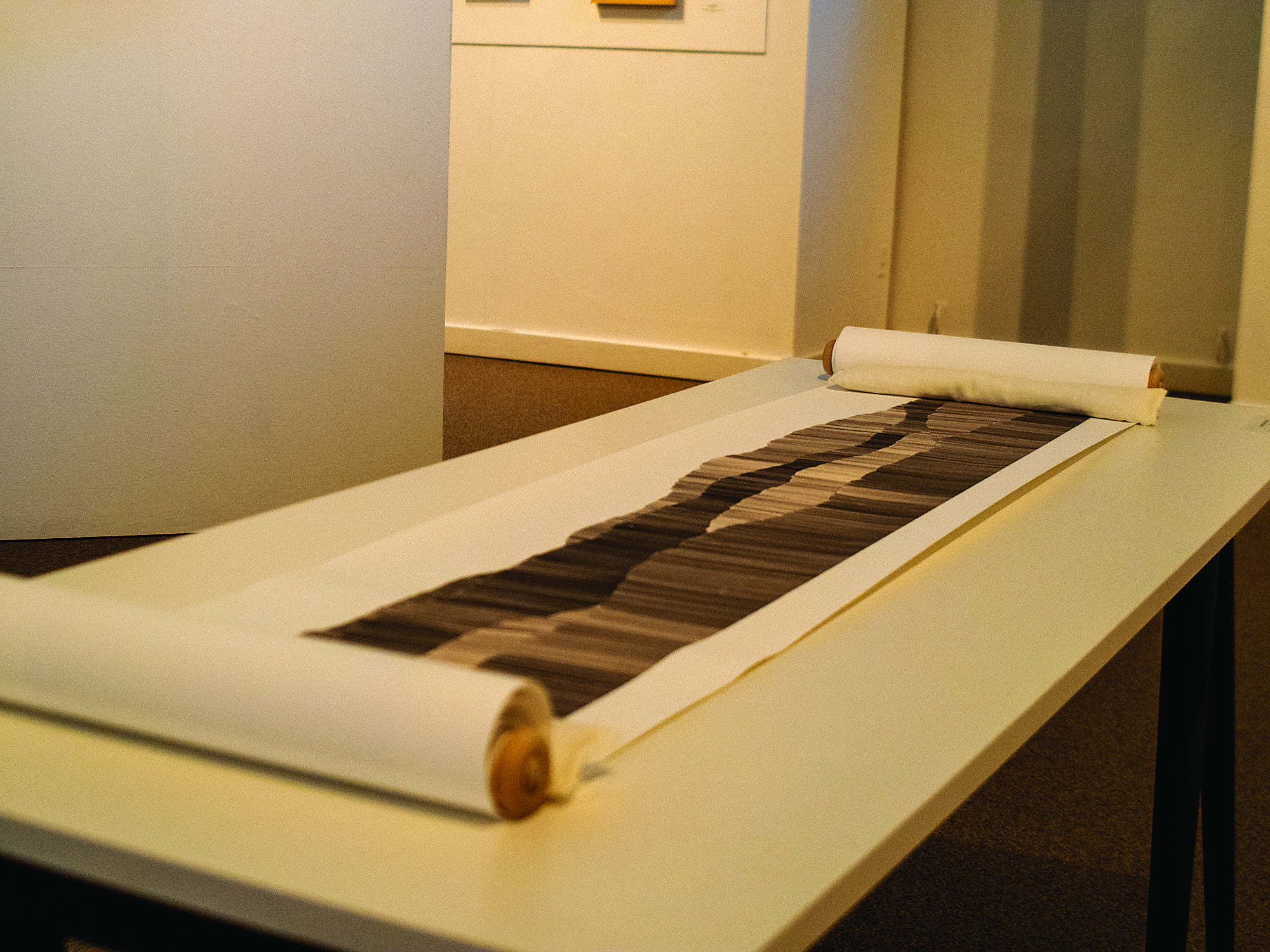
The exhibition features two of Bradshaw’s bodies of work, “Stacks and Shapes” and “Survey.” “Stacks and Shapes” features manipulated images of paperback books. Photographs of books are arranged to create geometrical forms, some of which resemble landscapes. “Survey” includes images of concrete that resemble scientific photographs of the moon.
Photo by Morgan Hancock | Julia Bradshaw’s “Survey” project inspired by early astrological photography.
“All of those are concrete, that’s just concrete, but she’s making it look like images of the moon,” Acosta said. “She does that through different processes of developing films and taking things at a certain angle.”
On her page on the Cal Poly Humboldt Department of Art website, Bradshaw says that the pieces included in “Survey” were inspired by scientific diagrams and notes. The photos were taken using a cardboard box and were edited using knives, inks, dyes, and other techniques.
“The simplicity of the materials is a subtle poke at the vast gap between investment in science and investment in art,” Bradshaw wrote. “By pointing my camera at the most abundant of materials, I aim to empower imagination in conjunction with science.”
Former Cal Poly Humboldt student and current faculty member at the Cultural Resources Facility in the anthropology department, Zedekiah Minkin, was impressed by Bradshaw’s moon-esque photos.
“Compared to the real scientific images, it looks like it could be straight out of NASA,” Minkin said.
Religious studies and art history major Cass Jensen also commented on the realism depicted in the photos. They also think that, by comparing concrete and the moon, Bradshaw is commenting on recurring patterns and themes throughout the universe.
“I really like the collage work because it does look exactly like some sort of scientific model that you would see come from NASA,” Jensen said. “It helps elaborate how certain things can be very similar but very different all at the same time. It’s like how a lot of things that may look really far away and intangible are just, like, everywhere.”
Jensen is a collage artist as well. They are inspired by how concisely Bradshaw is able to convey her message through her artwork.
“I like the simplicity of it, it still makes a point without being too much,” Jensen said. “It’s not as complicated and overwhelming as sometimes my pieces come out to be.”
Overall, the most striking quality of Bradshaw’s work is the illusion that she creates. The images are created to allow the viewer to see beyond just the materials used in each piece. The pieces do not necessarily resemble the materials that they are made of.
“I get a raw sense,” Acosta said. “She’s just doing things from a different perspective.”
Photo by Lexi Rangel | (left to right) Lalo Rivera, Gigi Salazar, Chris Servi, and Josie Licavoli pose for a photo at Goth Night at Richard’s Goat on Feb 25.
On Friday, Feb. 25, Richards’ Goat Tavern & Tea Room hosted its first ever Goth Night, created by recent Cal Poly Humboldt graduate Jamie Cocking. The event was a tribute to the Goth subculture, which originated in the United Kingdom in the early 1980s. The subculture is open ended, yet is heavily saturated with darker tone aesthetics and music.
“I think goth subculture is all about expressing yourself in your truest form,” Cocking said. “Since I’ve lived here and have turned 21, I haven’t found any clubs or events with the music that I love to dance to, so I just decided to do it myself.”
Being a small town, Arcata is not well-known for its nightlife. However, contributions to the scene, such as Goth Night, keep it going.
“I just wanted to create a space where people could dress up as much as they wanted and not feel like they are sticking out like a sore thumb,” Cocking said. “Because for me, I mean everyday is Halloween.”
Richards Goat will be hosting another Goth Night on April 9.
My entire existence is a tightrope balancing act between two facets of myself, that are constantly told they cannot exist together. Yet these facets can not be divided from me nor from one another. I am queer. I’m a person of faith. I am a trans and bisexual Christian.
As Lent rolls in, I often find myself having to reflect upon these two identities. I take this time of the year to re-orientate myself back to my spiritual core. It is a beautiful process that reminds me of my humanity and the love I receive everyday from my Creator, but it is a side that I often feel compelled to hide, just as I am often compelled to hide my queer side from the greater Christian community.
It is a fine line. I’m constantly aware of my fellow queer peers’ religious trauma, something I’d never want to make them relive. It hurts, though, to know that my faith comes with so many automatic assumptions of my character.
Some have ideas that I’m conservative in my politics or that I don’t affirm my own queer identity. I am neither of those, and neither are many other queer people of faith. So, I stay silent. Yet in this very silence I only continue to feed into the false narrative that all religious persons or persons of faith are non-affirming of queer identities, bigoted, or close minded.
Growing up, I was extremely lucky to live in both a queer affirming and religious household. I was raised predominantly in a Christian denomination that had already begun to take the steps towards full LGBT+ inclusion by the time I was born.
It is a huge privilege, one I constantly try to stay aware of. I also believe it is a statement of hope. I am living proof that one can grow up as Christian, as a religious person, and still fully affirm their own queer existence. It is because of this very truth that I continue to live knowing these two identities are not mutually exclusive.
I don’t wish to proselytize or to convert any person to my own faith, nor to any religion in general. There is truth, validity and importance to be found in both agnosticism and atheism. All I wish is to break the narrative that all people of faith are non-affirming.
This perception erases the amazing work that queer people of faith all around the world are doing to create rightful places for us in these sacred spaces. More frightfully, it gives more power to those of faith who may wish to silence us, oppress us or destroy us both within these religious spaces and out of them.
I want to extend my love and validation to any fellow LGBT+ people out there who also desire to stay in or are currently part of any certain religion, whether you be Christian, Jewish, Muslim or belong to any other faith. There are people out there just like you, and there are resources out there that can allow you to flourish fully and wholly as you are.
This Lent, as many like me take this moment to pause and self-reflect on ourselves, I hope to show through my actions and pure existence that religion and spiritual expression are as much a right to LGBT+ people as they are to others.
This year’s keynote speaker, Mary Akpovi, who was born in Nigeria but has lived most of her life in California, inspired us to be both local and global citizens. While Akpovi has spent most of her career in public accounting, her true passion, in recent years, has been charity work. Having been involved with several charity organizations here in the United States and abroad, she has a lot of wisdom to offer.
Photo courtesy of Mary Akpovi
In California, Akpovi was previously a board member for the Exceptional Children Foundation, an organization that provides services to children and adults with learning and developmental challenges. She also worked with Hope of the Valley Rescue Mission, an organization that assists people experiencing homelessness.
Her international work has been centered in Sierra Leone, Uganda, and Kenya. She has been instrumental in opening vocational training centers in these countries and continues to support several vocational schools, primarily in tailoring, catering and salon care.
When asked where her passion for charity work comes from, she said it was the support she received in her own life, from her father, her religion, and from others. Now, she is paying it forward by mentoring, and it is at the heart of everything she does. In her opinion, it is one of the best investments a person can make. She hopes participants got the overall message that everyone has potential. That potential can be fostered by encouraging one another, being intentional, and “staying in your lane,” a phrase that Akpovi holds close to her heart.
by Rachel Hood
Movement and Identity
In light of forced displacements, violence, and complex geo-political issues, Dr Tani Sebro (PSCI) explored the cultural performances that have served the critical function of Myanmar’s refugee population in her session “Aesthetic Nationalism: The Dance of War and Exile along the Thai-Myanmar border.”
In the context of conflict and exile, music, dance, and the performing arts play a pivotal role in creating a sense of national and community, according to Sebro. As a cultural ethnographer who also underwent training in the traditional performance arts called Jaad Thai, Sebro was able to experience how dance and performing arts made life possible outside the contemporary nation-state system for exiled people. In essence, physically synchronized rhythmic movement promotes a strong sense of unity within all cultures, religions, and nations. It also holds potential for expressing ethnic identity for refugees, especially for the Tai living in a time of danger.
by Johnny Mendoza
IEW Highlights Black Voices
On Feb. 14, Professor Maxwell Schnurer kicked off International Education Week with a presentation about the music and activism of Fela Aníkúlápó Kuti, a Nigerian Pan-Africanist and musician.
During his life, Kuti reinvented African culture as a revolutionary act to subvert colonialism and reassert his autonomy as a Black person. “I never thought about it, being African as such,” Kuti said in an interview from the 1970s. “It didn’t mean anything to me until much later in my life.”
Schnurer deconstructed the sociology of colonialism to provide a framework for cultural appropriation, a phenomenon that exploits indigenous Black cultures in particular. Colonialism is a kind of discourse that perpetuates a narrative of European superiority.
“You’re born out of the womb into a world of discourse,” Schnurer said. “Your grandparents, your aunts and uncles had language on this planet, before you arrived.”
Umoja Center for Pan-African Academic Excellence Coordinator and International Studies alumnus Doug Smith also spoke, sharing his ongoing master’s research about Pan-African identity.
“For many people of color, the use of English as a language, as a means of communication, is very tied into their history and engagement with colonialism and settler colonialism,” Smith said.
by Emma Roberts and Lex Valtenbergs
Levels of Connection
International Education Week helps inform us about the issues that connect us wherever we are in the world; two presentations made this point very clear.
COVID-19 is perhaps the most immediate example of how globalization affects our daily lives. Economics professor Beth Wilson brought this idea closer to home by looking at the impact of the pandemic on education.
Wilson’s information-packed presentation examined the different ways that the pandemic has affected the lives of one billion students worldwide, particularly in developing countries with little access to technology. Short term decisions made by local authorities will have long term economic consequences Wilson argued that “COVID-19 is the biggest education disruption in history.”
To finish out the week and bringing the world back to Humboldt, alum Viridiana Preciado discussed the work done by the Sovereign Bodies Institute, an organization that helps locate missing and murdered Indigenous women.
Preciado’s presentation highlighted the injustices that indigenous communities face on a daily basis and talked about the work SBI has done locally with the Yurok tribe and offered ways people can support this effort. She concluded her presentation by pointing out that she got her job after meeting the CEO of her organization at an IEW session two years ago.
“I just followed my heart and introduced myself after the session. I told her I really wanted to help make a difference and here I am,” said Preciado.
by Laura Gurney
Following the Flow: Coffee and Gold
We are very fortunate here at Cal Poly Humboldt to have professors who are passionate about the work they have done, and who want to share their knowledge and experience. International Education Week offers faculty from across the university the opportunity to showcase their work.
Gordon Ulmer and Noah Zerbe traced the “social life” of two very different commodities economically and culturally.
Together, they explored the impact of global markets for gold and food (and specifically for coffee) on local communities around the world. Each of these common goods ties together different social, cultural, political, and economic ideas. They also asked us to think about our own responsibility in that global exchange.
“Starting my day with a cup of coffee connects us, connects me, connects all of us to these broader economic, political, cultural, environmental questions,” Zerbe said.
by Abby Reina-Guerra
Only 1% of College Students Study Abroad – Stand Out from the Crowd
Despite COVID-19 and lockdowns, Cal Poly Humboldt is beginning to plan for study abroad again. Five different sessions during International Education Week helped students prepare for their trips. Videos are available on the IEW website (iew.humboldt.edu/schedule) where you can hear from students about their own experiences; from budget planning and cell phone plans to what it was like to be a student of color in a strange place.
Professors Matthew Dean and Joseph Diémé also hosted a session to talk about their Leon, Spain and Nantes, France programs scheduled to take place this summer. They discussed the appeal of faculty-led programs, including the ease of transferring credits and even the possibility of gaining a minor. More information can be found on the Humboldt Study Abroad website, which also includes information about other programs through the CSU or third-party providers. All programs are available to any student at Humboldt regardless of major.
Photos Courtesy of Danika McGeever on her trip abroad to South Korea.Photos Courtesy of Danika McGeever on her trip abroad to South Korea.
A final look at study abroad was presented by Jonathan Maiullo of College of the Redwoods, who discussed the importance of recognizing the impact you have in the communities where you travel. He stressed the importance of “responsible storytelling” as a way to share your experiences with others while respecting the culture you visit. If you are thinking study abroad is not for you because of cost, there are a number of scholarships with deadlines coming soon.
Kicking off on Valentine’s Day, it seemed natural for anthropologist Mary Scoggin to speak of love in the context of China.She discussed the many different ways in which we understand and express our affection, and how even our most cherished emotion is rooted in our own cultural history.
Educating the next generation is deeply rooted in culture. Vincent Biondo, Department Chair of Religious Studies at Cal Poly Humboldt, talked about Islam and citizenship education in Europe. Biondo addressed the question of how Europe should respond to diversity and incoming migrant communities, specifically Muslims. Biondo argued that Europe should invest in schools that teach pro-social values.
“There’s a lot of evidence that shows that people solidify their prejudices by the time they’re in middle school,” Biondo said.
In other words, if one educates students at a younger age about diversity, communities would become more accepting.
On the other end of the spectrum, Kerri Malloy of San Jose State discussed a workshop he was asked to help host in 2019 on promoting and protecting civil and human rights. That year the seminar was exclusively designed for members of the US civil service like ICE and FBI agents. Perhaps more importantly, it took place at the Auschwitz concentration camp as organizers felt there was no better place to talk about the erosion of human and civil rights.
As Malloy showed multiple pictures of the camp, he asked his audience to consider these images not simply as foreign, but to think of places here in California that are also places of violence.
As he repeatedly observed, “These places were built to last – they have a permanence – they mark the landscape forever.”
by Haley Rodden and Cataleena Tchieng
Work Around the World
International careers offer an extraordinary experience for anyone to branch out of their comfort zone and explore the world. Through your experience abroad you can gain a stronger understanding of other types of cultures, peoples, environments, and governments depending on the work you choose. People who work in an international setting are often pushed to confront extraordinary new elements that open any number of lifetime options.
Careers extend from working on a campus to help students to build their own international experience. Nora Montoya of Cal Poly Humboldt’s Academic and Career Advising Center took time to work for the Peace Corps, and Ryan Gliha worked for the State Department. He has since spent his career helping build strong relationships between the United States and other nations around the world. Now, as the diplomat in residence for California, Gliha is helping students join the foreign service.
Even while still in college there are ways to build a strong international profile. For example, the State Department has remote internships around the world and every government department hosts internships that could help you build your career.
“International work is an opportunity like no other,” Gliha said. “It will change your life”.
For support or more information contact ACAC and Nora Montoya (nora.montoya@humboldt.edu), John Keller, Peace Corps (Jkeller2@peacecorps.gov) or Ryan Gliha, State Dept (DIRnorthwest@state.gov).
by Leslie Ortiz
About International Studies
Photo courtesy of the International Studies dept.
International studies is an interdisciplinary major that examines the drivers of globalization. The goal is to better understand the forces that shape the world so we can make changes in that world. Students study other languages and are required to study abroad as part of their own exploration of the interconnections between people and places local and global.
International Education Week, now in its 23rd year at Humboldt, is a 1-unit colloquium crossed-listed by six majors and open to the community, but required for international majors. This year, IEW brought together faculty and staff from across Humboldt, California and the world via Zoom to present 30 hours of programming to well over 700 attendees.
Students in this year’s international capstone class acted as hosts for each session and wrote this report of the week’s events. We are honored to be guest reporters for The Lumberjack and hope this helps you feel less distanced in a time of COVID-19. We are rooted in this community but still reaching for the world.
If you have any questions about IEW or international studies, my door is always open.
International Education Week would like to thank its sponsors and all of our presenters. The full schedule and videos of sessions from 2022 (and 2021) can be found online: https://iew.humboldt.edu/.
International Studies Capstone Class Spring 2022 Laura Gurney, Rachel Hood, Johnny Medoza, Leslie Ortiz, Abby Reina Guerra, Debora Rios, Emma Roberts, Haley Rodden, Cataleena Tchieng, Lex Valtenbergs
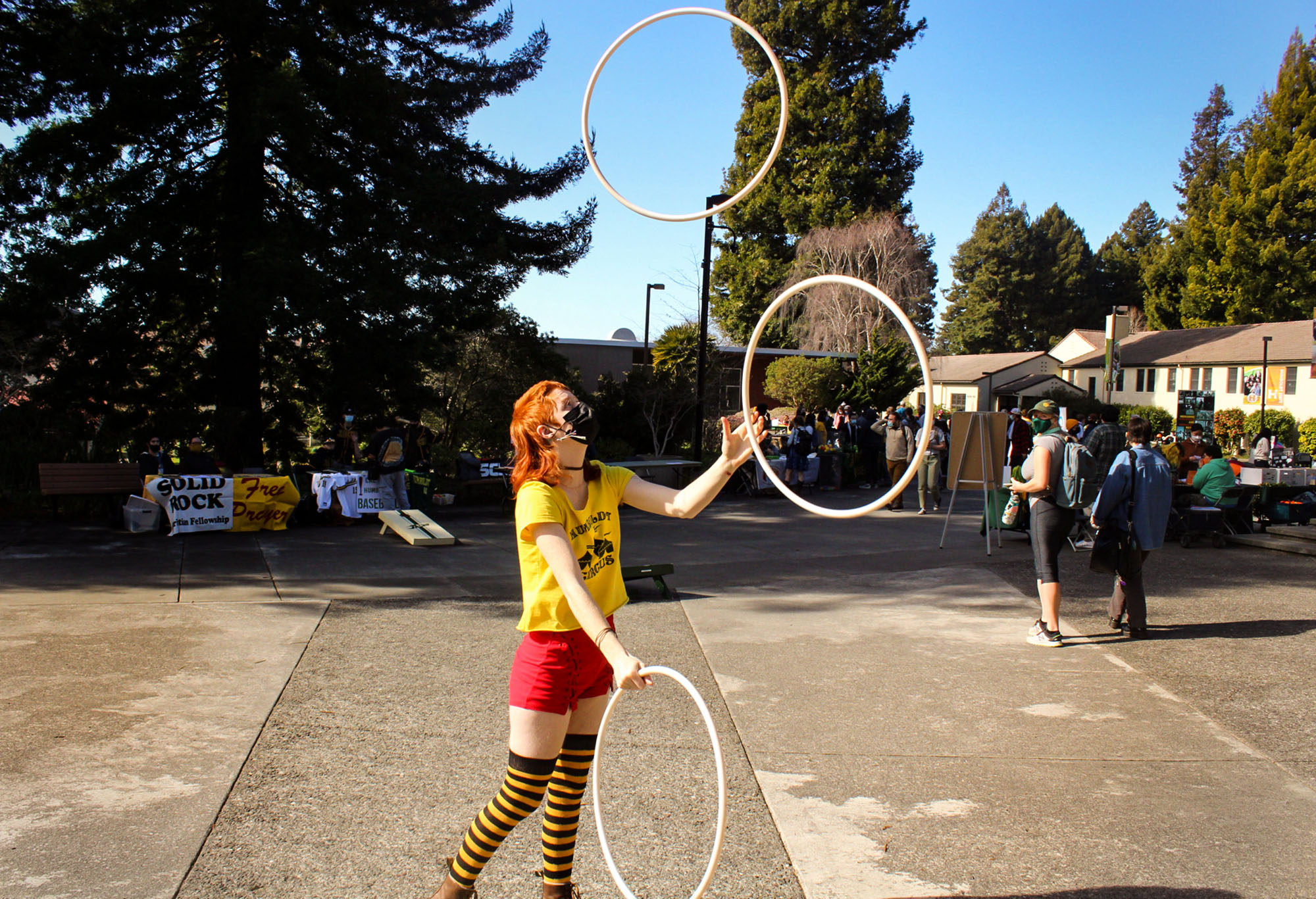
As his staff flew around his body. It became an extension of himself, twirling over the pavement. Man and tool became one through dance. Liam Boyd, a transfer student, and part-time circus performer ran up to the booth with a clown nose and a staff in hand. He had no idea Humboldt had a circus club and was overjoyed to meet everyone. Boyd started to perform with his staff and soon was joined by others, slowly growing into a full-grown performance.
The Humboldt Circus is one of many student-led Cal Poly Humboldt clubs. These clubs give students a safe place to meet like-minded individuals and learn new skills.
Photo by Gabriel Zucker | Louis Parr and Isla Marten sit behind the Circus Club banner, calling people over to check them out. Feb. 11.
On Wednesday, Feb. 10, student clubs set up booths around the Quad. This gave new students a chance to learn about and join these clubs, opening the door for new friendships and experiences.
Louis Parr, President of Humboldt Circus, brought a box full of circus props to their booth. Immediately the traffic in front of the booth increased.
“Circus is a magical place, full of fun and free creativity,” Parr said. “You are allowed to do whatever you want to, within the circus.”
Every week Circus hosts “Play Time” Monday from 5-8 pm at the West Gym. There they give students a chance to let their inner freak out in an artistically unique way. In this space, students are given complete freedom to explore and experiment to their heart’s content, trying new things every time, or perfecting one act over the course of the year.
Isla Merten, a longtime member of Humboldt Circus, walked around the Club Fair. They juggled everything from bowling pins to thin disks. Soon they were joined by more and more interested students, all signing up for the club and trying out some of the cool props. By the end of the club fair, multiple students had stopped what they were doing and taken a couple of minutes to try out different props and write down their emails.
Photo by Gabriel Zucker | Louis Parr, President of Circus Club, does bike tricks around the quad, during the Club Fair on Feb. 11.
Humboldt Circus gives its members endless possibilities for what they can perform and act out. Character acting and improv also have a place in Humboldt Circus. Props are used for tricks, laughs, and skits, adding a new layer to the performance. This year Merten moved away from the props and instead focused on improv and clowning.
“A clown means being creative and open to work with what you are given,” Merten said. “The spirit of play and creation.”
Embodying the clown, they act out scenes by themselves and with others. Merten uses improv to expand and perfect their character. Humboldt Circus, like all the other student clubs, gives a social place for students to bond with one another. When asked about who usually joins the club, Merten didn’t miss a beat.
“It’s a club for introverted weirdos,” Merten said with a laugh. “We have extroverted weirdos too.”
In 2019, Cal Poly Humboldt students envisioned a project that would re-indigenize the campus by creating the Rou Dalagurr Food Sovereignty Lab & Cultural Workspace.
According to the summer 2021 FSL Progress Report, this new indigenized space is “dedicated to the research, practice, and preservation of food sovereignty and traditional ecological knowledge. The purpose of the FSL is to provide an opportunity to work directly with the surrounding communities, tribal nations, and national and international scholars and community leaders to center, learn, and engage with Indigenous science, environmental management, and preservation practices.”
The Food Sovereignty Lab serves to “unify our students, faculty, local tribes, and communities; to center and support tribal sovereignty, natural resource management, and preservation practices; and to provide students with culturally appropriate education in Indigenous natural resource management that respects Indigenous sovereignty and self-determination and serves our community.”
To help the public and Cal Poly Humboldt students understand the practice of food sovereignty, there will be an online film series via zoom that highlights the importance of revitalizing traditional food sources in March and April.
The first film, “Inhabitant: Indigenous Perspectives on Restoring Our World,” will be presented by the Social Justice Summit on Thursday, March 3 at 7 p.m. PST.
The second film, “Voices From the Barrens: Native People, Blueberries & Sovereignty,” will be shown Thursday, March 24 at 7 p.m. PST.
“Gather” will be shown on Thursday, April 14 at 7 p.m. PST.
The third part will be a double feature. “El Cacao: The Challenge of Fair Trade,” and “No Place to Grow,” featuring a discussion with filmmaker Michelle Aguilar, will be shown on Thursday, April 24 at 7 p.m. PST.
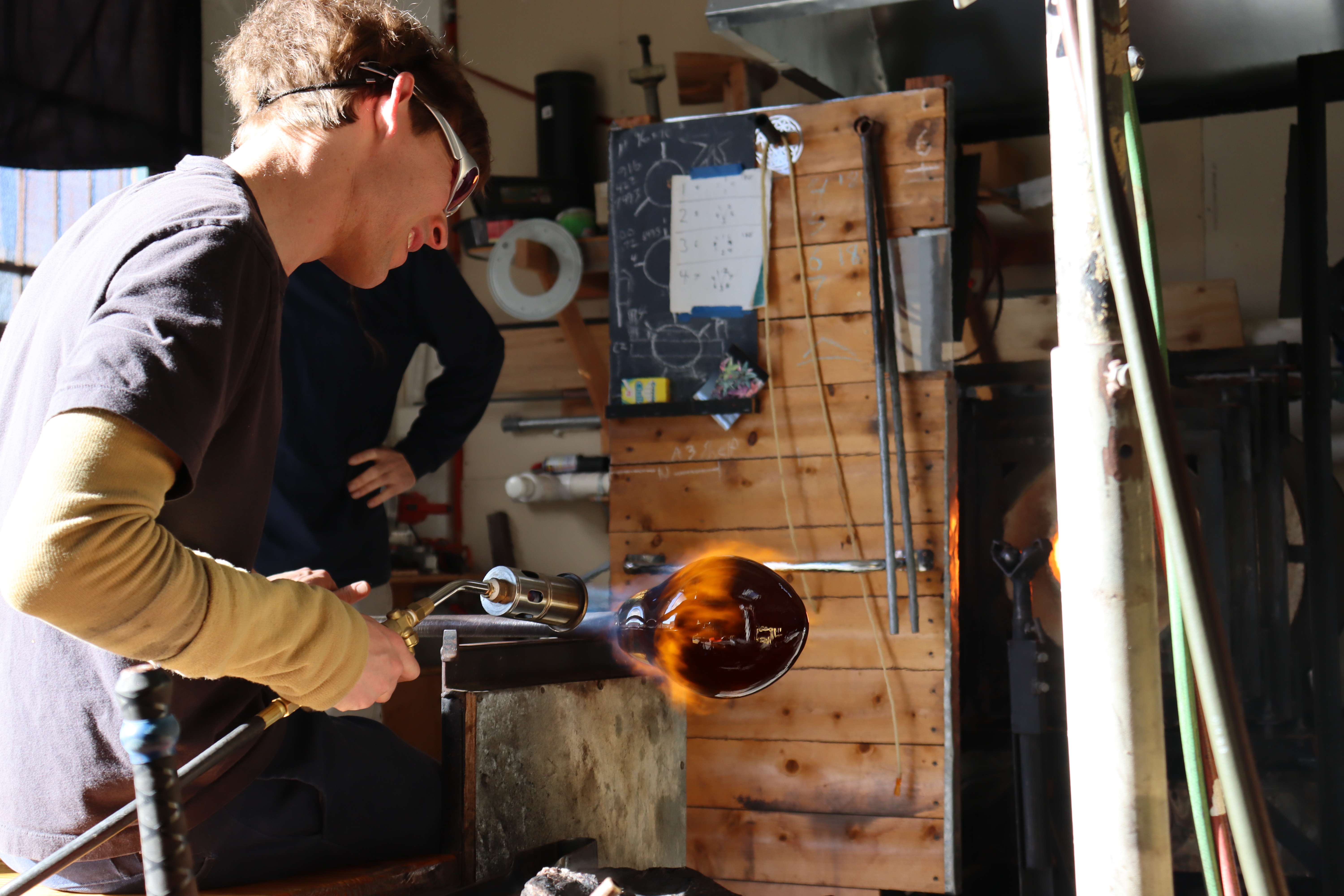
Tucked away in a small alley behind Six Rivers Solar on Broadway in Eureka is John Gibbons Glass. At his glass art workshop, Gibbons can be found coaxing hot molten glass into stunning art pieces or after melting down raw glass in his homemade furnace.
Photo by Lex Valtenbergs | John Gibbons (left) and Matthew Gagliardi (right) shaping a glass sphere at Gibbons’ glass art shop in Eureka on Feb. 1
Gibbons was first introduced to glass art by his father at antique glass shows when he was five or six years old. He’s been hooked ever since. While studying glass art at college, he dreamed of it when he slept.
“All I could think about was blowing glass,” Gibbons said. “I dreamed about it every night for a year.”
The glass artist community in Humboldt County is small but tight-knit. Matthew Gagliardi, a glassblower with three decades of experience under his belt, has worked with Gibbons for the last five years. Gibbons and Gagliardi both use soft glass, a fluid type of glass that is ideal for sculpting.
“We all kind of work with each other,” Gagliardi said. “There’s only so much of us in the county that work with soft glass.”
Photo by Lex Valtenbergs | Michelle Coelho diverts heat from John Gibbons’ face with wooden heat shields while Gibbons shapes a glass sphere in his shop in Eureka on Feb. 1
Michelle Coelho is another one of the few Humboldt-based glass artists who works with soft glass. She has been doing it for 20 years, about as long as Gibbons has. Gibbons, Gagliardi and Coelho all specialize in Venetian glassblowing, a technique that dates back to the 8th century AD. The type of tools that they use goes back to the 14th century AD.
The trio worked in synchronized harmony on the morning of Feb. 1 to transform a glob of raw glass into a beautiful pendant light, a lime green sphere with a hypnotic spiral pattern rolled into the glass on a steel table – a marver – and inlaid with a mold.
“It’s like a well-orchestrated dance,” Coelho said. “John’s body language tells us what to do next. It’s not so much verbal, it’s visual.”
They were constantly in motion to prevent the glass from losing its temperature and shattering or drooping down towards the floor like viscous honey falling off a honeycomb, as Coelho put it. They have to be on sharp alert at all times. Not only is the glass is heated up to over 2,000 degrees Fahrenheit, the operating costs involved are expensive as well.
“There’s a lot of trust, and also money,” Gibbons said. “You gotta trust them not to break your investment because there’s a lot of money that goes into it.”
Photo by Lex Valtenbergs | A close-up shot of a hypnotic pendant light made by John Gibbons, Matthew Gagliardi and Michelle Coehlo at Gibbons’ glass art shop in Eureka on Feb. 1
Gibbons hired a media assistant in April 2021 to vamp up his online presence. Makayla Sandifer worked in information technology before she found a niche in media production and picked up the job at Gibbons’ shop.
As a Black woman in a white and male-dominated field, Sandifer enjoys the opportunity to work in such a dynamic space that fosters her creativity.
“It’s honestly awesome,” Sandifer said. “It allows me to bring diversity to spaces that didn’t have it previously and to reflect that in my work. It’s super gratifying.”
The product photos that Sandifer takes for Gibbons’ Etsy profile do justice to his vibrant glass art pieces. Whimsical starfish vases, turtles with bubbles of glass trapped inside their shells, and light fixtures adorned with alluring spiral patterns boggle the mind with their complexity, vibrant colors, and otherworldly beauty.
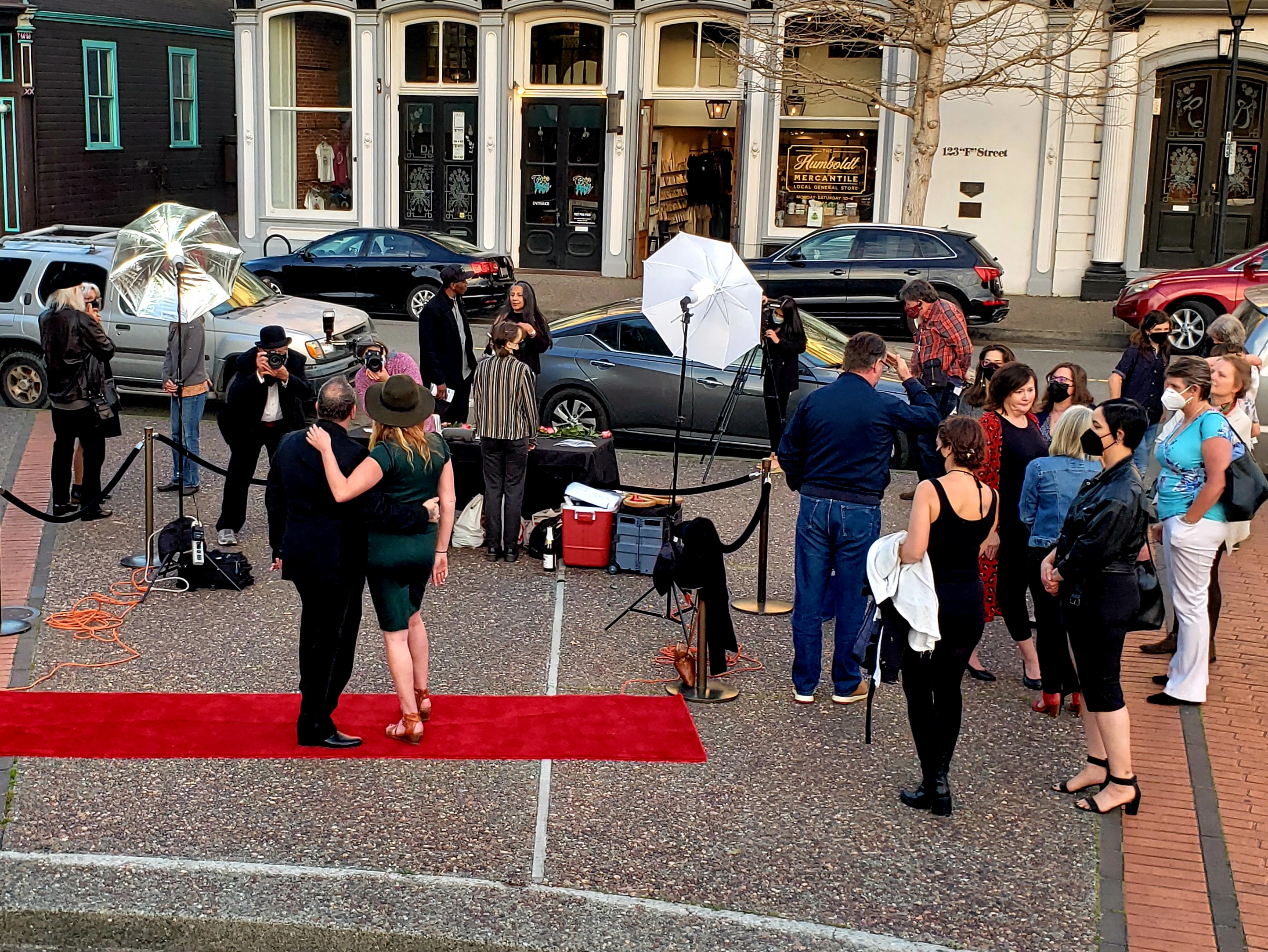
On Friday, Feb. 11, the A24 movie “The Sky is Everywhere” premiered on Apple TV+, accompanied by a red carpet event in Old Town Eureka. Filming took place locally on such locations as Moonstone Beach, Arcata High School, College of the Redwoods, and Sequoia Park, and over 500 locals were involved in the production, myself included.
The film itself explores the grief of Lennie Walker, a high school girl grappling with the sudden loss of her idolized older sister. Lennie, portrayed by actress Grace Kaufman, finds herself caught between a grief-forged connection with Toby, her late sister’s boyfriend (Pico Alexander), and Joe, an intriguing new music student fresh from a Parisian conservatory (Jacques Colimon), but more than that, she finds herself torn between mourning and moving on.
Director Josephine Decker depicts this world through a lens of magical realism. Lennie’s inner turmoil causes a storm around her only she can see, and the act of playing music literally leaves her walking on air. While these slightly surrealist aspects could serve to take one out of a film, here it serves to highlight Lennie’s turbulent emotions and sense of unreality. The visuals help set “The Sky is Everywhere” apart from many other YA dramas, while characterizing it with a certain twee sensibility and aesthetic.
The film’s minor characters round out the ensemble with heart and soul. Tyler Lofton’s nice guy Marcus, Ji-Young Yoo’s supportive bestie Sarah, and Jason Segal’s stoner uncle Big are all highlights, but Cherry Jones as Lennie’s grandmother Fiona is the standout star of the ensemble. Jones grounds the piece with her kind yet authoritative presence, quietly stealing the show without detracting from her costars. Though the film focuses on Lennie, it, unfortunately, does so at the cost of the people around her. We never get more than one or two shallow notes on many of the people populating this world, despite the actors turning in genuine performances with what they were given.
Still, nothing is quite like seeing my own hometown (and in one scene about four minutes in, my own face) filmed so beautifully and professionally on the silver screen. Humboldt is on full display here, with every scene reminding the local viewer of a place they know well. A jubilant dance scene appears before the Old Town Gazebo, a heartfelt apology takes place in the streets of Ferndale, and the Arcata Presbyterian Church hosts the funeral that sets so much into motion. The emotion of seeing one’s home in this way was one shared by Deputy Director of the Humboldt Film Commission Nate Adams, who I interviewed at the red carpet.
Photo by Sophia Escudero | Eureka Mayor Susan Seaman cuts the red ribbon commemorating the Old Town gazebo as a site of filming Feb. 11.
“It’s overwhelming, trying to focus on the movie and seeing the locations, and the people, and the art, and even my friend’s stickers made it into the movie,” Adams said. “It’s just overwhelming to see so much of Humboldt.”
Film Commissioner and HSU alum Cassandra Hesseltine teared up as I asked her about her experience helping create this production.
“I cried at the end of the movie yesterday when I watched it,” Hesseltine said. “Part of why I cried is because I love working in film. I wanted to work in film since I was five. Besides the content of the movie, and it is a beautiful movie, the reason why I cried was just to think about how all this happened in my community, that I helped it happen, and it was really, really special.”
“The Sky is Everywhere” is available for streaming at Apple TV+.
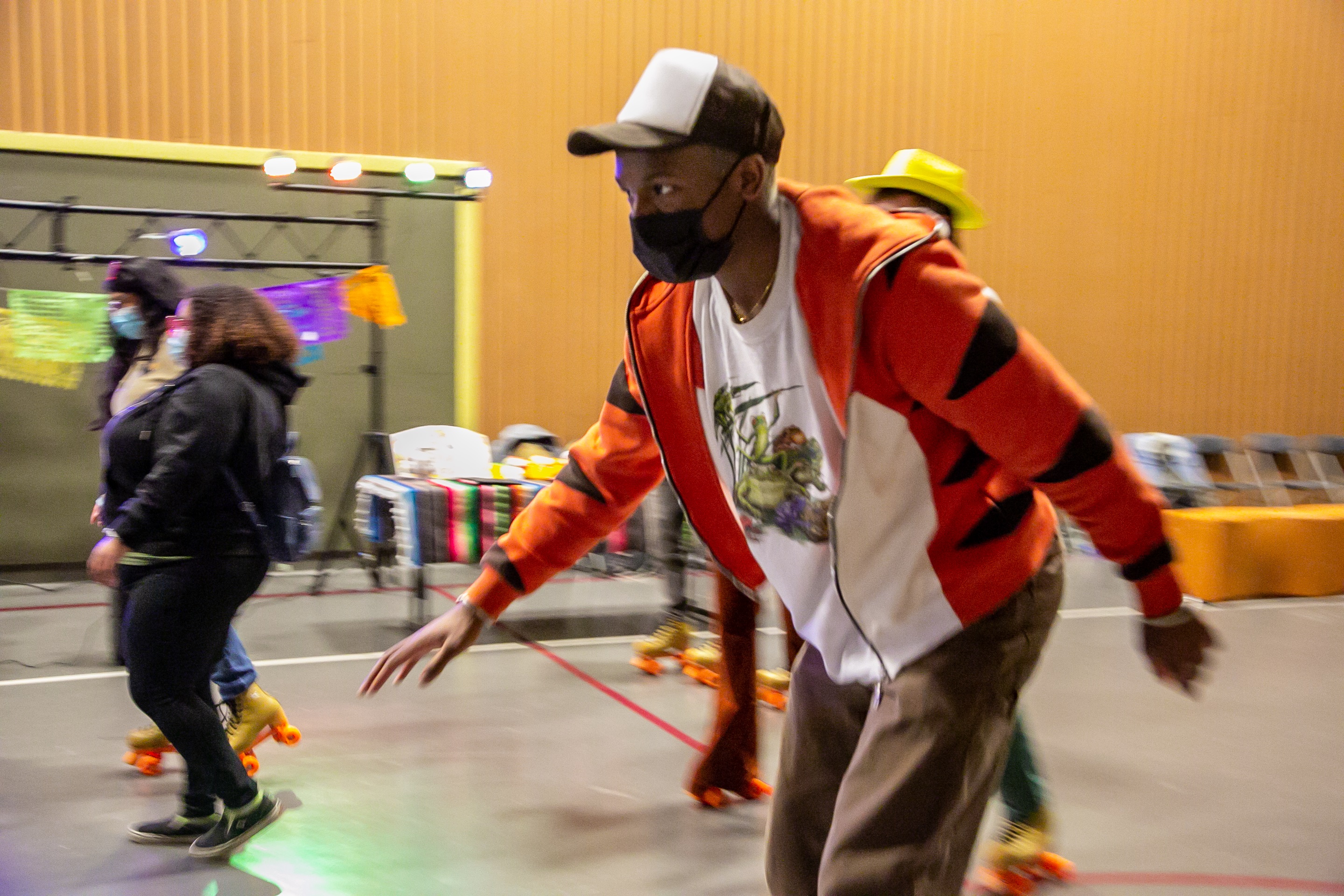
A flurry of rainbow colors whipped by as Cal Poly Humboldt students both old and new skated side by side across the West Gym’s floors. Outfits ranging from the mundane to the elaborate, with glitter dotting the faces of many, could be seen throughout the room.
Near the entrance of the gymnasium, two tables were draped in sarapes and decorated with marigolds, sugar skulls, and an assortment of popular Mexican candies. Behind these tables stood a large speaker and multi-colored spotlights, as well as over thirty chairs where students would fight to get the tight roller skates onto their feet.
Volunteers collected donations for the El Centro Académico Cultural de Humboldt (El Centro) ‘Graduacion Latinx’ ceremony.
“The first [Skate Night] was just a phone speaker,” Taylor Sachez, an ESM major, said whilst putting on her own skates. “Since then we’ve got a DJ and sponsor.”
El Centro is that sponsor. Under the ideas and leadership of Giovanni Guerrero, ESM major and a student staff member of the organization, this Latin-themed skate night was born. This project has been in the works since the fall semester of last year.
“I heard about HSU having skate nights,” Guerrero said. “I wanted to combine the skate night with Latin music to make it a kinda party.”
Photo by Abraham Navarro | Cal Poly Humboldt Students round the corner in the West Gym during Roller Skate Night on Feb. 4.
A party it certainly was. Students skated in circles around the linoleum floor, but many also danced together, swinging each other around with the momentum of their wheels.
Latin music blasted through the speakers and through the skaters’ bodies, with the DJ, known as B1g $uave, interjecting every few minutes to liven the crowd up. When he’s not spinning the tunes, B1g $uave is José Juan Rodriguez, wildlife biology major and student staff member at El Centro.
Cal Poly Humboldt students and friends Norma Francisco and Cierra Holmes heard about the drop-in skate nights through El Centro’s sponsorship.
“I would go [skating] occasionally, mainly while in middle school,” Holmes said. “I think ice skating is easier.”
“I think this is easier,” Francisco replied with a laugh. “I was nervous to come, both to skate for the first time and from being off-campus for so long.”
Both friends were able to agree on one thing though, the event was fun and had good vibes.
Kumami Jackson, a local science major, explained that he’d been skating on and off since the 3rd grade but skateboards pretty regularly.
“It’s kinda the same motion,” he said.
A few couples dotted across the room could also be seen skating together. One such couple was Jessica Ordaz, a mathematics education major, and her partner Gilberto Gamboa. He held her arm or hand all night as she attempted to learn how to skate. She was the event specialist for El Centro, but this was one of her first times doing this kind of skating.
“I’m very grateful for the people here, I want to encourage people to come out,” El Centro staffer Guerrero said nearing the end of the event. “[El Centro] is planning [other] events, Ciencia Para Todos and Cafe con Chisme.”
Ciencia Para Todos (Science for All) will be hosting the creation of their bilingual science children’s book this Friday at 3 pm in Nelson Hall 206, and community talk space Cafe con Chisme will meet on Friday, Feb. 18th at 3 pm in Nelson Hall 205.
None of us thought we would wake up one morning and be told that we could no longer make connections the way we were used to. COVID-19 became a part of our daily lives, affecting us at every turn.
Dating during a worldwide pandemic has impacted us all in unique ways, including CSH students.
Local resident and Cal Poly Humboldt alumnus Olivia Brock shared their experience.
“Dating during COVID times for me is for sure more online now at the beginning of talking to someone,” Brock said. “It definitely restricts what we do … all the dates I’ve been on have been outside usually somewhere in nature with a mask on.”
Once you’ve managed to meet someone, COVID-19 precautions also complicate bringing them home. Having roommates means that bringing over a new flame has to involve conversations about masking, exposure, and testing.
“But once enough of the outside dates and FaceTime dates have happened and it feels worth it, then we could move forward with figuring out how to add someone to our exposure bubble. It’s a lot of logistics and communication,” said Brock. “I enjoy FaceTime dates a lot, because I don’t have to leave my house and they’re easier to schedule.”
Building connections online does have its advantages, according to Brock. She says it forces her to be more engaged in the conversation, because that’s the only way there’s any hope of forging an online connection.
“Overall, COVID has forced me to go slower in relationships and communicate boundaries more effectively,” she said.
History major Victoria Bankson often worries about the vaccination status of potential partners. She says that if the person she’s interested in has purposely chosen to avoid getting vaccinated, that completely changes her opinion of them and weighs into her decision to ultimately not date them.
“I’m not going to mess around with somebody who’s unvaxxed, that’s just not right,” Bankson said. “We don’t have the same values if you’re that way.”
She also shared that conversing online isn’t the most enjoyable way for her to get to know someone, but that having a phone conversation feels more intimate and comfortable.
“I don’t like texting online, and I don’t feel like I’m the best communicator that way,” Bankson said. “I’m much more of a ‘give me a phone call’ [person,] which is very much opposite of what things are now.”
Junior Franziska Daumberger doesn’t feel like COVID-19 changed the dating scene for her personally, but acknowledges that it added some new challenges.
“People would either be careful about COVID and say like ‘oh I’m vaccinated’ or ‘I wear a mask’ or wanting to meet in outdoor places,” said Daumberger. “And then that’s further stipulation upon whether or not I was interested in them or not … if they didn’t care at the height of it I was like ‘I don’t wanna be even knowing you because your beliefs don’t align with mine.”
A new local restaurant opened on the Cal Poly Humboldt campus. Located inside the College Creek Marketplace, Taste of Bim is now serving the public. The grand opening for this Caribbean-inspired spot happened on Wednesday, Feb. 2.
Gabrielle Long is the owner of the Eureka-based restaurant. She was accompanied to the grand opening by her mother Verna. Long says she is excited for the opportunity to bring a fresh set of flavors to campus.
Photo by Abraham Navarro | Gabrielle Long, owner of Taste of Bim and her mother Verna Long serve up carribean cuisine at the ribbon cutting ceremony on Feb. 2 outside the College Creek Marketplace.
“Bim is slang for Barbados,” Long said in her statement before the ribbon-cutting ceremony, “I want to continue to spread Caribbean love and flavor.”
The menu will go through rotations depending on the day of the week, featuring many items including plantains, jerk wings, burgers, curry chicken, and more.
“A Taste of Bim seeks to satisfy your soul via your taste buds in a warm and classy atmosphere,” the restaurant’s website says on its welcome page. “Our cozy little restaurant specializes in Caribbean cuisine inspired by our family’s heritage.”
This all authentic food is now available to students, staff, and the public. James Richards, Resident Dining Director, was ecstatic for the opening.
“It is the kind of place you’re going to go and leave full,” Richards said in his speech.
Richards went to the restaurant prior to the opening on campus and loved it. Taste of Bim was recommended to him by Dr. Jason Meriwether, Cal Poly Humboldts Vice President, who also loved the food.
“The food spoke for itself,” Long said. “Dr. Meriwether came down and tried the food and he loved it.”
All that was left was the logistics. College Creek Marketplace had an open spot for new food and it was a perfect place to add some flair and flavor.
Many people came out for the grand opening ribbon-cutting ceremony. There were free samples and swag. Janaee Sykes, Social Events Specialist in the Admissions office went for two reasons.
Photo by Abraham Navarro | Cal Poly Admissions speciallists Rickiyah Mcgrady and Janaee Sykes, enjoy carribean cuisine at the Taste of Bim ribbon cutting ceremony on Feb. 2 outside the College Creek Marketplace.
“I came out to support local black business. It’s quite refreshing to have them on campus,” Sykes said. “I really liked the cod fritter, it was probably my favorite. I usually don’t like fish but it is not super fishy.”
Sykes mentioned she had been to the original spot before and it was always delicious with great customer service.
“The customer service was 20 out of 10, totally recommend,” Sykes said.
“The plantains are really delicious,” said Admissions Counselor Rickiyah McGrady. “And the beef empanada is just delicious.”
Many Cal Poly Humboldt faculty and staff showed their support for the new business during the grand opening.
Featuring all student employees, Taste of Bim is now open Monday through Friday from 11 am to 7 pm. Head there any day of the week to experience flavors from Barbados and the Caribbean.
This website uses cookies to improve your experience. We'll assume you're ok with this, but you can opt-out if you wish. Cookie settingsACCEPT
Privacy & Cookies Policy
Privacy Overview
This website uses cookies to improve your experience while you navigate through the website. Out of these cookies, the cookies that are categorized as necessary are stored on your browser as they are essential for the working of basic functionalities of the website. We also use third-party cookies that help us analyze and understand how you use this website. These cookies will be stored in your browser only with your consent. You also have the option to opt-out of these cookies. But opting out of some of these cookies may have an effect on your browsing experience.
Necessary cookies are absolutely essential for the website to function properly. This category only includes cookies that ensures basic functionalities and security features of the website. These cookies do not store any personal information.
Any cookies that may not be particularly necessary for the website to function and is used specifically to collect user personal data via analytics, ads, other embedded contents are termed as non-necessary cookies. It is mandatory to procure user consent prior to running these cookies on your website.