The Lumberjack


Students Serving The Cal Poly Humboldt Campus and Community Since 1929

Tag: News

  • Seven years after the killing of Josiah Lawson, Arcata still mourns his loss

    Seven years after the killing of Josiah Lawson, Arcata still mourns his loss

    By Eli Farrington

    On April 15, 2017, David Josiah Lawson, an HSU sophomore, community leader, and member of the Black community, was killed at a house party in Arcata. He was sprayed with bear mace and then fatally stabbed six times after he was falsely accused of stealing someone’s cell phone. 

    On the seventh anniversary of Josiah’s passing, members of the Arcata community gathered in the square to honor his time on earth with a candlelight vigil and call for justice to be served. 

    Sarai Bordeaux, community member and former Humboldt State University student, spoke about the lack of justice surrounding Josiah’s case. She was heartbroken to hear that nothing was being done to bring Josiah’s attacker to justice. 

    “The fact that people knew who did it, knew who was involved, and very much could have done something, but didn’t, has stuck with me throughout my entire context in moving back to Humboldt,” Bordeaux said. “I’m a substitute teacher, and I work in the community, and to hear that there’s an event to celebrate Josiah’s life in the midst of a space that has done nothing to get justice for him just made me really want to come out.”

    For Bordeaux, the vigil served as a firm reminder that the Arcata community hasn’t forgotten about what happened to Josiah, and that the strength, persistence, and power of the community as a whole has the power to make positive change and make Arcata a safer place for people of color. As much as she loves the tight-knit community of Arcata, Bordeaux knows that it can be a bit intimidating and unwelcoming to marginalized communities coming here for the first time, especially when it comes to getting housing, jobs, and meeting locals. 

    “As much as I love coming out here, and as much as I need to come out here and see the community and know that we’re all still grieving, as much as I want space to be held for us, I am tired of holding it in trauma. the vigils that we hold are a visible display of our trauma,” Bordeaux said. “[The vigils] are important because people need to know that this is what we’re still dealing with here. We have to keep holding vigils because our folks keep getting murdered. We have to keep coming out to honor the lives of those that we have lost.” 

    Marlon Jones II, a community leader, activist, and organizer of the vigil, shared Bordeaux’s desires to create a safer and more accessible Arcata for people of color. He acknowledged the hard work and dedication of places like El Centro and the Umoja Center, but he expressed the fact that many black and brown students still feel unsafe outside of these environments. 

    “Through the vigils, I’ve met so many amazing people who all have this common goal of just making this place safer for Black and brown people, and providing these spaces where we can just exist,” Jones said. “Places where we can be ourselves and not feel threatened by this white supremacist, patriarchal society that tells us that we have to conform to certain spaces, or that we don’t belong in them at all.”

    Jones believes that Josiah’s vigil will continue to impact the community and motivate people to take action and seek justice, even when it may not be easy. 

    “It’s important to remember how to remain hopeful in a place that surrounds you with hopelessness,” Jones said. “It’s important to be the answer to the question … to understand that we the people, as a community, are the solution to this. We have to understand how powerful we are.”

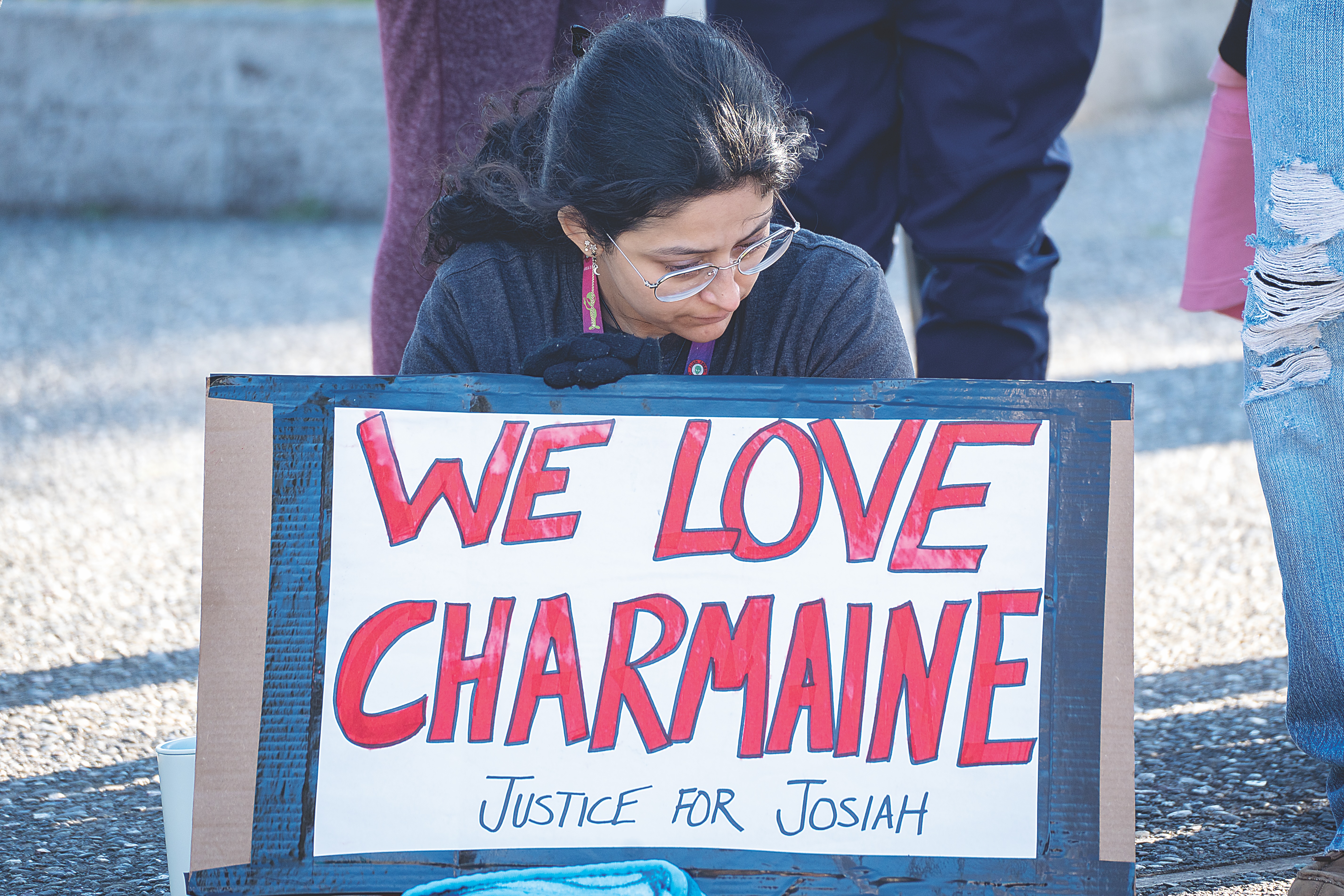
    A major source of hope for the Justice for Josiah Committee and all of its supporters is Charmaine Lawson, Josiah’s mother. After Josiah’s passing, Jones was introduced to Charmaine. She immediately took him under her wing and showed him unconditional love and support. While she wasn’t able to attend the vigil this year, she has attended every year in the past, and even often comes on a regular basis, making the long trip up to Humboldt from Southern California to honor her son’s life and continue to spread love in Arcata. 

    “[Charmaine] does so many things for the Arcata community, despite the lack of justice,” Jones said. “She does so many things out of love and gratitude because that’s just who she is. That’s who her son is, even though he’s no longer with us physically. This young man was on the path to changing the world positively, and he was taken from us, through that avenue. There’s been so much love and support behind getting that justice, behind putting those minute steps into action, going to the courthouses, calling the [District Attorneys], and making sure that they know that this is important. Not just to Arcata, but to California, and to anybody that has had to deal with a missing or murdered person.”

    Charmaine Lawson’s goal since her son’s passing has been to continue to uplift the Cal Poly Humboldt and Arcata community. Her passion and positivity inspired countless others to follow in her footsteps, including Romi Hitchcock Tinseth, a community leader and organizer of the vigil. When Tinseth heard about Josiah’s murder, she immediately knew that she had a responsibility as a mother to take action and help the cause in any way that she could. 

    “It’s no wonder that DJ [David Josiah] was a spectacular human being, because his mother is a spectacular human being,” Tinseth said. “She has devoted her energy to carrying on the love that DJ gave, that is a product of her love. So she comes here, she does good in this community, she does the work that DJ would be doing, and she has come often every single month on the 15th, for years now. And it has been seven years. This is the first anniversary of DJ’s death that she was not here, because she chose to surround herself with her family in Southern California and celebrate DJ’s life that way.”

    Seven years after his passing, Josiah’s positive impact on the community is still being felt in many different ways, giving Tinseth and many others an outlet for creating a better Arcata and a better world. 

    “[He was] an incredible student at Humboldt State University, a leader, a person who was dedicated to changing people’s lives for the better, and fighting for justice in the world,” Tinseth said. “In fact, he was a criminology and justice studies major. He was President of Brothers United at Humboldt State, and just an amazing, good human being.”

    Michihiro Sugata, Cal Poly Humboldt Criminology & Justice Studies Program Coordinator, Associate Professor of Sociology, and former teacher of Josiah’s, spoke about who Josiah was as a student and a man. According to him, Josiah had a contagious smile that brought people in and kept them engaged. Josiah brought so much light and energy to his class, and his positivity was infectious. He loved to learn new things and take on new challenges, and he wasn’t afraid to discuss difficult topics. 

    “Losing Josiah was like watching hope die,” Sugata said. “I’ve never articulated it this way before, but Josiah was the type of student that [educators] put our hope in. He was the type of student that makes you believe that the challenges of this world can be met and overcome — he instilled hope in all of us and to lose that was just devastating. But I know he wasn’t the only one, and to see young people showing up to the vigil, to see young people painting murals and writing poetry about Josiah, that brings back the hope.”

    The vigil was ultimately a celebration of Josiah Lawson’s life, a life that was taken far too soon. But it was also a sobering reminder that justice has still not been served. 

    “These vigils remain important for many reasons,” Sugata said. “They keep us connected to one another, and keep us connected to the broader fight for injustices in our community and beyond. Just as important, the vigil serves as a symbol for the continued struggle for racial justice within this community and this country. For those of us who knew Josiah, gathering in community and fighting for just causes isn’t just an act of remembrance. It’s a way to honor the man he was and the life he lived. These are the things he embodied.”

  • Who are the faces behind the picket lines?

    Who are the faces behind the picket lines?

    By Dezmond Remington

    The sun is setting and people are hollering. 

    There’s a group of about 20 students parked outside of the Reese Bullen Gallery screaming their best chants at the university administrators and jet-setting donors who are supposedly inside. None of the protestors have seen them in the hours they’ve been there, and the windows are covered in cardboard anyway. 

    At the top of 12 stone stairs facing the buildings opposite stand a few people with a megaphone speaking to those down below — and across the quad, and across the street, too. Their megaphone is crackly, but effective. 

    “All he cares about is getting more students and then fucking them over by making us pay more tuition and more in housing!” Mary Mangubat said, clad in a blue surgical mask and an undone black zip-up hoodie. The protestors nod, as does student Richard Toledo, who is holding the megaphone for her. 

    Mangubat and Toledo are constant presences at protests in and around campus. They’ve supported everything from Palestinians in Gaza to professors striking this semester. Mangubat even got a protest in her honor when the megaphone usage and other violations of the university’s Time, Place, and Manner restrictions on free speech at the Reese Bullen Gallery on Jan. 23 got her and Toledo yanked into a meeting with Dean of Students Mitch Mitchell and handed a “deferred probation”— in other words, a slap on the wrist. The next time one of them breaks the rules, they may face measures such as expulsion. As it was, they had to write a reflection essay on how to be a better organizer. 

    Signs from the student protest on Feb 8 prompted by Toledo and Mangubat’s deffered probation following a violation of the university’s Time, Place, and Manner restrictions. Photo by Griffin Mancuso.

    Though many of the things people see Mangubat and Toledo do are similar, such as leading protests and showing up to meetings, how they approach those actions contrast heavily. 

    Mangubat, 20, started protesting when she was attending high school in San Francisco’s SoMa district, where she said there were issues with things like outdoors accessibility. Mangubat, a Filipina, said she had an early awareness of concepts like intersectionality when she noticed the other students working to raise awareness of those issues were richer and went to private schools. 

    She occupies many roles on campus. She’s the environmental educator at the Women’s Resource Center. She interns for the Student for Quality Education chapter at Cal Poly Humboldt. She works for the Environmental Science and Management department on their Justice Equity Diversity Inclusion committee. All of these titles add up, but at the end of it, Mangubat sees herself as a coordinator, setting people up with resources they need. 

    Toledo, 32, defines his role on campus similarly. However, the route he took to get to Humboldt was vastly different than Mangubat’s.

    He developed an early sense of the unfairness in the world after watching his mom struggle to afford to house them while he was growing up. When Toledo was 18, he tore his ACL skateboarding a few days after his insurance provider dropped him and got thousands of dollars worth of debt when he couldn’t afford to pay it all. He hopes others can avoid that fate.

    “I find purpose in anything that I can tell is making a difference of some kind,” Toledo said. “That’s why I want to work in restoration science as well. I think that being on the ground and watching those seeds literally grow – not even just metaphorically, but watching the seeds that I’ve planted grow, the things that I’ve done, develop. That makes me happy. Seeing an actual difference from my actions is something I really enjoy.”

    Now in his third semester at Humboldt, Toledo is in his second go-round through a university. He got a multimedia production degree from CSU Northridge in 2020, but after a few years of working as a web developer, he decided to quit and get a degree in environmental studies. 

    “It turned out that I was pretty good at coding and there was a lot of money in it,” Toledo said. “So, I just kind of fell into it, and I ended up despising it. Something about just how tedious the work was, and seeing the news everyday, and watching what was happening outside of my bubble at work, and wanting to do something about it as well and not just be sitting behind the computer. After a certain point, you see enough climate headlines that the pay doesn’t really matter anymore, and you just want to do something good.”

    Toledo, a self-described “de-colonial Marxist,” is deeply into studying leftist theory, and idolizes people such as Marxist revolutionary Thomas Sankara and Black Panther Fred Hampton. He’s currently working on organizing a chapter of the Students for a Democratic Society. His earliest memory at a protest was during the Occupy protests back in 2012, when he was 20 years old. Toledo met everyone from garden-variety Democratic Socialists, to anarchists, to socialists to full-blooded commies. The experience left a large impact on him. Now, he has too many books to store them all on the dorm bookshelves and leaves them in piles on his floor. 

    Mangubat’s style tends to be more accessible, not founded on turgid leftist musings or obscure revolutionaries. Though these self-appointed guardians of campus operate on distinct levels, what does make them come to the forefront of every anti-something shindig on campus is a love of disruption. 

    It’s what Toledo and Mangubat use to explain college students protesting events happening both half the globe away and close to home. Student activists get a lot of flak from the general student body because of the perceived irrelevance and disconnect from Arcata to places like Gaza or Washington D.C. They argue that that’s part of the point. 

    “The only avenue that people have is disruption,” Toledo said. “And if you disrupt as many things as possible, even if they may not be wholly related, it’s going to cause more problems for the people at the top. They’re going to take notice of that. If you have whole businesses shut down, if you have schools that are shut down on certain days, if you have more and more people that are sympathetic to the cause and getting out there in the streets, making noise and demanding things on the local level, that reaches up to the top. They realize that and they start to change their narrative, and they might even start to change things.”

    Both Mangubat and Toledo feel the Time, Place, and Manner (TPM) restrictions they violated are excessive and defeat the point of protesting and organizing. One of the TPM restrictions requires organizers to make it clear to administration when and where they plan to protest, a rule Mangubat hates. 

    “The rule of protesting is that you’re disrupting systems,” Mangubat said. “You’re disrupting the place and the people who are oppressing you, so it’s not productive or efficient to just be like ‘Hey, here’s everything I’m doing,’ and then, admin will be like, ‘OK, now we know what they’re saying…’ They have every step to prepare to cover their own asses if they had to.”

    Both Toledo and Mangubat do not have mixed feelings when it comes to Cal Poly Humboldt’s administration, which they characterize as aloof from campus and not held accountable often enough for things like last semester’s eviction of the van lifers.  At the Jan. 23 protest, Dean of Students Mitch Mitchell called the university police department on them — something campus employees are supposed to do when there’s a protest on campus. It wasn’t a move that went over well with the students that were there, especially after he talked to some of the protestors there in a way many of them thought was overly confrontational. Mitchell left when protestors booed him and chanted the word “Shame” at him over and over again. Mangubat feels that outburst was reasonable because of his position as an administrator. 

    “From my perspective, I think it’s justified because every step that they had taken since my disciplinary notice to the students trying to put on this protest, they had been escalating everything …” Mangubat said. “So, I think in some way, it was needed for admin to see what students are capable of doing. Not in a harmful way, but in a human way, like a human response type of way … it’s a complicated situation because, you know, at the end of the day, people are human, they have feelings, but your hierarchy stands out so much more. And you’re acting in that position.”

    “I’m proud of what we set out to try to do to try to get the attention of Tom Jackson,” Toledo said. “I’m not proud of exactly how it turned out.”

  • UPD Bytes

    UPD Bytes

    Sunday March 17, 2024

    7:24 a.m. – Welfare Check – student’s phone is pinging to the area of the D street neighborhood center and parent says he should be in his dorm. Didn’t answer the door but his vehicle was on campus. 

    1:23 p.m. – Medical Aid – Alcohol related – Willow Residence Hall on Granite Ave.

    Subject laying on ground with scratches on him in front of building.

    Monday March 18, 2024

    1:12 p.m. – Citizen Assist – Library 

    Subject reported unattended E-bike charging with keys still inside of it. Subject states bikes are not supposed to be in the library. Unable to locate owner. 

    Tuesday March 19, 2024

    4:09 p.m. – Suspicious Circumstances – Nelson Hall West

    Subject states there is a suitcase outside near a green electrical box.

    6:05 p.m. – Grand Theft – Campus Apartments

    Anonymous report of an E-bike that was stolen between March 18 and 19.

    8:08 p.m – 911 Abandoned call – Shasta Resident Hall

    8:16 p.m. – 911 Abandoned call – Humboldt Ave.

    9:30 p.m. – 911 Abandoned call – Lot FS-6 on Plaza Ave

    Laughing heard in the background.

    Wednesday March 20, 2024

    8:49 a.m. – Emergency Elevator Button – Behavioral and Social Sciences

    1:53 p.m. – Vehicle Booted – Lot Library South on Laurel Dr.

    Vehicle booted for unpaid parking citations.

    5:13 p.m. – Vehicle Boot Removal – Lot Library South on Laurel Dr.

    Fines paid, boot removed.

    Thursday March 21, 2024

    2:34 p.m. – Suspicious Person 

    Subject and her friend were walking through the community forest when a male approached them and made a concerning statement regarding doing harm. Unknown if he is associated with campus. 

    4:20 p.m. – 911 Hang up/ No Response

    Two 911 hang ups from two different 911 only phones.

    6:17 p.m. – Drug Activity

    Subject enroute to address a possible marijuana related incident. Residents are refusing to open the door for the RAs. Negative contraband, handled by housing. 

    11:35 p.m. – Patrol Check – Creekside Lounge 

    Subject calling to report hearing a female scream in unknown area of creekside 

    Friday March 22, 2024

    3:36 p.m. – Disturbance – Library

    Female in the first floor women’s restroom heard yelling and cussing. She was escorted out of the building and going to take the bus home.

    Saturday March 23, 2024

    3:16 p.m. – Suspicious Person – Craftsman Mall on St. Louis rd. 

    Subject wearing a raincoat walking through the property.

    Sunday March 24, 2024

    2:31 p.m. – Suspicious Person – Craftsman Mall on St. Louis rd. 

    Report of person walking through property. Only described as wearing a yellow rain jacket.

    Monday March 25, 2024

    2:46 p.m. – Disturbance – Library 

    Subject in the lobby filming another member. He is currently sitting at the cafe wearing an orange jacket. Subject contacted and decided to leave the premise for the day.

    2:58 p.m. – Public Intoxication – Kinesiology & Athletics on Gymnasium Ln. 

    Intoxicated subject falling down the stairs. Arrested.

  • Being a part of the fourth estate: The Lumberjack attends the ACP conference in La Jolla

    Being a part of the fourth estate: The Lumberjack attends the ACP conference in La Jolla

    By Griffin Mancuso

    One of the distinctive qualities of a journalist is that they never truly stop working. They may finish working on a story or taking photos, but they are always thinking of their next story, their next assignment, their next grand idea to pitch to their editor. A great journalist can make a story out of almost anything.

    One of my greatest qualities (and downfalls) is my ability to turn what was supposed to be my vacation into another article.

    Every March, just before spring break, a handful of journalism students at Cal Poly Humboldt get the chance to attend the Associated Collegiate Press Conference (ACP), where we get to attend panels on journalistic practices, connect with companies and other students, and submit our work for the chance to win awards. It takes place in a different city in California every year, which gives us the opportunity to travel to new places and see all the local sights.

    This year, the ACP conference was held in La Jolla, a sunny beachside town populated by rich people and entitled seagulls. Journalists travel from all over the country to attend this conference and, hopefully, win some awards for their student media. Apparently, this year had the most attending journalism students out of any ACP conference, according to a fellow journalist who interviewed me for an article. Even with the large number of attendees, there was an unspoken sense of comradery and understanding among us, even if we had never met each other.

    One of the appeals of the conference, besides the opportunity to network and learn new skills at the dozens of panels, is getting to explore the city as a group. I didn’t have the opportunity to stick around and enjoy the city at last year’s conference, so I’m happy I had the chance to spend time with the rest of the Lumberjack team. We had a group breakfast of homemade eggs and potatoes made by our editors. We visited the Birch Aquarium where I stared at the leopard shark tank for a good ten minutes. We browsed downtown La Jolla and I made everyone visit my mother’s yoga teacher’s deli shop. I got to swim at the beach for the first time since high school.

    I make an effort to attend panels with differing topics to broaden my knowledge and gain an appreciation for the other jobs in the newsroom. I learned about the particular but important art of typography, I got a refresher on inclusive design for newspapers and websites, I learned about covering LGBTQ+ communities in San Diego County, and I attended the panel on satire news hosted by our amazing adviser and one of our editors-in-chief. Everyone was laughing for a good half of the presentation, so I consider that a success. I smiled as journalists from other schools ecstatically told me how they planned to pitch a satire issue to their publications. Holding figures of authority accountable is much more fun when you get to be funny about it.

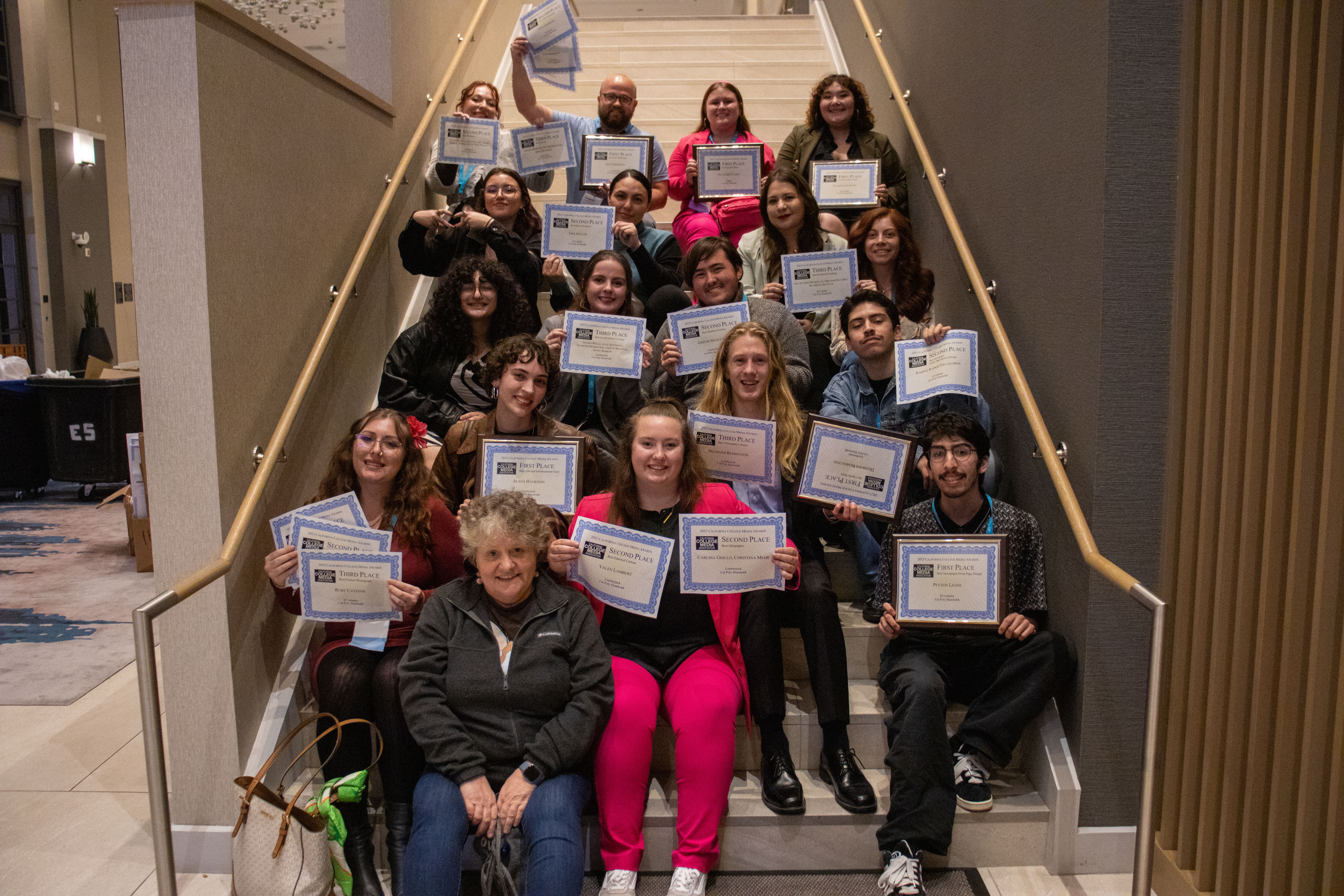
    The biggest part of the conference for our newspaper is the awards. The ACP hosts its own award show, and a separate group called the California College Media Association (CCMA) has its own awards on the last night of the conference. ACP is a national organization, and out of all the schools with less than 15,000 students, we still won 5th place in Best in Show for one of our papers. Not too shabby for a staff of less than 30.

    The CCMAs focuses more on awards for individual journalists and is where we get most of our recognition. We all watch with anticipation as the announcer reads off each category, waiting for our school’s name to appear on the projector.

    Being unable to take a break ever, I took it upon myself to film all of our announced awards for social media. As the announcer read off the top three winners for Best Headline Portfolio, I narrowed my eyes as three familiar headlines rolled across the screen. I soon realized they were my headlines and I had won second place out of all California schools with under 15,000 students. I can now proudly put on my resume that I have the second best headlines in the state, and I have the piece of paper to prove it.

    We embraced one another and cheered as we collected a total of 14 awards for the Lumberjack. We placed in categories like Best Social Justice Coverage, Best Feature Photo, Best Arts and Entertainment Story, and Best in Show. We were struggling to get a photo with all of our awards together on the table, even when I stood on a chair and raised my camera in the air. Our advisor soon approached each of us to get a snippet of our reactions for social media. At the time, I was so overwhelmed with excitement and pride in my team that I couldn’t give the groundbreaking, heartfelt speech I wanted. I can at least give that speech in writing.

    I didn’t originally come to Cal Poly Humboldt as a journalist. I was an English major and I wanted to write novels. I joined the student magazine, Osprey, during my first semester and fell in love with it. I loved learning from people and giving that knowledge to the public. I knew I wanted to write. When I took the Lumberjack workshop, I didn’t expect to be writing for an award-winning paper. I’m grateful to be a part of the process and I am honored that our hard work gets to be recognized on a state and national level. The pressure of working on The Lumberjack is intense, but you take on that pressure as a team. No matter what else is going on in our lives, we get together every Tuesday, hunker down in the newsroom, and make a newspaper for our campus.

  • Proposed state assembly bill gives van lifers hope

    Proposed state assembly bill gives van lifers hope

    By Eli Farrington

    On Oct. 25, 2023, Cal Poly Humboldt sent out an email to the entire student body detailing a list of new parking regulations that were going to be enforced effective immediately. However, none of the new regulations actually pertained to the majority of the on-campus community, but rather to a much smaller and more vulnerable one: the van lifers. 

    Jan. 11, 2024, Assembly member Corey Jackson introduced bill AB 1818 into the state legislature. If passed, all California State Universities and California Community Colleges would be required, and all UC campuses requested, to allow students that live in their vehicles to park on campus overnight as long as they possess a valid parking pass issued from their institution. 

    A humble community of vehicle-dwelling college students, the van lifers lived comfortably and peacefully in the parking lots of Cal Poly Humboldt for many years before the university finally decided to crack down on them. After the university claimed that their presence in the parking lots created ‘unsafe and unsanitary conditions,’ the van lifers were forced to leave the campus and look for overnight parking elsewhere. 

    Caleb Chen, a first-year Cal Poly Humboldt masters student in the public sociology program, was one of the students who were forced to leave. At the time, he was living in his vehicle, and the uncertainty of not knowing where he was going to sleep that night took its toll on him. 

    “In November, when we all had to move, it scattered us all to different places, and some of us ended up at the Arcata Community Center,” Chen said. “It definitely felt less safe there. It caused a lot of [stress] at the end of the semester that got in the way of schoolwork and the research assistantship that I’d come to this school for. Cops locking the gate to the community center at night meant if I needed to drive off all of a sudden in the middle of the night due to a break-in attempt, I’d be stuck in that parking lot. That wasn’t ever a concern at the school parking lot.” 

    At the beginning of 2024, Chen’s vehicle broke down. He couldn’t afford to fix it, so he ditched the van life and moved into an apartment with his significant other. Regardless of his new living situation, Chen was still impressed with the opportune timing of AB 1818’s proposal. 

    “It’s very timely, and whoever introduced it must have had their finger to the pulse, because this isn’t only happening at Cal Poly Humboldt,” Chen said. “It just speaks to the widespreadness of this and the fact that students at Humboldt are really just a drop in the pond, so to speak, of people that are affected by this situation.”

    In contrast to Chen, junior Hannah Barrett and sophomore Joshua Tarman left their overpriced one bedroom apartment at the beginning of the new year and moved into a camper together for a more favorable living situation. Barrett is a psychology major, while Tarman attends College of the Redwoods with a focus on early childhood education. 

    The couple originally planned to park their camper on Cal Poly Humboldt’s campus overnight, but when the Oct. 25 email was sent out they were forced to make other arrangements, including parking in areas of Samoa and Manila Dunes. 

    “I think that secure parking is something that should be a given for students,” Tarman said. “[Students are] paying to be in an environment where they’re supposed to learn, and so if a school wants to be able to provide all the facets for students to learn, they should definitely have a priority over their safety and their emotions. Students can’t learn when they’re just figuring out how to live in the first place.”

    While Barrett and Tarman are doing well enough with their vehicle parked off campus, they would definitely prefer the safety and security of an on-campus parking spot if AB 1818 were to pass. 

    “I just think that if you’re able to park here overnight with a parking pass, it is a little silly that you just can’t physically be inside your vehicle,” Barrett said. “It’s like at that point, [the university] is just trying to make it more difficult for people, because there’s [nobody] – at least I didn’t see – being unsanitary or dumping anything.” 

    The unsafe and unsanitary accusations have rubbed many of the van lifers the wrong way, including junior and mechanical engineering major, Derek Beatty. 

    “That was a smear campaign,” said Beatty. “It was, I guess, the only way that they could find to try to make other students feel like, ‘Oh I guess that’s why they’re getting kicked out.’ It was like they needed to give some reason so that there wasn’t as much outrage, but obviously, I don’t think many people believed those claims, and I think that even made people a little more upset on our behalf. But yeah… it’s kinda bullshit that they said that and then didn’t have any evidence to back it up other than a picture of a rainwater collection bucket.”

    The Lumberjacks request for complaints against van life students resulted in a total of two back-to-back complaints made by two anonymous people. Otherwise, no complaints were found. 

    Beatty is hopeful that AB 1818 will pass soon, so that he and others can park on campus again. He misses the safety net and the sense of community that on-campus parking provided for the van lifers, and having to park off-campus every night has taken that away. 

    One of the primary benefits of on-campus overnight parking is consistency. Having a dependable place to call home, even if it’s just a place to park a van or camper, can make all the difference in the world to the van lifers, one of Cal Poly Humboldt’s most at-risk communities. 

    “I spend all my time in this same parking spot,” Beatty said. “It’s just now for some reason I have to not be here from 10:00 p.m. to 7:00 a.m., when I could just stay parked here, not have to move all the time, and just have a consistent spot.”

    Carrie White, a Cal Poly Humboldt senior and biology major, lived on campus in her camper starting in 2021, but it recently broke down and has been stuck at a mechanic shop for several weeks. Since then, White’s living situation has been volatile, sleeping sometimes with friends, and at other times on the floor at one of her places of work. She hopes that AB 1818 will pass, to give low-income, displaced, immigrant students like herself a safe and secure location for alternative living. 

    “I think that passing the California Assembly Bill AB 1818 is the bare minimum a multi-million dollar institution affiliated with the CSU organization owes to its students,” White said. “In general, folks living in their vehicles are amongst the most vulnerable students. We know from thousands of studies that homelessness is a risk factor for mental and physical health pathologies, increased loneliness and isolation, decreased academic performance, decreased quality of life, and suicide. Passing a bill allowing homeless students to stay on-campus, in their vehicles, with a valid permit shouldn’t be a discussion – it should be a glaringly obvious choice. This is a social crisis, a public health crisis, a humanitarian crisis – and it is here, on our campus.”

    Student homelessness is a problem that plagues practically every college campus in California, and Cal Poly Humboldt is no exception. Cal Poly Humboldt students are still prohibited from sleeping in their vehicles on campus, but if AB 1818 passes, they can come back and the van life community can rebuild in a safe environment. 

    “I felt safer staying on-campus up until I was forced to leave,” White said. “In the act that I believe was an attempt to shame homeless students off campus – cue gross Cal Poly Humboldt email accusing homeless students of being ‘unsafe and unsanitary’ – the trust I have in this institution is null and void. Having said this, I would absolutely move back to campus if Bill AB 1818 passed; proud, in a state of activism, and don’t worry – safe and most definitely sanitary.”

  • Humboldt student hit by car makes recovery, moves back

    Humboldt student hit by car makes recovery, moves back

    By Jasmin Shirazian

    On a drizzly, cold Humboldt day, Madelyn Vink was getting ready for a first date. With her hair in two braids, she picked some jasmine flowers and placed them in the pleats. She remembers looking down and seeing them still in place when she woke up in the hospital hours later, with blood soaking the flowers.

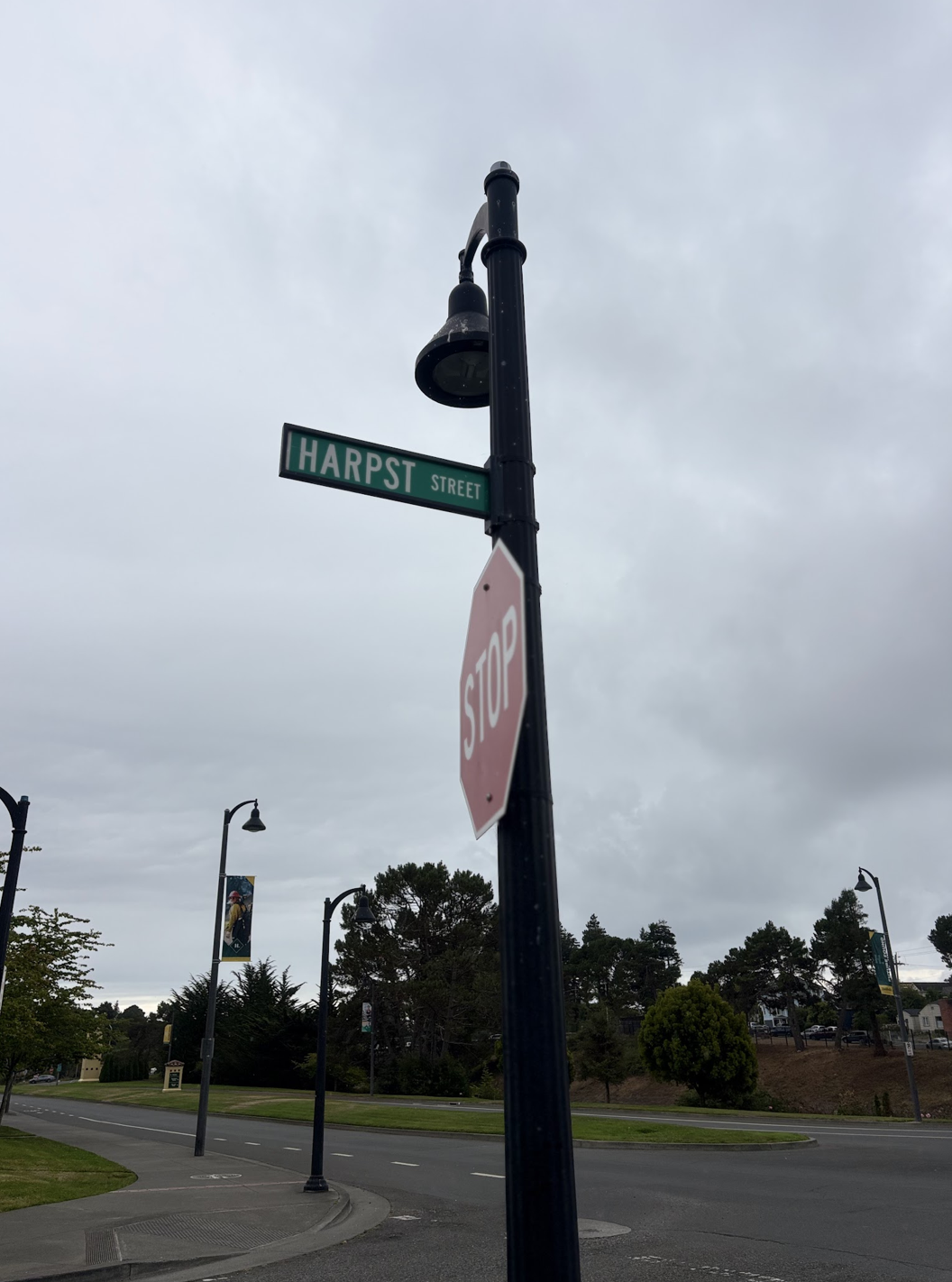
    On Sept. 1, 2023, Vink, a religious studies major with an art history minor, was in the crosswalk at the intersection of Harpst and Rossow St. when she and her date were struck by a vehicle. 

    “I had a crush on this guy, so we decided to meet up on campus as the seemingly safe place to go on a date,” Vink said. “We were just planning to go on a walk, because I thought that would be better than unsafe sex. Turns out that was wrong.”

    They met outside of College Creek Marketplace, where Vink parked her bike. From there, they began their date. The first part went well, with them taking a stroll in the community forest. Later, Vink decided she was ready to go home, and together they planned to walk back to her bike. When they crossed the street, Vink and her companion were both hit by an oncoming car. 

    “The date was very fun at first,” Vink said. “Then, when I was going to get my bike, in the crosswalk in front of [the] Marketplace, we were both hit. I took most of the damage, having flown 22 feet. I suffered what is known as a traumatic brain injury.”

    After being transported from three different medical centers, Vink ended up at UCSF where she received life saving treatment. For several months, Vink was in intensive care fighting for her life. However, she fought through and is now back in school. Some of her family has since moved up from their home in Turlock to Humboldt county to support her in her recovery.

    Vink, who chose her major to make sense of the world both spiritually and practically, is considering enrolling at Cal Poly Humboldt. She is taking the summer to decide if she wants to continue her education here. 

    “I would’ve graduated this summer,” Vink said. “Given my injuries, it’s going to take another year at least.”

    Despite the traumatic event, Vink is still as hopeful as ever. While the accident may have taken time out of her life, she refuses to allow it to take anymore. 

    “I’m going ok, everyday is a struggle, but I am so happy to be alive,” Vink said. “Most people that suffer my kinds of injuries don’t make it, or they are in a wheelchair the rest of their lives. I got lucky somehow.”

    The lesson Vink wants people to take away from this horrific accident is to be more careful when behind the wheel. 

    “I’d like to encourage people to take more caution when driving, especially on campus,” Vink said. “All could’ve been prevented if care was taken while driving. Instead I got five of the hardest months of my life. So, please be careful.”

    Besides that, Vink wants to remind people to live authentically. This experience has taught her to appreciate those around you and the life you live.

    “Live the life you want to!” Vink said. “Life really is special, and equally fragile. There’s no time to waste. I want people to be happy. Life is a gift. Keep fighting in school and dancing in life. Love is everywhere, even in your darkest moments.” 

  • UPD BYTES

    UPD BYTES

    Monday, Feb 19, 2024

    1:06 p.m. Welfare Check – First Floor Library Computer Lab

    White male in his 40s with scruffy hair and tan baseball cap, red in the face and rocking back and forth, non-responsive to staff approaching him. He left on arrival of the officers. 

    8:04 p.m. – Investigation at JGC

    Subject believes someone placed an Apple Airtag on her vehicle and is requesting contact. 

    11:42 p.m. – Patrol Check Kinesiology Building

    4 skateboarders at the student recreation center advised of school policy on grinding and tricks. Subjects moved along. 

    Tuesday, Feb 20, 2024

    08:36 a.m. – Vandalism – Humboldt Bay Aquatic Center

    Rowing coach advised via email someone has been untying and tampering with the boats at night. 

    3:52 p.m. – Drug Activity- Alder Hall

    Officers requested to pick up a bong. No marijuana present or resident on scene. 

    11:01 p.m. – Investigation at Mendocino Residence Halls 

    Subject called to report a possible missing person. 

    Wednesday, Feb 21, 2024

    1:03 p.m. – Suspicious Circumstances – Kinesiology and Athletics Building 

    Subject’s car was tagged with #13 on the side mirror with a sharpie. She was able to remove it, but is concerned it may be a marking for someone targeting vehicles or people. She was parked off-campus on 16th and Spring St., but requested documentation in case there are other victims.

    5:42 p.m. – Alder Hall – Grand Theft 

    Subject reported their bike was taken from the bike rack between Alder and Chinquapin.

    7:41 p.m. – Vandalism – 2nd Floor Library

    Custodial staff reported vandalism in the women’s handicap stall.

    Thursday, Feb. 22, 2024

    10:16 p.m. – Drug Activity – Chinquapin Residence Halls

    RA requested the officer for drug paraphernalia.

    Friday, February 23, 2024

    11:09 a.m. – Vandalism – Kinesiology and Athletics Building

    Eternal Heart graffiti found on the stairwell in the Kinesiology building.

    2:53 p.m. – Suspicious Circumstances – 14th Street and Union

    Subject reported male is on top of a moving vehicle. APD was contacted as vehicle was located off-campus.

    5:15 p.m. – Misc. Parking Problem – Sunset Residence Hall 

    The Residence Life Coordinator requested the officer to respond to the garden area for a motorcycle and small jug of gasoline locked to the bike rack. Handled by housing.

    Monday, Feb 26, 2024

    2:45 p.m. – Fire Alarm – Mendocino Residence Hall

    Fire Alarm [went off] as a result of burnt food. False Alarm.

    5:03 p.m. – Welfare Check – Trinity Residence Hall 

    Mother of a student received a call at [3 p.m.] stating her daughter had been kidnapped and they were threatening to kill her if the mother didn’t send money. The daughter was contacted and the call appears to be fraudulent. Subject contacted her mother. 

    8:19 p.m. – Welfare Check – Plaza Circle 

    Subject called to report a 30-year-old white male in a bright blue sweatshirt acting erratically. 

  • What is Proposition 1?

    What is Proposition 1?

    Voting on the future of mental health treatment

    By Savana Robinson

    At face value, Proposition 1 amends the Mental Health Services Act to offer more behavioral health services. This requires authorizing $6.38 billion in bonds. Meaning that the state sells this amount in bonds, which is how the government borrows money and repays it, plus interest over time. According to the Legislative Analyst’s Office, it would increase state costs to repay bonds, amounting to $310 million annually for 30 years. This also means that an annual $140 million of existing tax revenue for mental health, alcohol, and drug rehabilitation shifts from counties to the state government.

    So what will Prop. 1 do?  If voted in, it will make counties’ mental health care and substance use treatment services more focused on housing and personalized support. The money could go to building more facilities and housing for people with mental health, drug, or alcohol issues. If it’s not voted in, nothing will change.

    Arguments for Prop. 1 emphasize the importance of finding solutions to the homelessness, mental health, and addiction crises, and Prop. 1 may be a step in the right direction. Arguments against Prop. 1 point out that the proposition is expensive and this is not the time for more government debt. It may also take away funding from current community-based mental health services funded by the Mental Health Services Act, taking almost a third of the annual funding dedicated by the act.

    According to the California Voter guide, those in favor of Proposition 1 include California Professional Firefighters, CA Assoc. of Veteran Service Agencies, and National Alliance on Mental Illness–Ca. Those opposing Prop. 1 include Mental Health America of California, Howard Jarvis Taxpayers Association, and CalVoices.

    Voting day is March 5. To register to vote, visit registertovote.ca.gov/

  • Campus Store, Eureka running deficit of $101,367 in first two years of operation

    Campus Store, Eureka running deficit of $101,367 in first two years of operation

    By Brad Butterfield

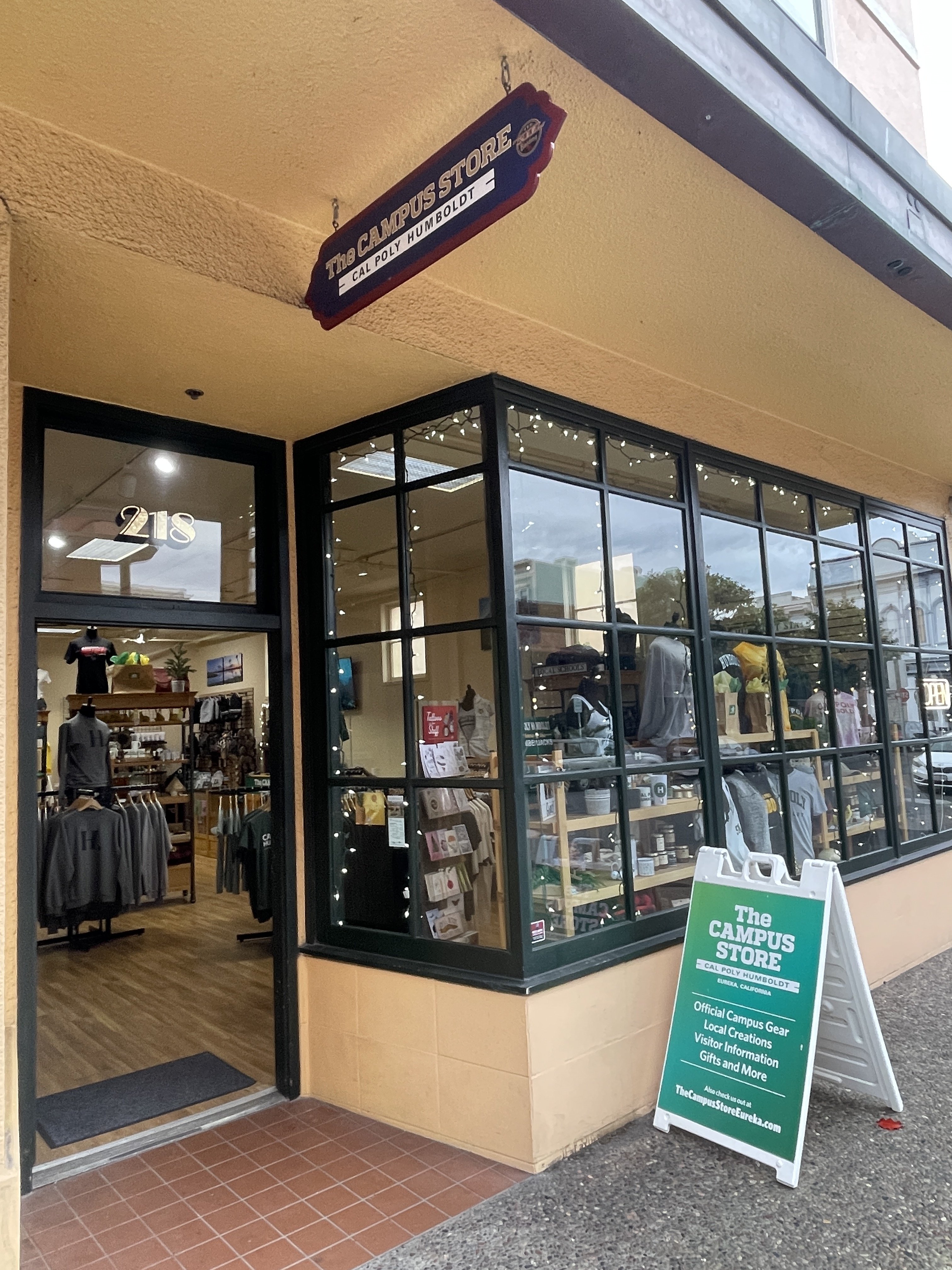
    Since opening November of 2021, The Campus Store, Eureka’s revenue stands at $188,596, with expenses totalling $289,936, equating to $101,367 in losses during its first 25 months in operation. The storefront boasts prime location in Eureka’s Old Town and was opened with the aim of increasing the university’s presence in Eureka. Despite consistent financial losses, the university remains steadfast about the importance of the Eureka store for community engagement and accessibility. 

    Although sharing a name with The Campus Store, Arcata, the Eureka location is different in many foundational ways. Whereas the Arcata building space is owned by the Cal Poly Humboldt Foundation, the Eureka location is leased by Cal Poly Humboldt for $2,000 a month. This $2,000 per month excludes utilities, trash services, maintenance, taxes, permit, inspections and license fees, according to the building lease agreement obtained through public record request. While the Arcata location is operated by Follet, a nationwide store operator for colleges, the Eureka location is operated by Humboldt Outfitters, a locally owned company. 

      “They are able to bring in their own approved designs, which may be different than the Arcata Campus Store. They also bring in some of their successful products they feature in their Arcata store,” said Grant Scott-Goforth, communications specialist for Cal Poly Humboldt.

    The deal with Humboldt outfitters arose from a request for proposal (RFP) put out by the University due to the fact that the Eureka location was too small to be operated by Follet, according to Scott-Goforth. Humboldt Outfitters was selected because of their success with their Arcata store, and their local screen printing and engraving capabilities. 

    David Neyra, owner of Humboldt Outfitters, deferred to university marketing and communications when asked for an interview. In his email response, Neyra copy and pasted questions and answers which had been asked directly to marketing and communications regarding the university’s perspective on operations at the store.

    The Eureka location layout also differs substantially from the Arcata storefront. In Eureka, sections of the store are reserved for local school merchandise in addition to offering Arcata, CA and Humboldt County branded clothing items. Additionally, an entire corner of the store is reserved for non-university affiliated trinkets like cutting boards, cutlery, and toiletry items. The store also features Humboldt State branded gear, which is important to the vast majority of current Alumni who studied at the then named Humboldt State University.

    At the Old Town store, Cal Poly Humboldt branded gear costs $89.99 for a zip-up fleece sweater, $69.99 for a plaid blanket with a white ‘H.,’ a pullover hoodie for $49.99, and $49.00 for a polo. However, the gear is name-brand. Nike, Holloway, and Port Authority all make items sold by the store. 

    Unprofitable since opening, The Campus Store, Eureka has run an average deficit of $4,055 a month for the 25 month period between Nov. 2021 to Dec. 2023. In spite of this, the university sees the store as a success in its main objectives of providing visibility and accessibility, expanding the relationship with the city of Eureka, and expanding logo wear offerings, according to Scott-Goforth. Naturally, running a consistent deficit is not ideal for any business, no matter how large the financial backing. This has led to the university’s constant changes to the store’s merchandise and marketing in an effort to attract more customers.

    “The Campus Store, Eureka continues to optimize its inventory selection and online ordering, along with social media marketing to increase sales,” Scott-Goforth said.

    The university’s Senior Director for Enterprise Services Todd Larsen, who oversees the Campus Stores, deferred an interview request to university marketing and communications.  President Tom Jackson Jr., who was credited by Frank Whitlatch in his letter to the editor on Nov. 29,  2023 with the achievement of opening the Campus Stores, did not respond to an interview request.

    From the city of Eureka’s perspective, the store is nothing but a major positive. City Manager Miles Slattery emphasized that any and all presence of the university in Eureka is hugely beneficial – and not only from an economic standpoint. 

    “It’s even more beneficial from a social standpoint of bringing in a younger and especially more diverse community to our area,” Slattery said. “Our emphasis in economic development has been working on BIPOC owned businesses, trying to expand on that and provide opportunities for folks to open up businesses. Having that population of folks in our Eureka commercial district is nothing but beneficial and expands the diversity of our businesses.”

  • Get your taxes done for free at the student clinic

    Get your taxes done for free at the student clinic

    By Dezmond Remington

    For many students with dozens of responsibilities, doing their own taxes is byzantine, boring, and back-breaking. Though doing taxes is famously painful, there are resources to help.

    The student tax clinic is open to almost all students and community members who make less than $70,000 a year. It’s free and staffed by accounting students. Book an appointment through their website, found through Humboldt’s School of Business website, which operates on Wednesday evenings in Siemens Hall.

    International students filing international tax forms are not eligible for the clinic’s help, though Instructor of Record for the clinic Joshua Zender, said the clinic will help international students if they are filing domestic returns. 

    The clinic’s scope is limited to processing tax documents students provide, using the IRS-supplied TaxSlayer software, and then sending those returns to the IRS. Anyone seeking tax advice or anything more complicated should use a qualified accountant. But just because what the clinic can do is limited doesn’t mean people can’t benefit immensely. 

    “Oftentimes, we find that people we’re serving are simply not aware that they’re eligible for, maybe, a renter’s tax credit, or they’re eligible for a special tax credit because they happen to be going to college right now,” Zender said. “That’s always a really rewarding experience, to see somebody’s face light up and think, ‘Oh, well, I’m actually gonna get money back from the government that I didn’t know I was eligible for.’”

    Another tax credit that’s worth looking into is the Earned Income Tax Credit (EITC), which Zender said some students qualify for. It’s open to low and moderate-income workers. 

    If someone earned less than $13,850 for the 2023 tax year, they can file and get all of their federal income taxes returned. 

    The students working at the clinic also benefit from helping people with their taxes. They get a $1,500 stipend provided by the Smullin foundation, an Oregon-based grant-giving organization, as well as a lot of experience. 

    “The main [benefits] are becoming proficient and more confident in using tax software to prepare a tax return,” Zeller said. “For accounting students, they’re looking for real world experience doing their field. But a second [reason] is establishing an ethos, or a commitment to serve a community, and in particular an underserved community, and so developing the skills to communicate and help and empower people who need assistance with their tax return is a really important skill to be developed from this experience as well.”

    Student David Mata is an accounting student who has worked for the clinic for two years. He started doing tax returns six years ago at H&R Block and enjoys the people he gets to meet.

    “You get to see people you don’t get to see,” Mata said. “I haven’t done much community stuff. This gives me a perspective on being a part of this community.”

    Daniel Taylor, another accounting student in his second year on staff, agreed with Mata. He said the experience he got from working there was invaluable–and the stipend is good too. 

    “It’s nice to help people,” Taylor said. “Everyone loves free taxes.”

  • Cal Poly Humboldt faces possible $8 million budget deficit next school year

    By Griffin Mancuso

    Cal Poly Humboldt may be faced with an $8 million budget deficit in the 2024-2025 school year. 

    At an Associated Students meeting on Feb. 9, Provost Jenn Capps and University Budget Office Director Amber Blakeslee gave a presentation on the university’s estimated budget and how they plan to address it.

    Beyond Cal Poly Humboldt, the entire CSU system is faced with budget constraints. Each year, the state governor puts out a proposed budget for the CSU system. After months of discussion and advocacy, the governor publishes a revised budget in May, which is then finalized in June. Currently, the 2024-2025 proposed budget for California projects a $38 billion deficit. CSU campuses get most of their funds from the state budget and funds are distributed based on enrollment.

    However, the governor and the CSU system have an agreement where their portion of state funding will increase by 5% every year, provided that the campuses continue meeting their student success outcomes. Because of the current deficit California is facing, the planned $240 million base increase will be delayed by a year and paid back retroactively. There is a chance that funding won’t be available for the 2025-2026 school year, so the CSU system is trying to redivide its funding among over-enrolled and under-enrolled schools.

    “The system is sort of reshuffling, so for campuses that were under-enrolled, [that means] reducing the targets, which means reducing funding and shifting that to campuses that are above target,” Blakeslee said. “And so for our campus, we’re going to have our target reduced by 3% next year, which means 3% of the funding will pull back as well, so it’s about a $2 million impact to our campus that we need to navigate as part of budget planning.”

    While the university’s revenue is increasing, expenses are increasing at a faster rate. For the 2024-2025 school year, the university is expecting funding from the state, the 6% tuition increase, enrollment, and California Polytechnic funding, totaling at $170 million. The deficit from compensation and benefits, financial aid, and other costs are estimated to reach $178 million.

    Blakeslee described how budget planning for the campus looks at three different scenarios for enrollment, including a baseline scenario, the best case scenario, and worst case scenario. The baseline enrollment increase projected for next year is 2.6%.

    “As a campus, we’re actively working toward ambitious growth,” Blakeslee said. “From a budget standpoint, we are conservatively planning but watching closely because we want to make sure that we are proactively supporting and growing capacity where needed as we realize the growth, but we also don’t want to spend it before it happens.”

    Carla Ho’ā, the interim Chief Financial Officer and Vice President of Finance and Administration, emphasized the university’s priority being the student population and minimizing negative effects when making budget cuts.

    “Financial resiliency is another aspect of this,” Ho’ā said. “It can be tempting at times to make short-term decisions that have long-term, and sometimes negative, consequences. [We’re] really needing to be thoughtful and looking out into the future and about the financial resiliency of the university for the long-term, like having sustainable decisions built into the process.”

    When deciding where to allocate funds for Academic Affairs, Capps collaborates with the department heads of the colleges, the library dean, and other areas to share strategies and distribute funding. She said that the university hopes to provide more opportunities for student collaboration in the future.

    “What has been asked in a lot of different spaces is, ‘Hey folks, could you share with the campus community what ideas you generate, what potential opportunities you might be going after, before you actually do it?’” Capps said. “So that you all know what we’re considering, what we’re thinking about, and potentially have a shot to weigh in.”

    Capps also said that the University Resources and Planning Committee – a part of the University Senate with representatives from faculty, staff administration and students – is hoping to hold a public forum at least once a semester. The URPC has two seats reserved for student representation and is responsible for drafting a budget proposal for the university president.

    The URPC budget recommendation will be finalized next April. The presentation encouraged students to provide input and engage with AS, administration, and other representative student communities. Several positions in AS are currently open, such as Environmental Sustainability Officer, Public Relations Officer, and college representatives. Elections for AS will be made public on March 6. For more information on the university budget and upcoming elections, you can visit the URPC and AS websites.

  • Humboldt drag artists slay outside the box

    Humboldt drag artists slay outside the box

    by Griffin Mancuso

    Shannon Rhodes already had a passion for fashion and makeup before delving into Humboldt’s drag scene. After attending several drag shows dressed to impress, Rhodes ran into drag artists Val de Flores and Sharon Taterz who offered them the opportunity to start booking their own performances. In May of 2023, Rhodes debuted as Killpop at the Septentrio Winery.

    “I kind of blackout when I’m performing, because it’s very short,” Rhodes said. “It’s just like, three to four minutes. The energy—it’s addicting. The crowds are amazing. It’s awesome getting to perform in front of a fully queer space, where everybody’s there just to see you and support you and be positive. All the other girls, they’re super fun to hang out with.”

    Killpop’s friend Seraphim Nagel joins their performance at the Septentrio Winery. Photo courtesy of Makayla Kuhnke.

    Despite being a small county, Humboldt has a thriving drag community. Every member’s introduction to drag and their personal relationship to the art form is unique. Additionally, every drag artist’s reason for performing is different and reflective of their life experiences.

    Paul Michael Leonardo Atienza, an assistant professor of Critical Race and Gender Studies at Cal Poly Humboldt, has been doing drag performances for 20 years. They began to explore their gender expression after attending an LGBT campus retreat during their senior year at UC Riverside.

    “We were processing trauma in our lives, and what came out for me was how I was shamed as a child of my gender expression, and particularly feminine gender expression,” Atienza said. “Many of us were figuring out, ‘Well, how do we work to strengthen and remove less of the stigma that we learn?’”

    Atienza took on the identity of Maria Arte Susya Purisima Tolentino during their drag performances. Ma Arte drifts between being an extension of Atienza and a separate persona, but Atienza considers her to be a creative collaborator. Together, Atienza and Ma Arte have collaborated with drag artists and members of the queer community across the world.

    Lawrence Fobes King, a queer middle schooler from Ventura, California, was murdered in 2008 by a classmate. This tragedy moved Atienza to use drag as a form of protest by bringing awareness of injustices against the queer community.

    “At that time, [drag] was still quite small, but people were really into watching drag, and a lot of the drag at that time also was lip synching to popular music,” Atienza said. “And I was like, ‘Well, if you have this audience, what can you do to also add more social issues to it?’ And with the murder of Larry King, I tried to pair a song and created a performance in honor of his struggle and his memory.”

    Drag also offers a secure support system to queer people and an opportunity to share queer joy. Joel Costello, who performs as Feral Fawcett, found his inspiration in popular drag queens like Trixie Mattell and Bob the Drag Queen. Performing since March of 2023, Costello found that Feral Fawcett had a positive impact on a wide range of community members.

    “This mom asked if she could take a picture of us because her daughter was in grade school and was getting bullied for being gay,” Costello said. “There was a lot of drama against drag queens happening at the time, so that felt really good… it reminds me that there’s more to it than just being silly and collecting the bills.”

    Feral Fawcett also provided Costello a space to explore feminine gender expression.

    “I feel like she is a representation over the feminine side of myself, which is something that before I used to try to squash down,” Costello said. “I came from a hometown that was not very pro-LGBT, so I always tried to be like the manly gay guy. It was nice to have a release… I like blending my masculine and feminine side into one thing.”

    Through drag, Rhodes has been able to gain confidence in their artistic skills and their body.

    Thrash and Recycling (left), Gliterous Cliterous (middle), and Killpop (right) pose together at the Septentrio Winery. Photo courtesy of Makayla Kuhnke.

    “I feel like my confidence was taking a hit for a while – you know, my body was changing,” Rhodes said. “That also means my favorite clothes that I like to wear don’t fit, I got to figure out new styles, new clothes. Having people just be like, ‘Damn, bro,’ and seeing photos of myself looking good performing in the body that I have is just like, ‘Alright, I guess your ass is kind of fat.’ The crowd really just shows you like, ‘I am cool. I’m doing this because I got so many awesome qualities to me.’”

    Drag expects a lot out of its performers, both mentally and physically.

    “What people don’t realize — until they maybe watch [RuPaul’s] Drag Race or something — drag queens have to be a comedian, a dancer, a seamstress, a hairdresser, a makeup artist, like your own manager,” Rhodes said. “You do everything for that performance. Even some are singers. You have to be so many things as a drag queen, and I think it’s a really pure form of art because you’re doing it all.”

    Drag artists have a lot to carry on their shoulders, including the stigma and lack of education around drag. 

    In 2023, Tennessee legislators passed the Adult Entertainment Act, meant to prohibit adult cabaret entertainment on public property, including, “male or female impersonators.” The act’s broad language allowed law enforcement to potentially prosecute drag artists and trans people. After Tennessee, anti-drag bills have been introduced in at least 14 other states. Many conservative legislators have used concern for the safety of minors to pass anti-drag laws and censor openly queer expressions.

    “A lot of people think it’s a super sexual thing and that it’s like a fetish,” Costillo said. “Most drag performers I know have a very distinct separation between the two.”

    People of many different gender identities do drag, but their gender identities are separate from their identity when in drag.

    “In general, people conflate gender expression, gender performance, [and] gender identity with sexual orientation, sexual behavior and practice. And all of those are separate,” Atienza said. “People who are drag performers are of all gender expressions and sexual orientations. I think that’s one thing that we need to challenge not just in drag, but in understanding gendered and sexual lives. We’re bodies that have different ways of feeling [and] expressing themselves and society has put us in specific boxes.”

    Despite the adversities the drag community faces in the U.S. and the rest of the world, drag artists have been thriving in Humboldt County. The definition of drag is constantly changing and growing. Members of Humboldt’s queer community from all backgrounds have been able to find a safe haven in drag, allowing them to heal from trauma and play with gender performance.

    “I do believe RuPaul in saying that we’re born naked, and the rest is drag, right?” Atienza said. “Drag is really a way to demonstrate the constructiveness of gender and how there’s so many possibilities out there. Drag to me is not just on stage, with queens and kings and in-betweens. Drag is every day.”

    Find the artists here:

    Ma Arte

    Instagram: @dragmaarte

    Facebook: Ma Arte SP Tolentino 

    Killpop:

    Instagram: @kill._.pop

    Feral Fawcett:

    Instagram: @myferal_lady

  • What you need to know about voting in the primaries

    What you need to know about voting in the primaries

    by Carlina Grillo

    This year marks a milestone for some Cal Poly Humboldt students: their first time voting in a presidential election. Besides potential presidential candidates, the ballot will include important propositions, like Proposition 1, a state-wide measure regarding funding within the mental health system.

    Polls open for California’s Presidential Primary Election on March 5 and vote-by-mail ballots have already begun mailing out. To participate in any election, voters must be registered in their state. In California, that means registering no later than 15 days beforehand.

    In order to vote in the primaries, the last day to register is Feb. 20. As a California resident, voting registration can be filed online at registertovote.ca.gov or by mail. 

    Paper applications can be found at County Registration Offices, Department of Motor Vehicles, public libraries, government offices and select post offices. Paperwork should be sent to the mailing address: Secretary of State Elections Division 1500 11th Street, 5th Floor Sacramento, CA 95814.

    If registered with a political party, that party’s political candidates will show up on the ballot. To update party affiliations, a new registration form will need to be submitted. 

    16 and 17-year-olds are eligible to pre-register to vote and will automatically be registered upon turning 18. 

    Alongside the new wave of voters across the nation is a new wave of Humboldt County residents. To vote locally, or in the case of an address change, an updated registration form must be completed. Luckily, the process is quick and easy. 

    For more information visit the Cal Poly Humboldt legal lounge website for voting (studentlegallounge.humboldt.edu/voting) or call (800) 345-VOTE (8683). 

  • Cal Poly Humboldt signs contract for installation of two megawatts of solar 

    Cal Poly Humboldt signs contract for installation of two megawatts of solar 

    University expects the new microgrid will provide about 25-30% of current annual campus electricity needs

    by Brad Butterfield

    Striving for sustainability and nestled in among the indomitable redwood giants of Northern California, California’s new polytechnic signed a contract on Feb. 2 for two megawatts of solar and three Tesla megapack batteries, which are expected to supply 25-30% of the university’s current annual electricity usage. Not yet immune from fossil fuel energy dependence, the university used 13,723,403 kWh of electricity and 922,559 Therms of natural gas, resulting in a combined 8,215.37 metric tons of carbon dioxide equivalent (MTCDE) of emissions during the 2022-23 academic year. The new microgrid/solar project is a tremendous step towards the university’s goal to become carbon neutral by 2045 and will change Cal Poly Humboldt’s energy portfolio for decades to come.

    Where does Cal Poly Humboldt currently get its electricity?

     Where a significant portion of Humboldt County purchases its energy from Redwood Coast Energy Association, Cal Poly Humboldt has opted to purchase electricity from Shell Energy, North America. This choice in energy procurement by the university is made possible by Cal Poly Humboldt’s direct access (DA) purchase of electricity, in congruence with 13 other DA CSU’s. “DA provides retail choice to customers by allowing them to purchase electricity directly from an Electric Service Provider (ESP),” according to the California Public Utilities Commission website. With DA, Shell, North America provides the energy, then that energy is transported by PG&E to Cal Poly Humboldt campus. DA is lottery based and allows universities to choose the most cost efficient energy option, rather than the county supplied utility in any given area. The negotiation of this DA energy procurement is handled by the chancellor’s office and allows Cal Poly Humboldt to access electricity at a competitive rate thanks to the aggregated 13-campus negotiation carried out by the CSU. While renewable energy sourcing is important, it has to be carefully balanced against the university’s broad range of financial needs, according to Cal Poly Humboldt’s Energy Manager Andrea Alstone. “As the Energy Manager, obviously, I want to use as little energy as possible and make it as renewable as possible. But, I also realize that costs are real and it’s kind of a zero sum game,” Alstone said. “What we’re spending on electricity means that we’re not spending on other things that the campus needs; we really want to be conscientious of that fact.” Importantly, CA Senate Bill 100 will require renewable energy and zero-carbon resources to supply 100 percent of electric retail sales to end-use customers by 2045. Californian’s are on a one-way road to renewable energy.“[Energy] use in California has to be 100% renewable by 2045. So, as a direct access customer, we will meet those standards, but there are other entities that are doing that sooner. “The choice to purchase from Shell, North America comes, primarily, down to cost – a fact not surprising nor impressive to environmental science and management senior Rain Lopez. “This school is a government institution, which is basically a business that is clearly more interested in maximizing its profits and reducing meaningful spending… so, it’s not surprising that the school made this choice,” Lopez said. Environmental science and management Junior Brooke Douglass put things more bluntly. “Shell is an evil company that has committed many environmental injustices,” Douglass said.

    The Carbon Cost of Purchasing Energy from Shell

    The university’s choice to purchase from Shell, North America has real world impact, as they do not source as much of their energy from renewables as Redwood Coast Energy Authority. Shell, North America sources its electricity from 34% renewables, (Biomass & Biowaste, Geothermal, Eligible Hydroelectric, Solar, Wind) whereas RCEA sources from 50% renewables. This gap is in large part due to the differing goals of each energy provider. Shell, North America looks to obtain the cheapest electricity possible for its customers, while still meeting California’s current renewable energy requirements, according to Alstone.“Whereas RCEA is more community focused and it’s like, ‘what does our community want and how can we meet that?’” Alstone said. “Cost is important, but it’s not the only factor in their decision.” 

    A (natural) gas need

     Importantly, when talking about total campus energy consumption, electricity is only half the equation – actually, it’s exactly 35% of the equation, with the majority of energy consumption on campus coming from natural gas. The university’s main account for natural gas is with the Department of General Services, a branch of the CA government. Perhaps surprisingly, campus use and cost of electricity is a near perfect mirror image of its natural gas use and cost in 2022-2023, where electricity accounted for 35% of total energy usage on campus, but 61% of total energy cost. Natural gas accounted for 65% of total energy used but only 39% of overall energy cost. Cal Poly Humboldt, being the northernmost CSU, has a much greater need to heat its buildings as compared to other CSU’s. The necessity of heating its buildings nearly year round contributes to Cal Poly Humboldt’s ranking as 2nd highest in ‘campus gas purchased’ out of the 23 CSU’s, for the ‘22-’23 academic year, (when natural gas usage is normalized per-square-foot) according to the CSU energy dashboard. This equates to 0.46 therms/SF natural gas usage at Cal Poly Humboldt, only out-gassed by Cal State Fullerton. When thinking about MTCDE emissions, it’s incredibly important to factor energy efficiency into the equation. “If someone told me I had an infinite amount of money to spend on things, before I started spending them on more renewable energy, I would make things more efficient,” Alstone said. Meaning, the best way to obtain sustainability is to not require said energy in the first place. A better insulated building with triple pane windows requires less overall energy to heat and is thus more energy efficient, which of course leads to the dilemma of whether to allocate money towards infrastructure efficiency projects or towards renewable energy generation, i.e. solar panels. In 2022-23, Cal Poly Humboldt used 6.8kwh of electricity per square foot at a rate of $1.49/SF. Total campus emission for ‘22-’23 was 13,787.34 MTCDE, equivalent to 31,889 barrels of oil, according to university Climate Action Analyst Morgan King. That’s a substantial consumption of fossil fuels, no matter how one looks at it. For some students, this speaks to a disconnect between the university’s green-marketing and the campus’ actions. “Humboldt likes to claim it’s green though and it’s superficial… I think that being ‘green’ is a political buzzword,” Lopez said. “An institution of this size, regardless of having a relatively ‘small student body’ should have more resources to support its ‘green programs.’”

    Solar energy on the horizon

    The contract signed with EDP Renewables North America Distributed Energy on Feb. 2 means the university will not own, maintain nor pay for the installation of the solar system, however there will still be initial costs. Roof replacements are necessary for buildings that will be receiving solar panels, and sites on campus receiving the microgrid components will need to be prepared. The facilities yard, for example, is going to house three Tesla shipping-container-sized batteries. In total, the campus will have two megawatts of solar when the project is complete, which is about the max number of panels the university can physically support, currently.  “I want as much as [solar] we can have, and that’s kind of the max given the roofs in the parking lots and the fact that we’re kind of physically constrained,” said Alstone.The battery will provide a peak power of 5.8MW and a total energy of 11.5MWh. Battery capacity is crucial to the systems function as a reliable microgrid.“If everything went out, we’d need a battery which can start our energy system from zero, so we’ve oversized the battery,” Alstone said.Annually, the solar system is expected to produce 3,300MWh of solar – with a guaranteed production of 2,866MWh. This equates to about 25-30% of the university’s current annual electricity usage. In addition to making strides to lower campus greenhouse gas emission, the solar is also expected to save the university money, in multiple ways. As per the contract with EDPR, the university will pay the company for the electricity generated by the solar, but at a much lower rate than the university currently pays for electricity from Shell, North America.“It will end up lowering our bill,” Alstone said. Additionally, thanks to the Inflation Reduction Act, the solar system will also save the university money through hand-me-down tax benefits.“The [tax] benefit will be passed on to the owners of the solar, EDPR, and they in turn pass it on to us in the form of lower electricity costs,” Alstone said.  Another positive aspect to the contract with EDPR is a guaranteed minimum amount of electricity. If they don’t meet the minimum, then EDPR will pay the difference to the university, according to Alstone.Due to the need to install the solar arrays in multiple parking lots across campus, the installation will likely need to take place during the summer break, so as not to irritate the difficult parking situation on campus any further.“We anticipate the canopies will be installed over existing parking spaces Summer 2025 when classes aren’t in session with temporary, minimal impact to parking, “ said Aileen Yoo, Director of News and Information for the university.Cost savings, reduced reliance on fossil fuels for energy, no installation or maintenance cost – this is sounding like a killer deal. Naturally, there are two ways of looking at things.“In an ideal, ethical world, the university would invest in these solar panels as owners, [then] source and promote local unionized workforce for photovoltaic product repair, which would boost your local economy and probably reduce overall maintenance costs…” Lopez said. “But again, universities are businesses and will not operate from a place of long-term vision, just immediate costs.” In any case, the contract signing and soon-to-come microgrid and solar system seem a justified time for Cal Poly Humboldt to raise arms in victory – and that they are. “The microgrid project not only showcases Cal Poly Humboldt’s longstanding commitment and investment into sustainability, but it captures the spirit of what we do here: educate students who can help solve the world’s most pressing problems by providing a real-world example of the benefits of microgrids and how they work,” Yoo said.

  • Student replaces housing liaison

    Student replaces housing liaison

    by Noah Pond

    Between cranking out assignments, having a social life, and enjoying living, most college students have enough on their plate. That’s why most colleges have off-campus housing offices. Humboldt had been without an off-campus housing liaison for over a month, but now one student has stepped up to the plate. 

    Iris Perla-Blanco is an engineering major currently working 10 hours a week at the Housing and Residence Life Center (HRLC). Since the liaison position has been empty, Perla-Blanco has assumed all of the position’s responsibilities.

    “Students will contact the housing department and they will forward it to me and then I’ll send them resource emails, or more specific ones,” Perla-Blanco said. “If they are having legal issues with their landlords, I’ll direct them to sources I know or to the Student Legal Lounge.” 

    In addition, she handles all interactions, emails, phone calls, appointments, resources, and she writes a newsletter that gets sent out every Friday. Perla-Blanco enjoys writing the weekly newsletter because individual property owners can contact her, fill out a Google form, and then have all their information in one place for students. 

    “There are also the cases where a lot of people come from SoCal or the Bay Area and can’t get up here to look at a place, which is definitely something you want to do before committing to renting a property,” Perla-Blanco said. “We have 45-minute slots you can book and I will go look at the property and scout it out, ask any questions, take videos, get to know the [landlord], and then I’ll report back to them so they can have a better feel.” 

    Todd Larsen, Senior Director of Housing Ops and Auxiliary Services, oversees the program. Having a real estate license, he has his foot in the door with property owners. Larsen believes that the housing market is slow right now, but is ramping up for fall. 

    “The market is softer, so the volume of calls and inquiries has dropped significantly,” Larsen said. “Maybe one or two inquiries per day, but it’s picking up for fall.”

    The HRLC is expecting a new employee starting Monday. Part of their duties will be working alongside Perla-Blanco by picking up some off-campus housing responsibilities. Larsen claims that as more housing buildings open, more stress will be taken off the off-campus housing team. 

    “As we build more buildings, like when Craftsman Mall opens in fall of 2025, we will need less and less off-campus housing support because that adds another 964 beds for upperclassmen,” Larsen said. “Then, we’re working on a new project – housing, dining, health, which is 305 beds, and that comes online fall of 2027. We are [also] being really intentional at pricing at the same price as College Creek on campus.”

    Cal Poly Humboldt’s President Tom Jackson addressed the construction of Craftsman Mall in the Feb. 1 issue of the Eureka Times Standard.

    “Once completed, this project will add nearly 50% more student housing,” Jackson stated. “It will help students today, and well into the future, be able to afford the Humboldt experience that our alumni value so highly.” 

    The program looks like it will always have a place for students. 

    “It will always be a student-assisted position because we want to employ students, and it’s great for resume building,” Larsen said. 

  • Provost Hosts Academic Address

    by Andres Felix

    Provost Jenn Capps held an Academic Address on Jan. 12 to update members of the Cal Poly Humboldt Campus on topics such as enrollment, budget and the way they’ve impacted each other.

    University Budget

    Although enrollment appears to be increasing, the University still took a financial hit this year as the California State University (CSU) Interim Chancellor Jollene Koster implemented enrollment recalibration. Essentially, CSU campuses that have been under their enrollment targets have had some of their funding given to campuses that are over-enrolled. The Humboldt campus enrollment target has also been lowered. 

    “We have taken a 3% hit,” Capps said. “Which equates to between $2.1 million and $2.3 million [taken from the] University [budget]. So, we’re losing those resources because they’re taking back some of the resources. What [the enrollment recalibration] also did was lower [the] target so our target is now 7,375 [down from 7,603].”

    Other financial changes that hurt the University’s wallet include faculty compensation, which will cost $3 million, and an increase in insurance and utility costs. There is hope from administration that enrollment numbers will continue to increase and thus garner more financial support from the Chancellor’s Office.

    Enrollment Numbers

    Capps shared that this is the second year in a row that the University has begun to level out and see some growth rather than a loss in students. 

    “We had about a 2% increase in enrollment for the second year,” Capps said. “Pause for a moment because that’s a big deal. As you all know, many of you [faculty] have been here much longer than I have. We were in a literal freefall; our parachute wasn’t opening. The parachute opened, we leveled out and now we’re [increasing our enrollment].” 

  • Students March on the Quad for Palestine

    Students March on the Quad for Palestine

    by Andres Felix

    On the morning of Wednesday, Jan. 24, students and faculty in and around the Gutswurrak Student Activity Center (SAC) stopped their activities and looked towards the quad. They could hear the chants and the drums long before the roughly two dozen demonstrators marched into the quad after beginning their demonstration at the Cal Poly Humboldt’s Children’s Center.

    The action was organized in part by Humboldt for Palestine, a collective of individuals from the community to support Palestine and protest apartheid. The demonstrators waved Palestinian flags, held their fists in the air, and held signs reading, “Resistance is not equal to terrorism,” “Don’t look away” and “Mourn the dead, fight like hell for the living.” Alongside this, the crowd chanted led by a demonstrator wielding a microphone.

    “Ceasefire now!” The demonstrators chanted. “Free, free Palestine! Gaza, Gaza can’t you see? Palestine will be free! No peace on stolen land!”

    After about 15 minutes, the demonstrators continued their march, passing by the library and chanting all the way.

    “Let. Gaza. Live!” They chanted to the drums. “No peace on stolen land!”

    The demonstrators eventually marched off campus, heading towards Wildberries. Maria Fragoso Calzada, a student who marched in the demonstration, feels that there are many parallels between her struggles growing up in Mexico and the struggles of the Palestinians in Gaza.

    “[I want] everyone to be liberated and supported,” Fragoso Calzada said. “[We need to] keep educating, because education is power and it’s liberation.”

  • All students are welcome at the Academic Advising Center

    by Savana Robinson

    College can be a challenging time for everyone, but one way to make it easier is by utilizing the resources offered at the Academic Career and Advising Center (ACAC). Academic Advisors help students with myriad academic-related matters: creating a DARS plan, creating a schedule, staying on track to meet degree requirements and graduating within their desired time frame.

    Kelda Quintana is an academic advisor at the Academic Advising Center. She would like to encourage all students to meet with an academic advisor at least once.

    “All students could benefit from meeting with an academic advisor,” Quintana said.

    Having an advisor to help navigate all aspects of college can help students succeed rather than stumble through challenges, such as course selection and even deciding on a major. Loren Collings is the interim director. He explained the mission of the Academic Advising Center.

    “Our goal is really to help people approach college holistically,” Collins said.

    Amy Martin is the interim associate director. She discussed the ways that academic advisors can help support students.

    “Our professional advisors are really amazing at connecting students with the resources on campus,” Martin said.

    Students can receive support in several ways by meeting with an academic advisor. Advisors care about more than academics. They want to ensure that all students have the resources necessary to succeed in and out of the classroom. This ranges from housing to food security to mental health. Advisors can help students with such needs by putting them in touch with the proper organizations, such as housing liaisons, Oh SNAP and the CARES team.

    All students are encouraged to meet with an advisor at the Academic Advising Center, located in lower library room 27, is open for drop-ins Monday through Friday, 10 a.m. to 3 p.m., in-person and online.

  • Two complaints were the basis for evicting over one dozen homeless Cal Poly Humboldt students

    Two complaints were the basis for evicting over one dozen homeless Cal Poly Humboldt students

    by Jasmin Shirazian

    Alleged complaints regarding unsanitary conditions created by students living in vehicles on campus didn’t exist when university administrators forced students living in their vehicles off-campus in November. 

    Aileen Yoo, Director of News and Information for Cal Poly Humboldt Marketing and Communications, was unable to find any formally filed complaints against alternative living students. 

    “There were no formal complaints filed with the University Police Department but there were informal complaints to UPD, Parking Services, and Facilities Management,” Yoo said in a Jan. 16 email. The italics are hers.

    After informing Yoo of the existing formal complaints and requesting any records of the alleged informal complaints, Lumberjack reporters did not receive a response.

    Cal Poly Humboldt released a campus-wide email stating the enforcement of parking regulations and ultimately the removal of students living within their vehicles on campus on Oct. 25, 2023.

    “There have been an increasing number of RVs and other vehicles parked long-term in University lots across campus,” Cal Poly Humboldt’s email read. “These vehicles are in permit-only parking spots, and have been parked in spaces overnight in violation of University policy that includes a prohibition on overnight camping on campus and overnight parking for anyone not living in University housing.”

    The email contained a statement that these students had received an unspecified amount of complaints regarding their living in on-campus parking.

    “Policy aside, overnight camping in University parking lots creates unsanitary and unsafe conditions for both those encamped and for our campus community at large,” the email read. “The University Police Department and other campus offices have taken calls from concerned members of the campus community expressing fear and frustration about the situation.”

    Only two formally filed complaints were made to UPD by the same people, listed only as RP and Pt, on Oct. 6 and Oct. 7, 2023. The complaints were obtained by The Lumberjack through a public records request 

    “RP owns the property at [redacted] and believes some of our houseless students are people associated with camping in the 14th and Union parking lots are jumping her fence to her unoccupied property at [redacted],” the Oct. 6 report states. “RP sent a photo of the subject who was unrecognizable.”

    The following day, UPD received another complaint from RP. This time, a person identified as Pt is mentioned in the same report, though their relation is unknown. 

    “RP calling back to report RV parked x 2 nights [across] the street from her residence,” the Oct. 7 report states. “Pt states there are ‘several men’ coming and going from the RV. RP is requesting a patrol check of the area. Subject contacted and they advise they will be moving RV.”

    The news of being removed from campus came as a shock to many alternative living students, who had recently formed a club to solidify the bond of their community. Some of these students even recall speaking to parking enforcement and housing administrators about their alternative housing plans prior to moving, to which they received no rejection or denial. 

    Carrie White, a biology major on a pre-medicine track, is one of the students who was pushed off campus by parking enforcement. 

    “Since I was forced to leave campus, I have continued to live in my vehicle, but I am parked in another parking lot,” White said. “I leave before dawn to avoid any potential issues occurring despite having permission to stay where I am. I stay away all day, moving between other street parking, lot parking and the coast line. I return later in the evening.” 

    White was already under tremendous stress when the university notified the students that they had to vacate the parking lots by Nov. 12, 2023, giving them two weeks to find accommodations. 

    “At the time, I had a friend that had just passed away, a sick grandfather, and finals,” White said. “There was a total lack of consideration of my humanity; I might have other things happening in my life besides living in my car, which is hard enough at times. It was a tone-deaf decision on behalf of the university, in my opinion.”

    Journalism major Brad Butterfield, who is also the science editor of The Lumberjack, is an alternative living student who has been living in his van on campus for several semesters. In an email to parking enforcement, Butterfield explained his situation and received a message stating that parking enforcers were aware of students living in their vehicles on campus. In Butterfield’s email, he specifically asked if the school allowed overnight parking if proper permits were displayed.

    “Parking is enforced from 7AM to 10PM, Monday through Friday,” Michaela Old, a parking enforcement employee said. “As long as you have a valid permit you will be able to park – also keep in mind that parking spaces are first come first serve.” 

    Several students said they attempted to acquire documentation of or information about the complaints, but were ultimately left without answers. 

    Recent graduate Maddy Montiel was in their last semester when they were notified of the parking enforcements. Montiel was finally becoming comfortable in their community after nine years in college, four of those spent at Humboldt. 

    “My last semester meant a lot to me,” Montiel said. “I was finally at the finish line, finally letting myself have some fun and deepen friendships. I joined more clubs and went to more events; I let myself enjoy the beautiful environment our school sits in. [I] remembered why I decided to move here and take all the risks I did to be here. I was finally getting what felt like a ‘college experience…  for the first time, I started to feel safe.” 

    This changed when Montiel had to vacate the parking lot in which the community formed. 

    “Having to spend my last couple months of what I thought was a graceful and beautiful end to my college experience, fighting for basic answers and the right to stay on campus until at least the end of the semester, only to have the door shut in my face over and over, was beyond disheartening,” Montiel said. “Since being kicked off campus, I’ve had to live at the community center and on city streets again. Always being on the move gets exhausting.”

    The vacating of students has left many of those affected, such as freshmen MA public sociology student Caleb Chen, feeling disheartened by the university’s decisions. 

    “I feel that this… has highlighted exactly how out of touch the administration and especially the President’s office is from their student body,” Chen said. “When the [administrative] office blatantly ignores the wishes and insights of everybody else, a university is doomed.”

    White shares a similar sentiment. 

    “One of the most hurtful things about that original email from Cal Poly Humboldt was that I realized I was totally disillusioned,” White said. “I chose to invest my time and money in this institution because I believed in its values and inclusivity policy, but upon that email being sent out, I realized that Cal Poly Humboldt is just that: an institution – with dollar signs for eyes.”

    Brad Butterfield is the science editor for the Lumberjack. He had no involvement with the making of this article.

  • Campus Store, Arcata, lost $250,000 in one year

    Campus Store, Arcata, lost $250,000 in one year

    by Brad Butterfield

    The Campus Store, Arcata boasts high ceilings, a prime location and 10,200 square feet of usable office and retail space for Cal Poly Humboldt to sell merchandise, build community relations and provide information on California’s new polytechnic. This lot, located at 697 8th St. on the Arcata Plaza, is owned by the Trustees of the California State University and is leased to the Humboldt State University Foundation at $12,240 a month, according to the lease agreement signed June 17, 2021. The expensive investment into the downtown Arcata real estate is both a success and failure, depending on who answers the question.

    Expense reports obtained through public records requests show that from July 2022 – Nov. 2023, the off-campus Campus Store, Arcata had expenses totaling $514,228 with only $258,034 in revenue. The last 15 months of operation have lost Cal Poly Humboldt a whopping $256,194.

    According to Cal Poly Humboldt Communications Specialist Grant Scott-Goforth, the main goals for the Campus Store, Arcata did not include profitability. Instead, according to the university, the new storefront’s main goals are to expand the university’s relationship with the community of Arcata, provide visibility to the community, engage with store guests and provide information about the university, as well as expand Cal Poly Humboldt logo wear offerings.

    “The University sees the stores as successes on those terms,” said Goforth in an email. 

    Karen Diemer, Arcata city manager, highlighted the crucial timing of the store’s opening.

     “It was kind of mid-pandemic and we had been working closely with downtown businesses trying to pivot to outdoor sales areas, outdoor dining, trying to do whatever we could do to assist businesses and keep [us] afloat during COVID,” Diemer said. “I remember just having a really thankful feeling of having the university invest in what would be a retail space right on the plaza as we feared, at the time, that businesses could be closing as a result of the pandemic.”

    It’s important to recognize that prior to the opening of the off-campus Campus Store, Arcata, branded gear, school supplies and books were all sold out of the on-campus Textbook Warehouse (more commonly referred to as the Bookstore), located in the Student Activities Center on the third floor. This on-campus location was difficult for alumni and community members to access, in part, because of Cal Poly Humboldt’s insufficient parking.

    “The campus location was difficult for people to access because of parking and its location on campus,” Goforth said in an email.

    An unnamed, long-term employee of the Campus Store, Arcata detailed how the parking situation at the off-campus Campus Store is not much of an improvement from on-campus parking. They chose to stay under the pseudonym Doe to avoid persecution from their job.

    “Even now, our parking lot still has parking permits [required],” Doe said. “Our whole parking lot; you need a parking permit or like 20 minute parking, so people get really annoyed about that.” 

    The university embarked on a massive undertaking upon buying the building, previously a bank, into a welcoming storefront that both represented Cal Poly Humboldt as well as fitting into the surrounding businesses.

    “The feedback that I received from the community has all been very positive about the bookstore,” Diemer said. “The feedback that I’ve received from retailers about having that kind of a core hub right on the plaza is positive from downtown businesses.”

    The city-center location of the Campus Store, Arcata lends itself to much higher foot traffic. But foot traffic alone does not necessarily translate into improved community outreach nor sales, Doe pointed out.

    “We should be more busy with the whole farmers market going on. Usually we’re not because a lot of people just go there specifically for the farmers market,” said Doe. “They’re not really wanting to shop around the plaza that much and other than that, weekends are pretty slow.”

    The new store’s location off-campus removes it from the epicenter of campus events, like graduation. This means there is an extra step for would-be customers in order to buy their Cal Poly branded gear.

    “We’re getting less foot traffic, from what I’ve been told, than previous graduations and things like that because when you have your main store for apparel and stuff—when parents are coming to buy apparel and things like that—off-campus and you’re holding the graduation on-campus, there’s a disconnect between that,” Justin Plourde said, an environmental science and management major who has worked at both Campus Store, Arcata and the on-campus Bookstore for over two years. “And yes, some people will come to the [off-campus] store specifically to come buy stuff. But before, [during] graduation, people tended to wander in [to the on-campus Bookstore] and buy stuff rather than go out of their way to go to the [off-campus] store.”

    Still, the Plaza location has more consistent foot traffic throughout the year, most notably through the summer months, Plourde said.

    The significant deficit of the off-campus Campus Store, Arcata may be, in part, due to inventory problems, both in price and availability. 

    “Their biggest income is from clothes, which is why they’re so expensive. And they’re all from like, these specific brands like MV, Champion and Nike, stuff like that. Literally, there’s a pair of leggings at our job that is $120. I’m like, no college student is going to pay $120. I would never buy that and I get a 20% discount,” Doe said. 

    The leggings Doe mentioned are not an outlier. A university branded notebook costs $44, a small, stuffed Cal Poly Humboldt branded bear runs $20, women’s shorts go for $78, bras for $78, and a plain white t-shirt with a green ‘H.’ will set customers back $76.

    Plourde explained that shipments coming to the Campus Store, Arcata can take months between the time they are ordered and when they finally hit the shelf. Currently, this has caused a lack of sizing and style options at a crucial time in the Campus Store’s sales year.

    “We usually have big shipments of clothing before graduation and between the new semesters, and we have yet to get anything that I have seen,” Plourde said.

    Plourde added that he has not been in the store this week and a massive shipment may have just come in time for the spring rush. Some inventory currently on-site has evidently sat for some time, as many mugs and cups were caked in a visible layer of dust observed on Jan. 16. 

    With the transfer of apparel and branded trinkets to the Campus Store, Arcata, the Bookstore on-campus has become a shell of its former self.

    “Everyone’s like, ‘what happened, it looks like you guys got cleared out,’ and we’re like… ‘yeah,’” said Doe.

    More concerning from an operational standpoint is the confusion the new store has generated for students buying textbooks. Plourde explained that the Campus Store, Arcata does not make textbook orders nor process returns. They do, however, shuttle books back and forth to the on-campus Bookstore which is responsible for all textbook processing. To confuse matters more, a clerical error in the listed phone numbers for the businesses has led to many customers calling the wrong store.

    “When people look up the on-campus Bookstore number, it gives them our number. So then, whenever I pick up the phone I have to tell the people like, ‘Sorry, I apologize. This isn’t the right store. I can give you the other store’s number.’ I [memorized it] now because of how often it happens,” Plourde said.

    The fact that the off-campus store is named the Campus Store, Arcata has complicated the situation further.

    “The name ‘Campus Store’ is so hard for new people to wrap their heads around because it’s like, oh, the Campus Store is the one on-campus… but it’s not. So, then everyone goes to the wrong store to pick up their package,” Doe said.

    This has led to a frequent shuttling of sold goods to and from the on-campus Bookstore and off-campus Campus Store, Arcata.

    “It’s like so extra and it is so confusing, because then people always think there’s items at one store and then [there aren’t]. It’s ridiculous,” Doe said.

    Plourde detailed the constant state of limbo that the Campus Store, Arcata has been in since its opening.

    “I think the school doesn’t know what they want from us. It sounds like they think they wanted everything off-campus. And then they realized that that probably wasn’t the best move, but they still want everything on-campus because they want to utilize that space,” said Plourde. “It’s very confusing. And like I said, I don’t think the school knows what they want to do.”

    According to Scott-Goforth, speaking on behalf of the University, Cal Poly Humboldt has no plans to close the on-campus Bookstore.

    With so much money poured into the new location, the university is attempting creative (and tasty) ways to attract potential customers to the off-campus Campus Store, Arcata. 

    “I know that we’re also trying to get food trucks and stuff to come by on certain days so that more people would want to come in the parking lot and things like that,” Doe said.

    Doe’s claim was confirmed by a marketing email sent out by the university on Jan. 15 that read, “Pineapple Express Food Truck, Spreading aloha 1 plate lunch at a time! Brought to you by Housing & Res Life. Fridays from 11:30 a.m. to 5:30 p.m. at the Campus Bookstore, Arcata!”

    Interestingly, the university advertised the Campus Store, Arcata as the “Campus Bookstore” in the email.

    With nearly half a billion dollars pumped into California’s newest Cal Poly, it may be true that the university is not concerned with a $256,194 deficit at the Campus Store, Arcata. However, as last semester saw budget cuts to many programs that benefit students, like the swimming pool, students are frustrated with the misallocation of resources.

    “I feel like that money should not be going to a new building. It wouldn’t make much of a difference if I was working on-campus or off-campus. I would appreciate them fixing things like that for the betterment of the students, not really what makes them the most money,” Plourde said before adding, “[There are] many other things that they should be working on, and I don’t see [why] this is something that they should be proud of.”

  • CFA and Teamsters commit to joint strike second week of classes

    CFA and Teamsters commit to joint strike second week of classes

    by Andres Felix Romero

    Originally printed 1/17/24

    After over a year of negotiations with the California State University (CSU) Chancellor’s Office, the California Faculty Association (CFA), which represents lecturers, professors, counselors, coaches and librarians, and Teamsters Local 2010, which represents skilled laborers such as locksmiths, plumbers, painters, etc., have decided to strike during the second week of classes Jan. 22-26.

    This will be the second strike for the Teamsters following their day-long strike across the CSU system on November 14, 2023. As for the CFA, this is their second strike as well, following their series of strikes across select CSU campuses in December 2023. 

    Goals for Strike

    Teamsters such as Housing Locksmith Phillip Bradley and the CFA hope that the combined strike will bring the CSU back to the bargaining table.

    “If you don’t have classes, you’re not going to have students-and if you don’t have students, you don’t have much of a university,” Bradley said. “So honestly, we’re hoping that the threat of [a week without classes] will get us back to the negotiating table, but the ultimate goal of this is to get some fair labor contracts.”

    The CFA in particular is fighting for better aspects in their contracts, such as paid leave for parents, lactation rooms, safer bathroom options and as CFA President Marisol Ruiz highlights as the most important, a wage increase that can compete with the recent 8% increase in inflation.

    “The end goal for us is to get our 12% [wage increase] that we deserve,” Ruiz said. “[The 5% wage increase that the Chancellor’s office is offering] is behind inflation and would mean that we’re getting a pay cut. Are you seeing the gas prices? Have you seen the PG&E bill? Have you seen the food prices? [The Chancellor’s Office] is cutting our salary because it doesn’t keep up with inflation, so we’re doing the same work for less pay.”

    The CSU has previously stated that they lack the funds to accommodate the 12% pay increase. However, Ruiz questions that the CSU lacks the funds, as evidenced by the salaries of the CSU presidents and chancellors, as well as pay increases they receive.

     “If [the CSU system] didn’t have the money, why did the Board of Trustees allow [new CSU Chancellor] Mildred Garcia to [receive] almost a million dollars for her salary?” Ruiz said. “For me, [the Board of Trustees are] not making good decisions. They’re using our taxpayer dollars, our student’s money, to give the rich more, and it’s not trickling down to us, the workers – the ones on the front lines with the students.”

    Potential Impact of the CFA-Teamster Strike on Campus

    Besides classes being canceled, there are more potential and expected impacts on the campus community at large. CFA Faculty Rights Chair and member of the state-wide bargaining team for the CFA, Loren Cannon, explains the extent of the strike for faculty besides lecturers temporarily trading their markers for picket signs.

    “We cannot do any other work,” Cannon said. “There’s no halfway to strike. If somebody said, ‘Hey, I’m not going to teach my classes, but I’m going to answer my students’ emails,’ – we can’t do that. We can be reprimanded. We can be disciplined. We can lose our jobs. So, the laws about striking, it’s gotta be an all-or-nothing.”

    During the week of the strike, the Teamsters and the CFA will be picketing across campus, notably on LK Wood and 14th Street. Ruiz encourages students to support by joining the line throughout the week and hopes that the actions can be a teaching moment. 

    “[The CFA and Teamsters are] modeling,” Ruiz said. “We don’t know what industry [the students are] going to be in, but in any industry, they’re going to have to join a union to protect their wages.”

    Bradley wants to make it clear that the Teamsters’ strike isn’t to attack Humboldt but to send a message to the CSU at large.

    “This strike is not about protesting Humboldt,” Bradley said. “All this is about our collective bargaining with the Chancellor’s Office and the CSU system as a whole. We’ve got good managers and supervisors at Humboldt who have been very respectful and very supportive, and have been going above and beyond.”

    With the Teamsters on strike, there will likely be much deeper impacts on the campus. Bradley explains that the university will likely need to hire outside contractors to keep the basic functions of the campus moving.

    “We have to assume [the university is] arranging to bring in contractors or [other skilled laborers] that cover for leaks or [other repairs],” Bradley said. “But, we all have to go through extensive background checks before we’re hired because, you know, we work around students. And contractors cost more, outsourcing rarely results in long-term savings.”

    On top of the CSU Teamsters being on strike, other Teamsters belonging to other companies and groups will not be crossing the picket line out of solidarity. 

    “It’s a good strike because it’s a [Teamster] sanctioned strike,” Bradley said. “That means all of the other Teamsters won’t cross that line. Food deliveries won’t happen [such as Sysco Foods, which delivers much of the campus dining food]. UPS also won’t deliver. Any other Teamster-related service won’t cross that line. It will probably halt or delay construction on the new buildings [as those Teamsters are also affiliated with those projects.]”

    Despite Sysco Foods not delivering for the campus next week, Assistant Retail Director Carlos Castillo assures that Dining services has prepared for the strike and there will be no expected food shortages.

    “All units are ordering heavy this week in order to get through all of next week,” Castillo said. “So that way, there are no food shortages for the week.”
    What About Those That Can’t Afford to Strike?

    As much as some faculty members would like to strike alongside their colleagues, some simply aren’t able to, as the financial hit of losing pay while on strike would be too much for them. Child Development Professor Larisa Callaway-Cole is trying to find a balance between supporting the action and meeting the needs of her family.

    “I have spent significant time thinking about my position with the strike and have come to the following decision for myself,” Callaway-Cole wrote in an email to her students. “I cannot afford to strike. I am a new single mom, which has come with a significant increase in costs that I am learning to balance. If I were to strike for a whole week, I would not be able to pay all of my bills. That being said, I would like to show solidarity with my union, and will be striking on Friday, January 26.” 

    Why Strike Now?

    Cannon clarifies that he feels the strike could have been avoided if the Chancellor’s Office were negotiating fairly.

    “We weren’t getting anywhere at the negotiation table,” Cannon said. “From my perspective, it just seemed like they weren’t ready to negotiate with us at all. The strike could have been called off if they had brought us something that made sense that we could work with, but I think they just want to act like there’s no union here at all. We said, ‘All right, then the strike is going on.’ This may be the largest strike in the history of higher education.”

    Cannon highlights the importance of the unions standing in solidarity together and taking action towards the CSU system.

    “The CSU does not work without faculty. The CSU does not work without the Teamsters,” Cannon said. “If we don’t make a stand, it’s just going to get worse. It’s going to get worse for faculty members, and it’s going to get worse for students.”

  • President Jackson’s absence concerns faculty, student leaders, and media

    President Jackson’s absence concerns faculty, student leaders, and media

    by Brad Butterfield

    Since President Jackson’s first three months in office, he has not interviewed with student or community media, he has never met with the California Faculty Association, he does not attend University Senate meetings and has been unable to retain a consistent cabinet during his tenure. CFA polling from May of this year shows dismal support for Jackson by faculty at Cal Poly Humboldt.

    This story all catalyzed in the first week of the fall semester with a curiosity on who President Jackson is as a leader, and an aim to land an interview with him to hear him in his own words. Anytime Jackson’s name is brought up on campus, it is usually followed up with a sentiment regarding his absence on campus, lack of leadership or unwillingness to meet with students, faculty and even administrators. However, it would seem strange that the CSU system would increase Jackson’s pay from $336,996 (+ $50,000 for housing) to $396,150 (+ $50,000 for housing) in 2023 if he wasn’t doing at least a few things really well. So, I began to request interviews with Jackson through the normal channel on campus, News and Information. 

    Weeks of that were unfruitful, so I began visiting his office weekly. Also, I began submitting public records requests with regularity and conducting interviews both on and off the record with anyone who had knowledge of Jackson in an attempt to gain an accurate understanding of Jackson without being able to meet the man myself. It seems obligatory to say that this article is not and has never been an attempt to misrepresent Jackson. In fact, until speaking with countless administrators, faculty and students about Jackson, I remained optimistic that he may be a fantastic, albeit private, leader. However, Jackson’s team and circle became increasingly difficult to deal with and often, outright rude. If Jackson is a great leader, why is he reluctant to boast his successes to the press? If he has nothing to hide, then why does Jackson play hide and seek every semester? 

    Jackson Leadership Style:

    In an article written by Meg Godlewski, published February 22, 2022 on flyingmag.com Jackson is quoted as saying, “‘Just as you must always keep flying the airplane, you must always keep leading in the business world.’ And that’s what education is, he says, a business charged with shaping the future.” Understanding this business prism through which Jackson views education makes understanding his strange leadership much easier. Rouhollah Aghasaleh, PhD, Assistant Professor, School of Education and University Senate Executive Member points out that Jackson’s business centered view of education is in line with the larger CSU system.

    “My understanding is that the role of a president is more the external affairs of the campus and the provost mostly attends the internal issues,” Aghasaleh said. “The way CSU defines the role of president, to my understanding, is more of a CEO.”

    In some ways, Jackson is a CEO. He is leading an institution through a period of (hopeful) growth and has nearly half a billion dollars to put towards creating a world class polytechnic university. In other ways, Jackson’s style of leadership more closely resembles that of an authoritarian, according to Tony Silvaggio, speaking as CFA vice president.

    “We don’t have shared governance,” Silvaggio said. “We have governance from an authoritarian ruler, basically. He doesn’t keep us informed. He’s failed to keep us informed about very important faculty issues, because he doesn’t meet with the faculty. I think he’s failed to build relationships, positive, meaningful relationships with the community of Arcata specifically. He’s failed miserably. He’s created enemies, nobody wants to deal with this guy. He won’t even respond to city councilors requests for just consultation. It feels like again the divine right of kings, where he’s just going to do what he wants, and he’s not going to ask anybody for permission. He’s really failed at creating sustainable, positive relationships with community partners.”

    As Silvaggio points out, Jackson’s unwillingness to speak with anyone about anything is becoming a prominent component of his legacy here on campus. It appears that Jackson has attempted to create a team around himself, for which students, faculty and community members are allowed to talk to. Then the message will be relayed to our President. 

     One of my first interview requests with President Jackson, garnered this response from Marketing and Communications. 

    “At this time, the President’s Office prefers to focus on the regular meetings that the Lumberjack has scheduled with campus leaders, including the Chief of Staff and a member of the News & Information team. We’re hopeful that this will be an effective way of building trusting relationships, sharing information, and discussing potential topics for coverage.”

    This barrier of communication has created frustration within the campus community. 

    “It’s not effective at all. It isn’t because you know what? Again, it’s like telephone, right? The game of telephone,” Silvaggio said. “But you don’t get the urgency of the issue if you’re getting it second hand, or third hand, right. I mean, you need to hear what’s going on once a year for crying out loud.”

    Even if Jackson’s game of telephone worked perfectly, it’d still be less than ideal. Unfortunately, much of the time, the call gets dropped completely.

    Worth mentioning is the high turnover rate of the President’s Cabinet.

    Jenn Capps, Provost & Vice President, Academic Affairs (hired Aug. 1, 2020)

    Mark Johnson, Chief of Staff (hired Aug. 21, 2023)

    Frank Whitlatch, Vice President, University Advancement (hired — to the President’s cabinet — May, 2019) 

    Carla Ho’a, Interim Vice President, Administration & Finance and CFO (hired Oct., 2023)

    Chrissy Holliday, Vice President, Enrollment Management & Student Success (hired Jan. 1, 2023)

    Adrienne Colegrove-Raymond, Special Assistant to the President for Tribal & Community Engagement (hired — to the president’s cabinet — Spring 2022)

    Nick Pettit, Director of Intercollegiate Athletics & Recreational Sports (hired June 8, 2023)

    A continual revolving cast of characters makes playing telephone with the president much more difficult, and also speaks to his inability to form a cohesive, committed team of leaders.

    “They got to stick around for at least a couple, three years for crying out loud right?” Silvaggio said. “This is unprecedented. And that indicates lack of leadership and a lack of vision if you can’t bring in people here that want to stay here and make this place great.” 

    Both students and faculty alike are tired of Jackson’s complete absence from the campus community.

    “I believe that Jackson has refused to make himself a part of the campus community, and that he sits up in his ivory tower and does not know the situation of the people,” Ethan LeVering said, Associated Students appointee to the University Senate.

    Shockingly, many faculty at Cal Poly Humboldt have never even met Jackson.

    “It’s like, ‘Where’s Waldo?’ Right? I mean, where’s this guy? No one knows. He’s never even introduced himself to any of us in my department that I know of. He refuses to meet with us when our leadership has attempted to talk to him about labor issues,” Silvaggio said.

    Exemplifying his lack of campus engagement, Jackson does not attend the University’s senate meetings.

    “During my term as a Senator, he’s never showed up to the Senate meetings. There has been times that we invited him to come and chat with us about a few issues, he’s never accepted. He’s officially on the roster for the Senate, but he always sends a proxy,” said Aghasaleh.

    Most importantly, Jackson’s absence does not just create frustration in the campus community, it has adverse effects on his ability to effectively steer the multi-million dollar ship that he is captain of.

    “As a result of his authoritarian style, what we see is he’s making mistake after mistake, after mistake because he does not consult with the people that make this place run,” said Silvaggio before adding, “We’ve dedicated decades of our life to this institution and this guy barks orders from his ivory tower.”

    What does Jackson do? What is his vision? How has he succeeded?

    In an April 4, 2022 article written by Jackson for Higher Ed Dive, Jackson wrote, “The re-energization of our campus allows us to demonstrate how public higher education, with public support, can quickly scale to meet what the state government has asked of us and needs. At Cal Poly Humboldt, the return on the investment will impact generations to come.” 

    As Jackson played a large part in Humboldt State becoming Cal Poly Humboldt it is understandable why he feels the pressure to deliver. Without speaking to Jackson, it’s impossible to pin down a reliable ethos which he abides and leads by. However, it seems clear that Jackson’s overall goals as president lie in growth. By that metric, one may say that Jackson has already succeeded.

    The state investment brought on by the polytechnic transition is $433 million in one-time funds with $25 million in ongoing funds to support Humboldts transition to become California’s third polytechnic university.

    Additionally, during Jackson’s tenure, the university achieved a balanced budget for the first time in over a decade and doubled gift commitments from donors. Also during Jackon’s tenure, two campus stores opened in downtown Arcata and Eureka. These big money moves deserve credit, but don’t constitute success in and of themselves. 

    “Certainly, he could bring money in credit. He could find some money from some company, right? That’s the neoliberal model. But it’s not about money. Right? It’s about relationship building. And you can’t just throw a bookstore on the corner, and all of a sudden a relationship emerges,” Silvaggio said. “He doesn’t respectfully engage with faculty, staff and students.” 

    Further, it bears mentioning that just because it happened during Jackson’s tenure, doesn’t mean it is his success to take sole ownership of.

    “I think the campus achievements are ours collectively. I don’t know if we can attribute any success to one individual,” Aghasaleh said. 

    In an effort to understand where Jackson spends his time on campus, I submitted a public records request for his daily schedule from the period August 17 to September 7. The request was denied by public records assistant, Joy Finney who wrote in an email, “As an exempt employee, President Jackson’s daily work schedule on behalf of the University is not specifically defined. His duties as President require his work and attention on days, nights, and weekends.” 

    In a semester marred by budget cuts, tuition increases, and faculty pay stagnation, Jackson’s salary of $396,150 and $50,000 for housing has become increasingly concerning.

    “I don’t think anybody making over $300,000 needs to get a housing stipend,” said Marisol Ruiz, CFA Humboldt Chapter President. “They’re [CSU] all about the market rate. This market is a public university and public universities should be cared for as a public good, not as a corporate good.” said Ruiz.

    Former CFA Humboldt Chapter President and current Faculty Rights Chair Loren Cannon echoed a similar sentiment.

    “All the presidents of the 23 [CSU] campuses make similar wages, and also have a housing and a car allowance, usually that I and they’re all making about the same as President Biden. just seems to me like a mal distribution of state resources.”

    President Jackson’s failures:

    CFA Polling from May of this year shows that 72.5% of responding CFA members disagree that “President Jackson keeps me well informed about important faculty issues.” Only 12.5% are satisfied with the leadership of the President. Only 18.9% have confidence that Jackson builds sustainably positive relationships with community partners. 15% agree that Jackson suitably and respectfully engages in the life of the University.

    Jackson still has yet to meet with the CFA in any capacity.

    “Every prior President has met with us. Prior presidents have come into our department to just introduce themselves,” said Silvaggio. “He’s continually failed in his role as a leader. Time and time again. Again, what kind of leader refuses to meet with his employees and his students?”

    Jackson’s unwillingness to meet with the CFA is representative of his complete absence of dialogue across the board. One of Jackson’s most important and sensitive considerations through the Polytechnic growth is the effect growth will have on the tight knit community of Arcata. Though, here again, apparently Jackson has decided to bury his head in the sand cut off communications.

    “He said to me that he has basically given up on working with the actual community of Arcata. There’s really no relationship between Cal Poly Humboldt and the town of Arcata,” said Sam Parker, Associated Students President. “The focus is more on other places like Eureka and stuff because he said that Arcata tends to have kind of that, ‘not in my backyard attitude,’ to the development. So he’s kind of given up on trying to form ties with them,” Parker said. “That’s somewhat of a recurring theme. Just kind of giving up on communication.

    Jackson’s unwillingness to speak extends to the media as well, and not just The Lumberjack – though this semester we have submitted more interview requests than any other local publication. The current tally of interview requests from The Lumberjack stands at 27. Jackson never responded in any capacity to my interview requests. The North Coast Journal has not interviewed Jackson since his very first days on the job. The same is true for the Lost Coast Outpost. The Times Standard provides Jackson a column every other week, but similarly does not have a reliable avenue for access to Jackson, according to Times Standard Managing Editor, Ruth Schneider.

    Among Jackson’s most glaring failures as a leader is the palpable fear that the campus community has in speaking out against him, in any capacity. In writing this story, many folks who I interviewed spoke of a fear of being reprimanded for voicing their concerns. 

    “Rather than think creatively, like a 21st century leader, he just decides to stick his head in the sand like authoritarian rulers do and just, you know, externalize the problems to the larger community. It’s frankly embarrassing,” said Silvaggio.

  • University housing contract goes to Sundt

    by Andrés Felix Romero

    As reported in the Sept. issue of The Lumberjack, Clayco was in the running for the Health, Dining, and Housing project alongside other construction companies Swinerton and Webcor. These companies ultimately lost out to Sundt Construction, for the contract. In late October, the facilities department released the winners of the construction contracts for upcoming campus projects and repairs. Sundt also won the contract for the Craftsman Mall Student Housing project.

    Clayco was the subject of a protest campaign by the Local Carpenter’s Union 751 at the beginning of the semester. For weeks, Local 751 set up signs and built a wooden speaking judge sculpture around campus while handing and posting flyers condemning Clayco. Local 751 representative Ruhama Tereda also spoke at the public forum section at the CSU Board of Trustees meeting to speak against Clayco. Although the campaign wasn’t as intense, Local 751 also wrote letters and spoke at public forums to the CSU Chancellor and Board of Trustees condemning Sundt, citing a history of malpractice by the construction company.